Gender & sexuality
Featured Artworks
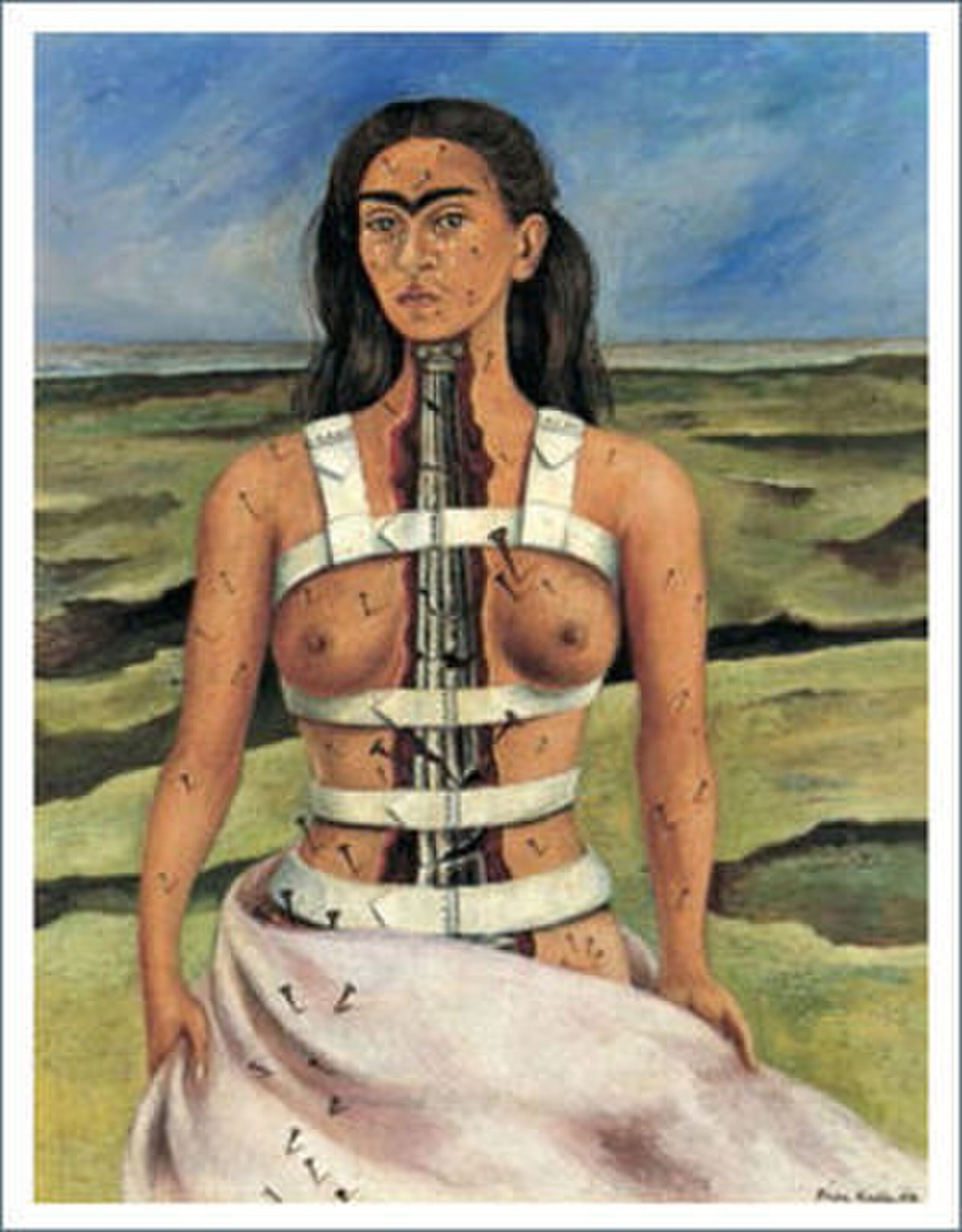
The Broken Column
Frida Kahlo (1944)
The Broken Column presents a frontal self-image split open to expose a shattered classical spine, mapping <strong>chronic pain</strong> across the body with nails while a white <strong>medical corset</strong> both supports and imprisons. Against a cracked, barren landscape, Kahlo’s steady gaze transforms injury into <strong>endurance</strong> and self-possession <sup>[1]</sup><sup>[2]</sup>.
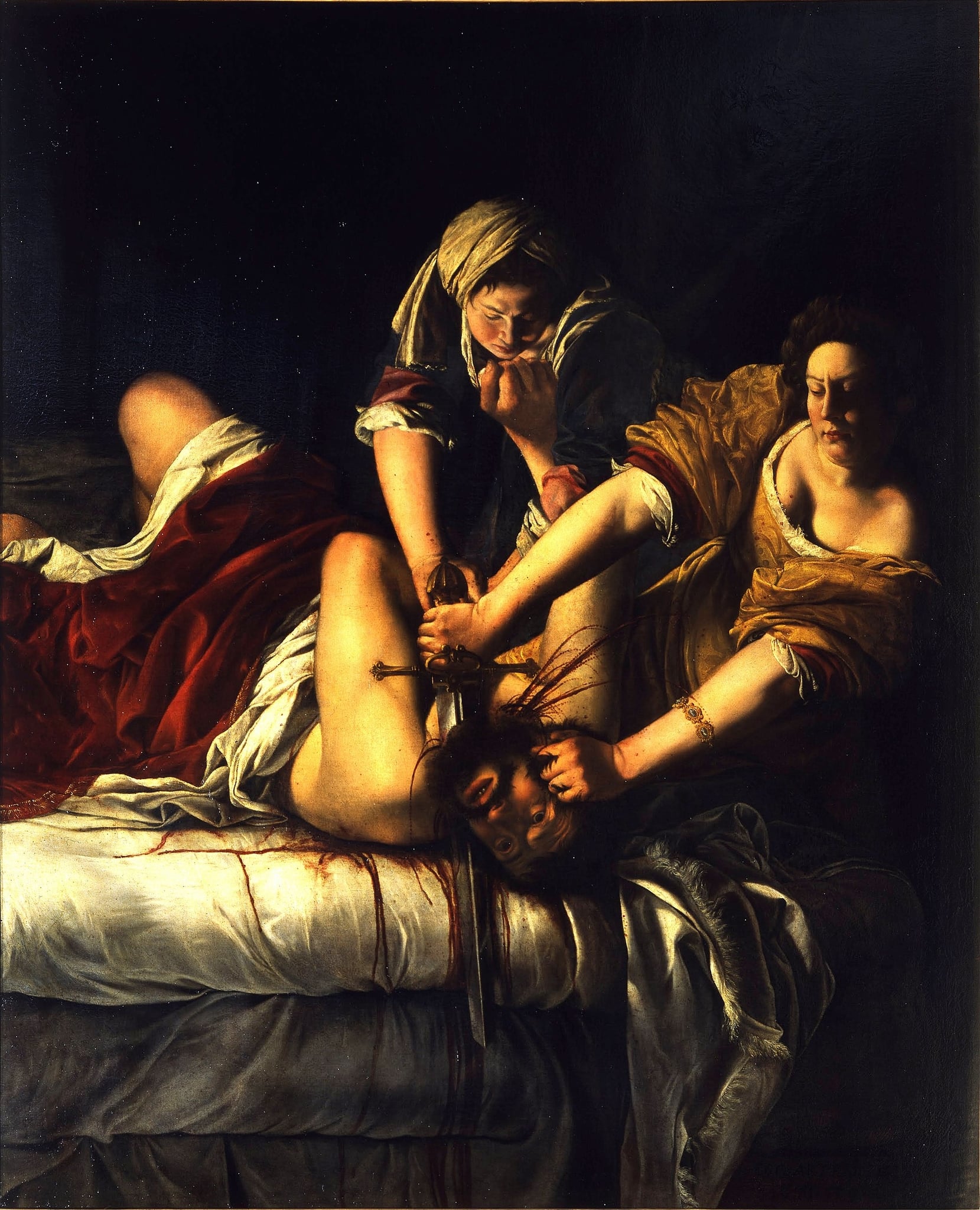
Judith Slaying Holofernes
Artemisia Gentileschi (c. 1612–13)
Artemisia Gentileschi’s Judith Slaying Holofernes hurls us into the fatal instant when Judith and her maid overpower the Assyrian general. In a void of darkness, a hard light chisels out straining arms, a heavy sword, and blood darkening the white sheets—an image of <strong>justice enacted through female collaboration</strong> <sup>[1]</sup><sup>[2]</sup>.
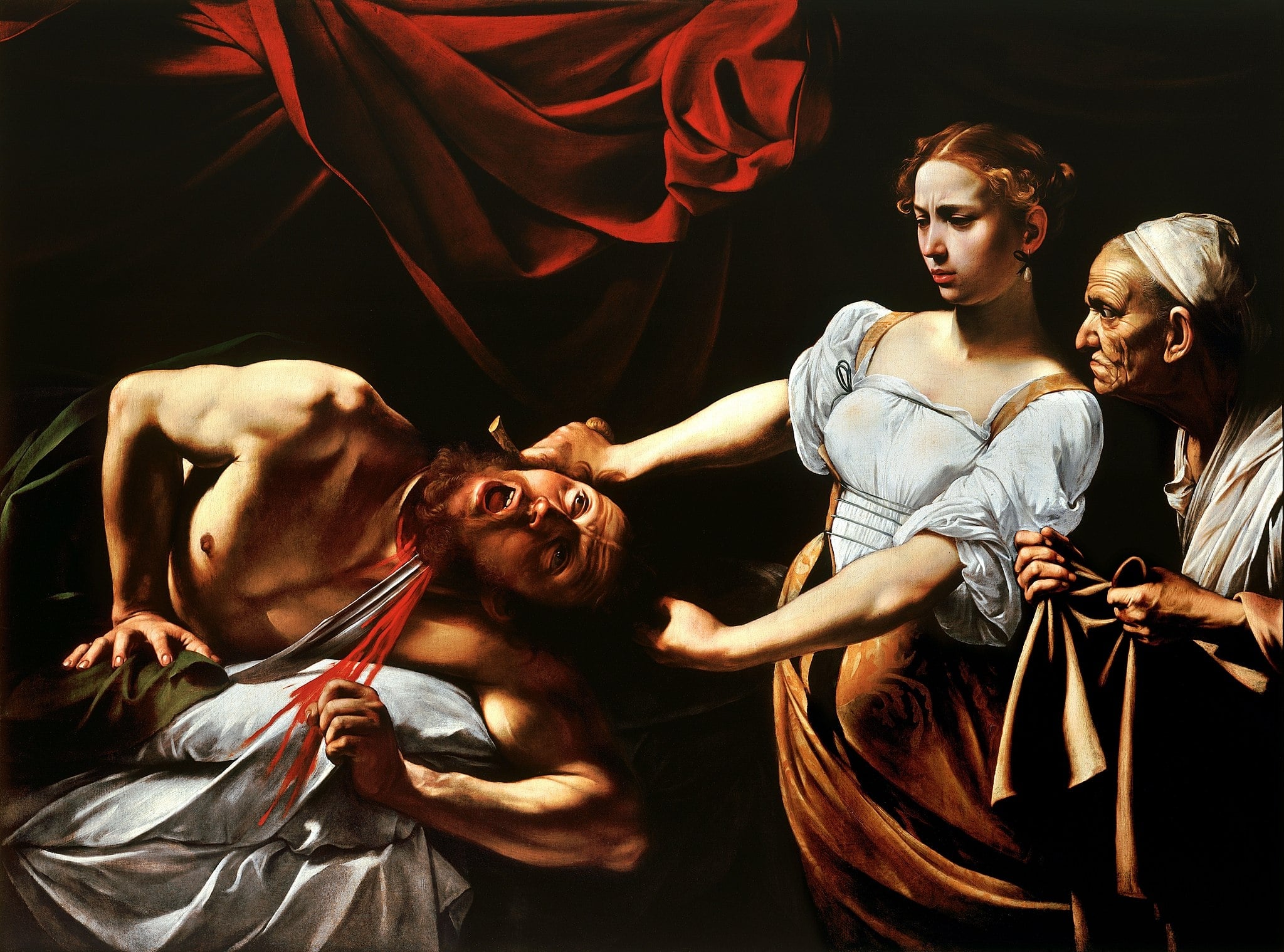
Judith Beheading Holofernes
Caravaggio (1599)
Caravaggio’s Judith Beheading Holofernes stages the biblical execution as a shocking present-tense event, lit by a raking beam that cuts figures from darkness. The <strong>red curtain</strong> frames a moral spectacle in which <strong>virtue overthrows tyranny</strong>, as Judith’s cool determination meets Holofernes’ convulsed resistance. Radical <strong>naturalism</strong>—from tendon strain to ribboning blood—makes deliverance feel material and irreversible.
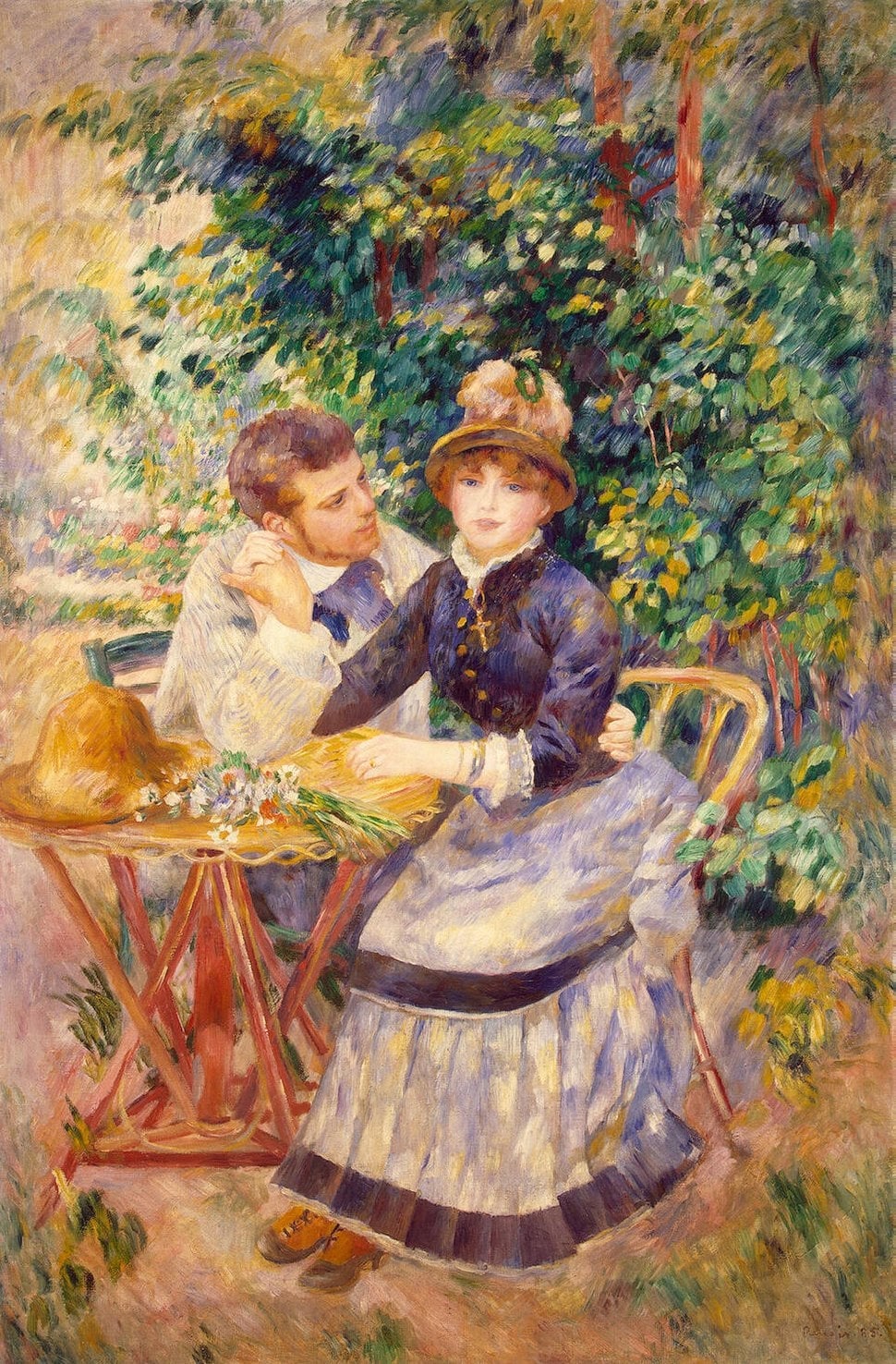
In the Garden
Pierre-Auguste Renoir (1885)
In the Garden presents a charged pause in modern leisure: a young couple at a café table under a living arbor of leaves. Their lightly clasped hands and the bouquet on the tabletop signal courtship, while her calm, front-facing gaze checks his lean. Renoir’s flickering brushwork fuses figures and foliage, rendering love as a <strong>transitory, luminous sensation</strong> <sup>[1]</sup><sup>[3]</sup>.
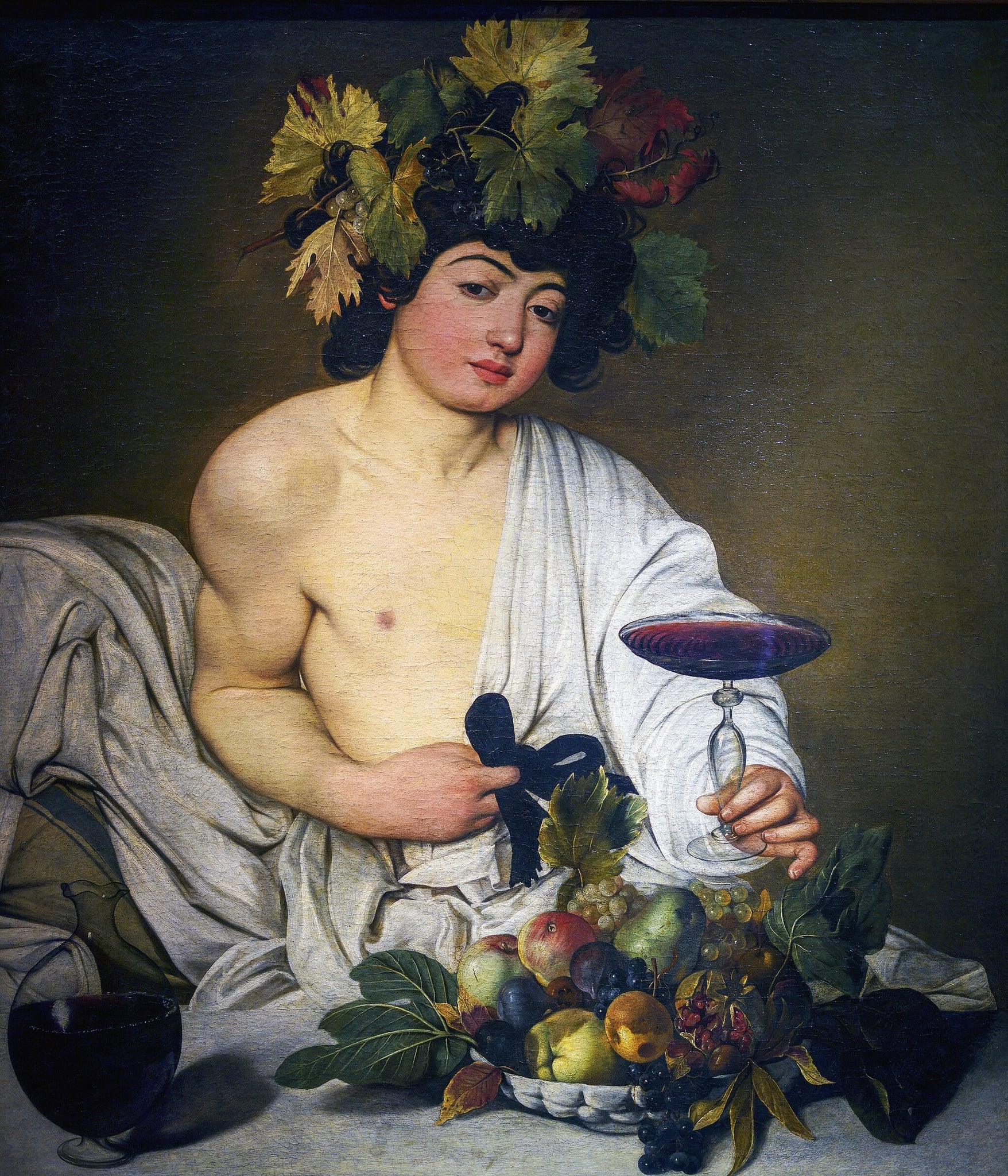
Bacchus
Caravaggio (c. 1598)
Caravaggio’s Bacchus stages a human-scaled god who offers wine with disarming immediacy, yoking <strong>sensual invitation</strong> to <strong>vanitas</strong> warning. The tilted goblet, blemished fruit, and wilting leaves insist that abundance and youth are <strong>precarious</strong>. A private Roman milieu under Cardinal del Monte shaped this refined, provocative image <sup>[1]</sup><sup>[2]</sup>.
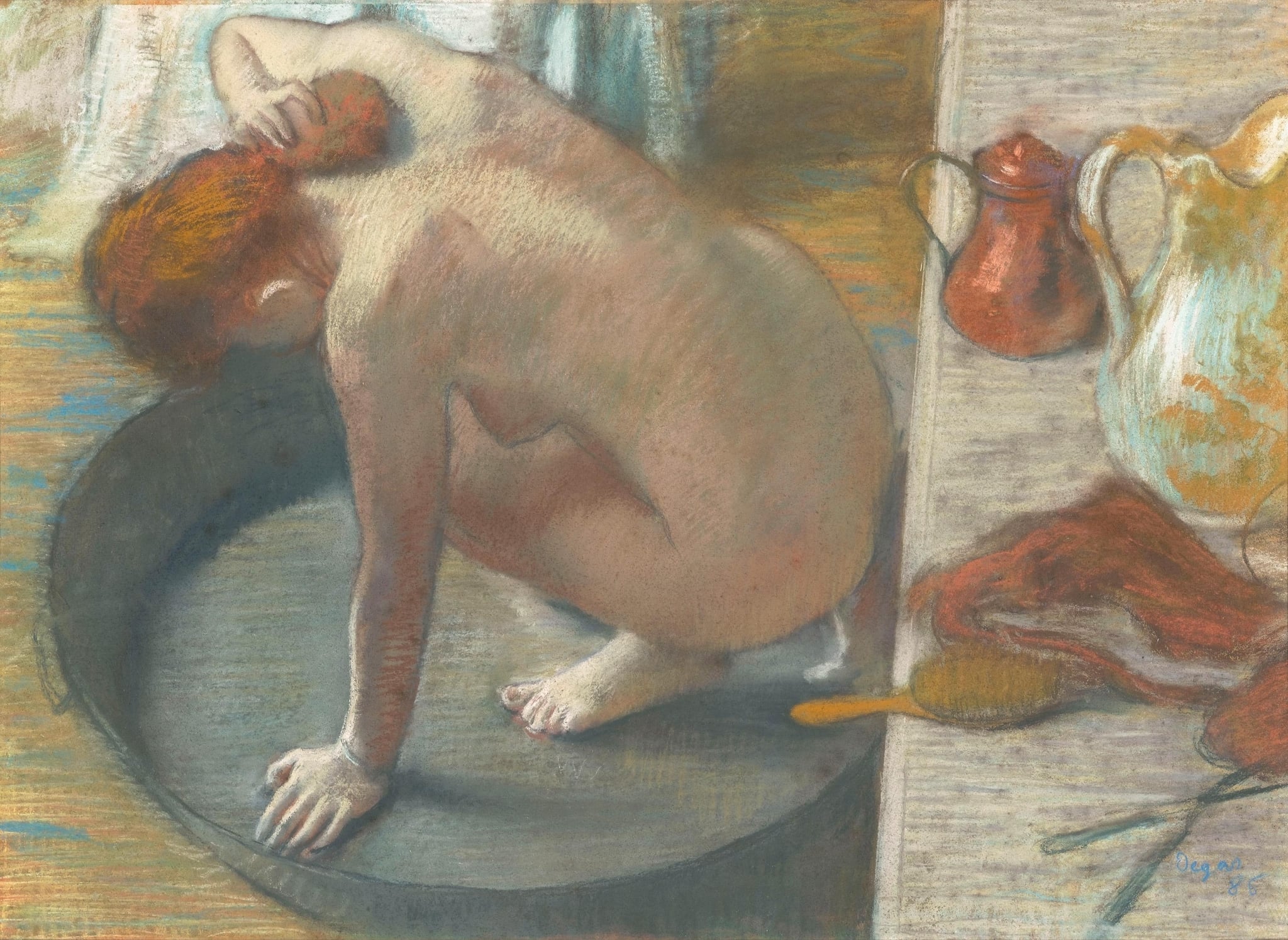
The Tub
Edgar Degas (1886)
In The Tub (1886), Edgar Degas turns a routine bath into a study of <strong>modern solitude</strong> and <strong>embodied labor</strong>. From a steep, overhead angle, a woman kneels within a circular basin, one hand braced on the rim while the other gathers her hair; to the right, a tabletop packs a ewer, copper pot, comb/brush, and cloth. Degas’s layered pastel binds skin, water, and objects into a single, breathing field of <strong>warm flesh tones</strong> and blue‑greys, collapsing distance between body and still life <sup>[1]</sup>.
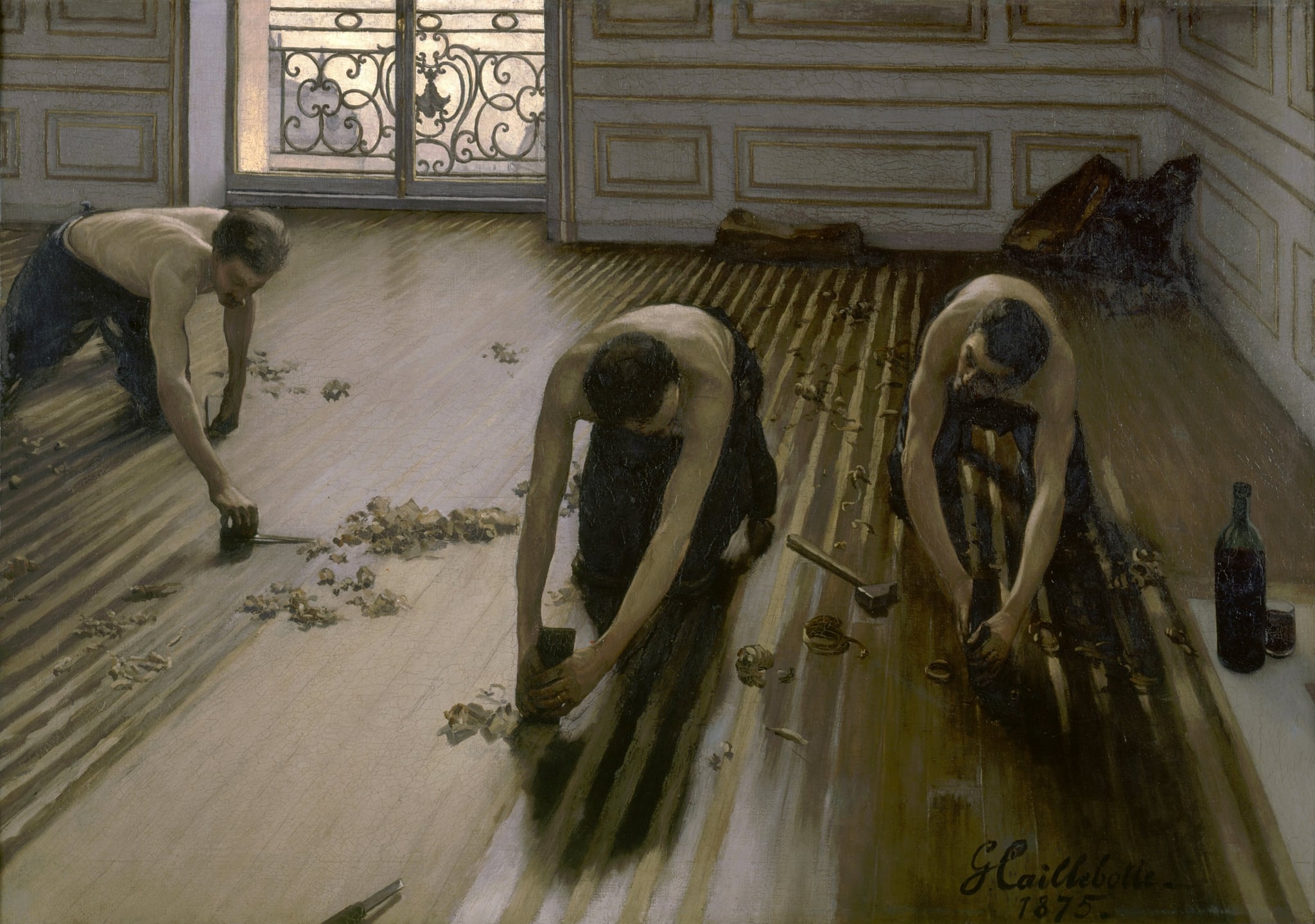
The Floor Scrapers
Gustave Caillebotte (1875)
Gustave Caillebotte’s The Floor Scrapers stages three shirtless workers planing a parquet floor as shafts of light pour through an ornate balcony door. The painting fuses <strong>rigorous perspective</strong> with <strong>modern urban labor</strong>, turning curls of wood and raking light into a ledger of time and effort <sup>[1]</sup><sup>[3]</sup>. Its cool, gilded interior makes visible how bourgeois elegance is built on bodily work.
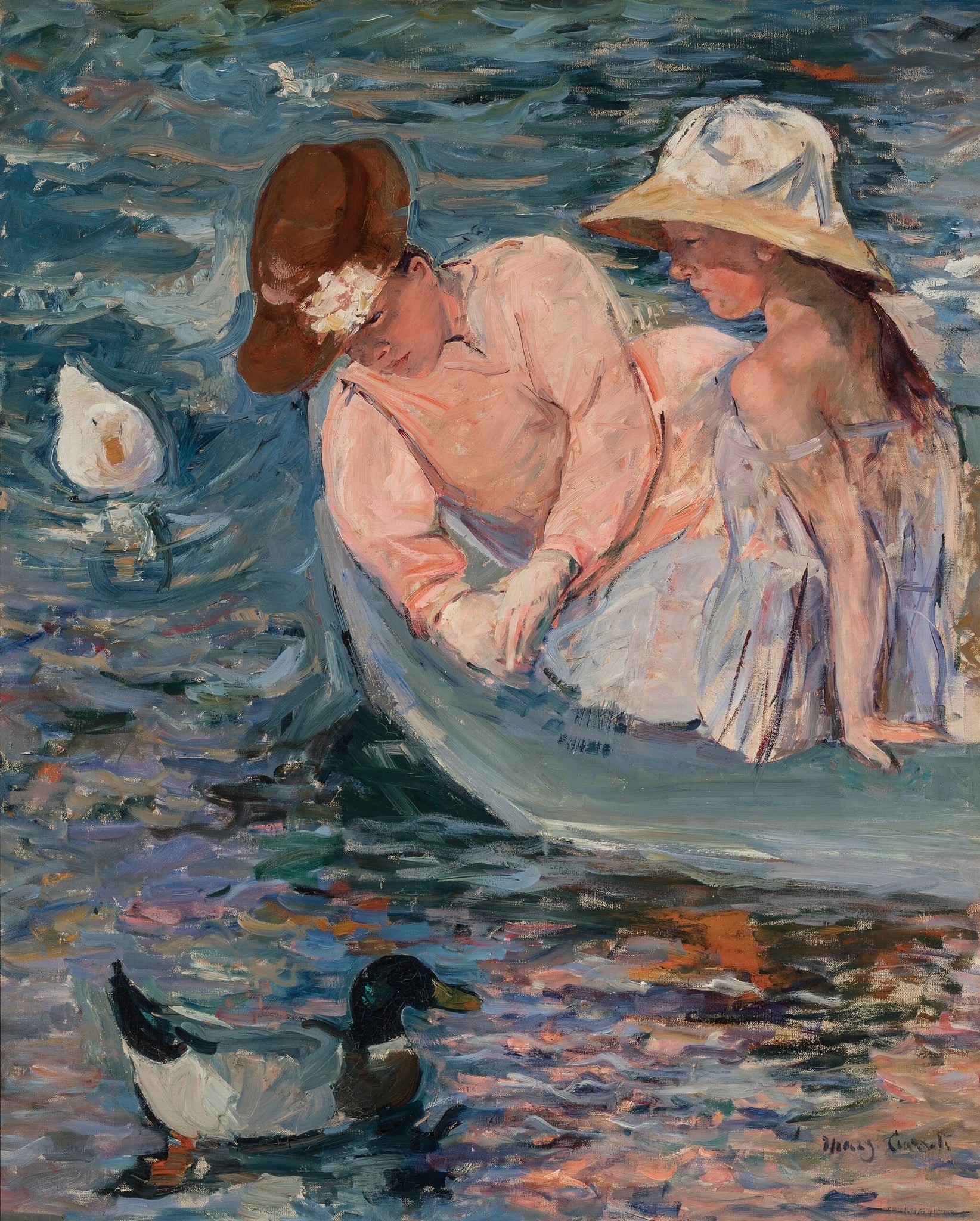
Summertime
Mary Cassatt (1894)
Mary Cassatt’s Summertime (1894) stages a quiet drama of <strong>attentive looking</strong>: a woman and a girl lean from a cropped boat toward two ducks as the lake flickers with broken color. Cassatt fuses <strong>Impressionism</strong> and <strong>Japonisme</strong>—no horizon, tipped perspective, and abrupt cropping—to press our gaze downward into light-spattered water. The result is an image of <strong>modern leisure</strong> that is also a study of perception itself <sup>[1]</sup>.
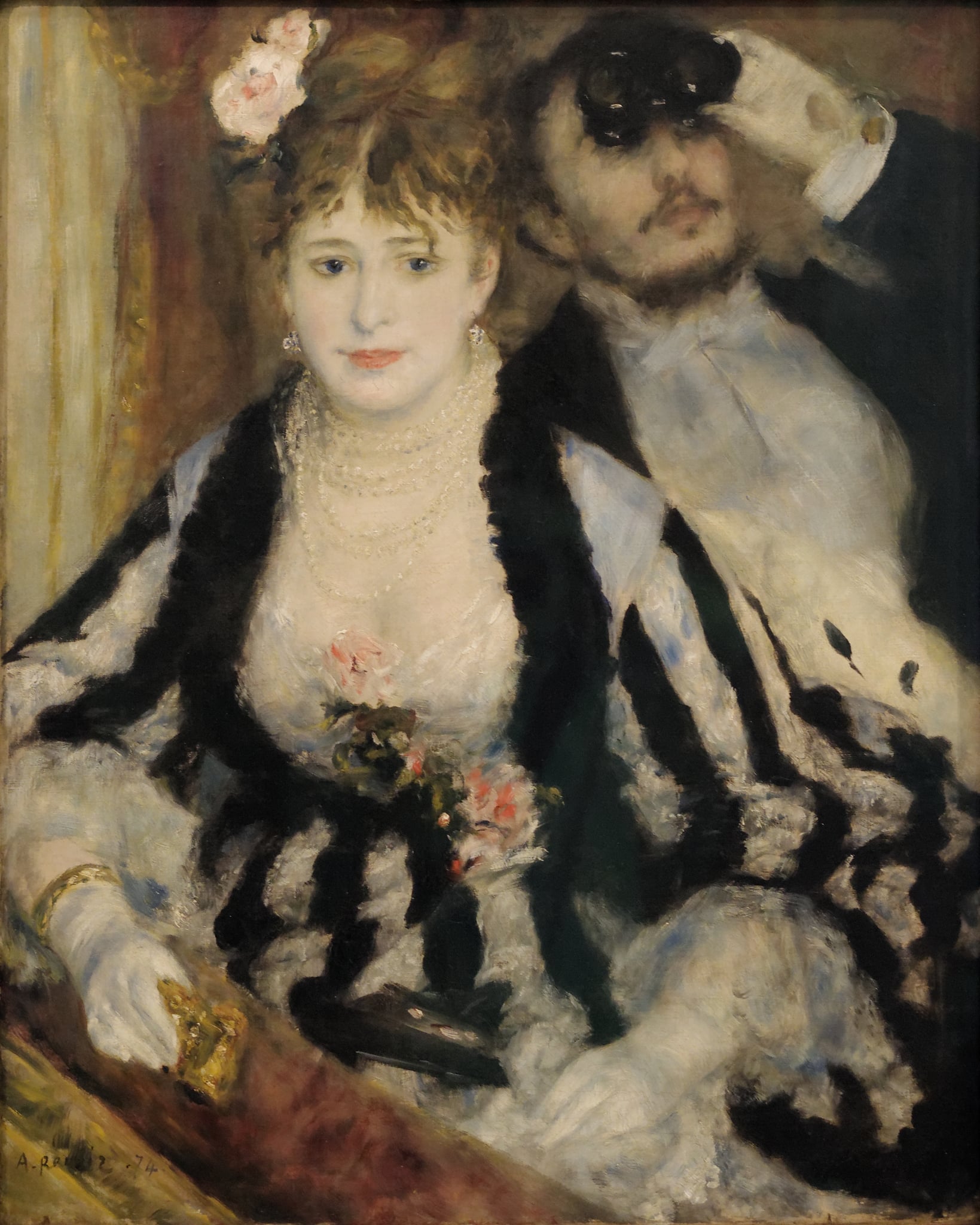
The Loge
Pierre-Auguste Renoir (1874)
Renoir’s The Loge (1874) turns an opera box into a <strong>stage of looking</strong>, where a woman meets our gaze while her companion scans the crowd through binoculars. The painting’s <strong>frame-within-a-frame</strong> and glittering fashion make modern Parisian leisure both alluring and self-conscious, turning spectators into spectacles <sup>[1]</sup><sup>[2]</sup>.
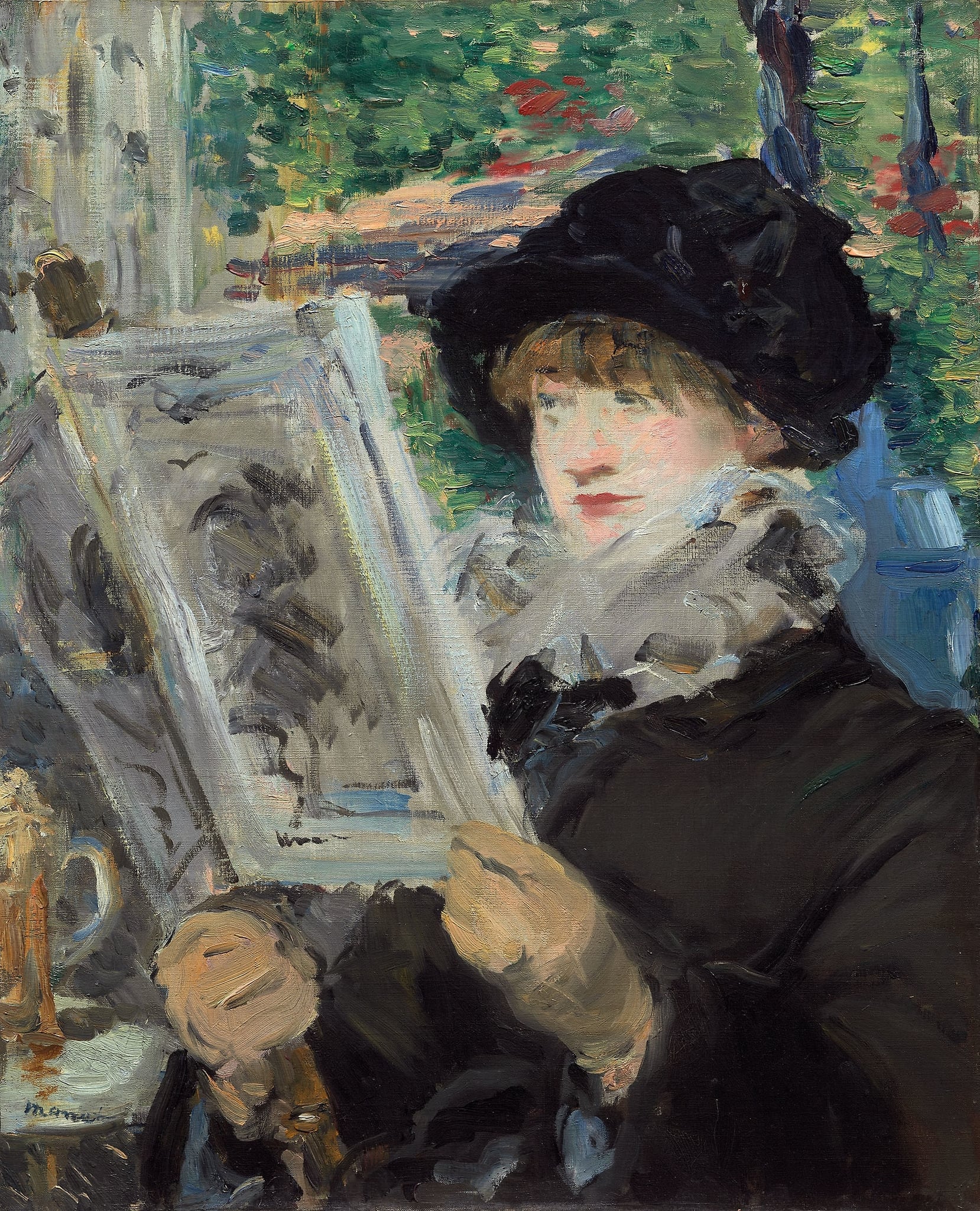
Woman Reading
Édouard Manet (1880–82)
Manet’s Woman Reading distills a fleeting act into an emblem of <strong>modern self-possession</strong>: a bundled figure raises a journal-on-a-stick, her luminous profile set against a brisk mosaic of greens and reds. With quick, loaded strokes and a deliberately cropped <strong>beer glass</strong> and paper, Manet turns perception itself into subject—asserting the drama of a private mind within a public café world <sup>[1]</sup><sup>[2]</sup>.
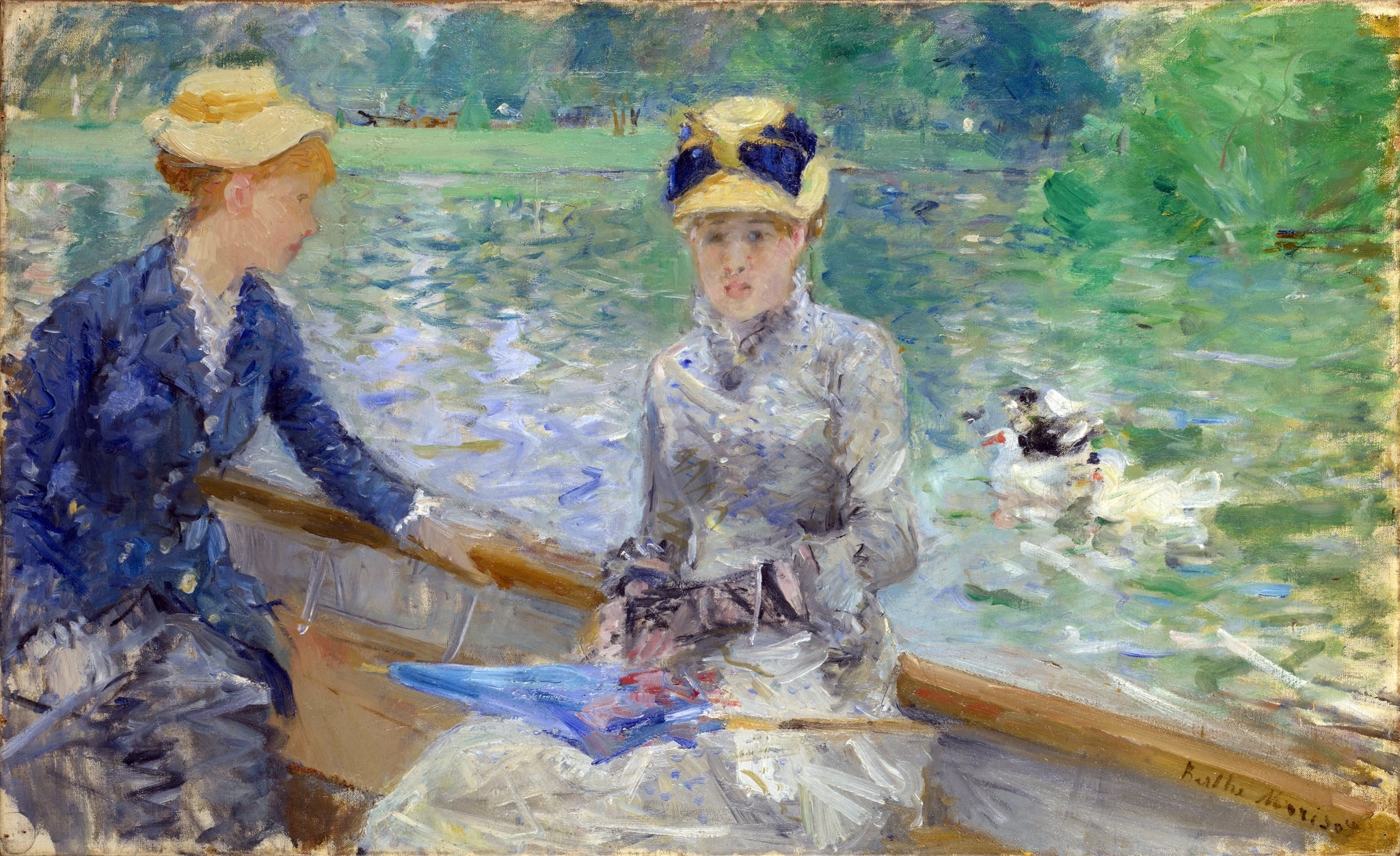
Summer's Day
Berthe Morisot (about 1879)
Two women drift on a boat in the Bois de Boulogne, their dresses, hats, and a bright blue parasol fused with the lake’s flicker by Morisot’s swift, <strong>zig‑zag brushwork</strong>. The scene turns a brief outing into a poised study of <strong>modern leisure</strong> and <strong>female companionship</strong> in public space <sup>[1]</sup>.
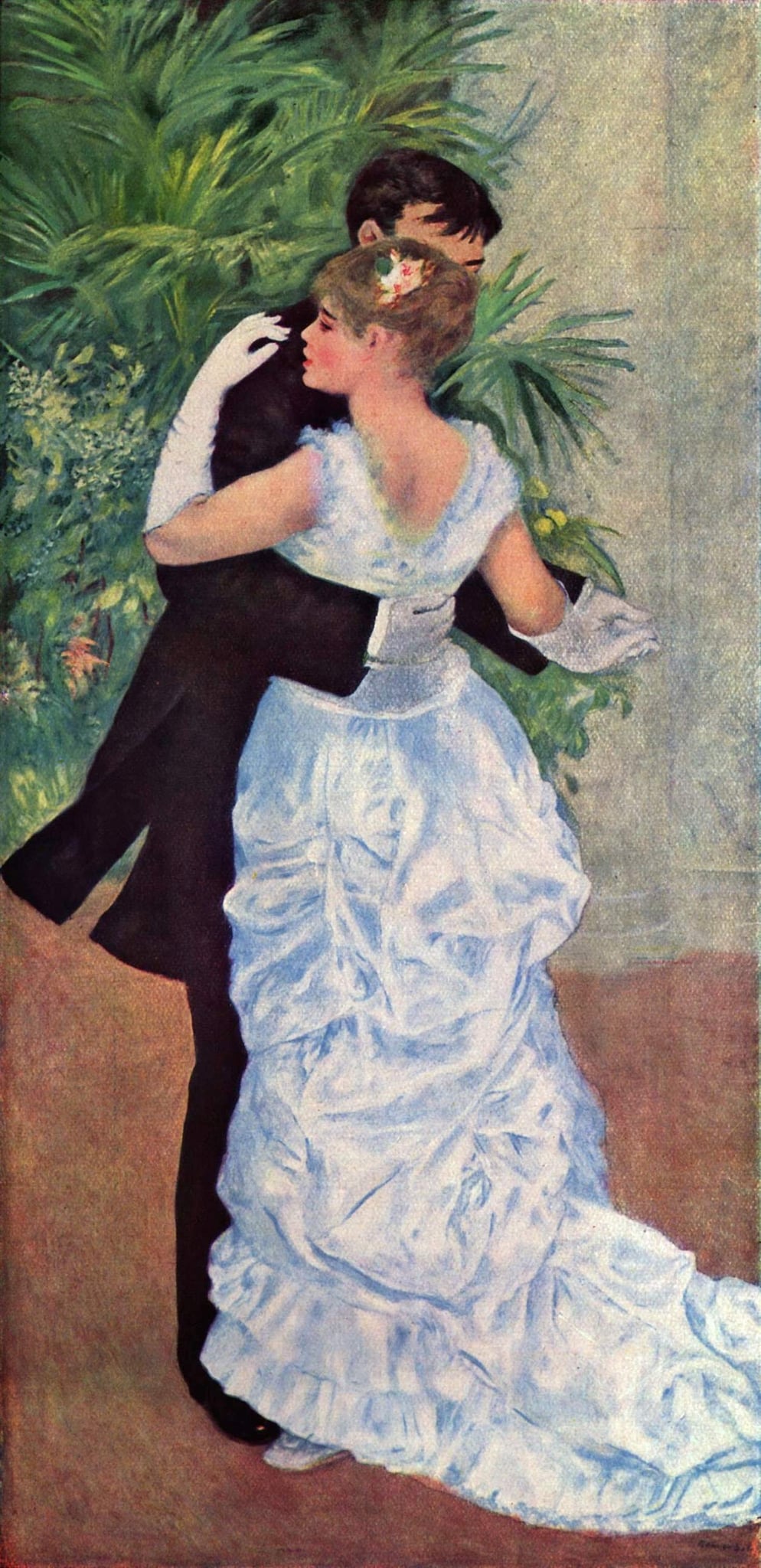
Dance in the City
Pierre-Auguste Renoir (1883)
Pierre-Auguste Renoir’s Dance in the City stages an urban waltz where decorum and desire briefly coincide. A couple’s close embrace—his black tailcoat enclosing her luminous white satin gown—creates a <strong>cool, elegant</strong> harmony against potted palms and marble. Renoir’s refined, post‑Impressionist touch turns social ritual into <strong>sensual modernity</strong> <sup>[1]</sup><sup>[2]</sup>.
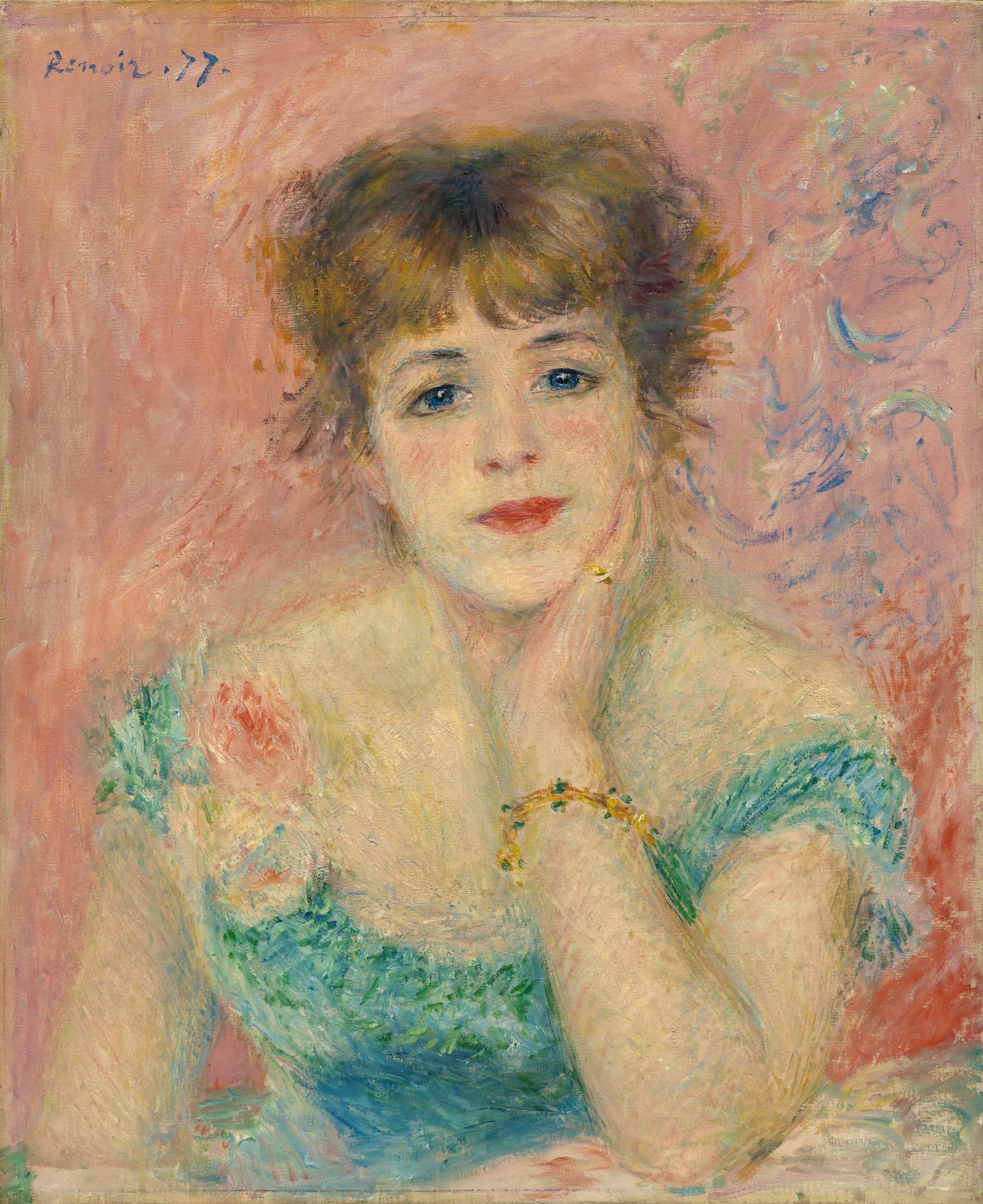
Portrait of Jeanne Samary
Pierre-Auguste Renoir (1877)
Renoir’s Portrait of Jeanne Samary (1877) turns a modern actress into a study of <strong>radiance and immediacy</strong>, fusing figure and air with shimmering strokes. Cool blue‑green dress notes spark against a warm <strong>coral-pink atmosphere</strong>, while the cheek‑in‑hand pose crystallizes a moment of intimate poise <sup>[1]</sup><sup>[4]</sup>.
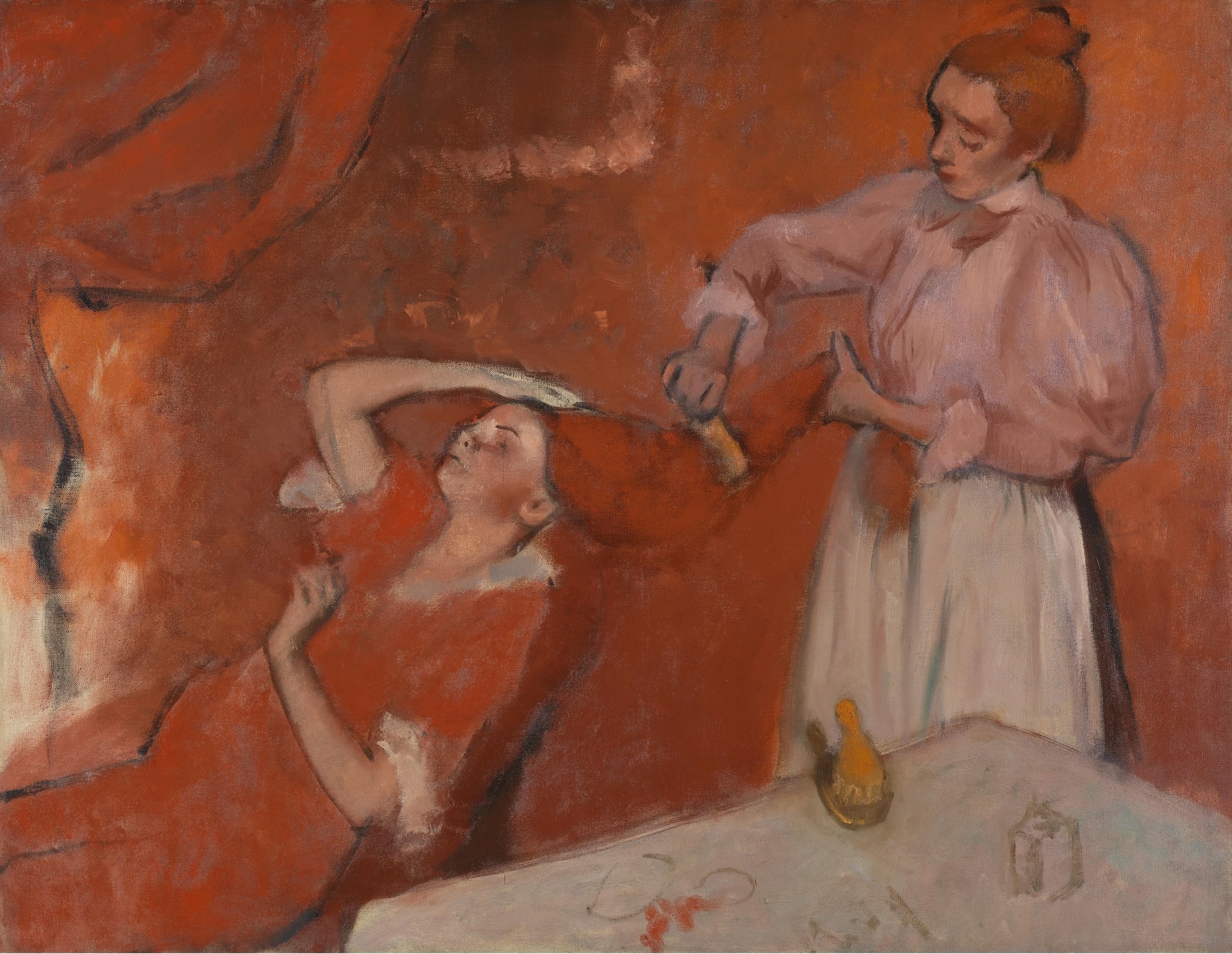
Combing the Hair
Edgar Degas (c.1896)
Edgar Degas’s Combing the Hair crystallizes a private ritual into a scene of <strong>compressed intimacy</strong> and <strong>classed labor</strong>. The incandescent field of red fuses figure and room, turning the hair into a <strong>binding ribbon</strong> between attendant and sitter <sup>[1]</sup>.
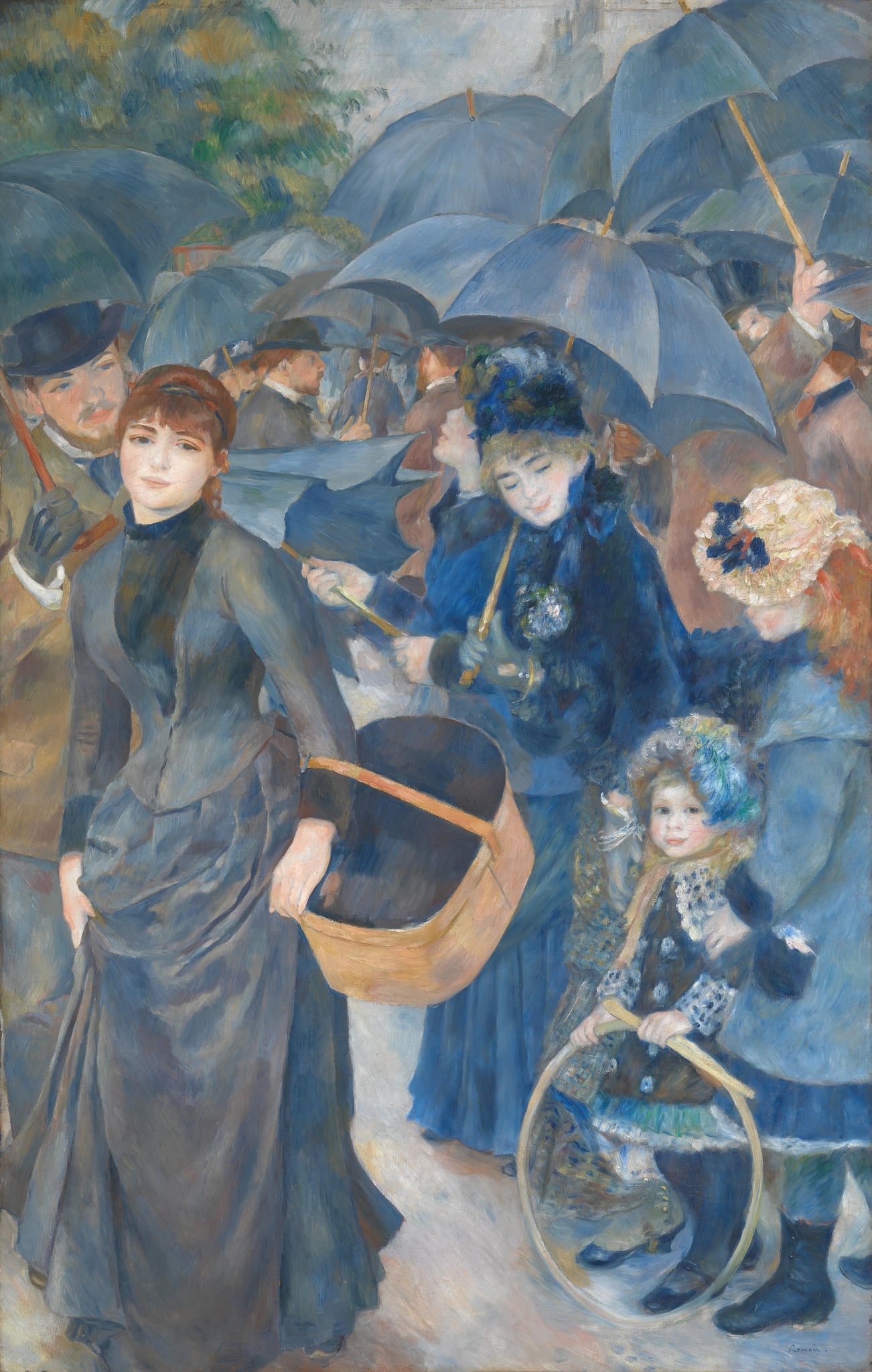
The Umbrellas
Pierre-Auguste Renoir (about 1881–86)
A sudden shower turns a Paris street into a lattice of <strong>slate‑blue umbrellas</strong>, knitting strangers into a single moving frieze. A bareheaded young woman with a <strong>bandbox</strong> strides forward while a bourgeois mother and children cluster at right, their <strong>hoop</strong> echoing the umbrellas’ arcs <sup>[1]</sup><sup>[5]</sup>.
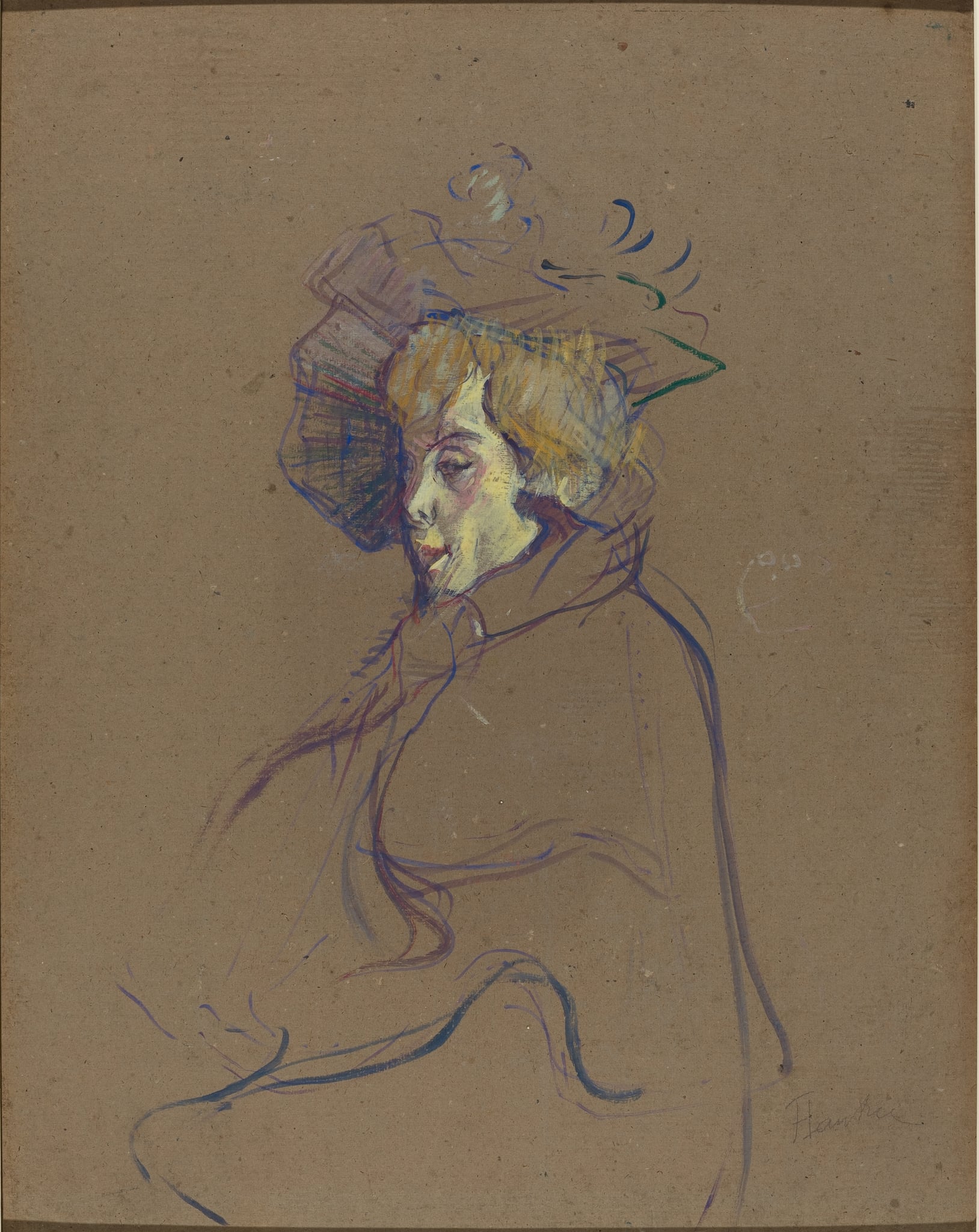
Jane Avril
Henri de Toulouse-Lautrec (c. 1891–1892)
In Jane Avril, Henri de Toulouse-Lautrec crystallizes a public persona from a few <strong>urgent, chromatic strokes</strong>: violet and blue lines whirl into a cloak, while green and indigo dashes crown a buoyant hat. Her face—sharply keyed in <strong>lemon yellow, lilac, and carmine</strong>—hovers between mask and likeness, projecting poise edged with fatigue. The raw brown ground lets her <strong>whiplash silhouette</strong> materialize like smoke from Montmartre’s nightlife.
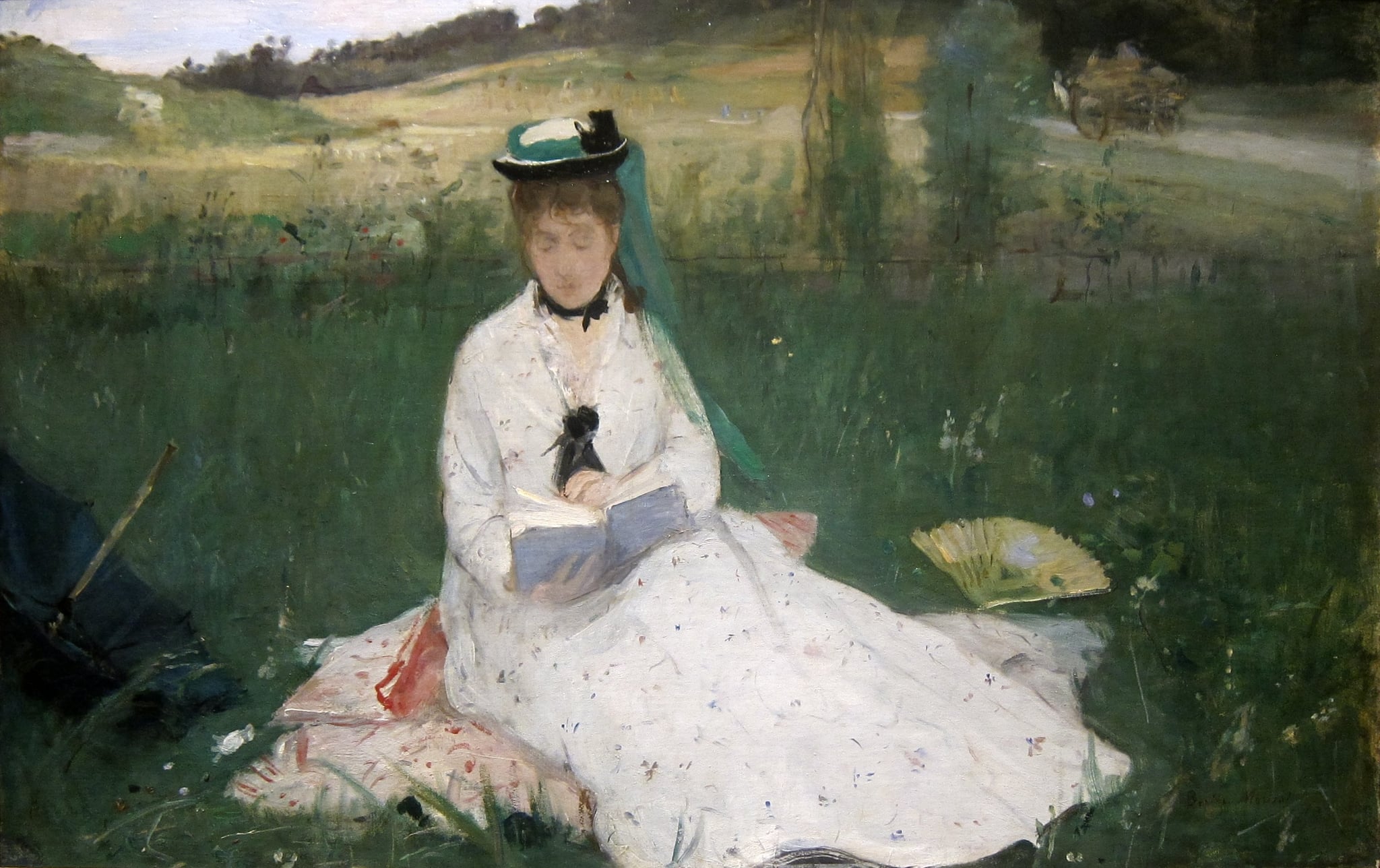
Reading
Berthe Morisot (1873)
In Berthe Morisot’s <strong>Reading</strong> (1873), a woman in a pale, patterned dress sits on the grass, absorbed in a book while a <strong>green parasol</strong> and <strong>folded fan</strong> lie nearby. Morisot’s quick, luminous brushwork dissolves the landscape into <strong>atmospheric greens</strong> as a distant carriage passes, turning an outdoor scene into a study of interior life. The work makes <strong>female intellectual absorption</strong> its true subject, aligning modern leisure with private thought.
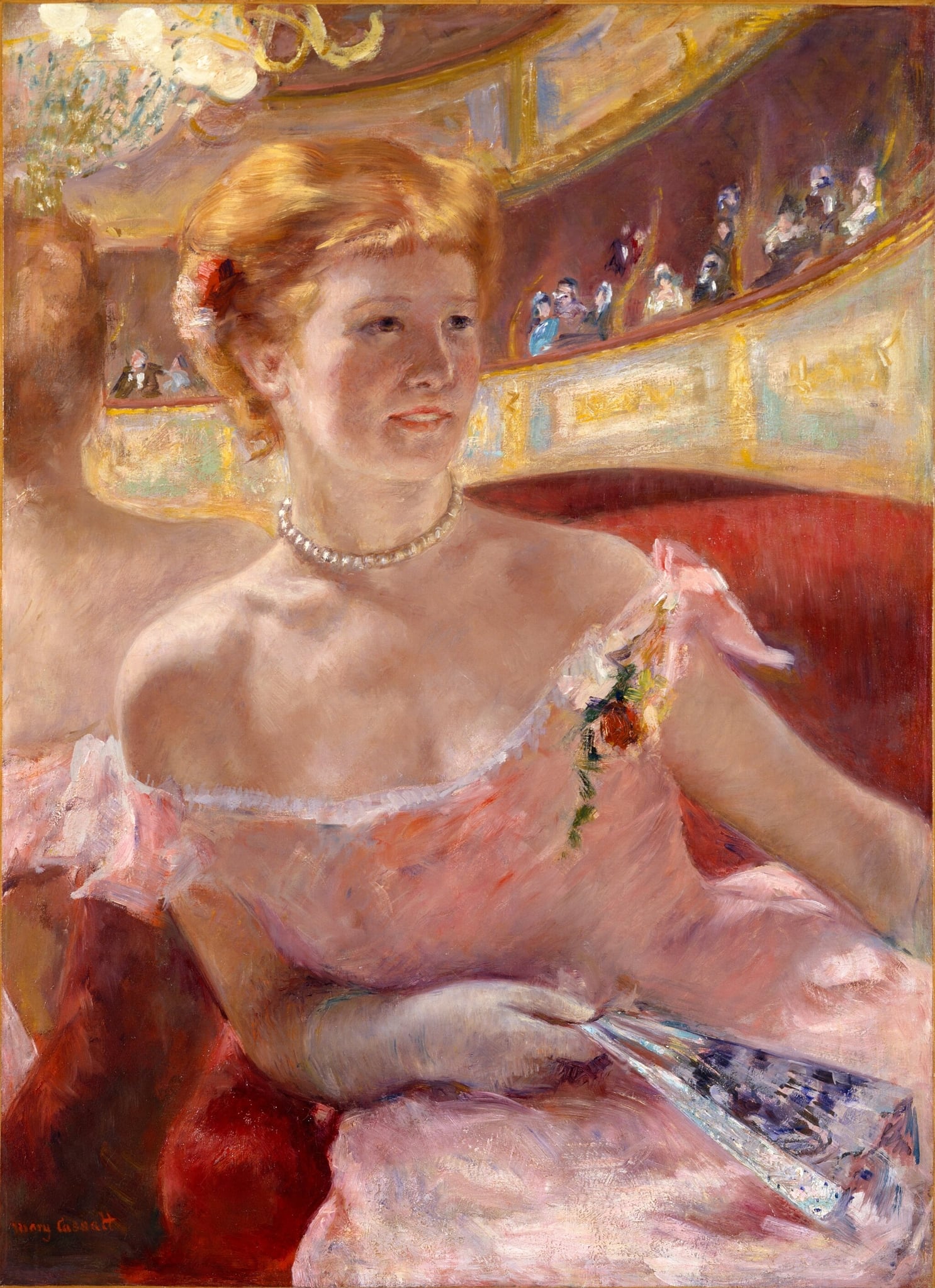
Woman with a Pearl Necklace in a Loge
Mary Cassatt (1879)
Mary Cassatt’s Woman with a Pearl Necklace in a Loge (1879) stages modern <strong>spectatorship</strong> inside a plush opera box, where a young woman in pink satin, pearls, and gloves occupies the red velvet seat while a mirror multiplies the chandeliers and balconies. Cassatt fuses <strong>intimacy</strong> and <strong>public display</strong>, using luminous brushwork to place her sitter within the social theater of Parisian leisure <sup>[1]</sup><sup>[2]</sup>.
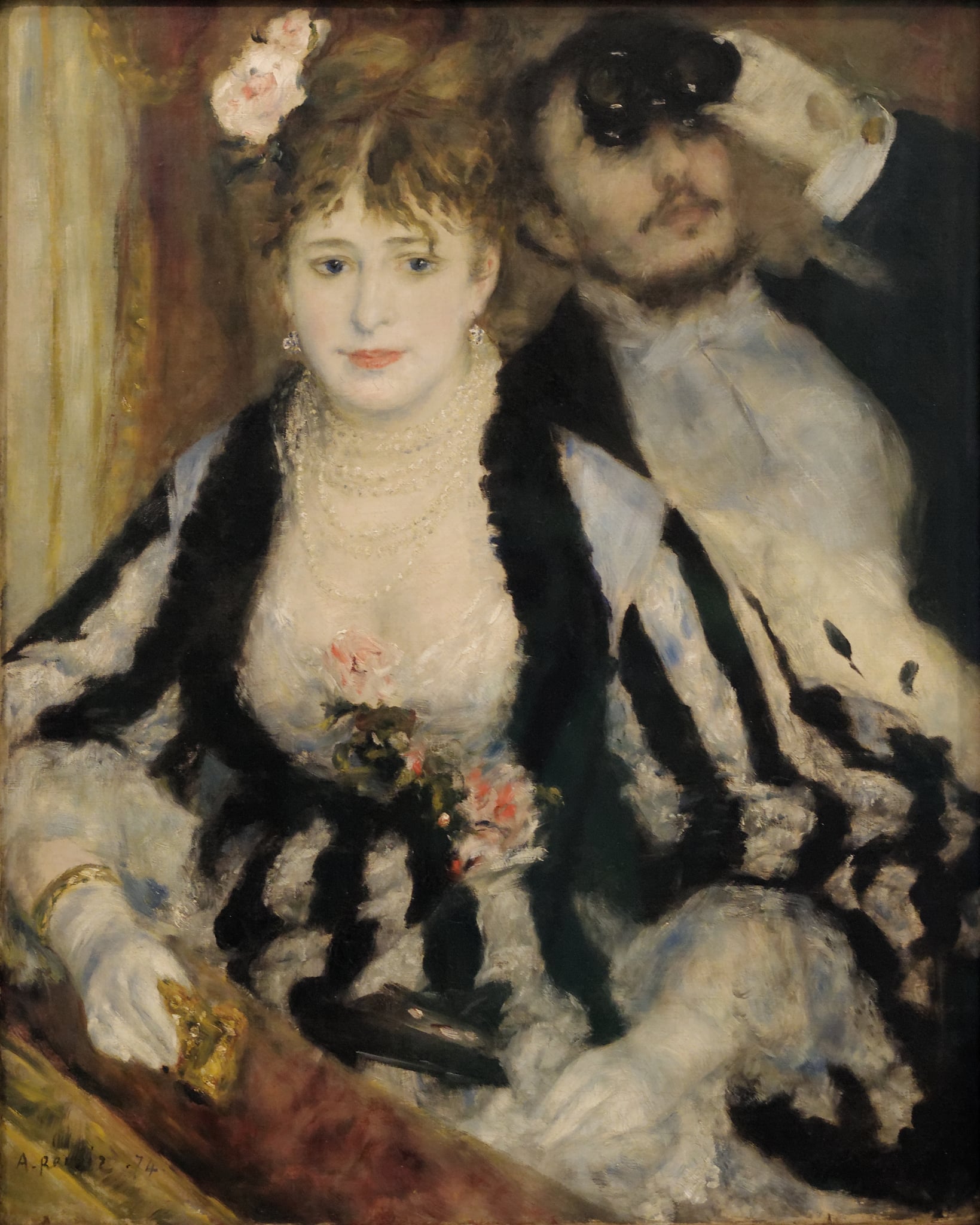
The Theater Box
Pierre-Auguste Renoir (1874)
Renoir’s The Theater Box turns a plush loge into a stage where seeing becomes the performance. A luminous woman—pearls, pale gloves, black‑and‑white stripes—faces us, while her companion scans the auditorium through opera glasses. The painting crystallizes Parisian <strong>modernity</strong> and the choreography of the <strong>gaze</strong> <sup>[1]</sup><sup>[5]</sup>.
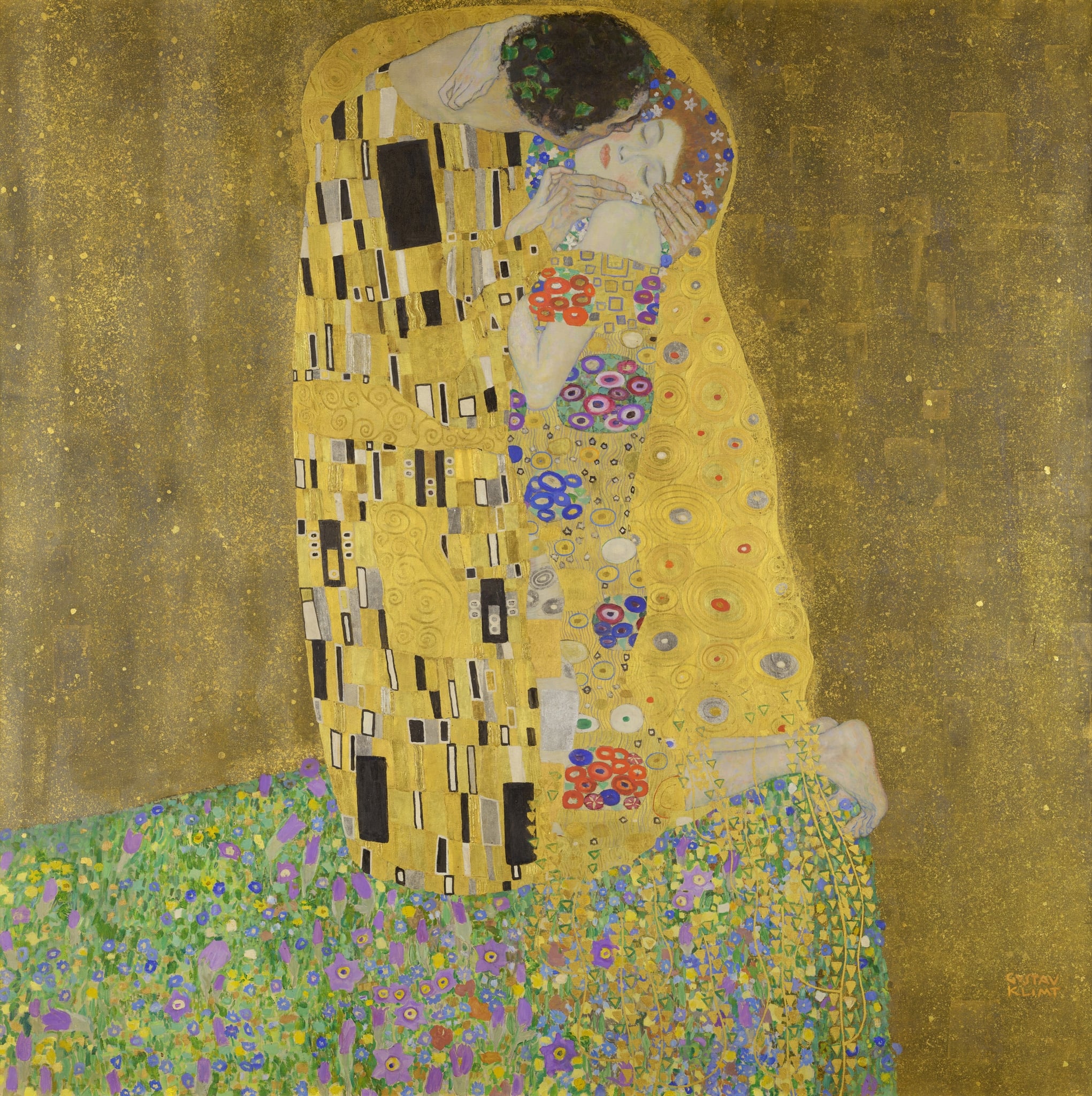
The Kiss
Gustav Klimt (1908 (completed 1909))
The Kiss stages human love as a <strong>sacred union</strong>, fusing two figures into a single, gold-clad form against a timeless field. Klimt opposes <strong>masculine geometry</strong> (black-and-white rectangles) to <strong>feminine organic rhythm</strong> (spirals, circles, flowers), then resolves them in radiant harmony <sup>[1]</sup><sup>[2]</sup>.
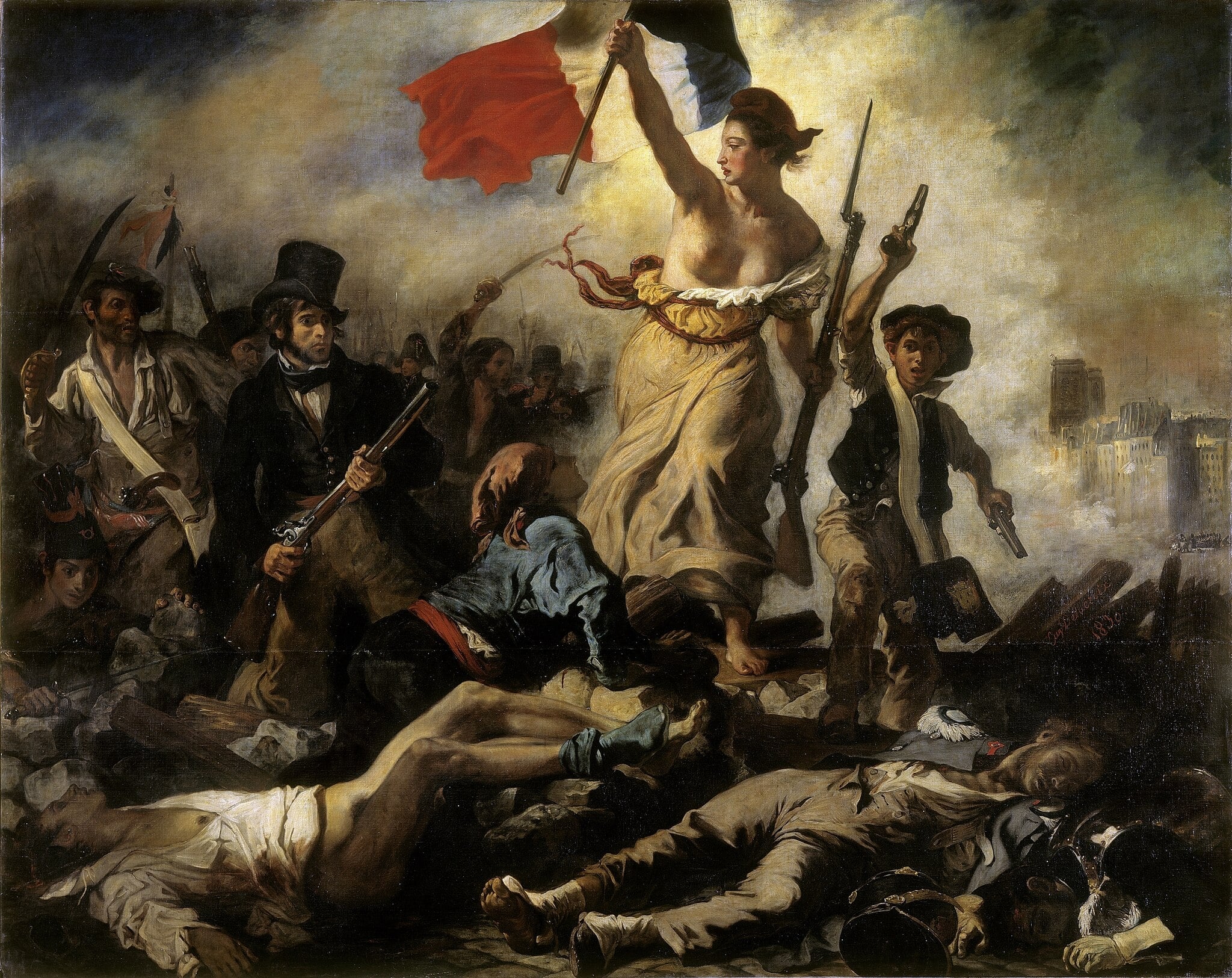
Liberty Leading the People
Eugene Delacroix (1830)
<strong>Liberty Leading the People</strong> turns a real street uprising into a modern myth: a bare‑breasted Liberty in a <strong>Phrygian cap</strong> thrusts the <strong>tricolor</strong> forward as Parisians of different classes surge over corpses and rubble. Delacroix binds allegory to eyewitness detail—Notre‑Dame flickers through smoke, a bourgeois in a top hat shoulders a musket, and a pistol‑waving boy keeps pace—so that freedom appears as both idea and action <sup>[1]</sup><sup>[2]</sup>. After its 2024 cleaning, sharper blues, whites, and reds re‑ignite the painting’s charged color drama <sup>[4]</sup>.
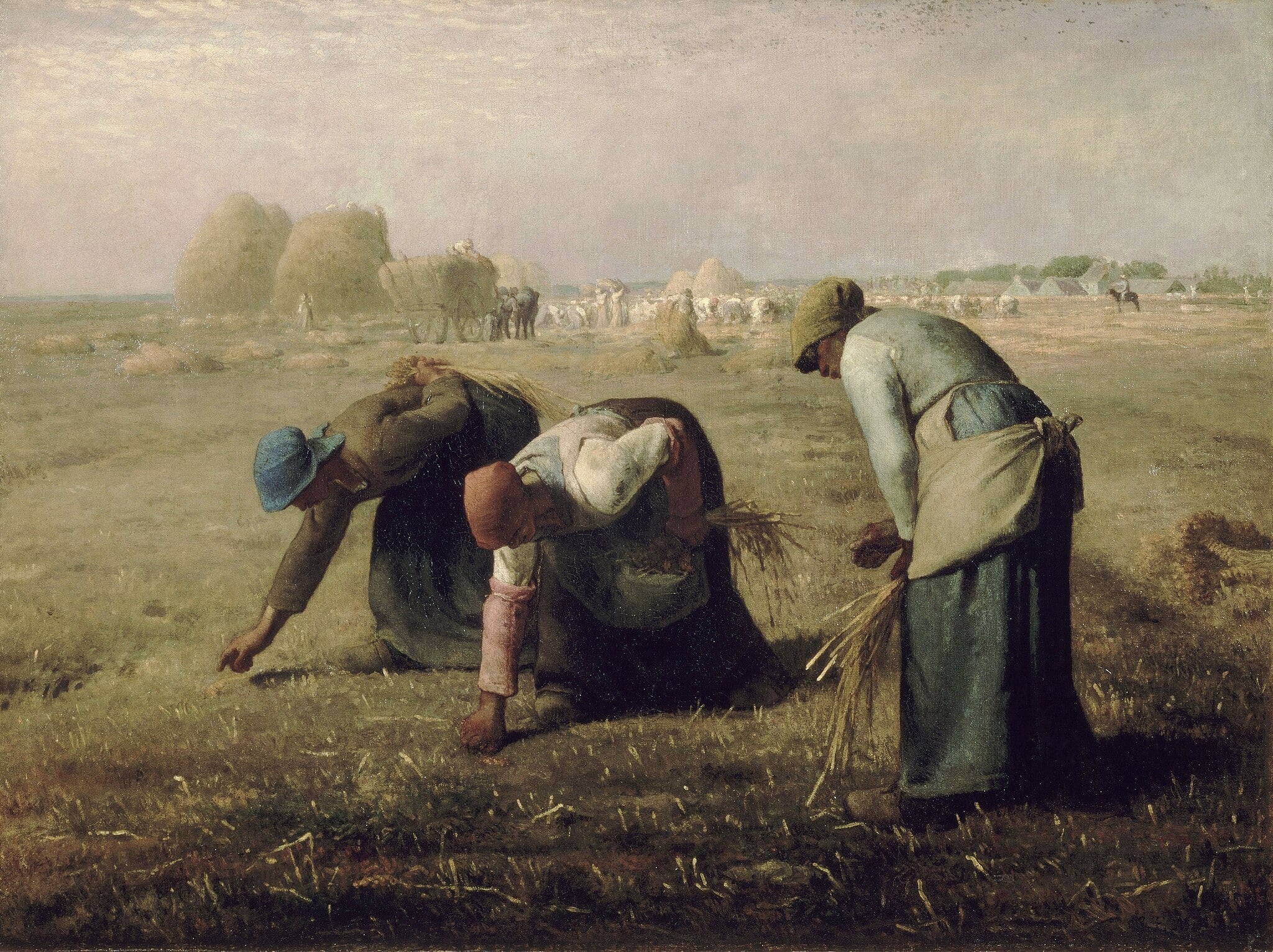
The Gleaners
Jean-Francois Millet (1857)
Three peasant women bend in a solemn rhythm, gleaning leftover stalks under a dry, late-afternoon light. In the far distance, tiny carts, haystacks, and an overseer on horseback signal abundance and authority, while the foreground figures loom with <strong>monumental gravity</strong>, asserting the dignity of labor amid inequality <sup>[1]</sup><sup>[2]</sup>.
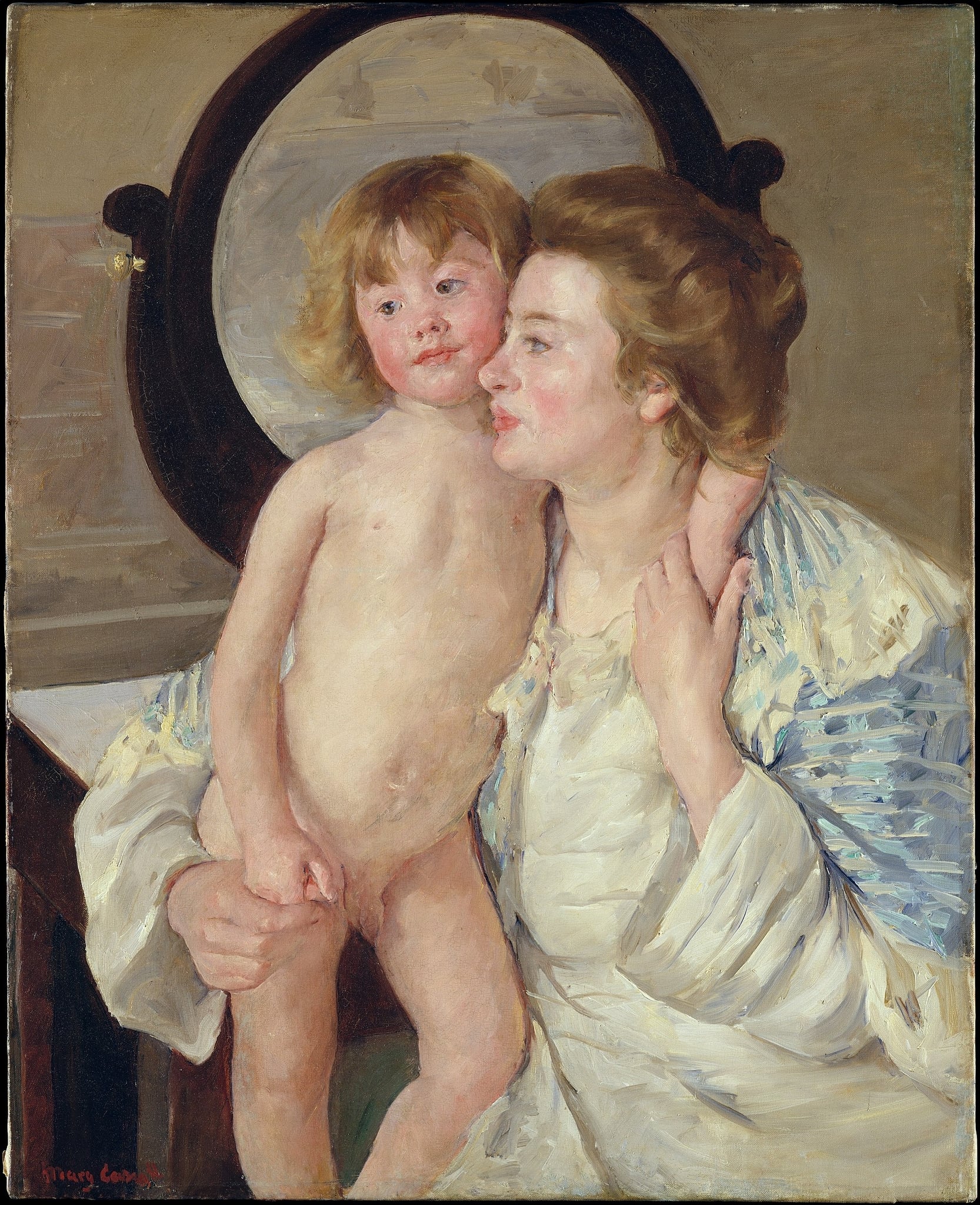
Mother and Child (The Oval Mirror)
Mary Cassatt (ca. 1899)
Mary Cassatt’s Mother and Child (The Oval Mirror) turns a routine act of care into a <strong>modern icon</strong>. An oval mirror <strong>haloes</strong> the child while interlaced hands and close bodies make <strong>touch</strong> the vehicle of meaning <sup>[1]</sup><sup>[3]</sup>.
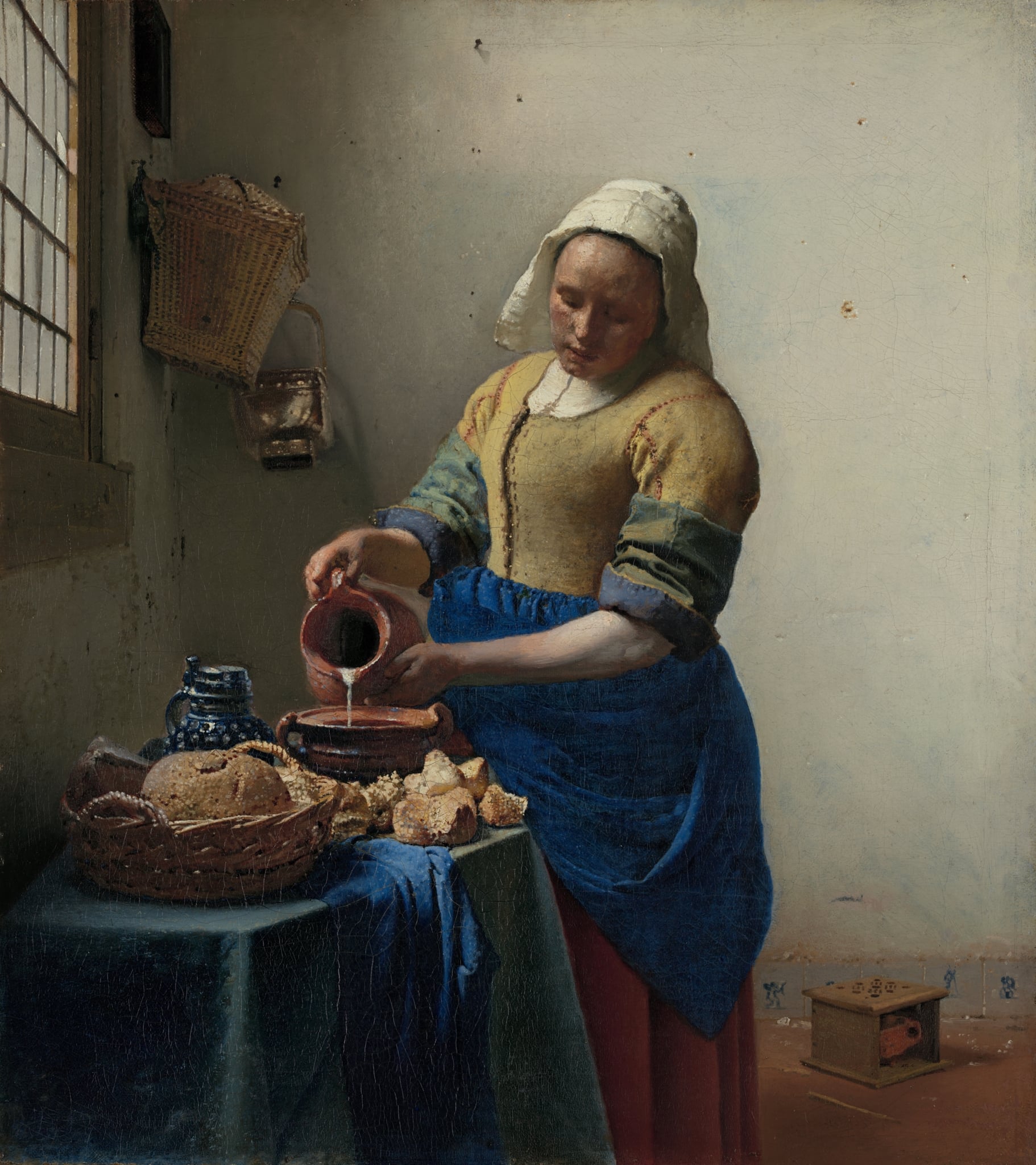
The Milkmaid
Johannes Vermeer (c. 1660)
In The Milkmaid, Vermeer turns an ordinary act—pouring milk—into a scene of <strong>quiet monumentality</strong>. Light from the left fixes the maid’s absorbed attention and ignites the <strong>saturated yellow and blue</strong> of her dress, while the slow thread of milk becomes the image’s pulse <sup>[1]</sup><sup>[2]</sup>. Bread, a Delft jug, nail holes, and a small <strong>foot warmer</strong> anchor a world where humble work is endowed with dignity and latent meaning <sup>[1]</sup><sup>[2]</sup>.
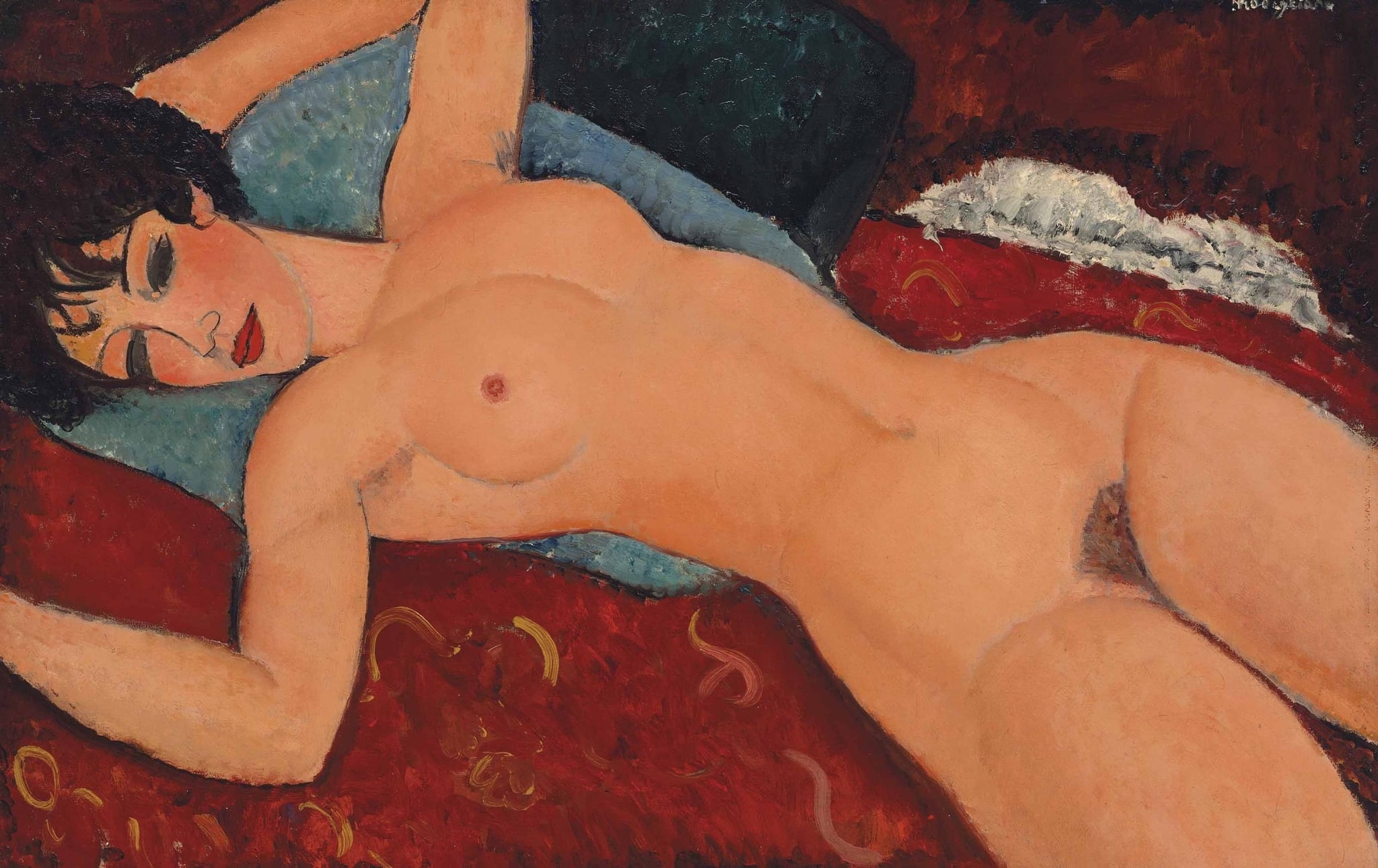
Nu couché
Amedeo Modigliani (1917)
Amedeo Modigliani’s Nu couché (1917) recasts the reclining nude as a <strong>modern icon of desire</strong>—a body reduced to <strong>lyric contour</strong> and glowing planes that stretch diagonally across a crimson bed. Warm, peach-toned flesh is keyed against <strong>saturated reds</strong> and <strong>cool blue pillows</strong>, fusing intimacy with monumentality while stripping away myth to confront eroticism directly <sup>[2]</sup><sup>[3]</sup>. Painted amid wartime Paris, it helped ignite the 1917 censorship scandal and later became a market landmark, underscoring its status as a defining image of <strong>modernism’s nude</strong> <sup>[4]</sup><sup>[5]</sup>.
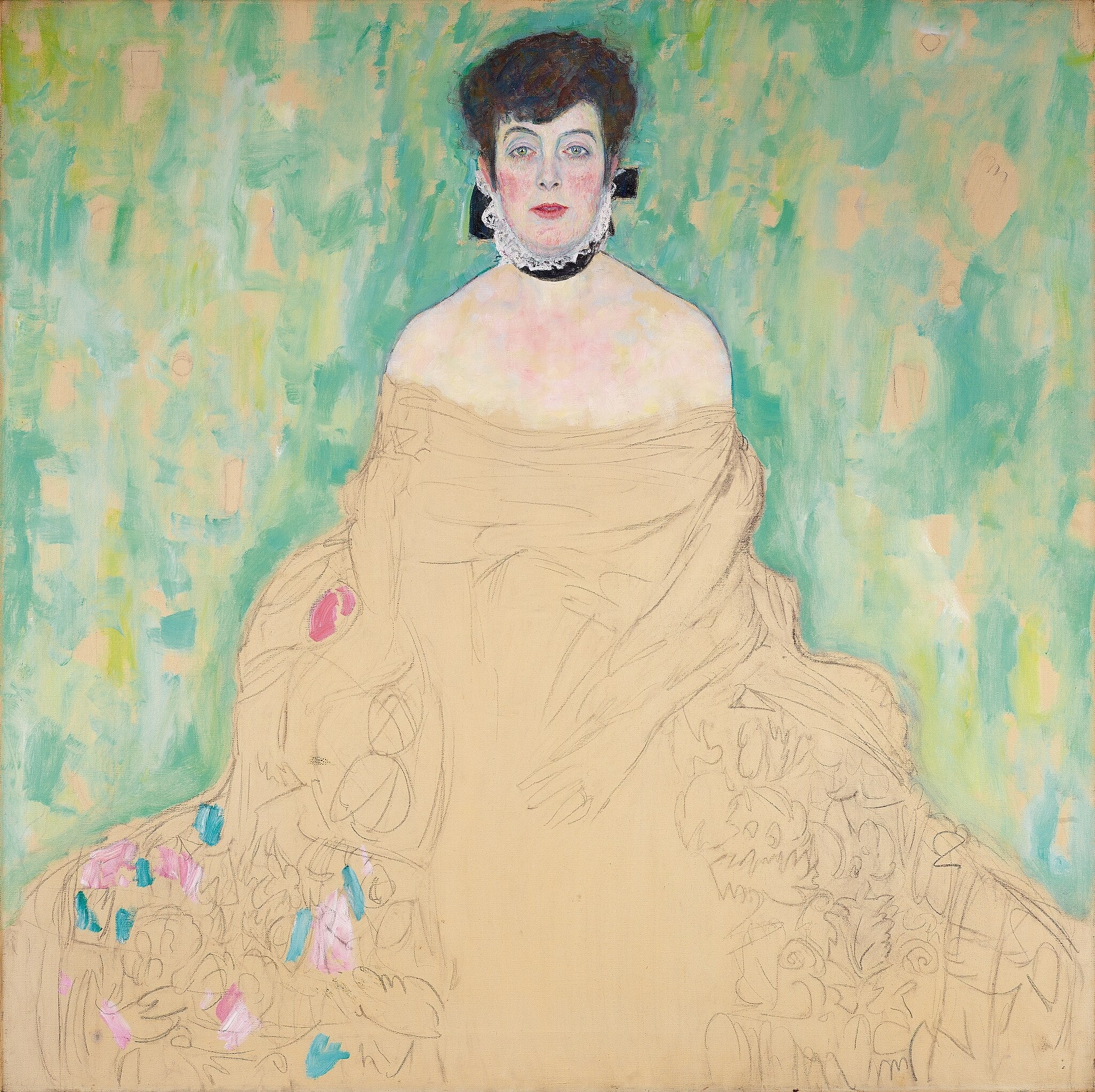
Amalie Zuckerkandl
Gustav Klimt (1917–1918)
Gustav Klimt’s Amalie Zuckerkandl is an <strong>unfinished</strong> late portrait in which a fully realized head and shoulders float above a gown left as <strong>skeletal graphite and washes</strong>. Set against a mottled, cool <strong>green ground</strong>, her flushed face, direct gaze, black <strong>choker</strong> and crisp lace collar stage a drama of poise, sensuality, and restraint <sup>[1]</sup><sup>[6]</sup>. The painting’s incompletion becomes the work’s meaning: a vivid selfhood <strong>emerging</strong> while ornament remains <strong>in potential</strong>.
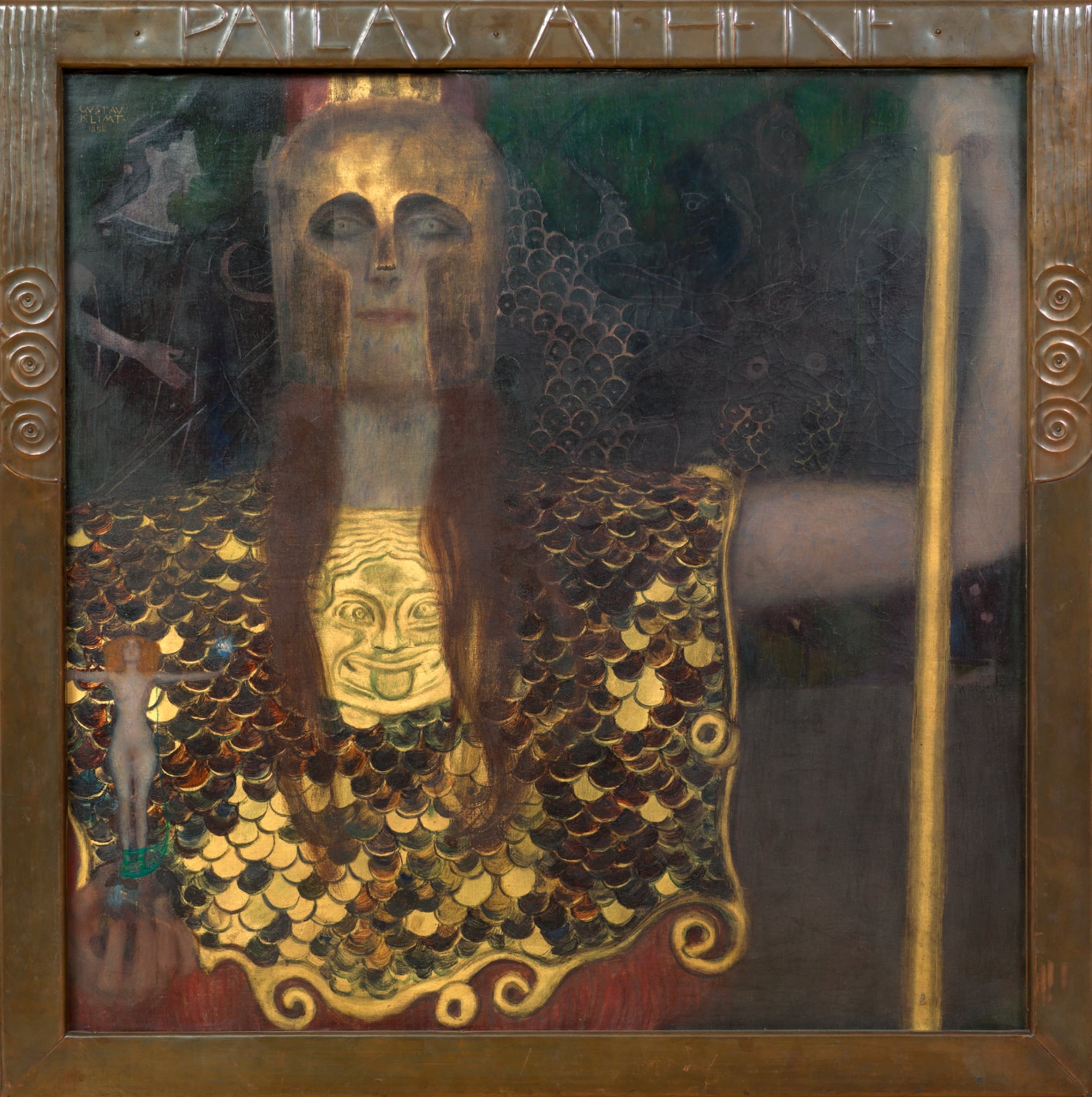
Pallas Athena
Gustav Klimt (1898)
Pallas Athena confronts the viewer as a <strong>frontal icon of power</strong>: helmeted, impassive, and armored in <strong>gleaming scale aegis</strong> crowned by a <strong>gorgoneion</strong>. Klimt fuses archaic authority with modern ornament to proclaim <strong>Vienna Secession</strong> ideals—reason, strategy, and artistic truth held in a single, implacable image <sup>[1]</sup><sup>[2]</sup>.
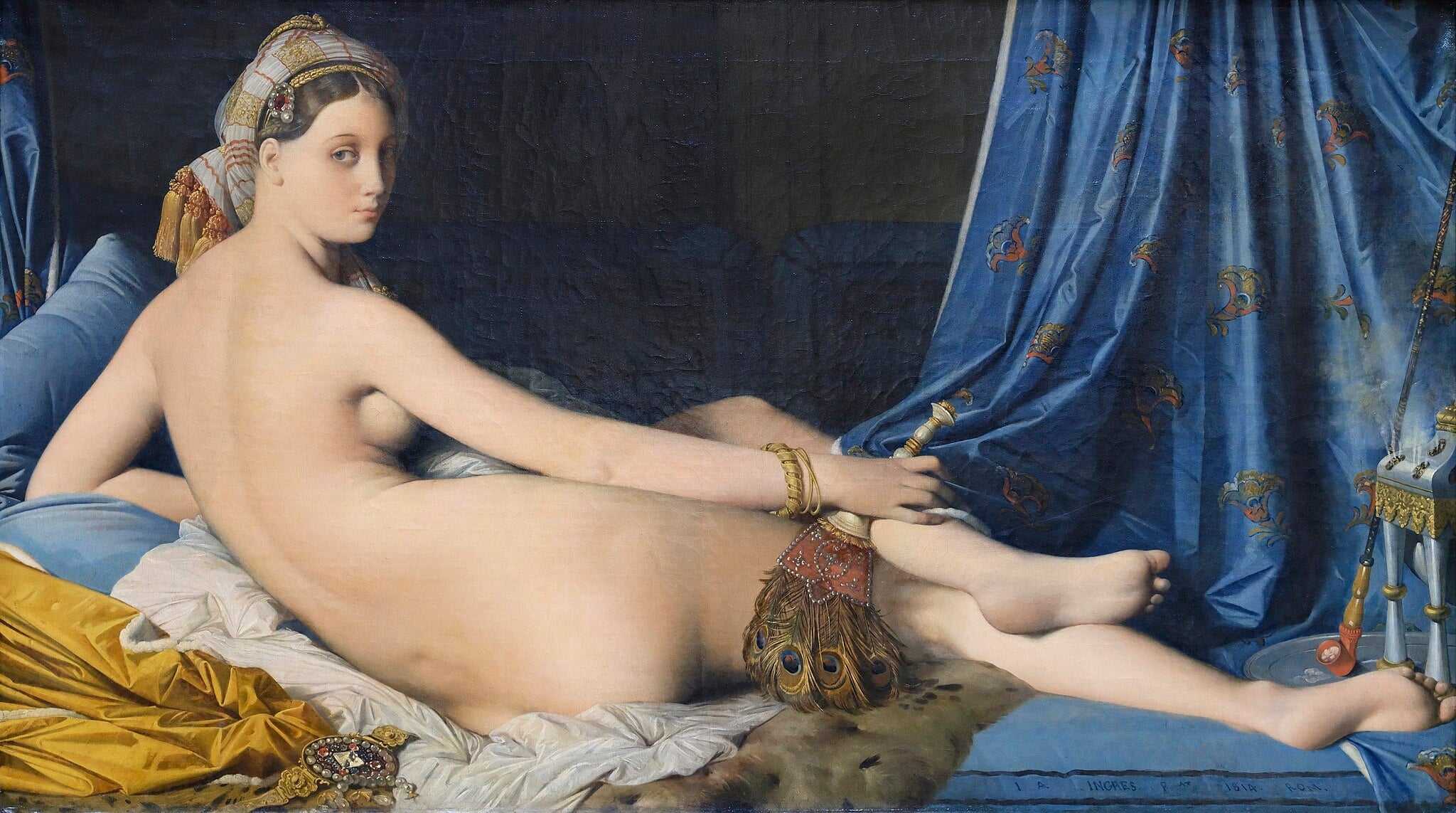
Grande Odalisque
Jean-Auguste-Dominique Ingres (1814)
In Jean-Auguste-Dominique Ingres’s Grande Odalisque (1814), a nude woman reclines against cool satin and a deep blue, patterned curtain, her spine drawn into an elegant, impossible arc. With a jeweled turban, bracelets, and a peacock-feather fan, she turns to meet the viewer’s look, poised yet distant. The image fuses <strong>Neoclassical idealization</strong> with <strong>Orientalist fantasy</strong>, privileging line and artifice over realism <sup>[1]</sup><sup>[2]</sup>.
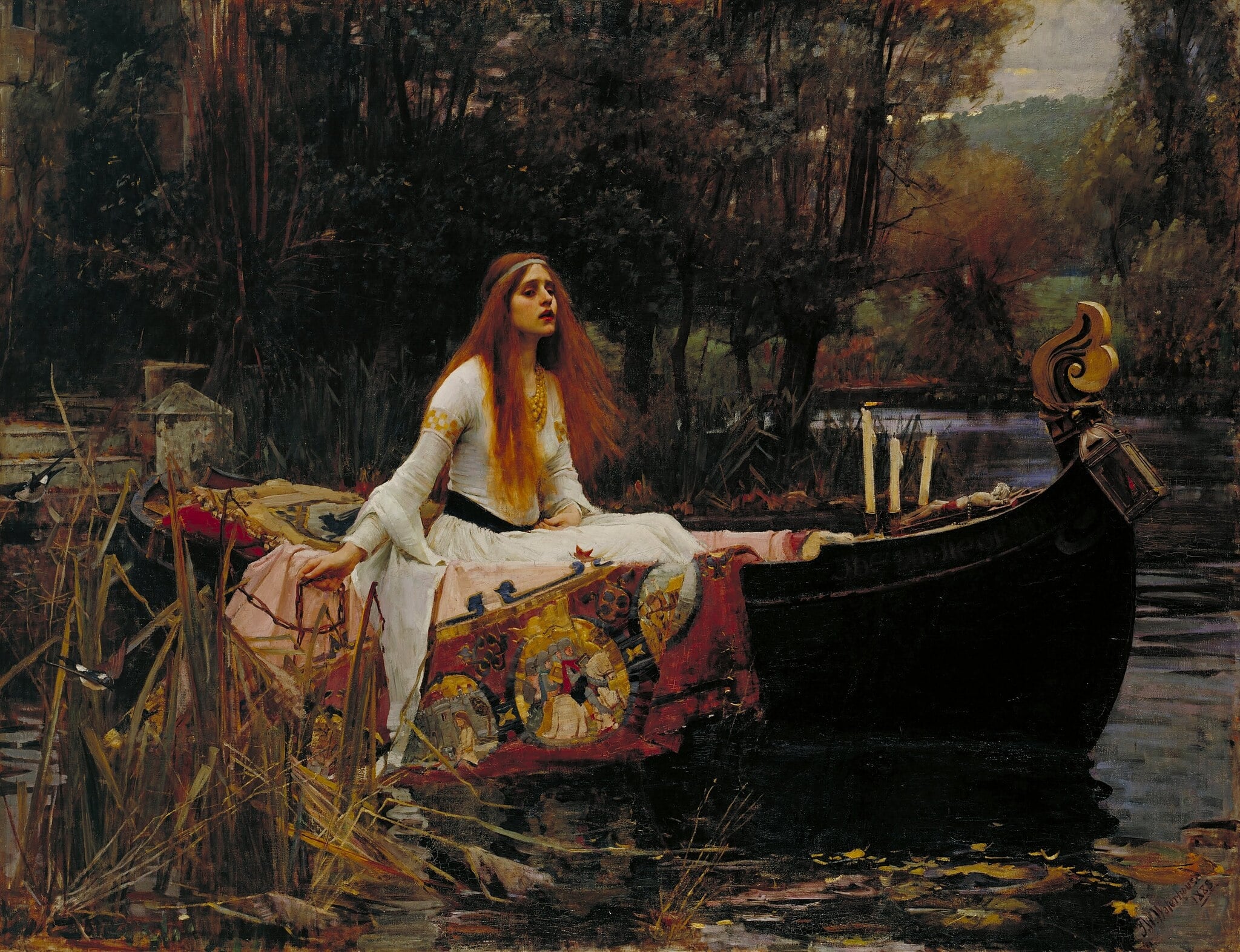
The Lady of Shallot
John William Waterhouse (1888)
John William Waterhouse’s The Lady of Shallot (1888) fixes on the instant the cursed heroine releases her chain and sets her black, coffinlike boat adrift. The extinguished candles, the small crucifix, and the tapestry trailing into the water stage a <strong>funerary voyage</strong> toward Camelot and a choice of <strong>experience over enclosure</strong> <sup>[1]</sup><sup>[2]</sup>.
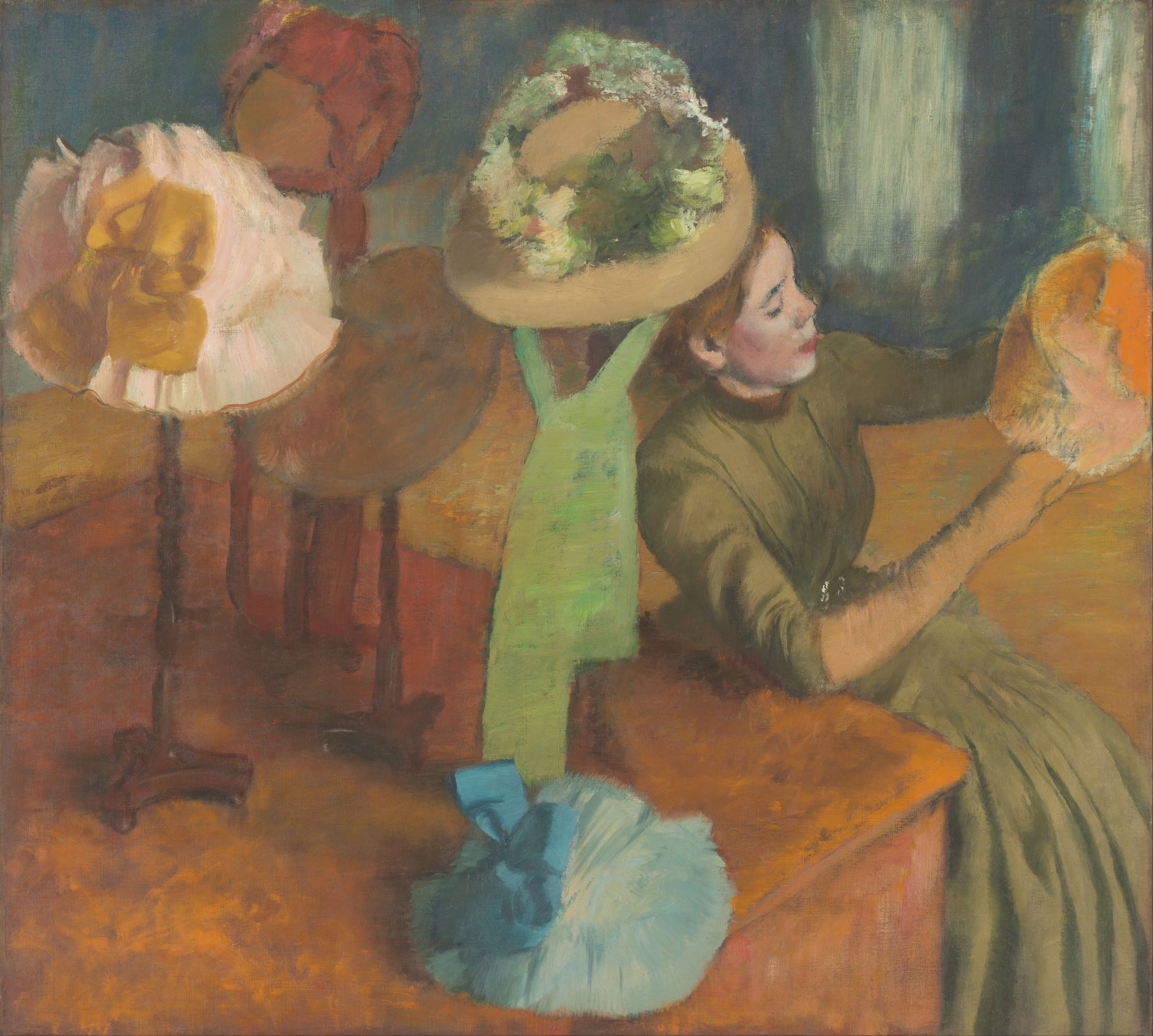
The Millinery Shop
Edgar Degas (1879–1886)
Edgar Degas’s The Millinery Shop stages modern Paris through a quiet act of <strong>work</strong> rather than display. A young woman, cropped in profile, studies a glowing <strong>orange hat</strong> while faceless stands crowned with ribbons and plumes press toward the picture plane. Degas turns a boutique into a meditation on <strong>labor, commodities, and identity</strong> <sup>[1]</sup><sup>[2]</sup>.
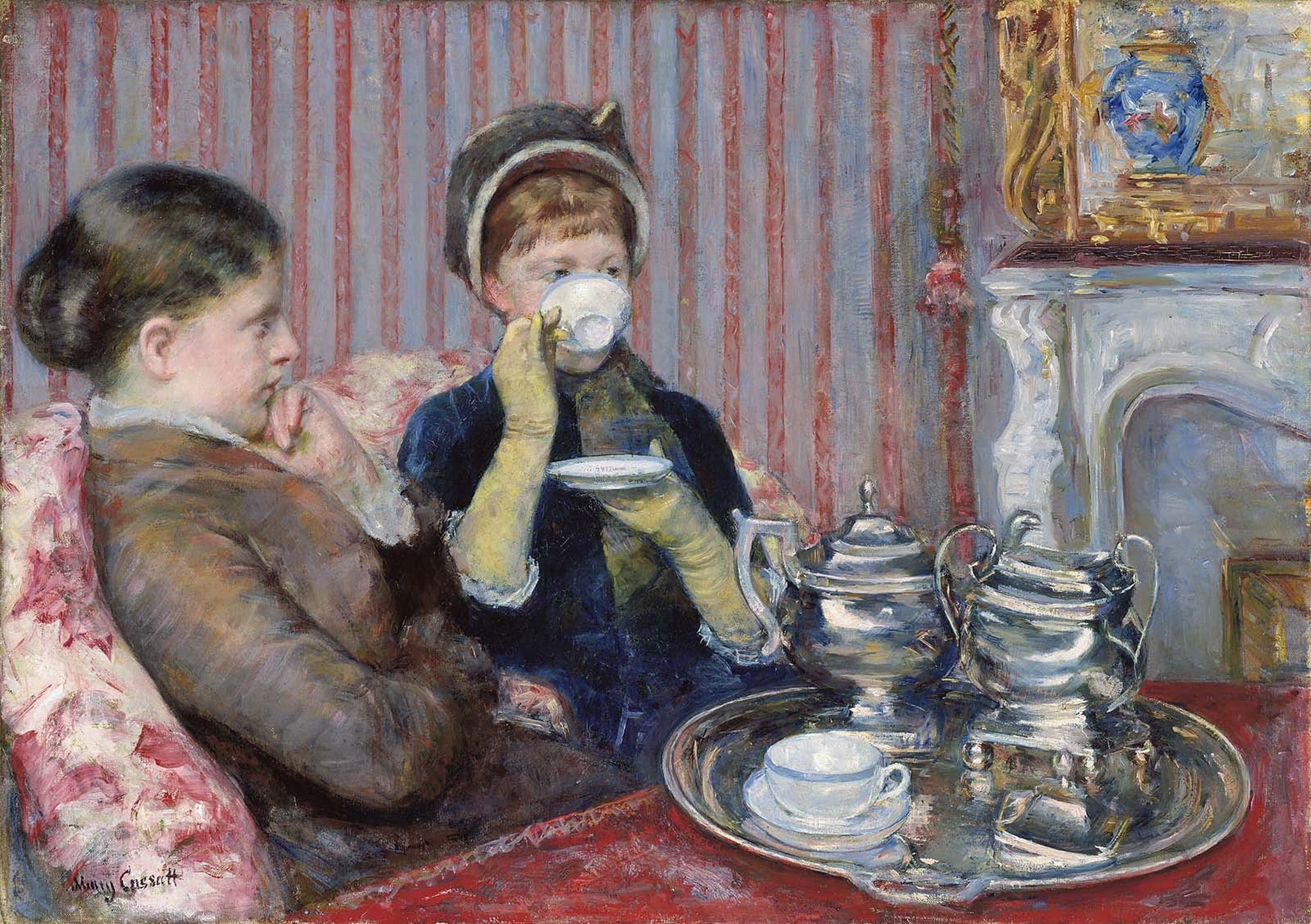
The Tea
Mary Cassatt (about 1880)
Mary Cassatt’s The Tea stages a poised, interior <strong>drama of manners</strong>: two women sit close yet feel apart, one thoughtful, the other raising a cup that <strong>veils her face</strong>. A gleaming, oversized <strong>silver tea service</strong> commands the foreground, its reflections turning ritual objects into actors in the scene <sup>[1]</sup>. The shallow, cropped room—striped wall, gilt mirror, marble mantel—compresses the atmosphere into <strong>intimacy edged by restraint</strong>.
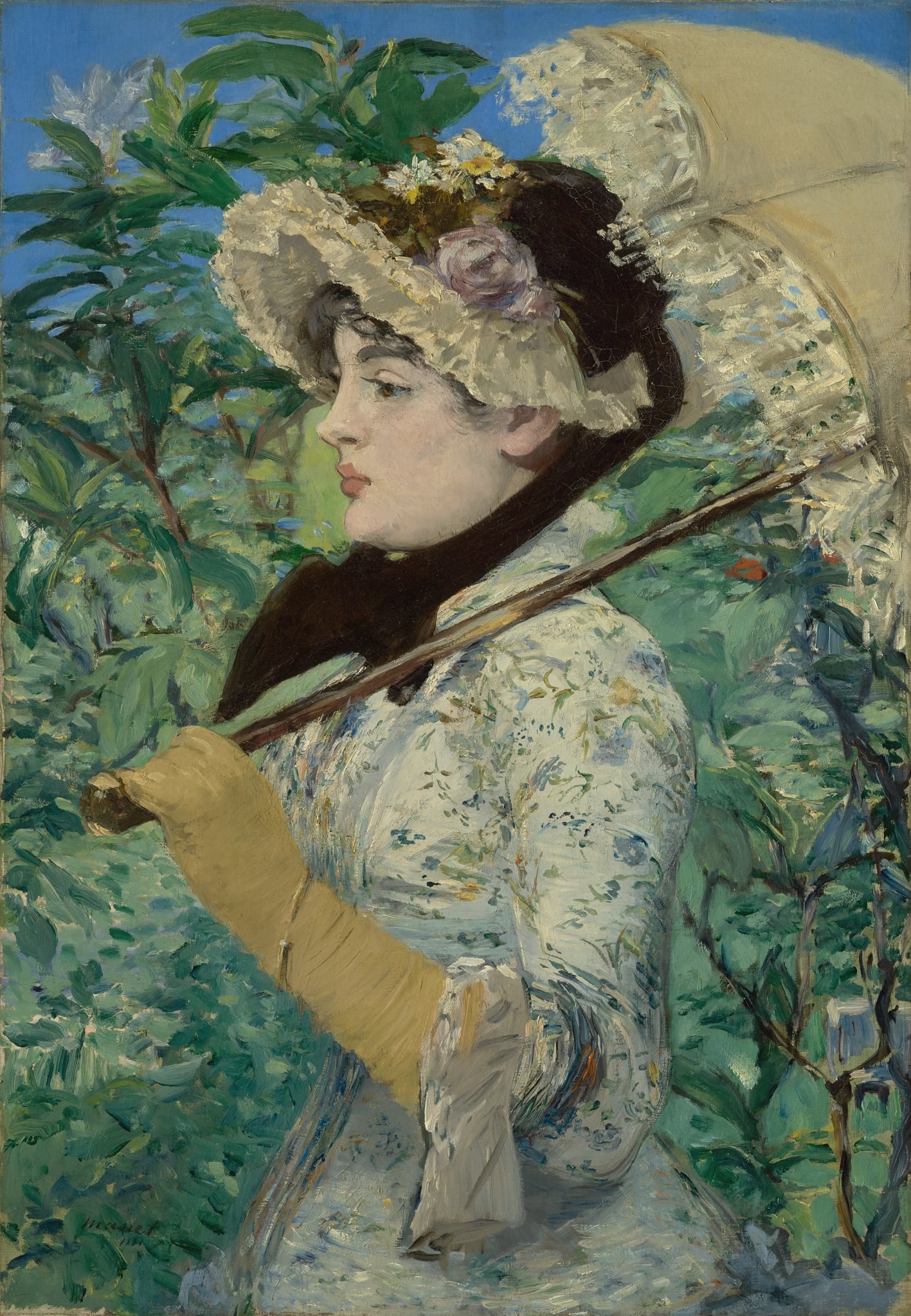
Jeanne (Spring)
Édouard Manet (1881)
Édouard Manet’s Jeanne (Spring) fuses a time-honored allegory with <strong>modern Parisian fashion</strong>: a crisp profile beneath a cream parasol, set against <strong>luminous, leafy greens</strong>. Manet turns couture—hat, glove, parasol—into the language of <strong>renewal and youth</strong>, making spring feel both perennial and up-to-the-minute <sup>[1]</sup><sup>[2]</sup>.
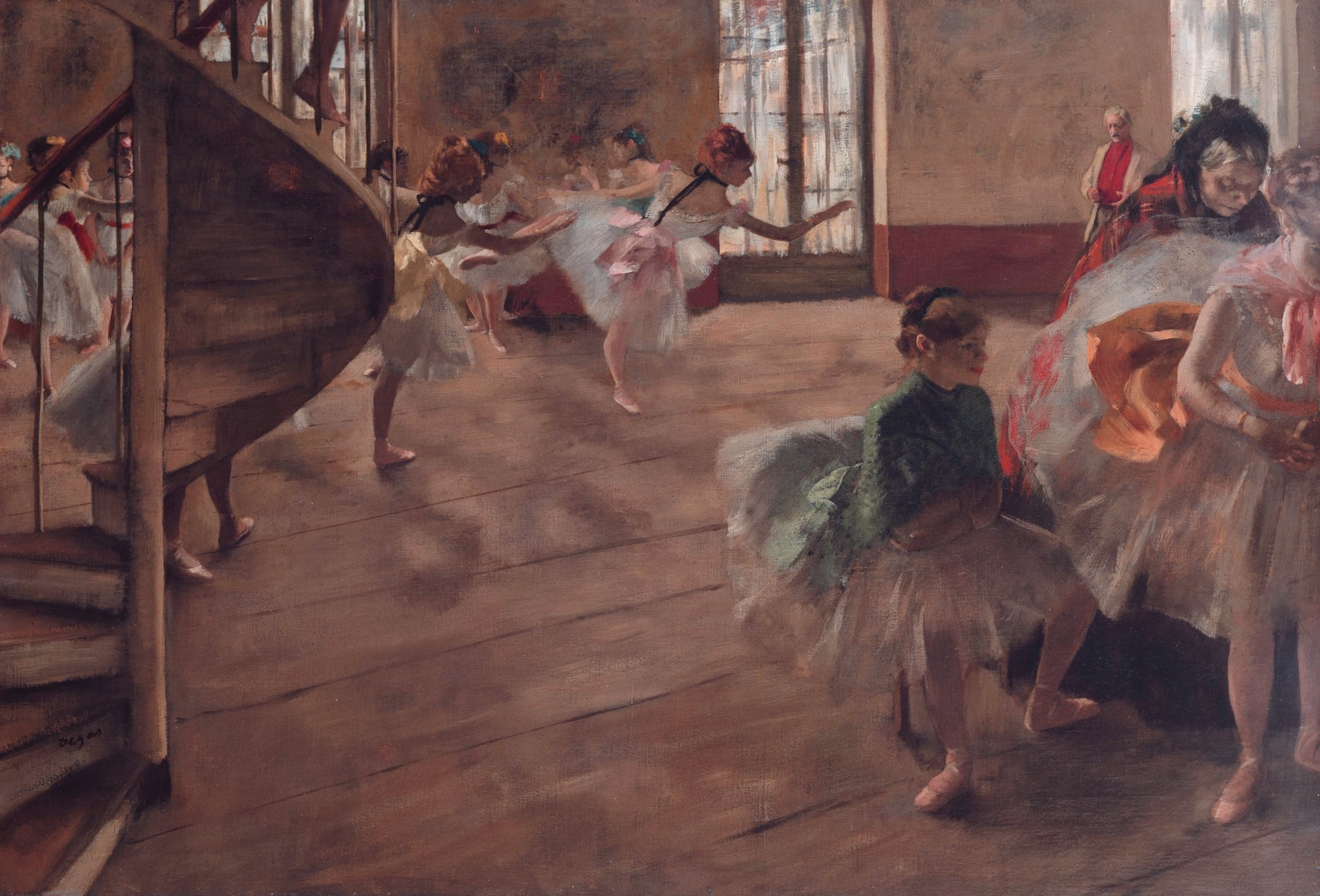
The Ballet Rehearsal
Edgar Degas (c. 1874)
In The Ballet Rehearsal, Edgar Degas turns a practice room into a modern drama where <strong>discipline and desire</strong> collide. A dark <strong>spiral staircase</strong> slices the space, scuffed floorboards yawn open, and clusters of dancers oscillate between poised effort and weary waiting <sup>[1]</sup><sup>[4]</sup>.
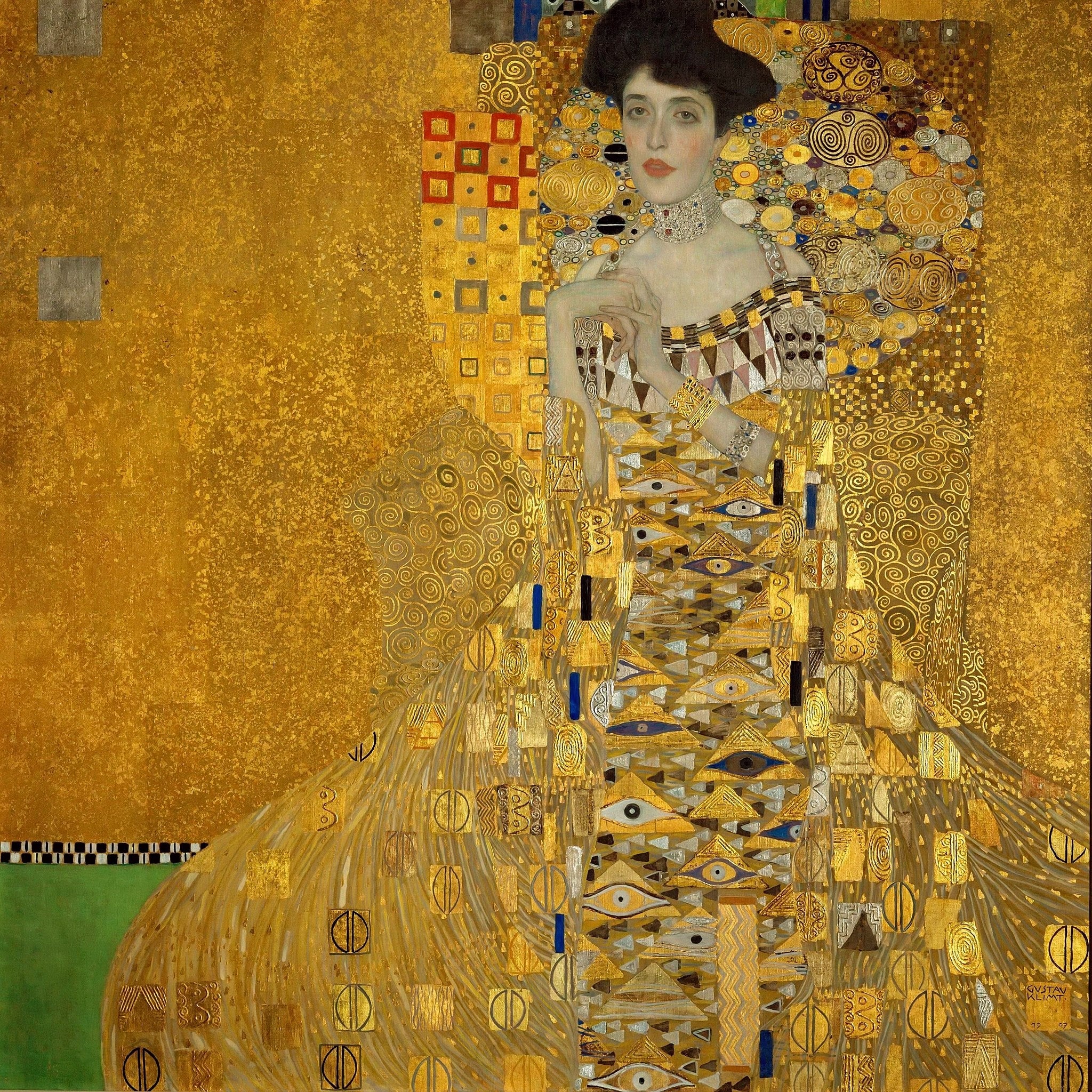
Portrait of Adele Bloch-Bauer I
Gustav Klimt (1907)
Gustav Klimt’s Portrait of Adele Bloch-Bauer I stages its sitter as a <strong>secular icon</strong>—a living presence suspended in a field of gold that converts space into <strong>pattern and power</strong>. The naturalistic face and hands emerge from a reliquary-like cascade of eyes, triangles, and tesserae, turning light, ornament, and status into the painting’s true subjects <sup>[1]</sup><sup>[2]</sup>.
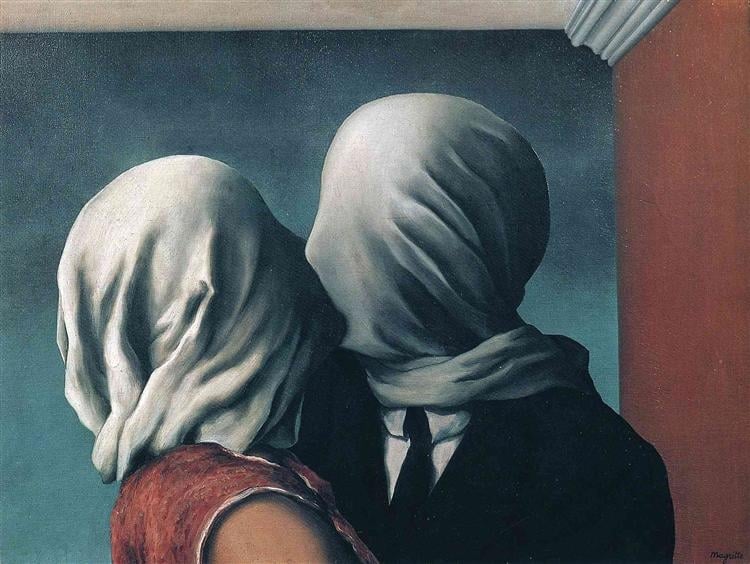
The Lovers
Rene Magritte (1928)
René Magritte’s The Lovers turns a kiss into an emblem of <strong>desire obstructed</strong>: two figures—she in red, he in a dark suit—press together while their heads are swathed in <strong>white cloth</strong>. Within a cool blue‑grey interior bounded by crown molding and a rust-red wall, intimacy becomes an image of <strong>opacity</strong> rather than revelation <sup>[1]</sup>.
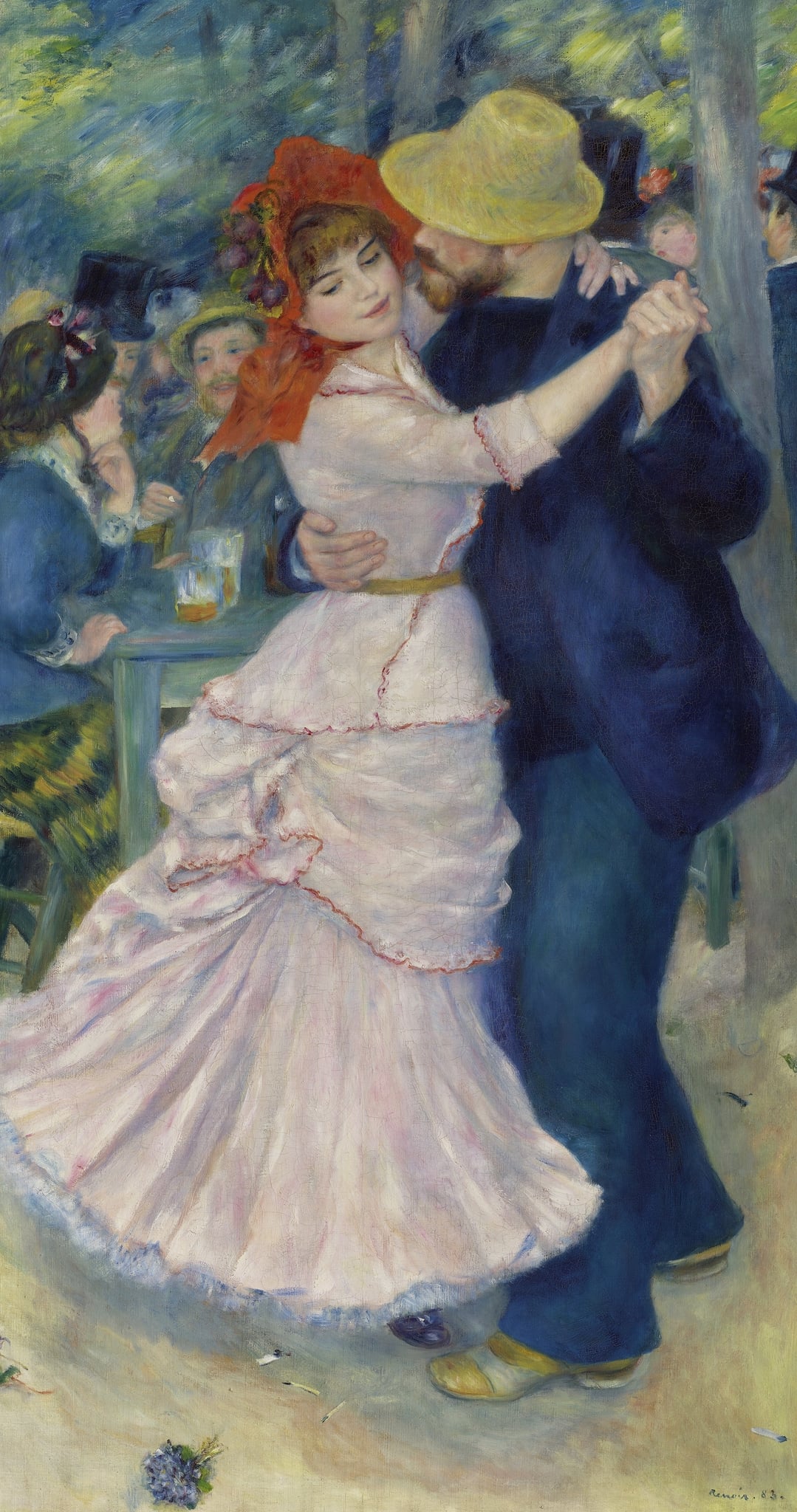
Dance at Bougival
Pierre-Auguste Renoir (1883)
In Dance at Bougival, Pierre-Auguste Renoir turns a crowded suburban dance into a <strong>private vortex of intimacy</strong>. Rose against ultramarine, skin against shade, and a flare of the woman’s <strong>scarlet bonnet</strong> concentrate the scene’s energy into a single turning moment—modern leisure made palpable as <strong>touch, motion, and light</strong> <sup>[1]</sup><sup>[2]</sup>.
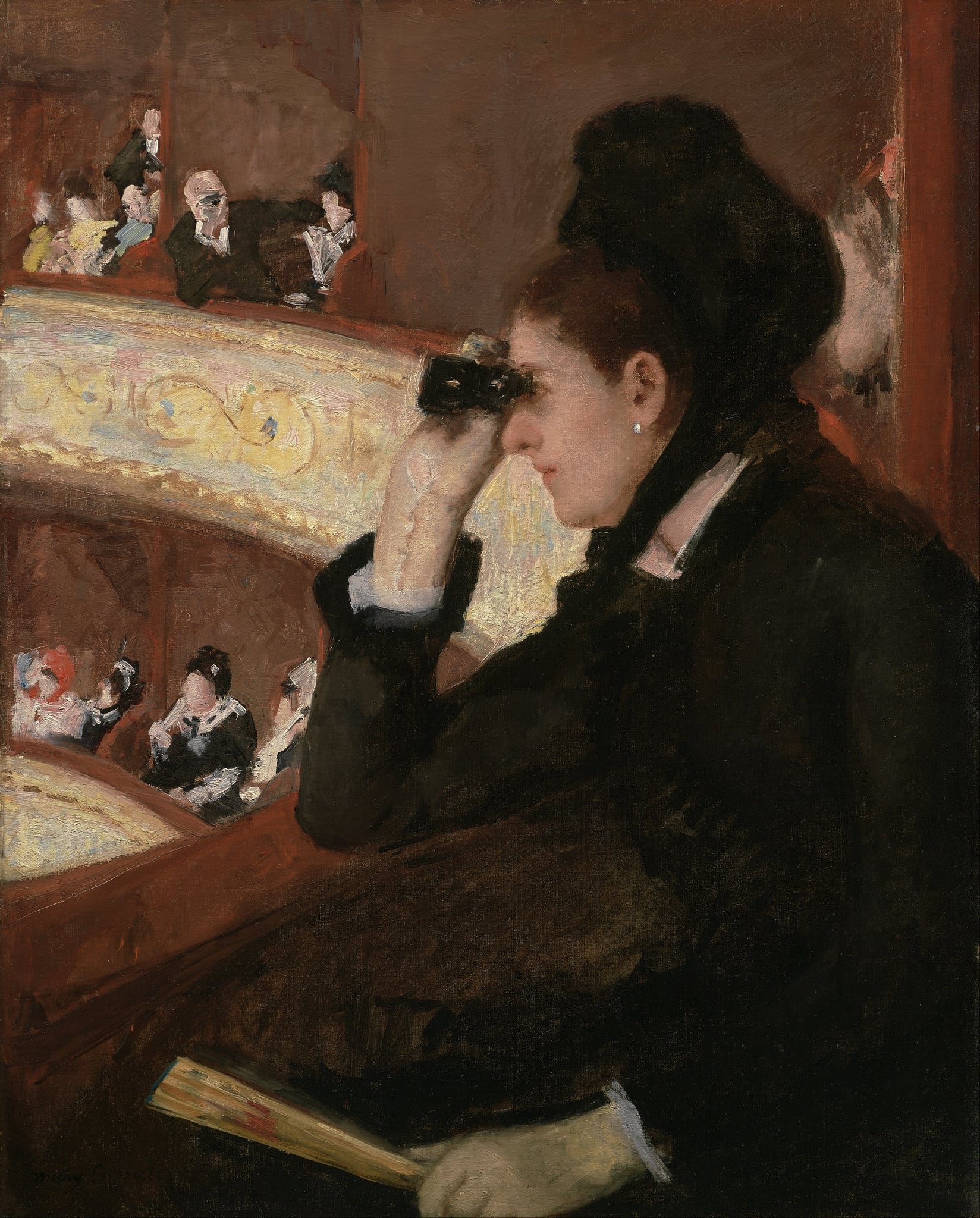
In the Loge
Mary Cassatt (1878)
Mary Cassatt’s In the Loge (1878) stages modern spectatorship as a drama of <strong>mutual looking</strong>. A woman in dark dress leans forward with <strong>opera glasses</strong>, her <strong>fan closed</strong> on her lap, as a man in the distance raises his own glasses toward her—turning the theater into a circuit of gazes <sup>[1]</sup><sup>[2]</sup>.
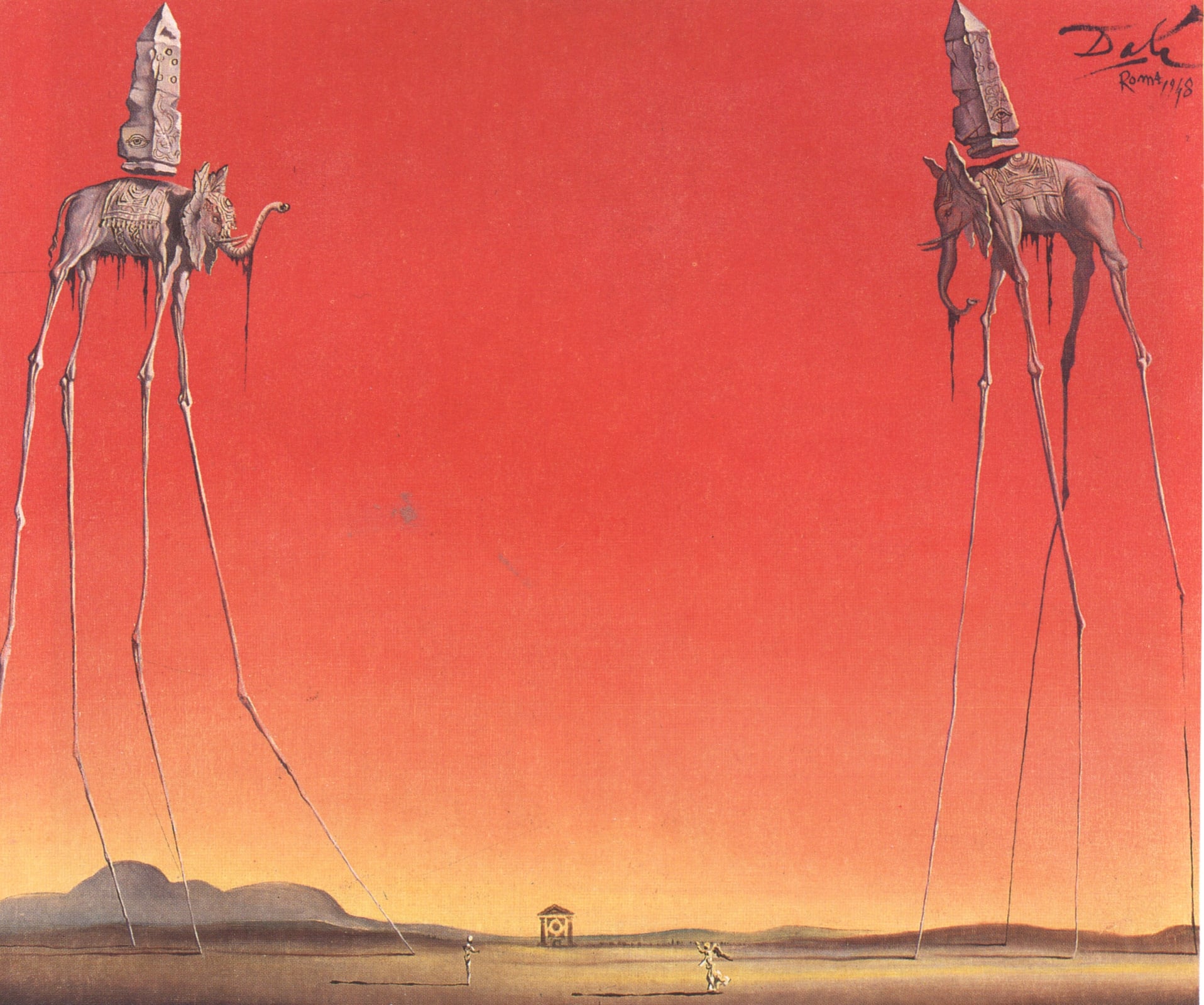
The Elephants
Salvador Dali (1948)
In The Elephants, Salvador Dali distills a stark paradox of <strong>weight and weightlessness</strong>: gaunt elephants tiptoe on <strong>stilt-thin legs</strong> while bearing stone <strong>obelisks</strong>. The blazing red-orange sky and tiny human figures compress ambition into a vision of <strong>precarious power</strong> and time stretched thin <sup>[1]</sup><sup>[2]</sup>.
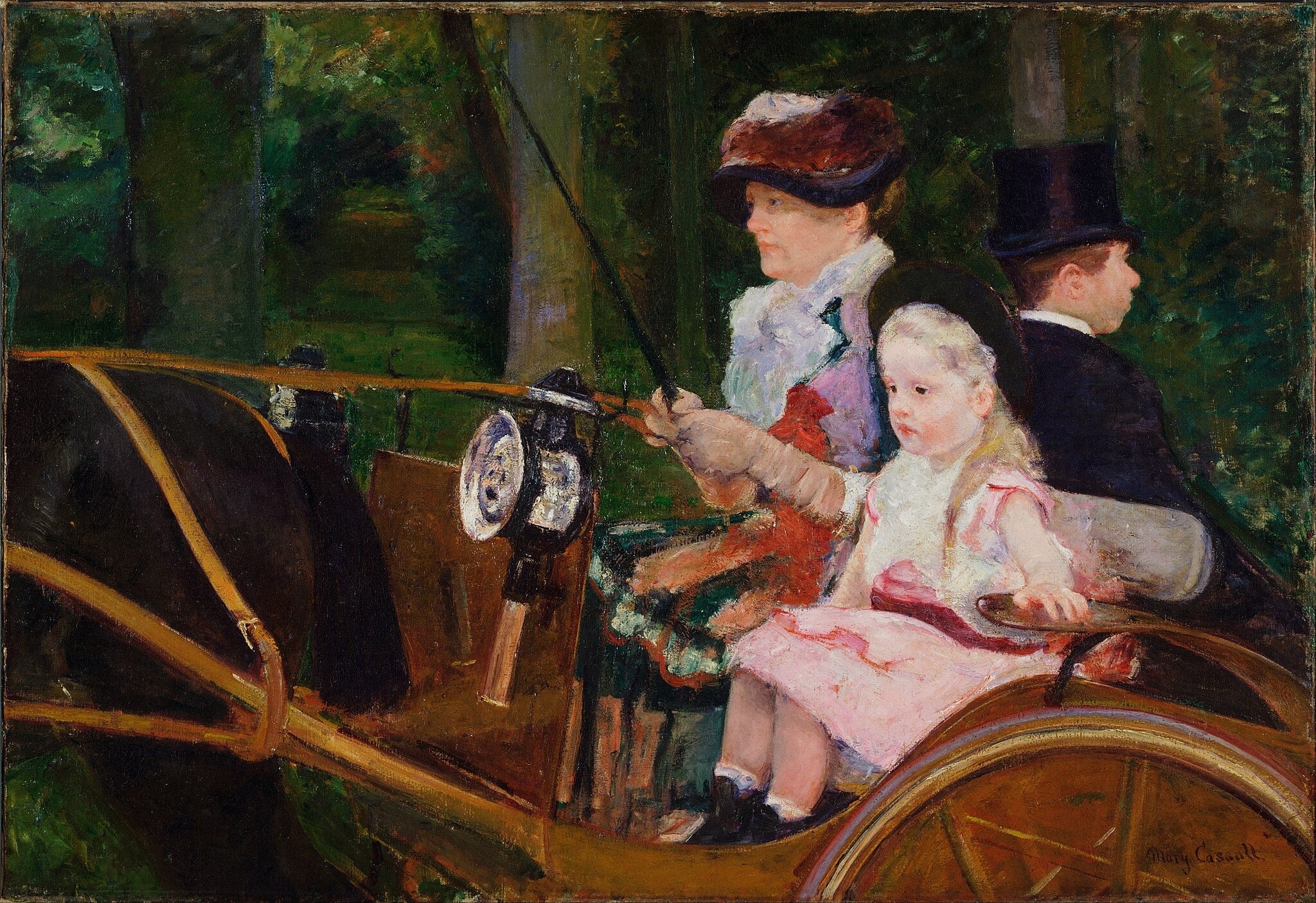
A Woman and a Girl Driving
Mary Cassatt (1881)
Cassatt stages a modern scene of <strong>female control</strong> in motion: a woman grips the reins and whip while a girl beside her mirrors the pose, and a groom seated behind looks away. The cropped horse and diagonal harness thrust the carriage forward, placing viewers inside a public outing in the Bois de Boulogne—an arena where visibility signaled status and autonomy <sup>[1]</sup><sup>[2]</sup>.
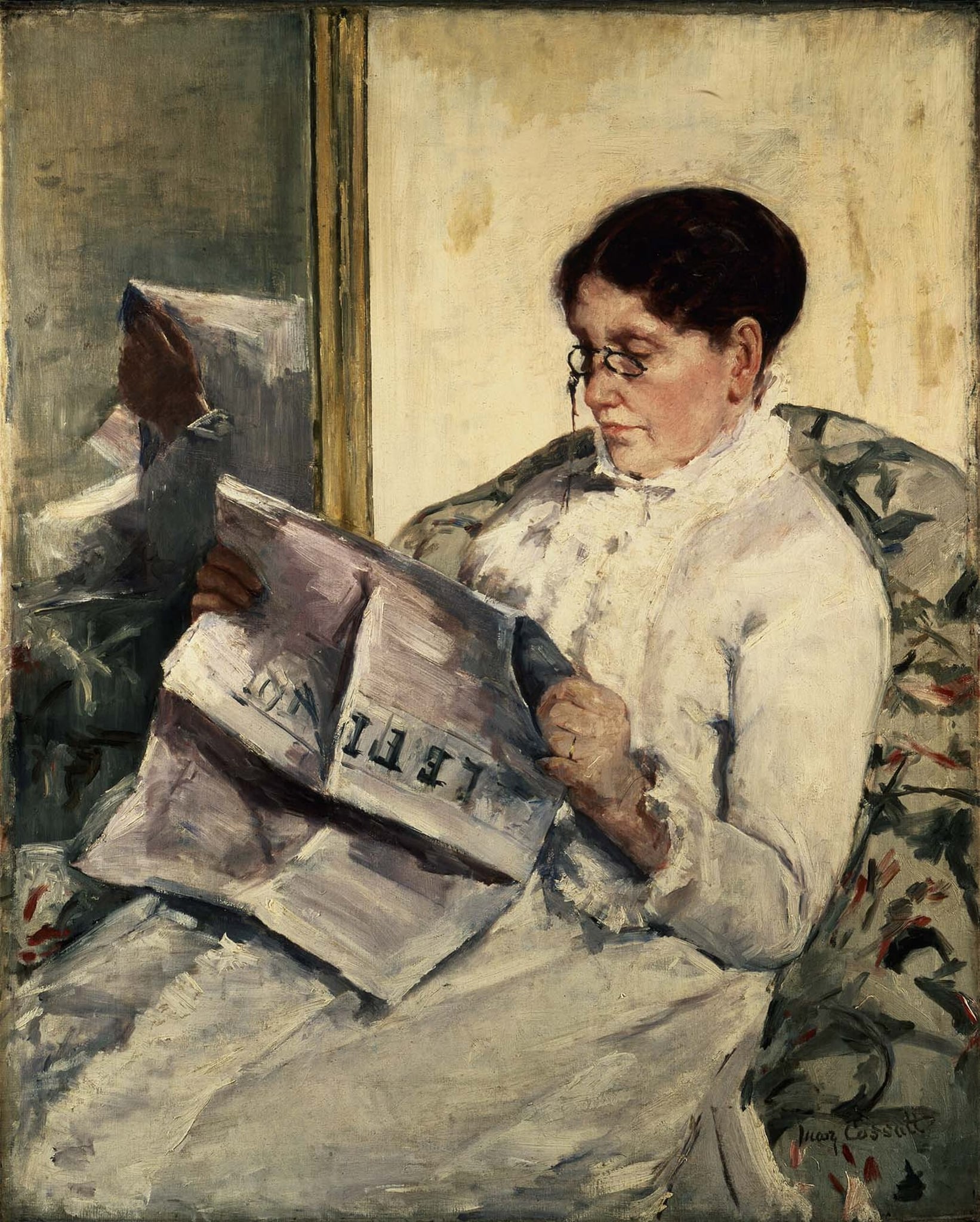
Reading Le Figaro
Mary Cassatt (c. 1878–83)
Mary Cassatt’s Reading Le Figaro turns a quiet parlor into a scene of <strong>intellect</strong> and <strong>modern life</strong>. The inverted masthead, mirrored repetition of the paper, and the sitter’s spectacles make <strong>attention</strong>—not appearance—the true subject <sup>[1]</sup><sup>[4]</sup>. Through brisk whites and grays, Cassatt dignifies everyday thought as a modern pictorial theme aligned with <strong>Impressionism</strong> <sup>[2]</sup>.
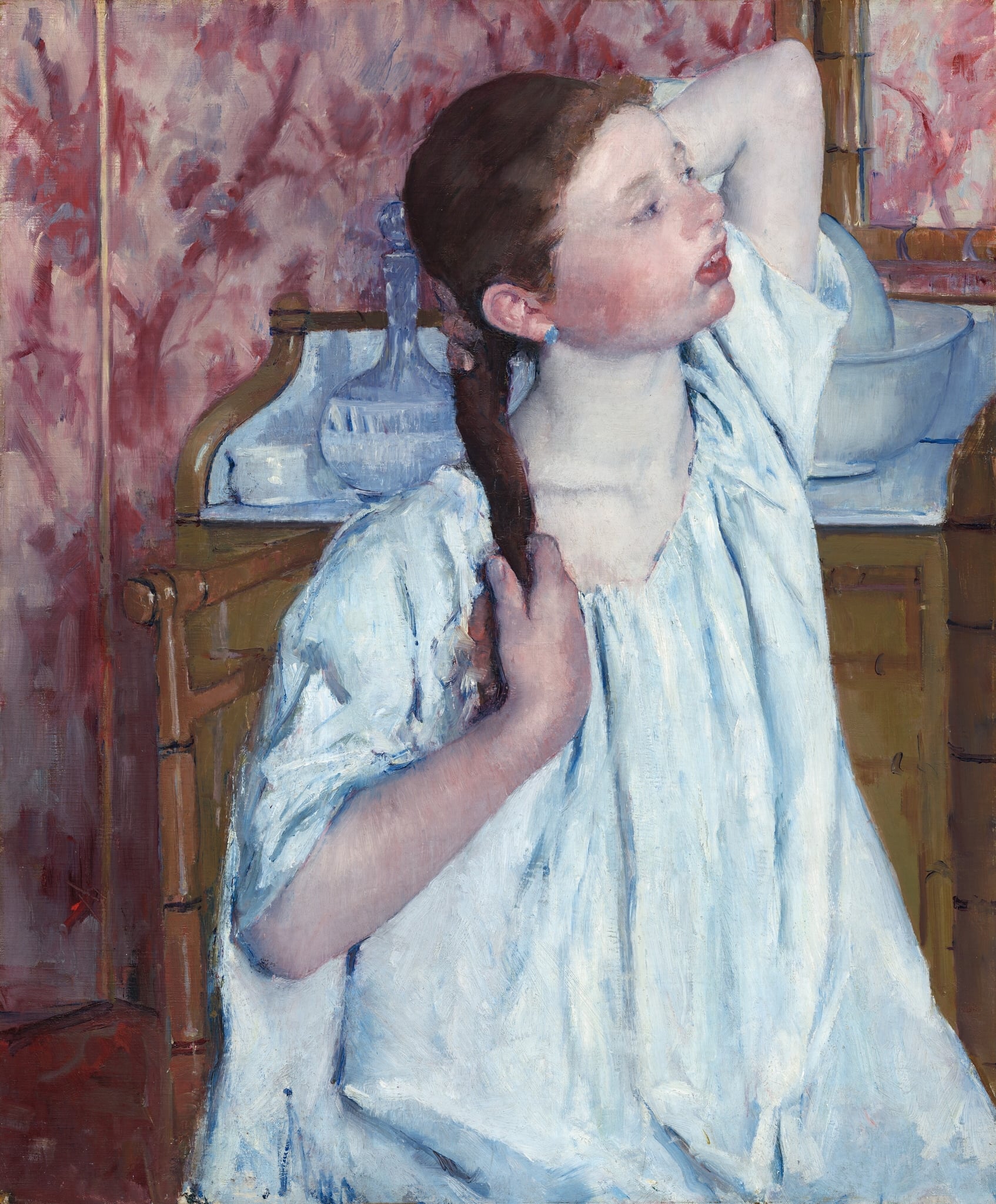
Girl Arranging Her Hair
Mary Cassatt (1886)
Mary Cassatt’s Girl Arranging Her Hair crystallizes a private rite of <strong>self‑regard</strong> into modern painting. Cool, broken strokes of the pale chemise meet the warm, patterned wall and bamboo furniture, staging a quiet drama of <strong>autonomy</strong> rather than display <sup>[1]</sup>. Exhibited in 1886, the work reframes the toilette as lived experience within Impressionism’s language of immediacy <sup>[2]</sup>.
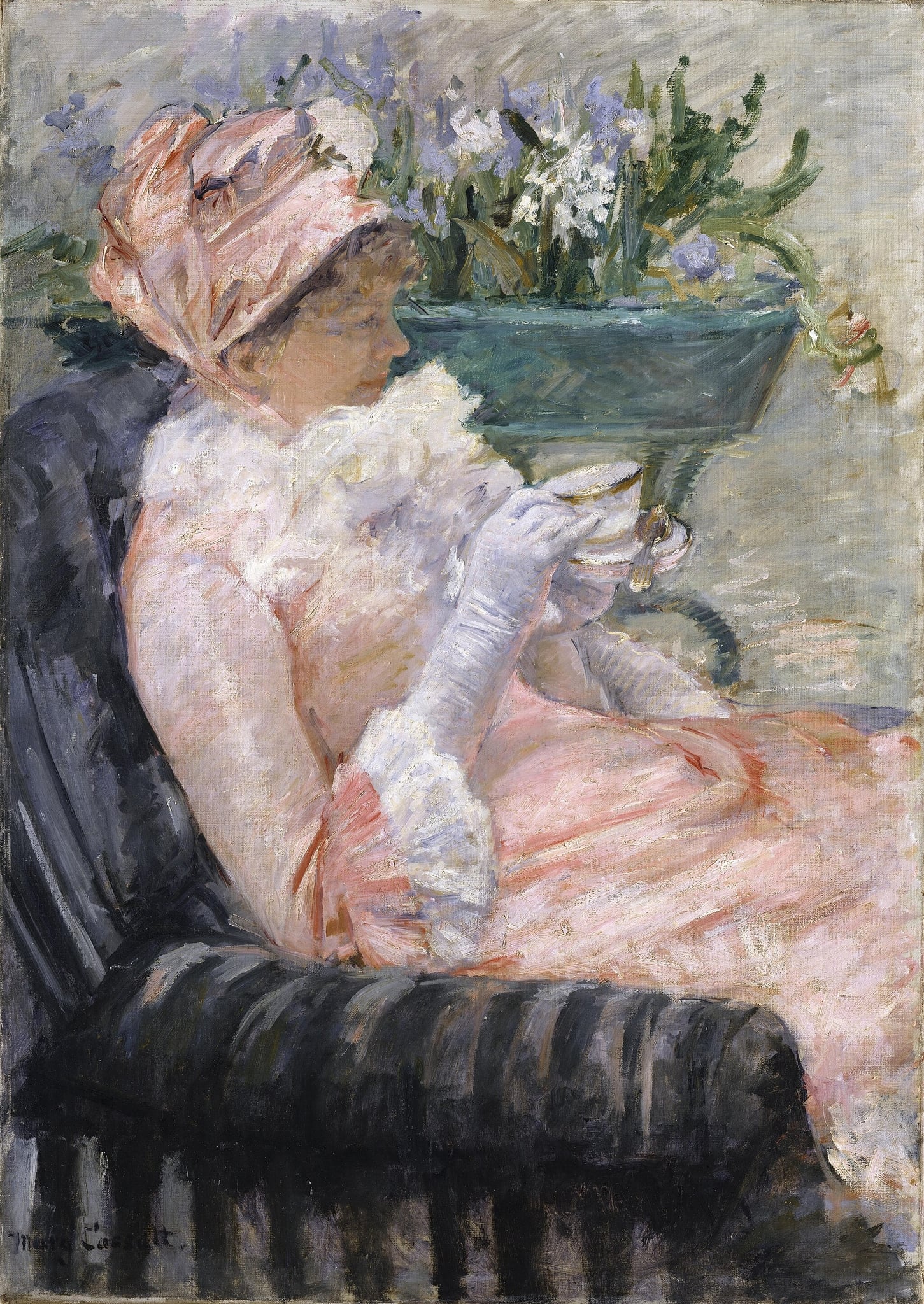
The Cup of Tea
Mary Cassatt (ca. 1880–81)
Mary Cassatt’s The Cup of Tea distills a moment of bourgeois leisure into a study of <strong>poise</strong>, <strong>etiquette</strong>, and <strong>private reflection</strong>. A woman in a rose‑pink dress and bonnet, white‑gloved, balances a gold‑rimmed cup against the shimmer of <strong>Impressionist</strong> brushwork, while a green planter of pale blossoms echoes her pastel palette <sup>[1]</sup>. The work turns an ordinary ritual into a modern emblem of women’s experience.
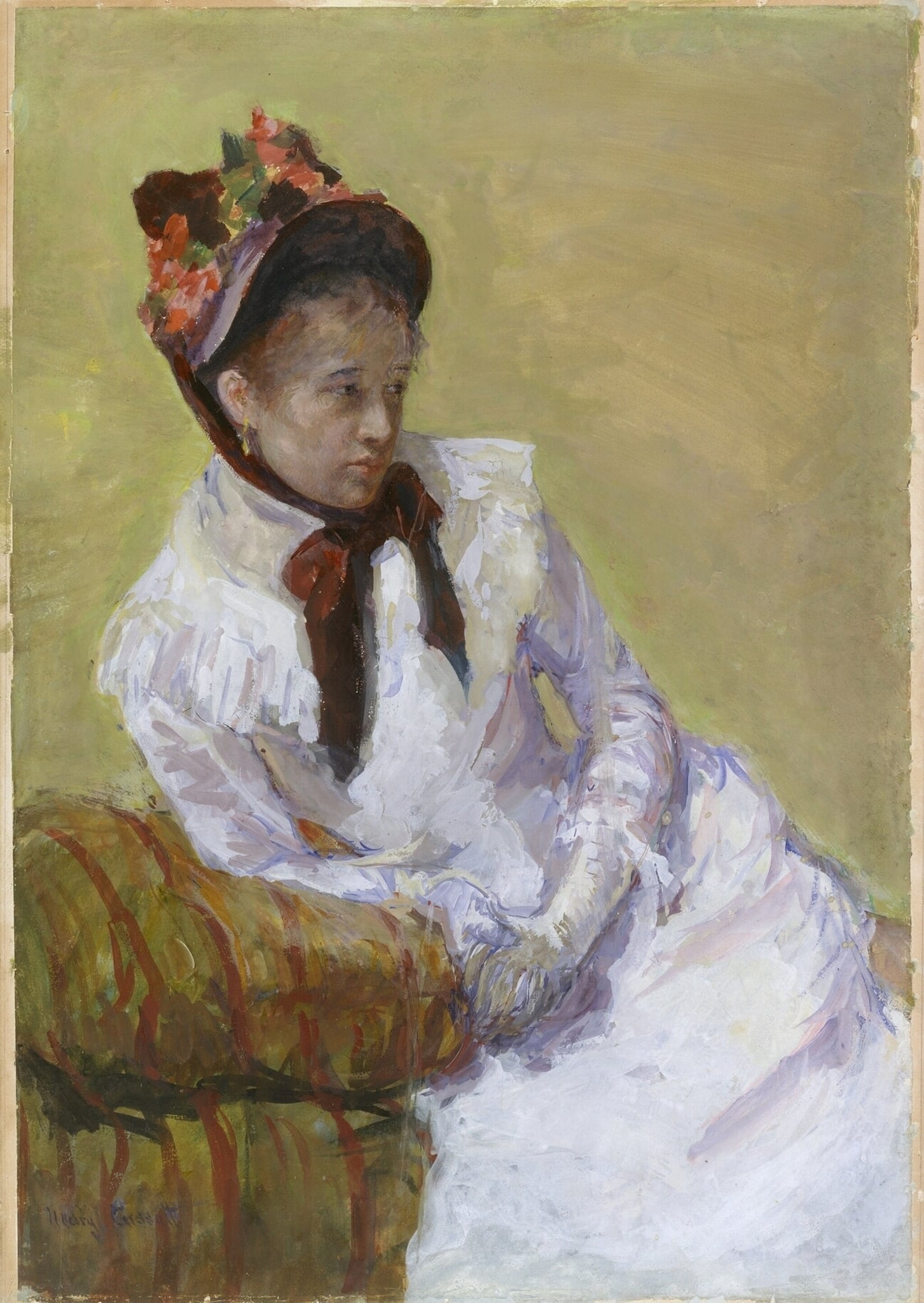
Self-Portrait
Mary Cassatt (1878)
In Self-Portrait, Mary Cassatt presents a poised, <strong>modern woman</strong> angled diagonally across a striped chair, her gaze turned away in <strong>thoughtful reserve</strong>. A <strong>sage-olive ground</strong> and tight crop strip away setting, while the <strong>white dress</strong> flickers with lilacs and blues against a <strong>decisive red ribbon</strong> and floral bonnet. The image asserts <strong>professional selfhood</strong> through restraint, asymmetry, and broken color.<sup>[1]</sup>
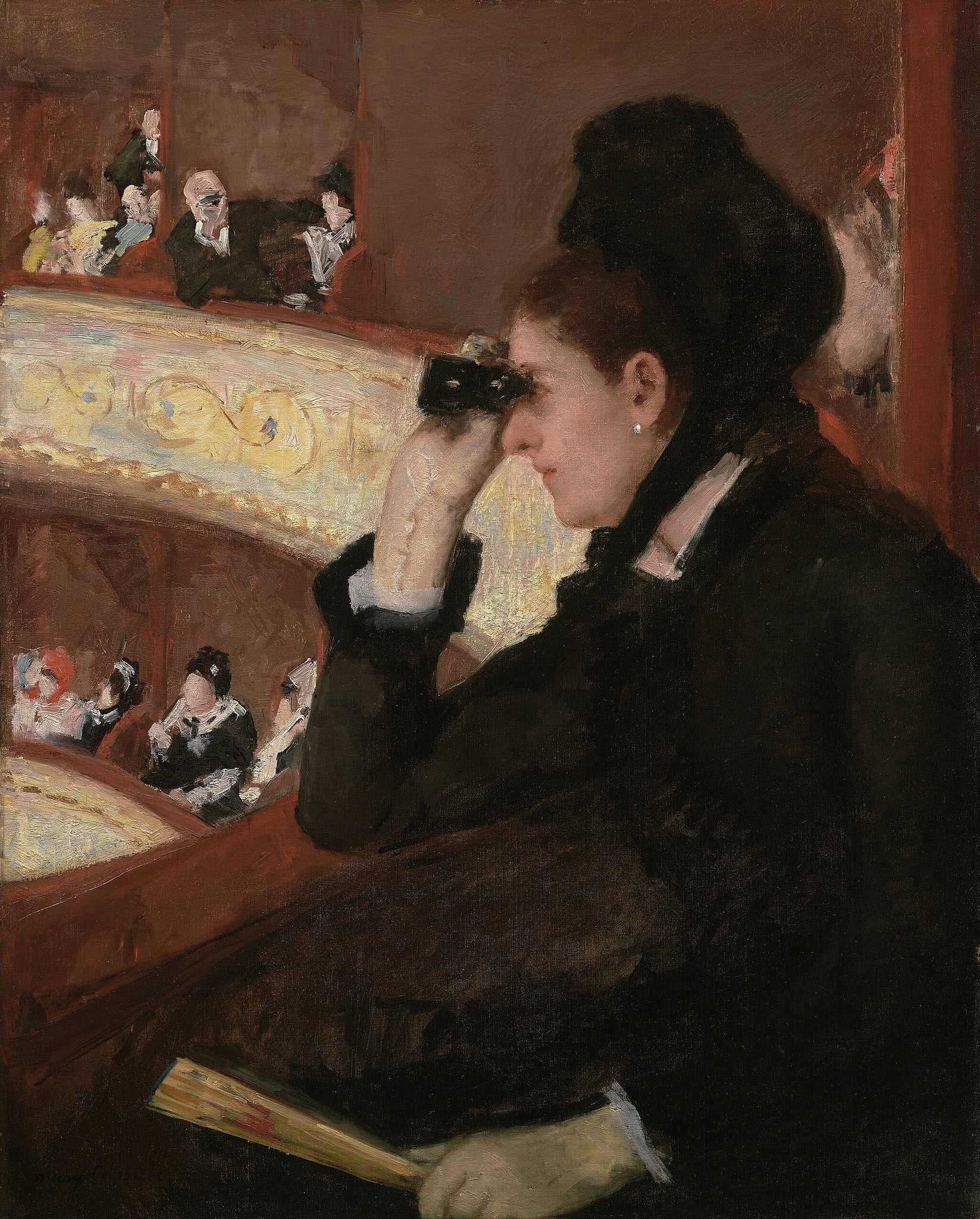
Woman in Black at the Opera
Mary Cassatt (1878)
Mary Cassatt’s Woman in Black at the Opera stages a taut drama of vision and visibility. A woman in <strong>black attire</strong> raises <strong>opera glasses</strong> while a distant man aims his own at her, setting off a chain of looks that makes public leisure a site of <strong>power, agency, and surveillance</strong> <sup>[1]</sup><sup>[2]</sup>.
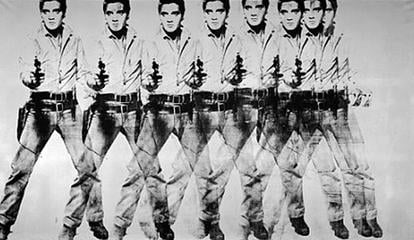
Eight Elvises
Andy Warhol (1963)
A sweeping frieze of eight overlapping, gun‑drawn cowboys marches across a silver field, their forms slipping and ghosting as if frames of a film. Warhol converts a singular star into a <strong>serial commodity</strong>, where <strong>mechanical misregistration</strong> and life‑size scale turn bravado into spectacle <sup>[1]</sup><sup>[2]</sup>.
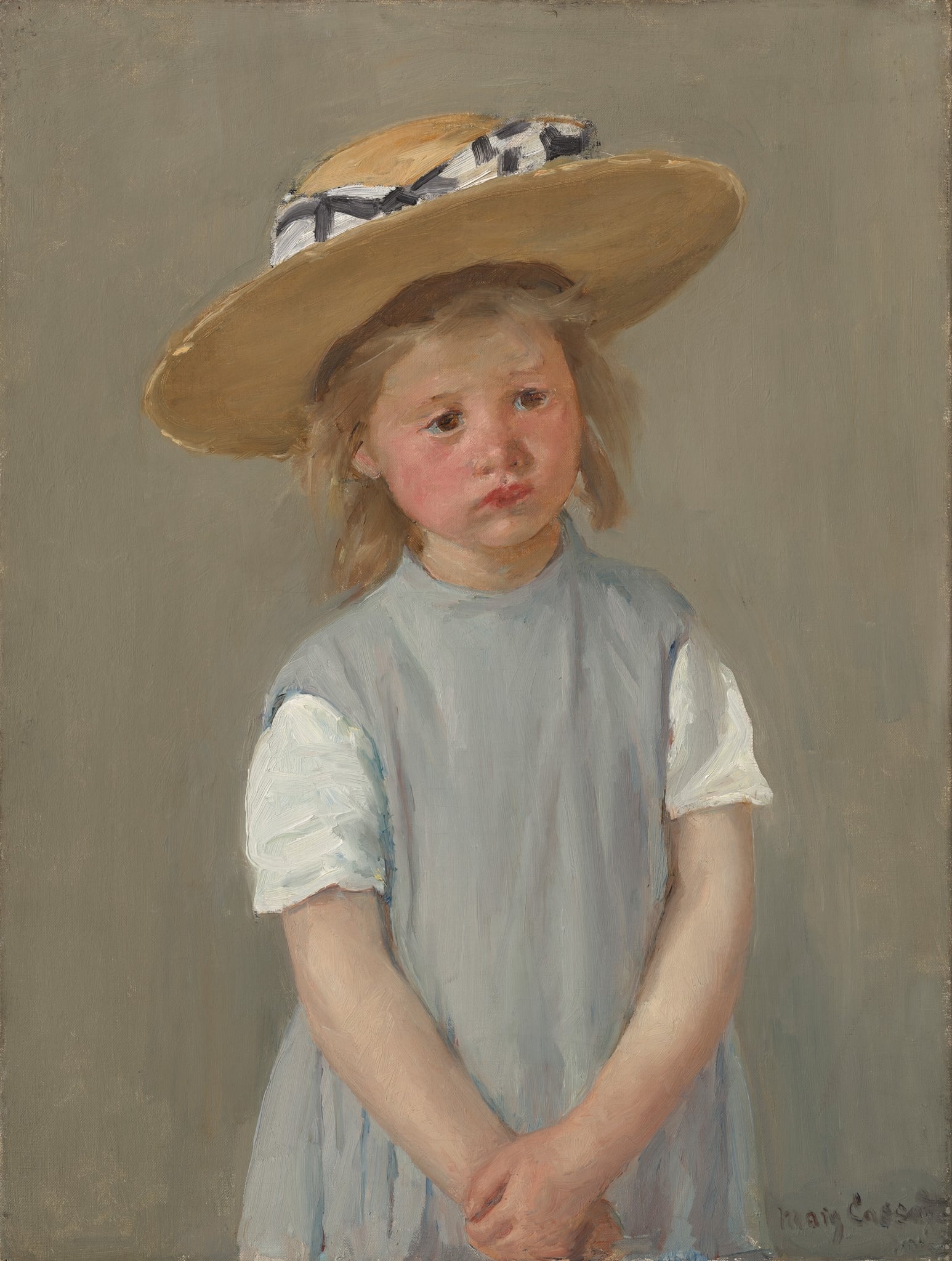
Little Girl in a Big Straw Hat and a Pinafore
Mary Cassatt (c. 1886)
Mary Cassatt’s Little Girl in a Big Straw Hat and a Pinafore distills childhood into a quiet drama of <strong>interiority</strong> and <strong>constraint</strong>. The oversized straw hat and plain pinafore bracket a flushed face, downcast eyes, and <strong>clasped hands</strong>, turning a simple pose into a study of modern self‑consciousness <sup>[1]</sup>. Cassatt’s cool grays and swift, luminous strokes make mood—not costume—the subject.
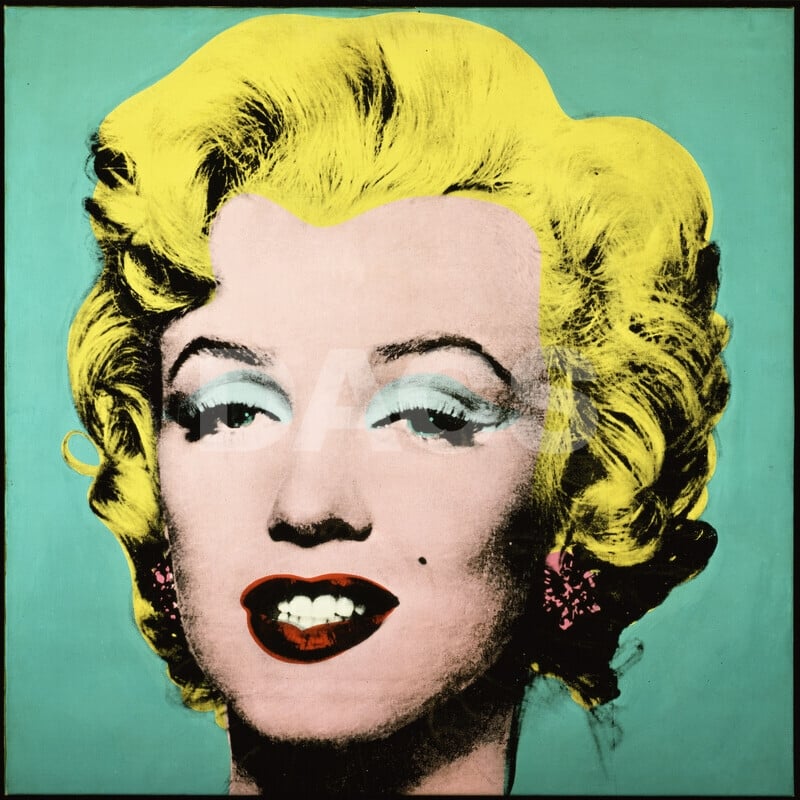
Turquoise Marilyn
Andy Warhol (1964)
In Turquoise Marilyn, Andy Warhol converts a movie star’s face into a <strong>modern icon</strong>: a tightly cropped head floating in a flat <strong>turquoise</strong> field, its <strong>acidic yellow hair</strong>, turquoise eye shadow, and <strong>lipstick-red</strong> mouth stamped by silkscreen’s mechanical bite. The slight <strong>misregistration</strong> around eyes and hair produces a halo-like tremor, fusing <strong>glamour and ghostliness</strong> to expose celebrity as a manufactured surface <sup>[1]</sup><sup>[2]</sup>.
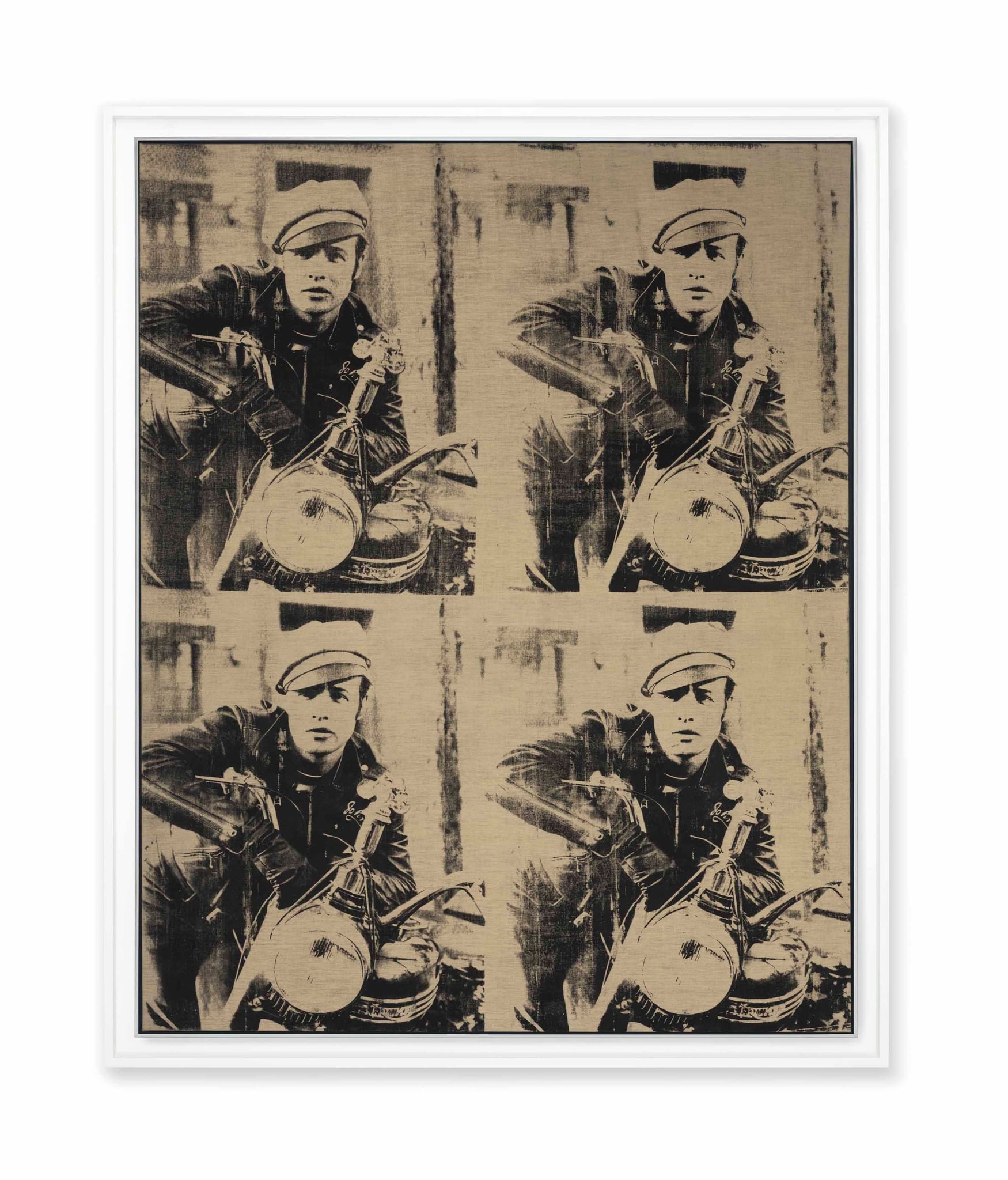
Four Marlons
Andy Warhol (1966)
Four Marlons is a 1966 silkscreen by Andy Warhol that multiplies a single biker film-still into a tight 2×2 grid on raw linen. Its inky blacks against a tan, unprimed ground turn the glare of the headlamp, the angled handlebars, and the figure’s guarded pose into a <strong>repeatable icon</strong> of outlaw cool. Warhol’s seriality both <strong>amplifies and drains</strong> the image’s aura, exposing fame as a commodity pattern <sup>[1]</sup><sup>[3]</sup>.
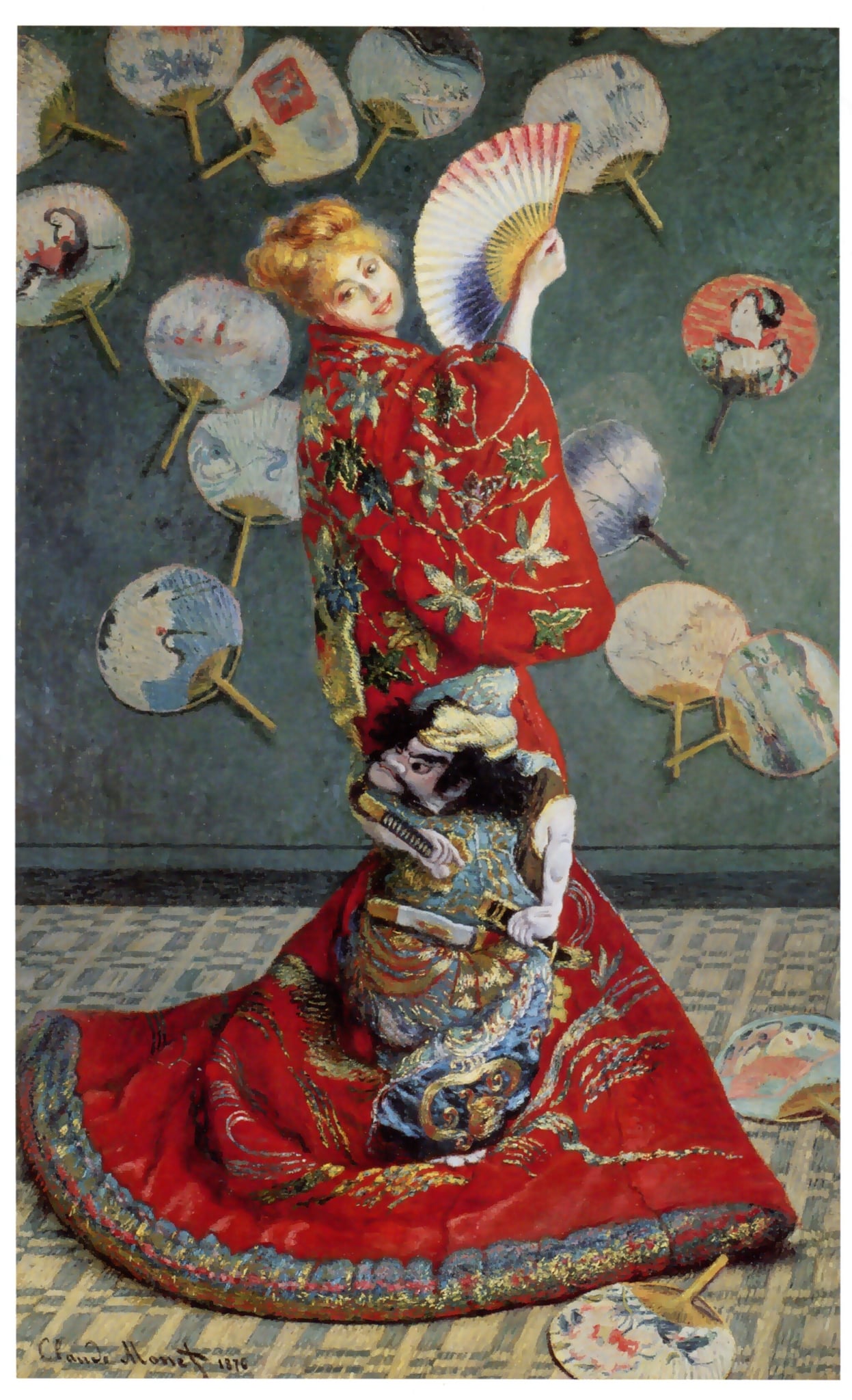
La Japonaise (Camille Monet in Japanese Costume)
Claude Monet (1876)
Claude Monet’s La Japonaise (Camille Monet in Japanese Costume) (1876) stages a witty confrontation between <strong>Parisian modernity</strong> and the fashion for <strong>Japonisme</strong>. A fair-skinned model in a blazing red uchikake preens before a wall tiled with uchiwa fans, lifting a <strong>tricolor</strong> hand fan that asserts Frenchness amid the imported decor. The painting turns costume, props, and gaze into a performance about <strong>desire, display, and identity</strong> <sup>[1]</sup><sup>[2]</sup>.
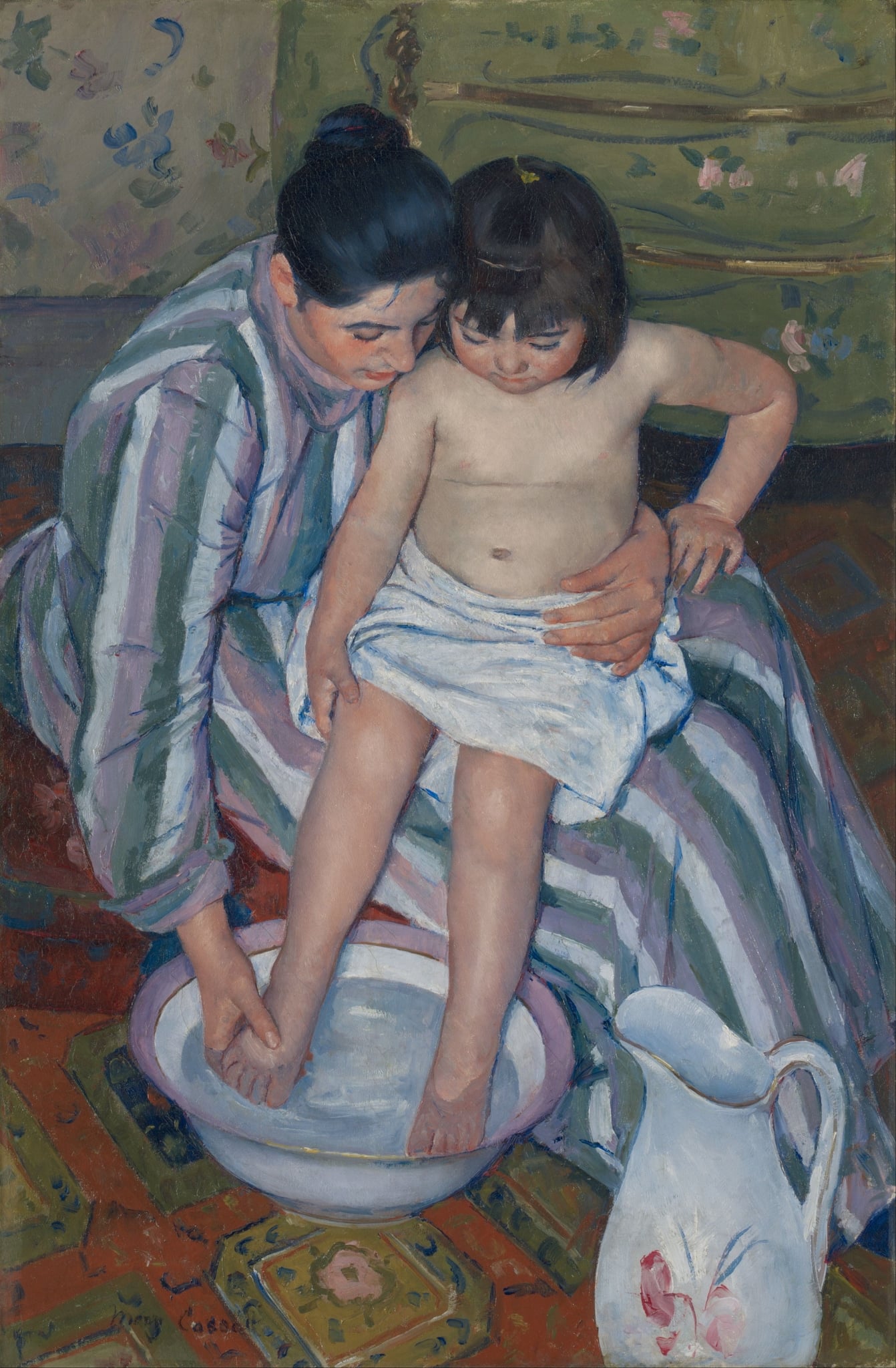
The Child's Bath
Mary Cassatt (1893)
Mary Cassatt’s The Child’s Bath (1893) recasts an ordinary ritual as <strong>modern devotion</strong>. From a steep, print-like vantage, interlocking stripes, circles, and diagonals focus attention on <strong>touch, care, and renewal</strong>, turning domestic labor into a subject of high art <sup>[1]</sup><sup>[3]</sup>. The work synthesizes Impressionist sensitivity with <strong>Japonisme</strong> design to monumentalize the private sphere <sup>[1]</sup><sup>[2]</sup>.
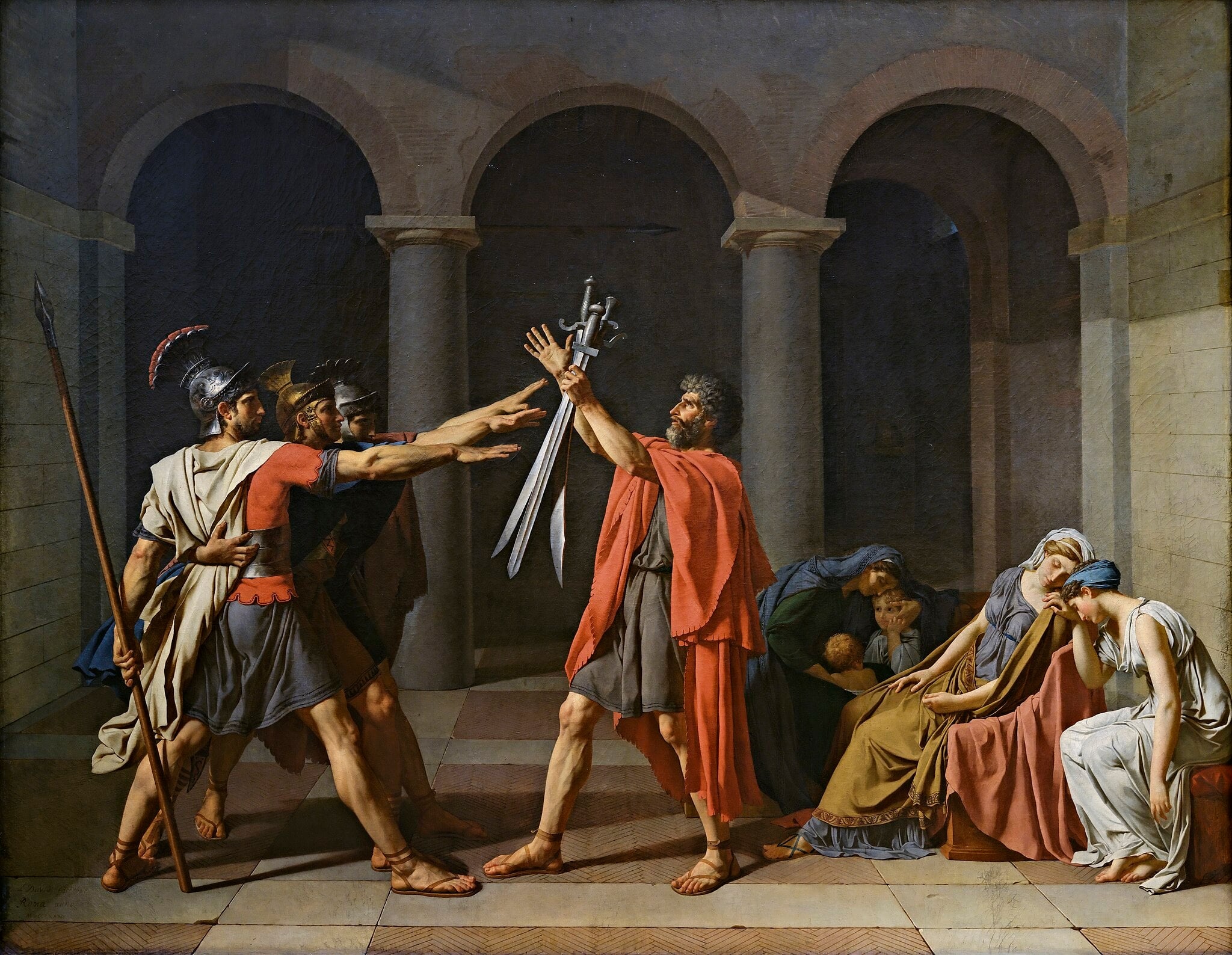
The Oath of the Horatii
Jacques-Louis David (1784 (exhibited 1785))
In The Oath of the Horatii, Jacques-Louis David crystallizes <strong>civic duty over private feeling</strong>: three Roman brothers extend their arms to swear allegiance as their father raises <strong>three swords</strong> at the perspectival center. The painting’s severe geometry, austere architecture, and polarized groups of <strong>rectilinear men</strong> and <strong>curving mourners</strong> stage a manifesto of <strong>Neoclassical virtue</strong> and republican resolve <sup>[1]</sup><sup>[2]</sup><sup>[3]</sup>.
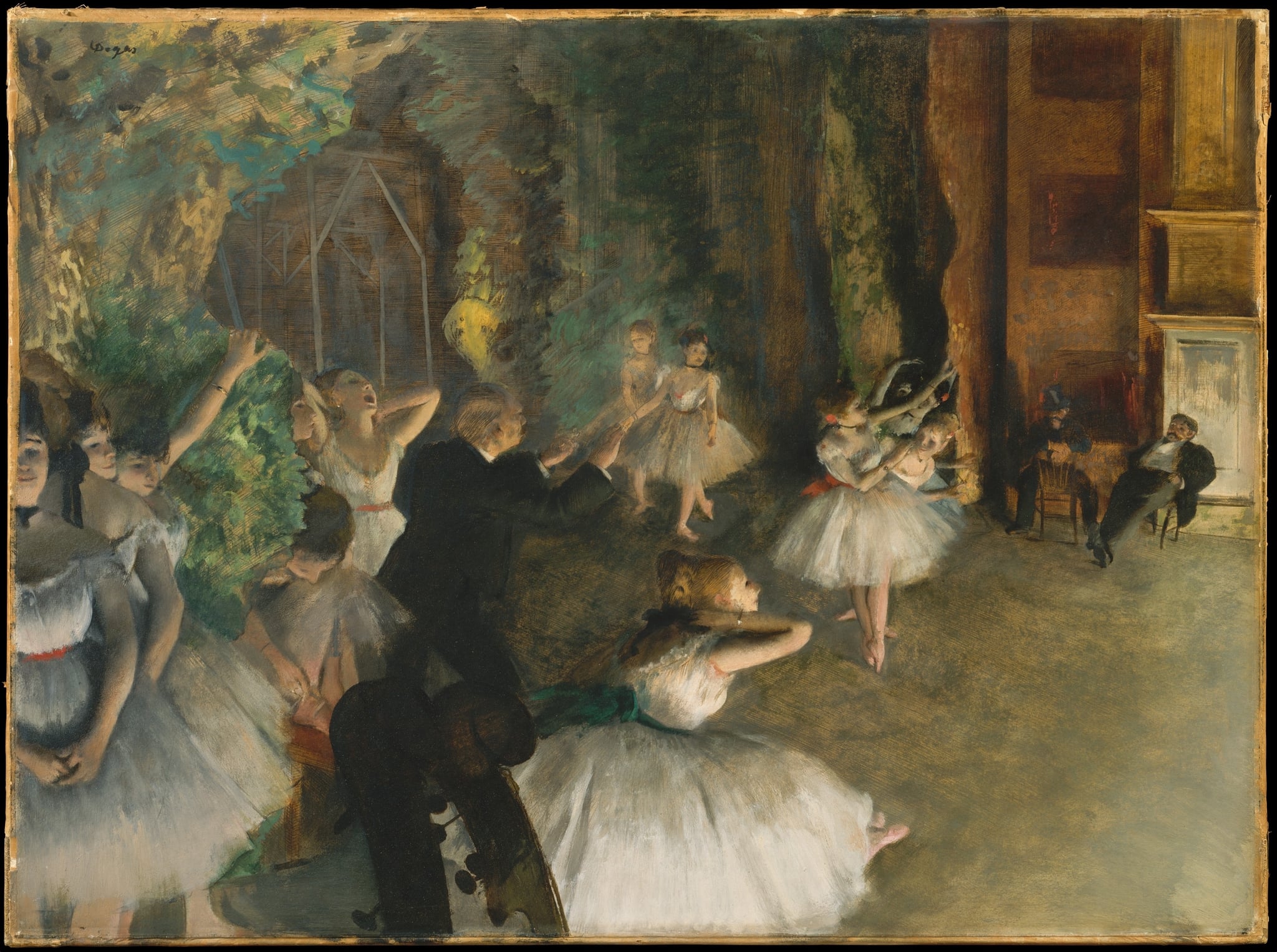
The Rehearsal of the Ballet Onstage
Edgar Degas (ca. 1874)
Degas’s The Rehearsal of the Ballet Onstage turns a moment of practice into a modern drama of work and power. Under <strong>harsh footlights</strong>, clustered ballerinas stretch, yawn, and repeat steps as a <strong>ballet master/conductor</strong> drives the tempo, while <strong>abonnés</strong> lounge in the wings and a looming <strong>double bass</strong> anchors the labor of music <sup>[1]</sup><sup>[3]</sup><sup>[4]</sup>.
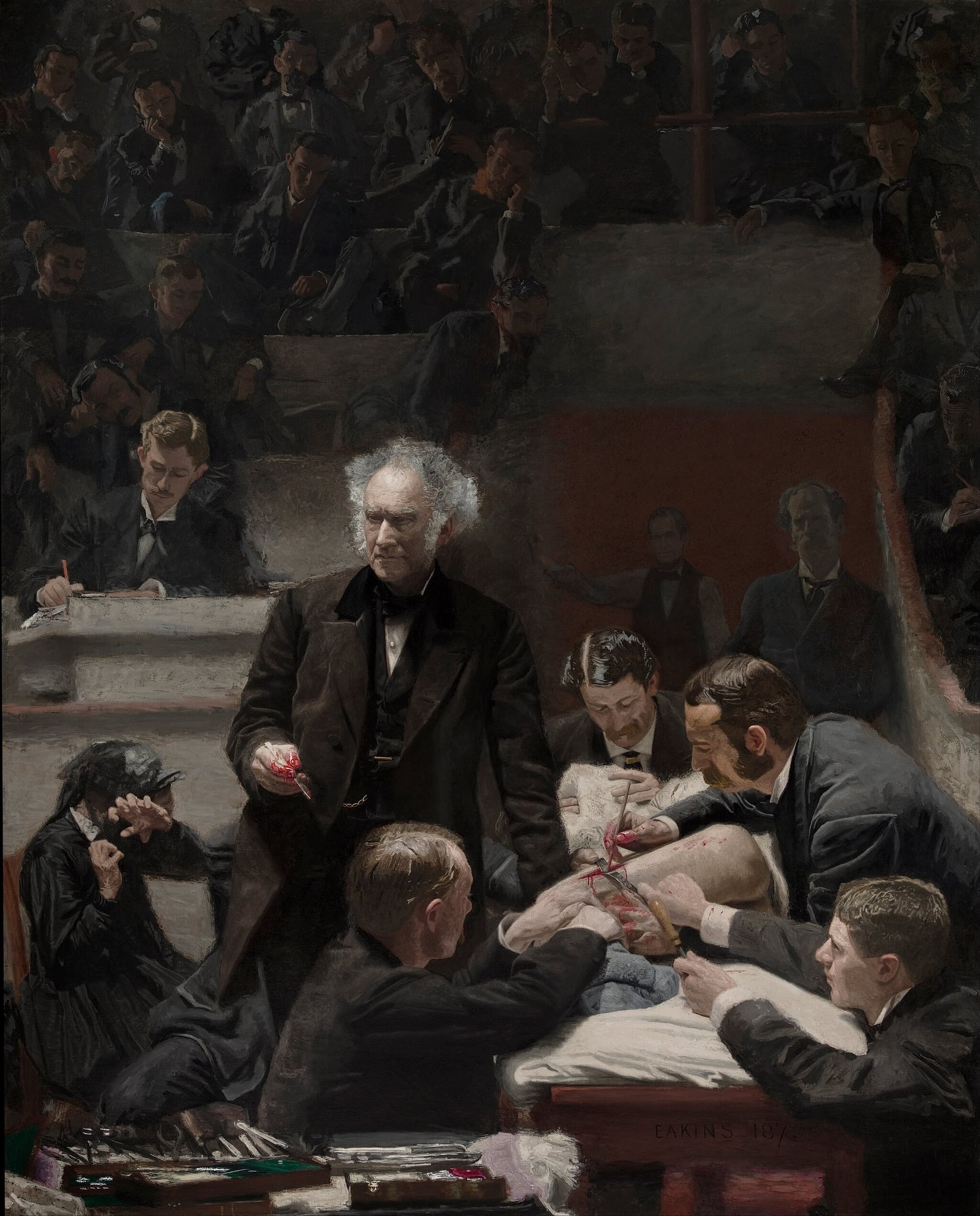
The Gross Clinic
Thomas Eakins (1875)
Thomas Eakins’s The Gross Clinic turns a surgical lesson into civic drama, casting a blaze of light on the surgeon’s white hair and bloodied fingers while students fade into shadow. With the veiled woman recoiling at left and a clerk calmly recording at right, the painting frames <strong>science as spectacle</strong> and <strong>witness as ethics</strong> <sup>[1]</sup><sup>[2]</sup>.
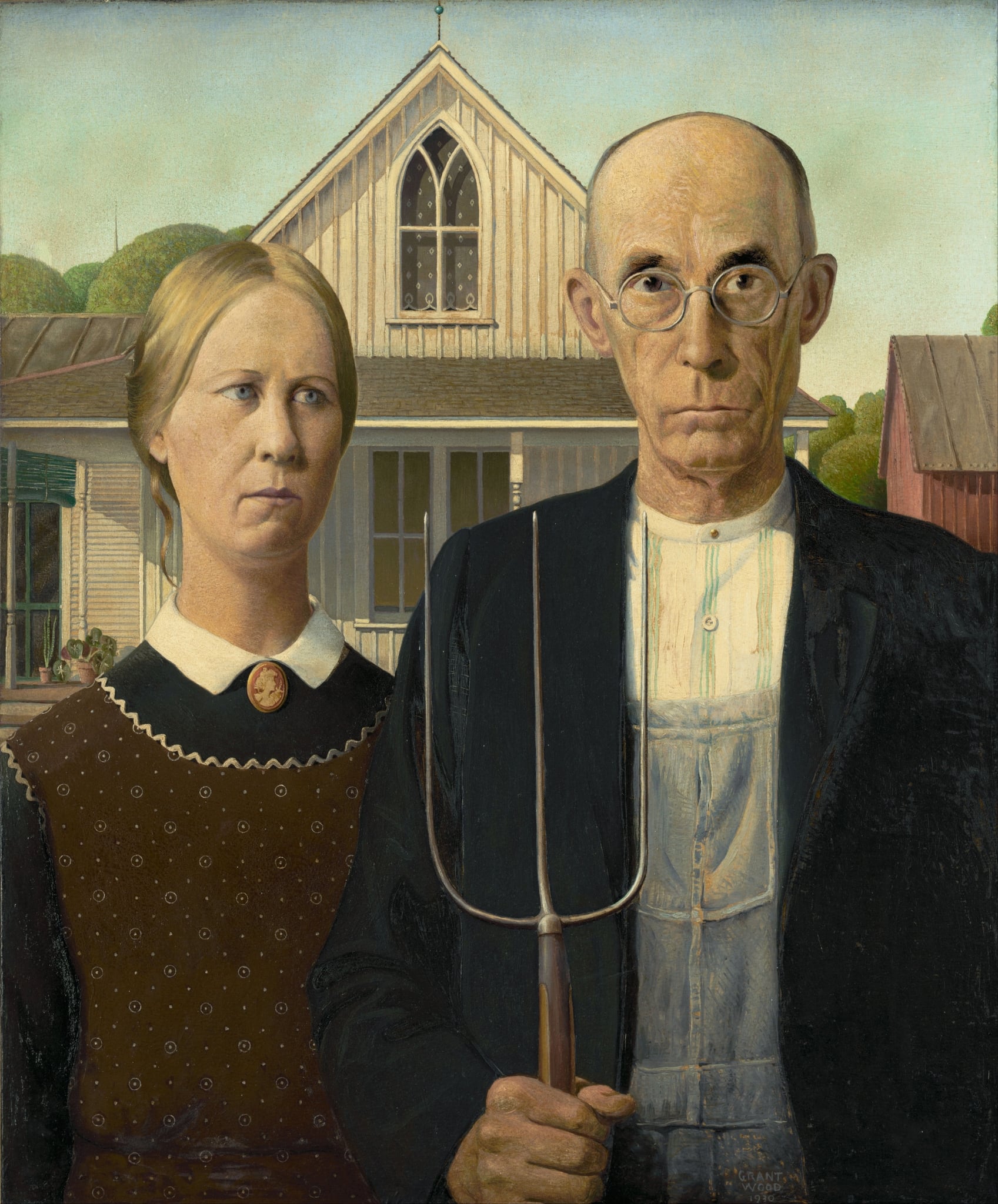
American Gothic
Grant Wood (1930)
Grant Wood’s American Gothic (1930) turns a plain Midwestern homestead into a <strong>moral emblem</strong> by binding two flinty figures to the strict geometry of a Carpenter Gothic gable and a three‑tined pitchfork. The painting’s cool precision and echoing verticals create a <strong>compressed ethic of work, order, and restraint</strong> that can read as both tribute and critique <sup>[1]</sup><sup>[2]</sup><sup>[3]</sup>.
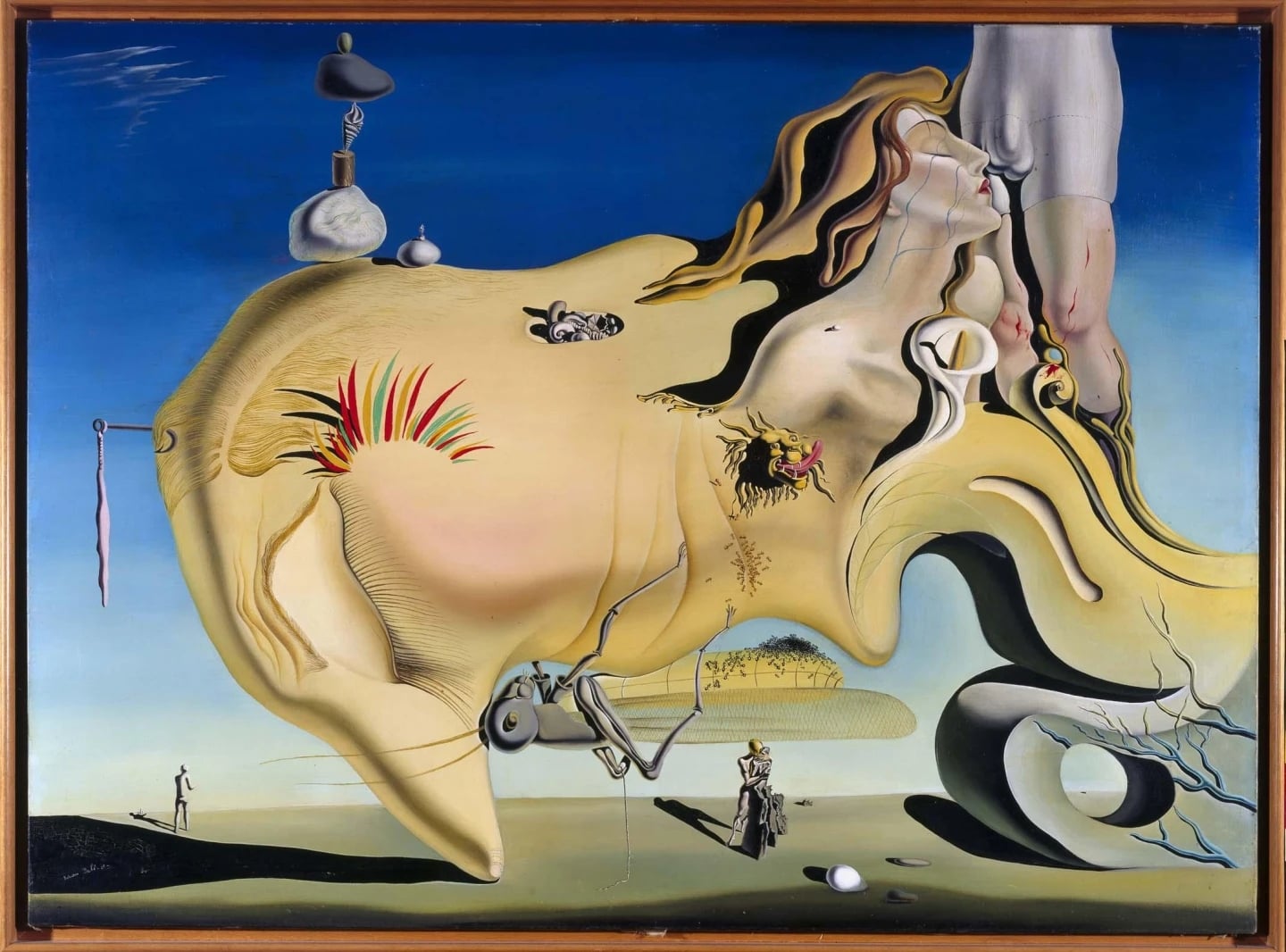
The Great Masturbator
Salvador Dali (1929)
The Great Masturbator condenses Dalí’s newly ignited desire and crippling dread into a single, biomorphic head set against a crystalline Catalan sky. Ants, a gaping grasshopper, a lion’s tongue, a bleeding knee, crutches, stones, and an egg collide to script a confession where <strong>eros</strong> and <strong>decay</strong> are inseparable <sup>[1]</sup><sup>[3]</sup><sup>[4]</sup>. Its precision staging turns autobiography into a <strong>surreal map of compulsion</strong> at the moment Gala enters his life <sup>[1]</sup>.
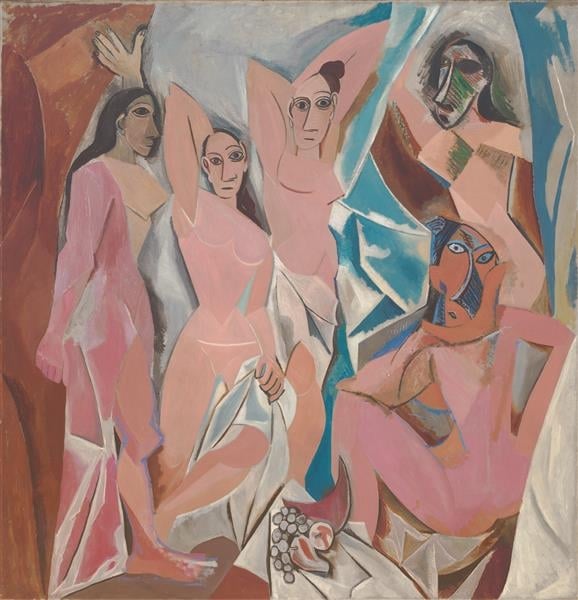
Les Demoiselles d'Avignon
Pablo Picasso (1907)
Les Demoiselles d'Avignon hurls five nudes toward the viewer in a shallow, splintered chamber, turning classical beauty into <strong>sharp planes</strong>, <strong>masklike faces</strong>, and <strong>fractured space</strong>. The fruit at the bottom reads as a sensual lure edged with threat, while the women’s direct gazes indict the beholder as participant. This is the shock point of <strong>proto‑Cubism</strong>, where Picasso reengineers how modern painting means and how looking works <sup>[1]</sup><sup>[2]</sup>.
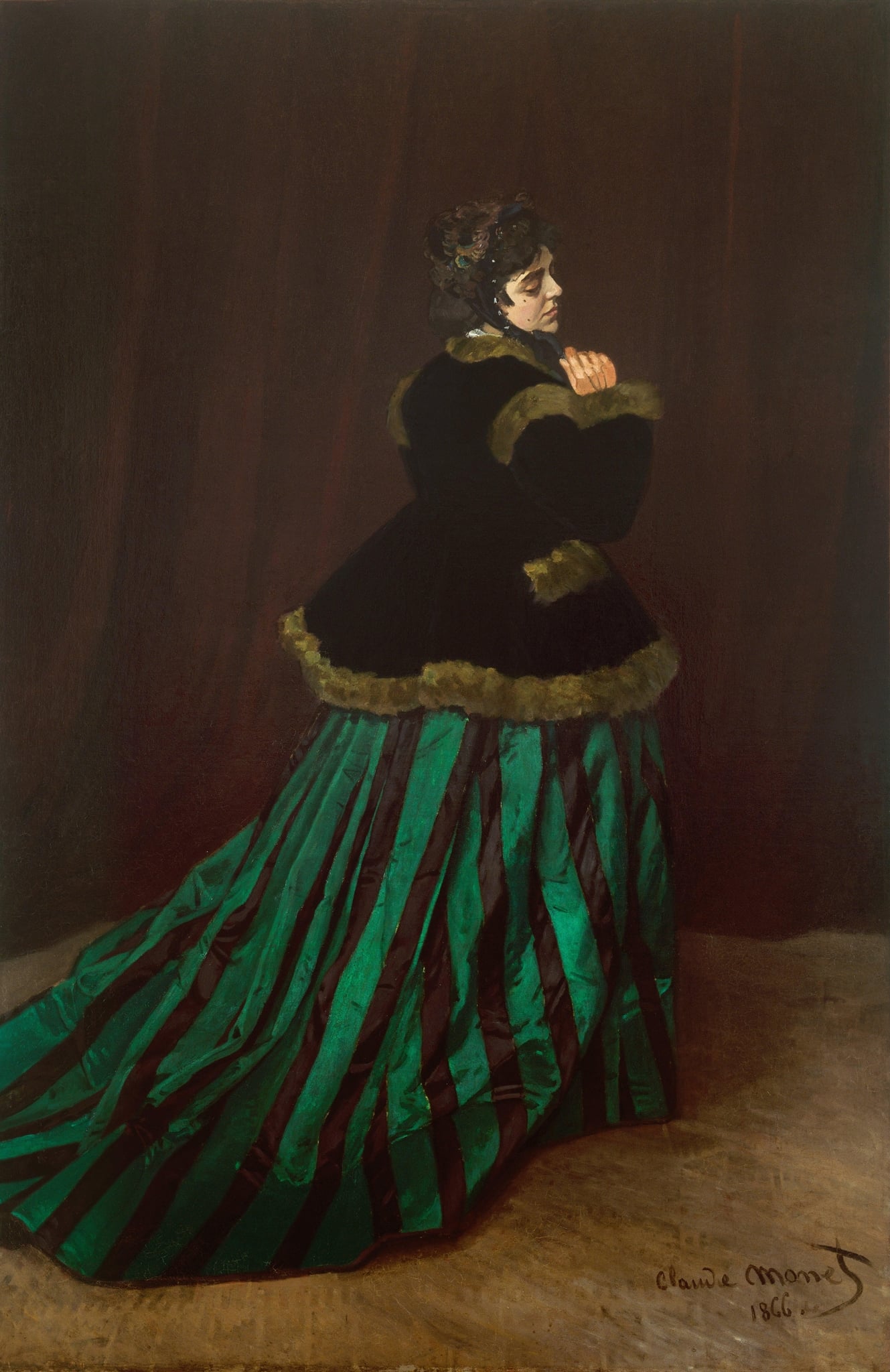
Camille (The Woman in the Green Dress)
Claude Monet (1866)
Monet’s Camille (The Woman in the Green Dress) turns a full-length portrait into a study of <strong>modern spectacle</strong>. The spotlit emerald-and-black skirt, set against a near-black curtain, makes <strong>fashion</strong> the engine of meaning and the vehicle of status.
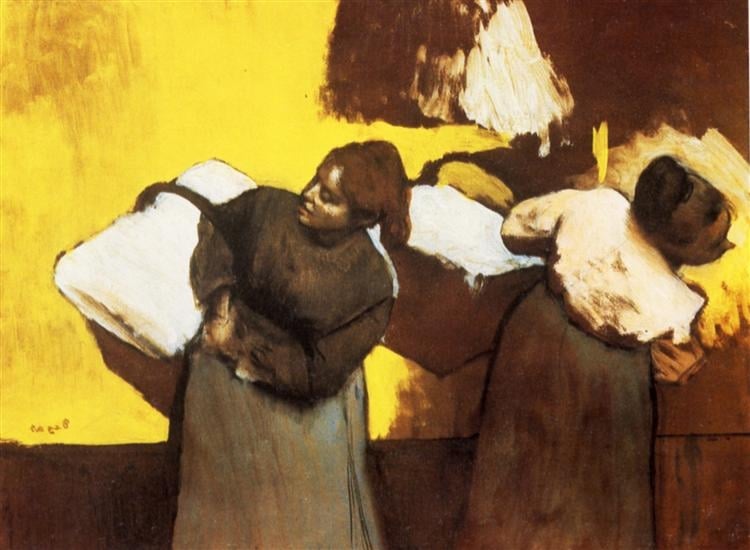
Laundresses Carrying Linen in Town
Camille Pissarro (1879)
In Laundresses Carrying Linen in Town, two working women strain under <strong>white bundles</strong> that flare against a <strong>flat yellow ground</strong> and a <strong>dark brown band</strong>. The abrupt cropping and opposing diagonals turn anonymous labor into a <strong>monumental, modern frieze</strong> of effort and motion.
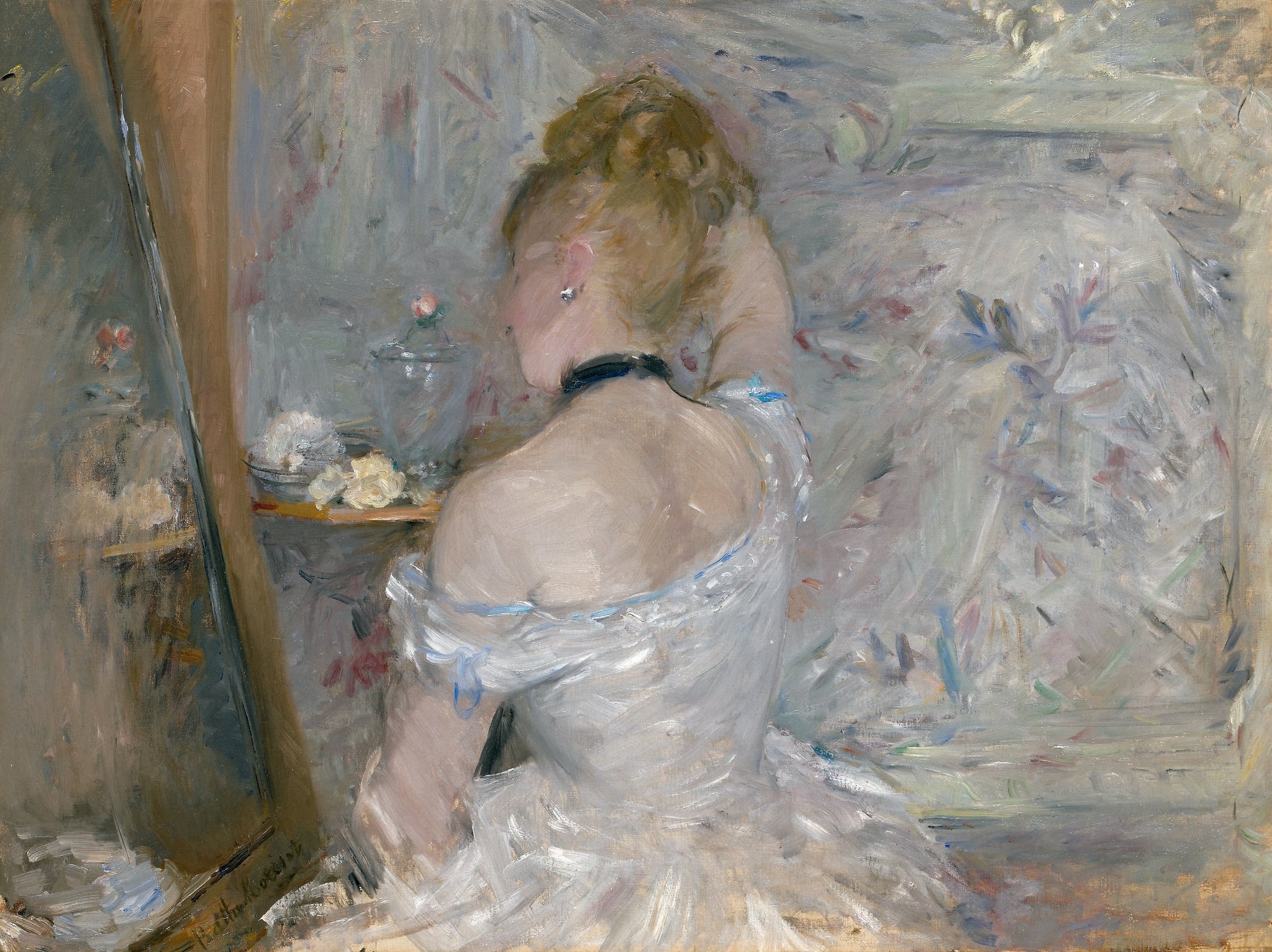
Woman at Her Toilette
Berthe Morisot (1875–1880)
Woman at Her Toilette stages a private ritual of self-fashioning, not a spectacle of vanity. A woman, seen from behind, lifts her arm to adjust her hair as a <strong>black velvet choker</strong> punctuates Morisot’s silvery-violet haze; the <strong>mirror’s blurred reflection</strong> with powders, jars, and a white flower refuses a clear face. Morisot’s <strong>feathery facture</strong> turns a fleeting toilette into modern subjectivity made visible <sup>[1]</sup>.
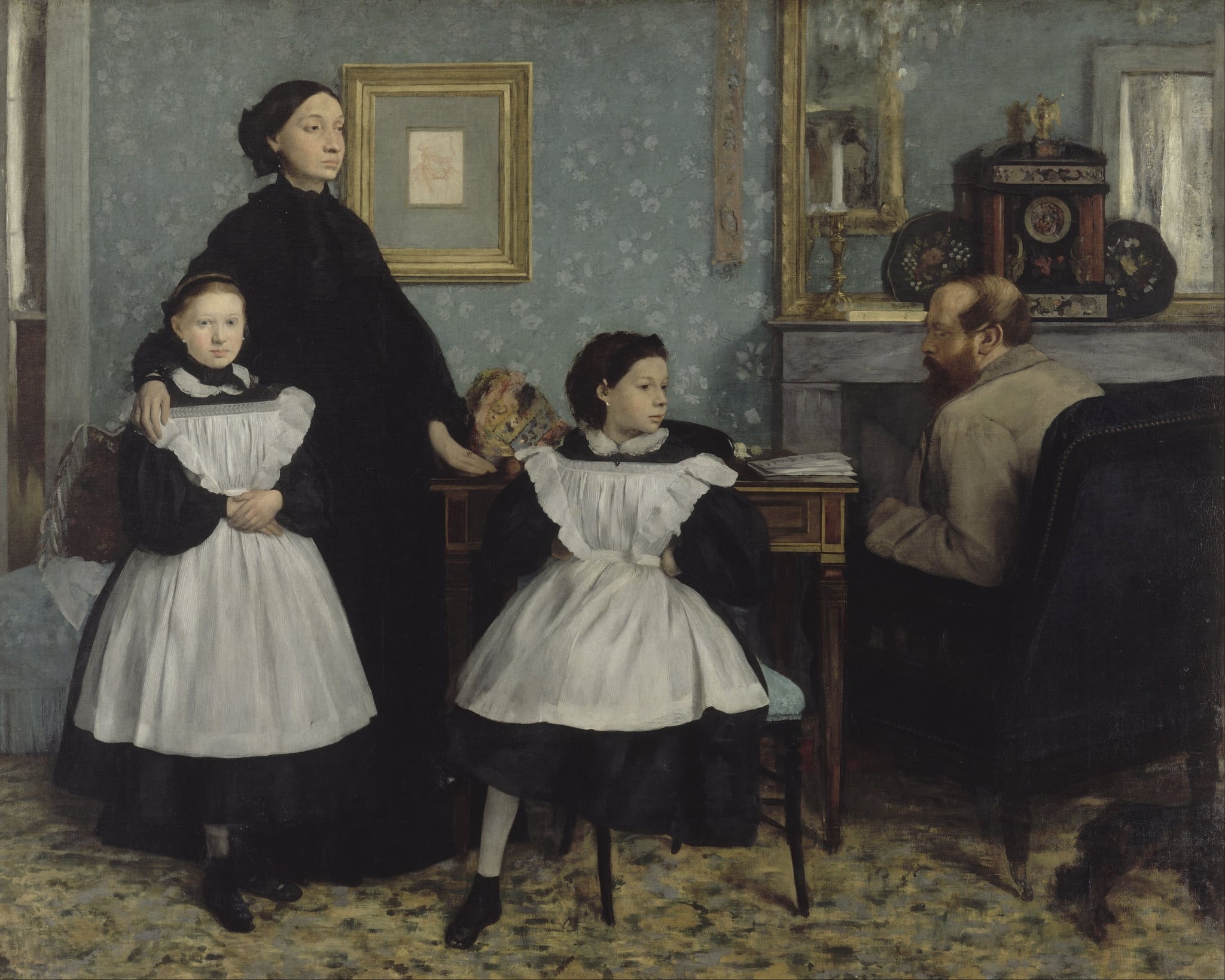
The Bellelli Family
Edgar Degas (1858–1869)
In The Bellelli Family, Edgar Degas orchestrates a poised domestic standoff, using the mother’s column of <strong>mourning black</strong>, the daughters’ <strong>mediating whiteness</strong>, and the father’s turned-away profile to script roles and distance. Rigid furniture lines, a gilt <strong>clock</strong>, and the ancestor’s red-chalk portrait create a stage where time, duty, and inheritance press on a family held in uneasy equilibrium.
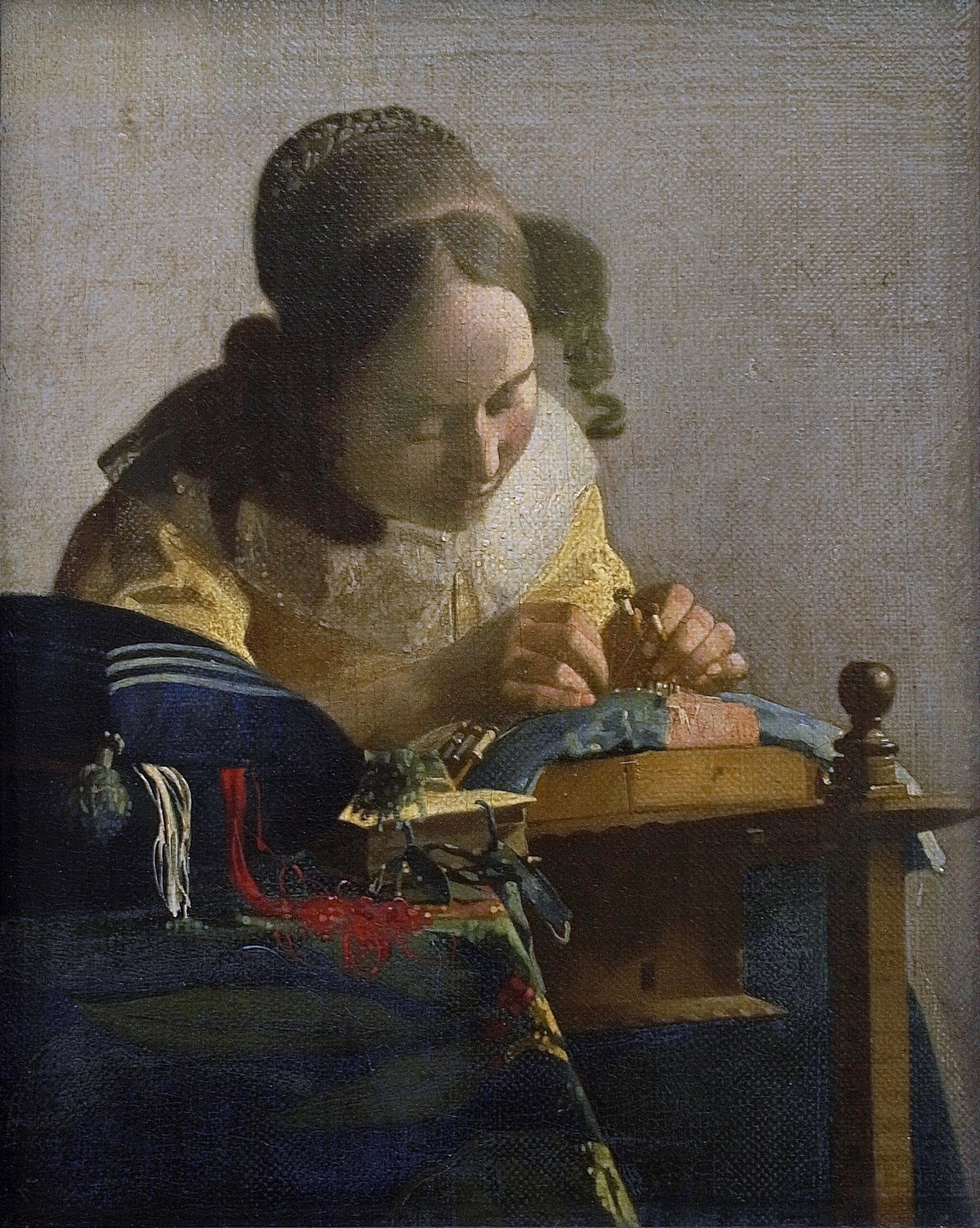
The Embroiderer
Johannes Vermeer (1669–1670)
In The Embroiderer, Johannes Vermeer condenses a world of work into a palm‑sized drama of <strong>attention</strong> and <strong>transformation</strong>. A young woman bends over a lace pillow as loose red and white threads spill in front, while a nascent pattern gathers under her poised fingers. Vermeer’s right‑hand light isolates the act of making and turns domestic labor into <strong>virtuous concentration</strong> <sup>[1]</sup>.
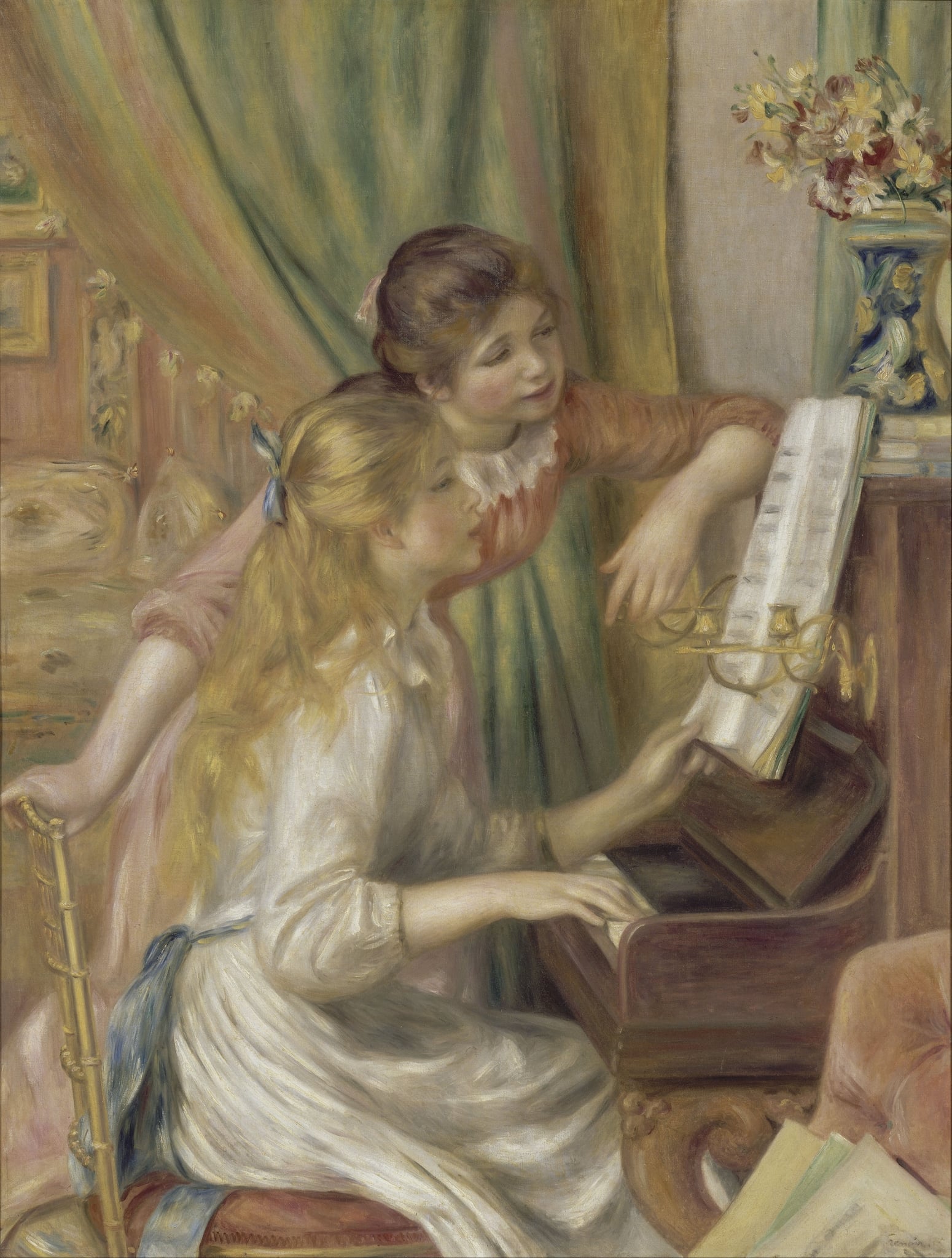
Young Girls at the Piano
Pierre-Auguste Renoir (1892)
Renoir’s Young Girls at the Piano turns a quiet lesson into a scene of <strong>attunement</strong> and <strong>bourgeois grace</strong>. Two adolescents—one seated at the keys, the other leaning to guide the score—embody harmony between discipline and delight, rendered in Renoir’s late, <strong>luminous</strong> touch <sup>[1]</sup><sup>[2]</sup>.
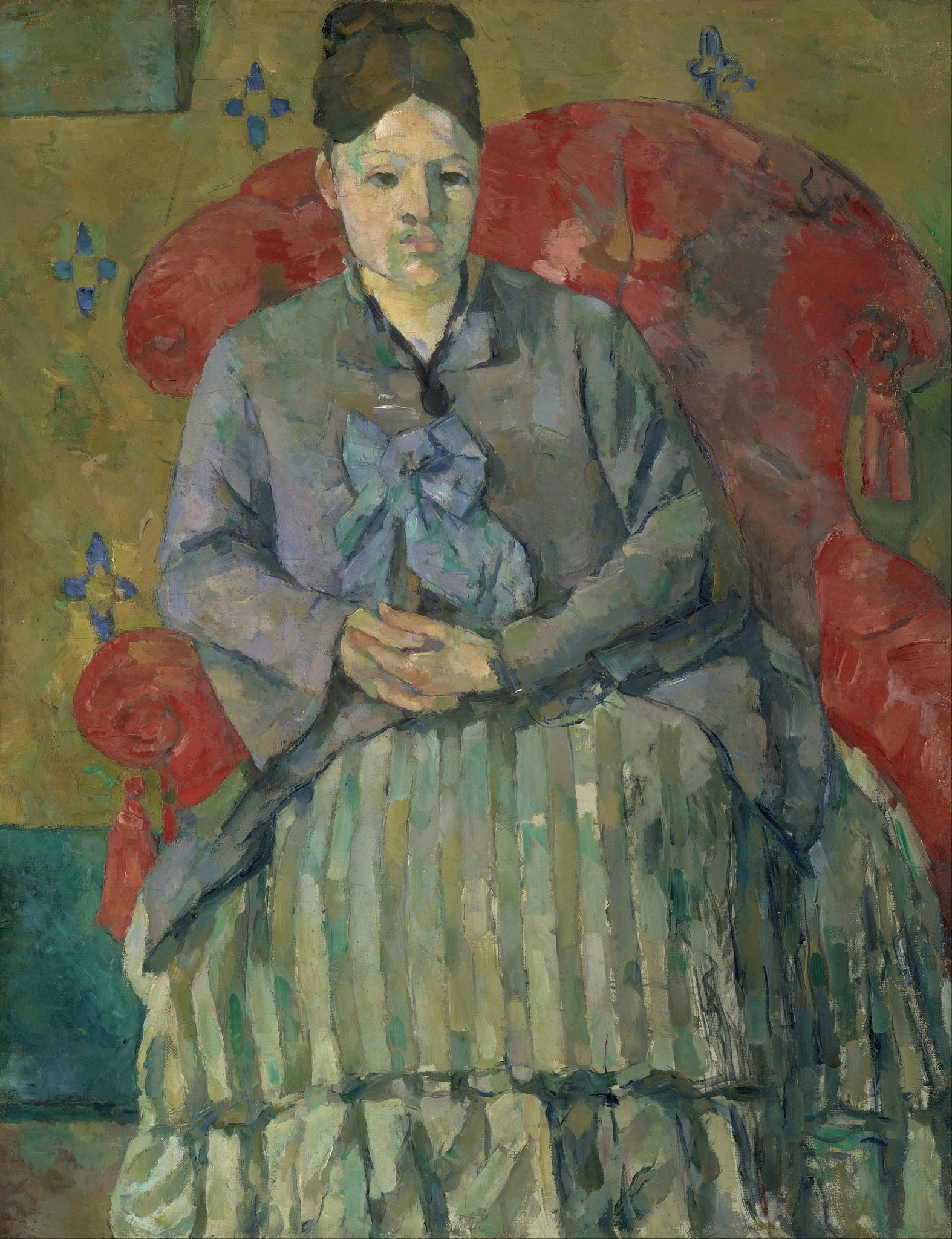
Madame Cézanne in a Red Armchair
Paul Cézanne (about 1877)
Paul Cézanne’s Madame Cézanne in a Red Armchair (about 1877) turns a domestic sit into a study of <strong>color-built structure</strong> and <strong>compressed space</strong>. Cool blue-greens of dress and skin lock against the saturated <strong>crimson armchair</strong>, converting likeness into an inquiry about how painting makes stability visible <sup>[1]</sup><sup>[3]</sup>.
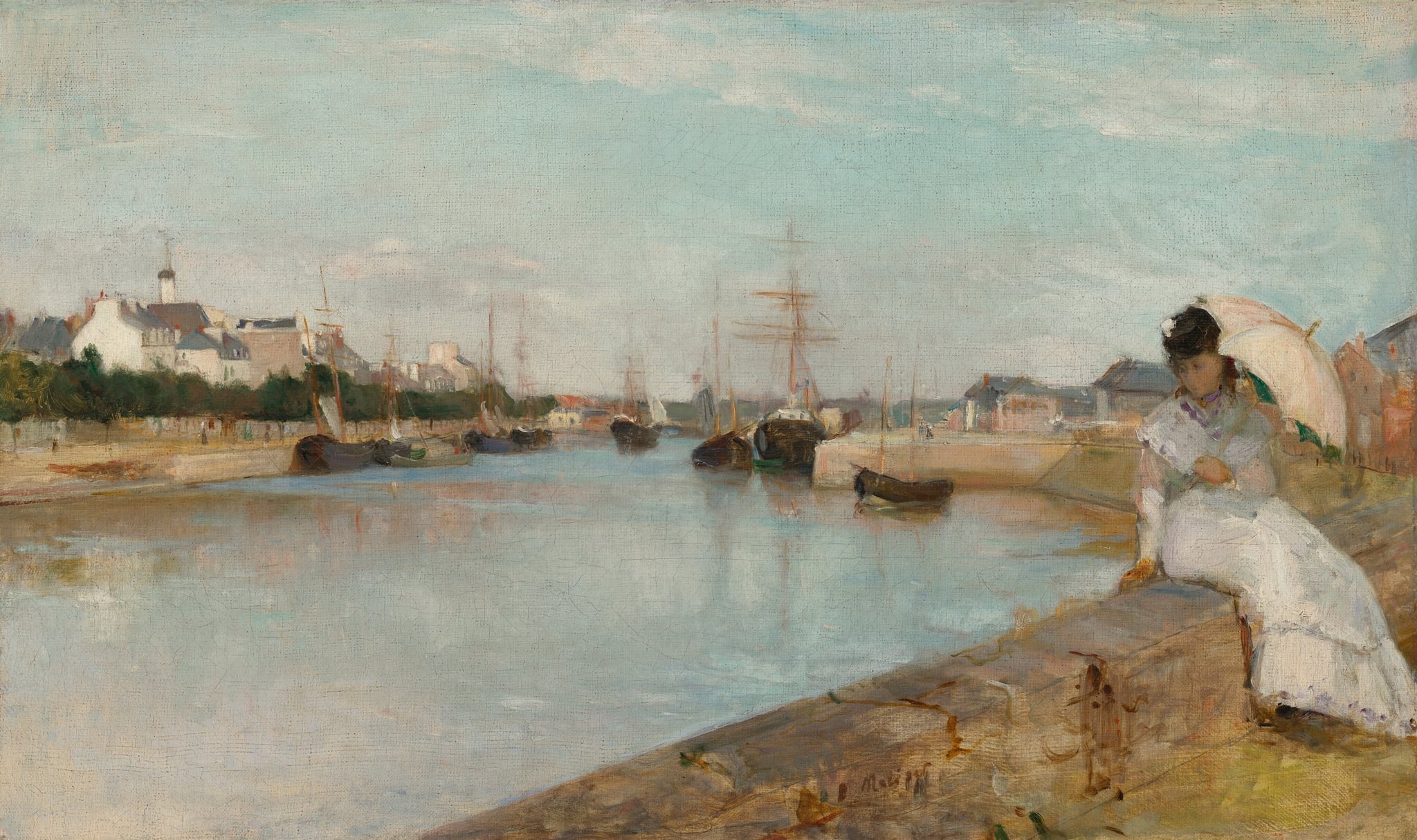
The Harbour at Lorient
Berthe Morisot (1869)
Berthe Morisot’s The Harbour at Lorient stages a quiet tension between <strong>private reverie</strong> and <strong>public movement</strong>. A woman under a pale parasol sits on the quay’s stone lip while a flotilla of masted boats idles across a silvery basin, their reflections dissolving into light. Morisot’s <strong>pearly palette</strong> and brisk brushwork make the water read as time itself, holding stillness and departure in the same breath <sup>[1]</sup>.
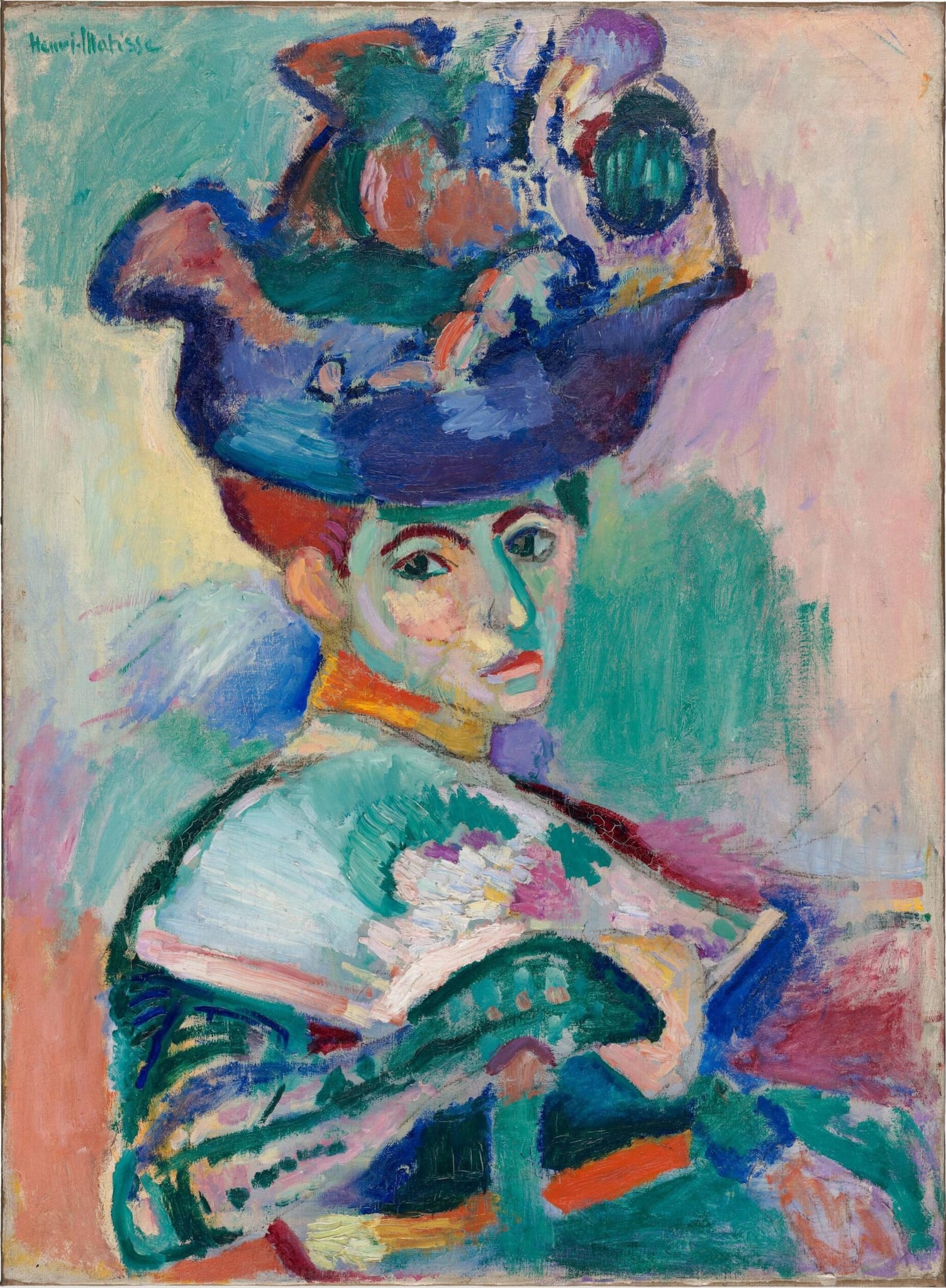
Woman with a Hat
Henri Matisse (1905)
In Woman with a Hat, Henri Matisse turns portraiture into a laboratory for <strong>pure color</strong> and <strong>modern identity</strong>. Jagged greens and violets carve the face; the hat detonates into a crown of brushstrokes; a fan slices the torso into bright planes. The result declares Fauvism’s credo: <strong>feeling over description</strong> <sup>[1]</sup><sup>[2]</sup>.
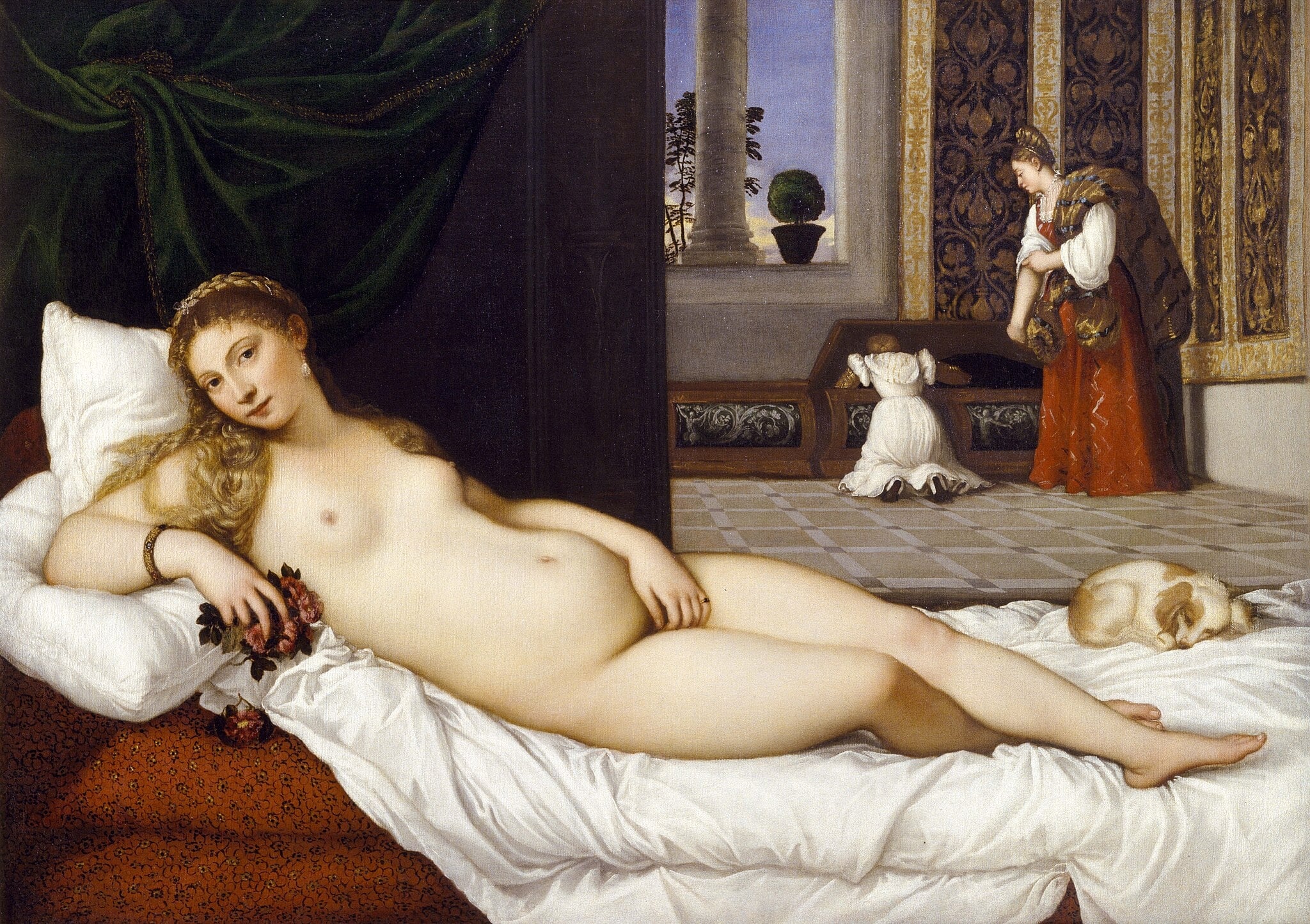
Venus of Urbino
Titian (1538)
Titian’s Venus of Urbino turns the mythic goddess into an ideal bride, merging frank <strong>eroticism</strong> with the codes of <strong>marital fidelity</strong>. In a Venetian bedroom, the nude’s direct gaze, roses, sleeping lapdog, and attendants at a cassone bind desire to domestic virtue and fertility <sup>[1]</sup><sup>[2]</sup>.
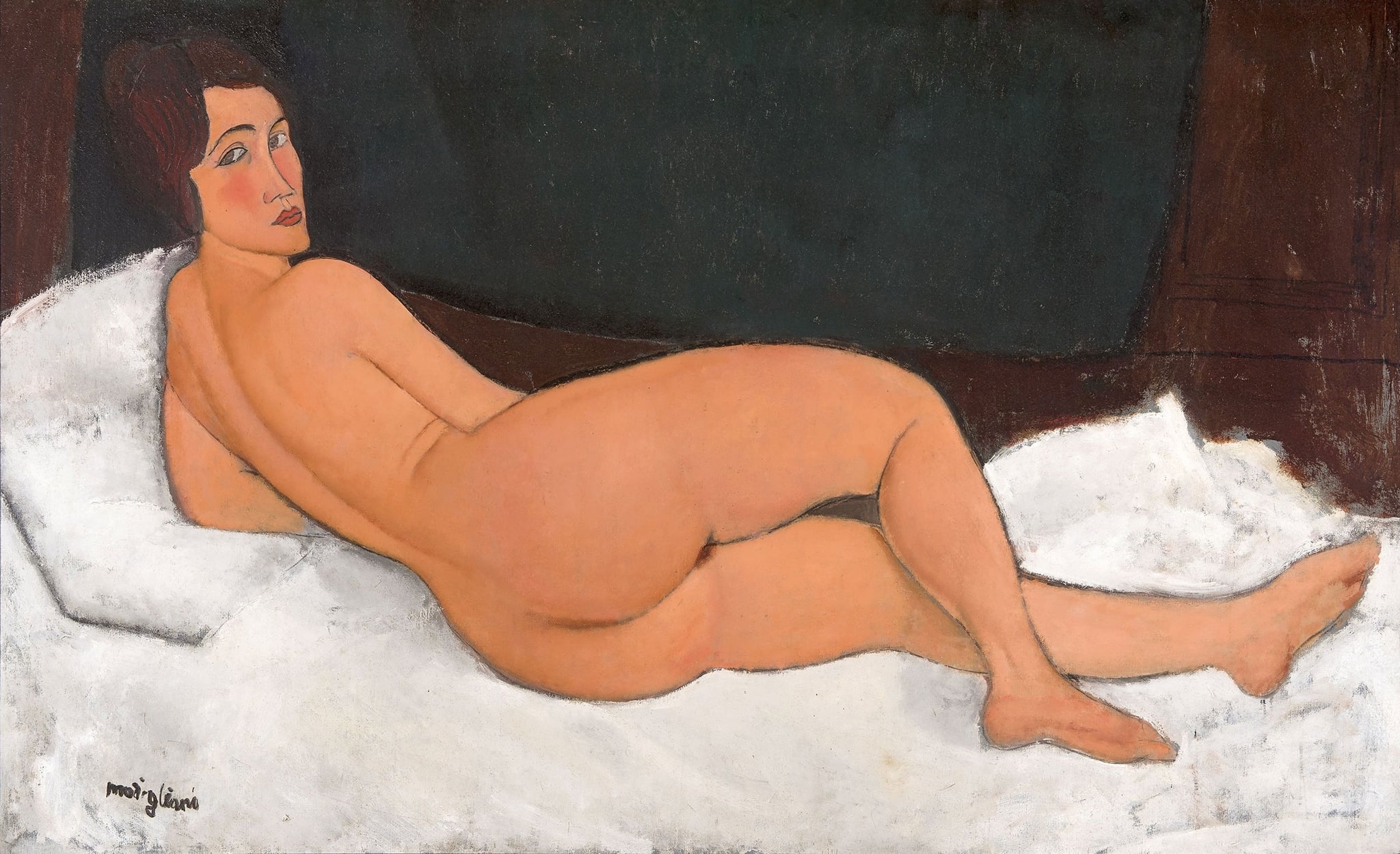
Nu couché (sur le côté gauche)
Amedeo Modigliani (1917)
Nu couché (sur le côté gauche) is a 1917 oil painting in which Amedeo Modigliani monumentalizes a reclining nude through a continuous, sculptural contour and a flattened, nearly void backdrop. The figure’s warm terracotta body, set against crisp white sheets and a dark field, fuses <strong>modern candor</strong> with <strong>classical poise</strong> <sup>[1]</sup><sup>[2]</sup>. The direct, appraising gaze and masklike face assert a new, <strong>autonomous modern nude</strong>.
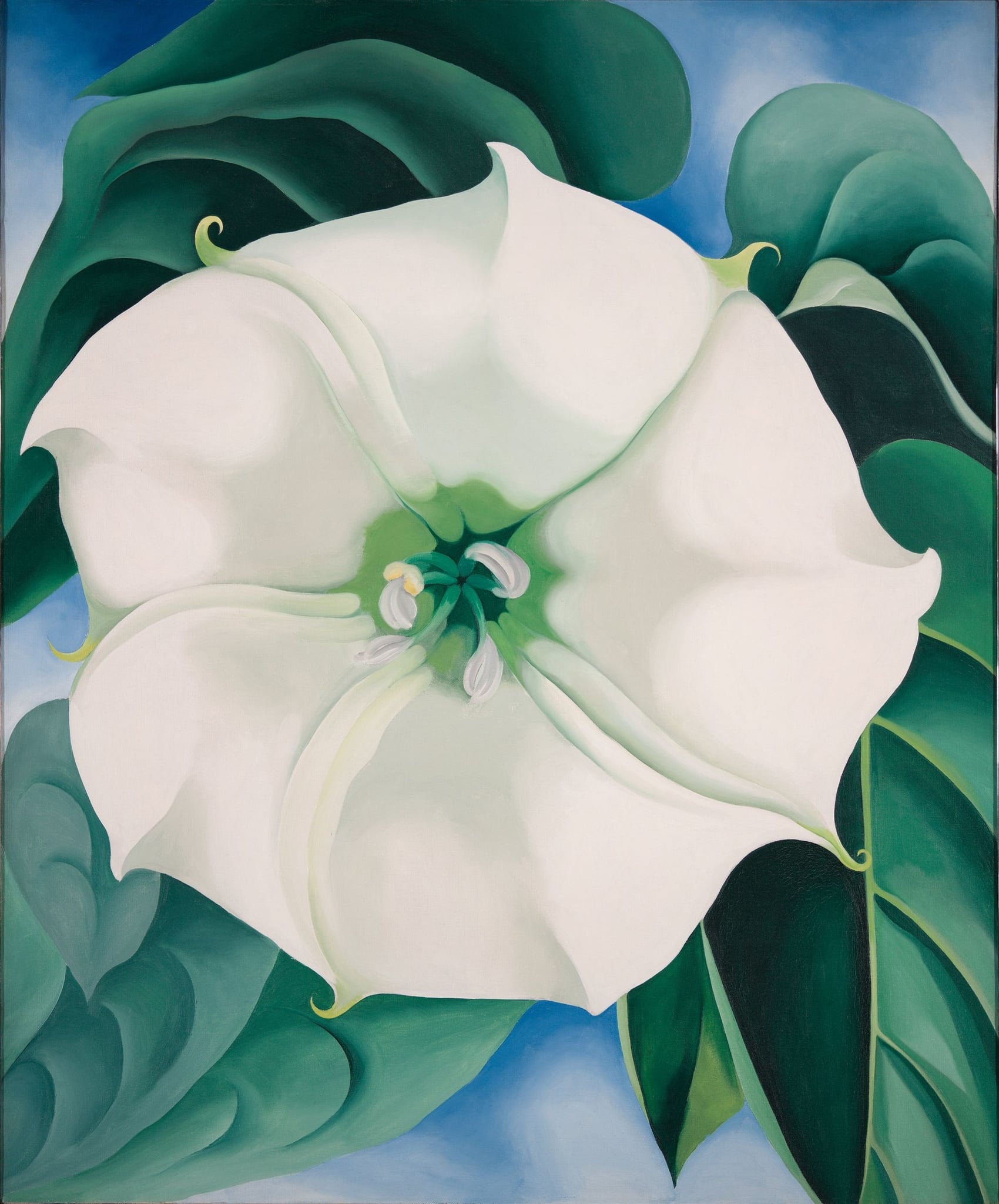
Jimson Weed/White Flower No. 1
Georgia O’Keeffe (1932)
Georgia O’Keeffe’s Jimson Weed/White Flower No. 1 turns a humble roadside blossom into a <strong>monumental icon</strong> of American modernism. The enlarged, close-cropped white trumpet radiates from a cool green throat, set against undulating leaves and a calm blue ground, so the viewer confronts <strong>form, scale, and stillness</strong> rather than botanical detail. Its immaculate bloom, drawn from the poisonous jimson weed, carries a charged tension between <strong>purity and peril</strong>.
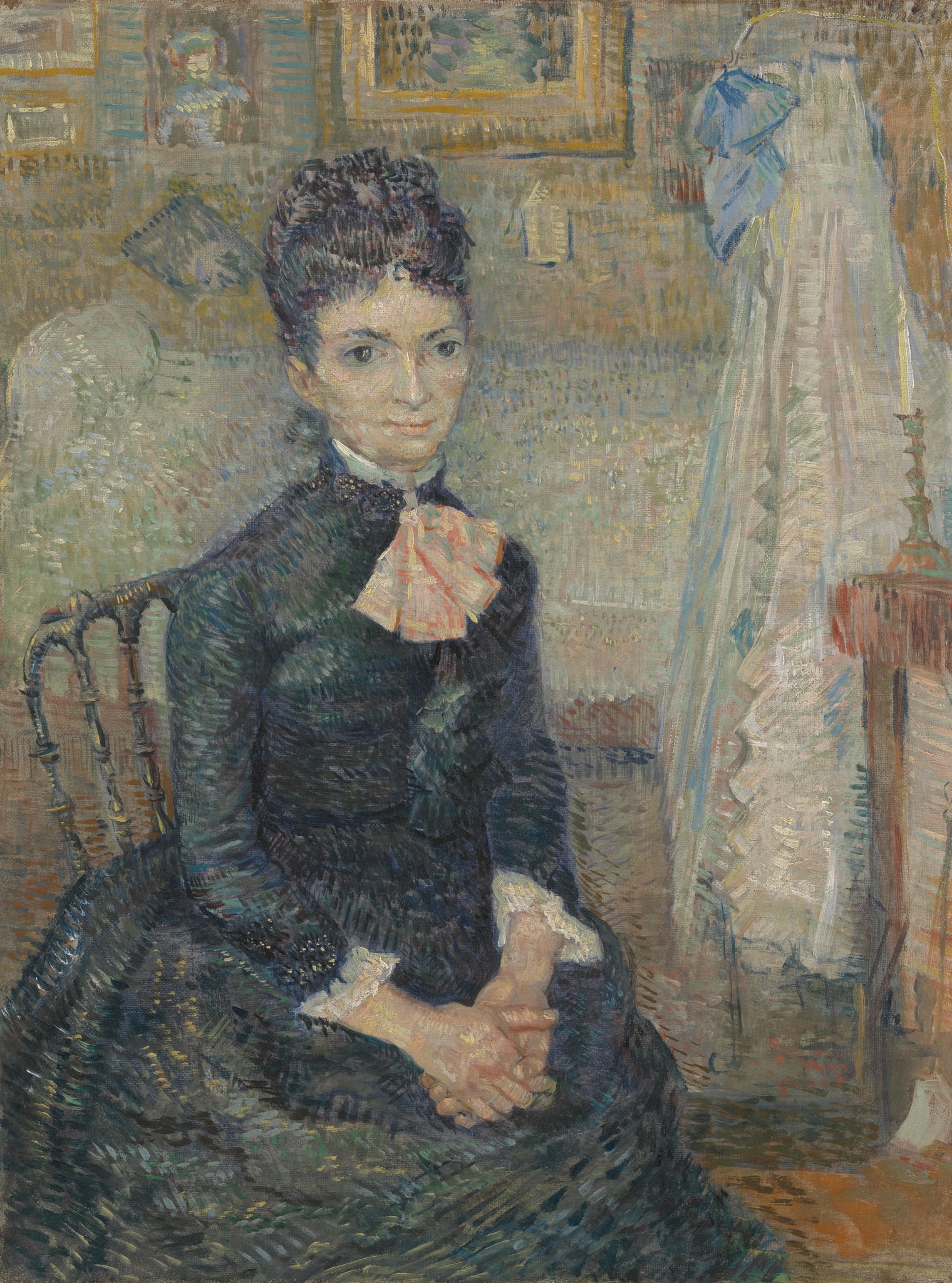
Portrait of Léonie Rose Charbuy-Davy
Vincent van Gogh (1887)
Vincent van Gogh’s Portrait of Léonie Rose Charbuy-Davy stages a composed, middle-class interior where a seated woman’s folded hands and dark blue-green dress meet a tremulous field of short, vibrating strokes. The cradle, fireplace glow, and dotted facture refract her poised exterior through <strong>modern, experimental color and touch</strong> <sup>[1]</sup><sup>[3]</sup>. The result is a portrait of <strong>maternal identity</strong> as much as a likeness, anchored by the hearth and cradle yet unsettled by the flicker of the paint itself <sup>[1]</sup>.
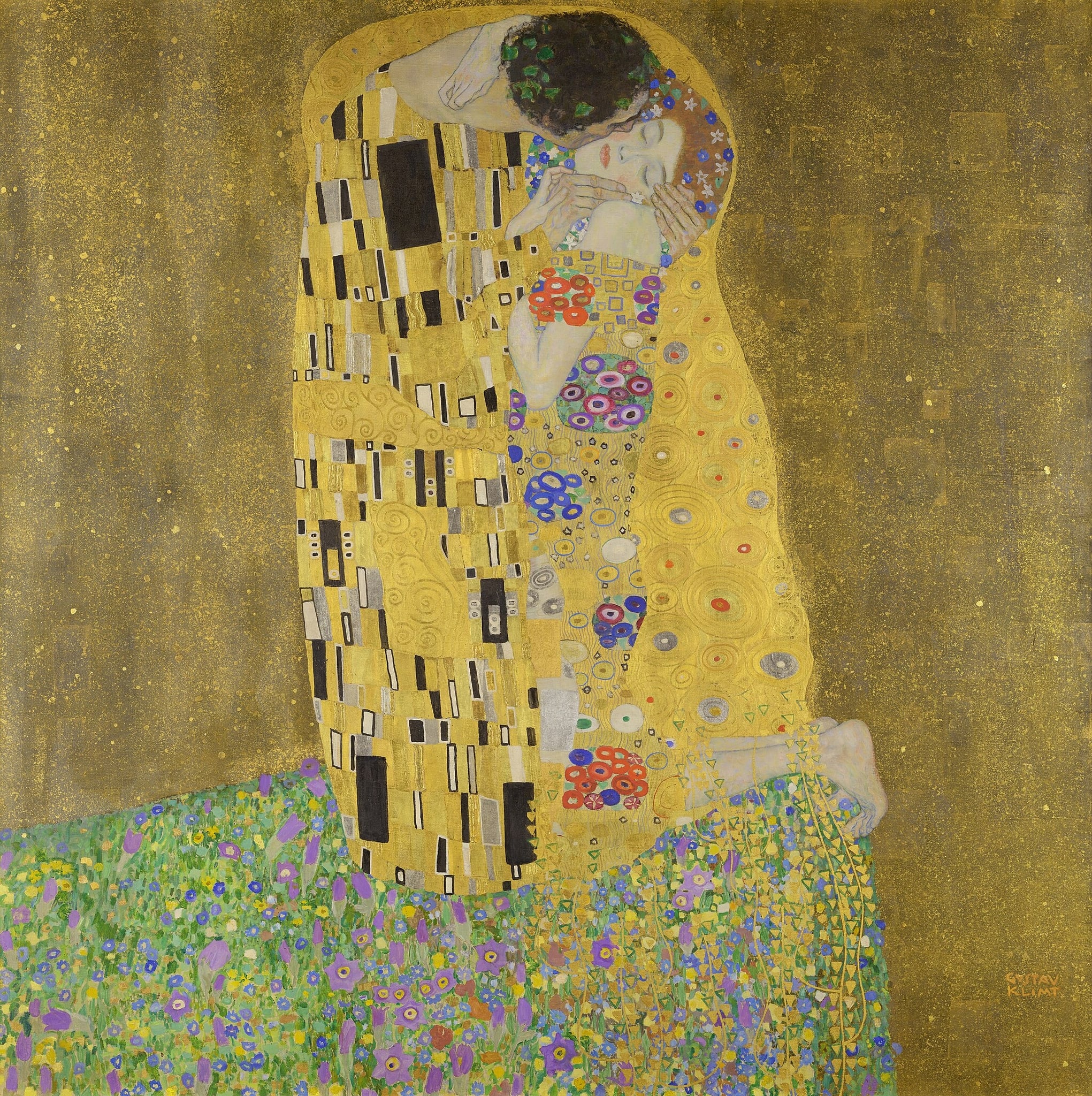
The Kiss (Lovers)
Gustav Klimt (1907–1908 (Belvedere lists 1908/09))
The Kiss (Lovers) crystallizes Klimt’s <strong>Golden Period</strong> ideal: erotic union staged as a sacred vision. Two bodies fuse beneath a single golden mantle, poised on a flowered ledge at the brink of the unknown, where <strong>pattern becomes symbol</strong> and intimacy becomes icon.
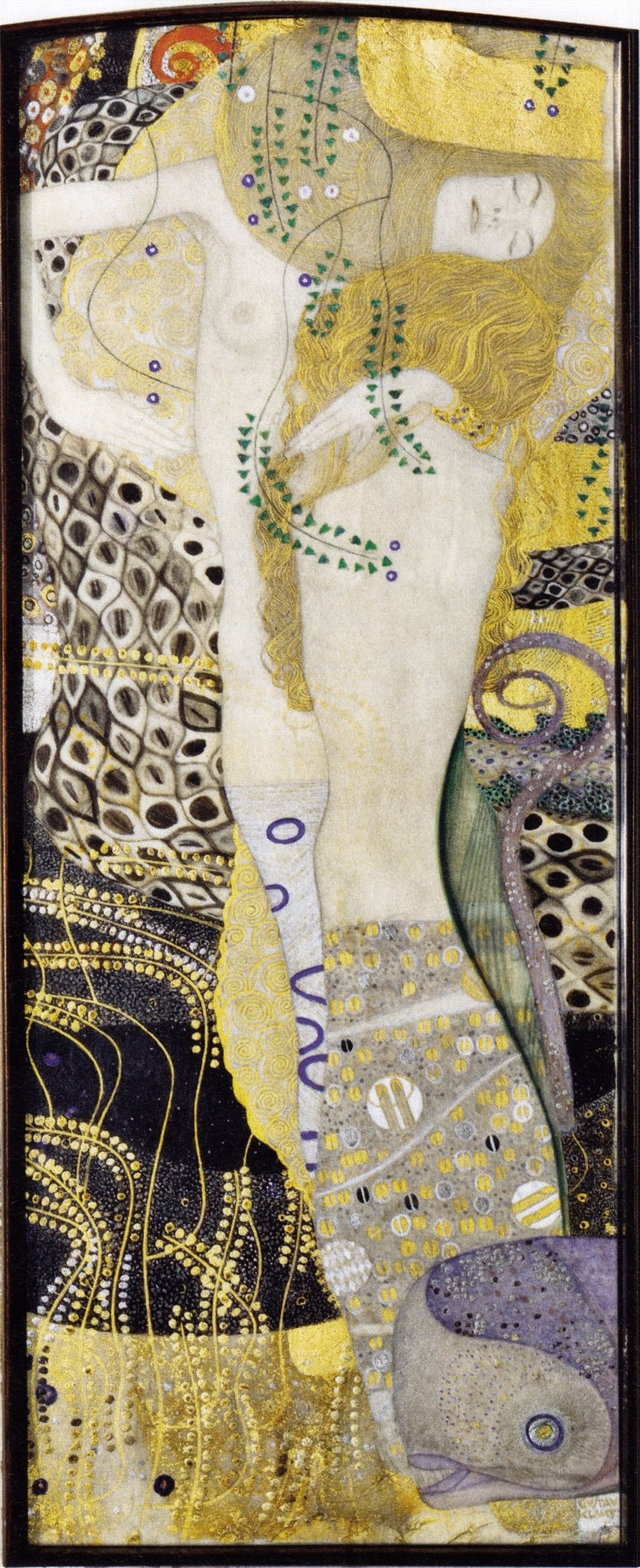
Girlfriends (Water Serpents I)
Gustav Klimt (1904; last revisions by 1907)
Gustav Klimt’s Girlfriends (Water Serpents I) stages two elongated nudes drifting in a jeweled, underwater field where bodies and ornament fuse into a single, <strong>luminous</strong> surface. Closed eyes, interlaced arms, and hair that streams like <strong>currents</strong> seal the scene in intimate secrecy, while metallic scales, eye-shaped ovals, and a watchful fish charge the water with <strong>erotic</strong> and <strong>mythic</strong> tension <sup>[1]</sup><sup>[2]</sup><sup>[3]</sup>.
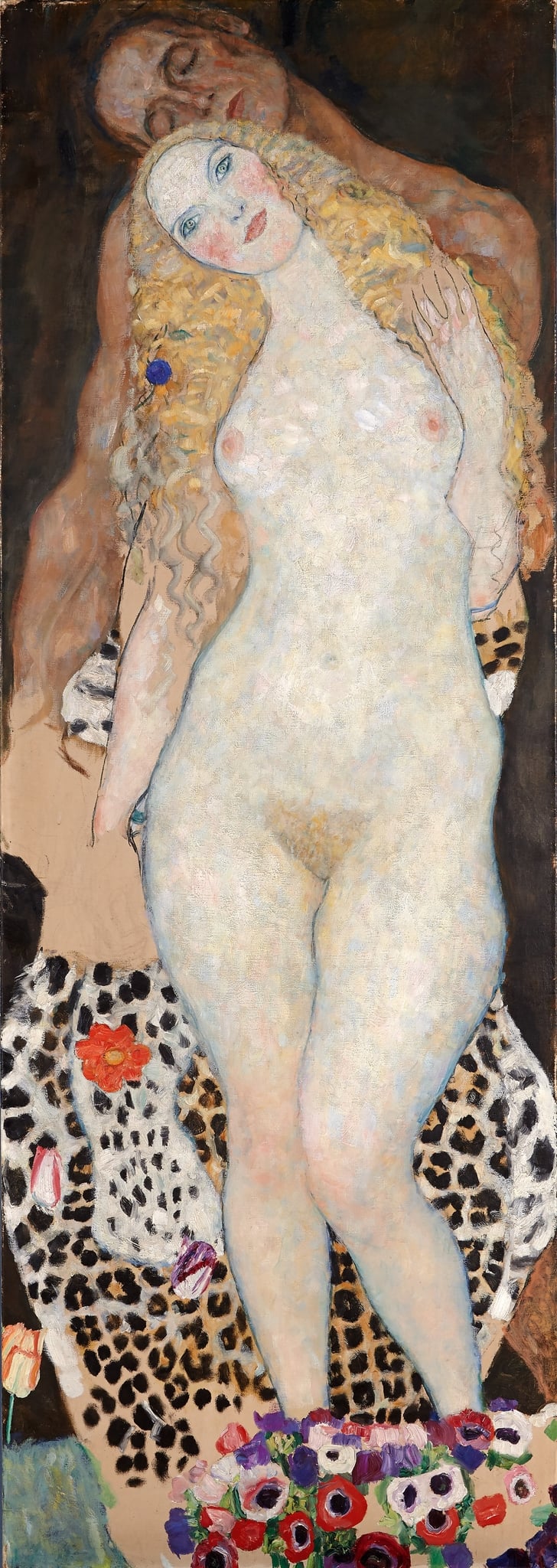
Adam and Eve
Gustav Klimt (1916–1918 (unfinished))
Gustav Klimt’s Adam and Eve recasts the biblical pair as a <strong>sensual, timeless allegory</strong> rather than a didactic tale. Eve’s <strong>luminous, opalescent body</strong> and direct gaze dominate, while Adam recedes in shadow, enfolding her amid a <strong>leopard pelt</strong> and a <strong>carpet of anemones</strong> that signal erotic vitality and fertility <sup>[2]</sup><sup>[3]</sup>.
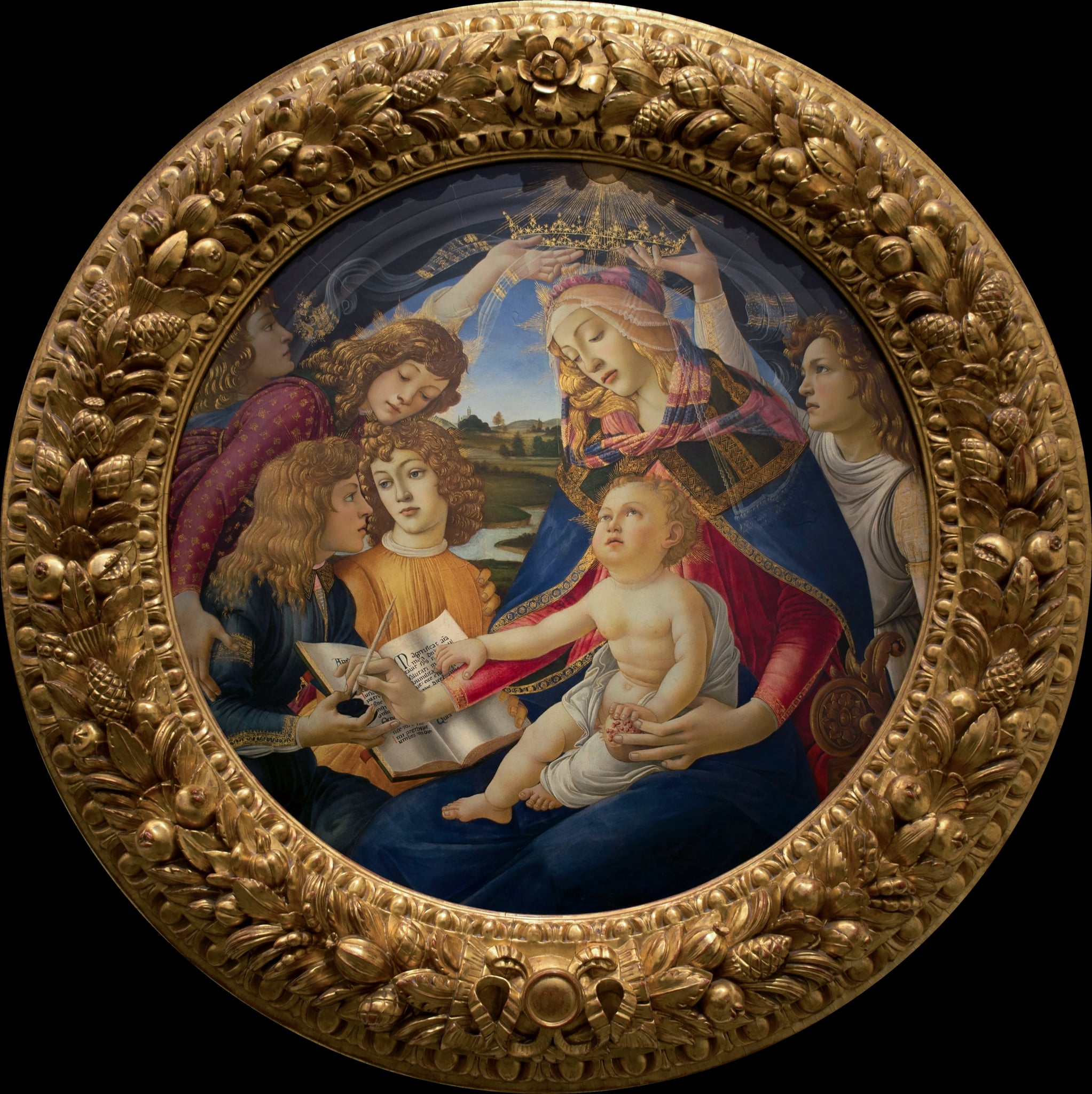
Madonna of the Magnificat
Sandro Botticelli (c. 1483)
Botticelli’s Madonna of the Magnificat is a circular panel where the Virgin, <strong>crowned by angels</strong>, writes the <strong>Magnificat</strong> as the Christ Child guides her hand. A split <strong>pomegranate</strong> in the Child’s grasp prefigures the Passion while the wingless, courtly angels and a Tuscan view bind sacred mystery to Florentine life <sup>[1]</sup><sup>[2]</sup>. The tondo’s swirl of fabrics and gold makes theology visible as a choreography of <strong>praise, prophecy, and sacrifice</strong>.
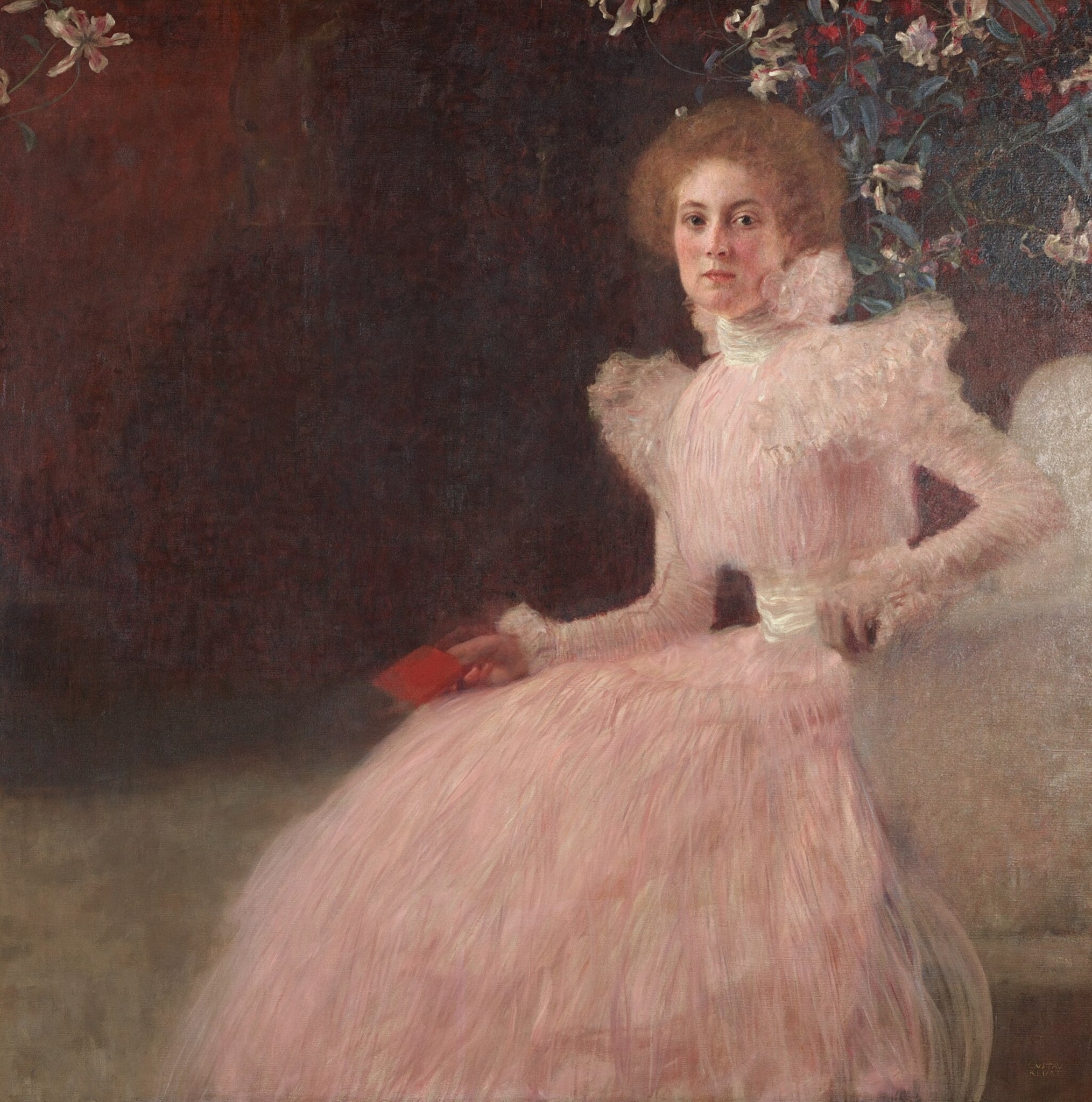
Sonja Knips
Gustav Klimt (1897/1898)
In Sonja Knips, Gustav Klimt stages a poised young woman as a modern self—held taut between <strong>lucid presence</strong> and <strong>ornamental dissolution</strong>. The square canvas, the feathery pink dress, the climbing white lilies, and the single <strong>red sketchbook</strong> in her hand crystallize an identity that is reflective, intelligent, and self‑aware within a decorous world <sup>[1]</sup><sup>[2]</sup><sup>[4]</sup>.
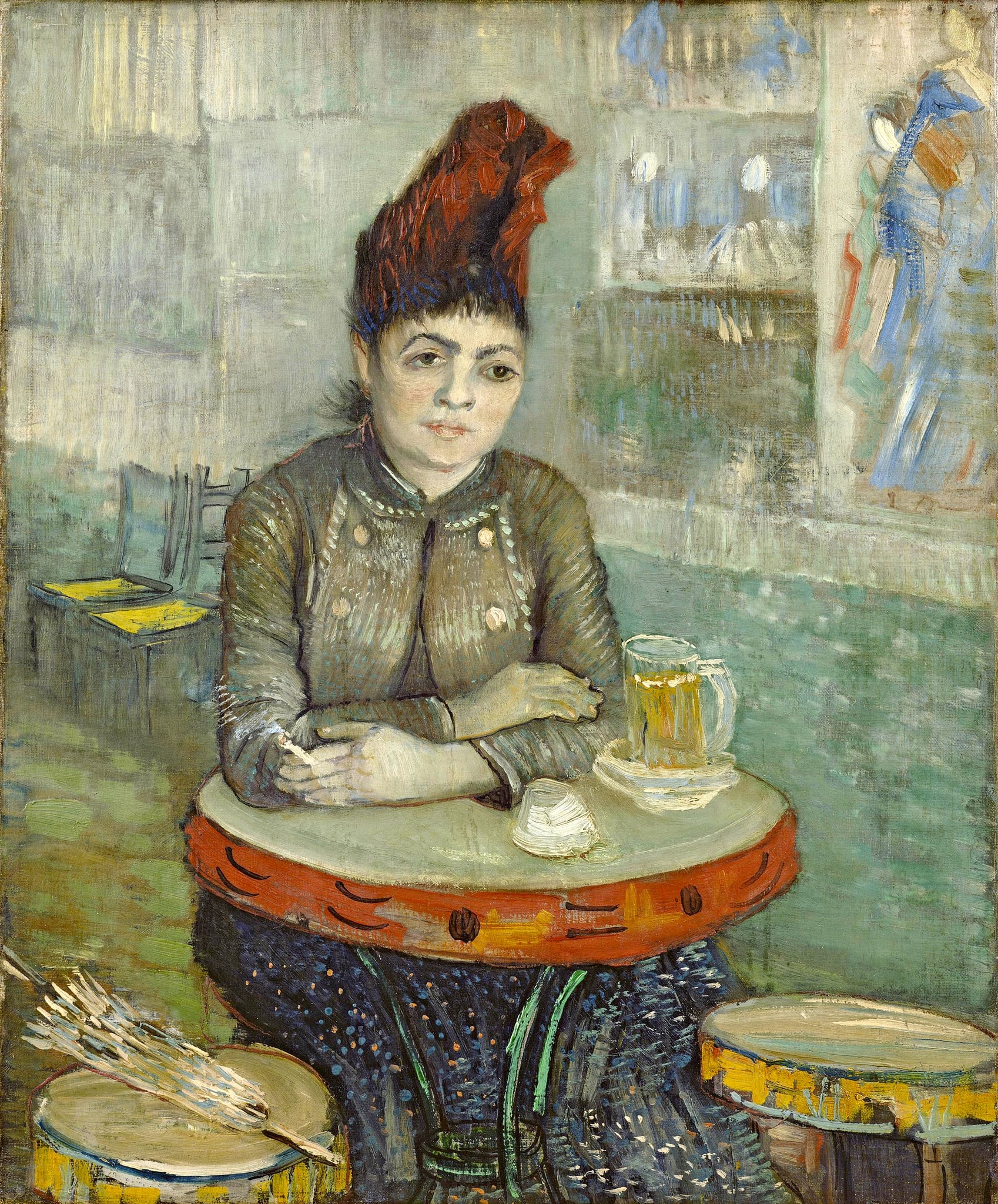
In the Café: Agostina Segatori in Le Tambourin
Vincent van Gogh (1887 (Jan–Mar))
Van Gogh casts Agostina Segatori at a tiny, tambourine‑like café table, turning Le Tambourin into a <strong>stage of modern life</strong>. Cool greens and greys make the red <strong>flame‑plume hat</strong> and the foaming <strong>beer</strong> flare, while folded arms and a set‑aside <strong>parasol</strong> register private fatigue amid public display <sup>[1]</sup><sup>[2]</sup><sup>[3]</sup>.
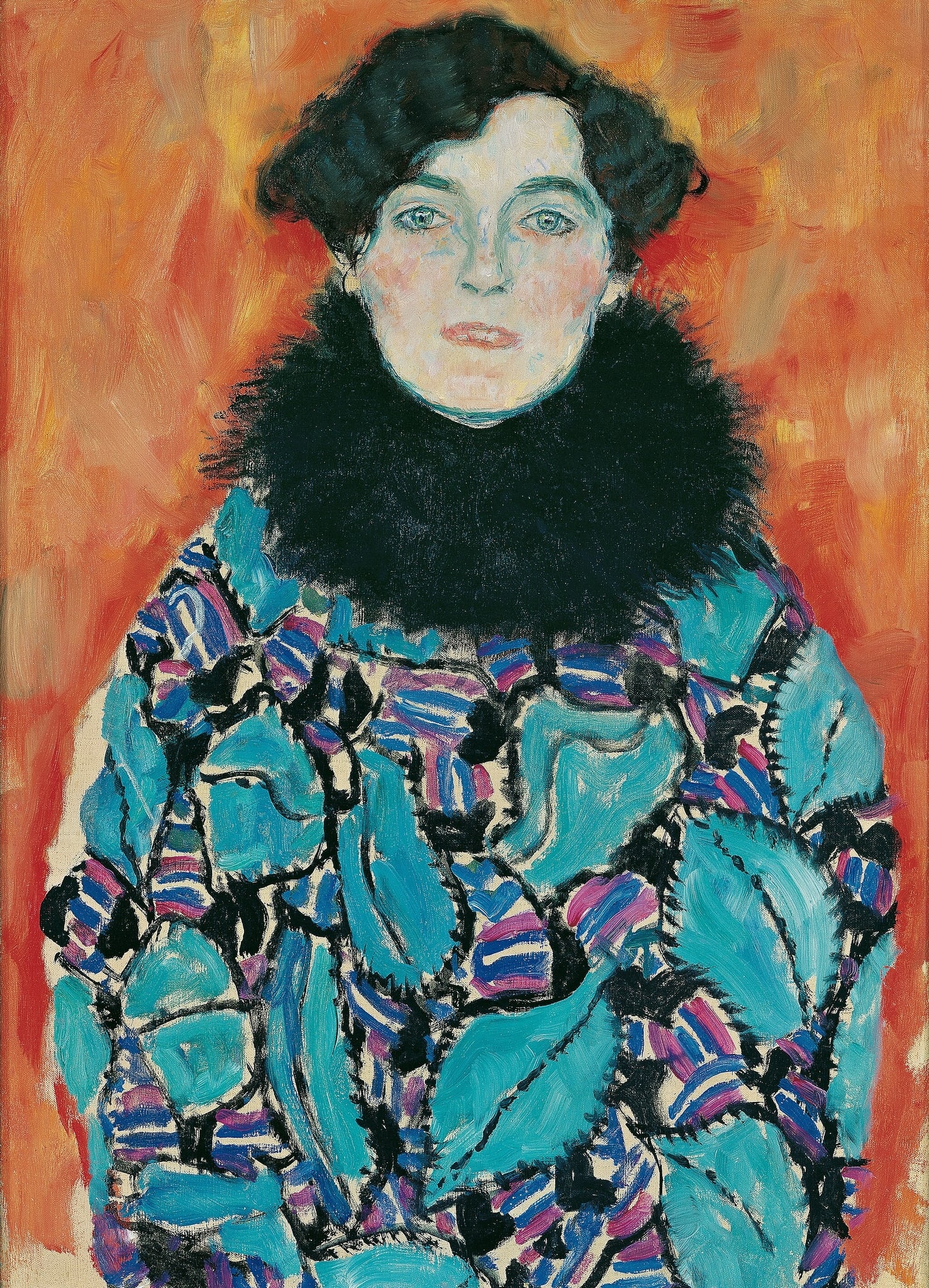
Johanna Staude
Gustav Klimt (1917/1918)
<strong>Johanna Staude</strong> distills Klimt’s late style into a charged encounter between a cool, impassive face and a blazing orange field. The sitter’s head is isolated by a <strong>black feather collar</strong>, while a <strong>Wiener Werkstätte</strong> blouse in turquoise leaves and violet stripes surges forward as a near-abstract surface <sup>[1]</sup><sup>[2]</sup>. Painted in 1917/1918 and left <strong>unfinished</strong> at the mouth, it becomes a poised emblem of modern identity in Vienna on the eve of Klimt’s death <sup>[1]</sup><sup>[2]</sup><sup>[5]</sup>.
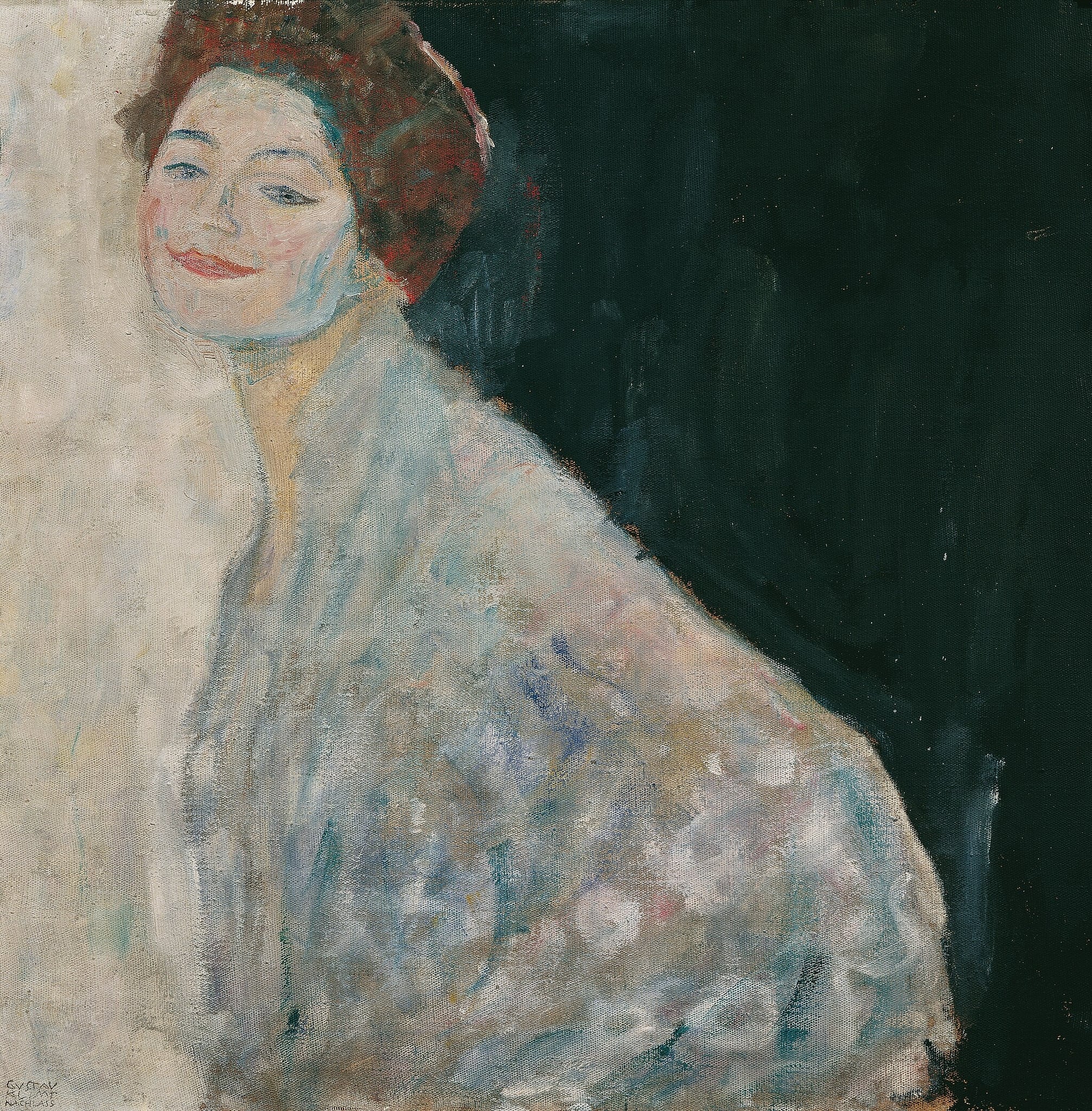
Lady in White
Gustav Klimt (1917–1918)
Lady in White crystallizes Klimt’s late style as a <strong>liminal apparition</strong>: a woman who seems to form out of paint where a pale field meets a dark one. Her kimono‑like robe dissolves into <strong>iridescent whites</strong> touched by blues and violets, while a tilted, <strong>mask‑like smile</strong> hovers between intimacy and anonymity <sup>[1]</sup><sup>[2]</sup><sup>[3]</sup>. The result is less a likeness than a <strong>luminous state of being</strong> suspended on a threshold.
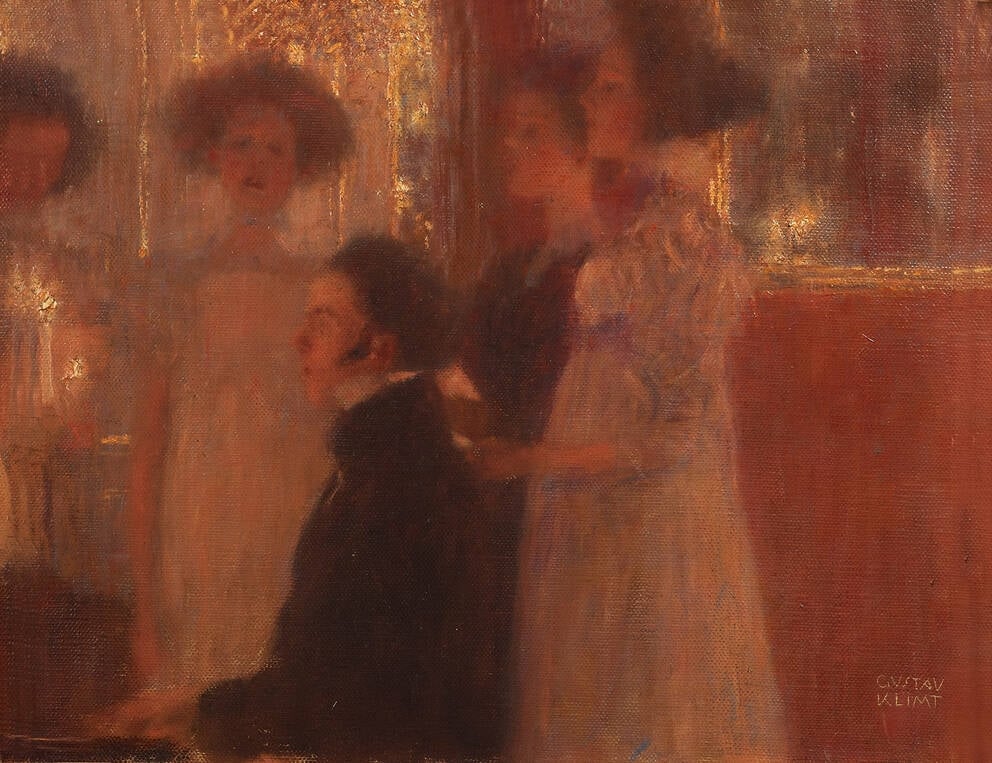
Schubert at the Piano. Design for the music room by Nikolaus Dumba
Gustav Klimt (1896)
Klimt’s 1896 oil study <strong>Schubert at the Piano. Design for the music room by Nikolaus Dumba</strong> turns a domestic recital into a glowing myth of listening. In dim, rosy-gold light, a dark-clad pianist is encircled by a soft choir of women whose blurred faces dissolve into the shimmer of the room. Klimt fuses contour and light so that sound seems to become <strong>radiance</strong>, anticipating his decorative modernism <sup>[1]</sup><sup>[2]</sup>.
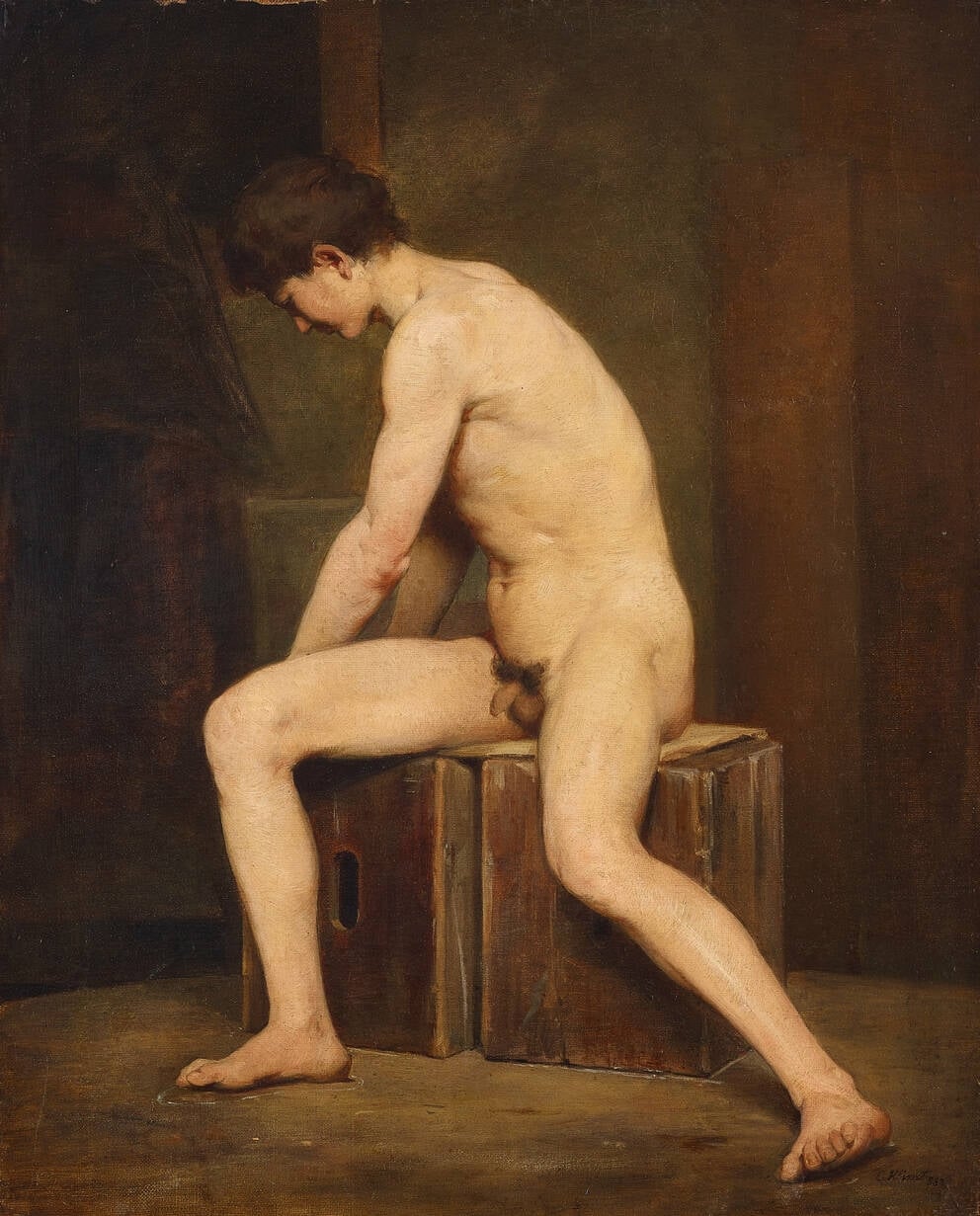
Sitting Nude Man Turned to the Left
Gustav Klimt (1883)
Painted in 1883, Sitting Nude Man Turned to the Left shows Klimt’s academic command of the male figure through a <strong>Naturalist/Realist</strong> approach. The model’s bowed head, splayed legs, and braced forearms form a taut <strong>triangular structure</strong> against rough wooden crates, where <strong>soft flesh meets hard geometry</strong> <sup>[1]</sup>. The restrained, earthy chiaroscuro isolates the body, turning a studio exercise into a quiet study of <strong>concentrated presence</strong>.
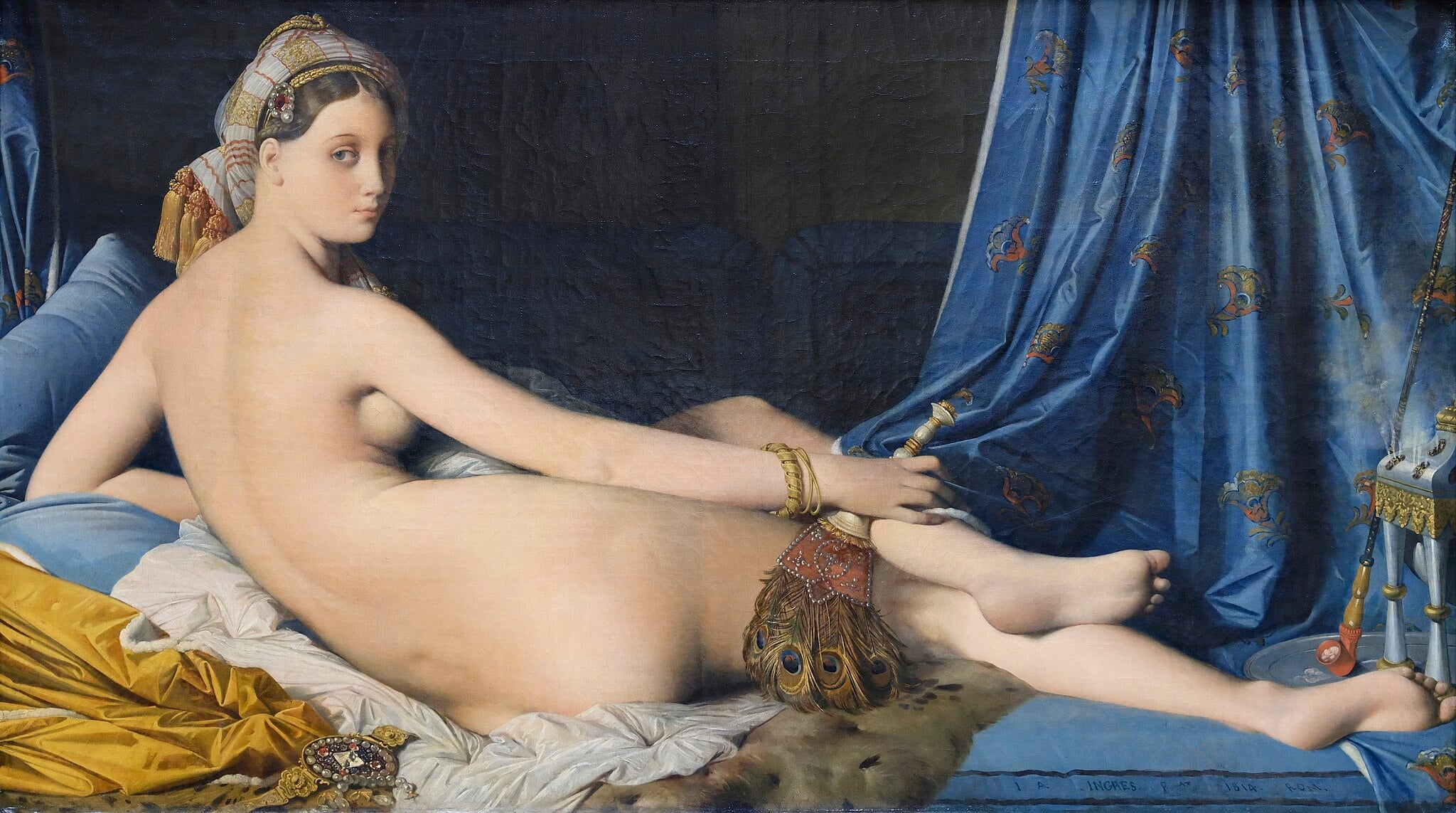
The Great Odalisque
Jean-Auguste-Dominique Ingres (1814)
Jean-Auguste-Dominique Ingres’s The Great Odalisque (1814) turns a reclining nude into an idealized, remote vision, polished to an <strong>enamel-like finish</strong> and staged with <strong>Orientalist</strong> props—turban, peacock-feather fan, blue curtain, and hookah. Commissioned by Caroline Murat and shown at the <strong>Salon of 1819</strong>, it fuses classical line with erotic fantasy, its elongated back and rotated shoulder declaring beauty as a constructed ideal <sup>[1]</sup><sup>[3]</sup>.
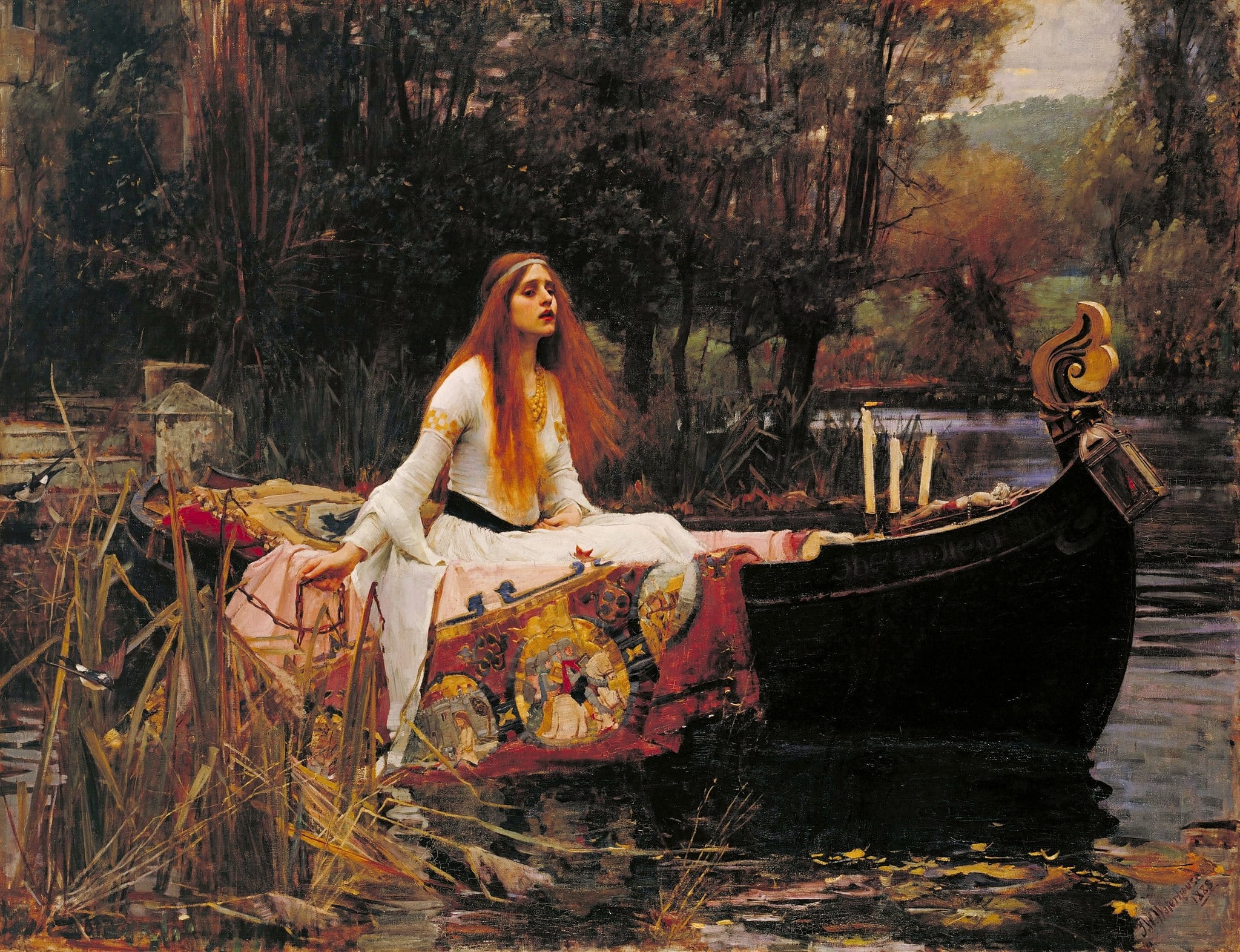
The Lady of Shalott
John William Waterhouse (1888)
John William Waterhouse’s The Lady of Shalott fixes the tragic instant when the cursed Lady chooses to loose her mooring and drift toward Camelot. The released <strong>chain</strong>, the guttering <strong>candles</strong>, and the tapestry spilling over the boat narrate a passage from sheltered artifice to fatal reality. Waterhouse fuses late <strong>Pre-Raphaelite</strong> symbolism with elegiac atmosphere to stage beauty caught between <strong>agency</strong> and <strong>doom</strong> <sup>[1]</sup><sup>[2]</sup><sup>[3]</sup>.
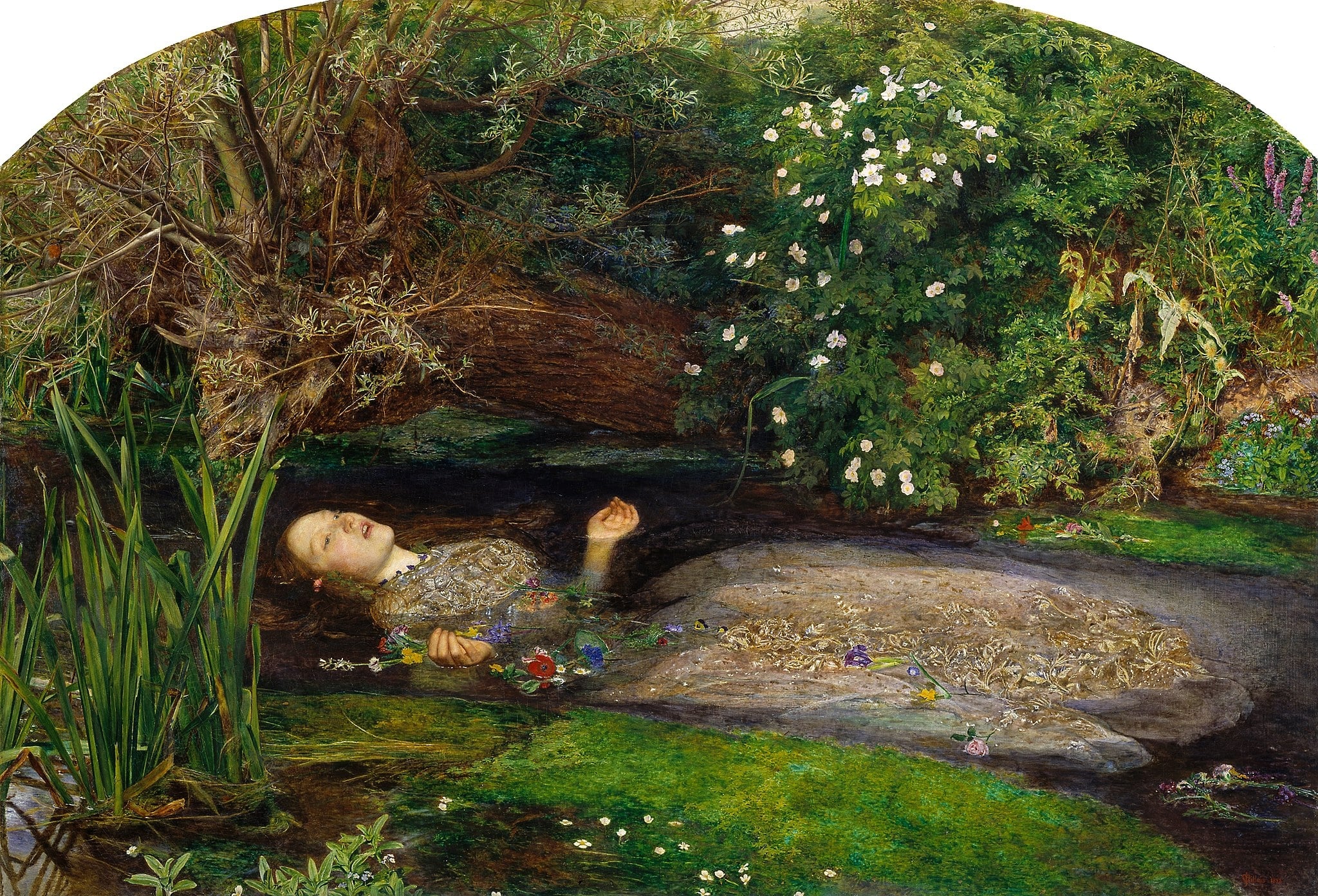
Ophelia
John Everett Millais (1851–1852)
John Everett Millais’s Ophelia shows Shakespeare’s heroine floating in a narrow stream, her jeweled dress both buoying and engulfing her. Millais renders the riverbank with <strong>forensic botanical precision</strong>, so that reeds, willow, briars, nettles, and a scatter of emblematic flowers surround a face slack in mid‑song and hands raised in <strong>open‑palmed surrender</strong> <sup>[1]</sup><sup>[3]</sup>.
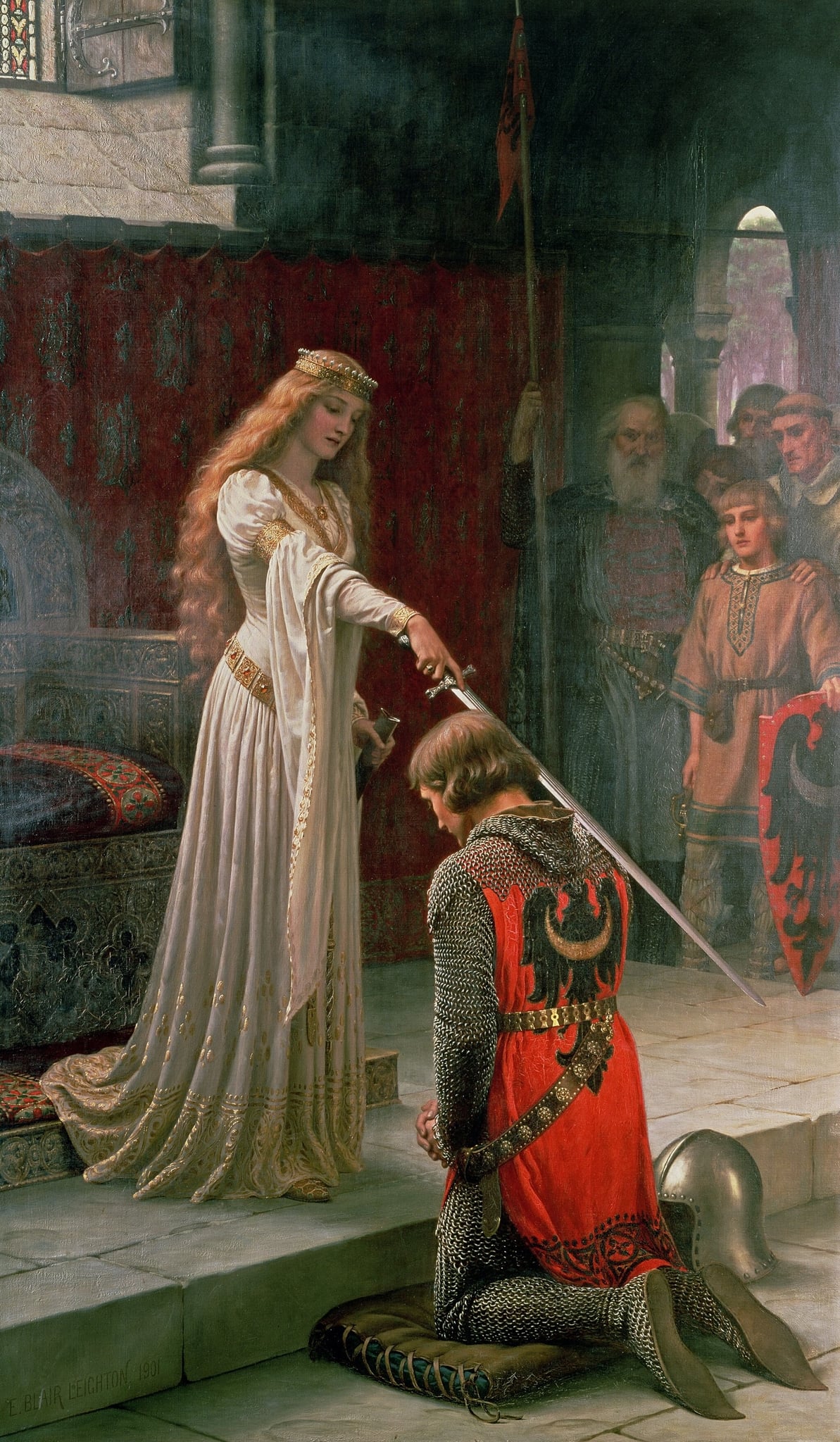
The Accolade
Edmund Leighton (1901)
Edmund Leighton’s The Accolade (1901) crystallizes the rite of knighthood as a moral initiation, staging duty conferred by <strong>grace</strong> rather than force. A lady in radiant white touches her sword to the shoulder of a kneeling knight in chain mail and scarlet surcoat, before a crimson tapestry and carved throne, while shadowed witnesses affirm the solemnity of the moment <sup>[1]</sup><sup>[2]</sup>.
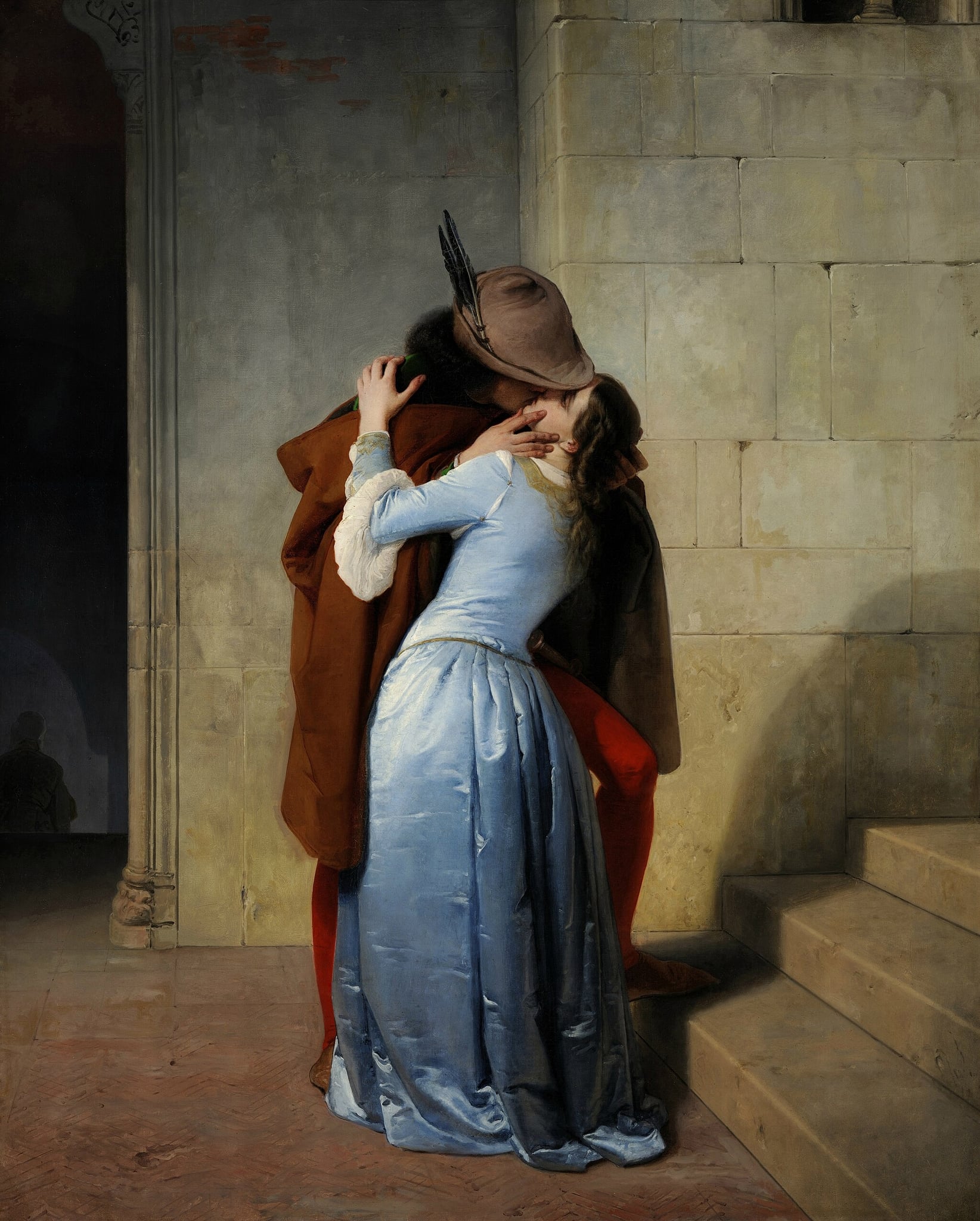
The Kiss (Hayez)
Francesco Hayez (1859)
Francesco Hayez’s The Kiss (Hayez) fuses intimate passion with <strong>political resolve</strong>: a clandestine embrace staged on a cold stone threshold as departure looms. The man’s <strong>outward-angled foot</strong> on the stair and the flash of a <strong>dagger</strong> compress time to a final instant before flight, while tricolour cues fold love into the Risorgimento alliance of 1859 <sup>[1]</sup>. The painting’s cool masonry and <strong>theatrical light</strong> make private tenderness read as public courage.
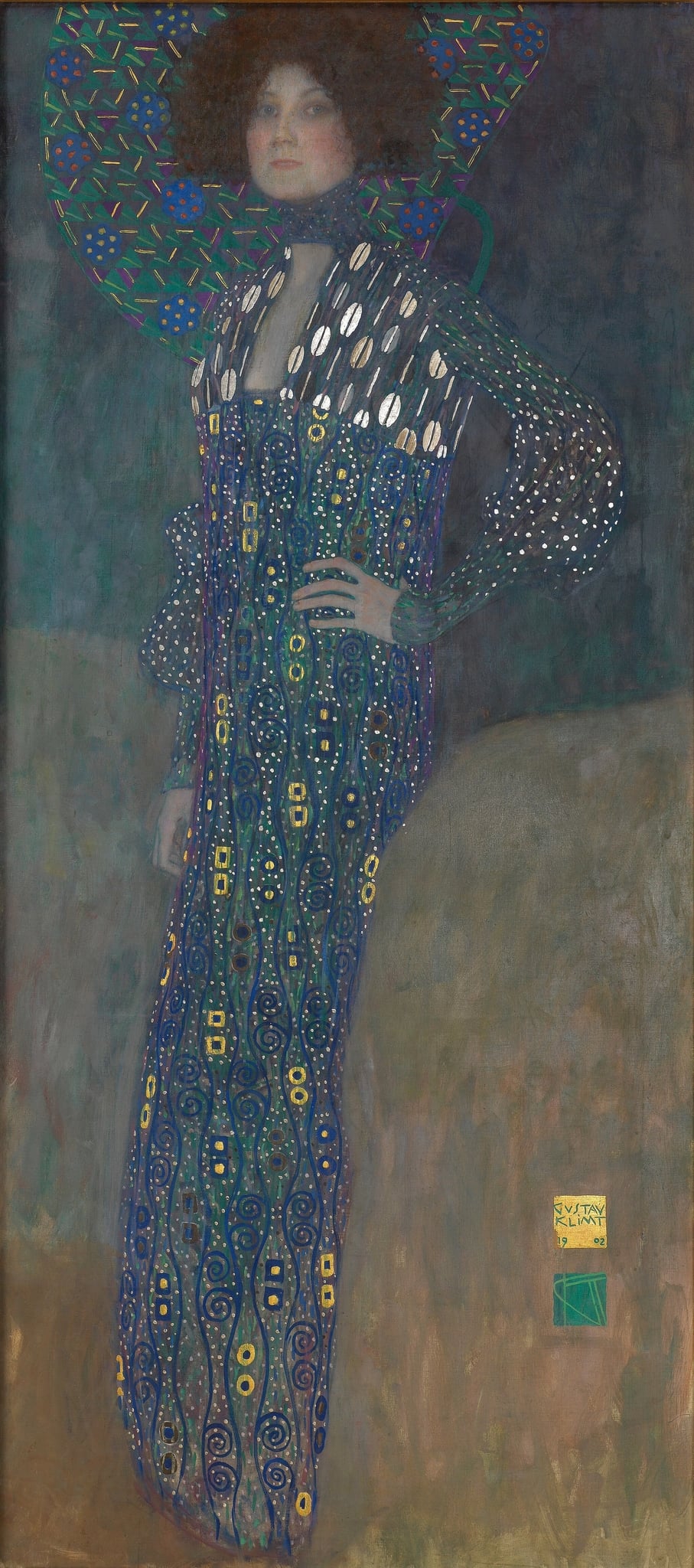
Emilie Flöge
Gustav Klimt (1902)
Gustav Klimt’s Emilie Flöge stages a modern identity as a work of <strong>design</strong> as much as portraiture: a columnar figure, hand on hip, radiates self-possession within a field of spirals, dots, and gold squares. The circular, flowered fan behind the head acts as a <strong>modern halo</strong>, collapsing depth and elevating presence in the Secessionist spirit of the <strong>Gesamtkunstwerk</strong> <sup>[1]</sup><sup>[2]</sup>.
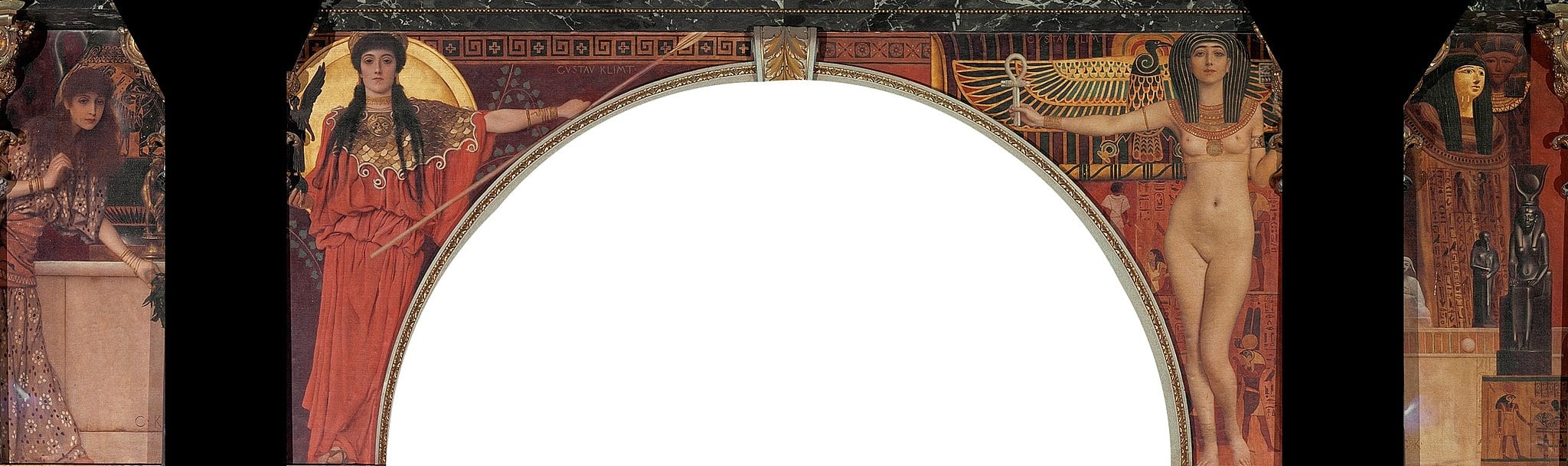
Ancient Greece and Egypt
Gustav Klimt (1891)
Gustav Klimt’s staircase pair Ancient Greece and Egypt stages two <strong>female allegories</strong> flanking an empty arch: a robed, animated <strong>Athena</strong> to the left and a frontal, nude Egyptian goddess aligned with <strong>Nekhbet’s vulture</strong> to the right. Klimt fuses collection-based citations with <strong>ornamental gold, red, and black</strong> to declare a canon in which Western art passes through Greece’s humanist clarity and Egypt’s sacral permanence <sup>[1]</sup><sup>[2]</sup><sup>[3]</sup>.
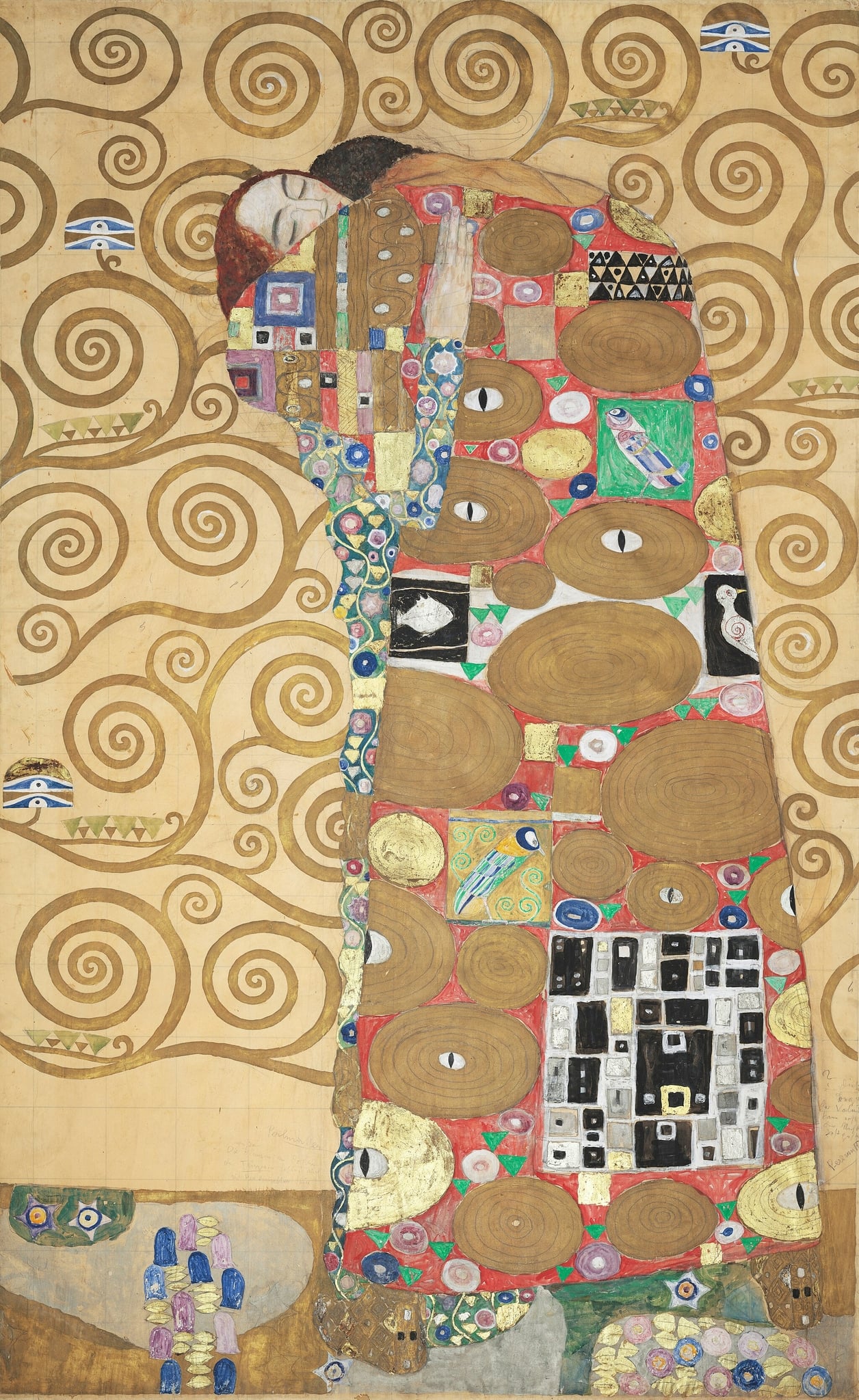
Fulfillment
Gustav Klimt (1910–1911 (cartoon); mosaic installed by 1911)
Klimt’s Fulfillment fuses two lovers into a single, radiant figure set before the spiraling <strong>Tree of Life</strong>, turning private embrace into a <strong>sacral consummation</strong>. Patterned robes—ovals, eyes, and flowers against black‑and‑white rectangles—stage a union of <strong>feminine/masculine energies</strong> within a golden, eternal field <sup>[1]</sup><sup>[3]</sup>.
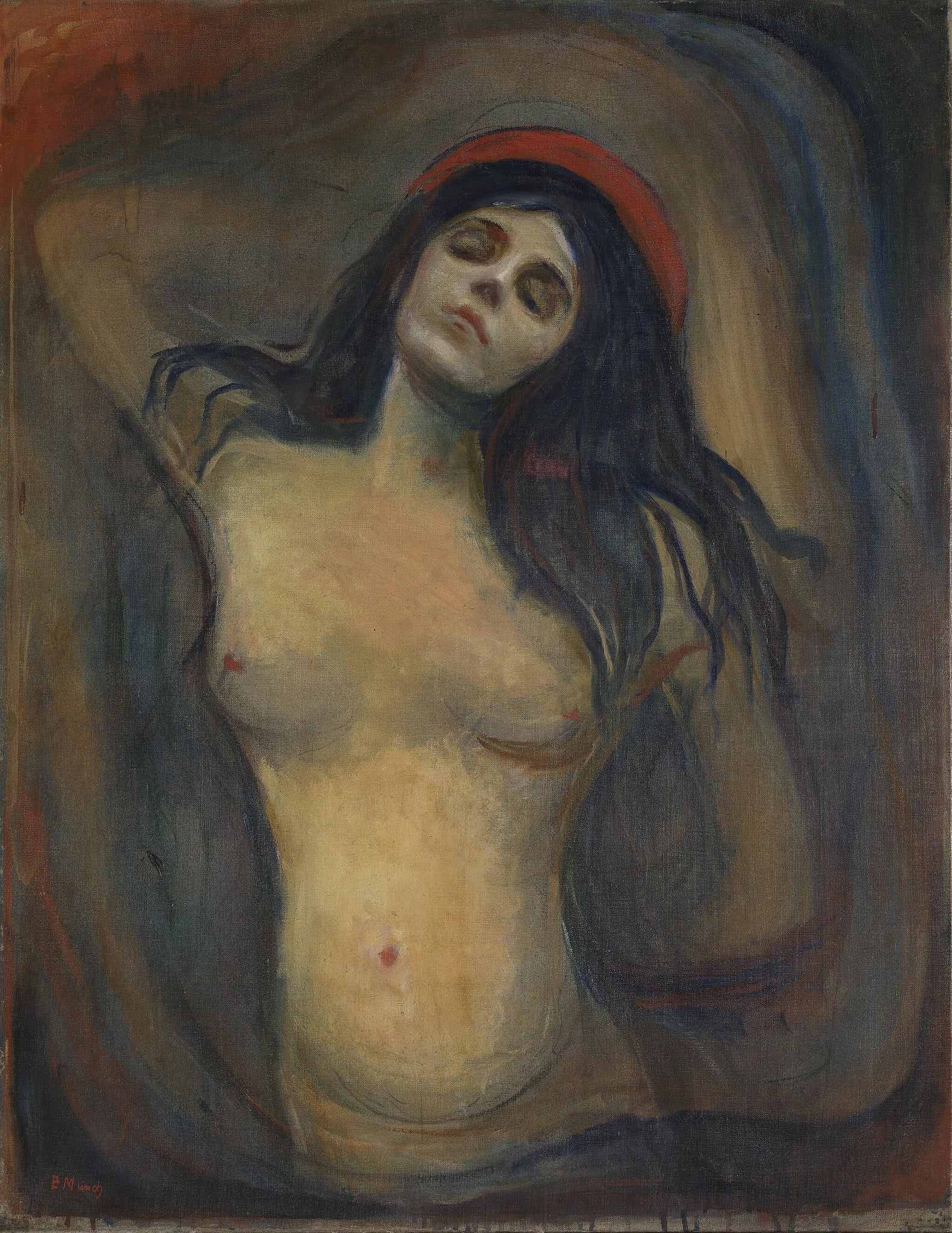
Madonna
Edvard Munch (1894)
Munch’s Madonna stages a collision of <strong>sanctity and sensuality</strong>: a half-length nude, eyes closed, tilts into a crimson nimbus while a dark, tidal field seems to carry her body. With smeared contours and a sparse palette, the figure hovers between emergence and dissolution, turning the Virgin’s icon into a modern emblem of <strong>eros, creation, and death</strong> <sup>[1]</sup><sup>[2]</sup><sup>[3]</sup>.
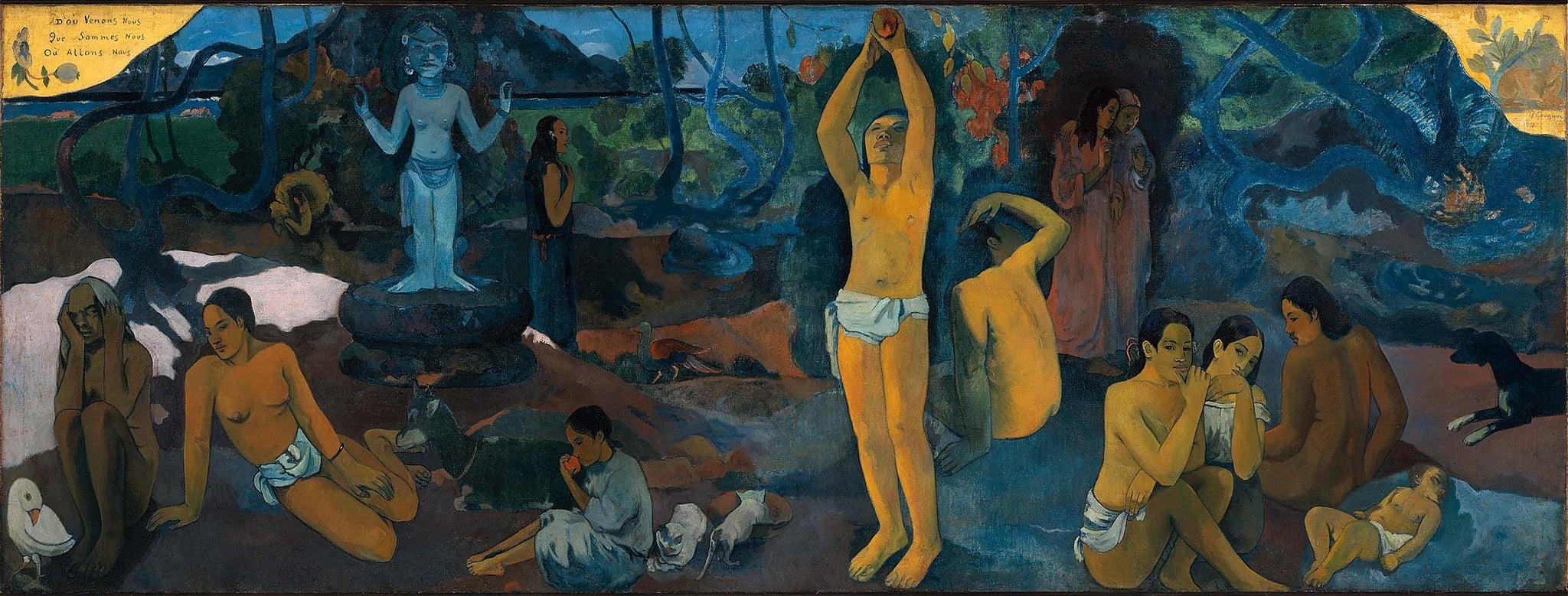
Where Do We Come From? What Are We? Where Are We Going?
Paul Gauguin (1897–1898)
A panoramic frieze staged in a Tahitian grove, Paul Gauguin’s Where Do We Come From? What Are We? Where Are We Going? unfolds right-to-left as a cycle of life, from an infant at the far right to an aged woman at the far left. Amid saturated blues and ochres, a central figure reaches for fruit and a pale-blue idol stands motionless, creating a theatre of <strong>origin, desire, and destiny</strong> that never resolves into a single answer.
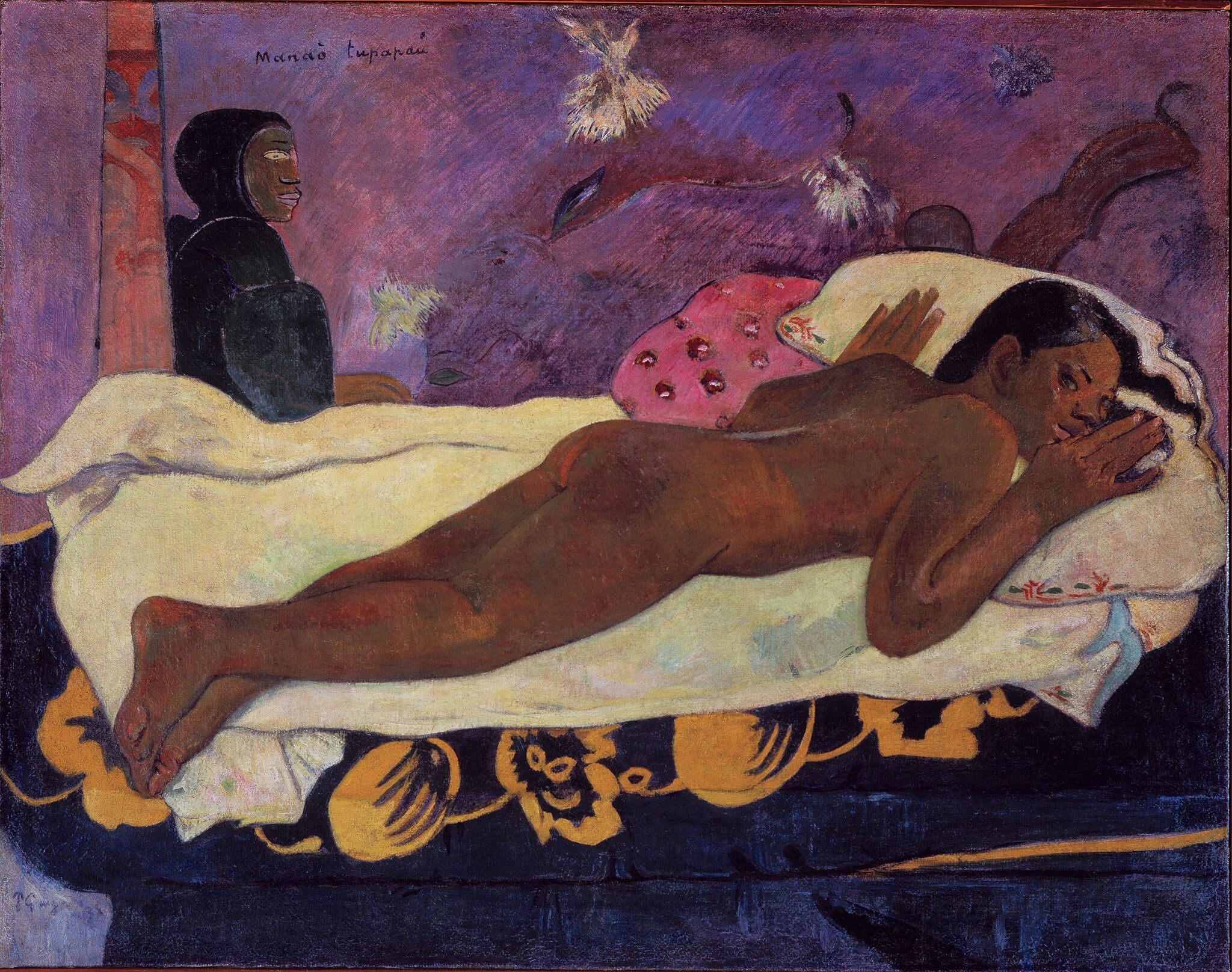
Spirit of the Dead Watching
Paul Gauguin (1892)
Spirit of the Dead Watching stages a nocturnal confrontation between a rigid, prone nude and a dark, hooded presence at the bed’s edge, fusing <strong>desire</strong> with <strong>dread</strong>. Flat patterns, cloisonné outlines, and violet-black fields convert the room into a symbolic plane where a Tahitian <strong>tupapaú</strong> may be either guardian or threat. The work crystallizes Gauguin’s Synthetist aim to make color and contour carry <strong>mythic psychology</strong> rather than mere description <sup>[1]</sup><sup>[2]</sup>.
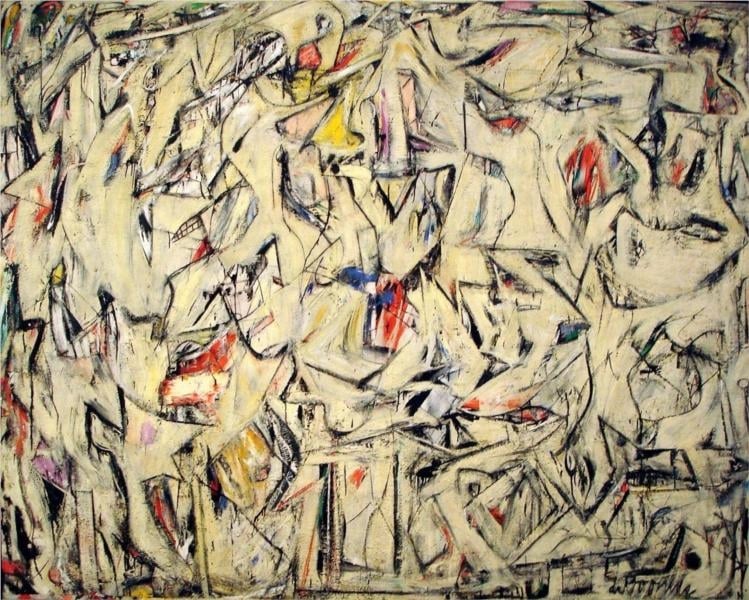
Excavation
Willem de Kooning (1950)
<strong>Excavation</strong> is a 1950 oil-on-canvas by <strong>Willem de Kooning</strong> whose all-over mesh of black, hooked lines rides a chalky, bone-colored ground, flaring with cadmium reds, yellows, and blues. Forms surface—beaklike profiles, teeth, fish, limbs, tool-shapes—then sink back into fragments, staging a <strong>simultaneous making and unmaking</strong> that turns the whole canvas into an active field. The work crystallizes de Kooning’s late-1940s abstractions and foreshadows the Women paintings, marking a pivot in postwar American art <sup>[1]</sup><sup>[3]</sup><sup>[4]</sup>.
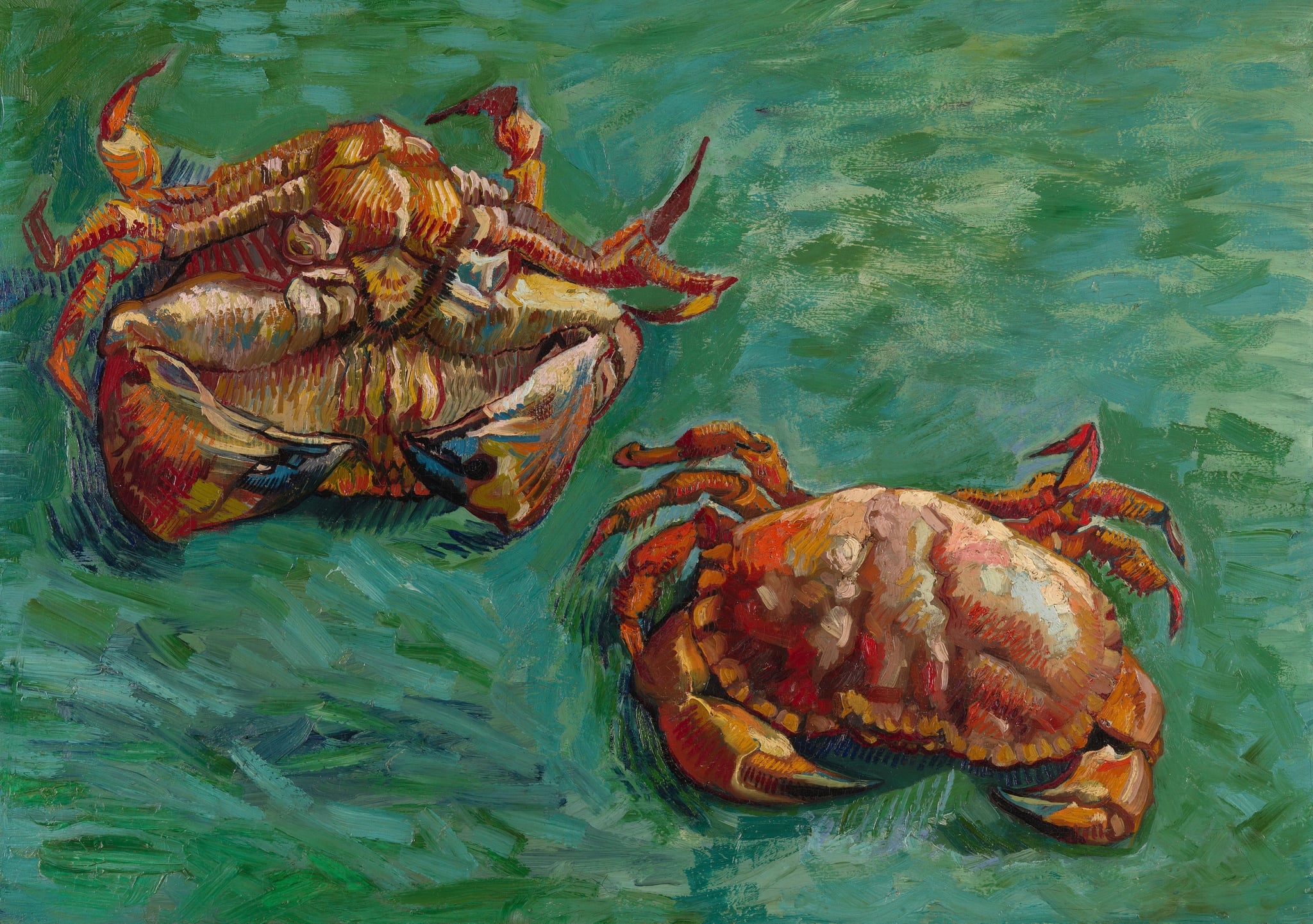
Two Crabs
Vincent van Gogh (1889)
Two Crabs stages a compact drama of <strong>vulnerability and resilience</strong>: one crab lies overturned, the other holds firm on its claws. Van Gogh fuses <strong>complementary red–green contrasts</strong> with calligraphic outlines to make the scene pulse between peril and recovery <sup>[1]</sup>.
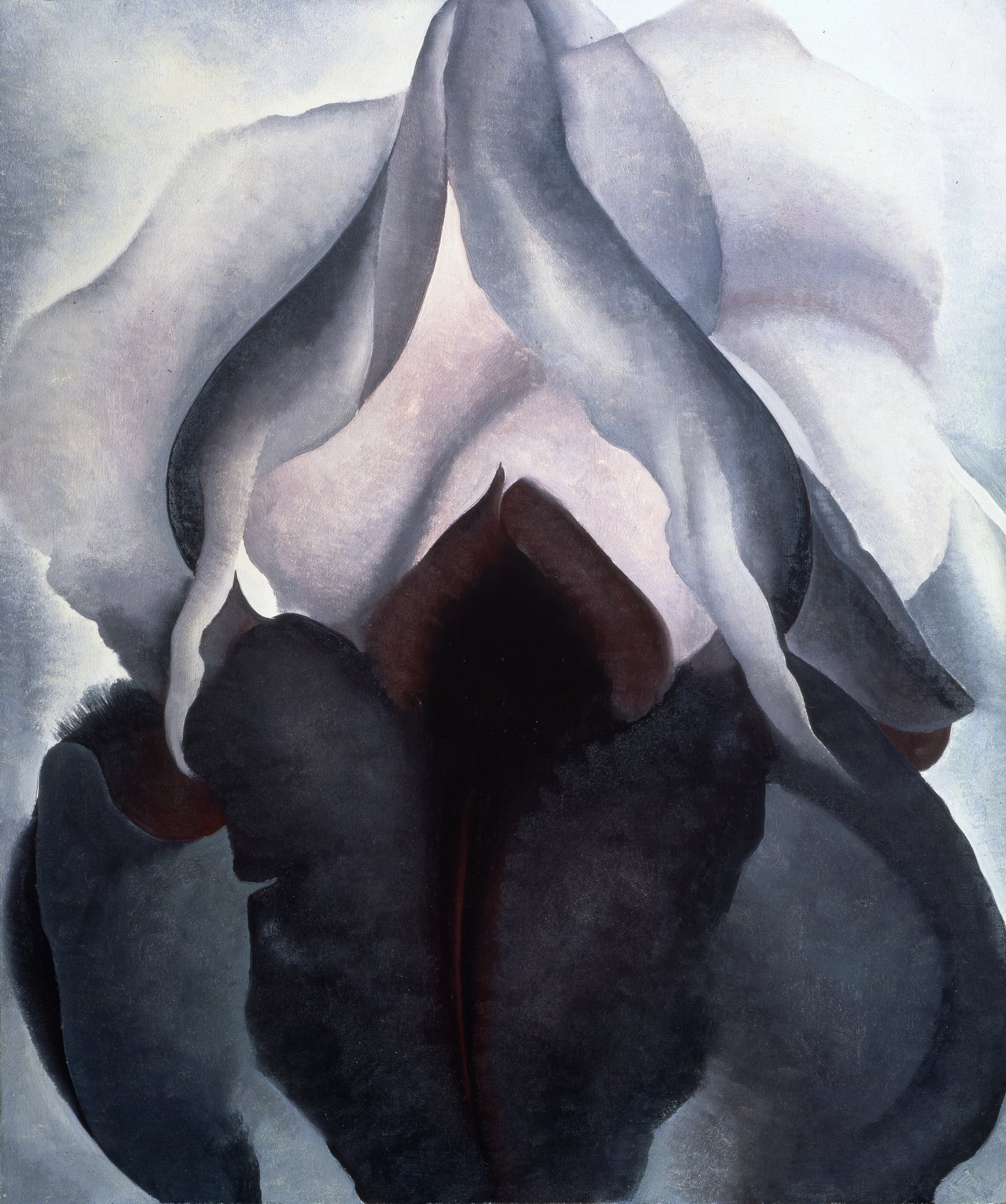
Black Iris
Georgia O’Keeffe (1926)
In Black Iris, Georgia O’Keeffe enlarges a single bloom to monumental scale, transforming it into <strong>luminous gradients</strong> and <strong>architectural folds</strong>. The pale, misted upper petals frame a velvety, wine‑black center, turning a familiar flower into an immersive field of <strong>abstraction and depth</strong> <sup>[1]</sup><sup>[3]</sup>.
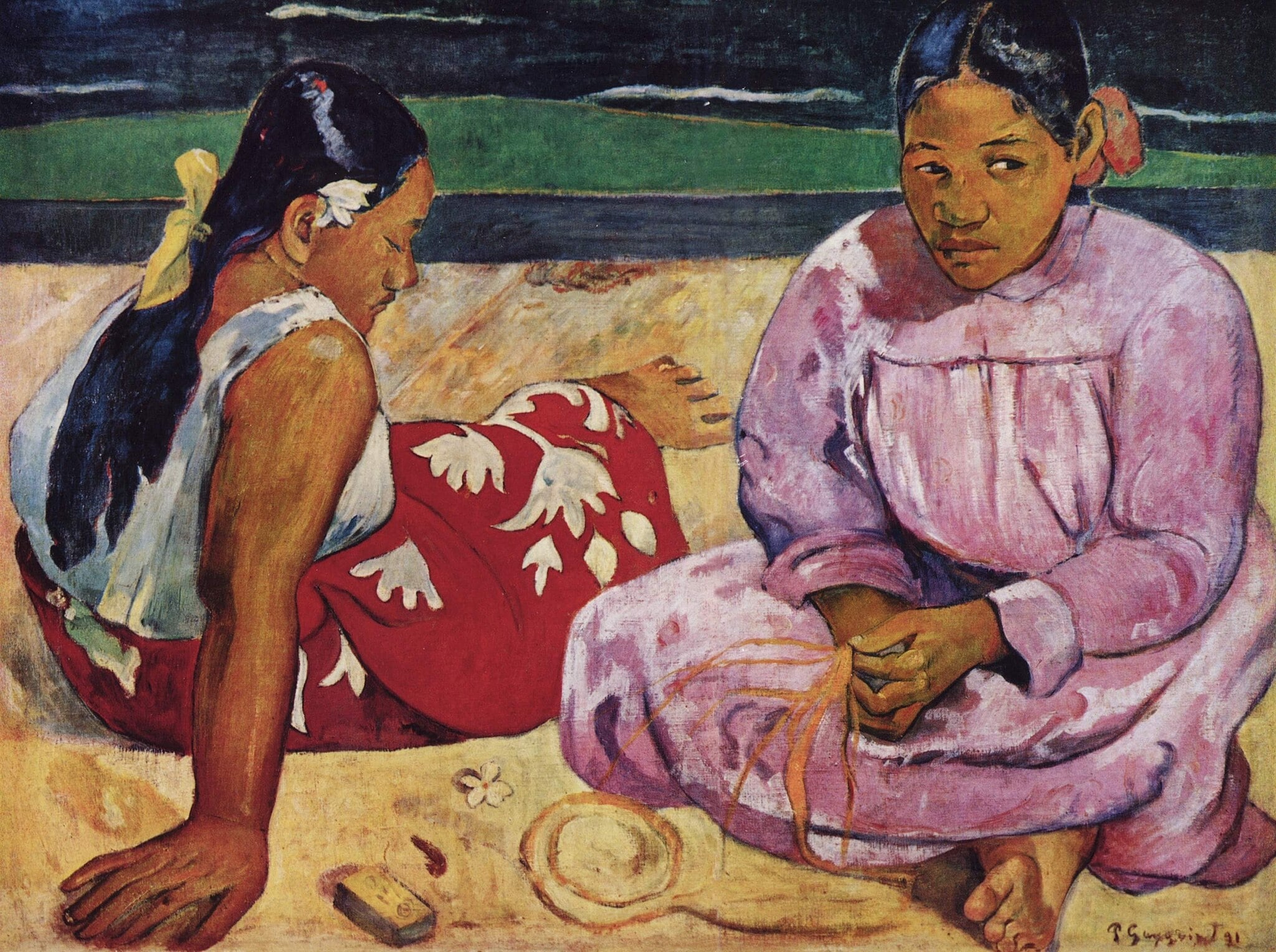
Tahitian Women on the Beach
Paul Gauguin (1891)
In Tahitian Women on the Beach, Paul Gauguin stages a tense duet between <strong>tradition</strong> and <strong>colonial modernity</strong>. Flat bands of sea and shore frame two monumental figures—one in a red <strong>pareo</strong>, the other in a pink <strong>missionary dress</strong>—whose guarded poses and averted gazes turn a casual beach scene into an <strong>iconic meditation on identity</strong> <sup>[1]</sup><sup>[2]</sup>. Modest objects on the sand—a flower, a coil, a bar-shaped stone—read like quiet <strong>tokens</strong> anchoring everyday life to ritual feeling <sup>[1]</sup>.
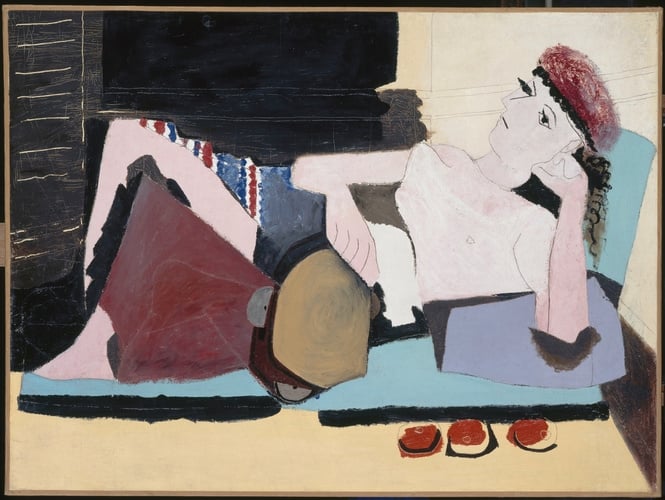
Femme au tambourin
Pablo Picasso (1925)
Picasso’s 1925 <strong>Femme au tambourin</strong> stages a reclining performer whose body is reduced to <strong>bold planes and hard contours</strong>. The circular tambourine across her lap and the <strong>three fruits</strong> aligned below create a visual rhythm that weighs <strong>pleasure against performance</strong> <sup>[1]</sup>.
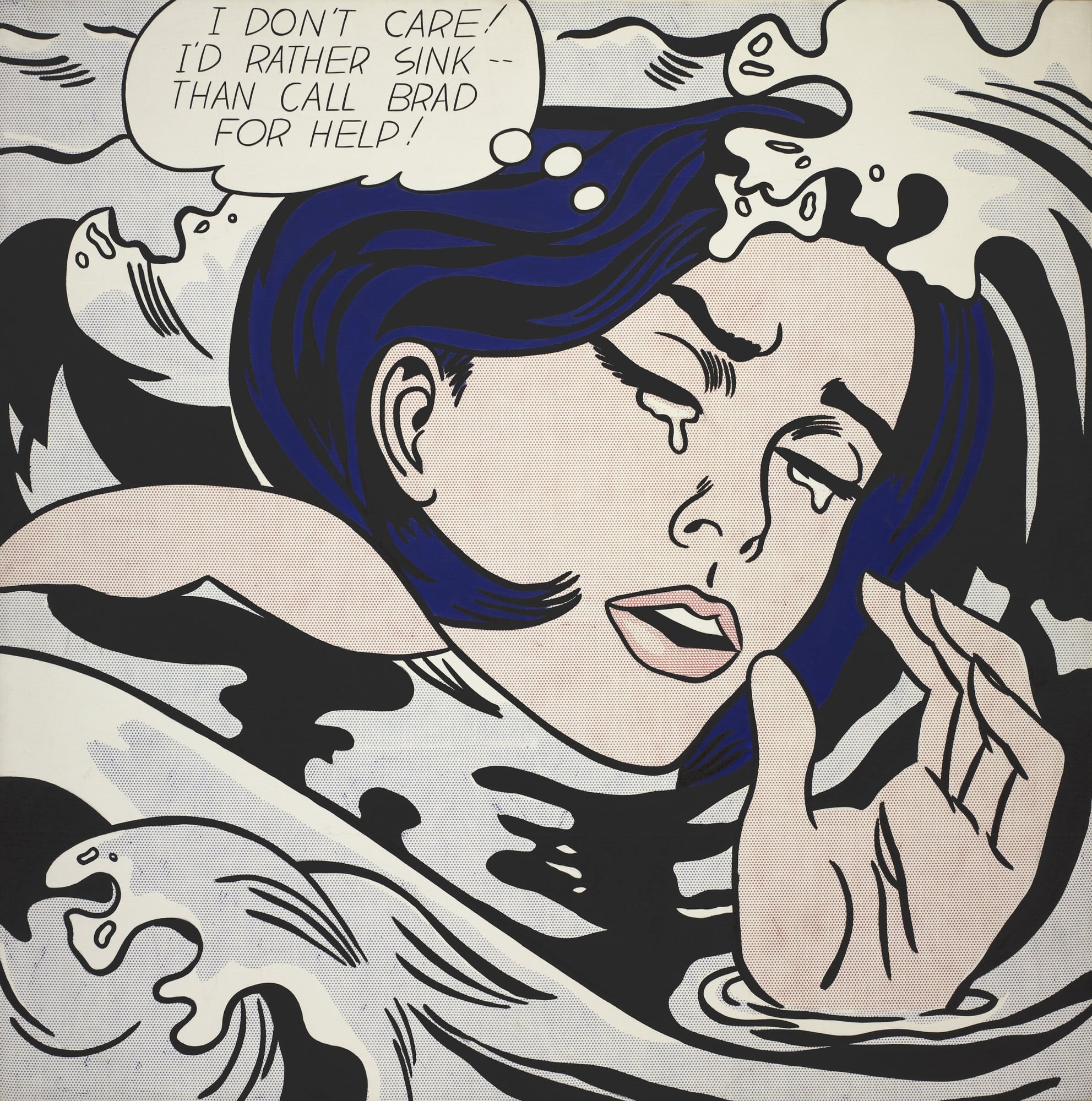
Drowning Girl
Roy Lichtenstein (1963)
<strong>Drowning Girl</strong> converts a romance-comic crisis into a monumental icon of cool, stylized emotion. With tight cropping, <strong>Ben-Day dots</strong>, and heavy black contours, <strong>Roy Lichtenstein</strong> isolates a heroine who declares, "I DON’T CARE! I’D RATHER SINK—THAN CALL BRAD FOR HELP!" The painting turns mass-media melodrama into a distilled language of signs that oscillates between parody and pathos <sup>[1]</sup><sup>[4]</sup>.
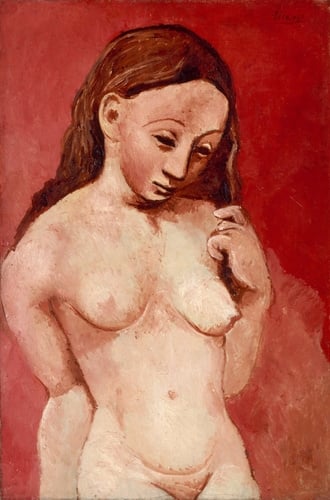
Nu sur fond rouge
Pablo Picasso (1906)
A solitary nude stands against a pulsating, uniform red field, her body reduced to <strong>rounded, sculptural planes</strong> and her face set with <strong>masklike eyes</strong>. The lowered gaze and self-touching gesture fold desire and inwardness into a single emblem, turning the figure into a <strong>proto‑Cubist icon</strong> rather than a person in space <sup>[1]</sup><sup>[2]</sup>.
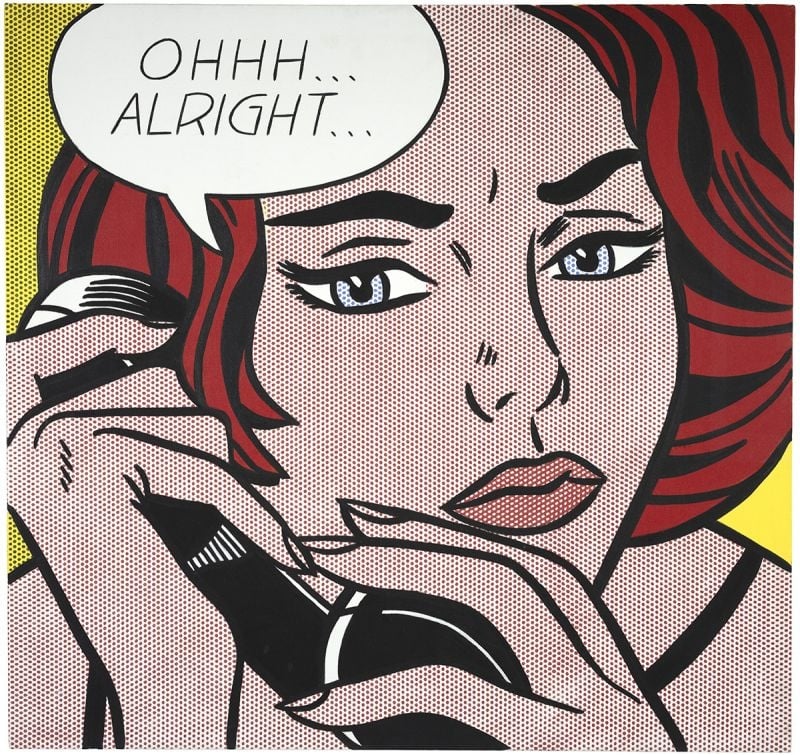
Ohhh...Alright...
Roy Lichtenstein (1964)
Roy Lichtenstein’s Ohhh...Alright... captures a suspended beat of romance‑comic melodrama in the cool idiom of <strong>Pop Art</strong>. A tightly cropped red‑haired woman grips a telephone as a speech balloon—“<strong>OHHH… ALRIGHT…</strong>”—signals reluctant acquiescence, while the hand‑painted <strong>Ben‑Day dots</strong> mimic mass printing to stage emotion as a commodity sign <sup>[1]</sup><sup>[2]</sup>.
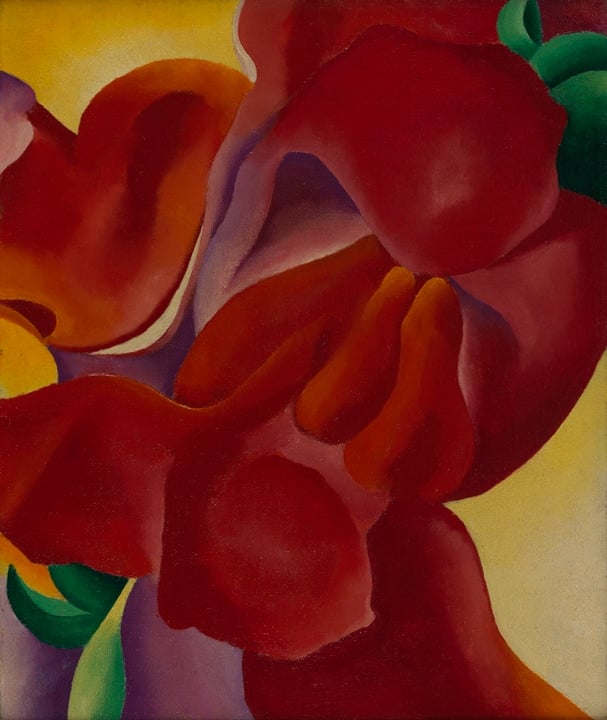
Red Canna
Georgia O’Keeffe (1925–1928)
Georgia O’Keeffe’s Red Canna turns a single bloom into an immersive field of <strong>magnified color and form</strong>. Swelling crimson petals edged with violet ride against a <strong>sunlit yellow</strong> ground, while small <strong>green flickers</strong> punctuate the heat, converting a garden flower into a modern emblem of <strong>vitality and perception</strong> <sup>[1]</sup><sup>[2]</sup>.
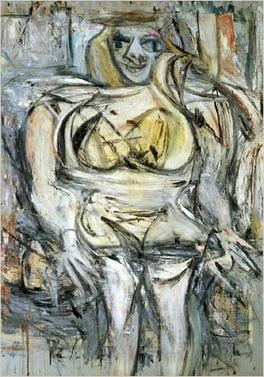
Woman III
Willem de Kooning (1952–53 (often dated 1953))
Woman III stages a face‑off between <strong>figuration and abstraction</strong>: a looming, front‑facing body whose breasts and hips jut forward even as limbs smear into eddies of paint. The mask‑like eyes and toothy grin toggle between <strong>seduction and menace</strong>, while the scraped, turbulent surface asserts painting as a <strong>combat zone</strong> rather than calm depiction <sup>[1]</sup>.
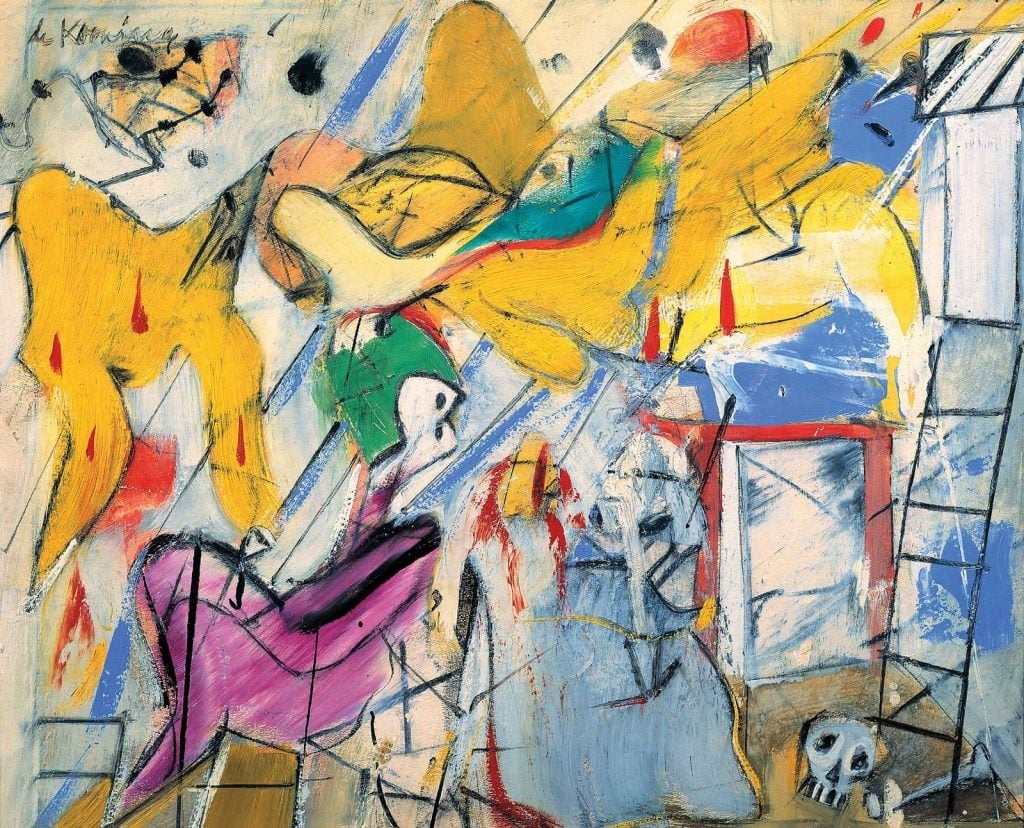
Interchange
Willem de Kooning (1955)
Interchange condenses the city’s churn into an arena of <strong>figure–ground flux</strong>, where mustard yellows, lilac, and sea‑blue collide and are corralled by black, calligraphic lines. De Kooning turns scraping, repainting, and slashing gestures into a living map of <strong>exchange</strong> between flesh and architecture, motion and arrest <sup>[2]</sup><sup>[3]</sup>.
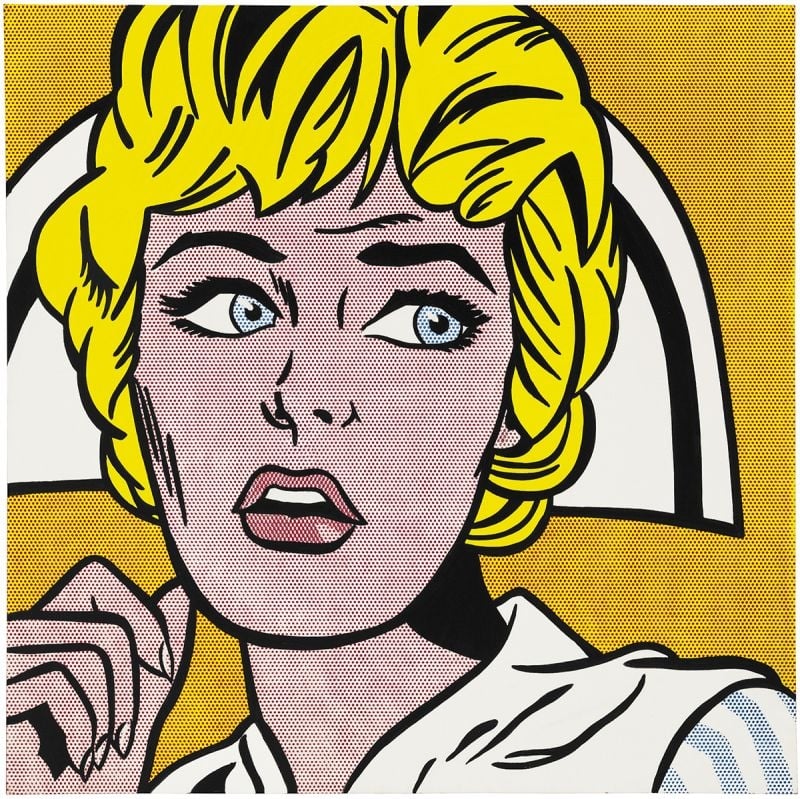
Nurse
Roy Lichtenstein (1964)
Nurse crystallizes Roy Lichtenstein’s 1964 turn to comic-derived icons, amplifying emotion through <strong>Ben‑Day dots</strong>, <strong>thick black contours</strong>, and a <strong>high‑contrast palette</strong>. The cropped close‑up—blond hair, white cap, parted lips, averted gaze—freezes suspense while stripping away speech bubbles. Lichtenstein converts pulp melodrama into a monumental emblem, making style itself the engine of feeling <sup>[1]</sup><sup>[2]</sup>.
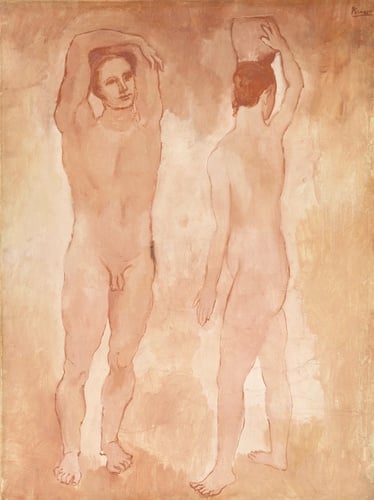
Les Adolescents
Pablo Picasso (1906)
Two nude youths stand in a shallow, fresco-like field, their bodies modeled in warm rose ochres that evoke Picasso’s <strong>Rose Period</strong> calm. Their matched yet misaligned gestures—one frontal with arms raised, the other in profile balancing a <strong>pitcher</strong>—stage a quiet rite of passage that turns adolescence into a timeless, <strong>classical</strong> type <sup>[1]</sup>.
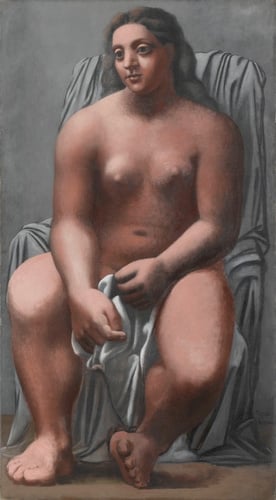
Grande baigneuse
Pablo Picasso (1921)
Picasso’s Grande baigneuse stages a monumental nude as an <strong>archetype of endurance</strong>, not a private individual. Seated frontally on a draped, stone-like chair, with <strong>downcast eyes</strong> and a towel clenched in her hand, she reads as a modernized classical statue—solid, calm, and timeless <sup>[1]</sup>. The painting fuses <strong>compressed modern space</strong> with antique gravitas to assert stability after wartime rupture <sup>[1]</sup><sup>[2]</sup>.
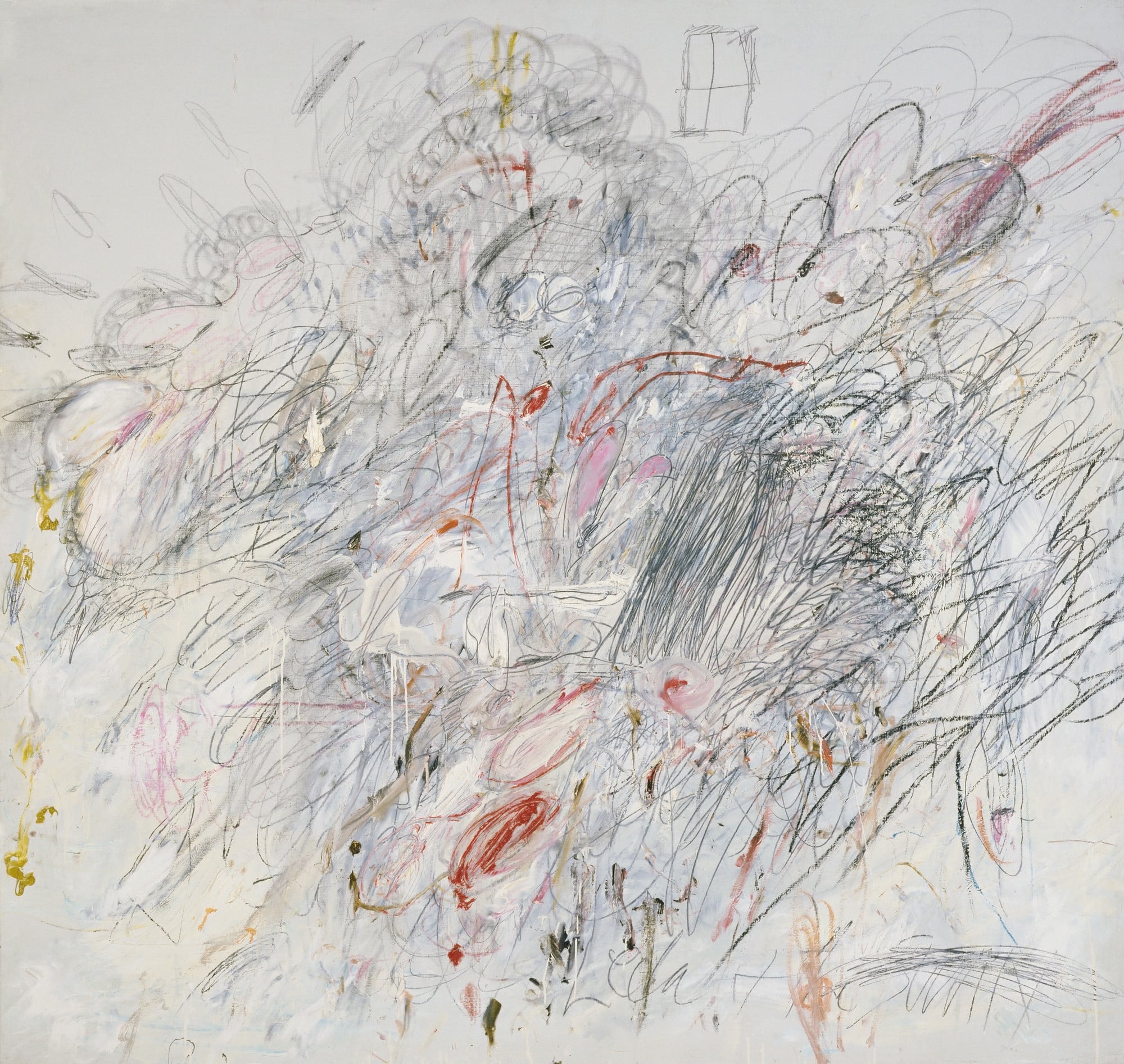
Leda and the Swan
Cy Twombly (1962)
Cy Twombly’s Leda and the Swan condenses the Greek myth into an <strong>orgiastic collision</strong> of marks: graphite scrawls, smeared whites, blush pinks, and eruptive reds radiate from a dark, compressed vortex. A sketched <strong>window-like rectangle</strong>, heart and phallic glyphs puncture the storm, making desire and violence legible as emblems rather than images <sup>[1]</sup>.
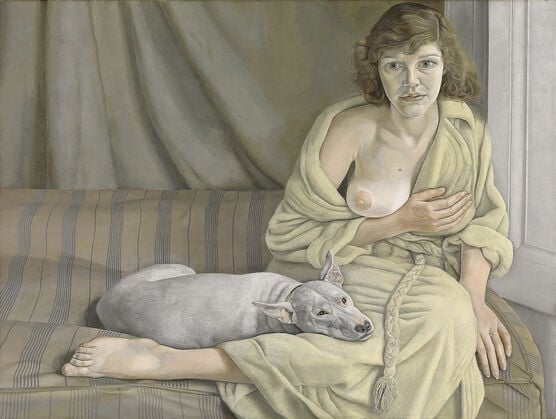
Girl with a White Dog
Lucian Freud (1950–51)
Lucian Freud’s Girl with a White Dog stages a charged quiet: a woman in a parted robe exposes one breast while shielding herself with a hand, as a white dog’s head lies heavy on her lap. The cool, fine-grained paint makes every surface hyper-present—the matte skin, the nap of the robe, the striped sofa—turning domestic calm into <strong>uneasy intimacy</strong> <sup>[1]</sup><sup>[2]</sup>.
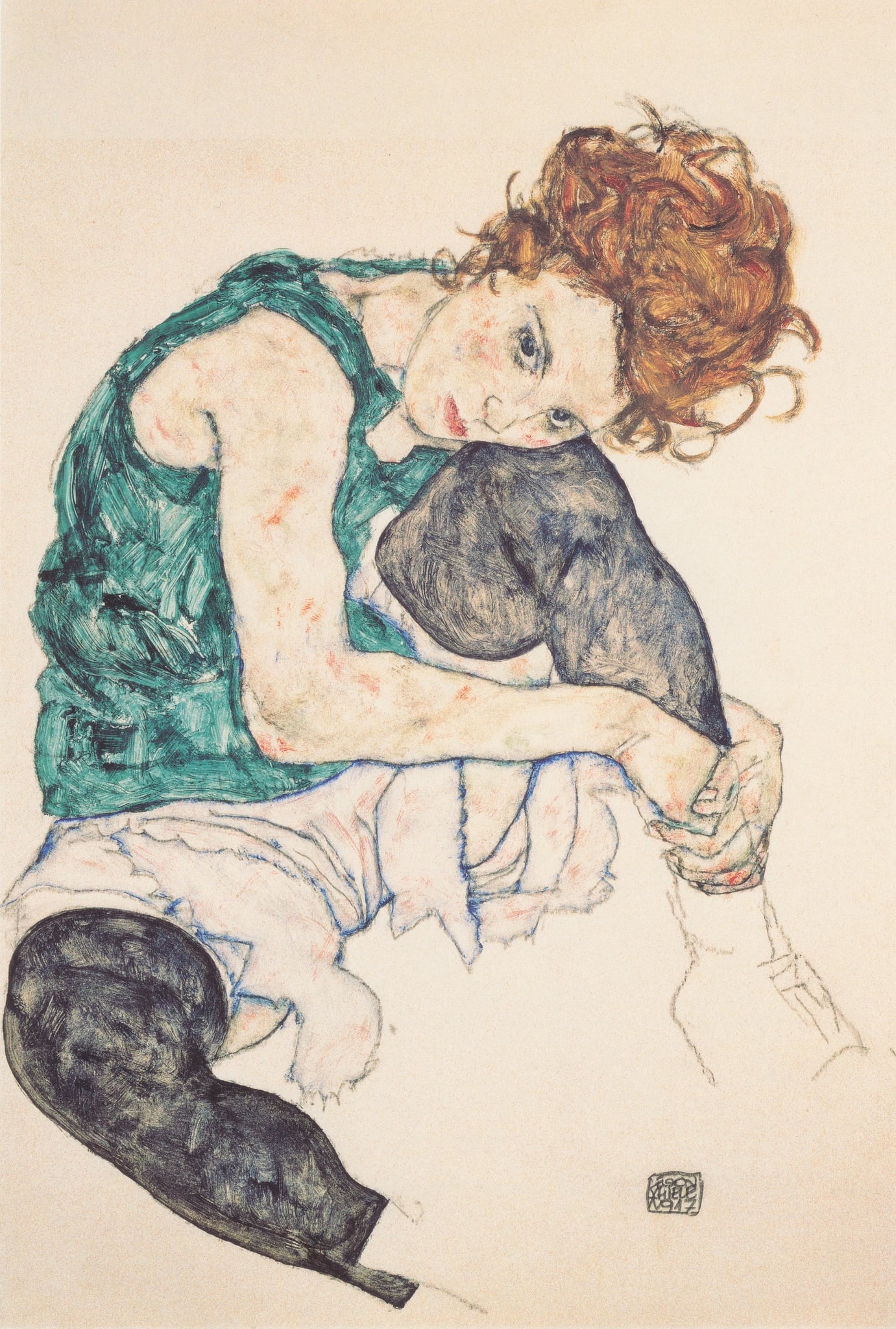
Seated Woman with Bent Knee
Egon Schiele (1917)
Egon Schiele’s Seated Woman with Bent Knee compresses the body into a tense, looping knot, fusing <strong>erotic charge</strong> with <strong>psychological vulnerability</strong>. The emerald bodice, inky stockings, and copper hair vibrate against a blank ground, while the sitter’s hands clamp her ankle, signaling <strong>self‑containment</strong> as much as display <sup>[1]</sup><sup>[3]</sup>.
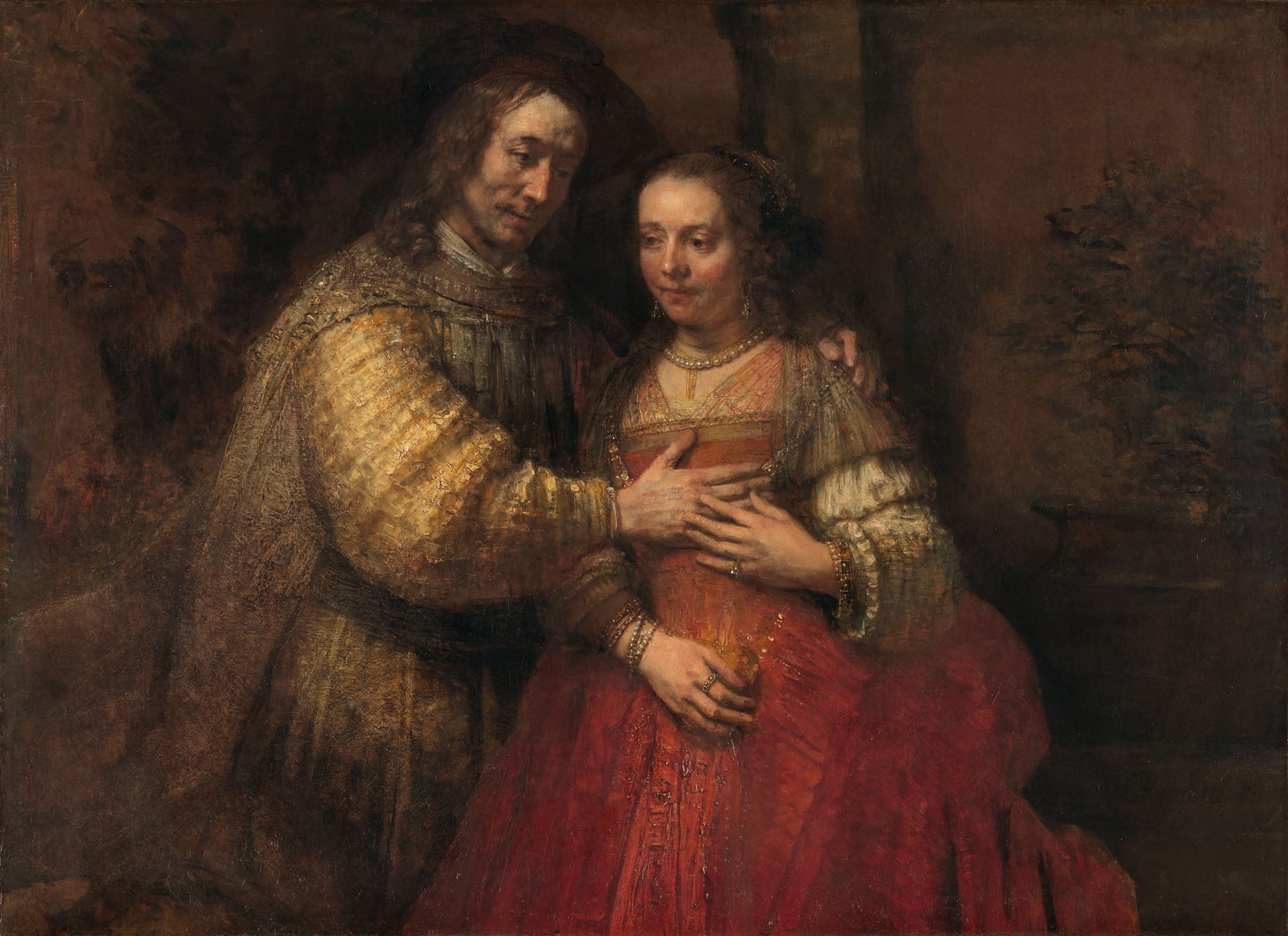
Isaac and Rebecca, Known as ‘The Jewish Bride’
Rembrandt van Rijn (c. 1665–1669)
Rembrandt van Rijn’s Isaac and Rebecca, Known as <strong>‘The Jewish Bride’</strong> crystallizes marriage as a covenant of <strong>love, protection, and consent</strong>. In warm chiaroscuro, the man’s enclosing arm and open right hand meet the woman’s regulating left hand over her chest, while her other hand gathers the glowing red dress. The painting turns a biblical recognition scene into an intimate vow illuminated from within.
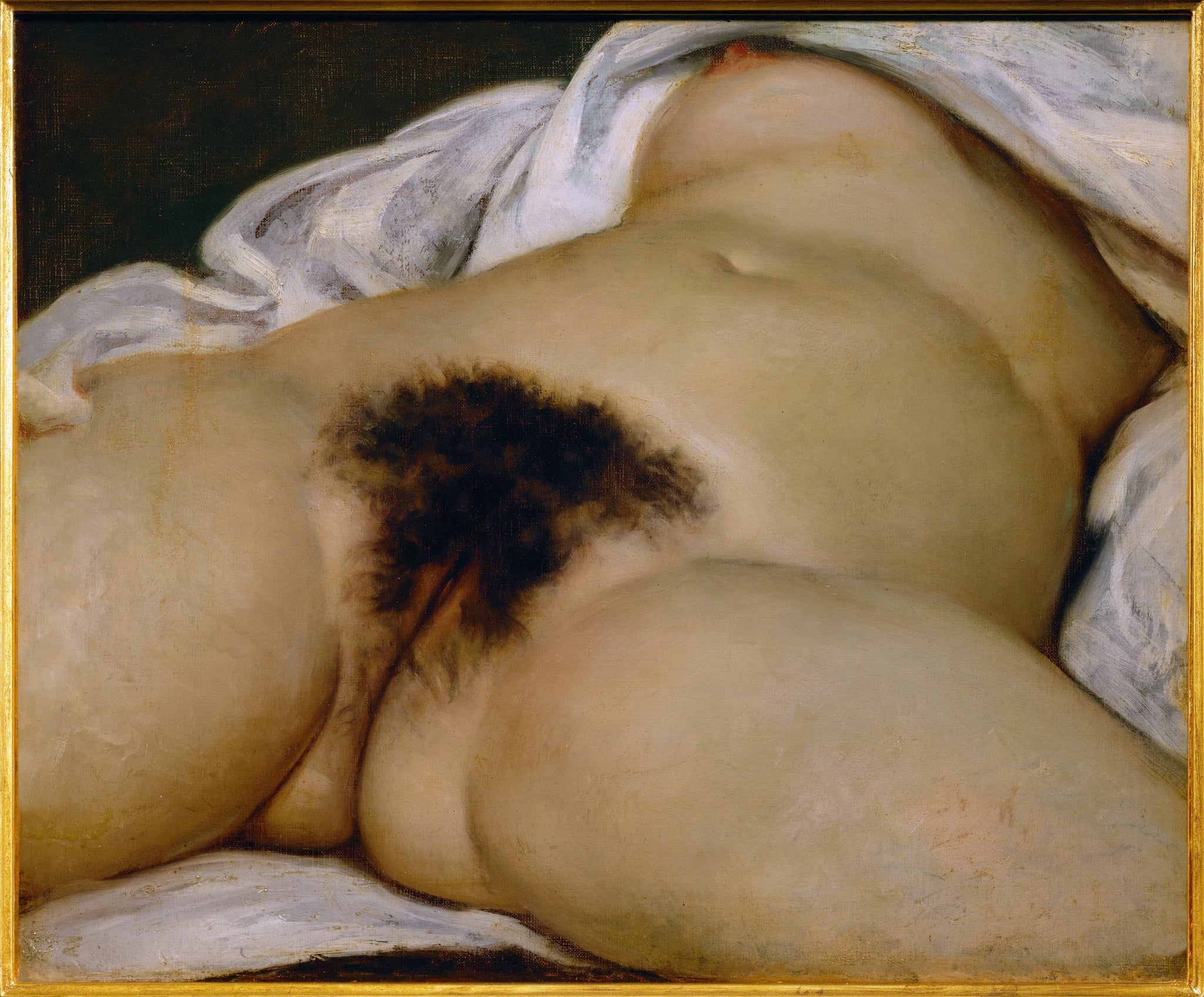
The Origin of the World
Gustave Courbet (1866)
The Origin of the World presents an uncompromising, tightly cropped view of a reclining female torso, setting warm flesh against cool, rumpled linen. With <strong>radical framing</strong> and <strong>unidealized realism</strong>, Gustave Courbet redirects the nude from myth to matter, making the central pubic triangle a compositional and conceptual anchor. The painting asserts a material, bodily <strong>origin</strong> in place of allegory, collapsing eroticism into a claim about life’s beginnings <sup>[1]</sup><sup>[3]</sup>.

The Woman taken in Adultery
Rembrandt van Rijn (1644)
Rembrandt van Rijn’s The Woman taken in Adultery (1644) stages John 8:3–11 as a tense, ethical <strong>pause</strong> inside a cavernous, gilded sanctuary. A narrow beam of <strong>light</strong> singles out the kneeling woman in white while Christ’s composed figure redirects the crowd from <strong>retribution</strong> toward <strong>mercy</strong> <sup>[1]</sup>.
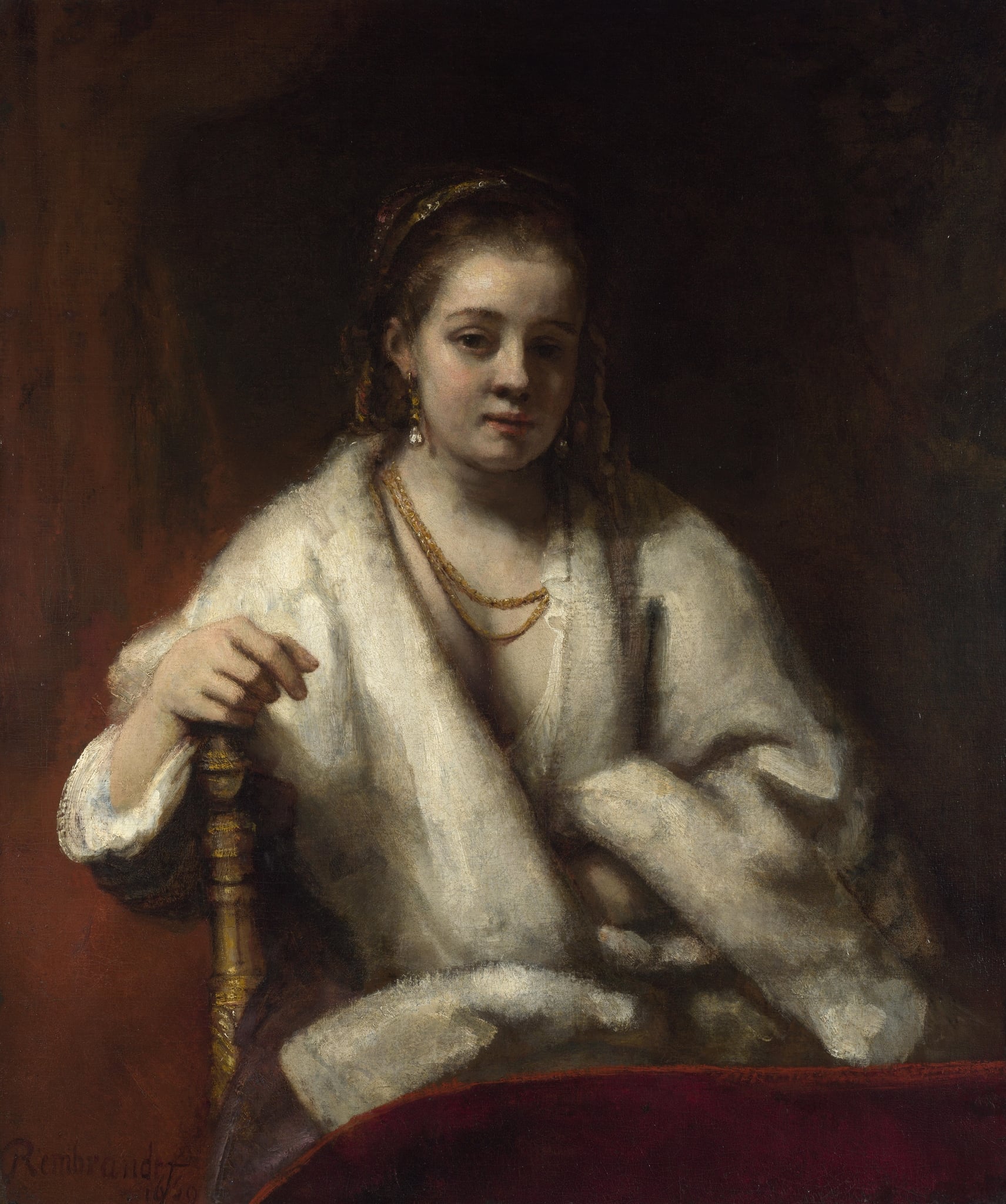
Portrait of Hendrickje Stoffels
Rembrandt van Rijn (c. 1654–1656)
In Portrait of Hendrickje Stoffels, Rembrandt van Rijn stages an intimate encounter in which a young woman leans from darkness into <strong>golden, directional light</strong>, her fur-trimmed wrap and jewelry catching the eye while her expression remains inward-looking. The thick impasto of the robe, the <strong>subtle glint of a gold chain and pearl earring</strong>, and the anchoring <strong>red table edge</strong> fuse touch, time, and tenderness into a single, contemplative presence <sup>[1]</sup>. Painted in the mid‑1650s, the work distills Rembrandt’s late style: psychological depth, restrained palette, and <strong>moral chiaroscuro</strong> <sup>[1]</sup>.
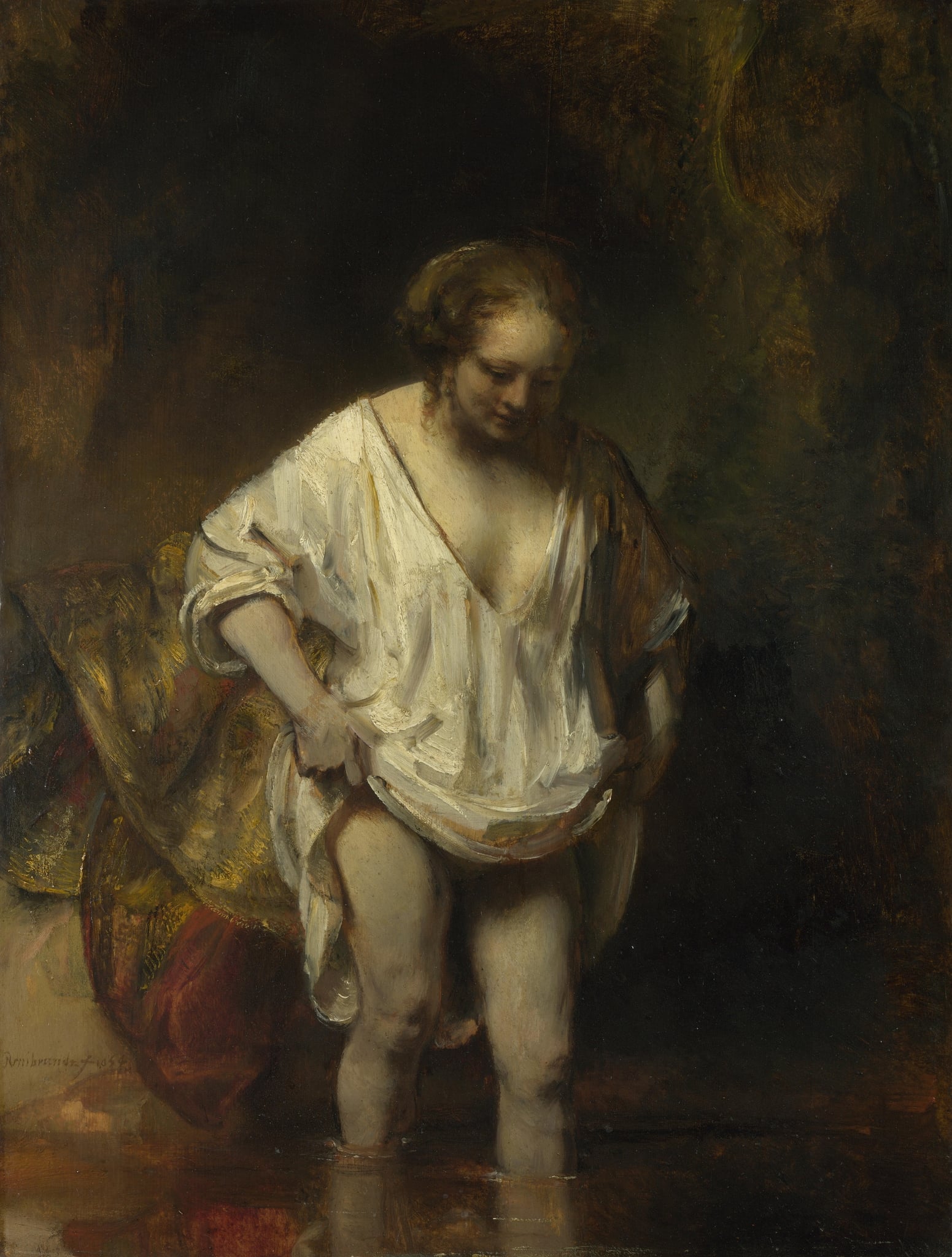
A Woman bathing in a Stream (Hendrickje Stoffels?)
Rembrandt van Rijn (1654)
Rembrandt van Rijn’s A Woman bathing in a Stream (Hendrickje Stoffels?) stages a private act as a public meditation on <strong>vulnerability</strong>, <strong>renewal</strong>, and <strong>empathetic seeing</strong>. The woman gathers her <strong>white shift</strong> as it clings to her, steps into the water, and glows under a warm, directional light against a shadowed bank. The image turns everyday intimacy into a <strong>monumental</strong>, morally inflected moment of presence <sup>[1]</sup><sup>[2]</sup>.