The Elephants

by Salvador Dali

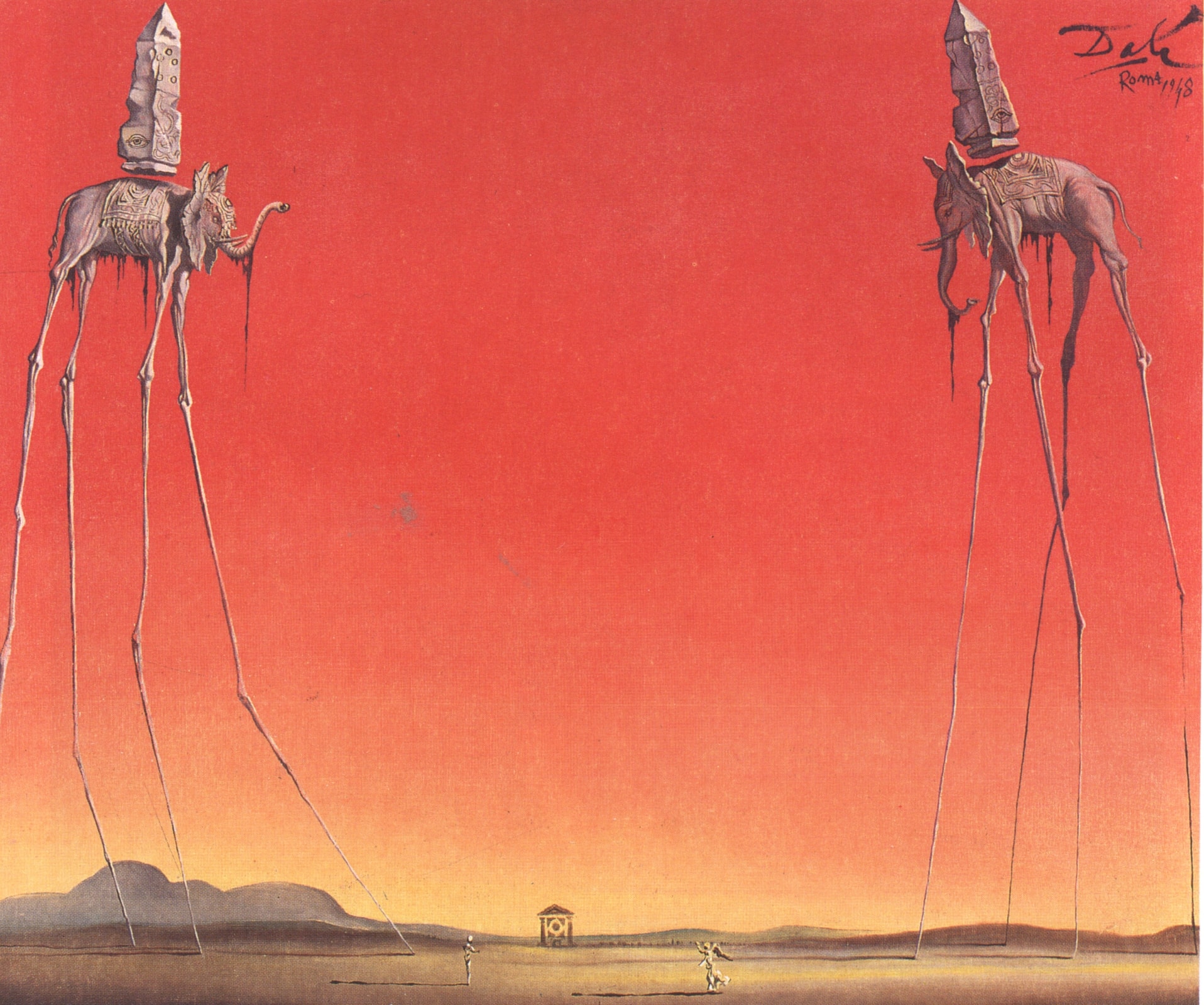
In The Elephants, Salvador Dali distills a stark paradox of weight and weightlessness: gaunt elephants tiptoe on stilt-thin legs while bearing stone obelisks. The blazing red-orange sky and tiny human figures compress ambition into a vision of precarious power and time stretched thin [1][2].

Fast Facts

Year
1948
Medium
Oil on canvas
Dimensions
49 x 60 cm
Location
Private collection
The Elephants by Salvador Dali (1948) featuring Elephants, Obelisks

Click on any numbered symbol to learn more about its meaning

Meaning & Symbolism

Dali constructs The Elephants as a theorem of contradiction. The creatures’ torsos are shrunken and ribbed, their skin streaking downward like melted wax, yet each supports an obelisk strapped high on its back. The legs extend as unnaturally long, jointed stilts that scarcely touch the ground, converting mass into an anxious levitation. This image operationalizes Dali’s recurring “legs of desire” concept: desire drives upward reach, but it also elongates and thins the very supports that must bear the load, leaving power to sway on brittle means 5. The obelisks—explicit heirs to Bernini’s elephant-and-obelisk ensemble—import a classical language of empire, phallic assertion, and permanence, only to be recoded by Surrealist physics in which weight floats and endurance drips 23. The tiny figures and lone pavilion at the horizon compress the scale further: the elephants are not simply large; they are systemically out of proportion to their world, dramatizing how ambition inflates itself beyond the body that carries it 3. This paradox is not merely formal; it is historical. Painted in 1948, the work sits at the hinge of Dali’s return to Spain and his engagement with post‑atomic thought—his move toward nuclear mysticism,” where matter fragments, levitates, and reorganizes according to invisible laws 46. The apocalyptic red sky functions less as meteorology than as a field of psychic heat, the ambient temperature of desire and ruin in the wake of war and the bomb. In this register, the elephants’ legs behave like vectors in a stressed system: excessively long to span a widened, emptied plain; perilously thin because the era’s supports—political, erotic, metaphysical—have been drawn taut. The strapped obelisks insist that the dream cannot renounce its monuments; authority and aspiration persist, but only by courting collapse. The painting thus argues that modern ambition survives through a logic of precarious elevation: everything is lifted, nothing is grounded. Why The Elephants is important emerges here: Dali synthesizes his mid‑1940s iconography into a concentrated emblem that is both self‑critical and epochal. By referencing Bernini while voiding the Baroque pedestal, he shows that tradition no longer stands under its own weight; instead, it must be carried—awkwardly, anxiously—by creatures whose bodies testify to exhaustion. The long shadows and the stretched interval between the two giants register time as extension rather than event, reinforcing a sense that endurance itself has become attenuated. In sum, The Elephants converts the classical monument into a Surreal equation: aspiration ÷ support = risk. It is a lucid dream of power whose tallest structures depend on the thinnest legs—an image of glory that survives only by balancing over the abyss 126.

Explore Deeper with AI

Ask questions about The Elephants

Popular questions:

Powered by AI • Get instant insights about this artwork

💬 Ask questions about this artwork!

Interpretations

Art-Historical Genealogy (Baroque Afterlife)

Dalí’s elephants are not only surreal fauna; they are a curatorial act on Baroque Rome. By lifting Bernini’s Elephant and Obelisk and subtracting the pedestal, Dalí converts a devotional wayfinding device into a mobile, anxiety‑ridden reliquary of tradition. The obelisk—once stabilized by masonry and papal urbanism—becomes a sign in transit, strapped to a mammal whose legs deny tectonic certainty. This is appropriation as analysis: the Baroque promise of permanence is re‑staged within a dream‑physics where support systems stretch toward failure. In doing so, Dalí exposes the monument as a contingent technology of power, dependent on carriers, straps, and spectacle rather than stone, foreshadowing postmodern “de‑pedestaled” public art 248.

Source: Royal Museums of Fine Arts of Belgium; Fundació Gala–Salvador Dalí; Wikipedia (Bernini monument)

Scientific-Philosophical Context (Nuclear Mysticism)

Painted at the hinge of Dalí’s return to Spain, The Elephants operationalizes his post‑atomic inquiry: matter fragmented yet held in suspension. The stilt‑legs act like vectors in a sparse field; mass is redistributed along tenuous lines rather than gathered in a base. This reflects Dalí’s effort to reconcile classical order with quantum discontinuity—an aesthetic of particles, gaps, and levitation. The red sky reads as an energetic field, not weather; the bodies are tense architectures subject to invisible laws. Rather than satire alone, the image proposes a metaphysics: endurance under modernity is a function of spacing, tension, and probabilistic support—what Dalí elsewhere folds into his theory of “nuclear mysticism” 15.

Source: Fundació Gala–Salvador Dalí (science essays); Smithsonian Magazine

Psychoanalytic/Gender Reading

The coupling of obelisk and attenuated limbs renders masculine assertion as fetish. The obelisk’s vertical thrust is unmistakably phallic, yet its authority depends on spidery, jointed “legs of desire,” emblems of excitatory drive without musculature. The result is a tableau of fetishistic disavowal: power insists on inviolability while parading its own instability. Dalí’s staging of tiny horizon figures intensifies the voyeuristic scale shift—grandiosity performed against miniaturized social measure. The erotic charge is inseparable from risk; desire produces height by mortgaging substance. In this lens, The Elephants becomes a clinical diagram of libidinal economy: maximal arousal, minimal support—a fantasy architecture straining at its own armature 32.

Source: Dalí Paris (Dalinian symbols); Royal Museums of Fine Arts of Belgium

Landscape-Time Phenomenology

Dalí’s desert is less site than instrument. The flattened horizon, attenuated shadows, and micro‑architecture compress time into extension rather than event; duration is measured as stretch. The elephants’ interval—the charged distance between their slow, impossible strides—reads like a temporal hinge that never closes. The landscape functions as a metronome of delay, a void that makes levitation legible. This is kin to the settings of The Temptation of St. Anthony, where barren plains host ordeals; but here the ordeal is structural, not narrative: the ordeal of support itself. Dalí converts plein‑air space into a phenomenological device that reveals how vision registers tension, scale, and the labor of holding things up 2.

Source: Royal Museums of Fine Arts of Belgium

Political Allegory of Empire Under Strain

Transposing Bernini’s papal elephant into a post‑war plain, Dalí reframes empire as cargo. Authority and aspiration persist, but only as strapped monuments whose transport exposes dependency: laboring bodies, lashings, and the spectacle of balance. In the wake of World War II and the bomb, the scene reads as a quiet state portrait of power’s afterlife—majestic, yes, but fundamentally logistical. The sovereign symbol no longer stands; it must be borne, advertised, and stabilized against collapse. Dalí thus anticipates late‑modern critiques of imperial display, affirming that grandeur survives as choreography, not foundation—a politics of precarious elevation 546.

Source: Smithsonian Magazine; Wikipedia (Bernini monument); Encyclopaedia Britannica (Dalí biography)

Medium Reflexivity: Monument vs. Picture Plane

The Elephants doubles as a treatise on pictorial support. Where sculpture depends on a pedestal, Dalí’s canvas supplies infinite ground—yet he paints supports that barely touch it. The stilt‑legs rhyme with brush‑drawn vectors, linearities that assert while withholding mass. The obelisk’s polished planes contrast with the sky’s saturated field, staging a dialogue between hard‑edge monument and chromatic atmosphere. By exchanging stone’s gravity for painting’s suspension, Dalí demonstrates how a two‑dimensional medium can simulate (and subvert) the contract of monumentality: visibility without weight, endurance as image. The work reads as medium‑aware Surrealism—an essay in how pictures can carry what pedestals no longer can 17.

Source: Fundació Gala–Salvador Dalí; Wikipedia (The Elephants)

Related Themes

About Salvador Dali

Salvador Dali (1904–1989) emerged as a leading Surrealist in the early 1930s, perfecting a hyper‑real style tied to his **paranoiac‑critical method**, which cultivated delirious associations rendered with photographic precision. His lifelong bond to the Portlligat/Cap de Creus coast shaped the seascapes behind his dream imagery [4][3].
View all works by Salvador Dali

More by Salvador Dali