Colonialism & empire
Featured Artworks
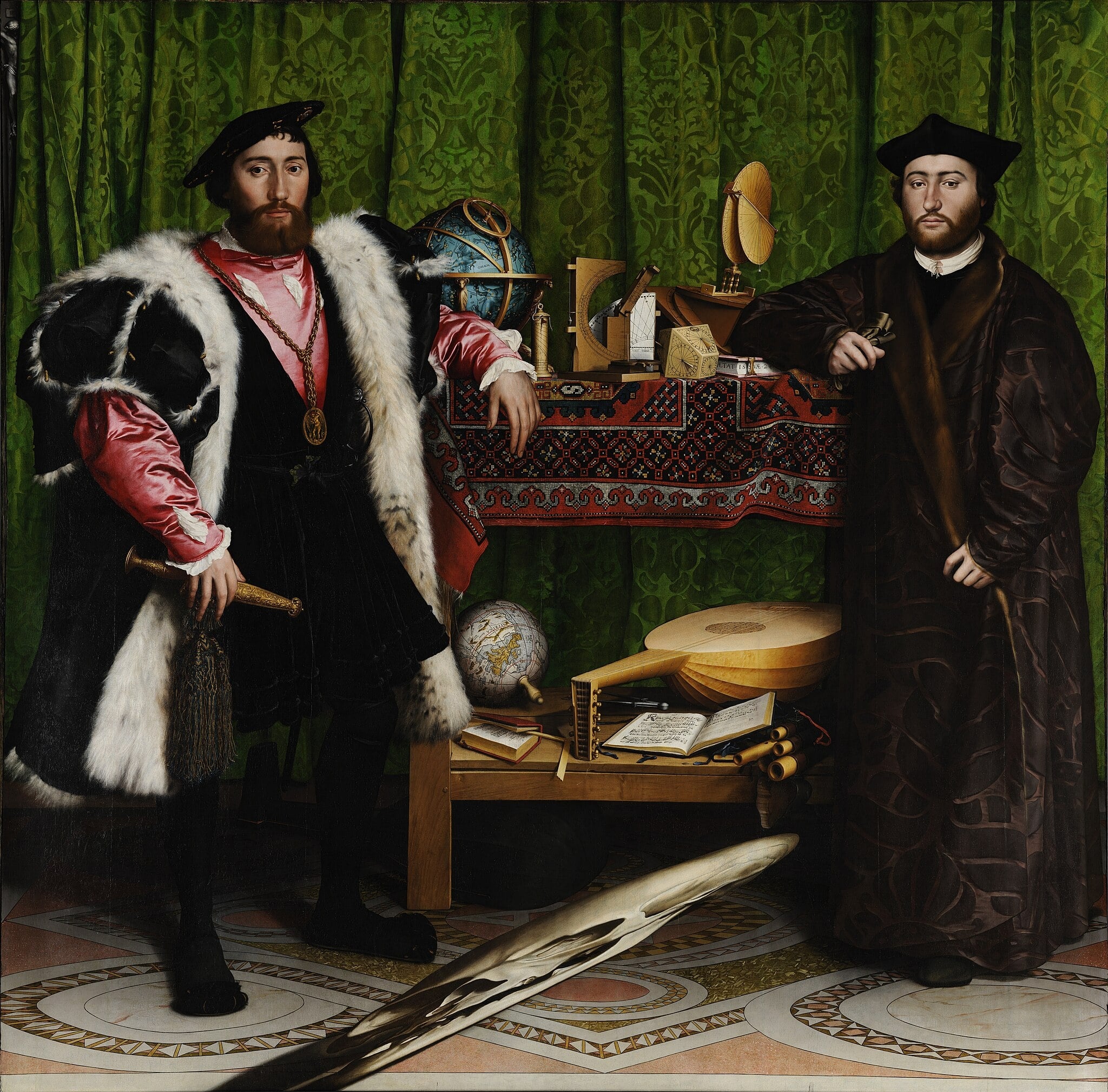
The Ambassadors
Hans Holbein the Younger (1533)
Holbein’s The Ambassadors is a double-portrait staged before a green curtain, where shelves of scientific instruments, books, and musical devices enact <strong>Renaissance learning</strong> while an anamorphic <strong>skull</strong> and a veiled <strong>crucifix</strong> counter it with mortality and salvation <sup>[1]</sup><sup>[2]</sup>. The work balances worldly status—fur, velvet, Oriental carpet—with a sober theology of limits amid the <strong>Reformation’s discord</strong> <sup>[1]</sup><sup>[2]</sup>.
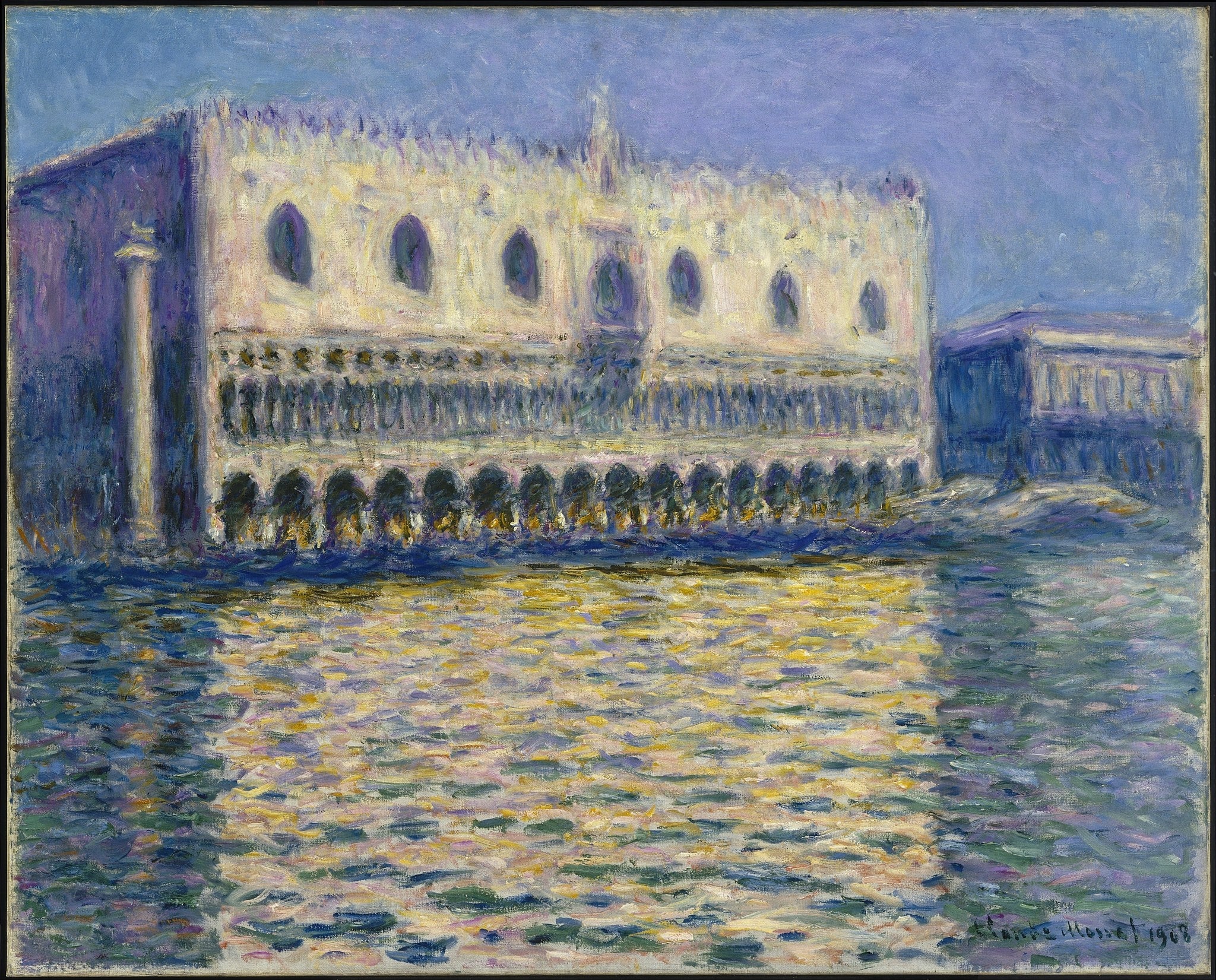
The Doge's Palace
Claude Monet (1908)
Monet’s The Doge’s Palace translates Venice’s emblem of authority into an <strong>atmospheric drama</strong> of lilac, cream, and ultramarine. Architecture becomes a <strong>screen for light</strong>, as the ogival windows and double arcades blur into vibrating strokes mirrored by the lagoon’s <strong>second architecture</strong>—its reflection <sup>[1]</sup><sup>[4]</sup>.
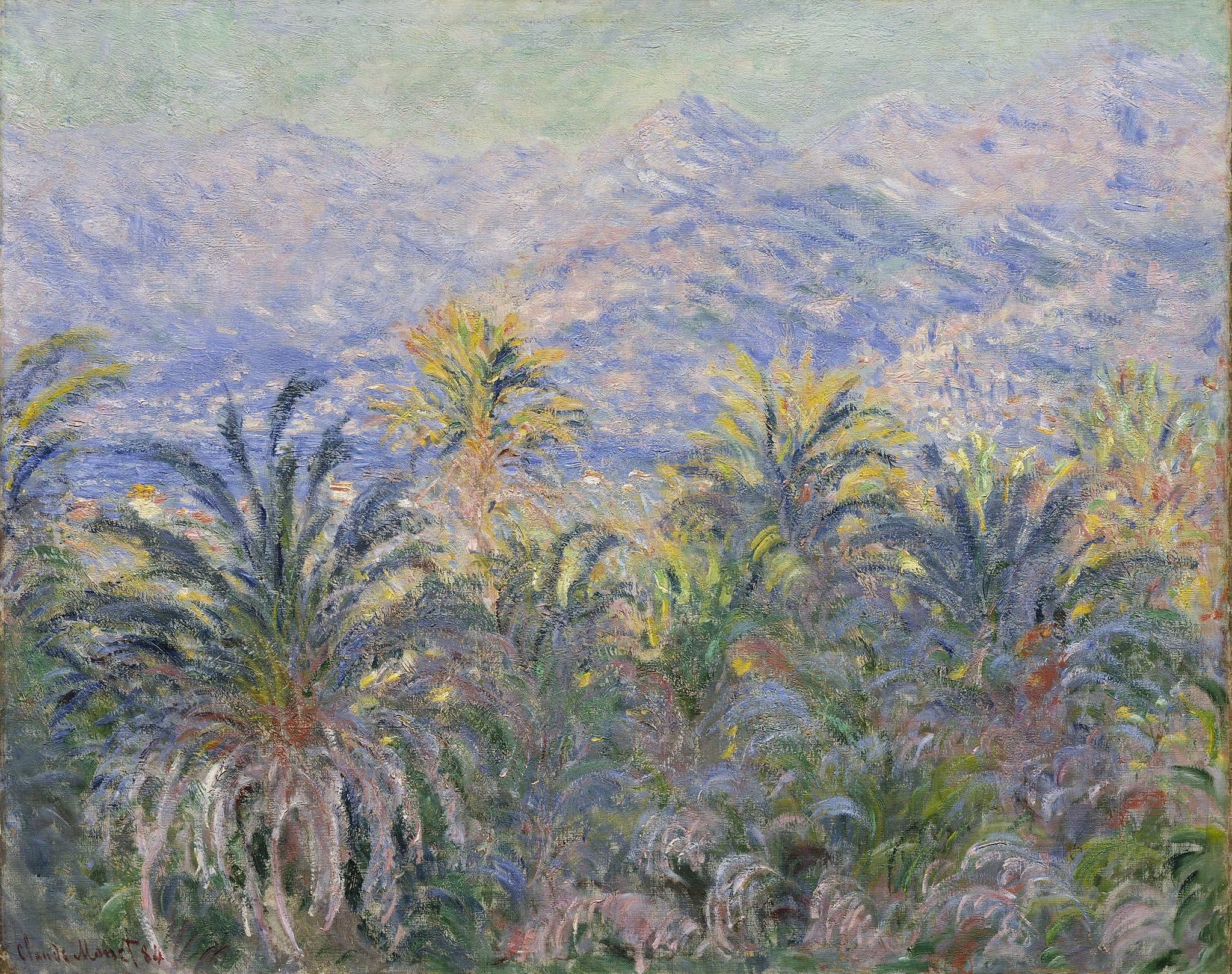
Palm Trees at Bordighera
Claude Monet (1884)
Claude Monet’s Palm Trees at Bordighera (1884) turns a Riviera grove into <strong>vibrating atmosphere</strong>: palm fronds surge across the foreground while a <strong>cobalt sea</strong> and <strong>violet-blue Alps</strong> dissolve into a misted sky. Monet pushes cool mauves, blues, and lemon tints into broken strokes so the scene reads as <strong>light-in-motion</strong> rather than botany <sup>[1]</sup><sup>[2]</sup>.
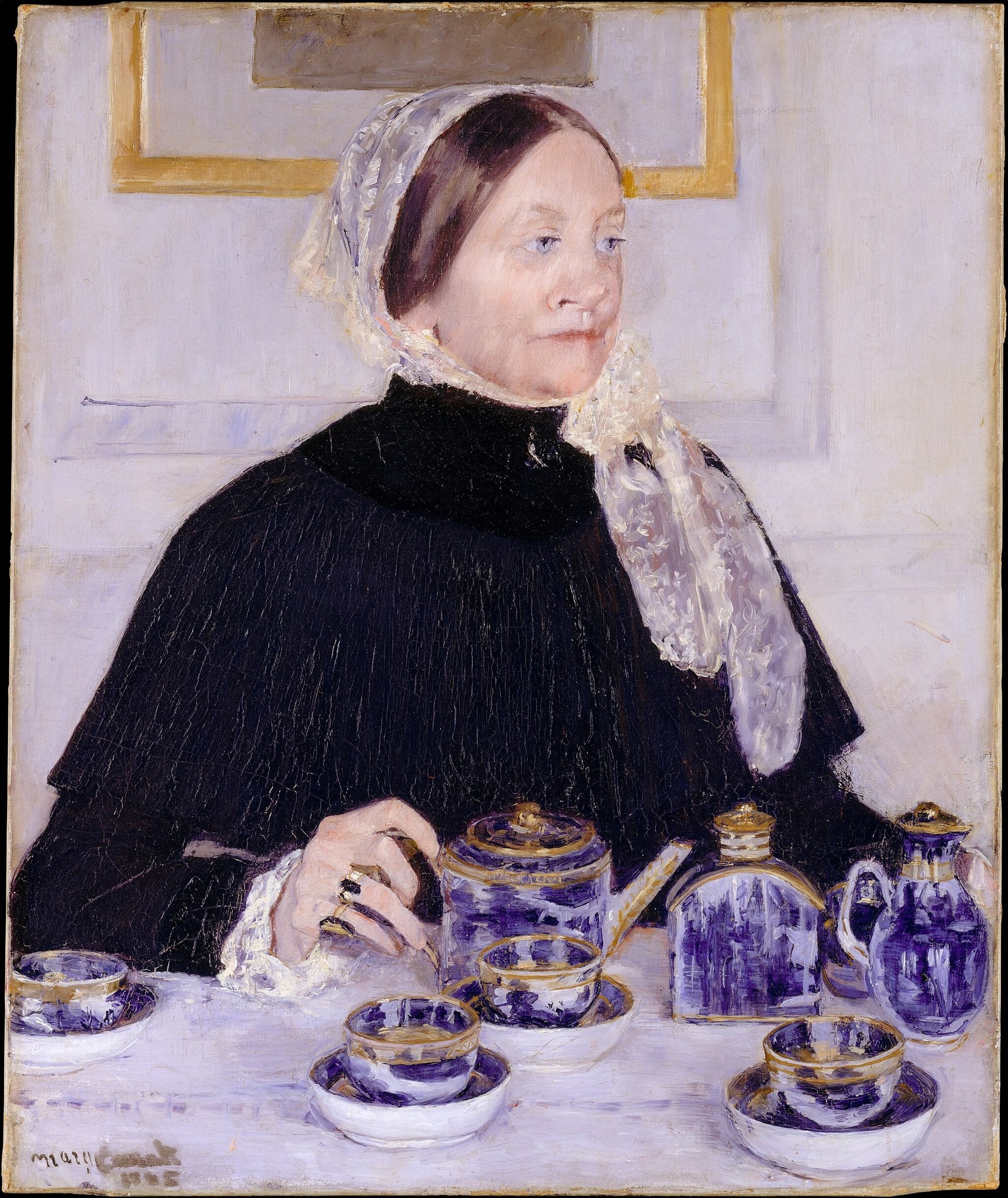
Lady at the Tea Table
Mary Cassatt (1883–85 (signed 1885))
Mary Cassatt’s Lady at the Tea Table distills a domestic rite into a scene of <strong>quiet authority</strong>. The sitter’s black silhouette, lace cap, and poised hand marshal a regiment of <strong>cobalt‑and‑gold Canton porcelain</strong>, while tight cropping and planar light convert hospitality into <strong>modern self‑possession</strong> <sup>[1]</sup><sup>[5]</sup>.
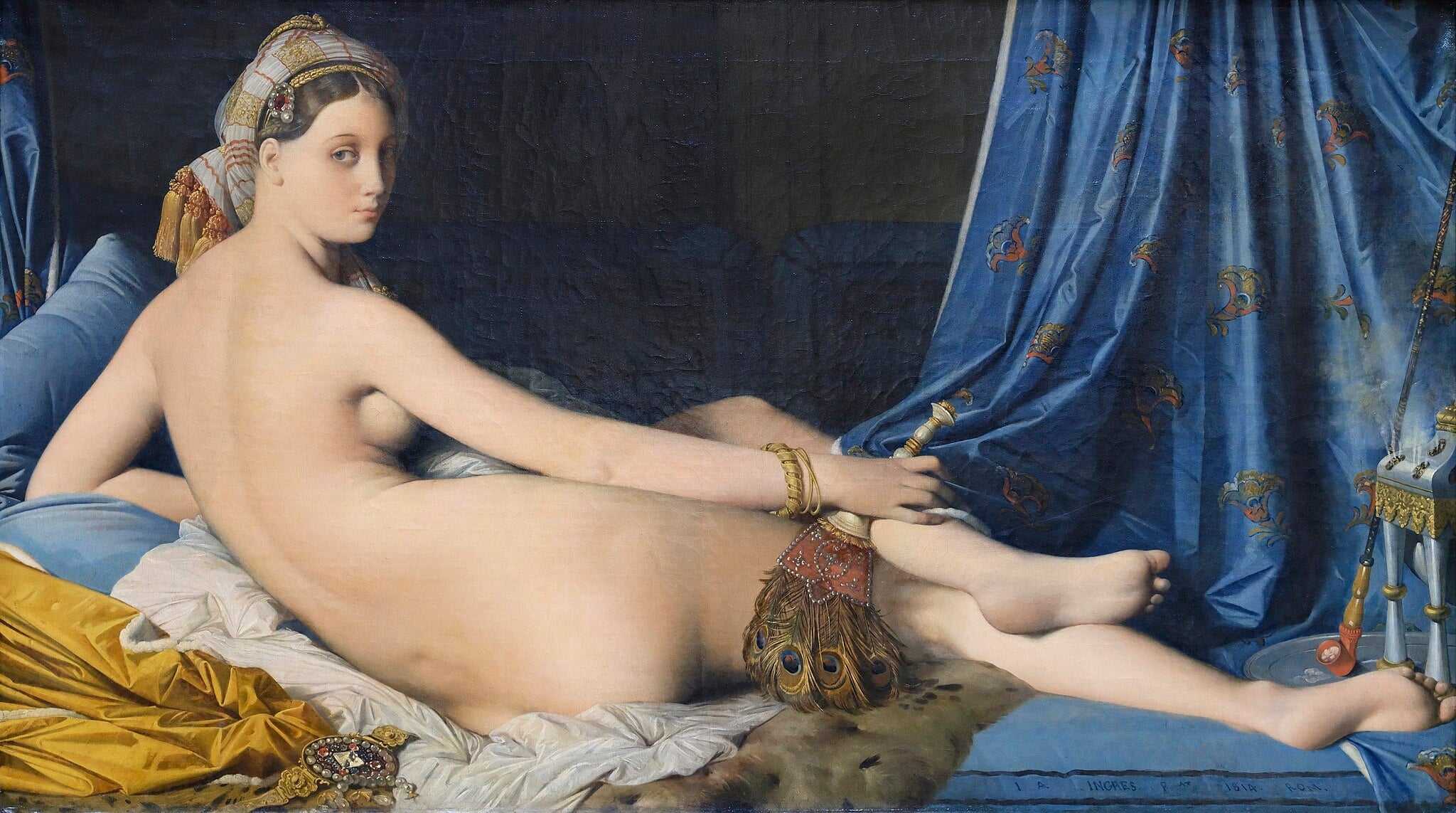
Grande Odalisque
Jean-Auguste-Dominique Ingres (1814)
In Jean-Auguste-Dominique Ingres’s Grande Odalisque (1814), a nude woman reclines against cool satin and a deep blue, patterned curtain, her spine drawn into an elegant, impossible arc. With a jeweled turban, bracelets, and a peacock-feather fan, she turns to meet the viewer’s look, poised yet distant. The image fuses <strong>Neoclassical idealization</strong> with <strong>Orientalist fantasy</strong>, privileging line and artifice over realism <sup>[1]</sup><sup>[2]</sup>.
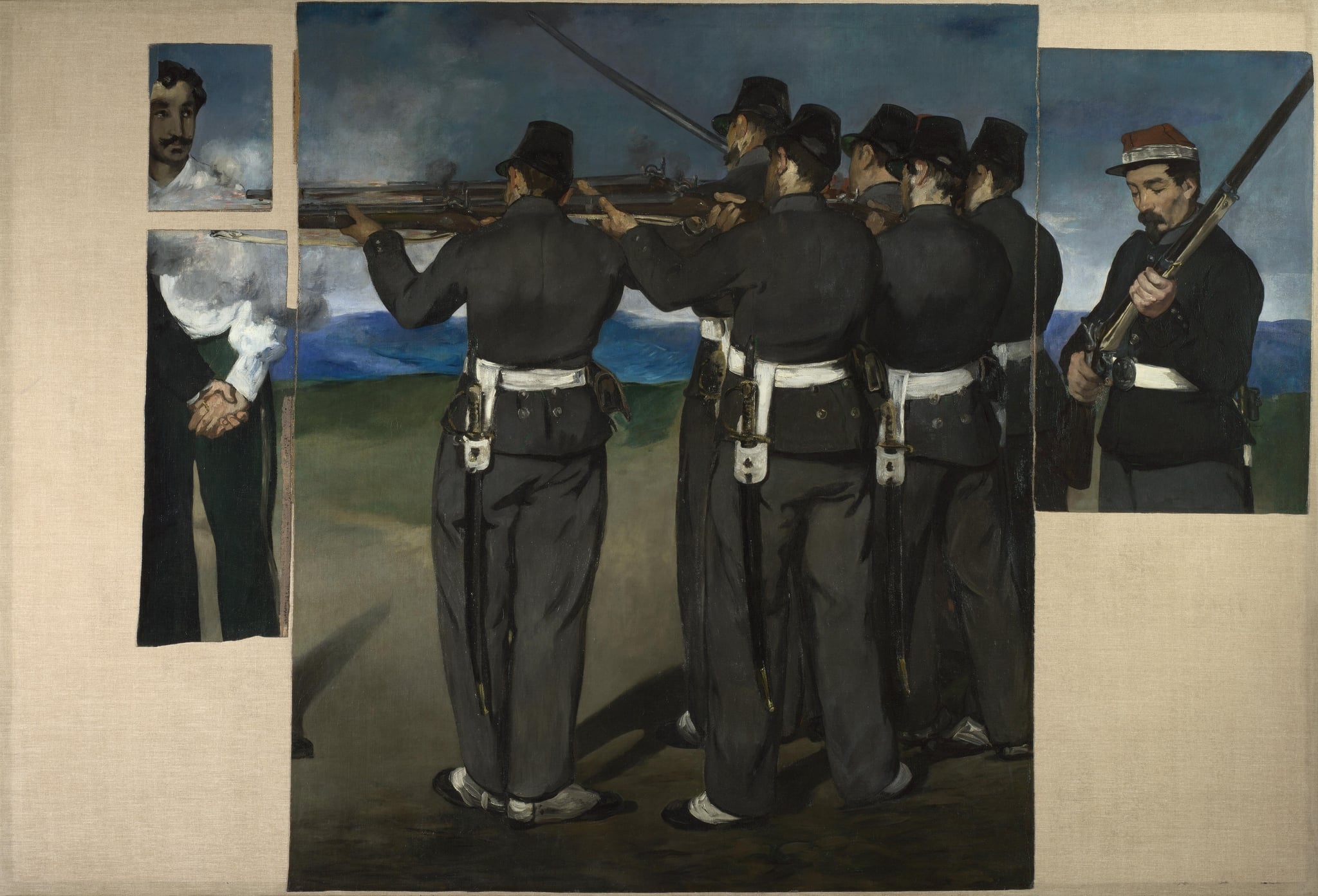
The Execution of Emperor Maximilian
Édouard Manet (1867–1868)
Manet’s The Execution of Emperor Maximilian confronts state violence with a <strong>cool, reportorial</strong> style. The wall of gray-uniformed riflemen, the <strong>fragmented canvas</strong>, and the dispassionate loader at right turn the killing into <strong>impersonal machinery</strong> that implicates the viewer <sup>[1]</sup><sup>[2]</sup>.
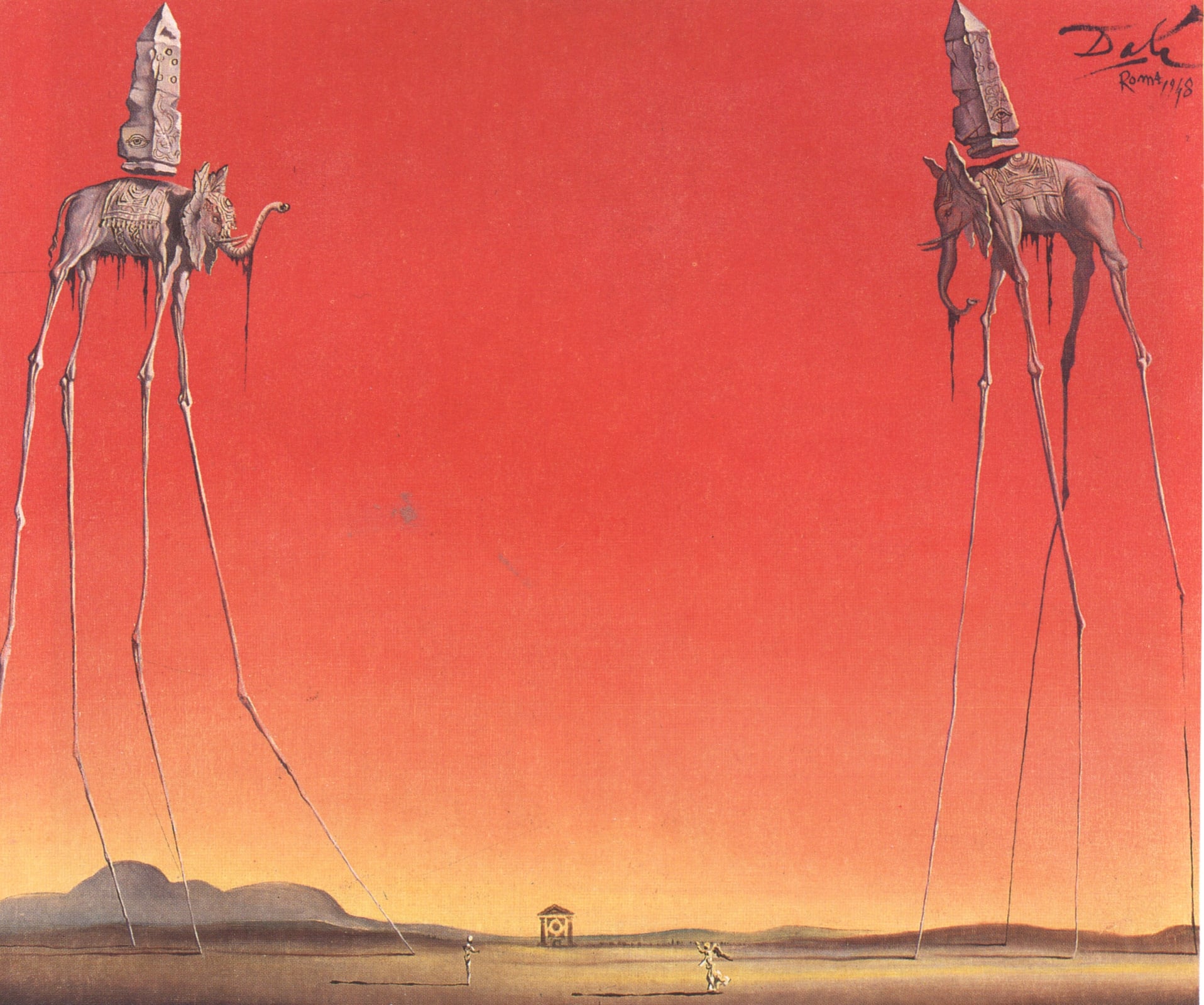
The Elephants
Salvador Dali (1948)
In The Elephants, Salvador Dali distills a stark paradox of <strong>weight and weightlessness</strong>: gaunt elephants tiptoe on <strong>stilt-thin legs</strong> while bearing stone <strong>obelisks</strong>. The blazing red-orange sky and tiny human figures compress ambition into a vision of <strong>precarious power</strong> and time stretched thin <sup>[1]</sup><sup>[2]</sup>.
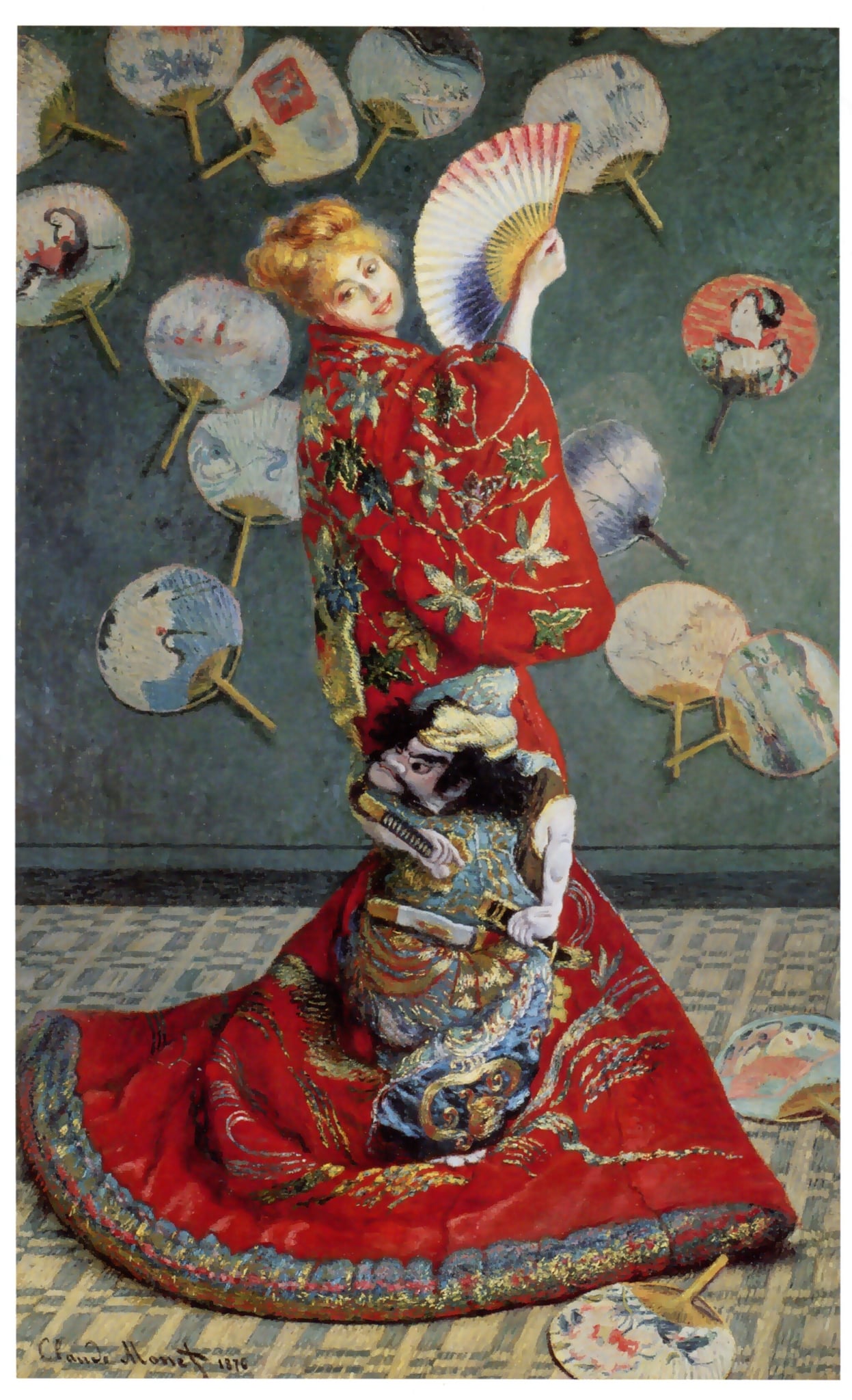
La Japonaise (Camille Monet in Japanese Costume)
Claude Monet (1876)
Claude Monet’s La Japonaise (Camille Monet in Japanese Costume) (1876) stages a witty confrontation between <strong>Parisian modernity</strong> and the fashion for <strong>Japonisme</strong>. A fair-skinned model in a blazing red uchikake preens before a wall tiled with uchiwa fans, lifting a <strong>tricolor</strong> hand fan that asserts Frenchness amid the imported decor. The painting turns costume, props, and gaze into a performance about <strong>desire, display, and identity</strong> <sup>[1]</sup><sup>[2]</sup>.
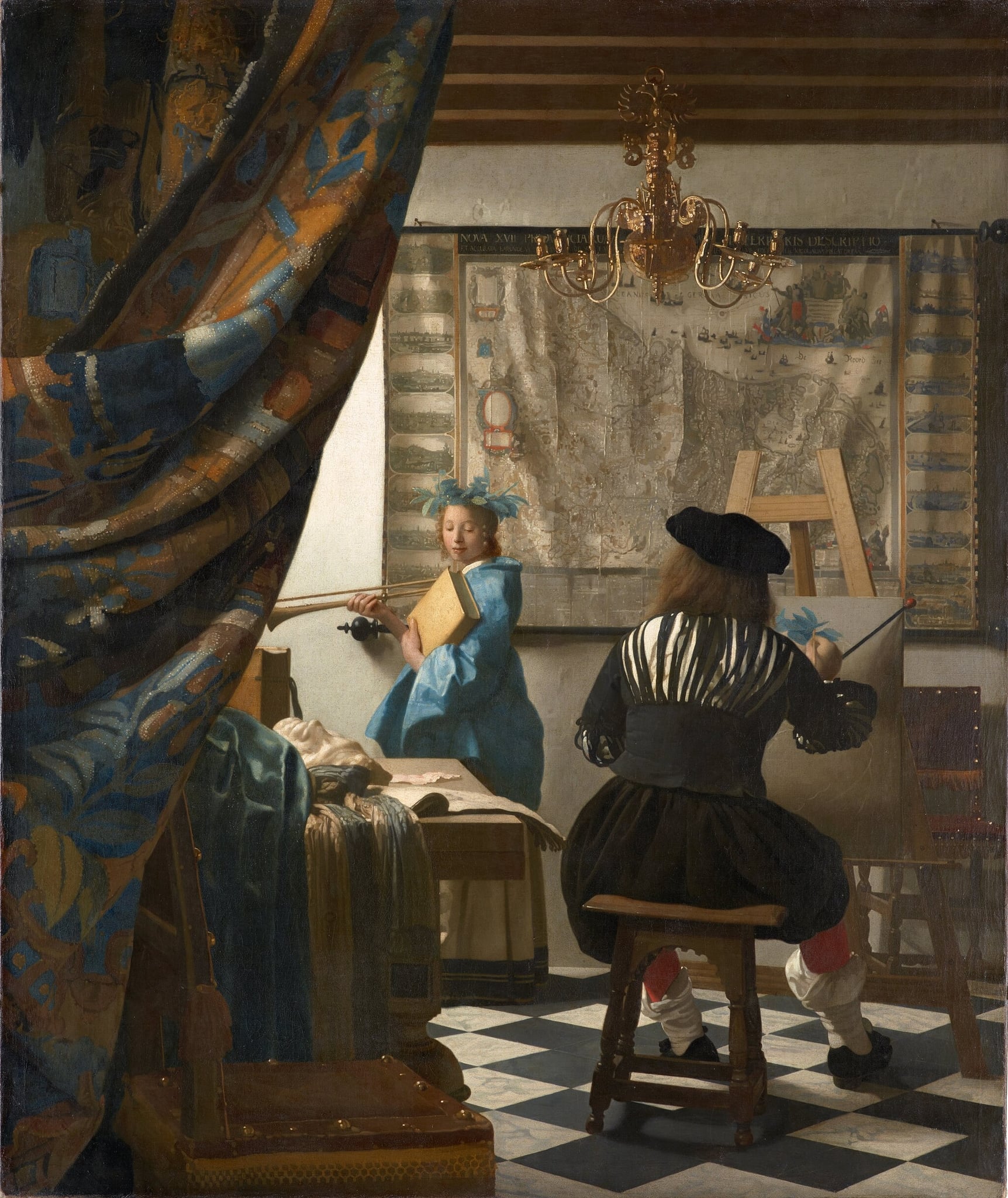
The Art of Painting
Johannes Vermeer (c. 1666–1668)
Johannes Vermeer’s The Art of Painting is a self-aware allegory that equates <strong>painting with history and fame</strong>. Framed by a parted <strong>tapestry</strong> like a stage curtain, an artist in historical dress paints the muse <strong>Clio</strong>, while a vast <strong>map of the Seventeen Provinces</strong> and a <strong>double‑headed eagle</strong> chandelier fold national memory into the studio scene <sup>[1]</sup><sup>[3]</sup>.
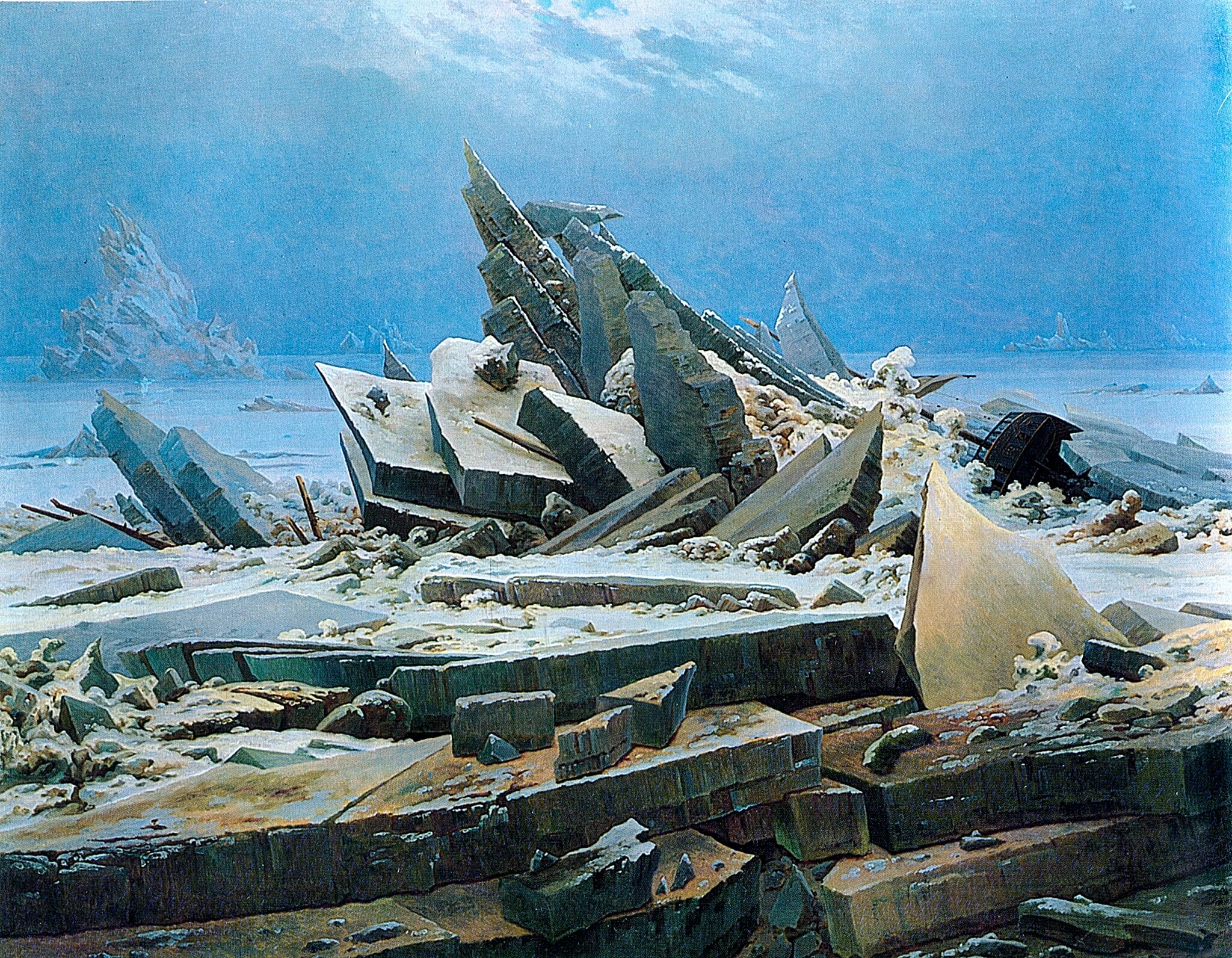
The Sea of Ice
Caspar David Friedrich (1823–1824)
Caspar David Friedrich’s The Sea of Ice turns nature into a <strong>frozen architecture</strong> that crushes a ship and, with it, human pretension. The painting stages the <strong>Romantic sublime</strong> as both awe and negation, replacing heroic conquest with the stark finality of ice and silence <sup>[1]</sup><sup>[3]</sup>.
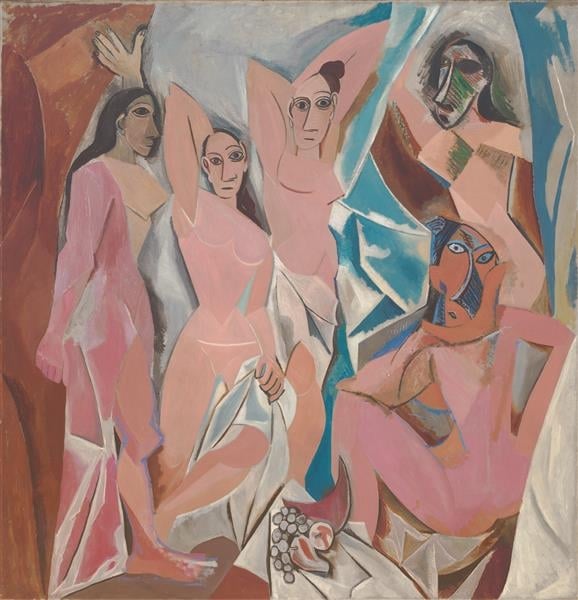
Les Demoiselles d'Avignon
Pablo Picasso (1907)
Les Demoiselles d'Avignon hurls five nudes toward the viewer in a shallow, splintered chamber, turning classical beauty into <strong>sharp planes</strong>, <strong>masklike faces</strong>, and <strong>fractured space</strong>. The fruit at the bottom reads as a sensual lure edged with threat, while the women’s direct gazes indict the beholder as participant. This is the shock point of <strong>proto‑Cubism</strong>, where Picasso reengineers how modern painting means and how looking works <sup>[1]</sup><sup>[2]</sup>.
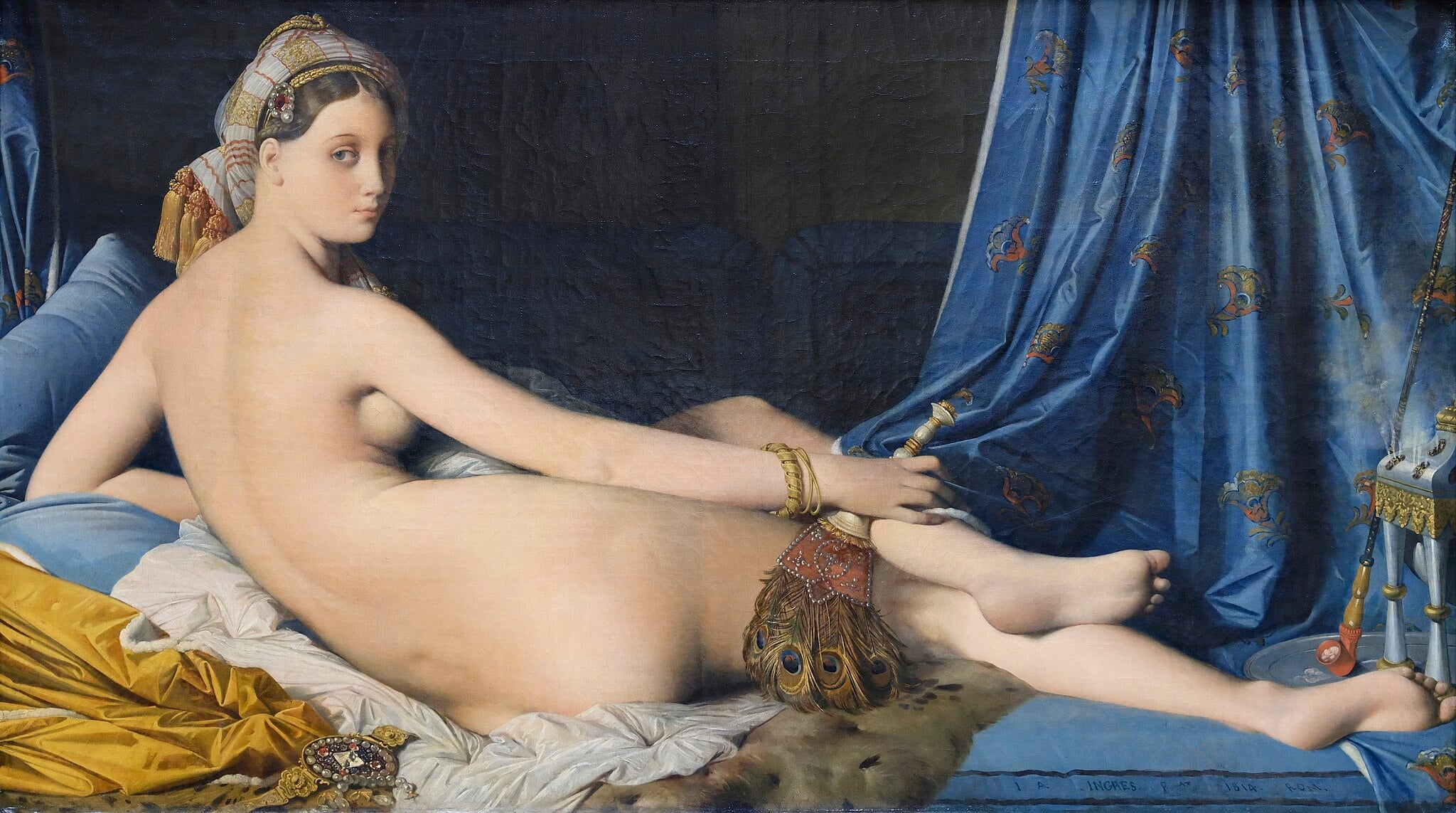
The Great Odalisque
Jean-Auguste-Dominique Ingres (1814)
Jean-Auguste-Dominique Ingres’s The Great Odalisque (1814) turns a reclining nude into an idealized, remote vision, polished to an <strong>enamel-like finish</strong> and staged with <strong>Orientalist</strong> props—turban, peacock-feather fan, blue curtain, and hookah. Commissioned by Caroline Murat and shown at the <strong>Salon of 1819</strong>, it fuses classical line with erotic fantasy, its elongated back and rotated shoulder declaring beauty as a constructed ideal <sup>[1]</sup><sup>[3]</sup>.
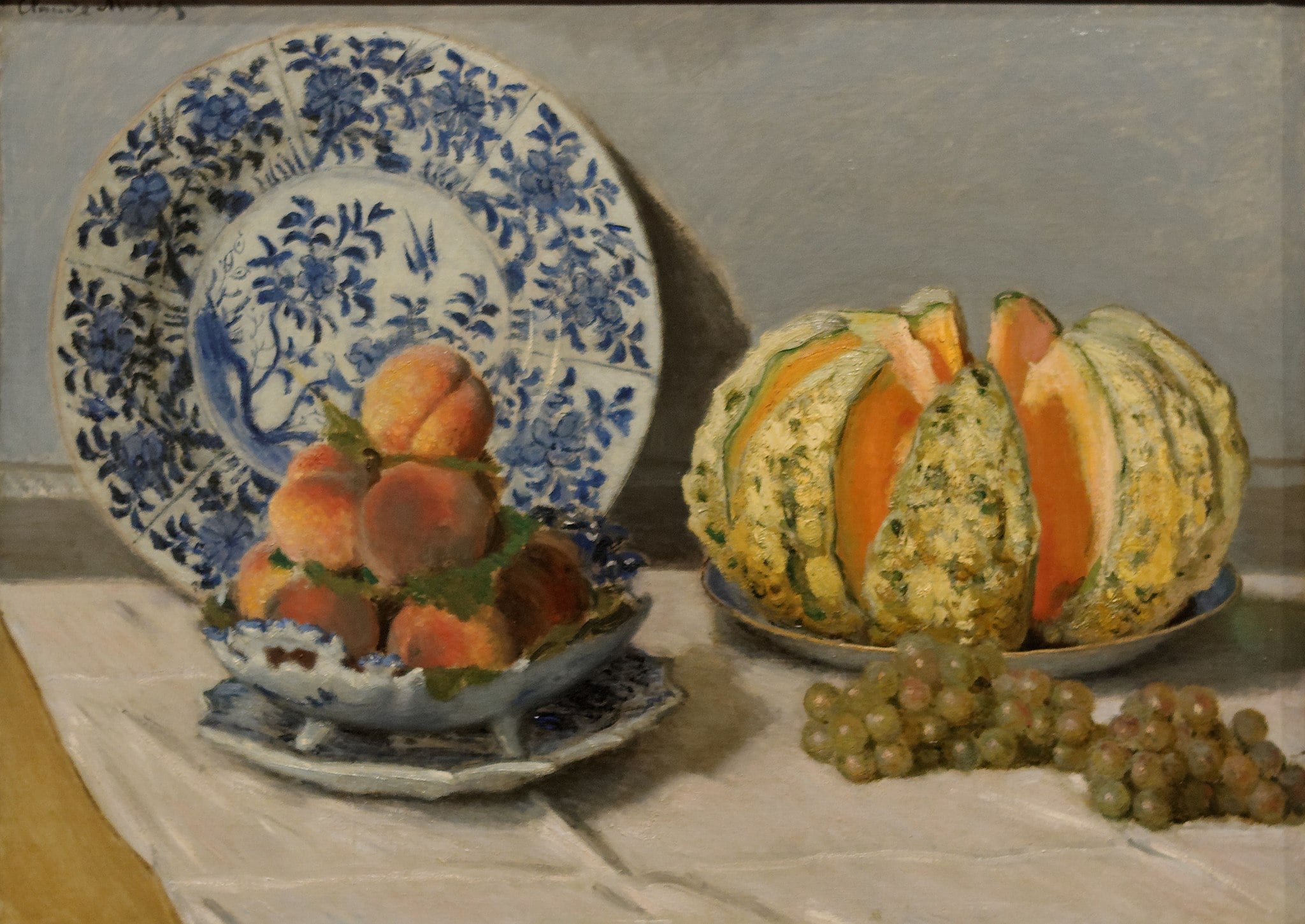
Still Life
Claude Monet (1872)
Claude Monet’s Still Life (1872) stages ripe peaches, a cut <strong>melon</strong>, and scattered grapes before luminous <strong>blue-and-white porcelain</strong>, turning a domestic spread into a drama of light and texture. Cool ceramics and a pale wall frame the warm, tactile fruit, while firm contours yield to buttery impasto on the melon’s rind. The painting renews a venerable genre through an Impressionist focus on <strong>perception</strong> and chromatic contrast <sup>[1]</sup><sup>[2]</sup>.
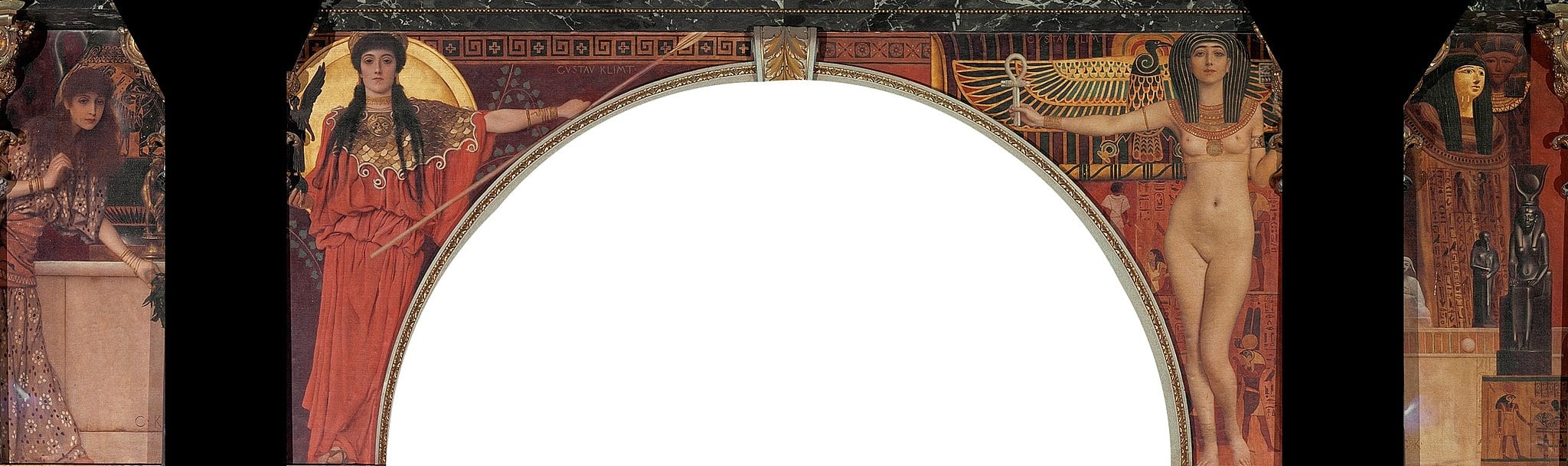
Ancient Greece and Egypt
Gustav Klimt (1891)
Gustav Klimt’s staircase pair Ancient Greece and Egypt stages two <strong>female allegories</strong> flanking an empty arch: a robed, animated <strong>Athena</strong> to the left and a frontal, nude Egyptian goddess aligned with <strong>Nekhbet’s vulture</strong> to the right. Klimt fuses collection-based citations with <strong>ornamental gold, red, and black</strong> to declare a canon in which Western art passes through Greece’s humanist clarity and Egypt’s sacral permanence <sup>[1]</sup><sup>[2]</sup><sup>[3]</sup>.
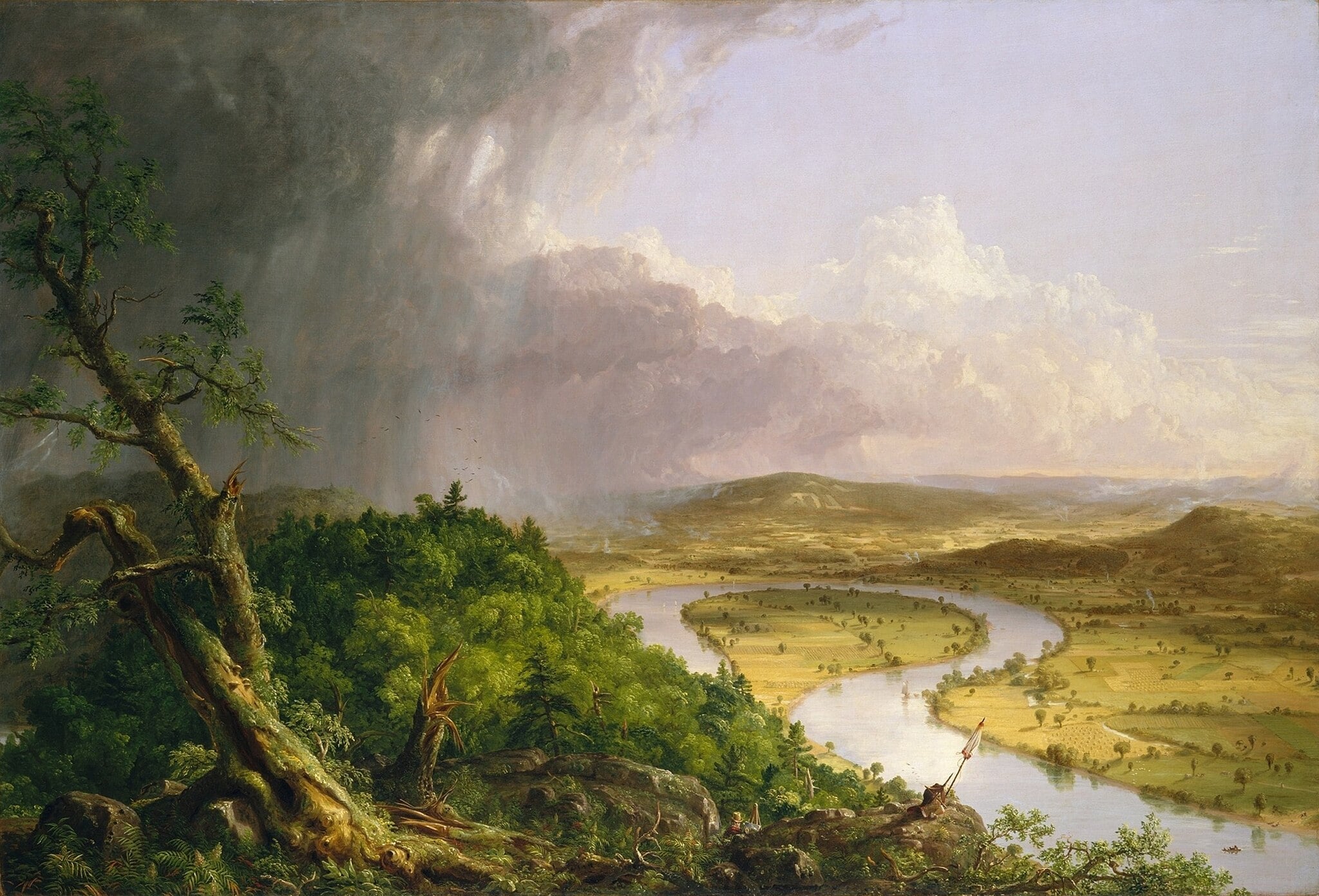
The Oxbow (View from Mount Holyoke)
Thomas Cole (1836)
Thomas Cole’s The Oxbow (View from Mount Holyoke) juxtaposes <strong>storm-lashed wilderness</strong> at left with <strong>sunlit, cultivated farmland</strong> at right, using a panoramic sweep of the Connecticut River’s curve. A tiny figure with an easel—Cole’s self-insertion—stands between realms, turning sight into judgment. The painting frames America’s landscape as both <strong>sublime</strong> and <strong>pastoral</strong>, a place of awe, promise, and warning.
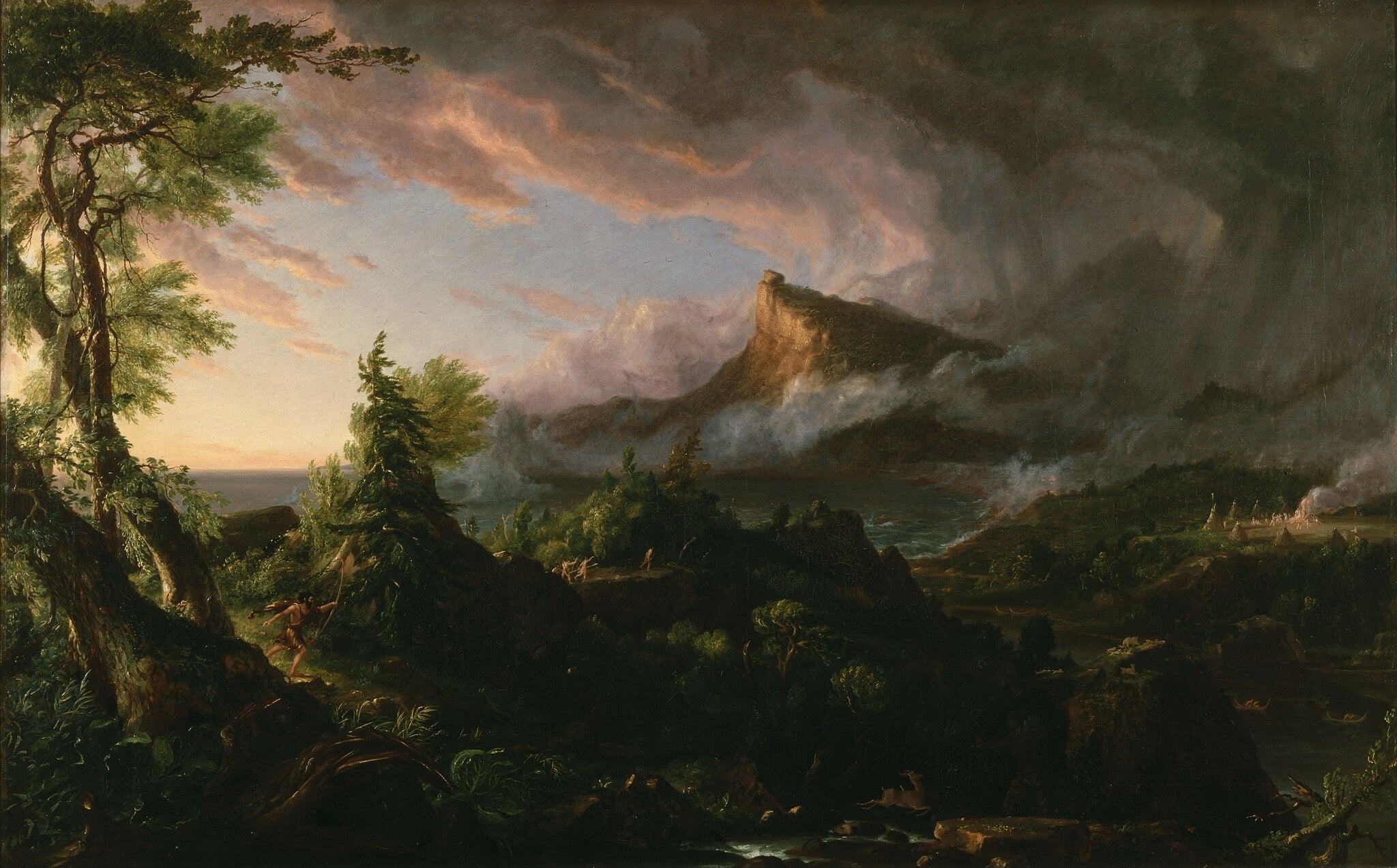
The Course of Empire: The Savage State
Thomas Cole (c. 1834 (series 1834–1836))
Thomas Cole’s The Course of Empire: The Savage State inaugurates his five-part cycle with a landscape ruled by <strong>wildness</strong> and <strong>origin</strong>. Dawn breaks at left as storm clouds rake a flat-topped crag, while a hunter looses an arrow, canoes cut the river, and smoke lifts from skin tents—signals of a society at the threshold of history <sup>[1]</sup><sup>[2]</sup><sup>[3]</sup>.
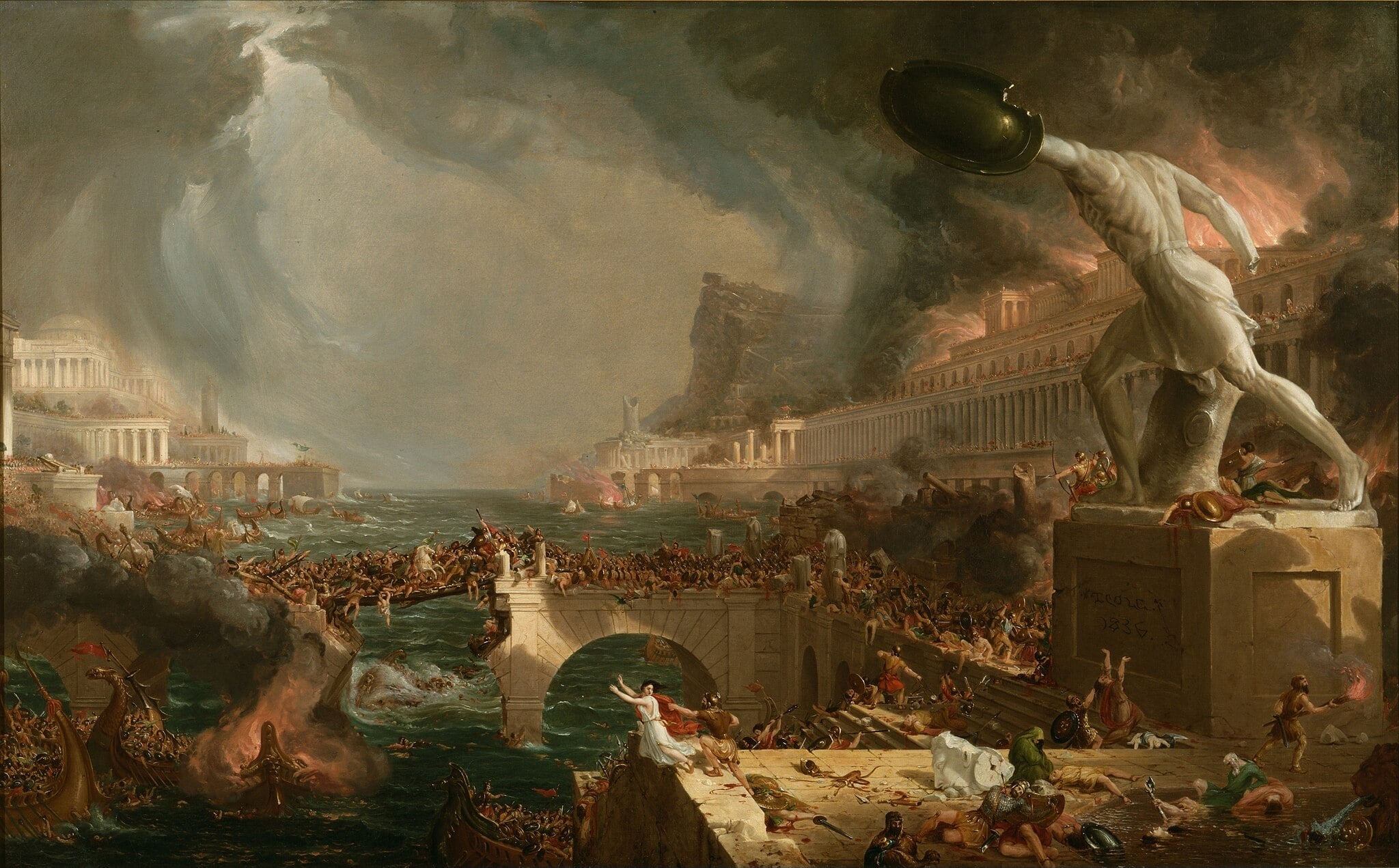
The Course of Empire: Destruction
Thomas Cole (1836)
Thomas Cole’s The Course of Empire: Destruction plunges a once‑ordered classical city into <strong>apocalyptic collapse</strong>. A <strong>collapsing bridge</strong>, <strong>burning colonnades</strong>, and a <strong>headless gladiator statue</strong> preside over panicked crowds and flaming warships, while a fixed mountain crag endures beyond the chaos. The canvas stages <strong>moral retribution</strong>: empire’s luxury curdles into vice and is swept away by combined human and elemental fury <sup>[1]</sup><sup>[2]</sup>.
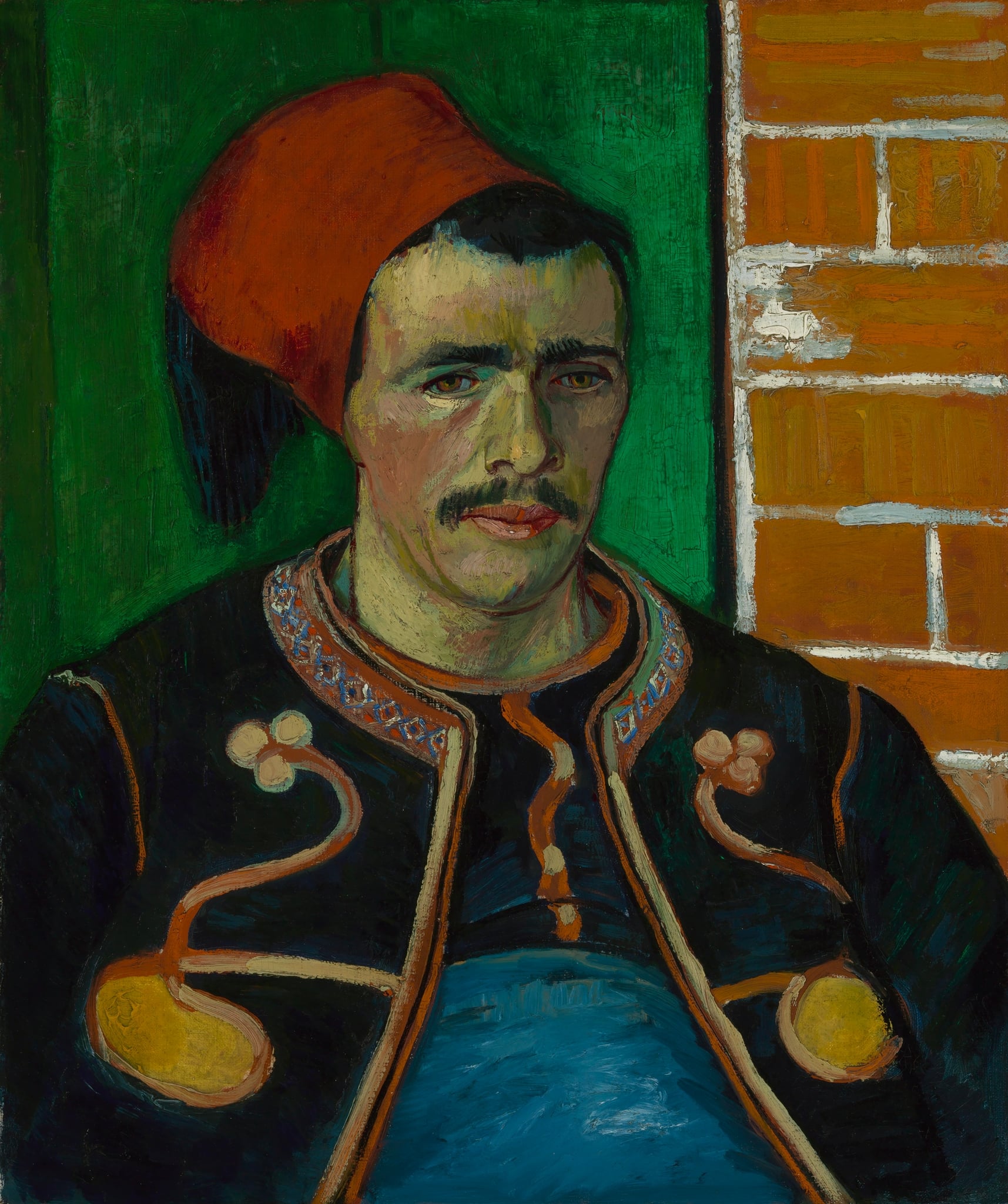
The Zouave
Vincent van Gogh (1888)
<strong>The Zouave</strong> crystallizes Van Gogh’s Arles project: a half-length soldier thrust forward by clashing complements—red, green, orange, blue—so color carries character. The flame-like <strong>fez</strong> ignites against a flat <strong>green door</strong> and a sliver of <strong>orange brick wall</strong>, while heavy outlines and simplified planes turn uniform into emblem. The work inaugurates his pursuit of the <strong>modern “character portrait,”</strong> where chromatic force outweighs likeness <sup>[1]</sup><sup>[2]</sup>.
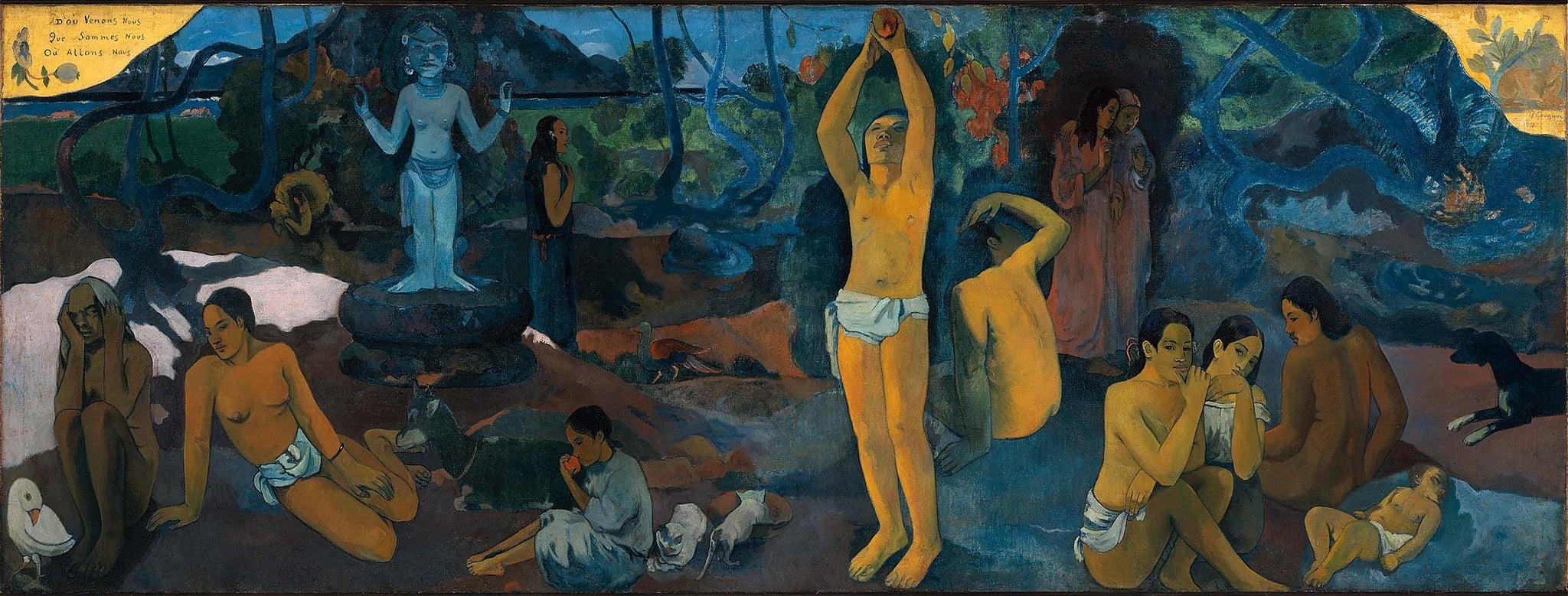
Where Do We Come From? What Are We? Where Are We Going?
Paul Gauguin (1897–1898)
A panoramic frieze staged in a Tahitian grove, Paul Gauguin’s Where Do We Come From? What Are We? Where Are We Going? unfolds right-to-left as a cycle of life, from an infant at the far right to an aged woman at the far left. Amid saturated blues and ochres, a central figure reaches for fruit and a pale-blue idol stands motionless, creating a theatre of <strong>origin, desire, and destiny</strong> that never resolves into a single answer.
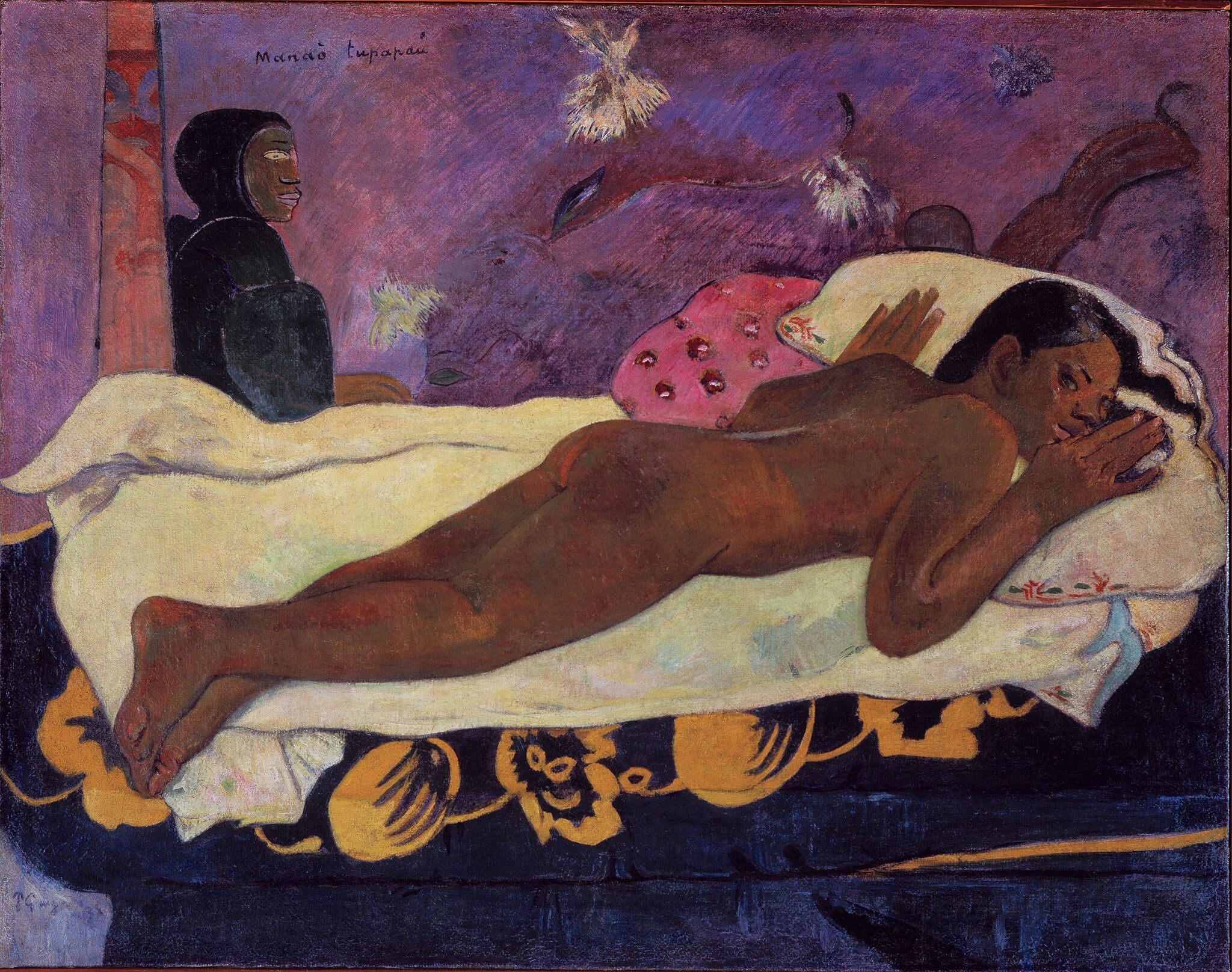
Spirit of the Dead Watching
Paul Gauguin (1892)
Spirit of the Dead Watching stages a nocturnal confrontation between a rigid, prone nude and a dark, hooded presence at the bed’s edge, fusing <strong>desire</strong> with <strong>dread</strong>. Flat patterns, cloisonné outlines, and violet-black fields convert the room into a symbolic plane where a Tahitian <strong>tupapaú</strong> may be either guardian or threat. The work crystallizes Gauguin’s Synthetist aim to make color and contour carry <strong>mythic psychology</strong> rather than mere description <sup>[1]</sup><sup>[2]</sup>.
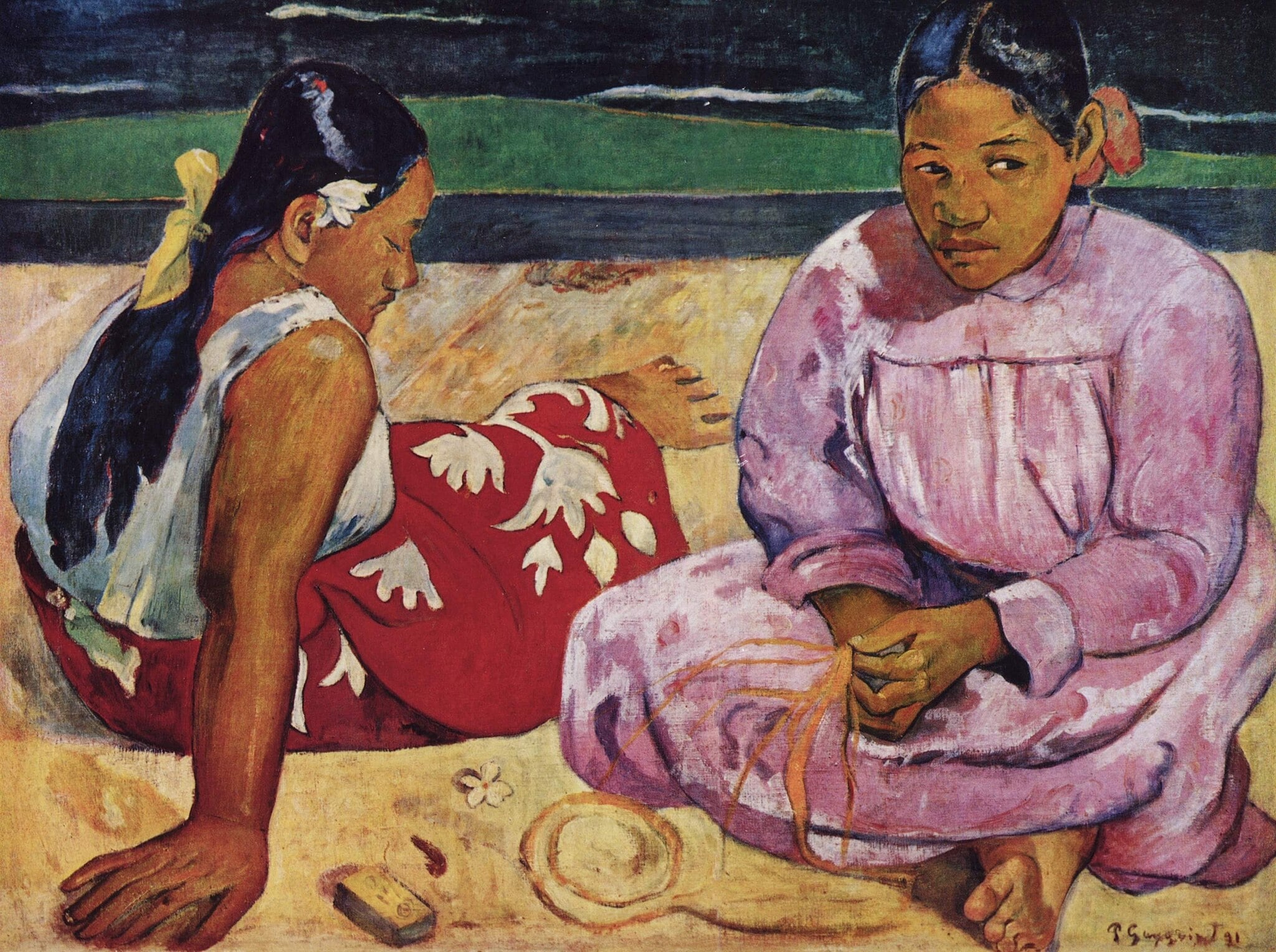
Tahitian Women on the Beach
Paul Gauguin (1891)
In Tahitian Women on the Beach, Paul Gauguin stages a tense duet between <strong>tradition</strong> and <strong>colonial modernity</strong>. Flat bands of sea and shore frame two monumental figures—one in a red <strong>pareo</strong>, the other in a pink <strong>missionary dress</strong>—whose guarded poses and averted gazes turn a casual beach scene into an <strong>iconic meditation on identity</strong> <sup>[1]</sup><sup>[2]</sup>. Modest objects on the sand—a flower, a coil, a bar-shaped stone—read like quiet <strong>tokens</strong> anchoring everyday life to ritual feeling <sup>[1]</sup>.
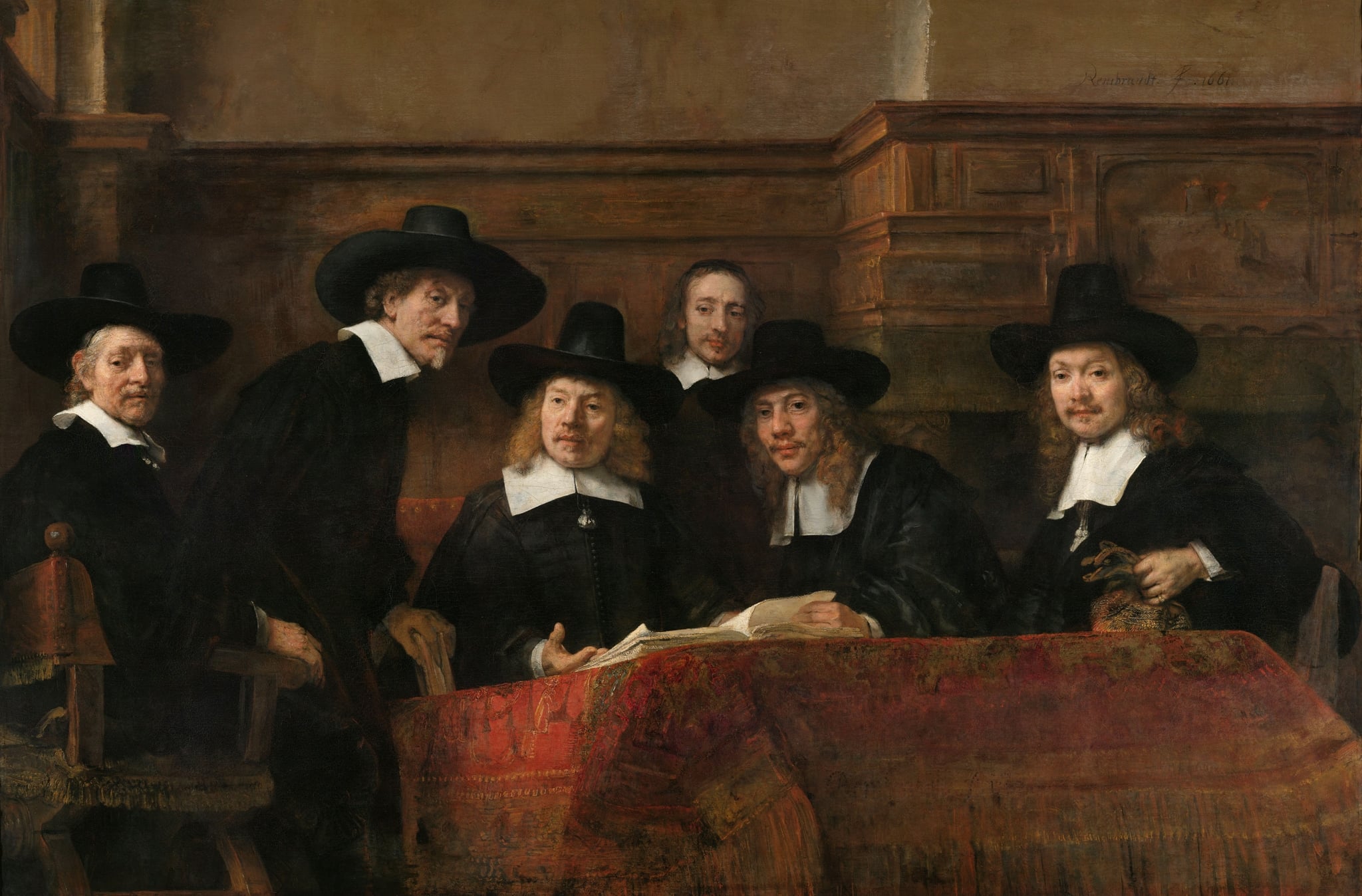
The Sampling Officials of the Amsterdam Drapers’ Guild, Known as ‘The Syndics’
Rembrandt van Rijn (1662)
Rembrandt van Rijn’s The Sampling Officials of the Amsterdam Drapers’ Guild, Known as ‘The Syndics’ (1662) stages a <strong>meeting interrupted</strong>: six guild officials glance up from an open <strong>stalenboek</strong> (sample book) atop a sumptuous <strong>Oriental carpet</strong>, as if a merchant has just entered. The low vantage and unified yet varied poses convert routine inspection into a drama of <strong>civic authority</strong> and <strong>public accountability</strong> <sup>[1]</sup>.
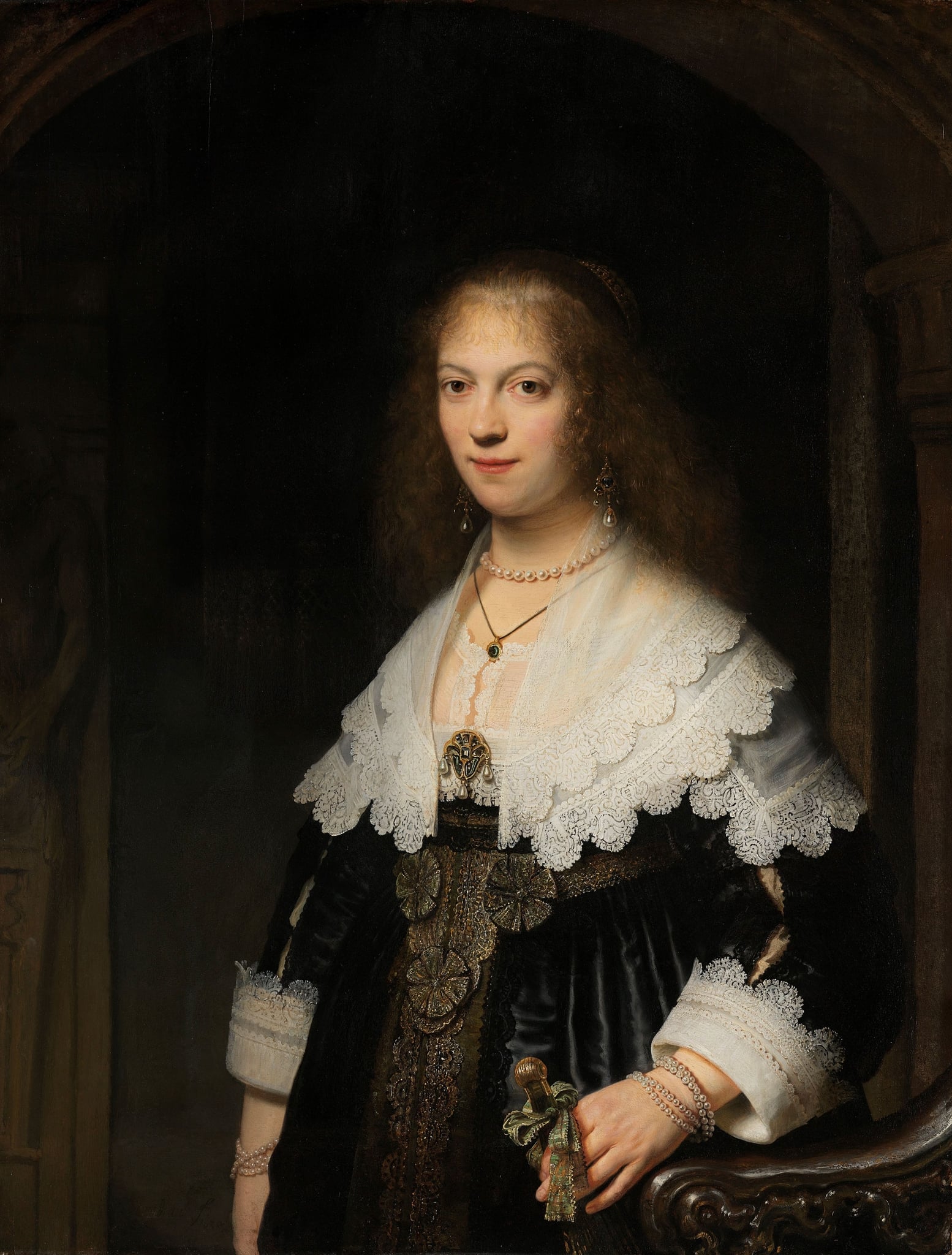
Portrait of a Woman, Probably Maria Trip
Rembrandt van Rijn (1639)
<strong>Portrait of a Woman, Probably Maria Trip</strong> crystallizes Rembrandt’s power to bind status and psyche: a young patrician steps from a dark stone recess into a clarifying beam, her face and hands carrying the drama. Black satin, sculpted lace, and glowing <strong>pearls</strong> register wealth, but the picture’s gravitational center is the sitter’s poised inner life <sup>[1]</sup>.
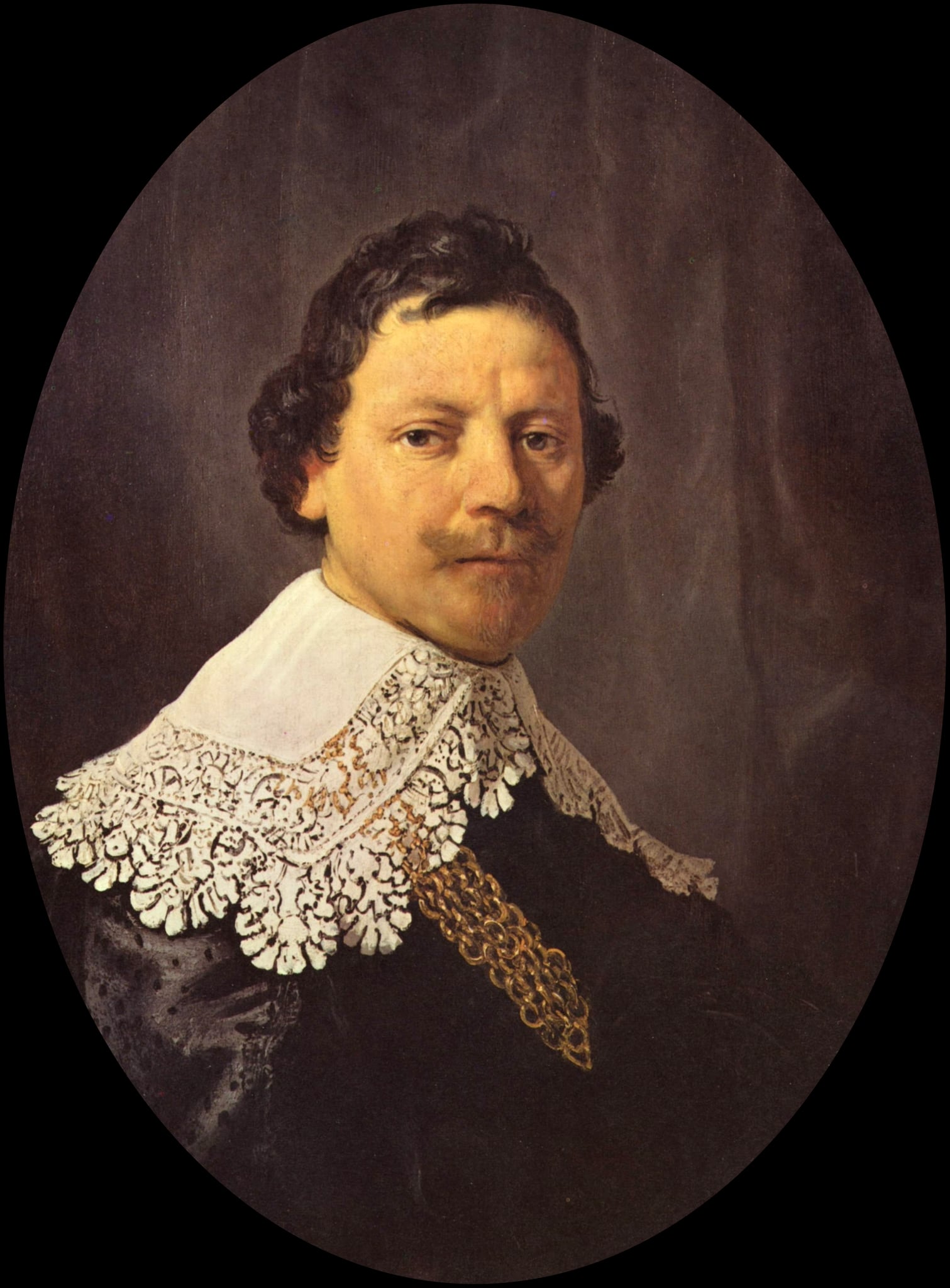
Portrait of Philips Lucasz.
Rembrandt van Rijn (1635)
Rembrandt van Rijn’s Portrait of Philips Lucasz. distills <strong>wealth and restraint</strong> into a poised, three-quarter likeness framed by an oval field. Raking light clarifies the sitter’s steady gaze, the <strong>crisp white lace</strong> and the diagonally falling <strong>gold chain</strong>, while the deep black costume absorbs attention back to character over display <sup>[1]</sup>.