The Zouave

by Vincent van Gogh

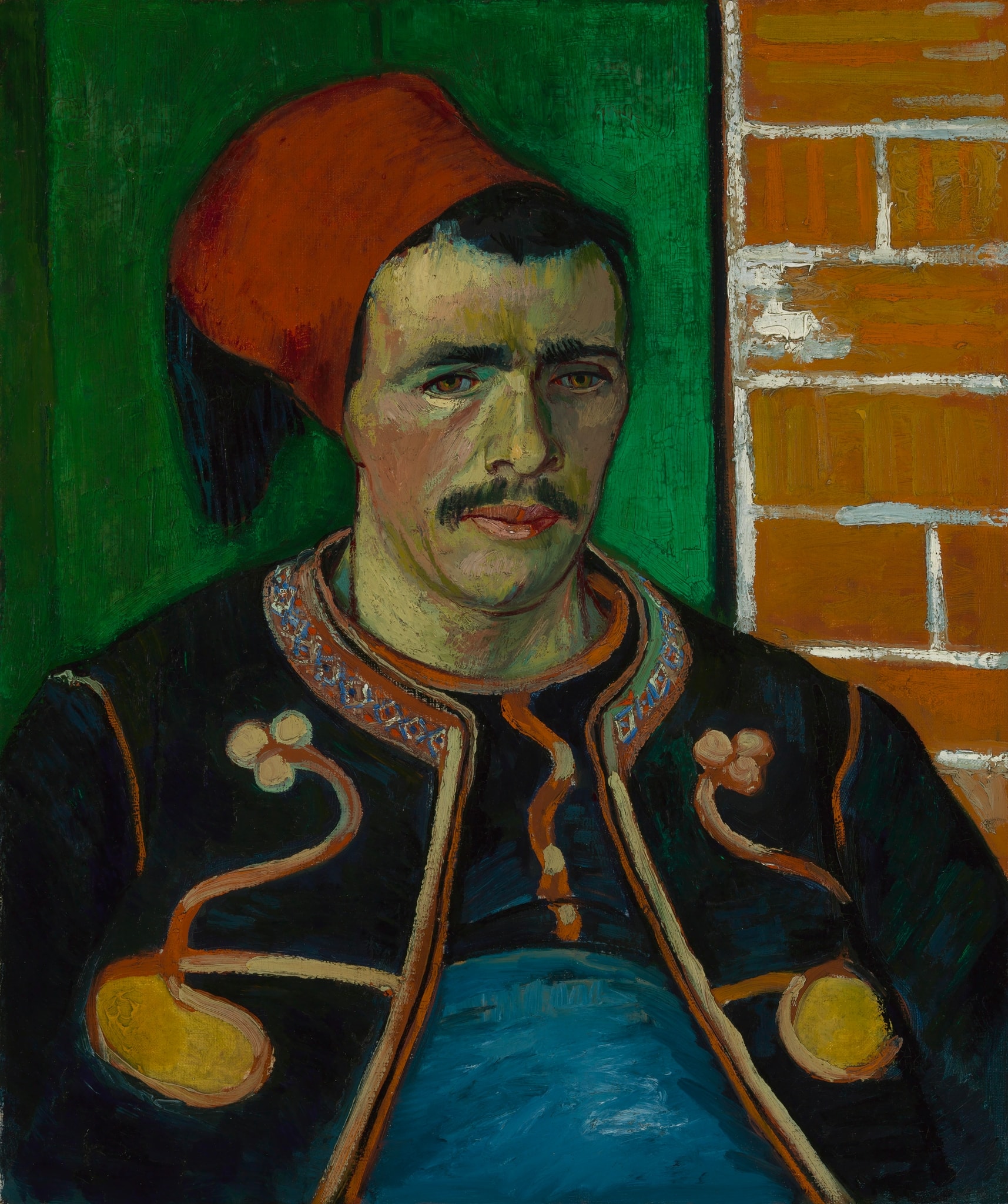
The Zouave crystallizes Van Gogh’s Arles project: a half-length soldier thrust forward by clashing complements—red, green, orange, blue—so color carries character. The flame-like fez ignites against a flat green door and a sliver of orange brick wall, while heavy outlines and simplified planes turn uniform into emblem. The work inaugurates his pursuit of the modern “character portrait,” where chromatic force outweighs likeness [1][2].

Study Print Studio

Create a personal study print

Build a companion study sheet around the part of this painting that speaks to you most. Choose a detail, shape an interpretation, and walk away with something personal and display-worthy.

Fast Facts

Year
1888
Medium
Oil on canvas
Dimensions
65.8 × 55.7 cm
Location
Van Gogh Museum, Amsterdam (Vincent van Gogh Foundation)
See all Vincent van Gogh paintings in Amsterdam
The Zouave by Vincent van Gogh (1888) featuring Orange brick wall, Red fez (with dark tassel), Blue tunic/torso field, Green door/plane

Click on any numbered symbol to learn more about its meaning

Meaning & Symbolism

Van Gogh constructs The Zouave as a drama of complementary shocks that read as psychology. The red fez, slumped like a live ember, strikes the green door with maximum contrast, a deliberate opposition the artist spelled out as a “coarse combination of disparate tones” in June 1888 1. The orange brick band at right completes a second chord with the blue tunic, so the soldier’s torso hums between antagonistic fields. This chromatic pressure compresses the figure forward, making his posture feel braced though he merely sits; the uniform’s looping copper arabesques and two lemon-yellow roundels (the “stars” he listed) act like codified suns that radiate outward from the chest, declaring duty and rank while pulsing as color accents 13. The result is not a neutral likeness but an assertion of temperament: the sitter reads as taut and combustible, his narrowed eyes and tight-lipped mouth holding ground against the chromatic storm. Line and plane harden that message. Van Gogh locks contours with thick, dark strokes, flattening the jacket’s panels and the background slabs into near-decorative fields, a cloisonné-like effect he and his circle cultivated from Japanese prints 5. Inside those outlines he models the head with blunt blocks—greens and ochers under the beard and jaw, lilac and blue near the temples—refusing soft transitions so the face becomes a site of character inscription rather than cosmetic shading. The uniform’s ornamental snakes do double duty: historically specific markers of the Zouave regiments (identified in museum notes as a trumpeter of the 3rd) and pictorial rhythms that push the gaze across the torso like a staff of music, counterpoint to the sitter’s immobile stare 12. Even the brick edge slices the picture like a rule of order, setting “duty” against the vibrating green of life; the soldier appears pinned between regulation and vitality, with the fez’s droop hinting at weariness inside the costume’s swagger. As program and milestone, the painting declares Van Gogh’s portrait theory in action. In Arles he sought a “modern portrait” where color bears truth—a credo echoed across the Roulin family and La Mousmé later that summer 245. Here he chooses a sitter whose very uniform is a ready-made color machine, then intensifies it to the threshold of the “vulgar” or “ugly,” as he admitted, precisely to learn how chroma can voice a life 13. The Zouave thus reads as both image and experiment: the soldier becomes a sign—of martial identity, of 1880s French colonial spectacle, of masculine bravado—while the painting reveals the human underside of that sign through the pressure of complements and the refusal of pretty finish. That tension—armor versus exposure, emblems versus eyes—anchors the meaning of The Zouave and explains why The Zouave is important: it inaugurates Van Gogh’s sustained campaign to make portraiture answerable not to resemblance but to the expressive grammar of color, a move that shaped Post‑Impressionist modernity 245.

Explore Deeper with AI

Ask questions about The Zouave

Popular questions:

Powered by AI • Get instant insights about this artwork

💬 Ask questions about this artwork!

Interpretations

Colonial Context and Visual Spectacle

Seen through a colonial lens, the portrait stages a Zouave as an emblem of the French empire’s exoticized display culture. The uniform’s North Africa–derived elements and brilliant chroma fold military identity into a modern image economy of spectacle. Van Gogh’s own compositional notes—red cap, enamel-blue jacket, lemon-yellow stars against green door and orange brick—instrumentalize this costume as a charged sign-system rather than neutral attire 1. In Arles, such imagery circulated alongside the artist’s Japonisme, contributing to a hybrid visual vocabulary in which the soldier’s body becomes a screen for empire’s colors. This is less ethnography than pictorial rhetoric: the painting converts colonial regalia into an experiment in color politics, where clash and contrast figure the tensions of late‑19th‑century France 15.

Source: Art Institute of Chicago (Studio of the South); Van Gogh Letters

Process: From Study to Chromatic Engine

Comparing the Met’s watercolor study to the oil reveals how Van Gogh amplifies dissonance in paint. The drawing refines contours and pose, but the oil escalates the “savage combination of incongruous tones,” relocating the sitter into a force field of complements (red/green; blue/orange) that the study only anticipates 14. The shift from linear notation to impastoed color-planes converts description into pressure—flattened panels lock the figure forward while the jacket’s arabesques become rhythmic vectors. The seated/full-length variant “against a white wall” mentioned by Van Gogh further marks his serial testing of how environment calibrates presence 1. Read together, the sequence charts a move from observation to constructed chromatic drama, a lab-like progression that positions The Zouave as an engineered color problem rather than a single-sitting likeness 14.

Source: The Metropolitan Museum of Art (study entry); Van Gogh Letters

Semiotics of Dress: Insignia as Pictorial Syntax

Uniform details operate as both legible signs and formal punctuation. Van Gogh itemizes the “two lemon-yellow stars,” the fez, and orange-red braids, a list that mirrors how these marks function on canvas: as crisp nodes of emphasis that articulate the torso’s field while signaling regiment and role 1. Curatorial notes link the insignia to a trumpeter of the 3rd Zouaves, showing how viewers of the time could decode identity from adornment 3. In semiotic terms, the stars read as indices of duty and as chromatic beats—fixed points that anchor the eye within an otherwise vibrating scheme. The portrait thus fuses sartorial taxonomy with color theory, making adornment a structural grammar through which character and institutional belonging are simultaneously stated 13.

Source: Van Gogh Museum/Google Arts & Culture; Van Gogh Letters

Modern Portrait Theory: Color as Character

The painting operationalizes Van Gogh’s ambition for a “modern portrait” where color carries truth. Rather than reconcile hues to naturalism, he drives them to the brink of the “ugly,” gauging how contrasts can voice temperament—an experimental ethic he defends even as he faults the work’s appearance 12. MoMA’s account of the Roulin portraits clarifies the theory: personality is constructed through chroma and contour, not mimetic likeness 6. In The Zouave, the compressed planes and complementary shocks act as proxies for inner life, aligning with a broader Post‑Impressionist pivot from resemblance to expression. The result is a portrait that reads less as depiction than as color-structured psychology, a template he would iterate across Arles in 1888 156.

Source: MoMA; Van Gogh Letters; Art Institute of Chicago (Studio of the South)

Appropriation Networks: Japonisme and Martial Dress

The canvas entwines two vectors of appropriation. Formally, its cloisonné contours and planar color derive from Japanese prints that Van Gogh and his circle absorbed as a modernizing resource 5. Culturally, the French Zouave uniform itself appropriated North African dress into a European military idiom—costume as colonial translation—now redeployed by Van Gogh as a ready-made chromatic engine 15. This double borrowing complicates authorship: expressive innovations ride on transposed aesthetics and power-laden attire. Rather than neutral synthesis, the painting exposes how modern style coalesces through circulation and asymmetry—how imported outlines and imperial fabrics become the substrate for a new portrait grammar. In The Zouave, originality emerges as a montage of borrowed forms activated by color 15.

Source: Art Institute of Chicago (Studio of the South); Van Gogh Letters

Related Themes

About Vincent van Gogh

Vincent van Gogh (1853–1890) developed a radical, emotion‑driven use of color after moving from Paris to Arles in 1888, seeking southern light and an artists’ community. In Arles he created the Sunflowers series to decorate the Yellow House ahead of Gauguin’s visit. His late work fused impasto, high chroma, and symbolic motifs that shaped modern painting [2][5].
View all works by Vincent van Gogh

More by Vincent van Gogh
Café Terrace at Night by Vincent van Gogh

Café Terrace at Night

Vincent van Gogh (1888)

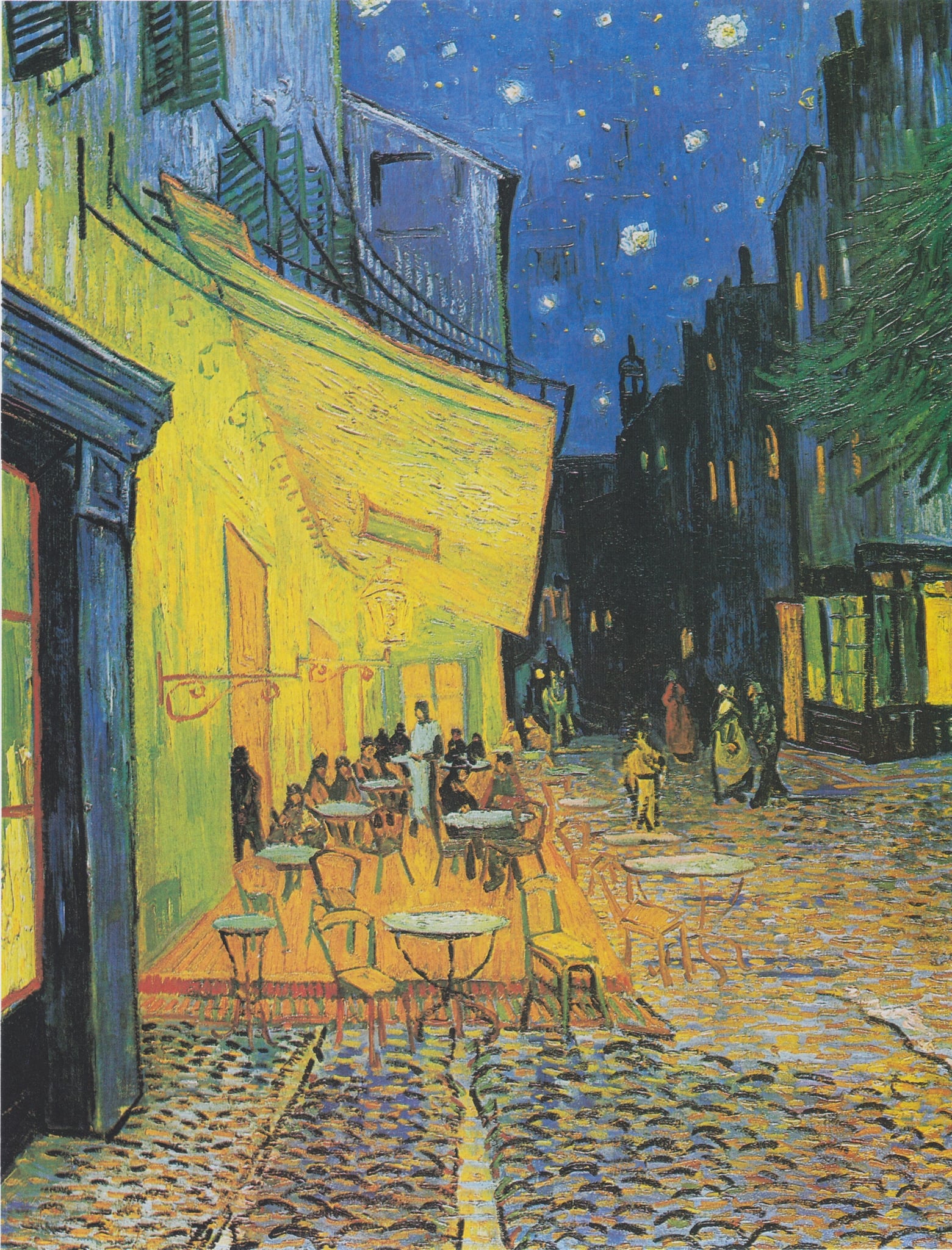
In Café Terrace at Night, Vincent van Gogh turns nocturne into <strong>luminous color</strong>: a gas‑lit terrace glows in yellows and oranges against a deep <strong>ultramarine sky</strong> pricked with stars. By building night “<strong>without black</strong>,” he stages a vivid encounter between human sociability and the vastness overhead <sup>[1]</sup><sup>[2]</sup>.
Red Cabbages and Onions by Vincent van Gogh

Red Cabbages and Onions

Vincent van Gogh (1887)

In Red Cabbages and Onions, Vincent van Gogh turns everyday produce into a drama of <strong>complementary color</strong> and <strong>restless brushwork</strong>. Hot red contours cinch violet cabbages and pale yellow bulbs against a cool, striated blue table, while a mustard‑yellow patch in the upper right tilts the space and sharpens the chromatic clash. The result asserts ordinary food as a locus of <strong>resilience</strong> and <strong>experimentation</strong> <sup>[1]</sup><sup>[2]</sup>.

Irises by Vincent van Gogh

Irises

Vincent van Gogh (1889)

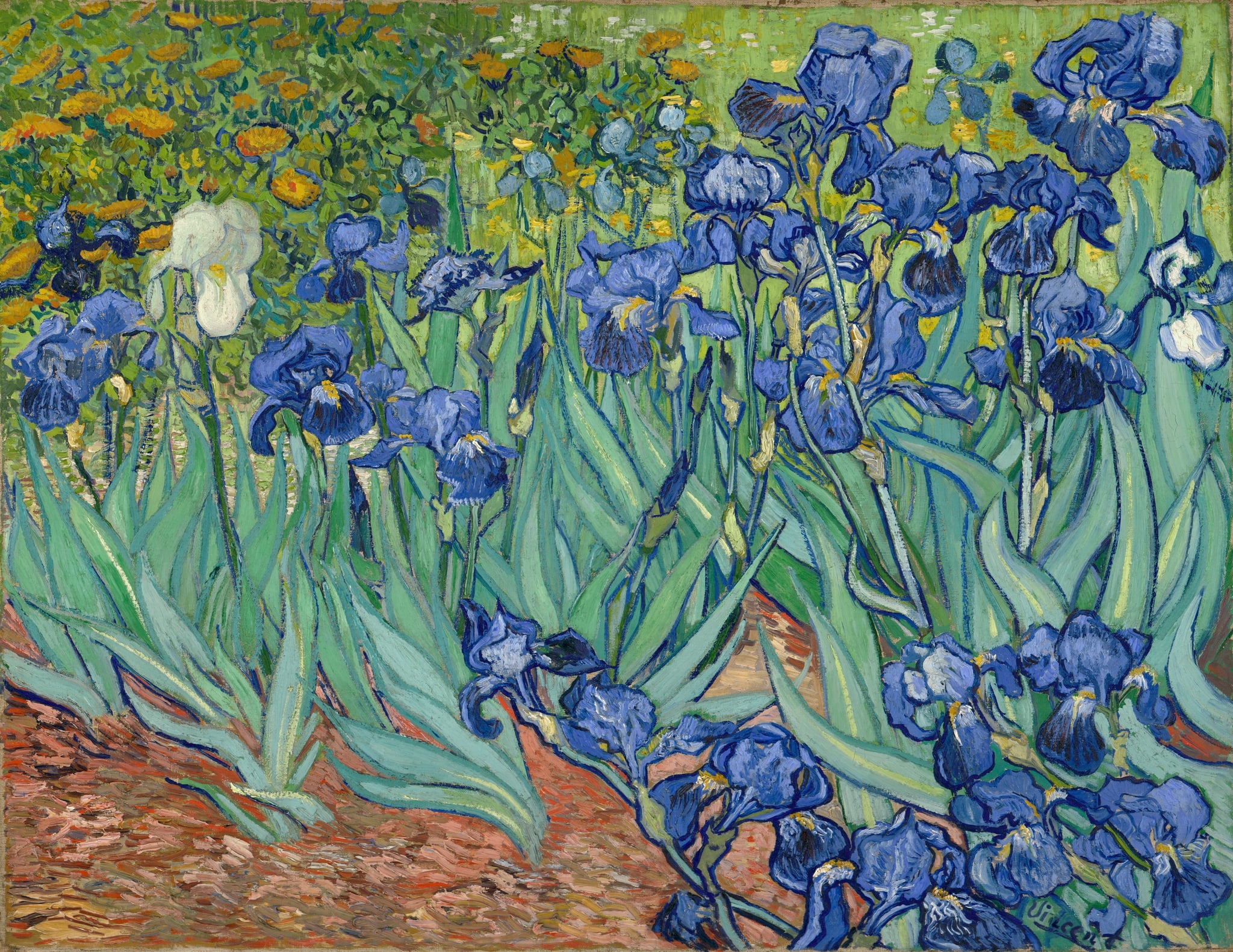
Painted in May 1889 at the Saint-Rémy asylum garden, Vincent van Gogh’s <strong>Irises</strong> turns close observation into an act of repair. Dark contours, a cropped, print-like vantage, and vibrating complements—violet/blue blossoms against <strong>yellow-green</strong> ground—stage a living frieze whose lone <strong>white iris</strong> punctuates the field with arresting clarity <sup>[1]</sup><sup>[2]</sup>.
Sunflowers by Vincent van Gogh

Sunflowers

Vincent van Gogh (1888)

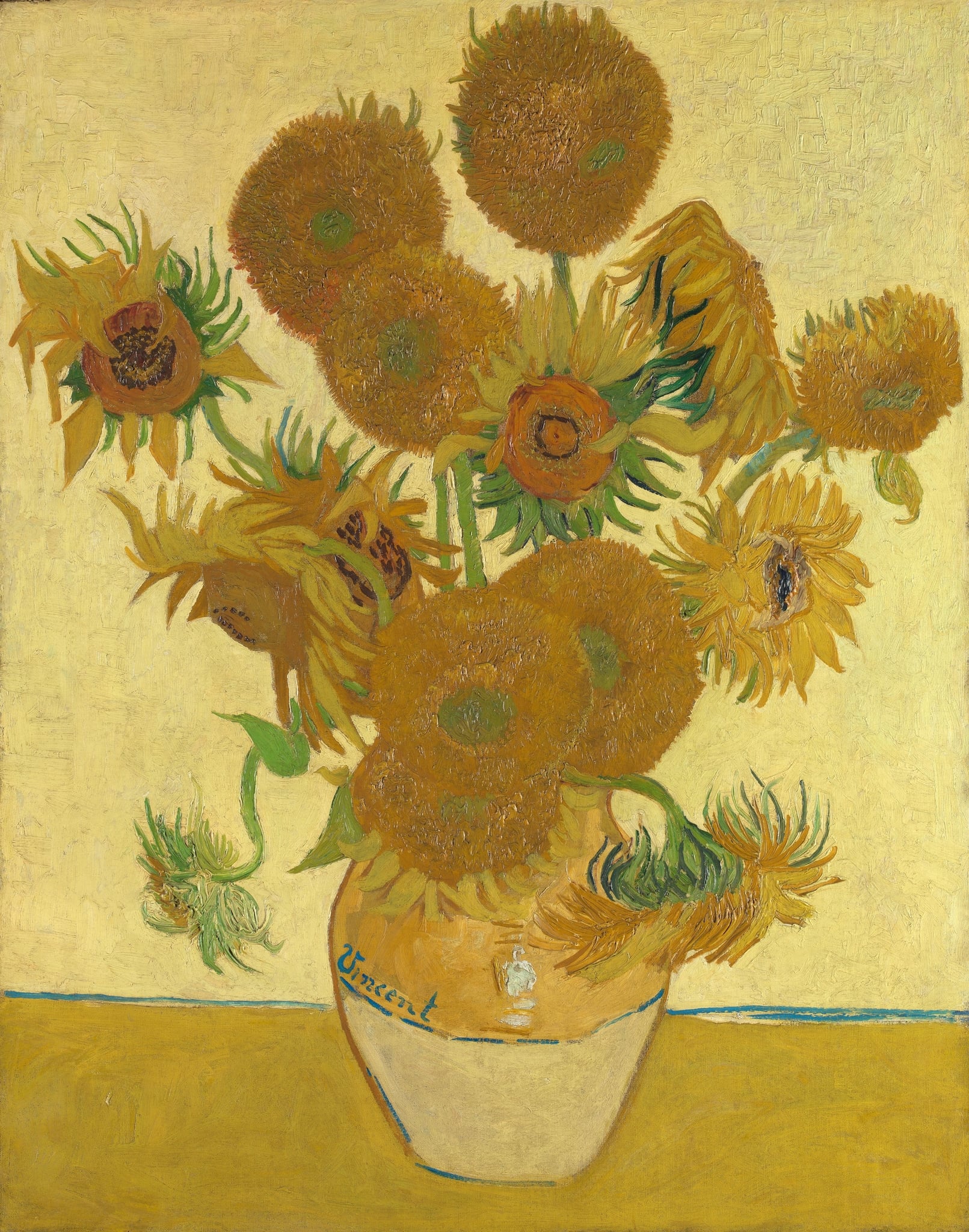
Vincent van Gogh’s Sunflowers (1888) is a <strong>yellow-on-yellow</strong> still life that stages a full <strong>cycle of life</strong> in fifteen blooms, from fresh buds to brittle seed heads. The thick impasto, green shocks of stem and bract, and the vase signed <strong>“Vincent”</strong> turn a humble bouquet into an emblem of endurance and fellowship <sup>[1]</sup><sup>[2]</sup>.

Garden with Courting Couples: Square Saint-Pierre by Vincent van Gogh

Garden with Courting Couples: Square Saint-Pierre

Vincent van Gogh (1887)

In Garden with Courting Couples: Square Saint-Pierre, Vincent van Gogh turns a small Montmartre park into a stage where <strong>spring</strong>, <strong>intimacy</strong>, and <strong>urban leisure</strong> converge. Short, shimmering strokes fuse pink chestnut blossoms, curving paths, and paired figures into one pulse of <strong>renewal</strong> and <strong>togetherness</strong> <sup>[1]</sup><sup>[2]</sup>.

In the Café: Agostina Segatori in Le Tambourin by Vincent van Gogh

In the Café: Agostina Segatori in Le Tambourin

Vincent van Gogh (1887 (Jan–Mar))

Van Gogh casts Agostina Segatori at a tiny, tambourine‑like café table, turning Le Tambourin into a <strong>stage of modern life</strong>. Cool greens and greys make the red <strong>flame‑plume hat</strong> and the foaming <strong>beer</strong> flare, while folded arms and a set‑aside <strong>parasol</strong> register private fatigue amid public display <sup>[1]</sup><sup>[2]</sup><sup>[3]</sup>.