Vincent van Gogh
Biography
Themes in Their Work
Where to See Vincent van Gogh's Paintings
Explore Vincent van Gogh's works on display in museums around the world.
Featured in Essays
Compare Vincent van Gogh
Most Expensive Vincent van Gogh Paintings
Explore ranked valuations of Vincent van Gogh's most valuable works →
Featured Artworks
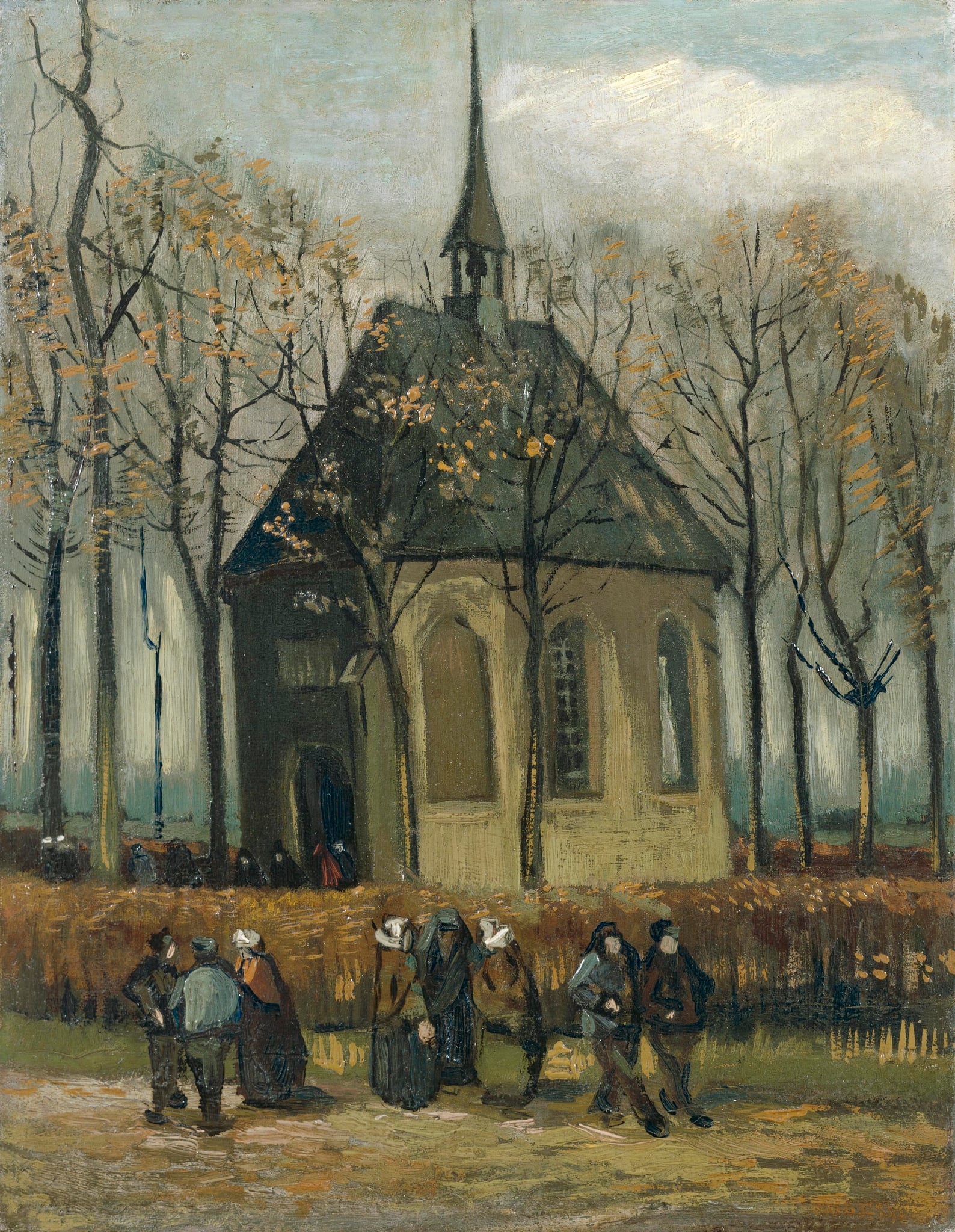
Congregation Leaving the Reformed Church in Nuenen
Vincent van Gogh (1884; reworked 1885)
Vincent van Gogh’s Congregation Leaving the Reformed Church in Nuenen turns a modest village service into a meditation on <strong>mourning</strong>, <strong>community</strong>, and <strong>thresholds</strong>. The low steeple, clipped hedge, and bundled figures in black shawls and white caps file past autumn-tinted, near-bare trees, shifting the scene from ordinary Sunday ritual to public grief. Painted in 1884 and <strong>reworked in 1885</strong> with the congregation and ocher leaves, the canvas folds private loss into rural Protestant life <sup>[1]</sup><sup>[2]</sup><sup>[3]</sup>.
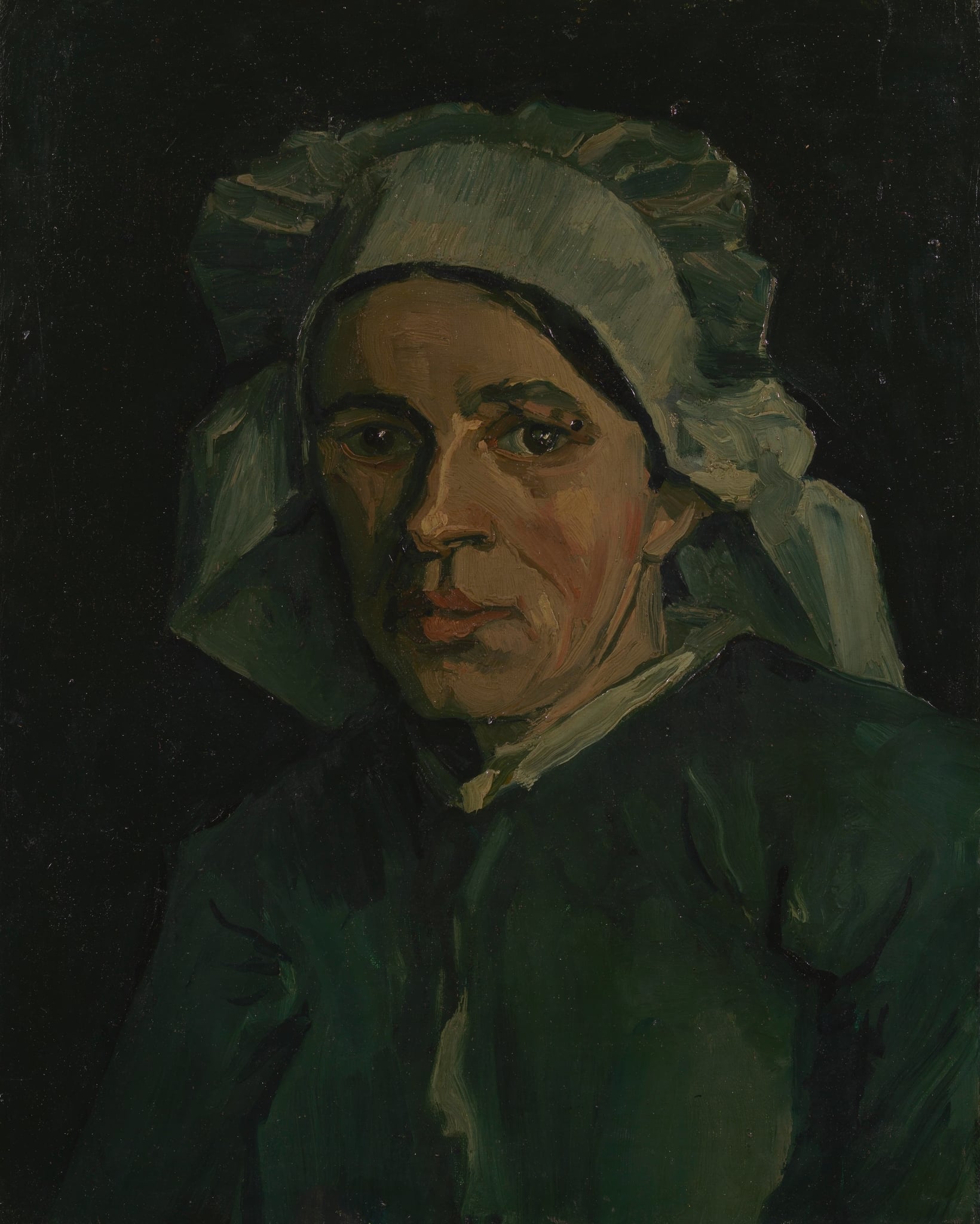
Head of a Woman
Vincent van Gogh (1885)
Van Gogh’s Head of a Woman turns a peasant’s face into a study of <strong>character and moral weight</strong>. With a near‑black ground, raking light from the left, and an earthbound range of greens and ochres, the painting asserts <strong>dignity without prettiness</strong>, anticipating the ethos of The Potato Eaters <sup>[1]</sup><sup>[2]</sup>.
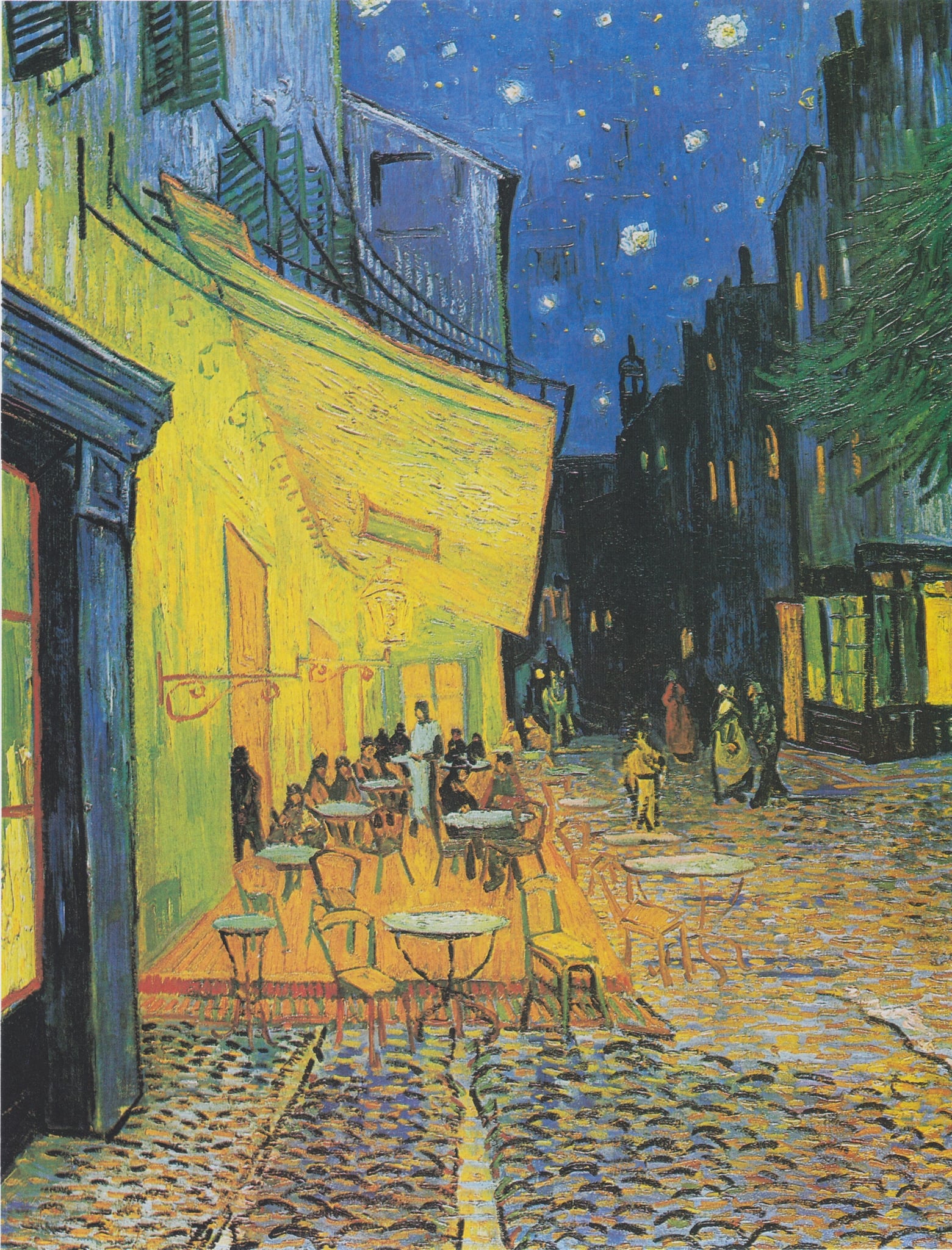
Café Terrace at Night
Vincent van Gogh (1888)
In Café Terrace at Night, Vincent van Gogh turns nocturne into <strong>luminous color</strong>: a gas‑lit terrace glows in yellows and oranges against a deep <strong>ultramarine sky</strong> pricked with stars. By building night “<strong>without black</strong>,” he stages a vivid encounter between human sociability and the vastness overhead <sup>[1]</sup><sup>[2]</sup>.
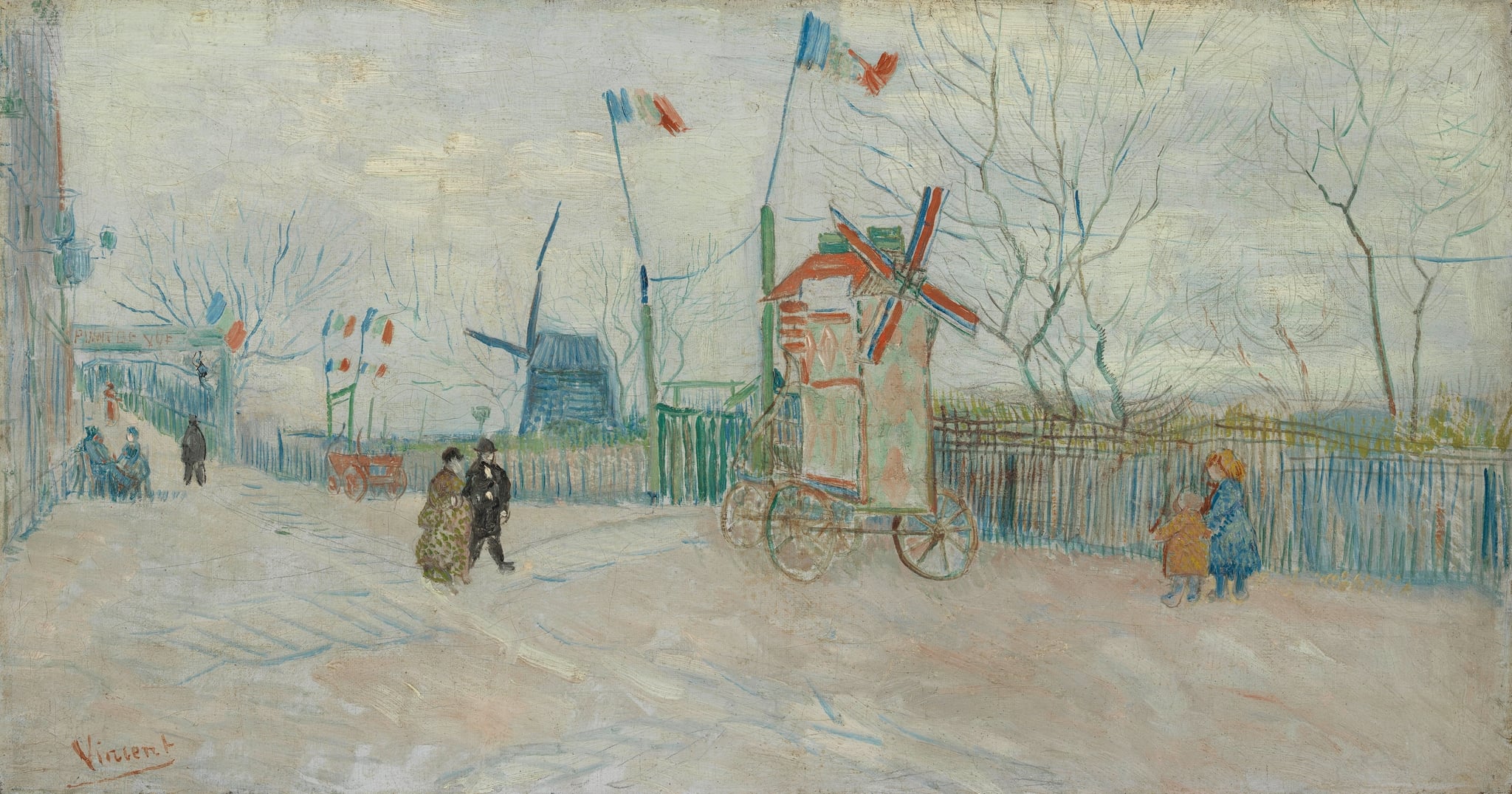
Impasse des Deux Frères in Montmartre
Vincent van Gogh (1887)
Van Gogh’s Impasse des Deux Frères in Montmartre crystallizes a <strong>threshold</strong> between rustic mills and a city turning to <strong>modern leisure</strong>. Tricolor flags, a wheeled “windmill” kiosk, and sketchlike figures animate a broad, chalky lane under pale winter light, declaring a neighborhood—and an artist—mid‑transition <sup>[1]</sup><sup>[3]</sup>.
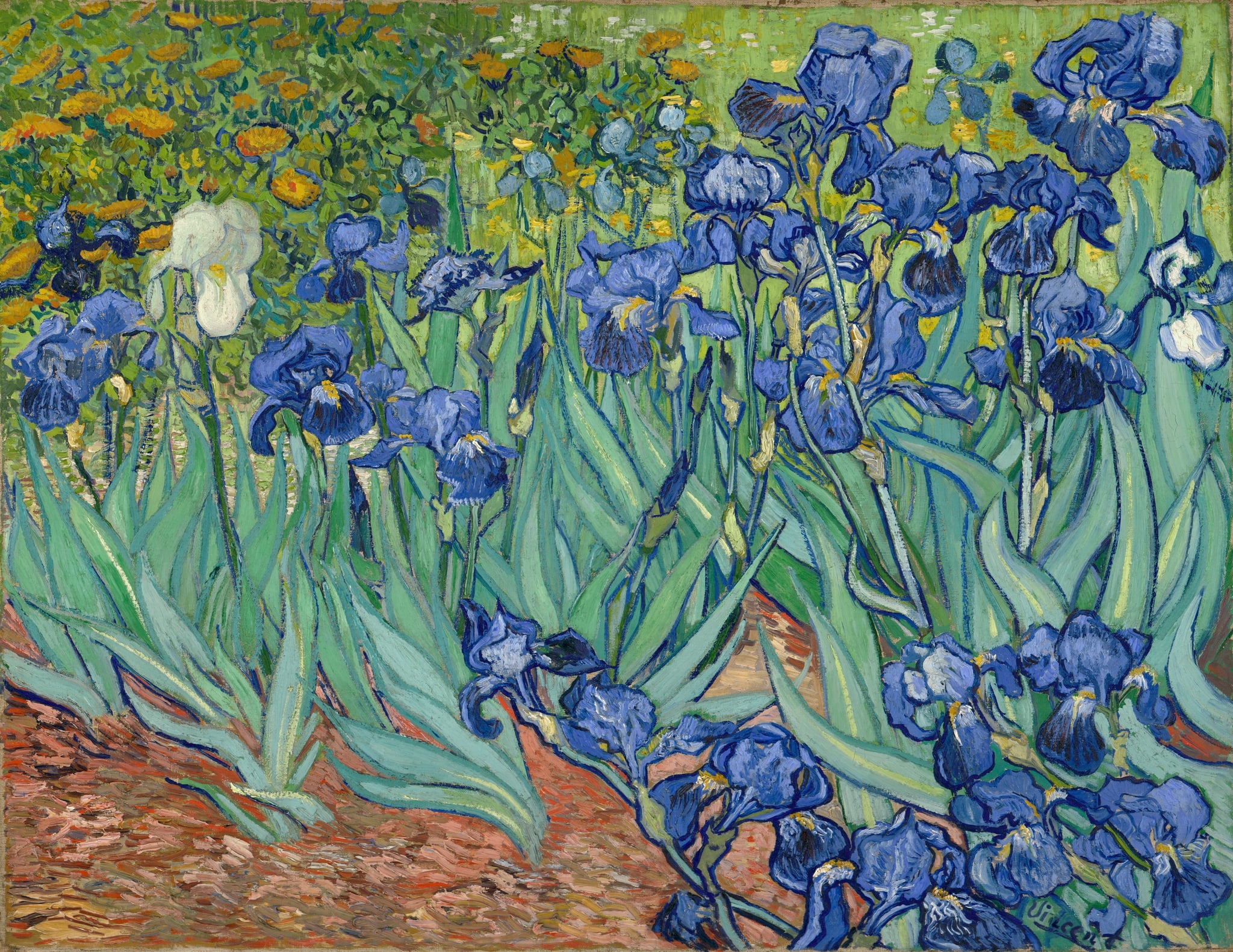
Irises
Vincent van Gogh (1889)
Painted in May 1889 at the Saint-Rémy asylum garden, Vincent van Gogh’s <strong>Irises</strong> turns close observation into an act of repair. Dark contours, a cropped, print-like vantage, and vibrating complements—violet/blue blossoms against <strong>yellow-green</strong> ground—stage a living frieze whose lone <strong>white iris</strong> punctuates the field with arresting clarity <sup>[1]</sup><sup>[2]</sup>.
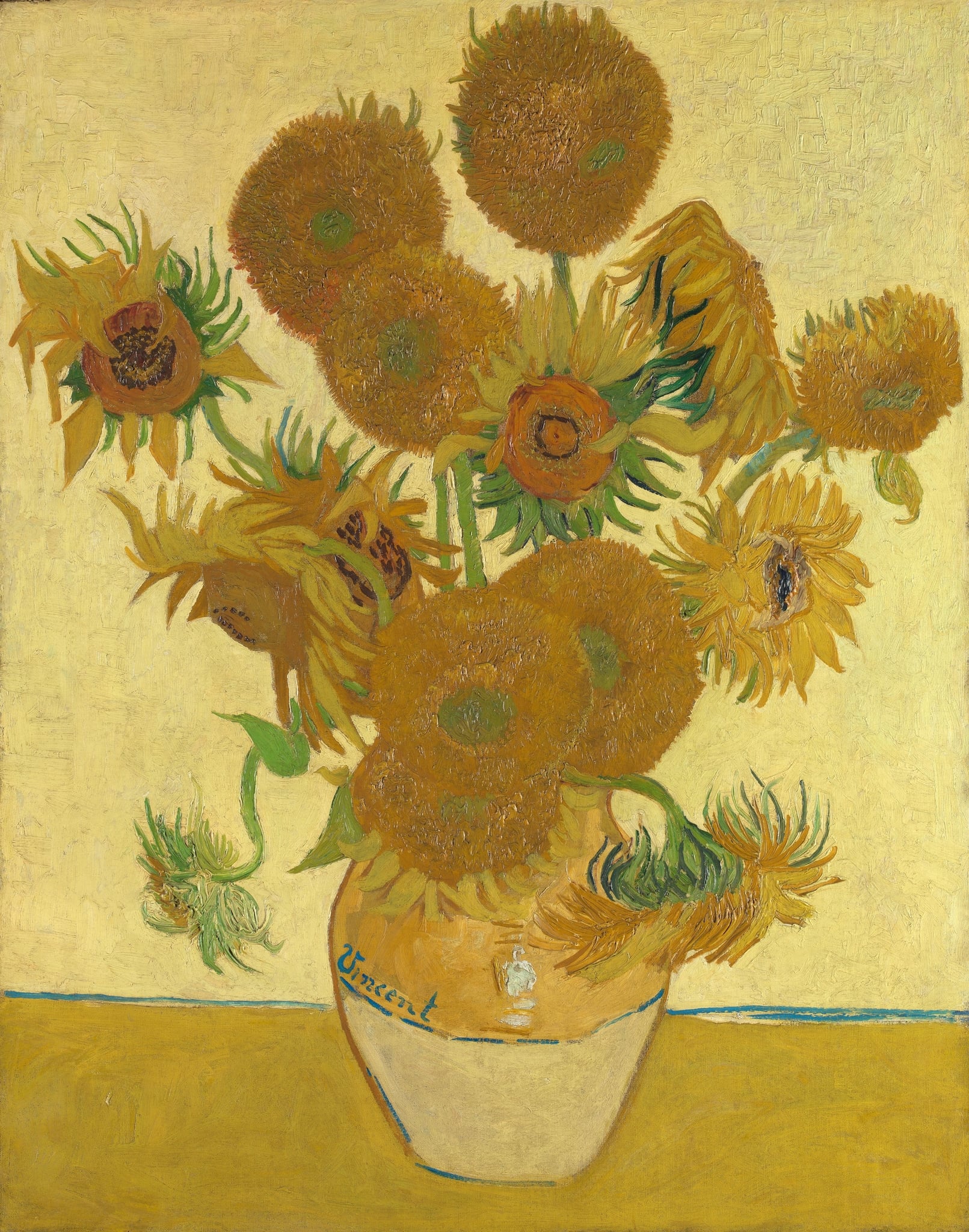
Sunflowers
Vincent van Gogh (1888)
Vincent van Gogh’s Sunflowers (1888) is a <strong>yellow-on-yellow</strong> still life that stages a full <strong>cycle of life</strong> in fifteen blooms, from fresh buds to brittle seed heads. The thick impasto, green shocks of stem and bract, and the vase signed <strong>“Vincent”</strong> turn a humble bouquet into an emblem of endurance and fellowship <sup>[1]</sup><sup>[2]</sup>.
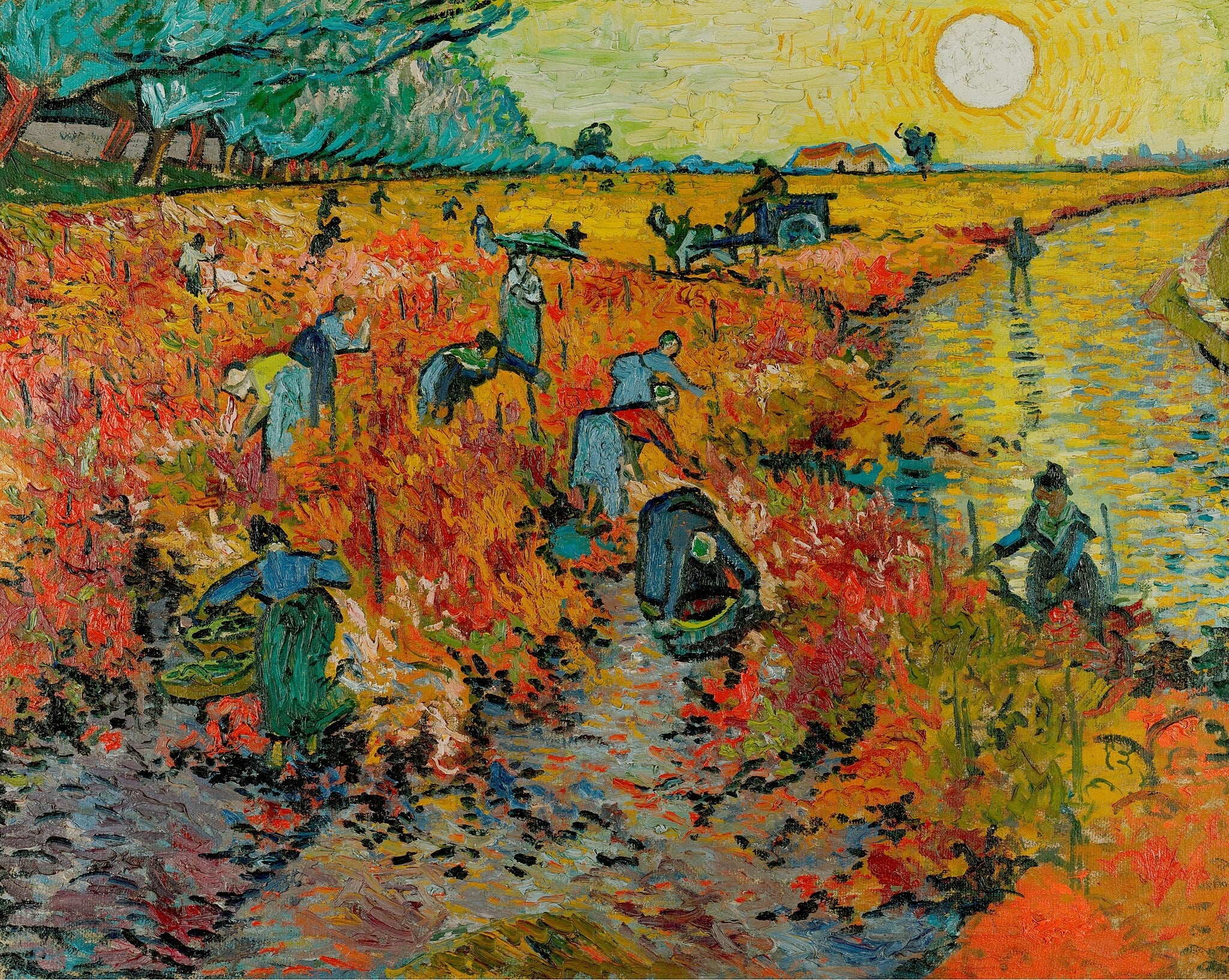
The Red Vineyard
Vincent van Gogh (1888)
In The Red Vineyard, Vincent van Gogh forges a vision of <strong>autumn labor under a blazing sun</strong>, where harvesters flow diagonally through scarlet vines while a band of <strong>yellow light</strong> flares along a reflective roadway. The scene fuses <strong>exhaustion and ripeness</strong>, turning work into a rhythmic, almost liturgical procession <sup>[1]</sup><sup>[3]</sup>.
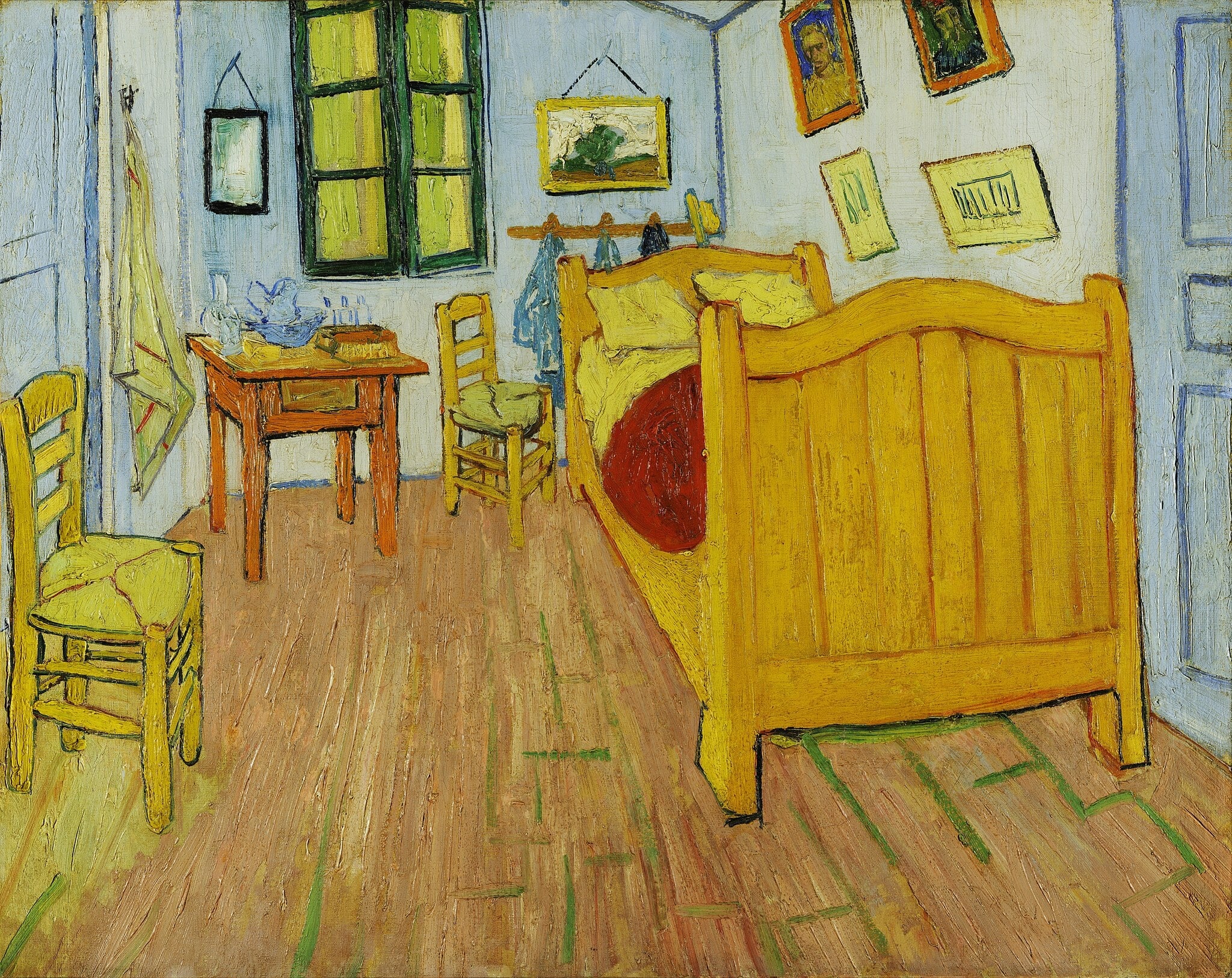
The Bedroom
Vincent van Gogh (1889)
Vincent van Gogh’s The Bedroom turns a modest room into a psychological stage, using <strong>clashing color</strong> and <strong>tilted space</strong> to test whether color alone can evoke rest. The bright yellow bed, twin chairs, and green‑shuttered window press forward as the floor tilts and pictures cant, so that <strong>refuge and unease</strong> exist side by side <sup>[1]</sup><sup>[2]</sup>.
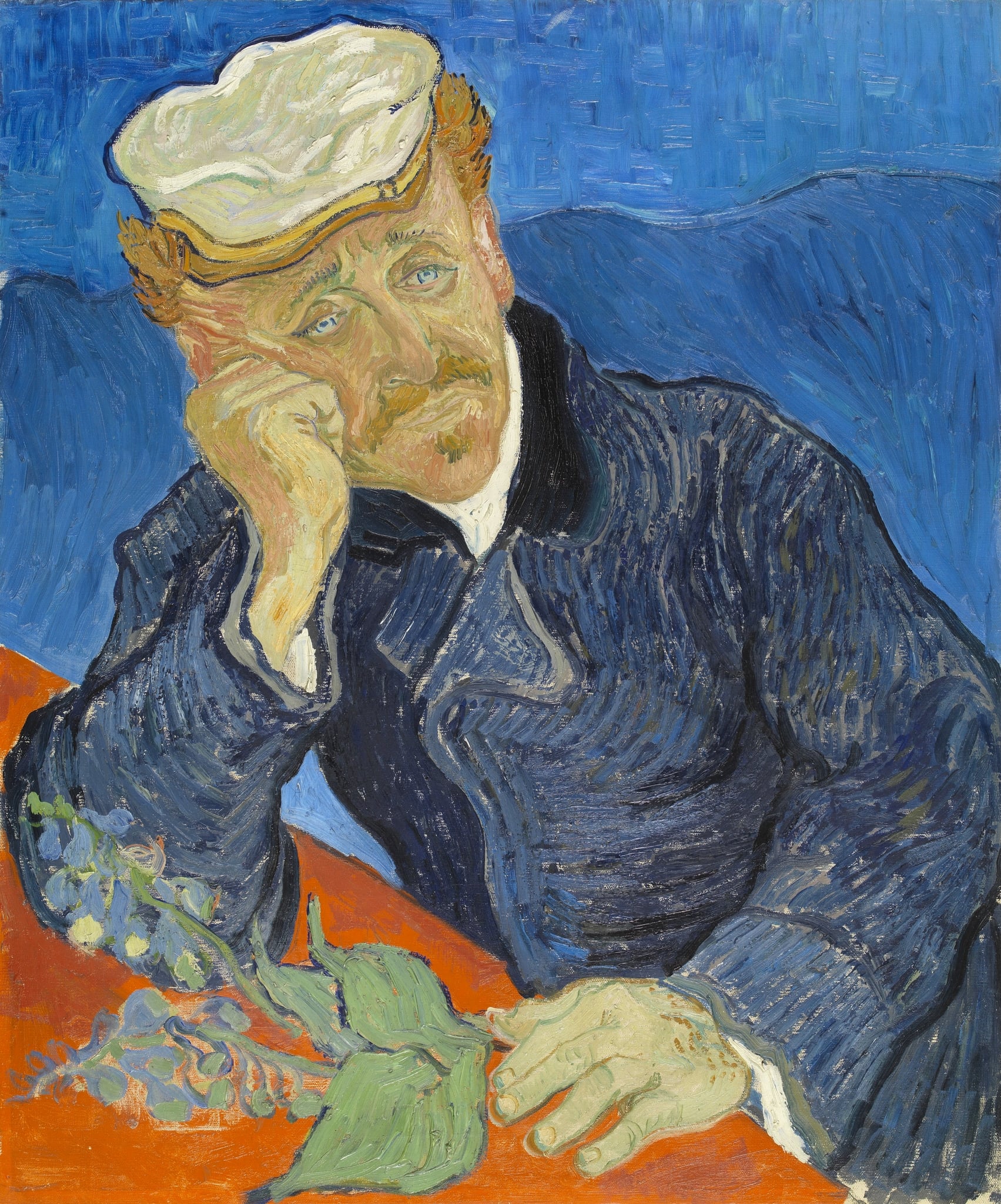
Portrait of Dr. Gachet
Vincent van Gogh (1890)
Portrait of Dr. Gachet distills Van Gogh’s late ambition for a <strong>modern, psychological portrait</strong> into vibrating color and touch. The sitter’s head sinks into a greenish hand above a <strong>blazing orange-red table</strong>, foxglove sprig nearby, while waves of <strong>cobalt and ultramarine</strong> churn through coat and background. The chromatic clash turns a quiet pose into an <strong>empathic image of fragility and care</strong> <sup>[1]</sup><sup>[2]</sup>.
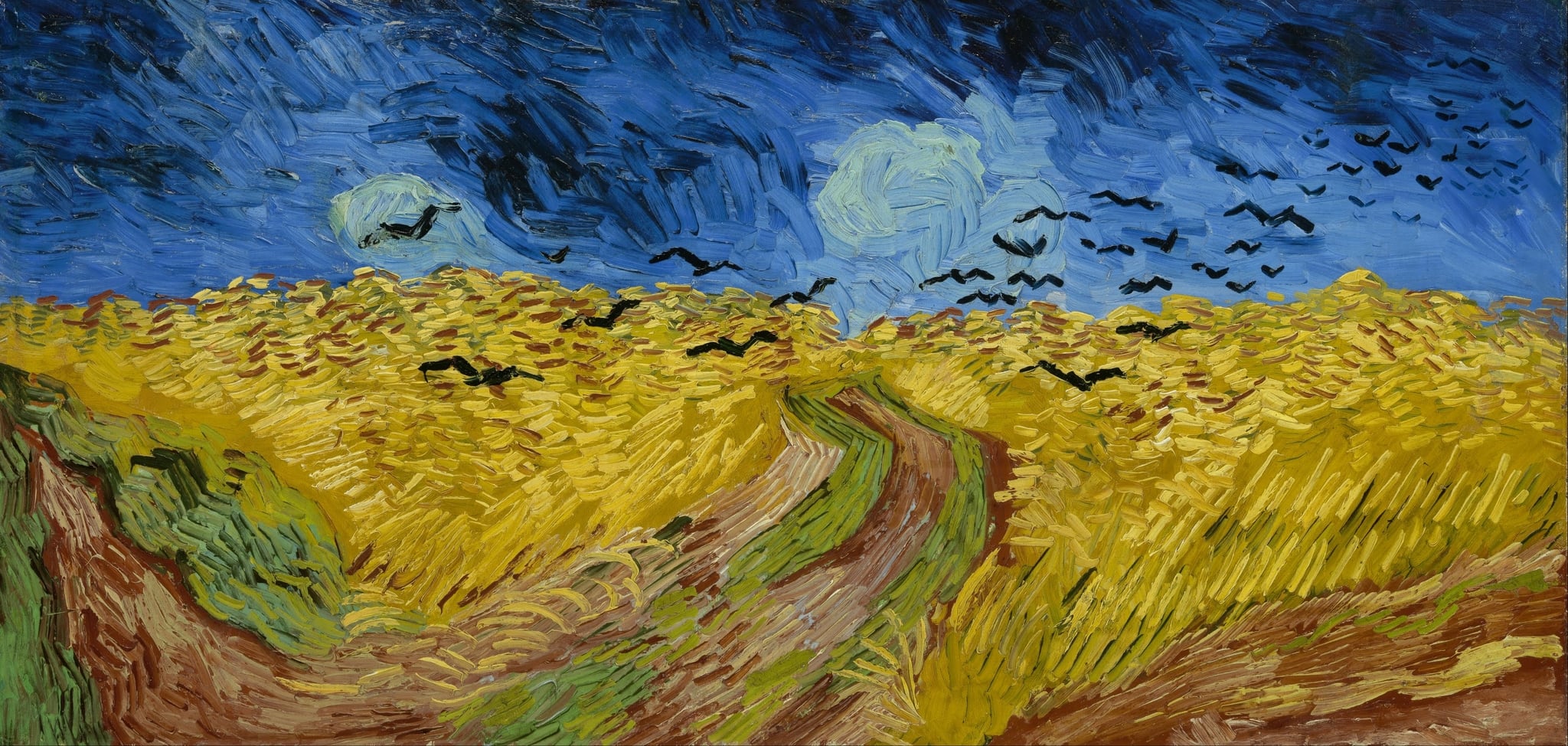
Wheatfield with Crows
Vincent van Gogh (1890)
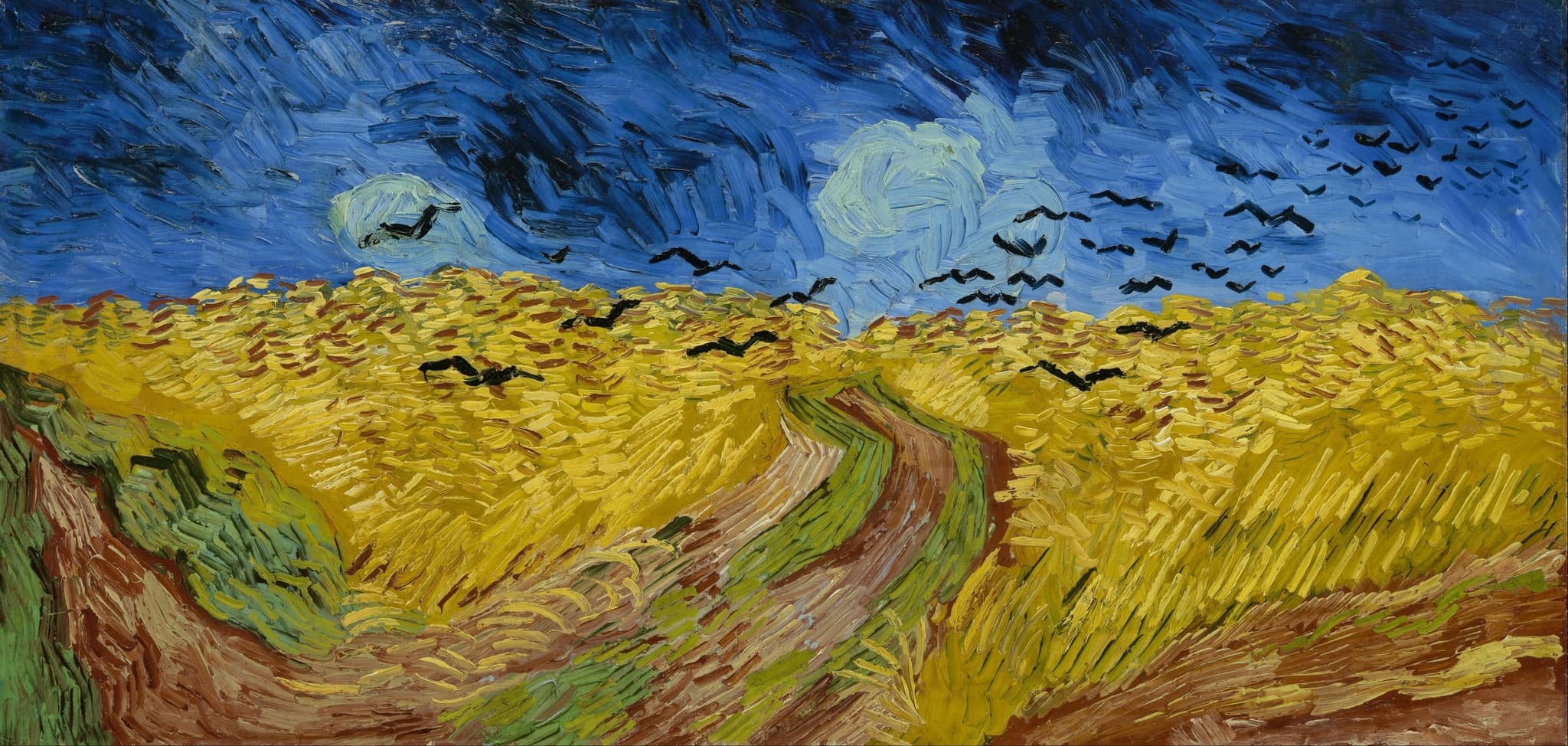
A panoramic wheatfield splits around a rutted track under a storm-charged sky while black crows rush toward us. Van Gogh drives complementary blues and yellows into collision, fusing <strong>nature’s vitality</strong> with <strong>inner turbulence</strong>.
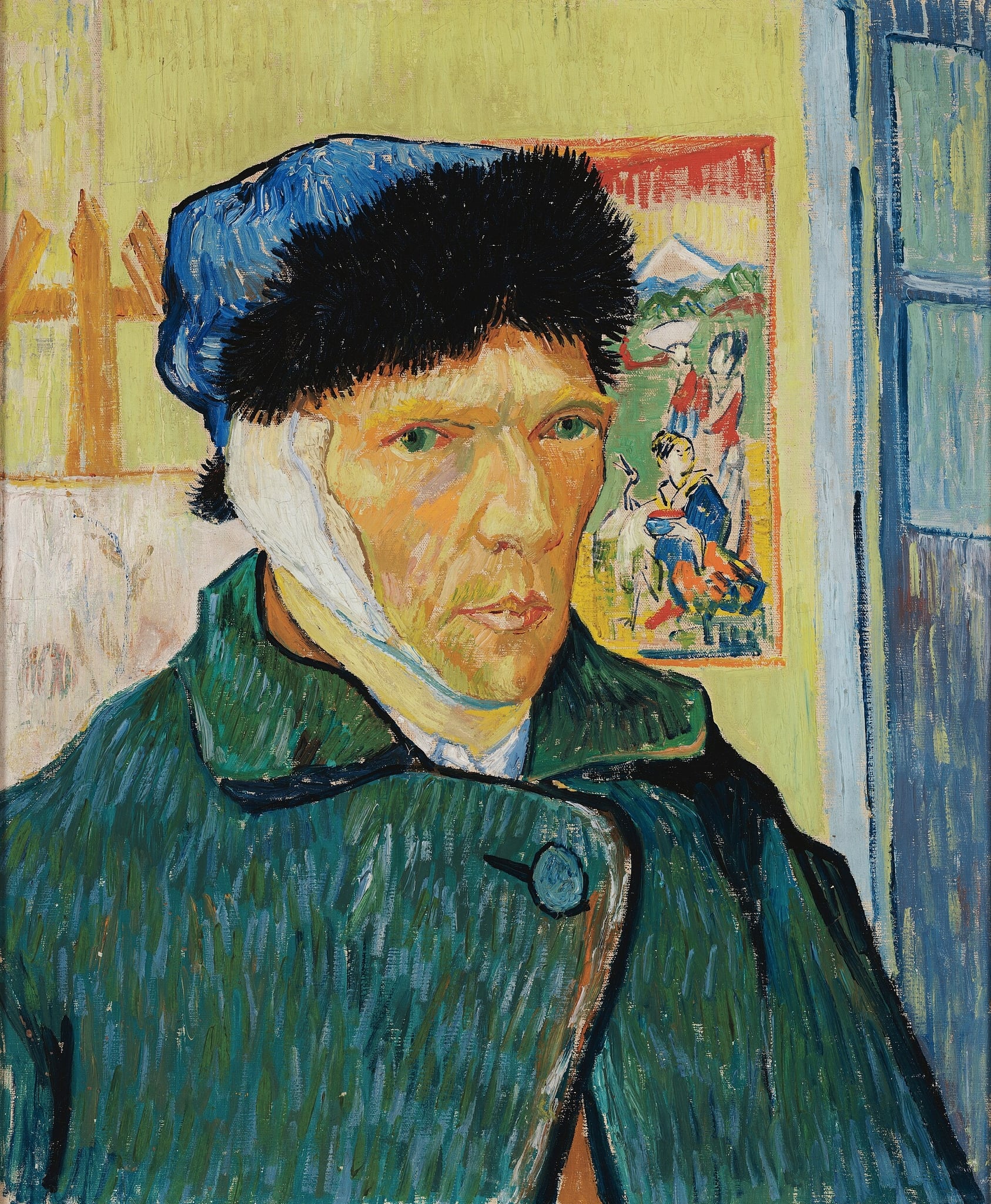
Self-Portrait with Bandaged Ear
Vincent van Gogh (1889)
In Self-Portrait with Bandaged Ear (1889), Vincent van Gogh converts a recent crisis into an image of <strong>resolve</strong>. The frontal, slightly turned pose forces attention to the white bandage at the viewer’s right, while the fur cap, heavy coat, and the nearby <strong>Japanese print</strong> declare persistence and ideals that steady him in the wake of trauma <sup>[1]</sup><sup>[2]</sup>. The painting’s cool, wintry palette and insistent strokes make suffering legible yet disciplined, transforming pain into <strong>artistic purpose</strong> <sup>[2]</sup>.
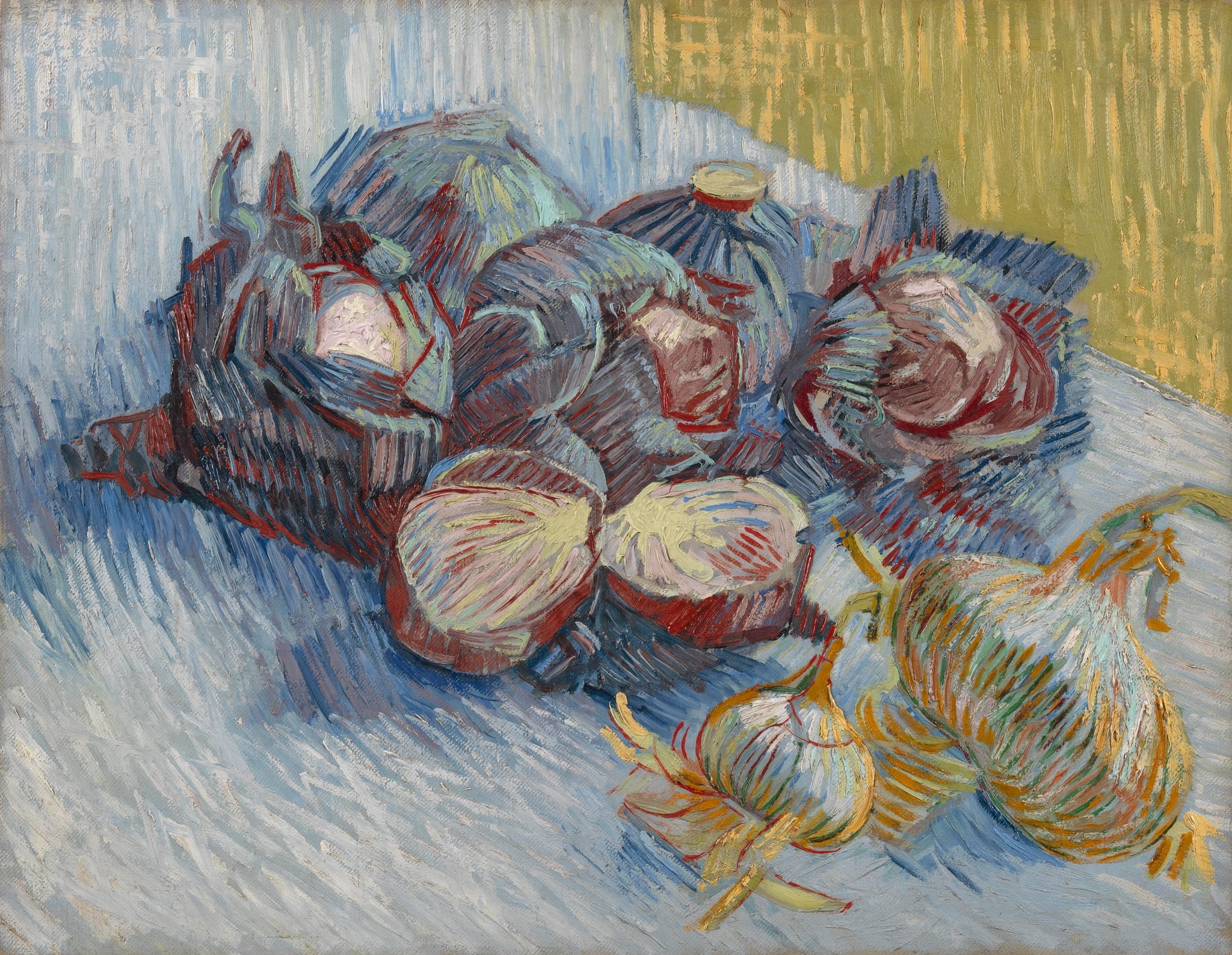
Red Cabbages and Onions
Vincent van Gogh (1887)
In Red Cabbages and Onions, Vincent van Gogh turns everyday produce into a drama of <strong>complementary color</strong> and <strong>restless brushwork</strong>. Hot red contours cinch violet cabbages and pale yellow bulbs against a cool, striated blue table, while a mustard‑yellow patch in the upper right tilts the space and sharpens the chromatic clash. The result asserts ordinary food as a locus of <strong>resilience</strong> and <strong>experimentation</strong> <sup>[1]</sup><sup>[2]</sup>.
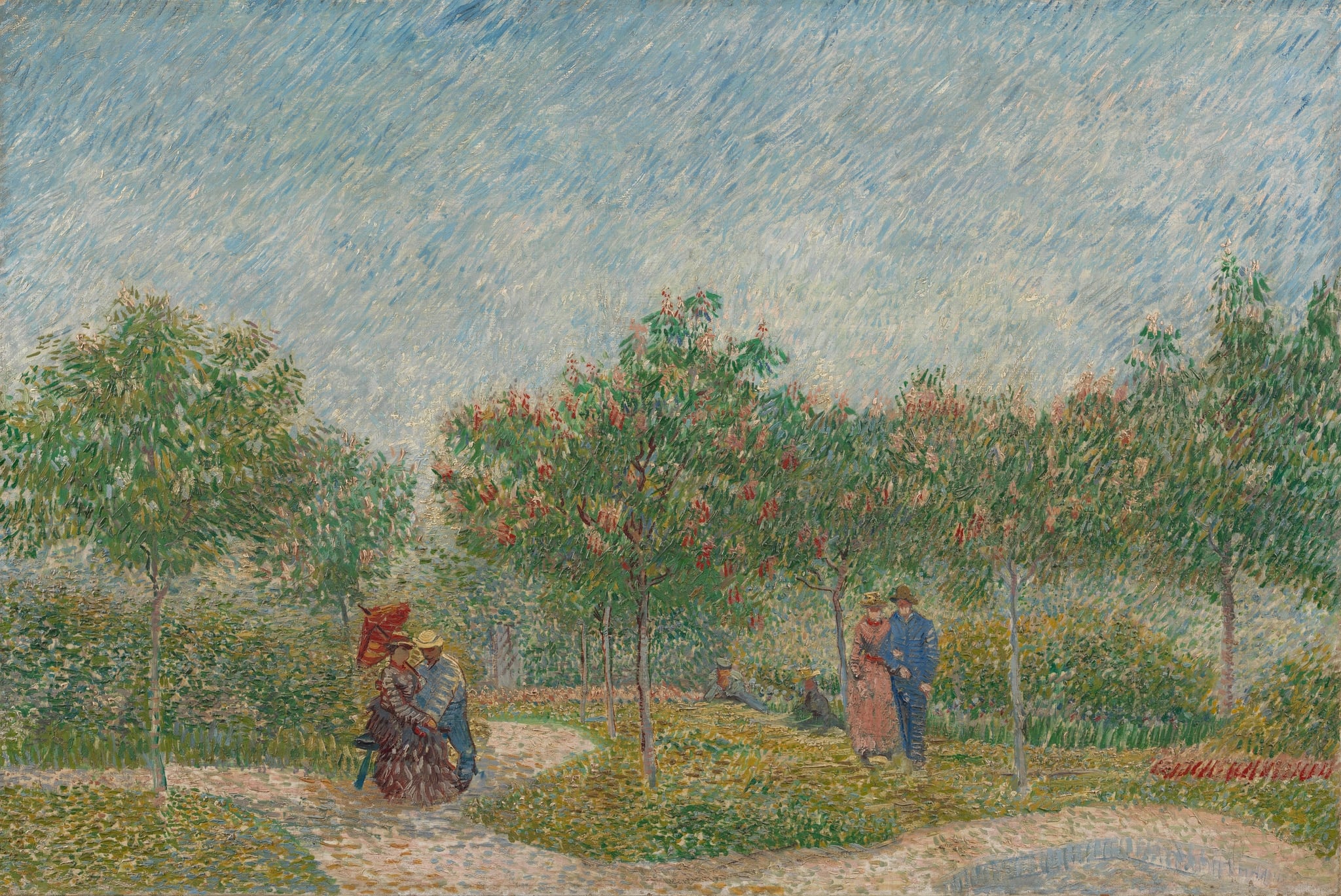
Garden with Courting Couples: Square Saint-Pierre
Vincent van Gogh (1887)
In Garden with Courting Couples: Square Saint-Pierre, Vincent van Gogh turns a small Montmartre park into a stage where <strong>spring</strong>, <strong>intimacy</strong>, and <strong>urban leisure</strong> converge. Short, shimmering strokes fuse pink chestnut blossoms, curving paths, and paired figures into one pulse of <strong>renewal</strong> and <strong>togetherness</strong> <sup>[1]</sup><sup>[2]</sup>.
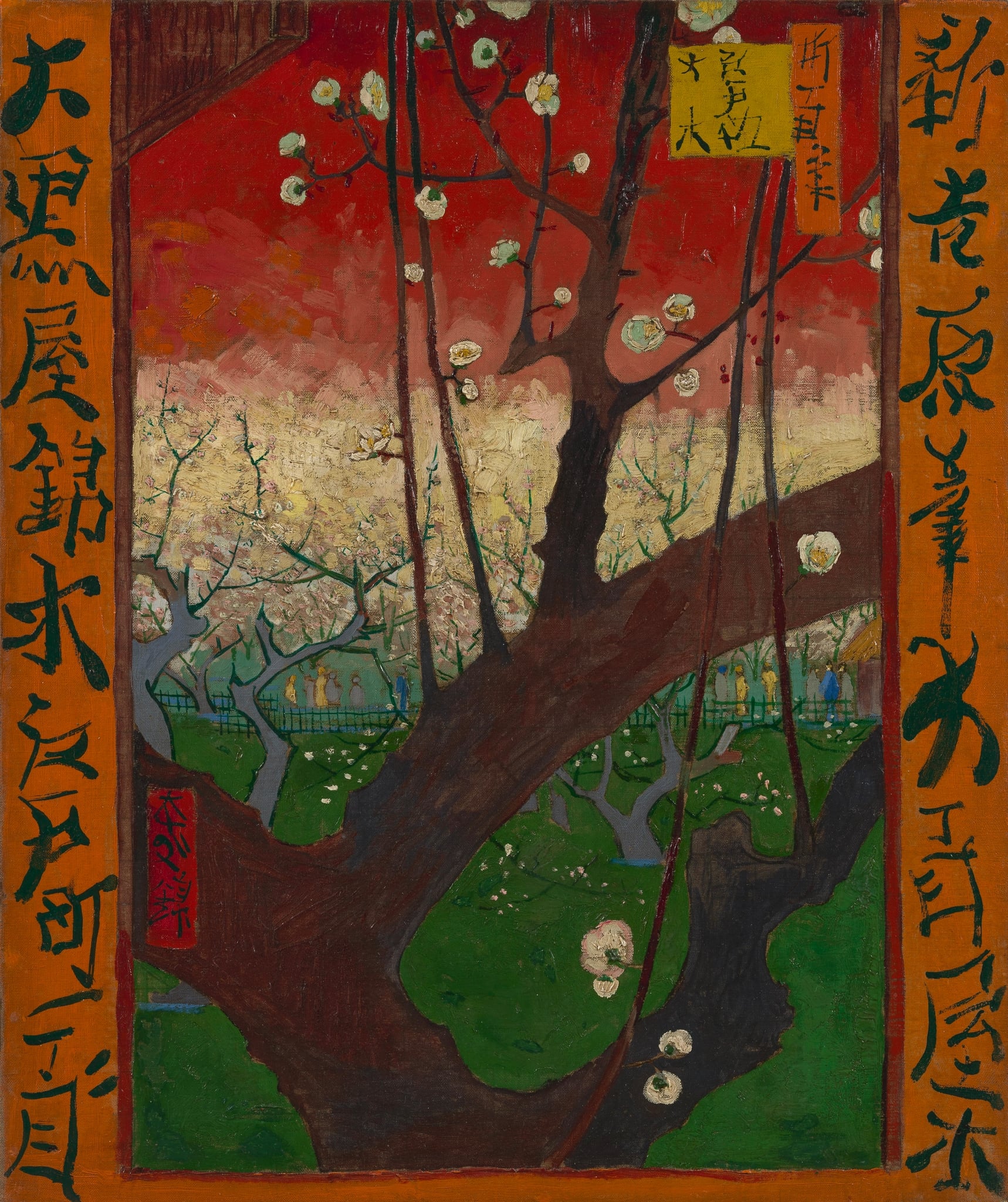
Flowering Plum Orchard (after Hiroshige)
Vincent van Gogh (1887)
In Flowering Plum Orchard (after Hiroshige), Vincent van Gogh fuses <strong>ukiyo-e design</strong> with <strong>post‑Impressionist color</strong>. A diagonal, calligraphic trunk cuts across a saturated green orchard, set against a <strong>blazing red sky</strong> and framed by <strong>orange borders with Japanese characters</strong>. The result is a vivid translation of Hiroshige’s motif into an oil painting charged with renewal and resolve <sup>[1]</sup><sup>[2]</sup>.
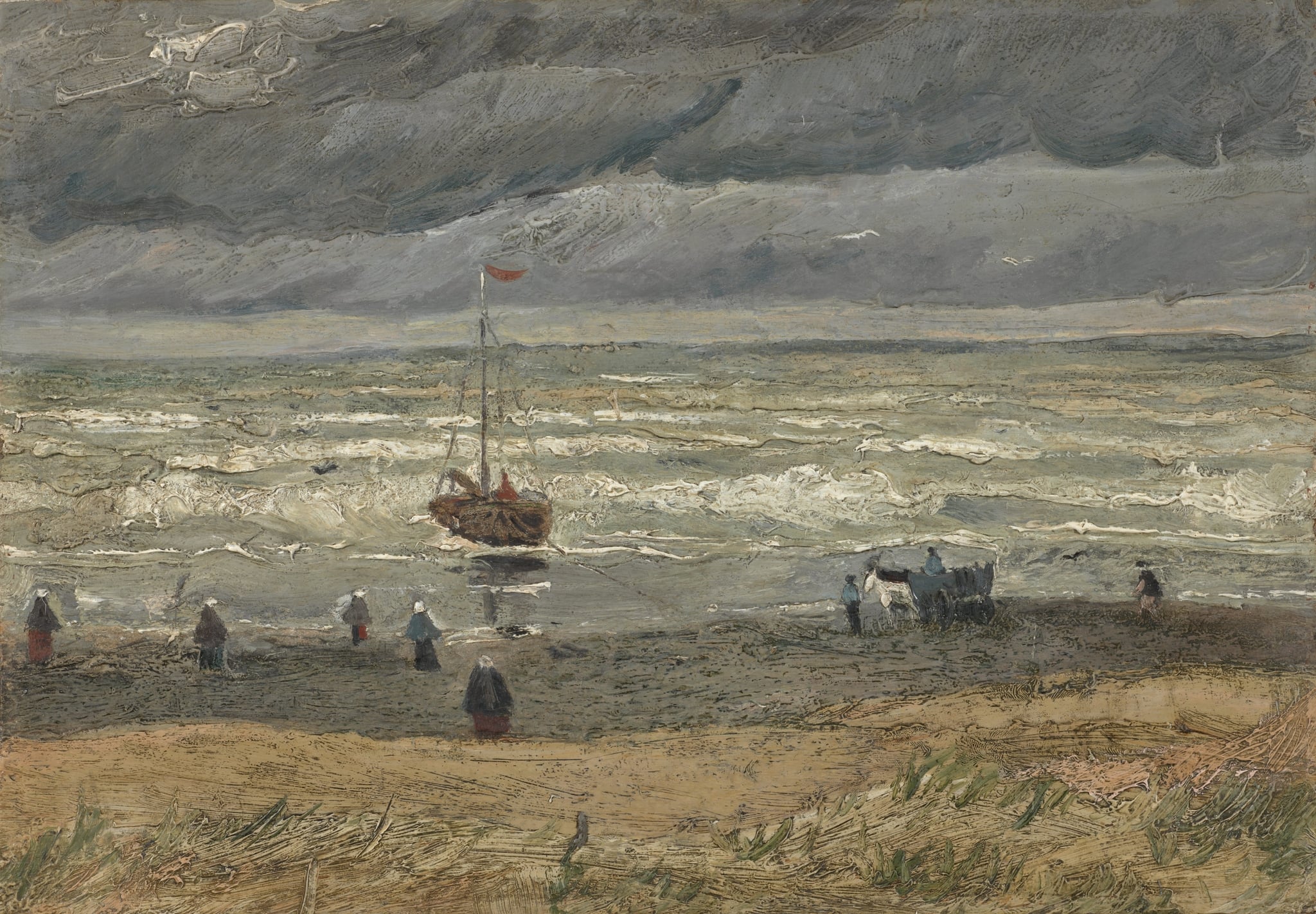
View of the Sea at Scheveningen
Vincent van Gogh (1882)
Under a storm-laden sky, Vincent van Gogh’s <strong>View of the Sea at Scheveningen</strong> pits tiny beach figures, a <strong>horse-and-cart</strong>, and a fishing boat with a <strong>red flag</strong> against the heaving <strong>North Sea</strong>. The quick, dense strokes and even grains of blown <strong>sand embedded in the paint</strong> make the weather itself the subject, fusing observation with immediacy <sup>[2]</sup><sup>[3]</sup>.
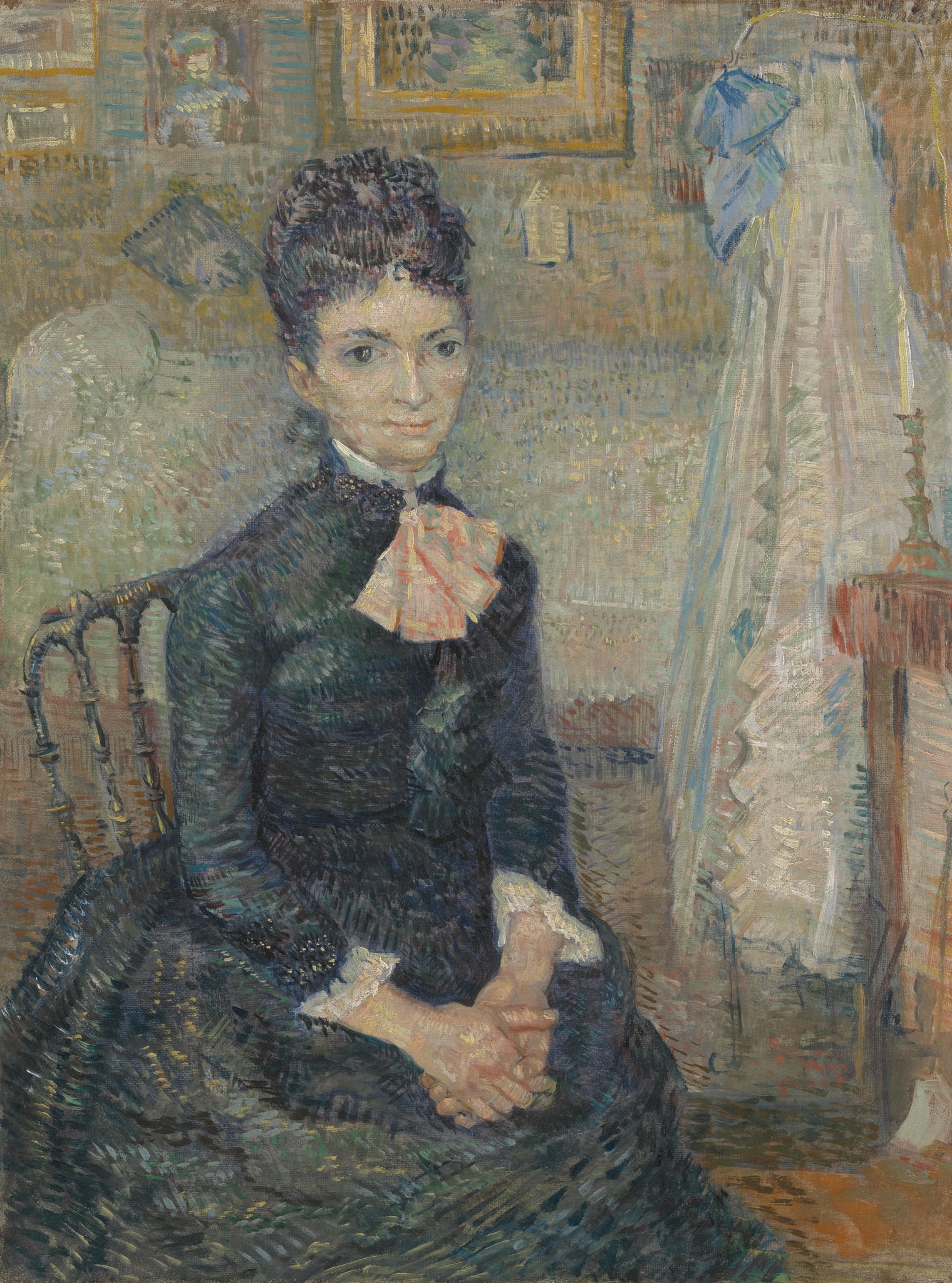
Portrait of Léonie Rose Charbuy-Davy
Vincent van Gogh (1887)
Vincent van Gogh’s Portrait of Léonie Rose Charbuy-Davy stages a composed, middle-class interior where a seated woman’s folded hands and dark blue-green dress meet a tremulous field of short, vibrating strokes. The cradle, fireplace glow, and dotted facture refract her poised exterior through <strong>modern, experimental color and touch</strong> <sup>[1]</sup><sup>[3]</sup>. The result is a portrait of <strong>maternal identity</strong> as much as a likeness, anchored by the hearth and cradle yet unsettled by the flicker of the paint itself <sup>[1]</sup>.
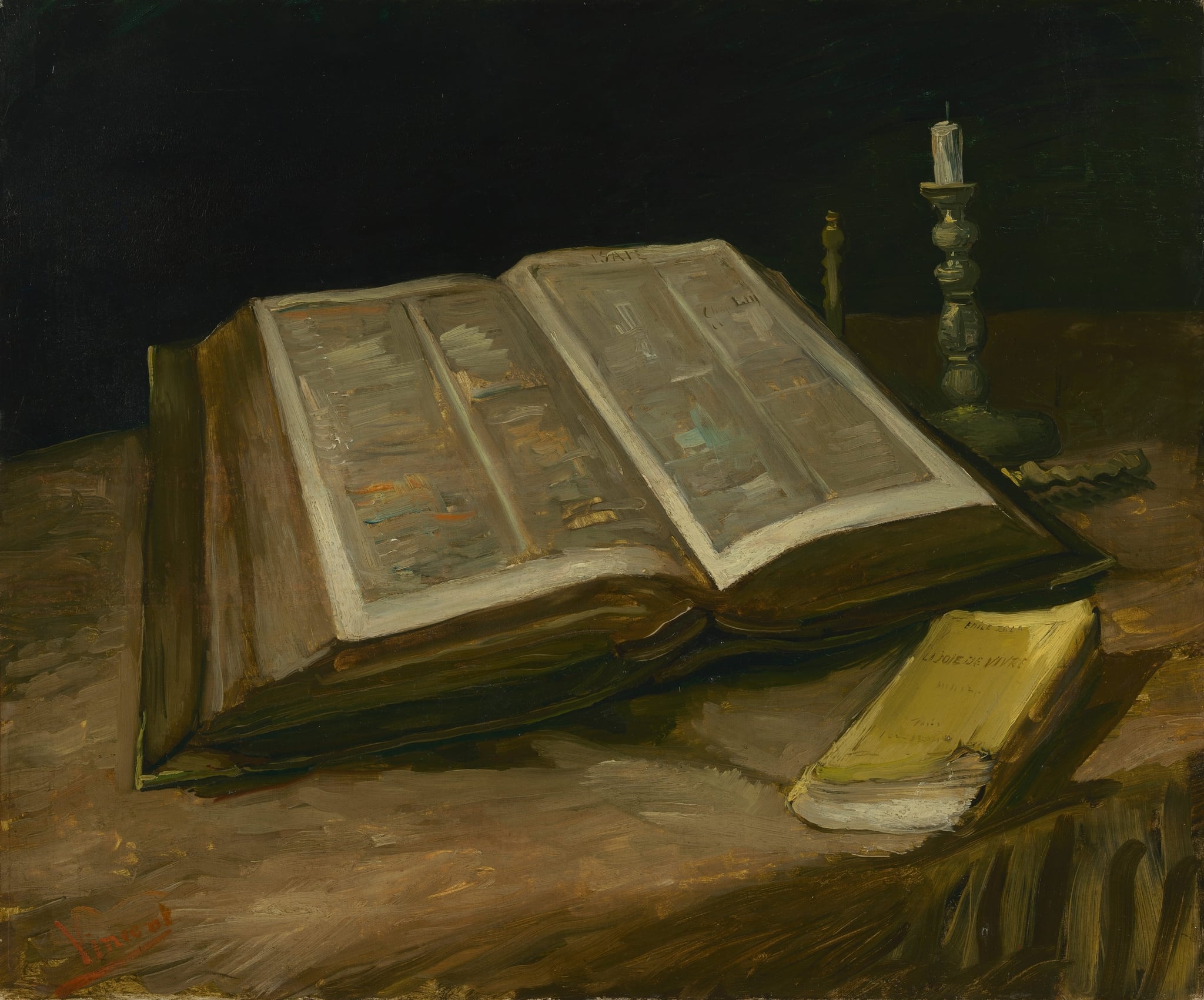
Still Life with Bible
Vincent van Gogh (1885)
Vincent van Gogh’s Still Life with Bible (1885) stages a stark encounter between a monumental family <strong>Bible</strong>, a snuffed <strong>candle</strong>, and Zola’s yellow‑covered <strong>La joie de vivre</strong>. The painting’s heavy, earthen brushwork and diagonal sweep forge a tense dialogue between <strong>inherited faith</strong> and <strong>modern experience</strong> <sup>[1]</sup><sup>[2]</sup>.
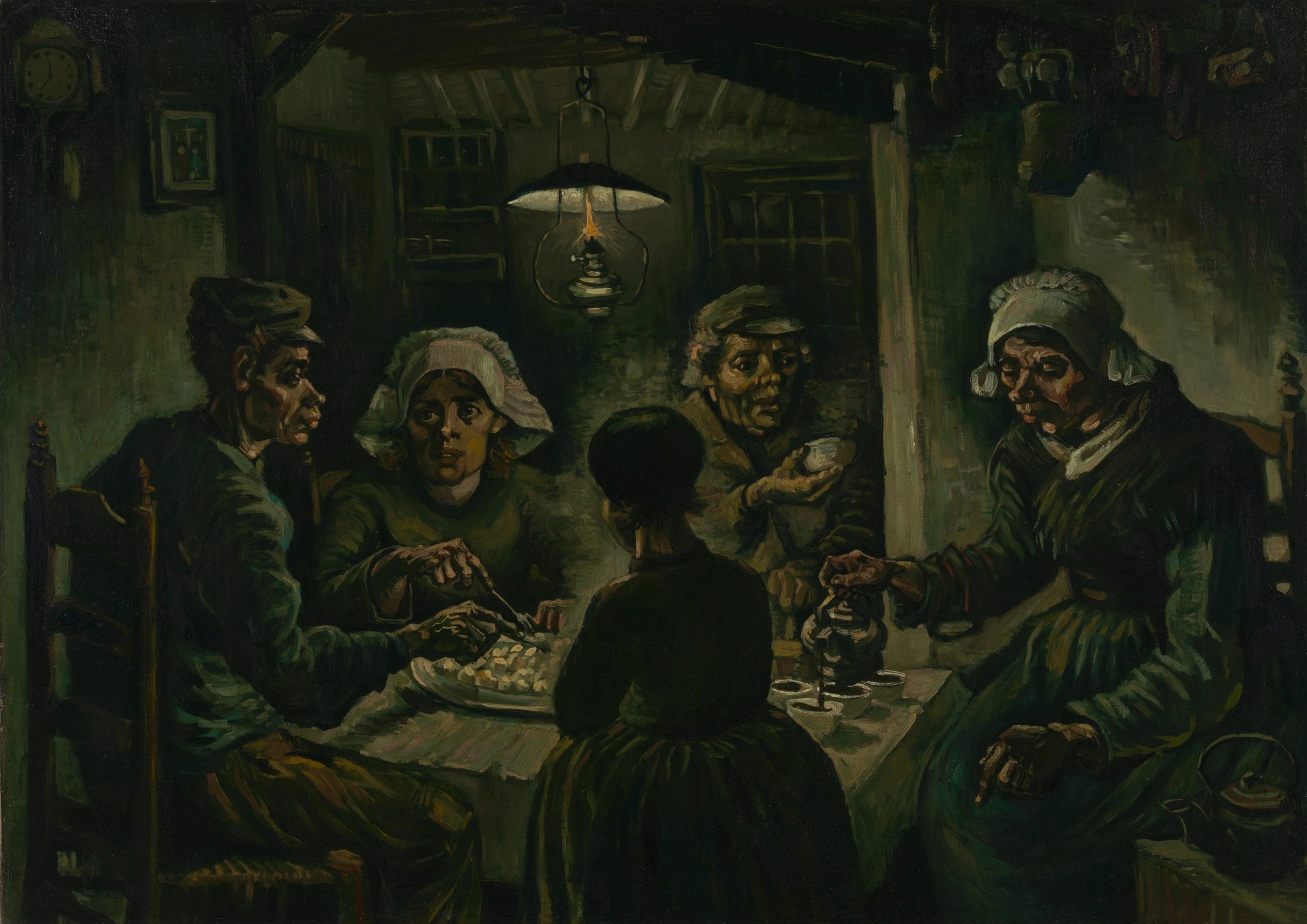
The Potato Eaters
Vincent van Gogh (1885)
In The Potato Eaters, five villagers huddle beneath a single oil lamp, their <strong>knotted hands</strong> reaching for a plate of potatoes and cups of coffee. The earthen palette and coarse brushwork forge a world of <strong>labor, humility, and solidarity</strong>, where the food on the table is the tangible outcome of the work in their hands <sup>[1]</sup><sup>[3]</sup>. Van Gogh turns scarcity into <strong>dignity</strong>, binding the group within the lamp’s modest halo <sup>[3]</sup><sup>[5]</sup>.
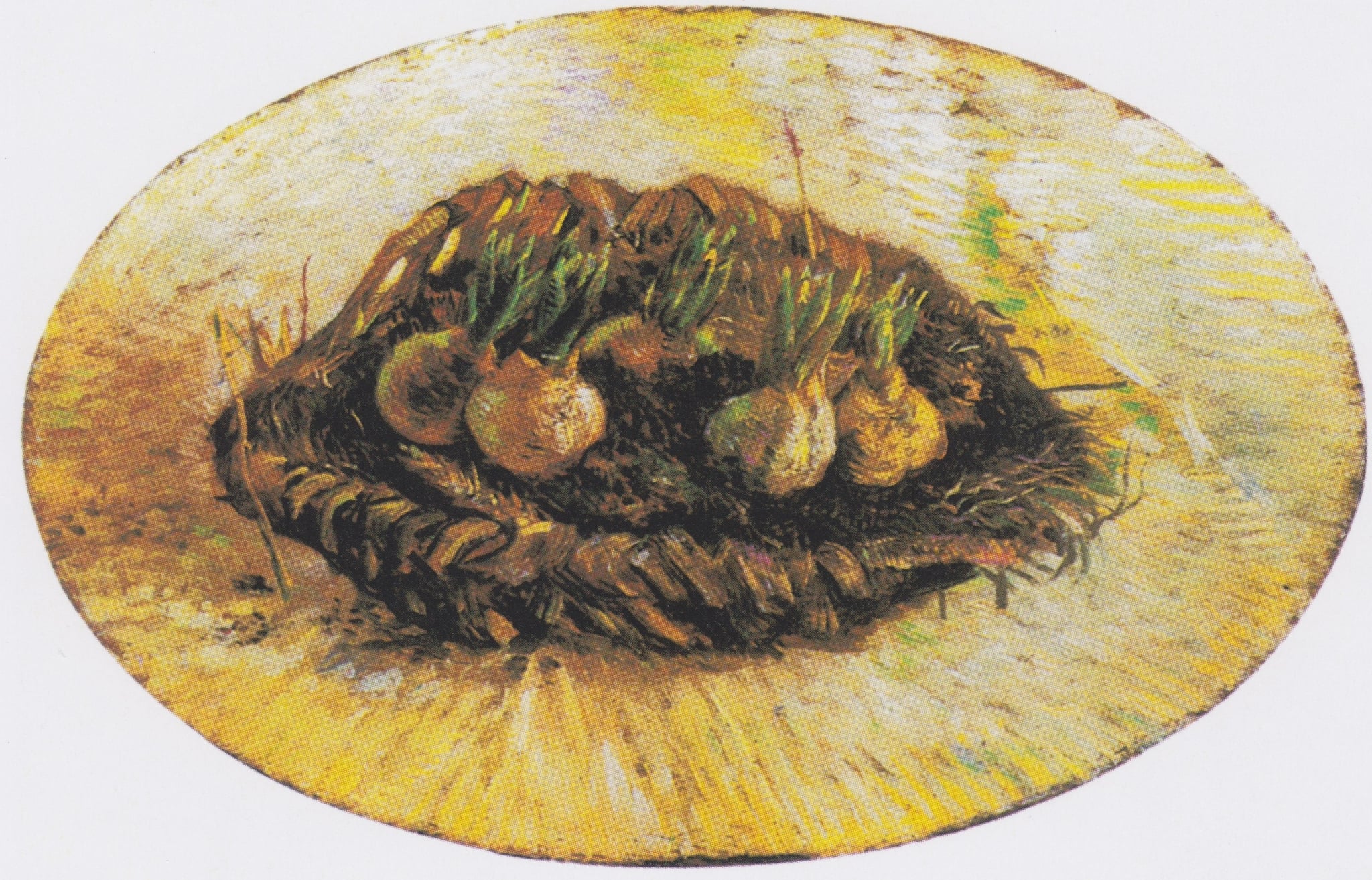
Basket of Hyacinth Bulbs
Vincent van Gogh (1887 (January–February))
<strong>Basket of Hyacinth Bulbs</strong> turns a modest basket of soil‑caked bulbs into a scene of <strong>latent vitality</strong>, painted in warm ochres and radiant yellows that encircle the motif like light. On an <strong>oval wooden panel</strong>, short, tactile strokes press the weave of the basket and the papery skins while green shoots puncture the dark soil, declaring life on the verge of emergence <sup>[1]</sup><sup>[2]</sup>.
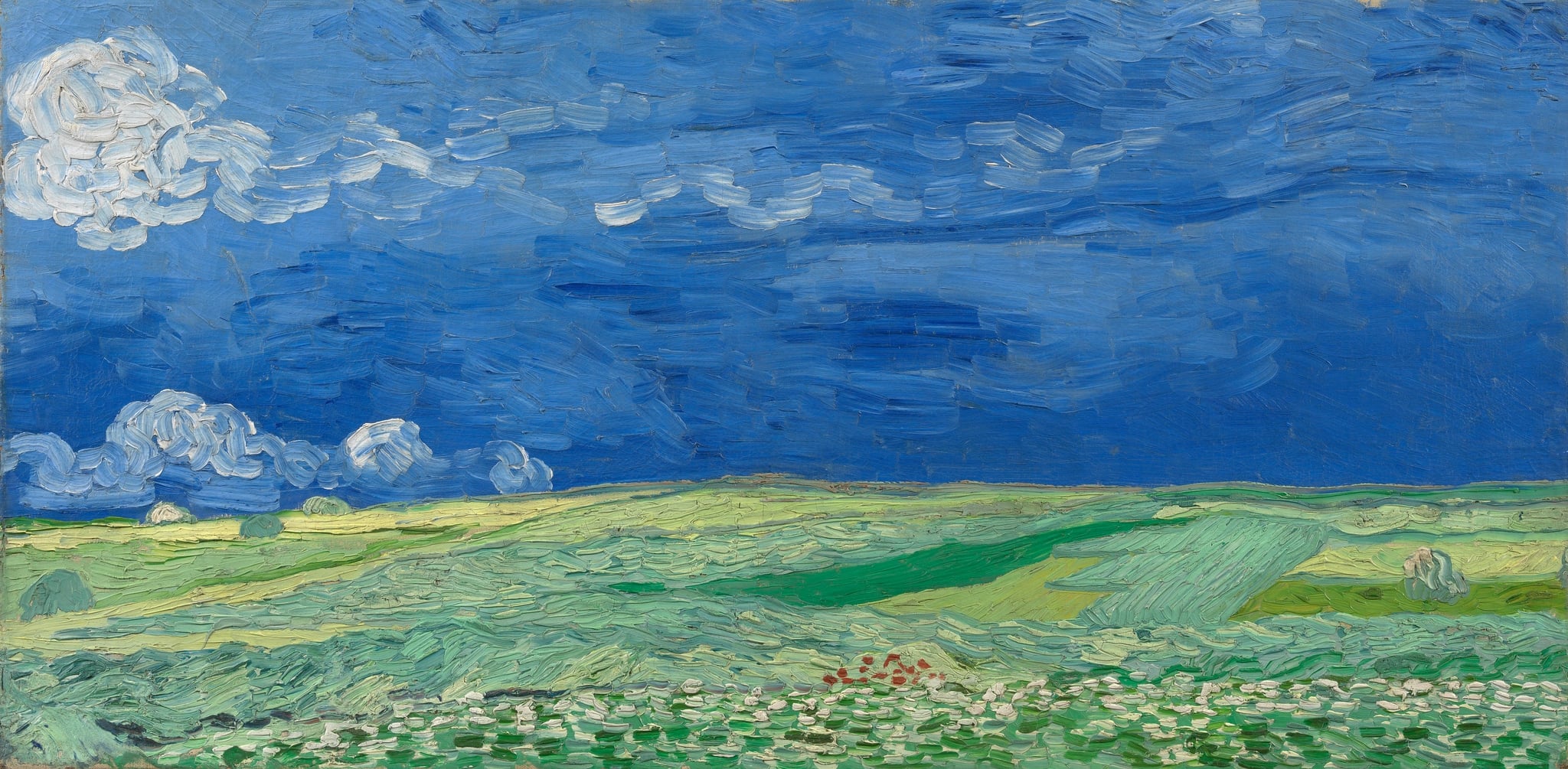
Wheatfield under Thunderclouds
Vincent van Gogh (1890)
A panoramic sweep of land and sky pits a wind‑combed wheatfield against an immense, <strong>thunder‑laden</strong> blue. Van Gogh uses a radically simple two‑band design and dense impasto to stage a confrontation between <strong>turbulence</strong> and <strong>endurance</strong> <sup>[1]</sup><sup>[2]</sup>.
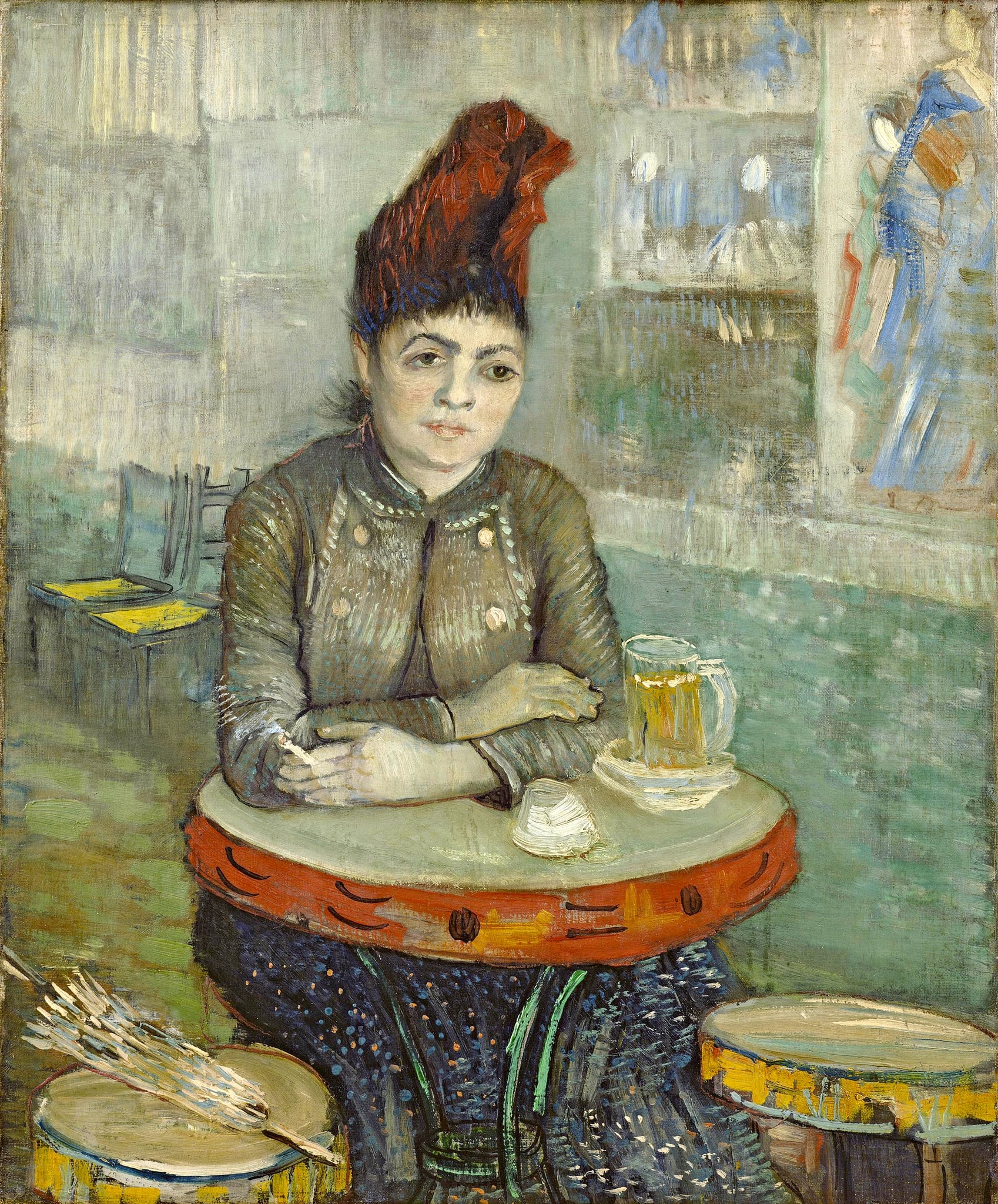
In the Café: Agostina Segatori in Le Tambourin
Vincent van Gogh (1887 (Jan–Mar))
Van Gogh casts Agostina Segatori at a tiny, tambourine‑like café table, turning Le Tambourin into a <strong>stage of modern life</strong>. Cool greens and greys make the red <strong>flame‑plume hat</strong> and the foaming <strong>beer</strong> flare, while folded arms and a set‑aside <strong>parasol</strong> register private fatigue amid public display <sup>[1]</sup><sup>[2]</sup><sup>[3]</sup>.
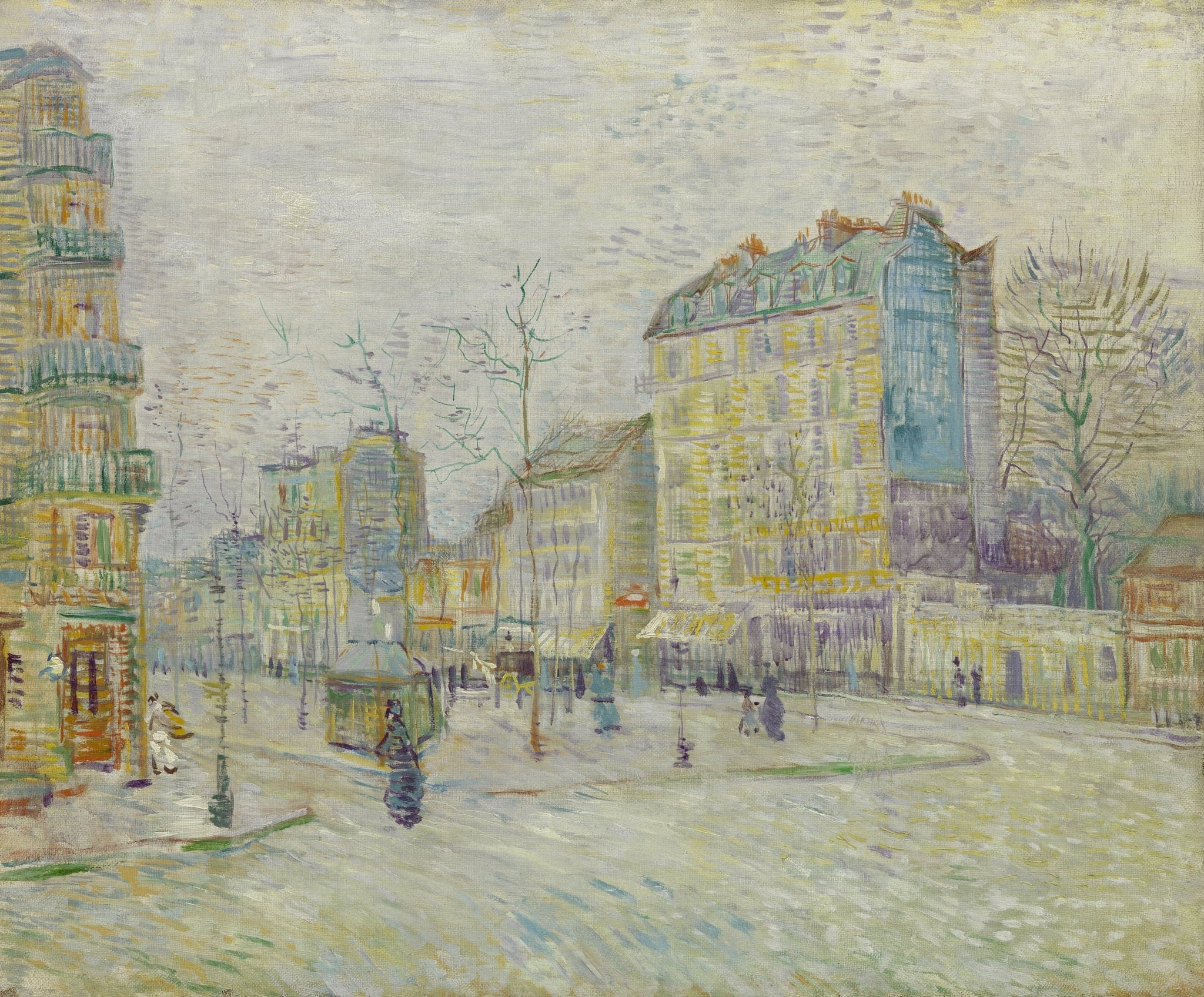
Boulevard de Clichy
Vincent van Gogh (1887)
Vincent van Gogh’s Boulevard de Clichy crystallizes a cool, wintry Paris into a <strong>vibrating field of light</strong> and motion. With leafless trees echoing lamp posts and façades stitched from lilac, blue, and sulfurous yellow strokes, the boulevard bends like a <strong>slow river of modernity</strong>. Tiny bundled figures drift across the cobbles, signaling the city’s <strong>anonymous flow</strong>.
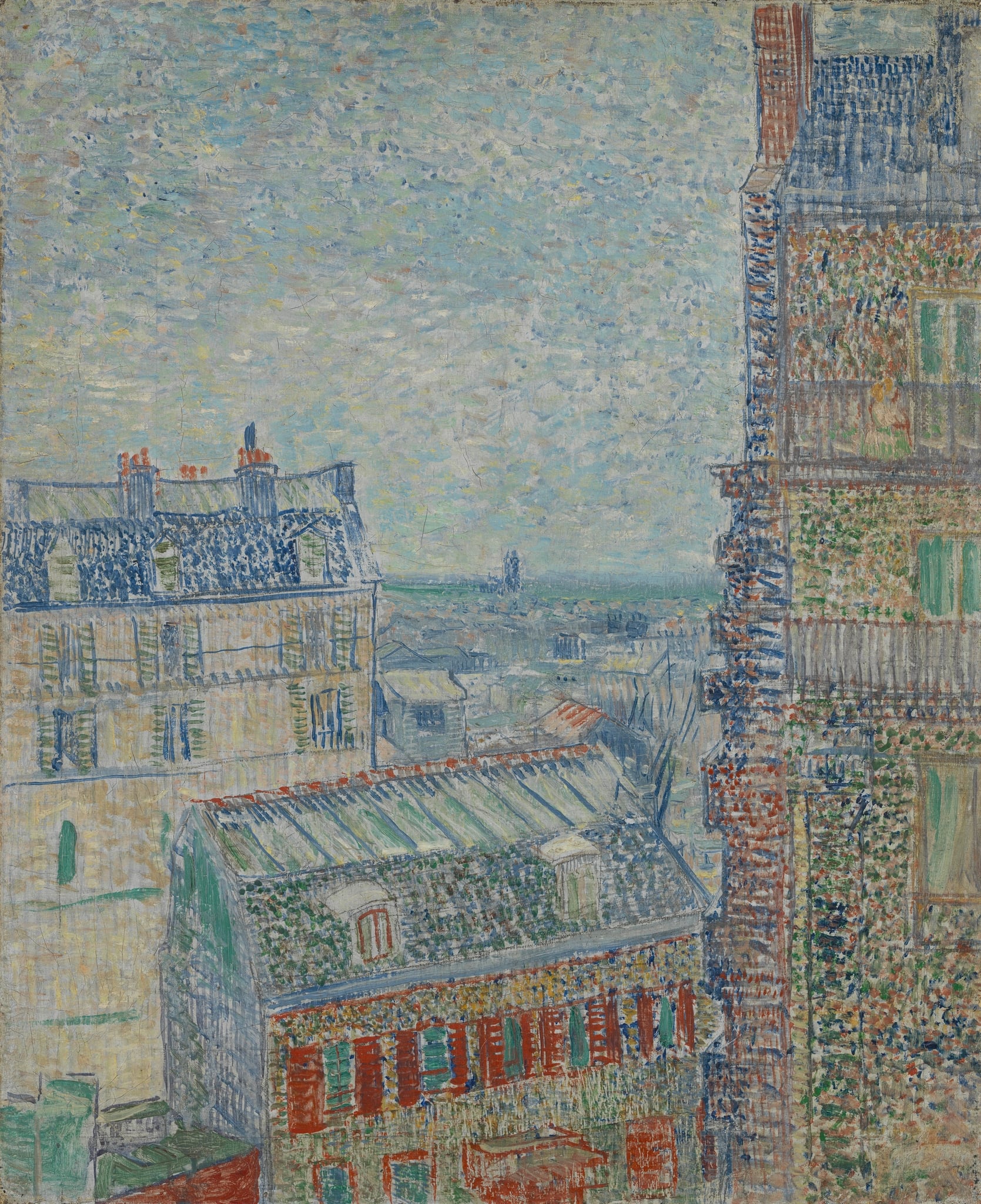
View from Theo's Apartment
Vincent van Gogh (1887)
Van Gogh’s View from Theo’s Apartment compresses Paris into a close tapestry of roofs, windows, and chimneys, then releases the gaze into a pale, stippled sky. The painting fuses loose strokes with Pointillist touches, setting cool slate blues against warm brick reds to make the city surface <strong>quiver with urban energy</strong> <sup>[1]</sup><sup>[5]</sup>. On the far horizon, the vista opens toward Meudon and the Trocadéro, anchoring the scene in a real, breathable distance <sup>[2]</sup>.
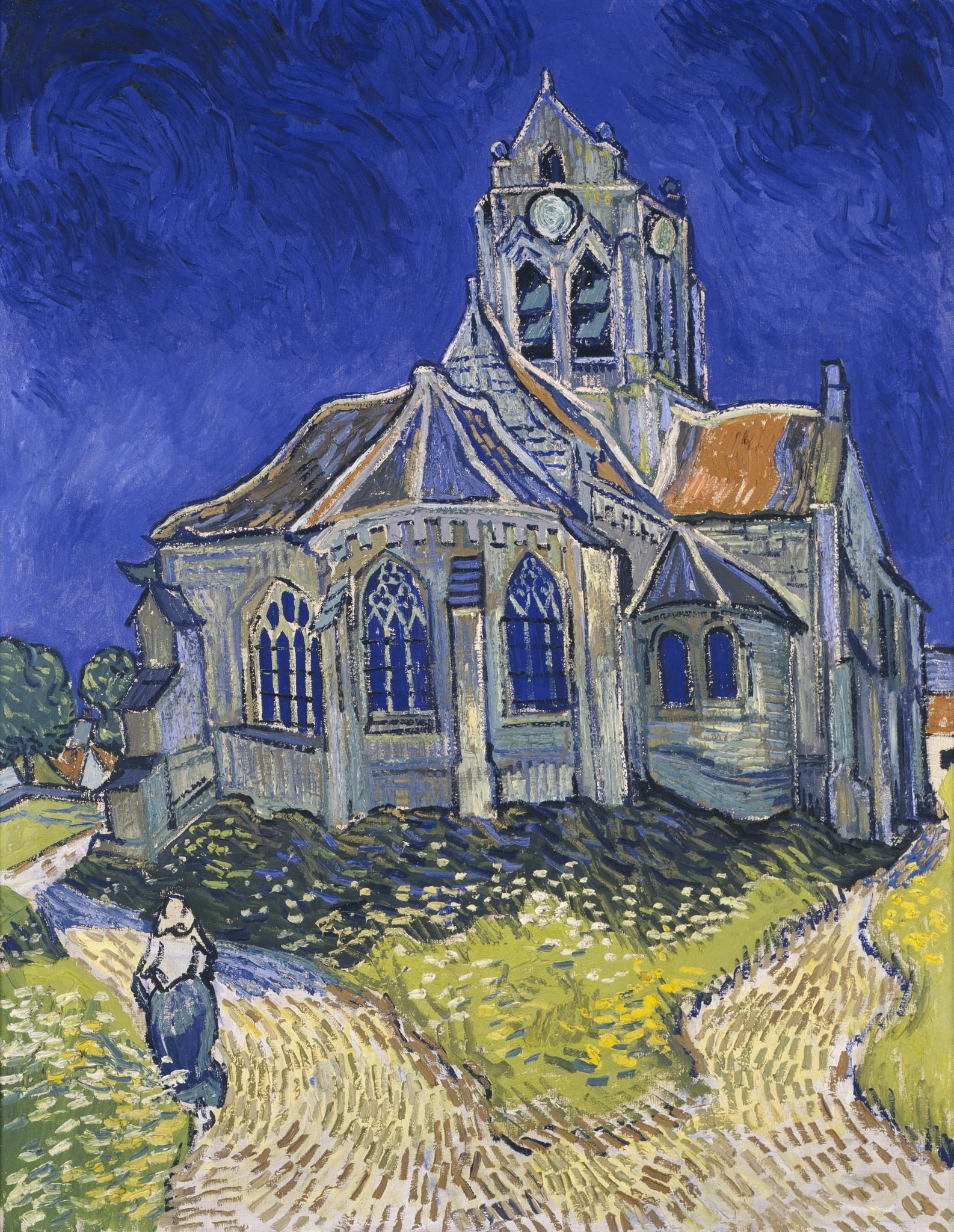
The Church at Auvers
Vincent van Gogh (1890)
In The Church at Auvers, Vincent van Gogh turns a modest Gothic church into a <strong>restless, living form</strong> against a <strong>cobalt sky</strong>. Two forked paths, a lone passerby, and windows sunk in <strong>ultramarine shadow</strong> stage a tension between the glowing world outside and the dim, unresponsive building within <sup>[1]</sup><sup>[2]</sup>.
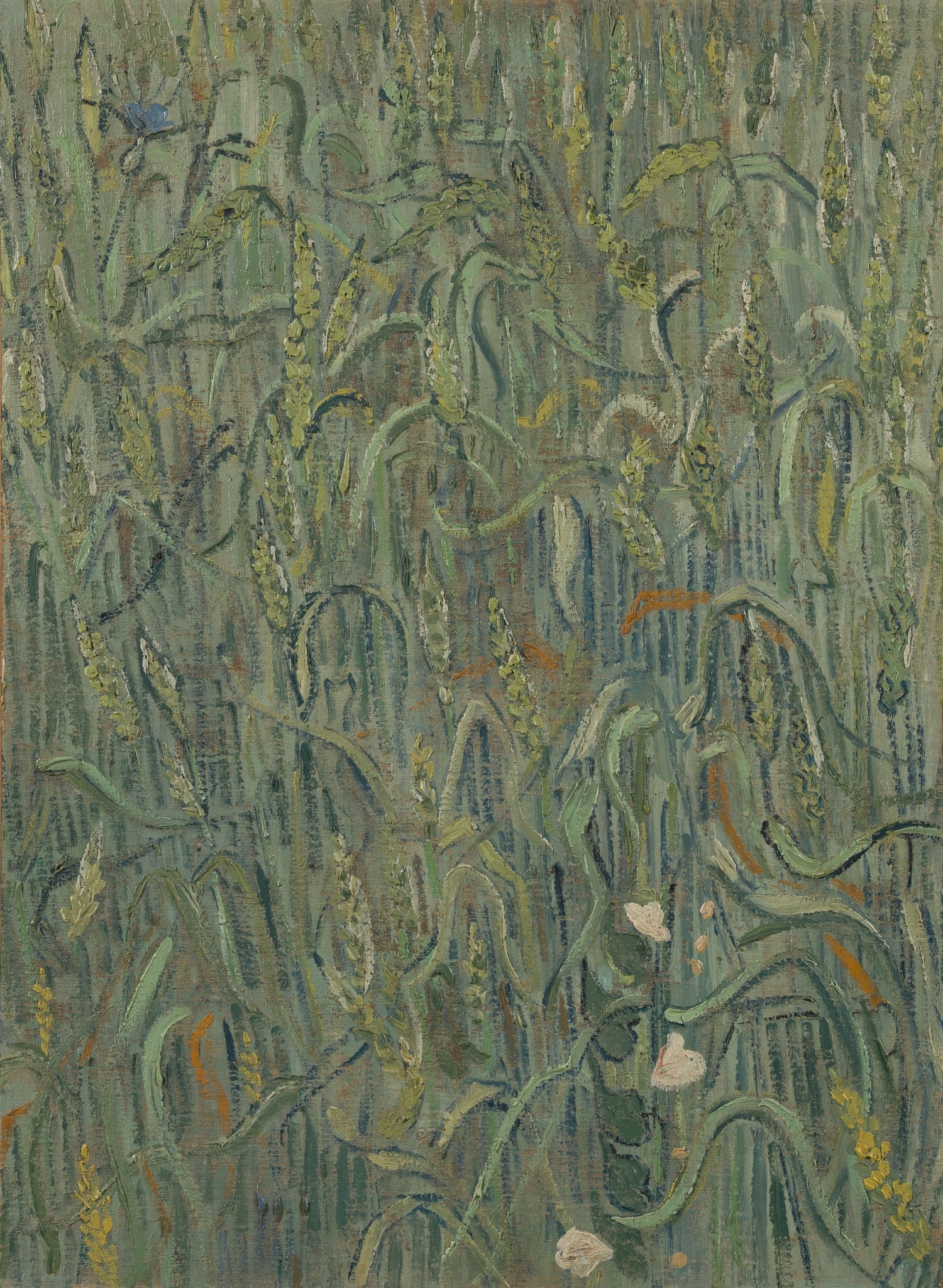
Ears of Wheat
Vincent van Gogh (1890)
Ears of Wheat plunges the viewer into a close, horizonless tangle of grain, rendering a living field as an all‑over surface of <strong>vibrating strokes</strong> and <strong>looping leaves</strong>. Cool greens and blue‑grays are pricked by ocher and rusty orange, while a blue <strong>cornflower</strong> at upper left and pale <strong>bindweed</strong> at lower right anchor the scene’s ecology <sup>[1]</sup><sup>[2]</sup>. Van Gogh turns a humble crop into a <strong>meditation on resilience and life’s cycles</strong>.
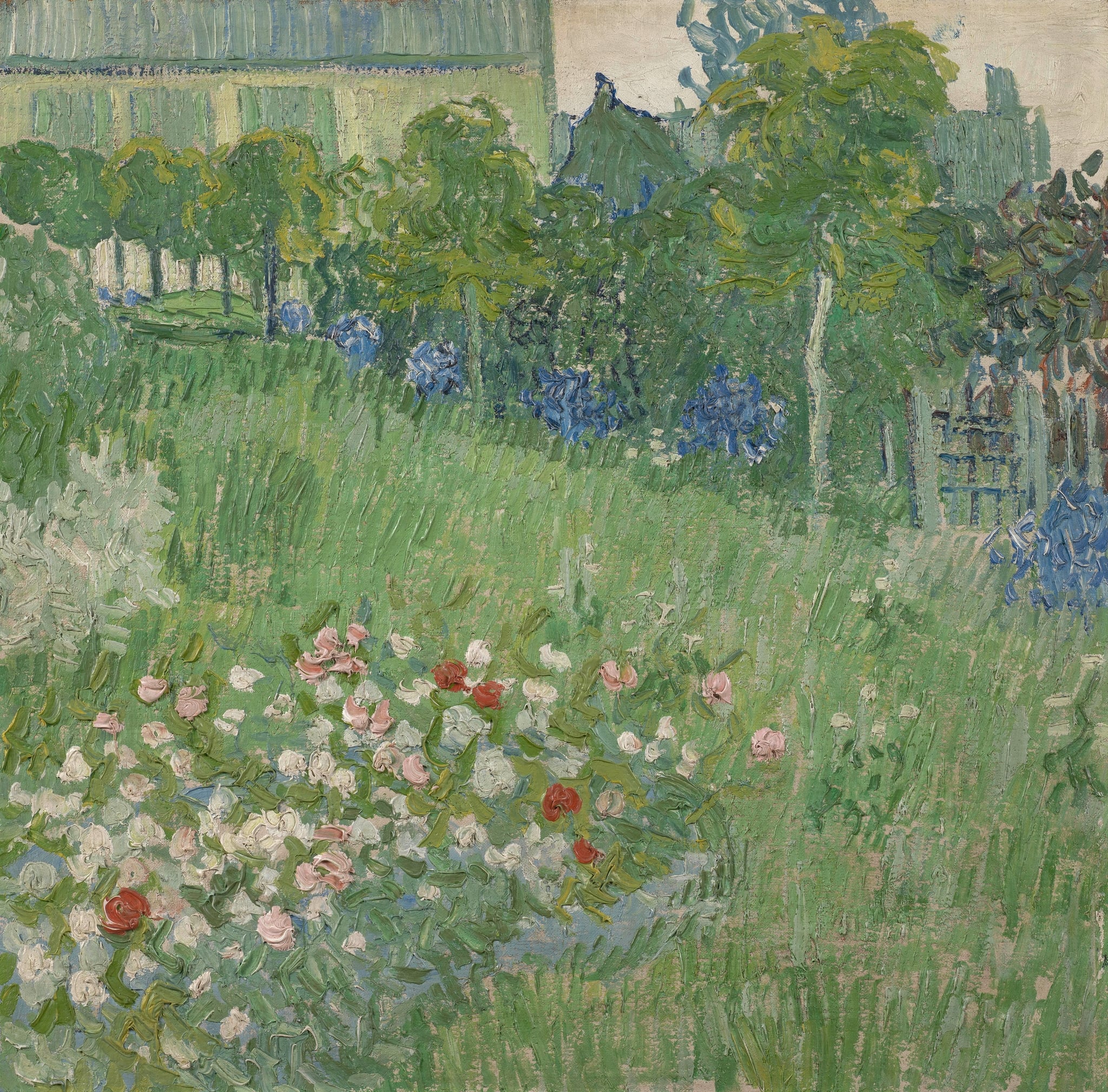
Daubigny's Garden
Vincent van Gogh (1890)
In Daubigny's Garden, Vincent van Gogh forges a <strong>living field of green</strong> where short, pulsating strokes turn grass, hedge, and trees into a single, breathing organism. A <strong>rose bed of pale pinks and reds</strong> pools in the foreground, while <strong>cobalt-blue flowers</strong> puncture the middle hedge, and the pale façade and roof beyond seal the garden into an intimate retreat <sup>[1]</sup><sup>[2]</sup>.
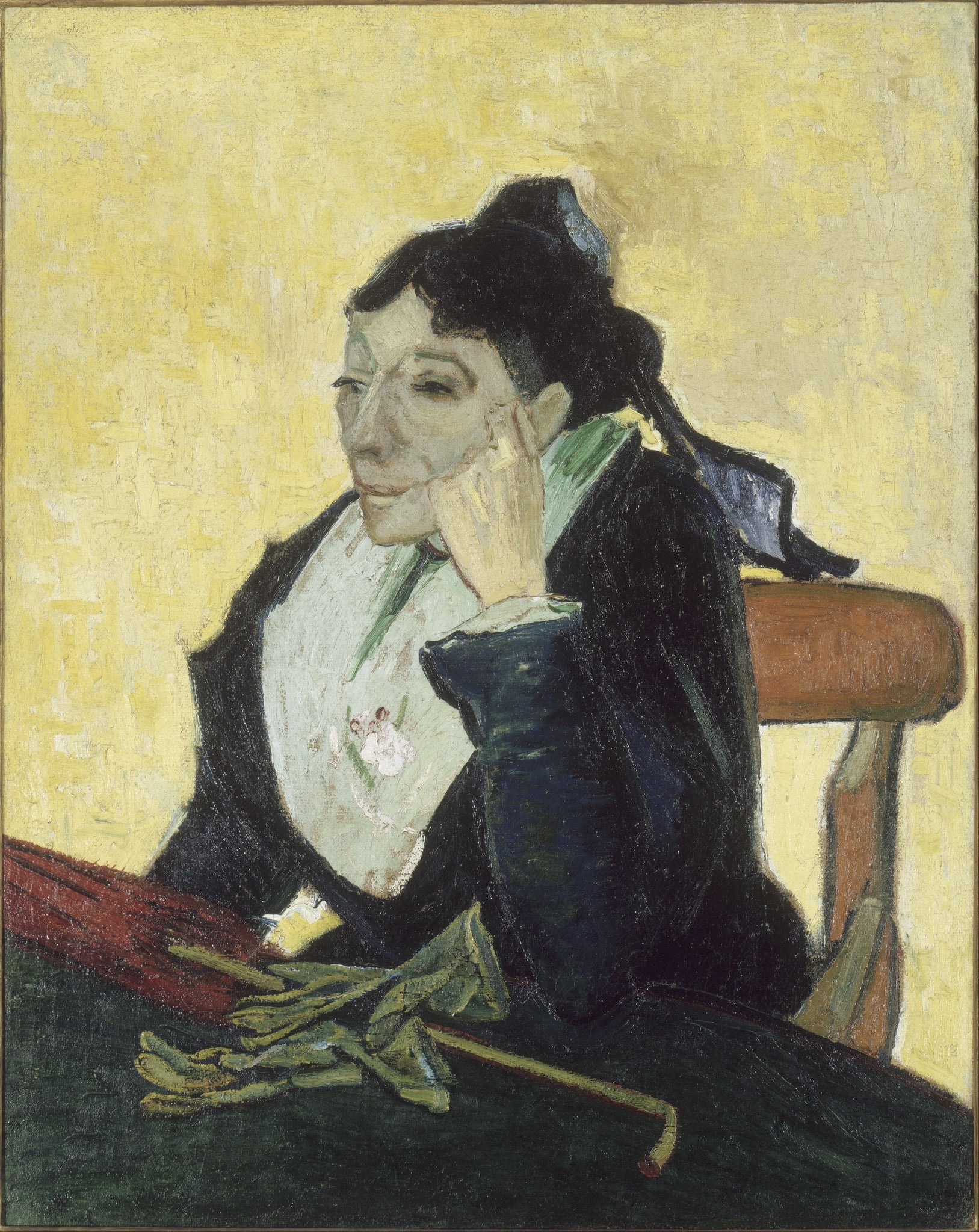
L'Arlésienne
Vincent van Gogh (1888)
In L'Arlésienne, Vincent van Gogh distills a moment of inward pause: a woman from Arles leans her cheek on her hand before a <strong>butter‑yellow wall</strong>, her <strong>black-and-blue silhouette</strong> set against a warm field. The <strong>red parasol</strong> and <strong>green gloves</strong> lie unused on the table, signaling a suspension of public persona in favor of private thought <sup>[1]</sup><sup>[3]</sup>.
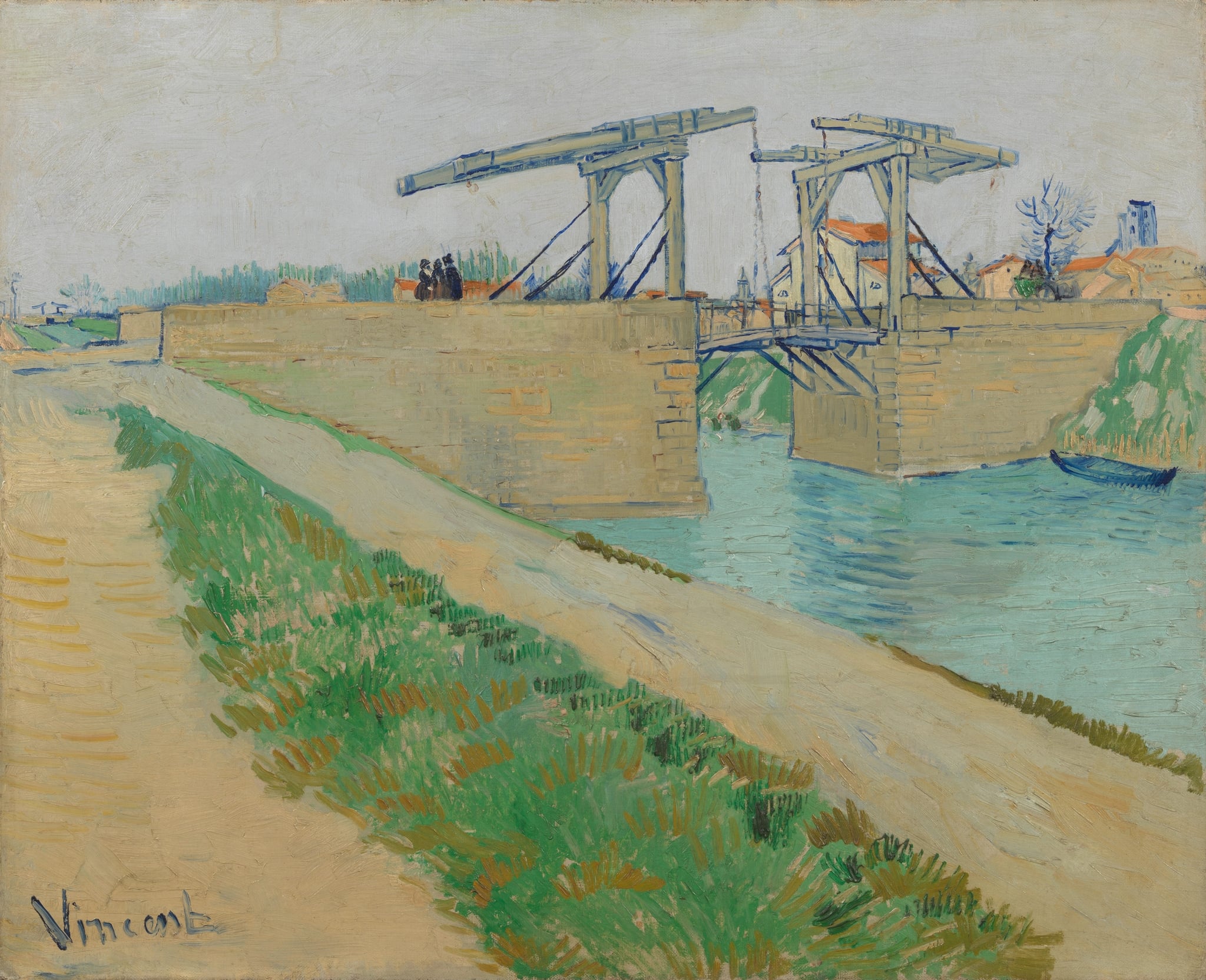
The Langlois Bridge
Vincent van Gogh (1888)
Van Gogh’s The Langlois Bridge turns a modest drawbridge into a <strong>symbol of connection</strong> and modern passage. With a sweeping towpath, <strong>firm blue contours</strong>, and turquoise water, the scene balances rural calm with engineered order <sup>[1]</sup><sup>[3]</sup>.
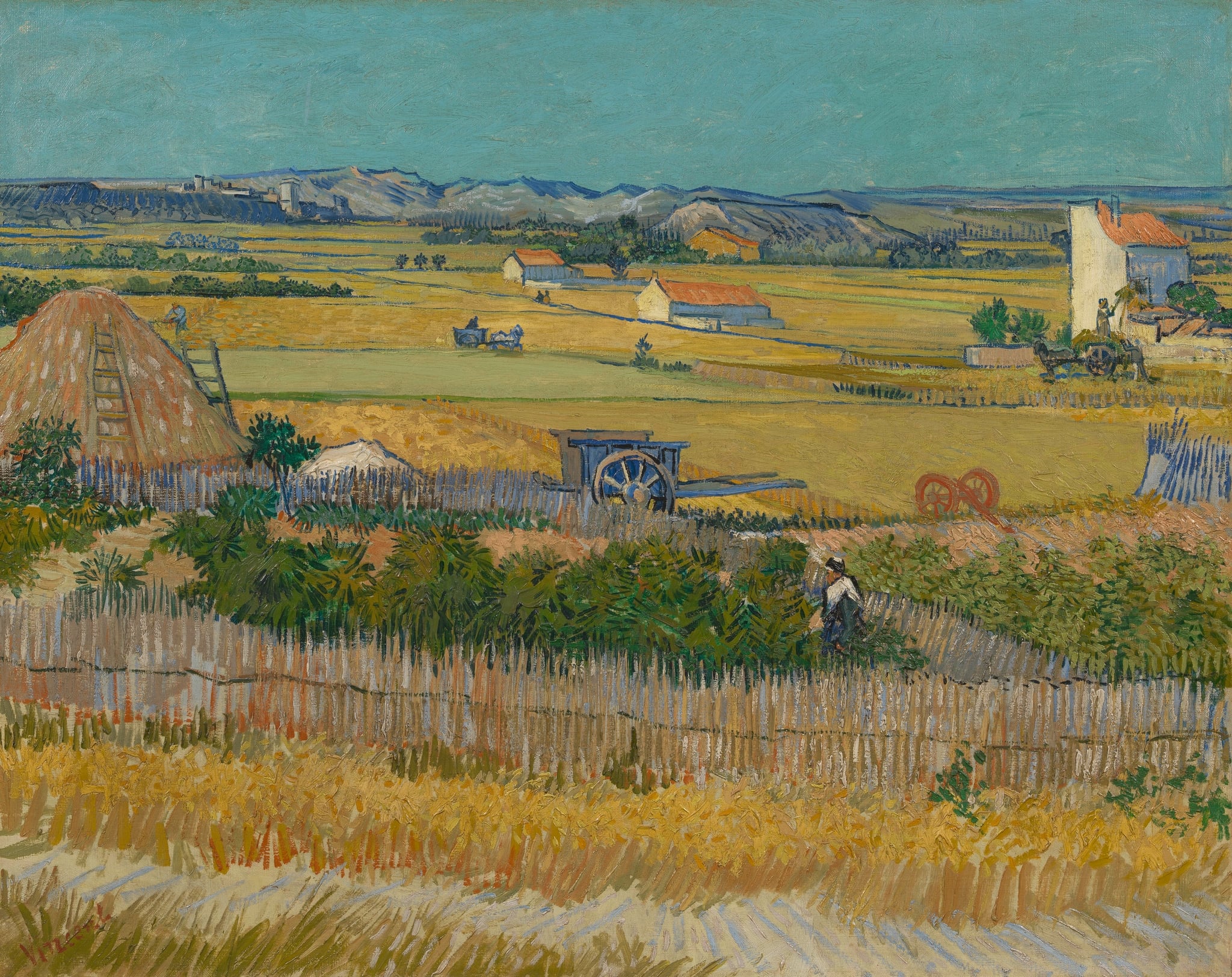
The Harvest
Vincent van Gogh (1888)
<strong>The Harvest</strong> surveys the La Crau plain as a luminous patchwork of ripe wheat, garden strips, and farm tracks under an <strong>azure</strong> sky. Van Gogh orchestrates tools and tasks—haystack with ladder, carts with <strong>red wheels</strong>, fenced plots—into a single, sunstruck order that turns labor into vision <sup>[1]</sup><sup>[2]</sup>. A lone reaper almost dissolves in the foliage, anchoring the panorama in human toil and seasonal time.
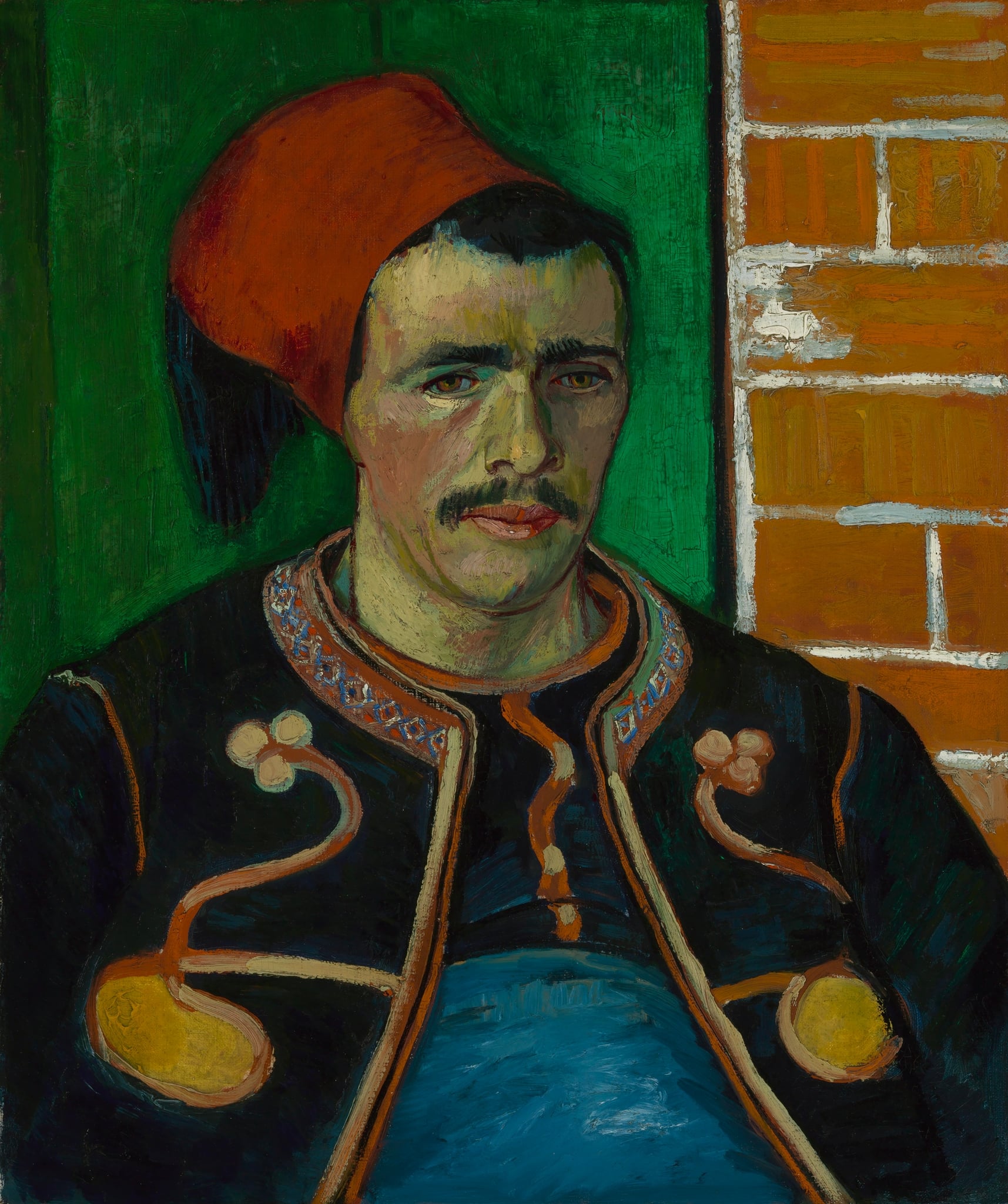
The Zouave
Vincent van Gogh (1888)
<strong>The Zouave</strong> crystallizes Van Gogh’s Arles project: a half-length soldier thrust forward by clashing complements—red, green, orange, blue—so color carries character. The flame-like <strong>fez</strong> ignites against a flat <strong>green door</strong> and a sliver of <strong>orange brick wall</strong>, while heavy outlines and simplified planes turn uniform into emblem. The work inaugurates his pursuit of the <strong>modern “character portrait,”</strong> where chromatic force outweighs likeness <sup>[1]</sup><sup>[2]</sup>.
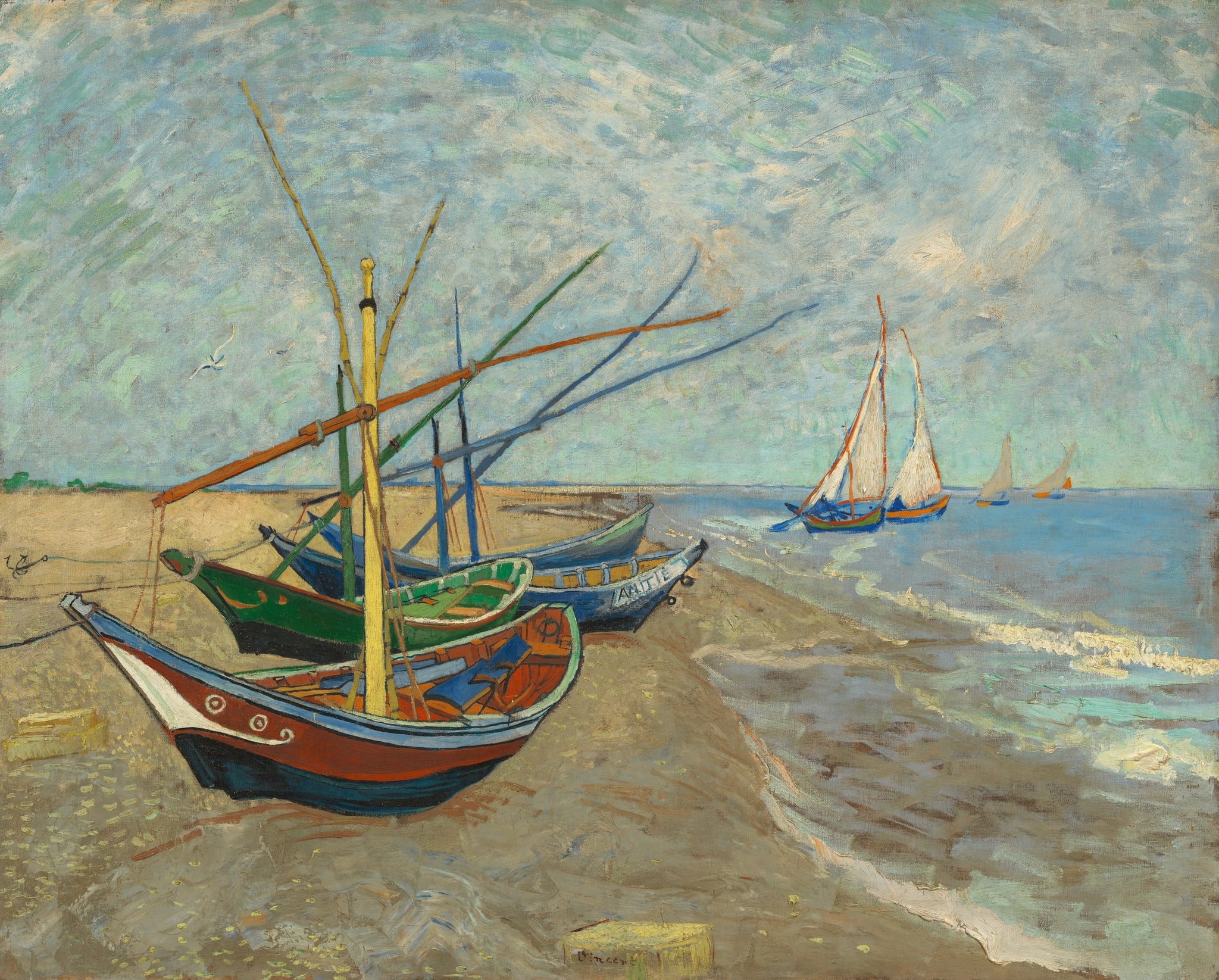
Fishing Boats on the Beach at Les Saintes-Maries-de-la-Mer
Vincent van Gogh (1888)
Vincent van Gogh lines up a file of beached craft like actors awaiting their cue, turning working boats into <strong>emblems of readiness and risk</strong>. Bold contours, flattened color, and the wind‑tossed sea and sky translate Mediterranean luminosity into a <strong>Japonisme/Cloisonnism</strong> idiom that clarifies form and heightens feeling. The scene suspends time at the edge of departure, where labor, hope, and the sea’s pull meet.
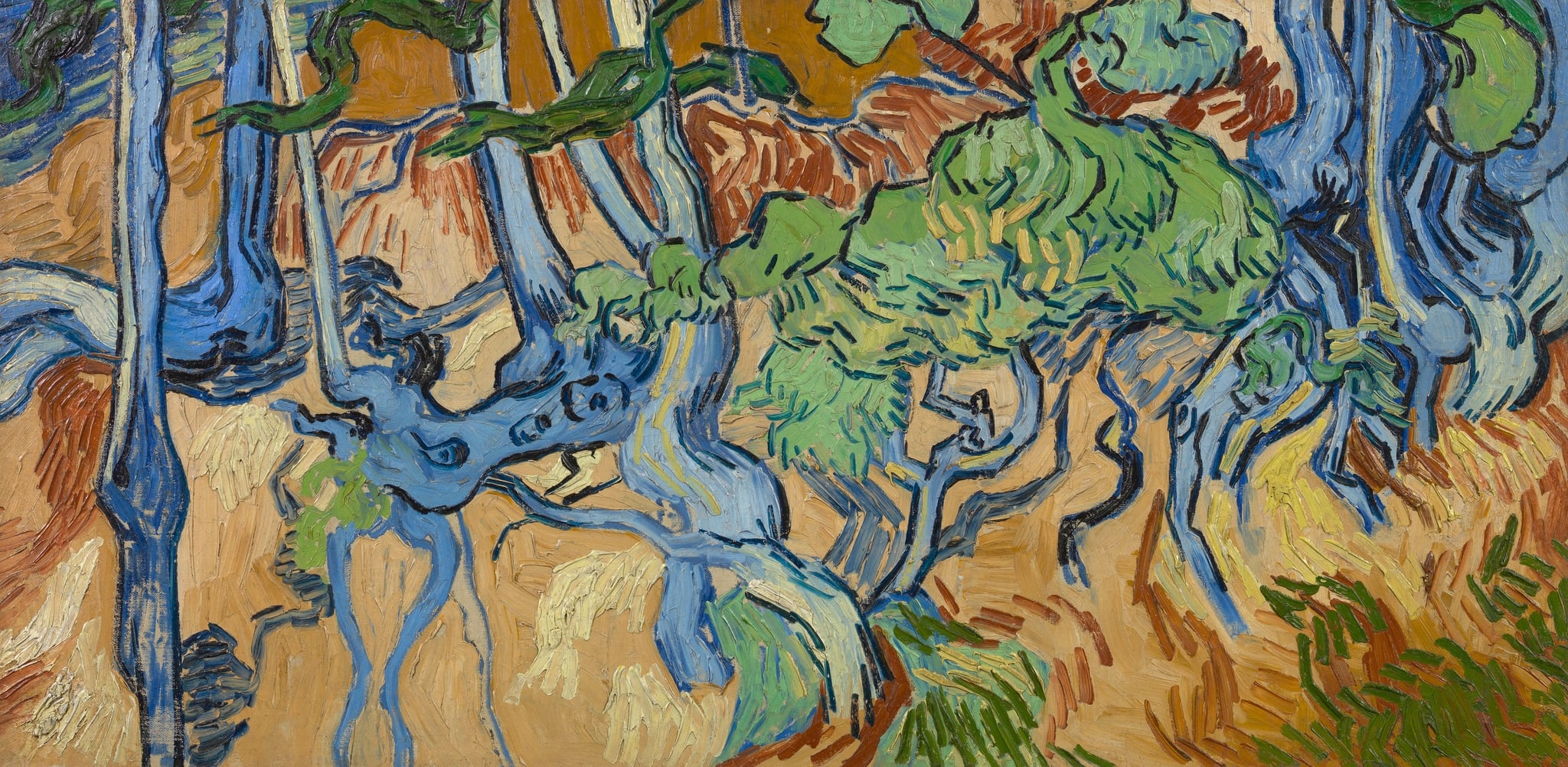
Tree Roots
Vincent van Gogh (1890)
Tree Roots is a late Auvers canvas in a rare, elongated "double‑square" format that compresses the view to nothing but interlaced trunks and roots. Thick, cobalt‑blue contours and vibrating oranges/ochres forge a field of near‑abstraction, turning a roadside bank into a <strong>charged meditation on resilience and exposure</strong> <sup>[1]</sup><sup>[6]</sup><sup>[2]</sup>.
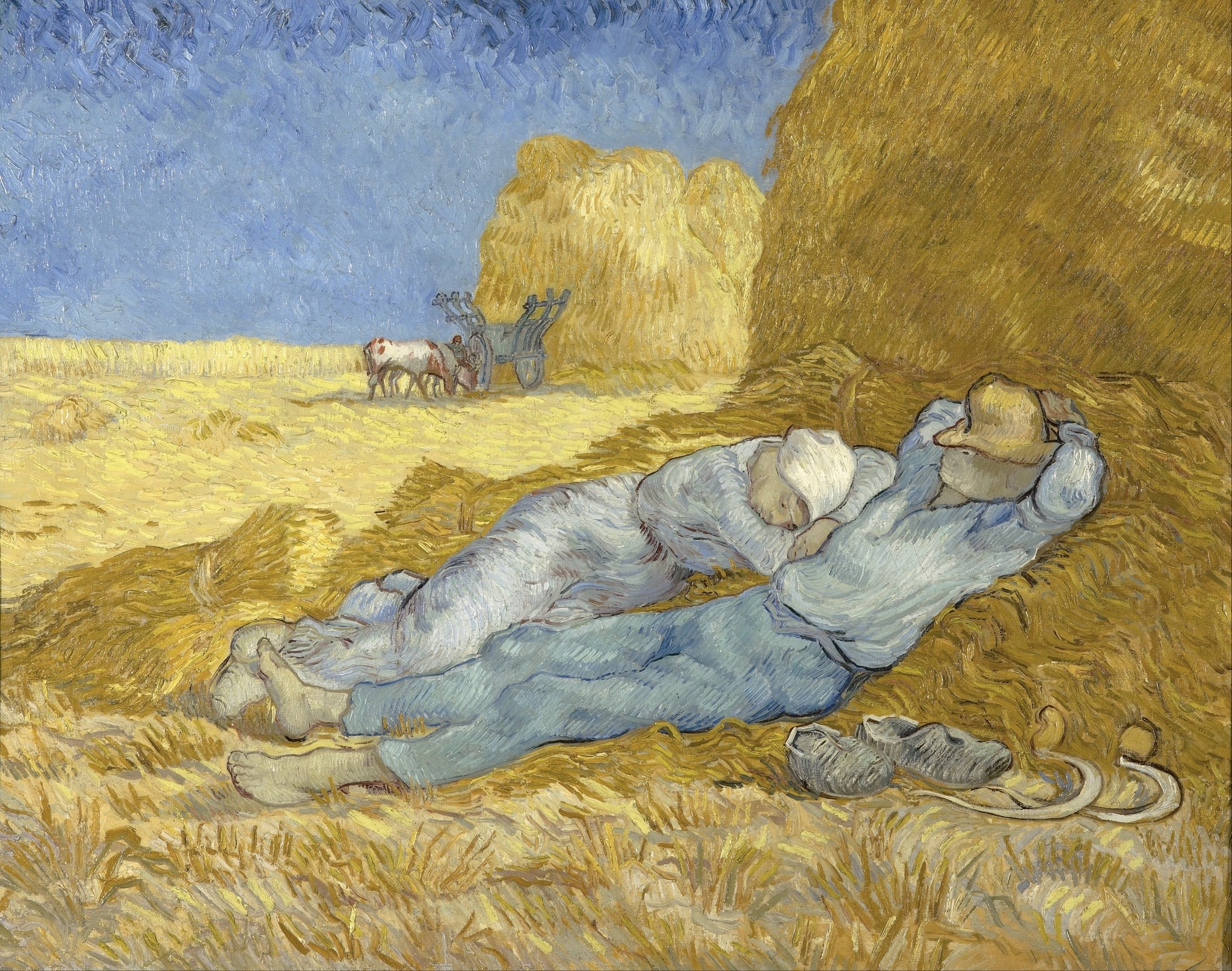
The Siesta
Vincent van Gogh (1889–1890)
The Siesta renders a midday pause as a scene of <strong>dignified repose</strong>: two harvesters sleep curved against a haystack while their scythes and shoes rest idle in the straw. Van Gogh’s complementary <strong>blue–yellow</strong> orchestration turns heat and light into rhythm, holding rest and labor in delicate equilibrium <sup>[1]</sup>. Painted at Saint‑Rémy as a color "translation" after Millet, it transforms a humble genre motif into an emblem of <strong>human need</strong> within work’s demands <sup>[1]</sup><sup>[3]</sup>.
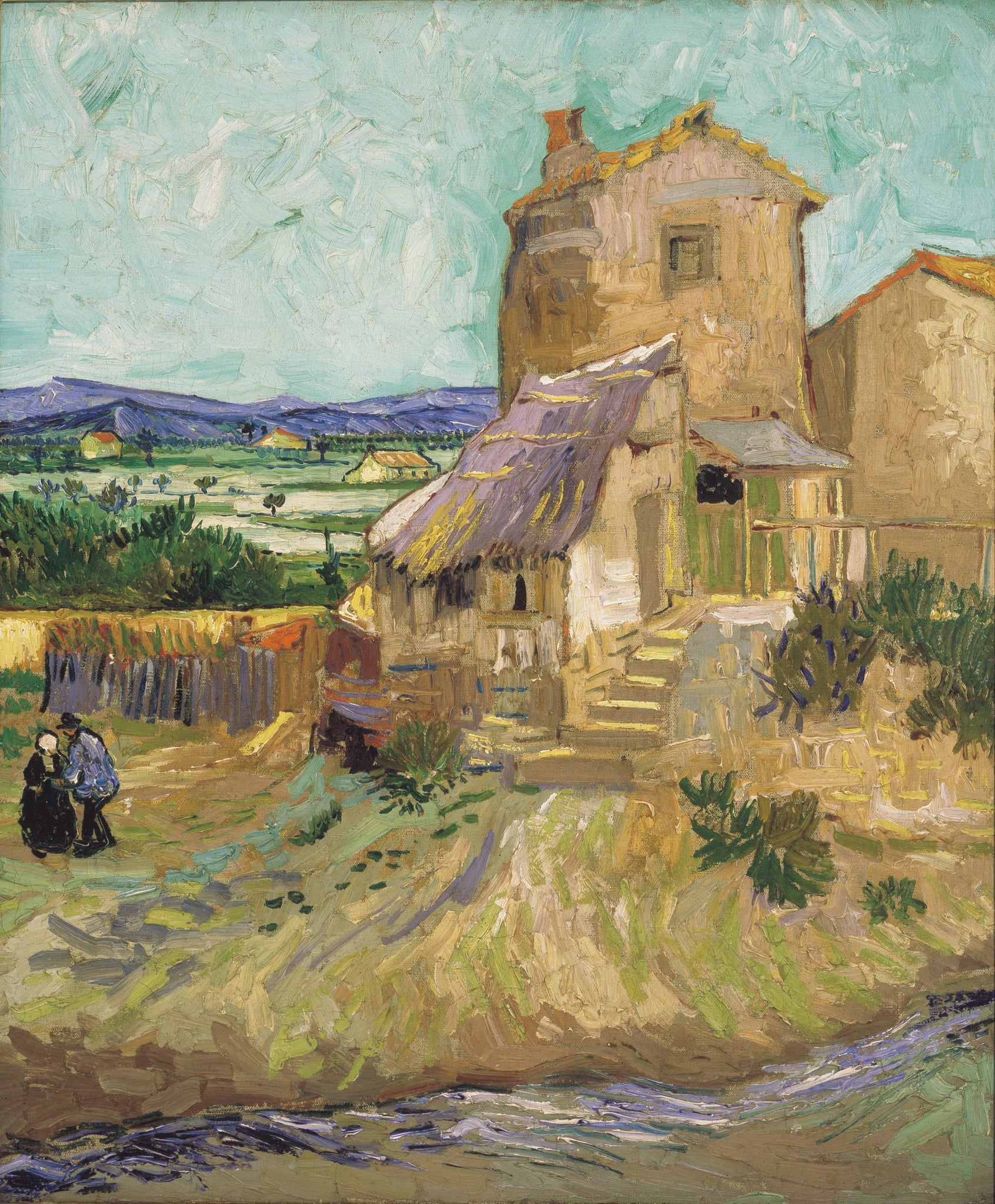
La Maison de La Crau (The Old Mill)
Vincent van Gogh (1888)
Van Gogh turns a modest Arles windmill into an emblem of <strong>resilience</strong> and <strong>human labor</strong> by staging its sun-baked tower against a <strong>wind-tossed, cool sky</strong> and the distant <strong>blue Alpilles</strong>. Rhythmic, directional strokes drive the eye from the <strong>rippling stream</strong> through the <strong>zigzag steps</strong> to the chimneyed tower, fusing workaday architecture with a modern language of <strong>expressive color</strong> and <strong>structure</strong> <sup>[1]</sup><sup>[3]</sup>.
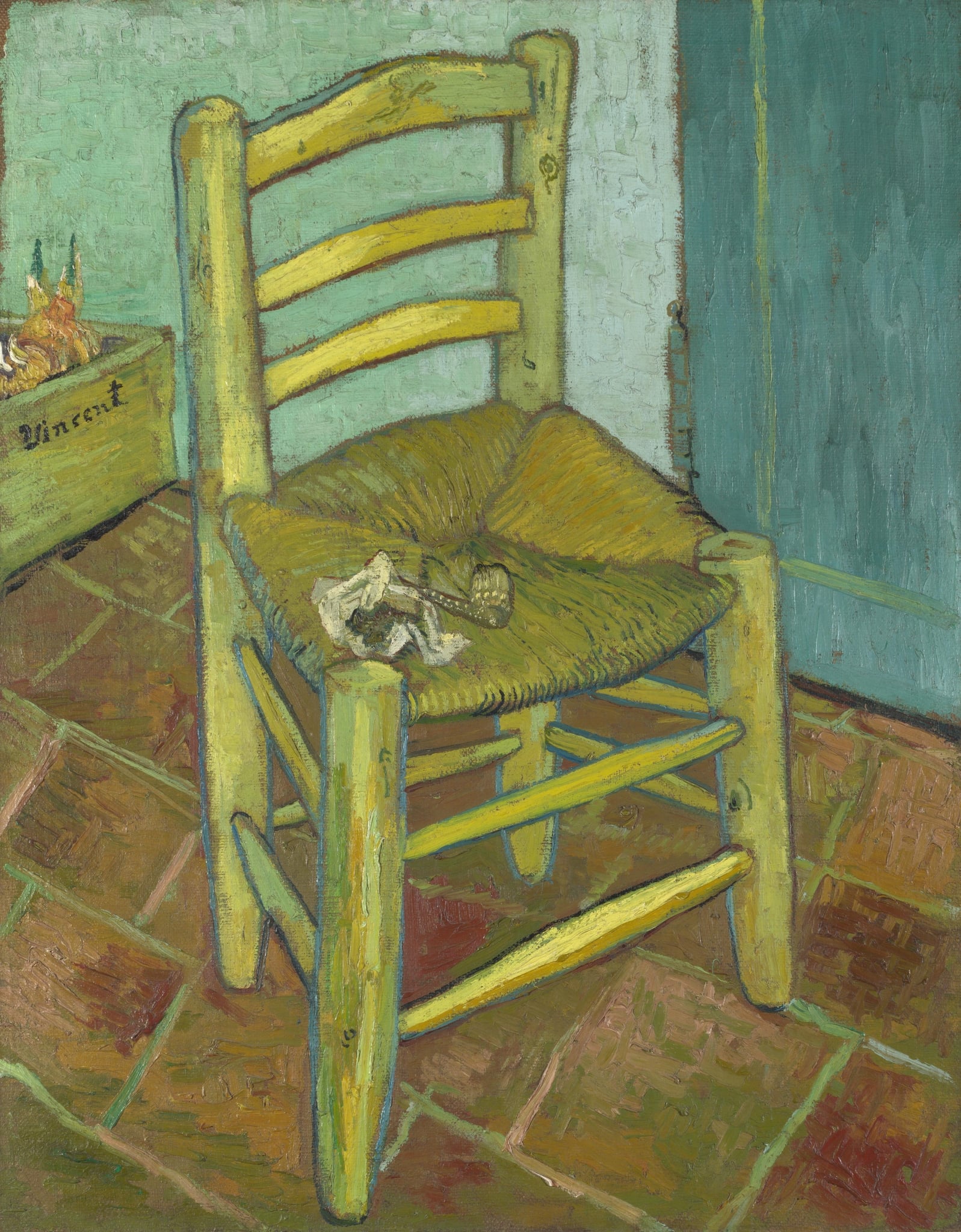
Van Gogh's Chair
Vincent van Gogh (1888; reworked January 1889)
In Van Gogh's Chair, a humble rush-seated chair blazes in <strong>radiant yellow</strong> against <strong>cool teal</strong> walls and door, its bold outlines charging the scene with tension. A <strong>pipe and tobacco pouch</strong> on the seat, a crate marked <strong>“Vincent”</strong> and sprouting onions turn this empty place into a surrogate presence, a still-life self-portrait built from things rather than a face <sup>[1]</sup><sup>[2]</sup>.
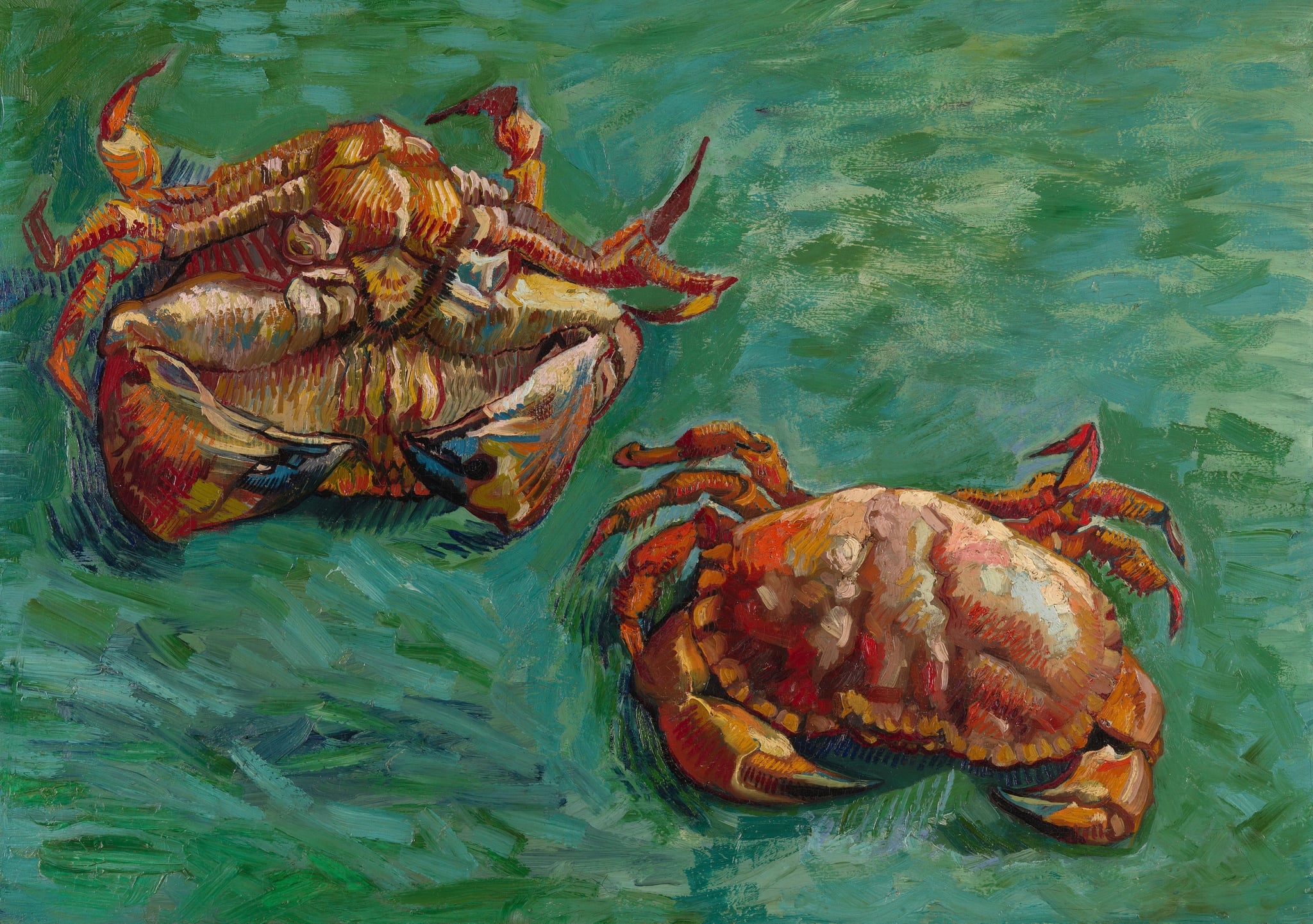
Two Crabs
Vincent van Gogh (1889)
Two Crabs stages a compact drama of <strong>vulnerability and resilience</strong>: one crab lies overturned, the other holds firm on its claws. Van Gogh fuses <strong>complementary red–green contrasts</strong> with calligraphic outlines to make the scene pulse between peril and recovery <sup>[1]</sup>.
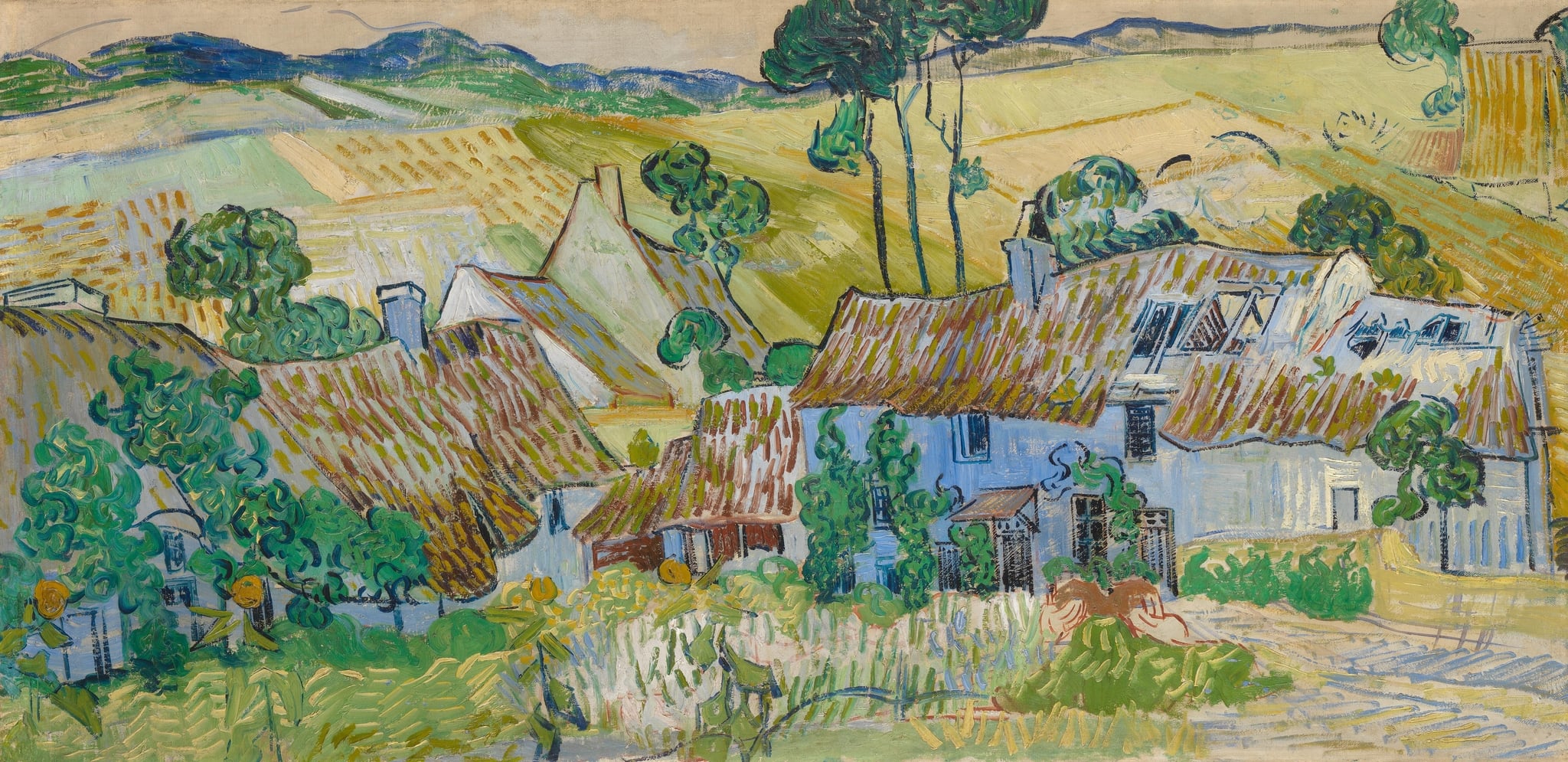
Farms near Auvers
Vincent van Gogh (1890)
Painted in July 1890, Vincent van Gogh’s Farms near Auvers is a late, "double‑square" panorama where thatched cottages, wheat plots, and wind‑bent trees pulse with <strong>rhythmic energy</strong>. The high horizon and criss‑crossing roofs compress the village into a living weave of color and line, turning ordinary farms into a scene of <strong>charged stillness</strong> <sup>[1]</sup><sup>[3]</sup>.
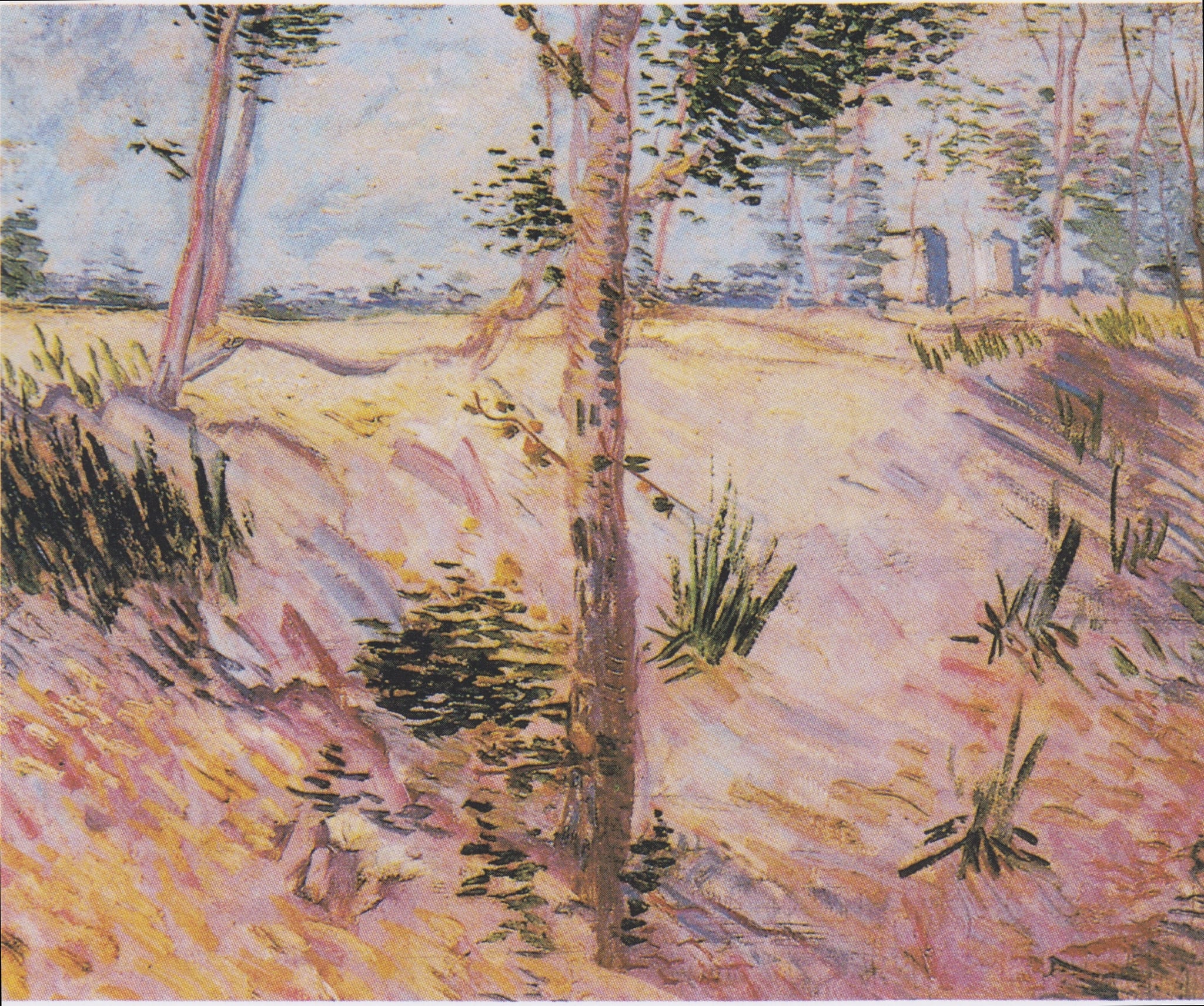
Riverbank with Trees
Vincent van Gogh (1887)
Riverbank with Trees is a compact 1887 study in which Vincent van Gogh turns a modest Seine embankment into a field of <strong>vibration and light</strong>. Diagonal sweeps of lilac and ochre sand collide with <strong>staccato foliage</strong> and a single upright trunk, fusing observation with sensation <sup>[1]</sup><sup>[2]</sup>.
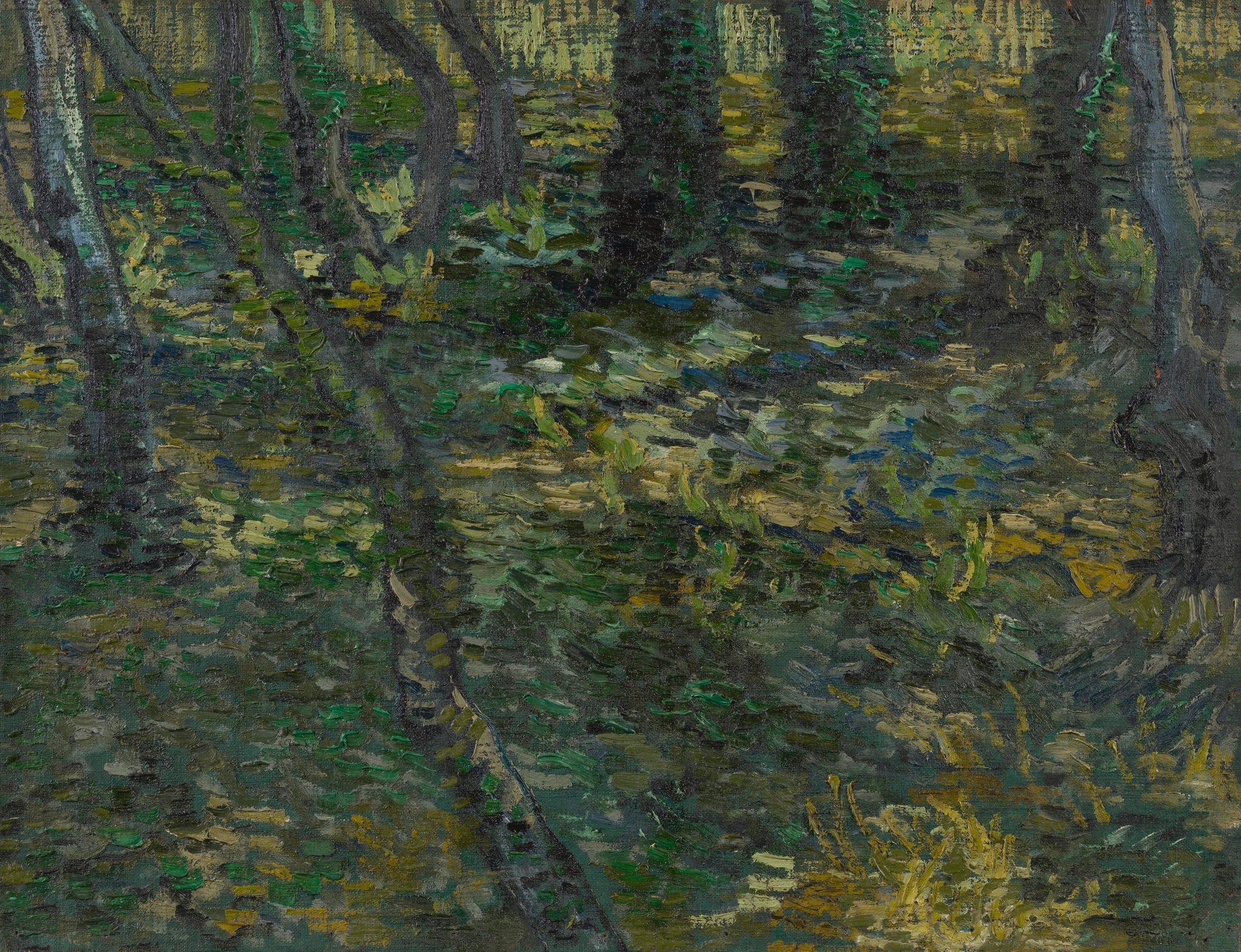
Undergrowth
Vincent van Gogh (1889)
Van Gogh’s Undergrowth drops us to ground level, where slanting trunks and a woven mat of ivy become a living field of <strong>rhythm</strong> and <strong>light</strong>. Close cropping, diagonal shadows, and short, pulsing strokes turn the forest floor into a study of <strong>endurance</strong> and <strong>renewal</strong> rather than a scenic view.
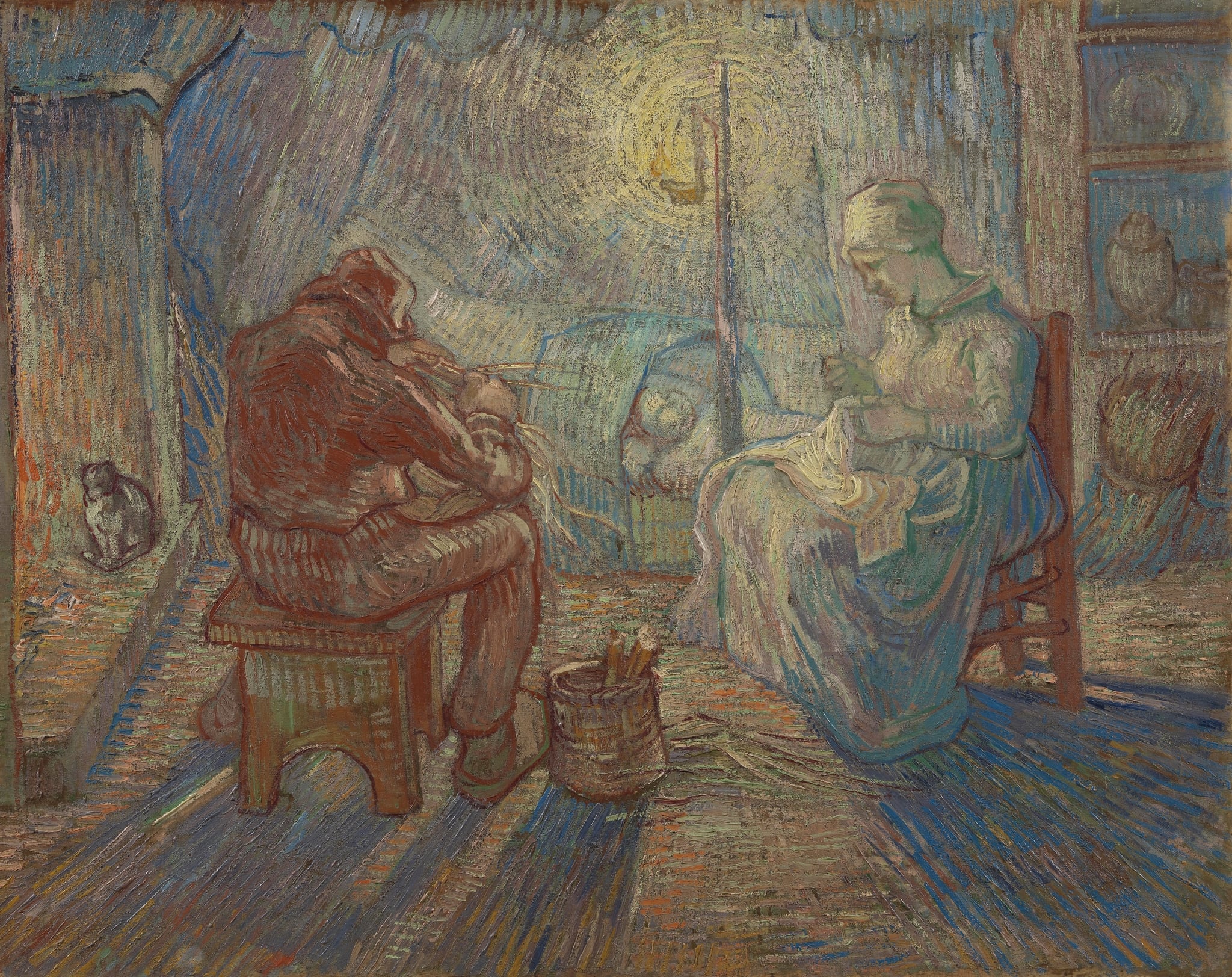
Evening (after Millet)
Vincent van Gogh (1889)
A peasant couple bends to evening tasks under a glowing lamp, its <strong>halo</strong> pulsing through the room while cool <strong>violets and blues</strong> pool across the floor. Van Gogh "<strong>translates</strong>" Millet’s print into a larger, color‑charged meditation on <strong>care, labor, and light</strong> at day’s end <sup>[1]</sup><sup>[2]</sup>.
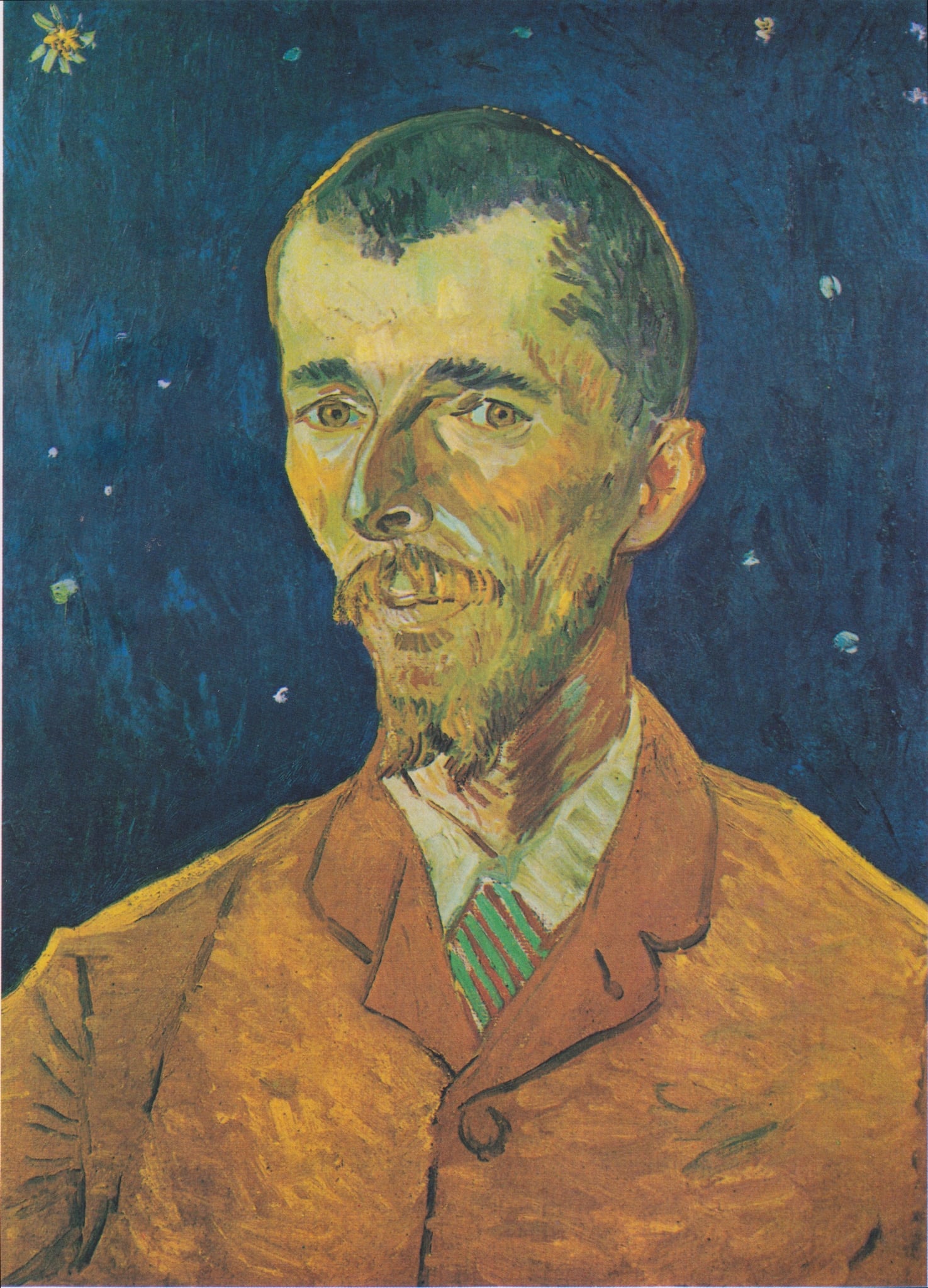
Eugène Boch
Vincent van Gogh (1888)
Vincent van Gogh’s 1888 portrait of <strong>Eugène Boch</strong> turns a friend into a visionary presence: a glowing, ocher head set before an <strong>infinite blue</strong> pricked with stars. The lone bright star at upper left and the cobalt field make the warm face and jacket <strong>vibrate</strong> from the night, declaring art as vocation rather than mere likeness <sup>[1]</sup><sup>[2]</sup>.
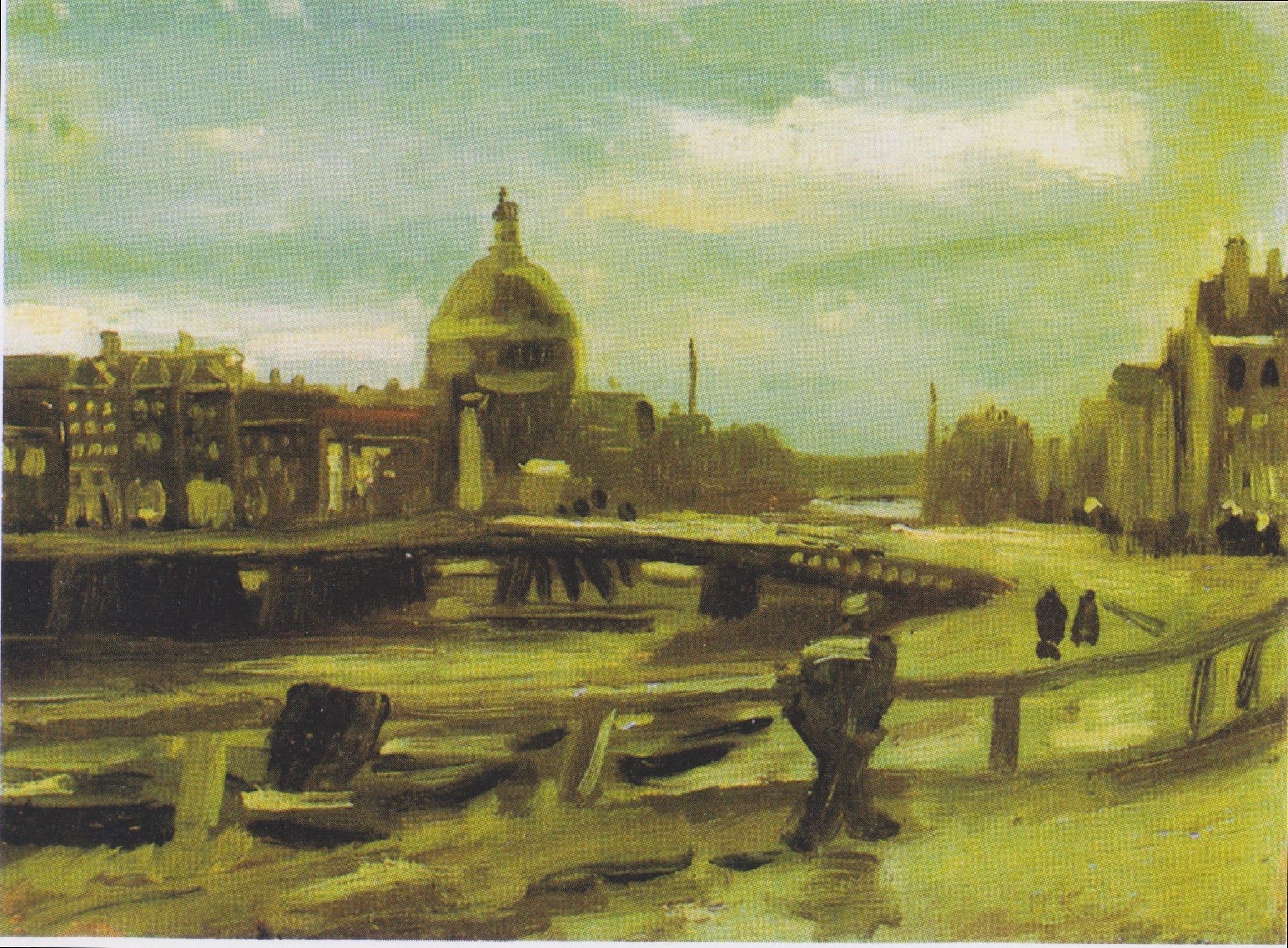
The Singel near the Lutheran Church in Amsterdam
Vincent van Gogh (1885)
In The Singel near the Lutheran Church in Amsterdam, Vincent van Gogh renders the canal belt in <strong>earthy greens and umbers</strong> under a <strong>cool, washed sky</strong>. A <strong>diagonal bridge</strong> and bundled figures press forward while the <strong>domed Lutheran church</strong> holds steady in the middle distance, turning a city view into a meditation on passage and refuge <sup>[1]</sup>.
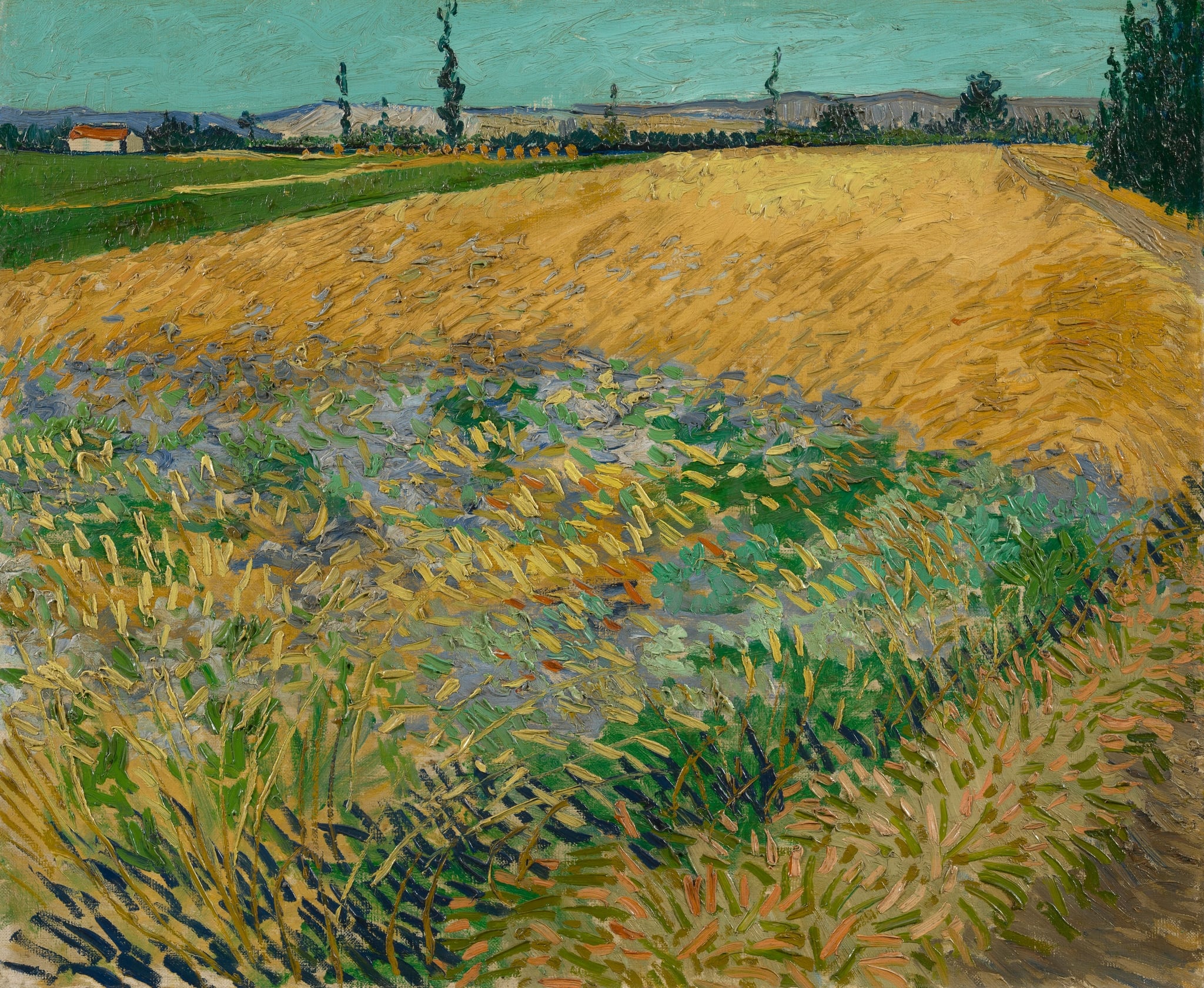
Wheatfield
Vincent van Gogh (1888)
Wheatfield converts a Provençal field into a drama of <strong>living motion</strong> and <strong>complementary color</strong>. A high horizon compresses the turquoise sky so the gold expanse dominates, while a narrow path at right and a modest farmhouse at left anchor human presence within <strong>restless nature</strong> <sup>[1]</sup><sup>[2]</sup>. Painted in Arles in June 1888, it crystallizes Van Gogh’s pursuit of expressive brushwork and yellow–blue vibration.
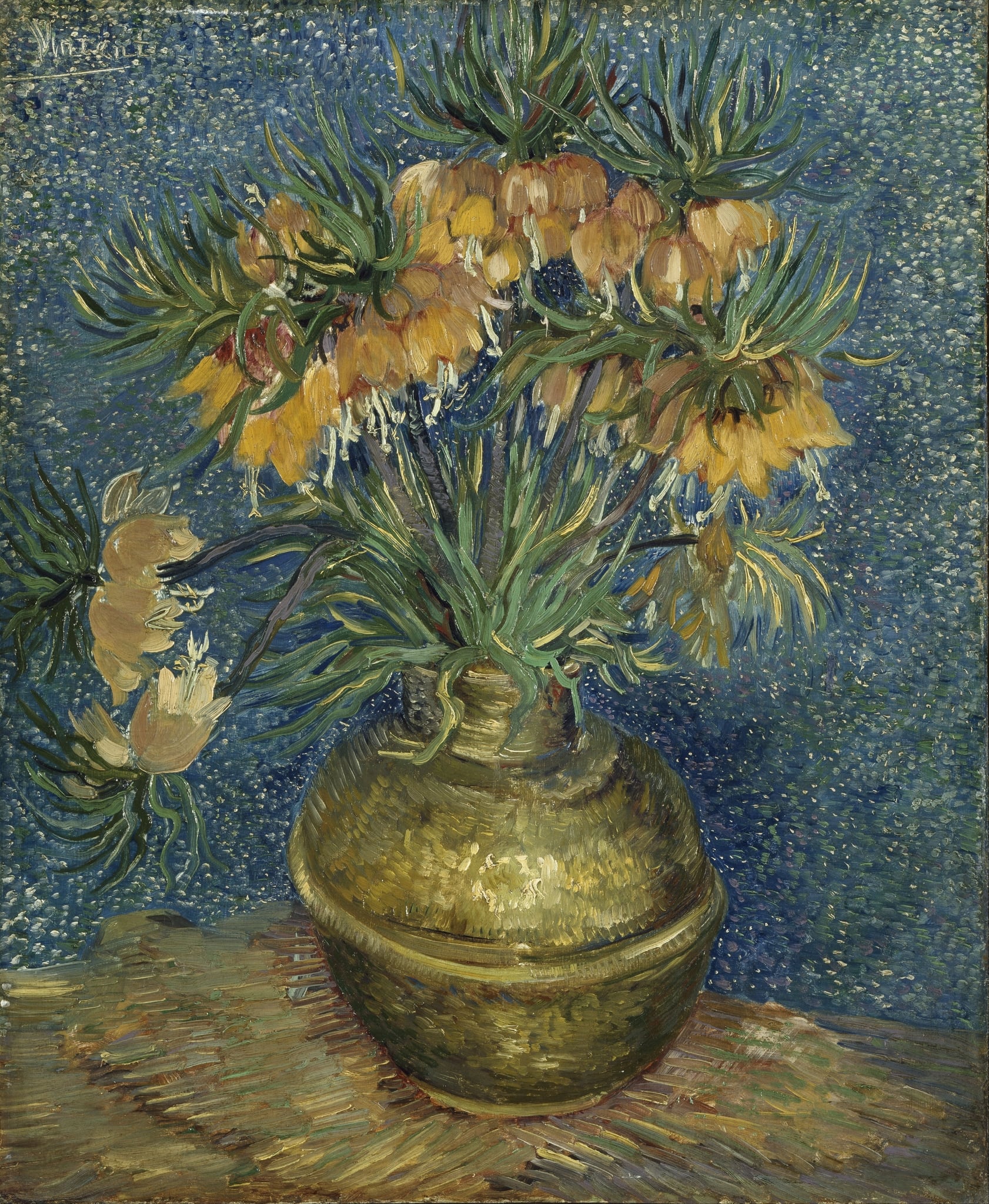
Imperial Fritillaries in a Copper Vase
Vincent van Gogh (1887)
A blaze of orange <strong>crown‑imperials</strong> arcs from a rounded <strong>copper vase</strong> against a stippled, breathing <strong>blue field</strong>. Van Gogh orchestrates a charged blue–orange counterpoint to turn still life into living force, where metal seems warm and air seems cool, and the flowers bow yet radiate power.
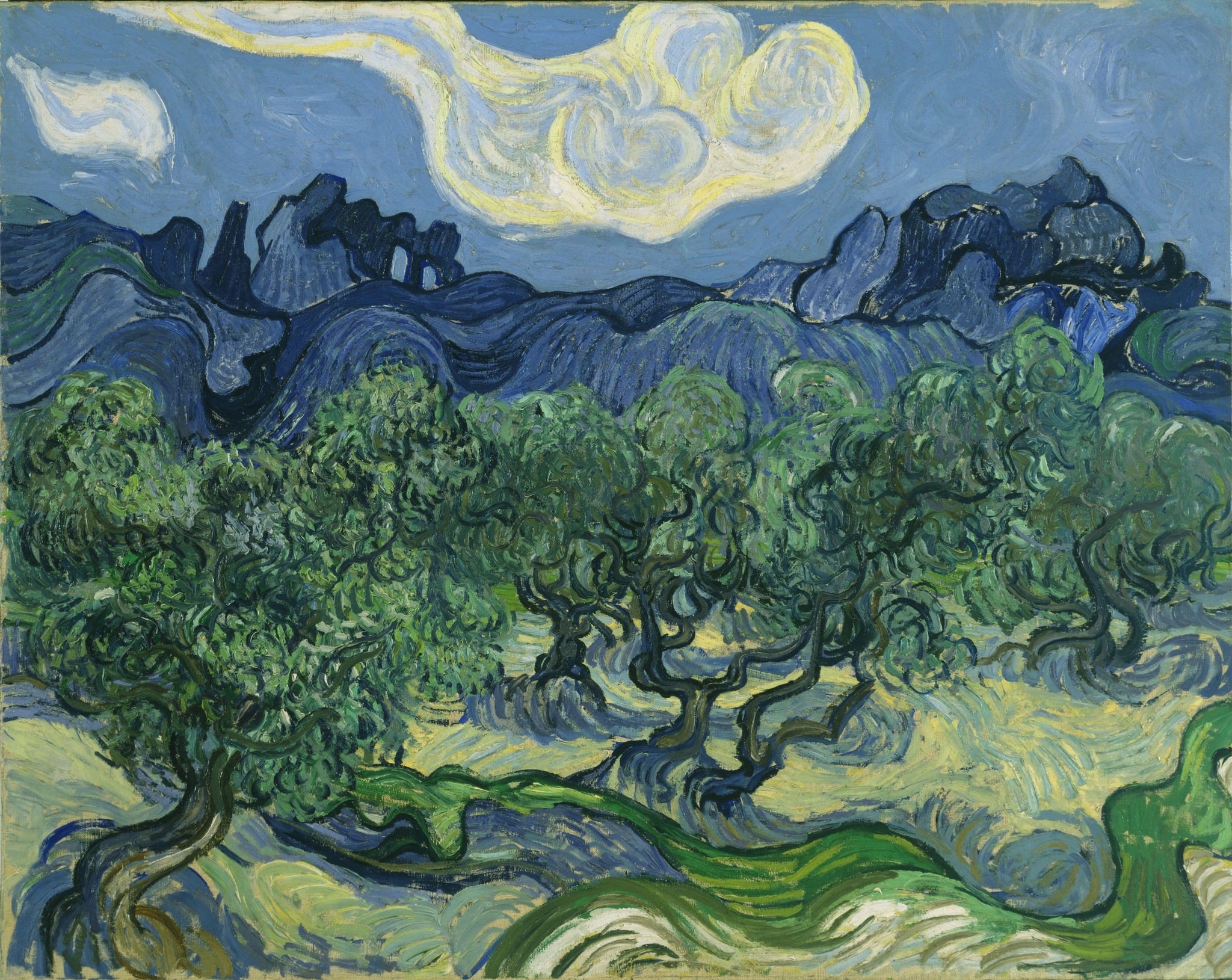
The Olive Trees
Vincent van Gogh (1889)
The Olive Trees courses with <strong>rhythmic, coiling strokes</strong> that bind earth and sky into a single pulse: twisted trunks, whorled foliage, and a pale, bundled <strong>cloud</strong> echo one another across the canvas. Van Gogh turns Provence’s grove before the <strong>Alpilles</strong> into a spiritual landscape where <strong>endurance and consolation</strong> feel visible in color and line <sup>[1]</sup>.
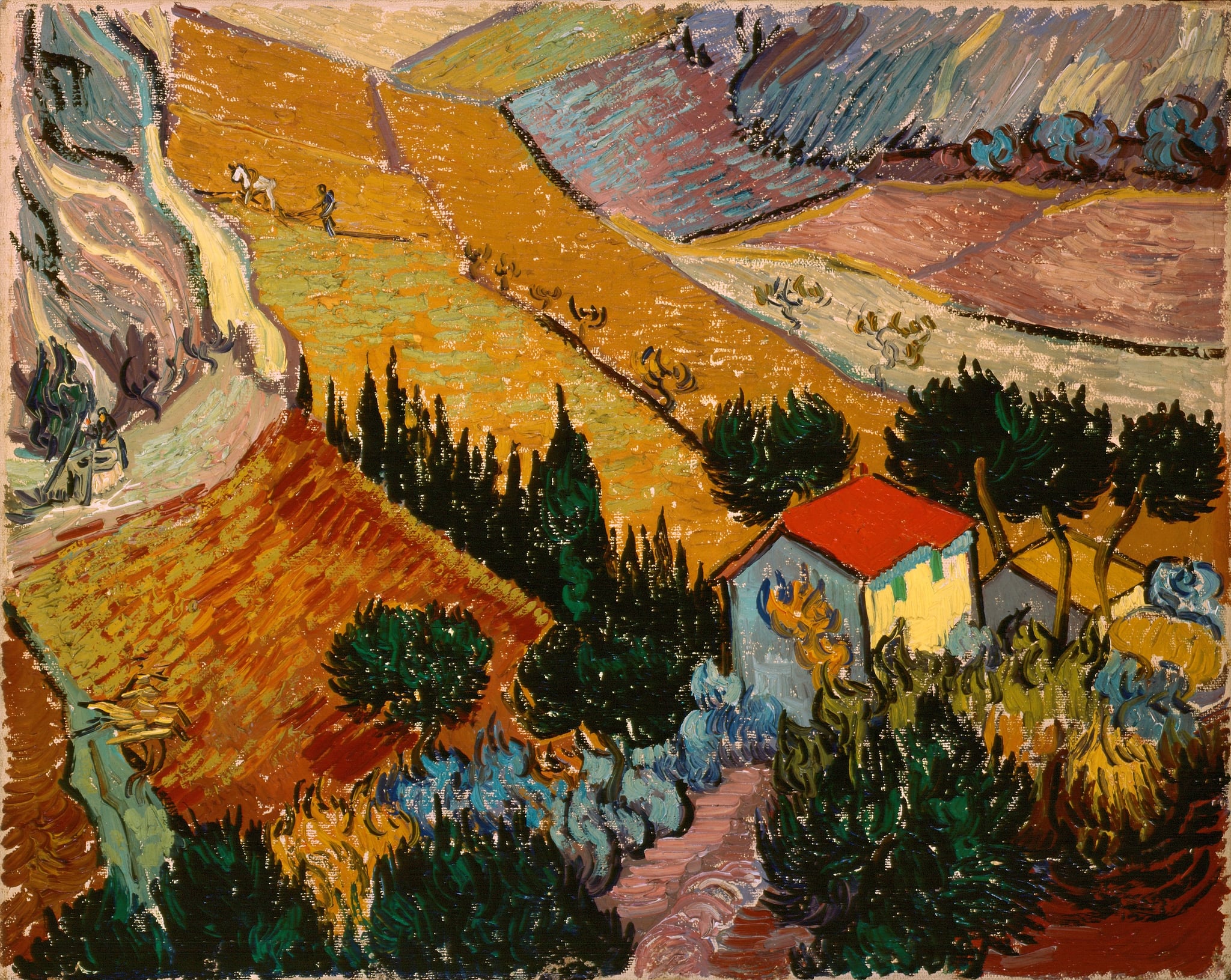
Landscape with Ploughman
Vincent van Gogh (1889)
Landscape with Ploughman compresses a steep Provençal valley into a vibrating mosaic of fields where a tiny figure with a white horse furrows the slope. Van Gogh turns cypress spires, a flame‑red roof, and banded plots into a pulse of <strong>human labor</strong> within <strong>restless nature</strong> <sup>[1]</sup><sup>[5]</sup>. The painting fuses elevated viewpoint and directional brushwork to stage endurance as pattern and rhythm.
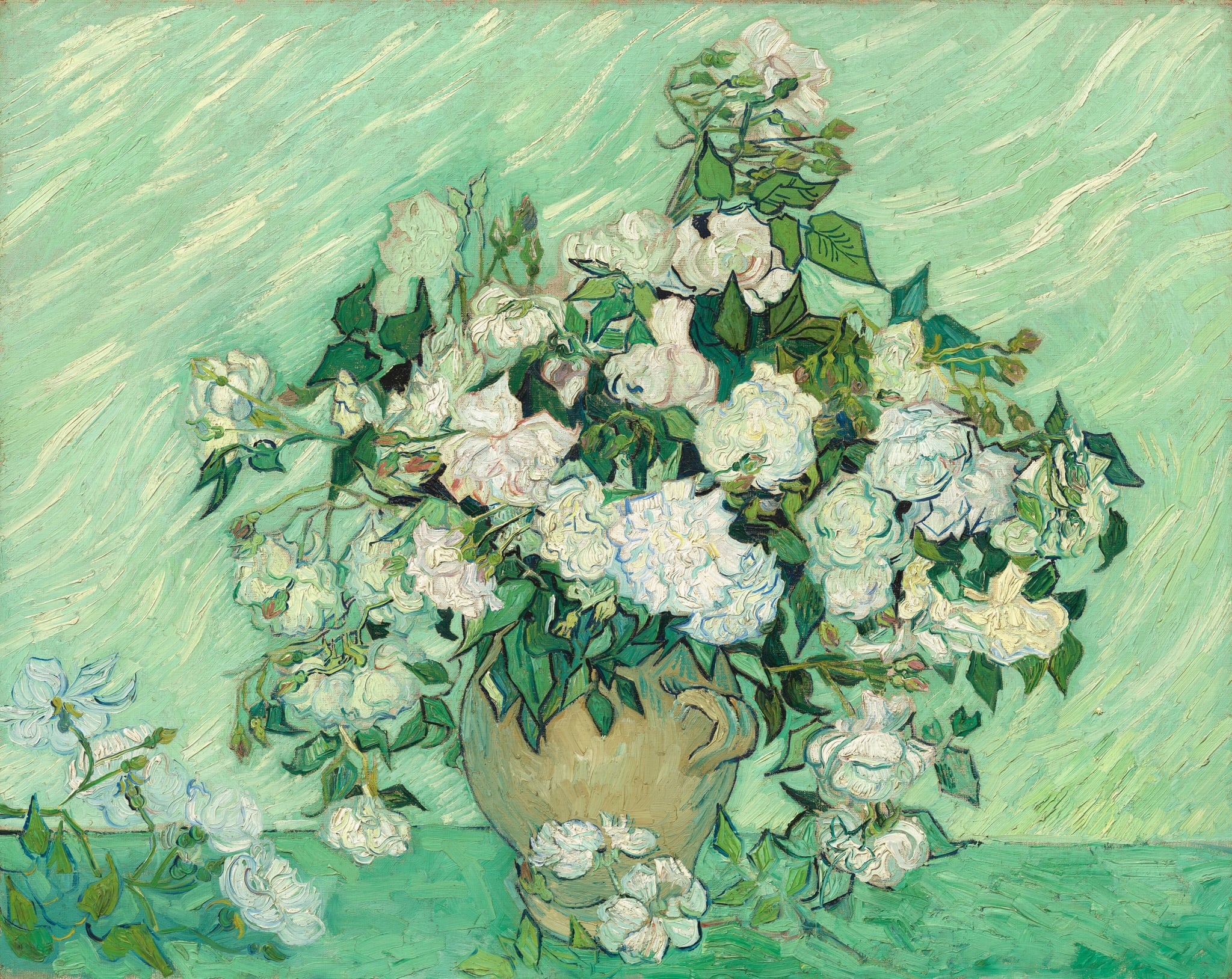
Roses
Vincent van Gogh (1890)
Roses gathers a bursting bouquet in a simple earthen pot against a sea of mint-green strokes, its blooms tipping, spilling, and glowing a cool white. Van Gogh’s thick, directional brushwork charges the still life with <strong>restless vitality</strong>, while the restrained green-and-pale palette creates a <strong>restorative</strong> calm <sup>[1]</sup>. Conservation shows the flowers were once <strong>pink</strong>, their fading altering the intended pink–green complement that anchored the ensemble of Irises and Roses from May 1890 <sup>[1]</sup><sup>[2]</sup><sup>[4]</sup>.