The Red Vineyard

by Vincent van Gogh

In The Red Vineyard, Vincent van Gogh forges a vision of autumn labor under a blazing sun, where harvesters flow diagonally through scarlet vines while a band of yellow light flares along a reflective roadway. The scene fuses exhaustion and ripeness, turning work into a rhythmic, almost liturgical procession [1][3].

Fast Facts

Year
1888
Medium
Oil on canvas
Dimensions
73 x 91 cm
Location
Pushkin State Museum of Fine Arts, Moscow
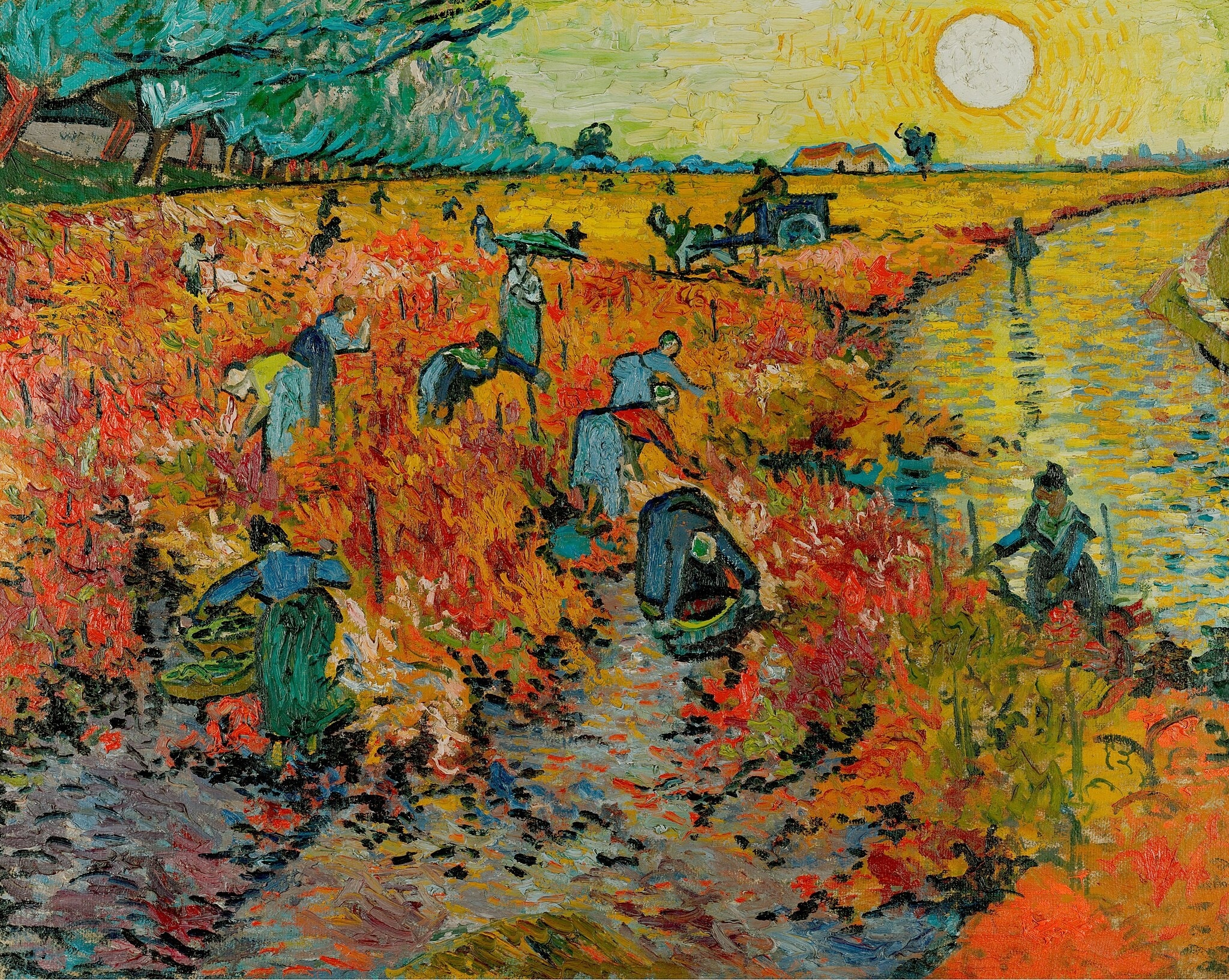
The Red Vineyard by Vincent van Gogh (1888) featuring Blazing Sun, Red Vineyard, Procession of Harvesters, Wet Road (Yellow Reflection)

Click on any numbered symbol to learn more about its meaning

Meaning & Symbolism

Van Gogh builds the vineyard as a living current of work: a diagonal of pickers runs from the lower right toward the cart and house near the horizon, their dark blue‑green garments punching through a blaze of reds. The blazing orb of the sun—laid on in thick, tubed impasto—radiates concentric rings that press down on the field, a visual mandate that labor must keep pace until the light fails 4. Along the right edge, a long yellow band catches and throws the sun back; conservation‑led topography identifies this not as a canal but as a wet road reflecting light after rain, a cool counter‑current to the heat of the vines 3. The eye toggles between these two forces—the vineyard’s red surge and the road’s yellow shimmer—so that the composition reads as a hinge between intensity and respite. Figures are generalized rather than individuated: bowed backs, upraised baskets, the striding silhouette on the road. Their anonymity converts them into beats in a measure, not portraits, aligning with the Pushkin Museum’s reading of the scene as emblematic of “exhausting daily toil” under an incandescent sun 1. Color is the argument. Van Gogh takes what he called a “completely red” vineyard seen with Gauguin and pushes it past natural observation into expressive complementarity: red vines are needled with green accents; blue garments snap against orange ground; yellow light rubs against lilac and violet shadows 25. These oppositions—learned from Delacroix and color theorists—do not illustrate a harvest so much as enact its temperature: the redness signals ripeness and demand, while the green‑blue clothing and the road’s cool reflections propose relief that never quite arrives. The sun, modeled with pigment squeezed directly from the tube and sometimes flattened with the finger, is both creator and taskmaster; its material heft on the surface turns symbol into substance 4. Even small, site‑specific cues strengthen the poem: the faint Montmajour silhouette at far right fixes the place while also reading like a distant, cooling bastion against the red sea at our feet 3. The painting’s narrative is inseparable from its making and early fate. Painted in early November 1888 on the outskirts of Arles, it develops a motif Van Gogh and Gauguin encountered on an October walk; crucially, he completed it in the studio, working from memory and imagination—Gauguin’s method—which licenses the spectral exaggeration of color and the rhythmic simplification of figures 23. That method clarifies why the work feels like a hymn rather than a report: its truth is emotional and seasonal, not optical. The Red Vineyard later hung with Les XX in Brussels and was purchased by Anna Boch—one of the few sales certainly documented during Van Gogh’s life—signaling that this bold union of complementary color, parable of labor, and surface bravura could command belief in real time 31. In the end, the canvas asserts that work, warmth, and transience are bound together: the harvesters’ bent silhouettes march toward dusk, the road’s glitter slides beside them like time itself, and the sun—thick, insistent, inescapable—marks the measure of both effort and ending 135.

Explore Deeper with AI

Ask questions about The Red Vineyard

Popular questions:

Powered by AI • Get instant insights about this artwork

💬 Ask questions about this artwork!

Interpretations

Technical/Conservation Insights

A conservation-driven reading reframes key motifs. The long yellow band is not a river but a wet road catching the low sun, a cool reflector that counterbalances the vineyard’s heat 3. The sun and sky were built with paint squeezed straight from the tube, sometimes pressed down with the finger—material choices that turn the sun into a literal, raised emblem on the surface 4. Chrome yellow has darkened over time, so the original sky-sun contrast would have been even more searing 4. Revisions matter: a road figure shifts from woman to man; a bent picker in the foreground was added later—adjustments that fine-tune the rhythm of labor and the eye’s diagonal sweep 4. These findings confirm that facture, not just color, is the engine of meaning here—matter enacting metaphor.

Source: Pushkin State Museum Conservation; Martin Bailey (The Art Newspaper)

Color Theory as Rhetoric

The canvas is a laboratory of complementary contrasts—red/green, blue/orange, yellow/violet—wielded as expressive rhetoric rather than description. Van Gogh’s letters align this practice with ideas gleaned from Delacroix and color writers like Blanc: complements heighten sensation and emotive charge 56. In The Red Vineyard, the field’s scorching reds/oranges are needled by green accents; workers’ blue-greens snap against orange ground; the yellow sun collides with lilac-violet shadows. Such oppositions do not merely depict harvest; they produce its temperature—ripeness as urgency, cool notes as provisional relief. Color becomes argumentative, staging a dialectic of heat versus respite that the figures must inhabit, not escape 356.

Source: Nelson-Atkins Museum; Van Gogh Letters

Memory-Driven Studio Practice

Although sparked by an autumn walk with Gauguin—“a completely red vineyard”—Van Gogh executed the painting in the studio from memory and imagination, an approach Gauguin advocated 23. This shift explains the spectral intensification of hue and the rhythmic generalization of bodies: bowed silhouettes function like beats in a measure rather than portraits. The studio becomes a crucible where observation is re-forged into parable, and topographic cues (Montmajour, the wet road) are retained only insofar as they support the work’s emotional cadence. The result is a scene truer to season and sensation than to optics, a hymn to harvest that elevates everyday toil into mythic labor through recollection’s edits and color’s exaggerations 23.

Source: Van Gogh Letters; Martin Bailey (The Art Newspaper)

Socio-Economic Labor Poetics

The Pushkin Museum’s reading of the scene as emblematic of exhausting daily toil invites a socio-economic lens: anonymized workers register as a collective rhythm rather than individuals, echoing late-19th-century realities of seasonal labor 1. The sun’s downward pressure becomes a managerial metronome, compressing time and demanding pace—an agrarian analogue to industrial temporality. The painting’s later inclusion at Les XX and purchase by Anna Boch shows that this union of bold complements, surface bravura, and labor parable resonated with avant-garde audiences, complicating the idea that market modernism only valorized leisure or the urban 37. Here, modernity’s taste recognizes the poetics—and pressure—of manual work under incandescent deadlines.

Source: Pushkin State Museum; Martin Bailey (The Art Newspaper)

Place, Weather, and Event

Two small, precise cues nail the image to place and moment: the faint silhouette of Montmajour at the far right and the rain-slick road mirroring the descending sun 23. These markers convert a chromatic vision into Arles-in-time, a harvested field just after rain, when glare slides across puddled ruts. Weather is not backdrop but dramaturgy: reflections cool the palette’s inferno without extinguishing it, creating a hinge of respite beside the red surge. The vineyard is thus less a static landscape than an event—of season, light, and labor’s culmination—where topography and meteorology co-author the image’s tempo and tone 34.

Source: Martin Bailey (The Art Newspaper); Pushkin State Museum Conservation; Van Gogh Letters

Related Themes

About Vincent van Gogh

Vincent van Gogh (1853–1890) developed a radical, emotion‑driven use of color after moving from Paris to Arles in 1888, seeking southern light and an artists’ community. In Arles he created the Sunflowers series to decorate the Yellow House ahead of Gauguin’s visit. His late work fused impasto, high chroma, and symbolic motifs that shaped modern painting [2][5].
View all works by Vincent van Gogh

More by Vincent van Gogh
Café Terrace at Night by Vincent van Gogh

Café Terrace at Night

Vincent van Gogh (1888)

In Café Terrace at Night, Vincent van Gogh turns nocturne into <strong>luminous color</strong>: a gas‑lit terrace glows in yellows and oranges against a deep <strong>ultramarine sky</strong> pricked with stars. By building night “<strong>without black</strong>,” he stages a vivid encounter between human sociability and the vastness overhead <sup>[1]</sup><sup>[2]</sup>.
Portrait of Dr. Gachet by Vincent van Gogh

Portrait of Dr. Gachet

Vincent van Gogh (1890)

Portrait of Dr. Gachet distills Van Gogh’s late ambition for a <strong>modern, psychological portrait</strong> into vibrating color and touch. The sitter’s head sinks into a greenish hand above a <strong>blazing orange-red table</strong>, foxglove sprig nearby, while waves of <strong>cobalt and ultramarine</strong> churn through coat and background. The chromatic clash turns a quiet pose into an <strong>empathic image of fragility and care</strong> <sup>[1]</sup><sup>[2]</sup>.

Irises by Vincent van Gogh

Irises

Vincent van Gogh (1889)

Painted in May 1889 at the Saint-Rémy asylum garden, Vincent van Gogh’s <strong>Irises</strong> turns close observation into an act of repair. Dark contours, a cropped, print-like vantage, and vibrating complements—violet/blue blossoms against <strong>yellow-green</strong> ground—stage a living frieze whose lone <strong>white iris</strong> punctuates the field with arresting clarity <sup>[1]</sup><sup>[2]</sup>.
Wheatfield with Crows by Vincent van Gogh

Wheatfield with Crows

Vincent van Gogh (1890)

A panoramic wheatfield splits around a rutted track under a storm-charged sky while black crows rush toward us. Van Gogh drives complementary blues and yellows into collision, fusing <strong>nature’s vitality</strong> with <strong>inner turbulence</strong>.

Sunflowers by Vincent van Gogh

Sunflowers

Vincent van Gogh (1888)

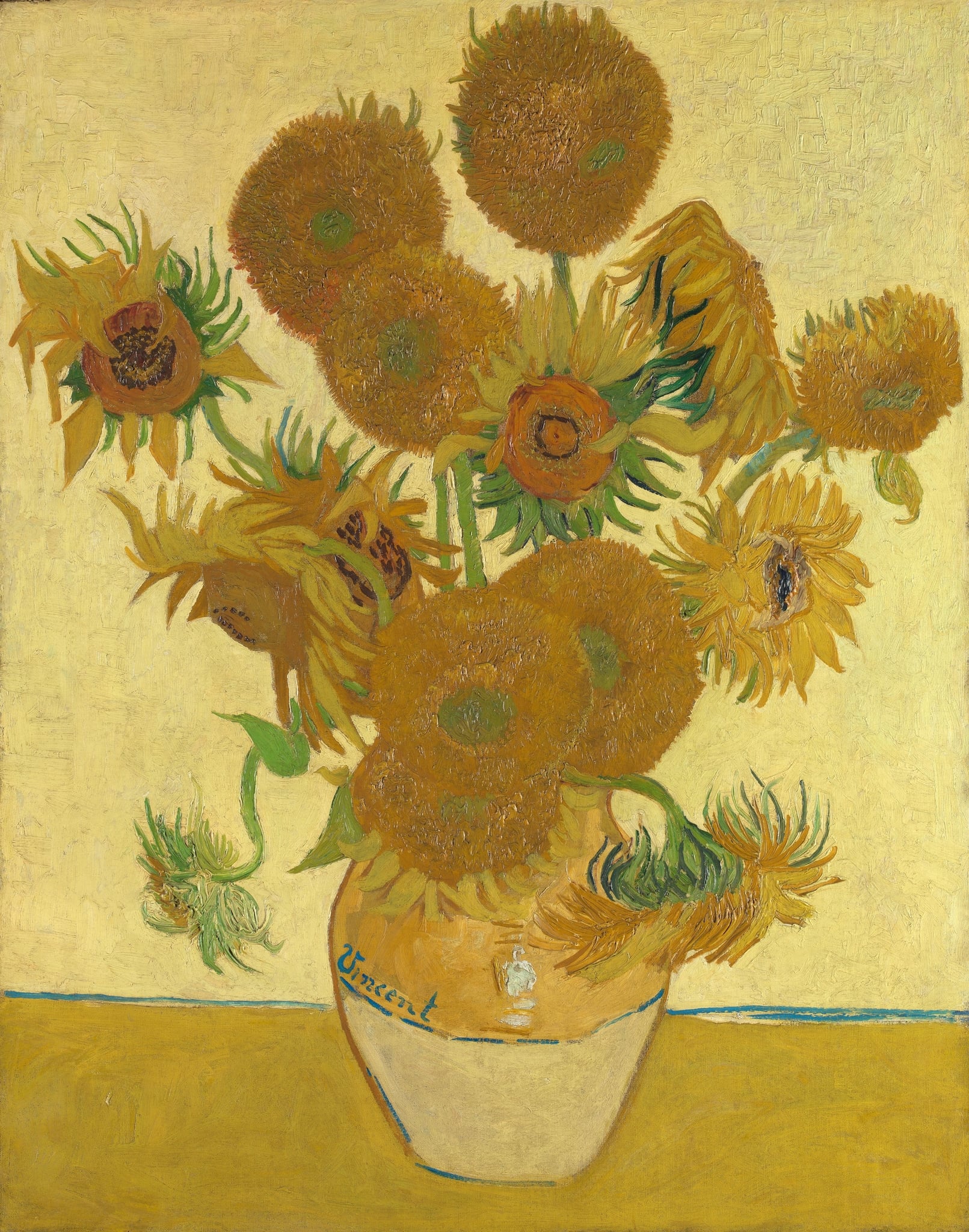
Vincent van Gogh’s Sunflowers (1888) is a <strong>yellow-on-yellow</strong> still life that stages a full <strong>cycle of life</strong> in fifteen blooms, from fresh buds to brittle seed heads. The thick impasto, green shocks of stem and bract, and the vase signed <strong>“Vincent”</strong> turn a humble bouquet into an emblem of endurance and fellowship <sup>[1]</sup><sup>[2]</sup>.

The Bedroom by Vincent van Gogh

The Bedroom

Vincent van Gogh (1889)

Vincent van Gogh’s The Bedroom turns a modest room into a psychological stage, using <strong>clashing color</strong> and <strong>tilted space</strong> to test whether color alone can evoke rest. The bright yellow bed, twin chairs, and green‑shuttered window press forward as the floor tilts and pictures cant, so that <strong>refuge and unease</strong> exist side by side <sup>[1]</sup><sup>[2]</sup>.