Self-Portrait with Bandaged Ear

by Vincent van Gogh

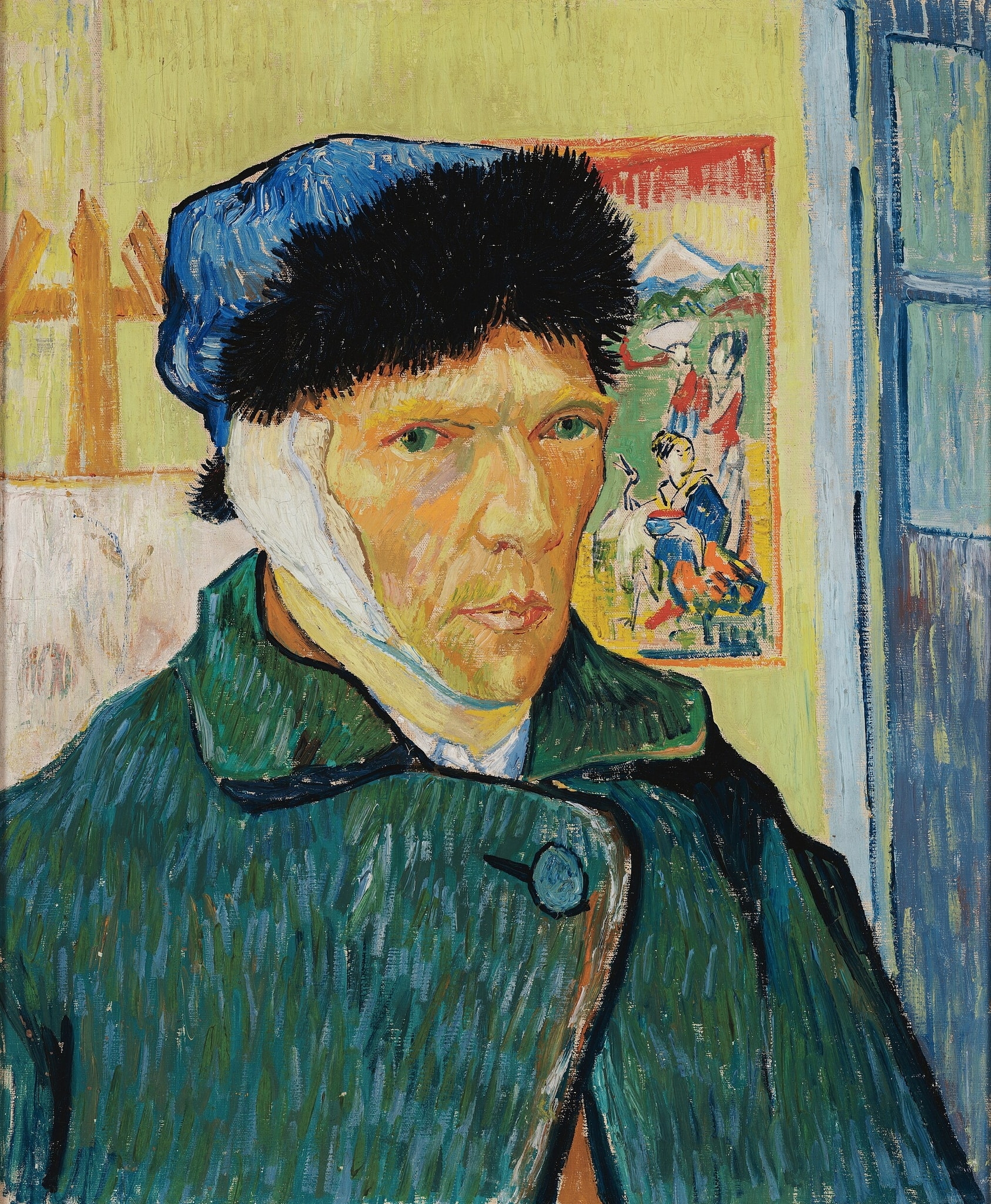
In Self-Portrait with Bandaged Ear (1889), Vincent van Gogh converts a recent crisis into an image of resolve. The frontal, slightly turned pose forces attention to the white bandage at the viewer’s right, while the fur cap, heavy coat, and the nearby Japanese print declare persistence and ideals that steady him in the wake of trauma [1][2]. The painting’s cool, wintry palette and insistent strokes make suffering legible yet disciplined, transforming pain into artistic purpose [2].

Fast Facts

Year
1889
Medium
Oil on canvas
Dimensions
60.5 × 50 cm
Location
The Courtauld Gallery, London
Self-Portrait with Bandaged Ear by Vincent van Gogh (1889) featuring Bandage, Fur cap, Heavy winter coat and buttoned collar, Japanese print

Click on any numbered symbol to learn more about its meaning

Meaning & Symbolism

Van Gogh constructs the portrait as a triad of acknowledgement, work, and ideal. First, he acknowledges the event: the bandage appears on the viewer’s right because he paints from a mirror after mutilating his left ear in December 1888; the choice to show it is a refusal of concealment and a statement of candor 134. The tight mouth and unwavering green eyes do not dramatize the incident; they stabilize it. The fur cap and buttoned winter coat are more than props—they are functional solutions for January cold and dressings, but also emblems of endurance, compressing the body into a compact, working self able to face the canvas again 2. The wintry blue-greens that consolidate coat, cap, and wall turn physical chill into a visual ethic of restraint. Rather than perform breakdown, he frames control. The paint handling does the same: short, vertical strokes and a pressed surface rhythm convey agitation that’s been contained in method, asserting craft over chaos. Second, he situates himself as a worker among tools. At the left edge, the upright struts and ochre geometry of an easel and a just-begun canvas announce immediate resumption of labor after discharge from the hospital in early January 1889; this is continuity made visible 12. The studio is shallow—pale wall, close easel, and a blue-framed window to the right—so the figure reads as embedded in a defined practice-space rather than drifting in psychological fog. The compressed interior blocks escape yet clarifies resolve: the only way out is through the work. This is why viewers read the picture as a compact manifesto of persistence: it relocates crisis from biography to procedure, where brushwork, palette, and composition carry the burden of recovery 2. Third, he sets his face against an ideal: the Japanese print pinned behind him (identified as Satō Torakiyo’s Geishas in a Landscape) with its crisp contours and harmonized color fields 5. Van Gogh revered Japanese prints for their order, clarity, and serenity; by staging the raw impasto of his cheek against the print’s planar calm, he frames a dialectic between the art he is and the art he seeks 26. The print is not decoration but a compass: an elsewhere he admires and tries to internalize. Its presence also signals a broader program of self-fashioning through images—van Gogh’s repeated self-portraits act as self-staging, crafting a public identity as disciplined, ambitious, and modern, not merely “wounded” 26. In this reading, even the mirror reversal becomes meaningful: it is the artist’s assertion that truth in art is constructed—mediated through tools, reflection, and choice—yet can still be ethically direct. These elements together explain why Self-Portrait with Bandaged Ear commands such standing in modernist narratives. It is not a document of defeat; it is a strategic, formally inventive picture that enacts recovery as a method. The steadiness of the pose, the cold palette’s grip, the resumed canvas, and the Japanese exemplar transform illness into creative agency, aligning personal survival with a program for painting after Impressionism—color and contour as expressive structure, facture as character, and the studio as site of moral resolve 126.

Explore Deeper with AI

Ask questions about Self-Portrait with Bandaged Ear

Popular questions:

Powered by AI • Get instant insights about this artwork

💬 Ask questions about this artwork!

Interpretations

Documentary Time as Meaning

Dating matters here. Letters place Vincent in the Arles hospital until January 7, 1889; the Courtauld notes this portrait was painted within a week of release. That compressed chronology makes the easel and near‑blank canvas legible as a time-stamp of return, not generic studio décor. The painting is thus indexed to a specific post‑crisis interval, turning biography into a temporal armature for formal choices: cold palette, enclosed space, and resumed work. This is not melodrama but documentary poise—an image that folds its own making-time into the subject, asserting capacity and routine precisely when routine could have failed 321.

Source: Vincent van Gogh Letters (Huygens/Van Gogh Museum); Courtauld object record; The Courtauld Gallery

Japonisme as Working Method, Not Motif

Van Gogh’s homage to Japanese prints is less quotation than operational model. The crisp contour and planar color of Satō Torakiyo’s crépon exemplify the serenity and economy he sought to naturalize in oil; the face’s impasto and the print’s flat fields enact a didactic contrast, teaching the eye to oscillate between texture and reserve. This is Japonisme as workflow—ordering palette, edge, and negative space—rather than ornament. His sizeable print collection, studied and pinned in the studio, functioned like a portable academy: a daily discipline of looking that calibrated his Post‑Impressionist chroma toward structural clarity even under duress 5107.

Source: Martin Bailey, The Art Newspaper; Van Gogh Museum (Japanese prints); The Met Museum

Mirror Ethics and Constructed Truth

The ear appears on the viewer’s right because the painting is mediated by a mirror—an explicit admission that representation is constructed. Yet van Gogh doubles down on candor: he refuses to conceal the injury, stabilizing it with a steady gaze and controlled facture. The picture thus threads an ethic: truth in art is not naïve mimesis but an earned accuracy assembled through tools (mirror), procedures (stroke systems), and selective disclosure (bandage shown). This self-aware staging of authorship aligns with his broader modernist pivot from retinal recording to principled making, where facture becomes a moral index as much as a stylistic one 127.

Source: The Courtauld Gallery; Courtauld object record; The Met Museum

Reception & Object Histories

The composition’s right-hand print is not just a sign of Japonisme; its specific history folds reception into the image. The Courtauld once held the very impression of Satō Torakiyo’s Geishas in a Landscape that van Gogh pinned in Arles—later stolen in 1981—making the self-portrait double as a micro‑display of collecting and taste within the studio. That provenance tailors the background into a curated wall, a proto‑museological frame that anticipates how the picture will be read: as an artist situating himself amid global images. The theft-and-recovery narratives attached to the print also show how auxiliary objects can redirect public attention, reframing the portrait as a node in networks of circulation, loss, and cultural memory 159.

Source: The Courtauld Gallery; Martin Bailey, The Art Newspaper; The Guardian (Jonathan Jones)

Comparative Formal Analysis (the Pipe version)

Set against the companion Self-Portrait with Bandaged Ear and Pipe (private collection), the Courtauld canvas sharpens a program of restraint. The Pipe version’s warmer ground and exhaled smoke read as recuperative softness; by contrast, the Courtauld’s wintry blue‑greens, buttoned coat, and vertical stroke discipline transform affect into structure. Both were likely painted within days of his January 7, 1889 discharge, but the Courtauld suppresses arabesque (smoke, curvilinear plumes) in favor of rectilinear scaffolding (easel struts, window frame). The pair demonstrates van Gogh’s range: one image metabolizes shock through sensory balm; the other through procedural rigor—two modalities of post‑traumatic picturing that still achieve high facture and chromatic intelligence 261.

Source: Courtauld Gallery; Martin Bailey, The Art Newspaper (2026 analysis of the Pipe version)

Spatial Psychology: The Studio as Constraint

The portrait engineers a shallow stage—pale wall, close easel, cropped window—so depth collapses into a pressurized near‑field. Rather than a Romantic void, this is a workshop cell where proximity to tools equates to control. The blue sash of the window and the tight frame read as spatial “braces,” containing psychic tumult without sensationalizing it. In this reading, the studio is an ethical device: a bounded architecture that turns crisis into method, the opposite of escapism. The room’s compression mirrors January cold and recent hospitalization yet converts both into a grammar of adjacency—artist, implement, exemplar—where the only permissible movement is the iterative return of brush to surface 18.

Source: The Courtauld Gallery; Beyond the Label (DHI/Courtauld-associated essay)

Related Themes

About Vincent van Gogh

Vincent van Gogh (1853–1890) developed a radical, emotion‑driven use of color after moving from Paris to Arles in 1888, seeking southern light and an artists’ community. In Arles he created the Sunflowers series to decorate the Yellow House ahead of Gauguin’s visit. His late work fused impasto, high chroma, and symbolic motifs that shaped modern painting [2][5].
View all works by Vincent van Gogh

More by Vincent van Gogh
Café Terrace at Night by Vincent van Gogh

Café Terrace at Night

Vincent van Gogh (1888)

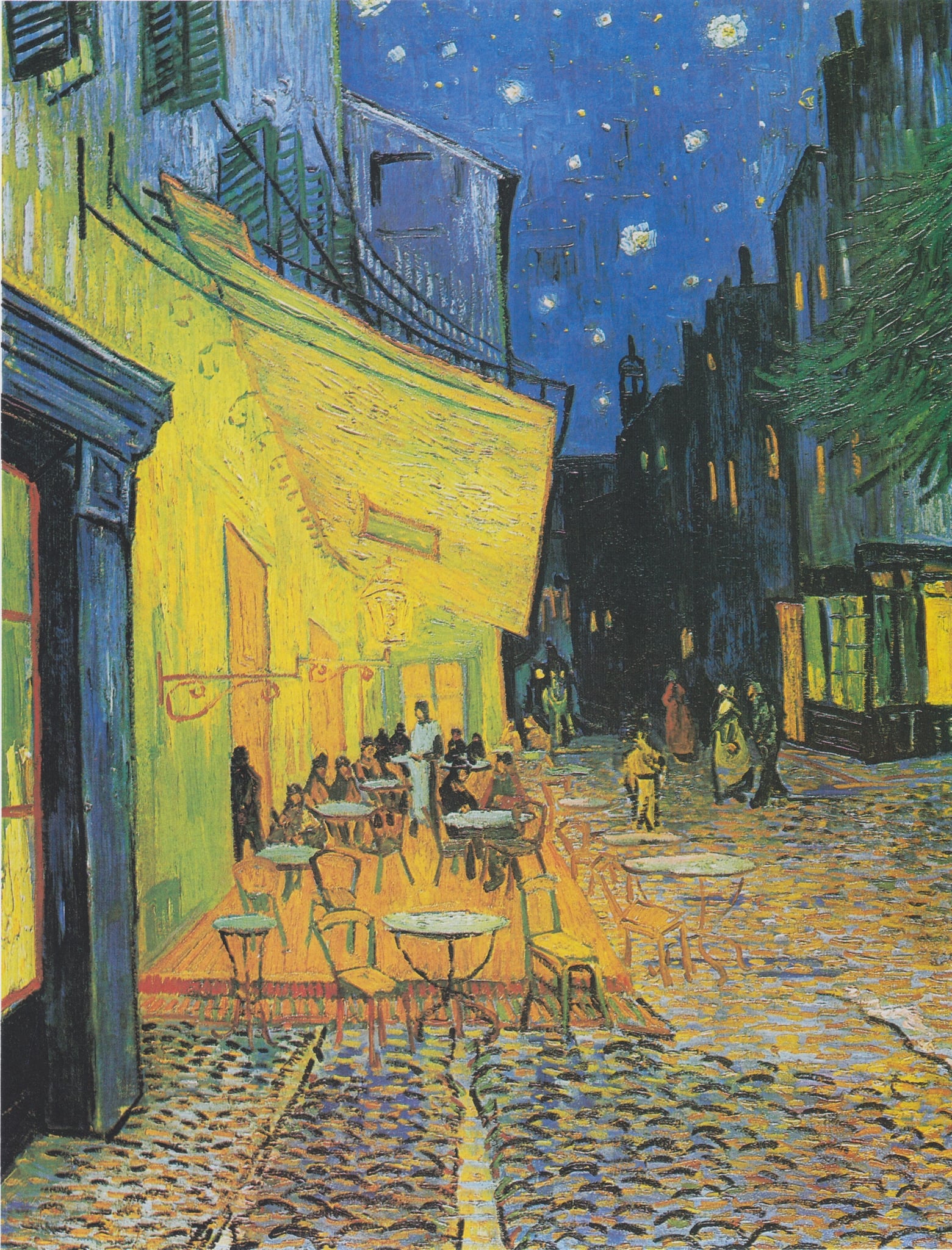
In Café Terrace at Night, Vincent van Gogh turns nocturne into <strong>luminous color</strong>: a gas‑lit terrace glows in yellows and oranges against a deep <strong>ultramarine sky</strong> pricked with stars. By building night “<strong>without black</strong>,” he stages a vivid encounter between human sociability and the vastness overhead <sup>[1]</sup><sup>[2]</sup>.
Portrait of Dr. Gachet by Vincent van Gogh

Portrait of Dr. Gachet

Vincent van Gogh (1890)

Portrait of Dr. Gachet distills Van Gogh’s late ambition for a <strong>modern, psychological portrait</strong> into vibrating color and touch. The sitter’s head sinks into a greenish hand above a <strong>blazing orange-red table</strong>, foxglove sprig nearby, while waves of <strong>cobalt and ultramarine</strong> churn through coat and background. The chromatic clash turns a quiet pose into an <strong>empathic image of fragility and care</strong> <sup>[1]</sup><sup>[2]</sup>.

Irises by Vincent van Gogh

Irises

Vincent van Gogh (1889)

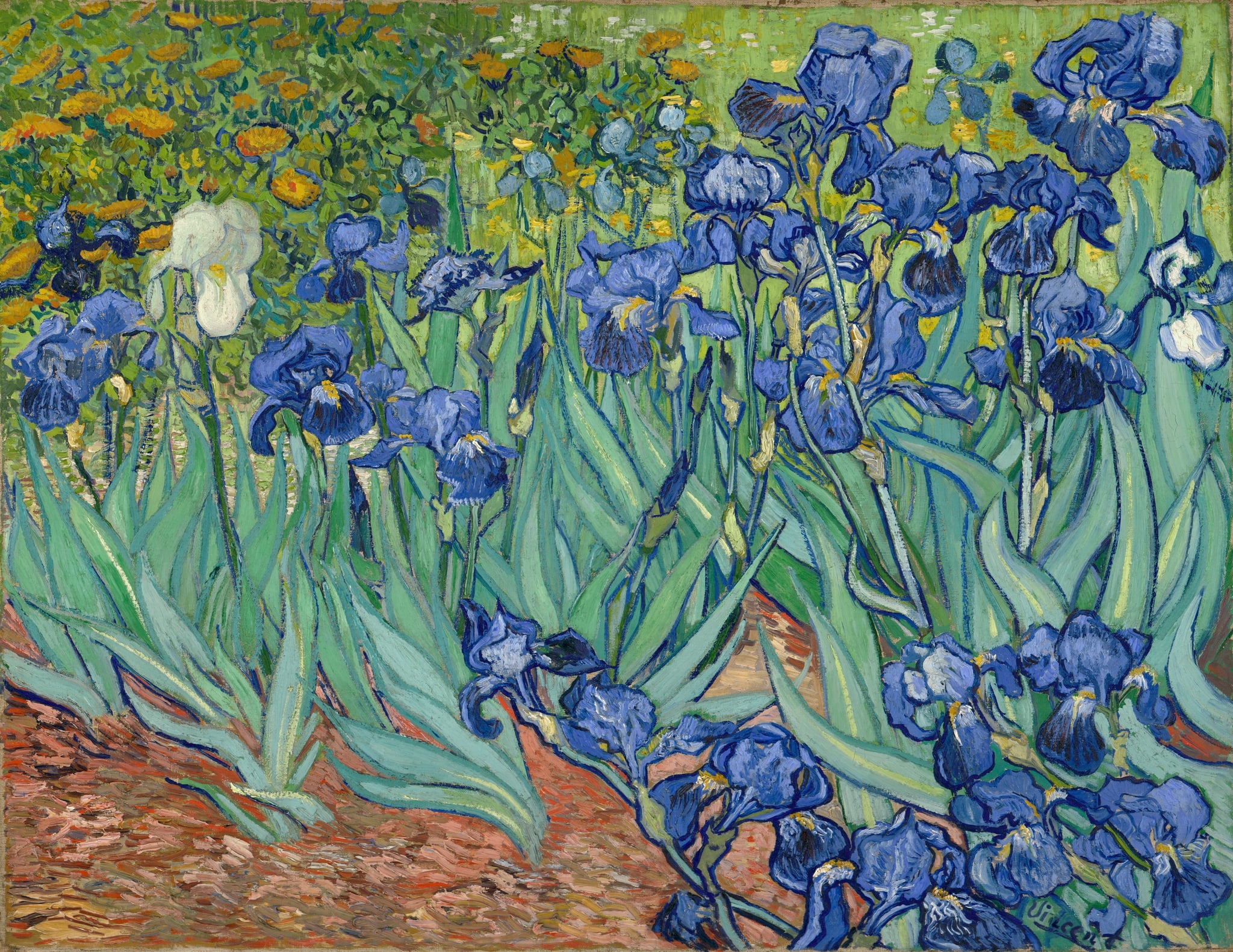
Painted in May 1889 at the Saint-Rémy asylum garden, Vincent van Gogh’s <strong>Irises</strong> turns close observation into an act of repair. Dark contours, a cropped, print-like vantage, and vibrating complements—violet/blue blossoms against <strong>yellow-green</strong> ground—stage a living frieze whose lone <strong>white iris</strong> punctuates the field with arresting clarity <sup>[1]</sup><sup>[2]</sup>.
Wheatfield with Crows by Vincent van Gogh

Wheatfield with Crows

Vincent van Gogh (1890)

A panoramic wheatfield splits around a rutted track under a storm-charged sky while black crows rush toward us. Van Gogh drives complementary blues and yellows into collision, fusing <strong>nature’s vitality</strong> with <strong>inner turbulence</strong>.

Sunflowers by Vincent van Gogh

Sunflowers

Vincent van Gogh (1888)

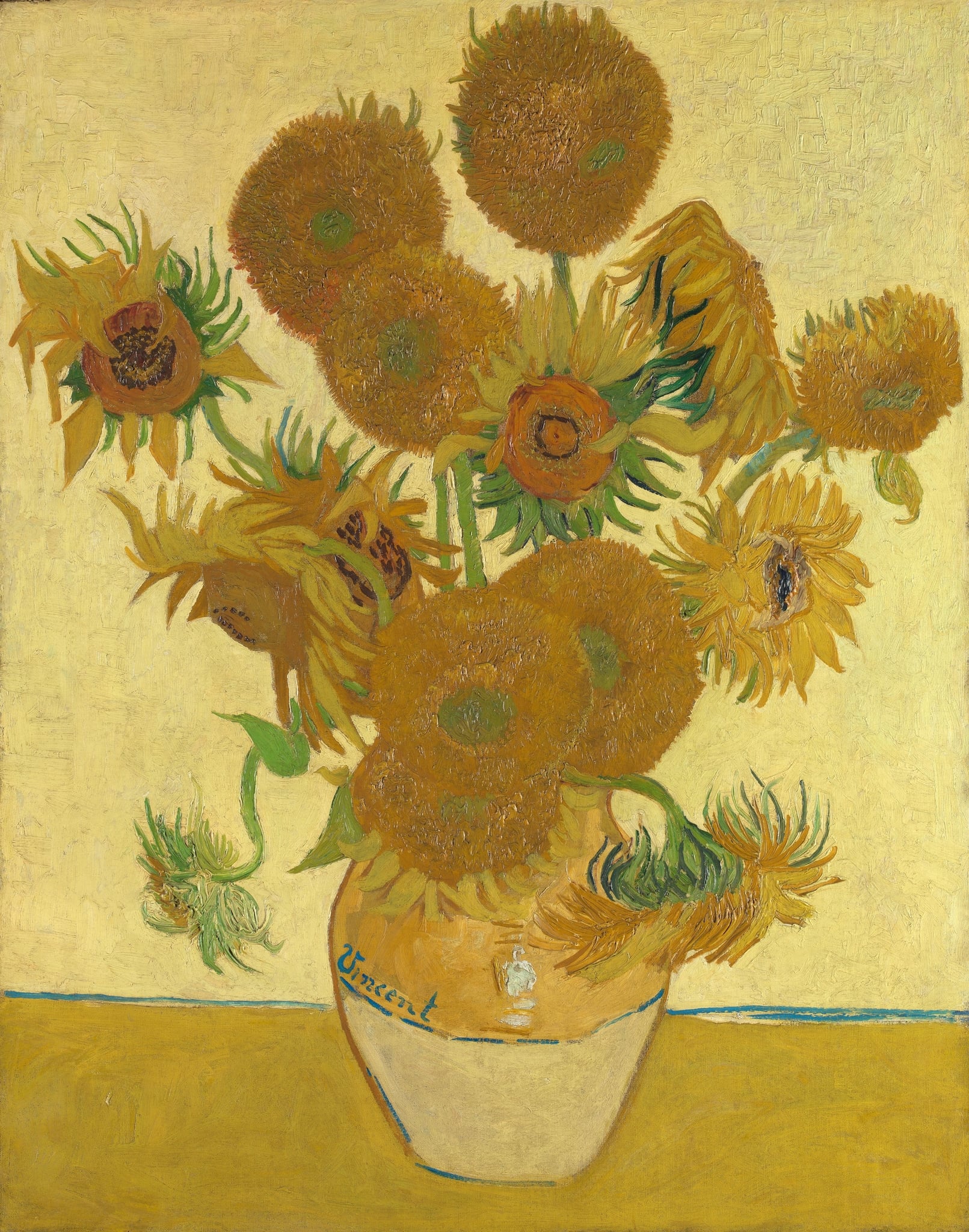
Vincent van Gogh’s Sunflowers (1888) is a <strong>yellow-on-yellow</strong> still life that stages a full <strong>cycle of life</strong> in fifteen blooms, from fresh buds to brittle seed heads. The thick impasto, green shocks of stem and bract, and the vase signed <strong>“Vincent”</strong> turn a humble bouquet into an emblem of endurance and fellowship <sup>[1]</sup><sup>[2]</sup>.

The Red Vineyard by Vincent van Gogh

The Red Vineyard

Vincent van Gogh (1888)

In The Red Vineyard, Vincent van Gogh forges a vision of <strong>autumn labor under a blazing sun</strong>, where harvesters flow diagonally through scarlet vines while a band of <strong>yellow light</strong> flares along a reflective roadway. The scene fuses <strong>exhaustion and ripeness</strong>, turning work into a rhythmic, almost liturgical procession <sup>[1]</sup><sup>[3]</sup>.