Labor & work
Featured Artworks
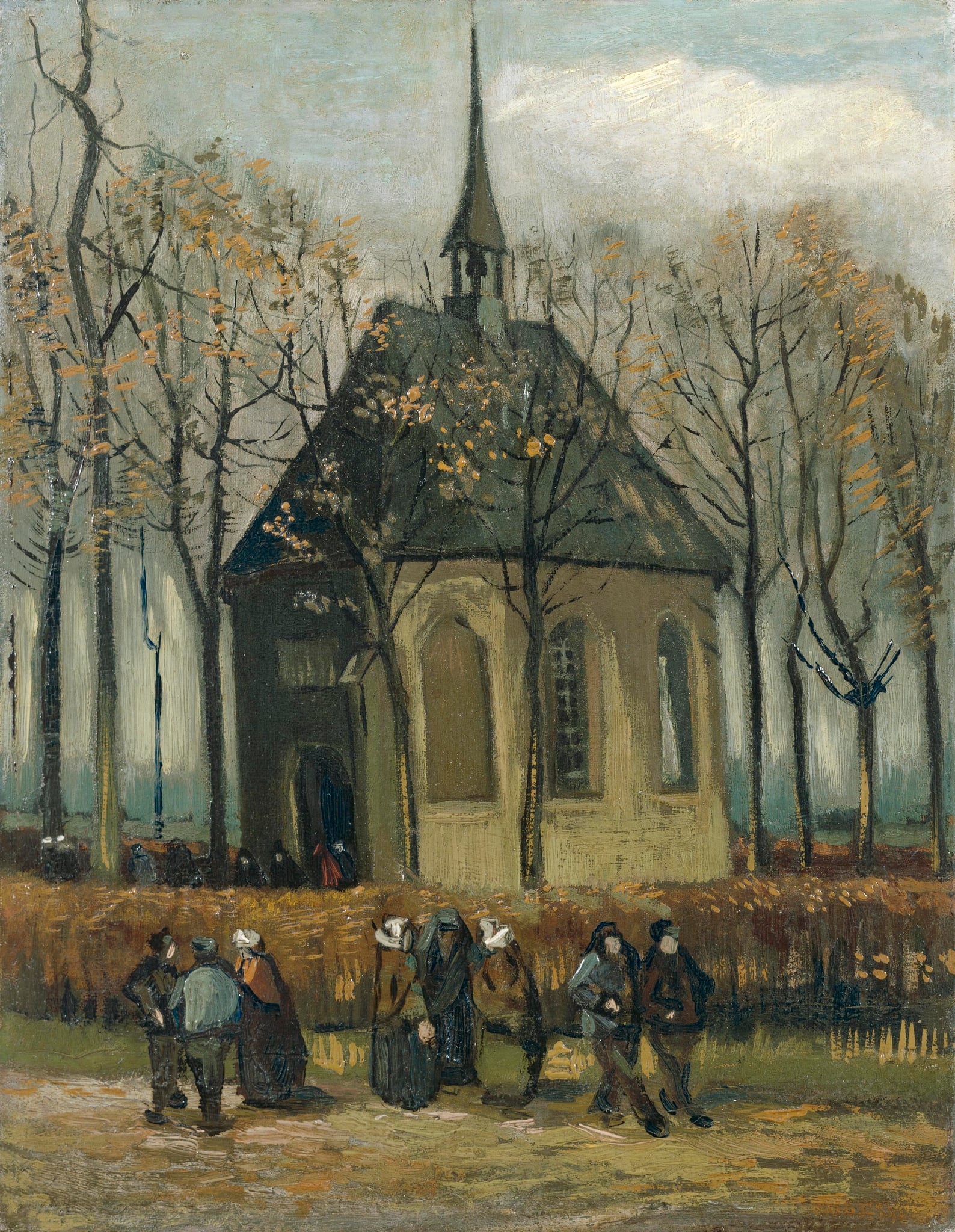
Congregation Leaving the Reformed Church in Nuenen
Vincent van Gogh (1884; reworked 1885)
Vincent van Gogh’s Congregation Leaving the Reformed Church in Nuenen turns a modest village service into a meditation on <strong>mourning</strong>, <strong>community</strong>, and <strong>thresholds</strong>. The low steeple, clipped hedge, and bundled figures in black shawls and white caps file past autumn-tinted, near-bare trees, shifting the scene from ordinary Sunday ritual to public grief. Painted in 1884 and <strong>reworked in 1885</strong> with the congregation and ocher leaves, the canvas folds private loss into rural Protestant life <sup>[1]</sup><sup>[2]</sup><sup>[3]</sup>.
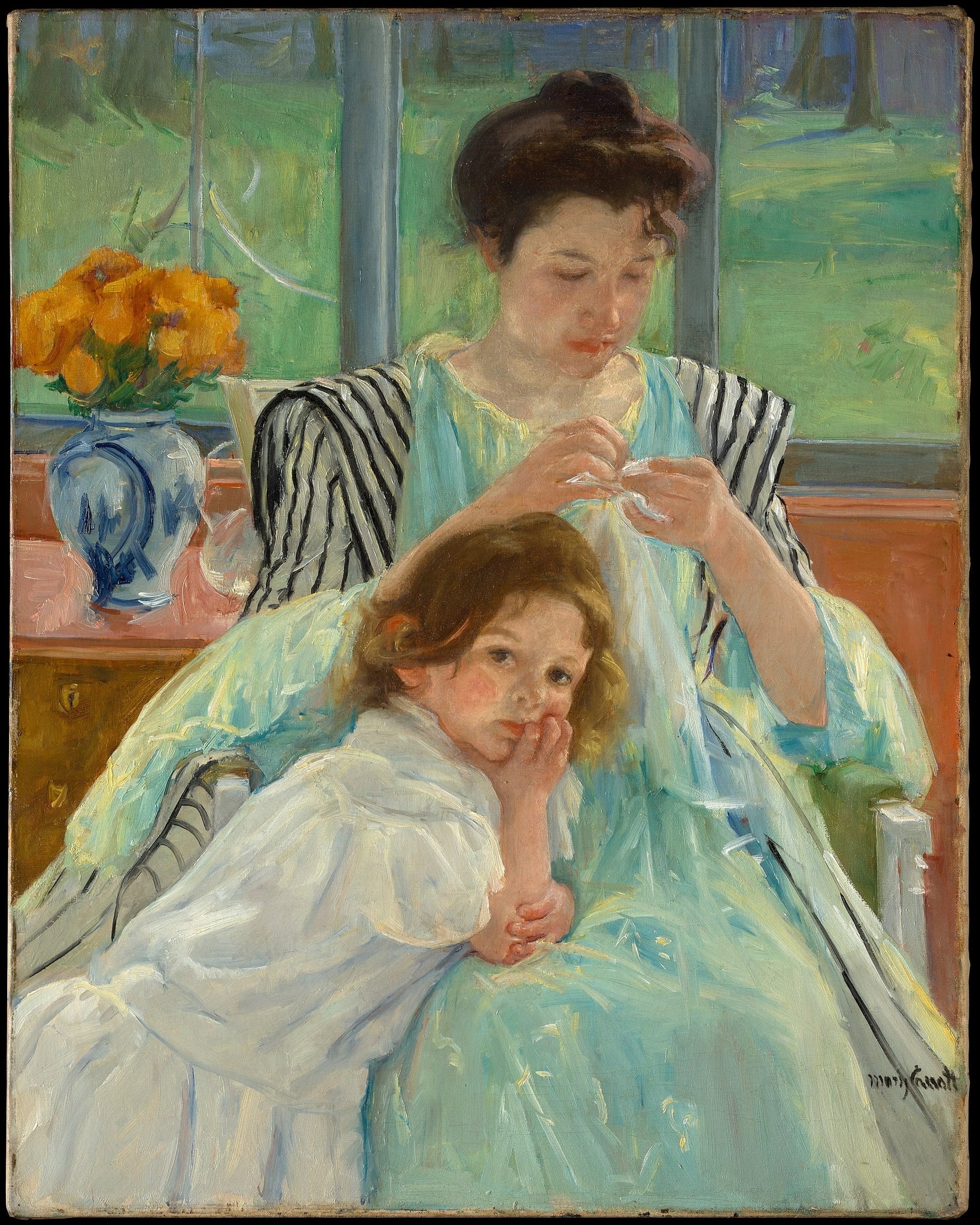
Young Mother Sewing
Mary Cassatt (1900)
Mary Cassatt’s Young Mother Sewing centers the quiet <strong>labor of care</strong>: a mother steadies pale fabric while a child in white leans into her, eyes meeting ours. Cool <strong>greens and blues</strong> bathe the figures as striped sleeves and chair arms rhythmically return attention to the mother’s working hands, while a burst of <strong>orange blossoms</strong> by the window anchors interior life against the world outside <sup>[1]</sup>.
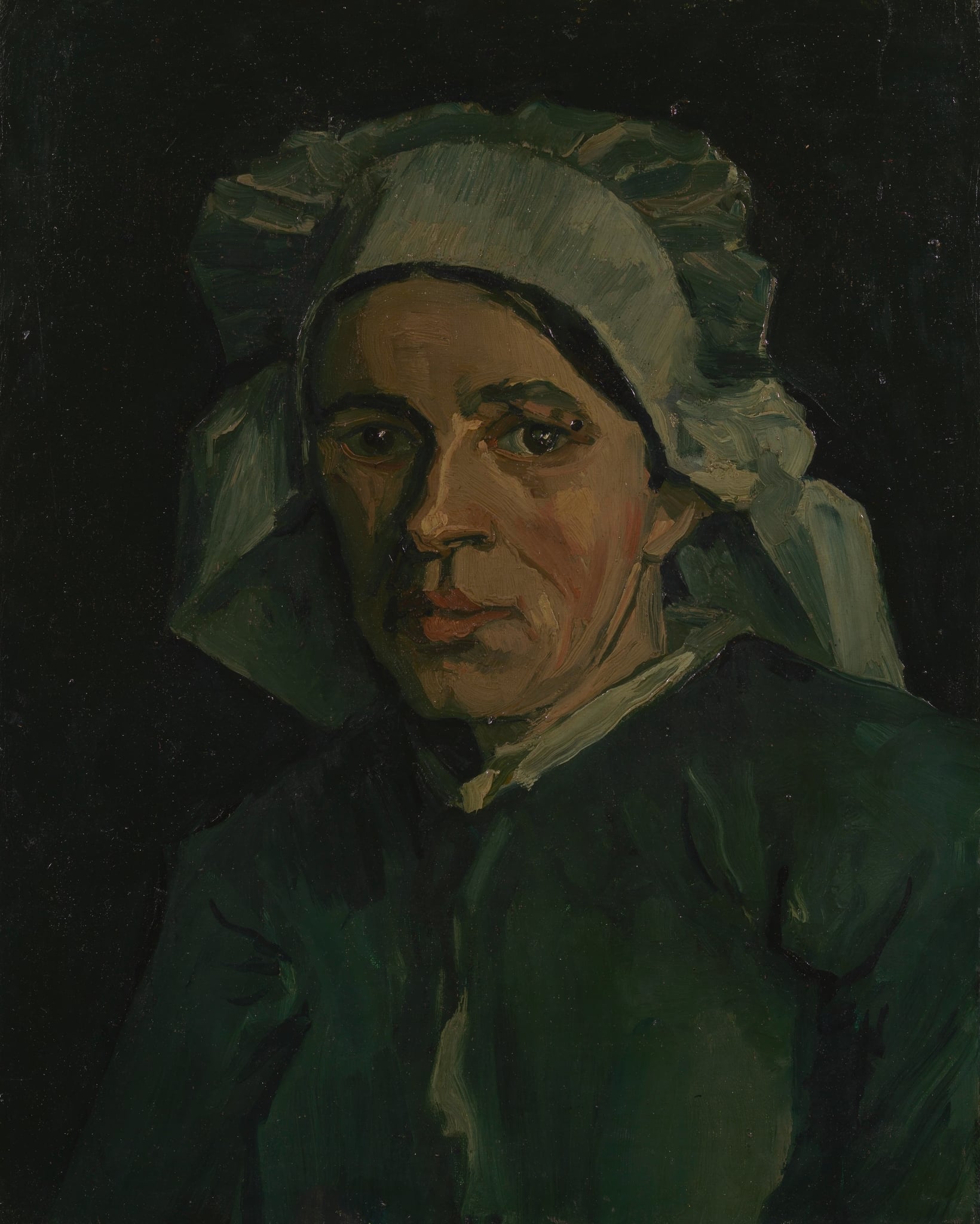
Head of a Woman
Vincent van Gogh (1885)
Van Gogh’s Head of a Woman turns a peasant’s face into a study of <strong>character and moral weight</strong>. With a near‑black ground, raking light from the left, and an earthbound range of greens and ochres, the painting asserts <strong>dignity without prettiness</strong>, anticipating the ethos of The Potato Eaters <sup>[1]</sup><sup>[2]</sup>.
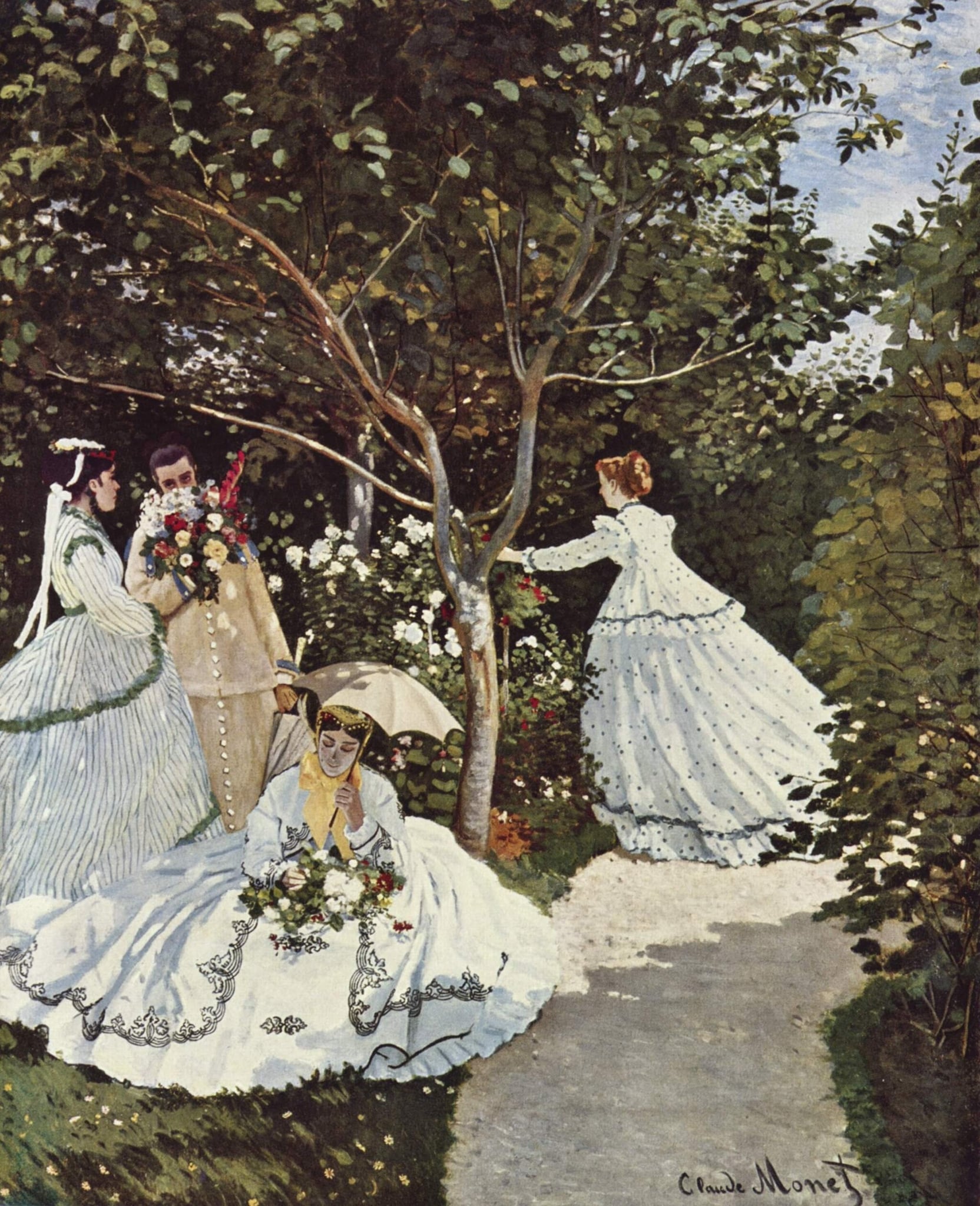
Women in the Garden
Claude Monet (1866–1867)
Claude Monet’s Women in the Garden choreographs four figures in a sunlit bower to test how <strong>white dresses</strong> register <strong>dappled light</strong> and shadow. The path, parasol, and clipped flowers frame a modern ritual of leisure while turning fashion into an instrument of <strong>perception</strong>. The scene reads less as portraiture than as a manifesto for painting the <strong>momentary</strong> outdoors <sup>[1]</sup><sup>[3]</sup>.
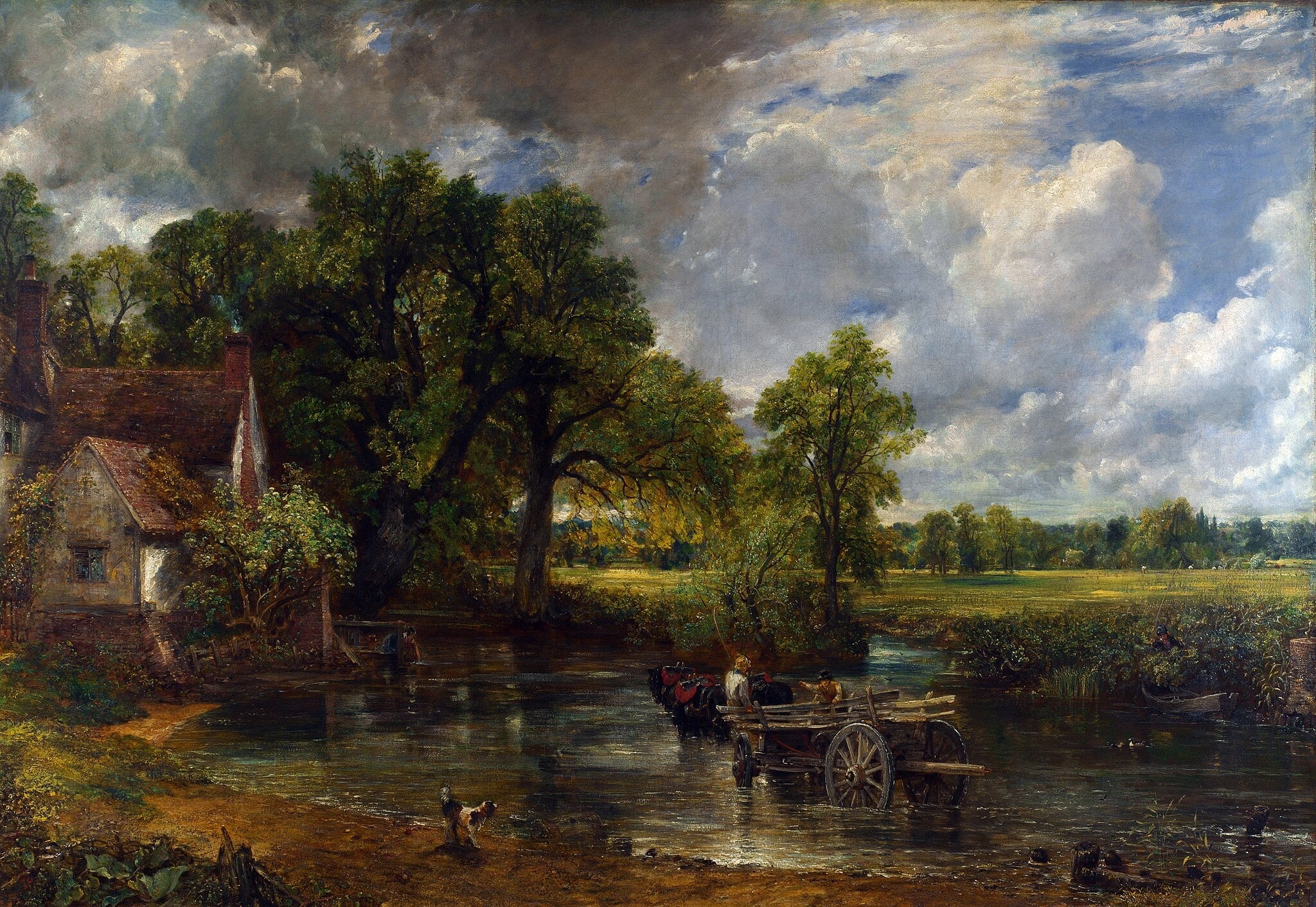
The Hay Wain
John Constable (1821)
Set beside Willy Lott’s cottage on the River Stour, The Hay Wain stages a moment of <strong>unhurried rural labor</strong>: an empty timber cart, drawn by three horses with red-collared tack, pauses mid‑ford as weather shifts above. Constable fuses <strong>empirical observation</strong>—rippling reflections, chimney smoke, flickers of white on leaves—with a composed vista of fields opening to sun. The result is a serene yet alert meditation on <strong>work, weather, and continuity</strong> in the English countryside <sup>[1]</sup><sup>[3]</sup>.
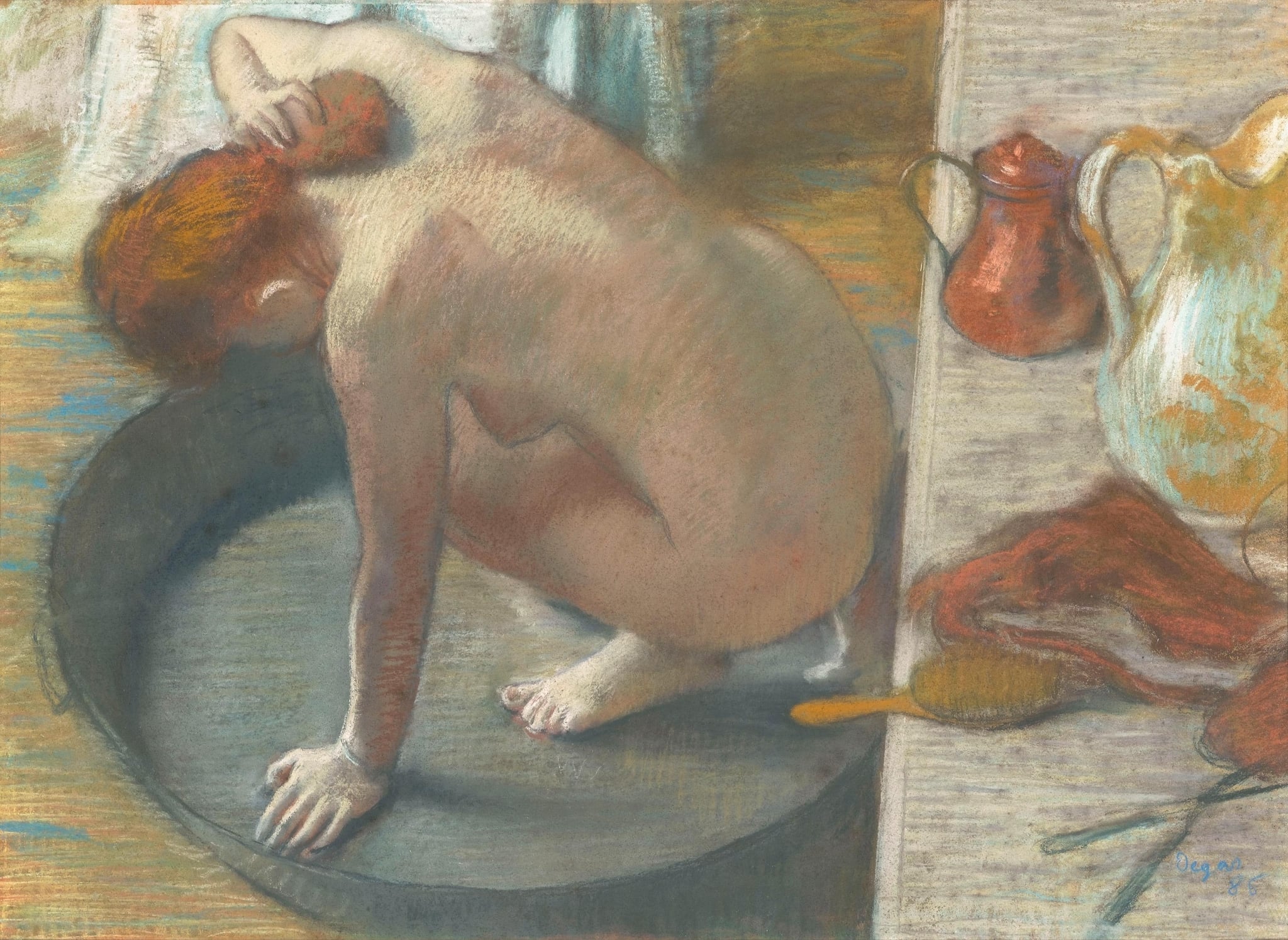
The Tub
Edgar Degas (1886)
In The Tub (1886), Edgar Degas turns a routine bath into a study of <strong>modern solitude</strong> and <strong>embodied labor</strong>. From a steep, overhead angle, a woman kneels within a circular basin, one hand braced on the rim while the other gathers her hair; to the right, a tabletop packs a ewer, copper pot, comb/brush, and cloth. Degas’s layered pastel binds skin, water, and objects into a single, breathing field of <strong>warm flesh tones</strong> and blue‑greys, collapsing distance between body and still life <sup>[1]</sup>.
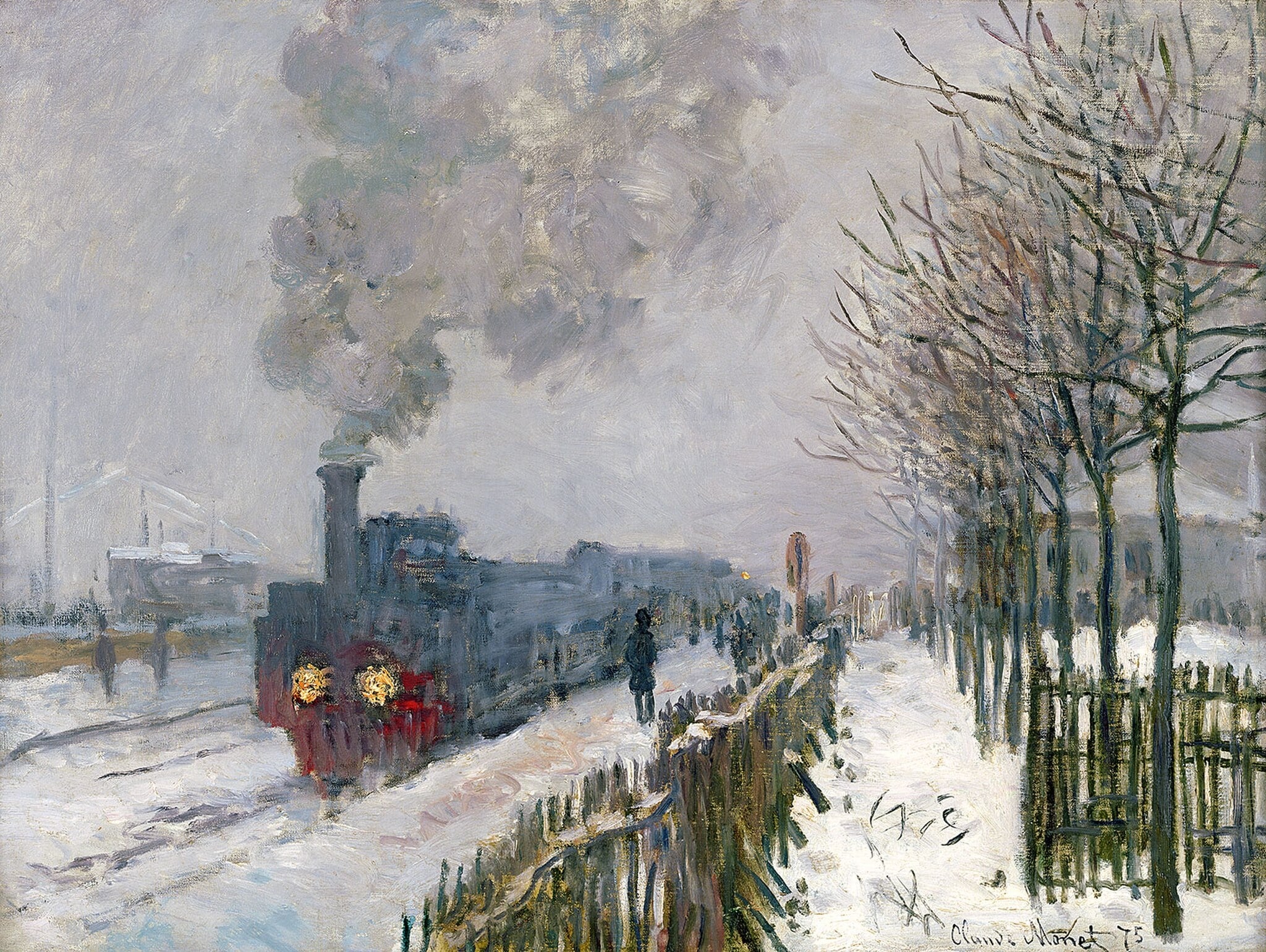
The Train in the Snow (The Locomotive)
Claude Monet (1875)
Claude Monet’s The Train in the Snow (The Locomotive) (1875) turns a suburban winter platform into a study of <strong>modernity absorbed by atmosphere</strong>. The engine’s twin yellow headlights and a smear of red push through a world of greys and violets as steam fuses with the low sky, while the right-hand fence and bare trees drill depth and cadence into the scene <sup>[1]</sup><sup>[4]</sup>. Monet fixes not an object but a <strong>moment of perception</strong>, where industry seems to dematerialize into weather <sup>[1]</sup><sup>[2]</sup>.
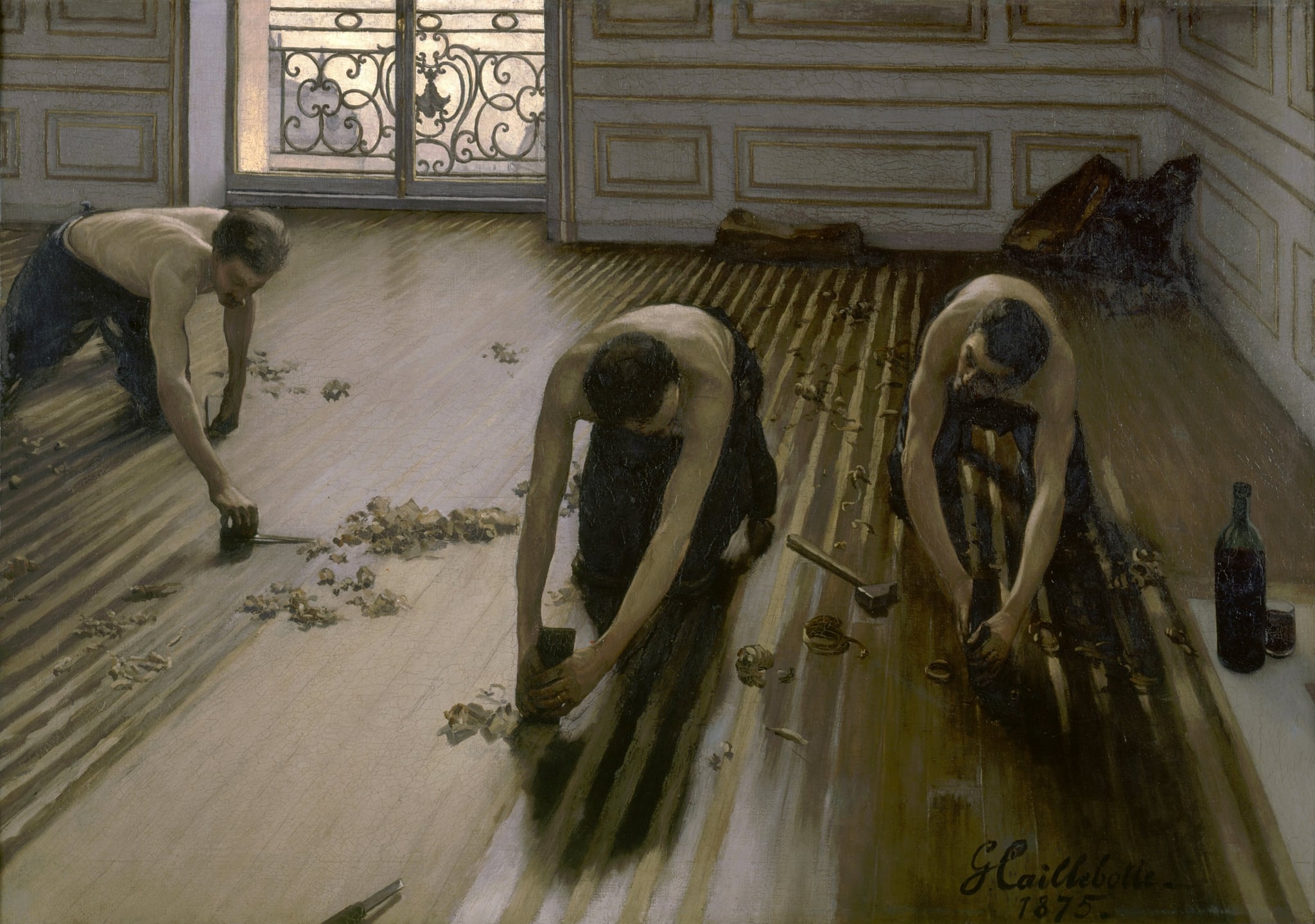
The Floor Scrapers
Gustave Caillebotte (1875)
Gustave Caillebotte’s The Floor Scrapers stages three shirtless workers planing a parquet floor as shafts of light pour through an ornate balcony door. The painting fuses <strong>rigorous perspective</strong> with <strong>modern urban labor</strong>, turning curls of wood and raking light into a ledger of time and effort <sup>[1]</sup><sup>[3]</sup>. Its cool, gilded interior makes visible how bourgeois elegance is built on bodily work.
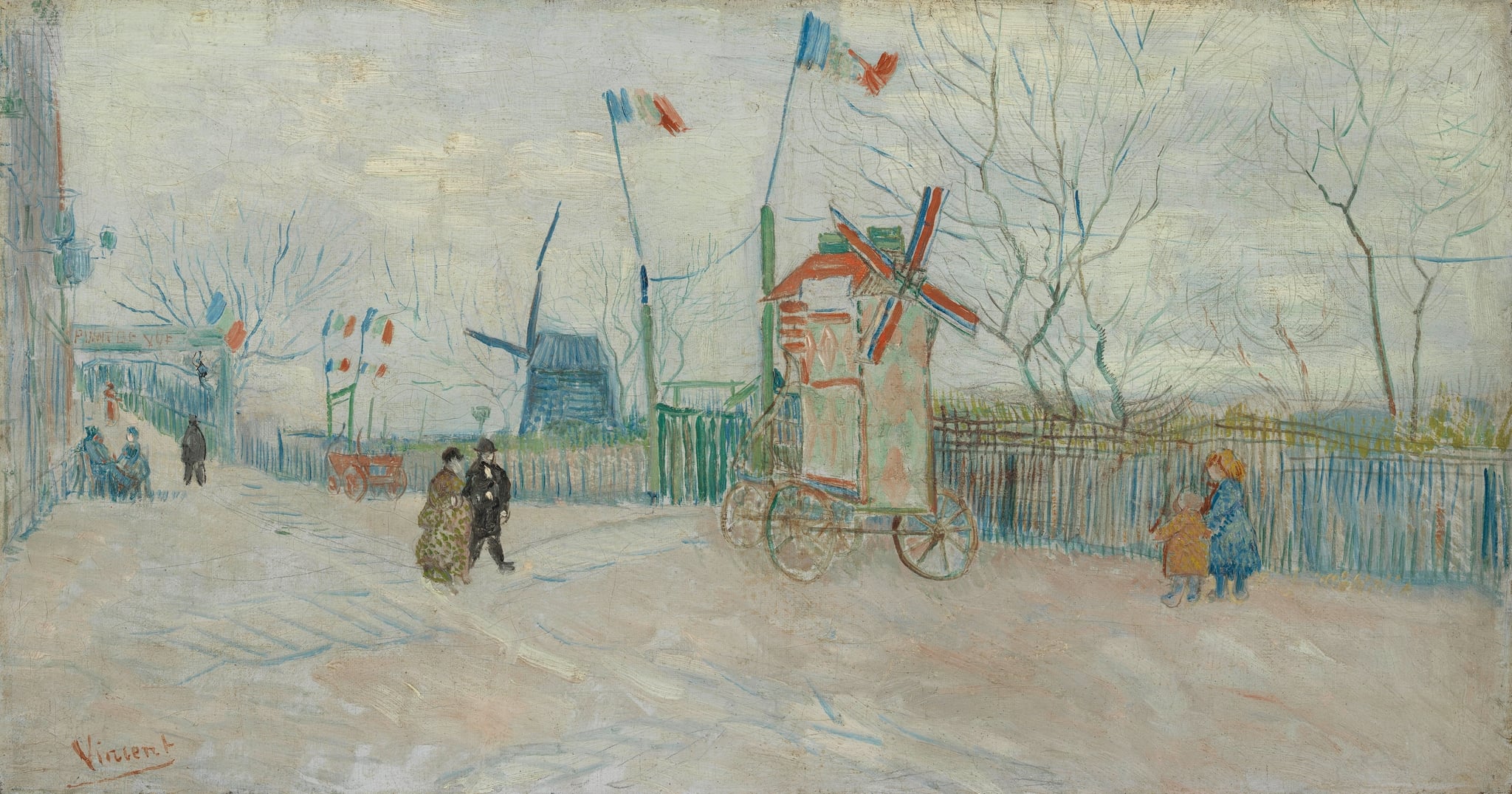
Impasse des Deux Frères in Montmartre
Vincent van Gogh (1887)
Van Gogh’s Impasse des Deux Frères in Montmartre crystallizes a <strong>threshold</strong> between rustic mills and a city turning to <strong>modern leisure</strong>. Tricolor flags, a wheeled “windmill” kiosk, and sketchlike figures animate a broad, chalky lane under pale winter light, declaring a neighborhood—and an artist—mid‑transition <sup>[1]</sup><sup>[3]</sup>.
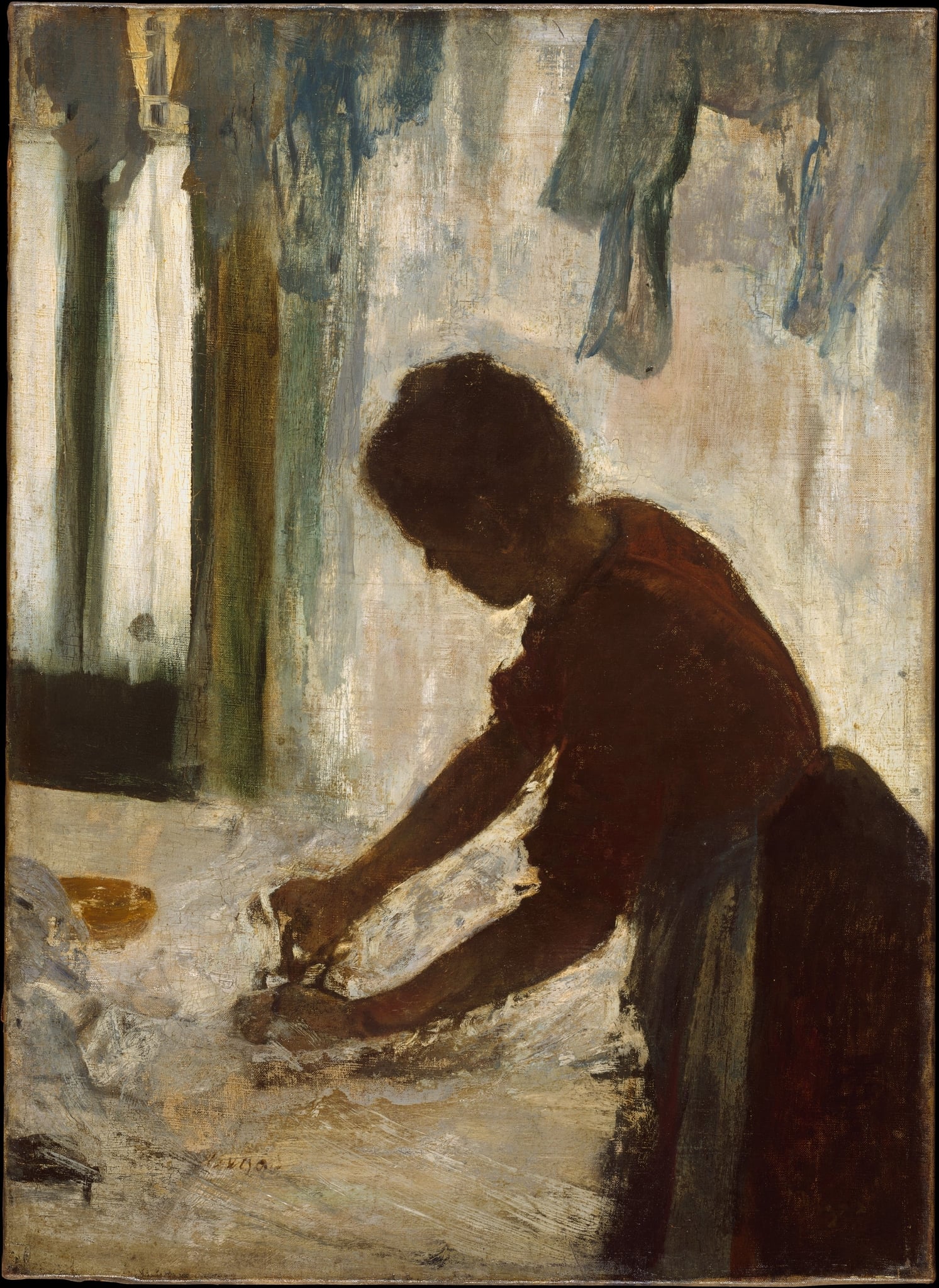
Woman Ironing
Edgar Degas (c. 1876–1887)
In Woman Ironing, Degas builds a modern icon of labor through <strong>contre‑jour</strong> light and a forceful diagonal from shoulder to iron. The worker’s silhouette, red-brown dress, and the cool, steamy whites around her turn repetition into <strong>ritualized transformation</strong>—wrinkled cloth to crisp order <sup>[1]</sup><sup>[2]</sup>.
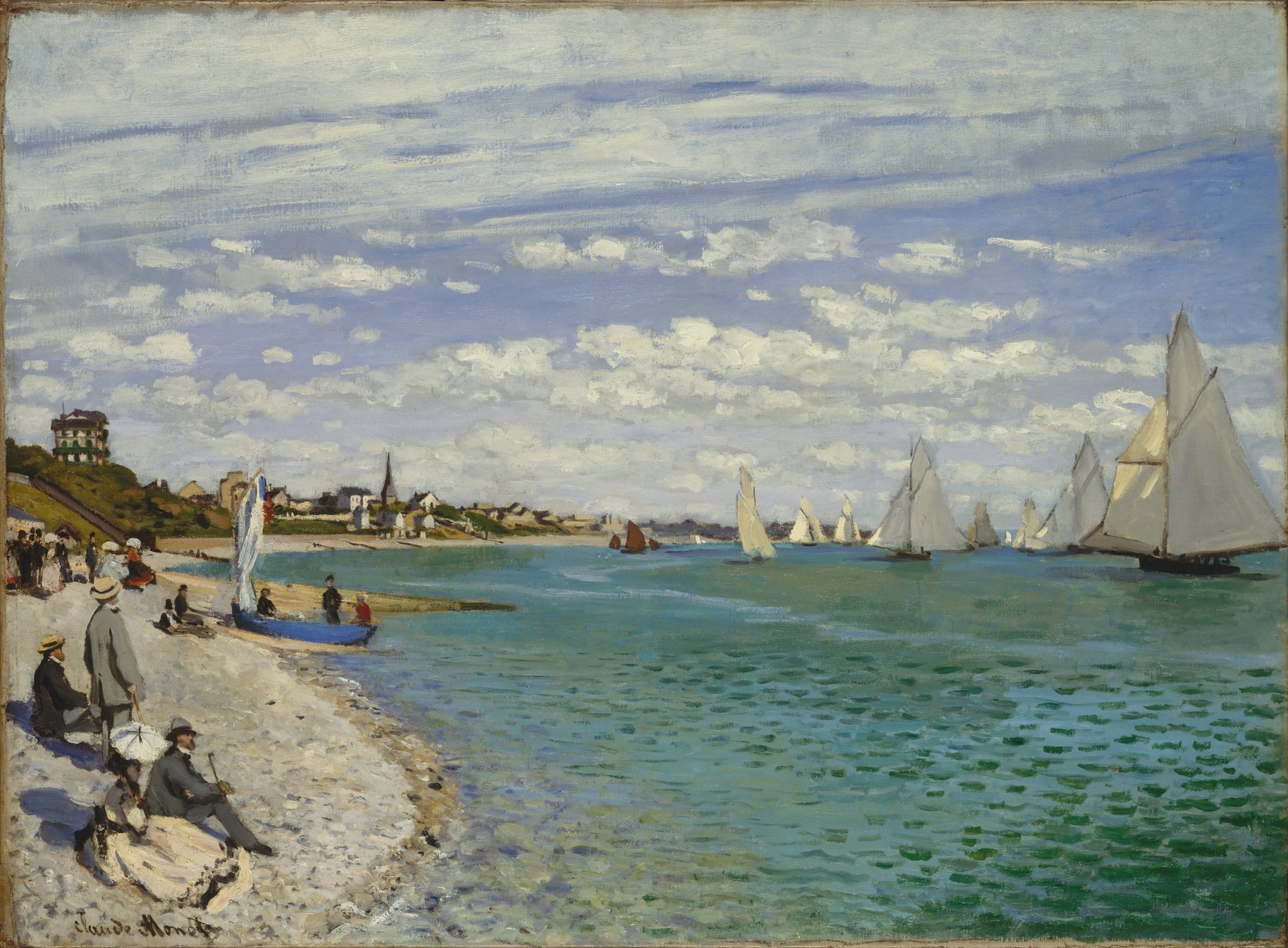
Regatta at Sainte-Adresse
Claude Monet (1867)
On a brilliant afternoon at the Normandy coast, a diagonal <strong>pebble beach</strong> funnels spectators with parasols toward a bay scattered with <strong>white-sailed yachts</strong>. Monet’s quick, broken strokes set <strong>wind, water, and light</strong> in synchrony, turning a local regatta into a modern scene of leisure held against the vastness of sea and sky <sup>[1]</sup><sup>[2]</sup>.
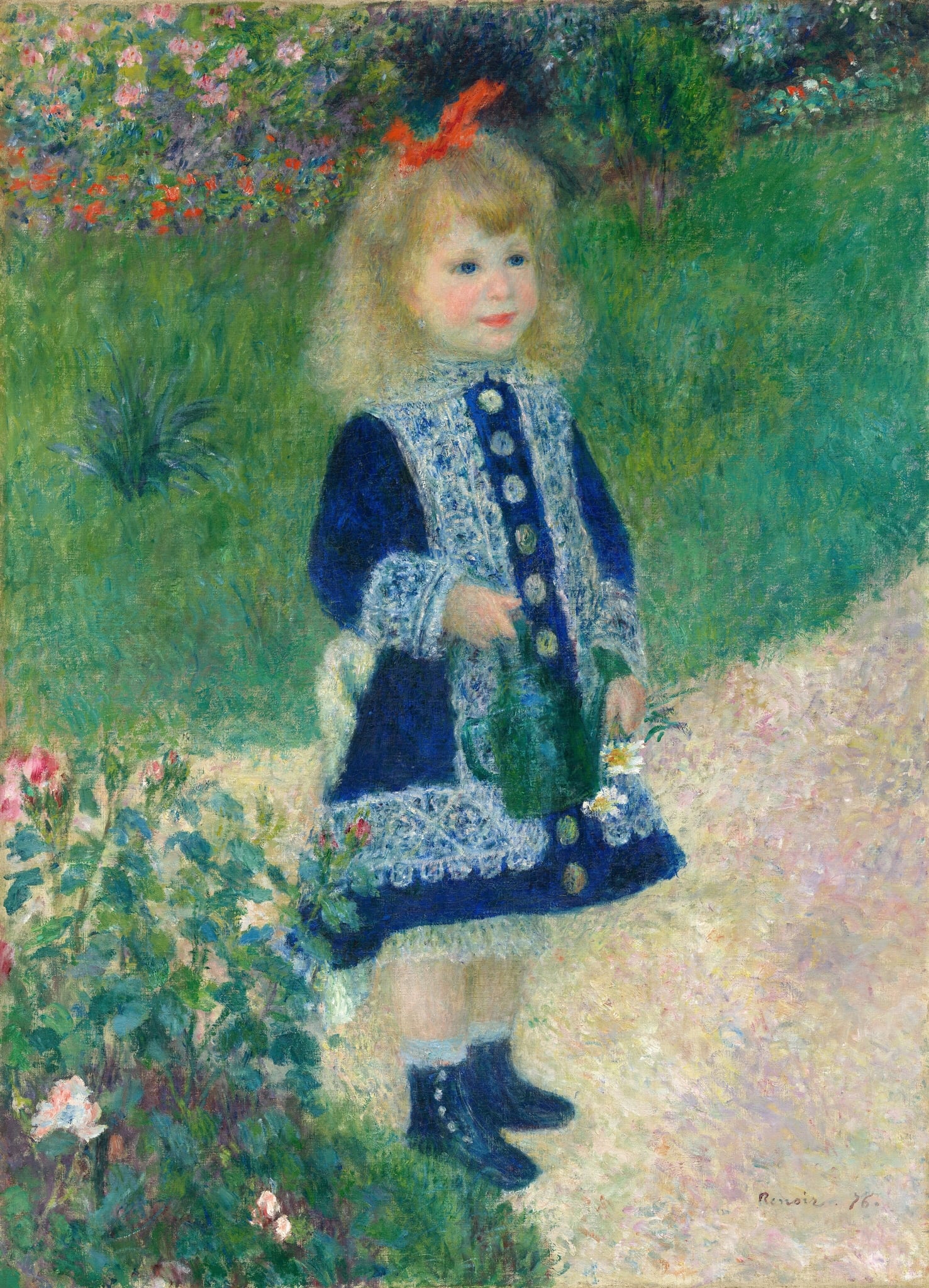
Girl with a Watering Can
Pierre-Auguste Renoir (1876)
Renoir’s 1876 Girl with a Watering Can fuses a crisply perceived child with a dissolving garden atmosphere, using <strong>prismatic color</strong> and <strong>controlled facial modeling</strong> to stage innocence within modern leisure <sup>[1]</sup>. The cobalt dress, red bow, and green can punctuate a haze of pinks and greens, making nurture and growth the scene’s quiet thesis.
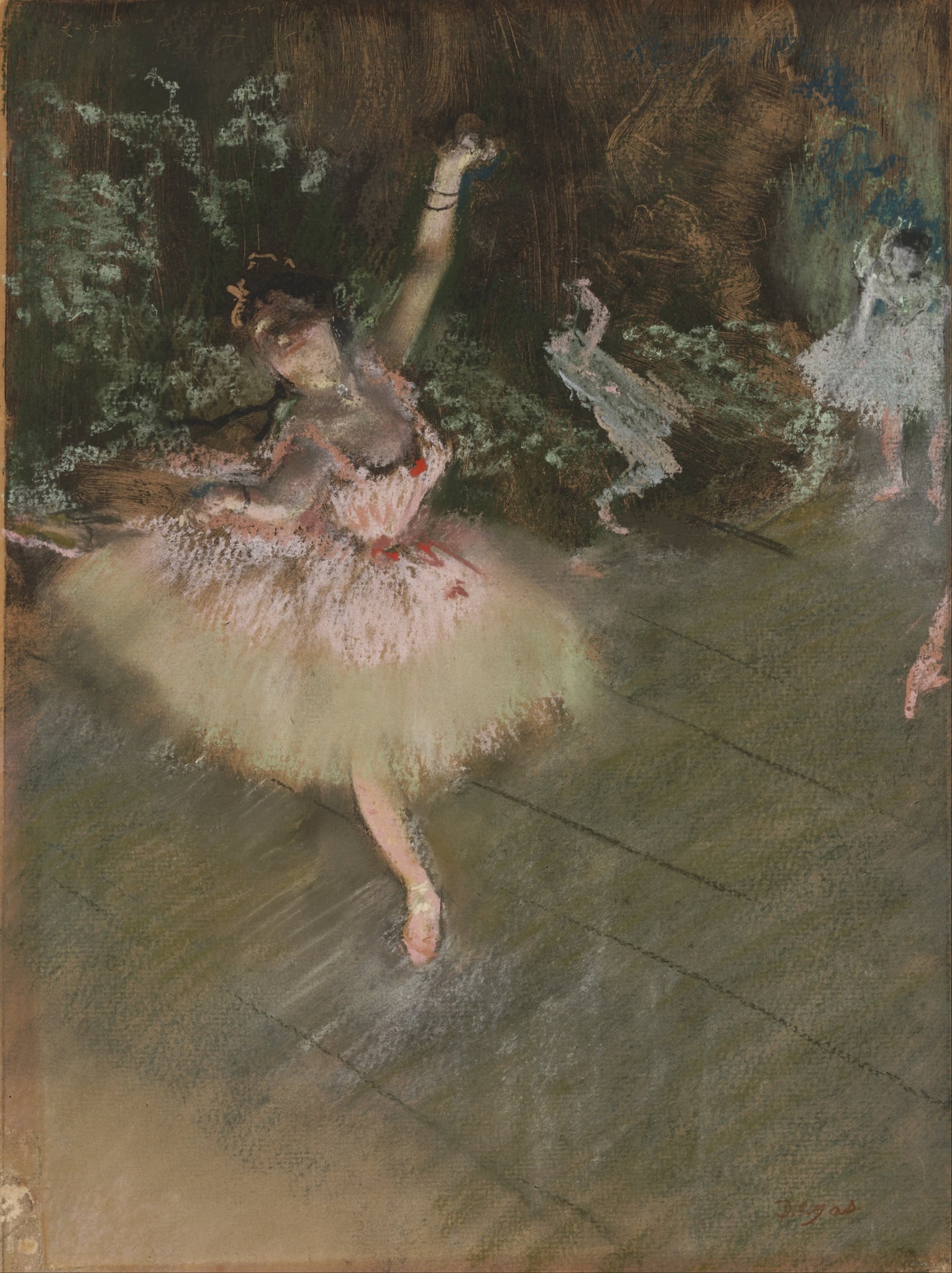
The Star
Edgar Degas (c. 1876–1878)
Edgar Degas’s The Star shows a prima ballerina caught at the crest of a pose, her tutu a <strong>vaporous flare</strong> against a <strong>murky, tilted stage</strong>. Diagonal floorboards rush beneath her single pointe, while pale, ghostlike dancers linger in the wings, turning triumph into a scene of <strong>radiant isolation</strong> <sup>[2]</sup><sup>[5]</sup>.
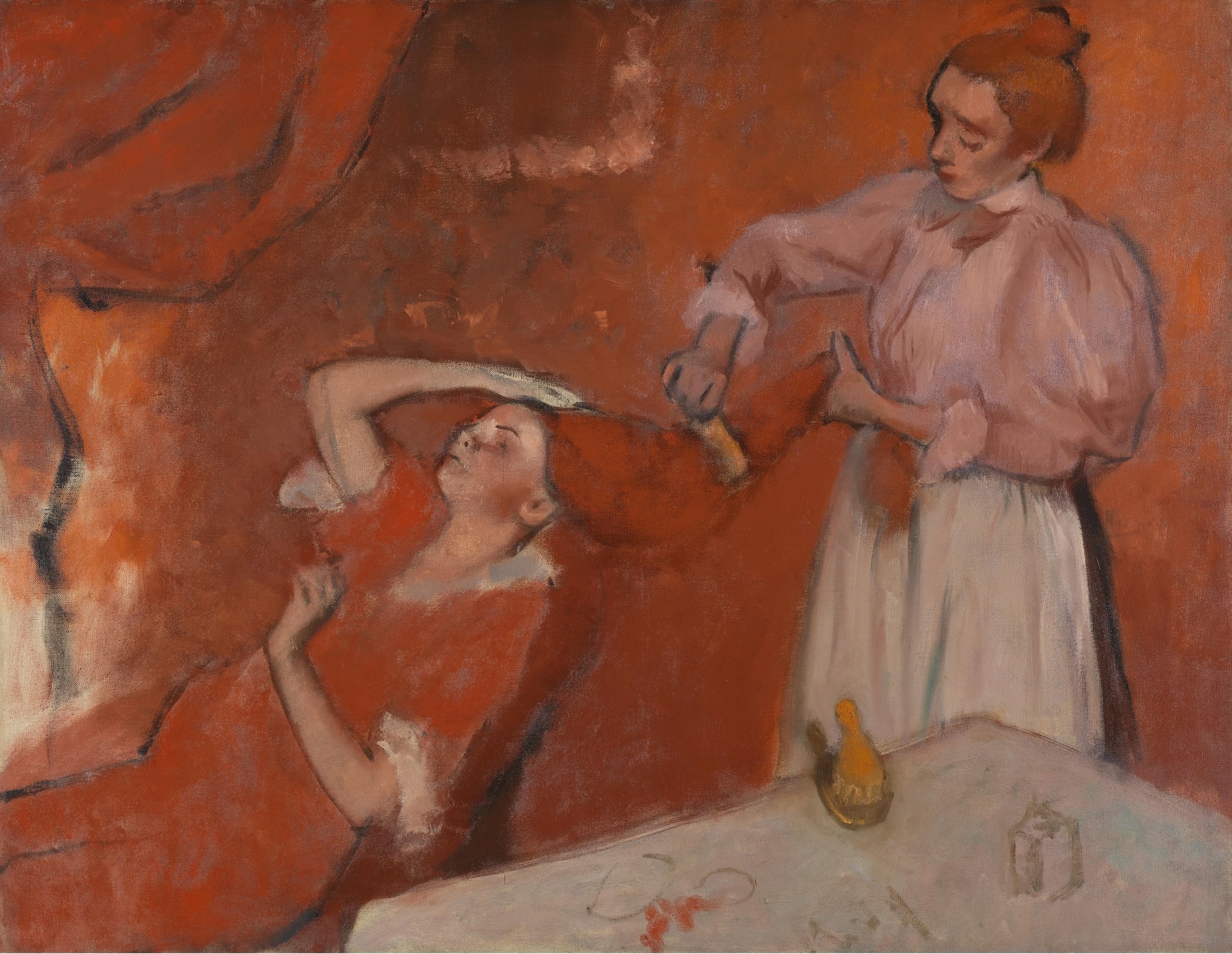
Combing the Hair
Edgar Degas (c.1896)
Edgar Degas’s Combing the Hair crystallizes a private ritual into a scene of <strong>compressed intimacy</strong> and <strong>classed labor</strong>. The incandescent field of red fuses figure and room, turning the hair into a <strong>binding ribbon</strong> between attendant and sitter <sup>[1]</sup>.
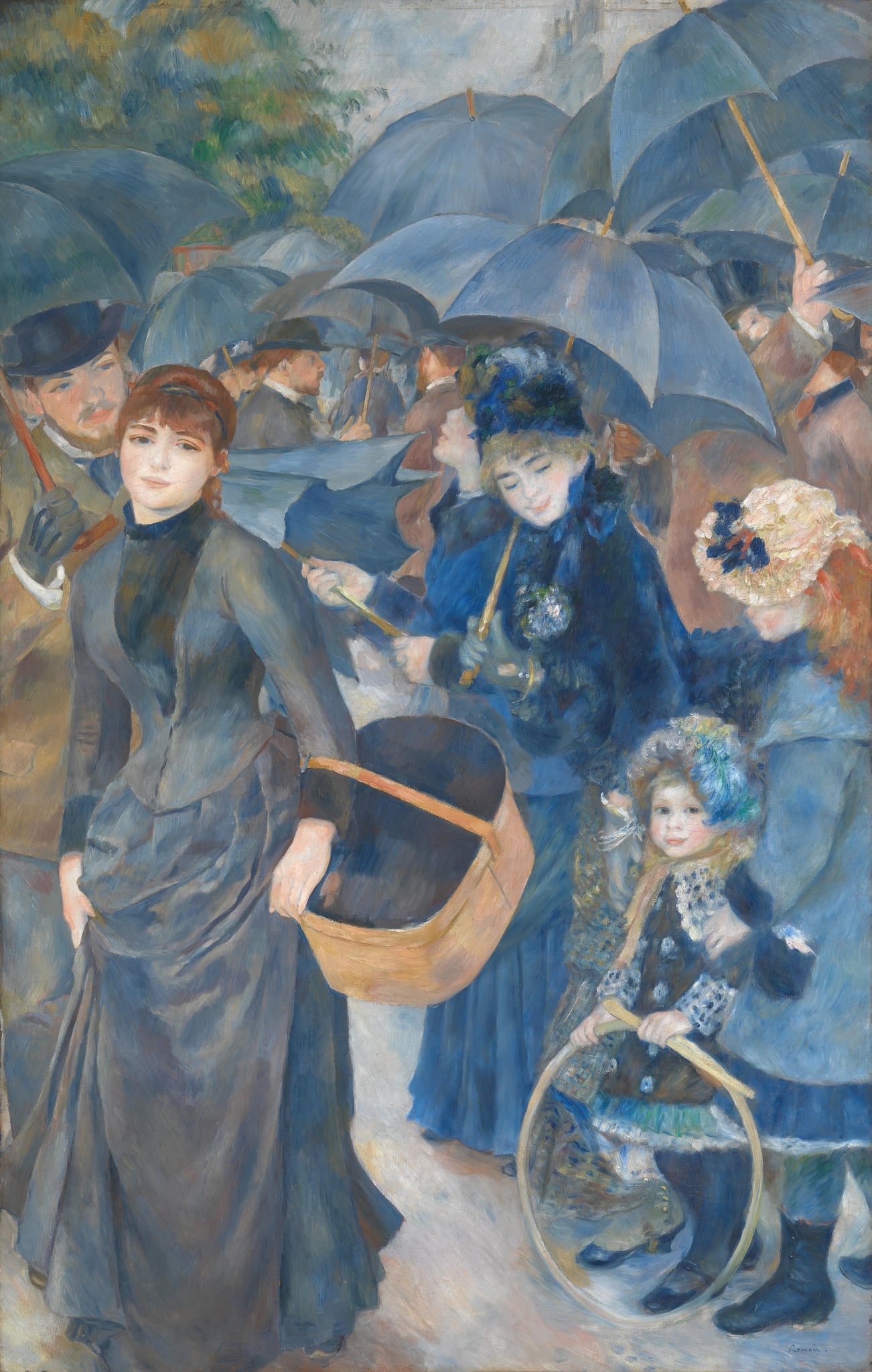
The Umbrellas
Pierre-Auguste Renoir (about 1881–86)
A sudden shower turns a Paris street into a lattice of <strong>slate‑blue umbrellas</strong>, knitting strangers into a single moving frieze. A bareheaded young woman with a <strong>bandbox</strong> strides forward while a bourgeois mother and children cluster at right, their <strong>hoop</strong> echoing the umbrellas’ arcs <sup>[1]</sup><sup>[5]</sup>.
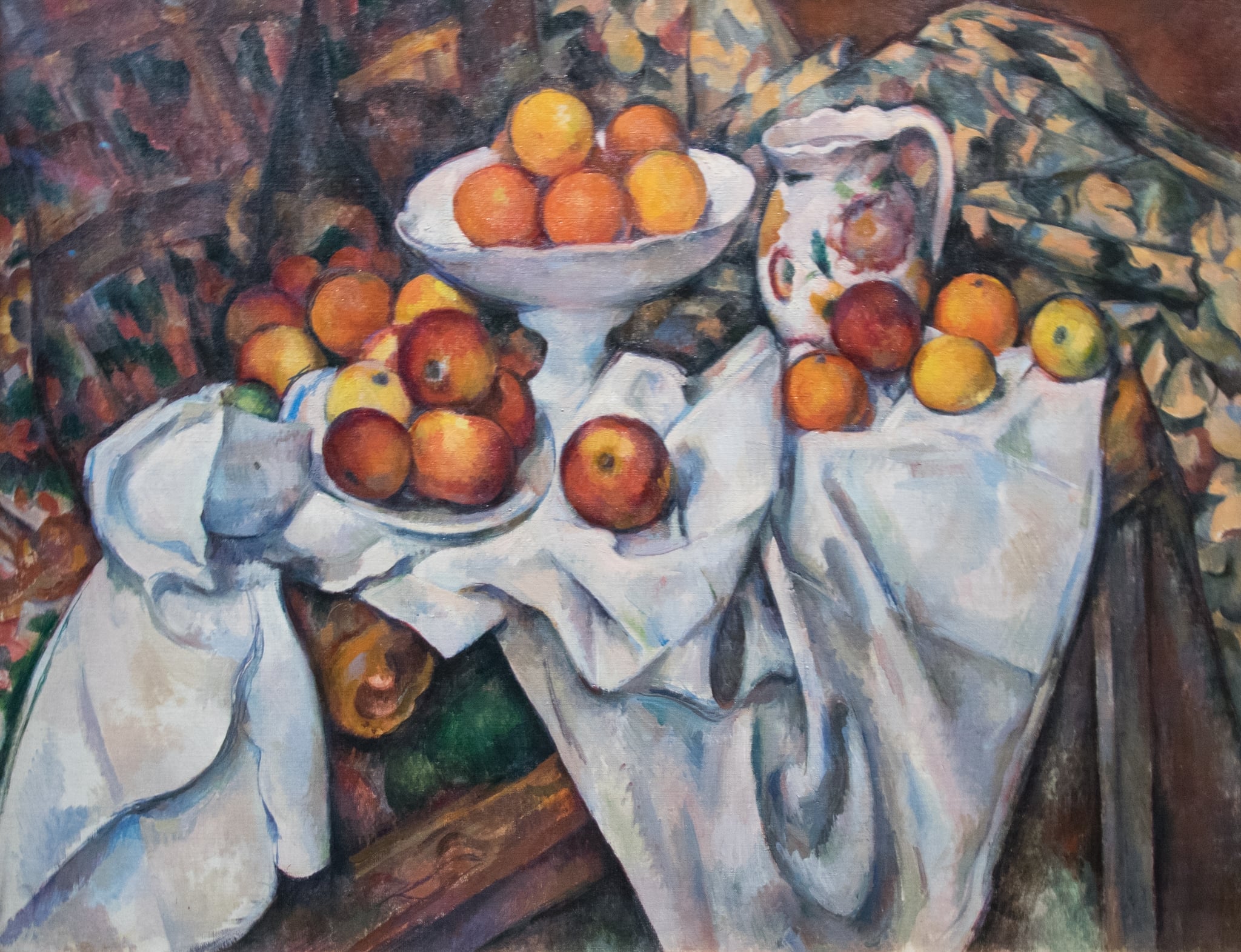
Still Life with Apples and Oranges
Paul Cézanne (c. 1899)
Paul Cézanne’s Still Life with Apples and Oranges builds a quietly monumental world from domestic things. A tilting table, a heaped white compote, a flowered jug, and cascading cloths turn fruit into <strong>durable forms</strong> stabilized by <strong>color relationships</strong> rather than single‑point perspective <sup>[1]</sup><sup>[2]</sup>. The result is a still life that feels both solid and subtly <strong>unstable</strong>, a meditation on how we construct vision.
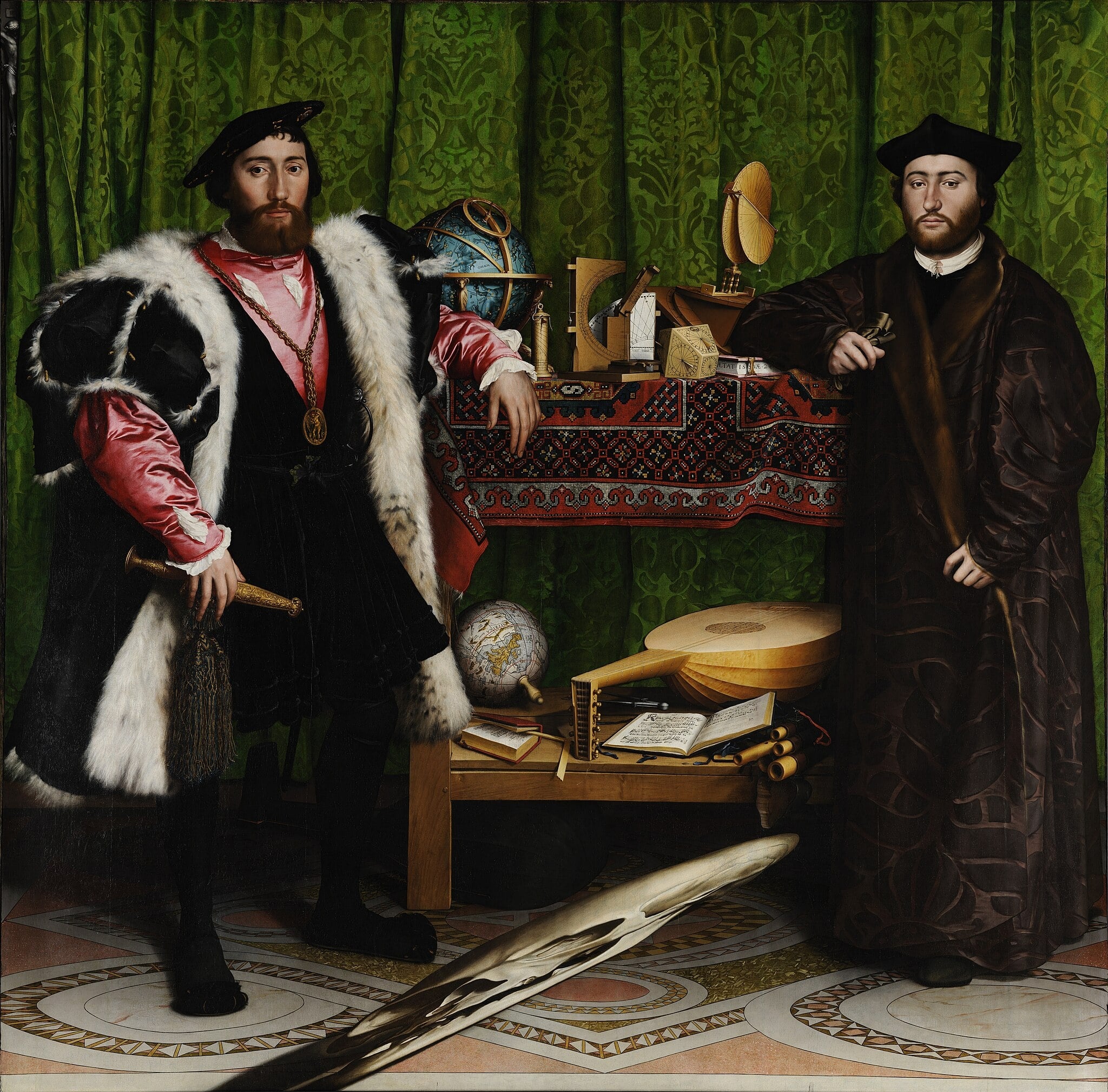
The Ambassadors
Hans Holbein the Younger (1533)
Holbein’s The Ambassadors is a double-portrait staged before a green curtain, where shelves of scientific instruments, books, and musical devices enact <strong>Renaissance learning</strong> while an anamorphic <strong>skull</strong> and a veiled <strong>crucifix</strong> counter it with mortality and salvation <sup>[1]</sup><sup>[2]</sup>. The work balances worldly status—fur, velvet, Oriental carpet—with a sober theology of limits amid the <strong>Reformation’s discord</strong> <sup>[1]</sup><sup>[2]</sup>.
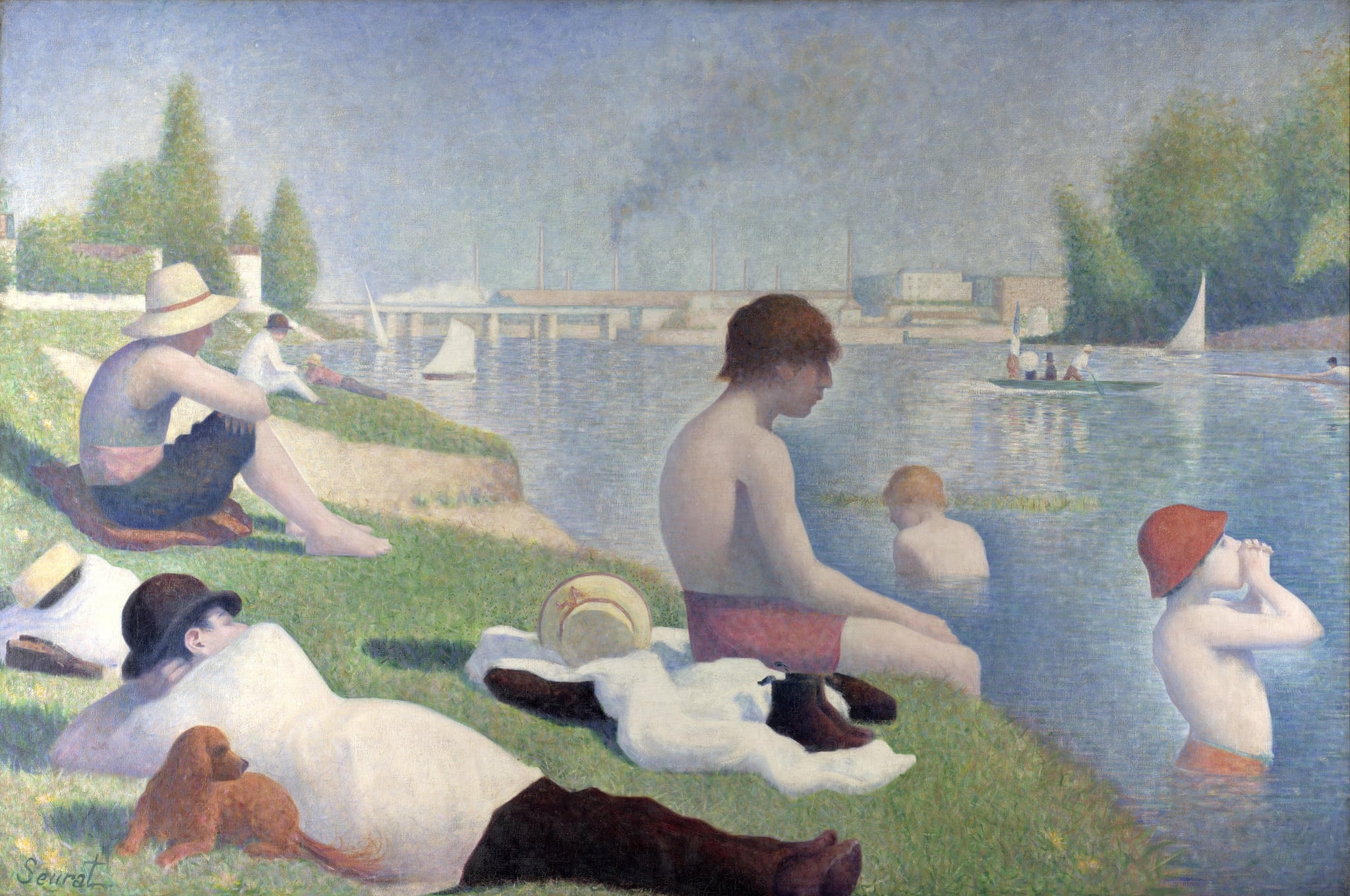
Bathers at Asnières
Georges Seurat (1884)
Bathers at Asnières stages a scene of <strong>modern leisure</strong> on the Seine, where workers recline and wade beneath a hazy, unified light. Seurat fuses <strong>classicizing stillness</strong> with an <strong>industrial backdrop</strong> of chimneys, bridges, and boats, turning ordinary rest into a monumental, ordered image of urban life <sup>[1]</sup><sup>[3]</sup>. The canvas balances soft greens and blues with geometric structures, producing a calm yet charged harmony.
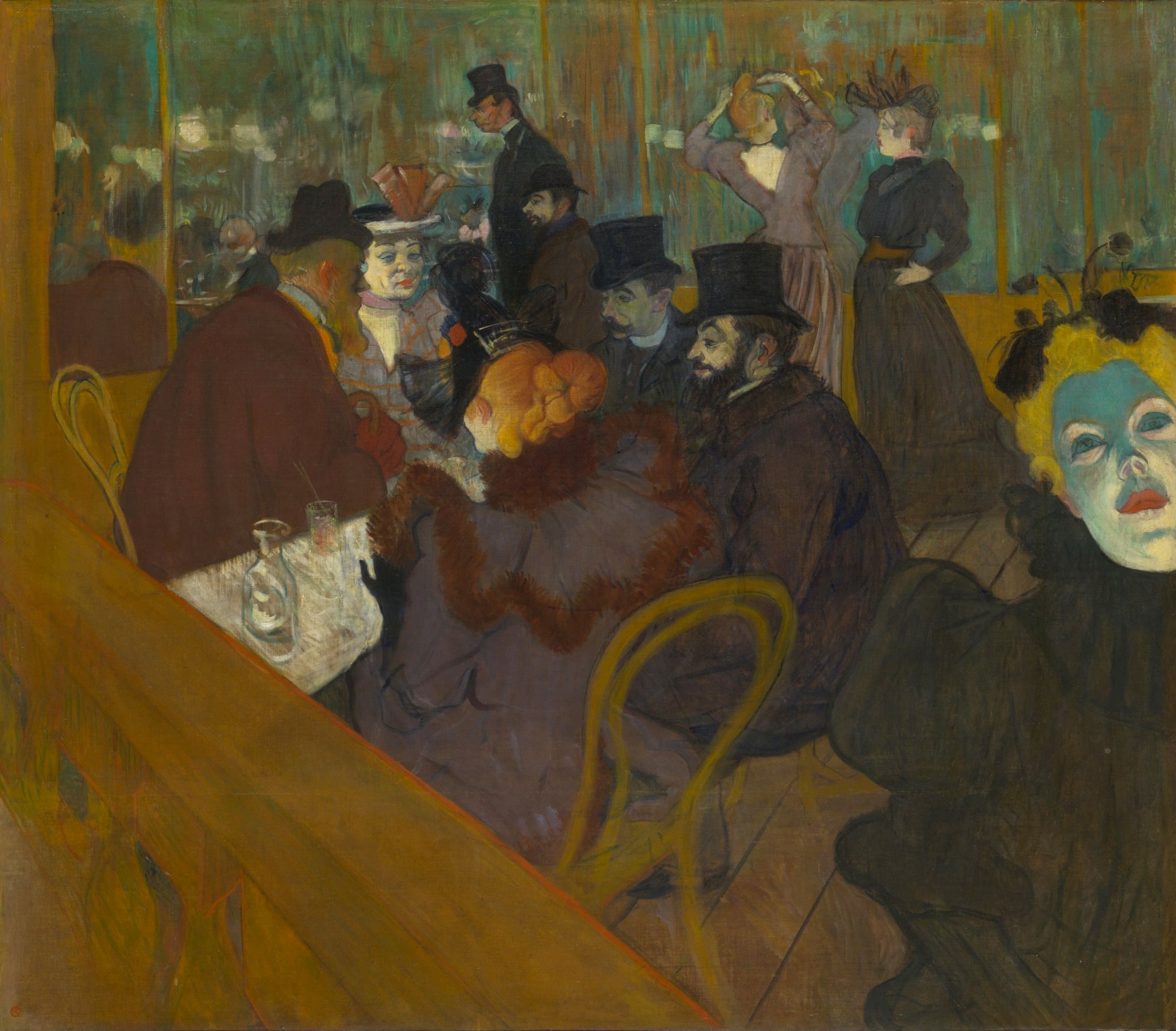
At the Moulin Rouge
Henri de Toulouse-Lautrec (1892–1895)
At the Moulin Rouge plunges us into the churn of Paris nightlife, staging a crowded room where spectacle and fatigue coexist. A diagonal banister and abrupt croppings create <strong>off‑kilter immediacy</strong>, while harsh artificial light turns faces <strong>masklike</strong> and cool. Mirrors multiply the crowd, amplifying a mood of allure tinged with <strong>urban alienation</strong> <sup>[1]</sup><sup>[3]</sup><sup>[4]</sup>.
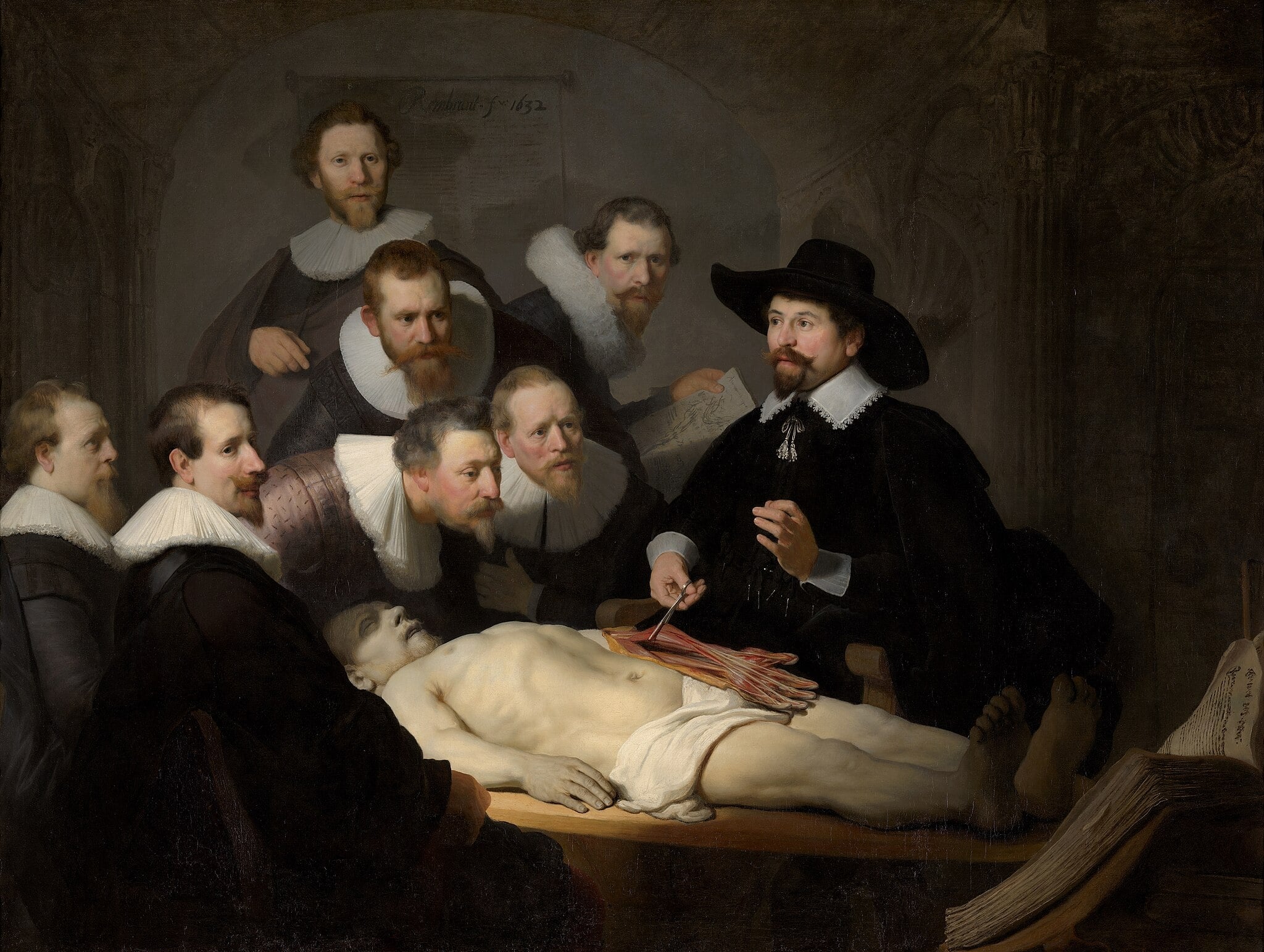
The Anatomy Lesson of Dr. Nicolaes Tulp
Rembrandt van Rijn (1632)
Rembrandt van Rijn turns a civic commission into a drama of <strong>knowledge made visible</strong>. A cone of light binds the ruff‑collared surgeons, the pale cadaver, and Dr. Tulp’s forceps as he raises the <strong>forearm tendons</strong> to explain the hand. Book and body face each other across the table, staging the tension—and alliance—between <strong>textual authority</strong> and <strong>empirical observation</strong> <sup>[1]</sup><sup>[2]</sup>.
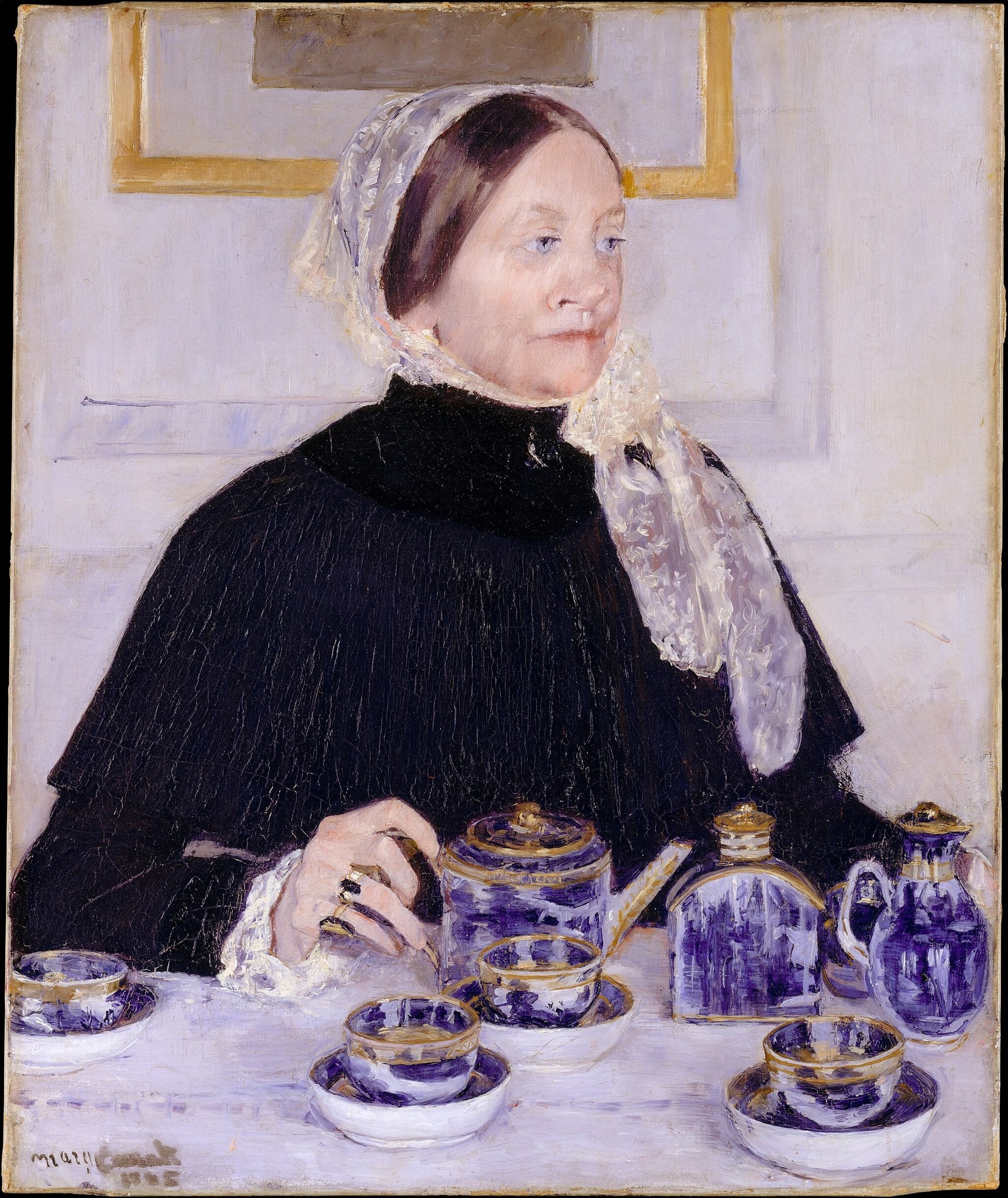
Lady at the Tea Table
Mary Cassatt (1883–85 (signed 1885))
Mary Cassatt’s Lady at the Tea Table distills a domestic rite into a scene of <strong>quiet authority</strong>. The sitter’s black silhouette, lace cap, and poised hand marshal a regiment of <strong>cobalt‑and‑gold Canton porcelain</strong>, while tight cropping and planar light convert hospitality into <strong>modern self‑possession</strong> <sup>[1]</sup><sup>[5]</sup>.
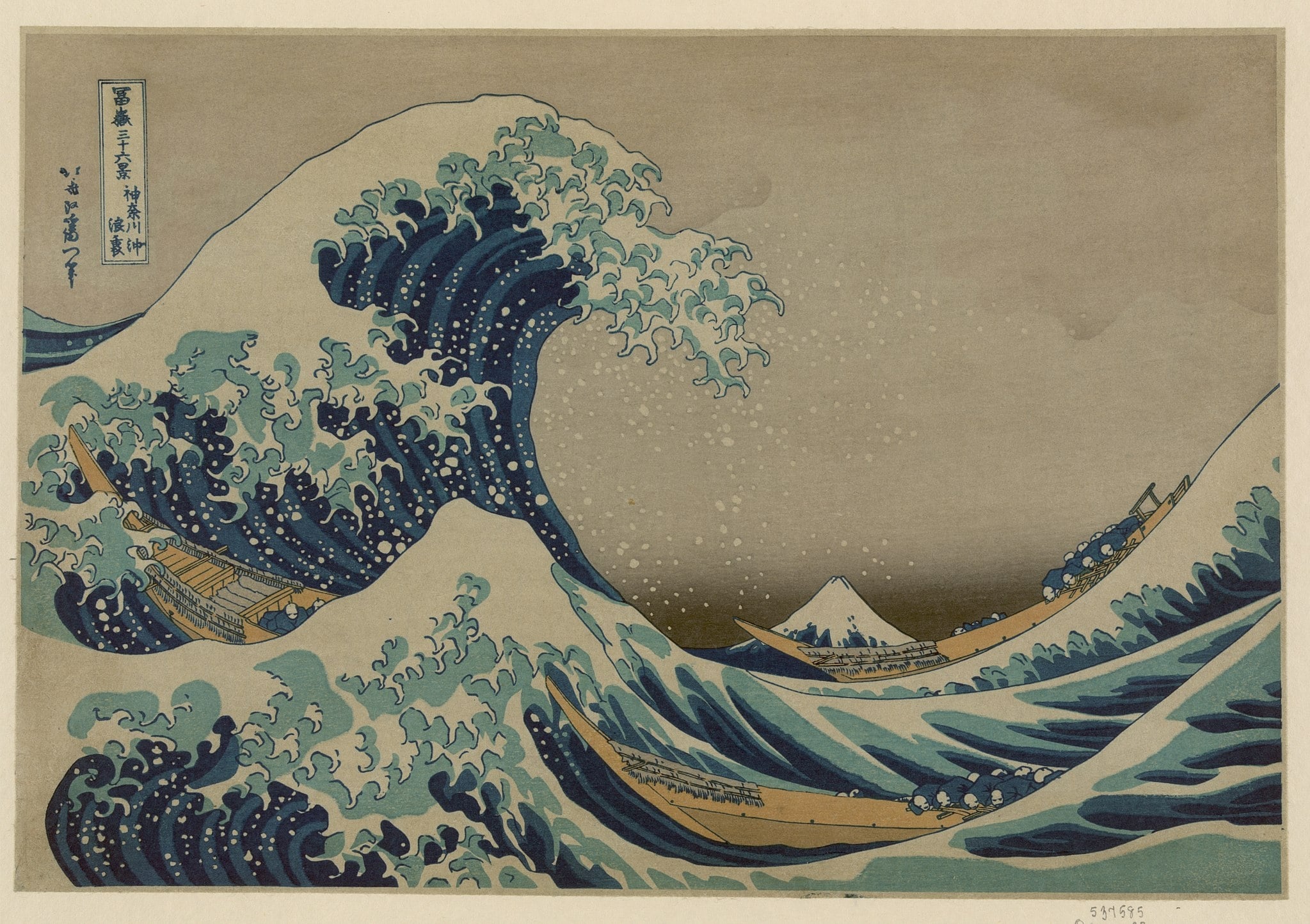
The Great Wave off Kanagawa
Hokusai (ca. 1830–32)
The Great Wave off Kanagawa distills a universal drama: fragile laboring boats face a <strong>towering breaker</strong> while <strong>Mount Fuji</strong> sits small yet immovable. Hokusai wields <strong>Prussian blue</strong> to sculpt depth and cold inevitability, fusing ukiyo‑e elegance with Western perspective to stage nature’s power against human resolve <sup>[1]</sup><sup>[3]</sup>.
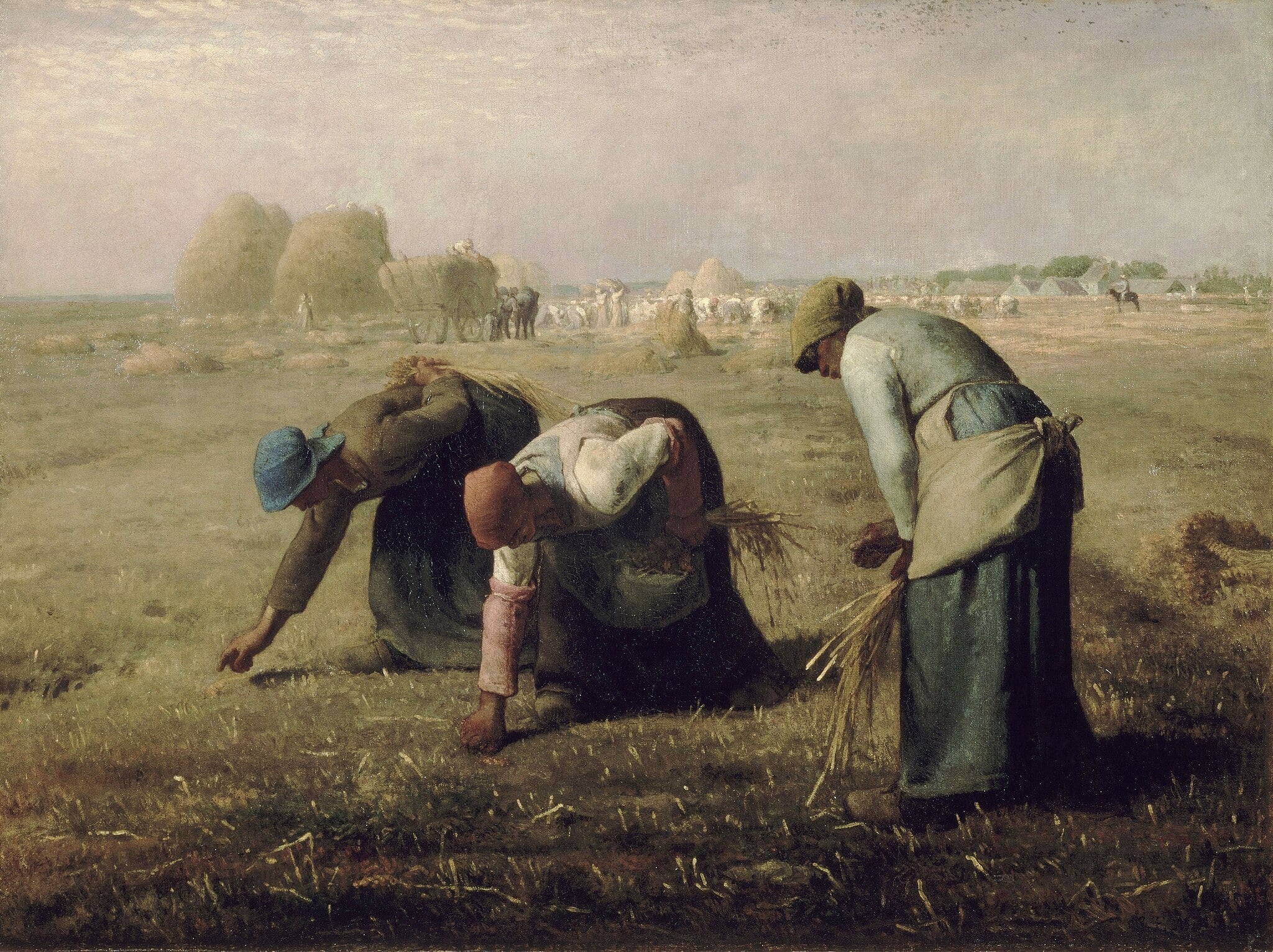
The Gleaners
Jean-Francois Millet (1857)
Three peasant women bend in a solemn rhythm, gleaning leftover stalks under a dry, late-afternoon light. In the far distance, tiny carts, haystacks, and an overseer on horseback signal abundance and authority, while the foreground figures loom with <strong>monumental gravity</strong>, asserting the dignity of labor amid inequality <sup>[1]</sup><sup>[2]</sup>.
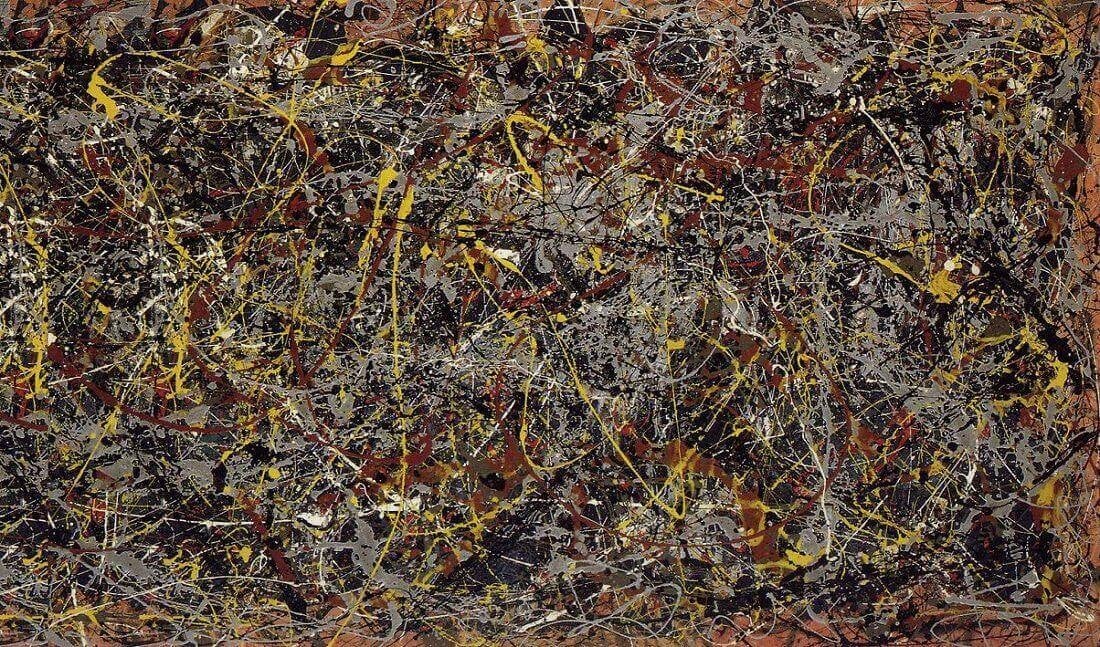
No. 5, 1948
Jackson Pollock (1948)
<strong>No. 5, 1948</strong> is a large, floor‑painted field of poured enamel where tangled skeins of black, gray, umber, and bursts of yellow span the entire support. Its <strong>all‑over</strong> structure rejects a central motif, turning the painting into a record of motion and material behavior. The result is a charged surface that reads as both <strong>image and event</strong> <sup>[1]</sup><sup>[2]</sup><sup>[3]</sup>.
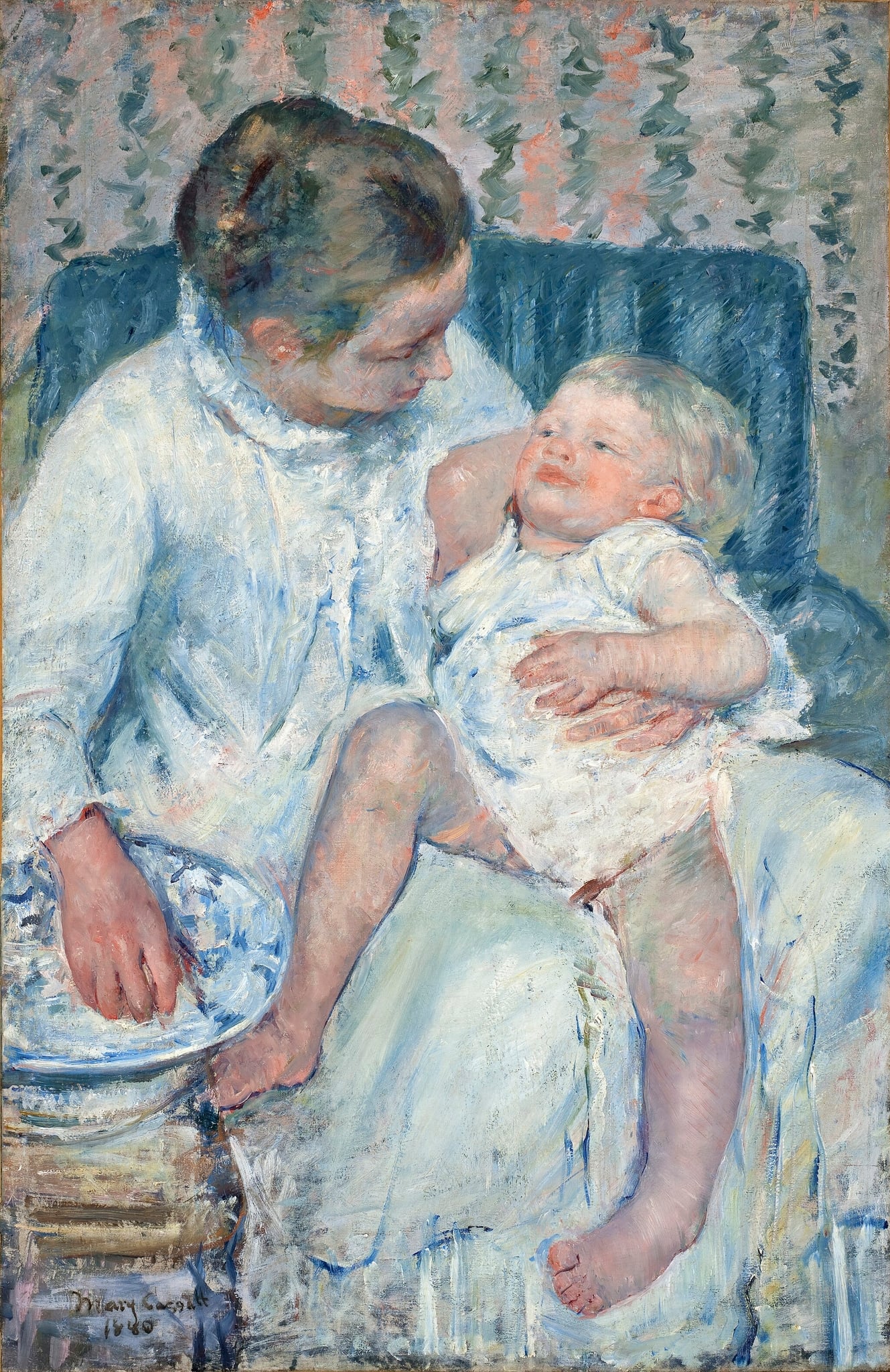
Mother About to Wash Her Sleepy Child
Mary Cassatt (1880)
Mary Cassatt’s Mother About to Wash Her Sleepy Child (1880) turns an ordinary bedtime ritual into a scene of <strong>caregiving, labor, and modern intimacy</strong>. Cropped close, with the child’s legs diagonally splayed and a tilted washbowl at the mother’s knee, the picture translates domestic routine into a <strong>modern Madonna</strong> for the bourgeois interior. Its flickering blues and milky whites, plus patterned upholstery and wallpaper, signal Cassatt’s <strong>Impressionist</strong> and japonisme-inflected design sense <sup>[2]</sup>.
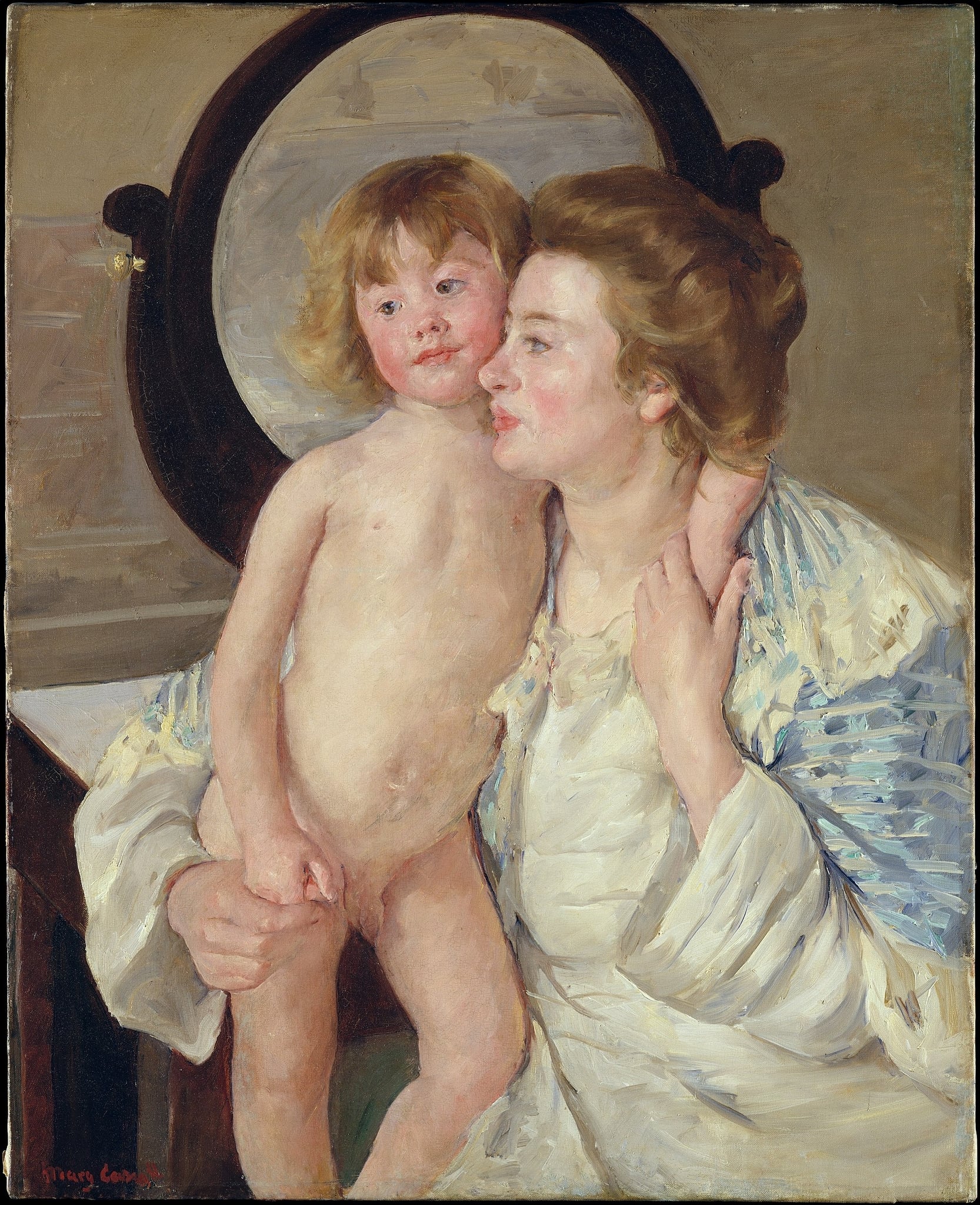
Mother and Child (The Oval Mirror)
Mary Cassatt (ca. 1899)
Mary Cassatt’s Mother and Child (The Oval Mirror) turns a routine act of care into a <strong>modern icon</strong>. An oval mirror <strong>haloes</strong> the child while interlaced hands and close bodies make <strong>touch</strong> the vehicle of meaning <sup>[1]</sup><sup>[3]</sup>.
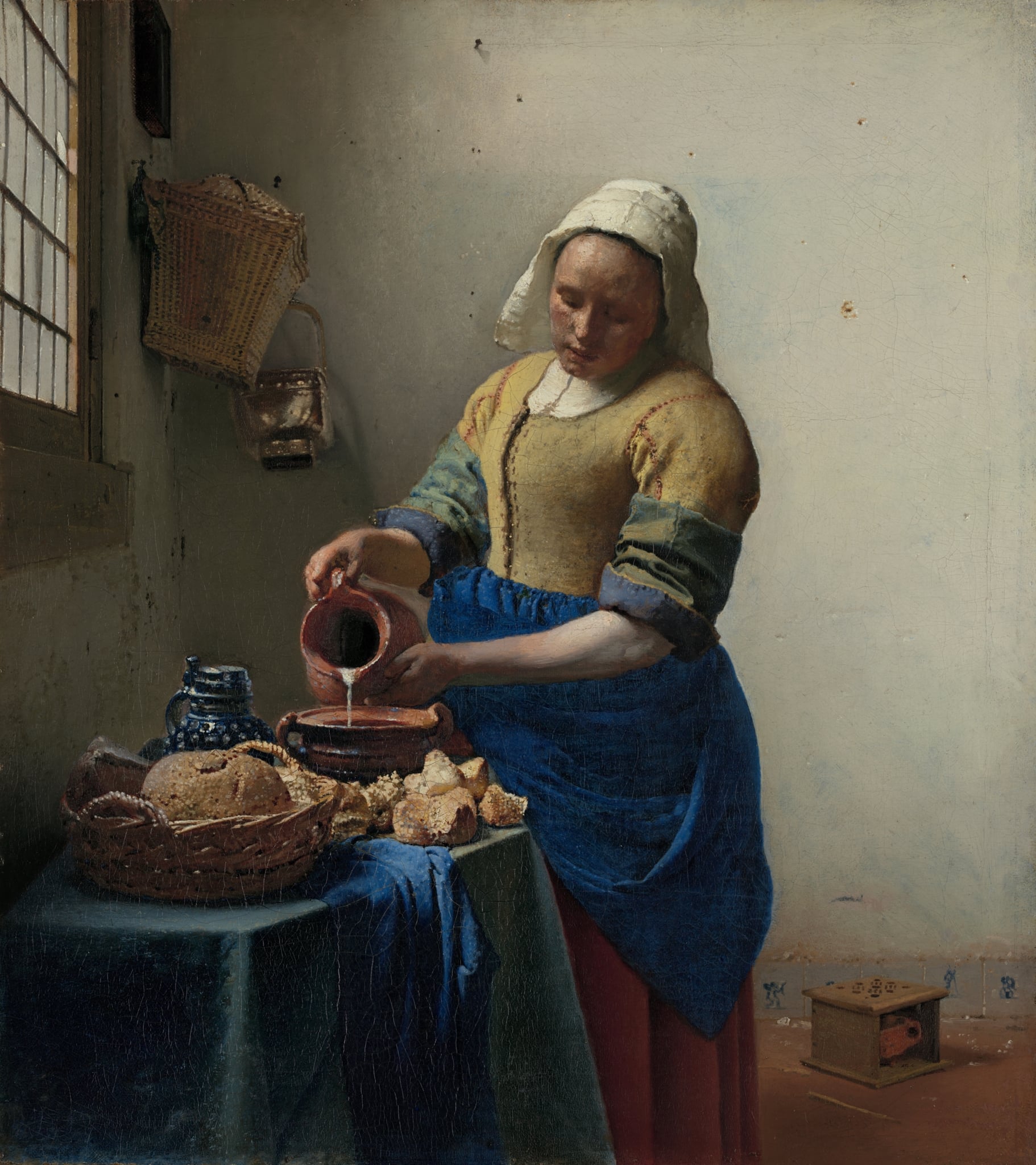
The Milkmaid
Johannes Vermeer (c. 1660)
In The Milkmaid, Vermeer turns an ordinary act—pouring milk—into a scene of <strong>quiet monumentality</strong>. Light from the left fixes the maid’s absorbed attention and ignites the <strong>saturated yellow and blue</strong> of her dress, while the slow thread of milk becomes the image’s pulse <sup>[1]</sup><sup>[2]</sup>. Bread, a Delft jug, nail holes, and a small <strong>foot warmer</strong> anchor a world where humble work is endowed with dignity and latent meaning <sup>[1]</sup><sup>[2]</sup>.
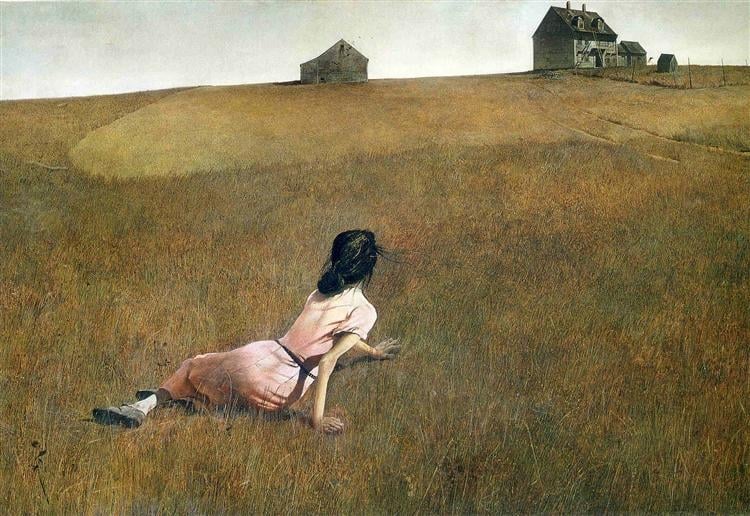
Christina's World
Andrew Wyeth (1948)
Andrew Wyeth’s Christina’s World distills vast rural space and human resolve into a single, charged image: a woman in a <strong>faded pink dress</strong> braces on the <strong>up-slope</strong> toward a weathered farmhouse. The diagonal pull between her body and the <strong>Olson House</strong> turns distance itself into <strong>yearning and endurance</strong> <sup>[1]</sup><sup>[4]</sup>. Wyeth’s spare, <strong>egg tempera</strong> surface makes every brittle grass blade feel like an act of will <sup>[1]</sup><sup>[3]</sup>.
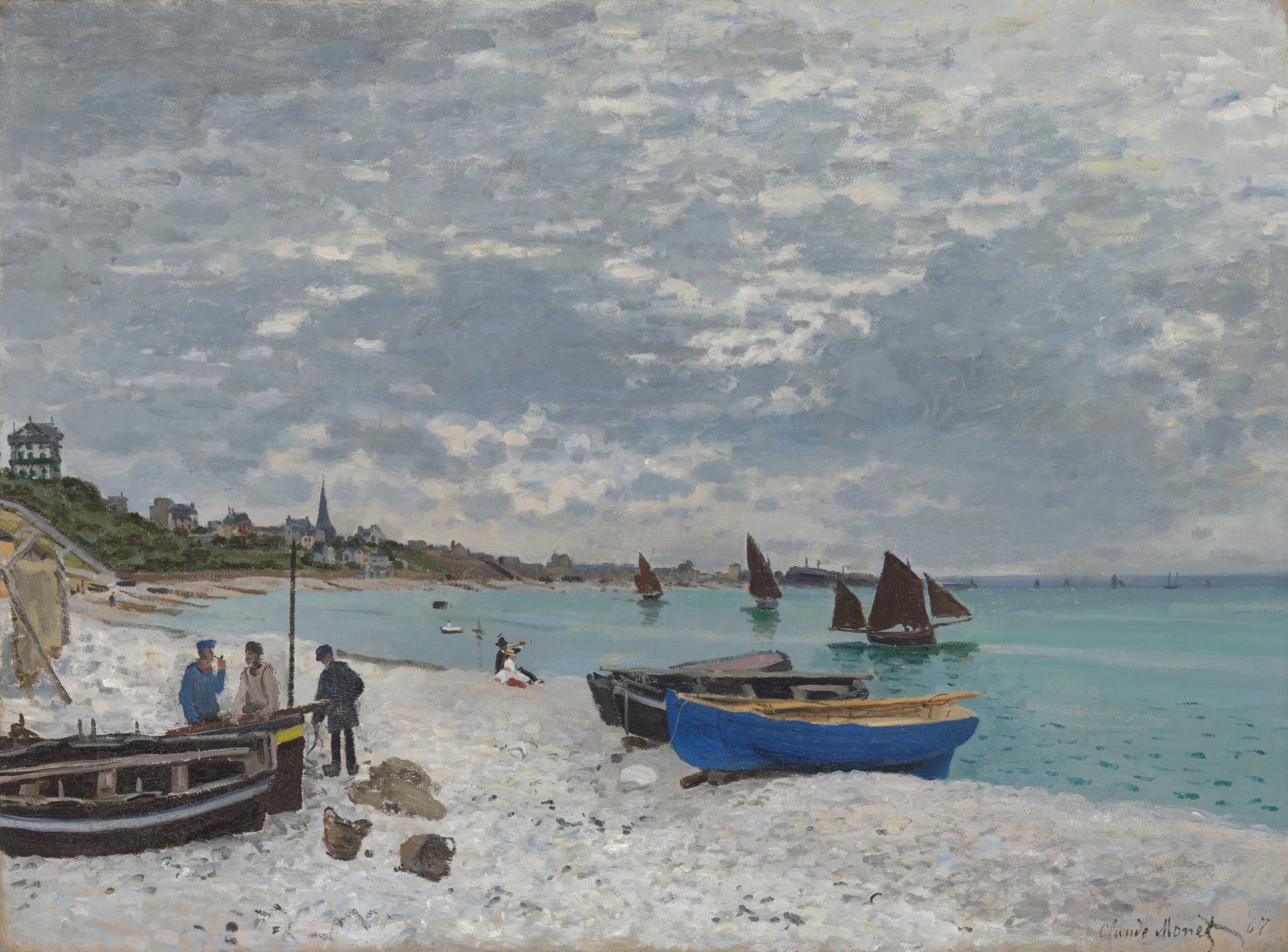
The Beach at Sainte-Adresse
Claude Monet (1867)
In The Beach at Sainte-Adresse, Claude Monet stages a modern shore where <strong>labor and leisure intersect</strong> under a broad, changeable sky. The bright <strong>blue beached boat</strong> and the flotilla of <strong>rust-brown working sails</strong> punctuate a turquoise channel, while a fashionably dressed pair sits mid-beach, spectators to the traffic of the port. Monet’s brisk, broken strokes make the scene feel <strong>caught between tides and weather</strong>, a momentary balance of work, tourism, and atmosphere <sup>[1]</sup><sup>[2]</sup>.
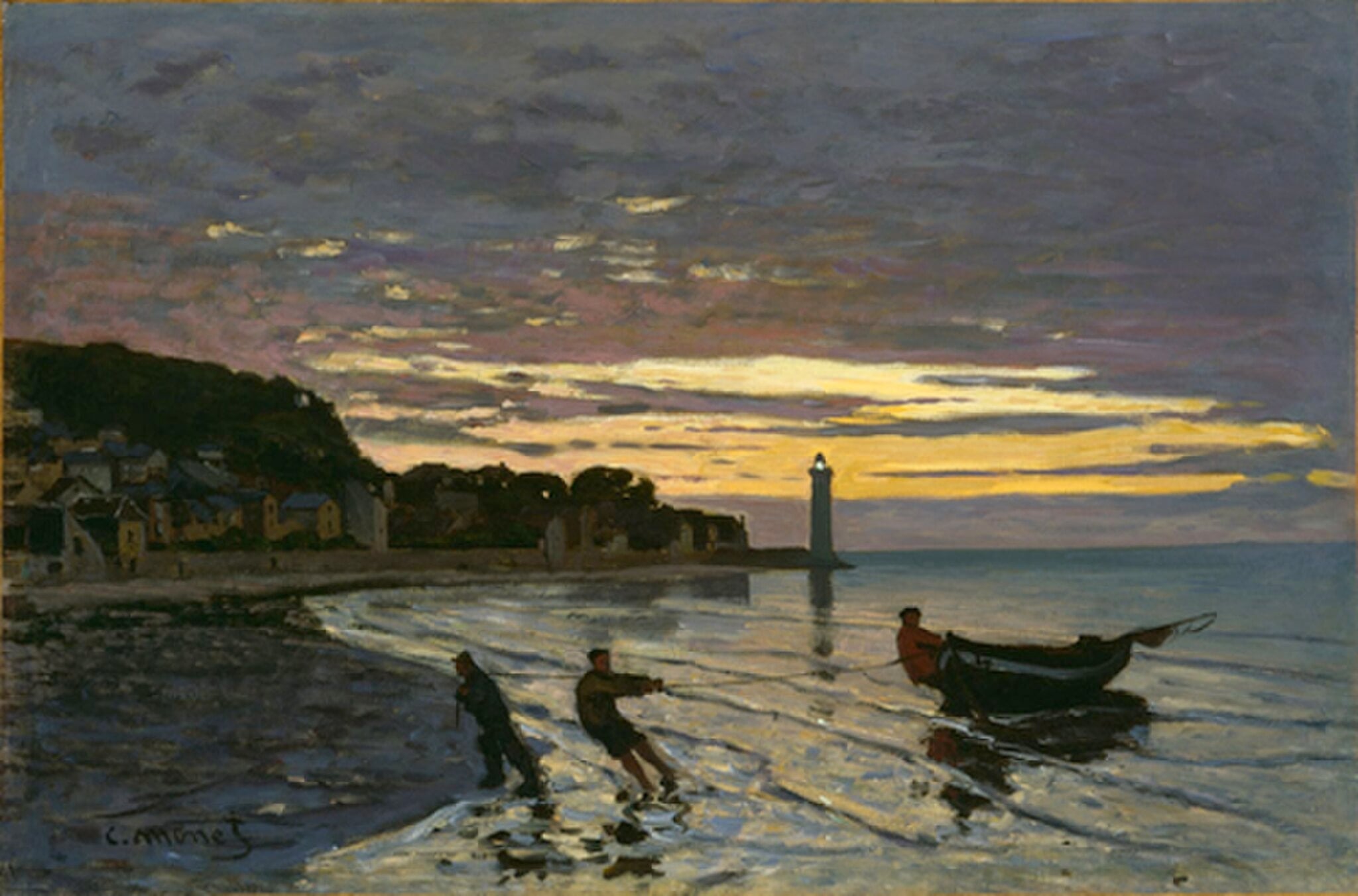
Towing a Boat, Honfleur
Claude Monet (1864)
Claude Monet’s Towing a Boat, Honfleur frames coastal labor against a dusk of <strong>fugitive light</strong> and <strong>reflective sands</strong>, where three figures strain on taut ropes as a lighthouse holds steady on the horizon. The canvas turns a routine task into a meditation on <strong>endurance, guidance, and time’s passage</strong>.
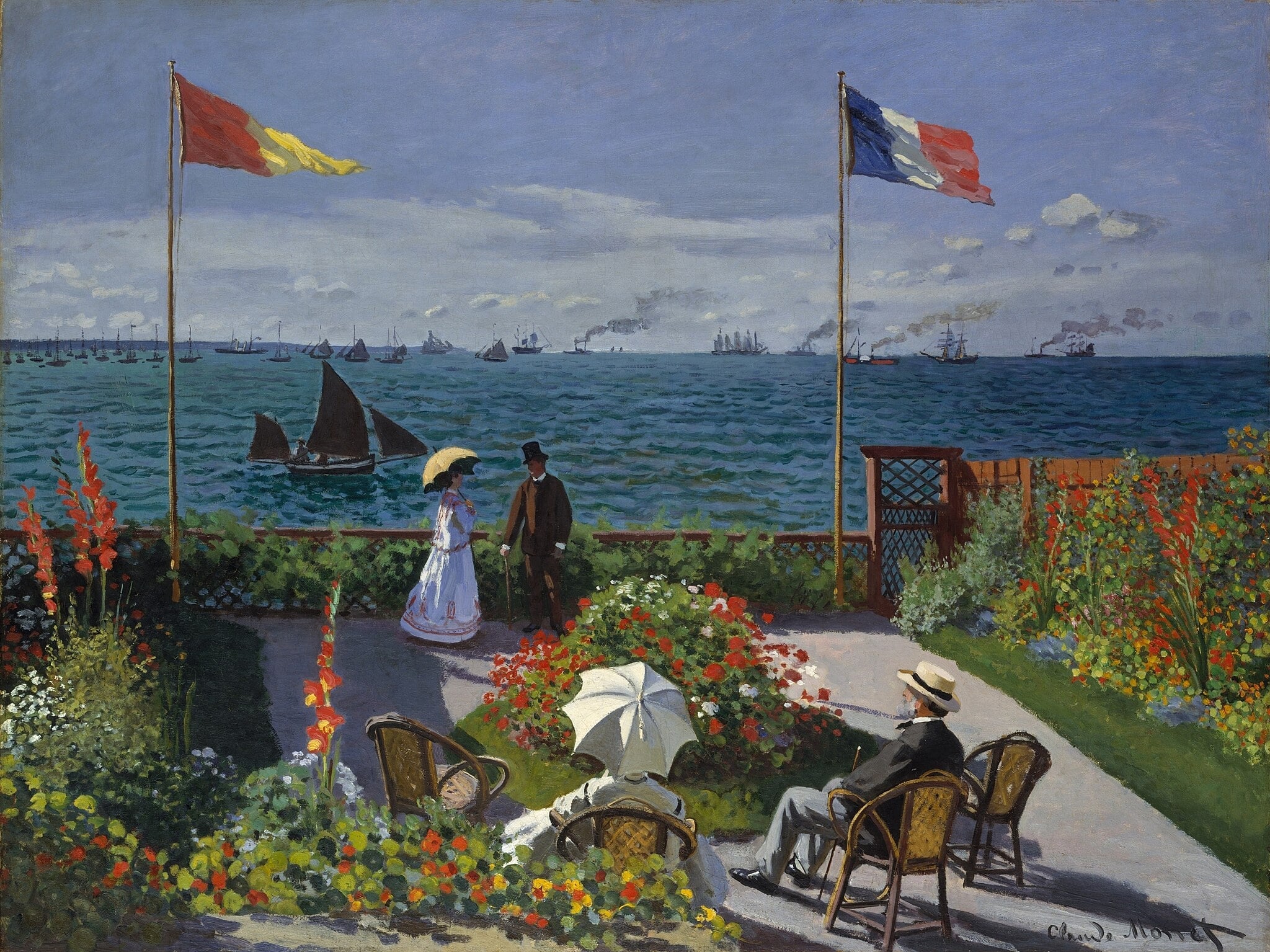
Garden at Sainte-Adresse
Claude Monet (1867)
<strong>Garden at Sainte-Adresse</strong> distills a breezy seaside terrace into a lucid design of color bands and flagpoles, where private leisure meets a busy, modern harbor. Claude Monet binds <strong>bourgeois ease</strong> (wicker chairs, parasol, promenade) to <strong>national and nautical identity</strong> (the French tricolor and a regatta/signal pennant) while sail and steam share the channel. Light and wind animate every element, turning a family terrace into a statement about modern life and its swift transitions <sup>[1]</sup><sup>[3]</sup><sup>[5]</sup>.
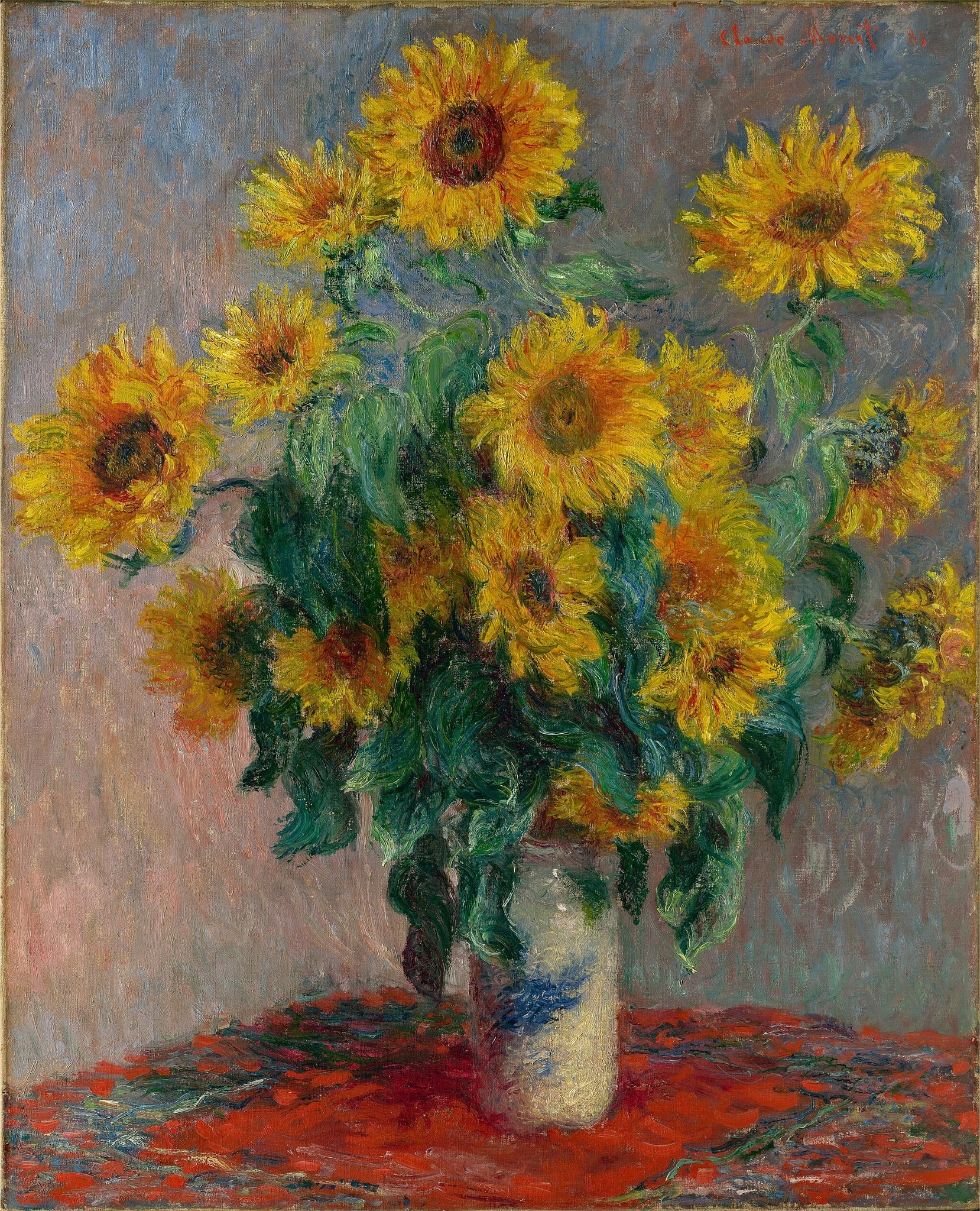
Bouquet of Sunflowers
Claude Monet (1881)
Claude Monet’s Bouquet of Sunflowers detonates with <strong>solar color</strong> and <strong>restless brushwork</strong>: yellow heads flare from a pale vase, thrust forward by a blazing red cloth against a cool, lilac‑gray wall. The painting converts a domestic bouquet into an arena where <strong>light, time, and touch</strong> supersede contour, staging blooms from vigor to fray in a single, pulsing image <sup>[1]</sup><sup>[2]</sup>.
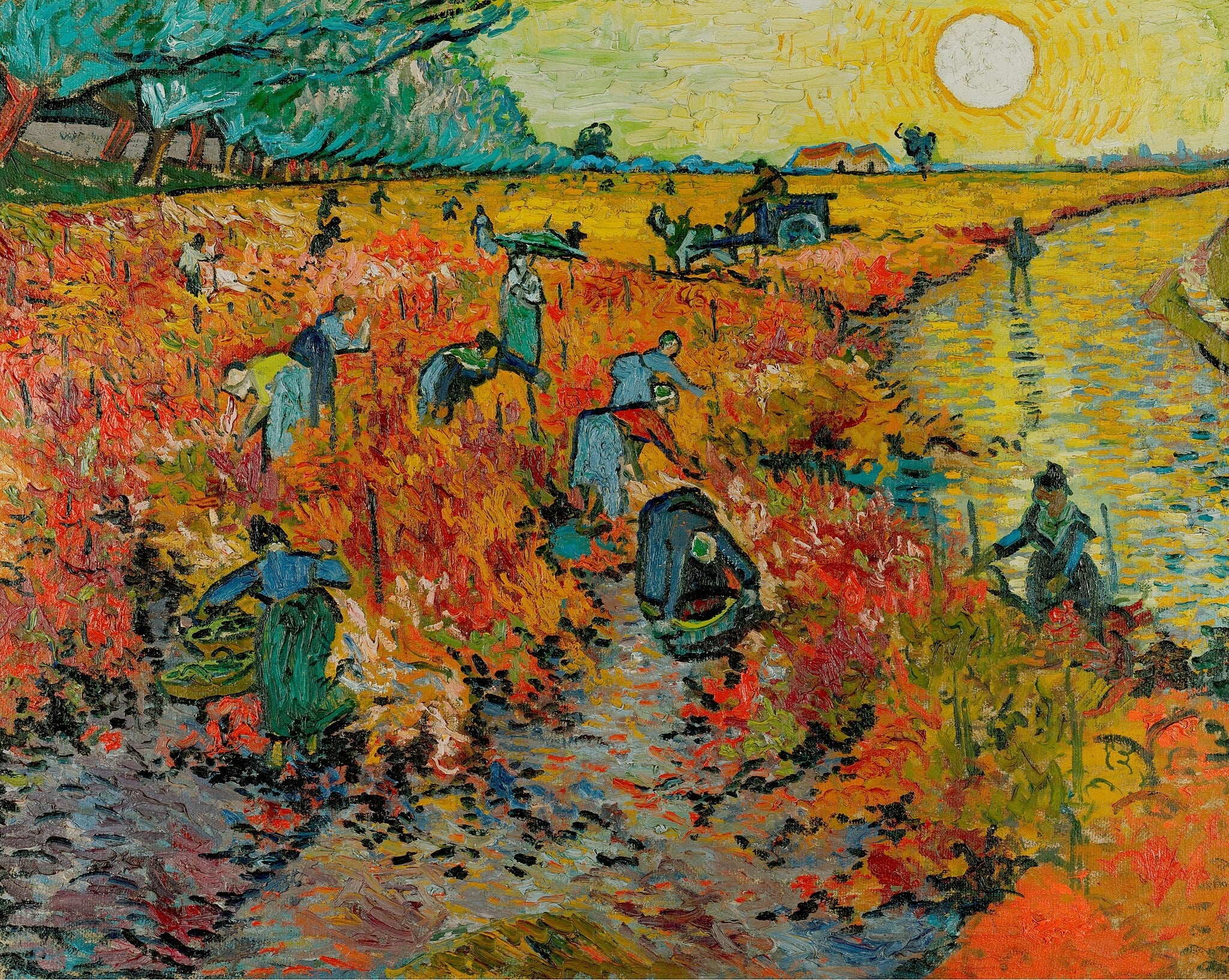
The Red Vineyard
Vincent van Gogh (1888)
In The Red Vineyard, Vincent van Gogh forges a vision of <strong>autumn labor under a blazing sun</strong>, where harvesters flow diagonally through scarlet vines while a band of <strong>yellow light</strong> flares along a reflective roadway. The scene fuses <strong>exhaustion and ripeness</strong>, turning work into a rhythmic, almost liturgical procession <sup>[1]</sup><sup>[3]</sup>.
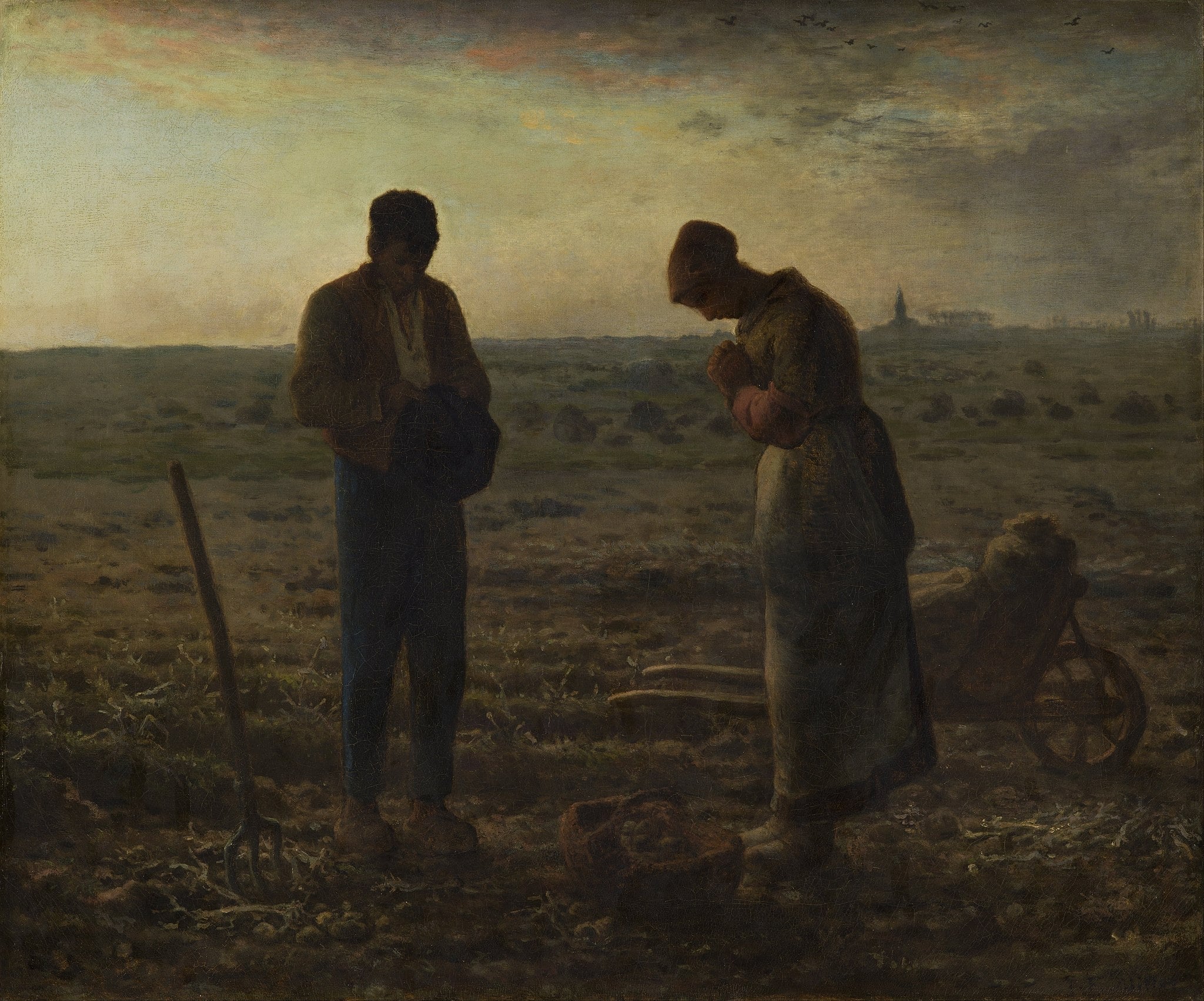
The Angelus
Jean-Francois Millet (1857–1859)
Jean-Francois Millet’s The Angelus (1857–1859) fuses <strong>devotion</strong> and <strong>labor</strong>: two peasants pause at dusk, heads bowed, as the Angelus bell sounds from a distant steeple. With a <strong>low horizon</strong>, earthen palette, and monumental silhouettes, the painting makes a brief pause in fieldwork feel timeless and sacred <sup>[1]</sup><sup>[2]</sup>.
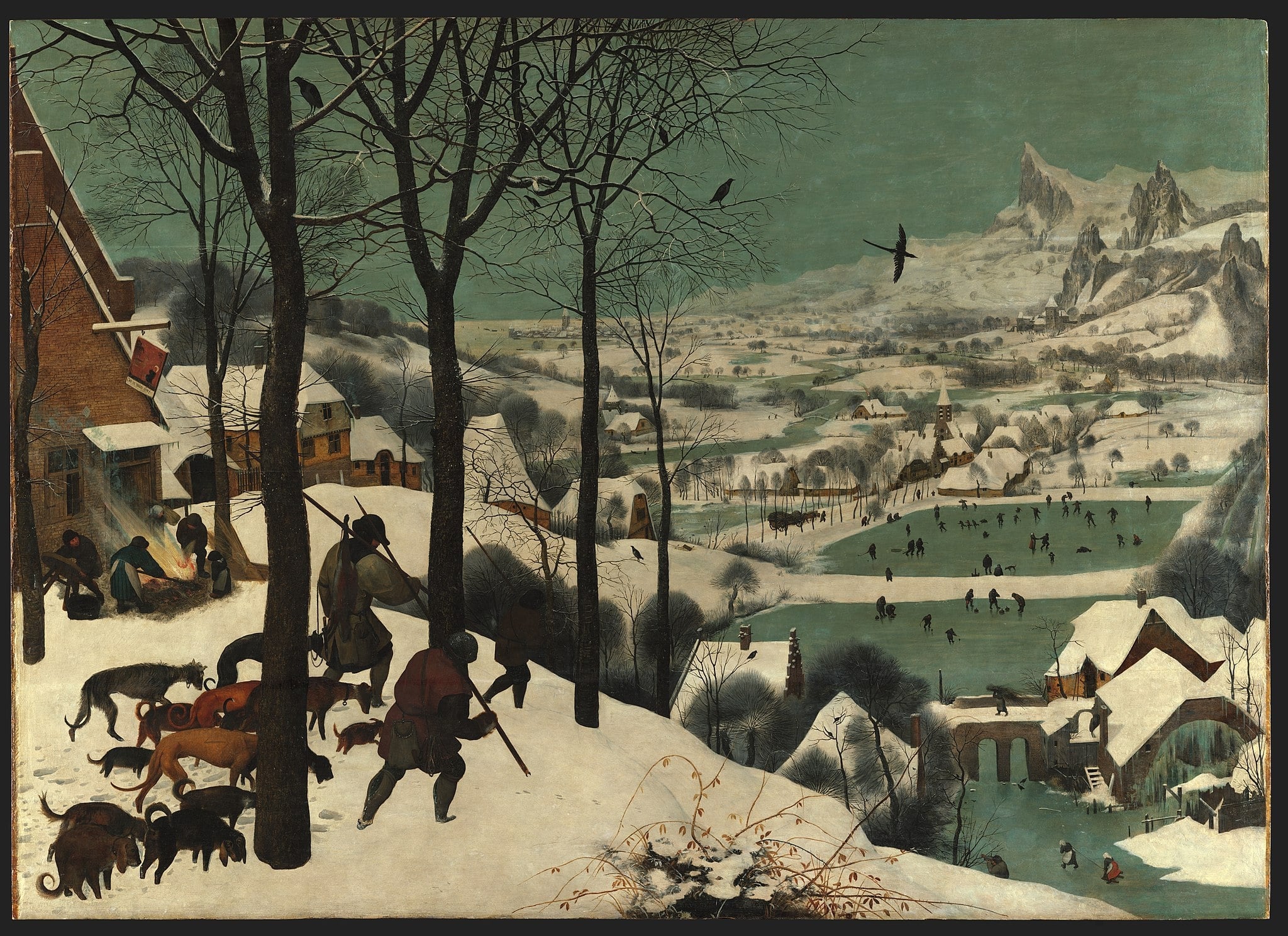
The Return of the Hunters
Pieter Bruegel the Elder (1565)
In The Return of the Hunters, Pieter Bruegel the Elder stages a wintry descent where three exhausted hunters and their dogs enter a valley alive with skaters and village chores. The painting forges a panoramic drama of <strong>hardship and resilience</strong>, contrasting scant game with communal play beneath a cold, teal sky <sup>[1]</sup><sup>[2]</sup>.
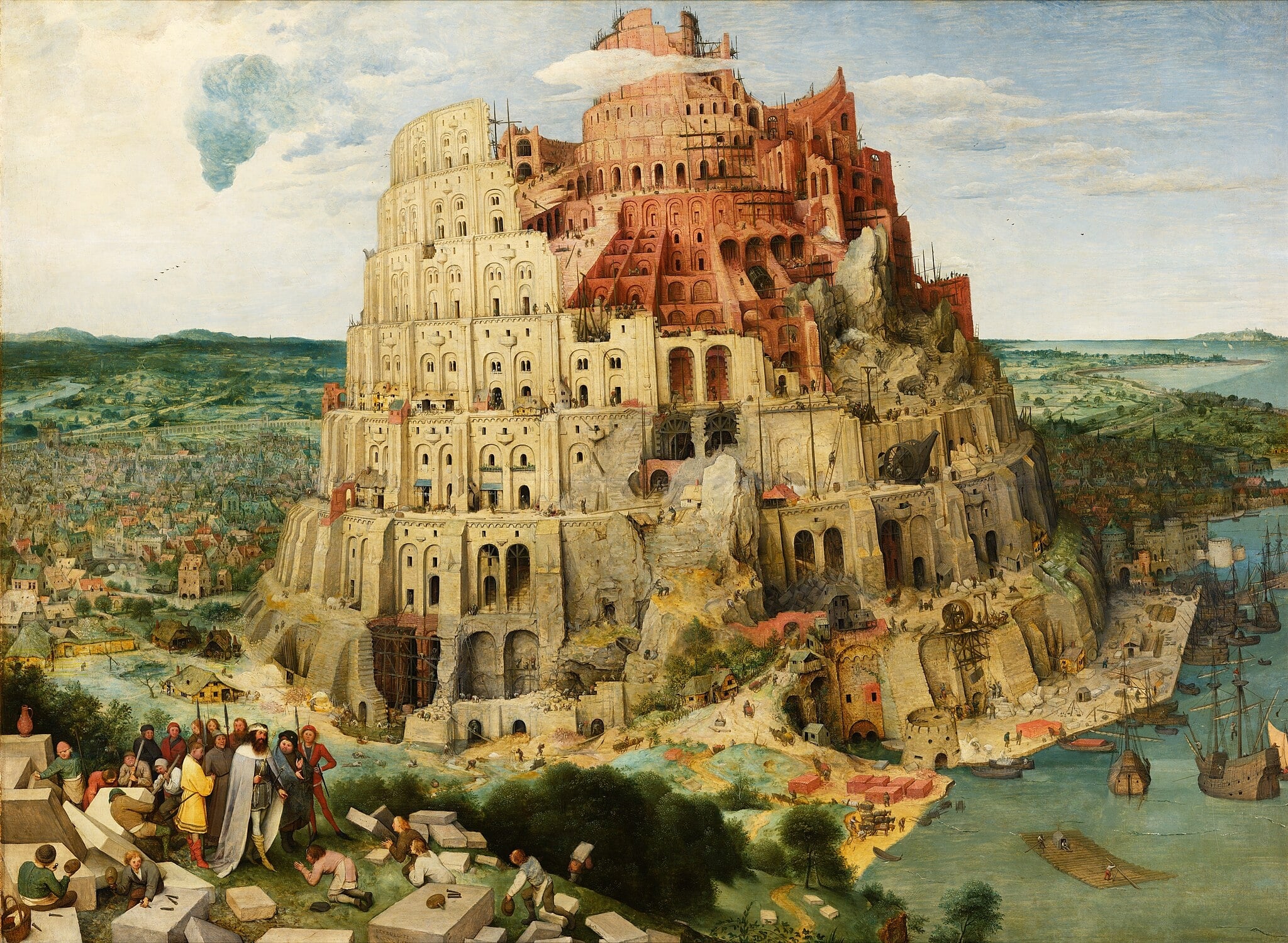
The Tower of Babel
Pieter Bruegel the Elder (1563)
In The Tower of Babel, Pieter Bruegel the Elder stages a spiraling, Roman‑style colossus whose arches, cranes, and swarming labor proclaim <strong>human industry</strong> even as cracked foundations and misaligned tiers foretell <strong>collapse</strong>. The pale, orderly left flank opposes the raw red masonry at right, while a ruler (often read as <strong>Nimrod</strong>) inspects kneeling builders before a bustling Flemish harbor—an image of ambition already undermined from within <sup>[1]</sup>.
The Peasant Wedding
Pieter Bruegel the Elder (1568)
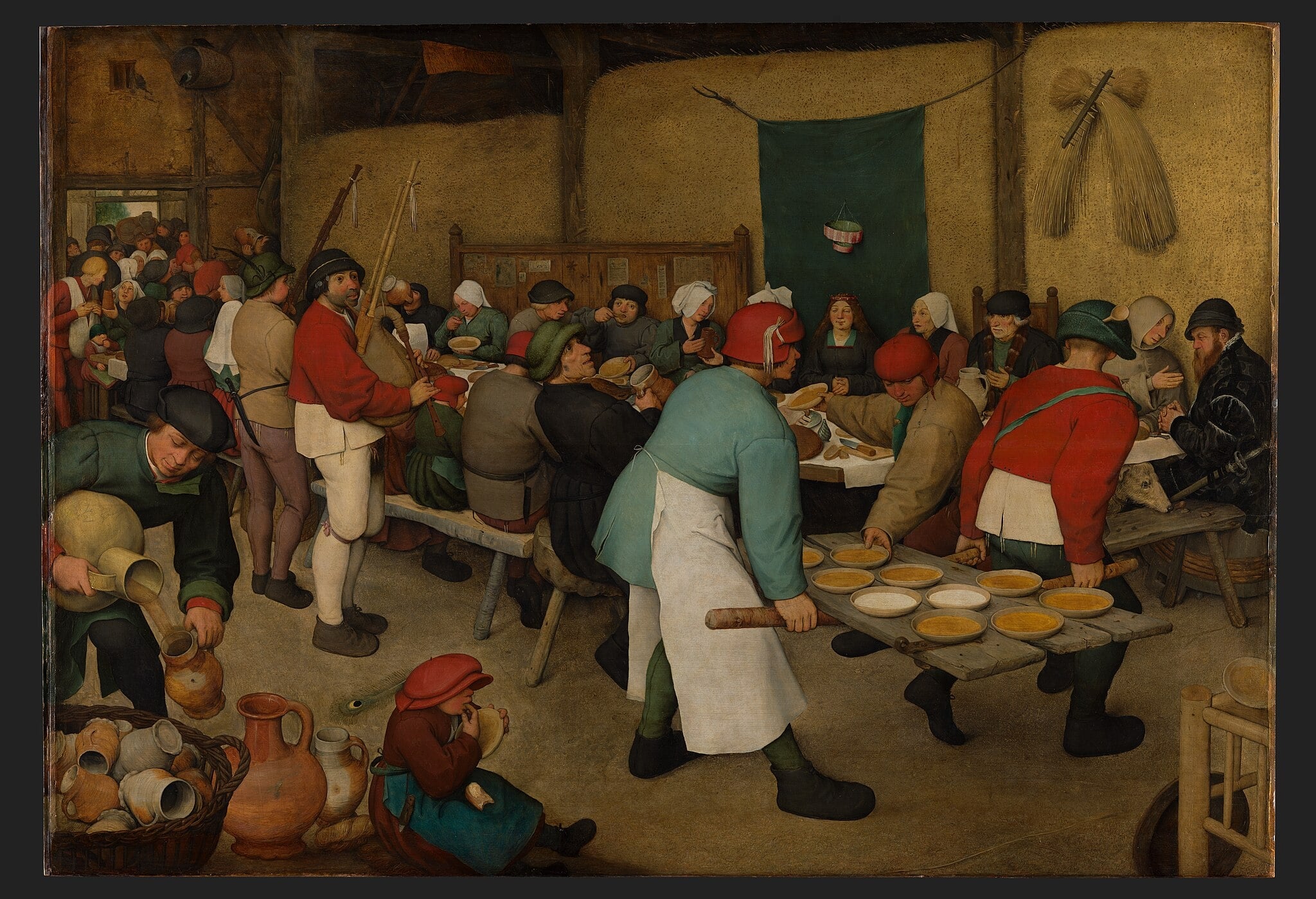
In The Peasant Wedding, Pieter Bruegel the Elder stages a <strong>communal rite</strong> inside a barn, where humble ingenuity and shared labor become the true spectacle. A bride sits beneath a <strong>green cloth of honor</strong> with a paper crown above, as servers balance bowls of porridge on a <strong>door turned into a tray</strong>, beer flows, and a bagpiper looks on <sup>[1]</sup><sup>[2]</sup>.
Hunters in the Snow
Pieter Bruegel the Elder (1565)
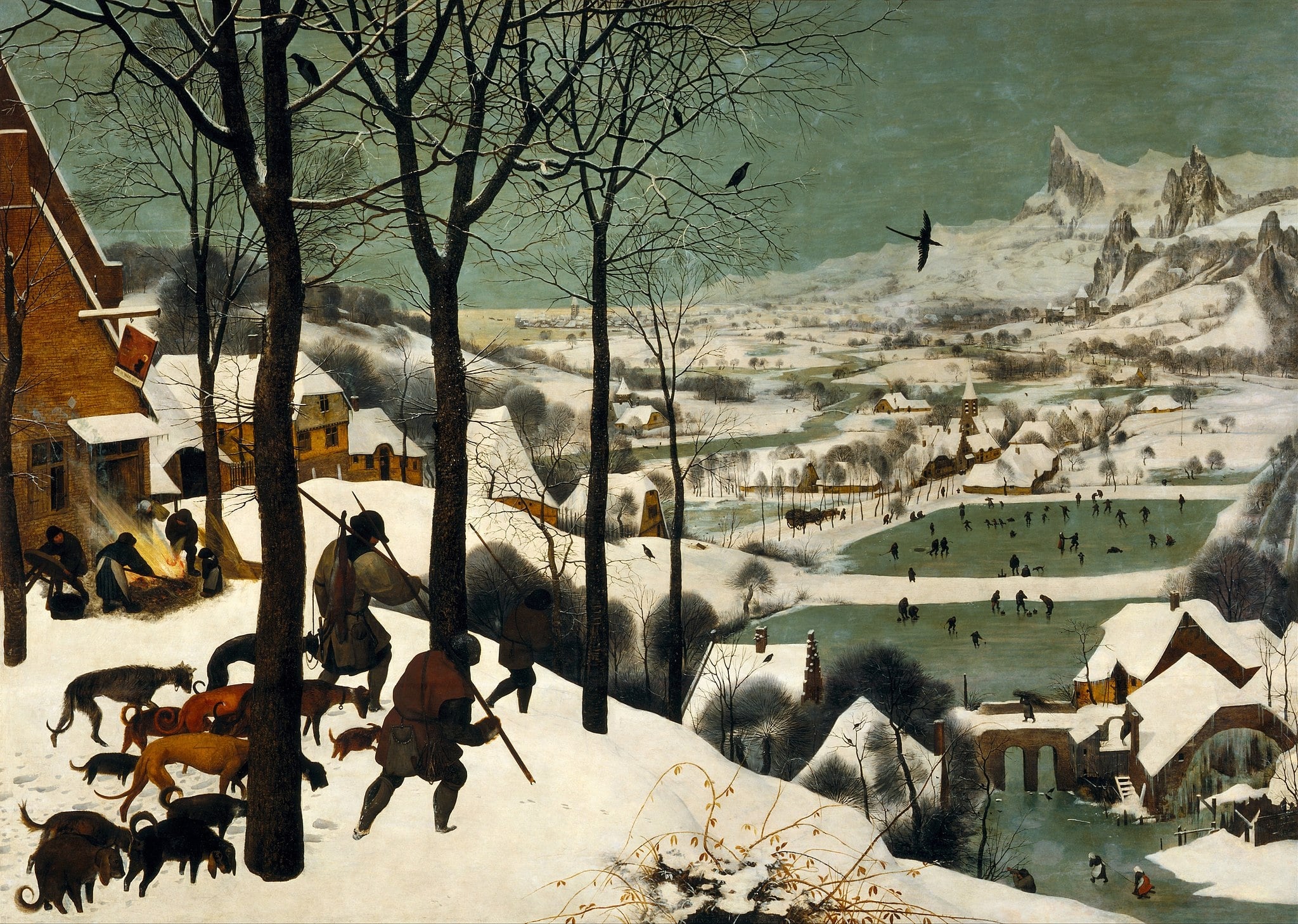
In Pieter Bruegel the Elder’s <strong>Hunters in the Snow</strong> (1565), a trio of tired hunters and <strong>gaunt dogs</strong> descend past an inn toward a vast frozen valley where villagers <strong>work, play, and endure</strong>. Bruegel fuses <strong>winter scarcity</strong> (a single fox, bare trees, crows) with <strong>communal resilience</strong> (pig-singeing fire, skaters, mill smoke) to stage a world ordered by the season’s cycle.
Bathers at La Grenouillère
Claude Monet (1869)
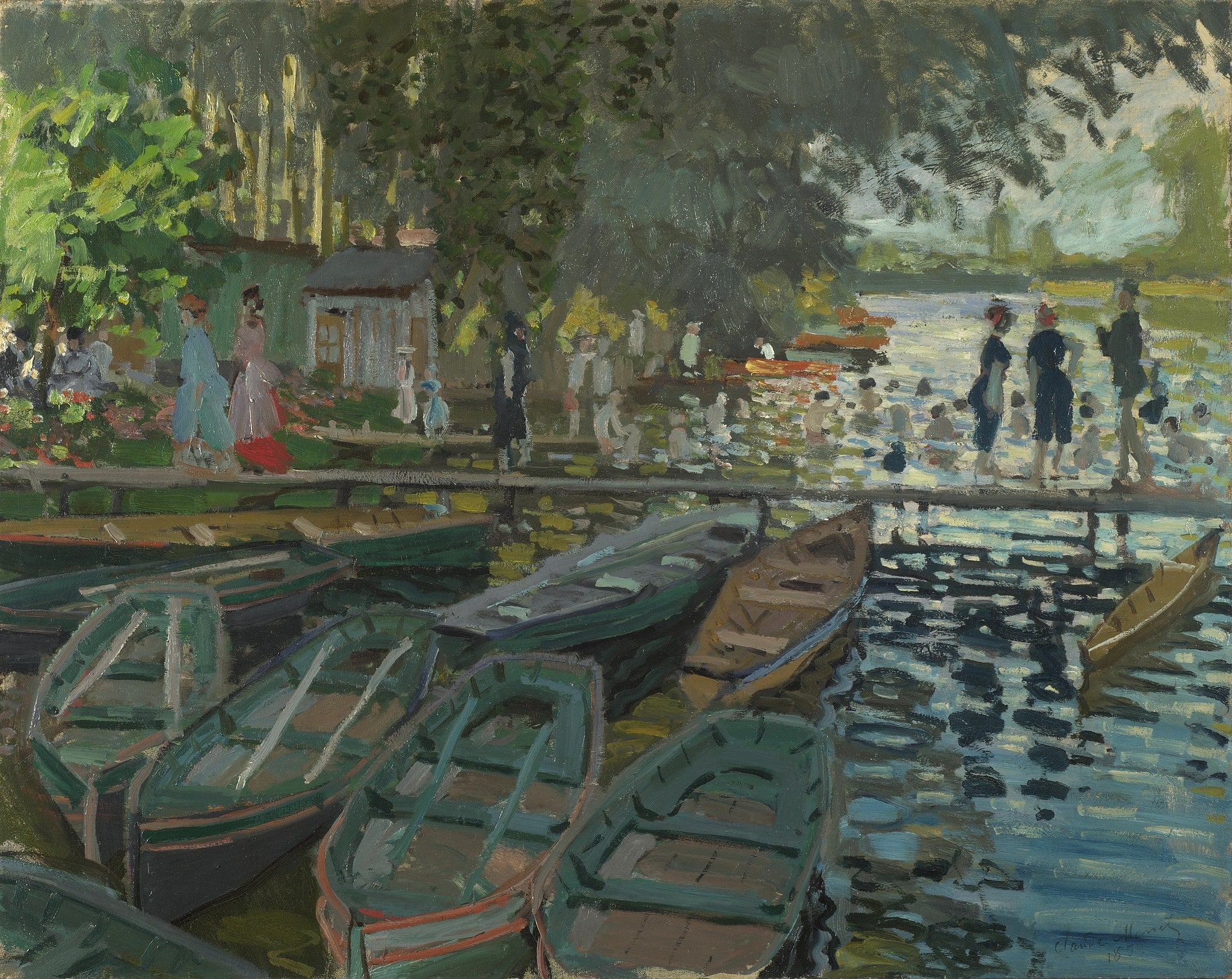
Claude Monet’s Bathers at La Grenouillère stages modern leisure on the Seine as a theater of <strong>light, motion, and sociability</strong>. Foregrounded green rowboats, a narrow footbridge, and clustered bathers turn the resort’s engineered setting into a manifesto for <strong>on‑the‑spot vision</strong> and the fleeting present <sup>[1]</sup>. Painted outdoors in 1869 with rapid strokes, it crystallizes the emergence of <strong>Impressionism</strong> <sup>[1]</sup>.
Snow Scene at Argenteuil
Claude Monet (1875)
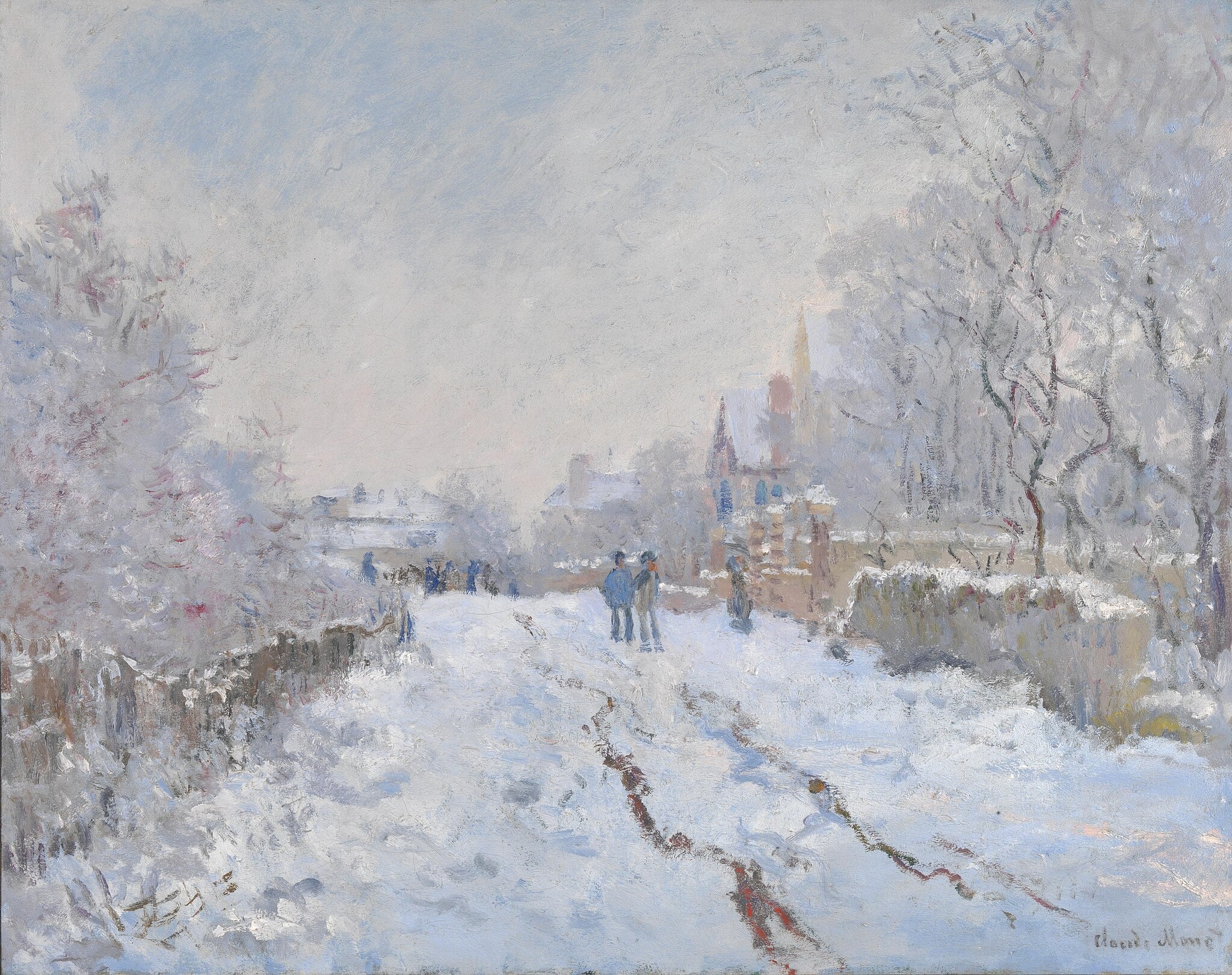
Claude Monet’s Snow Scene at Argenteuil distills a winter afternoon into a field of shimmering perception, where <strong>air, light, and snow</strong> merge. Russet cart tracks vein the road while <strong>blue‑grey figures</strong> drift toward a misted <strong>church spire</strong>, binding ordinary movement to a larger atmospheric whole.
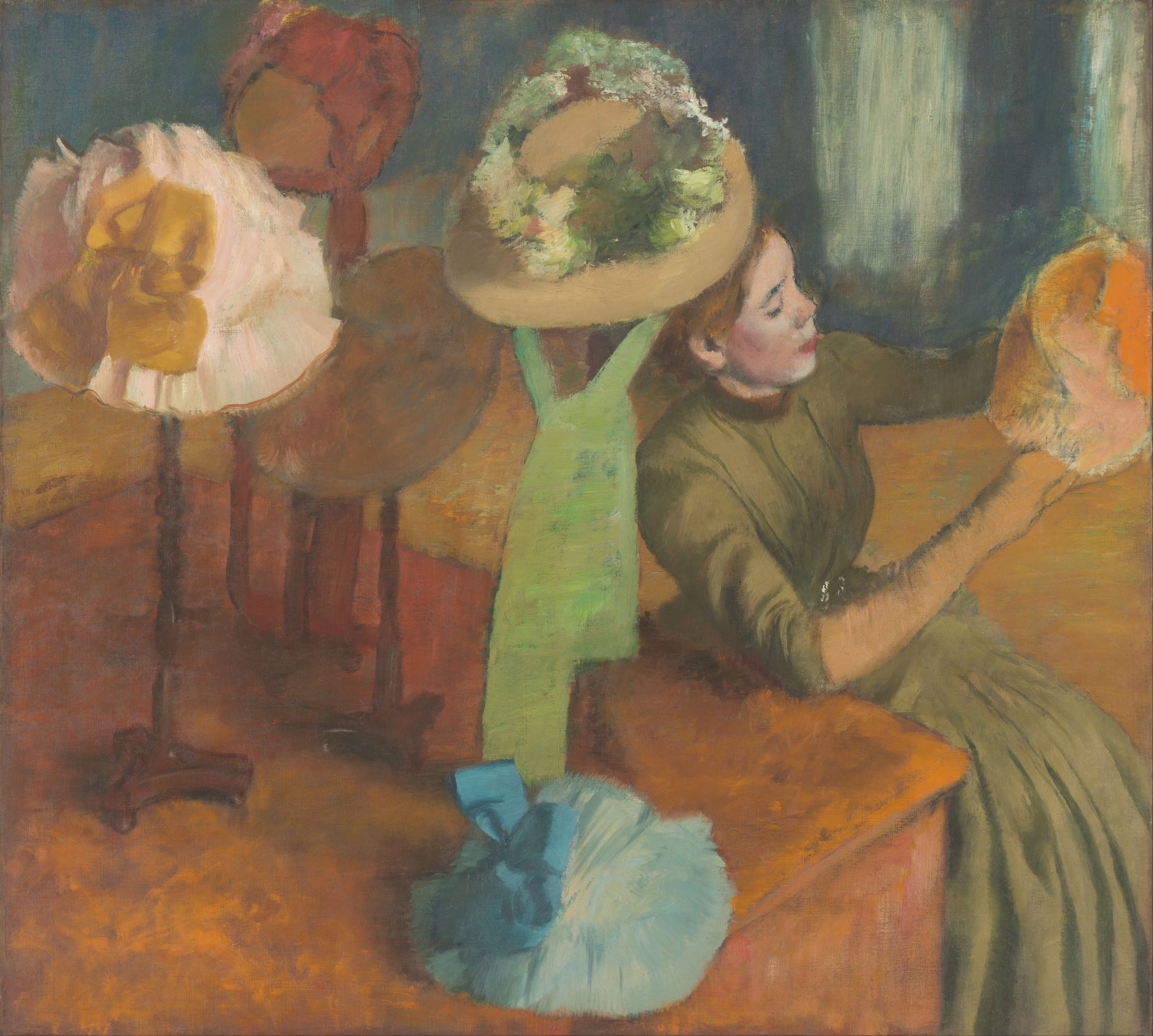
The Millinery Shop
Edgar Degas (1879–1886)
Edgar Degas’s The Millinery Shop stages modern Paris through a quiet act of <strong>work</strong> rather than display. A young woman, cropped in profile, studies a glowing <strong>orange hat</strong> while faceless stands crowned with ribbons and plumes press toward the picture plane. Degas turns a boutique into a meditation on <strong>labor, commodities, and identity</strong> <sup>[1]</sup><sup>[2]</sup>.
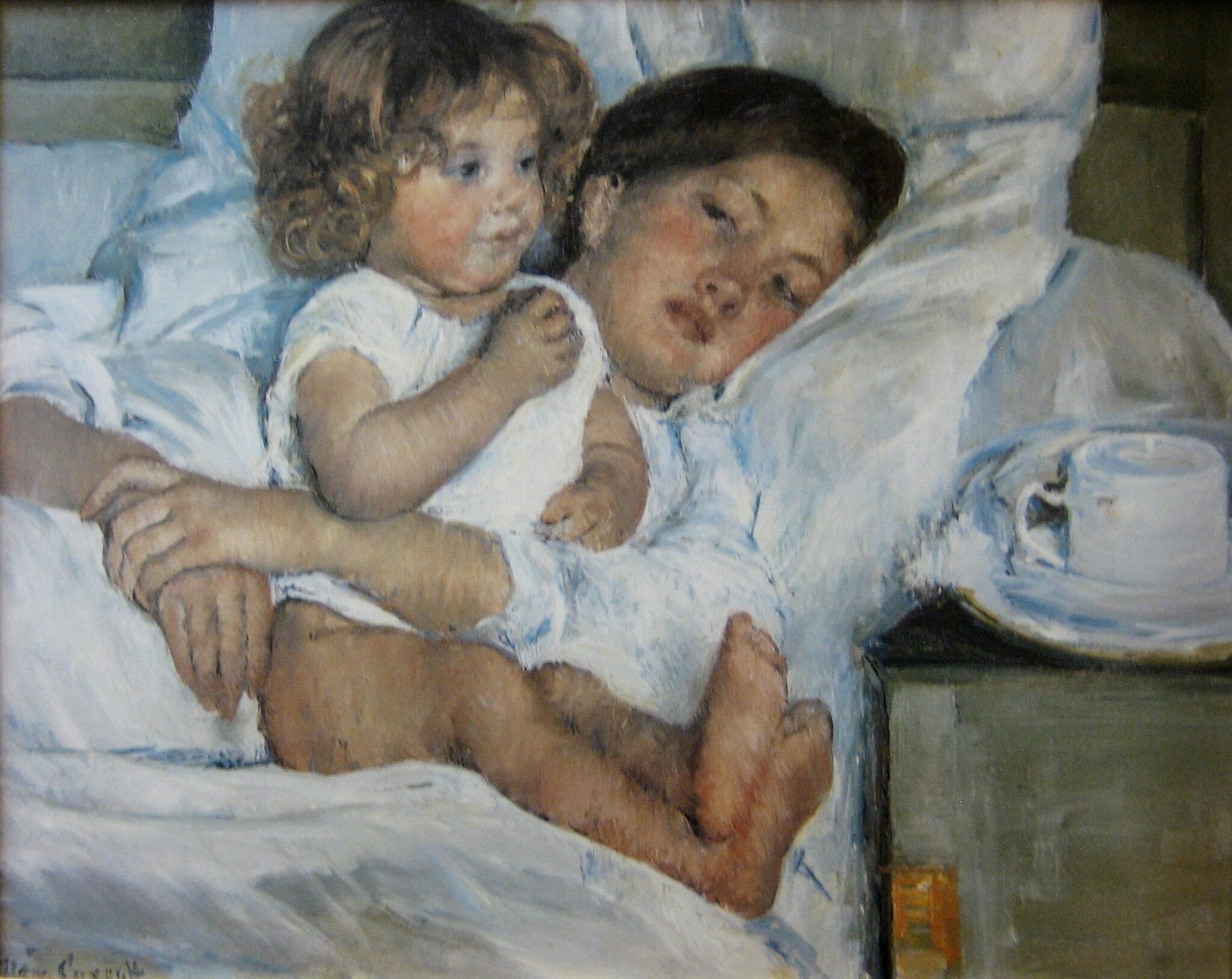
Breakfast in Bed
Mary Cassatt (1897)
Breakfast in Bed distills a <strong>tender modern intimacy</strong> into a tightly cropped sanctuary of rumpled white linens, protective embrace, and interrupted routine. Mary Cassatt uses <strong>cool light</strong> against <strong>warm flesh</strong> to anchor attention on the mother’s encircling arm and the child’s outward gaze, fusing care, curiosity, and the rhythms of <strong>everyday modern life</strong> <sup>[1]</sup><sup>[2]</sup>.
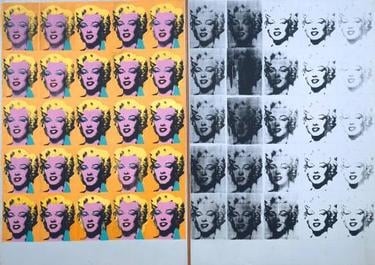
Marilyn Diptych
Andy Warhol (1962)
Marilyn Diptych crystallizes the paradox of fame: <strong>dazzling allure</strong> and <strong>inevitable decay</strong>. Warhol’s 50 repeated silkscreens—color at left, fading grayscale at right—turn a movie-star headshot into a mass-produced <strong>icon</strong> and a memento of mortality <sup>[1]</sup><sup>[2]</sup>.
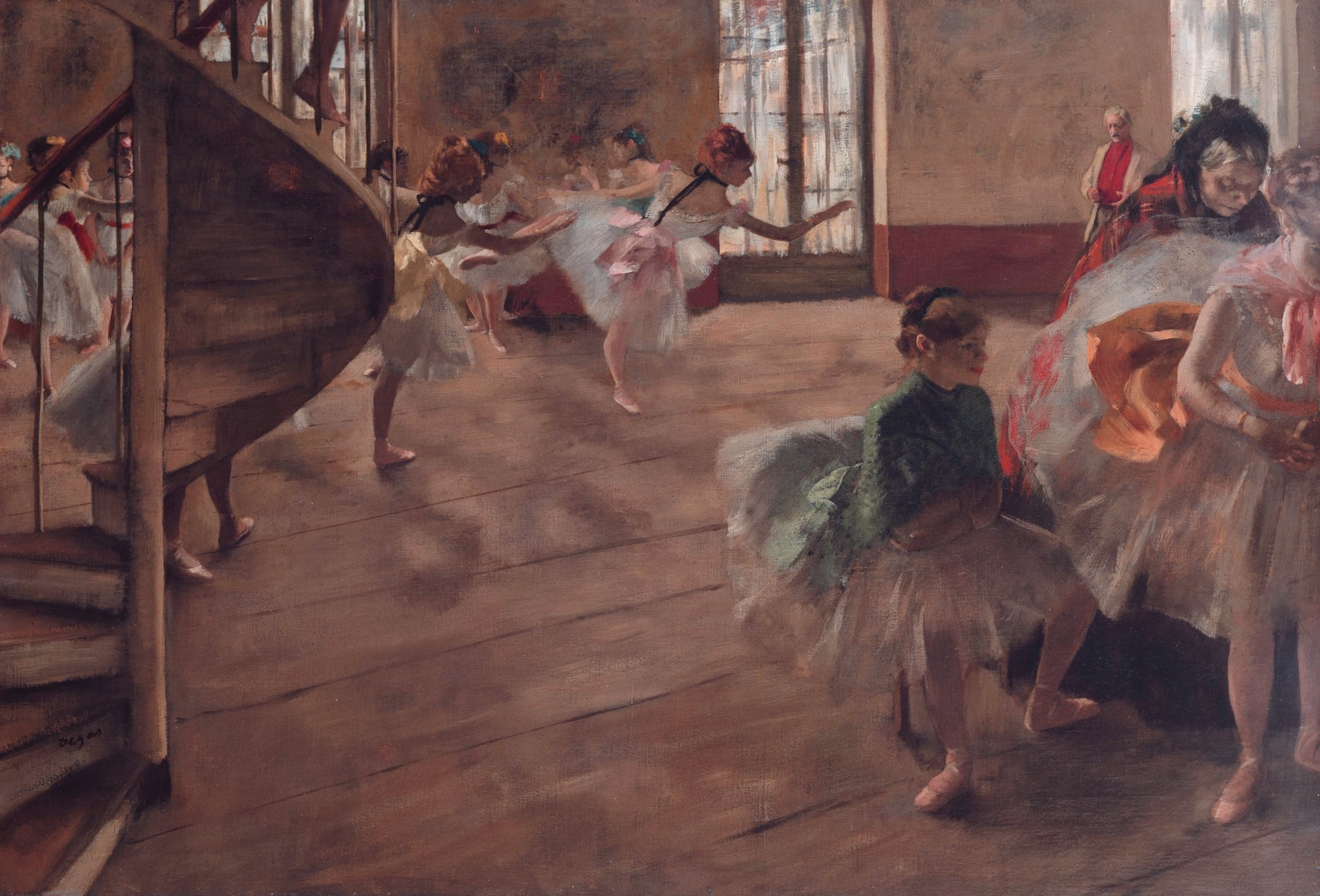
The Ballet Rehearsal
Edgar Degas (c. 1874)
In The Ballet Rehearsal, Edgar Degas turns a practice room into a modern drama where <strong>discipline and desire</strong> collide. A dark <strong>spiral staircase</strong> slices the space, scuffed floorboards yawn open, and clusters of dancers oscillate between poised effort and weary waiting <sup>[1]</sup><sup>[4]</sup>.
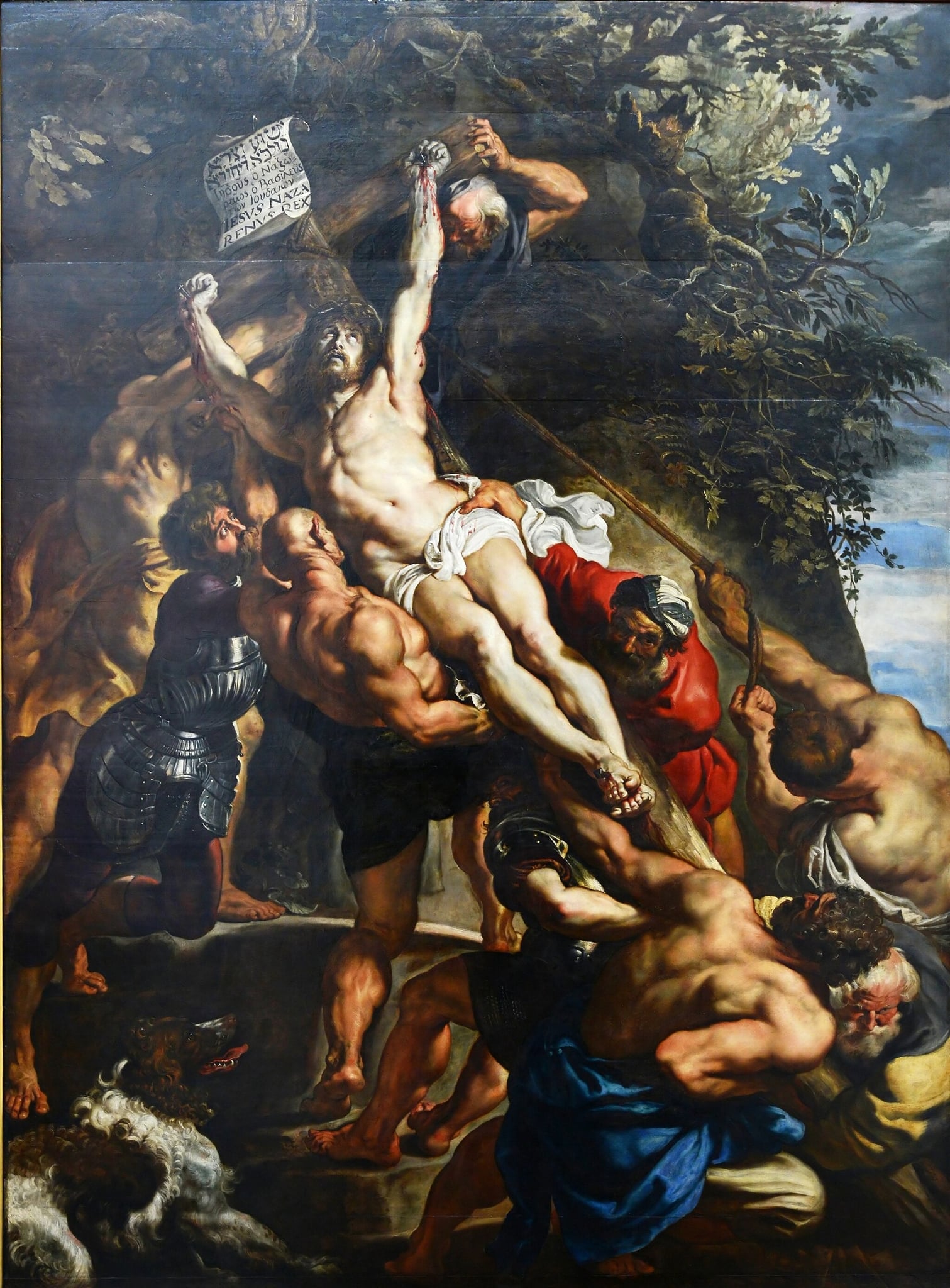
The Elevation of the Cross
Peter Paul Rubens (1609–1610)
A single, surging diagonal drives The Elevation of the Cross as straining executioners heave the timber while Christ’s pale body becomes the calm, radiant fulcrum. Rubens fuses muscular anatomy, flashing armor, taut ropes, and storm-dark landscape into a Baroque crescendo where <strong>divine light</strong> confronts <strong>human violence</strong> <sup>[1]</sup><sup>[3]</sup>.
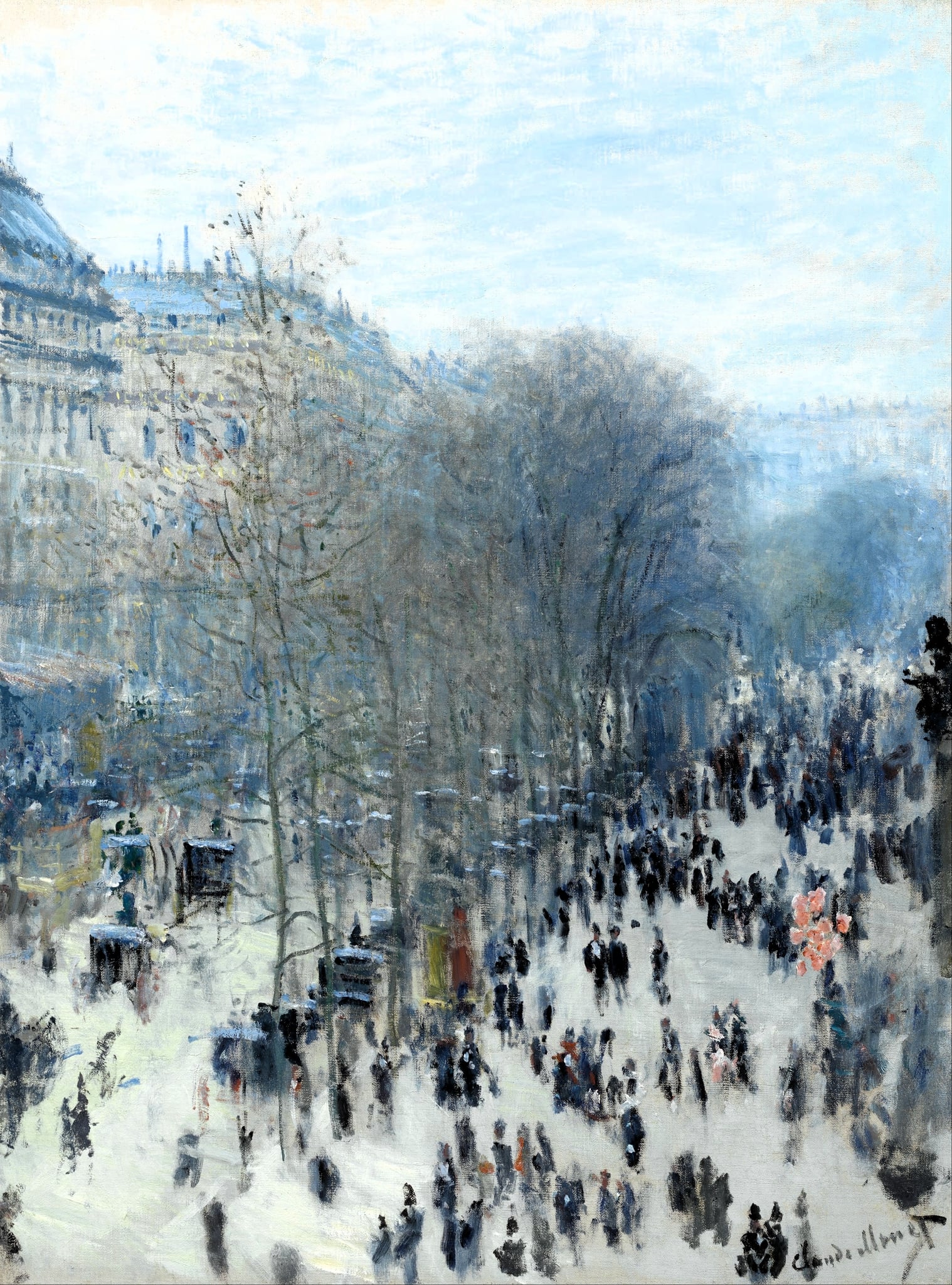
Boulevard des Capucines
Claude Monet (1873–1874)
From a high perch above Paris, Claude Monet turns the Haussmann boulevard into a living current of <strong>light, weather, and motion</strong>. Leafless trees web the view, crowds dissolve into <strong>flickering strokes</strong>, and a sudden <strong>pink cluster of balloons</strong> pierces the cool winter scale <sup>[1]</sup><sup>[2]</sup>.
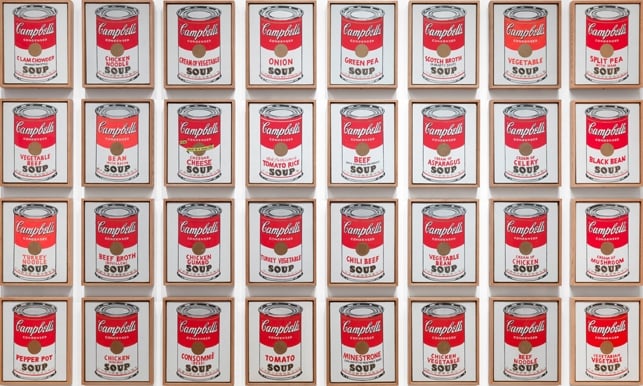
Campbell's Soup Cans
Andy Warhol (1962)
Warhol’s Campbell’s Soup Cans turns a shelf-staple into <strong>art</strong>, using a gridded array of near-identical red-and-white cans to fuse <strong>branding</strong> with <strong>painting</strong>. By repeating 32 flavors—Tomato, Clam Chowder, Chicken Noodle, and more—the work stages a clash between <strong>mass production</strong> and the artist’s hand <sup>[1]</sup><sup>[3]</sup>.
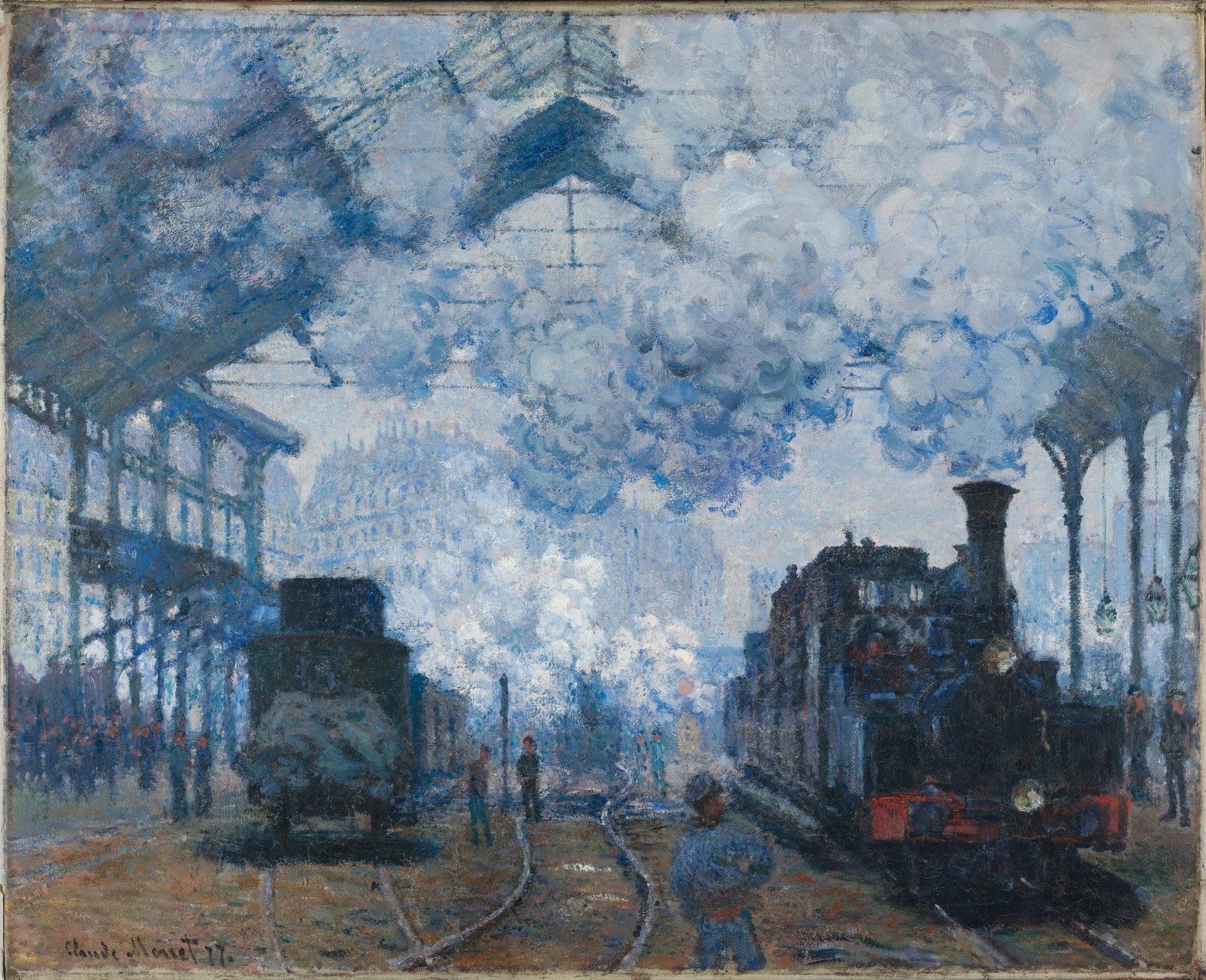
The Gare Saint-Lazare: Arrival of a Train
Claude Monet (1877)
Claude Monet’s The Gare Saint-Lazare: Arrival of a Train plunges viewers into a <strong>vapor-filled nave of iron and glass</strong>, where billowing steam, hot lamps, and converging rails forge a drama of industrial modernity. The right-hand locomotive, its red buffer beam glowing, materializes out of a <strong>blue-gray atmospheric envelope</strong>, turning motion and time into visible substance <sup>[1]</sup><sup>[3]</sup>.
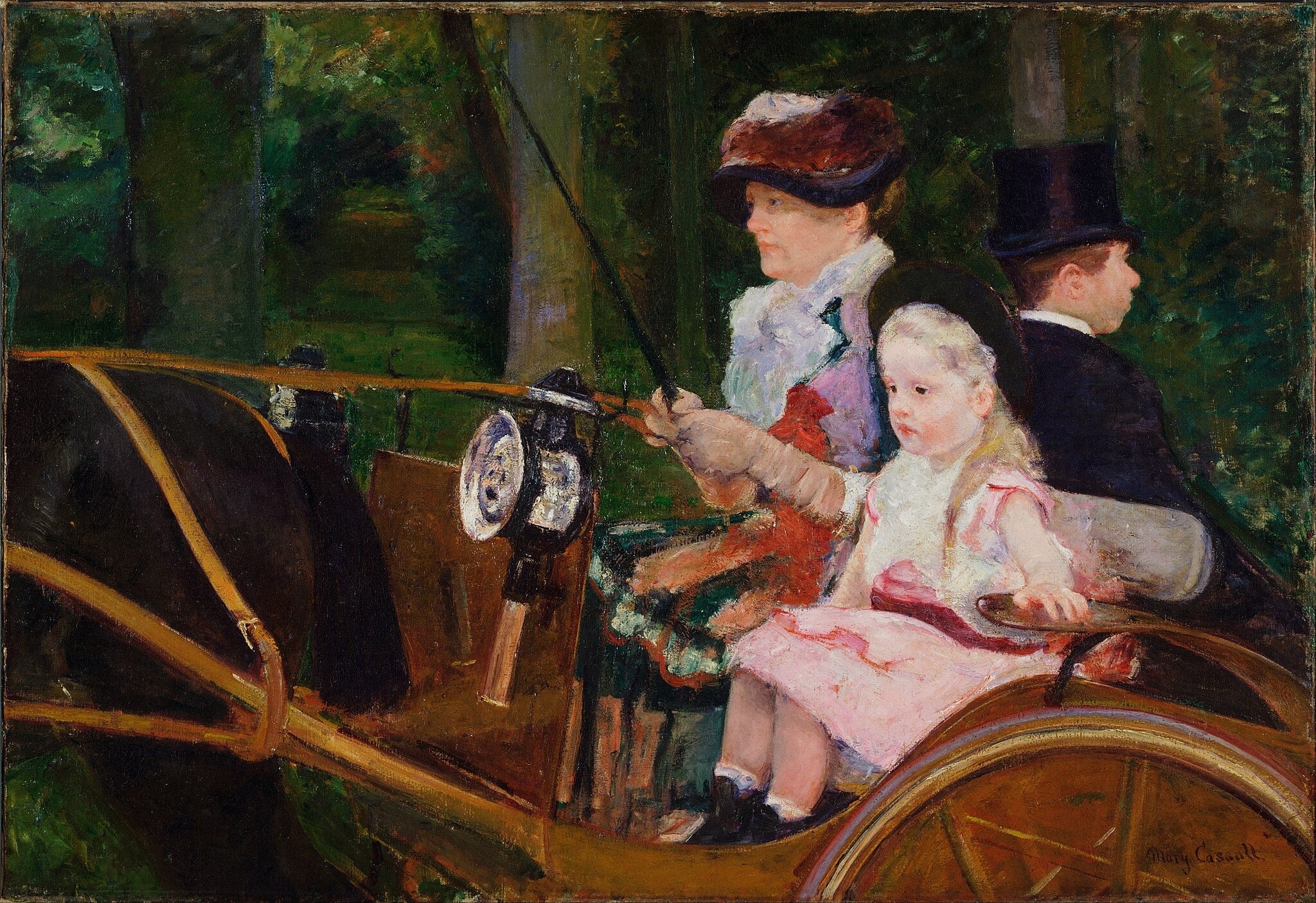
A Woman and a Girl Driving
Mary Cassatt (1881)
Cassatt stages a modern scene of <strong>female control</strong> in motion: a woman grips the reins and whip while a girl beside her mirrors the pose, and a groom seated behind looks away. The cropped horse and diagonal harness thrust the carriage forward, placing viewers inside a public outing in the Bois de Boulogne—an arena where visibility signaled status and autonomy <sup>[1]</sup><sup>[2]</sup>.
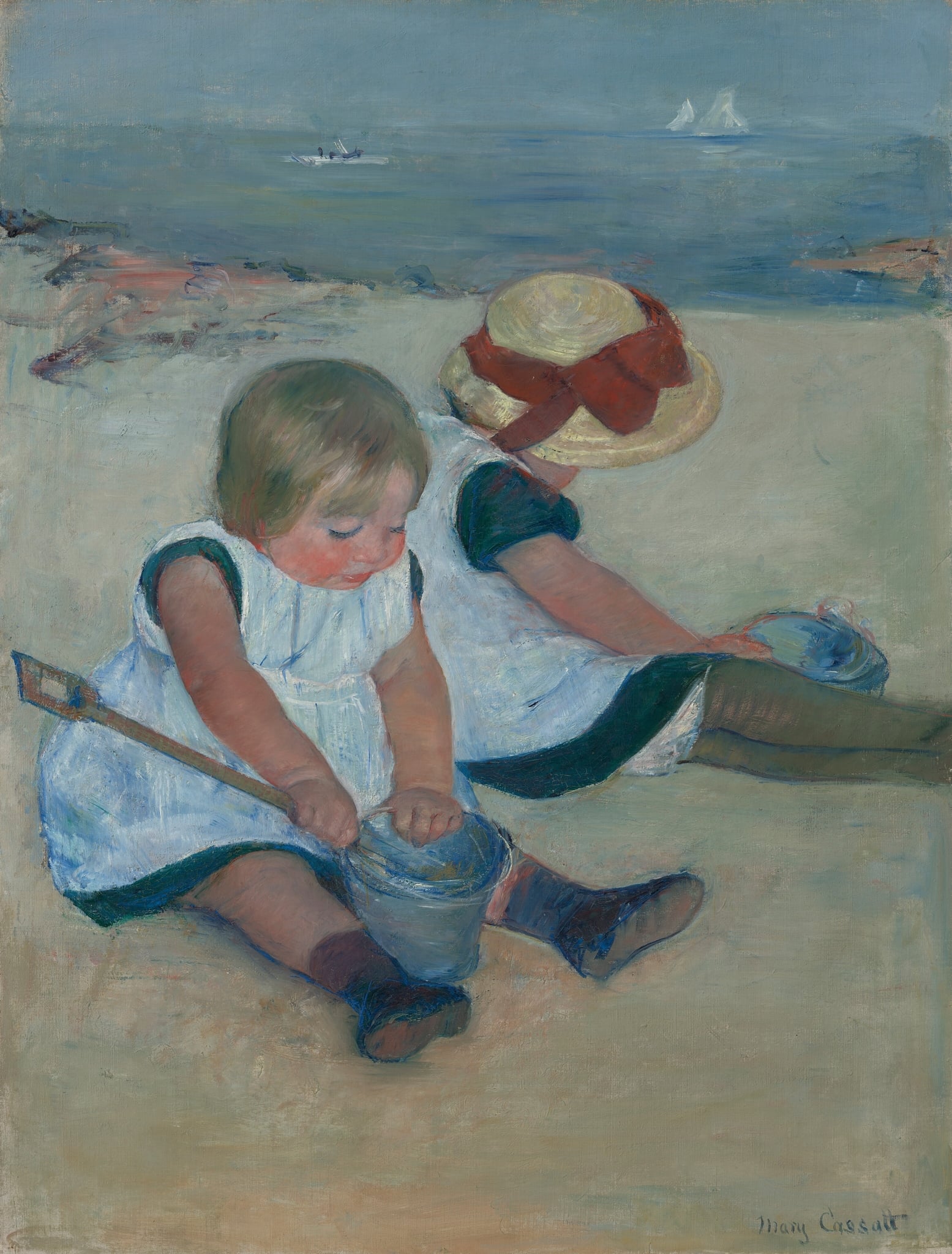
Children Playing on the Beach
Mary Cassatt (1884)
In Children Playing on the Beach, Mary Cassatt brings the viewer down to a child’s eye level, granting everyday play the weight of <strong>serious, self-contained work</strong>. The cool horizon and tiny boats open onto <strong>modern space and possibility</strong>, while the cropped, tilted foreground seals us inside the children’s focused world <sup>[1]</sup>.
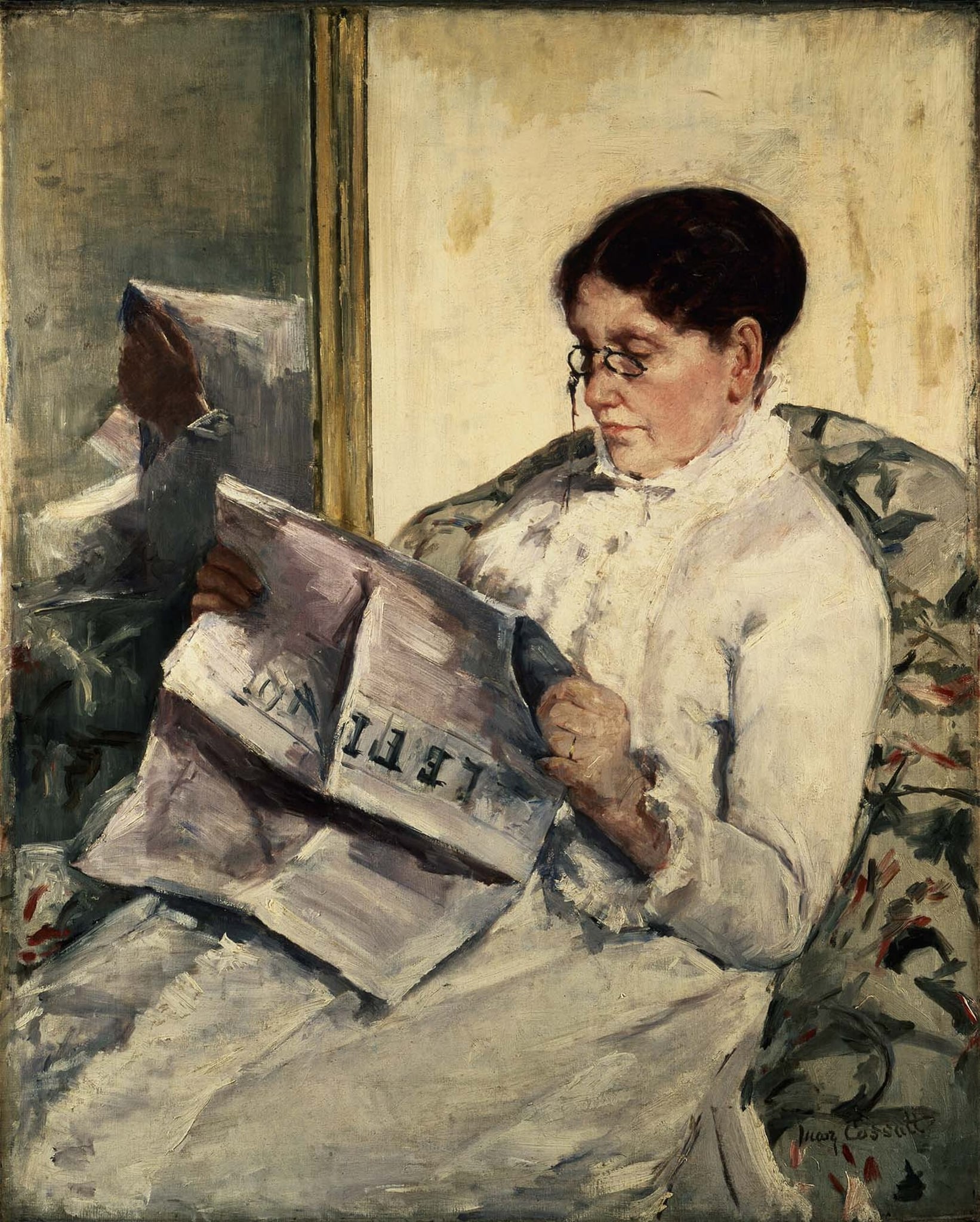
Reading Le Figaro
Mary Cassatt (c. 1878–83)
Mary Cassatt’s Reading Le Figaro turns a quiet parlor into a scene of <strong>intellect</strong> and <strong>modern life</strong>. The inverted masthead, mirrored repetition of the paper, and the sitter’s spectacles make <strong>attention</strong>—not appearance—the true subject <sup>[1]</sup><sup>[4]</sup>. Through brisk whites and grays, Cassatt dignifies everyday thought as a modern pictorial theme aligned with <strong>Impressionism</strong> <sup>[2]</sup>.
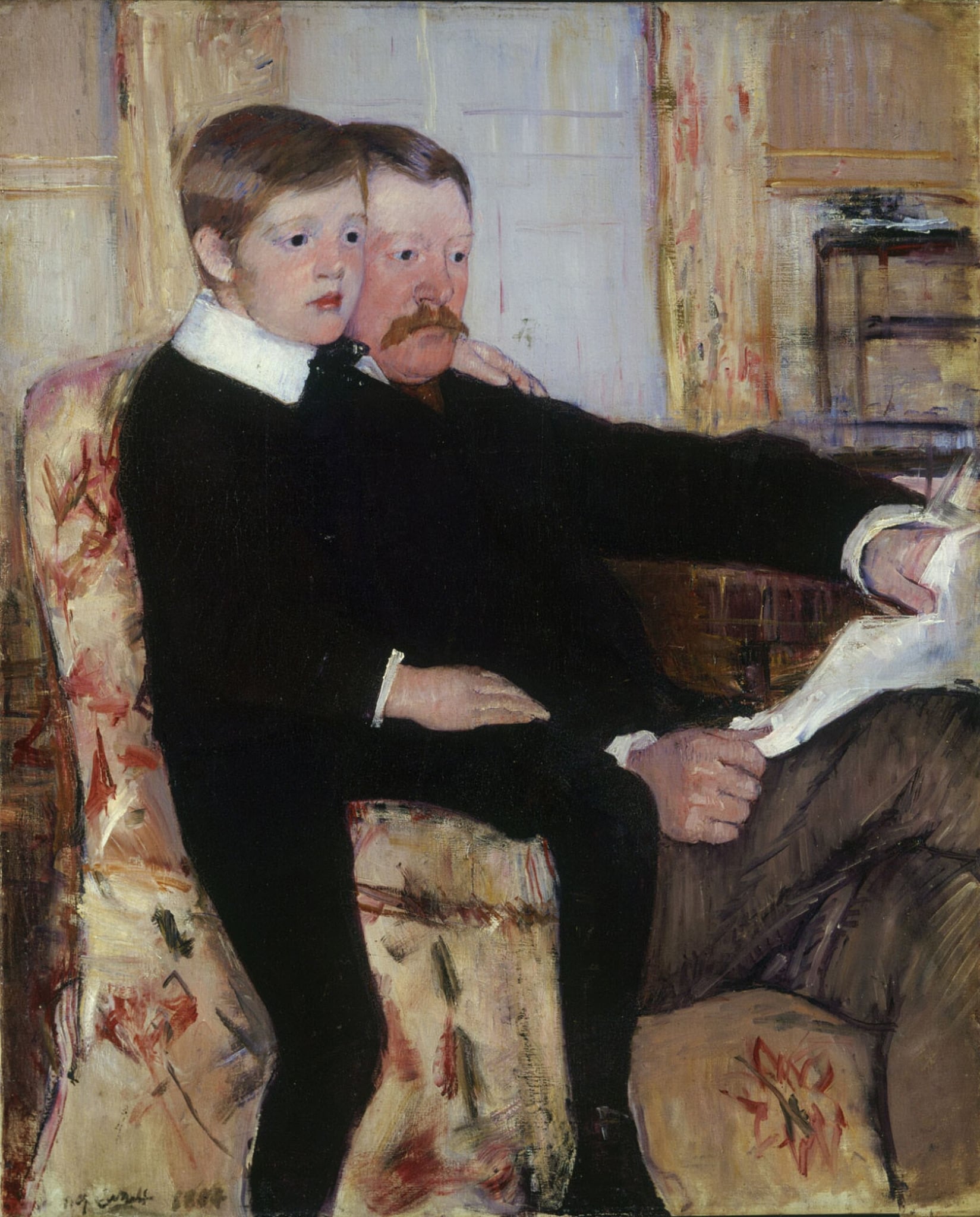
Portrait of Alexander J. Cassatt and His Son Robert Kelso Cassatt
Mary Cassatt (1884)
A quiet, domestic tableau becomes a study in <strong>authority tempered by affection</strong>. In Portrait of Alexander J. Cassatt and His Son Robert Kelso Cassatt, Mary Cassatt fuses father and child into a single dark silhouette against a luminous, brushed interior, their shared gaze fixed beyond the frame. The <strong>newspaper</strong>, <strong>linked hands</strong>, and <strong>cropped closeness</strong> transform a routine moment into a symbol of generational continuity and modern attentiveness.
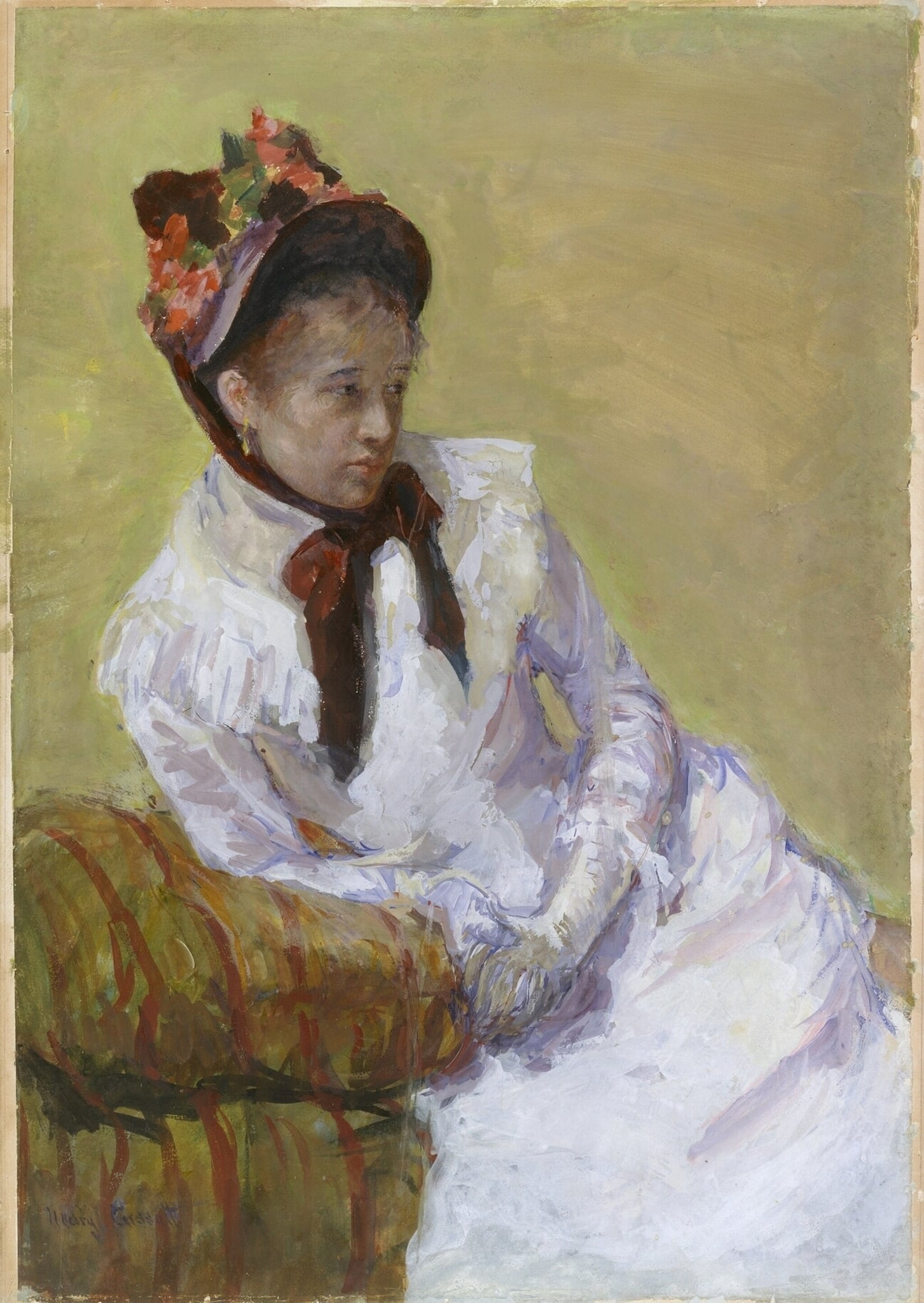
Self-Portrait
Mary Cassatt (1878)
In Self-Portrait, Mary Cassatt presents a poised, <strong>modern woman</strong> angled diagonally across a striped chair, her gaze turned away in <strong>thoughtful reserve</strong>. A <strong>sage-olive ground</strong> and tight crop strip away setting, while the <strong>white dress</strong> flickers with lilacs and blues against a <strong>decisive red ribbon</strong> and floral bonnet. The image asserts <strong>professional selfhood</strong> through restraint, asymmetry, and broken color.<sup>[1]</sup>
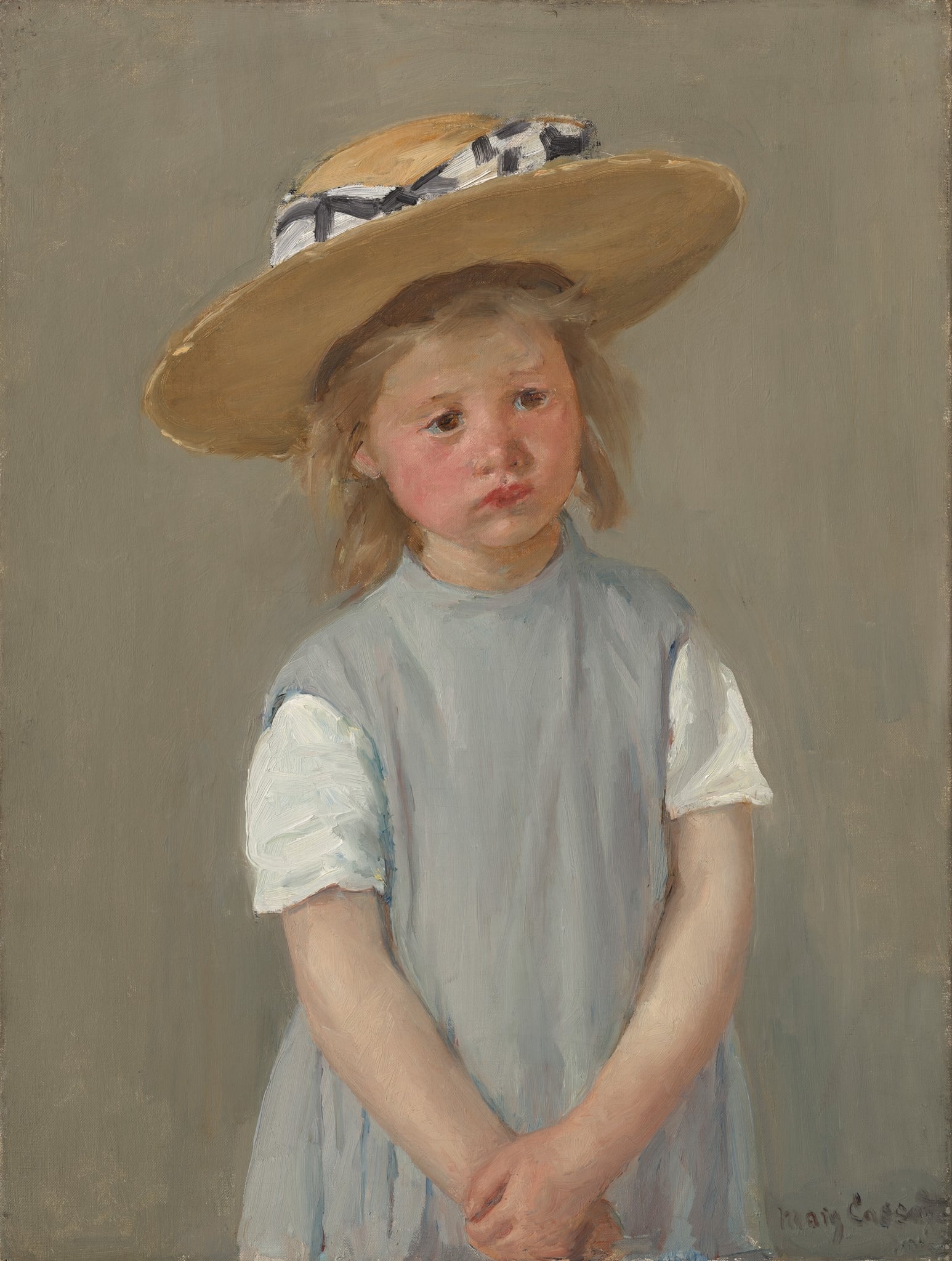
Little Girl in a Big Straw Hat and a Pinafore
Mary Cassatt (c. 1886)
Mary Cassatt’s Little Girl in a Big Straw Hat and a Pinafore distills childhood into a quiet drama of <strong>interiority</strong> and <strong>constraint</strong>. The oversized straw hat and plain pinafore bracket a flushed face, downcast eyes, and <strong>clasped hands</strong>, turning a simple pose into a study of modern self‑consciousness <sup>[1]</sup>. Cassatt’s cool grays and swift, luminous strokes make mood—not costume—the subject.
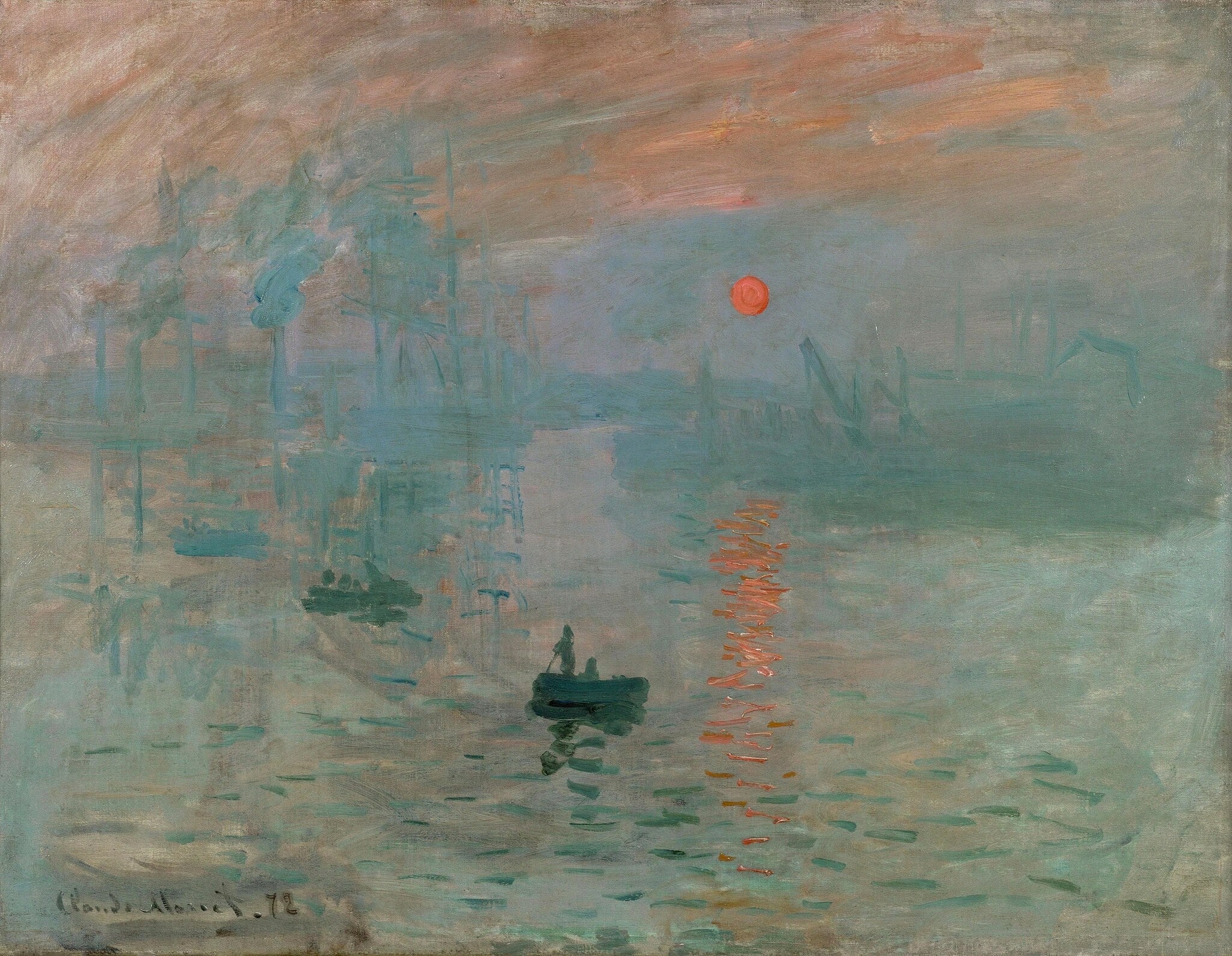
Impression, Sunrise
Claude Monet (1872)
In Impression, Sunrise, Claude Monet turns Le Havre’s fog-bound harbor into an experiment in <strong>immediacy</strong> and <strong>modernity</strong>. Cool blue-greens dissolve cranes, masts, and smoke, while a small skiff cuts the water beneath a blazing, <strong>equiluminant</strong> orange sun whose vertical reflection stitches the scene together <sup>[1]</sup><sup>[3]</sup>. The effect is a poised dawn where industry meets nature, a quiet <strong>awakening</strong> rendered through light rather than line.
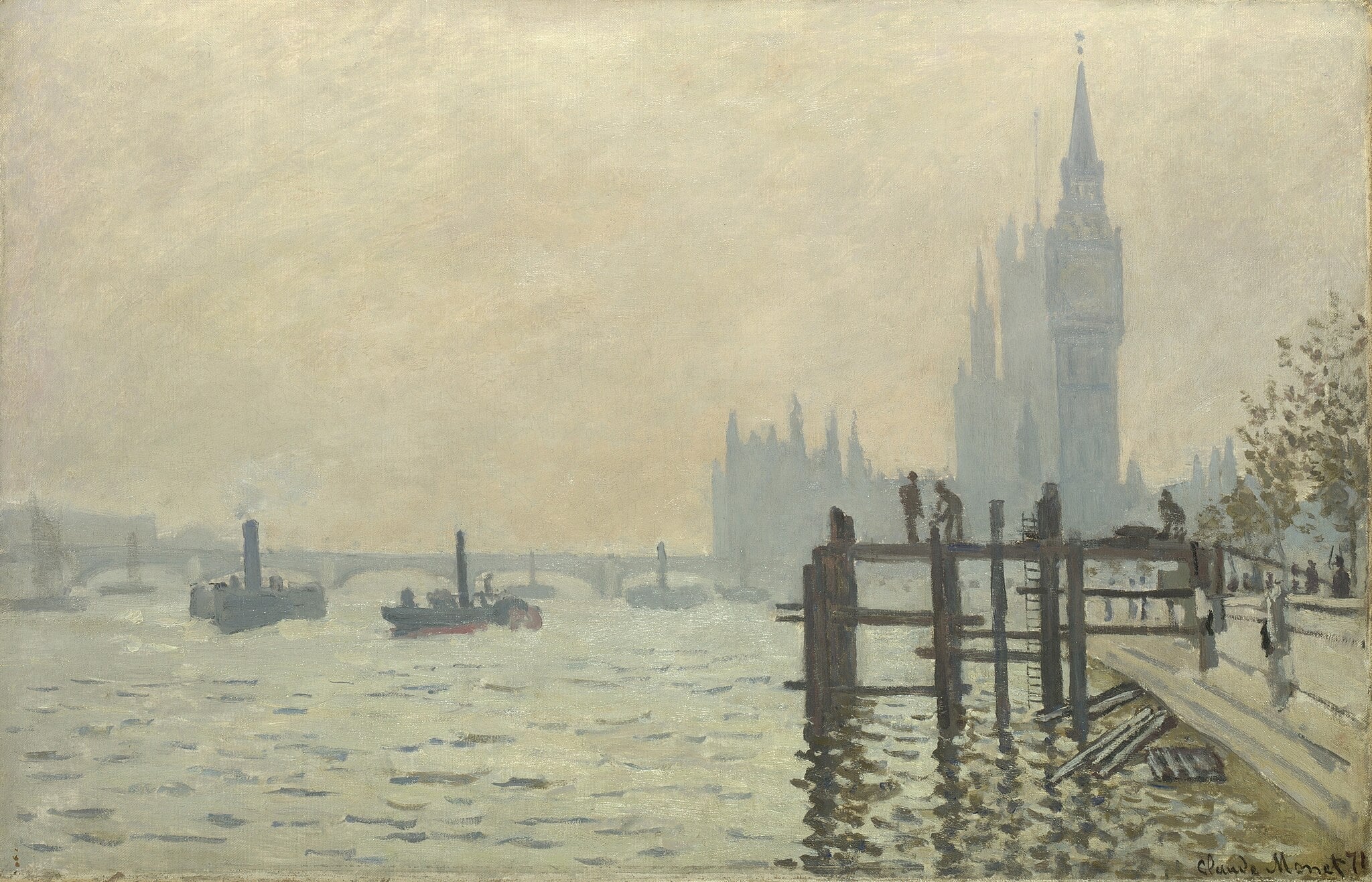
The Thames below Westminster
Claude Monet (about 1871)
Claude Monet’s The Thames below Westminster turns London into <strong>light-made architecture</strong>, where Parliament’s mass dissolves into mist and the river shivers with <strong>industrial motion</strong>. Tugboats, a timber jetty with workers, and the rebuilt Westminster Bridge assert a modern city whose power is felt through atmosphere more than outline <sup>[1]</sup>.
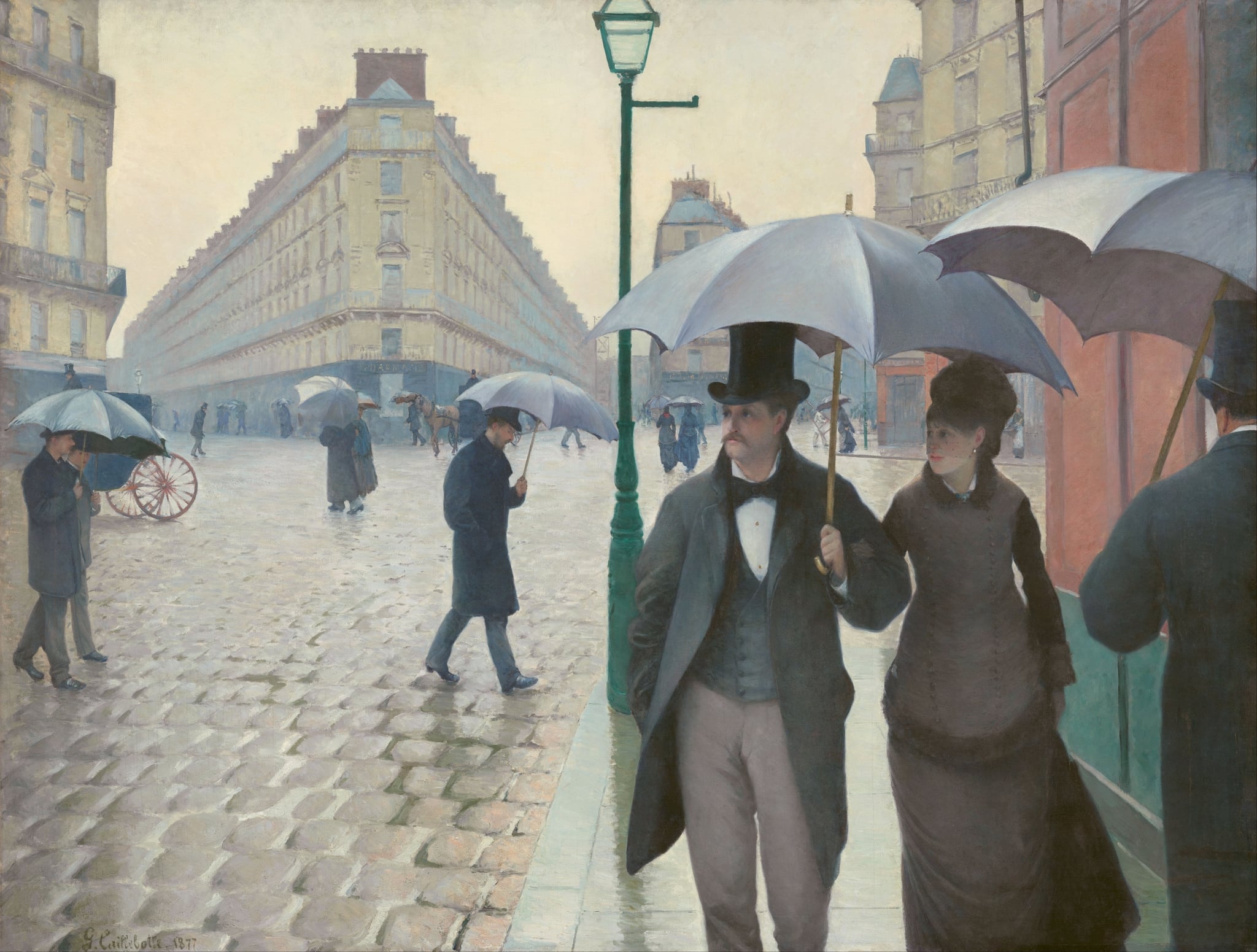
Paris Street; Rainy Day
Gustave Caillebotte (1877)
Gustave Caillebotte’s Paris Street; Rainy Day renders a newly modern Paris where <strong>Haussmann’s geometry</strong> meets the <strong>anonymity of urban life</strong>. Umbrellas punctuate a silvery atmosphere as a <strong>central gas lamp</strong> and knife-sharp façades organize the space into measured planes <sup>[1]</sup><sup>[2]</sup>.
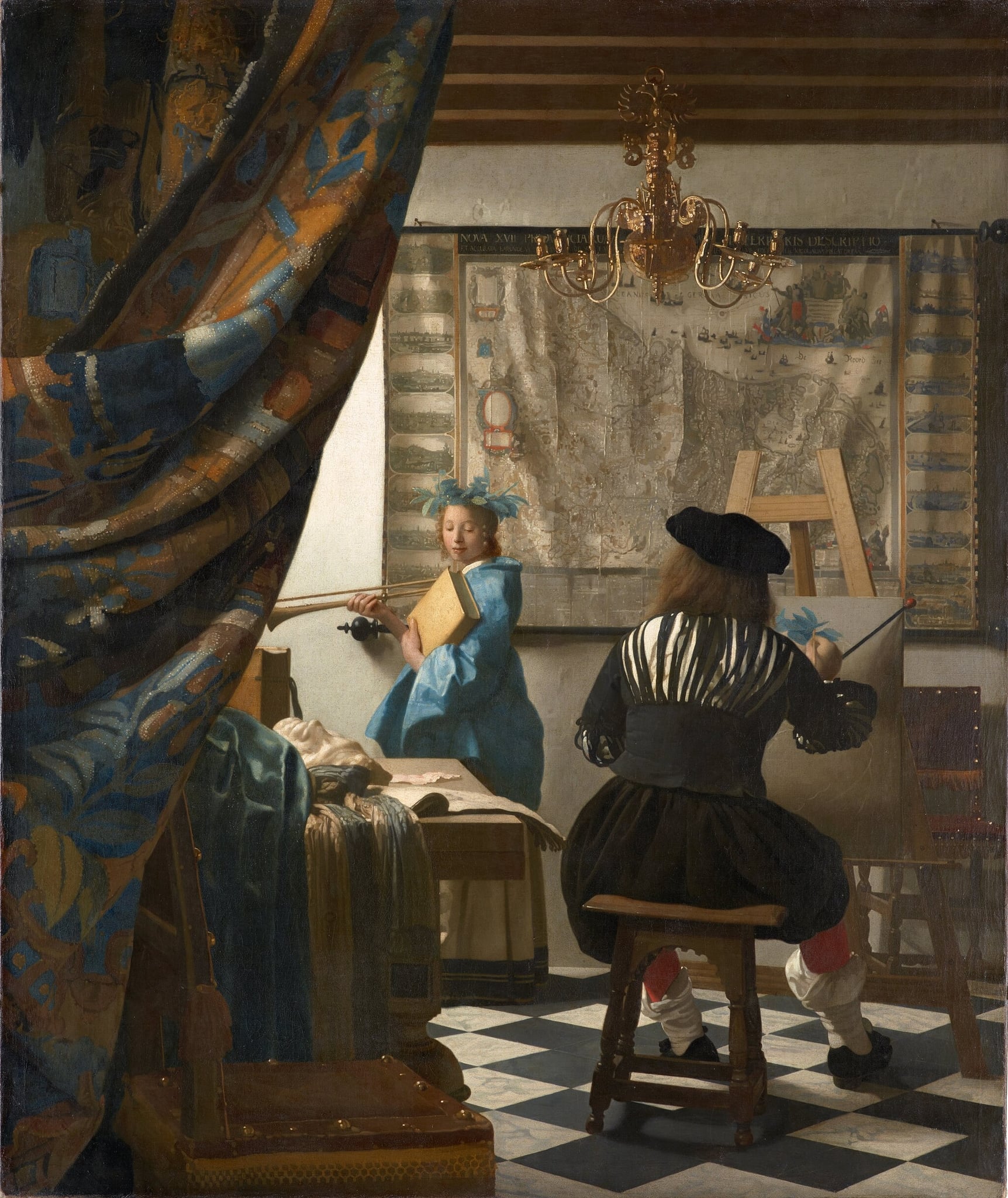
The Art of Painting
Johannes Vermeer (c. 1666–1668)
Johannes Vermeer’s The Art of Painting is a self-aware allegory that equates <strong>painting with history and fame</strong>. Framed by a parted <strong>tapestry</strong> like a stage curtain, an artist in historical dress paints the muse <strong>Clio</strong>, while a vast <strong>map of the Seventeen Provinces</strong> and a <strong>double‑headed eagle</strong> chandelier fold national memory into the studio scene <sup>[1]</sup><sup>[3]</sup>.
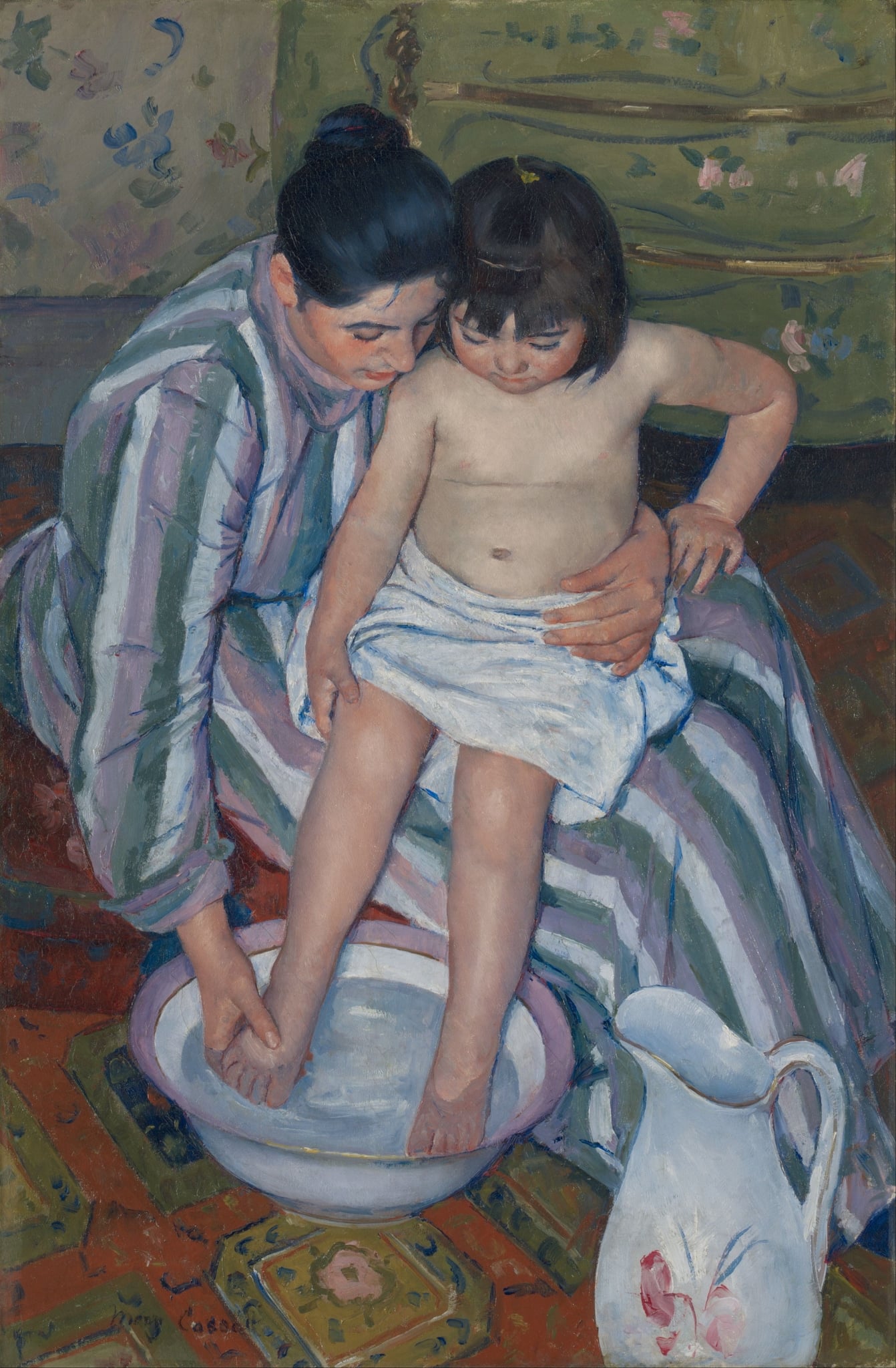
The Child's Bath
Mary Cassatt (1893)
Mary Cassatt’s The Child’s Bath (1893) recasts an ordinary ritual as <strong>modern devotion</strong>. From a steep, print-like vantage, interlocking stripes, circles, and diagonals focus attention on <strong>touch, care, and renewal</strong>, turning domestic labor into a subject of high art <sup>[1]</sup><sup>[3]</sup>. The work synthesizes Impressionist sensitivity with <strong>Japonisme</strong> design to monumentalize the private sphere <sup>[1]</sup><sup>[2]</sup>.
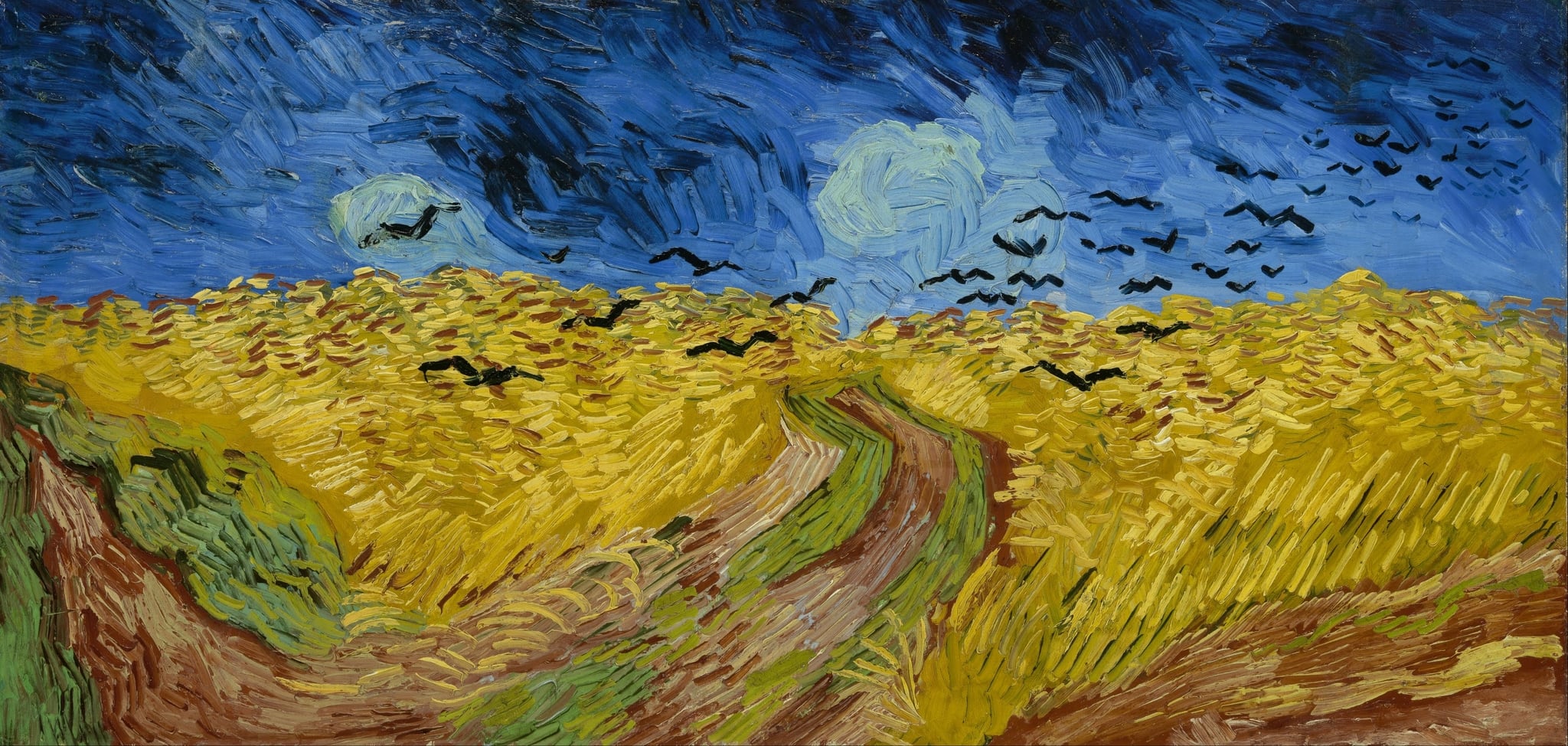
Wheatfield with Crows
Vincent van Gogh (1890)
A panoramic wheatfield splits around a rutted track under a storm-charged sky while black crows rush toward us. Van Gogh drives complementary blues and yellows into collision, fusing <strong>nature’s vitality</strong> with <strong>inner turbulence</strong>.
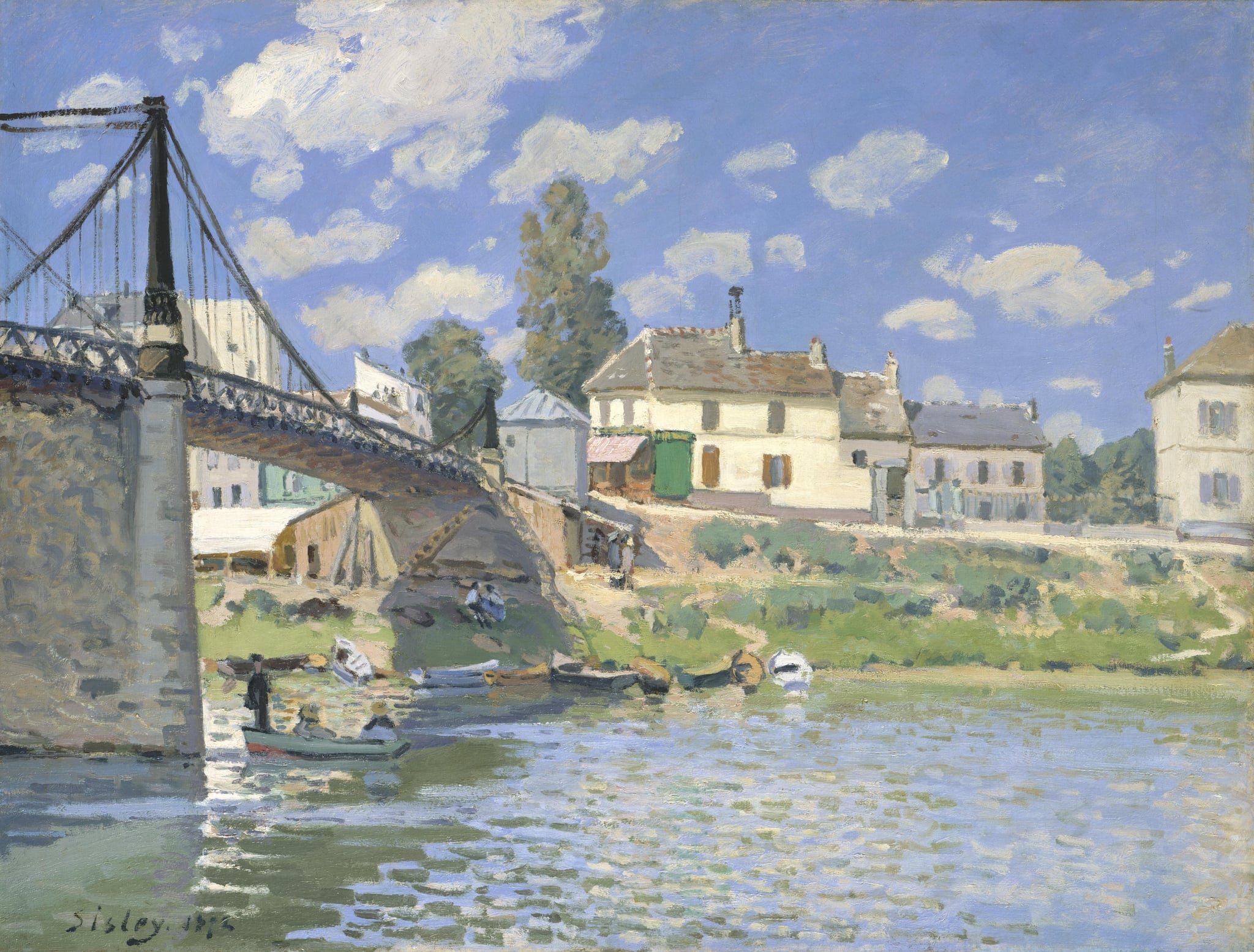
The Bridge at Villeneuve-la-Garenne
Alfred Sisley (1872)
Alfred Sisley's The Bridge at Villeneuve-la-Garenne crystallizes the encounter between <strong>modern engineering</strong> and <strong>riverside leisure</strong> under <strong>Impressionist light</strong>. The diagonal suspension bridge, dark pylons, and filigreed truss command the left foreground while small boats skim the Seine, their wakes breaking into shimmering strokes that echo the sky.
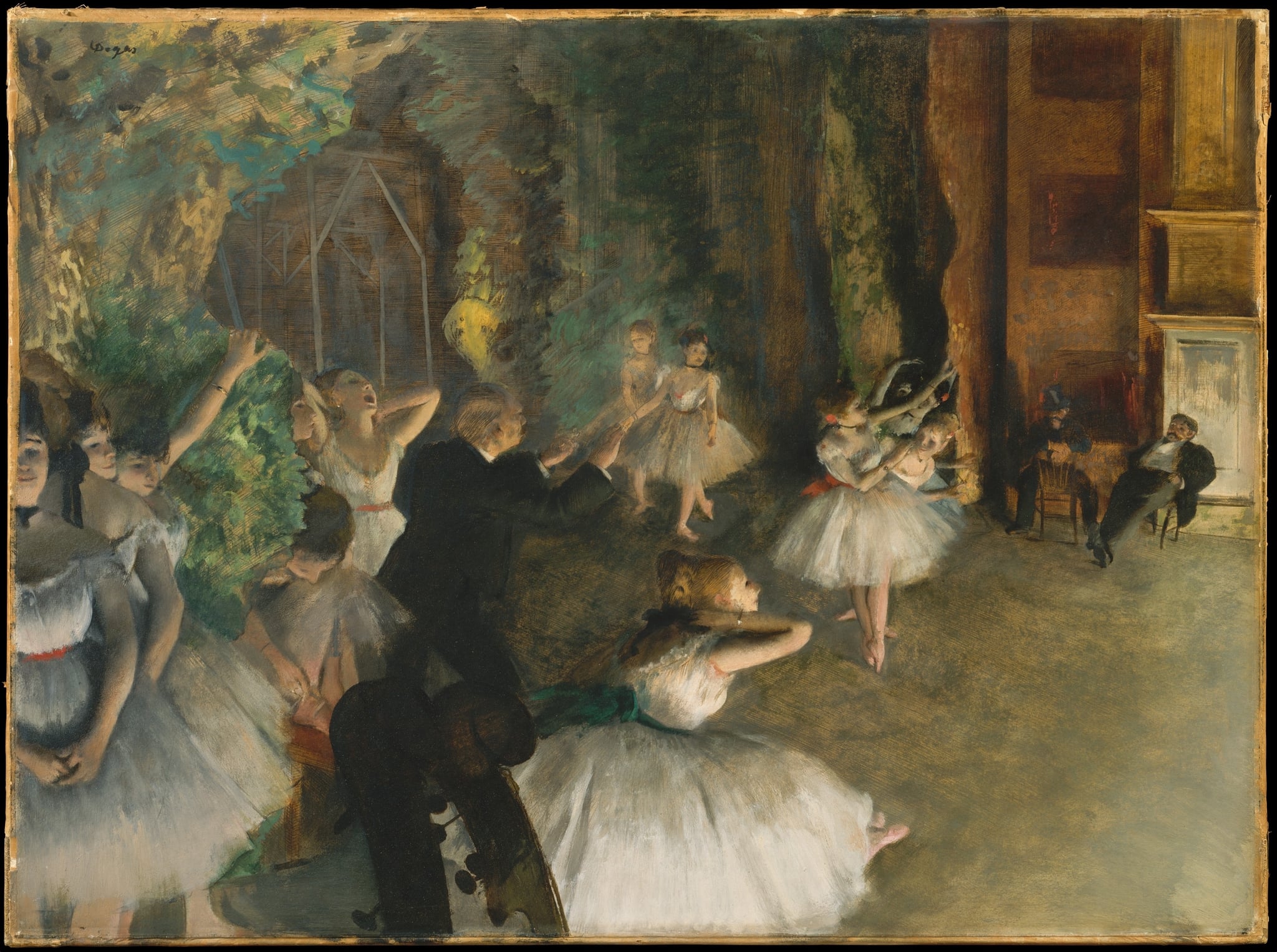
The Rehearsal of the Ballet Onstage
Edgar Degas (ca. 1874)
Degas’s The Rehearsal of the Ballet Onstage turns a moment of practice into a modern drama of work and power. Under <strong>harsh footlights</strong>, clustered ballerinas stretch, yawn, and repeat steps as a <strong>ballet master/conductor</strong> drives the tempo, while <strong>abonnés</strong> lounge in the wings and a looming <strong>double bass</strong> anchors the labor of music <sup>[1]</sup><sup>[3]</sup><sup>[4]</sup>.
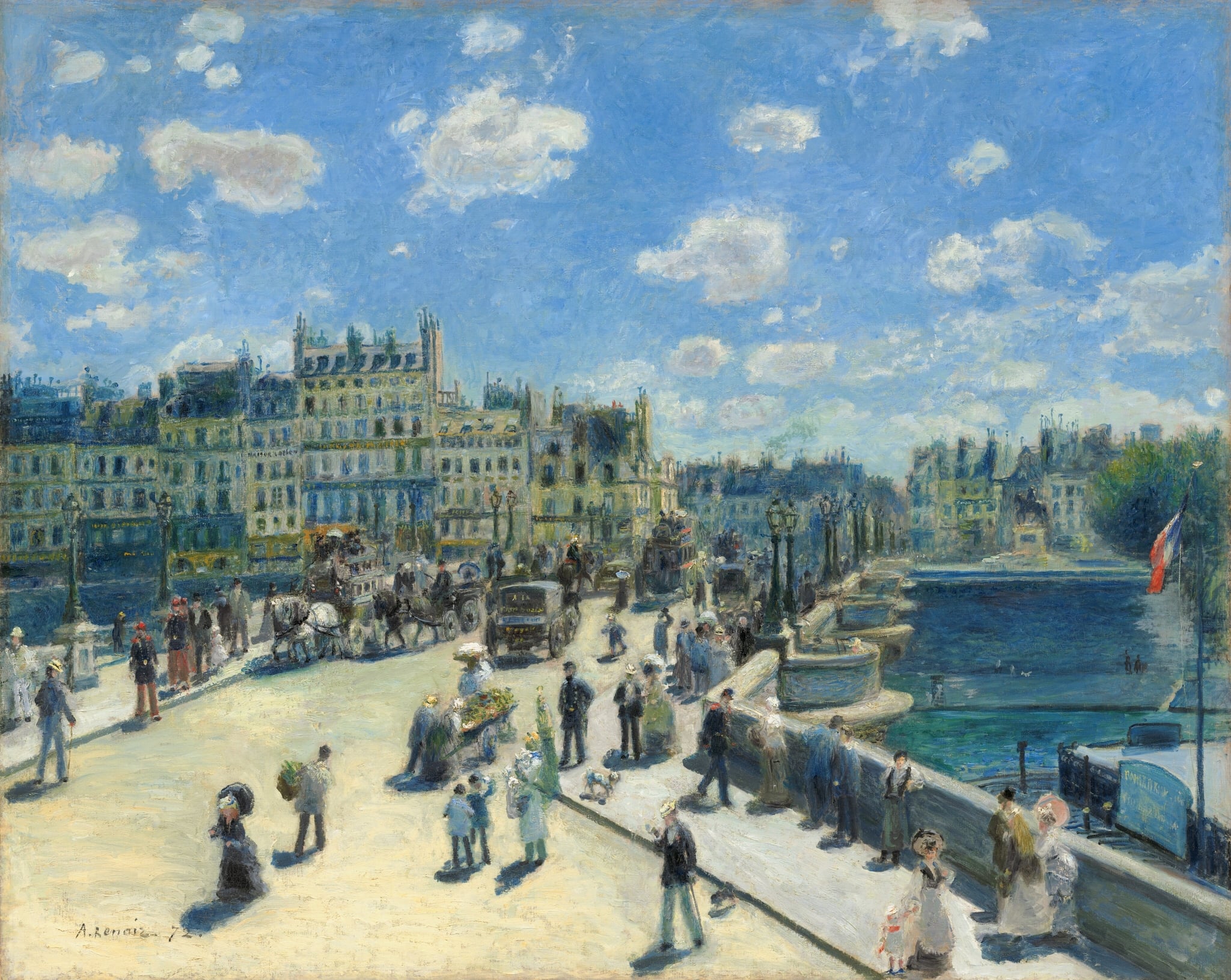
Pont Neuf Paris
Pierre-Auguste Renoir (1872)
In Pont Neuf Paris, Pierre-Auguste Renoir turns the oldest bridge in Paris into a stage where <strong>light</strong> and <strong>movement</strong> bind a city back together. From a high perch, he orchestrates crowds, carriages, gas lamps, the rippling Seine, and a fluttering <strong>tricolor</strong> so that everyday bustle reads as civic grace <sup>[1]</sup>.
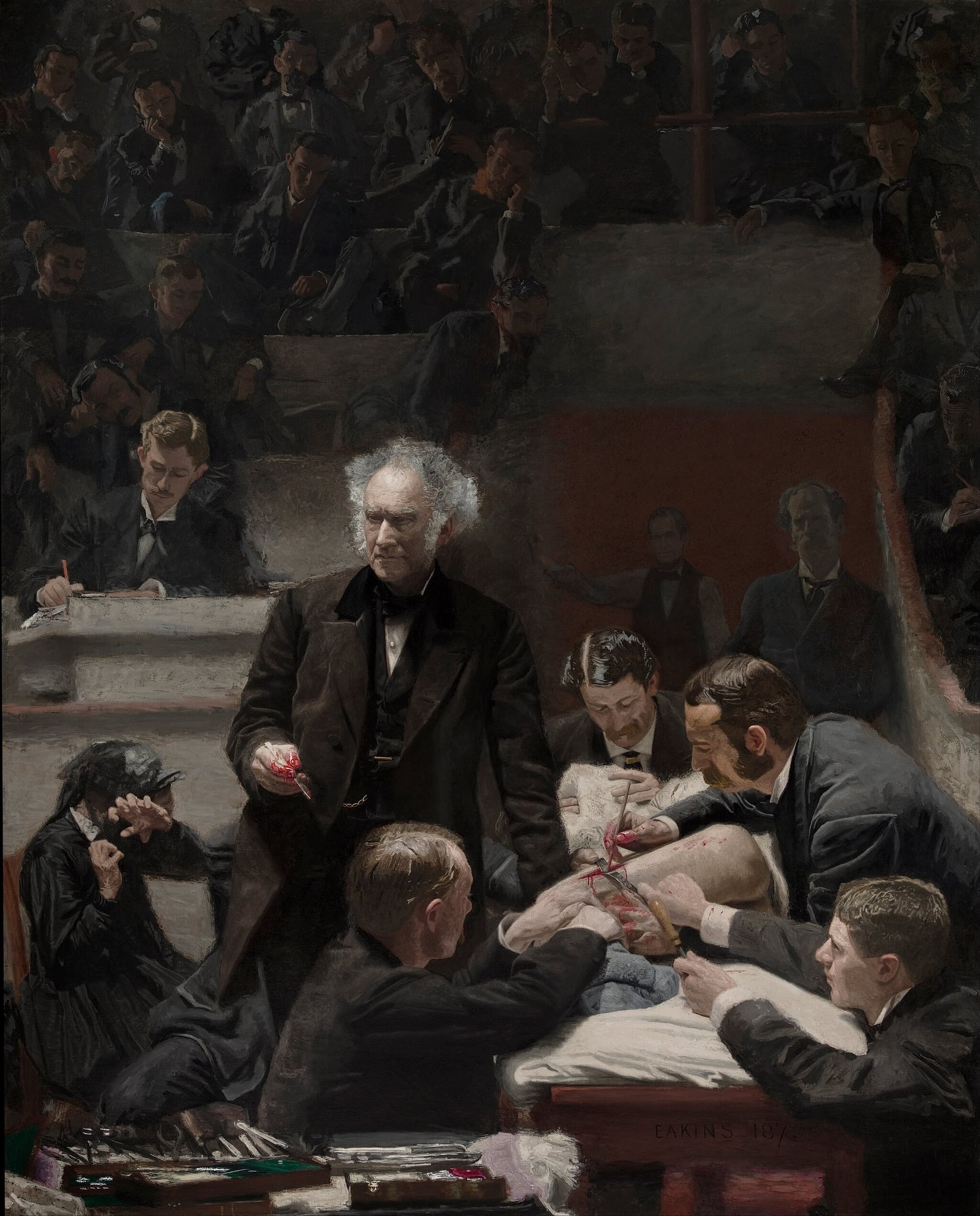
The Gross Clinic
Thomas Eakins (1875)
Thomas Eakins’s The Gross Clinic turns a surgical lesson into civic drama, casting a blaze of light on the surgeon’s white hair and bloodied fingers while students fade into shadow. With the veiled woman recoiling at left and a clerk calmly recording at right, the painting frames <strong>science as spectacle</strong> and <strong>witness as ethics</strong> <sup>[1]</sup><sup>[2]</sup>.
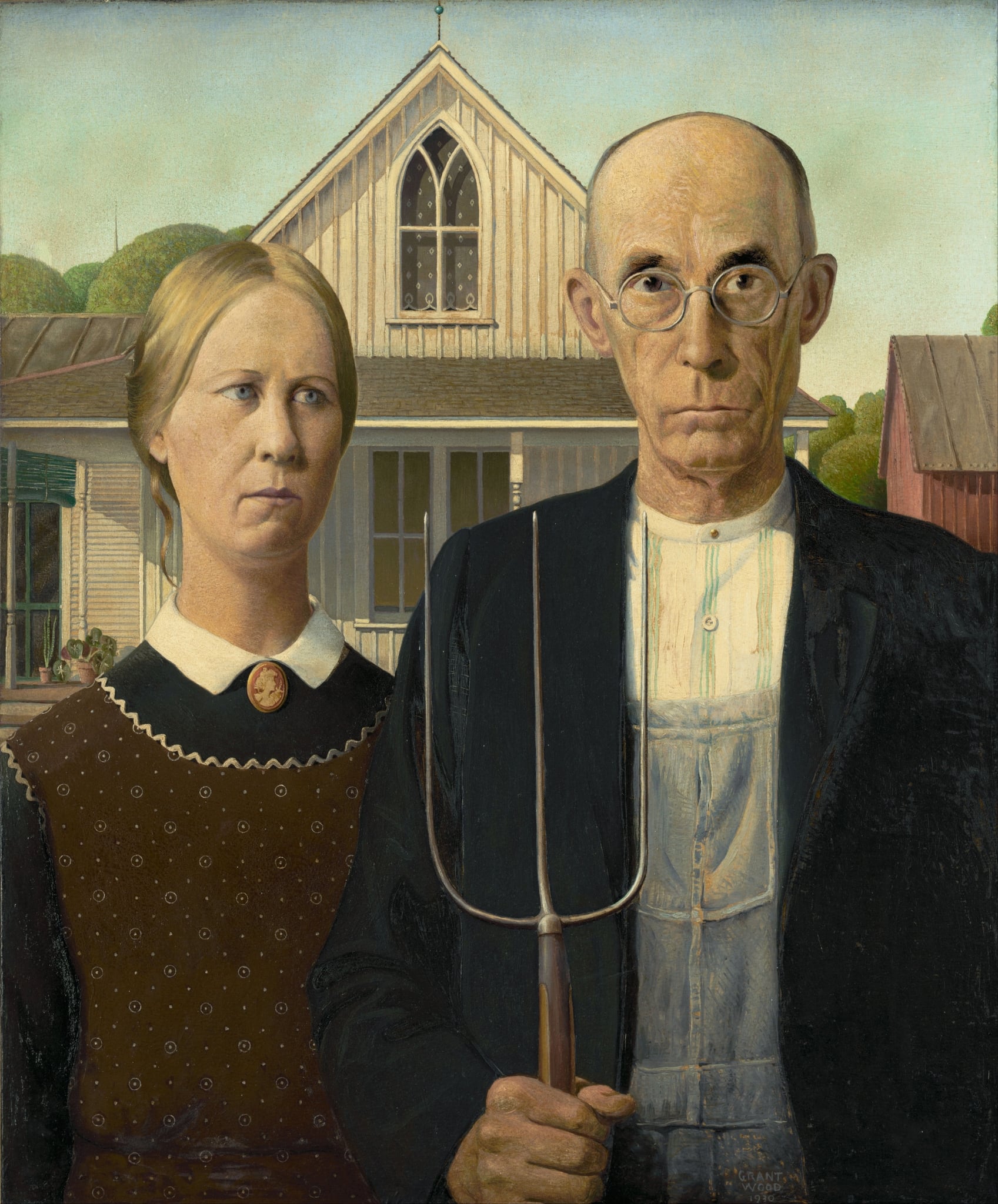
American Gothic
Grant Wood (1930)
Grant Wood’s American Gothic (1930) turns a plain Midwestern homestead into a <strong>moral emblem</strong> by binding two flinty figures to the strict geometry of a Carpenter Gothic gable and a three‑tined pitchfork. The painting’s cool precision and echoing verticals create a <strong>compressed ethic of work, order, and restraint</strong> that can read as both tribute and critique <sup>[1]</sup><sup>[2]</sup><sup>[3]</sup>.
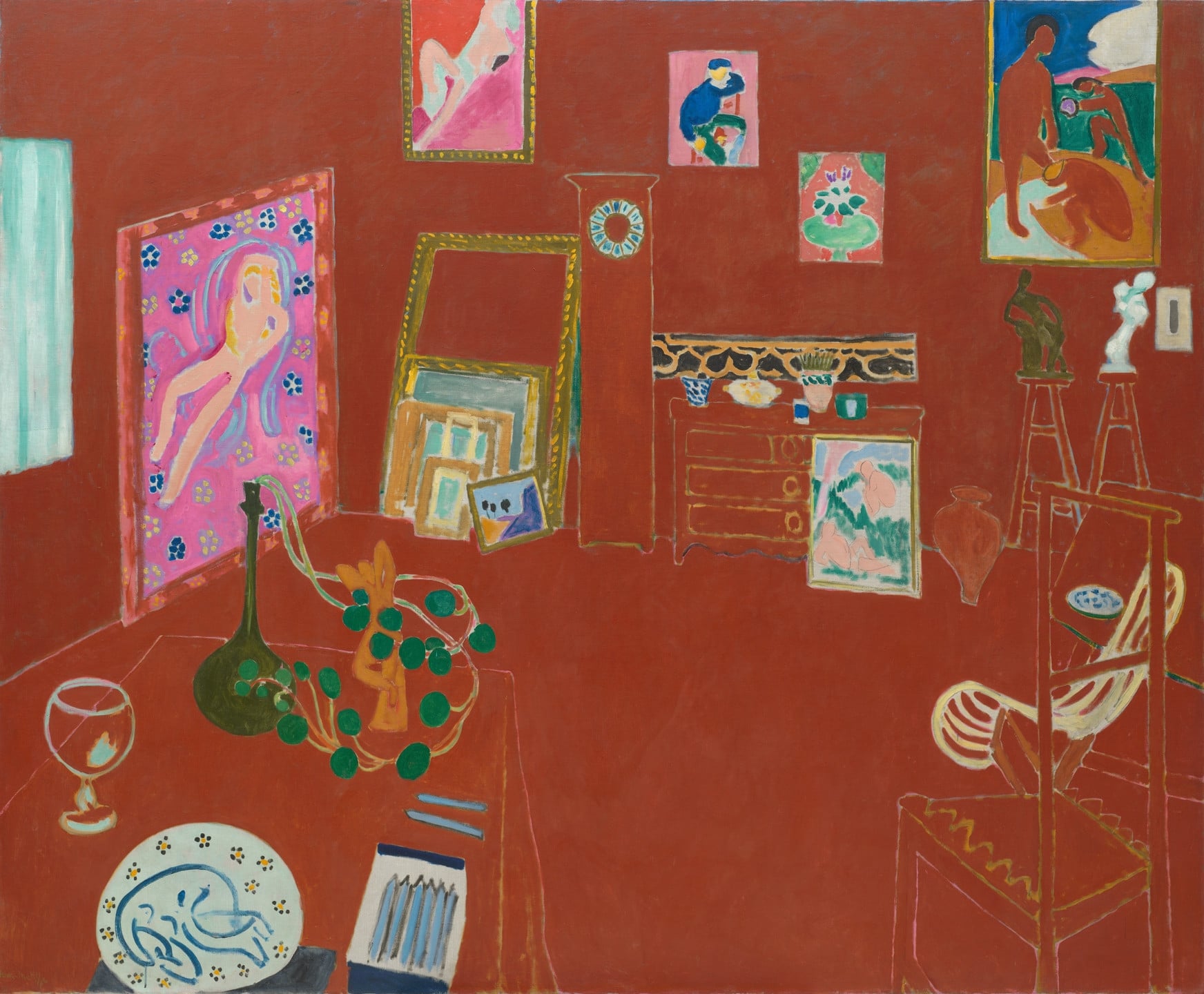
The Red Studio
Henri Matisse (1911)
Henri Matisse’s The Red Studio (1911) saturates the artist’s workspace in a continuous field of <strong>Venetian red</strong>, collapsing walls, floor, and furniture into a single chromatic plane. Objects and architecture appear as <strong>mustard-yellow reserve lines</strong> that read like drawing, while Matisse’s own paintings and sculptures retain full color, asserting art’s primacy within the room <sup>[1]</sup><sup>[2]</sup><sup>[3]</sup>. The result is a studio that feels like a <strong>mental map</strong> rather than a literal interior.
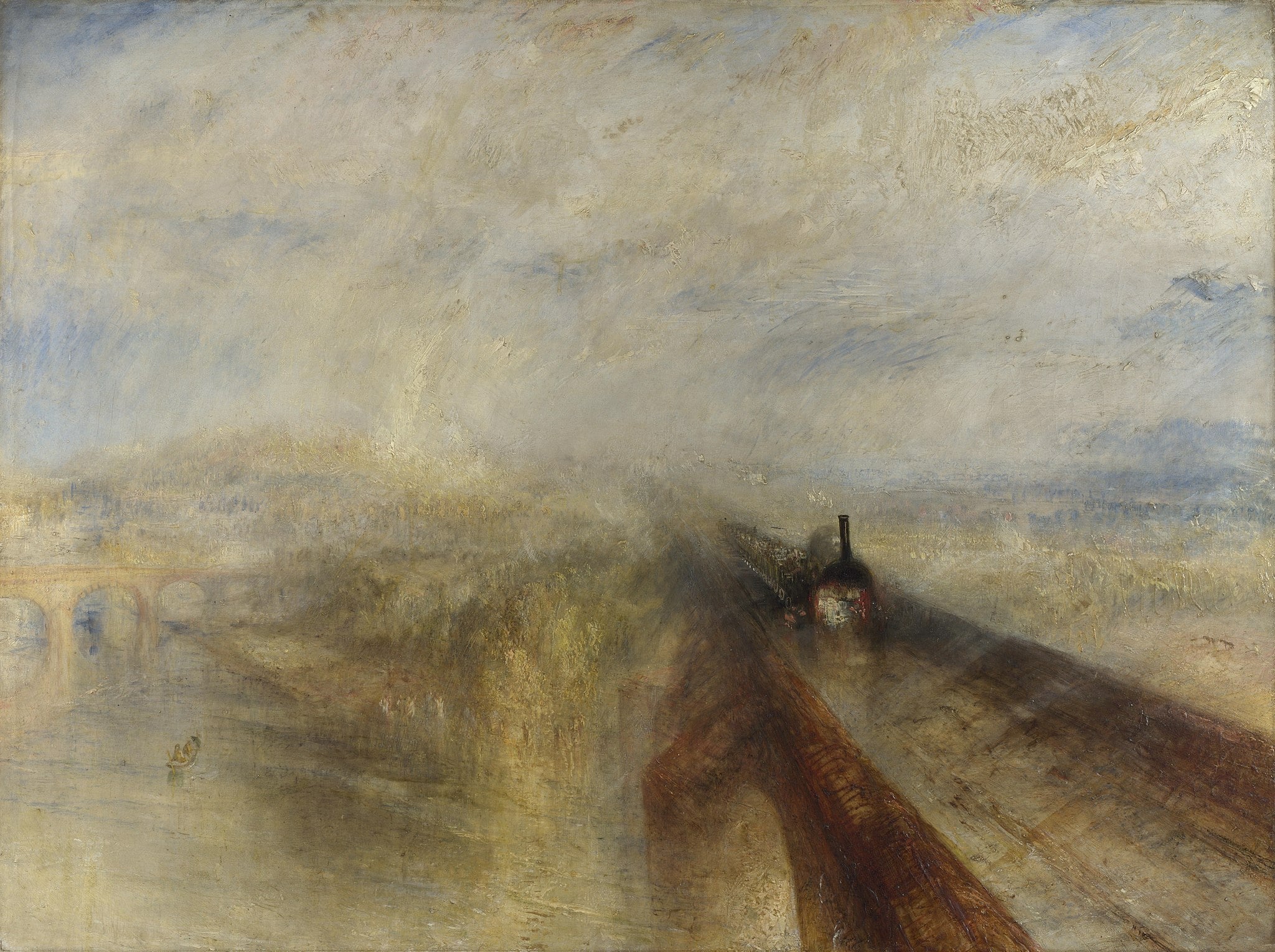
Rain, Steam and Speed
J. M. W. Turner (1844)
In Rain, Steam and Speed, J. M. W. Turner fuses weather and industry into a single onrushing vision, as a dark locomotive thrusts along the diagonal of Brunel’s Maidenhead Railway Bridge through veils of rain and light. The blurred fields, river, and town dissolve into a charged atmosphere where <strong>rain</strong>, <strong>steam</strong>, and <strong>speed</strong> become the true subjects. Counter-motifs—a small boat beneath pale arches and a near-invisible hare ahead of the train—stage a drama between pre‑industrial life and modern velocity <sup>[1]</sup><sup>[2]</sup>.
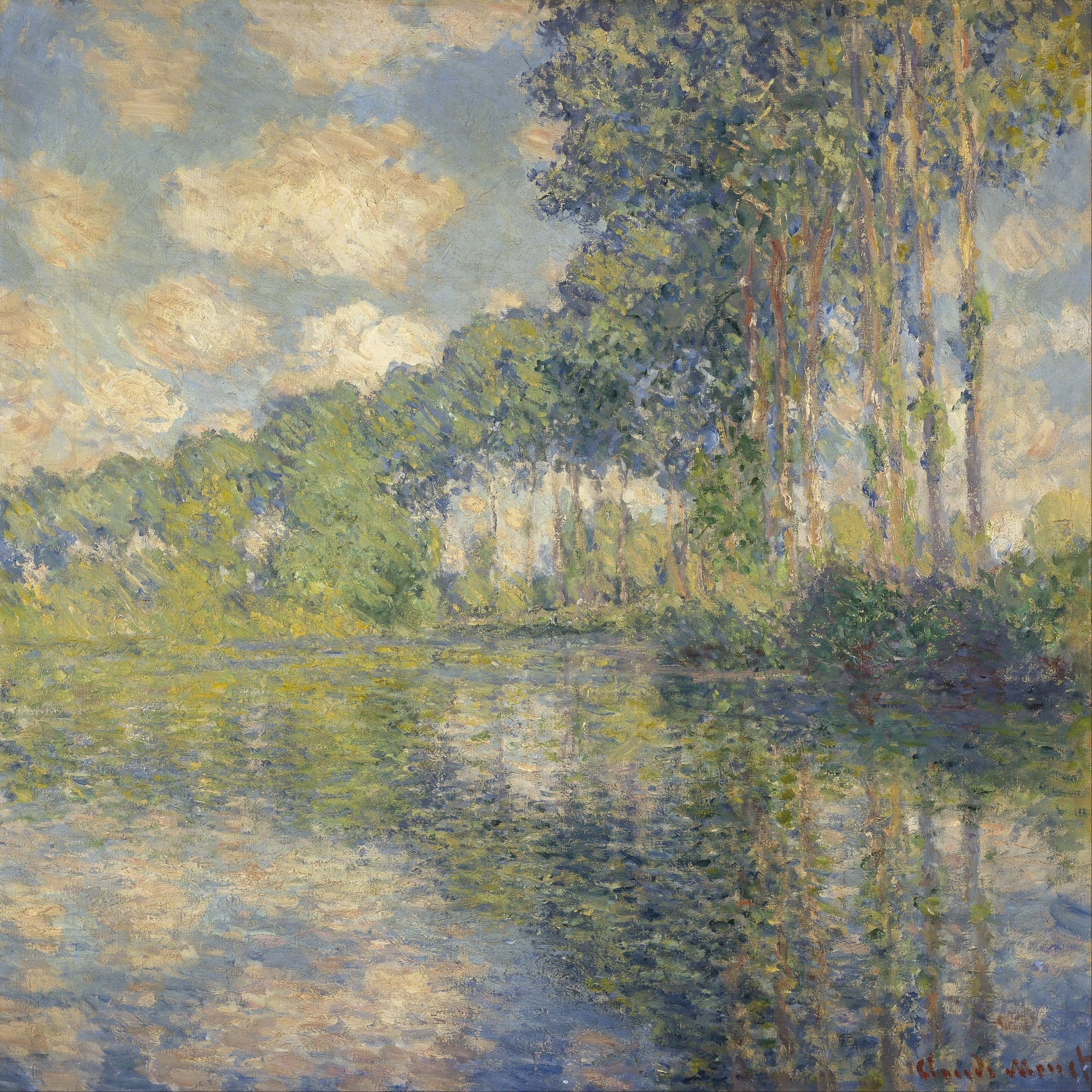
Poplars on the Epte
Claude Monet (1891)
Claude Monet’s Poplars on the Epte turns a modest river bend into a meditation on <strong>time, light, and perception</strong>. Upright trunks register as steady <strong>vertical chords</strong>, while their broken, shimmering reflections loosen form into <strong>pure sensation</strong>. The image stages a tension between <strong>order and flux</strong> that anchors the series within Impressionism’s core aims <sup>[1]</sup><sup>[2]</sup>.
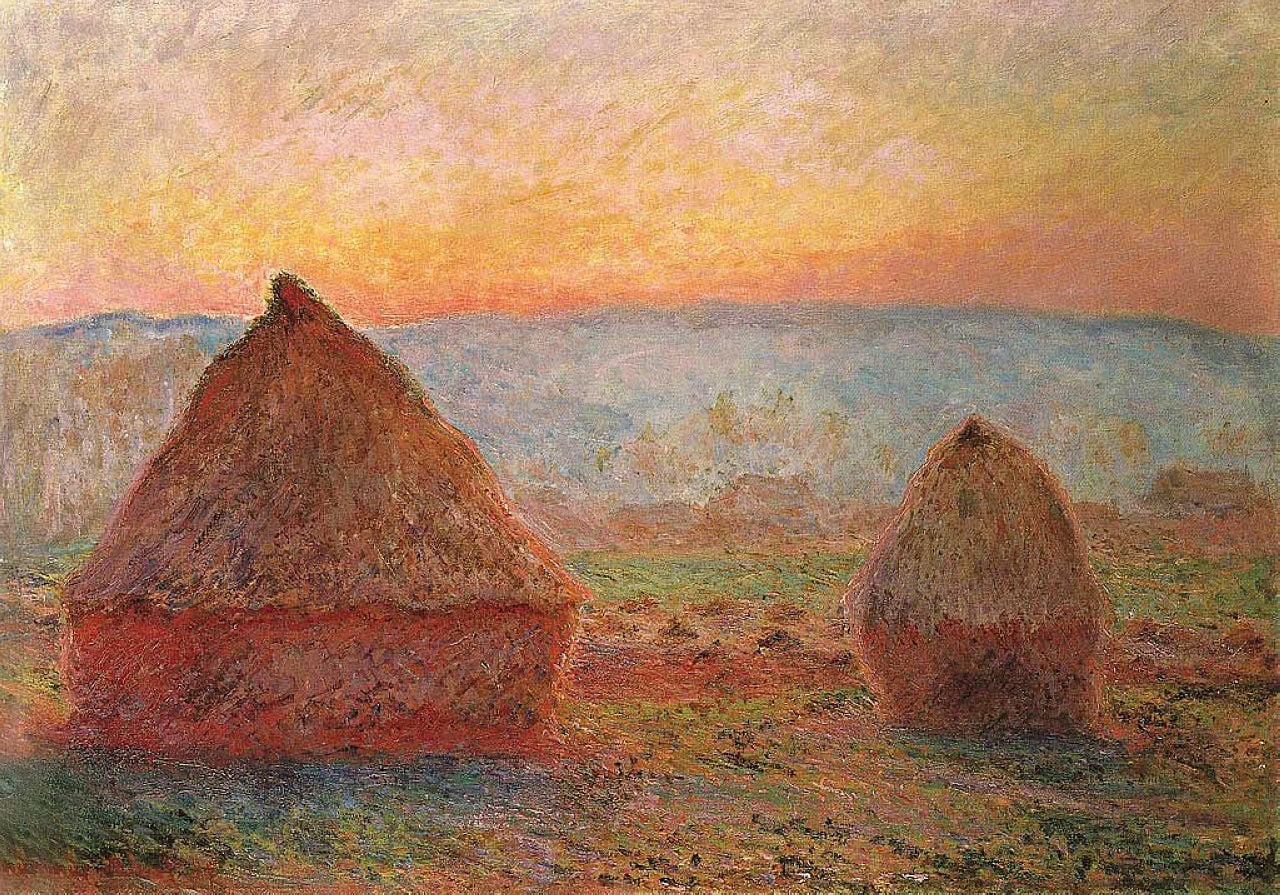
Haystack, Sunset
Claude Monet (1891)
Two conical stacks blaze against a cooling horizon, turning stored grain into a drama of <strong>light, time, and rural wealth</strong>. Monet’s broken strokes fuse warm oranges and cool violets so the stacks seem to glow from within, embodying the <strong>transience</strong> of a single sunset and the <strong>endurance</strong> of agrarian cycles <sup>[1]</sup><sup>[2]</sup><sup>[3]</sup>.
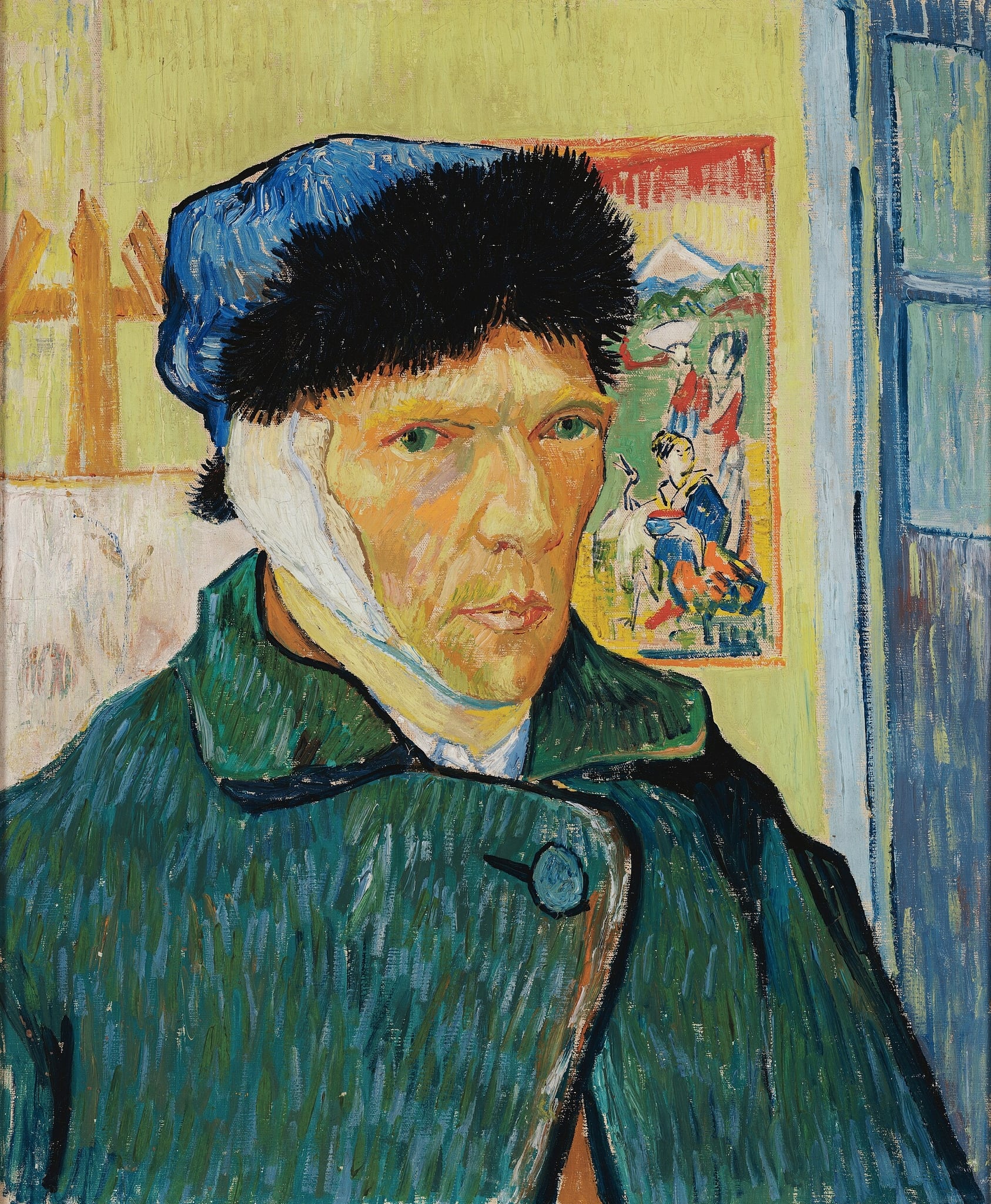
Self-Portrait with Bandaged Ear
Vincent van Gogh (1889)
In Self-Portrait with Bandaged Ear (1889), Vincent van Gogh converts a recent crisis into an image of <strong>resolve</strong>. The frontal, slightly turned pose forces attention to the white bandage at the viewer’s right, while the fur cap, heavy coat, and the nearby <strong>Japanese print</strong> declare persistence and ideals that steady him in the wake of trauma <sup>[1]</sup><sup>[2]</sup>. The painting’s cool, wintry palette and insistent strokes make suffering legible yet disciplined, transforming pain into <strong>artistic purpose</strong> <sup>[2]</sup>.
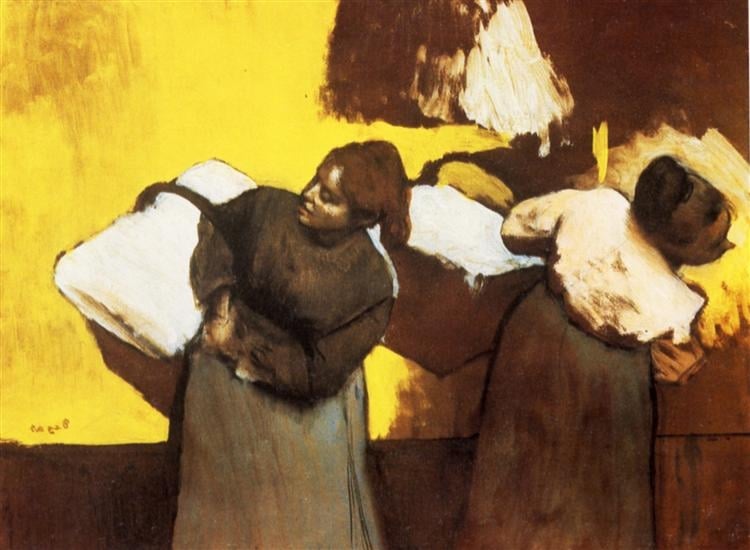
Laundresses Carrying Linen in Town
Camille Pissarro (1879)
In Laundresses Carrying Linen in Town, two working women strain under <strong>white bundles</strong> that flare against a <strong>flat yellow ground</strong> and a <strong>dark brown band</strong>. The abrupt cropping and opposing diagonals turn anonymous labor into a <strong>monumental, modern frieze</strong> of effort and motion.
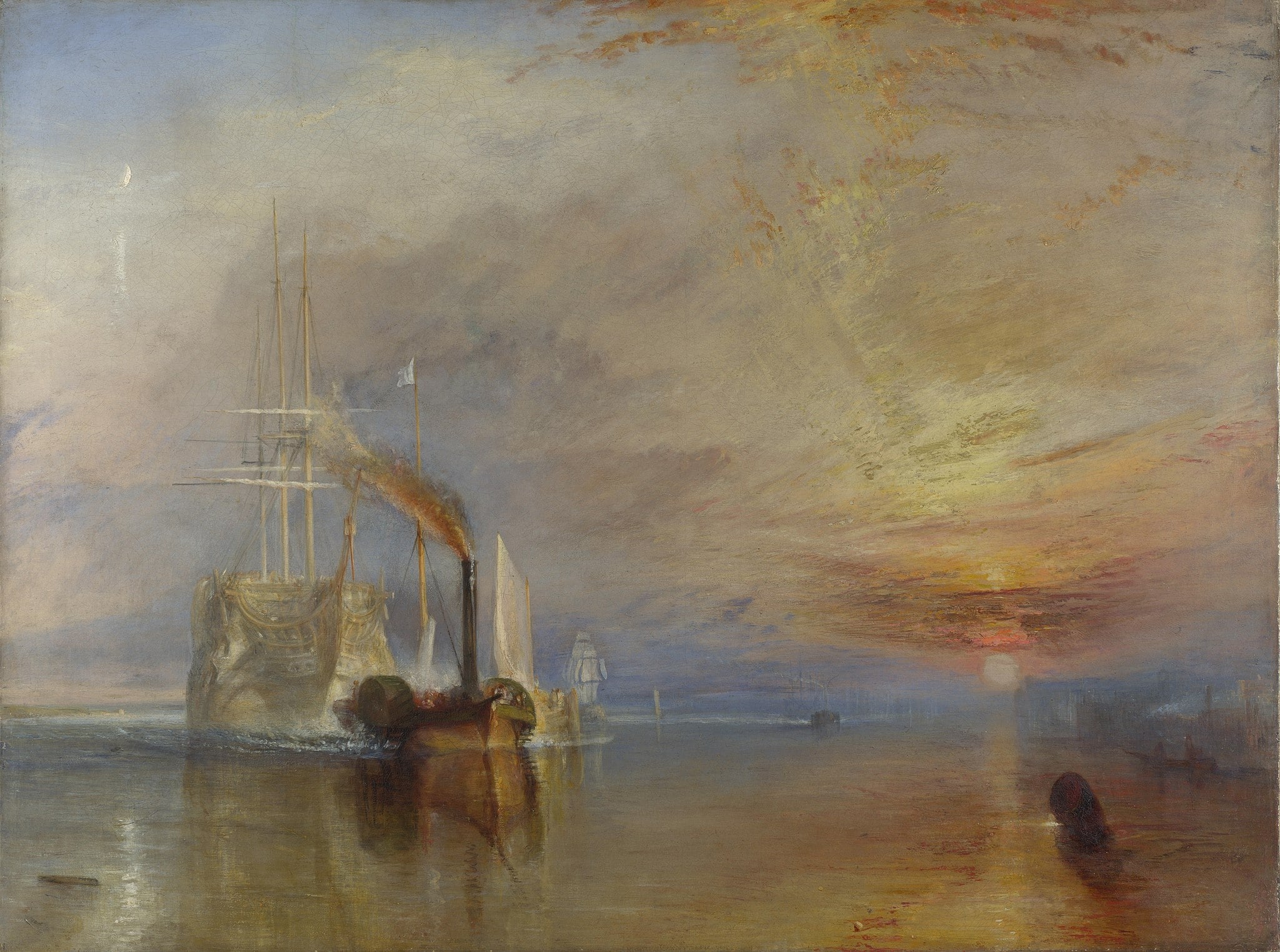
The Fighting Temeraire
J. M. W. Turner (1839)
In The Fighting Temeraire, J. M. W. Turner sets a <strong>ghostly man‑of‑war</strong> against a <strong>sooty steam tug</strong> under a blazing, emblematic sunset. The pale ship’s towering masts and slack rigging read like memory, while the tug’s black smoke cuts through the rigging where a flag once flew, signaling <strong>power passing from sail to steam</strong> <sup>[1]</sup><sup>[2]</sup>. A crescent moon and a humble buoy punctuate a river turned to molten gold, marking both ending and beginning <sup>[3]</sup><sup>[4]</sup>.
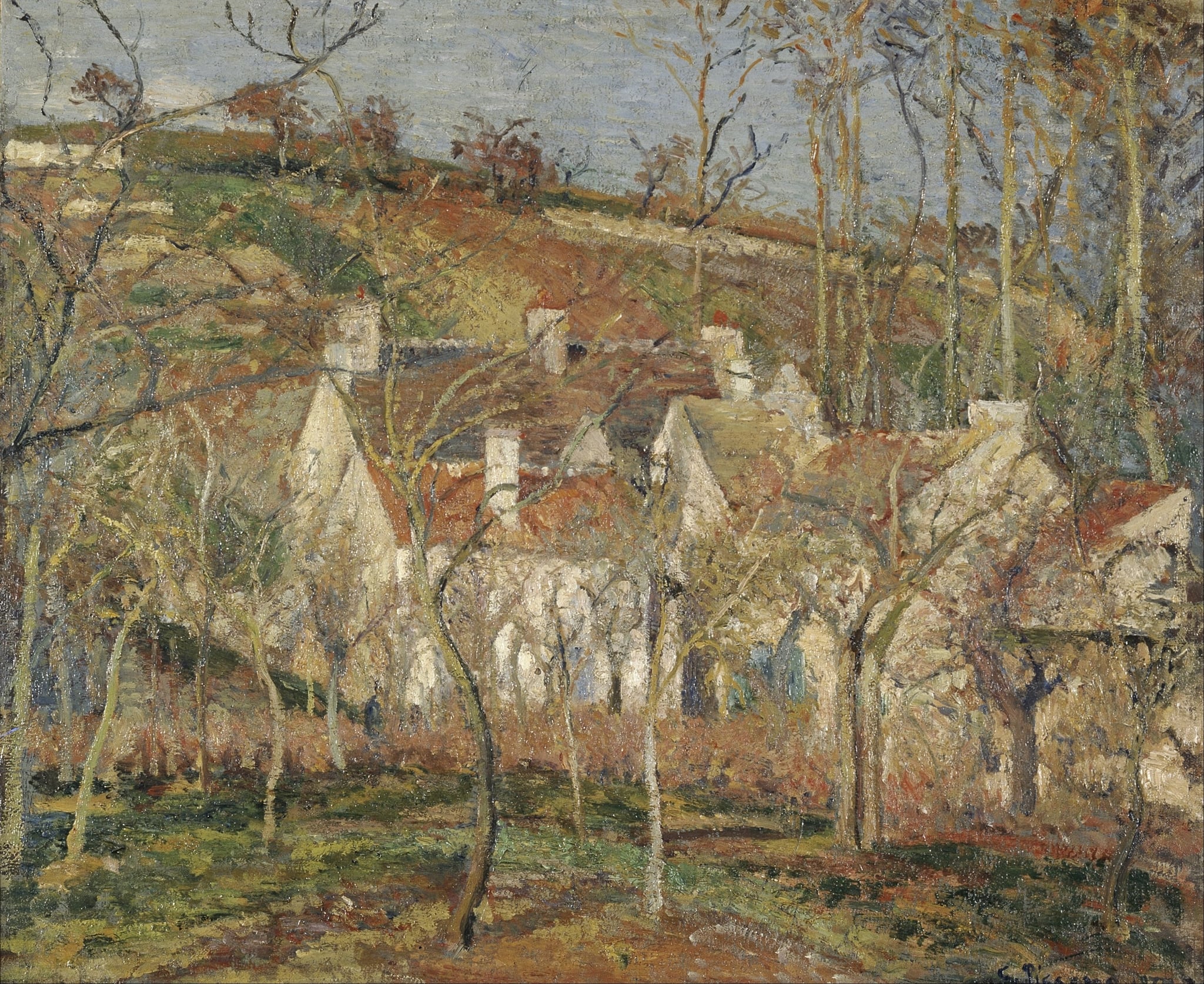
Red Roofs
Camille Pissarro (1877)
In Red Roofs, Camille Pissarro knits village and hillside into a single living fabric through a <strong>screen of winter trees</strong> and vibrating, tactile brushwork. The warm <strong>red-tiled roofs</strong> act as chromatic anchors within a cool, silvery atmosphere, asserting human shelter as part of nature’s rhythm rather than its negation <sup>[1]</sup><sup>[3]</sup>. The composition’s <strong>parallel planes</strong> and color echoes reveal a deliberate structural order that anticipates Post‑Impressionist concerns <sup>[1]</sup><sup>[2]</sup>.
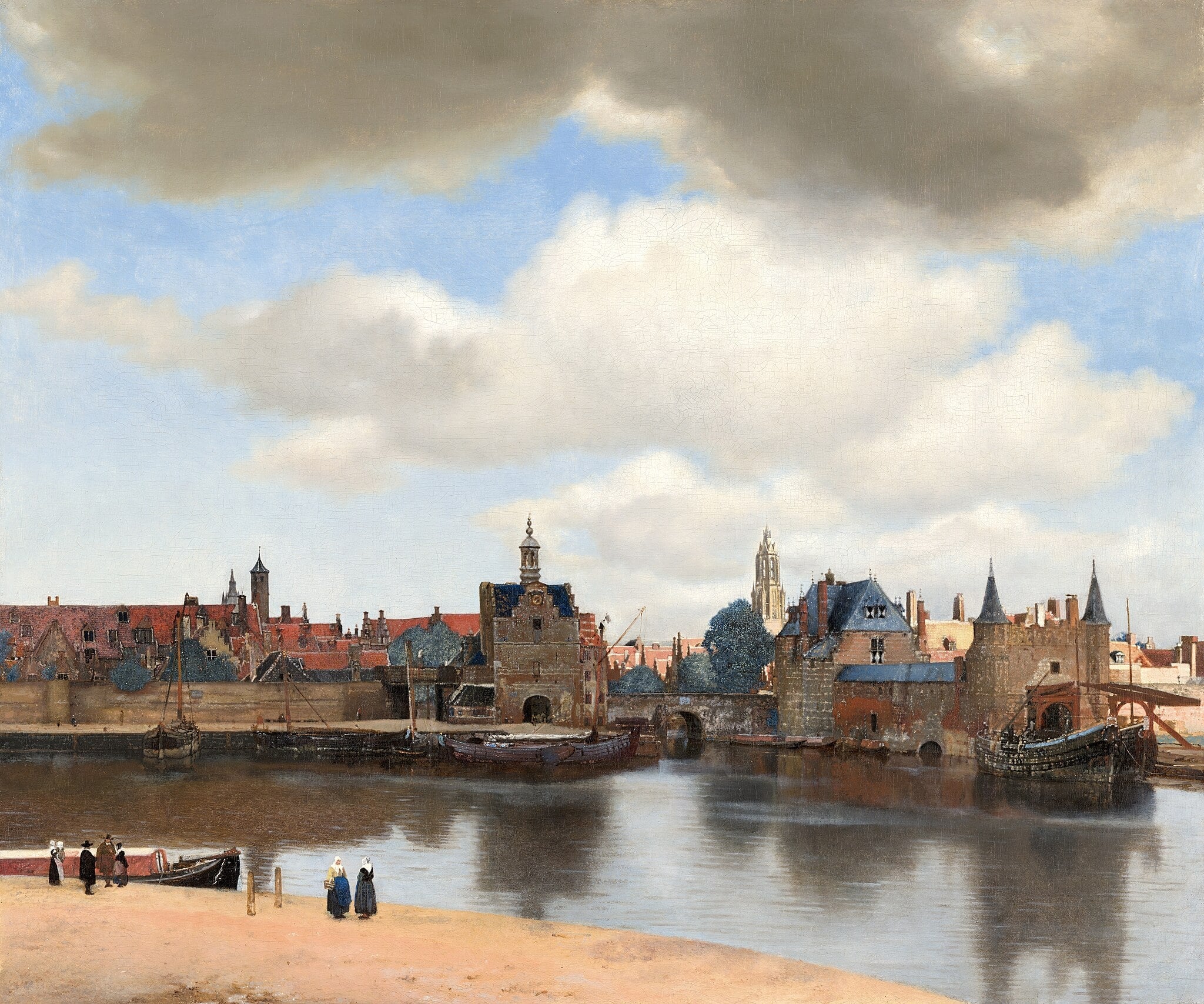
View of Delft
Johannes Vermeer (c. 1660–1661)
View of Delft turns a faithful city prospect into a meditation on <strong>civic order, resilience, and time</strong>. Beneath a low horizon, drifting clouds cast mobile shadows while shafts of sun ignite blue roofs and the bright spire of the <strong>Nieuwe Kerk</strong>, holding the scene’s moral center <sup>[1]</sup>. Small figures and moored boats ground prosperity in <strong>everyday community</strong> without breaking the hush.
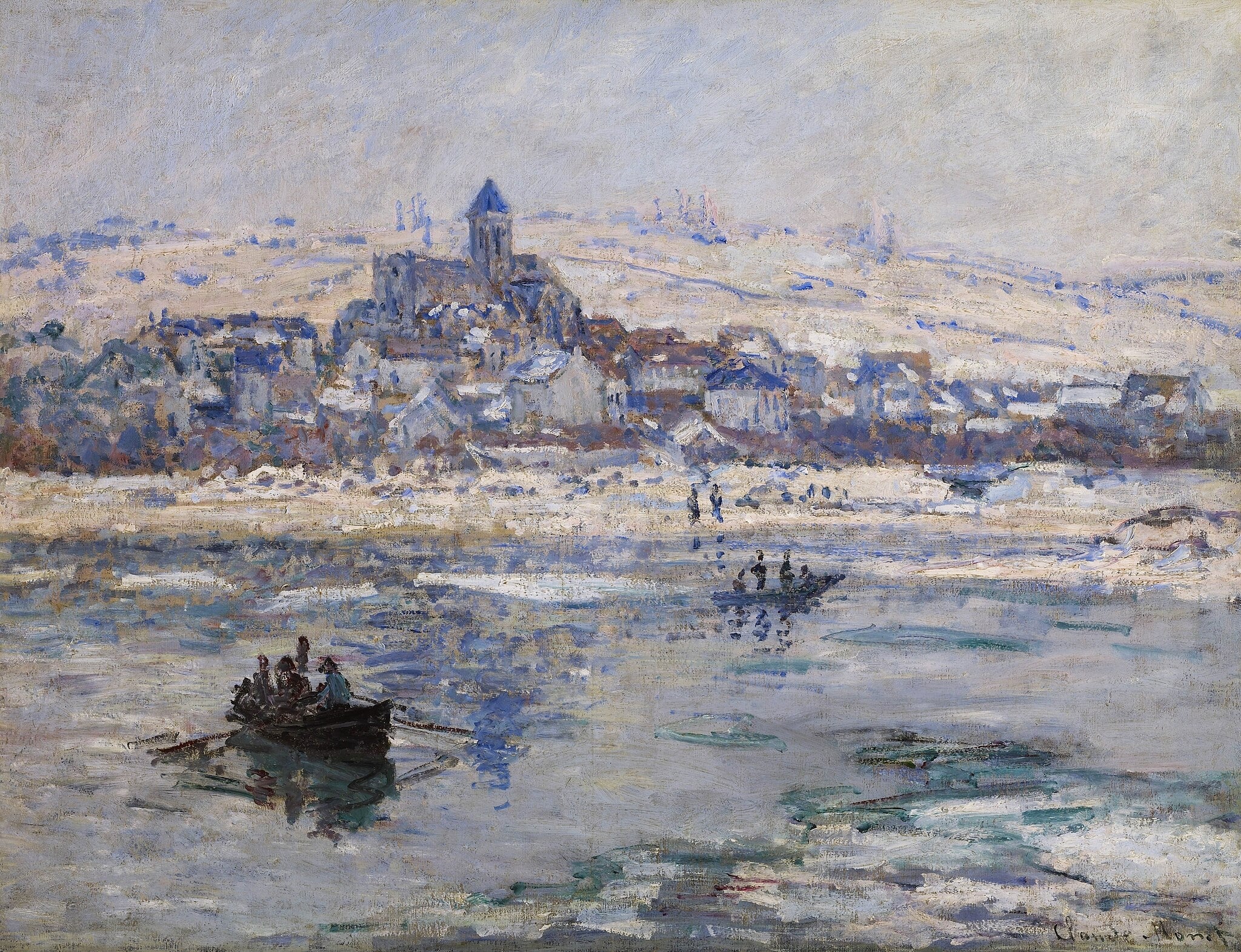
Vétheuil in Winter
Claude Monet (1878–79)
Claude Monet’s Vétheuil in Winter renders a riverside village in a <strong>silvery, frost-laden light</strong>, where the Seine carries <strong>broken ice</strong> past clustered houses and the tall church tower. The scene’s <strong>granular blue-green palette</strong> and softened edges make the town appear to crystallize out of air and water, while small boats and figures signal quiet persistence.
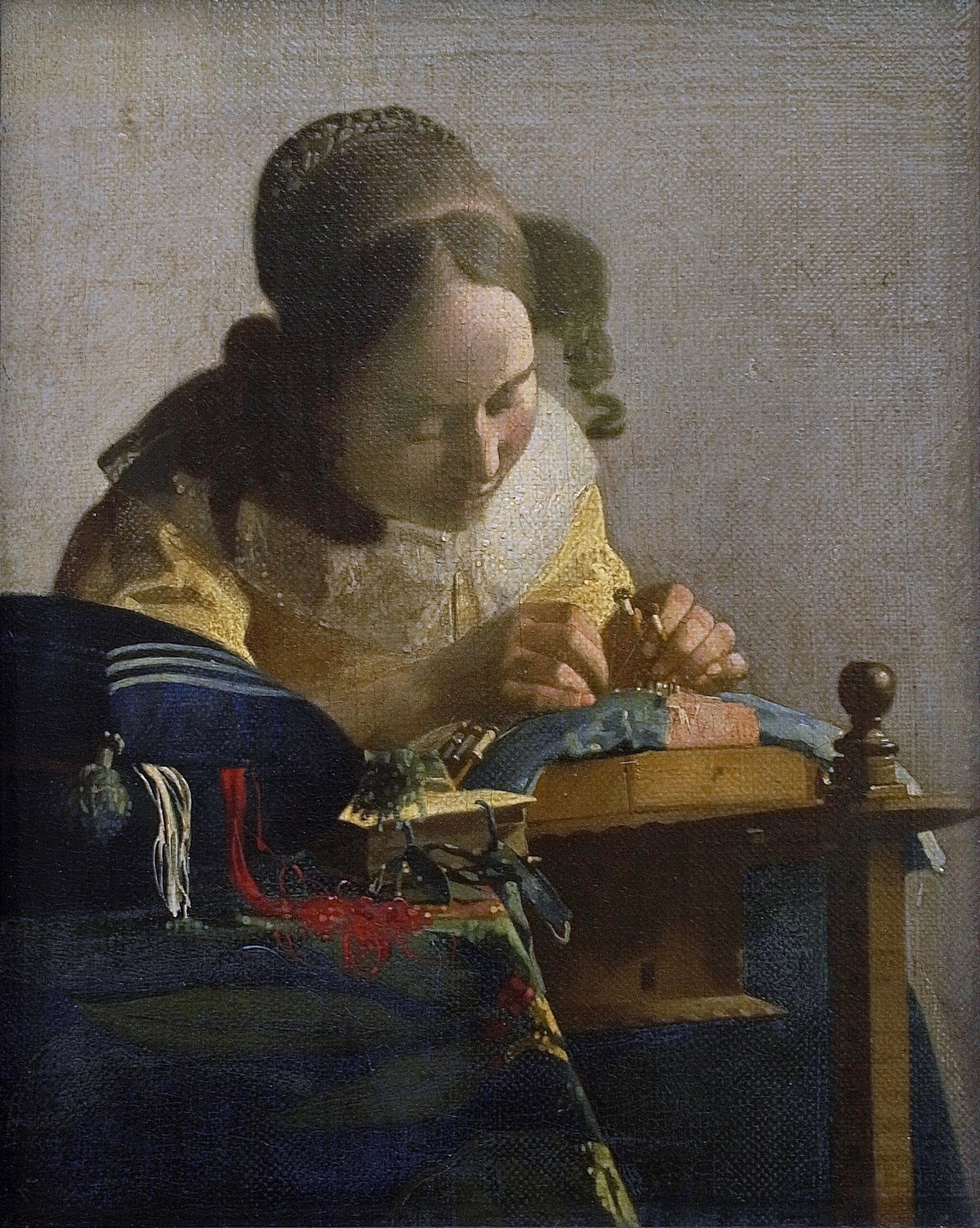
The Embroiderer
Johannes Vermeer (1669–1670)
In The Embroiderer, Johannes Vermeer condenses a world of work into a palm‑sized drama of <strong>attention</strong> and <strong>transformation</strong>. A young woman bends over a lace pillow as loose red and white threads spill in front, while a nascent pattern gathers under her poised fingers. Vermeer’s right‑hand light isolates the act of making and turns domestic labor into <strong>virtuous concentration</strong> <sup>[1]</sup>.
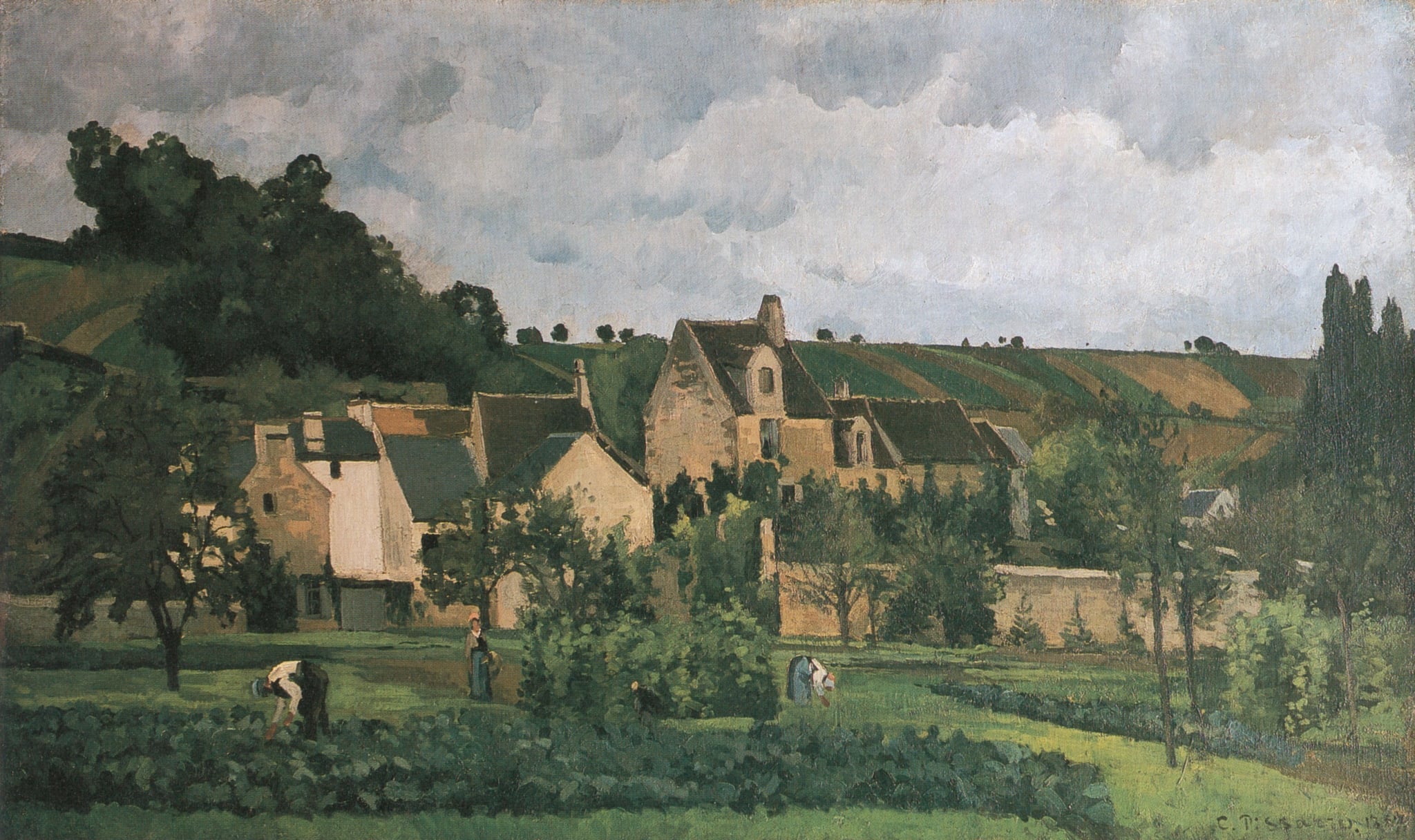
The Hermitage at Pontoise
Camille Pissarro (ca. 1867)
Camille Pissarro’s The Hermitage at Pontoise shows a hillside village interlaced with <strong>kitchen gardens</strong>, stone houses, and workers bent to their tasks under a <strong>low, cloud-laden sky</strong>. The painting binds human labor to place, staging a quiet counterpoint between <strong>architectural permanence</strong> and the <strong>seasonal flux</strong> of fields and weather <sup>[1]</sup><sup>[3]</sup>.
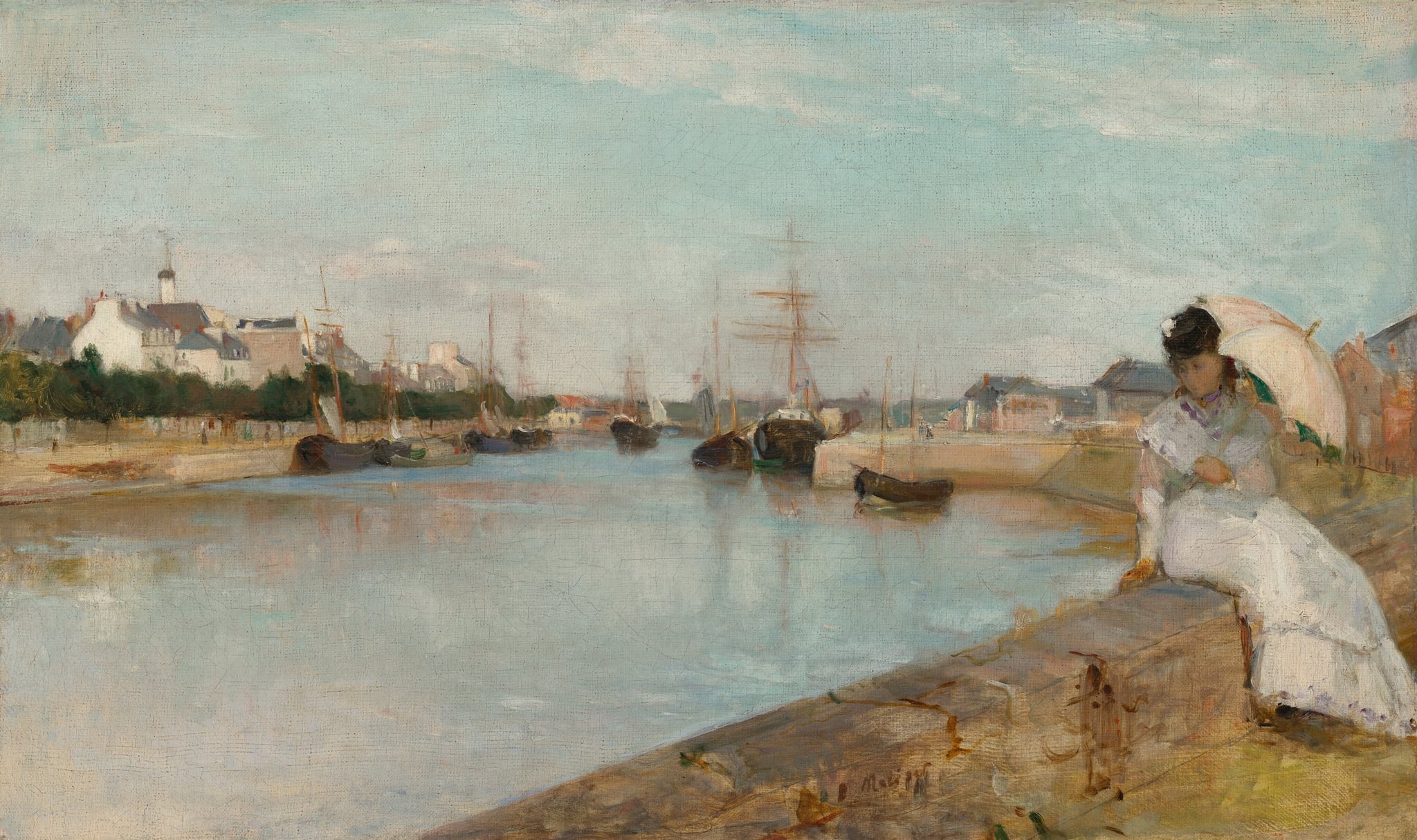
The Harbour at Lorient
Berthe Morisot (1869)
Berthe Morisot’s The Harbour at Lorient stages a quiet tension between <strong>private reverie</strong> and <strong>public movement</strong>. A woman under a pale parasol sits on the quay’s stone lip while a flotilla of masted boats idles across a silvery basin, their reflections dissolving into light. Morisot’s <strong>pearly palette</strong> and brisk brushwork make the water read as time itself, holding stillness and departure in the same breath <sup>[1]</sup>.
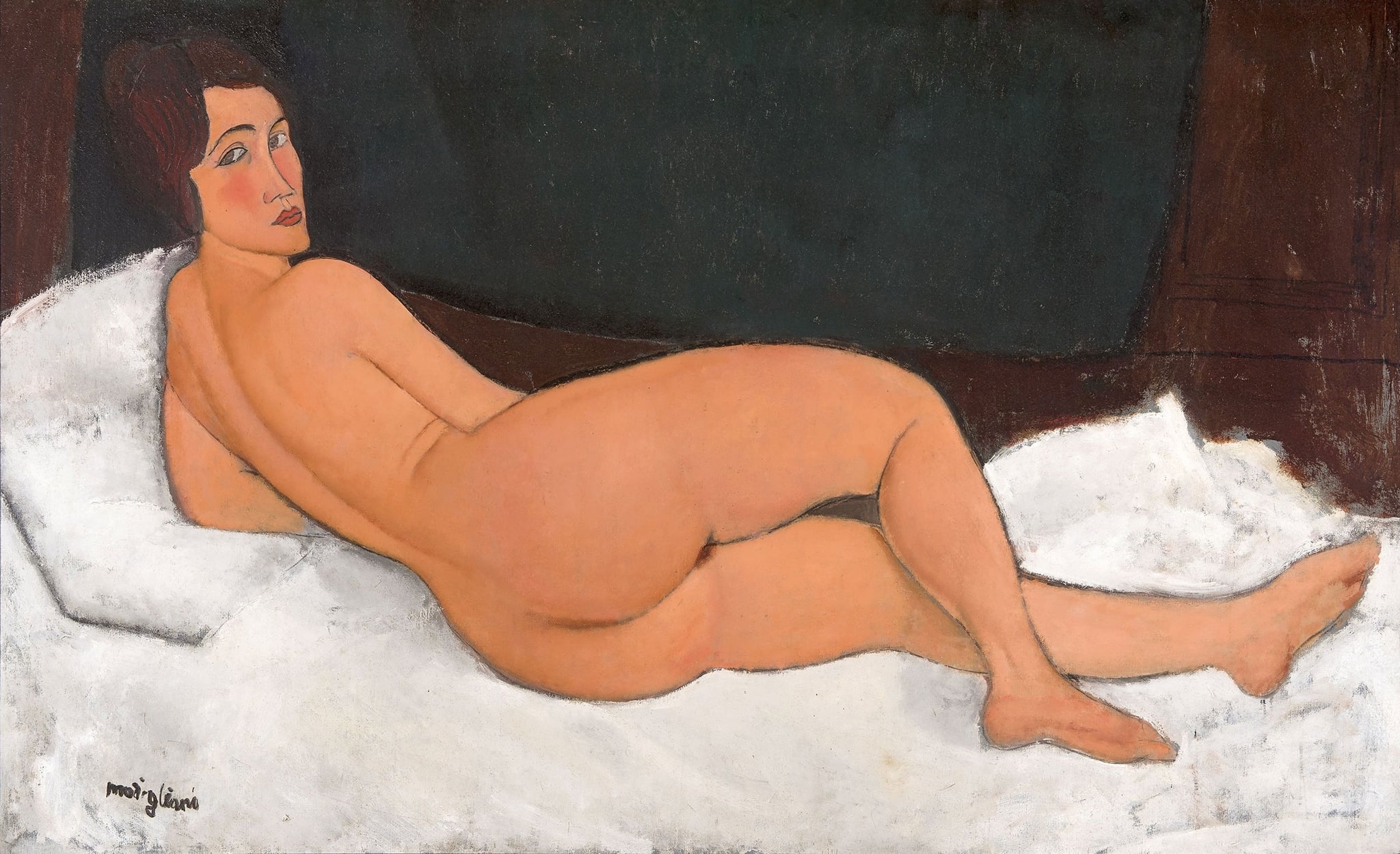
Nu couché (sur le côté gauche)
Amedeo Modigliani (1917)
Nu couché (sur le côté gauche) is a 1917 oil painting in which Amedeo Modigliani monumentalizes a reclining nude through a continuous, sculptural contour and a flattened, nearly void backdrop. The figure’s warm terracotta body, set against crisp white sheets and a dark field, fuses <strong>modern candor</strong> with <strong>classical poise</strong> <sup>[1]</sup><sup>[2]</sup>. The direct, appraising gaze and masklike face assert a new, <strong>autonomous modern nude</strong>.
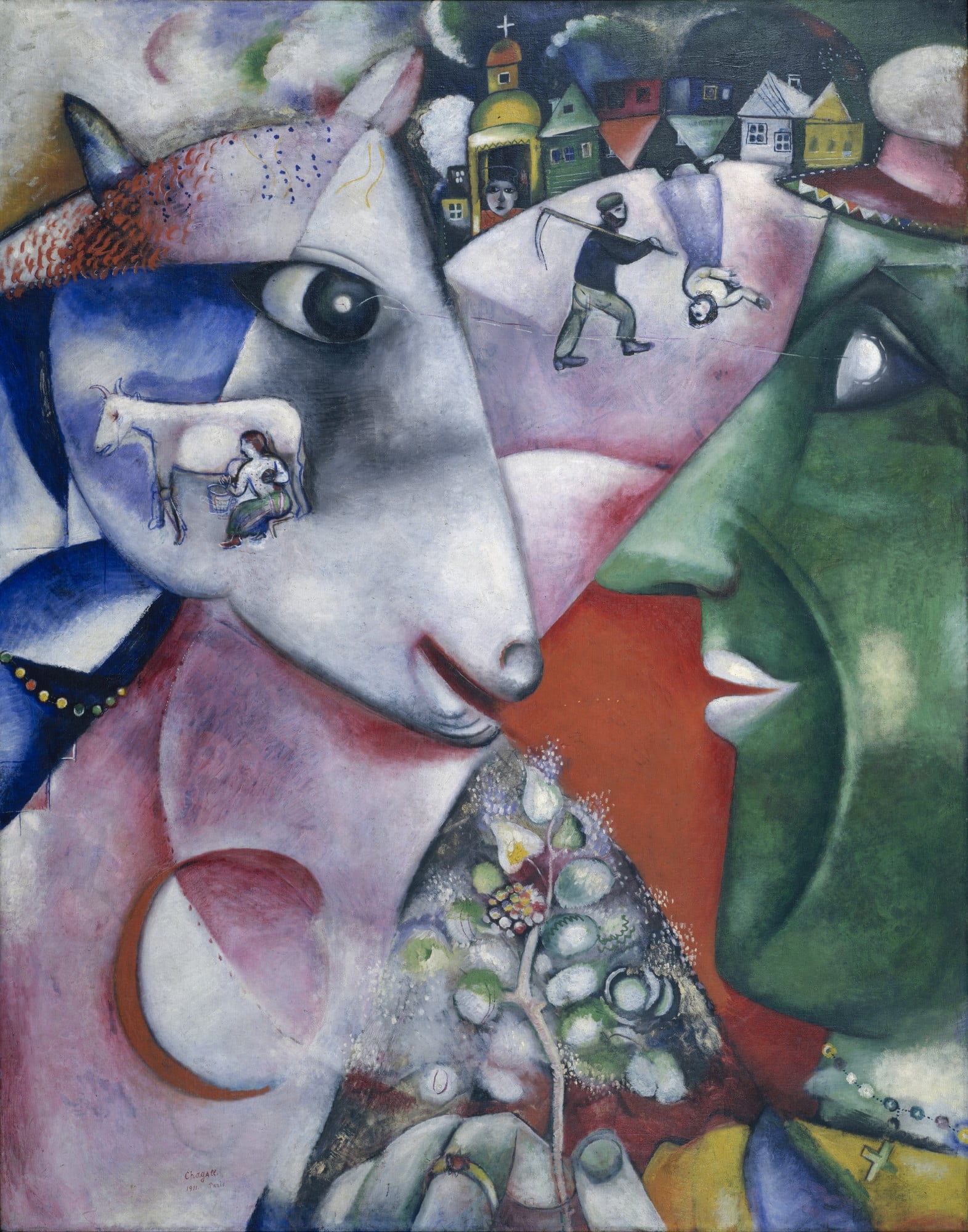
I and the Village
Marc Chagall (1911)
In I and the Village, Marc Chagall fuses <strong>memory, myth, and rural ritual</strong> into a dream‑logic tableau where a green‑faced villager and a pale bovine meet <strong>eye‑to‑eye</strong>. Concentric forms, prismatic color, and floating figures turn Vitebsk’s everyday life into a <strong>cosmic community</strong> where work, faith, and imagination coexist <sup>[1]</sup><sup>[3]</sup>.
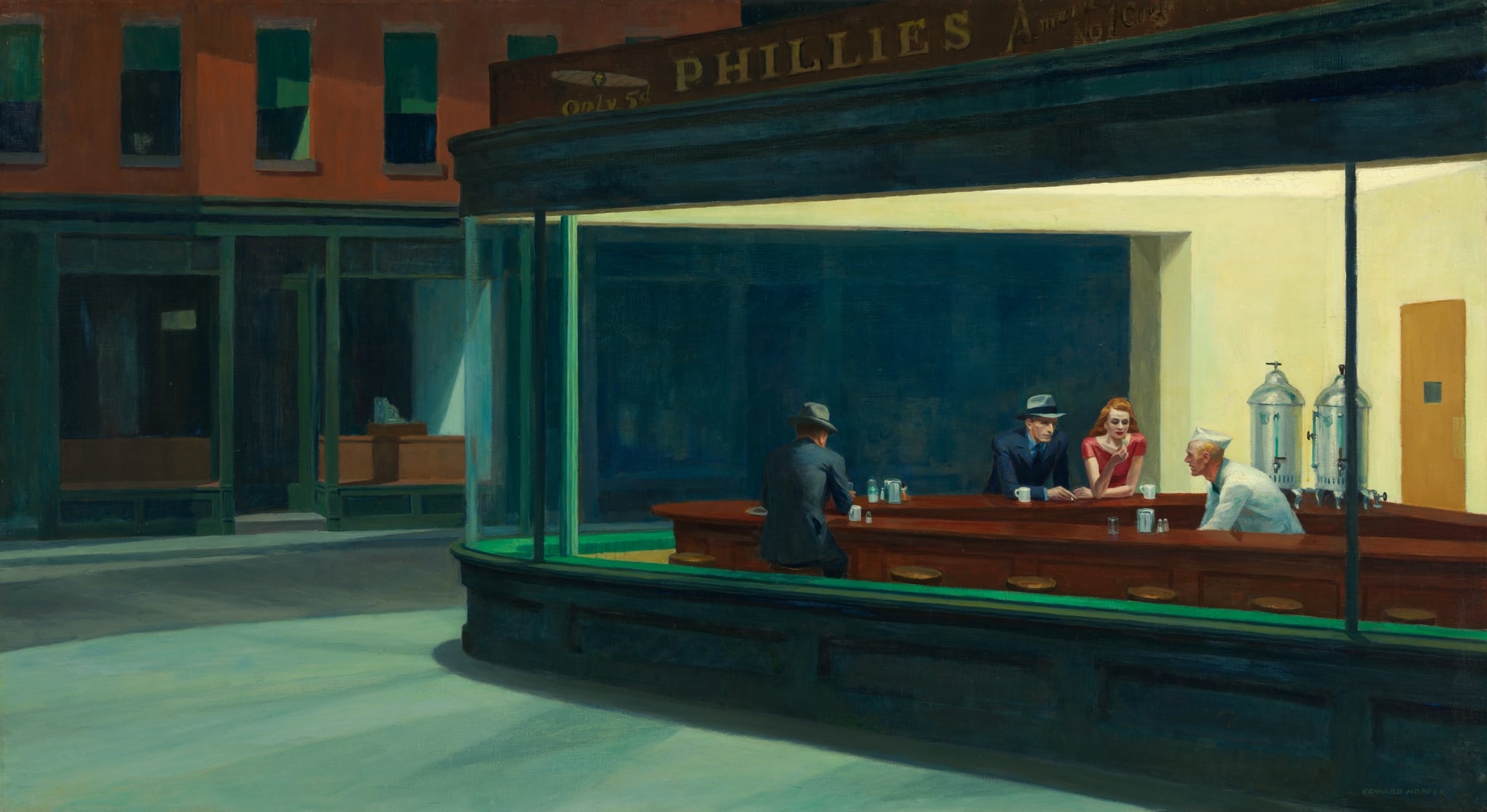
Nighthawks
Edward Hopper (1942)
Edward Hopper’s Nighthawks turns a corner diner into a sealed stage where <strong>fluorescent light</strong> and <strong>curved glass</strong> hold four figures in suspended time. The empty streets and the “PHILLIES” cigar sign sharpen the sense of <strong>urban solitude</strong> while hinting at wartime vigilance. The result is a cool, lucid image of modern life: illuminated, open to view, and emotionally out of reach.
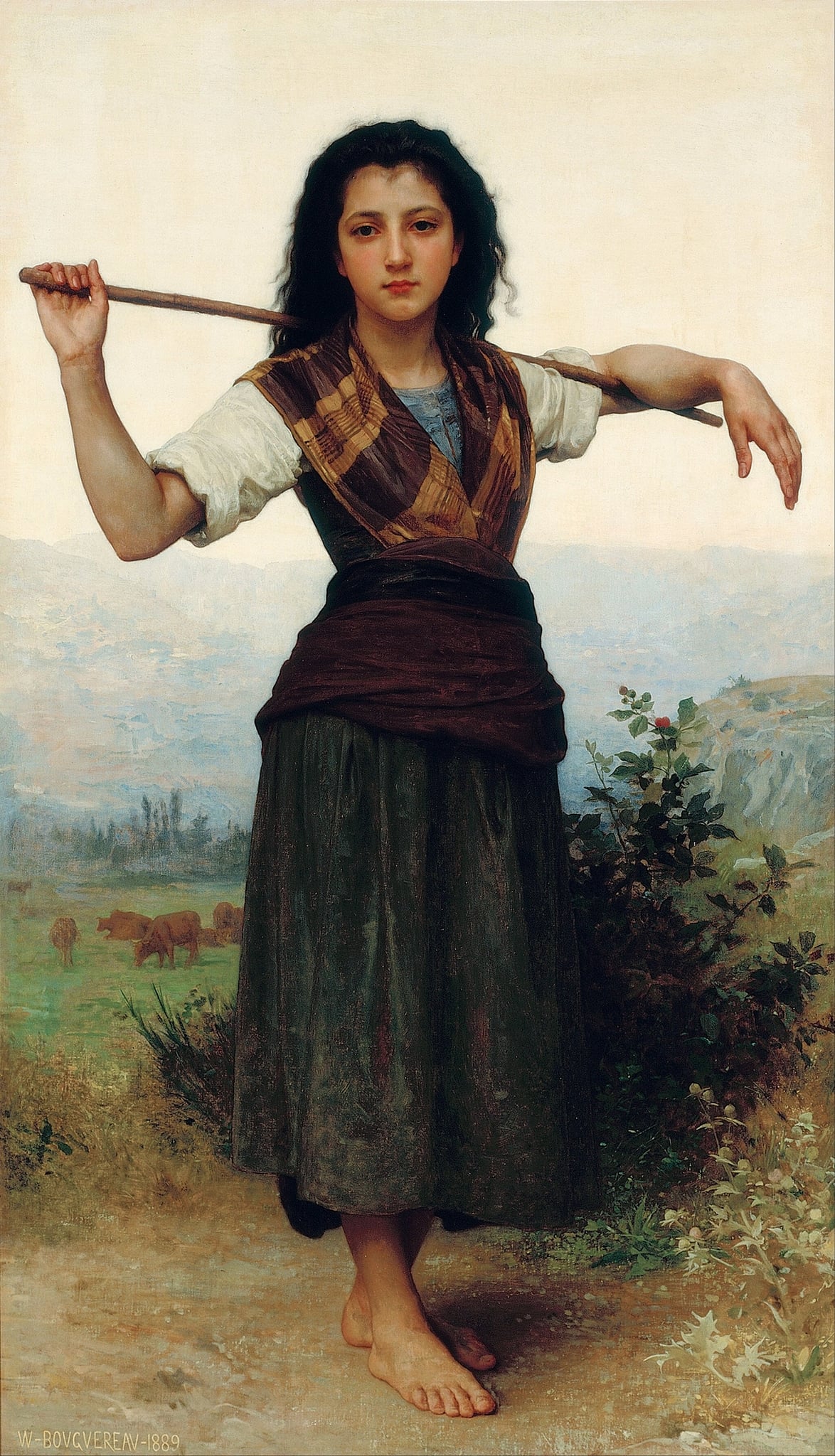
The Shepherdess
William-Adolphe Bouguereau (1889)
The Shepherdess presents a barefoot country girl frontally, her staff resting across her shoulders as she meets the viewer’s gaze with calm resolve. Bouguereau fuses <strong>rustic reality</strong> (earth‑stained feet, worn skirt, grazing cattle) with <strong>classical idealization</strong> (polished skin, poised contrapposto), elevating humble labor into quiet nobility <sup>[1]</sup><sup>[2]</sup>.
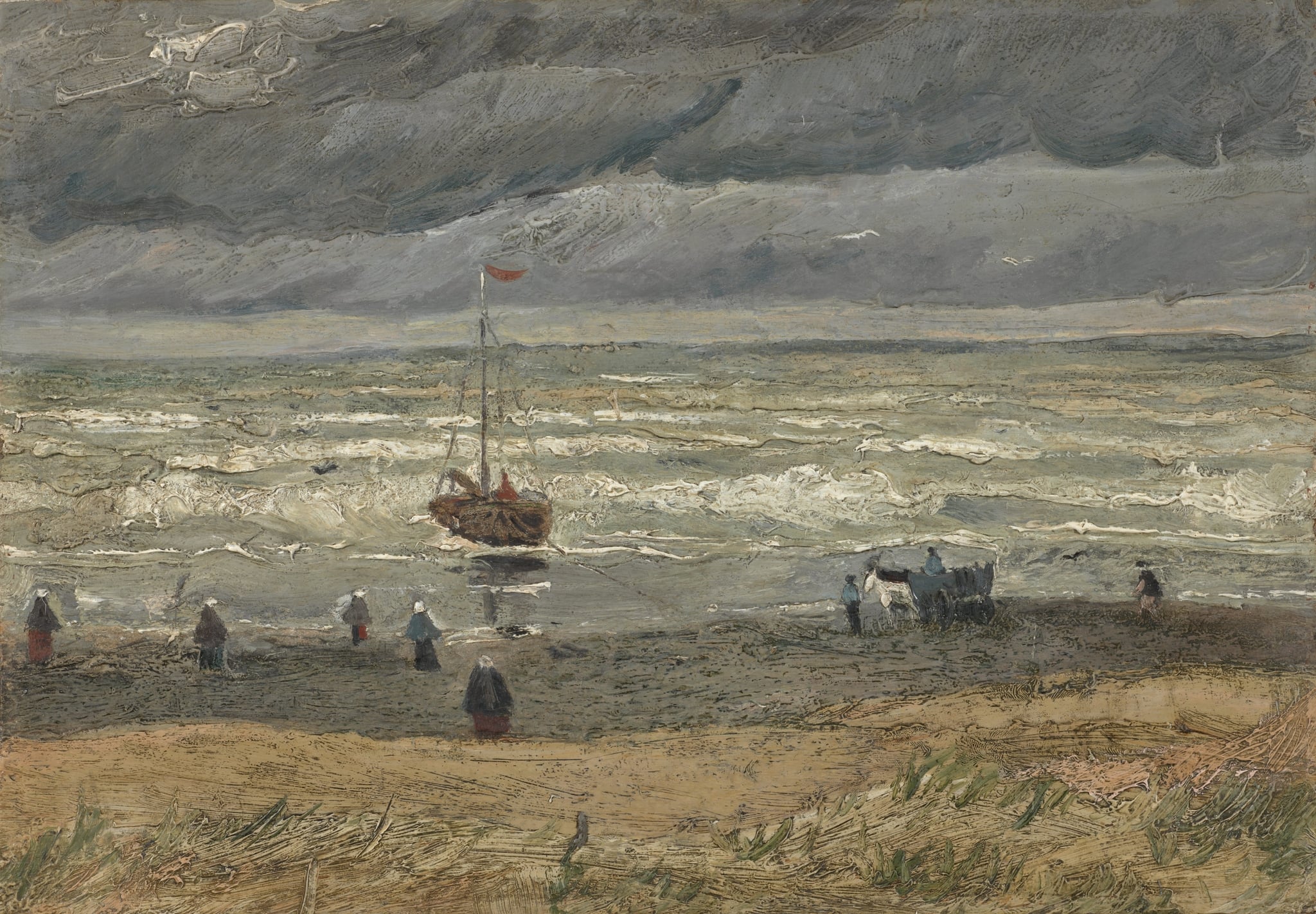
View of the Sea at Scheveningen
Vincent van Gogh (1882)
Under a storm-laden sky, Vincent van Gogh’s <strong>View of the Sea at Scheveningen</strong> pits tiny beach figures, a <strong>horse-and-cart</strong>, and a fishing boat with a <strong>red flag</strong> against the heaving <strong>North Sea</strong>. The quick, dense strokes and even grains of blown <strong>sand embedded in the paint</strong> make the weather itself the subject, fusing observation with immediacy <sup>[2]</sup><sup>[3]</sup>.
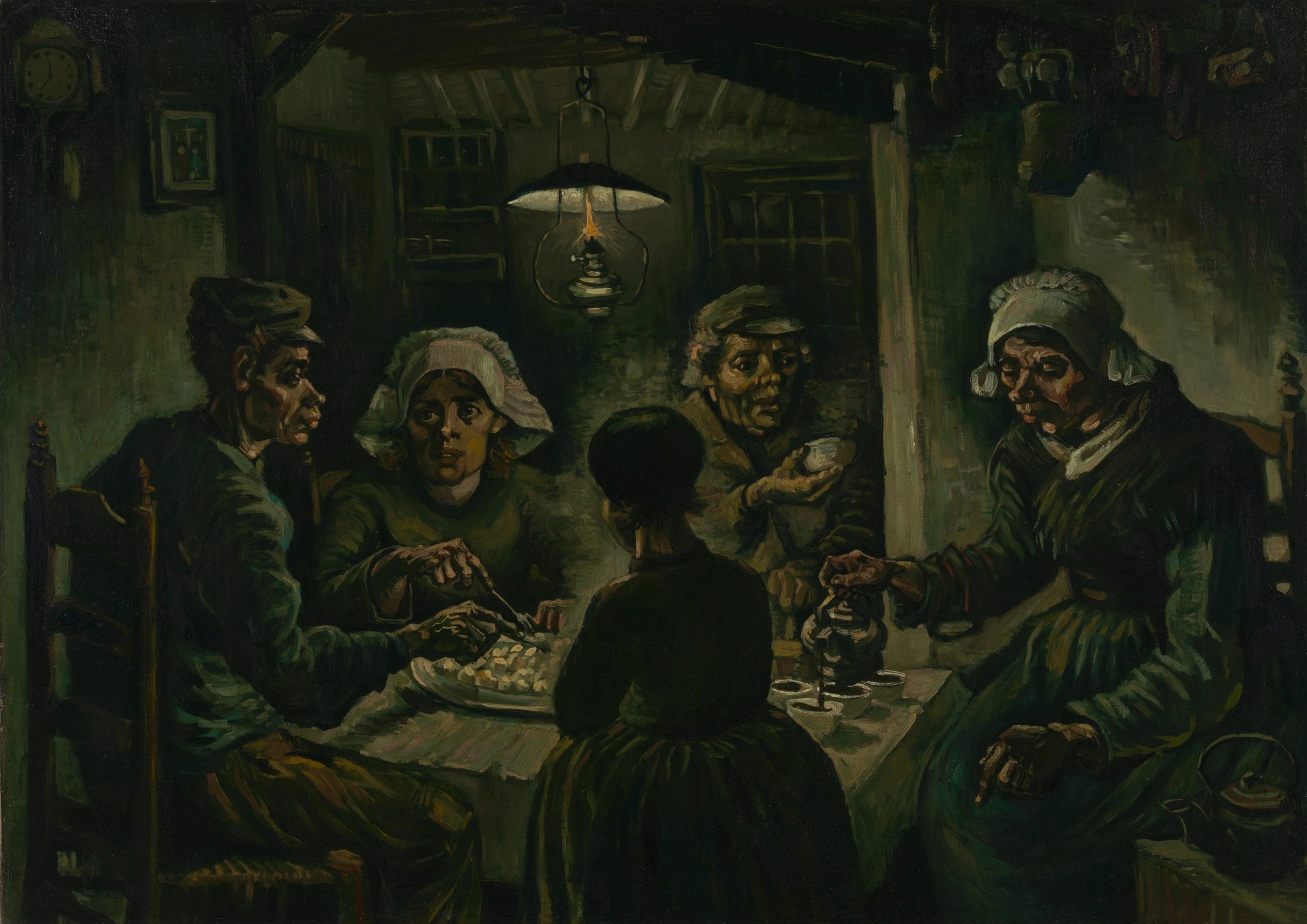
The Potato Eaters
Vincent van Gogh (1885)
In The Potato Eaters, five villagers huddle beneath a single oil lamp, their <strong>knotted hands</strong> reaching for a plate of potatoes and cups of coffee. The earthen palette and coarse brushwork forge a world of <strong>labor, humility, and solidarity</strong>, where the food on the table is the tangible outcome of the work in their hands <sup>[1]</sup><sup>[3]</sup>. Van Gogh turns scarcity into <strong>dignity</strong>, binding the group within the lamp’s modest halo <sup>[3]</sup><sup>[5]</sup>.
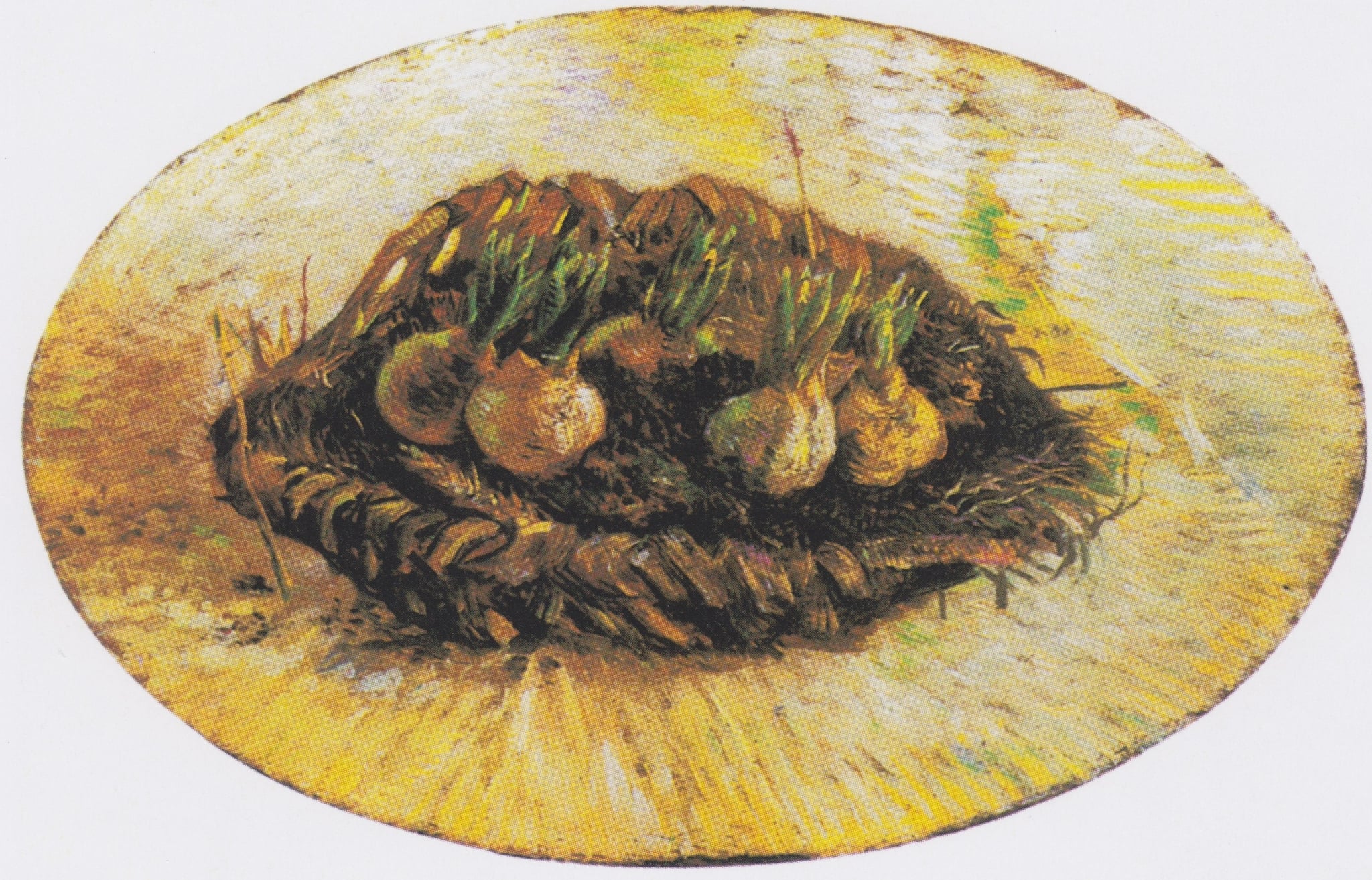
Basket of Hyacinth Bulbs
Vincent van Gogh (1887 (January–February))
<strong>Basket of Hyacinth Bulbs</strong> turns a modest basket of soil‑caked bulbs into a scene of <strong>latent vitality</strong>, painted in warm ochres and radiant yellows that encircle the motif like light. On an <strong>oval wooden panel</strong>, short, tactile strokes press the weave of the basket and the papery skins while green shoots puncture the dark soil, declaring life on the verge of emergence <sup>[1]</sup><sup>[2]</sup>.
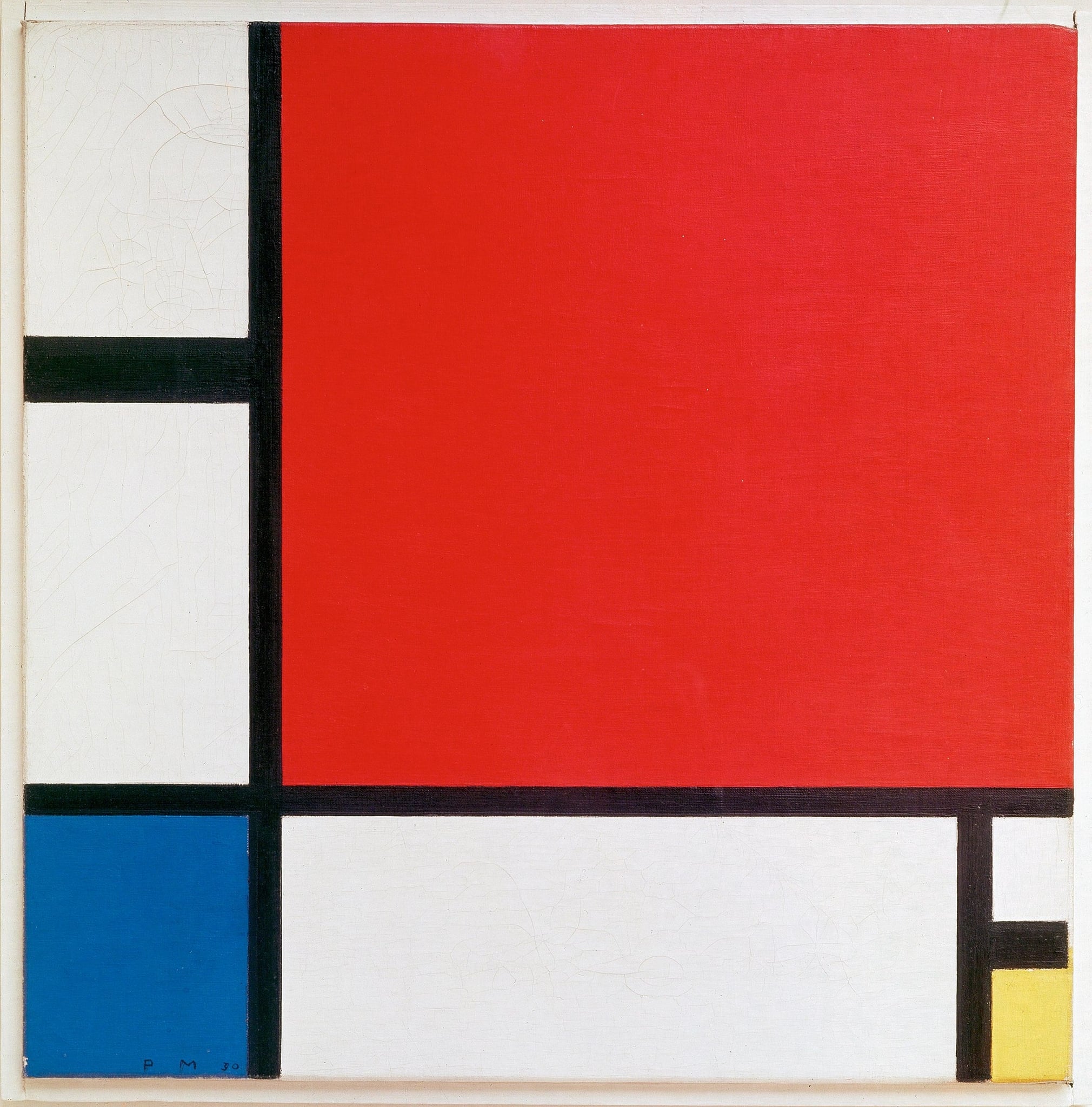
Composition with Red, Blue and Yellow
Piet Mondrian (1930)
Mondrian’s Composition with Red, Blue and Yellow crystallizes <strong>Neo‑Plasticism</strong> into a taut field of verticals/horizontals and primary planes, rejecting depth for <strong>pure relational balance</strong>. A dominant red at upper right is held in check by smaller blue and yellow blocks and by black bars that function as <strong>active planes</strong> rather than outlines. The result is a concise proposal for <strong>universal order</strong> achieved through asymmetry and reduction <sup>[1]</sup><sup>[2]</sup>.
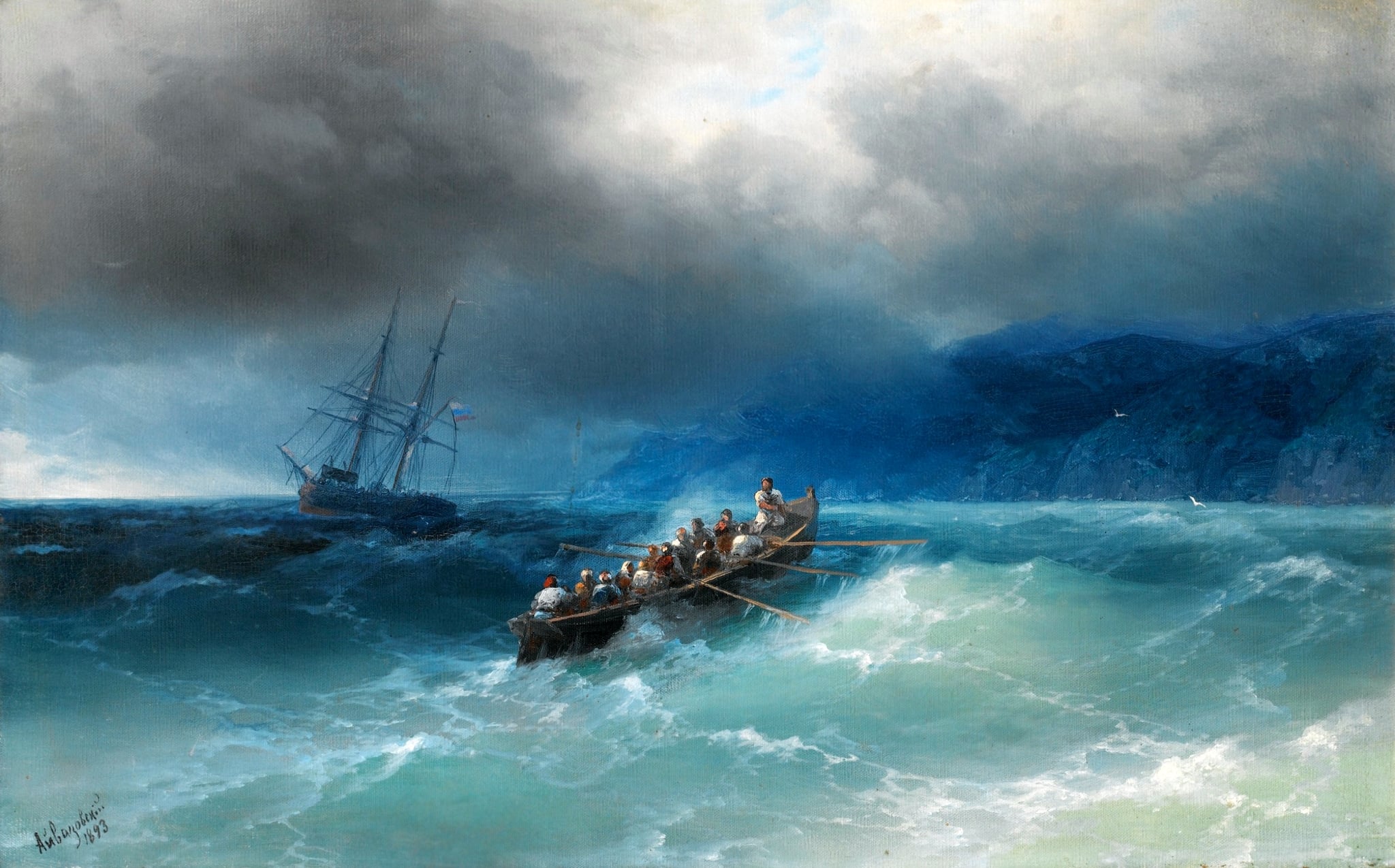
The Storm (Seascape)
Ivan Aivazovsky (1850)
In The Storm (Seascape), Ivan Aivazovsky forges a drama of <strong>human resolve</strong> against the <strong>Sublime sea</strong>. A crowded lifeboat claws up a green-blue swell toward a <strong>break of light</strong>, while a tall-masted ship lists behind and a <strong>rocky coast</strong> looms to the right. The painting crystallizes peril and hope in a single, surging moment.
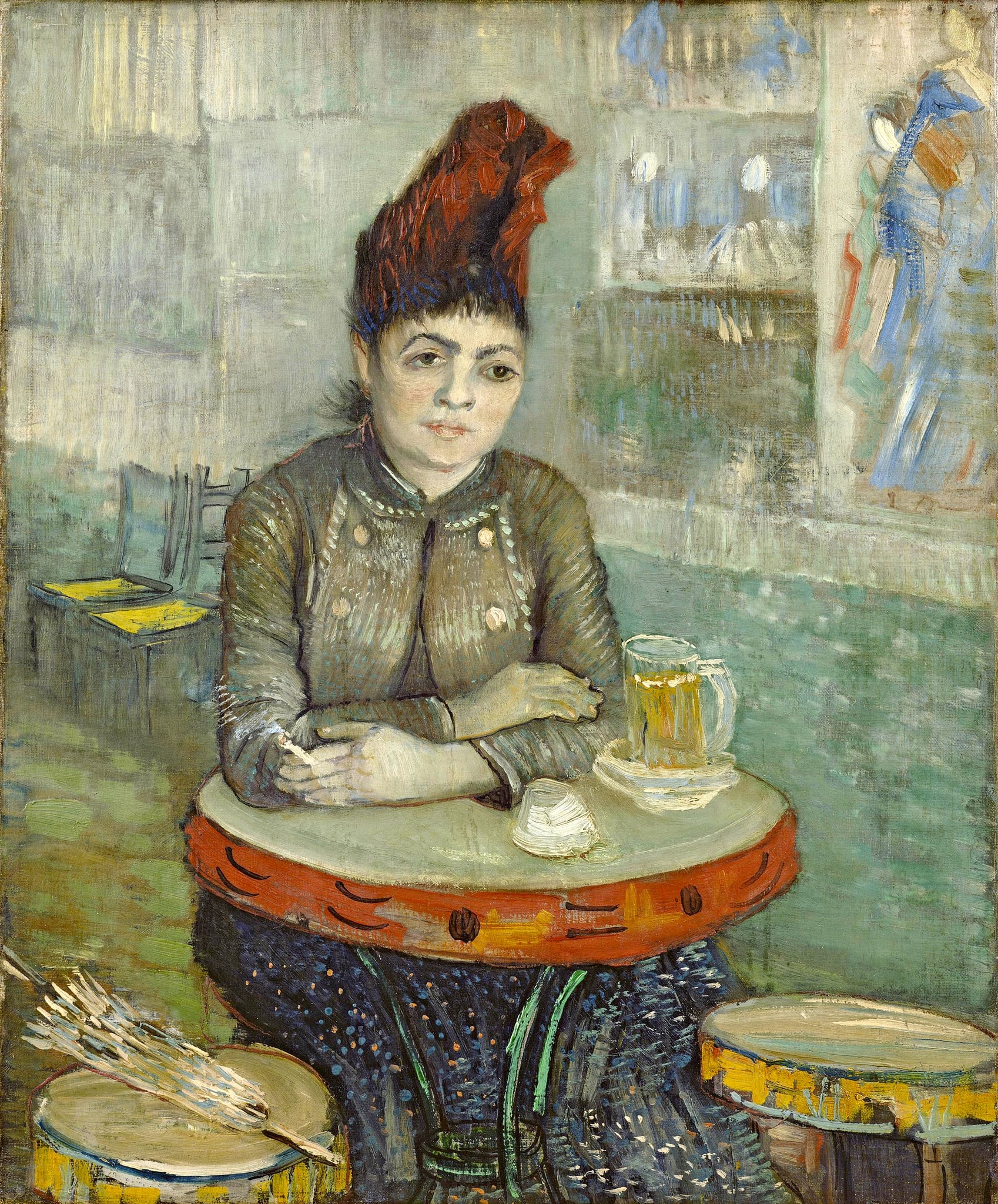
In the Café: Agostina Segatori in Le Tambourin
Vincent van Gogh (1887 (Jan–Mar))
Van Gogh casts Agostina Segatori at a tiny, tambourine‑like café table, turning Le Tambourin into a <strong>stage of modern life</strong>. Cool greens and greys make the red <strong>flame‑plume hat</strong> and the foaming <strong>beer</strong> flare, while folded arms and a set‑aside <strong>parasol</strong> register private fatigue amid public display <sup>[1]</sup><sup>[2]</sup><sup>[3]</sup>.
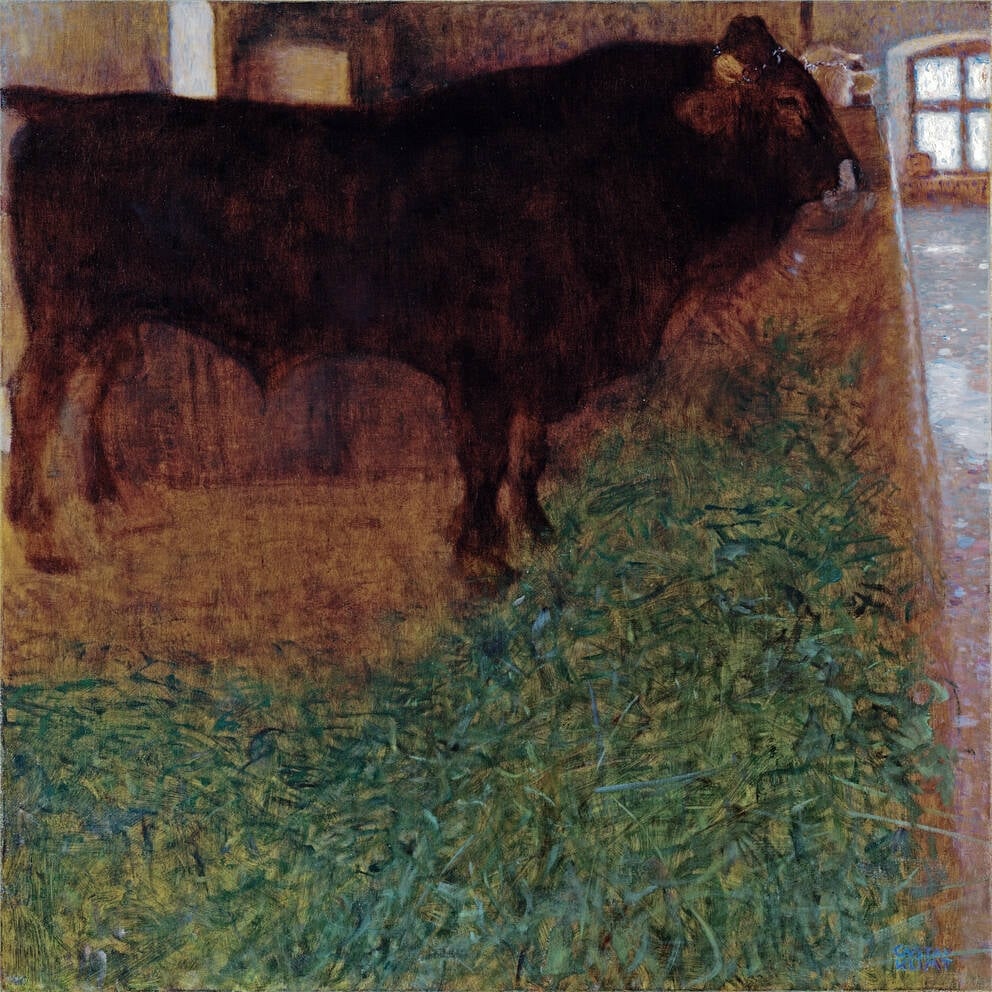
The Black Bull
Gustav Klimt (1900 (1900–1901 also cited))
<strong>The Black Bull</strong> distills raw animal power into a near-monolithic presence, its dark mass occupying the square field while a cool window flare touches the snout and horn. <strong>Gustav Klimt</strong> transforms a stable interior into a drama of force and limit, the diagonal swath of green fodder channeling energy toward the tethered head. The work finds grandeur in a local motif from Klimt’s first Attersee summer, uniting tactile surface with psychological tension <sup>[1]</sup><sup>[4]</sup>.
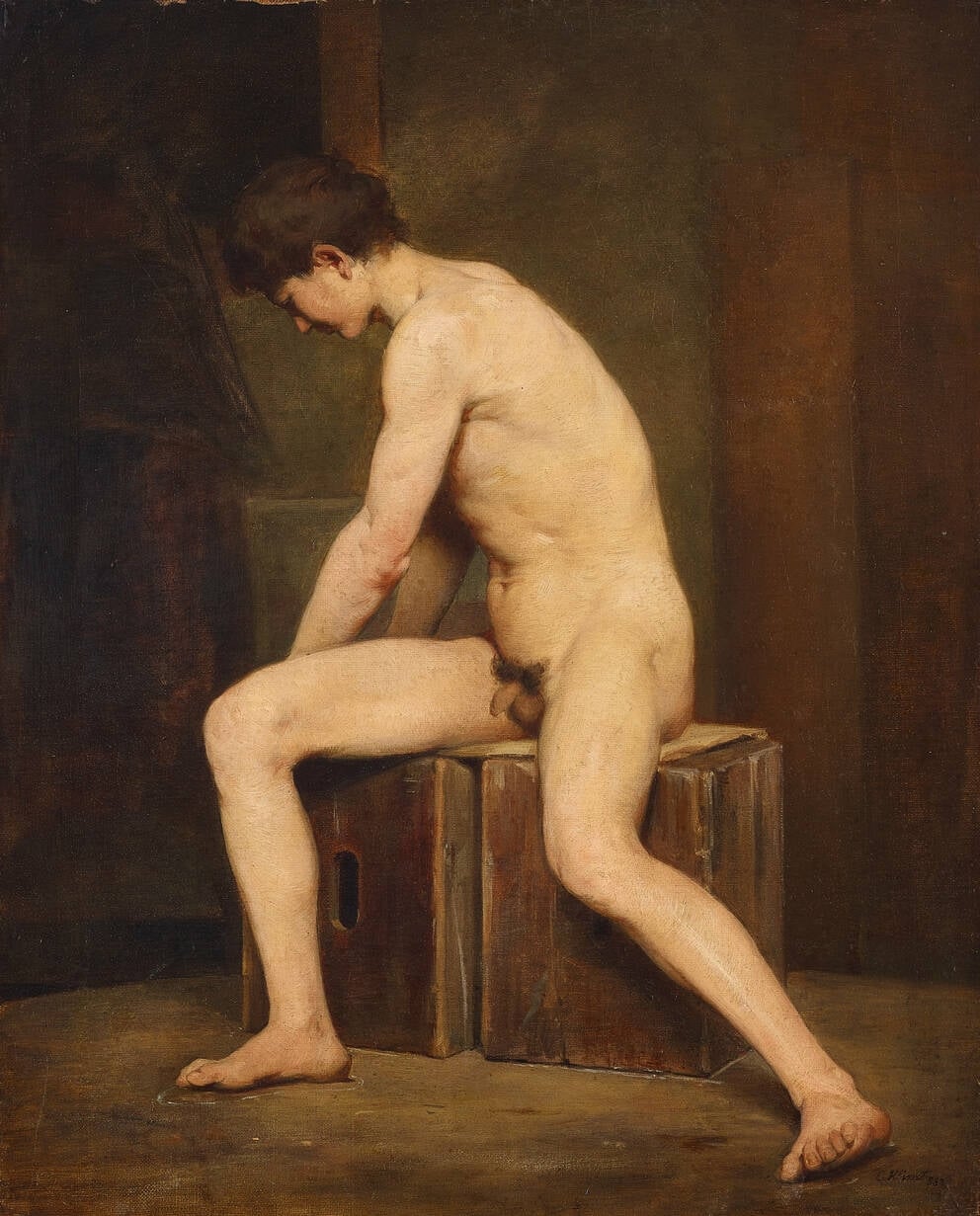
Sitting Nude Man Turned to the Left
Gustav Klimt (1883)
Painted in 1883, Sitting Nude Man Turned to the Left shows Klimt’s academic command of the male figure through a <strong>Naturalist/Realist</strong> approach. The model’s bowed head, splayed legs, and braced forearms form a taut <strong>triangular structure</strong> against rough wooden crates, where <strong>soft flesh meets hard geometry</strong> <sup>[1]</sup>. The restrained, earthy chiaroscuro isolates the body, turning a studio exercise into a quiet study of <strong>concentrated presence</strong>.
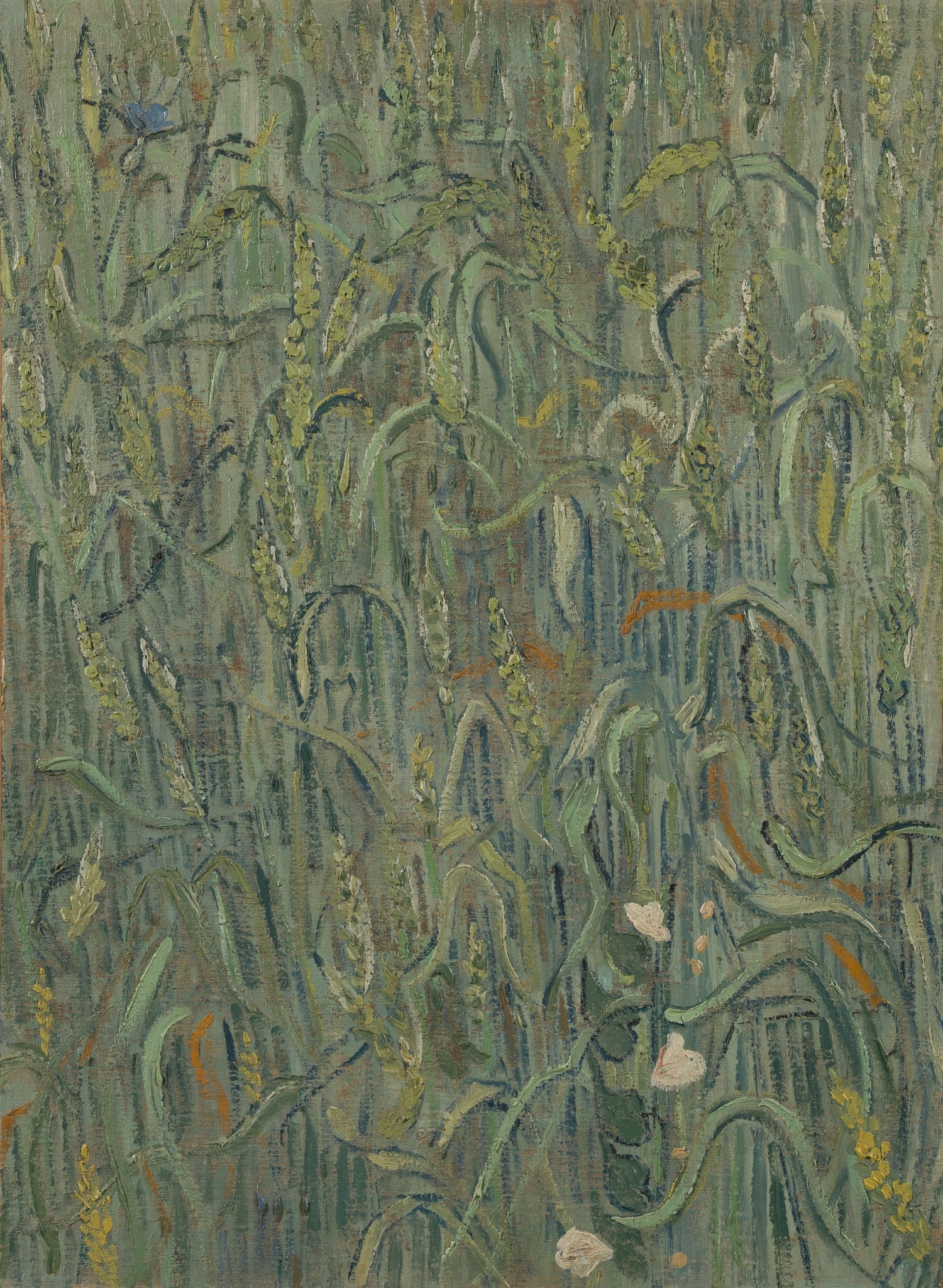
Ears of Wheat
Vincent van Gogh (1890)
Ears of Wheat plunges the viewer into a close, horizonless tangle of grain, rendering a living field as an all‑over surface of <strong>vibrating strokes</strong> and <strong>looping leaves</strong>. Cool greens and blue‑grays are pricked by ocher and rusty orange, while a blue <strong>cornflower</strong> at upper left and pale <strong>bindweed</strong> at lower right anchor the scene’s ecology <sup>[1]</sup><sup>[2]</sup>. Van Gogh turns a humble crop into a <strong>meditation on resilience and life’s cycles</strong>.
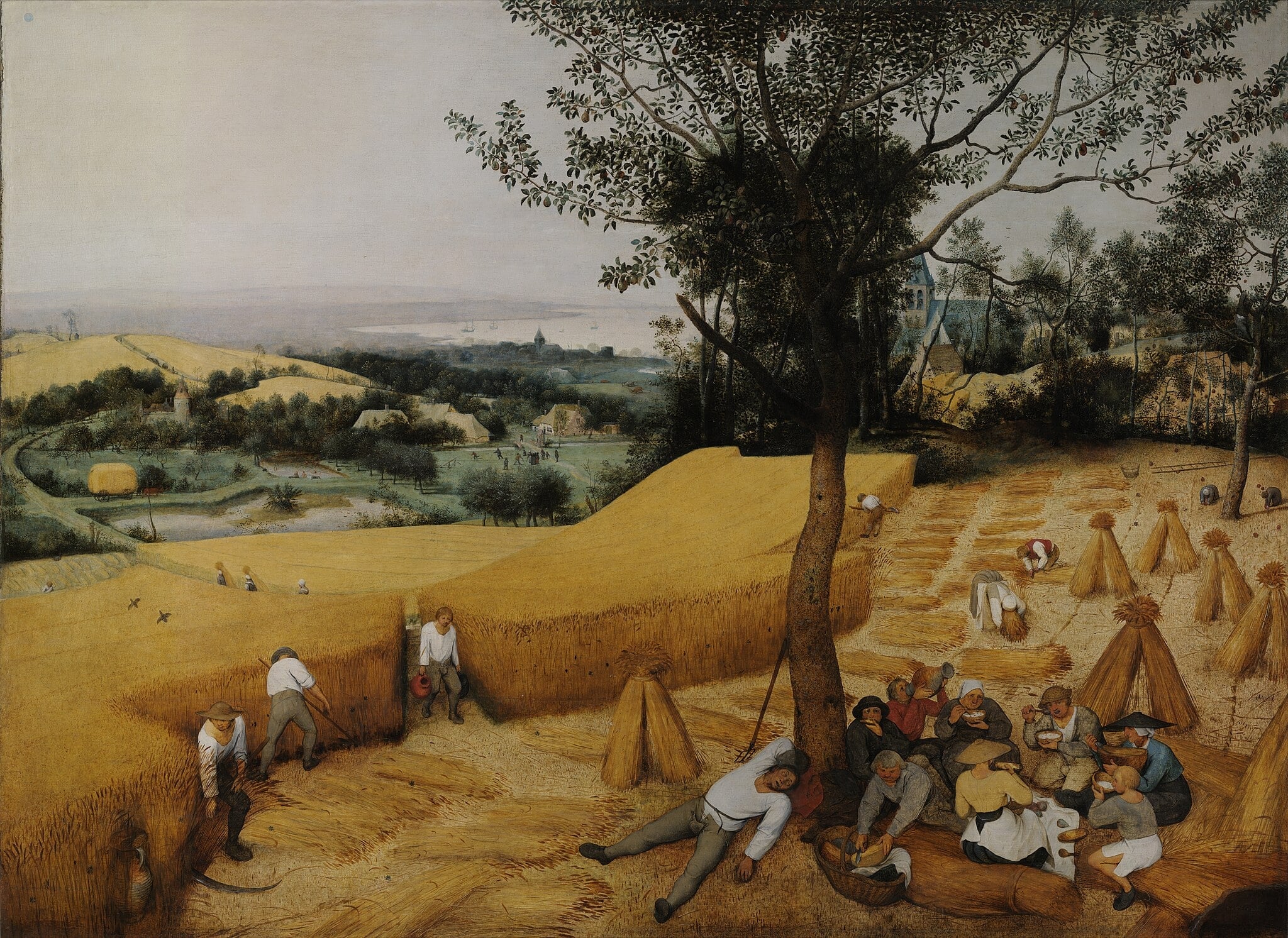
The Harvesters
Pieter Bruegel the Elder (1565)
The Harvesters distills late summer into a seamless weave of <strong>labor and reward</strong>: reapers bend to wheat while others eat and doze beneath a tree, and the world opens to roads, a village, and ships. Bruegel dignifies every action with <strong>even light</strong> and a democratic gaze, turning a specific day’s work into an image of <strong>cyclical time</strong> and shared sustenance <sup>[1]</sup><sup>[4]</sup>.
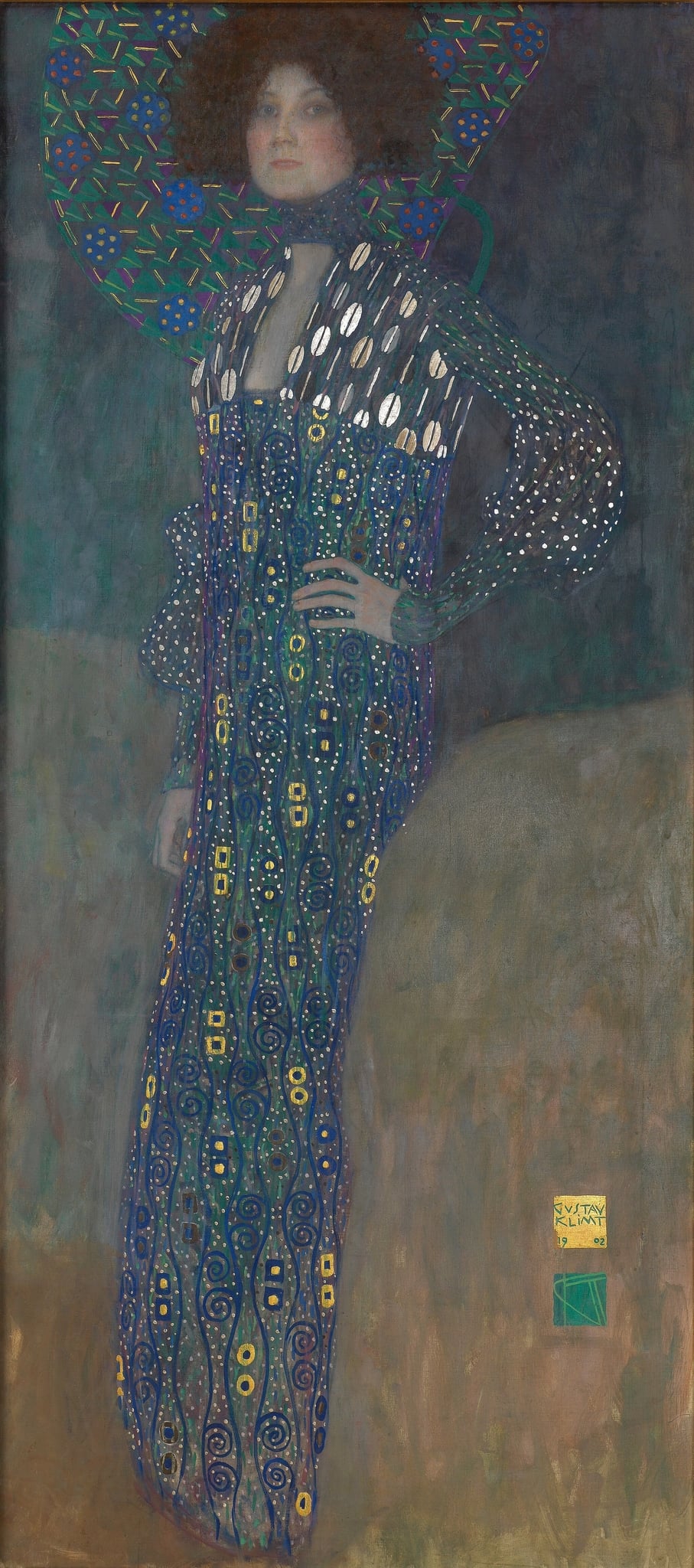
Emilie Flöge
Gustav Klimt (1902)
Gustav Klimt’s Emilie Flöge stages a modern identity as a work of <strong>design</strong> as much as portraiture: a columnar figure, hand on hip, radiates self-possession within a field of spirals, dots, and gold squares. The circular, flowered fan behind the head acts as a <strong>modern halo</strong>, collapsing depth and elevating presence in the Secessionist spirit of the <strong>Gesamtkunstwerk</strong> <sup>[1]</sup><sup>[2]</sup>.
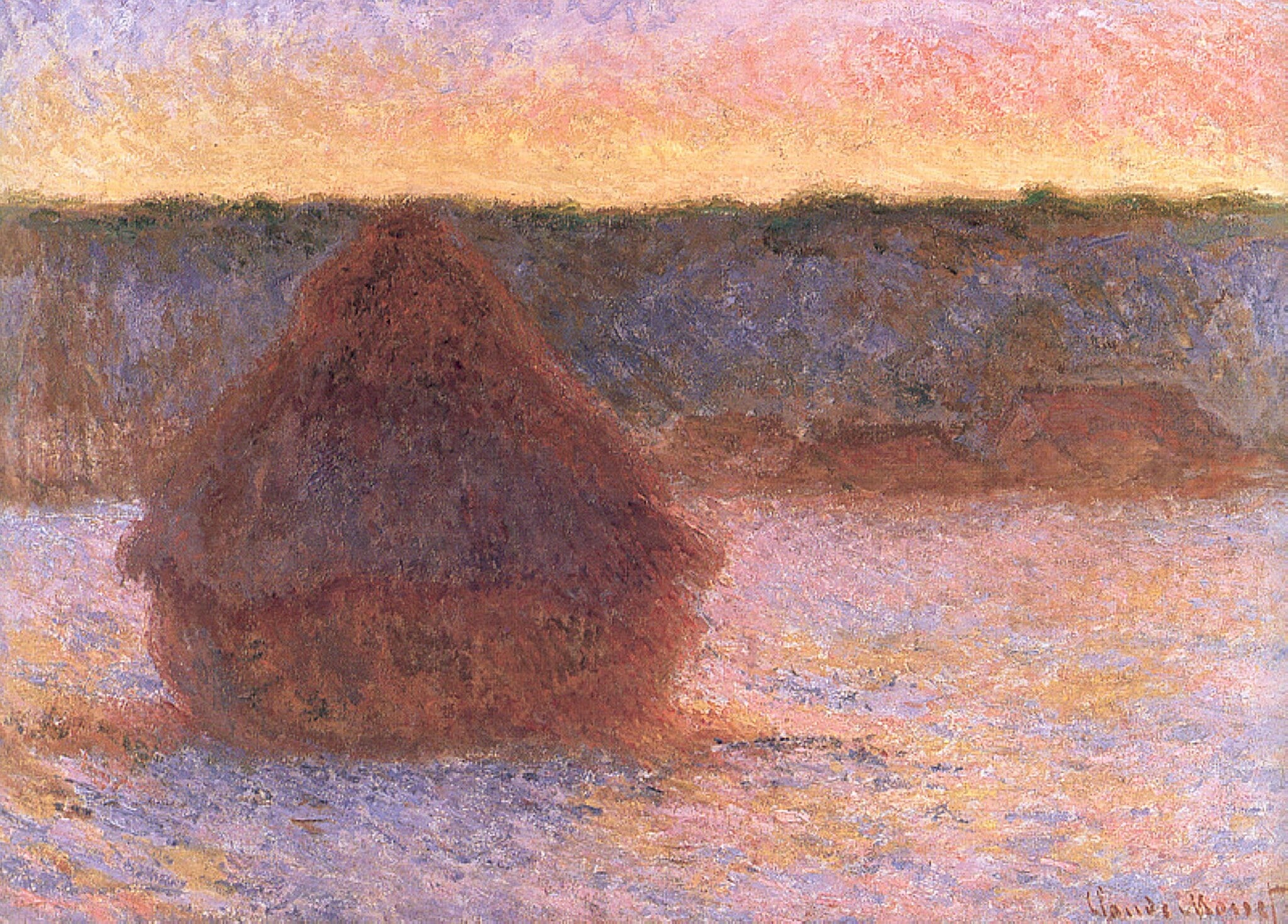
Grainstack (Sunset: winter)
Claude Monet (1890–1891)
Claude Monet’s Grainstack (Sunset: winter) turns a single rural grainstack into a <strong>condenser of light and time</strong>. A conical mound, rimmed with warm glow against violet-blue snow and a dusk band of trees, declares <strong>light as structure</strong> and winter’s <strong>cyclical pause</strong>.
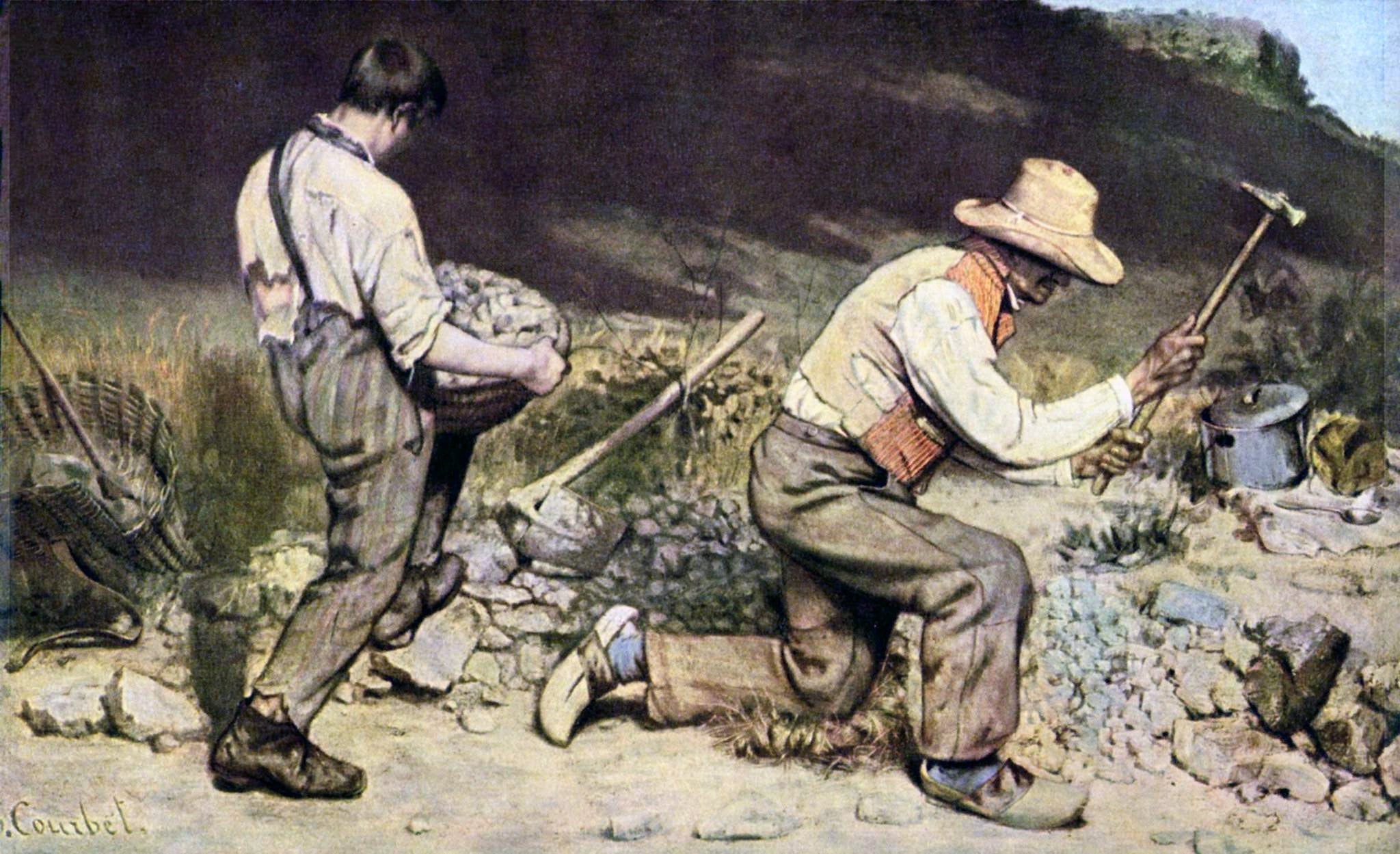
The Stone Breakers
Gustave Courbet (1849)
In The Stone Breakers, <strong>Gustave Courbet</strong> monumentalizes the backbreaking <strong>labor</strong> that underpins modern life. Two workers—youth and age—turn their faces away as patched clothes, wooden clogs, a wicker basket, and a dented kettle state a stark economy. The low horizon and compressed space forge a mood of <strong>claustrophobic realism</strong> that resists heroism <sup>[1]</sup><sup>[2]</sup><sup>[3]</sup>.
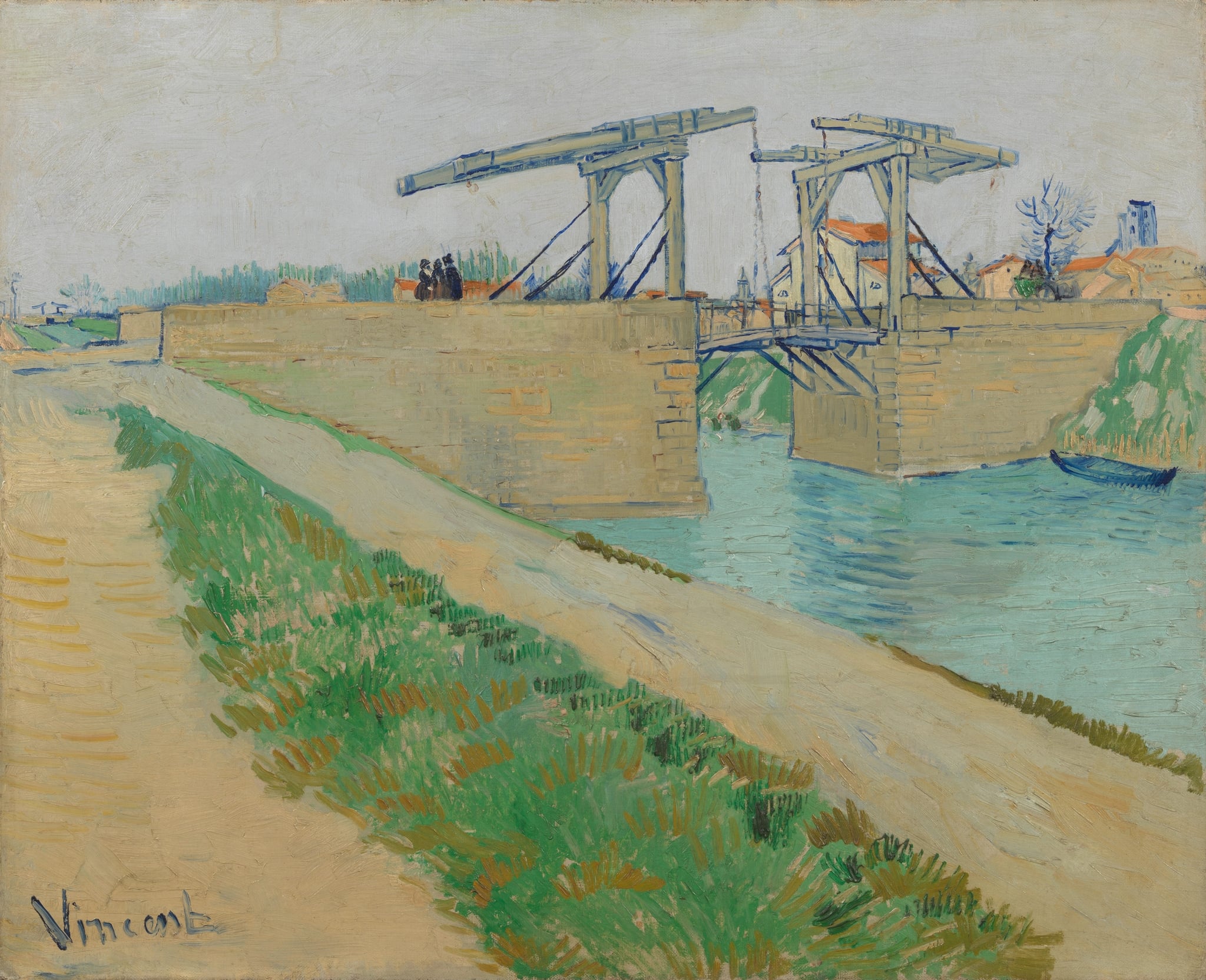
The Langlois Bridge
Vincent van Gogh (1888)
Van Gogh’s The Langlois Bridge turns a modest drawbridge into a <strong>symbol of connection</strong> and modern passage. With a sweeping towpath, <strong>firm blue contours</strong>, and turquoise water, the scene balances rural calm with engineered order <sup>[1]</sup><sup>[3]</sup>.
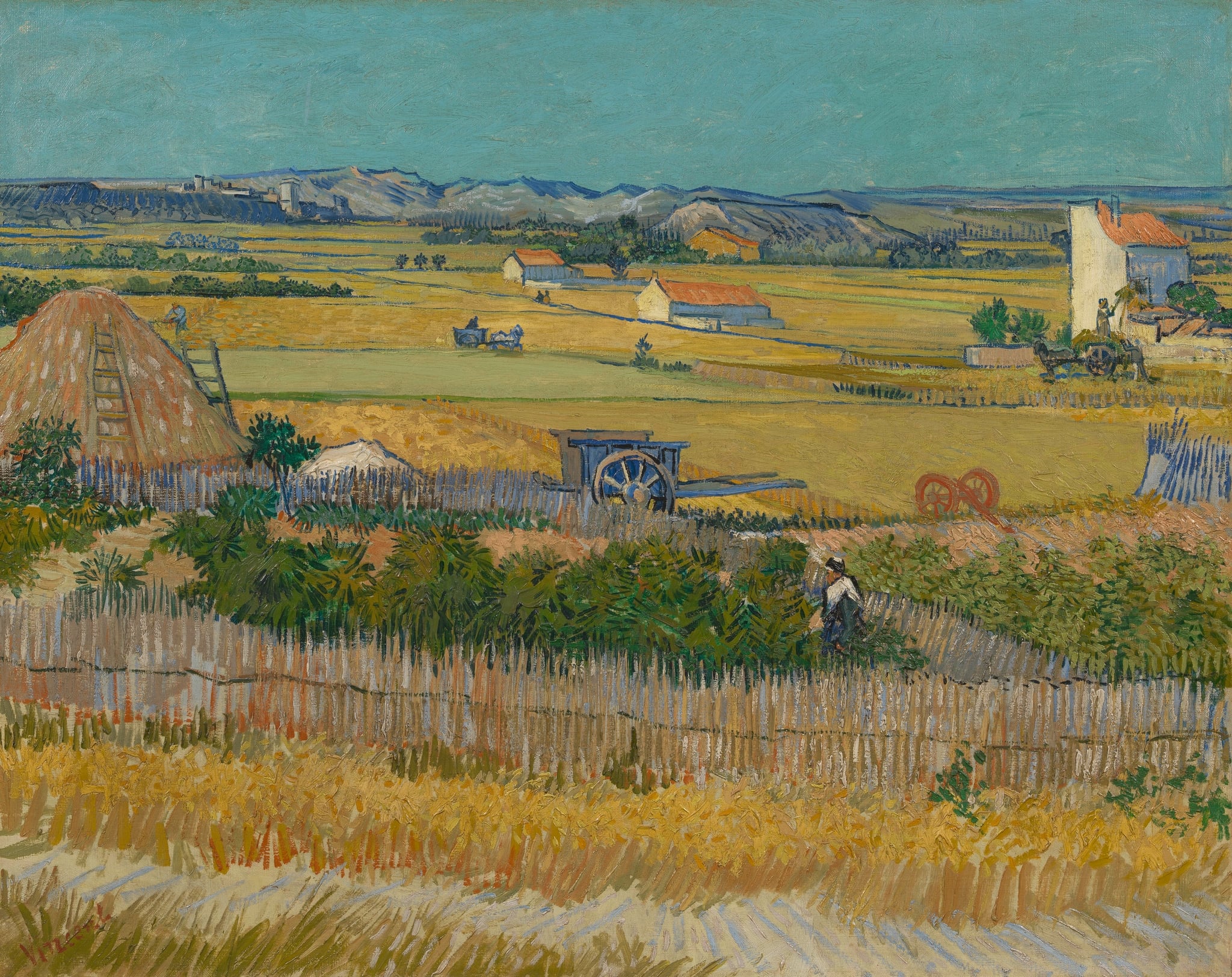
The Harvest
Vincent van Gogh (1888)
<strong>The Harvest</strong> surveys the La Crau plain as a luminous patchwork of ripe wheat, garden strips, and farm tracks under an <strong>azure</strong> sky. Van Gogh orchestrates tools and tasks—haystack with ladder, carts with <strong>red wheels</strong>, fenced plots—into a single, sunstruck order that turns labor into vision <sup>[1]</sup><sup>[2]</sup>. A lone reaper almost dissolves in the foliage, anchoring the panorama in human toil and seasonal time.
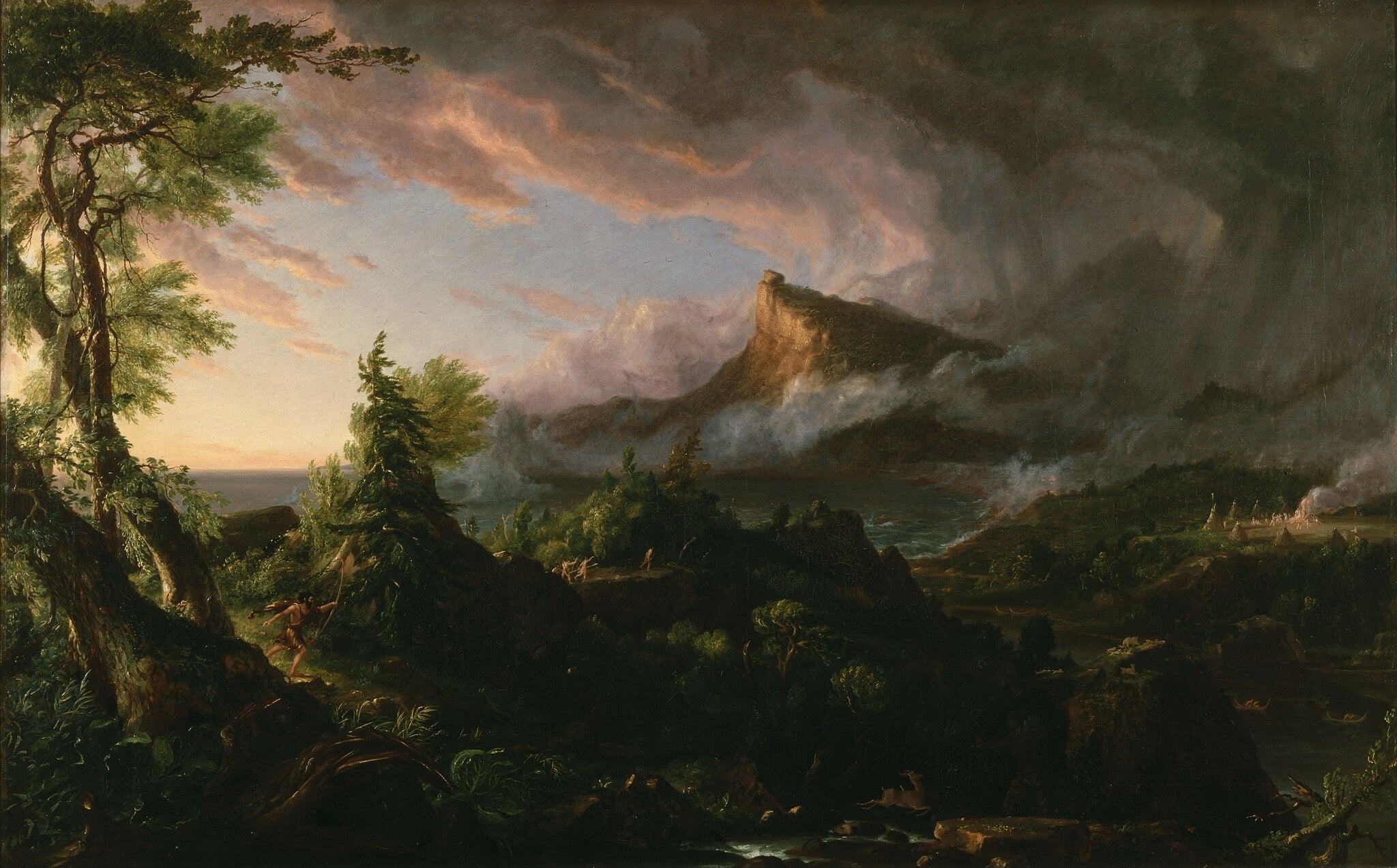
The Course of Empire: The Savage State
Thomas Cole (c. 1834 (series 1834–1836))
Thomas Cole’s The Course of Empire: The Savage State inaugurates his five-part cycle with a landscape ruled by <strong>wildness</strong> and <strong>origin</strong>. Dawn breaks at left as storm clouds rake a flat-topped crag, while a hunter looses an arrow, canoes cut the river, and smoke lifts from skin tents—signals of a society at the threshold of history <sup>[1]</sup><sup>[2]</sup><sup>[3]</sup>.
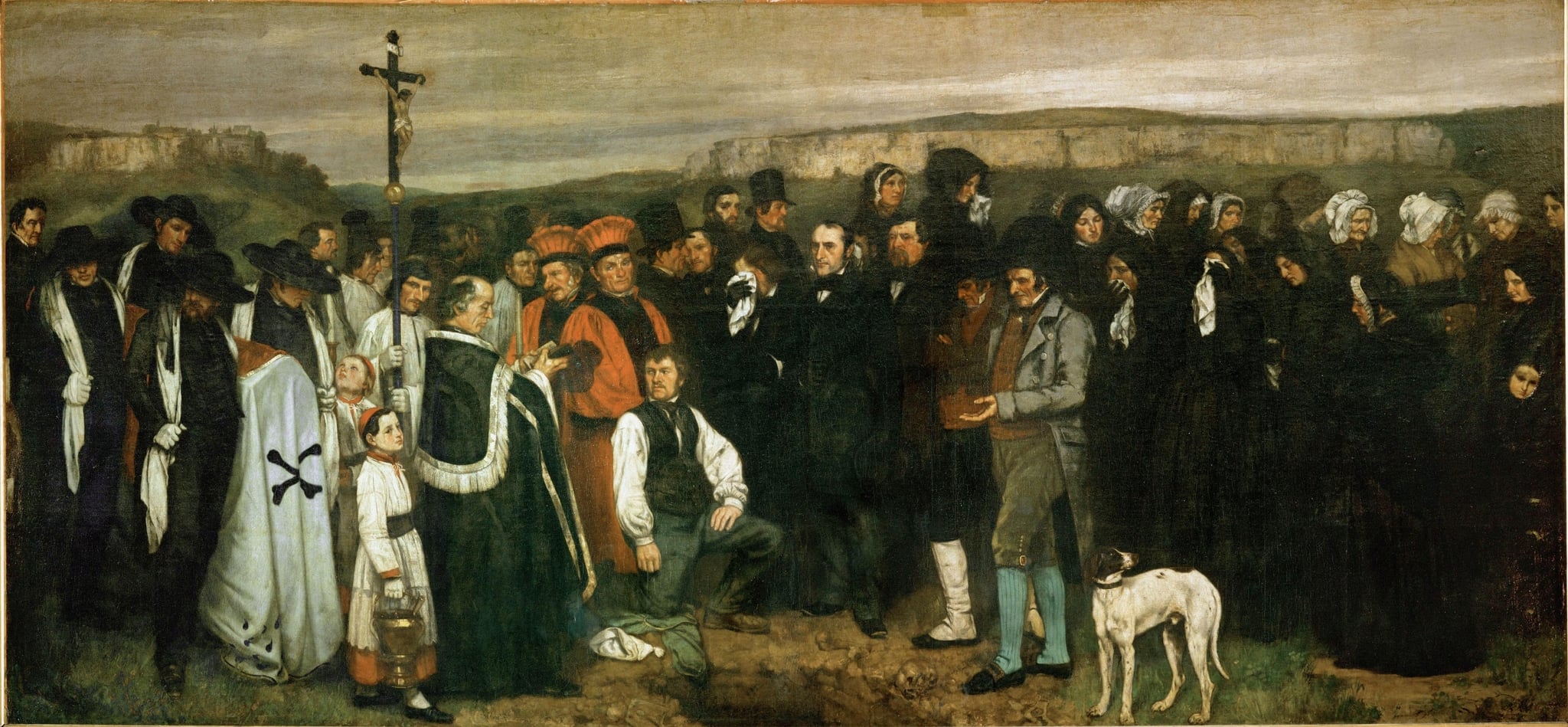
A Burial at Ornans
Gustave Courbet (1849–1850)
A Burial at Ornans turns a provincial funeral into a life‑size, horizontal <strong>frieze</strong> where clergy, officials, peasants, and mourners stand shoulder to shoulder before an <strong>open grave</strong> and skull. Courbet’s refusal of climax—despite the tall <strong>processional crucifix</strong>—and details like the <strong>kneeling gravedigger</strong> and indifferent <strong>dog</strong> make mortality the great equalizer, not piety or heroism. The limestone <strong>cliffs of Ornans</strong> close the horizon, sealing the scene’s weight and finality.
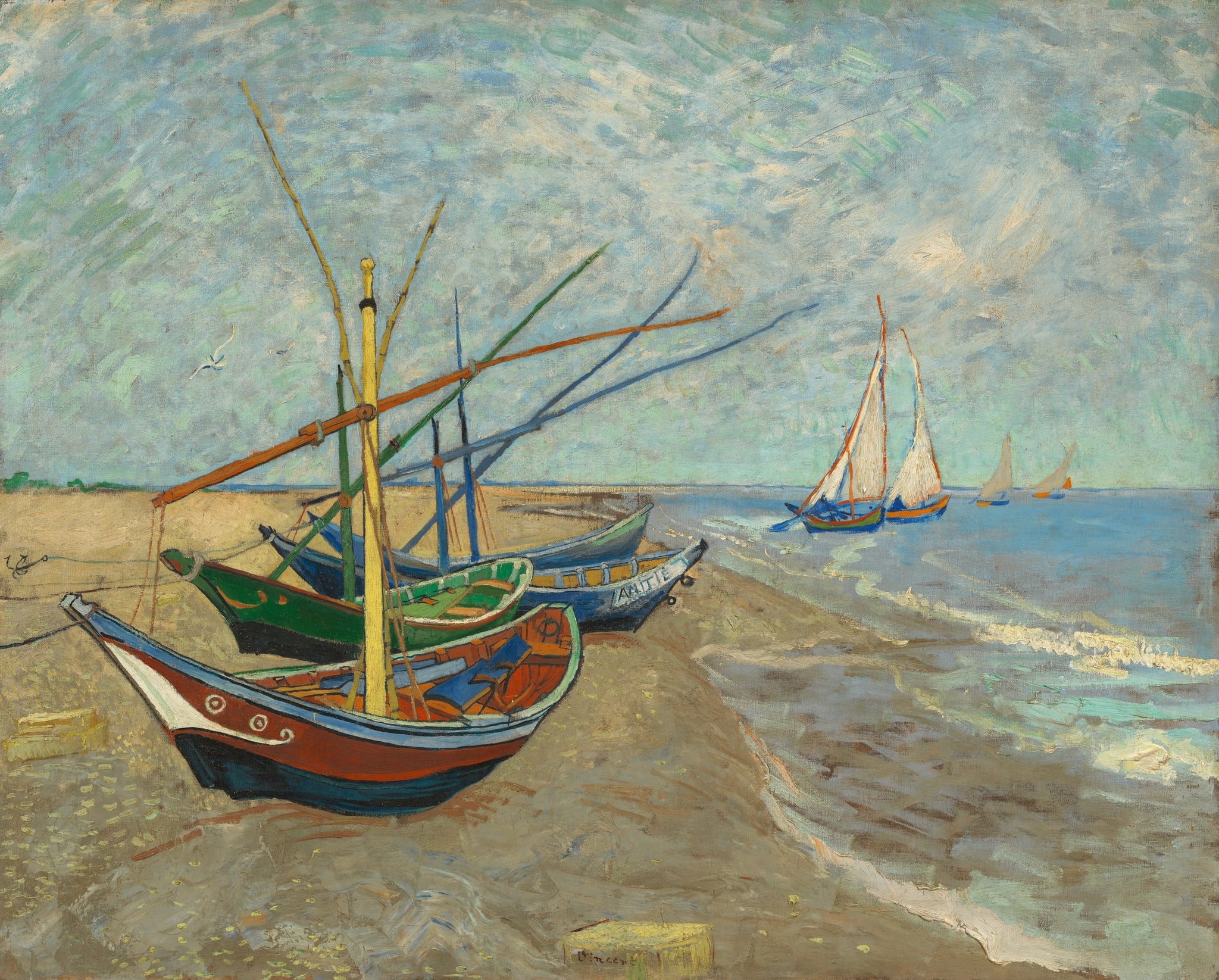
Fishing Boats on the Beach at Les Saintes-Maries-de-la-Mer
Vincent van Gogh (1888)
Vincent van Gogh lines up a file of beached craft like actors awaiting their cue, turning working boats into <strong>emblems of readiness and risk</strong>. Bold contours, flattened color, and the wind‑tossed sea and sky translate Mediterranean luminosity into a <strong>Japonisme/Cloisonnism</strong> idiom that clarifies form and heightens feeling. The scene suspends time at the edge of departure, where labor, hope, and the sea’s pull meet.
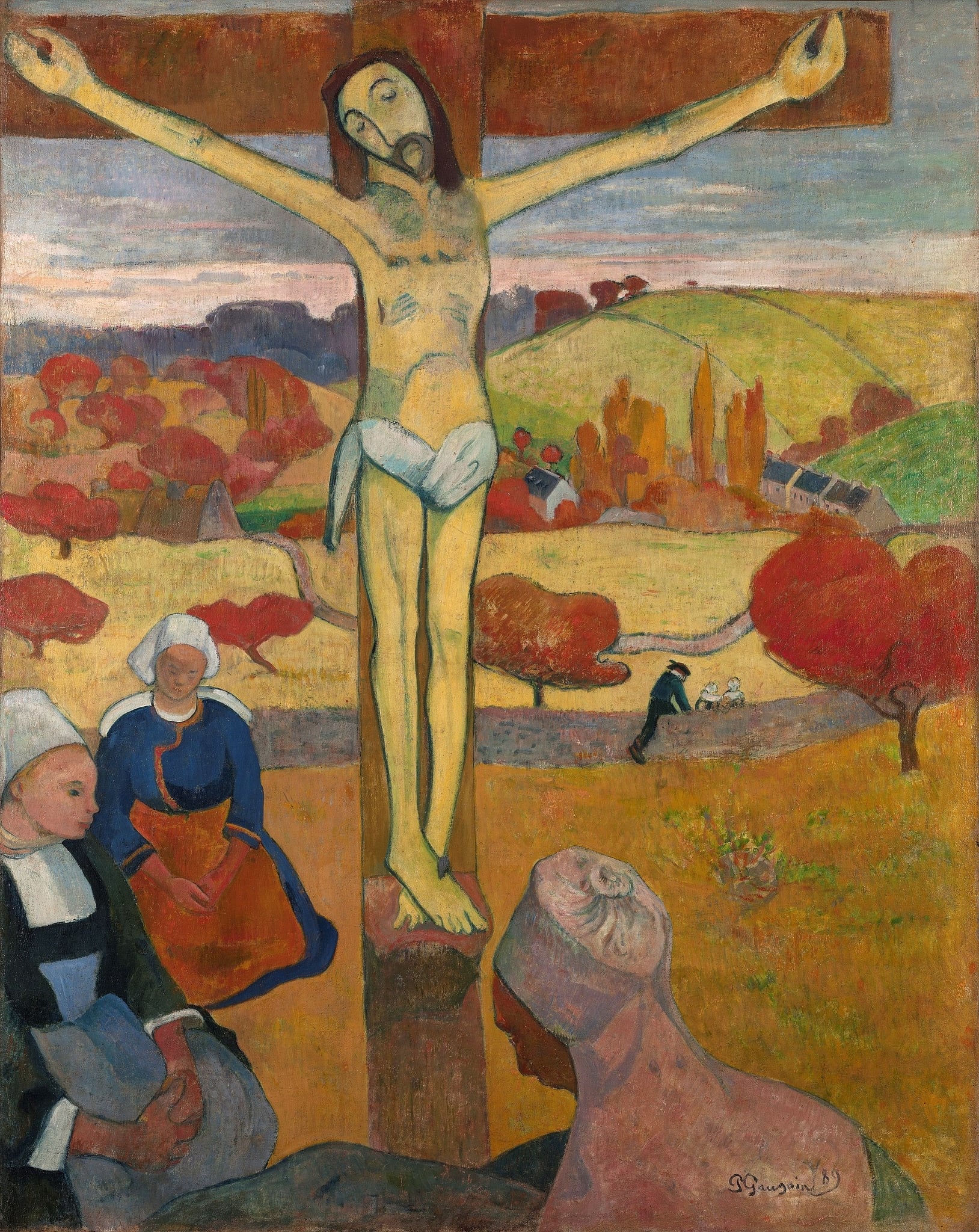
The Yellow Christ
Paul Gauguin (1889)
Paul Gauguin’s The Yellow Christ (1889) fuses sacred narrative with everyday Brittany, rendering a lemon‑<strong>yellow</strong> Christ in a rural autumn landscape. Through <strong>Synthetist</strong> color and <strong>Cloisonnist</strong> contours, the work declares spiritual meaning over naturalism, placing devotion among kneeling Breton women beneath a banded, hope‑tinged sky <sup>[1]</sup><sup>[3]</sup>.
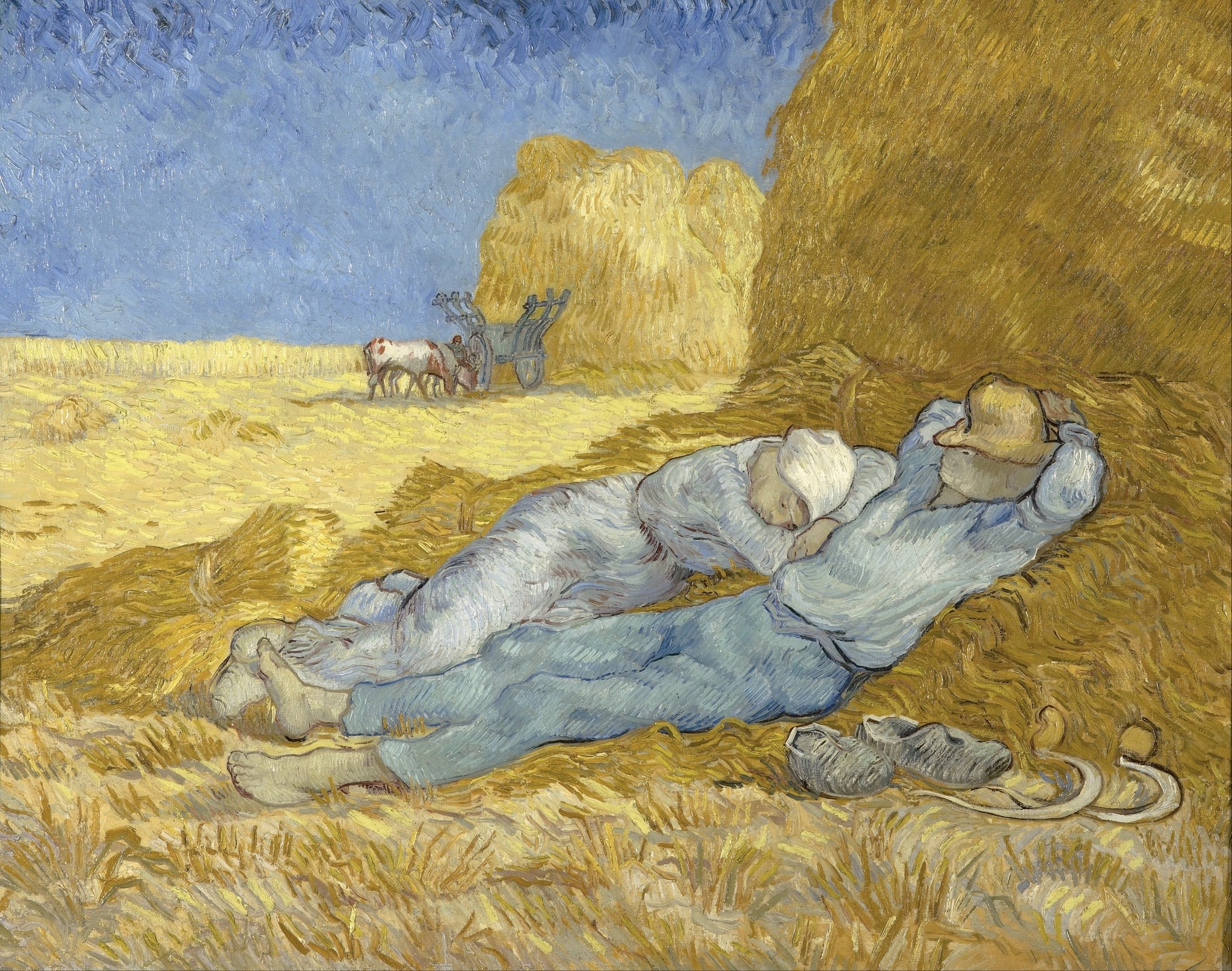
The Siesta
Vincent van Gogh (1889–1890)
The Siesta renders a midday pause as a scene of <strong>dignified repose</strong>: two harvesters sleep curved against a haystack while their scythes and shoes rest idle in the straw. Van Gogh’s complementary <strong>blue–yellow</strong> orchestration turns heat and light into rhythm, holding rest and labor in delicate equilibrium <sup>[1]</sup>. Painted at Saint‑Rémy as a color "translation" after Millet, it transforms a humble genre motif into an emblem of <strong>human need</strong> within work’s demands <sup>[1]</sup><sup>[3]</sup>.
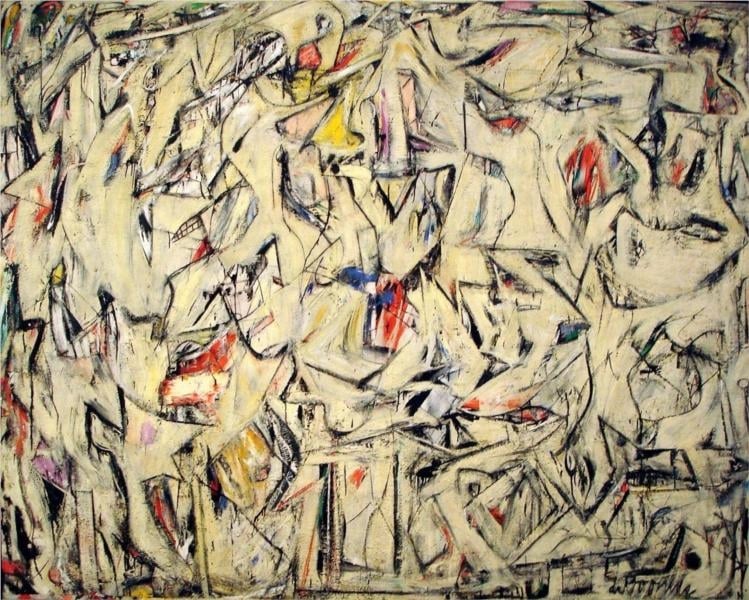
Excavation
Willem de Kooning (1950)
<strong>Excavation</strong> is a 1950 oil-on-canvas by <strong>Willem de Kooning</strong> whose all-over mesh of black, hooked lines rides a chalky, bone-colored ground, flaring with cadmium reds, yellows, and blues. Forms surface—beaklike profiles, teeth, fish, limbs, tool-shapes—then sink back into fragments, staging a <strong>simultaneous making and unmaking</strong> that turns the whole canvas into an active field. The work crystallizes de Kooning’s late-1940s abstractions and foreshadows the Women paintings, marking a pivot in postwar American art <sup>[1]</sup><sup>[3]</sup><sup>[4]</sup>.
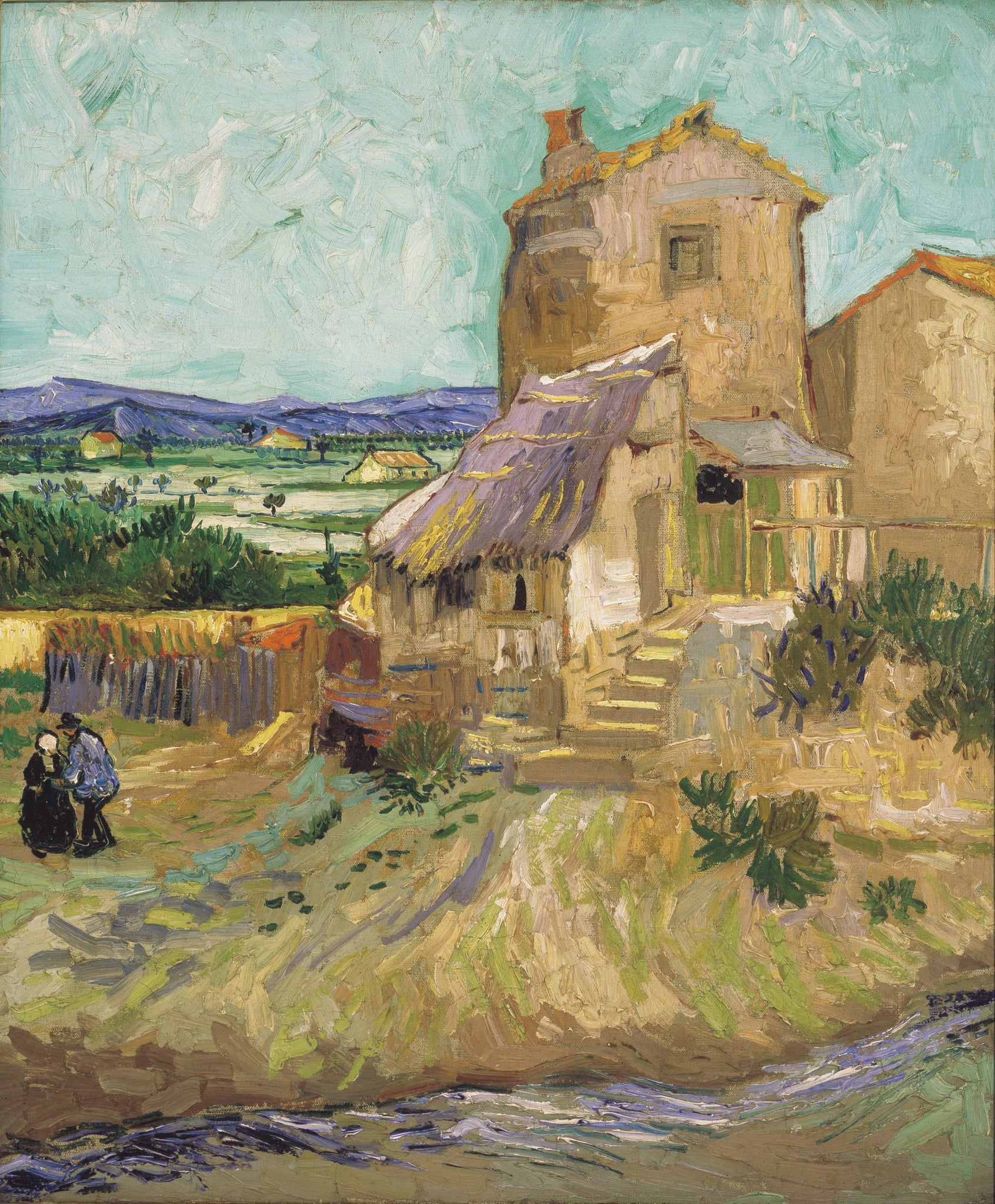
La Maison de La Crau (The Old Mill)
Vincent van Gogh (1888)
Van Gogh turns a modest Arles windmill into an emblem of <strong>resilience</strong> and <strong>human labor</strong> by staging its sun-baked tower against a <strong>wind-tossed, cool sky</strong> and the distant <strong>blue Alpilles</strong>. Rhythmic, directional strokes drive the eye from the <strong>rippling stream</strong> through the <strong>zigzag steps</strong> to the chimneyed tower, fusing workaday architecture with a modern language of <strong>expressive color</strong> and <strong>structure</strong> <sup>[1]</sup><sup>[3]</sup>.
Van Gogh's Chair
Vincent van Gogh (1888; reworked January 1889)
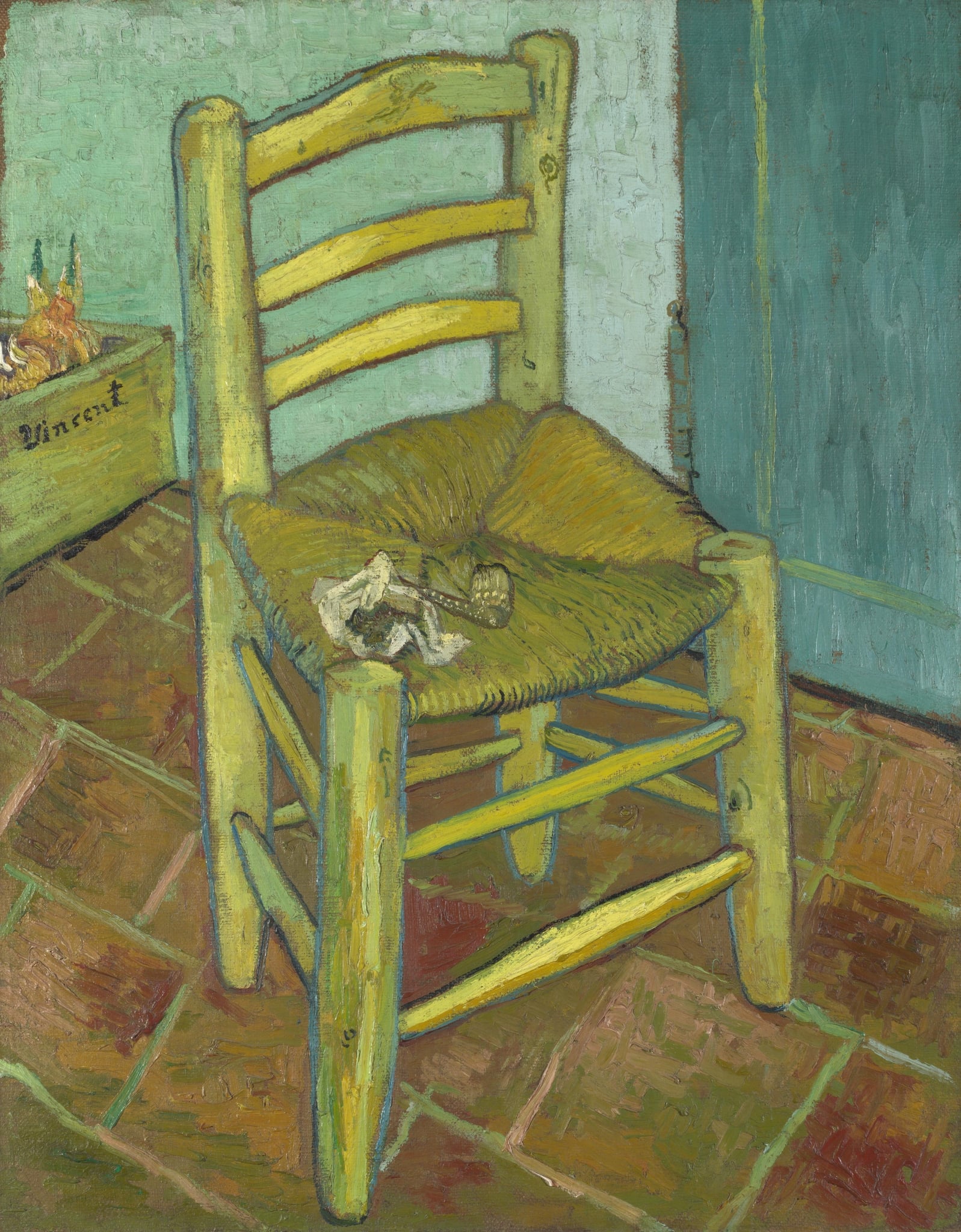
In Van Gogh's Chair, a humble rush-seated chair blazes in <strong>radiant yellow</strong> against <strong>cool teal</strong> walls and door, its bold outlines charging the scene with tension. A <strong>pipe and tobacco pouch</strong> on the seat, a crate marked <strong>“Vincent”</strong> and sprouting onions turn this empty place into a surrogate presence, a still-life self-portrait built from things rather than a face <sup>[1]</sup><sup>[2]</sup>.
Farms near Auvers
Vincent van Gogh (1890)
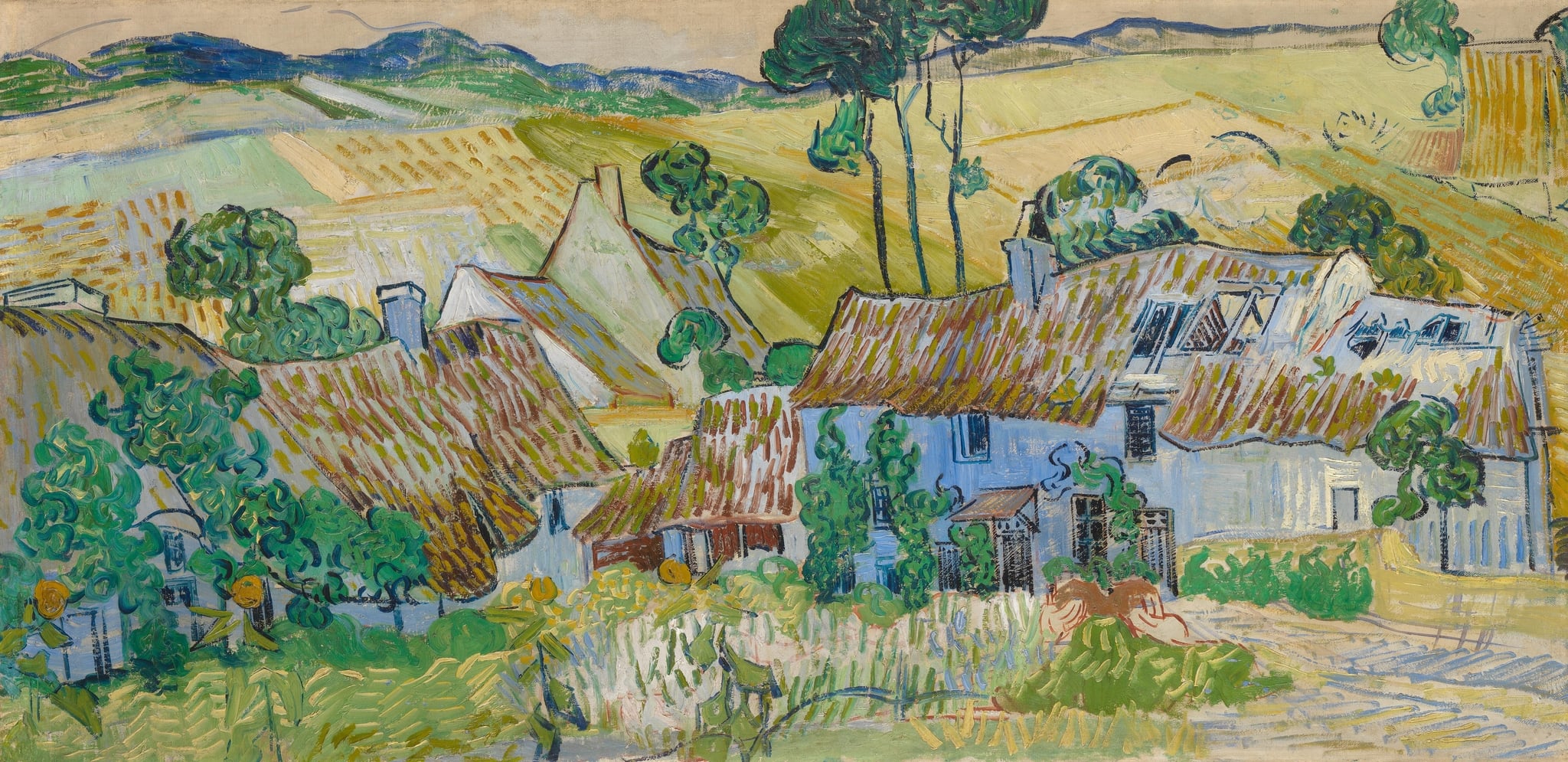
Painted in July 1890, Vincent van Gogh’s Farms near Auvers is a late, "double‑square" panorama where thatched cottages, wheat plots, and wind‑bent trees pulse with <strong>rhythmic energy</strong>. The high horizon and criss‑crossing roofs compress the village into a living weave of color and line, turning ordinary farms into a scene of <strong>charged stillness</strong> <sup>[1]</sup><sup>[3]</sup>.
Evening (after Millet)
Vincent van Gogh (1889)
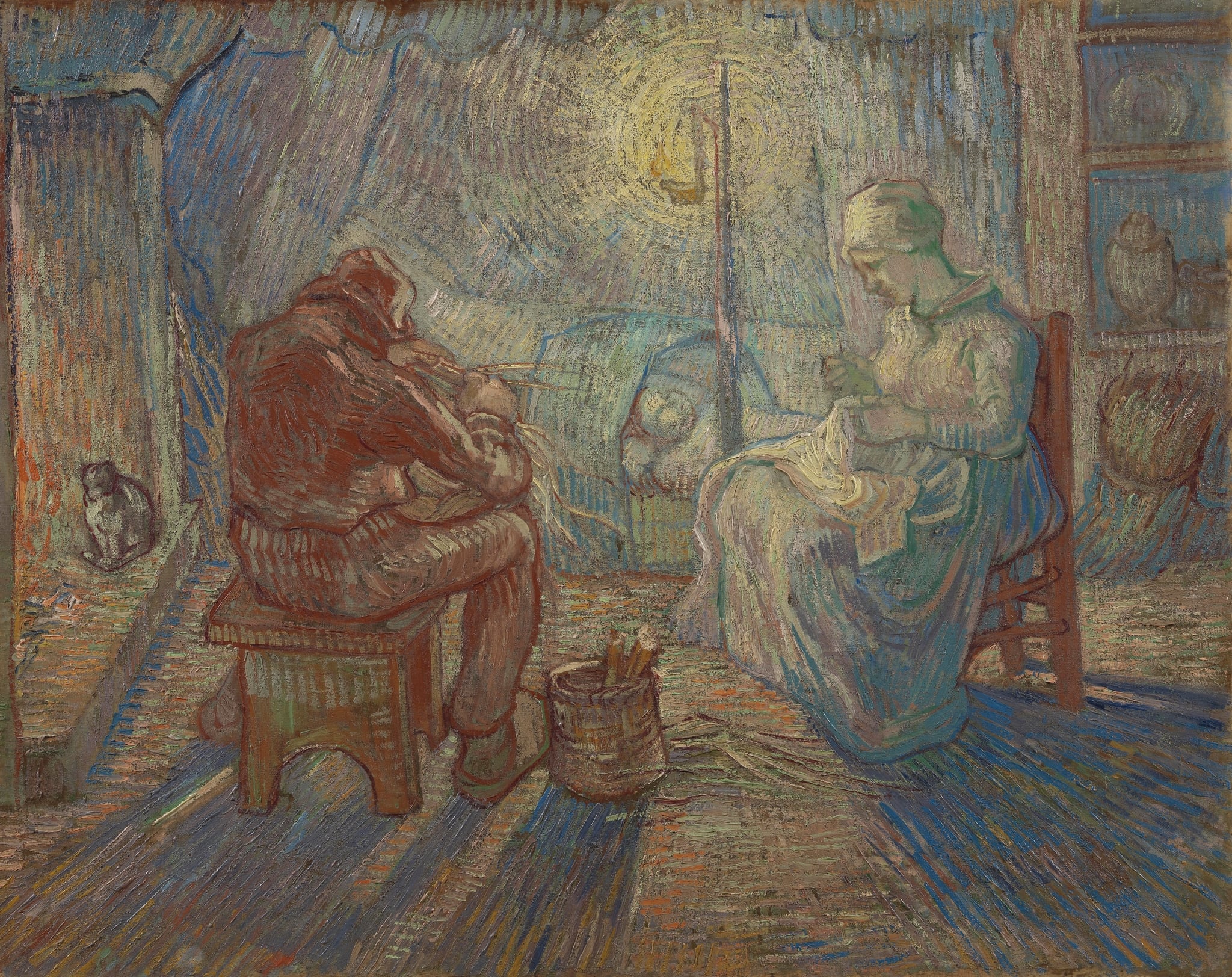
A peasant couple bends to evening tasks under a glowing lamp, its <strong>halo</strong> pulsing through the room while cool <strong>violets and blues</strong> pool across the floor. Van Gogh "<strong>translates</strong>" Millet’s print into a larger, color‑charged meditation on <strong>care, labor, and light</strong> at day’s end <sup>[1]</sup><sup>[2]</sup>.
Boat Lying at Low Tide
Claude Monet (1881)
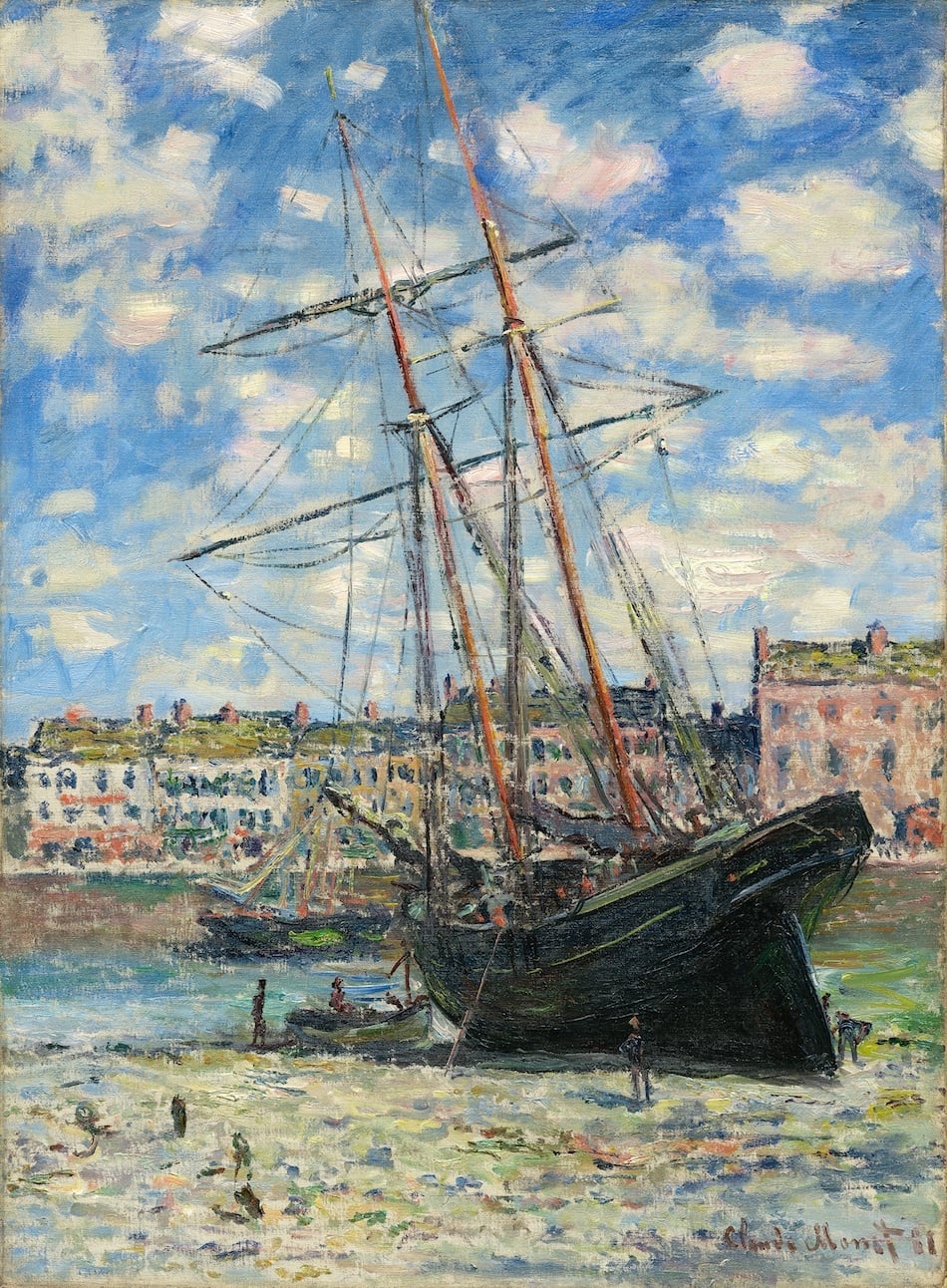
Claude Monet’s Boat Lying at Low Tide stages a moment of <strong>suspension</strong> between work and weather: a dark hull settles on the glittering strand as masts and rigging cut a lattice through a <strong>light‑soaked sky</strong>. The grounded vessel faces a town flickering in <strong>pinks, blues, and creams</strong>, so that atmosphere—not the boat—emerges as the true protagonist of change <sup>[1]</sup><sup>[2]</sup>.
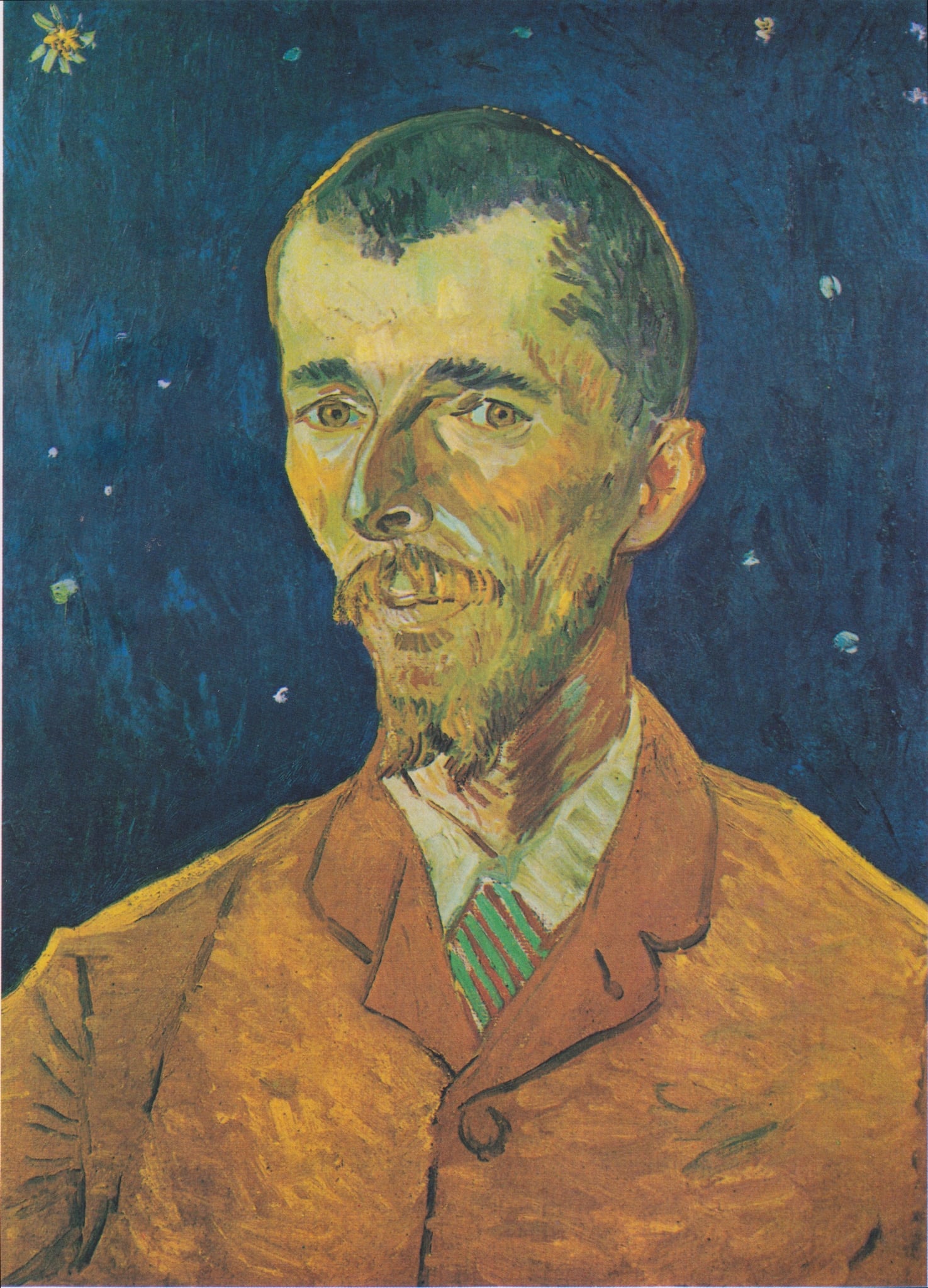
Eugène Boch
Vincent van Gogh (1888)
Vincent van Gogh’s 1888 portrait of <strong>Eugène Boch</strong> turns a friend into a visionary presence: a glowing, ocher head set before an <strong>infinite blue</strong> pricked with stars. The lone bright star at upper left and the cobalt field make the warm face and jacket <strong>vibrate</strong> from the night, declaring art as vocation rather than mere likeness <sup>[1]</sup><sup>[2]</sup>.
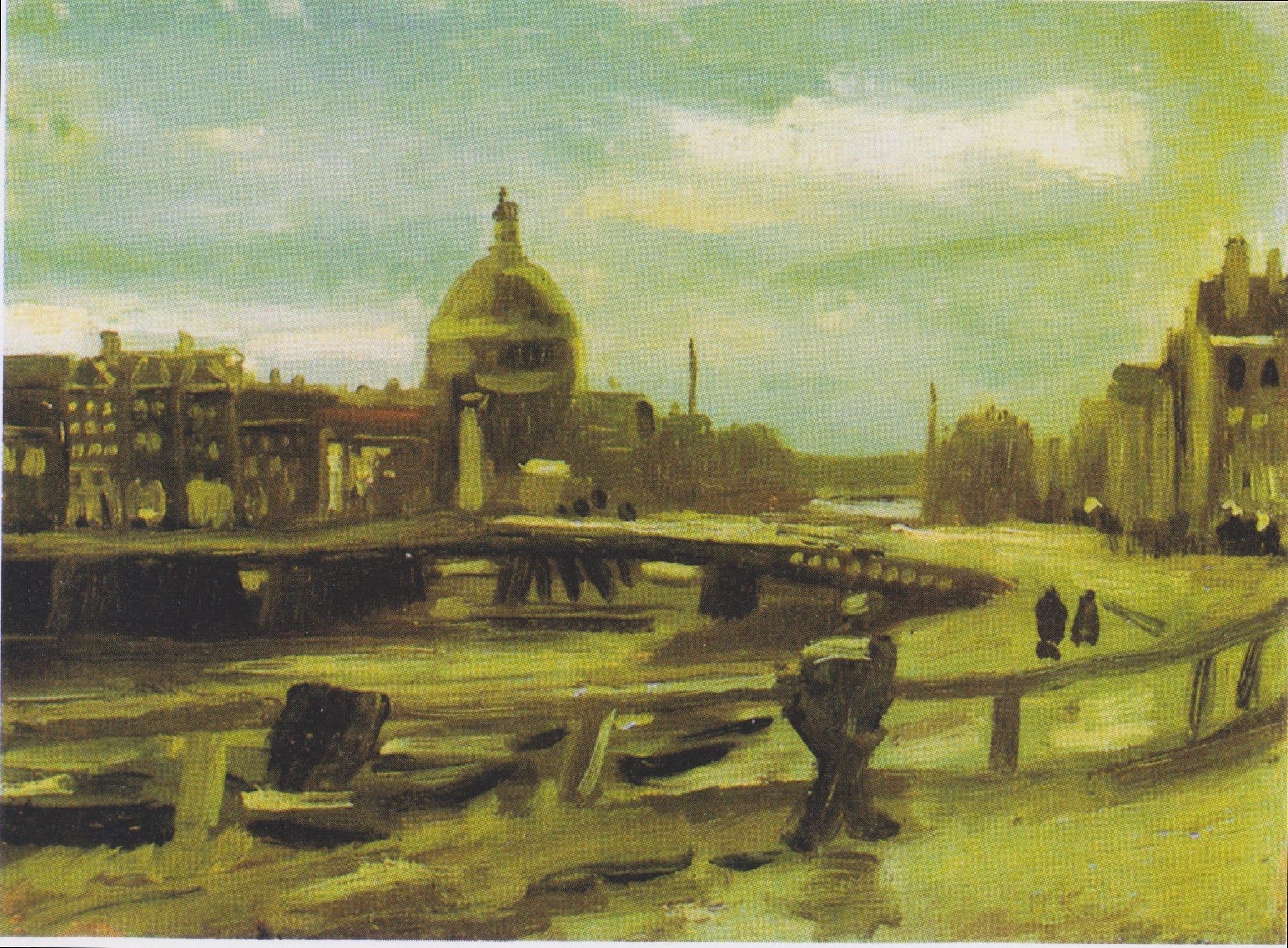
The Singel near the Lutheran Church in Amsterdam
Vincent van Gogh (1885)
In The Singel near the Lutheran Church in Amsterdam, Vincent van Gogh renders the canal belt in <strong>earthy greens and umbers</strong> under a <strong>cool, washed sky</strong>. A <strong>diagonal bridge</strong> and bundled figures press forward while the <strong>domed Lutheran church</strong> holds steady in the middle distance, turning a city view into a meditation on passage and refuge <sup>[1]</sup>.
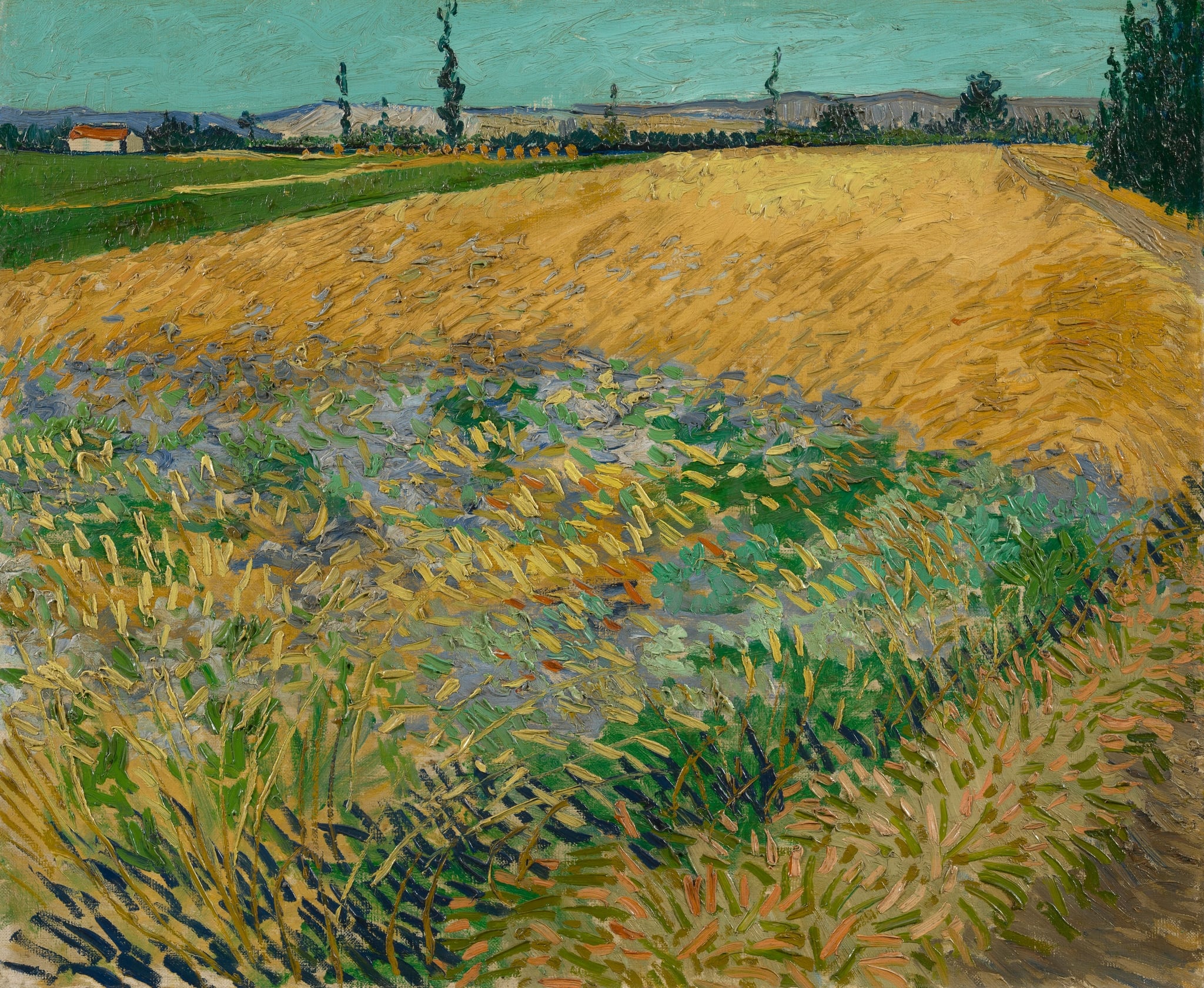
Wheatfield
Vincent van Gogh (1888)
Wheatfield converts a Provençal field into a drama of <strong>living motion</strong> and <strong>complementary color</strong>. A high horizon compresses the turquoise sky so the gold expanse dominates, while a narrow path at right and a modest farmhouse at left anchor human presence within <strong>restless nature</strong> <sup>[1]</sup><sup>[2]</sup>. Painted in Arles in June 1888, it crystallizes Van Gogh’s pursuit of expressive brushwork and yellow–blue vibration.
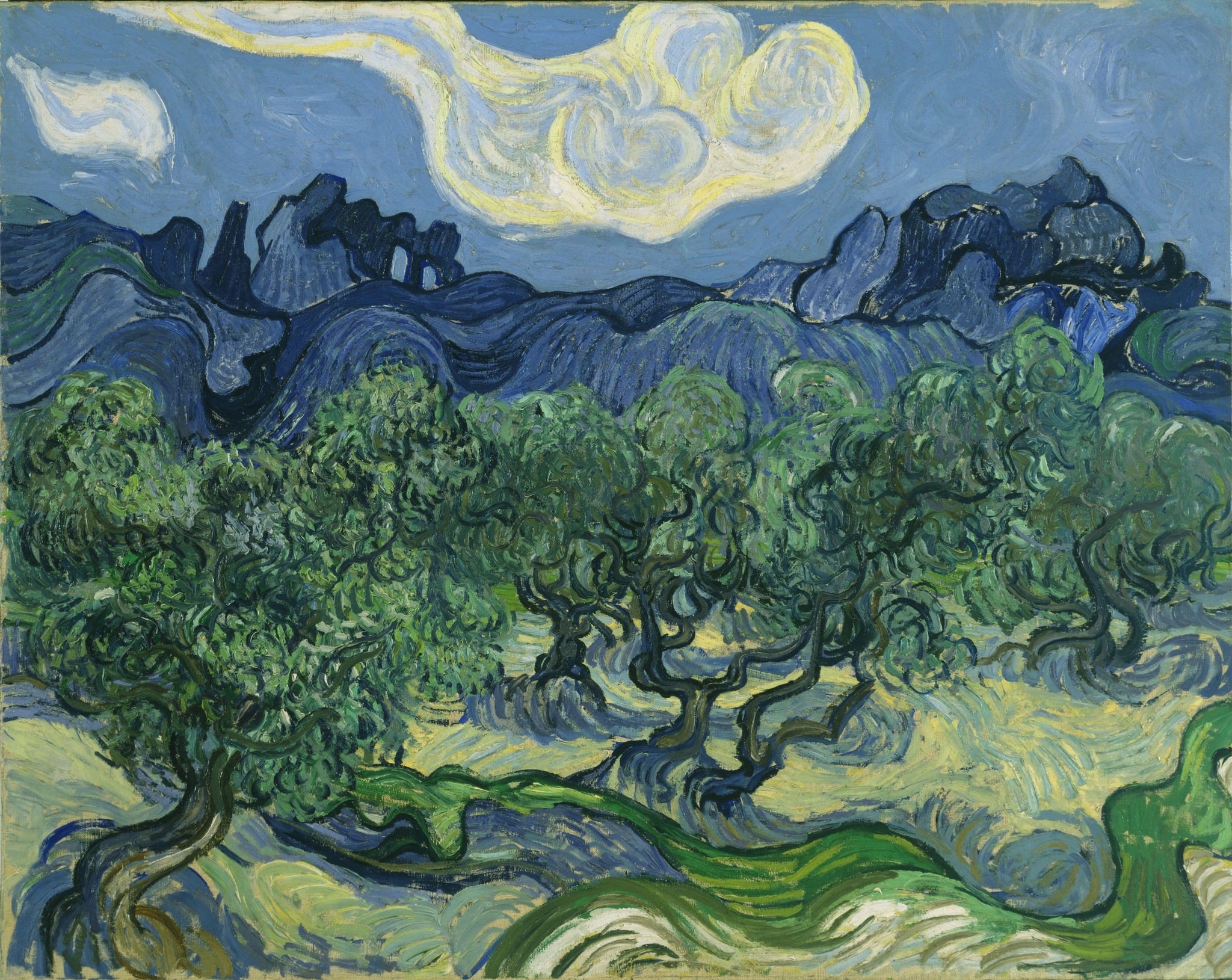
The Olive Trees
Vincent van Gogh (1889)
The Olive Trees courses with <strong>rhythmic, coiling strokes</strong> that bind earth and sky into a single pulse: twisted trunks, whorled foliage, and a pale, bundled <strong>cloud</strong> echo one another across the canvas. Van Gogh turns Provence’s grove before the <strong>Alpilles</strong> into a spiritual landscape where <strong>endurance and consolation</strong> feel visible in color and line <sup>[1]</sup>.
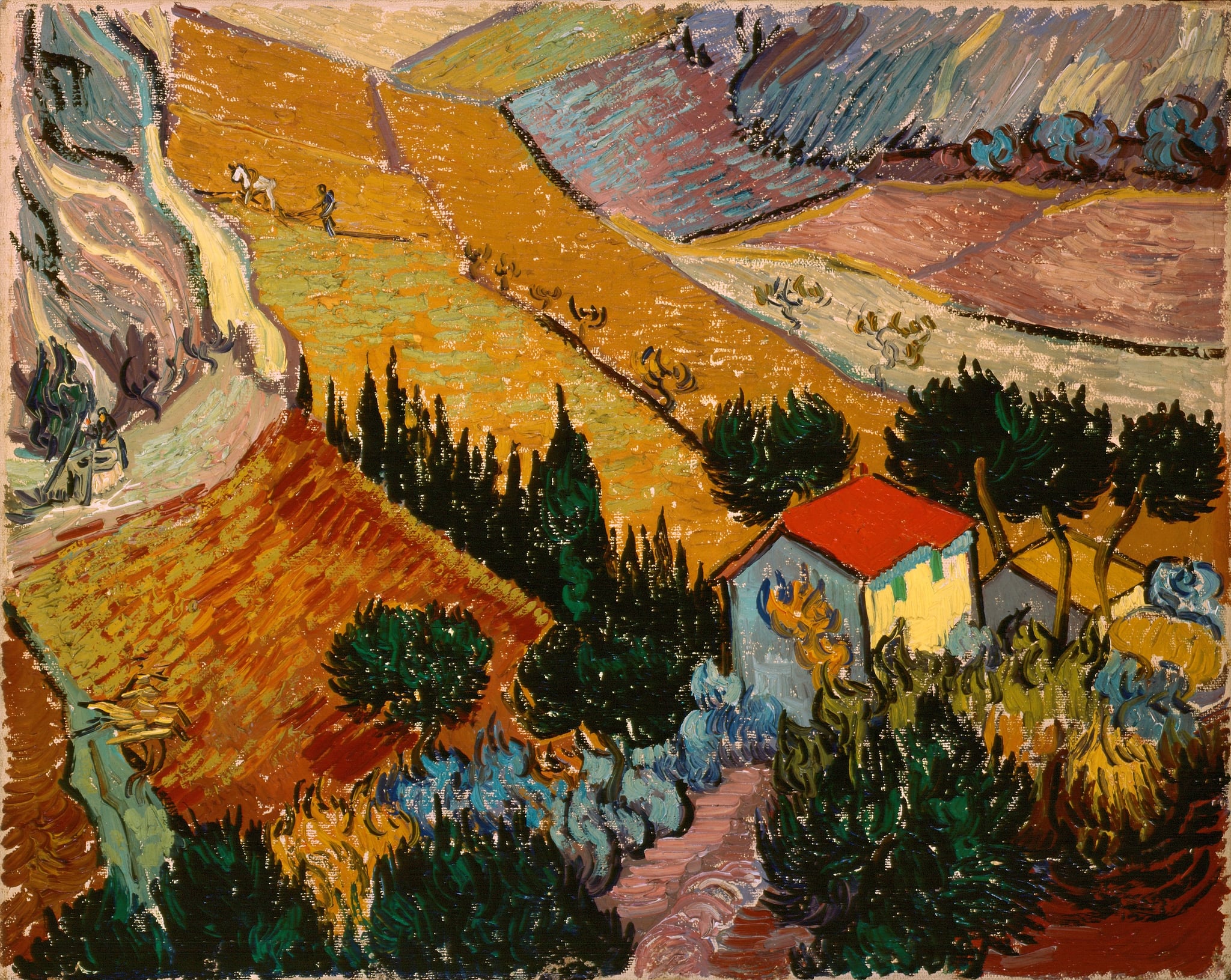
Landscape with Ploughman
Vincent van Gogh (1889)
Landscape with Ploughman compresses a steep Provençal valley into a vibrating mosaic of fields where a tiny figure with a white horse furrows the slope. Van Gogh turns cypress spires, a flame‑red roof, and banded plots into a pulse of <strong>human labor</strong> within <strong>restless nature</strong> <sup>[1]</sup><sup>[5]</sup>. The painting fuses elevated viewpoint and directional brushwork to stage endurance as pattern and rhythm.
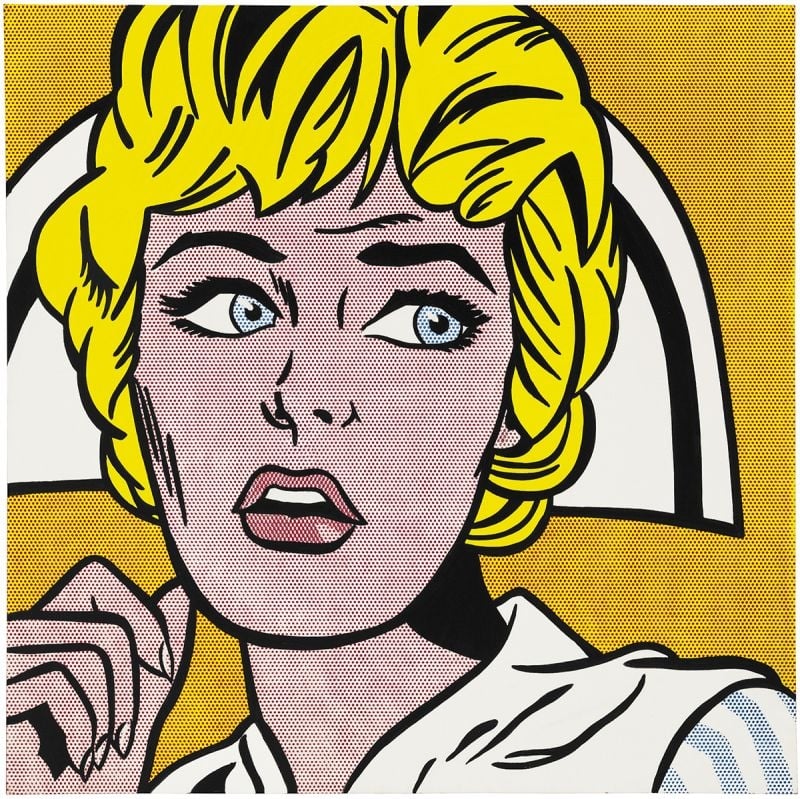
Nurse
Roy Lichtenstein (1964)
Nurse crystallizes Roy Lichtenstein’s 1964 turn to comic-derived icons, amplifying emotion through <strong>Ben‑Day dots</strong>, <strong>thick black contours</strong>, and a <strong>high‑contrast palette</strong>. The cropped close‑up—blond hair, white cap, parted lips, averted gaze—freezes suspense while stripping away speech bubbles. Lichtenstein converts pulp melodrama into a monumental emblem, making style itself the engine of feeling <sup>[1]</sup><sup>[2]</sup>.
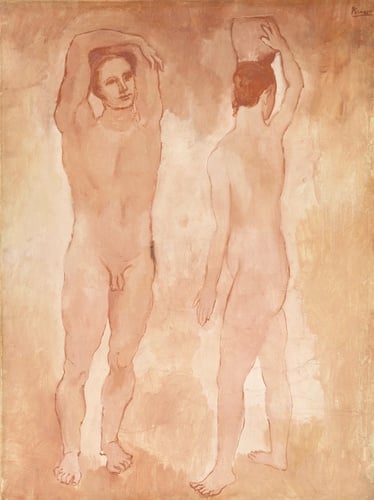
Les Adolescents
Pablo Picasso (1906)
Two nude youths stand in a shallow, fresco-like field, their bodies modeled in warm rose ochres that evoke Picasso’s <strong>Rose Period</strong> calm. Their matched yet misaligned gestures—one frontal with arms raised, the other in profile balancing a <strong>pitcher</strong>—stage a quiet rite of passage that turns adolescence into a timeless, <strong>classical</strong> type <sup>[1]</sup>.
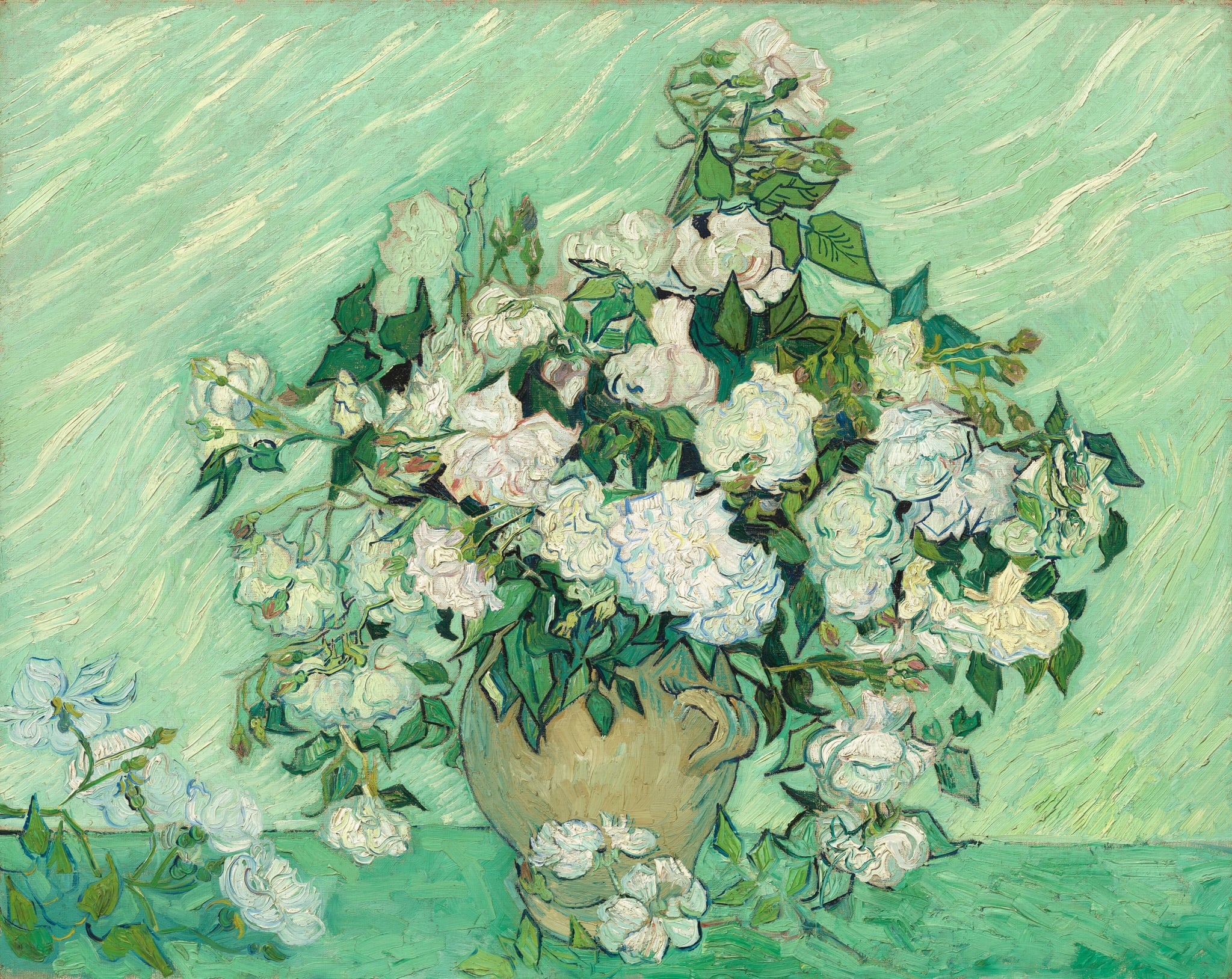
Roses
Vincent van Gogh (1890)
Roses gathers a bursting bouquet in a simple earthen pot against a sea of mint-green strokes, its blooms tipping, spilling, and glowing a cool white. Van Gogh’s thick, directional brushwork charges the still life with <strong>restless vitality</strong>, while the restrained green-and-pale palette creates a <strong>restorative</strong> calm <sup>[1]</sup>. Conservation shows the flowers were once <strong>pink</strong>, their fading altering the intended pink–green complement that anchored the ensemble of Irises and Roses from May 1890 <sup>[1]</sup><sup>[2]</sup><sup>[4]</sup>.
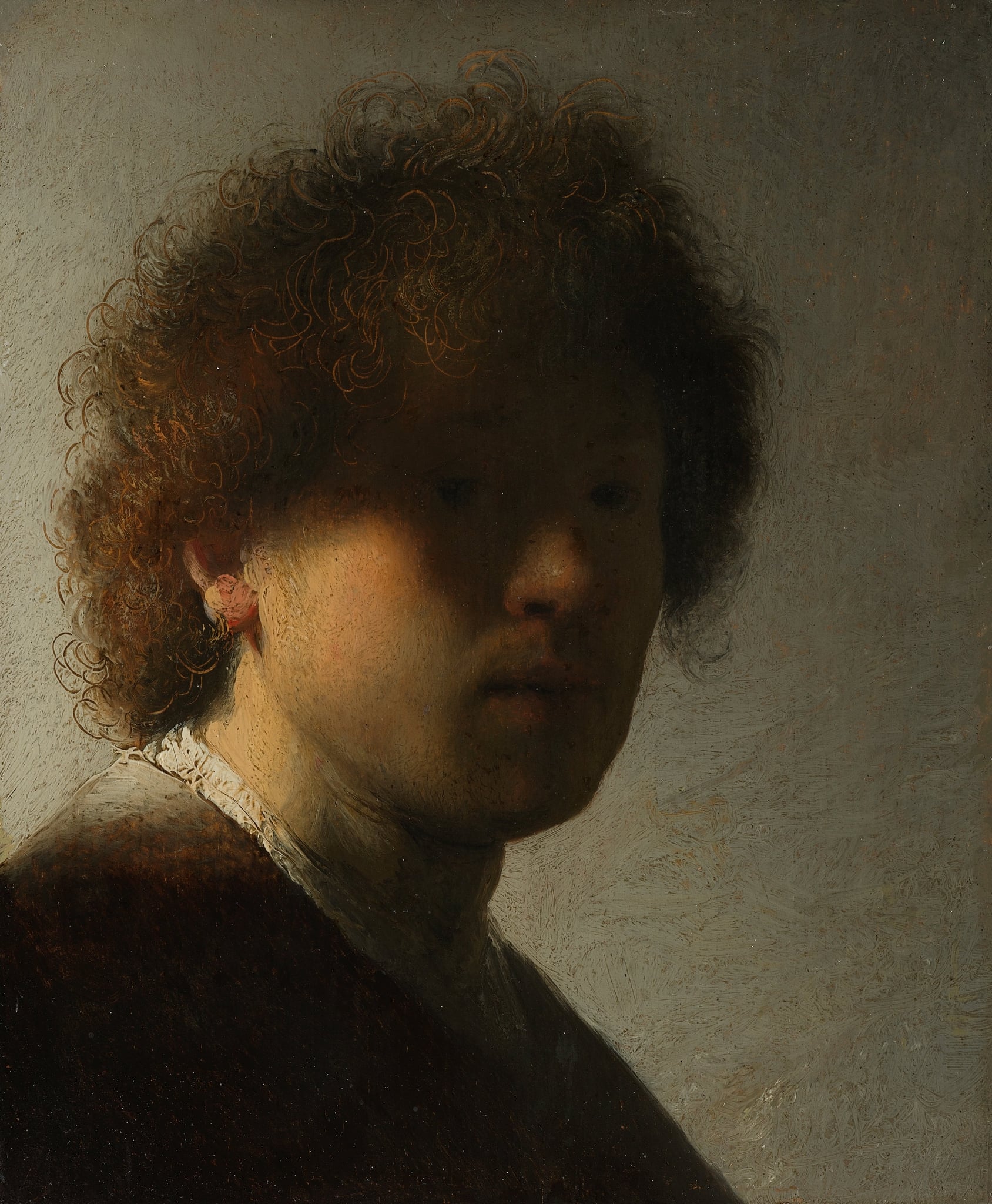
Self-portrait (with tousled hair)
Rembrandt van Rijn (c. 1628)
A young Rembrandt van Rijn tests how <strong>light both reveals and withholds</strong> by letting his face emerge from darkness while his <strong>scratched, backlit curls</strong> flare like a rough halo. The small oak panel makes <strong>process itself the subject</strong>, turning hair, stubble, and a raking highlight into a statement of identity-in-formation <sup>[1]</sup><sup>[5]</sup>.
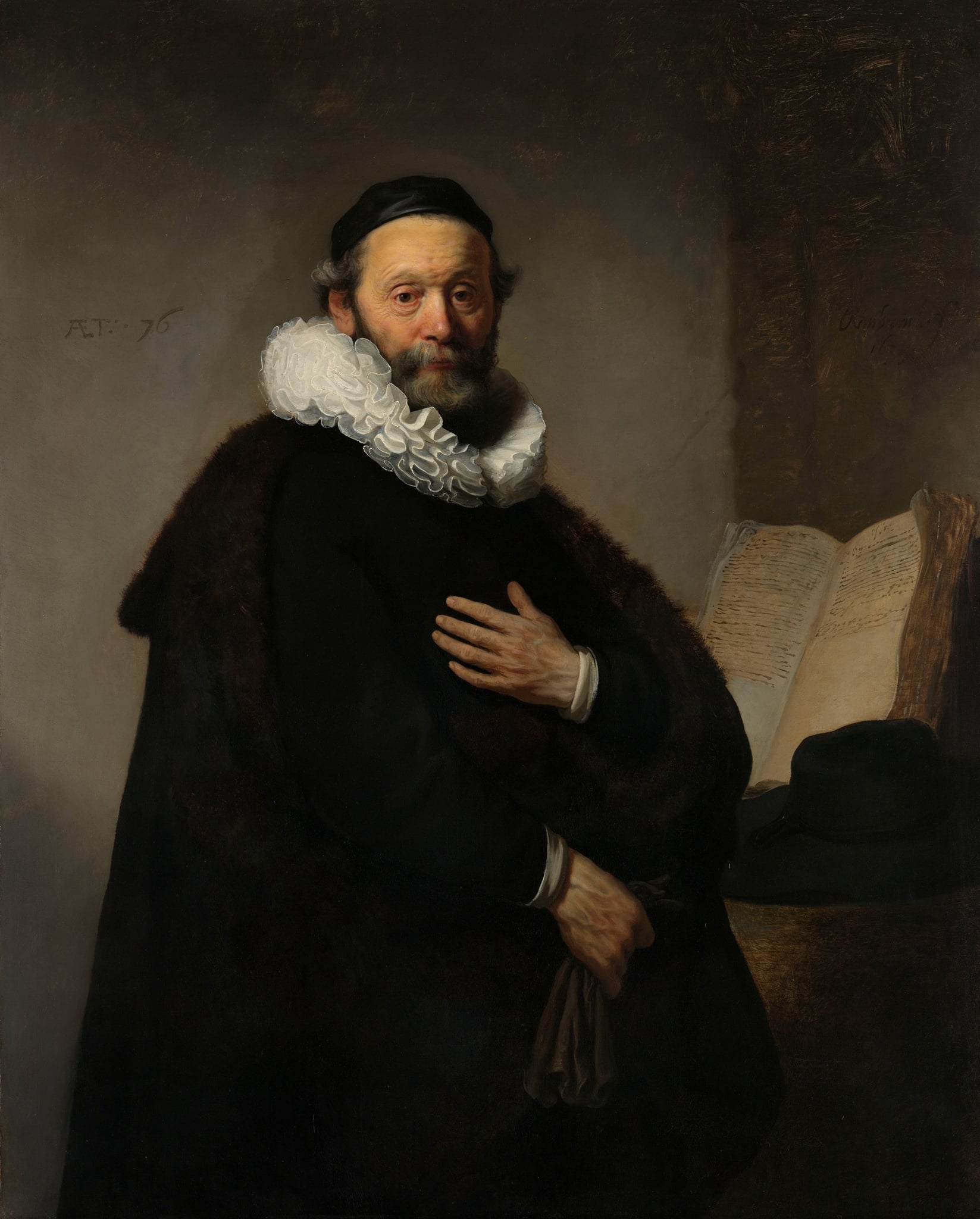
Johannes Wtenbogaert
Rembrandt van Rijn (1633)
Rembrandt van Rijn casts the Remonstrant minister as a study in <strong>moral authority</strong> and <strong>conscience</strong>. A raking light isolates the creased face, cloudlike ruff, and pale hands against the weight of a dark fur-lined cloak, while an open book and a plain hat anchor the scene in <strong>learning</strong> and <strong>humility</strong> <sup>[1]</sup>. The held glove acknowledges worldly status even as the hand to the chest declares inner conviction <sup>[1]</sup><sup>[3]</sup>.
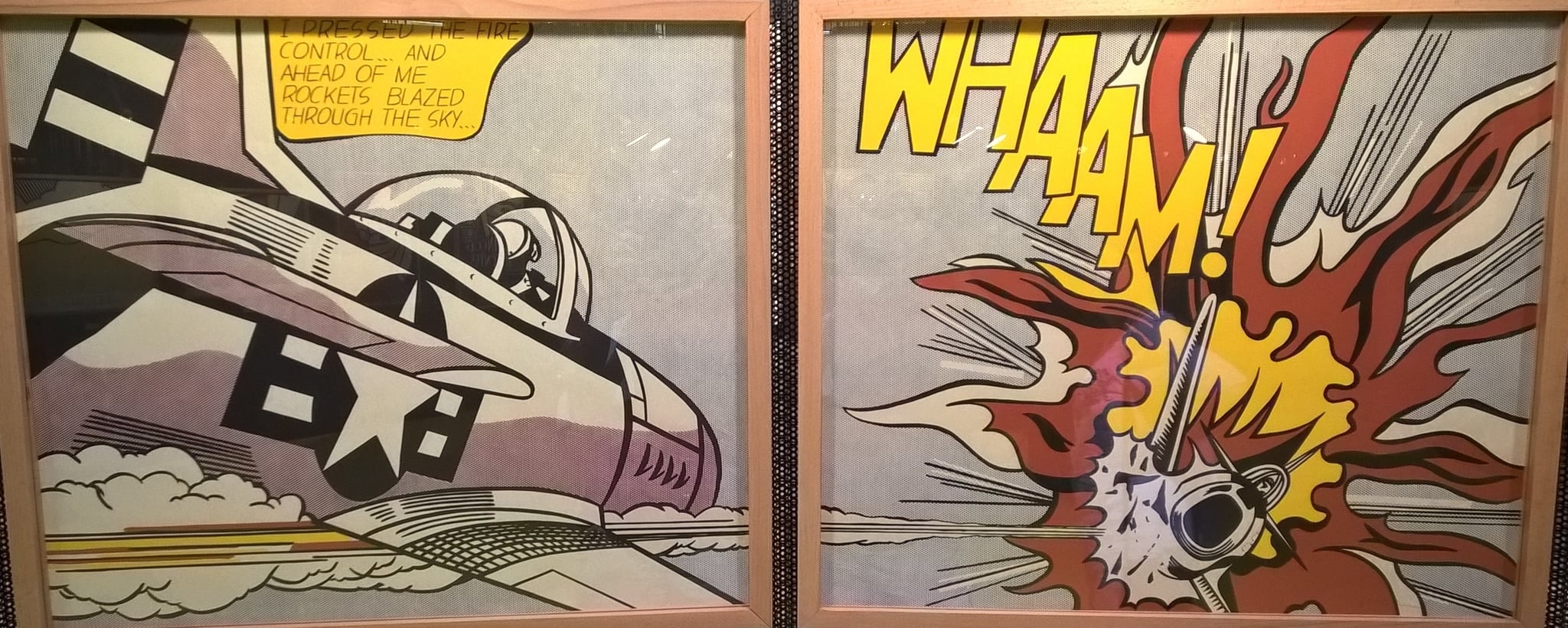
Whaam!
Roy Lichtenstein (1963)
Whaam! stages a split-second airstrike as a two-panel, comic-derived spectacle where <strong>cool control</strong> meets <strong>hot impact</strong>. Lichtenstein converts lethal action into <strong>graphic codes</strong>—Ben-Day dots, speech balloon, and the yellow onomatopoeia “WHAAM!”—to expose how mass media packages warfare as crisp design <sup>[1]</sup><sup>[3]</sup><sup>[5]</sup>.
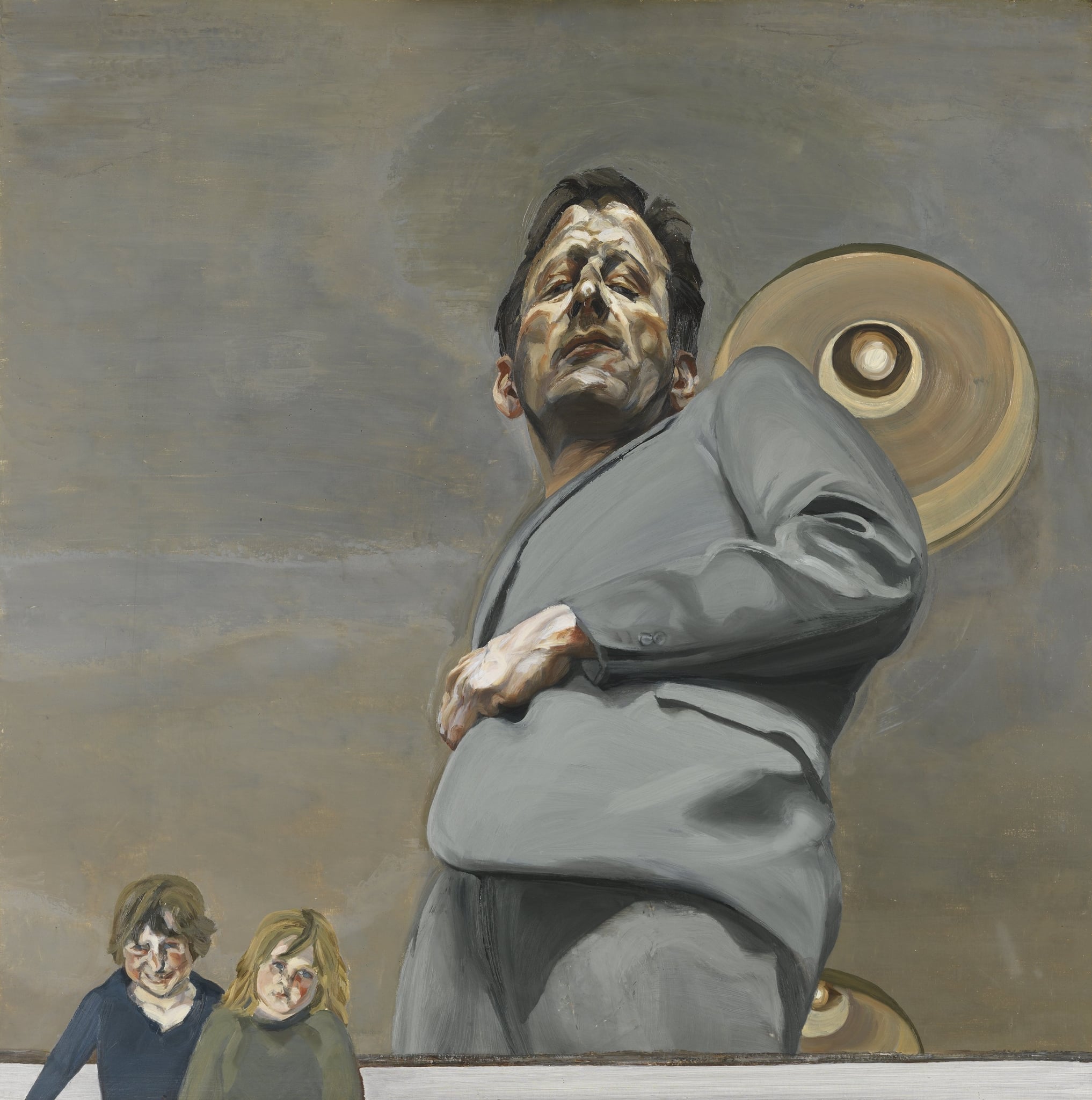
Reflection with Two Children
Lucian Freud (1965)
Lucian Freud’s Reflection with Two Children stages a self‑portrait as a confrontation with a mirror placed on the floor, forcing a vertiginous, low viewpoint. A suited figure looms while a ceiling lamp hovers like a disc behind his head, and two small children puncture the frame at the bottom edge. The painting converts self‑representation into a drama of <strong>authority</strong>, <strong>exposure</strong>, and <strong>accountability</strong> <sup>[1]</sup><sup>[2]</sup>.
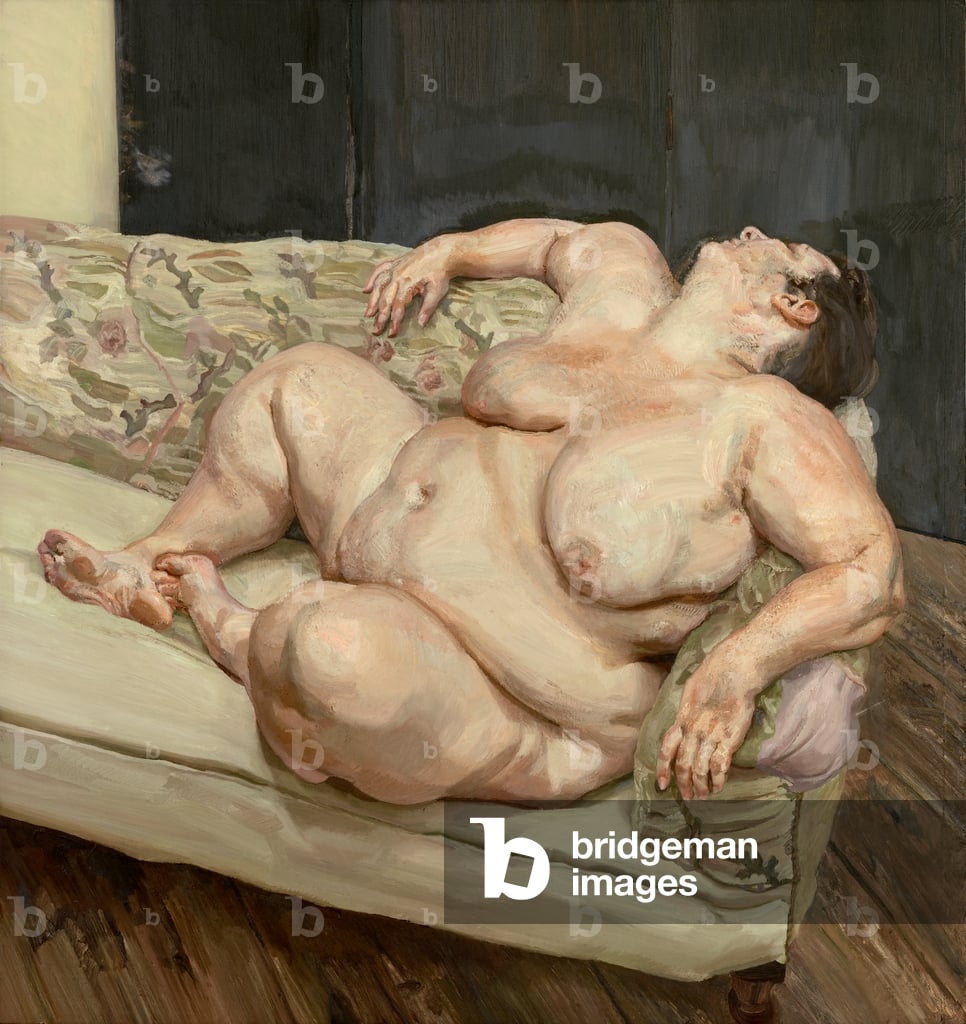
Benefits Supervisor Resting
Lucian Freud (1994)
Benefits Supervisor Resting confronts the reclining‑nude tradition with <strong>unvarnished corporeality</strong> and <strong>quiet dignity</strong>. Sprawled on a sagging floral sofa, the sitter’s tilted head and unarranged limbs shift attention from face to the <strong>landscape of flesh</strong>, rendered in dense, mottled strokes. The humble studio—scuffed wooden floor, dark wall—magnifies the body’s monumental presence rather than flattering it <sup>[1]</sup>.
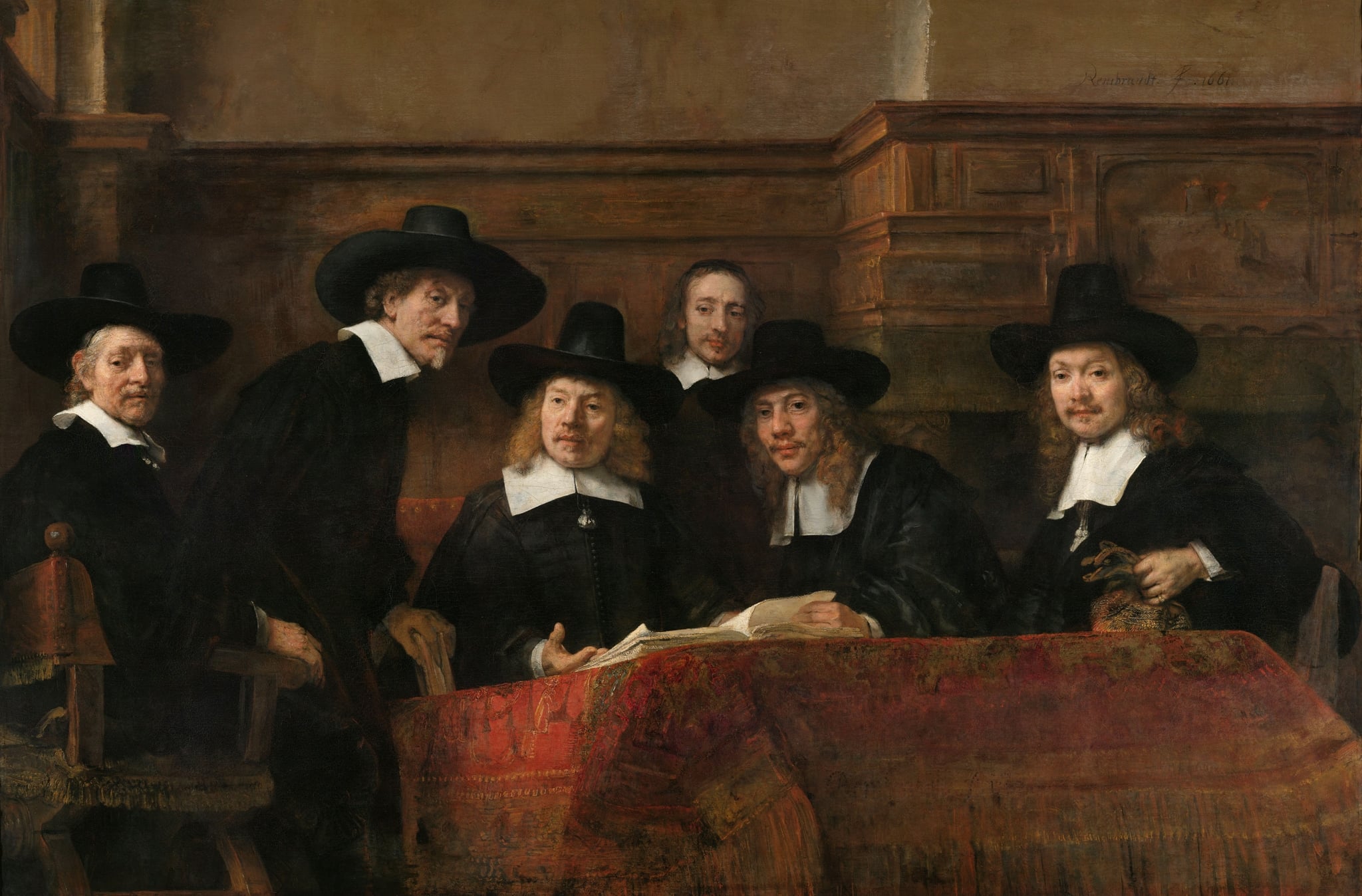
The Sampling Officials of the Amsterdam Drapers’ Guild, Known as ‘The Syndics’
Rembrandt van Rijn (1662)
Rembrandt van Rijn’s The Sampling Officials of the Amsterdam Drapers’ Guild, Known as ‘The Syndics’ (1662) stages a <strong>meeting interrupted</strong>: six guild officials glance up from an open <strong>stalenboek</strong> (sample book) atop a sumptuous <strong>Oriental carpet</strong>, as if a merchant has just entered. The low vantage and unified yet varied poses convert routine inspection into a drama of <strong>civic authority</strong> and <strong>public accountability</strong> <sup>[1]</sup>.
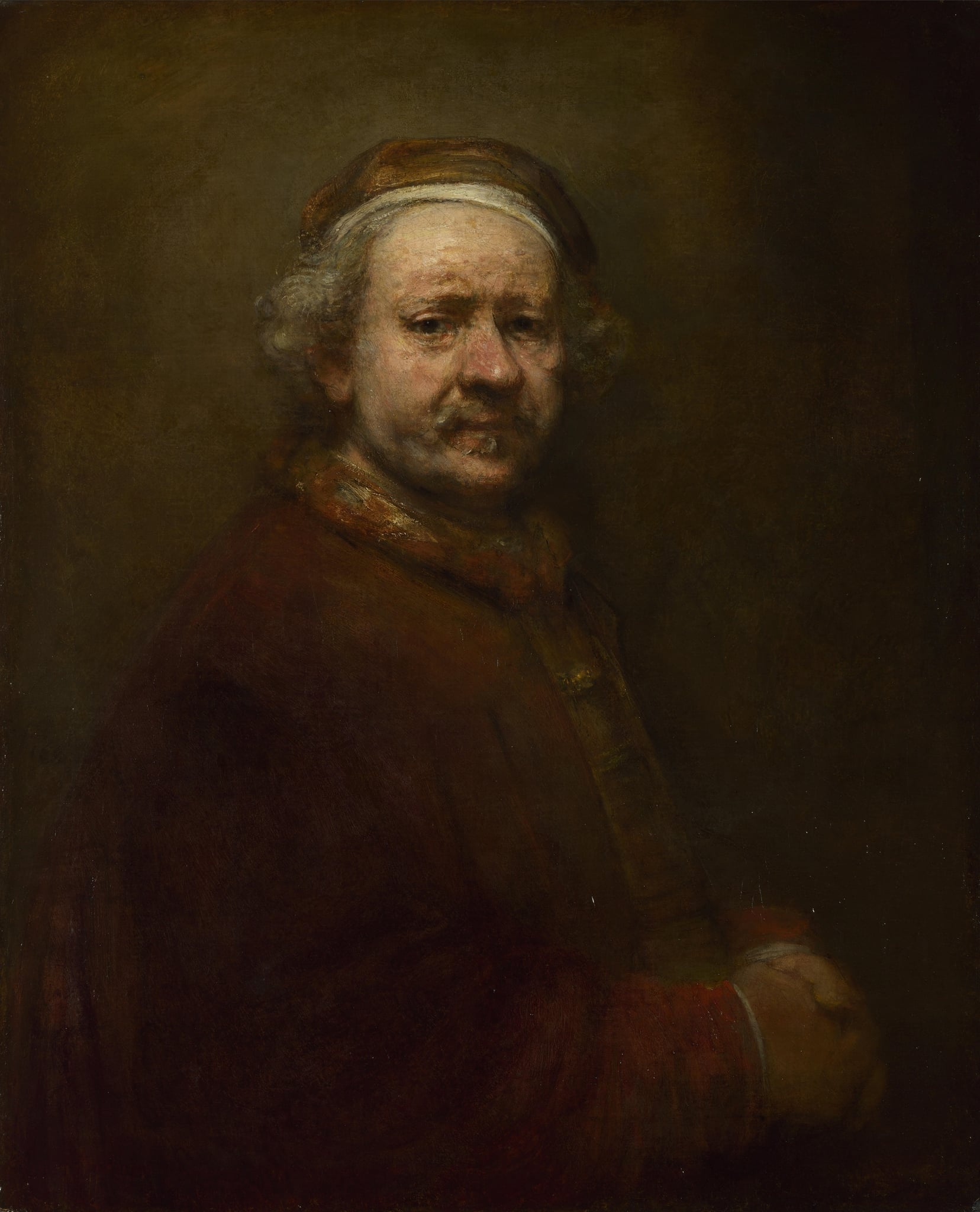
Self Portrait at the Age of 63
Rembrandt van Rijn (1669)
Rembrandt van Rijn’s Self Portrait at the Age of 63 (1669) presents an aged painter held in a warm cone of light against an engulfing dark. Thick, tactile strokes carve the face while the clasped hands retreat into shadow, turning bodily presence into a <strong>meditation on endurance</strong> and the <strong>craft of looking</strong> <sup>[1]</sup><sup>[2]</sup>.
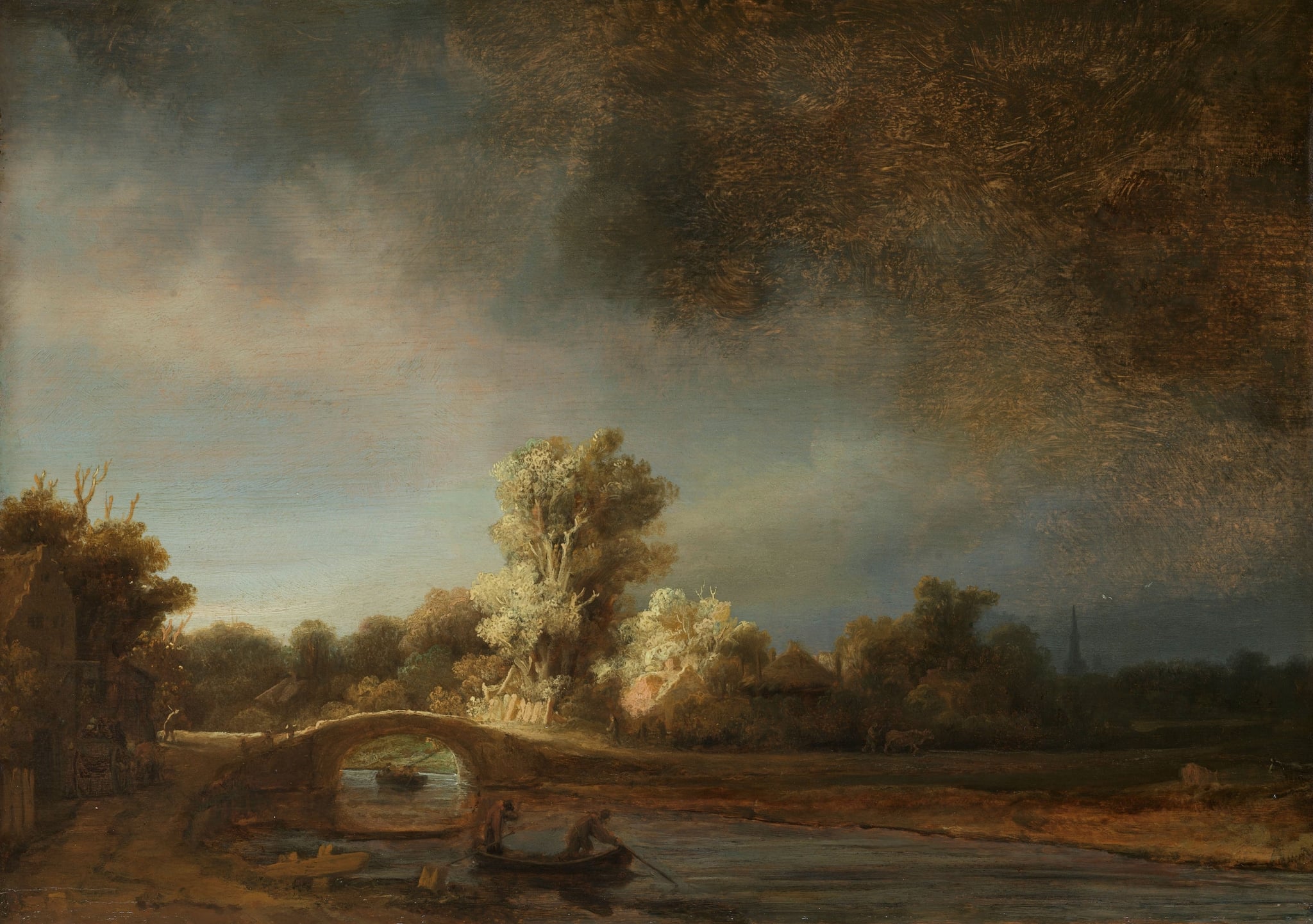
Landscape with a Stone Bridge
Rembrandt van Rijn (late 1630s (c. 1637–1638))
Under a storm-laden sky, a sudden shaft of light isolates the low <strong>stone bridge</strong> and a cluster of <strong>silvery trees</strong>, while tiny boats, a rutted track, a cottage, grazing animals, and a far <strong>church spire</strong> register human presence. Rembrandt van Rijn turns an everyday crossing into a scene of <strong>passage and providence</strong>, where transience moves beneath the endurance of stone and sky <sup>[1]</sup><sup>[2]</sup>.
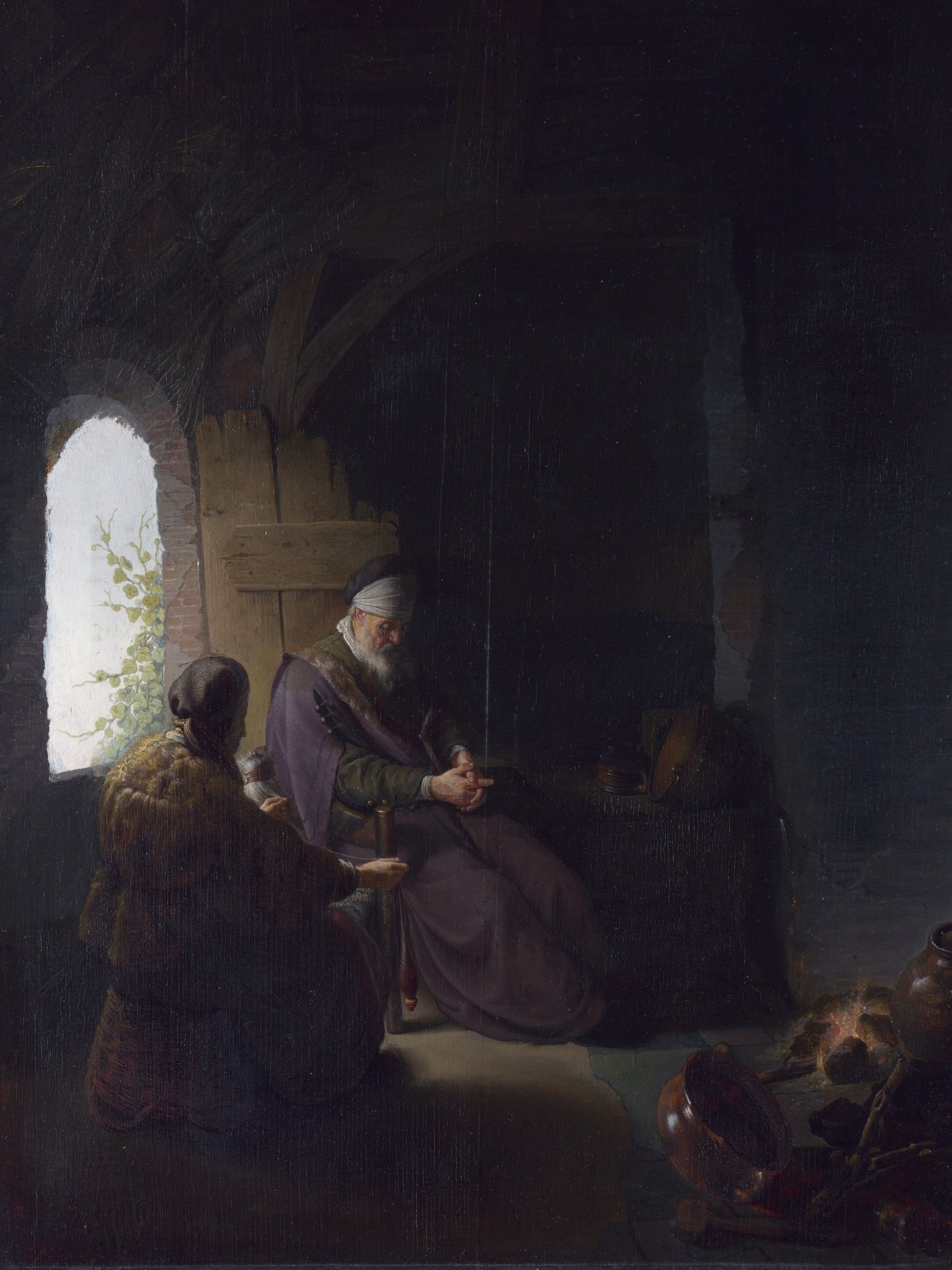
Anna and the Blind Tobit
Rembrandt van Rijn (about 1630)
In Rembrandt van Rijn’s Anna and the Blind Tobit, a cool beam from an unglazed window touches two aging figures while the room recedes into shadow. The painting compresses the Tobit story into a moment of <strong>patient endurance</strong>, where clasped hands, a staff, a smoldering hearth, and ivy at the window do the narrative work of <strong>faith under trial</strong> <sup>[1]</sup>.
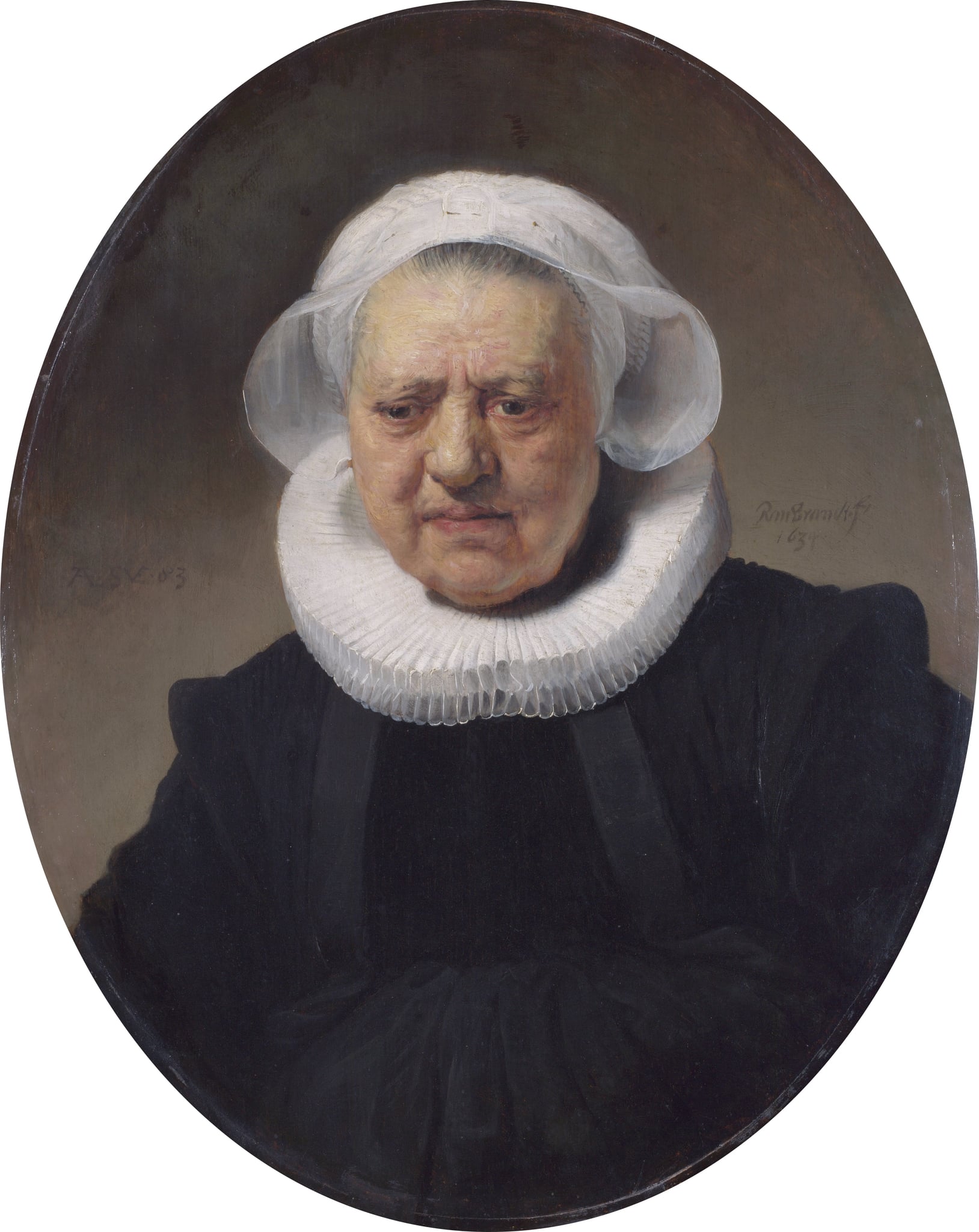
Portrait of Aechje Claesdr.
Rembrandt van Rijn (1634)
Rembrandt van Rijn’s Portrait of Aechje Claesdr. (1634) distills <strong>age, dignity, and moral clarity</strong> into an intimate oval. A black gown and a luminous white ruff and cap concentrate light on her face, where Rembrandt’s tactile strokes honor the <strong>truth of age</strong> without caricature <sup>[1]</sup>.
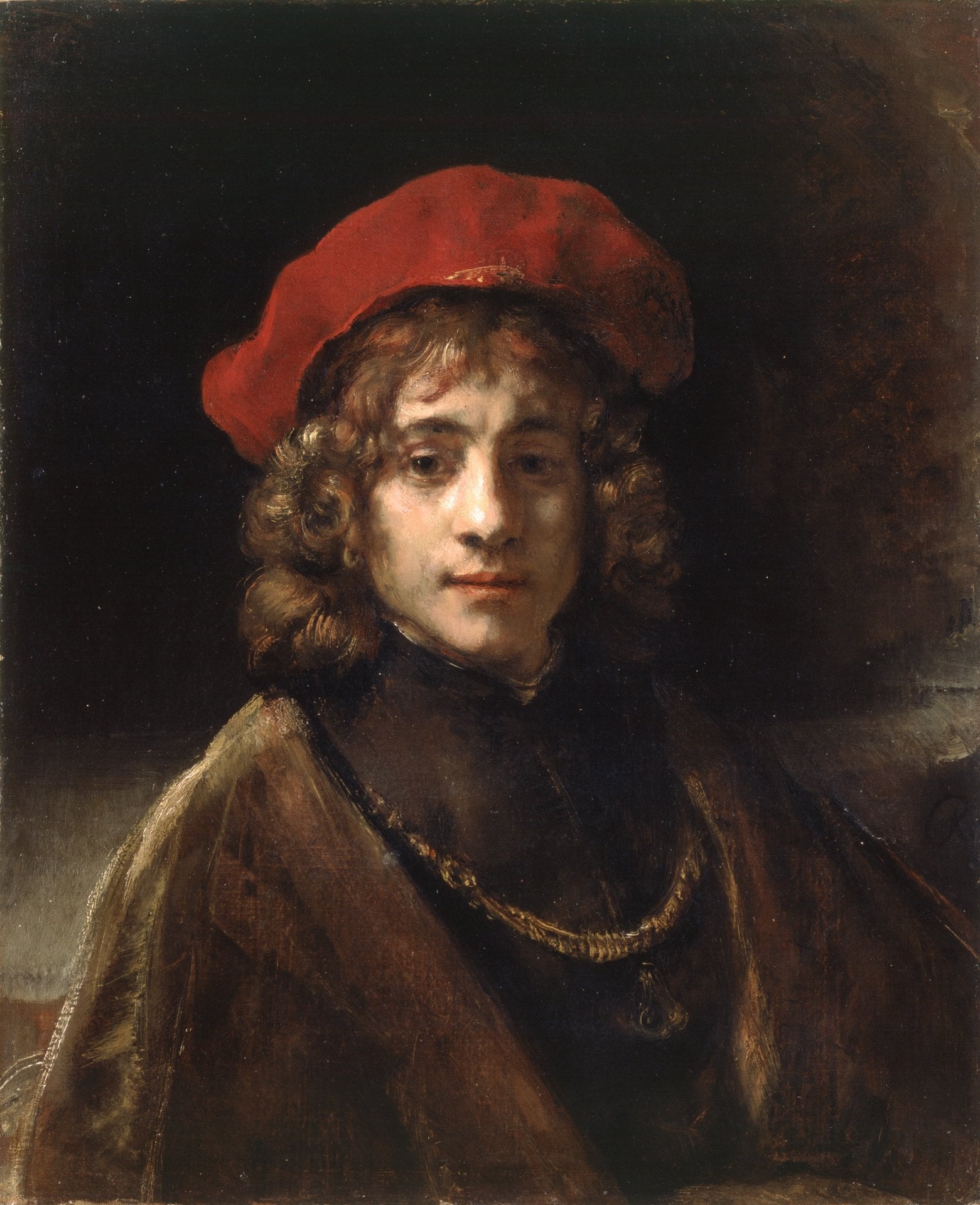
Titus, the Artist's Son
Rembrandt van Rijn (c. 1657)
Rembrandt van Rijn’s Titus, the Artist’s Son is a poised, half-lit study of youth, where <strong>tender chiaroscuro</strong> gathers on the face and crimson cap while the rest dissolves into shadow. The <strong>fancy Venetian costume</strong>, notably the red beret and simple gold chain, elevates a private likeness into a meditation on dignity and becoming <sup>[1]</sup><sup>[2]</sup>.