Reading Le Figaro

by Mary Cassatt

Mary Cassatt’s Reading Le Figaro turns a quiet parlor into a scene of intellect and modern life. The inverted masthead, mirrored repetition of the paper, and the sitter’s spectacles make attention—not appearance—the true subject [1][4]. Through brisk whites and grays, Cassatt dignifies everyday thought as a modern pictorial theme aligned with Impressionism [2].
💰

Market Value

$6–12 million

How much is Reading Le Figaro worth?

Fast Facts

Year
c. 1878–83
Medium
Oil on canvas
Dimensions
104.1 x 83.8 cm
Location
Private collection, Washington, DC (anonymous)
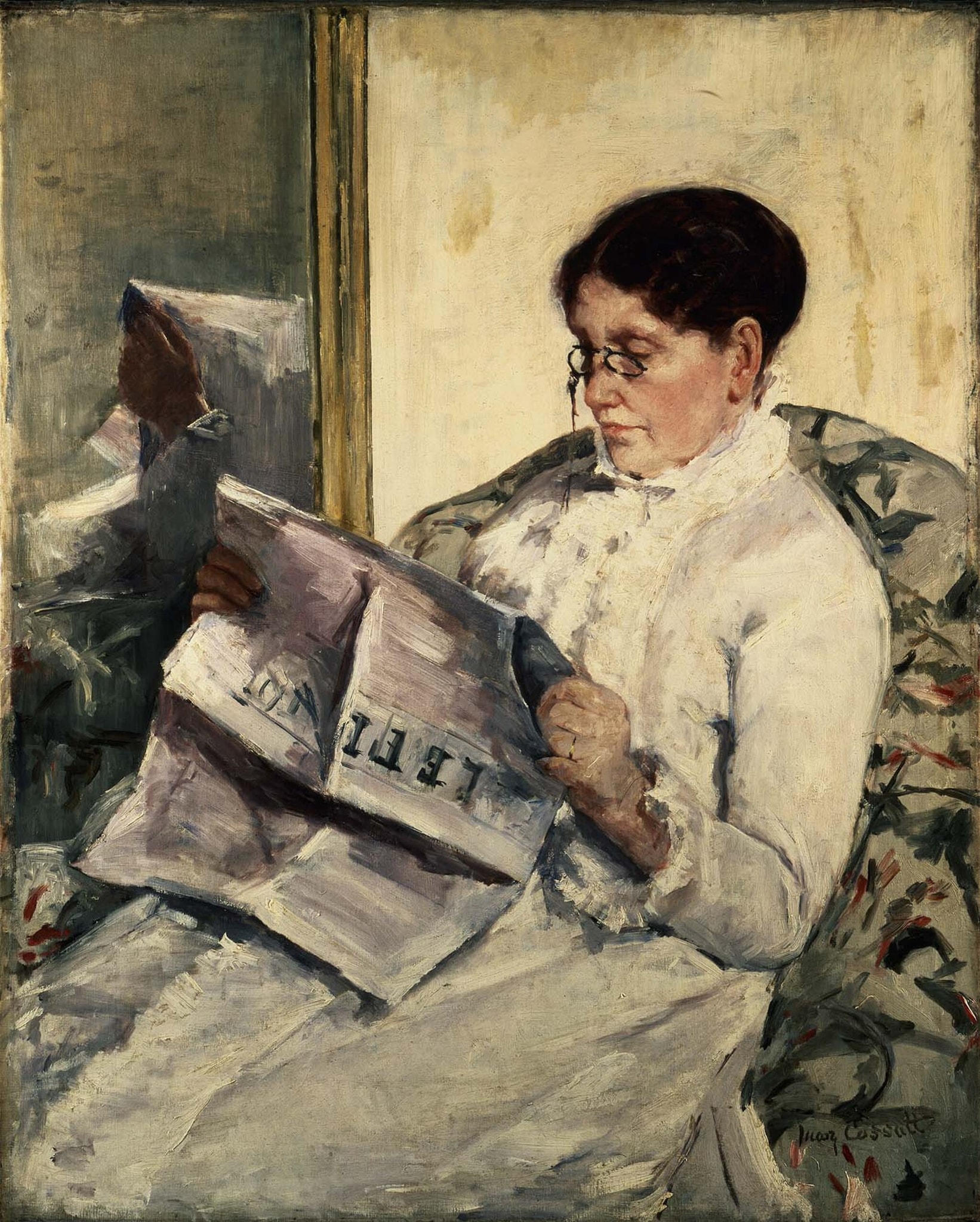
Reading Le Figaro by Mary Cassatt (c. 1878–83)

Click on any numbered symbol to learn more about its meaning

Meaning & Symbolism

Cassatt organizes the composition so that the newspaper—its masthead tilted toward us, letters legible even as they flip in orientation—becomes a declarative sign of public life entering a private room. The mirror to the left refuses to return the reader’s face and instead echoes the sheet and hand, so that reflection is displaced from self-display to the act of reading. This rejection of the conventional “woman-with-mirror” trope dismantles an equation of femininity with vanity and substitutes an image of disciplined attention. The spectacles catch small points of light and press into the bridge of the nose, emphasizing reading as visual labor. Brushwork in whites and grays knits dress and paper into a single zone of thought, while the patterned armchair and muted wall keep the eye from drifting; they anchor the stage on which cognition is performed 14. Formally, Cassatt adapts Impressionist means—creamy facture, compressed interior space, and a restricted palette—to a theme of perception as action. The diagonal thrust of the sheet across the torso generates a contained dynamism, a felt rhythm of scanning lines and turning pages. The mirror’s planar repetition subtly flattens space, echoing strategies Cassatt learned in the Degas circle, yet the effect is not optical trickery for its own sake; it is a structural argument that seeing twice is thinking once with emphasis 2. The painting shares Whistler’s restraint of tone, but, as Linda Nochlin noted, substitutes absorption for stasis: this sitter is not posed; she is at work, mentally present and publicly connected through print 4. That the paper is Le Figaro—symbol of daily news, politics, and culture—matters iconographically: the object in her hands signals entry into a discourse long coded as masculine. Ruth Iskin has read this image as a seminal portrayal of the older “New Woman,” detached from domestic display and engaged in self‑cultivation through reading 3. Historically, the work belongs to Cassatt’s late‑1870s Paris interiors, when her family lived with her and sat for multiple pictures. Whether dated 1878 or reworked by 1883, its early exhibition history places it at a moment when women’s visibility in the public sphere—and the Impressionists’ commitment to modern subjects—were mutually intensifying 152. Cassatt’s choices are exact: the hand grips the paper firmly, not delicately; the spectacles, pragmatic and unornamental, declare utility over allure; the mirror withholds the reader’s visage, so the image of woman is mediated by reading rather than by self-regard. These decisions persuade us that intelligence, not ornament, commands the scene. In this way, Reading Le Figaro becomes more than a genre interior; it is a modern manifesto in lowercase—an argument that private spaces can be sites of public thinking, and that painting can picture not only how women look, but how they read, decide, and belong in the world of news and ideas 341.

Explore Deeper with AI

Ask questions about Reading Le Figaro

Popular questions:

Powered by AI • Get instant insights about this artwork

💬 Ask questions about this artwork!

Interpretations

Historical Context: A Picture Made Twice (c. 1878–83)

Dating oscillates between 1878 and 1883, a slippage that matters: the painting was likely conceived amid Cassatt’s late‑1870s Paris interiors and shown at PAFA in 1879, then possibly reworked or signed later. Rather than a clerical wrinkle, this double-timestamp mirrors the canvas’s own theme—seeing/reading twice—and situates the work at the height of Impressionism’s modern-life project while registering Cassatt’s iterative studio practice. The family’s 1877 arrival in Paris supplied a ready model and an Anglo-American lens onto French print culture, making Le Figaro both prop and passport into public discourse. Exhibitions and provenance trace the piece from intimate domesticity to the marketplace, underscoring how private cognition and public valuation converged in this image of attention 1457.

Source: Smithsonian American Art (SIRIS)

Print Culture & Gender Politics

Le Figaro is not neutral furniture; it is a portable forum of debate. By picturing an older woman absorbed in a mass-circulation daily, Cassatt folds the putatively masculine sphere of news into a feminized interior, rerouting authority through literacy rather than lineage. Ruth Iskin reads this as a seminal portrayal of the older New Woman, whose agency derives from self-cultivation and access to public discourse rather than maternal display. The inverted masthead operates like a modern sign, confronting the viewer with the fact of reading as an empowered act. In this staging, the newspaper becomes a credential—visual proof of a woman’s right to know, to judge, and to belong in the polis of print 2.

Source: Ruth E. Iskin

Optical Construction: Flatness, Reflection, and Attention

Cassatt adapts Degas-derived tactics—planar echoes, cropping, tonal restraint—to build a cognitive stage where reflection is of action, not appearance. The mirror reprises the sheet and hand, flattening depth while doubling the act of reading; this reflexive structure turns the picture into a theory of perception. As Linda Nochlin notes, Cassatt’s restraint of tone nods to Whistler, yet the psychological engine is different: absorption replaces stasis. The creamy facture stitches paper and dress into a continuous field of attention, and the diagonal sheet organizes a scanning rhythm across the canvas. Form is not decorative surplus; it is the syntax by which focused looking gets pictured as modern labor 34.

Source: Linda Nochlin (London Review of Books)

Ageing Modernity: Rethinking the ‘New Woman’

Tamar Garb’s dating of the work to 1877–78 aligns with a Paris moment when Cassatt repeatedly cast her mother as a thinking subject, unsettling the youth bias of modern femininity. Iskin’s emphasis on an older New Woman reframes ageing as a resource: spectacles, firm grip, and unornamental dress read as pragmatics of knowledge, not deficits of allure. The sitter’s maturity makes the crossing of gendered spheres sharper—she is past the rituals of display and squarely in the realm of judgment. In a culture that iconized youthful fashionability, Cassatt dignifies senior intellect as a modern ideal, expanding who gets to be seen as contemporary, capable, and publicly connected 25.

Source: Tamar Garb (Yale A&AePortal)

Work in the Parlor: The Ergonomics of Looking

The painting translates domestic quiet into a choreography of intellectual labor. Spectacles bite light at the bridge; fingers torque the broadsheet; chair patterning and muted wall act as cognitive dampeners, keeping attention from fraying. Recent scholarship on Cassatt’s practice reframes her interiors as sites where skill, repetition, and tool-use (spectacles, print, mirror) articulate women’s work beyond the wage. The restricted palette economizes means the way concentration economizes motion, while the diagonal thrust of the sheet measures effort in page-turns and eye-sweeps. Cassatt thus aligns the ergonomics of vision with modern work-discipline: to read is to labor, to focus is to produce meaning inside a space misread as merely decorative 46.

Source: Philadelphia Museum of Art (Mary Cassatt at Work, 2024)

Comparative Modernities: Against ‘Whistler’s Mother’

Placed against Whistler’s Arrangement in Grey and Black, Cassatt’s mother is no icon of filial piety but a participant in the public sphere. Nochlin underscores how Cassatt swaps memorial pose for active absorption, turning grisaille restraint into a vehicle for thought-in-process. Where Whistler monumentalizes stillness, Cassatt synchronizes eye, page, and reflection, embedding time (the scan, the turn) inside the paint. This is not anti-portrait; it is portraiture retooled around cognition and media—an ethics of looking that values decision over decorum. The result is a modern subject calibrated to print capitalism and urban tempo, a mother whose authority stems from what she reads rather than how she is revered 34.

Source: Linda Nochlin (London Review of Books)

Related Themes

About Mary Cassatt

Mary Cassatt (1844–1926) was an American painter who settled in Paris, exhibited with the Impressionists, and became a key conduit for introducing their art to U.S. collectors. After 1890 she adopted japoniste flatness, bold patterning, and strong design, focusing on modern women’s lives—especially mother‑and‑child subjects—until failing eyesight curtailed her work by 1914 [4].
View all works by Mary Cassatt

More by Mary Cassatt

Woman in Black at the Opera by Mary Cassatt

Woman in Black at the Opera

Mary Cassatt (1878)

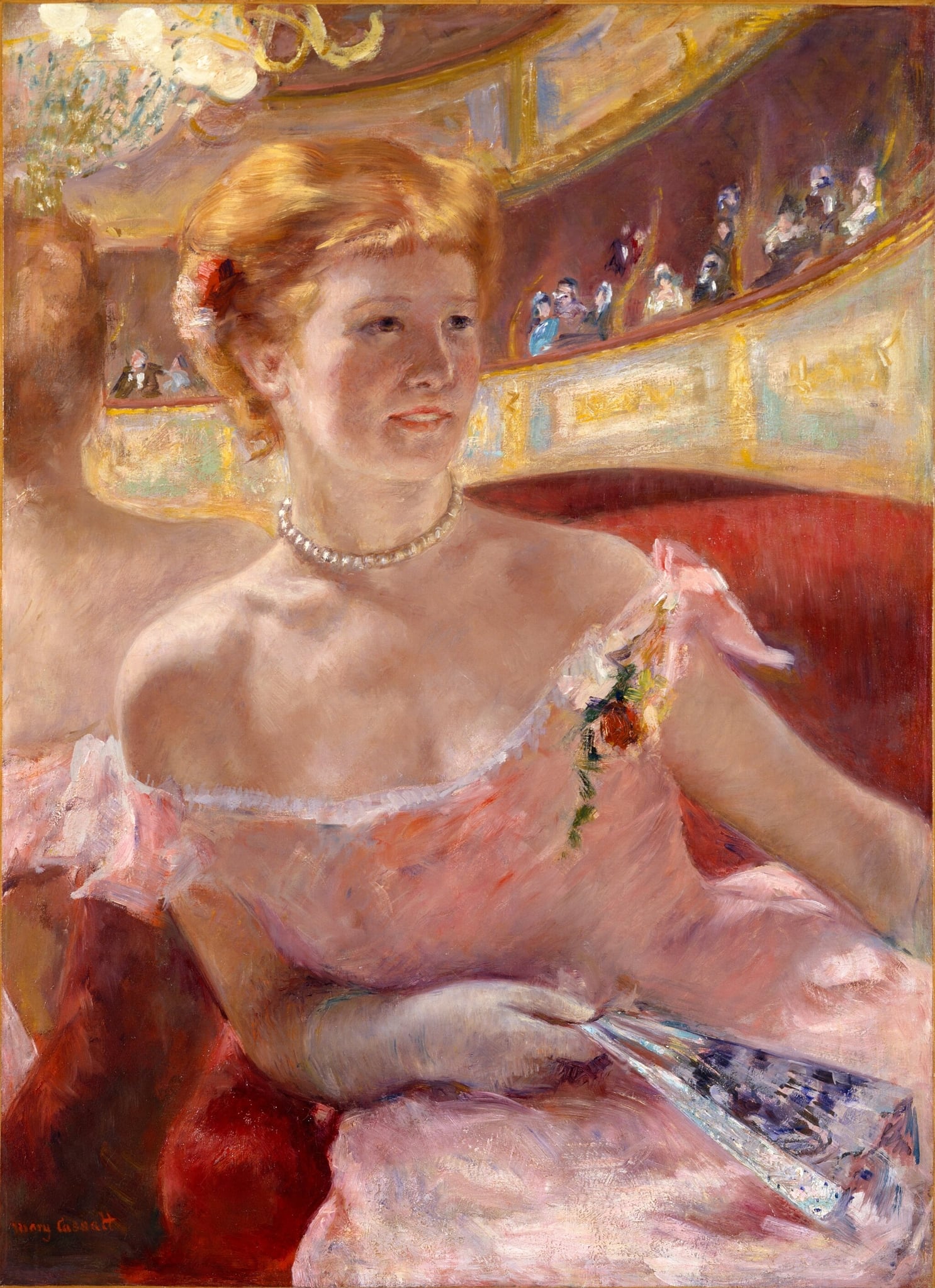
Mary Cassatt’s Woman in Black at the Opera stages a taut drama of vision and visibility. A woman in <strong>black attire</strong> raises <strong>opera glasses</strong> while a distant man aims his own at her, setting off a chain of looks that makes public leisure a site of <strong>power, agency, and surveillance</strong> <sup>[1]</sup><sup>[2]</sup>.

The Tea by Mary Cassatt

The Tea

Mary Cassatt (about 1880)

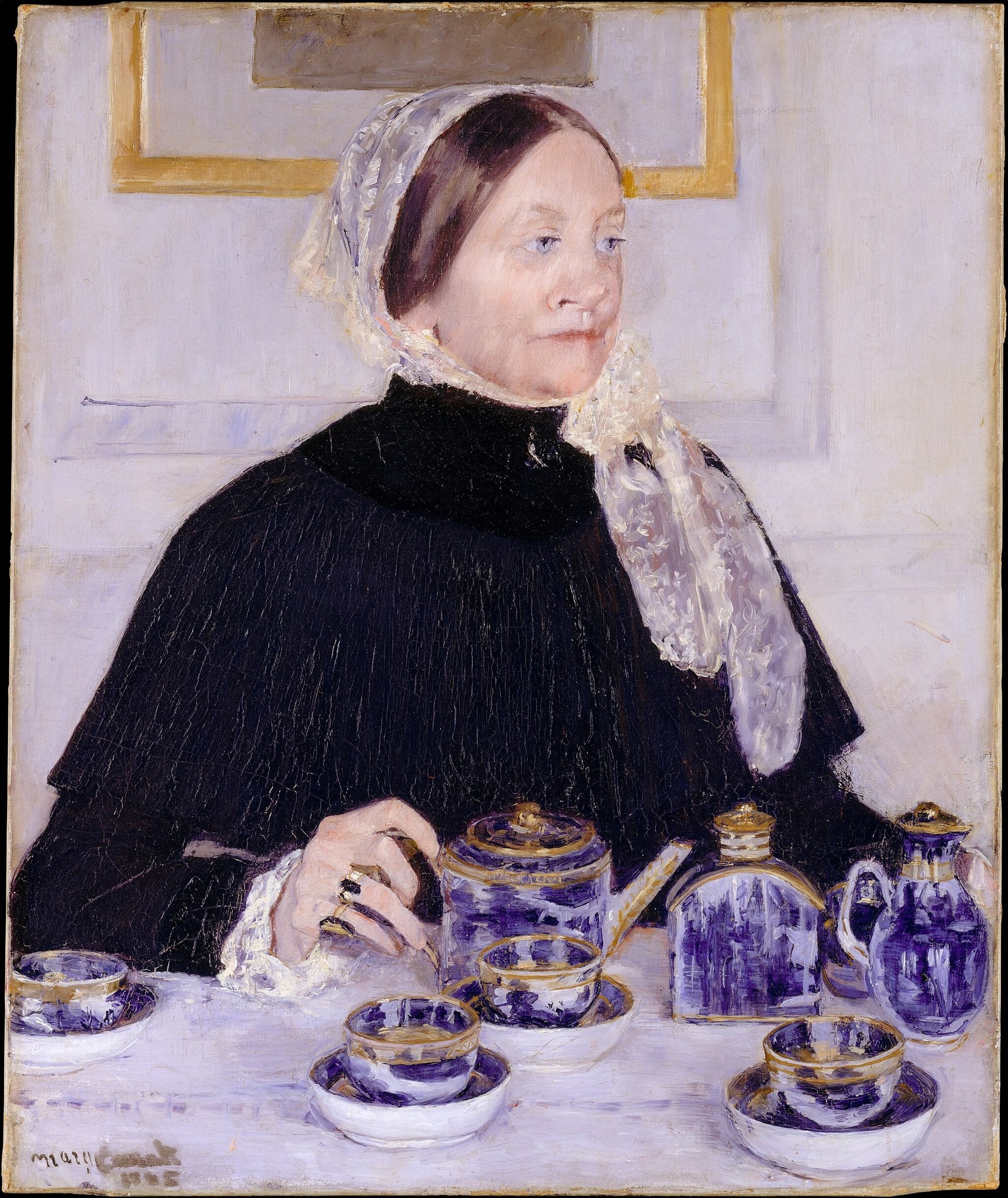
Mary Cassatt’s The Tea stages a poised, interior <strong>drama of manners</strong>: two women sit close yet feel apart, one thoughtful, the other raising a cup that <strong>veils her face</strong>. A gleaming, oversized <strong>silver tea service</strong> commands the foreground, its reflections turning ritual objects into actors in the scene <sup>[1]</sup>. The shallow, cropped room—striped wall, gilt mirror, marble mantel—compresses the atmosphere into <strong>intimacy edged by restraint</strong>.

Little Girl in a Big Straw Hat and a Pinafore by Mary Cassatt

Little Girl in a Big Straw Hat and a Pinafore

Mary Cassatt (c. 1886)

Mary Cassatt’s Little Girl in a Big Straw Hat and a Pinafore distills childhood into a quiet drama of <strong>interiority</strong> and <strong>constraint</strong>. The oversized straw hat and plain pinafore bracket a flushed face, downcast eyes, and <strong>clasped hands</strong>, turning a simple pose into a study of modern self‑consciousness <sup>[1]</sup>. Cassatt’s cool grays and swift, luminous strokes make mood—not costume—the subject.

Breakfast in Bed by Mary Cassatt

Breakfast in Bed

Mary Cassatt (1897)

Breakfast in Bed distills a <strong>tender modern intimacy</strong> into a tightly cropped sanctuary of rumpled white linens, protective embrace, and interrupted routine. Mary Cassatt uses <strong>cool light</strong> against <strong>warm flesh</strong> to anchor attention on the mother’s encircling arm and the child’s outward gaze, fusing care, curiosity, and the rhythms of <strong>everyday modern life</strong> <sup>[1]</sup><sup>[2]</sup>.

Young Mother Sewing by Mary Cassatt

Young Mother Sewing

Mary Cassatt (1900)

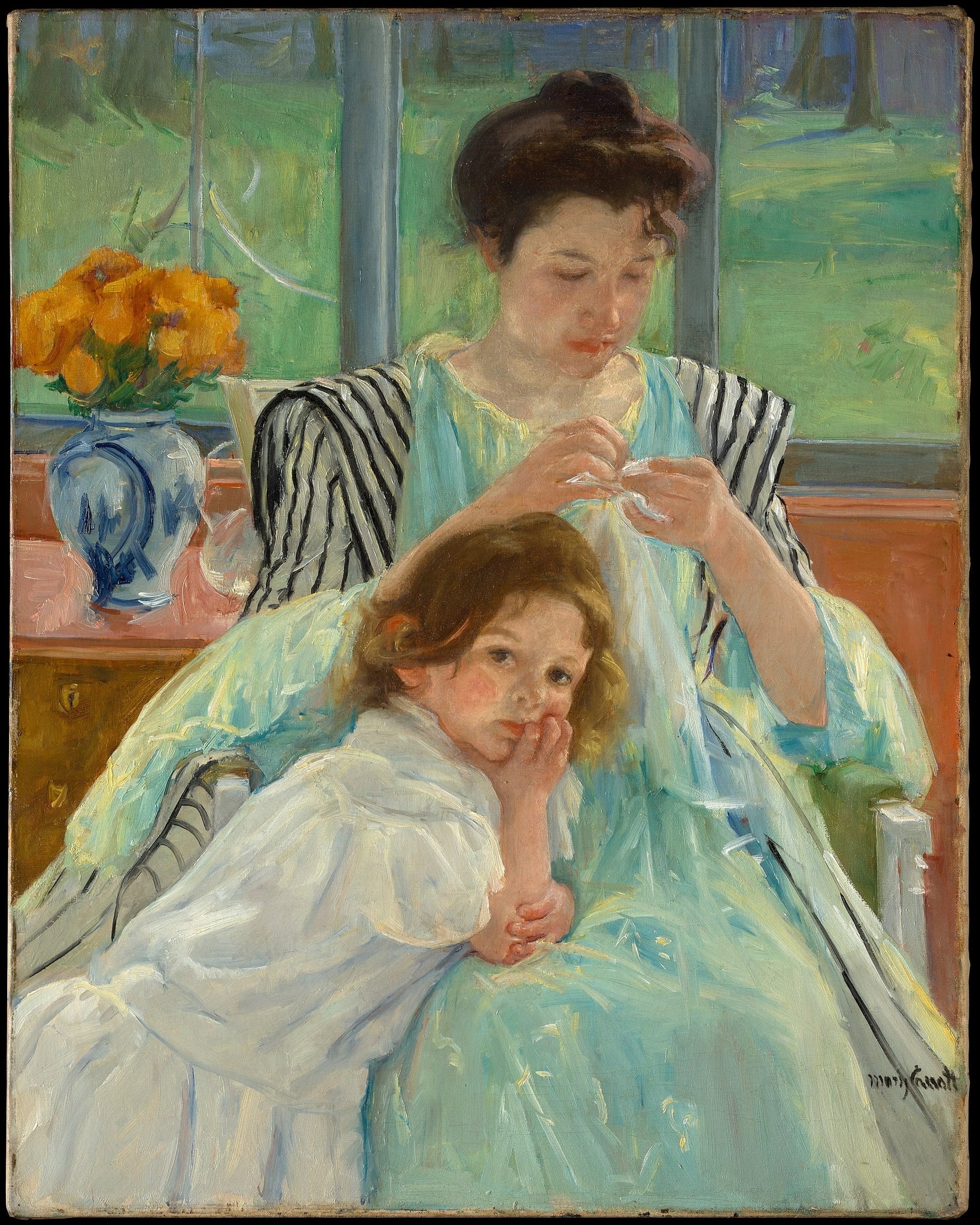
Mary Cassatt’s Young Mother Sewing centers the quiet <strong>labor of care</strong>: a mother steadies pale fabric while a child in white leans into her, eyes meeting ours. Cool <strong>greens and blues</strong> bathe the figures as striped sleeves and chair arms rhythmically return attention to the mother’s working hands, while a burst of <strong>orange blossoms</strong> by the window anchors interior life against the world outside <sup>[1]</sup>.
Children Playing on the Beach by Mary Cassatt

Children Playing on the Beach

Mary Cassatt (1884)

In Children Playing on the Beach, Mary Cassatt brings the viewer down to a child’s eye level, granting everyday play the weight of <strong>serious, self-contained work</strong>. The cool horizon and tiny boats open onto <strong>modern space and possibility</strong>, while the cropped, tilted foreground seals us inside the children’s focused world <sup>[1]</sup>.