Woman with a Pearl Necklace in a Loge

by Mary Cassatt

Mary Cassatt’s Woman with a Pearl Necklace in a Loge (1879) stages modern spectatorship inside a plush opera box, where a young woman in pink satin, pearls, and gloves occupies the red velvet seat while a mirror multiplies the chandeliers and balconies. Cassatt fuses intimacy and public display, using luminous brushwork to place her sitter within the social theater of Parisian leisure [1][2].

Fast Facts

Year
1879
Medium
Oil on canvas
Dimensions
81.5 × 59.5 cm
Location
Philadelphia Museum of Art, Philadelphia
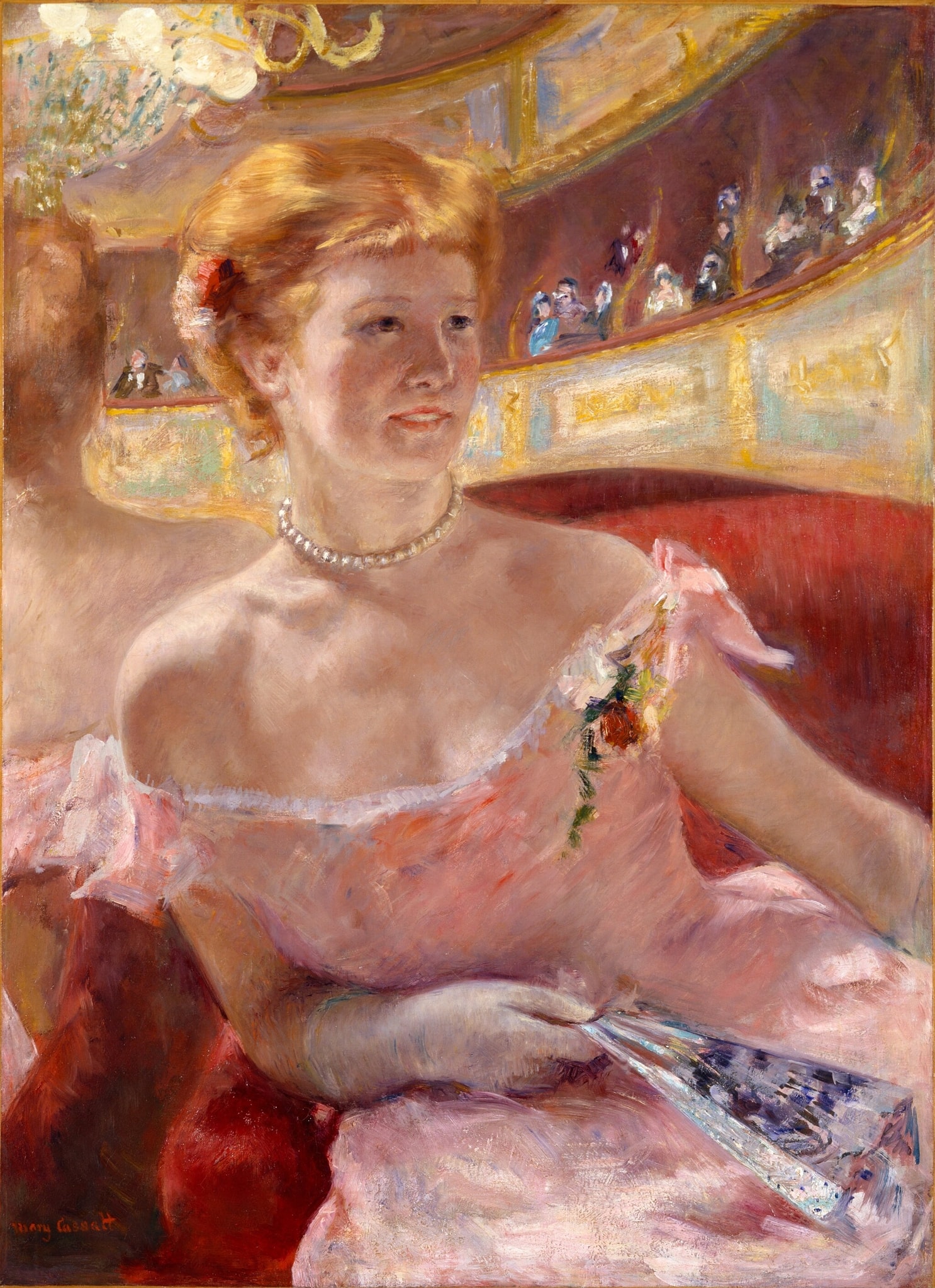
Woman with a Pearl Necklace in a Loge by Mary Cassatt (1879)

Click on any numbered symbol to learn more about its meaning

Meaning & Symbolism

Cassatt builds the composition around a strategic optical machine: the mirror behind the sitter doubles her shoulder and neck while unfurling a panorama of curved gilt balconies and a foamy chandelier. That device folds the audience—the social body that normally surveils women—back into the woman’s own pictorial space, making her the axle around which the spectacle turns 15. The sitter’s head tilts slightly toward the reflected theater, but her gaze does not seek flirtation; it registers composed awareness. Her pearl necklace—precisely struck so each bead catches artificial light—reads as a badge of bourgeois respectability, yet Cassatt insists that it frames, not defines, the subject; the warm gaslight modulates her skin and the pink satin into a continuum of color that softens the authority of costume codes 14. The white opera gloves and the fan, gripped rather than fluttered, behave like props in a social choreography that she controls. Rather than isolate the woman as a decorative object, Cassatt lets the red velvet seat cradle her torso and arm in a stable arc, asserting corporeal presence against the shimmering flux beyond. Within Impressionism’s theater imagery, this canvas sharpens the politics of looking. Where the opera box traditionally functioned as a showcase for display, Cassatt recasts it as a negotiated threshold between private self-possession and public scrutiny 34. She rejects anecdote in favor of structure: the sweeping curve of the loge rail in reflection rhymes with the curve of the sitter’s shoulder; the chandelier’s broken lights echo the pearly highlights along the necklace and glove seams. Those correspondences bind figure and environment, but the paint handling keeps their statuses distinct—thick, buttery accents mark the sitter’s necklace and lips, while the crowd dissolves into flicks of color, reducing the onlookers to ambient noise. The result is a quiet inversion of power: the woman holds stillness amid a field of flux. This is Cassatt’s answer to a culture of surveillance that Robert L. Herbert identifies in Haussmannized leisure spaces; the loge is not just a vantage point but a stage on which women articulate their participation without surrendering authorship of their image 4. The work also materializes Cassatt’s dialogue with Degas and the Impressionists’ fascination with artificial light and unconventional framing. Cropped edges, off-center focus, and the radiant mapping of gaslight on flesh declare a modern pictorial intelligence, while the mirror’s doubling recalls Manet’s mirror logics without capitulating to spectacle’s seductions 125. Shown at the Fourth Impressionist Exhibition, the painting condenses Cassatt’s program: to depict modern women as critical agents within public life. Even the debated identification of the sitter (often said to be Cassatt’s sister) reinforces the point: whether kin or model, the figure operates not as portrait celebrity but as a type—an urban participant who refuses to be only ornament 13. In this way, the canvas becomes both a celebration of Paris’s glittering ritual and a lucid critique of its optics; Cassatt turns the opera box into a laboratory where visibility and autonomy are tested—and, here, convincingly claimed.

Explore Deeper with AI

Ask questions about Woman with a Pearl Necklace in a Loge

Popular questions:

Powered by AI • Get instant insights about this artwork

💬 Ask questions about this artwork!

Interpretations

Feminist Spectatorship

Rather than a passive ornament in an opera box, Cassatt’s sitter occupies a zone of self-directed looking, a countertype to the coquettish belle of boulevard lore. In tandem with Cassatt’s In the Loge (1878), the work anatomizes the traffic of glances in Haussmann’s theaters, where women navigated exposure under the codes of propriety. Here, the mirror sutures audience to subject, but the woman’s bearing and controlled fan-hand signal agency, not availability. This is less a portrait of flirtation than a study in managed visibility, aligning with social-historical readings of the Opéra as a stage of mutual surveillance and class display. Cassatt thus tests how a woman may be fully present in public while withholding herself from objectification—a distinctly modern posture of autonomy within spectacle 134.

Source: MFA Boston (In the Loge context); Philadelphia Museum of Art; Robert L. Herbert

Optical Engineering & Mirror Ethics

The painting functions as an optical device: the rear mirror doubles the figure and fans out balconies and chandelier into a panoramic sweep. This structure recalls Manet’s mirror logics while absorbing Degas’s lessons in cropping and artificial light. Yet Cassatt refuses virtuoso trickery; she codes the reflected crowd as ambient facture—flicks and daubs—while reserving buttery impasto for beads, lips, and seams. That hierarchy of touch becomes an ethics of attention: the individual woman receives painterly specificity; the public dissolves into incident. The result converts spectacle into a test case for modern pictorial intelligence, where viewpoint, framing, and reflectivity expose how images can either amplify or resist social scripts of display 125.

Source: Philadelphia Museum of Art; The Met Heilbrunn Timeline; Web Gallery of Art

Class Codes under Gaslight

Pearls, gloves, corsage, and pink satin articulate the semiotics of bourgeois evening dress, but Cassatt treats them as mutable under gaslight rather than fixed emblems. The necklace becomes a register of illumination—bead-by-bead highlights—while gloves and silk catch warm tones that bridge flesh and fabric. This chromatic continuum softens rigid class signifiers, shifting our attention from what attire declares to how light mediates identity in the theater’s artificial ecology. Framed by Herbert’s account of Parisian leisure as a ritual of display, these accessories appear as props in a codified performance that the sitter handles with intent, not as dictates that define her 13.

Source: Philadelphia Museum of Art; Robert L. Herbert

Architecture as Social Machine

The curving gilt tiers and chandelier are not mere décor; they visualize the Opéra’s architecture as a mechanism of vision that organizes who sees and who is seen. By routing that mechanism through a mirror behind the sitter, Cassatt turns the loge into a negotiated threshold—private enclosure meeting public arena. The sweeping rail rhymes with the sitter’s shoulder, binding body to building, while the crowd’s dissolution into strokes underscores spectators as a systemic backdrop. Within Herbert’s framework of Haussmannized spectacle, the canvas renders infrastructure—balconies, lighting, upholstery—as active agents in shaping gendered visibility, even as the sitter’s stillness reclaims control within the machine 135.

Source: Philadelphia Museum of Art; Robert L. Herbert; Web Gallery of Art

Seriality, Type, and Professional Strategy

Exhibited in the Fourth Impressionist Exhibition (1879), the painting belongs to Cassatt’s sustained loge series, where she refines a type: the modern urban woman who participates in public life without yielding authorship of her image. The sitter—often linked to Lydia Cassatt but not definitively—operates less as celebrity and more as a repeatable modern subject-position. Across the series, Cassatt iterates framing, reflective space, and lighting to probe spectatorship’s rules. This serial method, highlighted by recent curatorial reassessments of Cassatt’s professional rigor, shows her positioning theater scenes as laboratories for modernity—and as a strategic answer to the market and critical discourses surrounding the Impressionists’ urban themes 126.

Source: Philadelphia Museum of Art; The Met Heilbrunn Timeline; PMA ‘Mary Cassatt at Work’

Related Themes

About Mary Cassatt

Mary Cassatt (1844–1926) was an American painter who settled in Paris, exhibited with the Impressionists, and became a key conduit for introducing their art to U.S. collectors. After 1890 she adopted japoniste flatness, bold patterning, and strong design, focusing on modern women’s lives—especially mother‑and‑child subjects—until failing eyesight curtailed her work by 1914 [4].
View all works by Mary Cassatt

More by Mary Cassatt

Woman in Black at the Opera by Mary Cassatt

Woman in Black at the Opera

Mary Cassatt (1878)

Mary Cassatt’s Woman in Black at the Opera stages a taut drama of vision and visibility. A woman in <strong>black attire</strong> raises <strong>opera glasses</strong> while a distant man aims his own at her, setting off a chain of looks that makes public leisure a site of <strong>power, agency, and surveillance</strong> <sup>[1]</sup><sup>[2]</sup>.

The Tea by Mary Cassatt

The Tea

Mary Cassatt (about 1880)

Mary Cassatt’s The Tea stages a poised, interior <strong>drama of manners</strong>: two women sit close yet feel apart, one thoughtful, the other raising a cup that <strong>veils her face</strong>. A gleaming, oversized <strong>silver tea service</strong> commands the foreground, its reflections turning ritual objects into actors in the scene <sup>[1]</sup>. The shallow, cropped room—striped wall, gilt mirror, marble mantel—compresses the atmosphere into <strong>intimacy edged by restraint</strong>.

Little Girl in a Big Straw Hat and a Pinafore by Mary Cassatt

Little Girl in a Big Straw Hat and a Pinafore

Mary Cassatt (c. 1886)

Mary Cassatt’s Little Girl in a Big Straw Hat and a Pinafore distills childhood into a quiet drama of <strong>interiority</strong> and <strong>constraint</strong>. The oversized straw hat and plain pinafore bracket a flushed face, downcast eyes, and <strong>clasped hands</strong>, turning a simple pose into a study of modern self‑consciousness <sup>[1]</sup>. Cassatt’s cool grays and swift, luminous strokes make mood—not costume—the subject.

Breakfast in Bed by Mary Cassatt

Breakfast in Bed

Mary Cassatt (1897)

Breakfast in Bed distills a <strong>tender modern intimacy</strong> into a tightly cropped sanctuary of rumpled white linens, protective embrace, and interrupted routine. Mary Cassatt uses <strong>cool light</strong> against <strong>warm flesh</strong> to anchor attention on the mother’s encircling arm and the child’s outward gaze, fusing care, curiosity, and the rhythms of <strong>everyday modern life</strong> <sup>[1]</sup><sup>[2]</sup>.

Young Mother Sewing by Mary Cassatt

Young Mother Sewing

Mary Cassatt (1900)

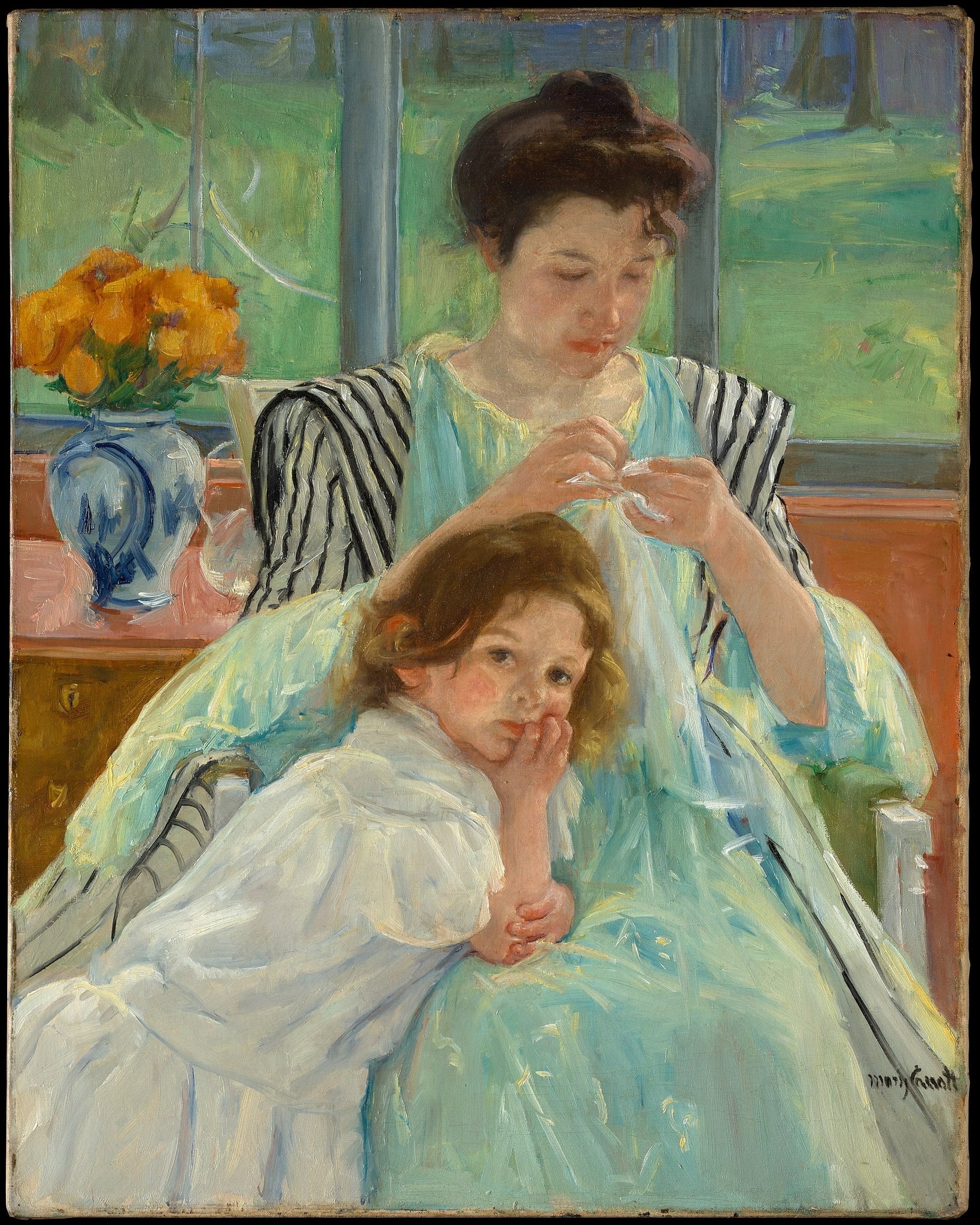
Mary Cassatt’s Young Mother Sewing centers the quiet <strong>labor of care</strong>: a mother steadies pale fabric while a child in white leans into her, eyes meeting ours. Cool <strong>greens and blues</strong> bathe the figures as striped sleeves and chair arms rhythmically return attention to the mother’s working hands, while a burst of <strong>orange blossoms</strong> by the window anchors interior life against the world outside <sup>[1]</sup>.
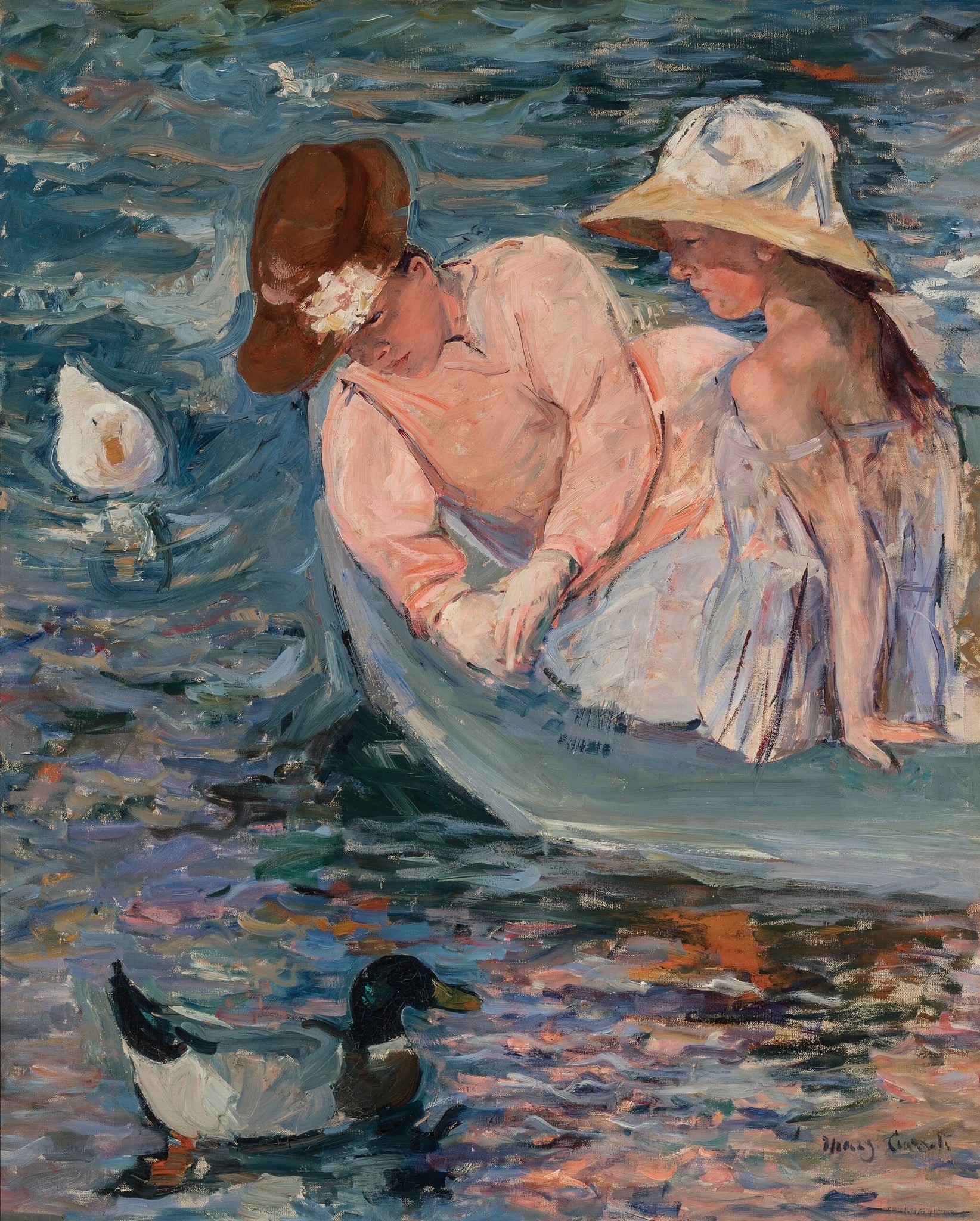
Children Playing on the Beach by Mary Cassatt

Children Playing on the Beach

Mary Cassatt (1884)

In Children Playing on the Beach, Mary Cassatt brings the viewer down to a child’s eye level, granting everyday play the weight of <strong>serious, self-contained work</strong>. The cool horizon and tiny boats open onto <strong>modern space and possibility</strong>, while the cropped, tilted foreground seals us inside the children’s focused world <sup>[1]</sup>.