Mother and Child (The Oval Mirror)

by Mary Cassatt

Mary Cassatt’s Mother and Child (The Oval Mirror) turns a routine act of care into a modern icon. An oval mirror haloes the child while interlaced hands and close bodies make touch the vehicle of meaning [1][3].

Fast Facts

Year
ca. 1899
Medium
Oil on canvas
Dimensions
81.6 x 65.7 cm
Location
The Metropolitan Museum of Art, New York
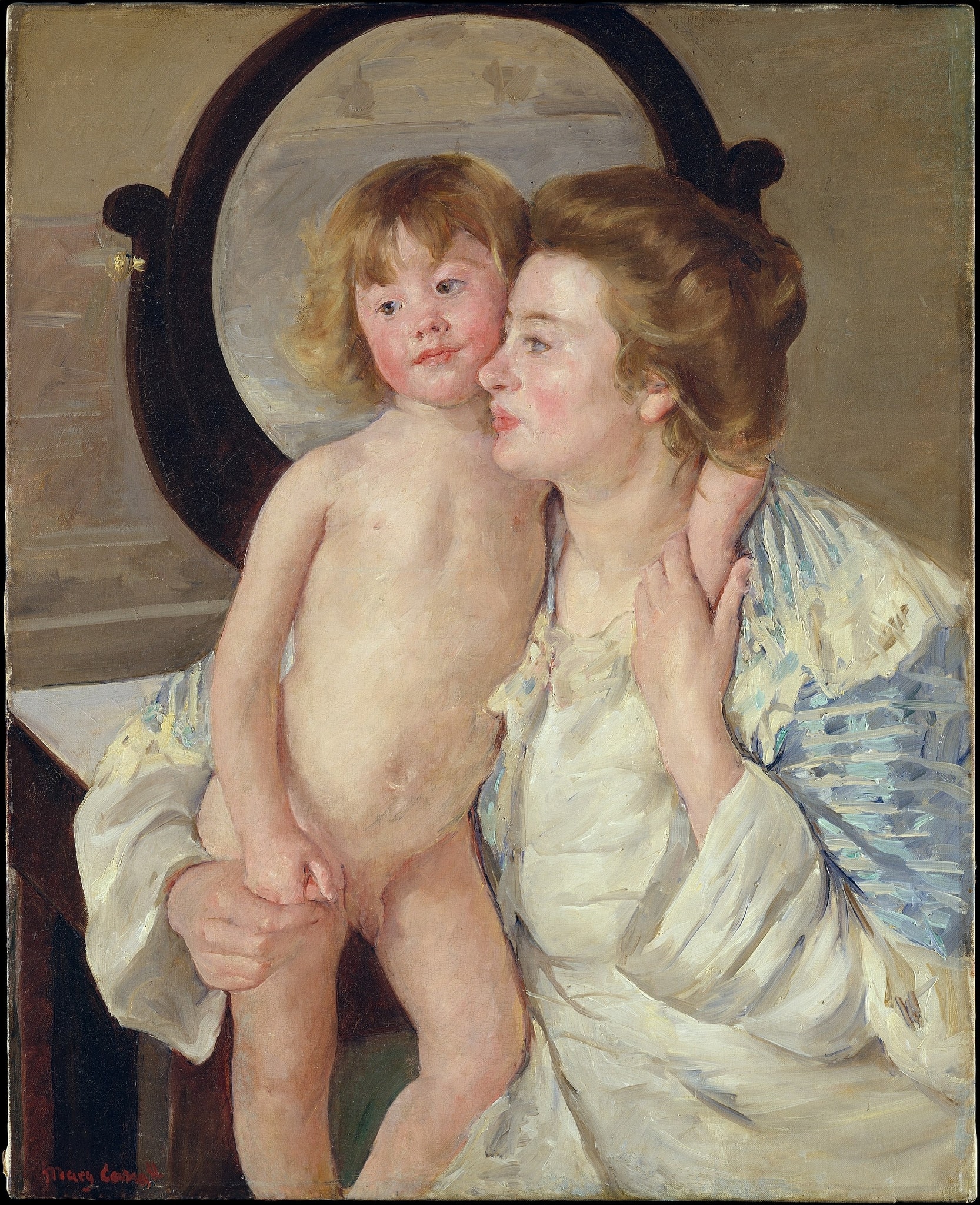
Mother and Child (The Oval Mirror) by Mary Cassatt (ca. 1899)

Click on any numbered symbol to learn more about its meaning

Meaning & Symbolism

Cassatt organizes the composition around the child’s torso, lifted to the mother’s shoulder so that the oval mirror rings the child’s head like a deliberate halo, an art-historical signal that immediately raises a private moment to the level of an icon. The child’s slight twist—one knee bent, hips shifted—quotes a Renaissance contrapposto; the mother’s cheek and lips press against the child in a diagonal that locks the pair into a single, protective unit. Cassatt’s brushwork is fast and tactile across cheeks, shoulders, and the blue-striped wrapper, so that light reads not as atmosphere but as contact—a sensation of skin and cloth. The mother’s left hand cups the child’s thigh while the right arm steadies the torso; the child’s small fingers rest over the mother’s hand. These interlaced hands, a recurrent Cassatt device, anchor the scene and concretize guidance and dependence without resorting to anecdote 13. The neutral room and cropped furniture strip away distractions; color is held to warm flesh, cream, and a few cool notes in the wrapper, so that gesture and proximity carry the meaning. The mirror’s doubling is crucial: it encloses the pair, turning the interior into a contemplative, almost votive space, while also hinting at self-recognition—the child faces outward but is visually framed by the mirror’s inner world, a modern meditation on looking and identity 1. This secular sacredness is not naïve piety but formal modernity. Period viewers recognized the Renaissance echo—Degas’s wry quip about “the Infant Jesus and his English nurse,” and the Havemeyers’ nickname “The Florentine Madonna,” confirm that Cassatt knowingly courts the Madonna-and-Child tradition while insisting on a contemporary, unidealized setting 156. The paint handling and high-keyed clarity place the work squarely in American Impressionism, where the subjects of modern life, especially women’s and children’s daily routines, receive the same painterly seriousness once reserved for history painting 2. Yet the scene is built, not diaristic: scholarship emphasizes Cassatt’s reliance on models and her iterative design of poses and props, a professional strategy that counters the cliché of maternal spontaneity 4. In Mother and Child (The Oval Mirror), that design culminates in a closed visual circuit—the mother’s profile turned toward the child, the child’s gaze slipping outward, the mirror enclosing both—through which Cassatt asserts that the labor of care and the rituals of washing, lifting, and holding are themselves a worthy subject of modern art. By yoking Renaissance dignity to domestic intimacy, she argues that tenderness can be rigorous, and that modern identity is forged as much by hands and habits as by grand narratives. The painting’s staying power lies in this double claim: the image reads instantly as an emblem of protection, yet it is constructed through acute formal choices—mirror as halo, contrapposto pose, interlaced hands, restrained palette—that keep sentiment in check and elevate everyday life to lasting significance 1235.

Explore Deeper with AI

Ask questions about Mother and Child (The Oval Mirror)

Popular questions:

Powered by AI • Get instant insights about this artwork

💬 Ask questions about this artwork!

Interpretations

Reception & Patronage History

Period response locates Cassatt’s canvas at the hinge of sacred precedent and modern life. Degas’s quip about “the Infant Jesus and his English nurse” and the Havemeyers’ nickname “The Florentine Madonna” show that contemporaries instantly recognized the halo‑like mirror and Renaissance pose, yet also read the scene as resolutely secular—an English (modern) nurse, not the Virgin 1. That double reading helped the work circulate as both intimate genre and elevated icon in elite collecting culture. Through Cassatt’s advisory role, the Havemeyers acquired the picture and later bequeathed it to The Met, where it now anchors narratives of American Impressionism and transatlantic taste formation—evidence that this domestic interior also performed on the grand stage of museum canon‑building 16.

Source: The Metropolitan Museum of Art; Met Publications (Havemeyer Collection)

Constructed Intimacy: Models, Design, and Process

Against the cliché of maternal spontaneity, scholarship emphasizes Cassatt’s professional staging. Her mother‑and‑child scenes of the 1890s were often built with models, refined across drawings and variant poses; intimacy here is a composed effect, not a diary entry 35. The interlaced hands and the closed visual circuit (profile/gaze/mirror) recur as designed armatures that turn caregiving into legible form. Recent reassessments stress technique and labor: Cassatt tests how touch can be painted—fast, tactile strokes over skin and cloth—so that sensation becomes structure. Far from anecdote, the picture demonstrates a modern studio practice that codifies care through pose, contour, and haptic brushwork, aligning Cassatt with the rigorous planning associated with her Impressionist peers while challenging gendered assumptions about “natural” femininity 35.

Source: Art Institute of Chicago; Financial Times (review of Mary Cassatt at Work)

Mirror Theory: Halo, Privacy, and Selfhood

The oval mirror is more than a halo citation: it is a modern optical device that engineers privacy and prompts self‑relation. By encircling the child’s head, the mirror contains the pair within a votive-like interior, but its reflective premise also introduces a second register of looking—an imagistic “inside” where recognition and identity are rehearsed 1. In Cassatt’s broader oeuvre, mirrors mediate female self‑awareness and spectatorship (compare Woman with a Sunflower), making reflection a theme of modern subject formation rather than vanity alone 8. Here, enclosure and exposure coexist: the mother closes ranks protectively while the child’s gaze slips outward, a subtle dramatization of emerging selfhood staged through reflective design rather than narrative incident 18.

Source: The Metropolitan Museum of Art; National Gallery of Art

Haptic Modernism: Touch as Form

Cassatt’s paint handling turns touch into a formal principle. Rapid, tactile strokes across cheeks, shoulders, and the blue‑striped wrapper let light read as contact rather than atmosphere, translating caregiving into visible facture 13. The motif of interlaced hands, familiar from works like The Child’s Bath, anchors a micro‑drama of guidance and trust without anecdotal props 3. This haptic emphasis aligns Cassatt with Impressionism’s interest in perception, yet redirects it from optical flicker to bodily sensation—the embodied knowledge of holding, lifting, and steadying. In doing so, the painting fuses material process with subject matter: the textures of care are literally built into the surface, arguing that modern meaning can be carried by the pressure of a brush as surely as by iconographic reference 32.

Source: Art Institute of Chicago; The Metropolitan Museum of Art (Heilbrunn Timeline)

American Impressionism and the Stakes of the Ordinary

Within American Impressionism, Cassatt gives everyday life the gravity of history painting. Restrained palette, cropped décor, and emphatic gesture make caregiving a modern paradigm rather than a sentimental vignette 2. Critics note how the canvas leverages Renaissance quotation (contrapposto, halo) not to revive piety but to test how canonical dignity can inhabit contemporary domestic space 17. The result is a secular icon: the labor of care becomes a civic image of modern identity, its clarity and high key aligned with Impressionist modernity while refusing anecdotal charm 15. By treating washing, lifting, and holding as form-bearing actions, Cassatt articulates an ethics of attention to the ordinary—an argument about what, and whom, modern art is for 257.

Source: The Metropolitan Museum of Art (Object record; Heilbrunn Timeline); London Review of Books; Financial Times

Related Themes

About Mary Cassatt

Mary Cassatt (1844–1926) was an American painter who settled in Paris, exhibited with the Impressionists, and became a key conduit for introducing their art to U.S. collectors. After 1890 she adopted japoniste flatness, bold patterning, and strong design, focusing on modern women’s lives—especially mother‑and‑child subjects—until failing eyesight curtailed her work by 1914 [4].
View all works by Mary Cassatt

More by Mary Cassatt

Woman in Black at the Opera by Mary Cassatt

Woman in Black at the Opera

Mary Cassatt (1878)

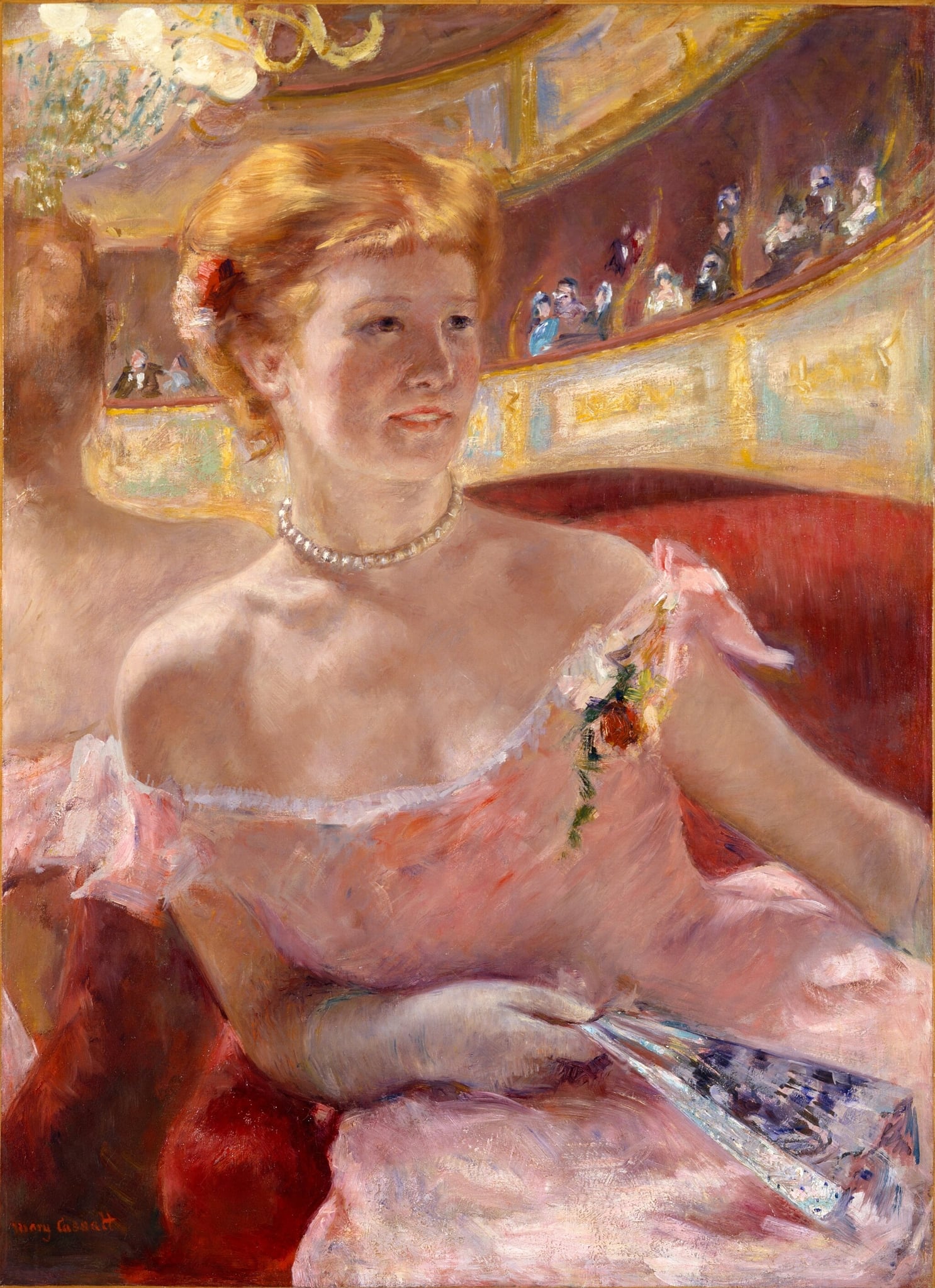
Mary Cassatt’s Woman in Black at the Opera stages a taut drama of vision and visibility. A woman in <strong>black attire</strong> raises <strong>opera glasses</strong> while a distant man aims his own at her, setting off a chain of looks that makes public leisure a site of <strong>power, agency, and surveillance</strong> <sup>[1]</sup><sup>[2]</sup>.

The Tea by Mary Cassatt

The Tea

Mary Cassatt (about 1880)

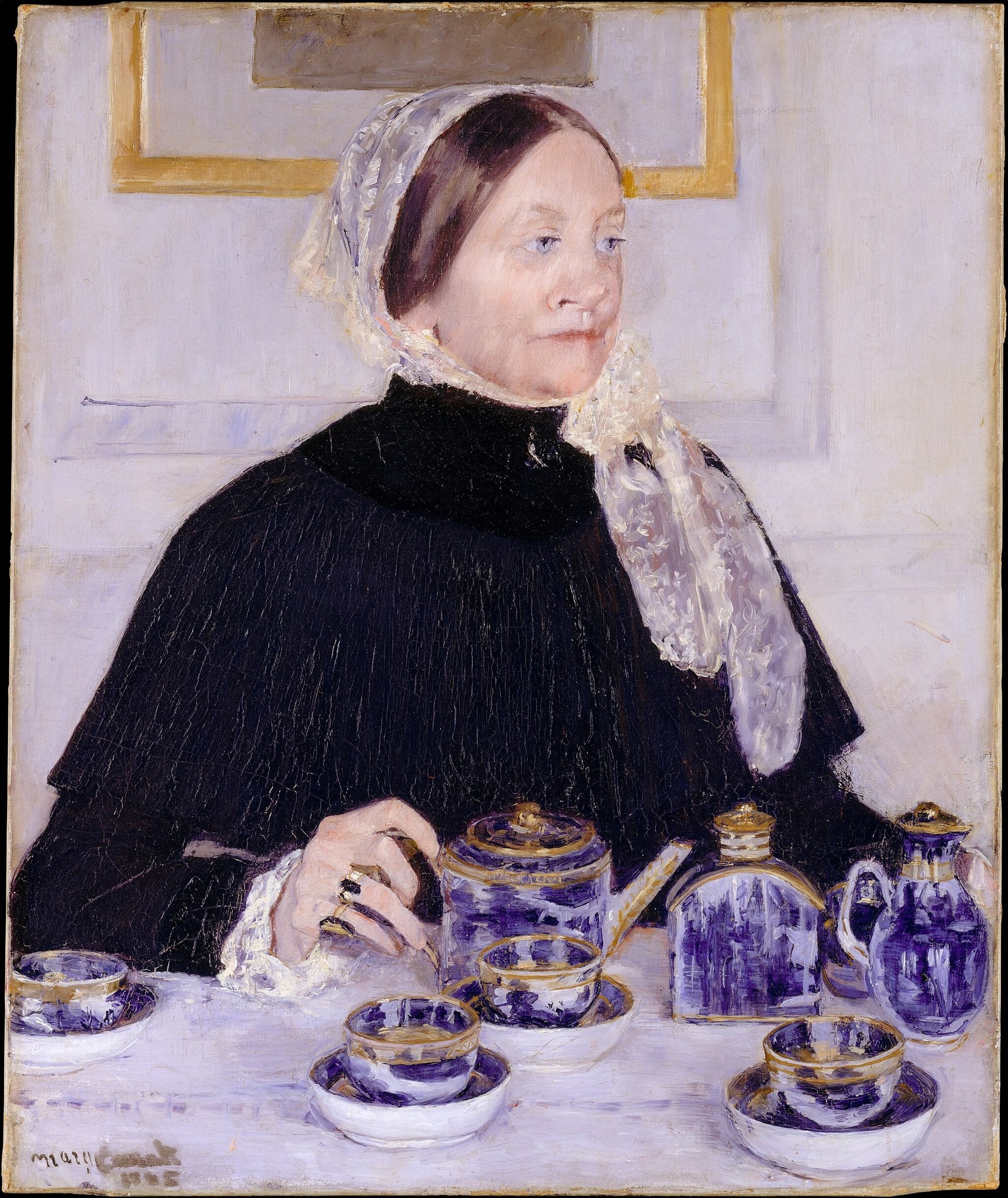
Mary Cassatt’s The Tea stages a poised, interior <strong>drama of manners</strong>: two women sit close yet feel apart, one thoughtful, the other raising a cup that <strong>veils her face</strong>. A gleaming, oversized <strong>silver tea service</strong> commands the foreground, its reflections turning ritual objects into actors in the scene <sup>[1]</sup>. The shallow, cropped room—striped wall, gilt mirror, marble mantel—compresses the atmosphere into <strong>intimacy edged by restraint</strong>.

Little Girl in a Big Straw Hat and a Pinafore by Mary Cassatt

Little Girl in a Big Straw Hat and a Pinafore

Mary Cassatt (c. 1886)

Mary Cassatt’s Little Girl in a Big Straw Hat and a Pinafore distills childhood into a quiet drama of <strong>interiority</strong> and <strong>constraint</strong>. The oversized straw hat and plain pinafore bracket a flushed face, downcast eyes, and <strong>clasped hands</strong>, turning a simple pose into a study of modern self‑consciousness <sup>[1]</sup>. Cassatt’s cool grays and swift, luminous strokes make mood—not costume—the subject.

Breakfast in Bed by Mary Cassatt

Breakfast in Bed

Mary Cassatt (1897)

Breakfast in Bed distills a <strong>tender modern intimacy</strong> into a tightly cropped sanctuary of rumpled white linens, protective embrace, and interrupted routine. Mary Cassatt uses <strong>cool light</strong> against <strong>warm flesh</strong> to anchor attention on the mother’s encircling arm and the child’s outward gaze, fusing care, curiosity, and the rhythms of <strong>everyday modern life</strong> <sup>[1]</sup><sup>[2]</sup>.

Young Mother Sewing by Mary Cassatt

Young Mother Sewing

Mary Cassatt (1900)

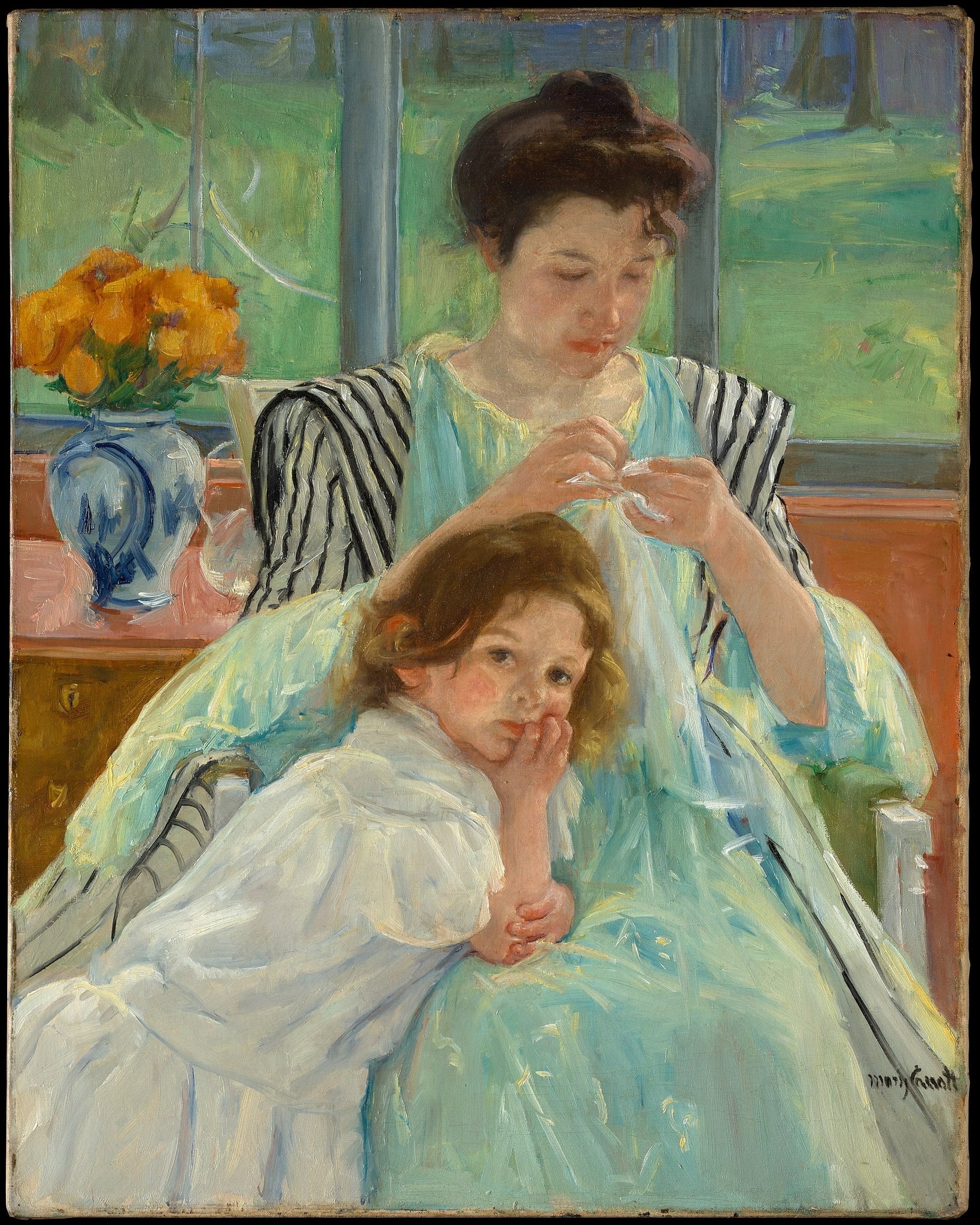
Mary Cassatt’s Young Mother Sewing centers the quiet <strong>labor of care</strong>: a mother steadies pale fabric while a child in white leans into her, eyes meeting ours. Cool <strong>greens and blues</strong> bathe the figures as striped sleeves and chair arms rhythmically return attention to the mother’s working hands, while a burst of <strong>orange blossoms</strong> by the window anchors interior life against the world outside <sup>[1]</sup>.
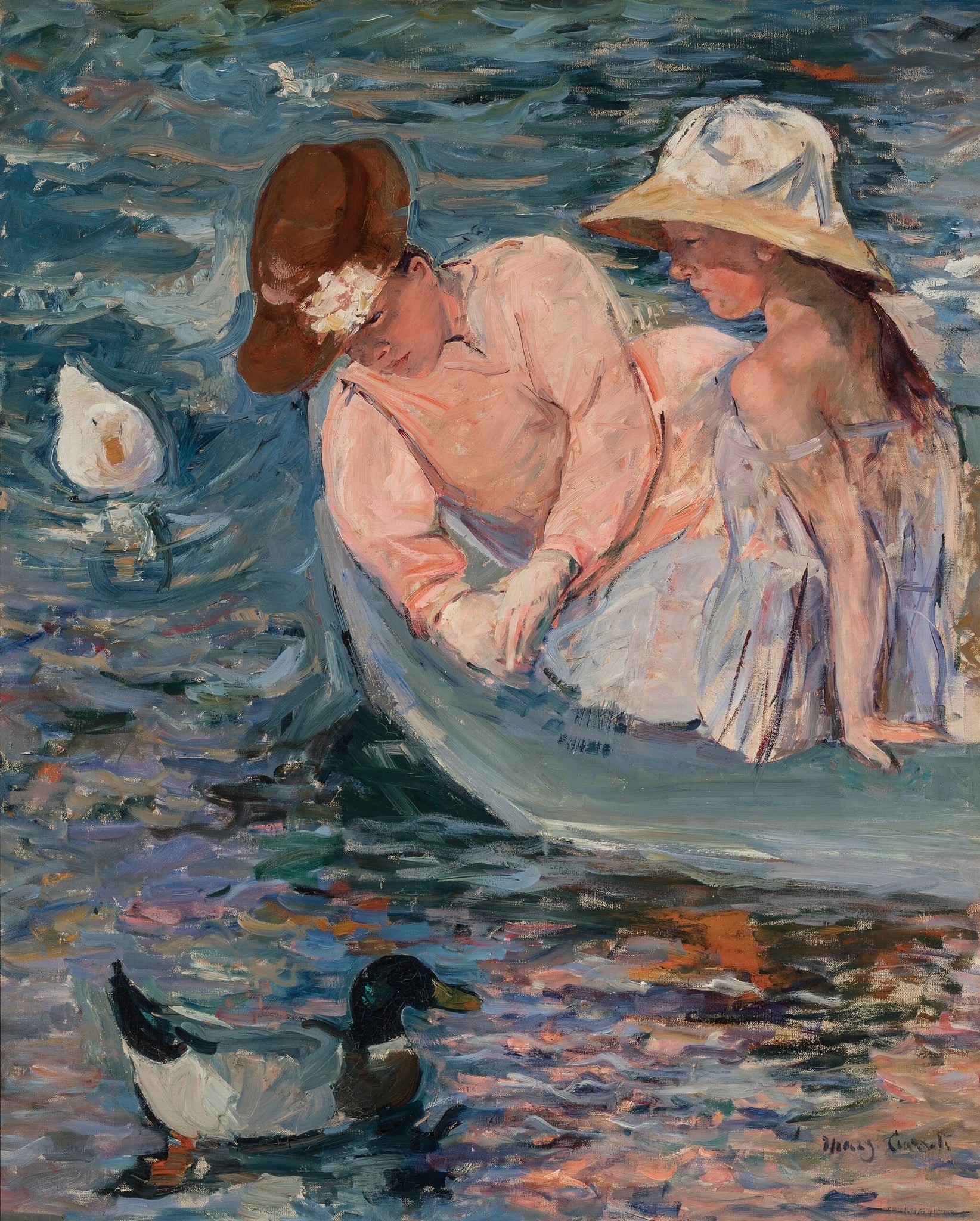
Children Playing on the Beach by Mary Cassatt

Children Playing on the Beach

Mary Cassatt (1884)

In Children Playing on the Beach, Mary Cassatt brings the viewer down to a child’s eye level, granting everyday play the weight of <strong>serious, self-contained work</strong>. The cool horizon and tiny boats open onto <strong>modern space and possibility</strong>, while the cropped, tilted foreground seals us inside the children’s focused world <sup>[1]</sup>.