Woman in Black at the Opera

by Mary Cassatt

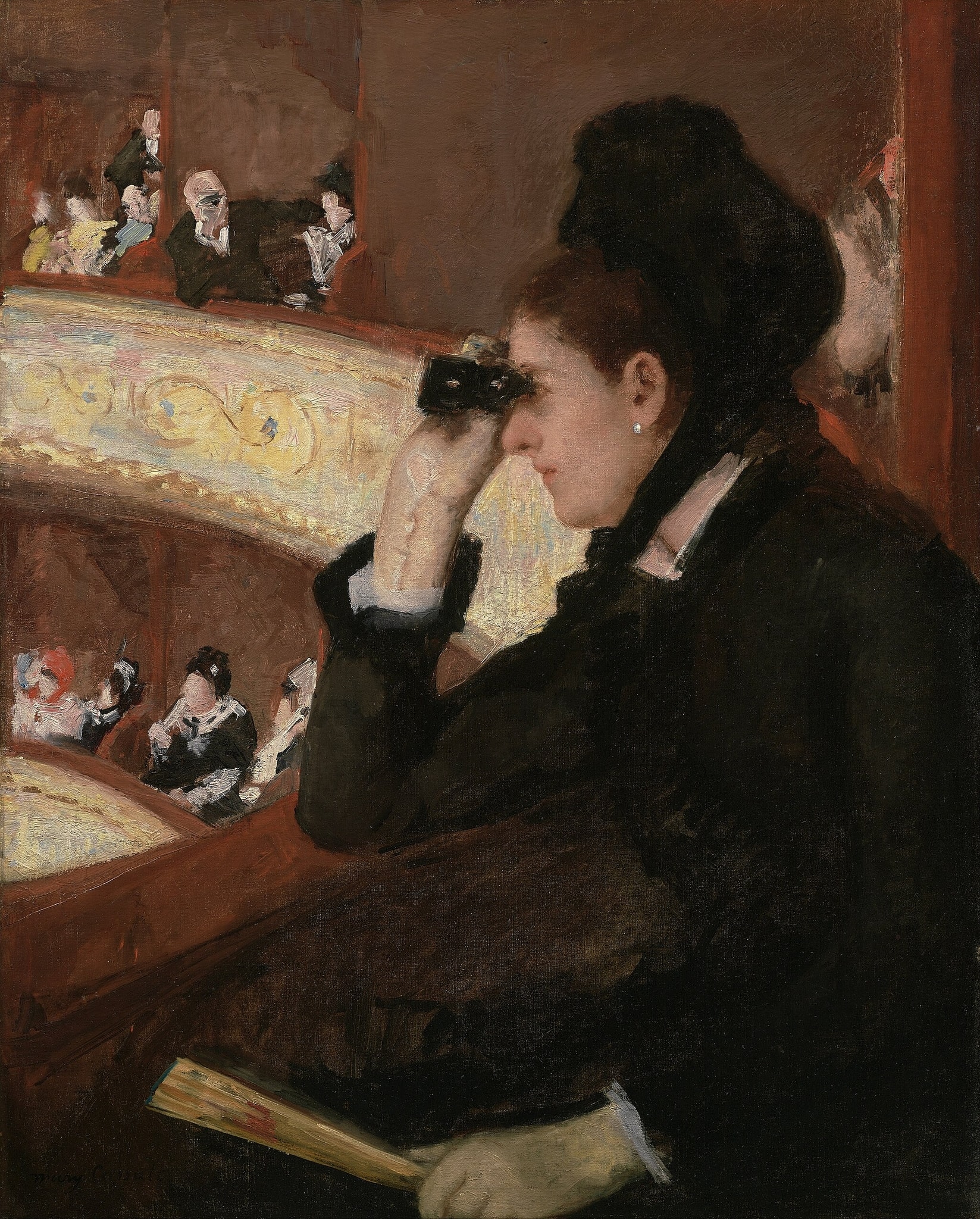
Mary Cassatt’s Woman in Black at the Opera stages a taut drama of vision and visibility. A woman in black attire raises opera glasses while a distant man aims his own at her, setting off a chain of looks that makes public leisure a site of power, agency, and surveillance [1][2].

Fast Facts

Year
1878
Medium
Oil on canvas
Dimensions
81.28 × 66.04 cm (32 × 26 in.)
Location
Museum of Fine Arts, Boston
Woman in Black at the Opera by Mary Cassatt (1878)

Click on any numbered symbol to learn more about its meaning

Meaning & Symbolism

Cassatt organizes the composition around a decisive profile: the woman’s forearm, sheathed in a pale glove, lifts binoculars that cut a black silhouette against the warm radiance of gilded balconies. The diagonal sweep of those balconies—thick, creamy strokes that catch the theater’s gaslight—pushes our eye into the depth of the house and then back to the figure who initiates the act of looking. In the middle distance, a man, also with glasses, fixes his gaze toward her, confirming that in this public interior one never only watches the stage; one becomes the spectacle. Cassatt completes the circuit with us, the viewer in the best “seat,” who observes both the woman and her observer. The result is a closed loop of surveillance that turns a scene of culture into a scene of power 12. Every prop sharpens this theme. The opera glasses function as tools of autonomy: they extend her vision and cloak her eyes, denying us direct access and resisting the era’s pictorial conventions of women as available to inspection 2. The fan, closed and resting in her lap, reads as a withheld social gesture; it is not waved in flirtation but held in reserve, a visual sign of control rather than invitation. Her black dress and bonnet amplify this reserve, hinting at decorum or mourning while also allowing her to slip through the spectacle with a measure of anonymity. A single pearl earring punctuates the darkness, signaling bourgeois status and reminding us that participation in the opera box is a ritual of class where one goes to see and be seen 13. Cassatt’s modernity lies not only in subject but in method. The tight crop thrusts us into the loge so abruptly that the figure’s shoulder nearly grazes the picture plane, a strategy that feels journalistic and immediate. The background figures dissolve into flickering notation, their faces sketchy, their gestures brisk, while the woman’s profile and gloved hand receive the greatest clarity; the paint handling enacts a hierarchy of attention that echoes her concentrated gaze. In contrast to contemporaries who luxuriated in display—think of plush fabrics and showy finery—Cassatt pares the scene to essentials: a woman, a tool of vision, a field of public watchers. That economy strengthens the argument advanced by feminist scholarship: Cassatt gives primacy to the woman’s look, staging how women navigated, negotiated, and sometimes neutralized the male gaze in the very spaces designed to showcase them 2. Historically, the painting belongs to Cassatt’s late-1870s focus on theaters and opera boxes, subjects she pursued across oil, pastel, and experimental prints as she aligned with the Impressionists and their scrutiny of modern Parisian life 134. Seen within that cluster, Woman in Black at the Opera emerges as the pivotal statement: it condenses the spectacle of leisure into a precise meditation on looking. The painting’s importance also extends to Cassatt’s broader career. As the only American to exhibit with the French Impressionists, she used motifs like this one to move beyond sentimental domesticity toward a rigorous, urban modernity that would shape taste on both sides of the Atlantic 5. In sum, Cassatt transforms a routine afternoon at the theater into a compact drama of agency, class ritual, and visual power—an image that still instructs us in how we look and how we are looked at 126.

Explore Deeper with AI

Ask questions about Woman in Black at the Opera

Popular questions:

Powered by AI • Get instant insights about this artwork

💬 Ask questions about this artwork!

Interpretations

Historical Context

Exhibited in Boston in 1878 as “At the Français—A Sketch,” this canvas was among the first of Cassatt’s Impressionist works shown in the United States, signaling an early American encounter with Parisian modernity 1. The specific venue—an afternoon performance at the Comédie‑Française—matters: daylight made such outings respectable yet still socially charged, especially for bourgeois women navigating public space without yielding to display 1. Cassatt’s choice ties the subject to the institutional theater of the Third Republic, where architecture and etiquette formalized who looked and who was looked at. The early U.S. reception praising its “strength” underscores how the picture’s assertive cropping and active heroine read as novel across the Atlantic, reframing Cassatt not as sentimental but as a player in modern urban pictorial debates 1.

Source: Museum of Fine Arts, Boston

Feminist Spatial Politics

Griselda Pollock’s framework clarifies how the loge becomes a policed zone of femininity: public yet surveilled, mobile yet constrained 2. Cassatt complicates this by giving the woman optical tools that both extend and mask her vision—she looks out while denying the onlooker access to her eyes, interrupting the usual circulation of female visibility 12. The distant man with glasses and we, the external spectator, complete a triangulated gaze that exposes gendered power relations rather than simply illustrating them. Crucially, Cassatt does not romanticize escape; she shows negotiation—small, strategic refusals (a closed fan, reserved dress) that recalibrate attention without abandoning the public sphere. The painting reads as a case study in how bourgeois women inhabited modernity’s interiors while contesting their objectification 21.

Source: Griselda Pollock

Comparative Formal Analysis

Compared with Renoir’s luxuriant loge scenes, Cassatt reduces ornament to intensify the act of looking: the cropped shoulder nearly grazes the picture plane, while the auditorium dissolves into notational strokes, creating a hierarchy that mirrors the woman’s concentrated vision 13. This is modernity by formal economy—no velvet bravura, only the optics of spectatorship. The diagonal run of balconies works like a visual conveyor, propelling our eye forward then snapping it back to the operative silhouette of the binoculars. Within the Impressionism, Fashion, and Modernity frame, Cassatt’s restraint in dress and decor becomes a deliberate counter‑display, a sober chic that asserts agency through self‑editing rather than ostentation 3. The result is a spatial machine that measures attention more than it depicts finery, redefining what counts as spectacle 13.

Source: Art Institute of Chicago (A&AePortal) and MFA Boston

Medium & Process: From Canvas to Plate

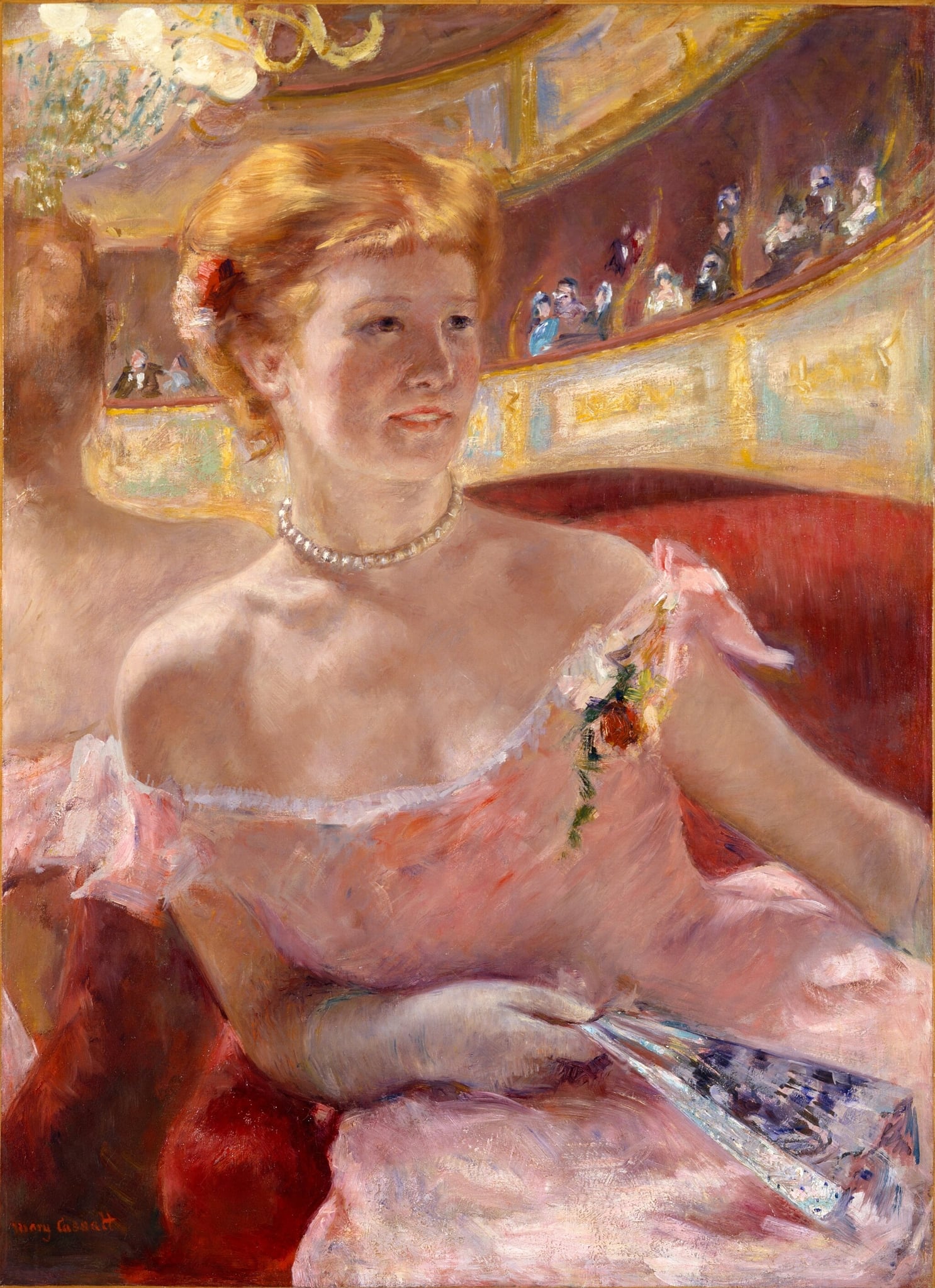
Cassatt did not leave the loge on canvas; she pushed it into printmaking—soft‑ground etching and aquatint—to test how different media render perception under low light 46. Works like In the Opera Box (No. 3) and Lady in Black, in a Loge, Facing Right distill silhouettes and tonal veils, turning the auditorium’s haze into an active field that both conceals and reveals 45. Aquatint’s grainy atmospherics simulate the auditorium’s gloom and glare, while etched line fixes the binoculars’ crisp contour—the very hinge of agency in the motif. This serial, cross‑media experimentation (nourished by Degas’s influence) shows Cassatt treating spectatorship as a problem of technique as much as subject, aligning her with the Impressionists’ drive to modernize both what and how we see 64.

Source: The Met; National Gallery of Art; Christie’s

Class Ritual and Social Optics

The loge encodes class as ritualized visibility: jewelry punctuates restraint, and etiquette choreographs who is entitled to survey the room 13. Cassatt’s single pearl glints like a status semaphore, but the real luxury here is optical privilege—the right to scan society from a protected perch. The MFA’s note that the viewer “completes the circle” reframes elite leisure as a contract: to attend is to participate in mutual surveillance, an economy of attention traded as social capital 1. Contemporary reappraisals emphasize how this professional, unsentimental Cassatt pinpoints the mechanics of bourgeois spectatorship rather than prettifying it; the woman is an agent of selection, not a passive ornament 71. By compressing class performance into a few props and a decisive gaze, Cassatt anatomizes the opera box as a device for producing status itself.

Source: Museum of Fine Arts, Boston; Financial Times

Related Themes

About Mary Cassatt

Mary Cassatt (1844–1926) was an American painter who settled in Paris, exhibited with the Impressionists, and became a key conduit for introducing their art to U.S. collectors. After 1890 she adopted japoniste flatness, bold patterning, and strong design, focusing on modern women’s lives—especially mother‑and‑child subjects—until failing eyesight curtailed her work by 1914 [4].
View all works by Mary Cassatt

More by Mary Cassatt

The Tea by Mary Cassatt

The Tea

Mary Cassatt (about 1880)

Mary Cassatt’s The Tea stages a poised, interior <strong>drama of manners</strong>: two women sit close yet feel apart, one thoughtful, the other raising a cup that <strong>veils her face</strong>. A gleaming, oversized <strong>silver tea service</strong> commands the foreground, its reflections turning ritual objects into actors in the scene <sup>[1]</sup>. The shallow, cropped room—striped wall, gilt mirror, marble mantel—compresses the atmosphere into <strong>intimacy edged by restraint</strong>.

Little Girl in a Big Straw Hat and a Pinafore by Mary Cassatt

Little Girl in a Big Straw Hat and a Pinafore

Mary Cassatt (c. 1886)

Mary Cassatt’s Little Girl in a Big Straw Hat and a Pinafore distills childhood into a quiet drama of <strong>interiority</strong> and <strong>constraint</strong>. The oversized straw hat and plain pinafore bracket a flushed face, downcast eyes, and <strong>clasped hands</strong>, turning a simple pose into a study of modern self‑consciousness <sup>[1]</sup>. Cassatt’s cool grays and swift, luminous strokes make mood—not costume—the subject.

Breakfast in Bed by Mary Cassatt

Breakfast in Bed

Mary Cassatt (1897)

Breakfast in Bed distills a <strong>tender modern intimacy</strong> into a tightly cropped sanctuary of rumpled white linens, protective embrace, and interrupted routine. Mary Cassatt uses <strong>cool light</strong> against <strong>warm flesh</strong> to anchor attention on the mother’s encircling arm and the child’s outward gaze, fusing care, curiosity, and the rhythms of <strong>everyday modern life</strong> <sup>[1]</sup><sup>[2]</sup>.

Young Mother Sewing by Mary Cassatt

Young Mother Sewing

Mary Cassatt (1900)

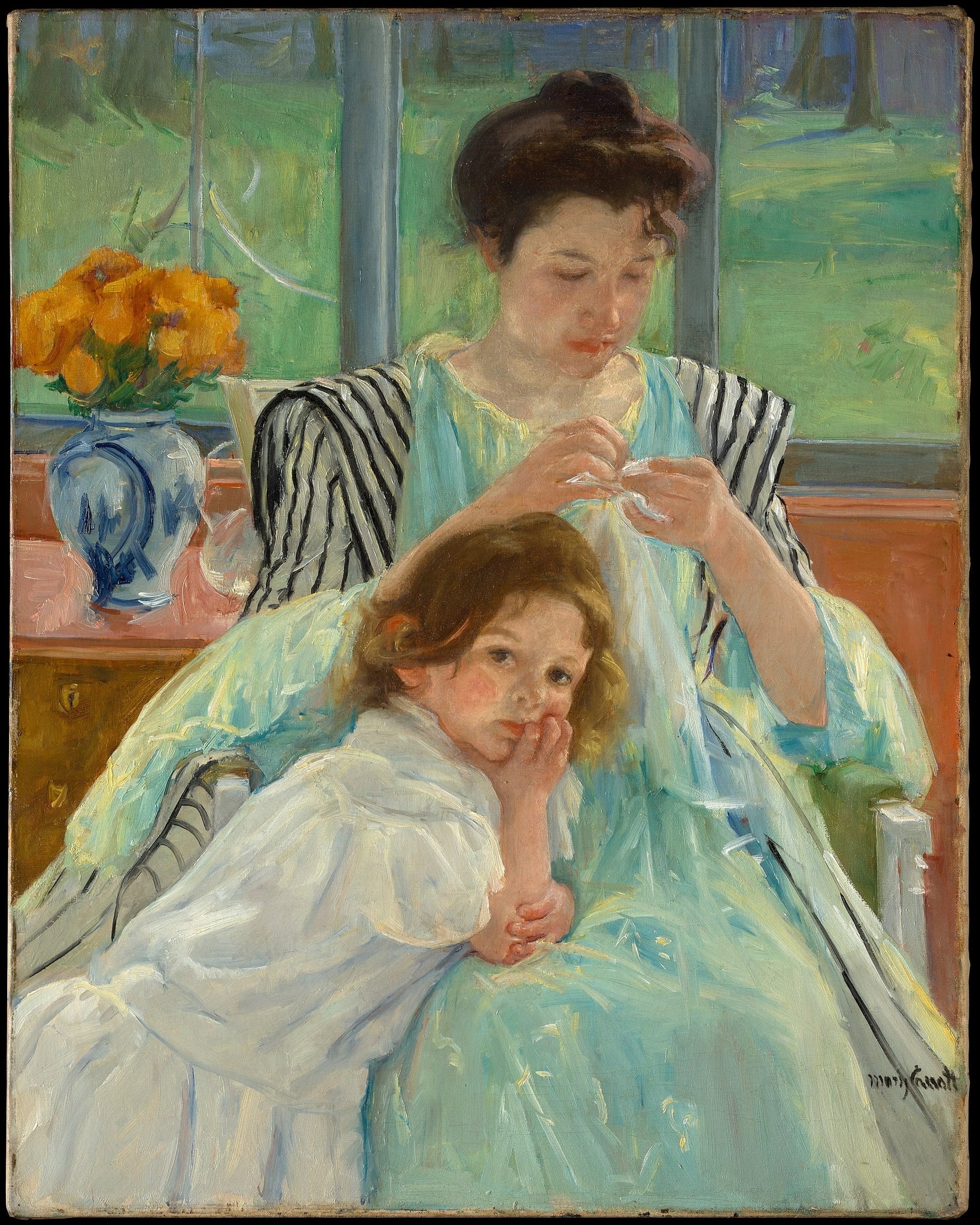
Mary Cassatt’s Young Mother Sewing centers the quiet <strong>labor of care</strong>: a mother steadies pale fabric while a child in white leans into her, eyes meeting ours. Cool <strong>greens and blues</strong> bathe the figures as striped sleeves and chair arms rhythmically return attention to the mother’s working hands, while a burst of <strong>orange blossoms</strong> by the window anchors interior life against the world outside <sup>[1]</sup>.
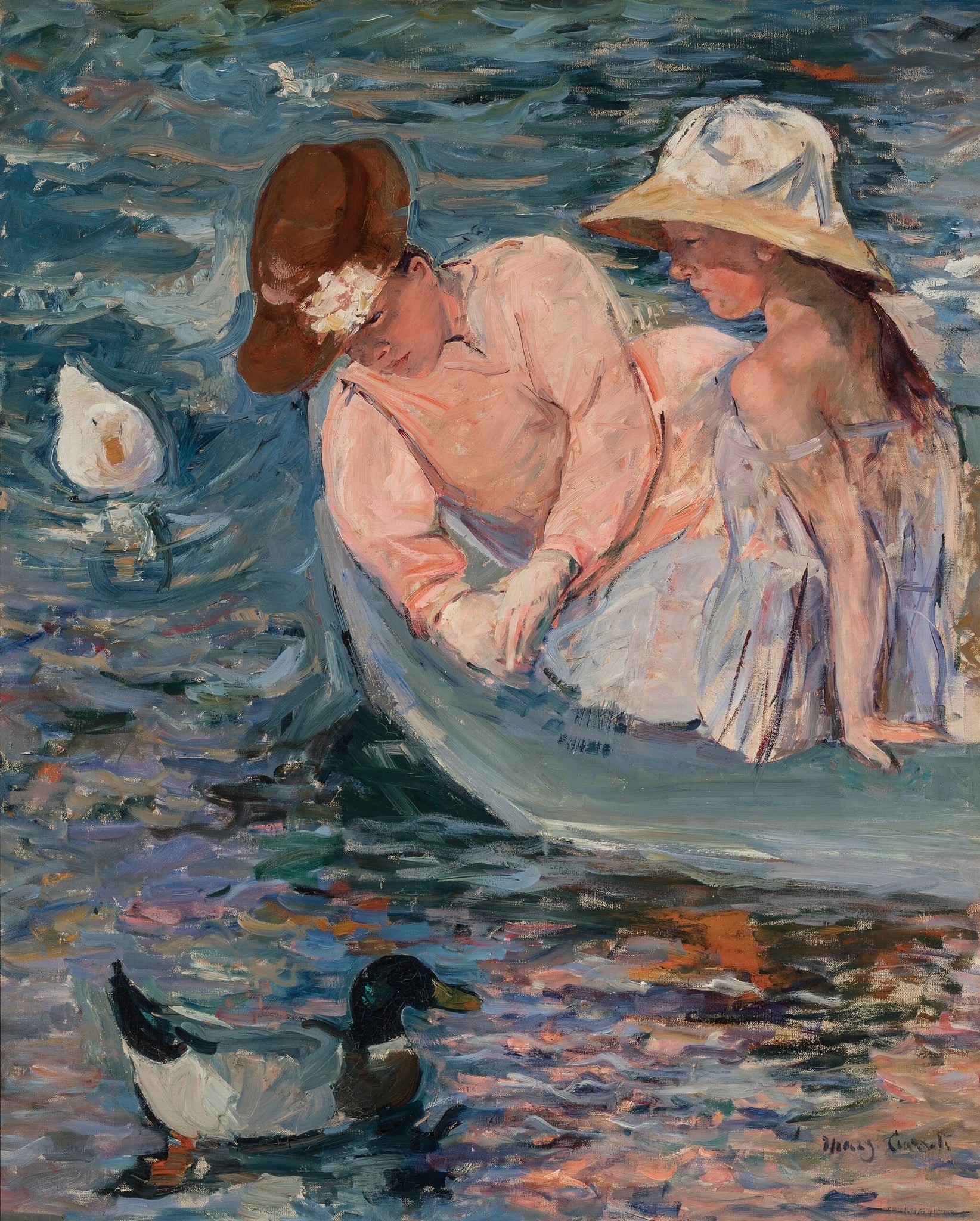
Children Playing on the Beach by Mary Cassatt

Children Playing on the Beach

Mary Cassatt (1884)

In Children Playing on the Beach, Mary Cassatt brings the viewer down to a child’s eye level, granting everyday play the weight of <strong>serious, self-contained work</strong>. The cool horizon and tiny boats open onto <strong>modern space and possibility</strong>, while the cropped, tilted foreground seals us inside the children’s focused world <sup>[1]</sup>.

A Woman and a Girl Driving by Mary Cassatt

A Woman and a Girl Driving

Mary Cassatt (1881)

Cassatt stages a modern scene of <strong>female control</strong> in motion: a woman grips the reins and whip while a girl beside her mirrors the pose, and a groom seated behind looks away. The cropped horse and diagonal harness thrust the carriage forward, placing viewers inside a public outing in the Bois de Boulogne—an arena where visibility signaled status and autonomy <sup>[1]</sup><sup>[2]</sup>.