The Tea

by Mary Cassatt

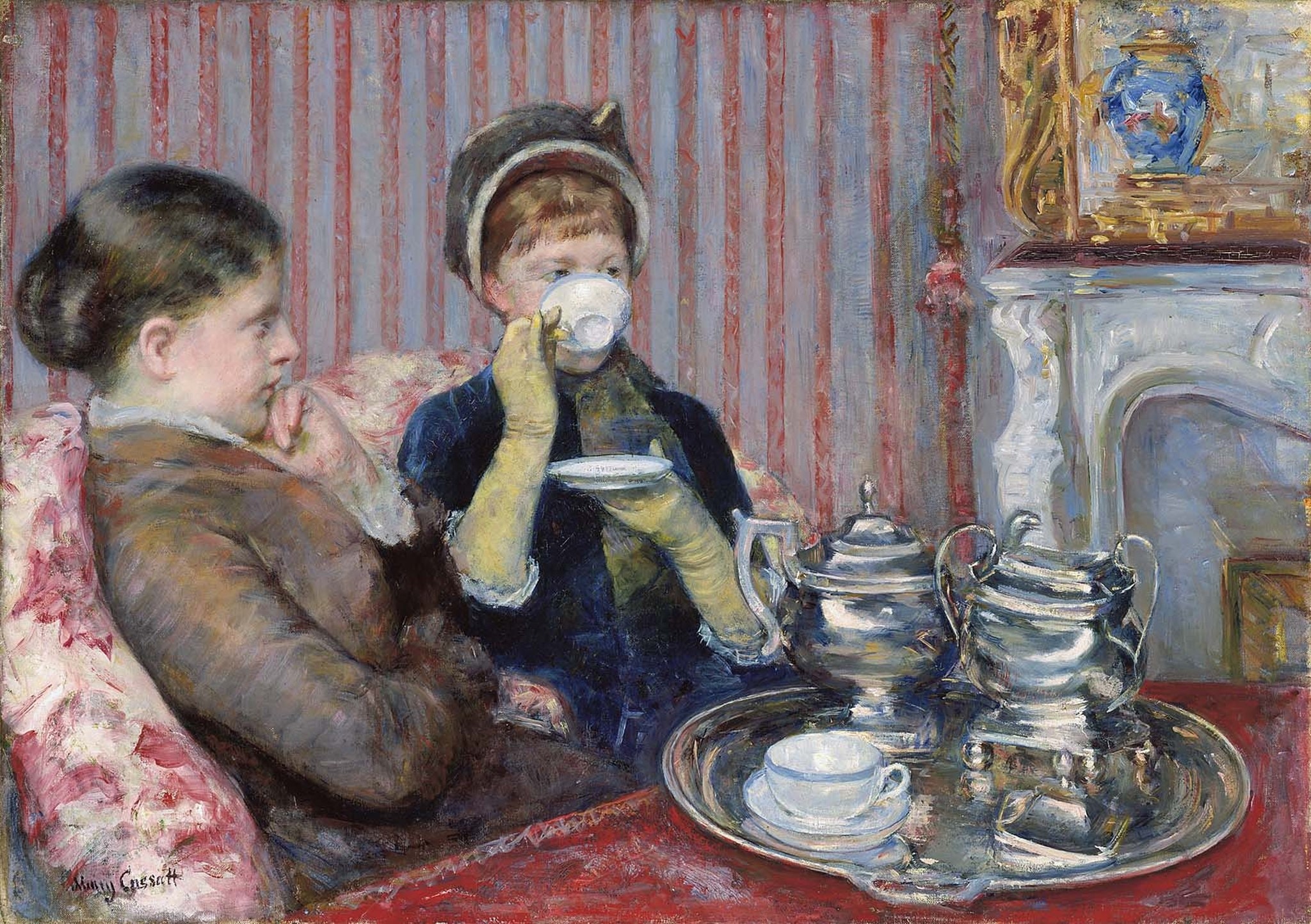
Mary Cassatt’s The Tea stages a poised, interior drama of manners: two women sit close yet feel apart, one thoughtful, the other raising a cup that veils her face. A gleaming, oversized silver tea service commands the foreground, its reflections turning ritual objects into actors in the scene [1]. The shallow, cropped room—striped wall, gilt mirror, marble mantel—compresses the atmosphere into intimacy edged by restraint.
💰

Market Value

$17-25 million

How much is The Tea worth?

Fast Facts

Year
about 1880
Medium
Oil on canvas
Dimensions
64.77 × 92.07 cm (25 1/2 × 36 1/4 in)
Location
Museum of Fine Arts, Boston
The Tea by Mary Cassatt (about 1880)

Click on any numbered symbol to learn more about its meaning

Meaning & Symbolism

Cassatt compresses space to register social pressure. The sofa’s rosy florals, the tight stripe of the wallpaper, and the gilt mirror stacked above a carved white mantel all press the figures forward, so the parlor feels less like a backdrop than a casing. Within this pressure chamber, gesture becomes code. The visitor keeps her bonnet and yellow gloves on, signaling she is “paying a call,” not settling in; the moment Cassatt selects is the one instant when that woman’s face disappears behind the cup. The choice refuses portrait convention and turns etiquette itself into a mask—intimacy is staged, not granted 1. Beside her, the hostess leans back with a hand to the chin, eyes unfixed; the posture registers a pause between remarks, heavy with unsaid terms. Cassatt sharpens this pause with color: warm reds and pinks of upholstery and tablecloth meet the cool, bluish flicker of metal and the chilly marble. Warmth and chill become social temperatures—comfort on offer, constraint enforced. The service dominates. The weighty Philadelphia silver, from Cassatt’s own family set, spills forward on a polished tray whose distorted reflections give the painting its most animated strokes 1. These objects are not props; they are the infrastructure of respectability, the apparatus by which the ritual runs. Cassatt enlarges them so they seem to outweigh the women, a modernist inversion that privileges things over likeness and aligns her with Degas’s object‑first experiments 1. In that inversion lies the pivot of meaning: the self is organized by ritual, and the ritual is organized by objects. The saucer held under the guest’s cup becomes a fragile token of propriety, while the empty cup on the tray waits as a silent cue for turn‑taking. The gilt mirror and porcelain jar advertise cultivated taste, yet they also flatten space, redoubling the sense that this sociability happens under the gaze of display. Scholars have read this scene from different angles. A feminist spatial reading emphasizes how the shallow room marks the limits of women’s mobility and the coded nature of their sociability; the veiled face reads as a witty, even daring exposure of how etiquette can efface identity 2. Others stress the ambivalence: calls like this could also broker alliances and information; Cassatt allows for agency within constraint, and her ambiguous pause refuses a single mood 2. Curatorially, the painting’s modernism is explicit: by denying figure primacy and embracing the transient gesture, Cassatt makes design and color—not narrative likeness—the painting’s engine 1. That formal decision explains why The Tea is important today. It captures the politics of everyday life without melodrama, shows how interiors manufacture behavior, and proves that modern life can be told through the choreography of small acts—gloves not removed, a face momentarily hidden, silver absorbing and reflecting it all.

Explore Deeper with AI

Ask questions about The Tea

Popular questions:

Powered by AI • Get instant insights about this artwork

💬 Ask questions about this artwork!

Interpretations

Feminist Spatial Reading

Cassatt’s parlor is a shallow social stage where women’s mobility is both pictured and policed by décor. The mantel, gilt mirror, and patterned upholstery compress depth, pushing bodies against an ornamental frontality that doubles as a code of containment. The guest’s veiled face—caught at the precise instant of the sip—turns etiquette into a mask, replacing individual identity with the performance of propriety. In Griselda Pollock’s terms, such interiors are gendered spaces of bourgeois sociability that articulate constraint through spatial design and viewpoint. Cassatt converts the parlor into a diagram of gendered spectatorship, where looking and being looked at are inseparable from rules of calling, dress, and timing 13.

Source: Griselda Pollock (via secondary summary); Museum of Fine Arts, Boston

Objects as Actors (Material Culture)

The Philadelphia silver—gleaming, weighty, and oversized—does not accompany the scene; it runs it. Cassatt enlarges the service so its reflective distortions become the canvas’s most animated passages, shifting agency from sitters to things. As the MFA notes, these are not props but the infrastructure of respectability: the polished tray coordinates turn‑taking, the empty cup cues the next pour, and the shining metal mirrors conduct the social electricity between figures. The service’s provenance (the Cassatt family set, c.1813) grounds the painting in lineage and class, turning an heirloom into a protagonist that organizes gesture, pace, and decorum—modern life told through object‑relations rather than psychological interiority 1.

Source: Museum of Fine Arts, Boston

Modernist Composition and Degas’s Legacy

Cassatt adopts an object‑first, edge‑cropped syntax that denies figure primacy and privileges transience—what MFA calls “embracing the transient gesture.” This places her squarely in dialogue with Degas’s experiments: asymmetry, shallow staging, and a fascination with how objects structure seeing. But Cassatt’s twist is ethical as well as formal: by selecting the one instant when a face disappears behind a cup, she substitutes gesture for likeness, nudging painting away from narrative portraiture toward design, rhythm, and reflective facture. The result is a cool modernism of manners in which compositional choices—scale shifts, reflective metal, patterned planes—carry the meaning of the scene as surely as any psychological expression 14.

Source: Museum of Fine Arts, Boston; Encyclopaedia Britannica

Ambivalence and Agency in Sociability

Norma Broude’s perspective resists a one‑note reading of oppression: parlor calls could be networks, brokering alliances and information within constraint. Cassatt’s pause—a hand to chin, eyes unfixed—registers a live interval where conversation might pivot, retract, or advance. Agency flickers in small choices: gloves kept on to mark boundaries; the saucer steadied to sustain decorum; a hostess’s lean that withholds or invites. Even the uncertainty of the sitters’ identities (possibly professional models, per MFA) reminds us that such “domesticity” is staged—a constructed modern scene about construction itself. Cassatt’s ambiguity sustains tension between compliance and strategy, turning etiquette into both limit and leverage 13.

Source: Norma Broude (via secondary summary); Museum of Fine Arts, Boston

Reception and Risk at the 1880 Impressionist Exhibition

Shown with the Impressionists in 1880, The Tea entered a critical field attentive to modern life’s ordinary theaters. Reviewers like Philippe Burty and Paul Mantz encountered a painting that withheld a face, elevated silverware, and compressed space—choices that defied academic hierarchies. J.-K. Huysmans would later praise the Indépendants’ cultivation of the contemporary moment, a context that frames Cassatt’s etiquette‑as‑mask as a bold bid for modern subject matter. John Loughery’s caution warns against over‑programming the symbols, yet the historical record confirms Cassatt’s calculated modernism: an urbane, risky refusal of “finished” portrait conventions in favor of momentary act, reflective surface, and interior stagecraft 13.

Source: Museum of Fine Arts, Boston; John Loughery (via secondary summary)

Comparative Motifs: From Silver to Porcelain

Across Cassatt’s tea pictures, tableware evolves from accompaniment to protagonist. In The Cup of Tea (ca. 1880–81, The Met), the service structures pose and color contrasts; by Lady at the Tea Table (1883–85), Chinese export porcelain sharpens the rhetoric of display. Against The Tea’s heavy Philadelphia silver—status rooted in family lineage—the later porcelain projects cosmopolitan taste, showing Cassatt’s interest in how specific materials inflect gendered sociability. This comparison clarifies The Tea’s choice: the reflective silver’s distortions supply painterly animation and a classed gravitas the later works redistribute into porcelain’s cool sheen and linear clarity—different objects, same choreography of manners 12.

Source: The Metropolitan Museum of Art; Museum of Fine Arts, Boston

Related Themes

About Mary Cassatt

Mary Cassatt (1844–1926) was an American painter who settled in Paris, exhibited with the Impressionists, and became a key conduit for introducing their art to U.S. collectors. After 1890 she adopted japoniste flatness, bold patterning, and strong design, focusing on modern women’s lives—especially mother‑and‑child subjects—until failing eyesight curtailed her work by 1914 [4].
View all works by Mary Cassatt

More by Mary Cassatt

Woman in Black at the Opera by Mary Cassatt

Woman in Black at the Opera

Mary Cassatt (1878)

Mary Cassatt’s Woman in Black at the Opera stages a taut drama of vision and visibility. A woman in <strong>black attire</strong> raises <strong>opera glasses</strong> while a distant man aims his own at her, setting off a chain of looks that makes public leisure a site of <strong>power, agency, and surveillance</strong> <sup>[1]</sup><sup>[2]</sup>.

Little Girl in a Big Straw Hat and a Pinafore by Mary Cassatt

Little Girl in a Big Straw Hat and a Pinafore

Mary Cassatt (c. 1886)

Mary Cassatt’s Little Girl in a Big Straw Hat and a Pinafore distills childhood into a quiet drama of <strong>interiority</strong> and <strong>constraint</strong>. The oversized straw hat and plain pinafore bracket a flushed face, downcast eyes, and <strong>clasped hands</strong>, turning a simple pose into a study of modern self‑consciousness <sup>[1]</sup>. Cassatt’s cool grays and swift, luminous strokes make mood—not costume—the subject.

Breakfast in Bed by Mary Cassatt

Breakfast in Bed

Mary Cassatt (1897)

Breakfast in Bed distills a <strong>tender modern intimacy</strong> into a tightly cropped sanctuary of rumpled white linens, protective embrace, and interrupted routine. Mary Cassatt uses <strong>cool light</strong> against <strong>warm flesh</strong> to anchor attention on the mother’s encircling arm and the child’s outward gaze, fusing care, curiosity, and the rhythms of <strong>everyday modern life</strong> <sup>[1]</sup><sup>[2]</sup>.

Young Mother Sewing by Mary Cassatt

Young Mother Sewing

Mary Cassatt (1900)

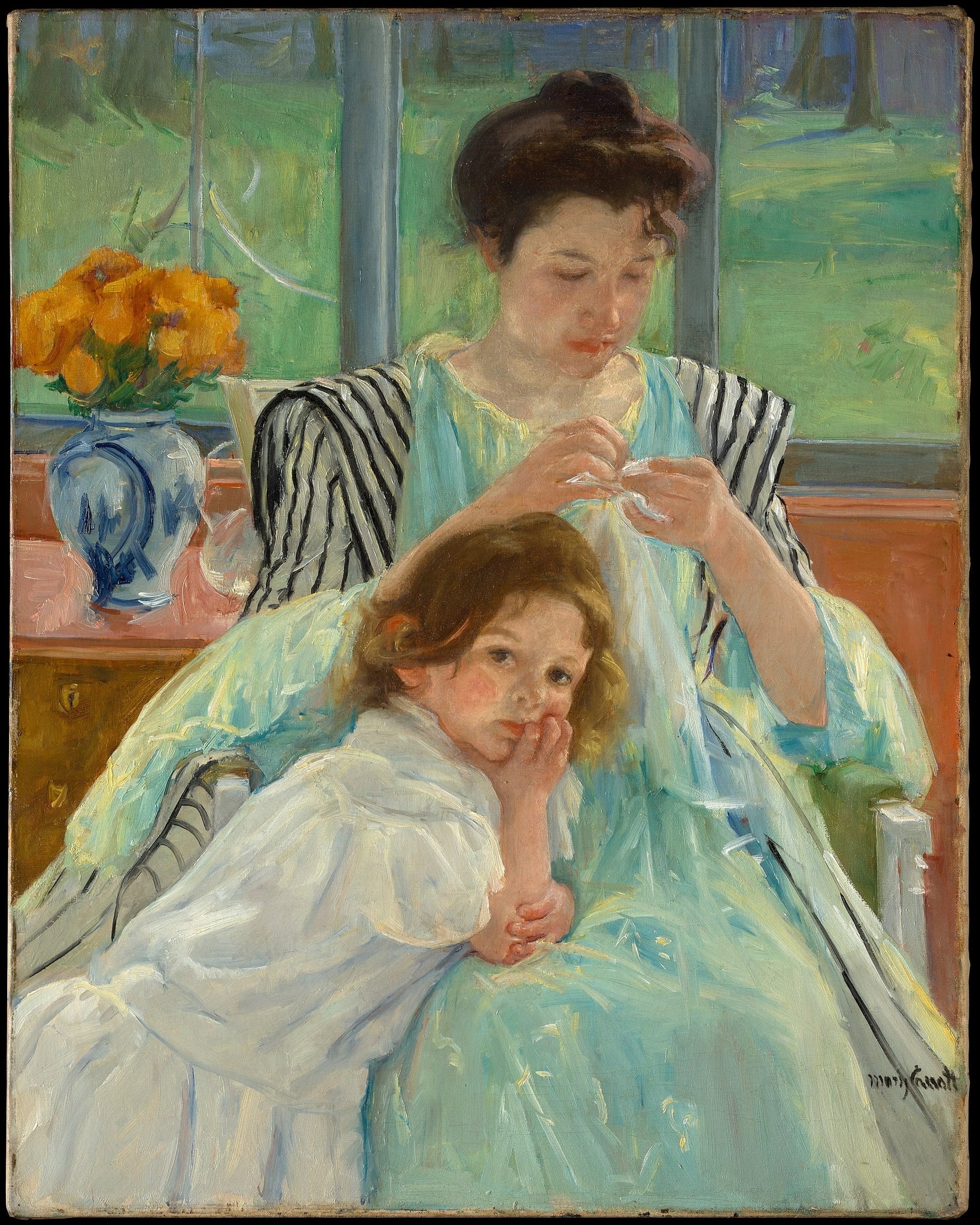
Mary Cassatt’s Young Mother Sewing centers the quiet <strong>labor of care</strong>: a mother steadies pale fabric while a child in white leans into her, eyes meeting ours. Cool <strong>greens and blues</strong> bathe the figures as striped sleeves and chair arms rhythmically return attention to the mother’s working hands, while a burst of <strong>orange blossoms</strong> by the window anchors interior life against the world outside <sup>[1]</sup>.
Children Playing on the Beach by Mary Cassatt

Children Playing on the Beach

Mary Cassatt (1884)

In Children Playing on the Beach, Mary Cassatt brings the viewer down to a child’s eye level, granting everyday play the weight of <strong>serious, self-contained work</strong>. The cool horizon and tiny boats open onto <strong>modern space and possibility</strong>, while the cropped, tilted foreground seals us inside the children’s focused world <sup>[1]</sup>.

A Woman and a Girl Driving by Mary Cassatt

A Woman and a Girl Driving

Mary Cassatt (1881)

Cassatt stages a modern scene of <strong>female control</strong> in motion: a woman grips the reins and whip while a girl beside her mirrors the pose, and a groom seated behind looks away. The cropped horse and diagonal harness thrust the carriage forward, placing viewers inside a public outing in the Bois de Boulogne—an arena where visibility signaled status and autonomy <sup>[1]</sup><sup>[2]</sup>.