Breakfast in Bed
by Mary Cassatt
Study Print Studio
Create a personal study print
Build a companion study sheet around the part of this painting that speaks to you most. Choose a detail, shape an interpretation, and walk away with something personal and display-worthy.
Fast Facts
- Year
- 1897
- Medium
- Oil on canvas
- Dimensions
- 58.4 × 73.7 cm
- Location
- The Huntington Library, Art Museum, and Botanical Gardens, San Marino, California
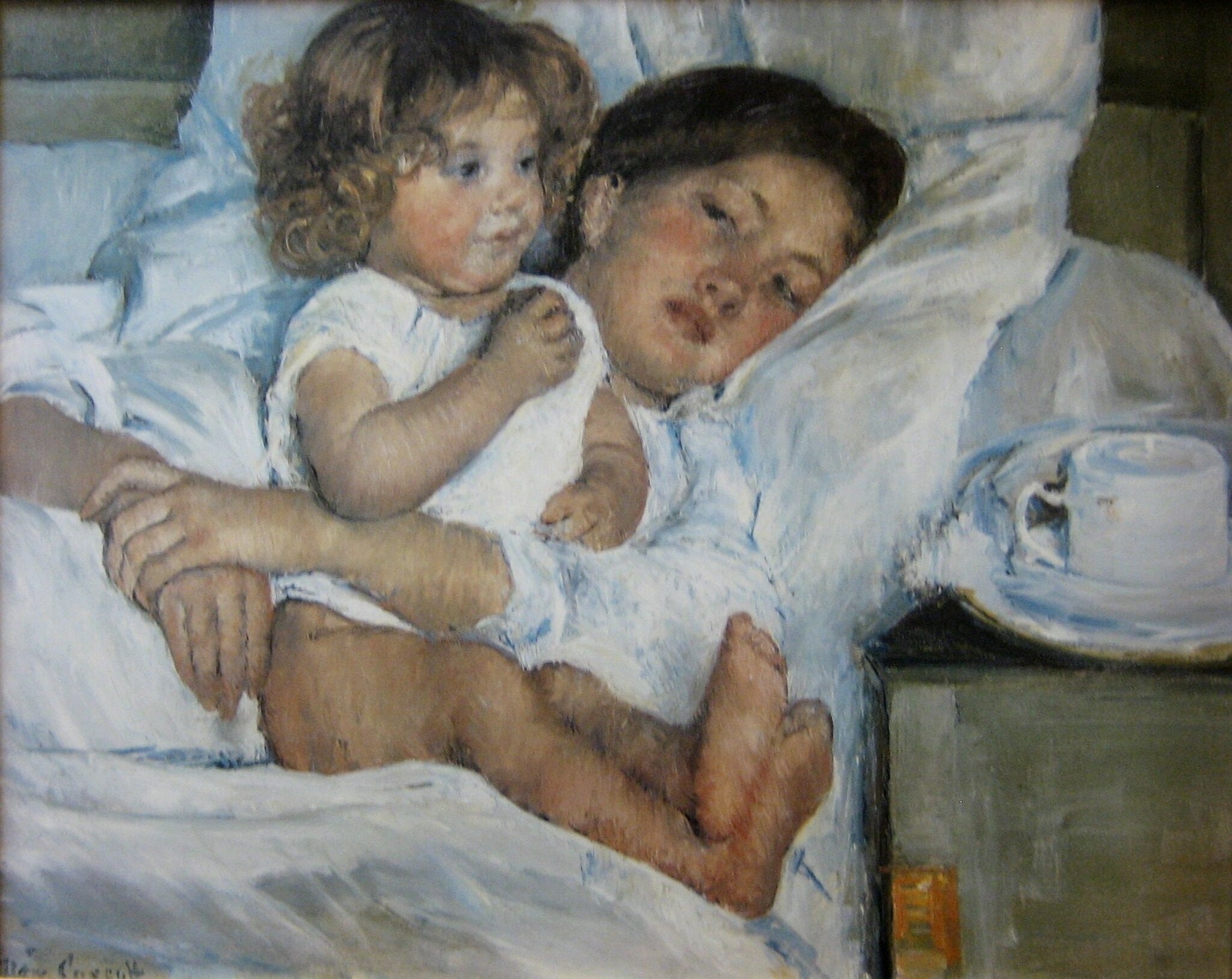
Click on any numbered symbol to learn more about its meaning
Meaning & Symbolism
Explore Deeper with AI
Ask questions about Breakfast in Bed
Popular questions:
Powered by AI • Get instant insights about this artwork
Interpretations
Feminist Labor Lens
Source: Financial Times; The Guardian; The Huntington
Formal/Japonisme Composition
Source: Encyclopaedia Britannica; The Huntington
Secular Sanctity (Modern Madonna)
Source: Nancy Mowll Mathews; The Huntington
Temporal Index and Interrupted Routine
Source: The Huntington; Encyclopaedia Britannica
Canonization and Cultural Legibility
Source: Smithsonian National Postal Museum; The Huntington
Related Themes
About Mary Cassatt
More by Mary Cassatt
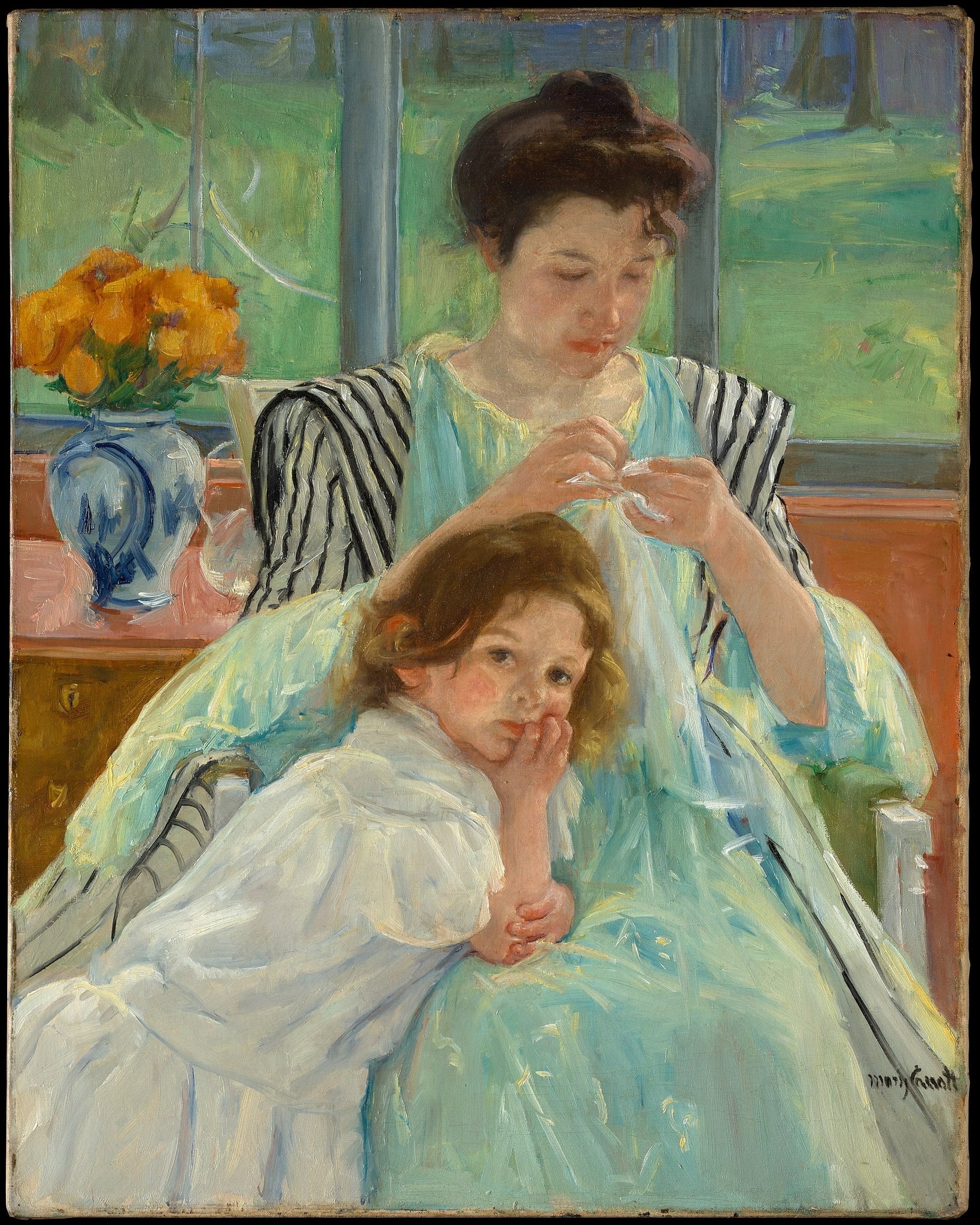
Young Mother Sewing
Mary Cassatt (1900)
Mary Cassatt’s Young Mother Sewing centers the quiet <strong>labor of care</strong>: a mother steadies pale fabric while a child in white leans into her, eyes meeting ours. Cool <strong>greens and blues</strong> bathe the figures as striped sleeves and chair arms rhythmically return attention to the mother’s working hands, while a burst of <strong>orange blossoms</strong> by the window anchors interior life against the world outside <sup>[1]</sup>.
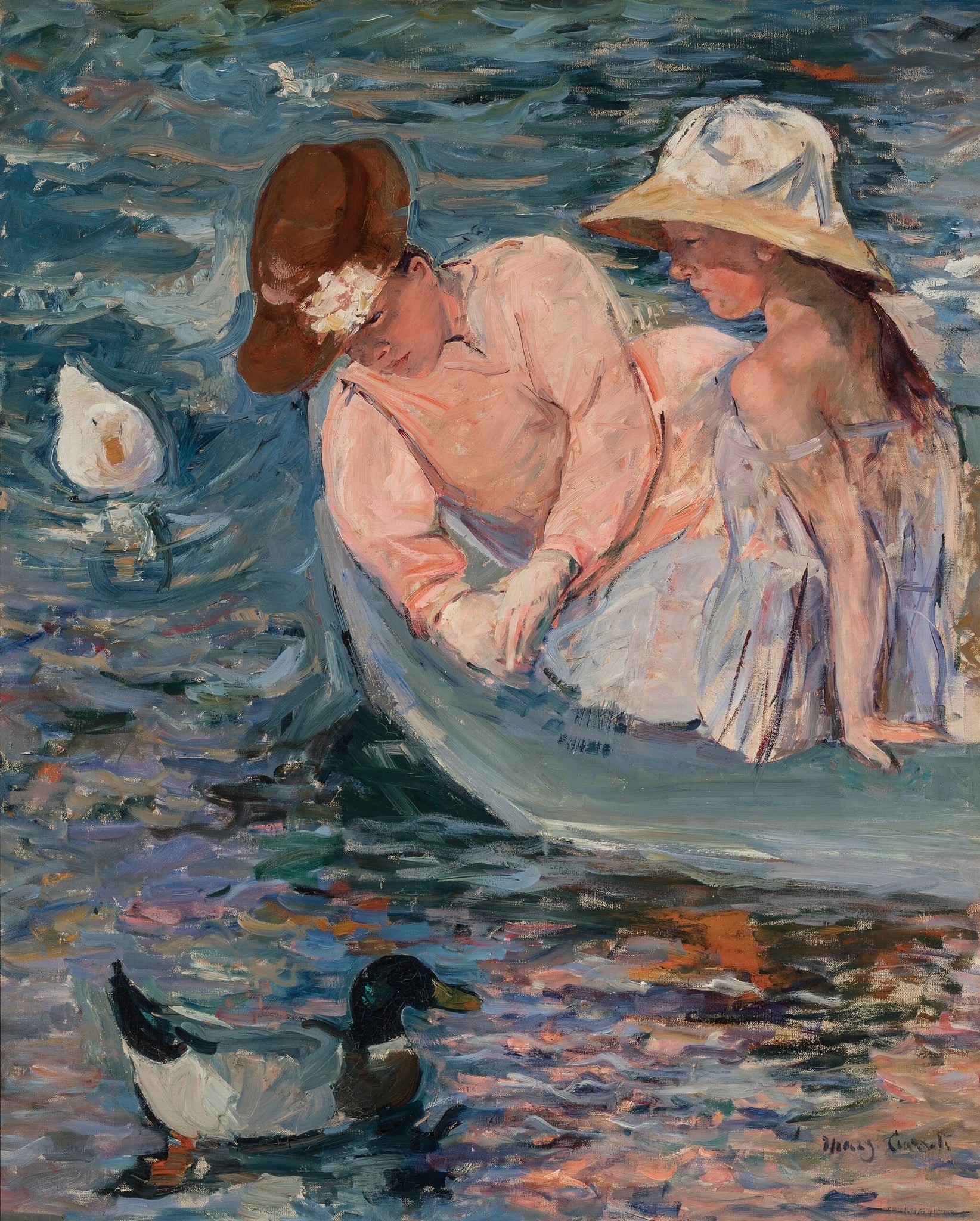
Summertime
Mary Cassatt (1894)
Mary Cassatt’s Summertime (1894) stages a quiet drama of <strong>attentive looking</strong>: a woman and a girl lean from a cropped boat toward two ducks as the lake flickers with broken color. Cassatt fuses <strong>Impressionism</strong> and <strong>Japonisme</strong>—no horizon, tipped perspective, and abrupt cropping—to press our gaze downward into light-spattered water. The result is an image of <strong>modern leisure</strong> that is also a study of perception itself <sup>[1]</sup>.
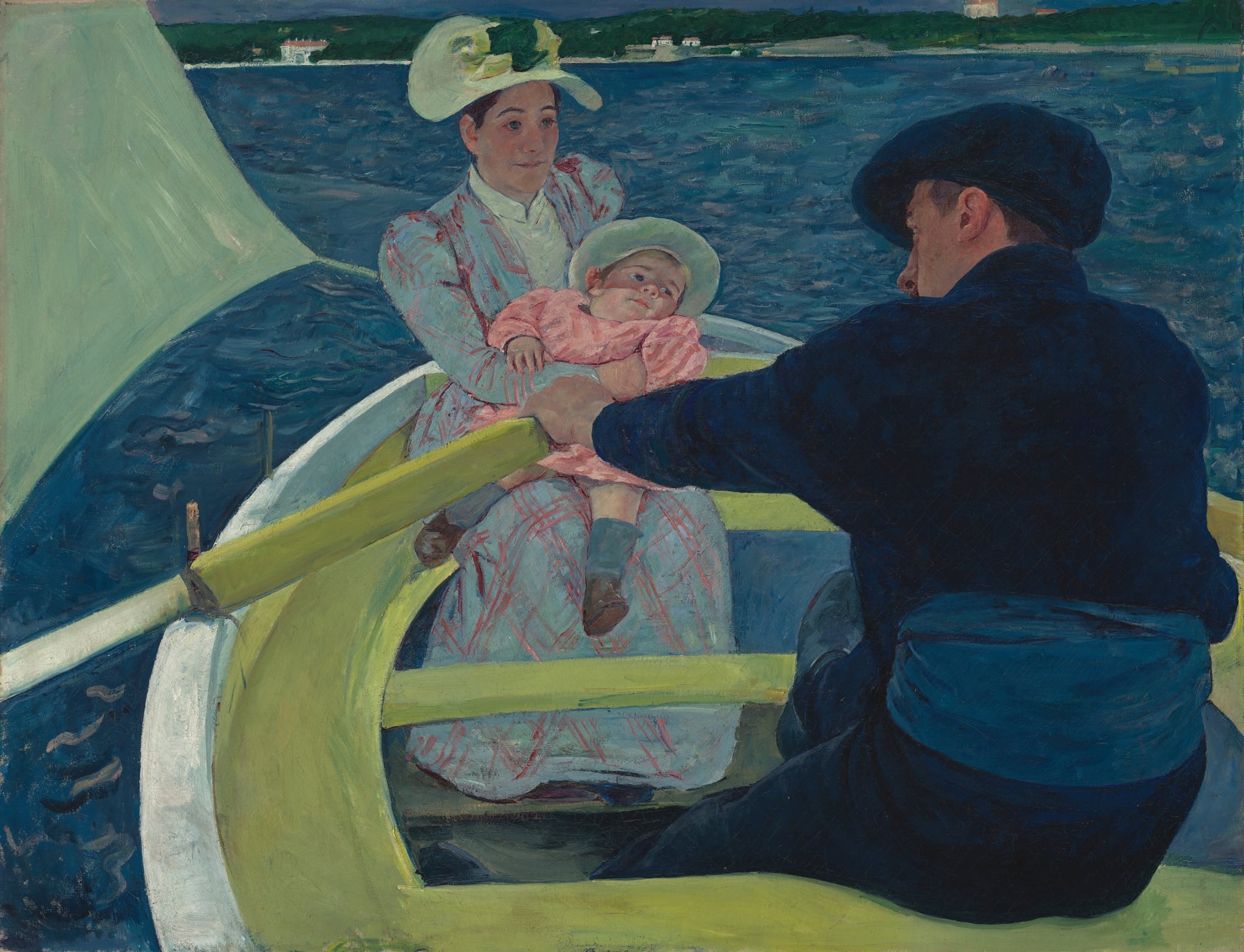
The Boating Party
Mary Cassatt (1893–1894)
In The Boating Party, Mary Cassatt fuses <strong>intimate caregiving</strong> with <strong>modern mobility</strong>, compressing mother, child, and rower inside a skiff that cuts diagonals across ultramarine water. Bold arcs of citron paint and a high, flattened horizon reveal a deliberate <strong>Japonisme</strong> logic that stabilizes the scene even as motion surges around it <sup>[1]</sup>. The painting asserts domestic life as a public, modern subject while testing the limits of Impressionist space and color.
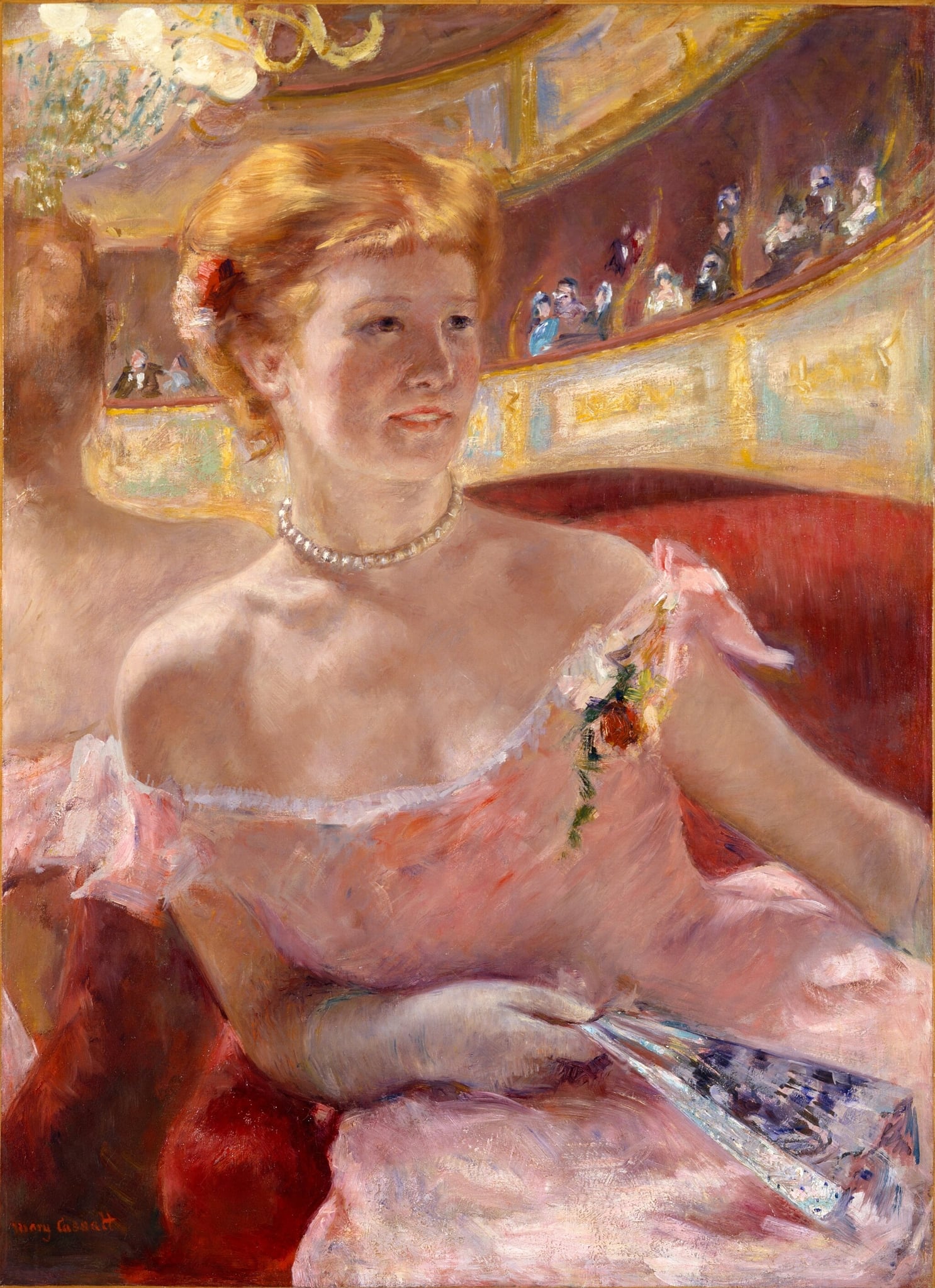
Woman with a Pearl Necklace in a Loge
Mary Cassatt (1879)
Mary Cassatt’s Woman with a Pearl Necklace in a Loge (1879) stages modern <strong>spectatorship</strong> inside a plush opera box, where a young woman in pink satin, pearls, and gloves occupies the red velvet seat while a mirror multiplies the chandeliers and balconies. Cassatt fuses <strong>intimacy</strong> and <strong>public display</strong>, using luminous brushwork to place her sitter within the social theater of Parisian leisure <sup>[1]</sup><sup>[2]</sup>.
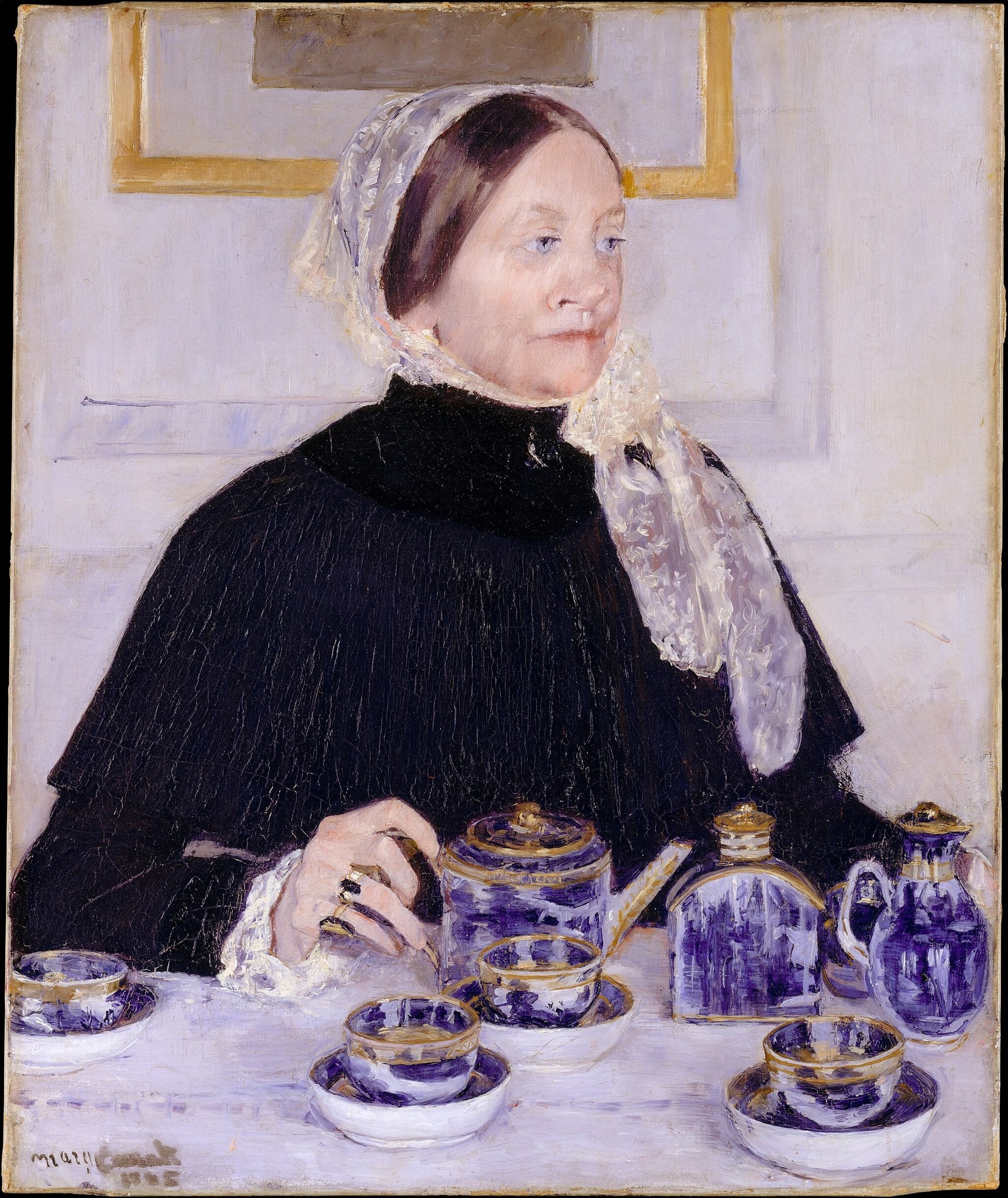
Lady at the Tea Table
Mary Cassatt (1883–85 (signed 1885))
Mary Cassatt’s Lady at the Tea Table distills a domestic rite into a scene of <strong>quiet authority</strong>. The sitter’s black silhouette, lace cap, and poised hand marshal a regiment of <strong>cobalt‑and‑gold Canton porcelain</strong>, while tight cropping and planar light convert hospitality into <strong>modern self‑possession</strong> <sup>[1]</sup><sup>[5]</sup>.
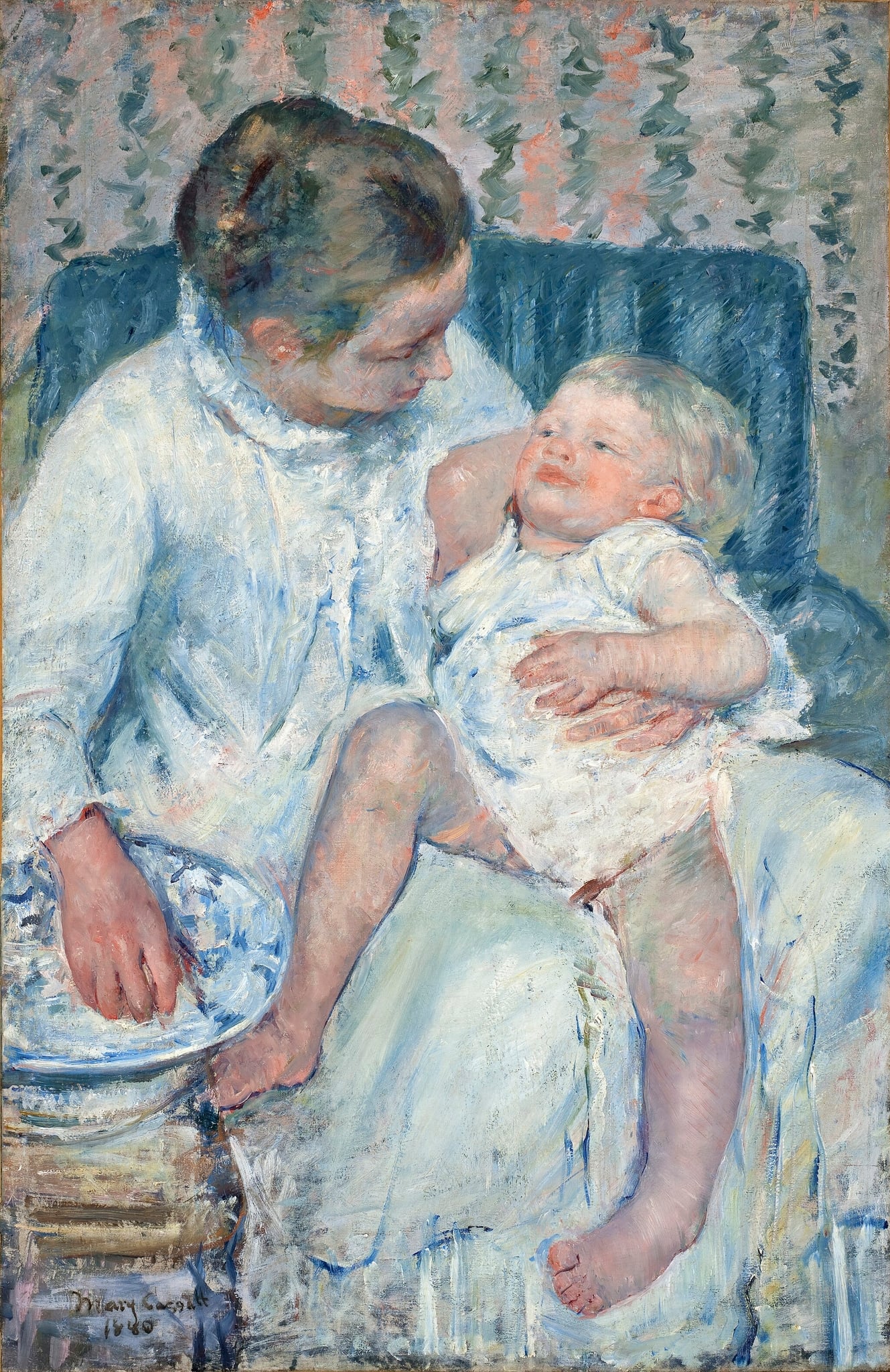
Mother About to Wash Her Sleepy Child
Mary Cassatt (1880)
Mary Cassatt’s Mother About to Wash Her Sleepy Child (1880) turns an ordinary bedtime ritual into a scene of <strong>caregiving, labor, and modern intimacy</strong>. Cropped close, with the child’s legs diagonally splayed and a tilted washbowl at the mother’s knee, the picture translates domestic routine into a <strong>modern Madonna</strong> for the bourgeois interior. Its flickering blues and milky whites, plus patterned upholstery and wallpaper, signal Cassatt’s <strong>Impressionist</strong> and japonisme-inflected design sense <sup>[2]</sup>.