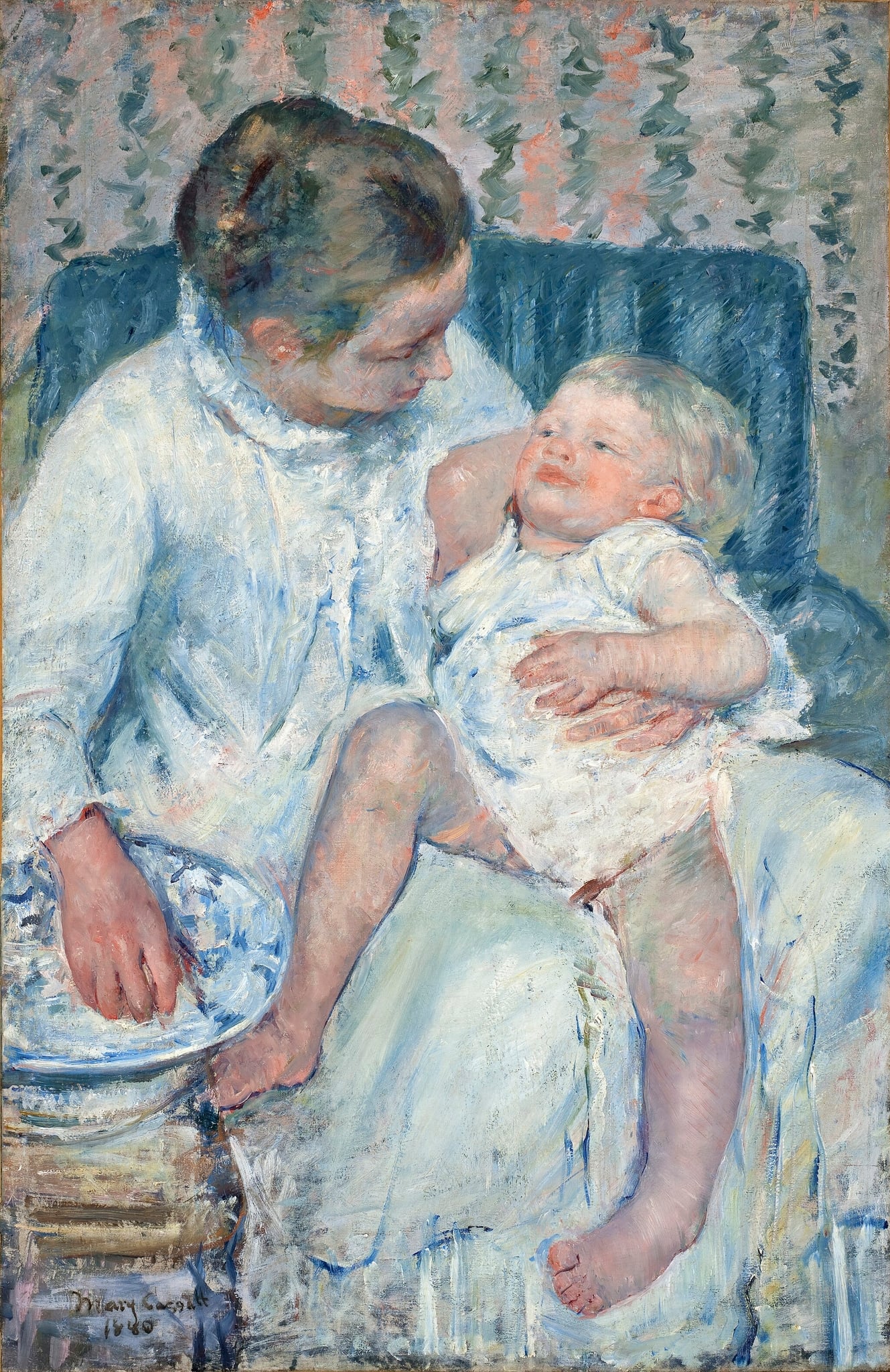
Little Girl in a Big Straw Hat and a Pinafore

by Mary Cassatt

Mary Cassatt’s Little Girl in a Big Straw Hat and a Pinafore distills childhood into a quiet drama of interiority and constraint. The oversized straw hat and plain pinafore bracket a flushed face, downcast eyes, and clasped hands, turning a simple pose into a study of modern self‑consciousness [1]. Cassatt’s cool grays and swift, luminous strokes make mood—not costume—the subject.

Fast Facts

Year
c. 1886
Medium
Oil on canvas
Dimensions
65.3 × 49.2 cm
Location
National Gallery of Art, Washington, DC
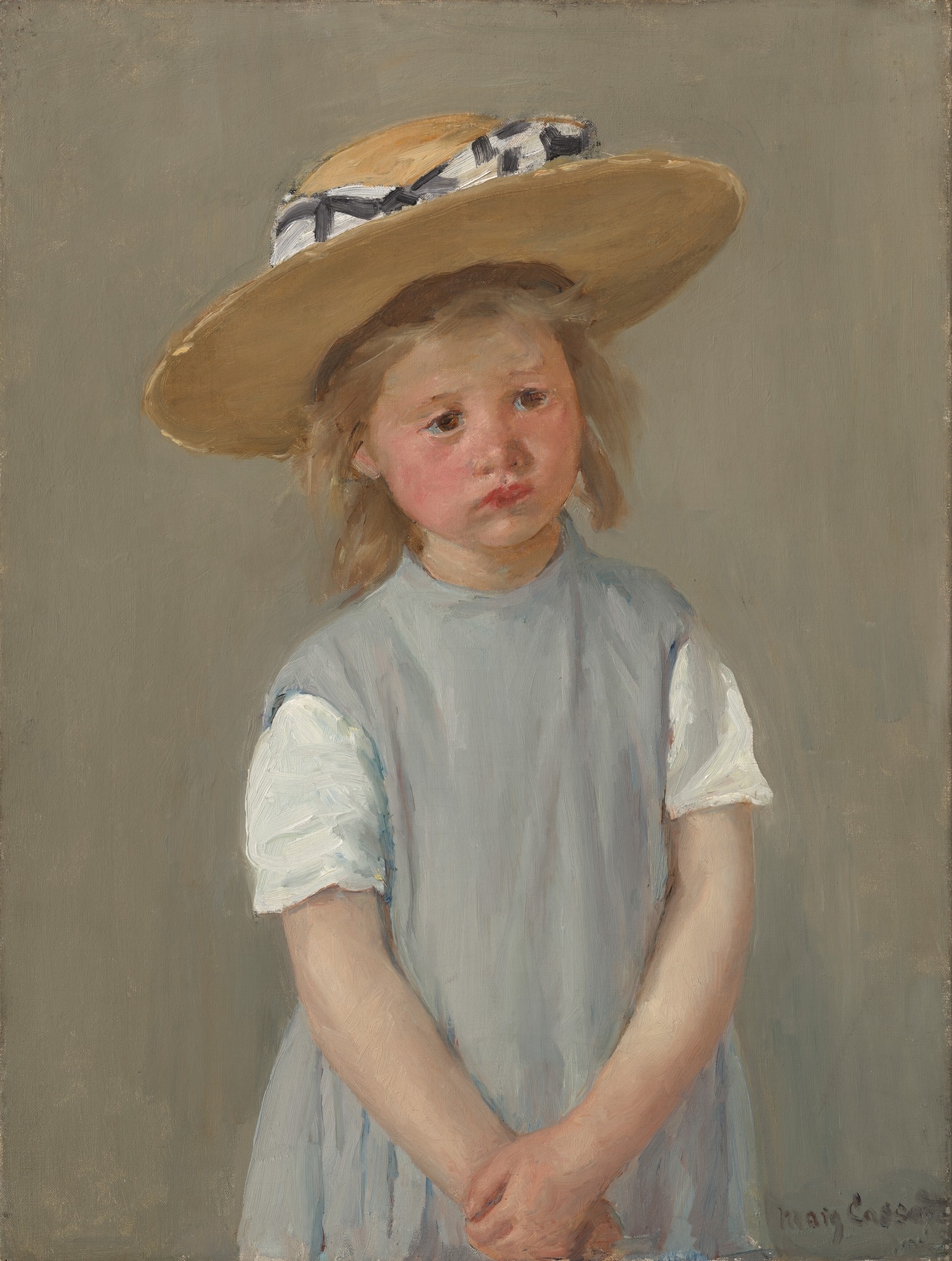
Little Girl in a Big Straw Hat and a Pinafore by Mary Cassatt (c. 1886)

Click on any numbered symbol to learn more about its meaning

Meaning & Symbolism

Cassatt builds the picture’s psychology from its edges inward. The brim of the big straw hat, ringed by a dark, graphic ribbon, throws a soft shadow that corrals our attention to the child’s reddened cheeks and slightly parted mouth. That high, circling arc is not mere fashion; it is a deliberate framing device that concentrates the image on the head—on thought—rather than on the body 2. Beneath it, the girl’s averted eyes refuse our direct address, and her hands interlocked at the waist stiffen into a compromise between obedience and resistance. The National Gallery notes this sitter “is not enjoying herself,” reading the scene as a dress‑up or enforced‑posing episode whose tension registers as boredom, pensiveness, even frustration 1. The visual facts corroborate that account: the body turns frontally while the attention turns away; the mouth swells with unspoken feeling; the shoulders tilt as if holding still is itself labor. Cassatt’s material choices translate that mood into paint. The restricted palette—cool grays for ground and pinafore, warm creams in the hat, quick pinks and corals in the skin—lets tiny chromatic shifts do narrative work. Loose, alla prima strokes around the sleeves and bodice telegraph immediacy, refusing the polished finish of sentimental portraiture 1. The pinafore, a plainly cut, washable over‑garment associated with children’s play and domestic activity, signals everyday childhood rather than display or wealth 4. Set against that practicality, the hat reads as borrowed adulthood: its outsized scale and sharp ribbon feel slightly imposed, a prop that marks the pressure of social expectation. Yet Cassatt will not let the hat turn the girl into a miniature coquette; instead it fences off a private interior, amplifying the child’s self‑containment. In this balance of prop and person, Cassatt aligns with what curators have observed across her “girl with hat” motif: the head is sovereign, the subject an individual with implied future potential and agency 2. Historically, the canvas crystallizes Cassatt’s mature modernism in the mid‑1880s, when she fused Impressionist light with a pared, frontal clarity learned in Paris and sharpened by Degas’s compositional rigor 3. But where Impressionism is often miscast as purely optical, this picture insists on ethics: the child’s interior state governs style. The flat, austere ground eliminates anecdote; the crop denies narrative clutter; and the brushwork, vigorous yet economical, keeps our time with the child brief and honest. That anti‑sentimental frankness—foregrounded by the National Gallery’s reading of the child’s displeasure—has become central to recent reassessments of Cassatt as a rigorously professional observer of women’s and children’s lived experience, not a purveyor of sweetness 15. The result is a modern portrait of constraint and consciousness: a small person learning how to be seen, testing the limits of compliance, and guarding a private self beneath a theatrical brim. In Little Girl in a Big Straw Hat and a Pinafore, looking becomes labor, childhood becomes a site of negotiation, and Impressionist paint becomes a language of mind.

Explore Deeper with AI

Ask questions about Little Girl in a Big Straw Hat and a Pinafore

Popular questions:

Powered by AI • Get instant insights about this artwork

💬 Ask questions about this artwork!

Interpretations

Formal Analysis

Cassatt turns the hat into a pictorial engine: its dark ribbon traces a high, graphic arc that corals light around the cheeks and mouth, directing attention to the head as the site of thought. This head‑centric design echoes the curator Karl Kusserow’s reading of Cassatt’s “girls with hats” as structures that privilege mind over costume, granting the sitter interior sovereignty 2. The cropped, frontal pose and austere ground compress depth and anecdote, while the alla prima handling around the sleeves preserves speed and presentness 1. Such economy—few forms, strong silhouette, decisive edges—owes to Degas’s compositional rigor absorbed in Paris and contemporaneous modern cropping 3. The result is a geometric, face‑forward armature that rejects ornamental finish to keep the eye where Cassatt wants it: on thinking, not trimming 123.

Source: Princeton University Art Museum (Karl Kusserow); National Gallery of Art; The Met (Heilbrunn Timeline)

Material Culture & Dress History

The child’s pinafore is a key to meaning. In the 19th century it functioned as a washable, protective over‑garment tied to school, play, and domestic tasks—clothes for doing, not display 4. Cassatt’s gray, plainly cut pinafore signals everyday childhood, while the large straw hat—a common but here outsized accessory—tips toward “dress‑up,” aligning with the NGA’s reading of a staged, not entirely willing session 1. This friction between practical garment and theatrical headgear maps a cultural seam where childhood meets the training of femininity. Rather than decorate the child into cuteness, Cassatt lets the garments declare use‑value versus social show, and she paints them with brisk, unvarnished strokes that refuse confection. Clothes here are not costume; they are arguments about age, activity, and expectation 14.

Source: National Gallery of Art; ASU FIDM Museum (pinafore context)

Feminist/Gender Lens

Cassatt’s big hats have been read as devices that both frame and foil feminine identity, marking the cultural trappings attached to girls while insisting on their individuality (Witzling) 2. In this canvas, the hat’s scale suggests borrowed adulthood, yet its shadow shields the child’s interiority rather than converting her into a petit coquette 12. Kusserow’s account of Cassatt’s “girl with hat” motif underscores the ethical pivot: the head—seat of agency—remains sovereign, even when social signs of femininity encroach 2. The averted gaze and clasped hands refuse the viewer’s easy consumption of prettiness, situating the child at the threshold of gendered socialization while preserving her self‑containment. Cassatt thus stages a quiet resistance: feminine adornment is acknowledged, but intellect and mood dictate our terms of looking 12.

Source: Princeton University Art Museum (Karl Kusserow); Scholarship summarized via Witzling

Ethics of Looking & Childhood

This picture makes spectatorship felt as effort: looking becomes labor. The NGA notes the sitter’s pensiveness, boredom, even frustration—states produced by being made to pose 1. That affect aligns with broader reassessments of Cassatt’s rigor, which foreground the work of care and representation rather than sentiment alone 5. Against the Victorian cult of the ideal child, Cassatt offers an ethical modernism: minimal setting, direct brush, limited palette, and an averted gaze that refuses our direct address. We witness a small person negotiating compliance and autonomy, and a painter calibrating style to protect that negotiation from saccharine display. The painting thus asks viewers to labor, too—to withhold projection, to read mood in slight chromatic shifts, and to grant the child time and privacy within our gaze 15.

Source: National Gallery of Art; Philadelphia Museum of Art/critical reassessment (reported in The Guardian)

Technique & Modernism

Cassatt’s restricted palette—cool grays, warm creams, and coral skin notes—lets micro‑contrasts carry narrative weight, a modern alternative to academic finish 1. The swift alla prima facture keeps surface alive, aligning with Impressionist immediacy even as the frontal clarity and tight crop betray Degas’s discipline 13. Crucially, Cassatt wields technique as ethics: the pared, austere ground deletes anecdote, preventing the props of childhood from hijacking the sitter’s psychological presence 1. Where Impressionism is often miscast as purely optical, this canvas retools it as a language for interior states. The refusal of glaze and ornament denies the comforts of polish, substituting a bracing candor that helped redefine the modern portrait in the 1880s 13.

Source: National Gallery of Art; The Met (Heilbrunn Timeline)

Related Themes

About Mary Cassatt

Mary Cassatt (1844–1926) was an American painter who settled in Paris, exhibited with the Impressionists, and became a key conduit for introducing their art to U.S. collectors. After 1890 she adopted japoniste flatness, bold patterning, and strong design, focusing on modern women’s lives—especially mother‑and‑child subjects—until failing eyesight curtailed her work by 1914 [4].
View all works by Mary Cassatt

More by Mary Cassatt

Woman in Black at the Opera by Mary Cassatt

Woman in Black at the Opera

Mary Cassatt (1878)

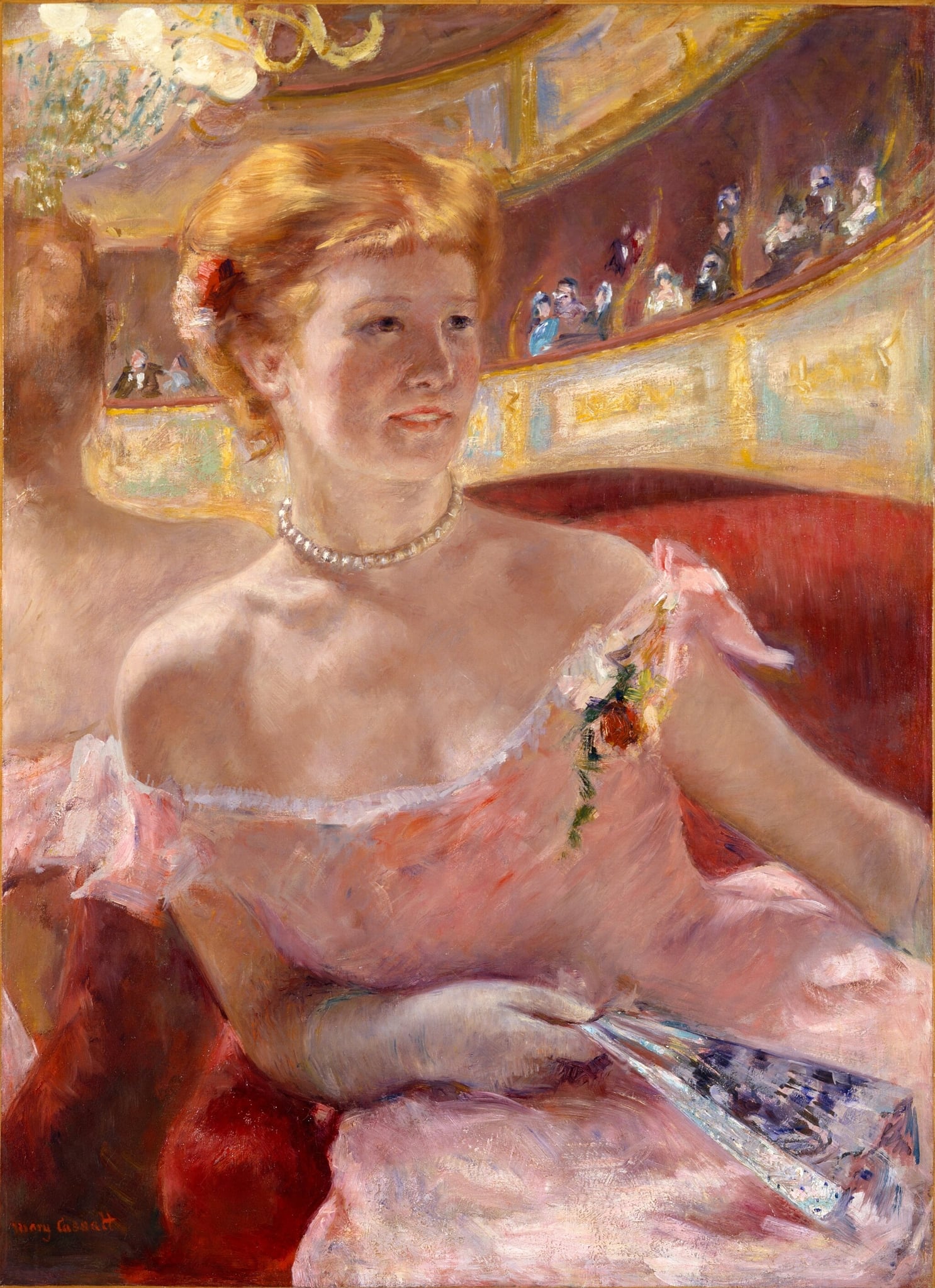
Mary Cassatt’s Woman in Black at the Opera stages a taut drama of vision and visibility. A woman in <strong>black attire</strong> raises <strong>opera glasses</strong> while a distant man aims his own at her, setting off a chain of looks that makes public leisure a site of <strong>power, agency, and surveillance</strong> <sup>[1]</sup><sup>[2]</sup>.

The Tea by Mary Cassatt

The Tea

Mary Cassatt (about 1880)

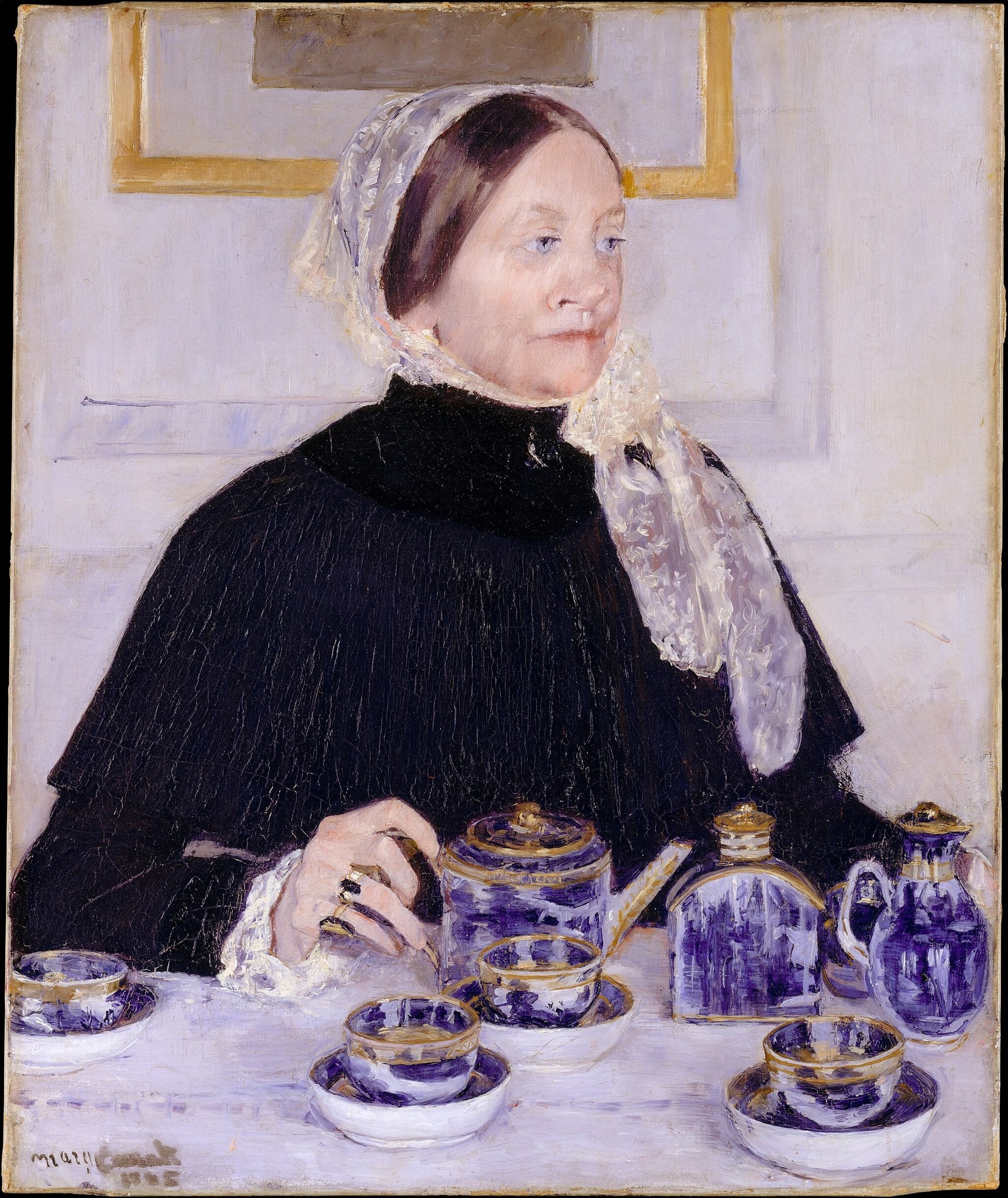
Mary Cassatt’s The Tea stages a poised, interior <strong>drama of manners</strong>: two women sit close yet feel apart, one thoughtful, the other raising a cup that <strong>veils her face</strong>. A gleaming, oversized <strong>silver tea service</strong> commands the foreground, its reflections turning ritual objects into actors in the scene <sup>[1]</sup>. The shallow, cropped room—striped wall, gilt mirror, marble mantel—compresses the atmosphere into <strong>intimacy edged by restraint</strong>.

Breakfast in Bed by Mary Cassatt

Breakfast in Bed

Mary Cassatt (1897)

Breakfast in Bed distills a <strong>tender modern intimacy</strong> into a tightly cropped sanctuary of rumpled white linens, protective embrace, and interrupted routine. Mary Cassatt uses <strong>cool light</strong> against <strong>warm flesh</strong> to anchor attention on the mother’s encircling arm and the child’s outward gaze, fusing care, curiosity, and the rhythms of <strong>everyday modern life</strong> <sup>[1]</sup><sup>[2]</sup>.

Young Mother Sewing by Mary Cassatt

Young Mother Sewing

Mary Cassatt (1900)

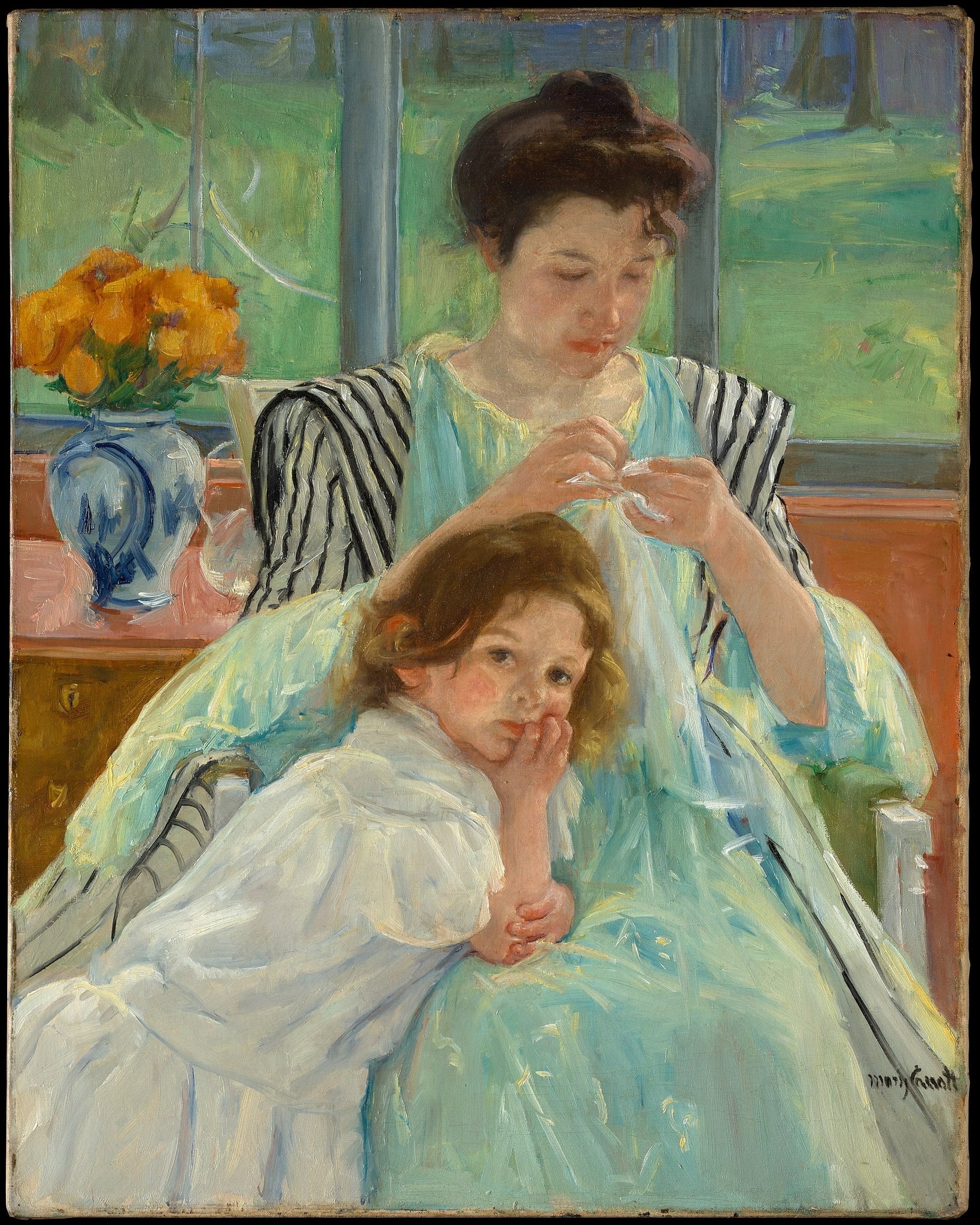
Mary Cassatt’s Young Mother Sewing centers the quiet <strong>labor of care</strong>: a mother steadies pale fabric while a child in white leans into her, eyes meeting ours. Cool <strong>greens and blues</strong> bathe the figures as striped sleeves and chair arms rhythmically return attention to the mother’s working hands, while a burst of <strong>orange blossoms</strong> by the window anchors interior life against the world outside <sup>[1]</sup>.
Children Playing on the Beach by Mary Cassatt

Children Playing on the Beach

Mary Cassatt (1884)

In Children Playing on the Beach, Mary Cassatt brings the viewer down to a child’s eye level, granting everyday play the weight of <strong>serious, self-contained work</strong>. The cool horizon and tiny boats open onto <strong>modern space and possibility</strong>, while the cropped, tilted foreground seals us inside the children’s focused world <sup>[1]</sup>.

A Woman and a Girl Driving by Mary Cassatt

A Woman and a Girl Driving

Mary Cassatt (1881)

Cassatt stages a modern scene of <strong>female control</strong> in motion: a woman grips the reins and whip while a girl beside her mirrors the pose, and a groom seated behind looks away. The cropped horse and diagonal harness thrust the carriage forward, placing viewers inside a public outing in the Bois de Boulogne—an arena where visibility signaled status and autonomy <sup>[1]</sup><sup>[2]</sup>.