Childhood & innocence
Featured Artworks
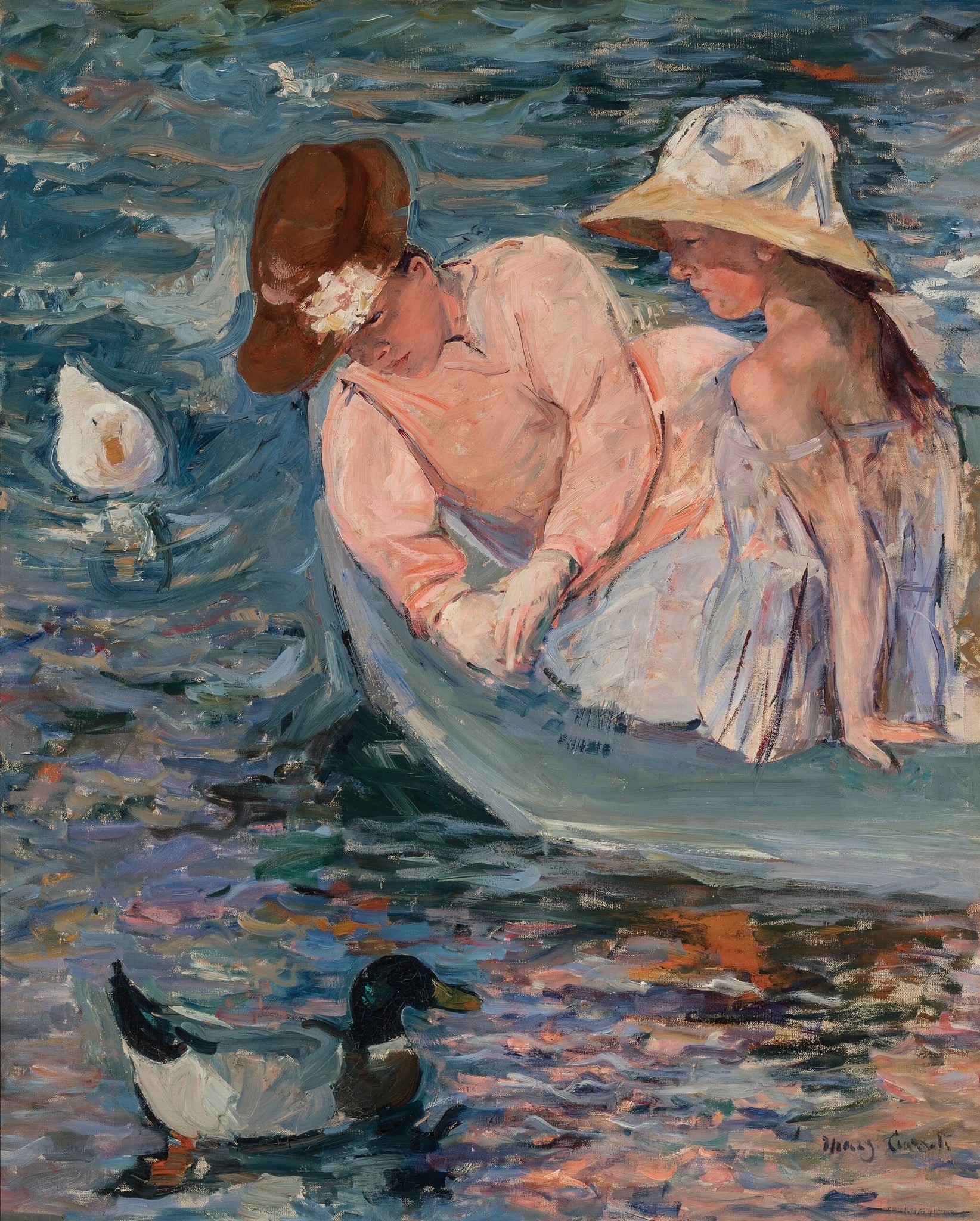
Summertime
Mary Cassatt (1894)
Mary Cassatt’s Summertime (1894) stages a quiet drama of <strong>attentive looking</strong>: a woman and a girl lean from a cropped boat toward two ducks as the lake flickers with broken color. Cassatt fuses <strong>Impressionism</strong> and <strong>Japonisme</strong>—no horizon, tipped perspective, and abrupt cropping—to press our gaze downward into light-spattered water. The result is an image of <strong>modern leisure</strong> that is also a study of perception itself <sup>[1]</sup>.
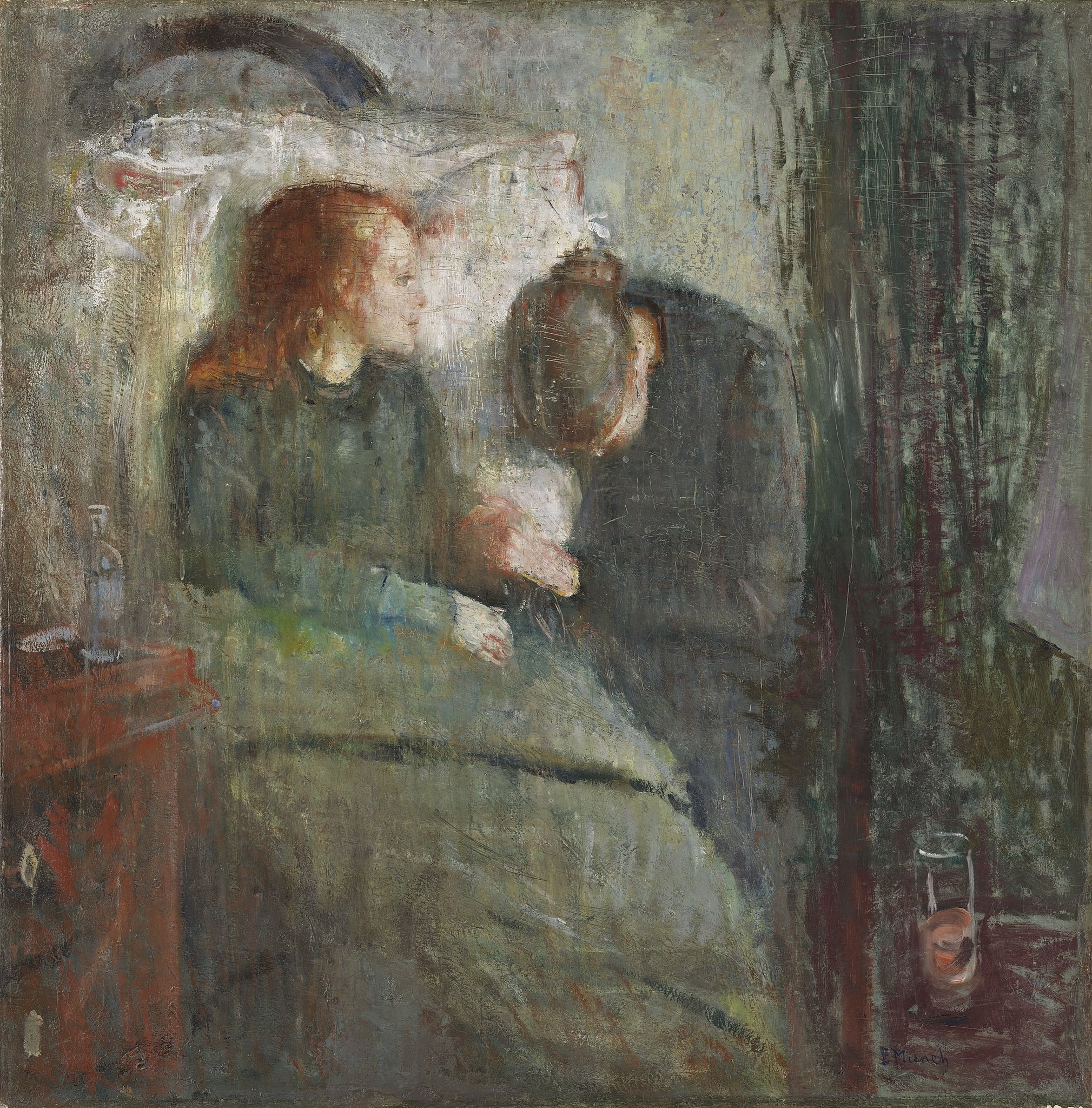
The Sick Child
Edvard Munch (1885–86)
The Sick Child condenses a bedside vigil into a stark drama of <strong>love and helplessness</strong>. A pale, copper-haired girl glows against a chalky pillow while a bowed caregiver clasps her hand; the scraped, striated paint makes grief feel <strong>present and eroding</strong> at once <sup>[1]</sup><sup>[2]</sup>. Sparse props—a bottle, a glass, a thin red line—stand as mute emblems of medicine’s limits.
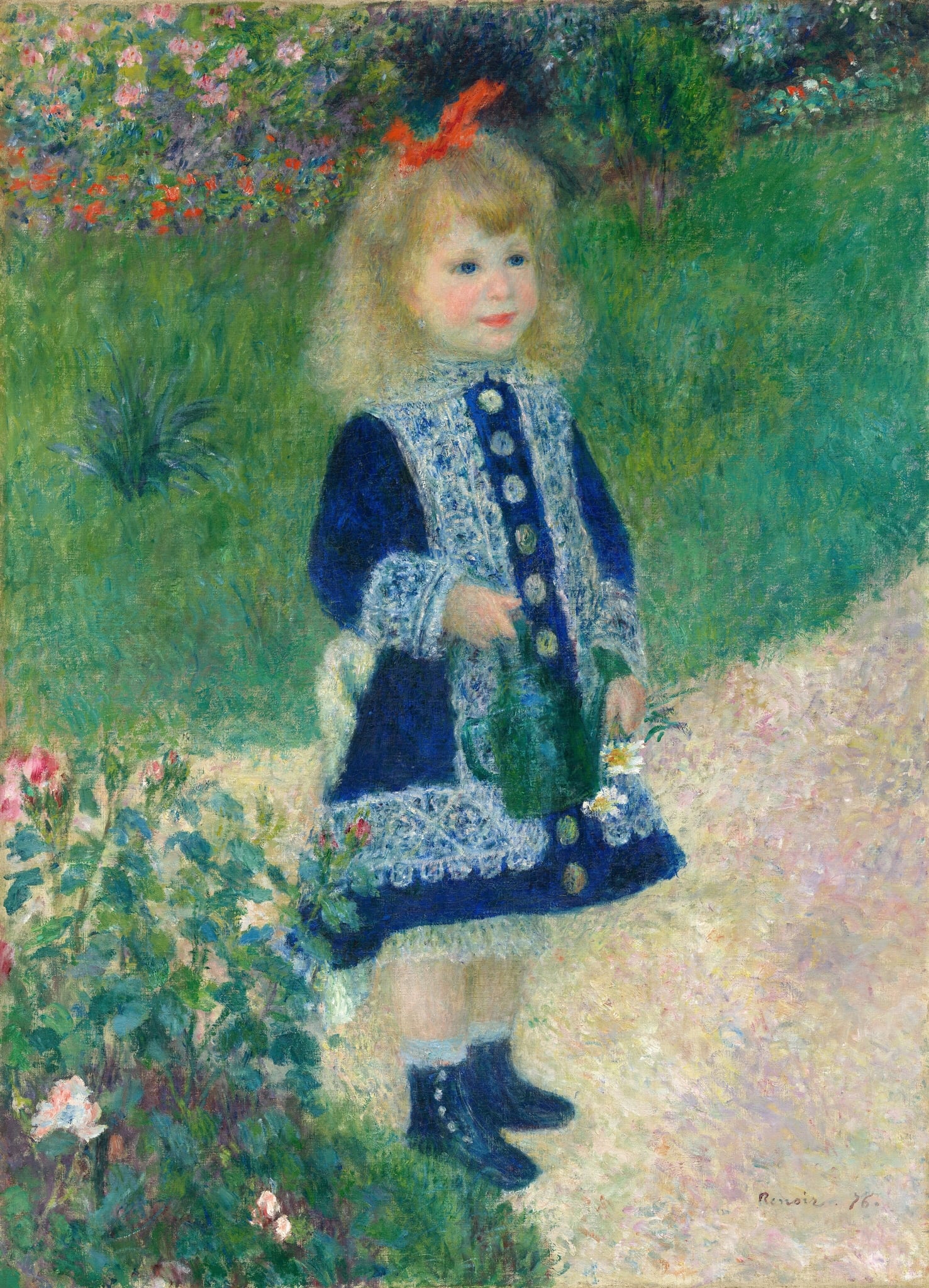
Girl with a Watering Can
Pierre-Auguste Renoir (1876)
Renoir’s 1876 Girl with a Watering Can fuses a crisply perceived child with a dissolving garden atmosphere, using <strong>prismatic color</strong> and <strong>controlled facial modeling</strong> to stage innocence within modern leisure <sup>[1]</sup>. The cobalt dress, red bow, and green can punctuate a haze of pinks and greens, making nurture and growth the scene’s quiet thesis.
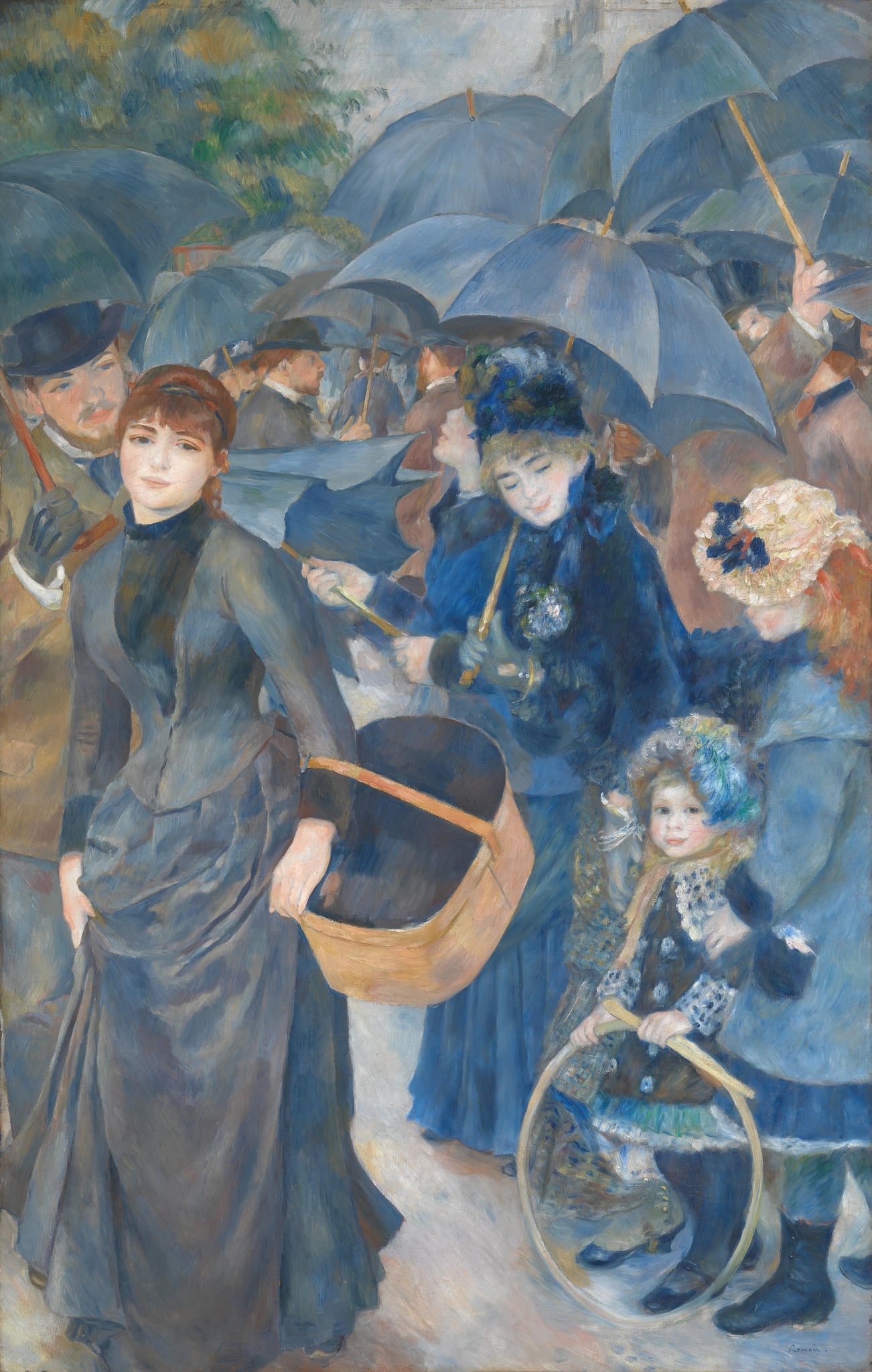
The Umbrellas
Pierre-Auguste Renoir (about 1881–86)
A sudden shower turns a Paris street into a lattice of <strong>slate‑blue umbrellas</strong>, knitting strangers into a single moving frieze. A bareheaded young woman with a <strong>bandbox</strong> strides forward while a bourgeois mother and children cluster at right, their <strong>hoop</strong> echoing the umbrellas’ arcs <sup>[1]</sup><sup>[5]</sup>.
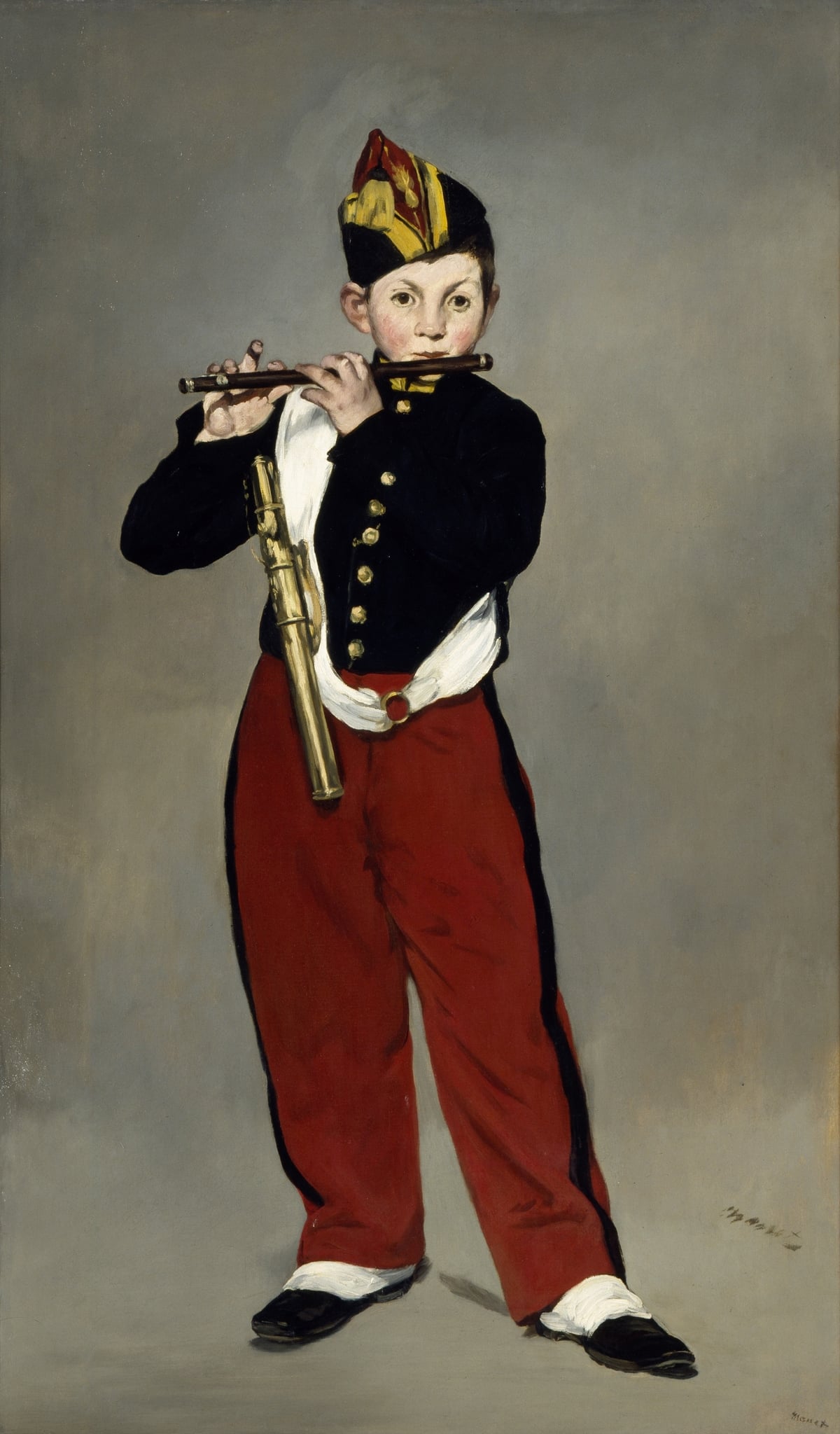
The Fifer
Édouard Manet (1866)
In The Fifer, <strong>Édouard Manet</strong> monumentalizes an anonymous military child by isolating him against a flat, gray field, converting everyday modern life into a subject of high pictorial dignity. The crisp <strong>silhouette</strong>, blocks of <strong>unmodulated color</strong> (black tunic, red trousers, white gaiters), and glints on the brass case make sound and discipline palpable without narrative scaffolding <sup>[1]</sup>. Drawing on <strong>Velázquez’s single-figure-in-air</strong> formula yet inflected by japonisme’s flatness, Manet forges a new modern image that the Salon rejected in 1866 <sup>[1]</sup><sup>[2]</sup><sup>[3]</sup>.
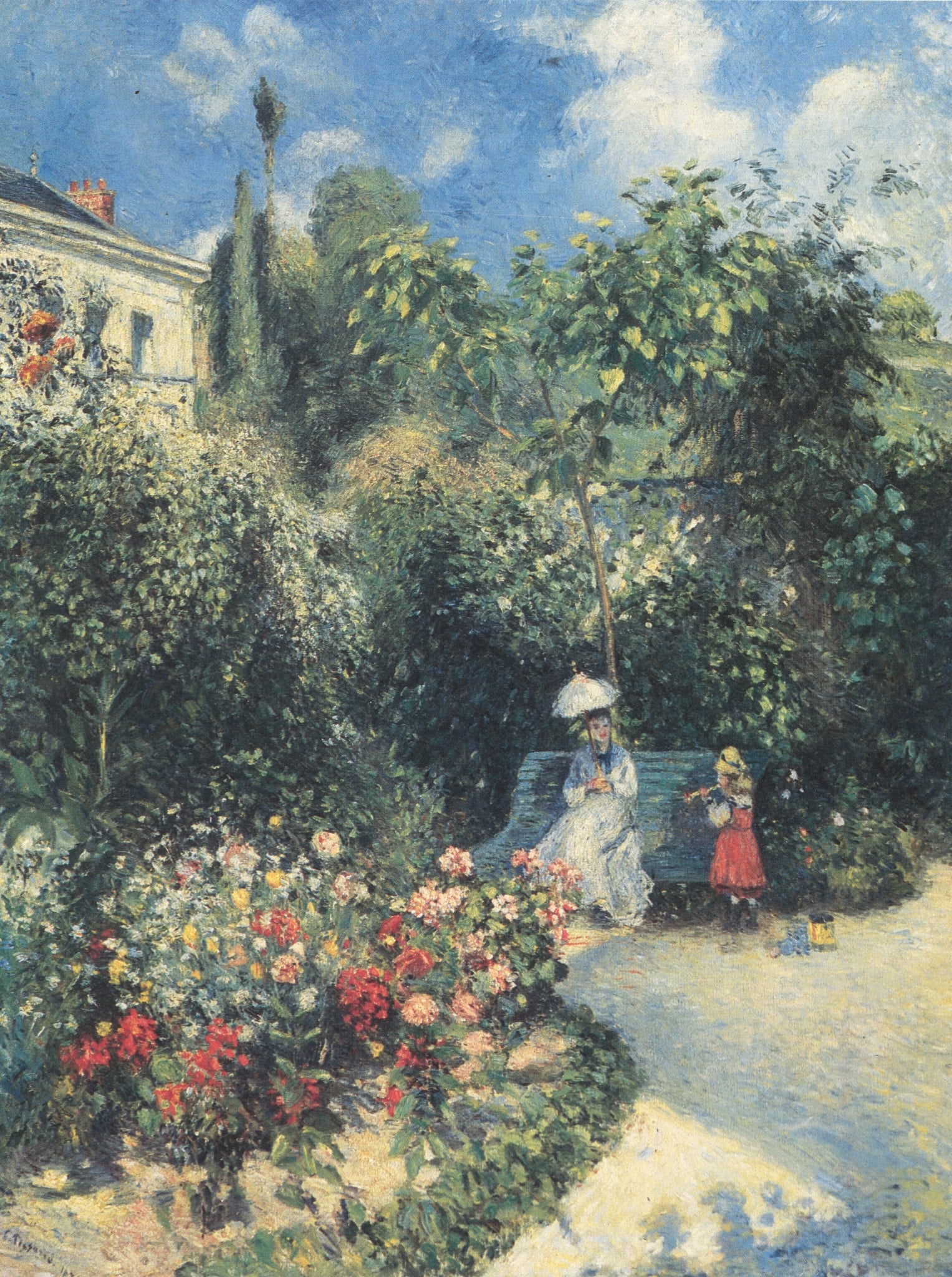
The Garden of Pontoise
Camille Pissarro (1874)
In The Garden of Pontoise, Camille Pissarro turns a modest suburban plot into a stage for <strong>modern leisure</strong> and <strong>fugitive light</strong>. A woman shaded by a parasol and a child in a bright red skirt punctuate the deep greens, while a curving sand path and beds of red–pink blossoms draw the eye toward a pale house and cloud‑flecked sky. The painting asserts that everyday, cultivated nature can be a <strong>modern Eden</strong> where time, season, and social ritual quietly unfold <sup>[1]</sup><sup>[3]</sup>.
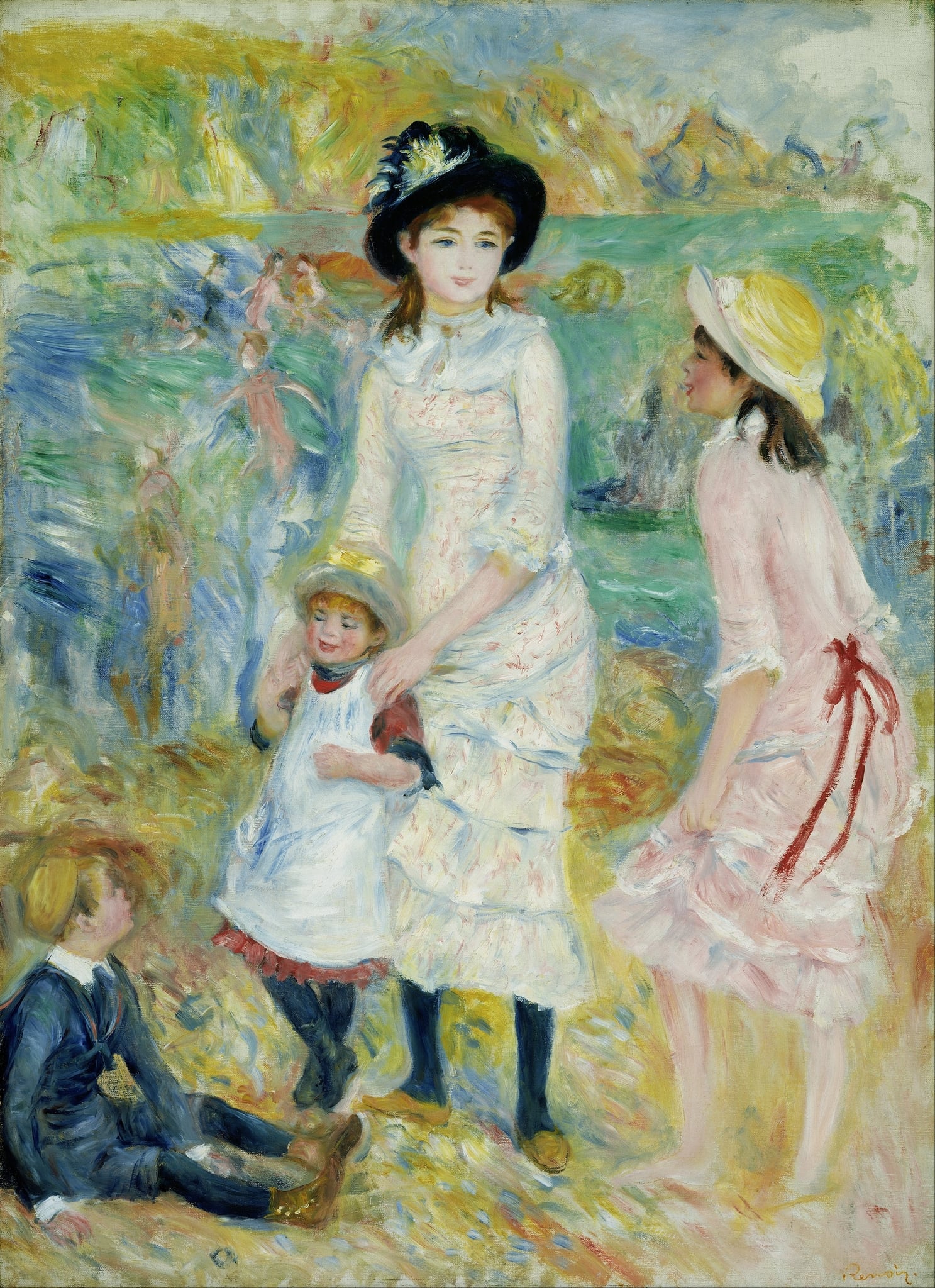
Children on the Seashore, Guernsey
Pierre-Auguste Renoir (about 1883)
Renoir’s Children on the Seashore, Guernsey crystallizes a wind‑bright moment of modern leisure with <strong>flickering brushwork</strong> and a gently choreographed group of children. The central girl in a white dress and black feathered hat steadies a toddler while a pink‑clad companion leans in and a sailor‑suited boy rests on the pebbles—an intimate triangle set against a <strong>shimmering, populated sea</strong>. The canvas makes light and movement the protagonists, dissolving edges into <strong>pearly surf and sun‑washed cliffs</strong>.
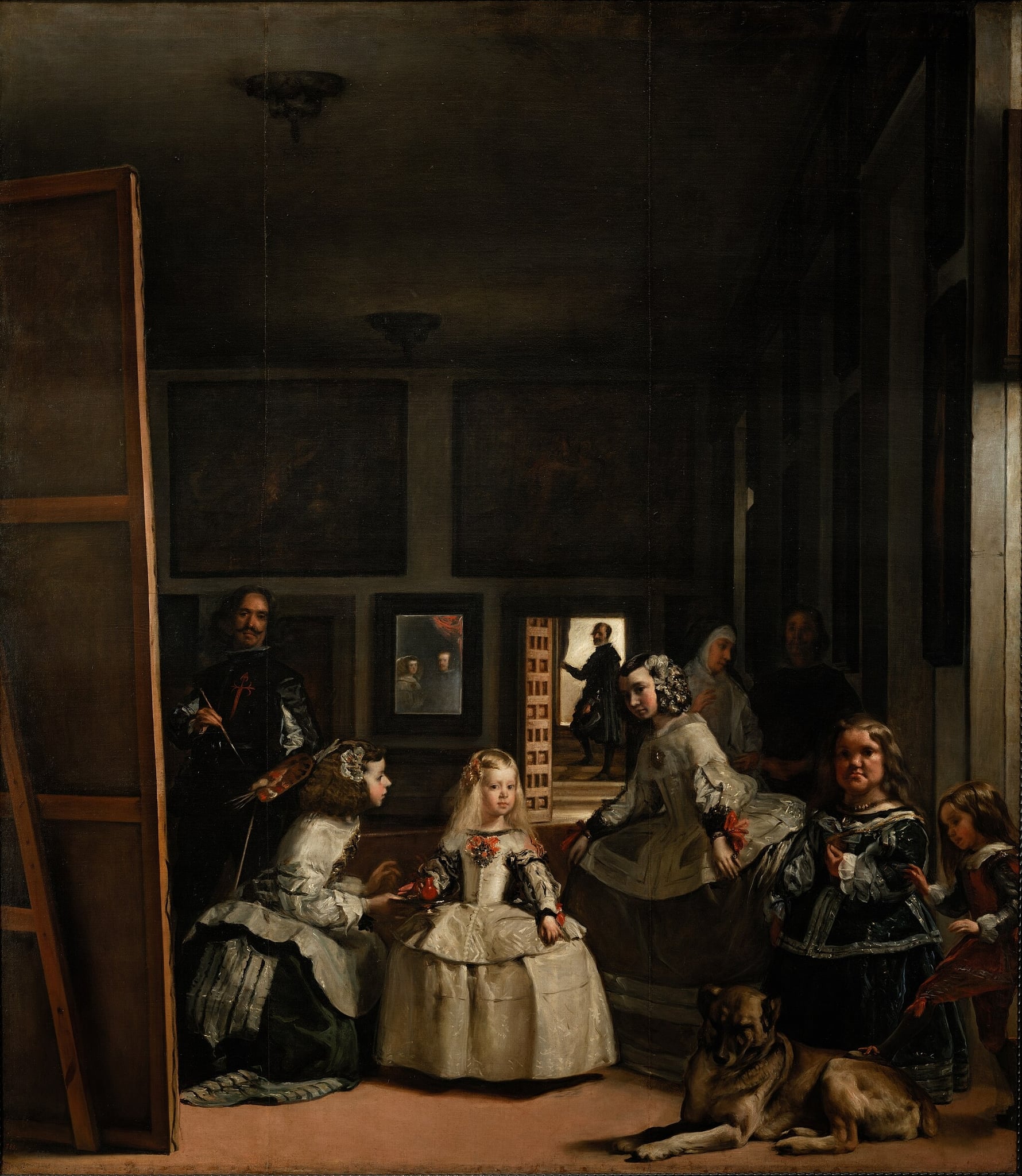
Las Meninas
Diego Velazquez (1656)
In Las Meninas, a luminous Infanta anchors a shadowed studio where the painter pauses at a vast easel and a small wall mirror reflects the monarchs. The scene folds artist, sitters, and viewer into one reflexive tableau, turning court protocol into a meditation on <strong>seeing and being seen</strong> <sup>[1]</sup><sup>[3]</sup>. A bright doorway at the rear deepens space and time, as if someone has just entered—or is leaving—the picture we occupy <sup>[1]</sup><sup>[5]</sup>.
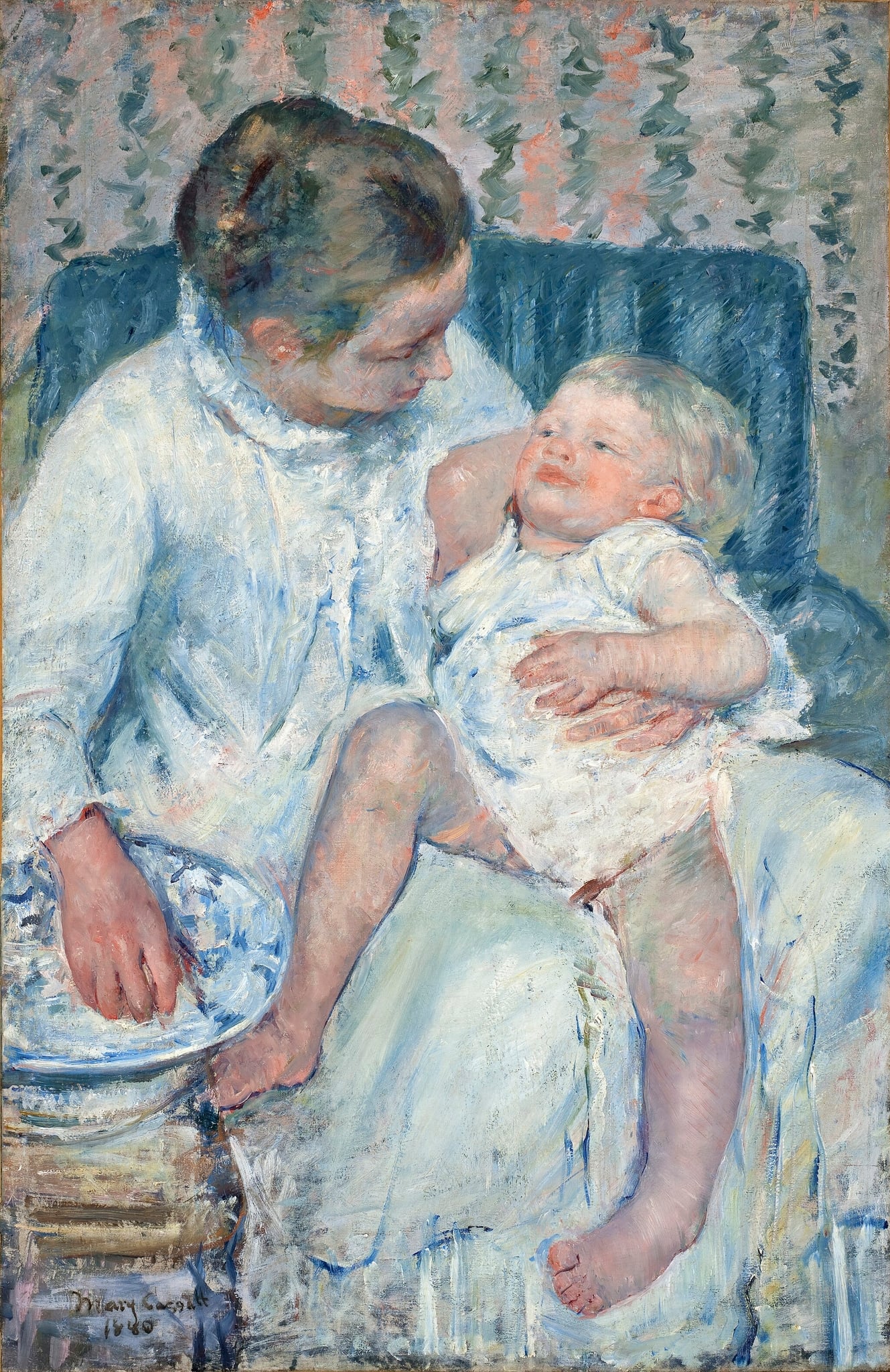
Mother About to Wash Her Sleepy Child
Mary Cassatt (1880)
Mary Cassatt’s Mother About to Wash Her Sleepy Child (1880) turns an ordinary bedtime ritual into a scene of <strong>caregiving, labor, and modern intimacy</strong>. Cropped close, with the child’s legs diagonally splayed and a tilted washbowl at the mother’s knee, the picture translates domestic routine into a <strong>modern Madonna</strong> for the bourgeois interior. Its flickering blues and milky whites, plus patterned upholstery and wallpaper, signal Cassatt’s <strong>Impressionist</strong> and japonisme-inflected design sense <sup>[2]</sup>.
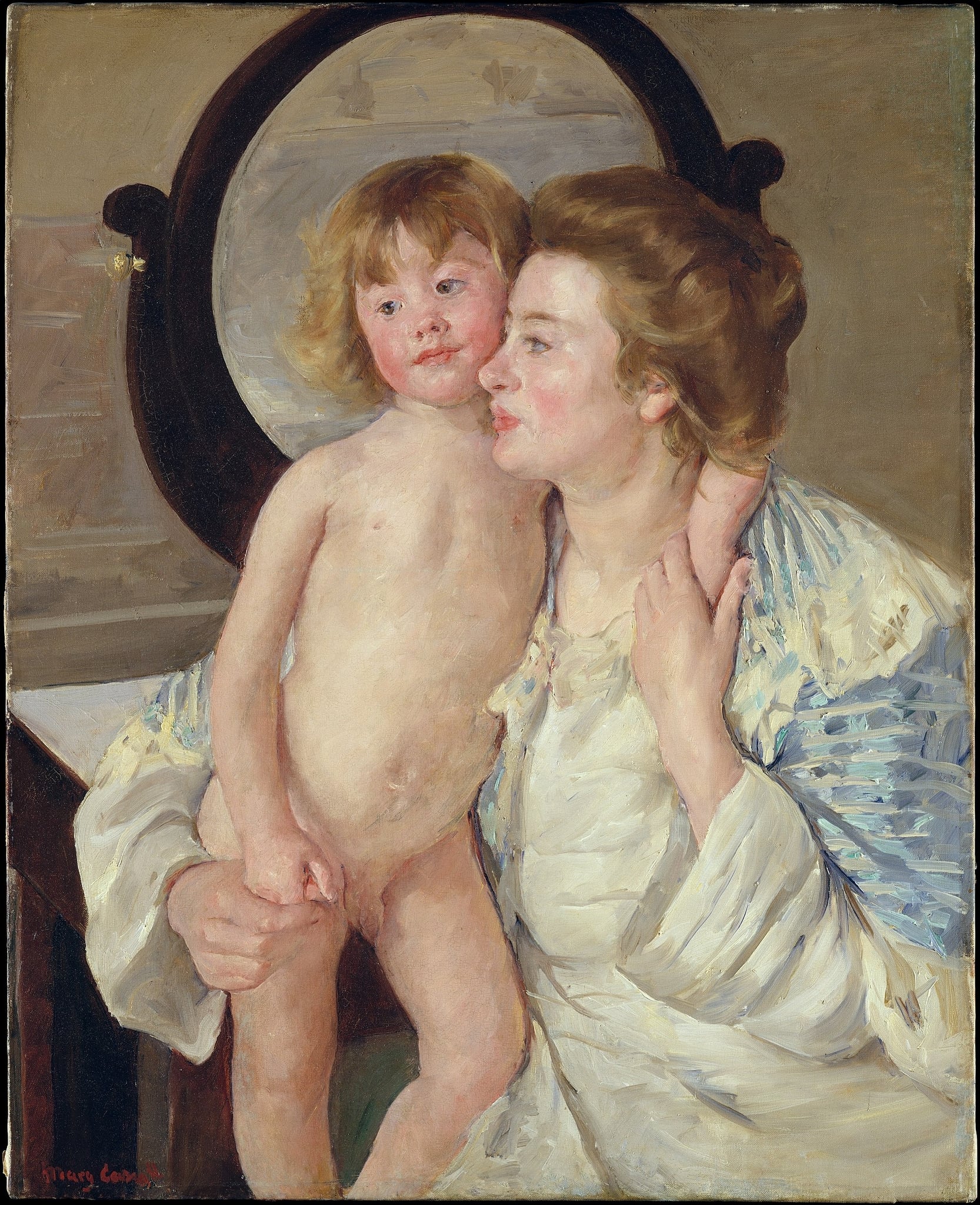
Mother and Child (The Oval Mirror)
Mary Cassatt (ca. 1899)
Mary Cassatt’s Mother and Child (The Oval Mirror) turns a routine act of care into a <strong>modern icon</strong>. An oval mirror <strong>haloes</strong> the child while interlaced hands and close bodies make <strong>touch</strong> the vehicle of meaning <sup>[1]</sup><sup>[3]</sup>.
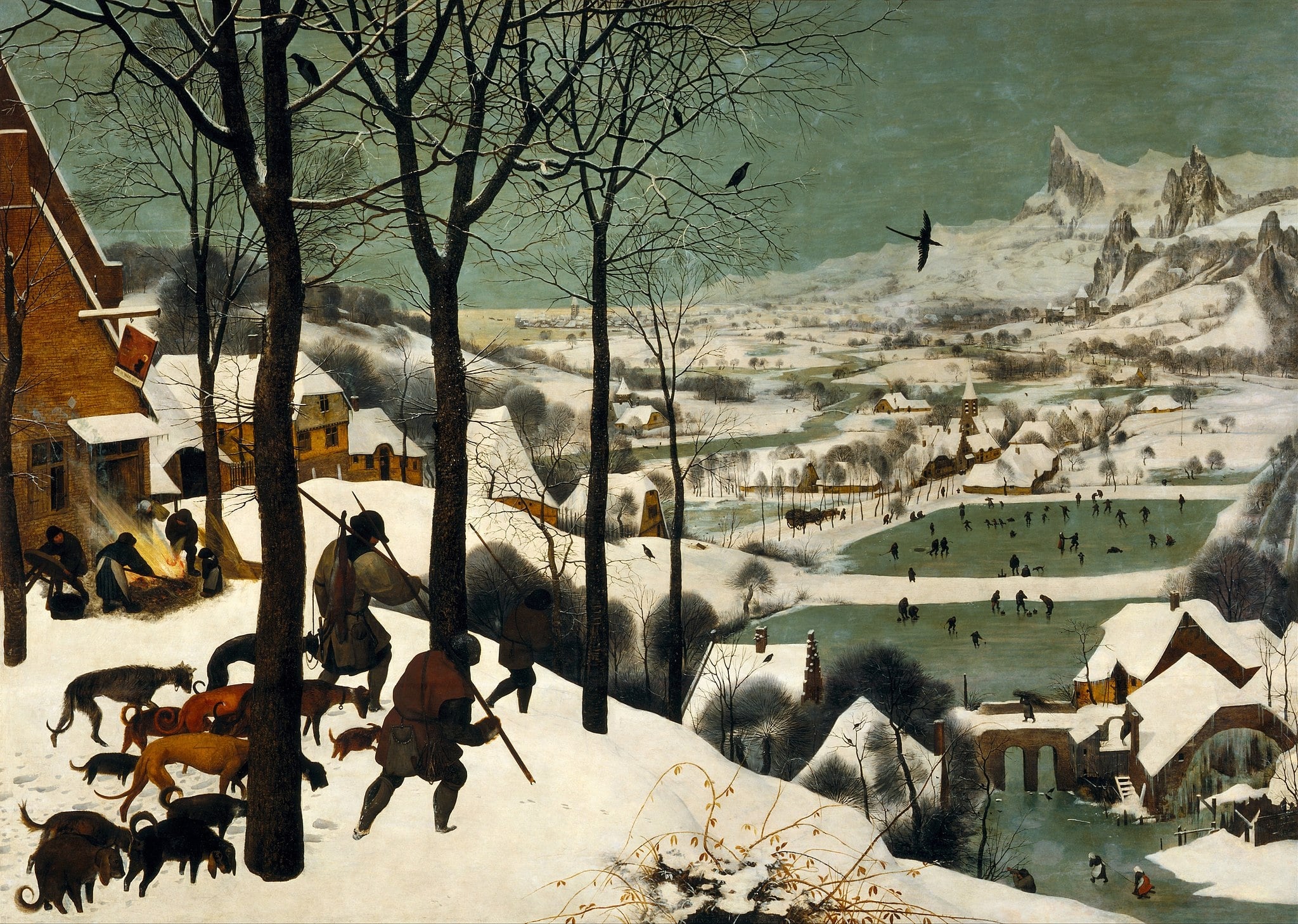
Hunters in the Snow
Pieter Bruegel the Elder (1565)
In Pieter Bruegel the Elder’s <strong>Hunters in the Snow</strong> (1565), a trio of tired hunters and <strong>gaunt dogs</strong> descend past an inn toward a vast frozen valley where villagers <strong>work, play, and endure</strong>. Bruegel fuses <strong>winter scarcity</strong> (a single fox, bare trees, crows) with <strong>communal resilience</strong> (pig-singeing fire, skaters, mill smoke) to stage a world ordered by the season’s cycle.
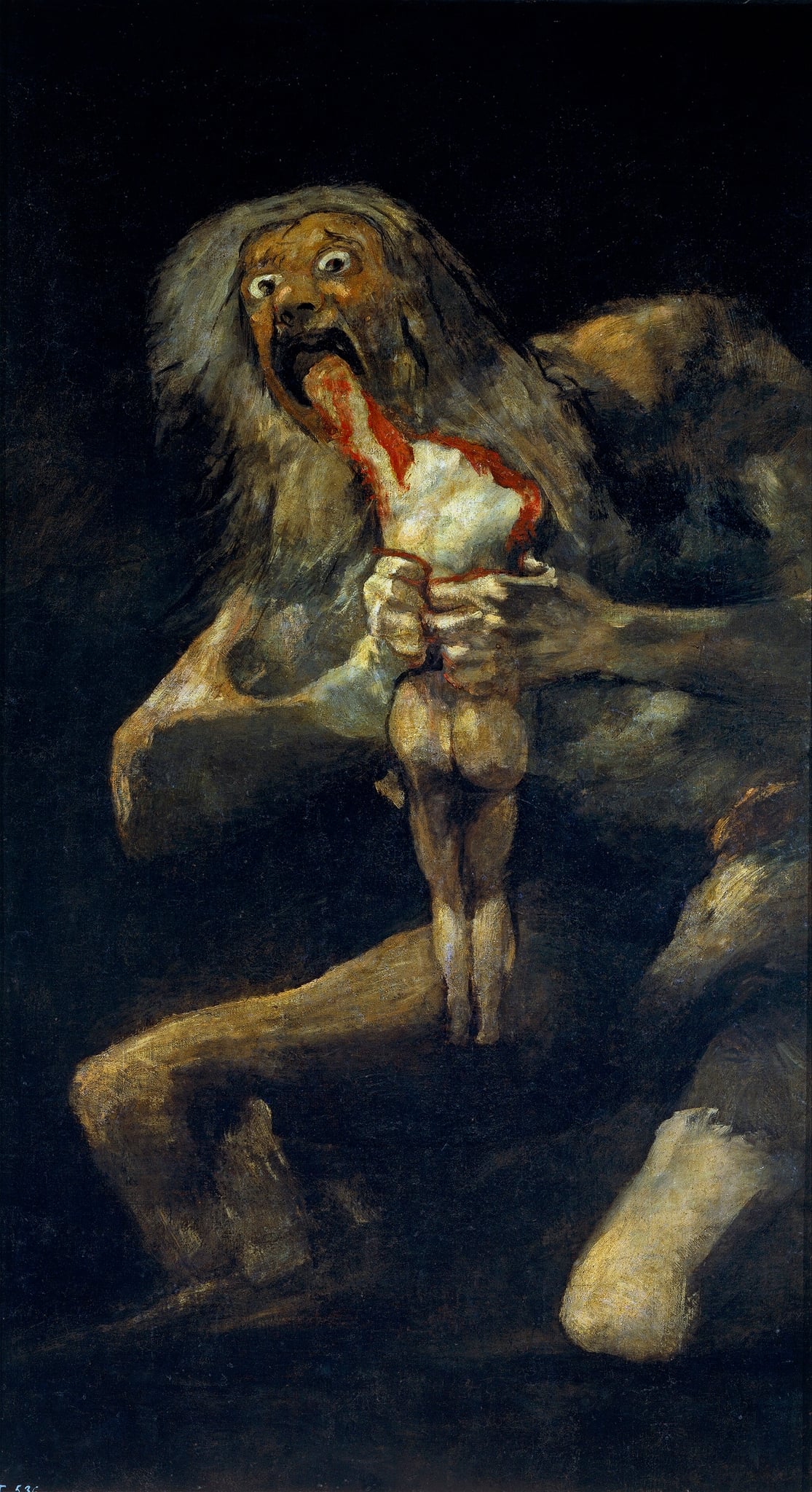
Saturn Devouring His Son
Francisco Goya (1820–1823)
Goya’s Saturn Devouring His Son distills myth into a raw vision of <strong>paranoia, power, and time</strong>: a giant crouches in darkness, eyes blown wide, tearing into a headless body whose blood streaks his hands. Stripped of classical emblems and staged in a near-black void, the scene asserts that fear of dispossession turns paternal authority into <strong>self-consuming violence</strong> <sup>[1]</sup><sup>[4]</sup>.
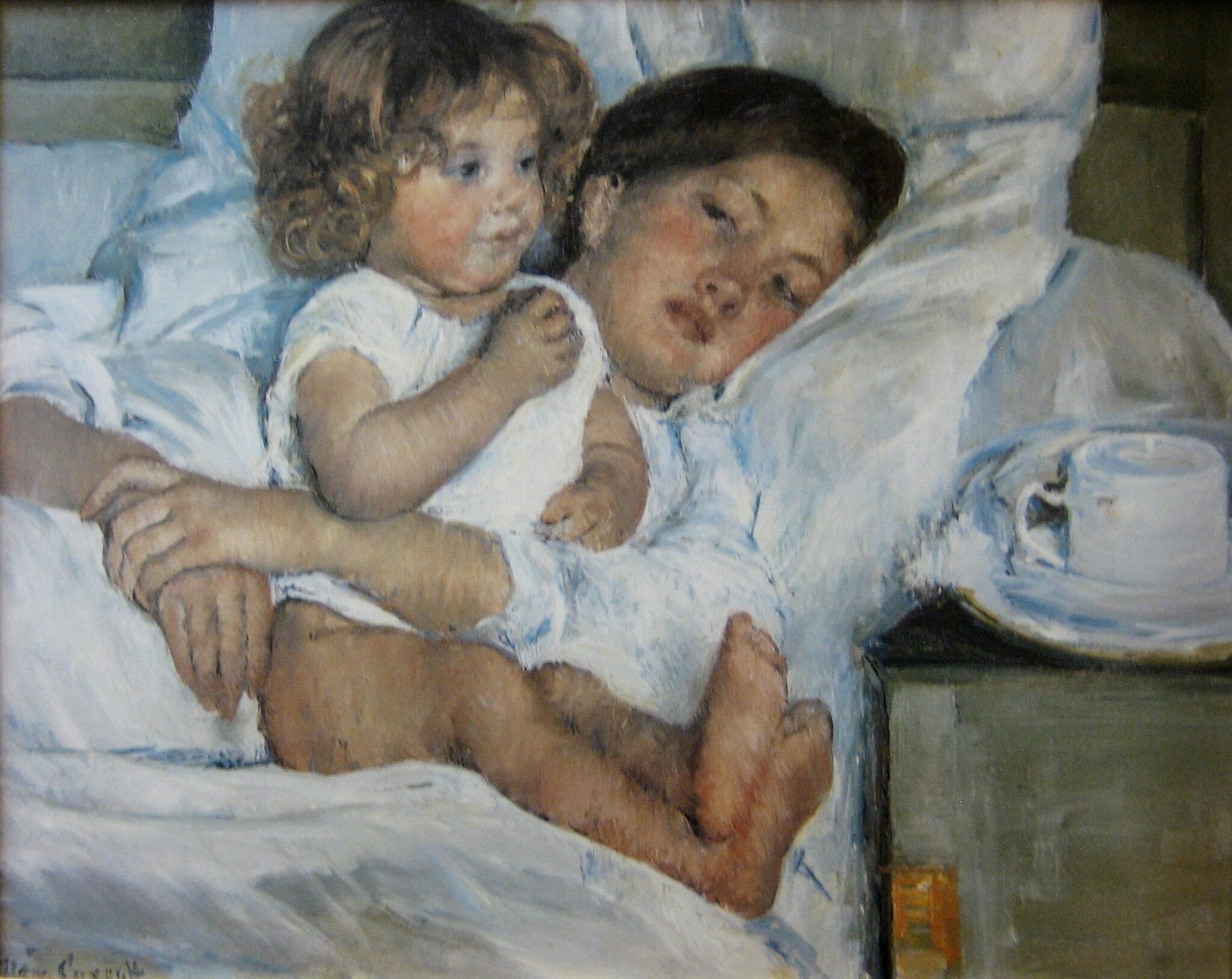
Breakfast in Bed
Mary Cassatt (1897)
Breakfast in Bed distills a <strong>tender modern intimacy</strong> into a tightly cropped sanctuary of rumpled white linens, protective embrace, and interrupted routine. Mary Cassatt uses <strong>cool light</strong> against <strong>warm flesh</strong> to anchor attention on the mother’s encircling arm and the child’s outward gaze, fusing care, curiosity, and the rhythms of <strong>everyday modern life</strong> <sup>[1]</sup><sup>[2]</sup>.
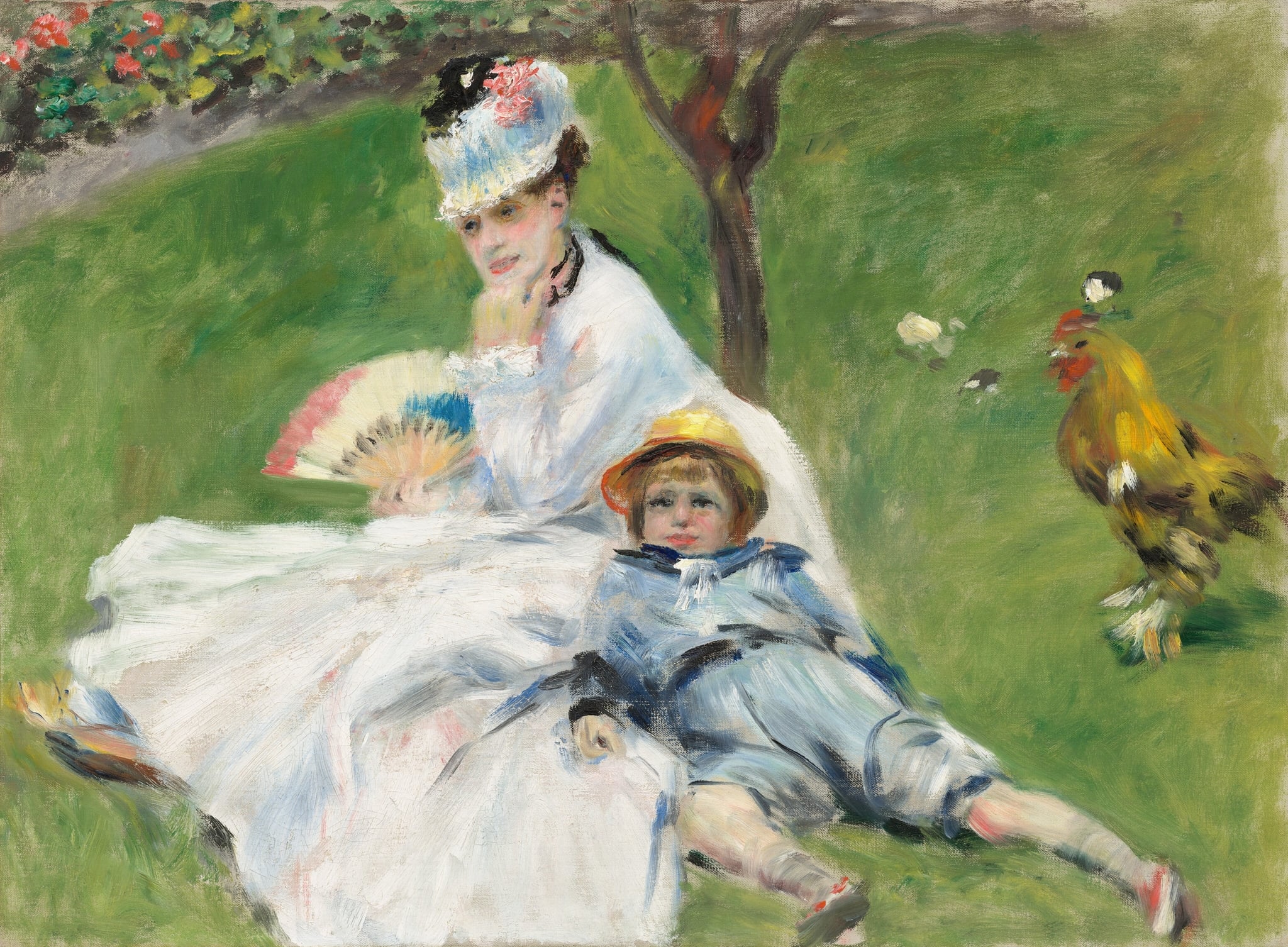
Madame Monet and Her Son
Pierre-Auguste Renoir (1874)
Renoir’s 1874 canvas Madame Monet and Her Son crystallizes <strong>modern domestic leisure</strong> and <strong>plein‑air immediacy</strong> in Argenteuil. A luminous white dress pools into light while a child in a pale‑blue sailor suit reclines diagonally; a strutting rooster punctuates the greens with warm color. The brushwork fuses figure and garden so the moment reads as <strong>lived, not staged</strong> <sup>[1]</sup><sup>[2]</sup><sup>[5]</sup>.
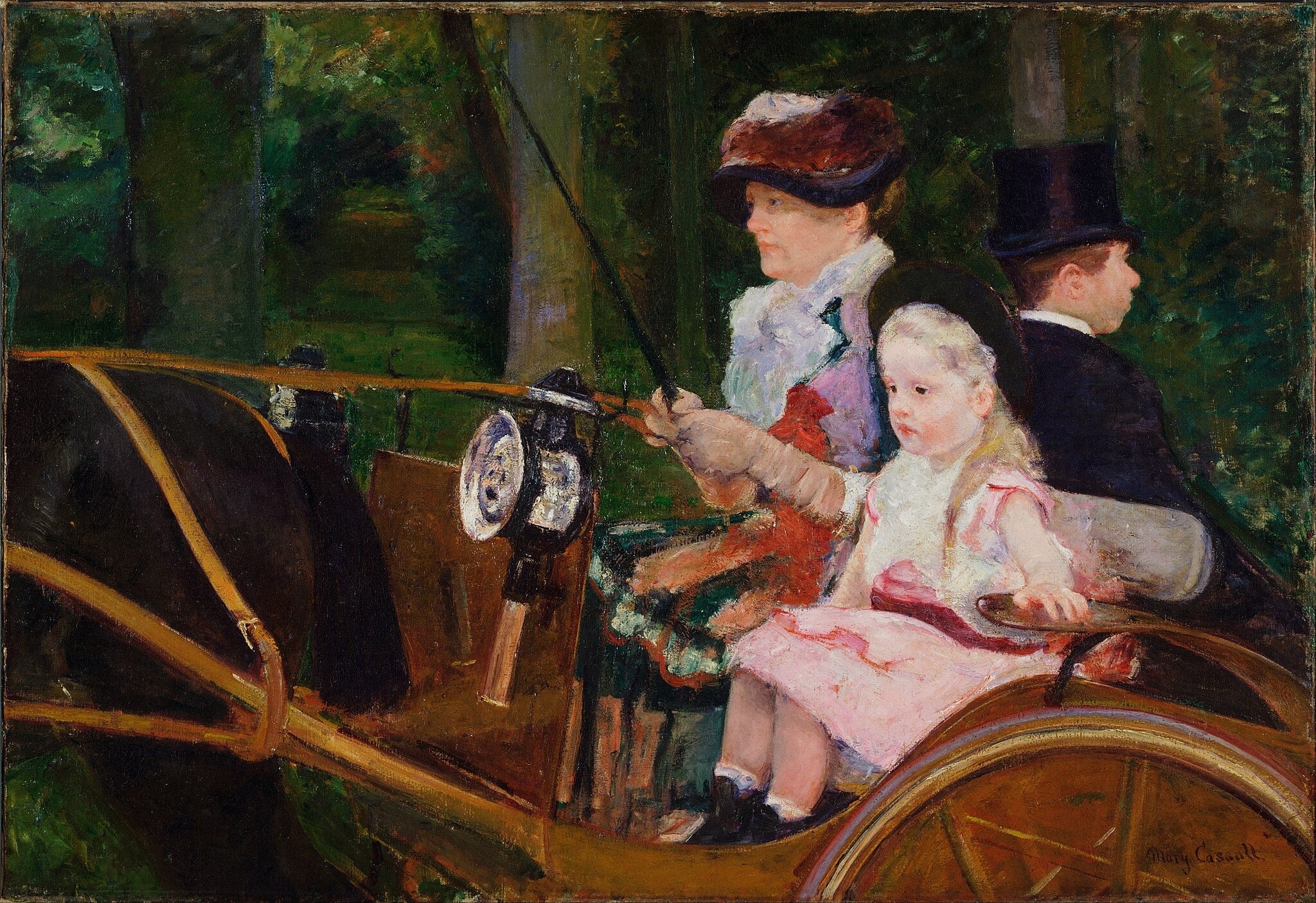
A Woman and a Girl Driving
Mary Cassatt (1881)
Cassatt stages a modern scene of <strong>female control</strong> in motion: a woman grips the reins and whip while a girl beside her mirrors the pose, and a groom seated behind looks away. The cropped horse and diagonal harness thrust the carriage forward, placing viewers inside a public outing in the Bois de Boulogne—an arena where visibility signaled status and autonomy <sup>[1]</sup><sup>[2]</sup>.
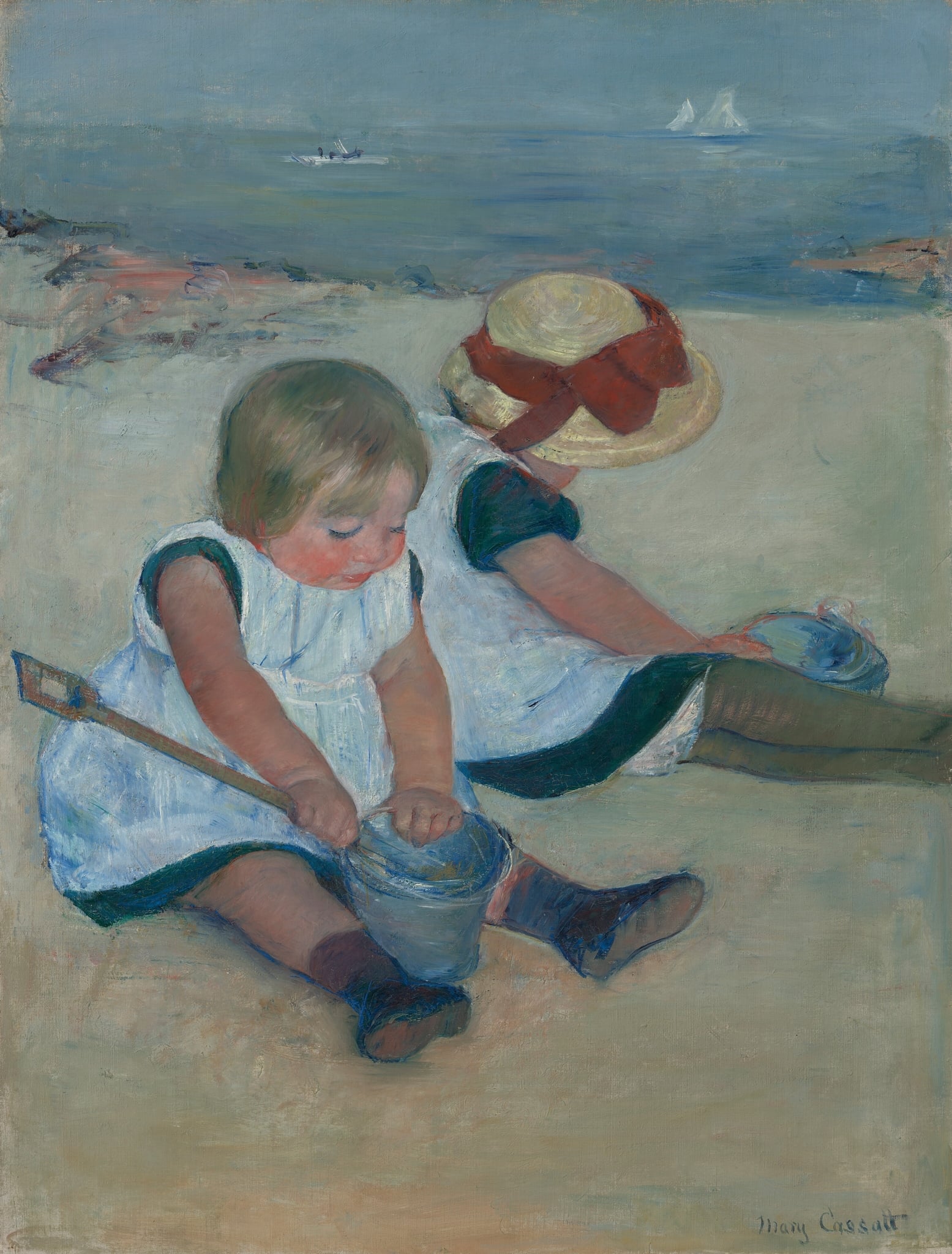
Children Playing on the Beach
Mary Cassatt (1884)
In Children Playing on the Beach, Mary Cassatt brings the viewer down to a child’s eye level, granting everyday play the weight of <strong>serious, self-contained work</strong>. The cool horizon and tiny boats open onto <strong>modern space and possibility</strong>, while the cropped, tilted foreground seals us inside the children’s focused world <sup>[1]</sup>.
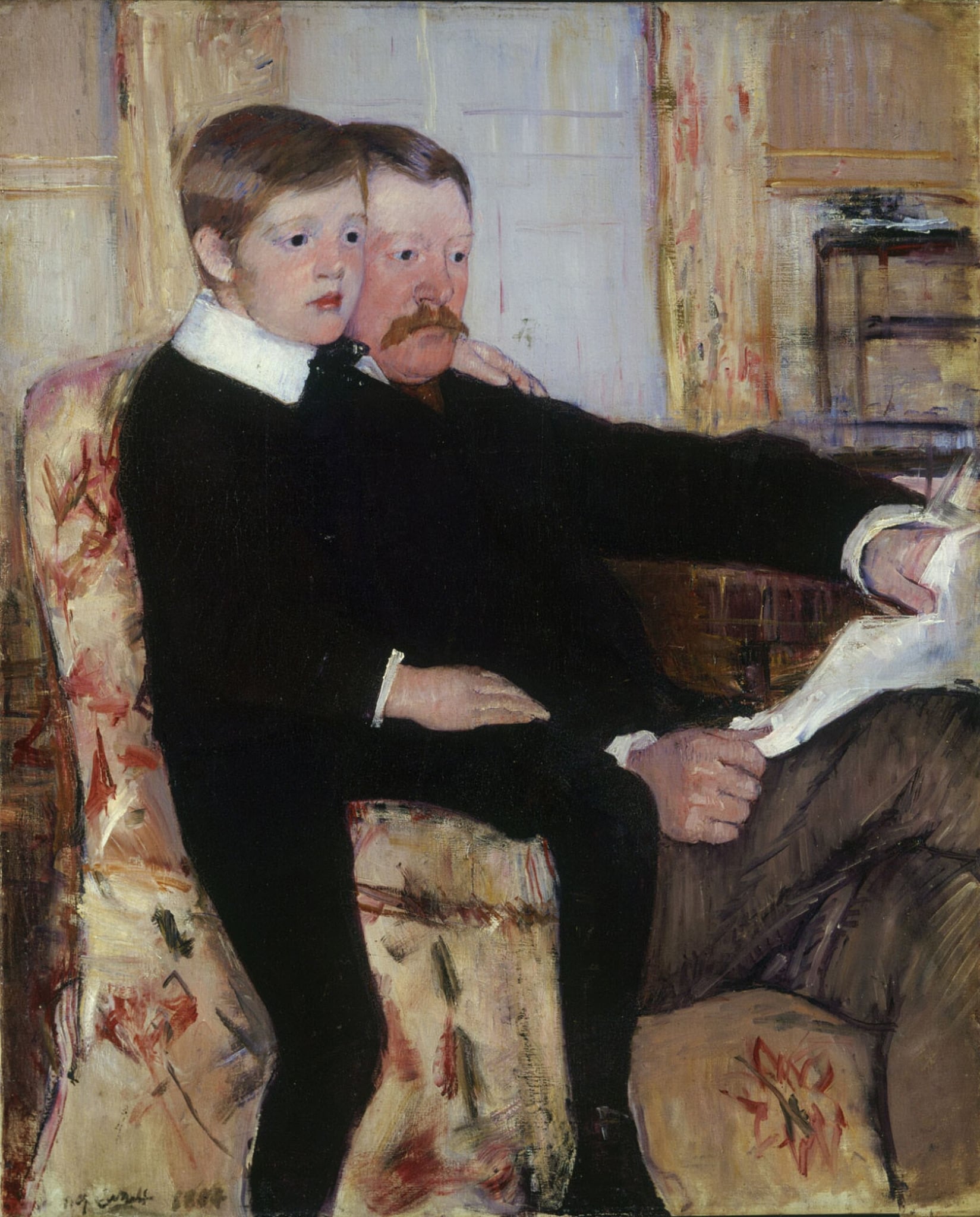
Portrait of Alexander J. Cassatt and His Son Robert Kelso Cassatt
Mary Cassatt (1884)
A quiet, domestic tableau becomes a study in <strong>authority tempered by affection</strong>. In Portrait of Alexander J. Cassatt and His Son Robert Kelso Cassatt, Mary Cassatt fuses father and child into a single dark silhouette against a luminous, brushed interior, their shared gaze fixed beyond the frame. The <strong>newspaper</strong>, <strong>linked hands</strong>, and <strong>cropped closeness</strong> transform a routine moment into a symbol of generational continuity and modern attentiveness.
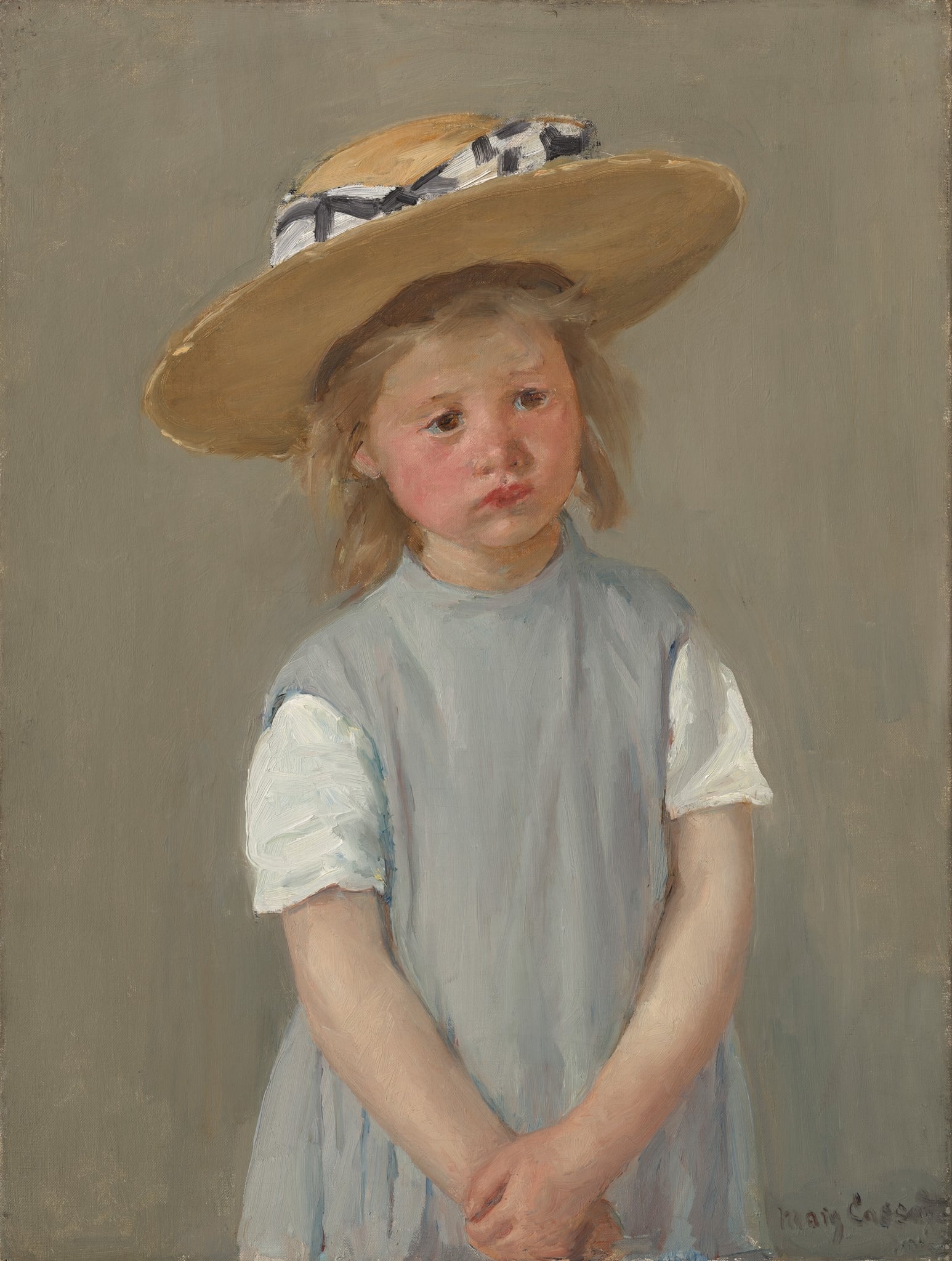
Little Girl in a Big Straw Hat and a Pinafore
Mary Cassatt (c. 1886)
Mary Cassatt’s Little Girl in a Big Straw Hat and a Pinafore distills childhood into a quiet drama of <strong>interiority</strong> and <strong>constraint</strong>. The oversized straw hat and plain pinafore bracket a flushed face, downcast eyes, and <strong>clasped hands</strong>, turning a simple pose into a study of modern self‑consciousness <sup>[1]</sup>. Cassatt’s cool grays and swift, luminous strokes make mood—not costume—the subject.
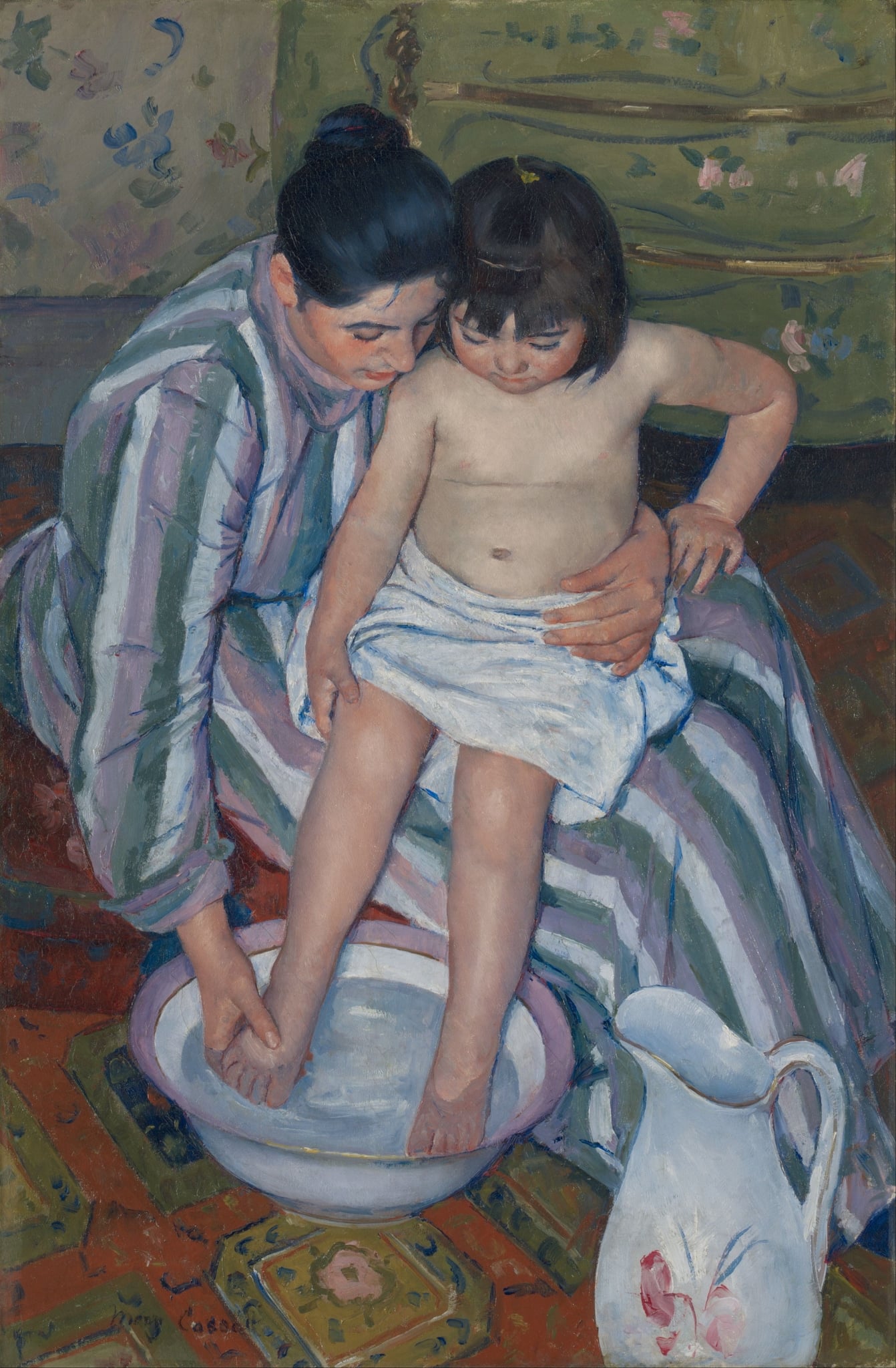
The Child's Bath
Mary Cassatt (1893)
Mary Cassatt’s The Child’s Bath (1893) recasts an ordinary ritual as <strong>modern devotion</strong>. From a steep, print-like vantage, interlocking stripes, circles, and diagonals focus attention on <strong>touch, care, and renewal</strong>, turning domestic labor into a subject of high art <sup>[1]</sup><sup>[3]</sup>. The work synthesizes Impressionist sensitivity with <strong>Japonisme</strong> design to monumentalize the private sphere <sup>[1]</sup><sup>[2]</sup>.
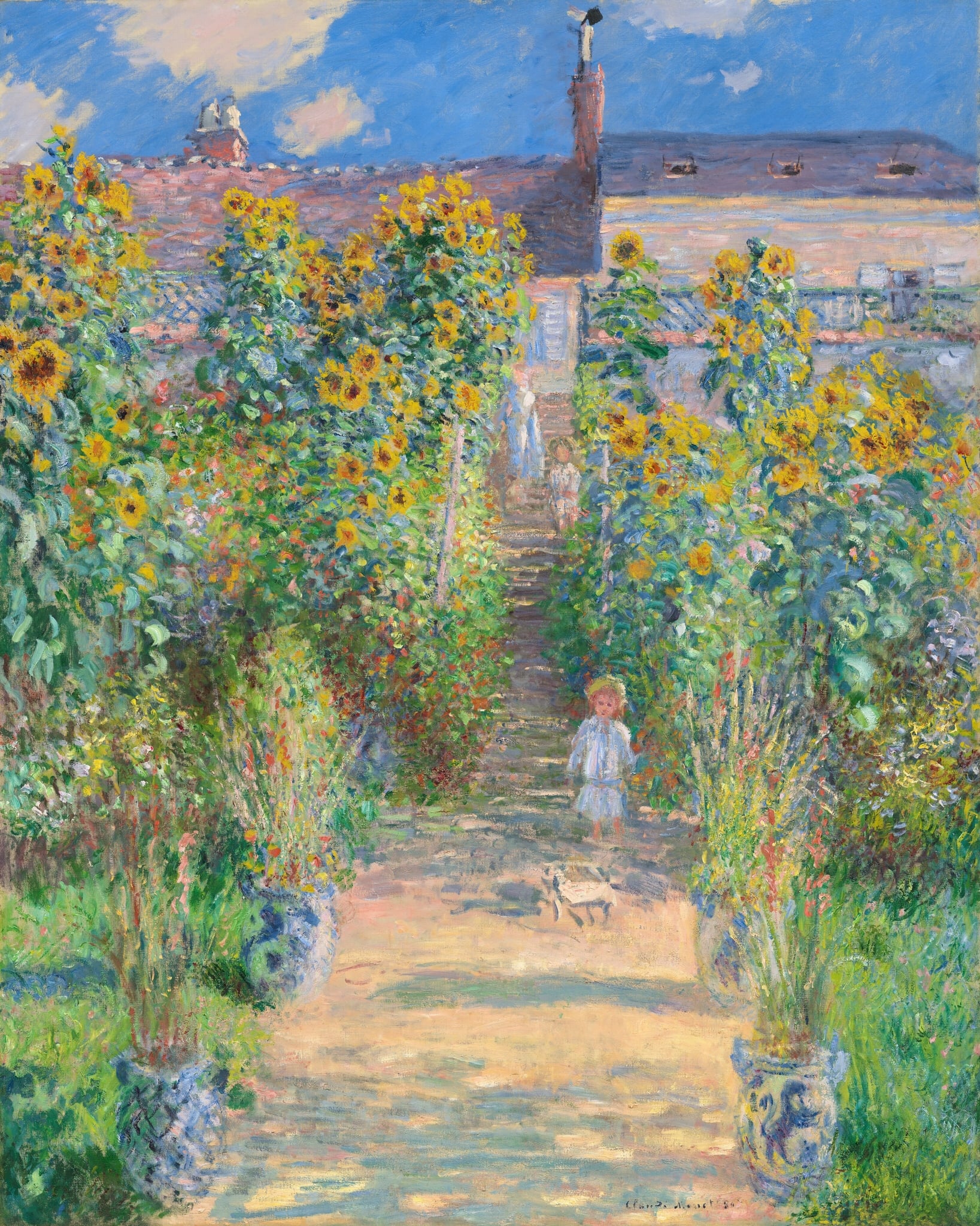
The Artist's Garden at Vétheuil
Claude Monet (1881)
Claude Monet’s The Artist’s Garden at Vétheuil stages a sunlit ascent through a corridor of towering sunflowers toward a modest house, where everyday life meets cultivated nature. Quick, broken strokes make leaves and shadows tremble, asserting <strong>light</strong> and <strong>painterly surface</strong> over linear contour. Blue‑and‑white <strong>jardinieres</strong> anchor the foreground, while a child and dog briefly pause on the path, turning the garden into a <strong>domestic sanctuary</strong> <sup>[1]</sup><sup>[2]</sup>.
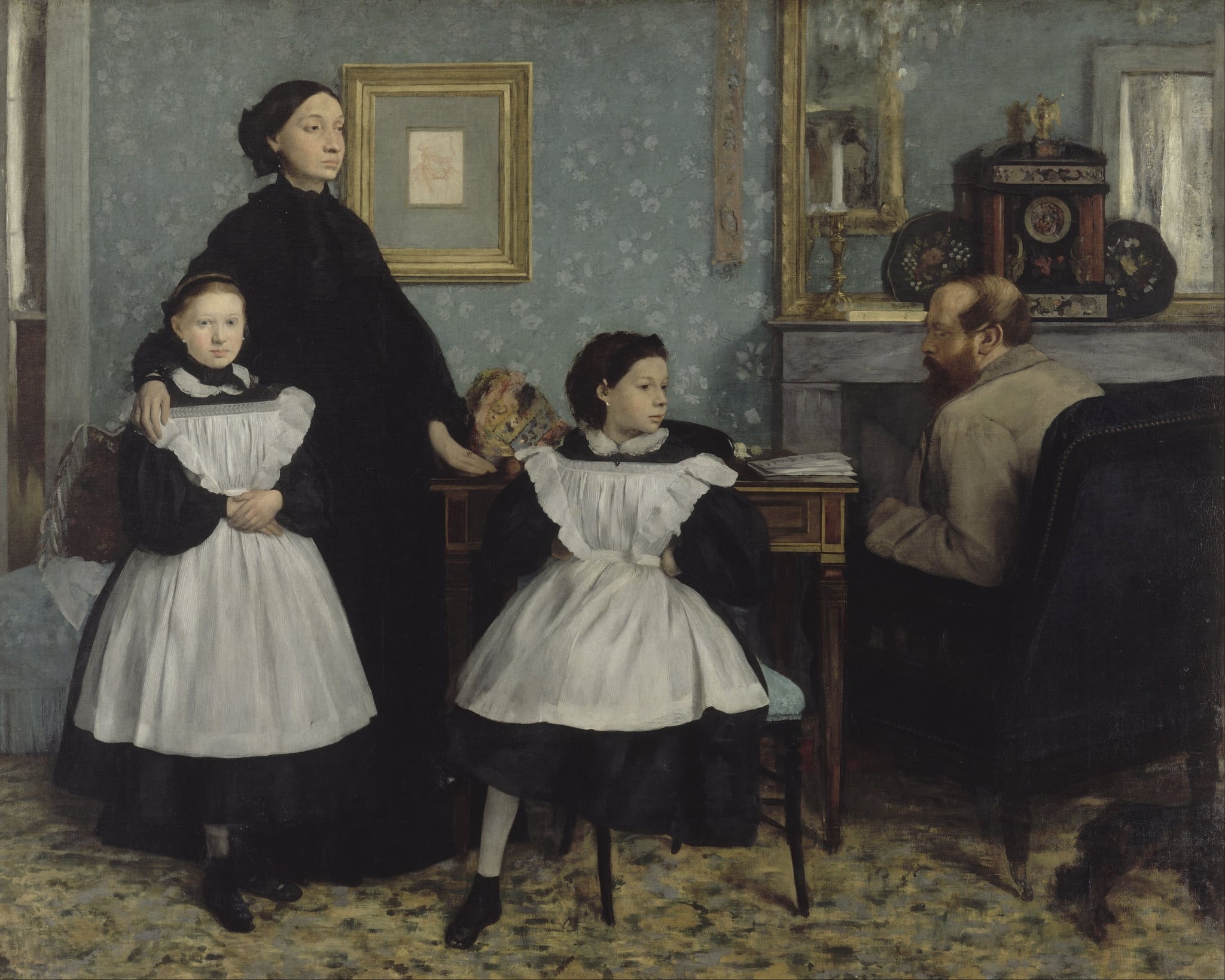
The Bellelli Family
Edgar Degas (1858–1869)
In The Bellelli Family, Edgar Degas orchestrates a poised domestic standoff, using the mother’s column of <strong>mourning black</strong>, the daughters’ <strong>mediating whiteness</strong>, and the father’s turned-away profile to script roles and distance. Rigid furniture lines, a gilt <strong>clock</strong>, and the ancestor’s red-chalk portrait create a stage where time, duty, and inheritance press on a family held in uneasy equilibrium.
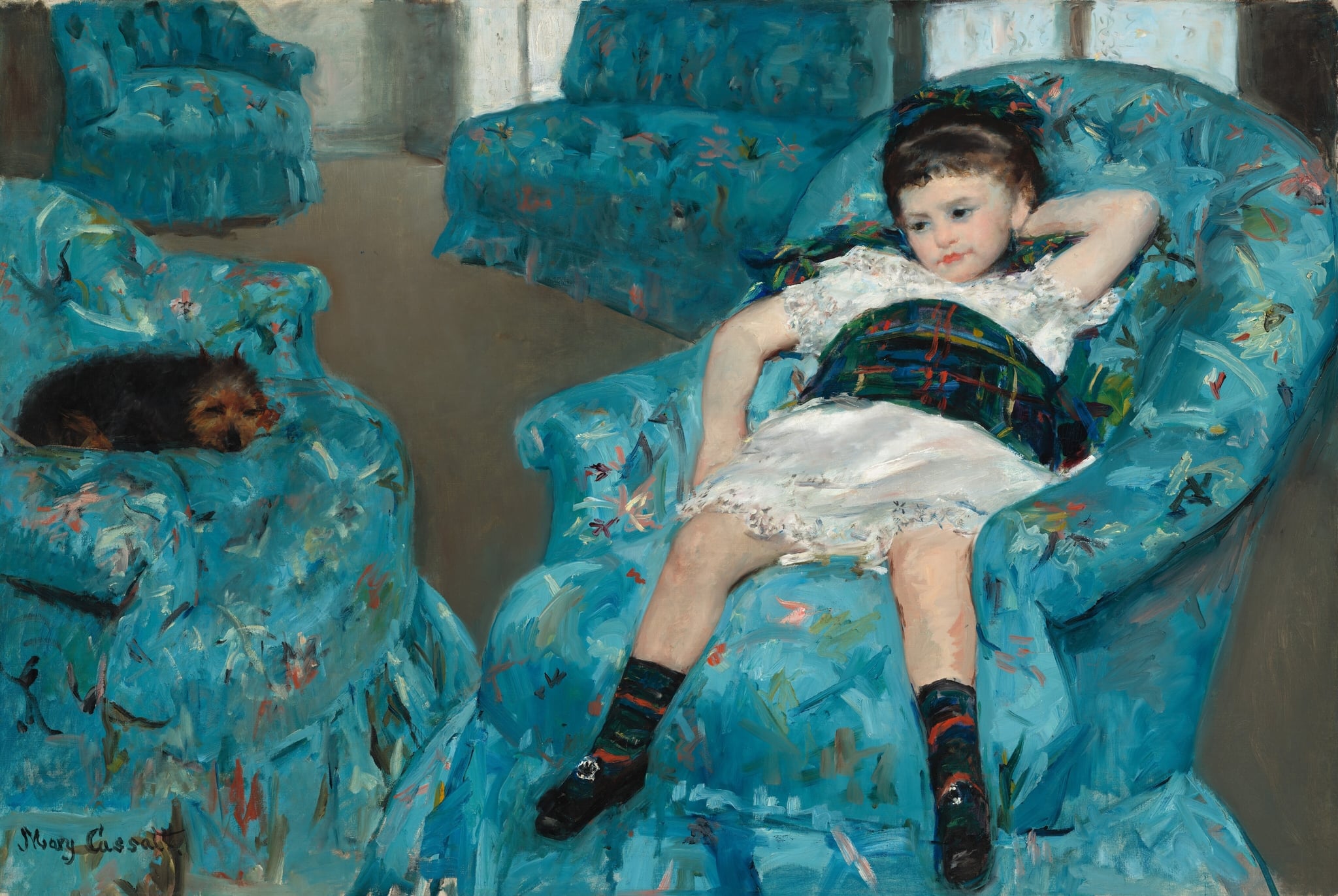
Little Girl in a Blue Armchair
Mary Cassatt (1878)
Mary Cassatt’s Little Girl in a Blue Armchair renders a child slumped diagonally across an oversized seat, surrounded by a flotilla of blue chairs and cool window light. With brisk, broken strokes and a skewed recession, Cassatt asserts a modern, unsentimental view of childhood—bored, autonomous, and <strong>out of step with adult decorum</strong> <sup>[1]</sup><sup>[4]</sup>. Subtle collaboration with <strong>Degas</strong> in the background design sharpens the picture’s daring spatial thrust <sup>[2]</sup>.
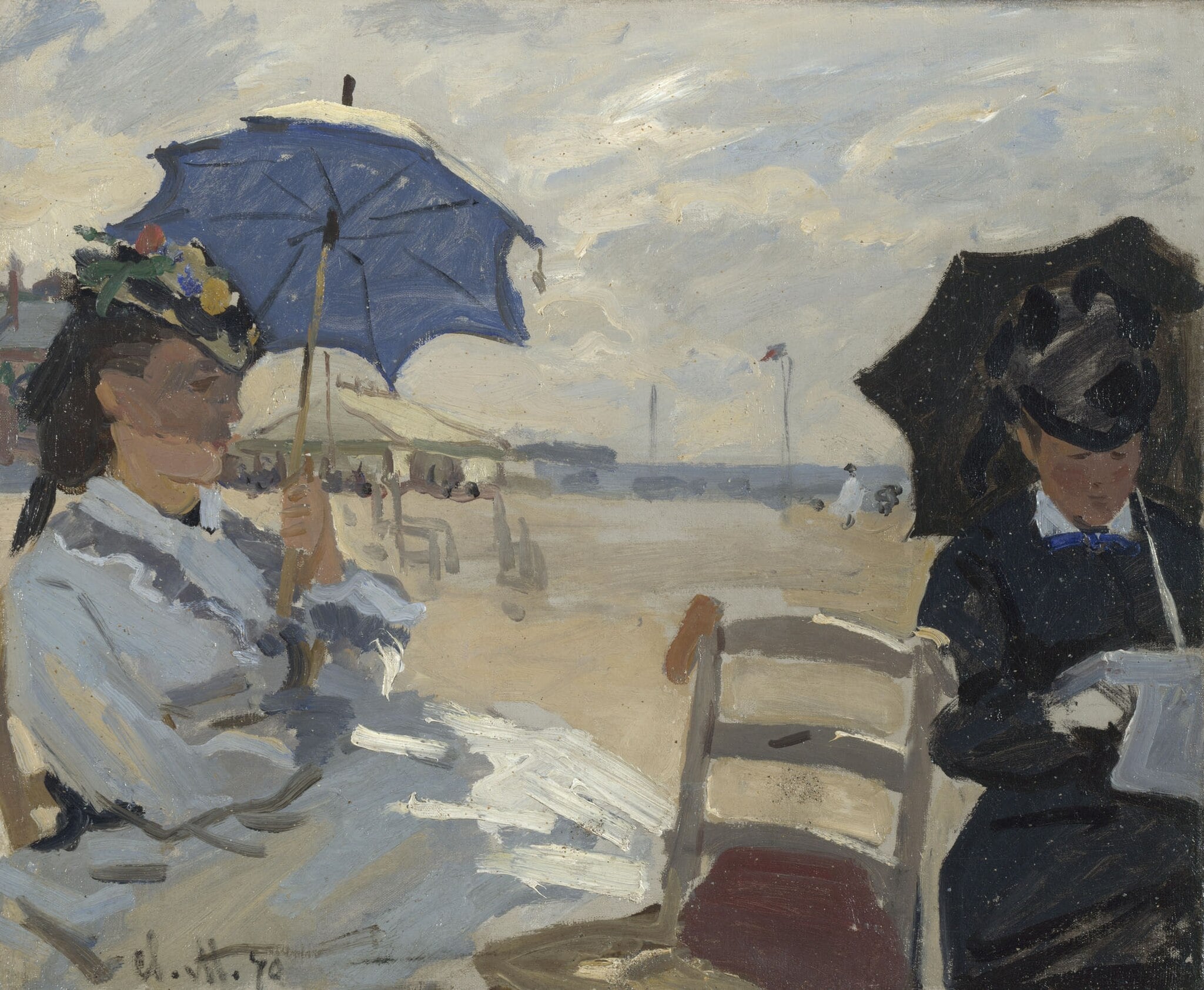
The Beach at Trouville
Claude Monet (1870)
Claude Monet’s The Beach at Trouville captures a wind-bright instant of <strong>modern leisure</strong> on the Normandy coast. Two women sit close to the viewer beneath a <strong>blue</strong> and a <strong>black parasol</strong>, their poses anchored against a hazy horizon where sea and sky fuse. Brisk strokes, embedded <strong>grains of sand</strong>, and snapshot-like <strong>cropping</strong> turn weather and time itself into the subject <sup>[1]</sup>.
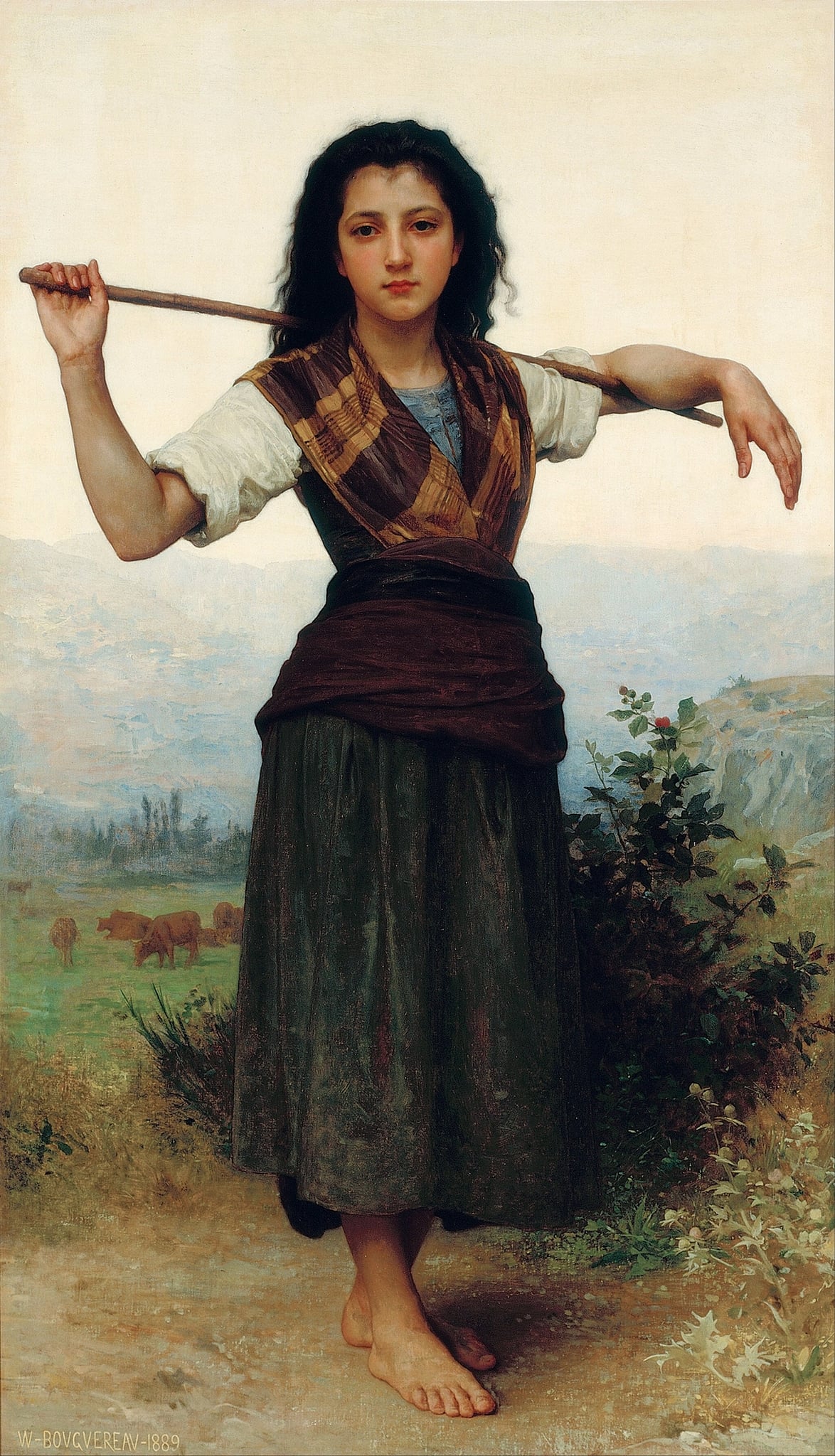
The Shepherdess
William-Adolphe Bouguereau (1889)
The Shepherdess presents a barefoot country girl frontally, her staff resting across her shoulders as she meets the viewer’s gaze with calm resolve. Bouguereau fuses <strong>rustic reality</strong> (earth‑stained feet, worn skirt, grazing cattle) with <strong>classical idealization</strong> (polished skin, poised contrapposto), elevating humble labor into quiet nobility <sup>[1]</sup><sup>[2]</sup>.
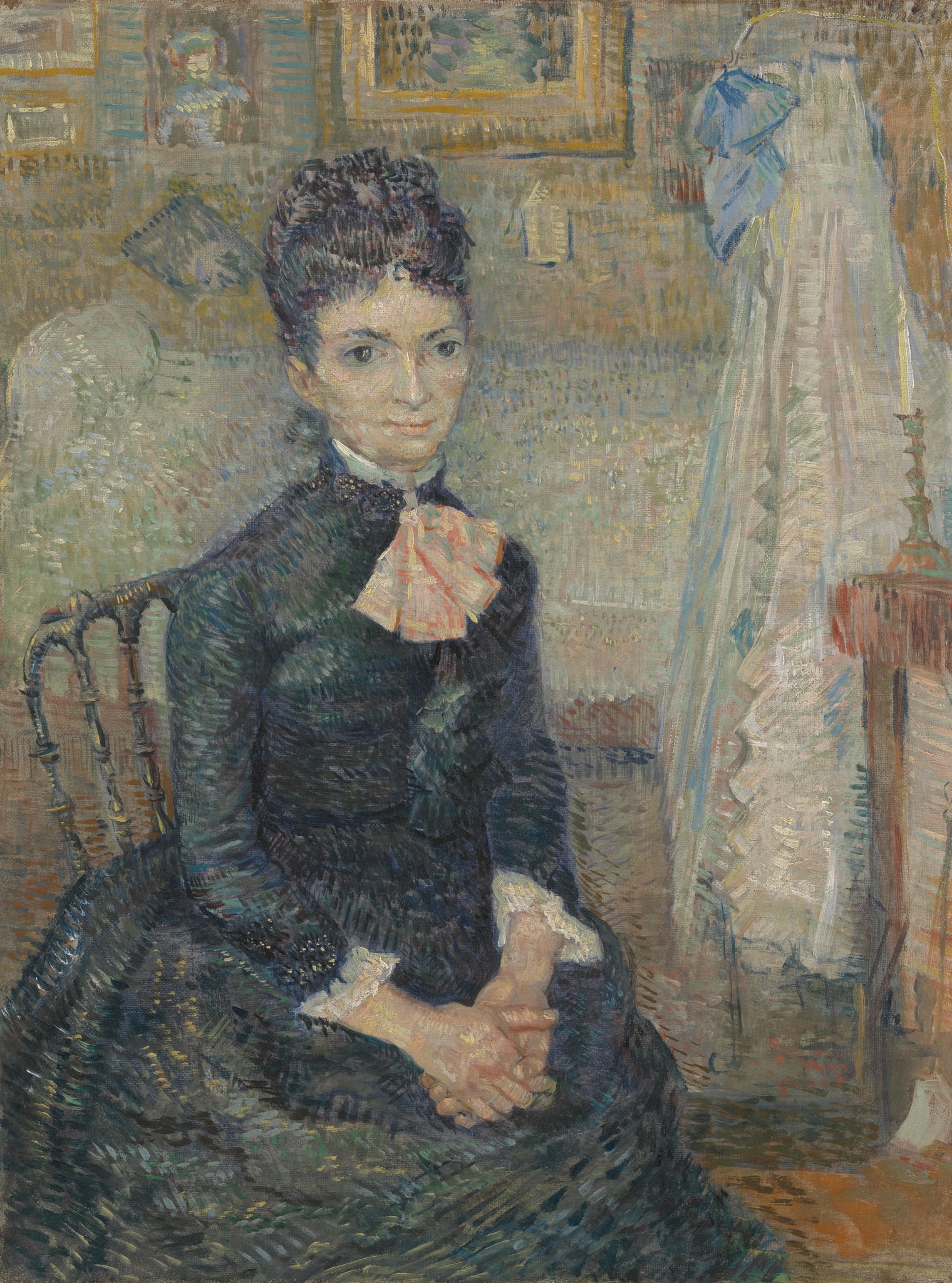
Portrait of Léonie Rose Charbuy-Davy
Vincent van Gogh (1887)
Vincent van Gogh’s Portrait of Léonie Rose Charbuy-Davy stages a composed, middle-class interior where a seated woman’s folded hands and dark blue-green dress meet a tremulous field of short, vibrating strokes. The cradle, fireplace glow, and dotted facture refract her poised exterior through <strong>modern, experimental color and touch</strong> <sup>[1]</sup><sup>[3]</sup>. The result is a portrait of <strong>maternal identity</strong> as much as a likeness, anchored by the hearth and cradle yet unsettled by the flicker of the paint itself <sup>[1]</sup>.
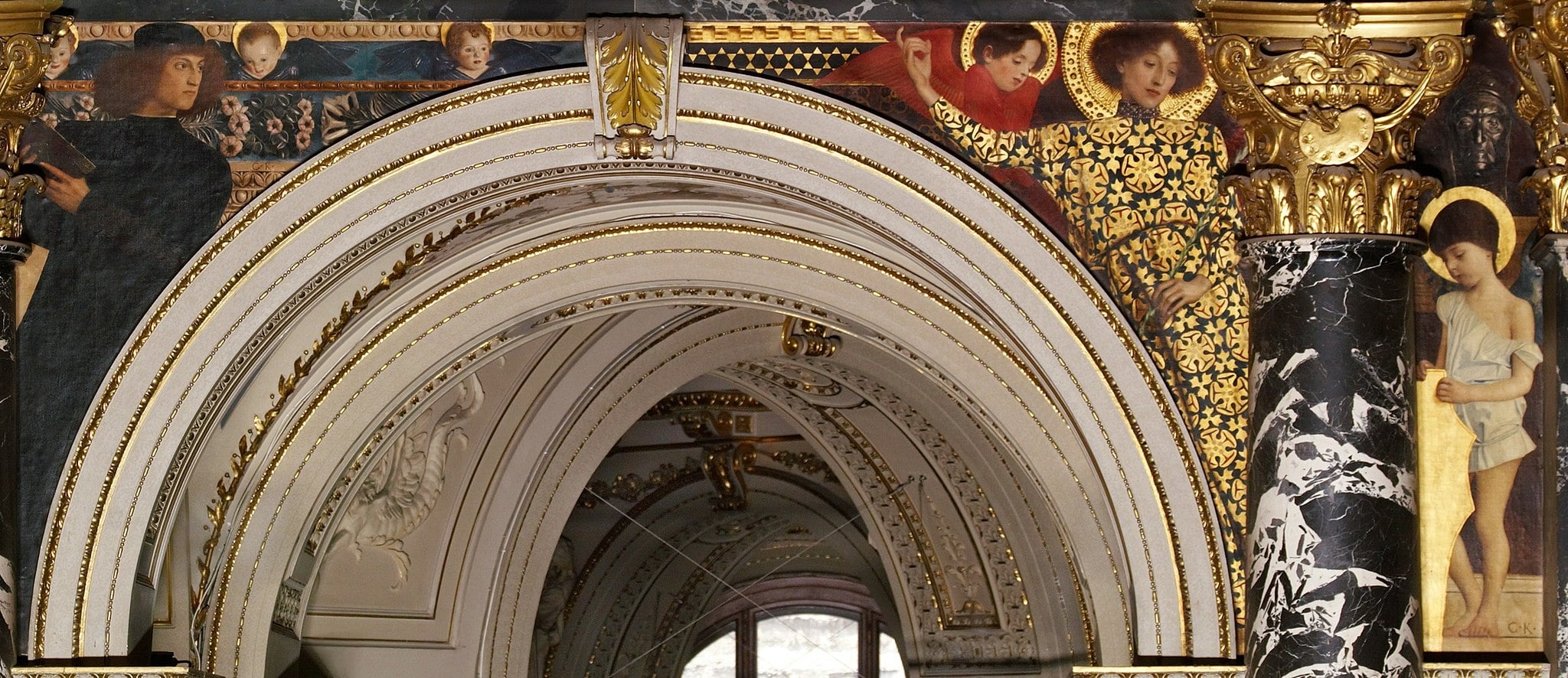
Old Italian Art
Gustav Klimt (1891)
Gustav Klimt’s <strong>Old Italian Art</strong> (1891) crowns the Kunsthistorisches Museum’s grand staircase with a shimmering allegory of trecento–quattrocento culture. A Florentine <strong>reader</strong>, a <strong>haloed</strong> saint-like figure in brocaded gold, putti, and a bust of <strong>Dante</strong> articulate a lineage of learning and piety, all fused to the building’s gilded architecture. Klimt’s patterned textiles and hovering angels already signal his move from Ringstraße historicism toward a <strong>decorative modern</strong> vision <sup>[1]</sup><sup>[2]</sup>.
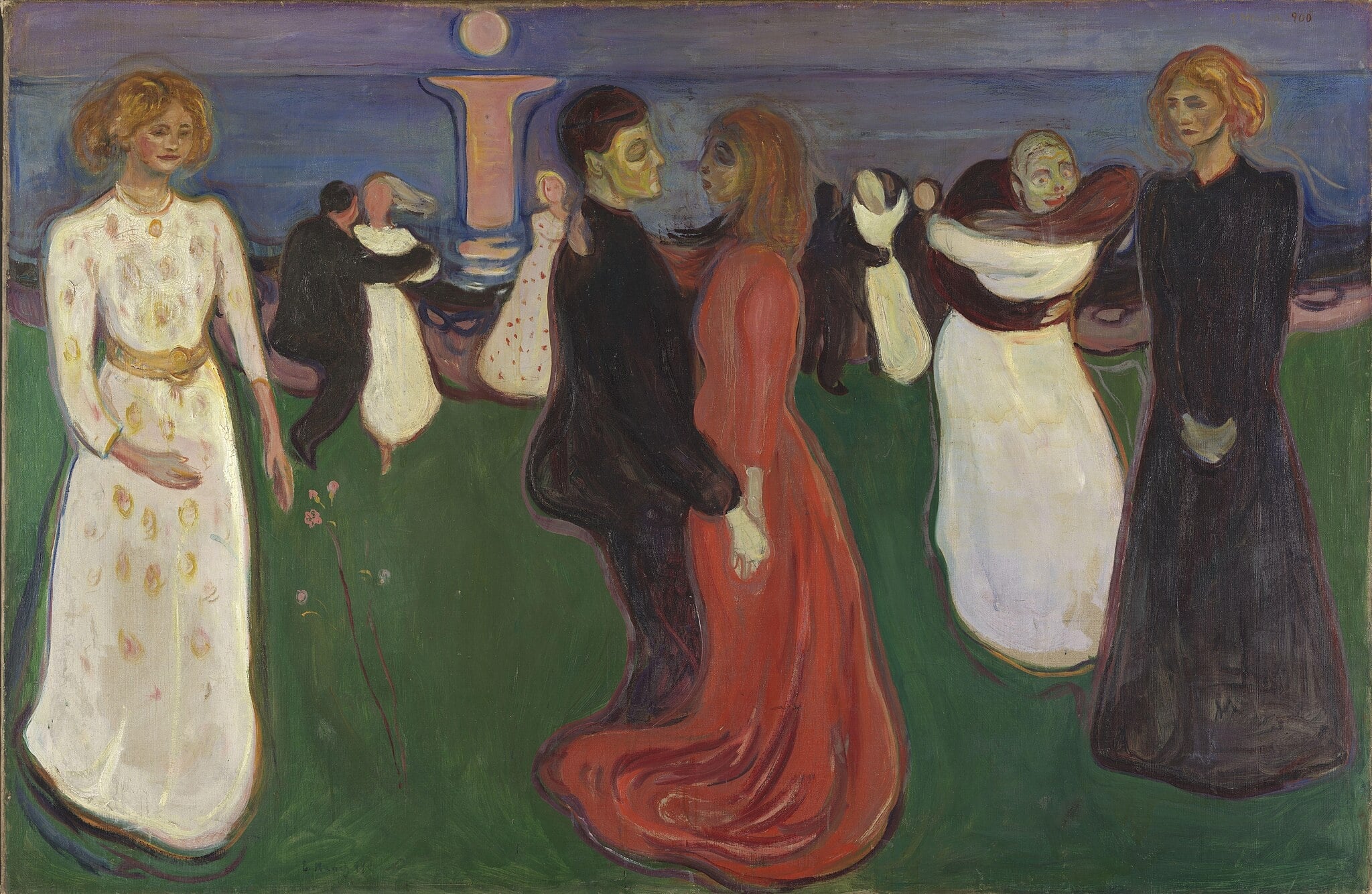
The Dance of Life
Edvard Munch (1899–1900)
The Dance of Life compresses <strong>youth, passion, and renunciation</strong> into a single moonlit scene on the Åsgårdstrand shore. A pale girl in white, a red‑clad woman entwined with a dark-suited man, and a withdrawn figure in black form a symbolic arc that binds love to <strong>time and mortality</strong> <sup>[1]</sup><sup>[2]</sup>.
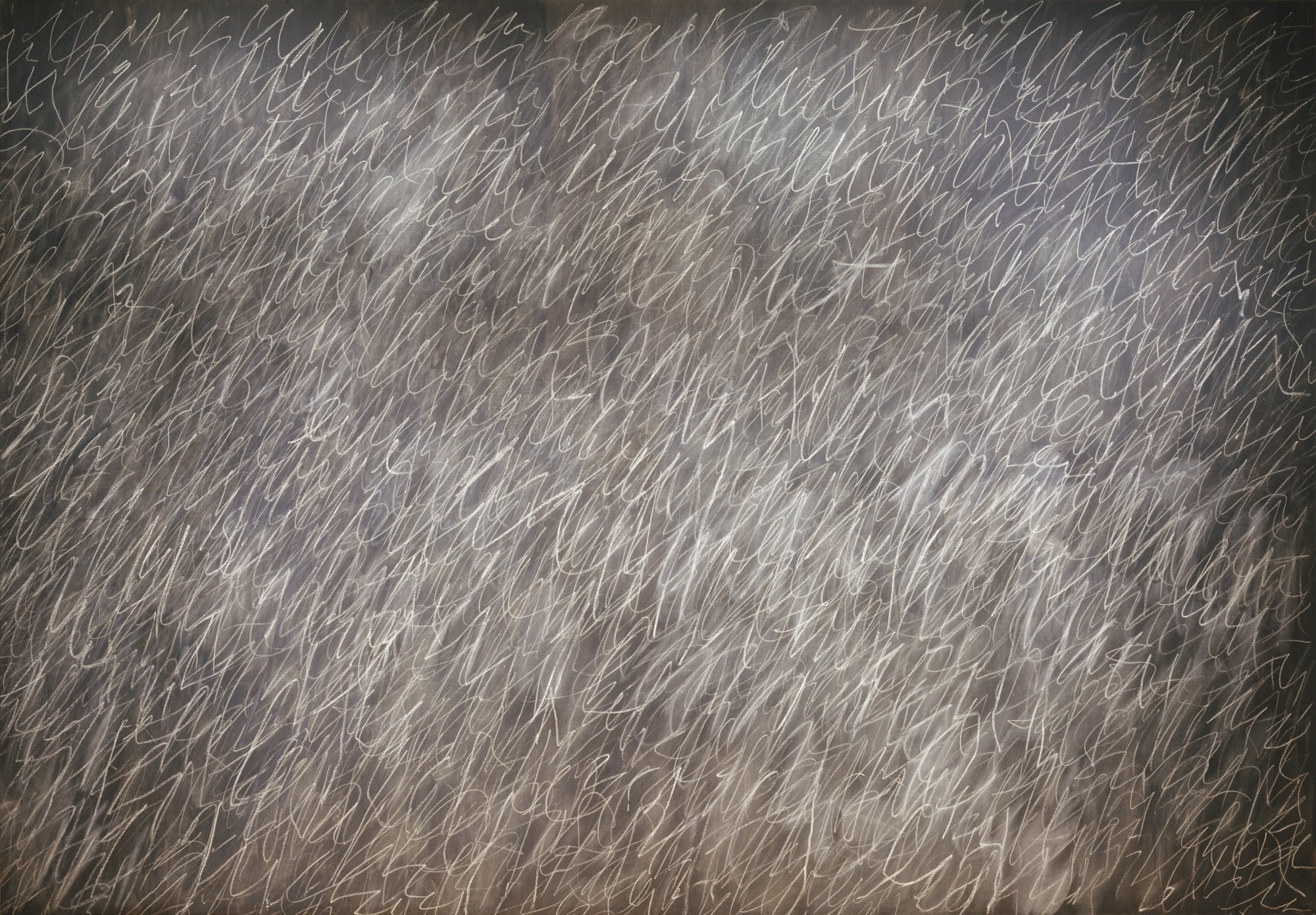
Blackboard
Cy Twombly (1968)
Blackboard stages <strong>writing without words</strong>: looping, chalk‑like lines sweep diagonally across a smoky gray field, rehearsing language as pure rhythm. Twombly turns the schoolroom slate into a <strong>theater of inscription</strong>, where repetition, erasure, and breath register as the true subject <sup>[1]</sup><sup>[2]</sup>.
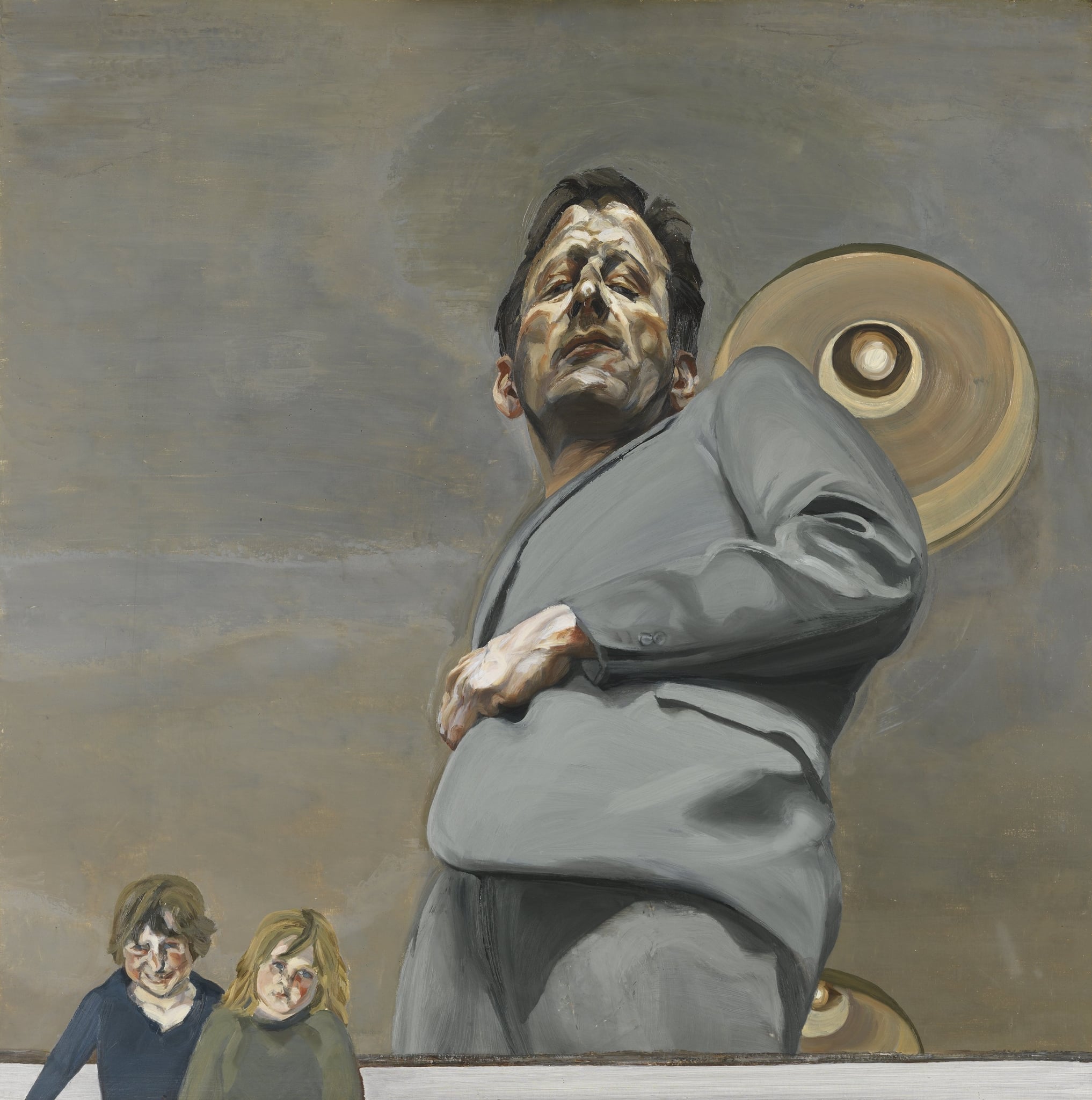
Reflection with Two Children
Lucian Freud (1965)
Lucian Freud’s Reflection with Two Children stages a self‑portrait as a confrontation with a mirror placed on the floor, forcing a vertiginous, low viewpoint. A suited figure looms while a ceiling lamp hovers like a disc behind his head, and two small children puncture the frame at the bottom edge. The painting converts self‑representation into a drama of <strong>authority</strong>, <strong>exposure</strong>, and <strong>accountability</strong> <sup>[1]</sup><sup>[2]</sup>.
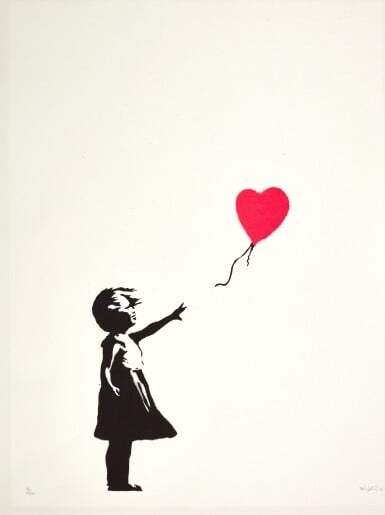
Girl with Balloon
Banksy (2002 (street motif); 2004–2005 (screenprint editions))
A lone, stenciled child reaches toward a bright red, heart-shaped balloon drifting into the blank field—an image that compresses <strong>hope</strong>, <strong>loss</strong>, and <strong>resilience</strong> into a single gesture. The monochrome figure and the one note of red make Girl with Balloon a portable emblem that moves easily from the street to prints and global campaigns <sup>[1]</sup><sup>[2]</sup>.
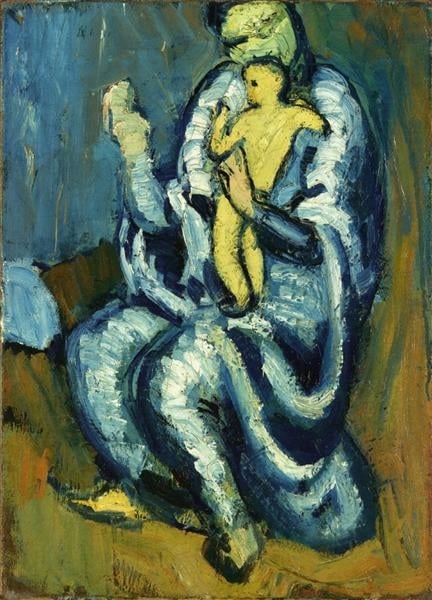
Motherhood (La Maternité)
Pablo Picasso (1903)
Motherhood (La Maternité) condenses a mother and child into a near-monument, the woman’s body forged from sweeping bars of blue and white that form a protective shell. The child’s <strong>ocher warmth</strong> glows against the cold field, a fragile ember of life amid austerity. The image declares <strong>care as architecture</strong> and frames tenderness as resistance.
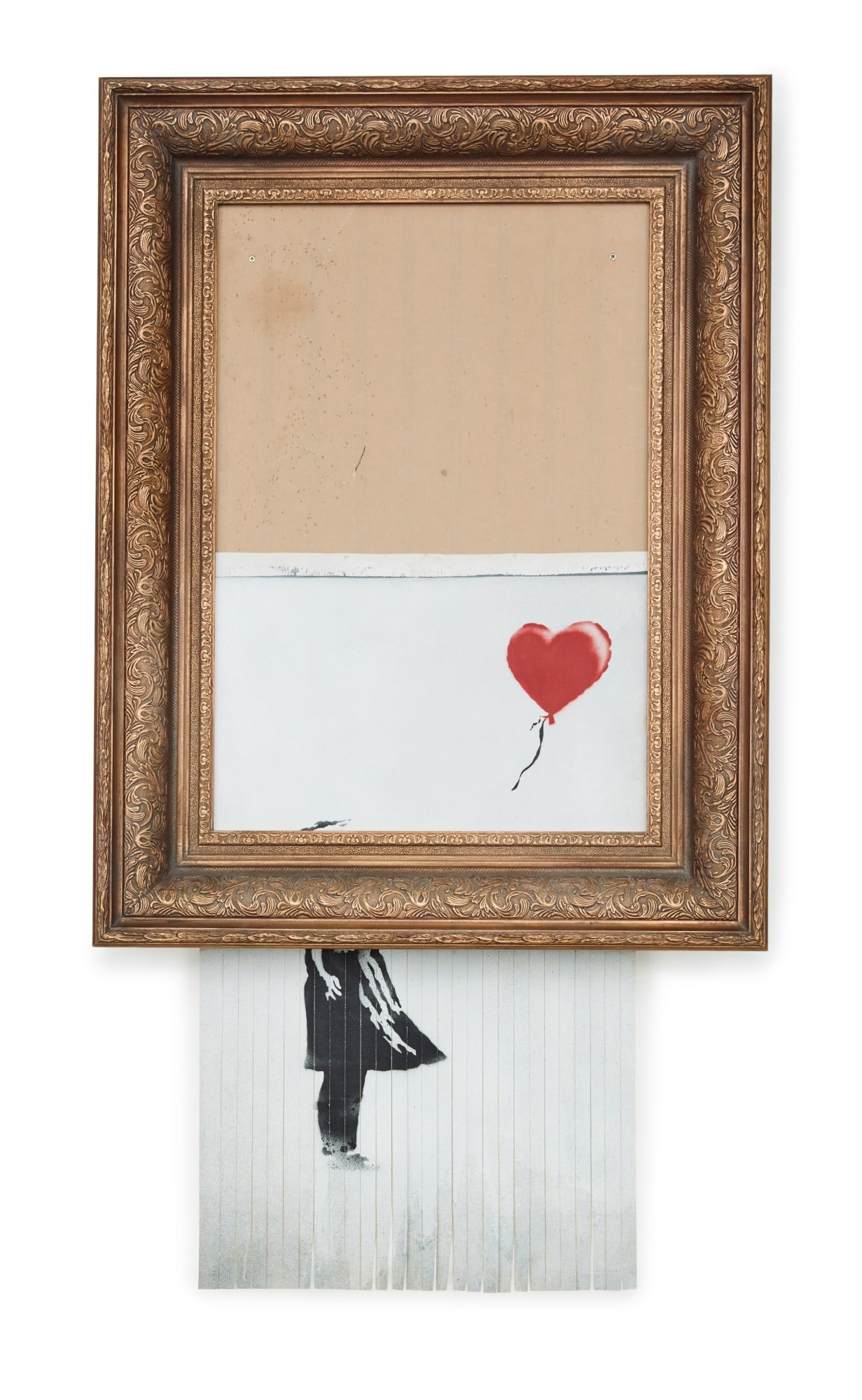
Love is in the Bin
Banksy (2018)
Banksy’s Love is in the Bin turns a familiar image into a live act of <strong>institutional critique</strong>: the ornate frame that normally guarantees value becomes a machine of <strong>auto‑destruction</strong>. The red, heart‑shaped balloon floats intact in a pale field while the lower half—showing the girl—hangs in vertical shreds, freezing the second when symbol survives but subject is sacrificed <sup>[1]</sup><sup>[3]</sup>. The work asserts that in contemporary art, <strong>spectacle and framing</strong> can fabricate value as surely as craftsmanship.
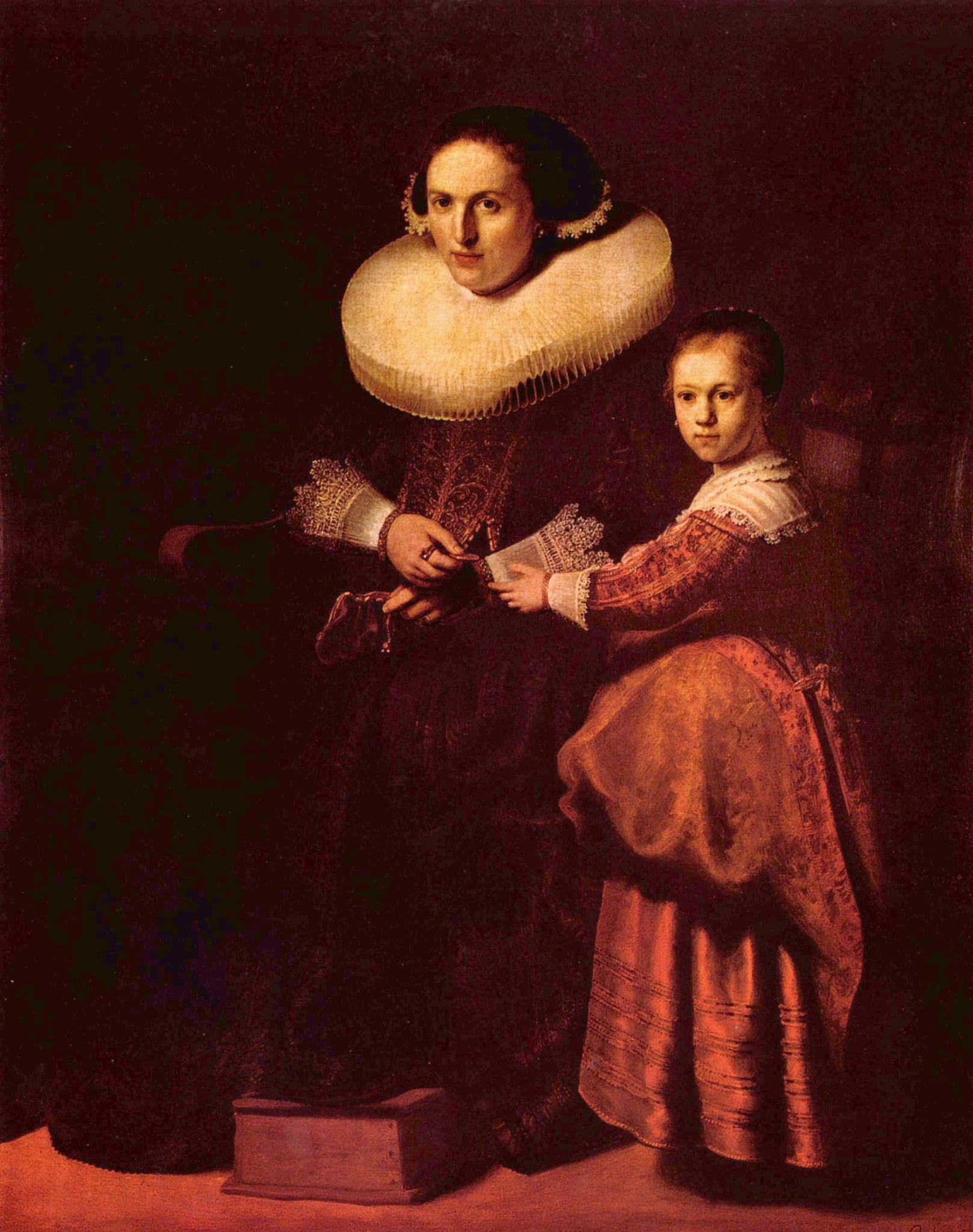
Portraits of Susanna van Collen and her Daughter Anna
Rembrandt van Rijn (c. 1632–33)
A mother and daughter step out of darkness, their faces, hands, and fabrics seized by Rembrandt’s <strong>chiaroscuro</strong>. The mother’s monumental <strong>ruff</strong> and sober black gown declare <strong>prosperity with restraint</strong>, while gloves, a clasped hand, and a book encode civility, lineage, and piety <sup>[1]</sup><sup>[4]</sup><sup>[5]</sup>.