Summertime

by Mary Cassatt

Mary Cassatt’s Summertime (1894) stages a quiet drama of attentive looking: a woman and a girl lean from a cropped boat toward two ducks as the lake flickers with broken color. Cassatt fuses Impressionism and Japonisme—no horizon, tipped perspective, and abrupt cropping—to press our gaze downward into light-spattered water. The result is an image of modern leisure that is also a study of perception itself [1].
💰

Market Value

$8-13 million

How much is Summertime worth?

Fast Facts

Year
1894
Medium
Oil on canvas
Dimensions
100.6 x 81.3 cm
Location
Terra Foundation for American Art, Chicago
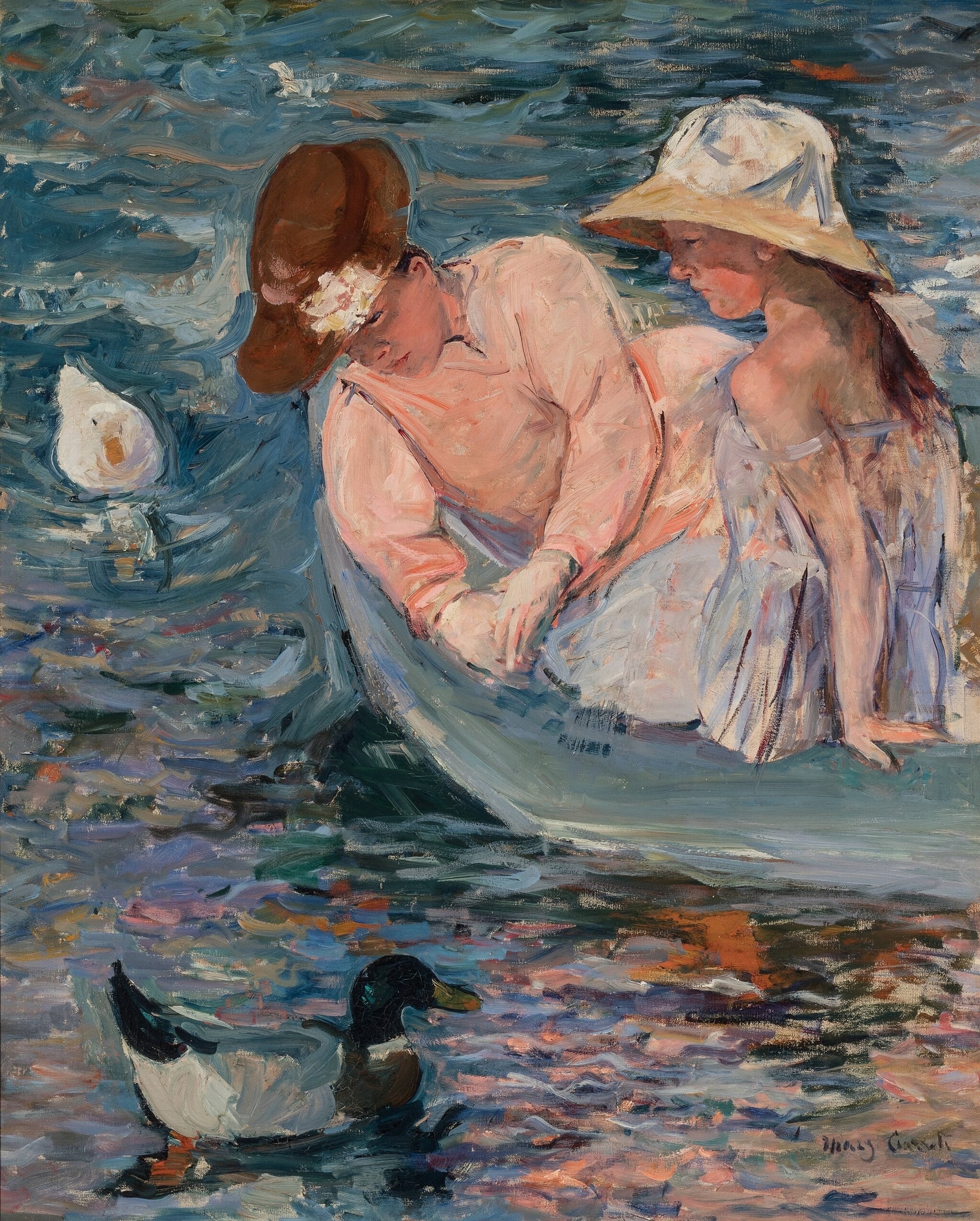
Summertime by Mary Cassatt (1894)

Click on any numbered symbol to learn more about its meaning

Meaning & Symbolism

Summertime composes a deliberate chain of attention. The woman in a brown hat bends from the skiff, her gloved hand poised near the gunwale; beside her, a girl in a sun dress with a loosened strap leans forward, both faces turned toward a pair of ducks skimming the surface. Cassatt crops the boat and eliminates the horizon so the canvas tilts up toward us; our eyes follow the diagonal of hull and bodies down to the dark‑headed duck at lower left. This tipped view, indebted to Ukiyo‑e prints Cassatt studied intensely in 1890, compresses depth and flattens the scene into layered patterns of water and light, transforming simple pastime into an exercise in looking—human attention mirrored by animal responsiveness 1. The water is not background but protagonist: long strokes of complementary blues, greens, oranges, and violets break across the surface, so the lake seems to scintillate and the paint’s facture reads as heat and glare. Cassatt’s unusually free brushwork for this period turns the sensation of summer—haze, shimmer, warmth—into the very grammar of the picture, aligning subject and surface so that perception becomes experience rather than description 1. Within this optical theater, Cassatt encodes a modern social script. The pairing is not two adults but a woman and a girl, their contrasting dress signaling decorum versus youthful looseness: hat, sleeves, and gloves against bare shoulders and a slipping strap. That contrast clarifies the scene’s gentle pedagogy—observation modeled and shared across generations—while the boat locates them in public, not parlor, space. In the 1890s this was a meaningful claim; Cassatt’s women act, watch, and occupy the outdoors without chaperone, countering the cliché of purely domestic femininity. The ducks serve as animate counterparts that activate the surface and invite empathetic attention, a motif Cassatt developed serially in her Beaufresne works, including the related color prints often titled Feeding the Ducks. Contemporary accounts note that at her country estate Cassatt observed guests boating on a tree‑lined pond with resident ducks and even installed a press nearby, iterating the motif across media—evidence that Summertime belongs to a deliberate cycle exploring how looking structures relation and care 34. Formally, the painting asserts a hybrid modernism. The cropped gunwale, the tipped plane, and the equal emphasis on figure and water trace directly to Cassatt’s engagement with Japanese prints; yet the high‑key palette and open‑air execution keep the work firmly in the Impressionist project of registering transient light. Terra Foundation curators call this one of her most freely brushed canvases, and that looseness is not decorative—it is meaning: the broken color both describes ripples and declares the canvas a vibrating field where time feels momentary and touch remains present. Read this way, the meaning of Summertime is twofold: it is a manifesto of perception—how to look with care—and an emblem of feminine modernity practiced in public leisure. Why Summertime is important is therefore historical as well as visual: painted the year Cassatt acquired Beaufresne and soon after her major mural and print experiments, it synthesizes her japoniste compositional intelligence with a renewed plein‑air vigor, inaugurating a mini‑series that includes a more distant sister canvas in Los Angeles and multiple prints. In compressing boat, bodies, birds, and water into a single shimmering surface, Cassatt gives modern life a form equal to its fleeting, humane attentions 12345.

Explore Deeper with AI

Ask questions about Summertime

Popular questions:

Powered by AI • Get instant insights about this artwork

💬 Ask questions about this artwork!

Interpretations

Serial Practice and Site-Specificity

Summertime belongs to a deliberate, site-based cycle developed at Cassatt’s newly purchased Beaufresne in 1894, where a tree‑lined pond and resident ducks became a laboratory for iterative variation 1. Christie’s records that Cassatt even installed a printing press near the water, moving fluidly between oil and color print experiments—evidence that the motif was worked out in situ and across media 3. Reading the Terra canvas alongside the related prints (often titled Feeding the Ducks) clarifies a serial logic: shifts in distance, cropping, and emphasis test how attention is choreographed among figures, birds, and water 14. Rather than a single pastoral, this is an on‑going inquiry into how looking is staged and shared, with the Los Angeles sibling painting expanding the experiment to a more distant vantage 2.

Source: Terra Foundation; Christie’s; The Met

Japonisme as Ethical Optics

Cassatt’s engagement with Ukiyo‑e after 1890 was not mere style-borrowing; it reorganized how spectatorship works in her paintings 12. The tipped plane, radical crop, and flattened, pattern-forward water recast depth into surface, compelling the viewer to adopt the figures’ downward gaze. This visual grammar models an ethics of attention—absorbed, non-possessive looking shared between woman, child, and animals. Recent reassessments of Cassatt’s practice emphasize such professional, strategic choices over sentiment, situating her Japonisme within a rigorous modernizing program rather than decorative taste 5. In Summertime, Japanese print strategies thus become engines of care: compositional devices that teach viewers to look with patience and reciprocity, aligning form with social conduct on the water’s glimmering skin 125.

Source: Terra Foundation; The Guardian (on PMA’s Mary Cassatt at Work)

Gendered Public Leisure and Modernity

Summertime claims outdoor leisure as a modern female sphere. The pairing—woman and girl—appears not as sentimental motherhood but as staged, model-based figures practicing shared spectatorship in a public setting 15. Terra’s emphasis on attire and setting signals classed propriety while rejecting the interior parlor; Cassatt’s women are active observers who command space and attention without male mediation. Such images revise the cliché of domestic confinement by showing how women engage modernity through public recreation and the labor of perception 1. Contemporary scholarship supports this reframing, stressing Cassatt’s professionalism and her construction of scenes that theorize women’s agency via looking, not just nurturing 5. The boat thus becomes a mobile platform of autonomy—an outdoor studio where vision, learning, and presence intersect 15.

Source: Terra Foundation; The Guardian (on PMA’s Mary Cassatt at Work)

Facture as Climate: Materializing Heat

Terra curators call this one of Cassatt’s most freely brushed canvases, and that looseness is conceptual, not cosmetic 1. Long, complementary strokes (greens/oranges, blues/reds) fracture the lake into a scintillating surface where paint equals glare, heat, and humidity. By eliminating the horizon and balancing figure and water, Cassatt fuses subject and surface so that sensation becomes structure: the paint’s vibration stands in for summer’s temporality—flicker, warmth, and passing breeze 12. This is Impressionism sharpened by japoniste design: a modern optics in which facture is climate, and climate is time. Summertime therefore operates as a micro‑manifesto for Impressionist immediacy, declaring that how the world is touched by the brush is inseparable from what the world feels like in the season named by the title 12.

Source: Terra Foundation

Animal Interlocutors and Empathy

The ducks are not props; they are interlocutors that complete the painting’s chain of attention. In the Terra canvas and related prints (Feeding the Ducks), the birds’ responsive movement externalizes curiosity and invites empathetic looking across species 14. Their agitation gives Cassatt a kinetic script to write in broken color, letting animal motion and water’s skin co-author the scene’s rhythm. By pairing a carefully dressed woman with a child of loosened strap, Cassatt triangulates decorum, play, and nonhuman life, suggesting that care is learned at the waterline where perception meets response 1. The print variants corroborate this reading, making the exchange explicit through the act of feeding; across media, the ducks secure a poetics of relation rather than dominance 14.

Source: Terra Foundation; The Met

Related Themes

About Mary Cassatt

Mary Cassatt (1844–1926) was an American painter who settled in Paris, exhibited with the Impressionists, and became a key conduit for introducing their art to U.S. collectors. After 1890 she adopted japoniste flatness, bold patterning, and strong design, focusing on modern women’s lives—especially mother‑and‑child subjects—until failing eyesight curtailed her work by 1914 [4].
View all works by Mary Cassatt

More by Mary Cassatt

Woman in Black at the Opera by Mary Cassatt

Woman in Black at the Opera

Mary Cassatt (1878)

Mary Cassatt’s Woman in Black at the Opera stages a taut drama of vision and visibility. A woman in <strong>black attire</strong> raises <strong>opera glasses</strong> while a distant man aims his own at her, setting off a chain of looks that makes public leisure a site of <strong>power, agency, and surveillance</strong> <sup>[1]</sup><sup>[2]</sup>.

The Tea by Mary Cassatt

The Tea

Mary Cassatt (about 1880)

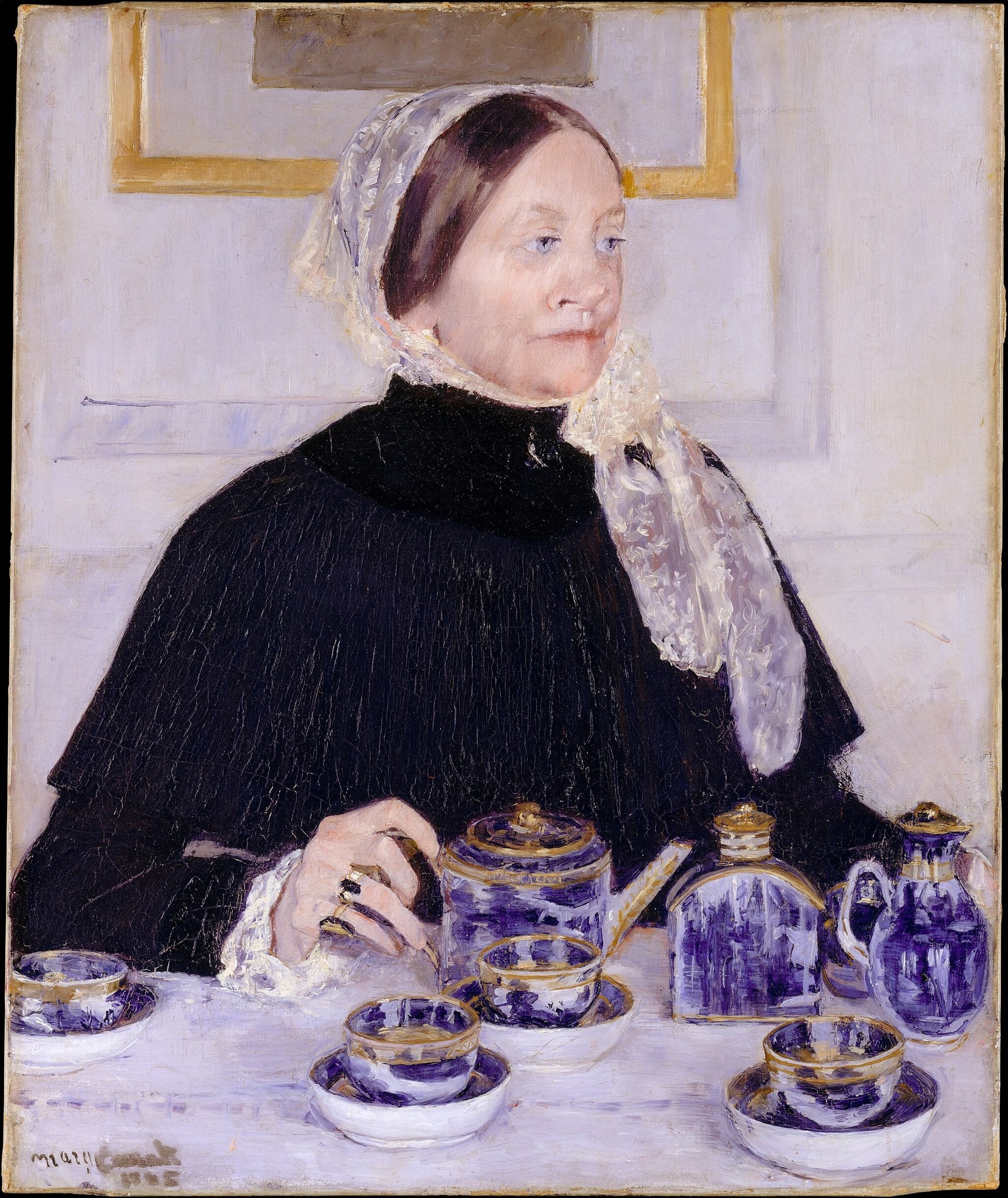
Mary Cassatt’s The Tea stages a poised, interior <strong>drama of manners</strong>: two women sit close yet feel apart, one thoughtful, the other raising a cup that <strong>veils her face</strong>. A gleaming, oversized <strong>silver tea service</strong> commands the foreground, its reflections turning ritual objects into actors in the scene <sup>[1]</sup>. The shallow, cropped room—striped wall, gilt mirror, marble mantel—compresses the atmosphere into <strong>intimacy edged by restraint</strong>.

Little Girl in a Big Straw Hat and a Pinafore by Mary Cassatt

Little Girl in a Big Straw Hat and a Pinafore

Mary Cassatt (c. 1886)

Mary Cassatt’s Little Girl in a Big Straw Hat and a Pinafore distills childhood into a quiet drama of <strong>interiority</strong> and <strong>constraint</strong>. The oversized straw hat and plain pinafore bracket a flushed face, downcast eyes, and <strong>clasped hands</strong>, turning a simple pose into a study of modern self‑consciousness <sup>[1]</sup>. Cassatt’s cool grays and swift, luminous strokes make mood—not costume—the subject.

Breakfast in Bed by Mary Cassatt

Breakfast in Bed

Mary Cassatt (1897)

Breakfast in Bed distills a <strong>tender modern intimacy</strong> into a tightly cropped sanctuary of rumpled white linens, protective embrace, and interrupted routine. Mary Cassatt uses <strong>cool light</strong> against <strong>warm flesh</strong> to anchor attention on the mother’s encircling arm and the child’s outward gaze, fusing care, curiosity, and the rhythms of <strong>everyday modern life</strong> <sup>[1]</sup><sup>[2]</sup>.

Young Mother Sewing by Mary Cassatt

Young Mother Sewing

Mary Cassatt (1900)

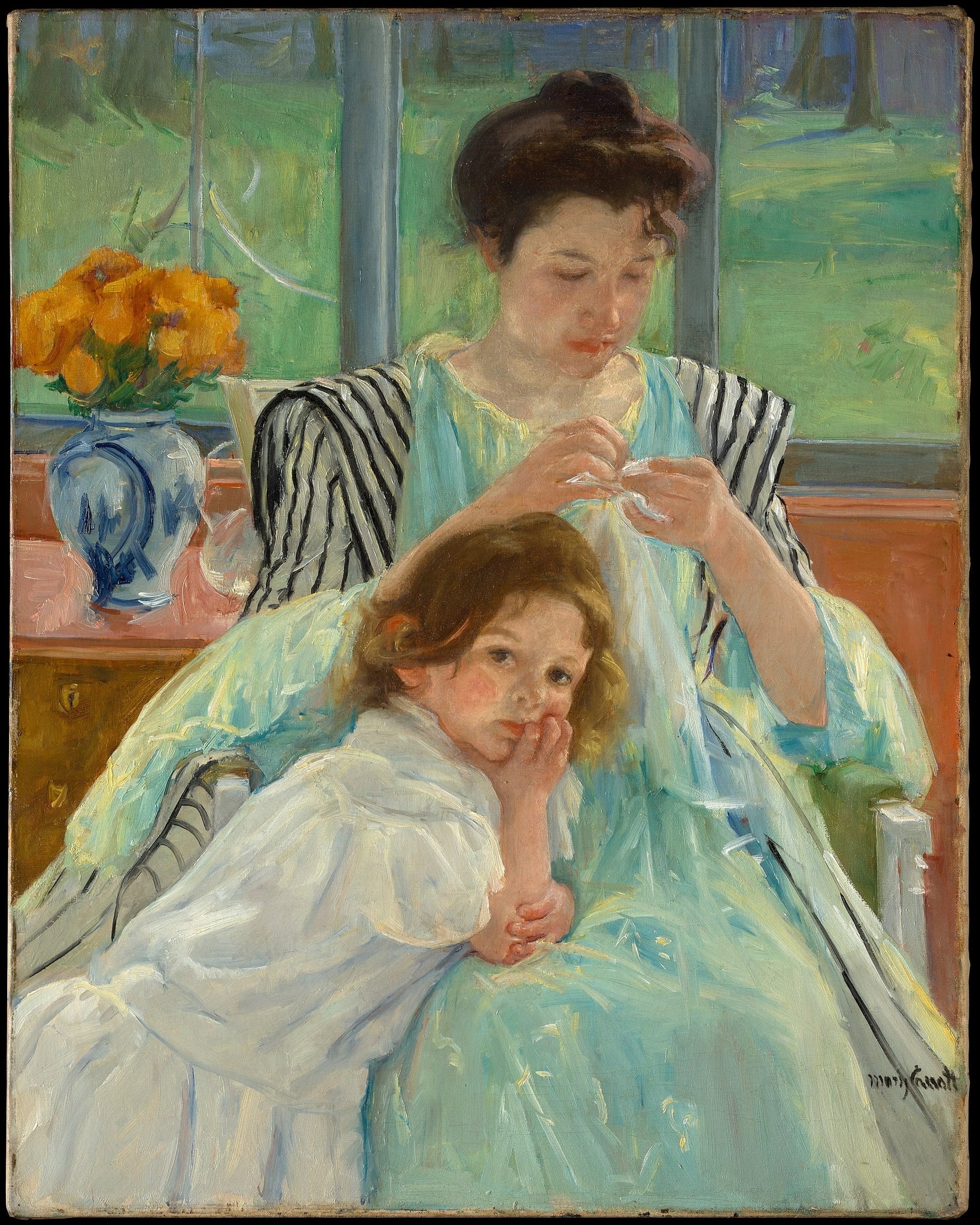
Mary Cassatt’s Young Mother Sewing centers the quiet <strong>labor of care</strong>: a mother steadies pale fabric while a child in white leans into her, eyes meeting ours. Cool <strong>greens and blues</strong> bathe the figures as striped sleeves and chair arms rhythmically return attention to the mother’s working hands, while a burst of <strong>orange blossoms</strong> by the window anchors interior life against the world outside <sup>[1]</sup>.
Children Playing on the Beach by Mary Cassatt

Children Playing on the Beach

Mary Cassatt (1884)

In Children Playing on the Beach, Mary Cassatt brings the viewer down to a child’s eye level, granting everyday play the weight of <strong>serious, self-contained work</strong>. The cool horizon and tiny boats open onto <strong>modern space and possibility</strong>, while the cropped, tilted foreground seals us inside the children’s focused world <sup>[1]</sup>.