Mother About to Wash Her Sleepy Child

by Mary Cassatt

Mary Cassatt’s Mother About to Wash Her Sleepy Child (1880) turns an ordinary bedtime ritual into a scene of caregiving, labor, and modern intimacy. Cropped close, with the child’s legs diagonally splayed and a tilted washbowl at the mother’s knee, the picture translates domestic routine into a modern Madonna for the bourgeois interior. Its flickering blues and milky whites, plus patterned upholstery and wallpaper, signal Cassatt’s Impressionist and japonisme-inflected design sense [2].

Fast Facts

Year
1880
Medium
Oil on canvas
Dimensions
100.3 × 65.8 cm
Location
Los Angeles County Museum of Art (LACMA), Los Angeles
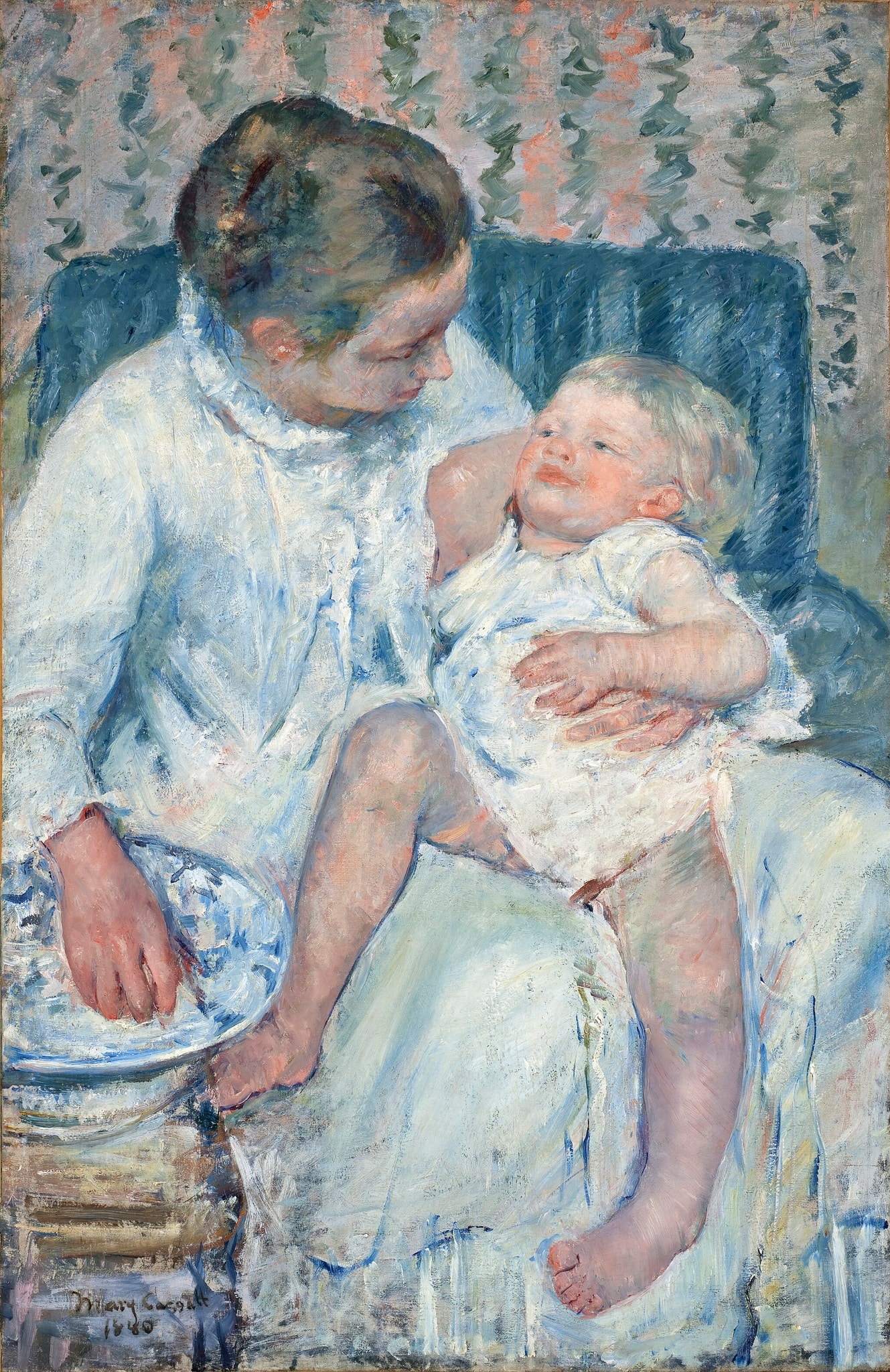
Mother About to Wash Her Sleepy Child by Mary Cassatt (1880)

Click on any numbered symbol to learn more about its meaning

Meaning & Symbolism

Cassatt builds the scene from tactile facts that become ethics. The mother braces the toddler across her lap, cradling the torso with one arm while the other dips toward the patterned basin; the child’s diagonally flung legs and slack, rosy face announce fatigue and trust. Those diagonals—echoed by the tilted rim of the ewer-and-basin and the downward slant of the mother’s forearm—energize a moment that would otherwise be quiet. Cassatt packs the figures against the front plane, cropping the settee and trimming limbs at the canvas edge, a compositional boldness absorbed from Degas and from japonisme’s flat, patterned fields 2. The leaf-like wallpaper stripes climb behind their heads, compressing space and emphasizing touch: the clasping hand, the soft press of a small foot against white skirts, the mother’s fingers hovering just above water. The brushwork is swift and open, the palette built from cool blues, chalky whites, and pink flesh notes, turning light itself into a gentle, enveloping presence. In this grammar of surfaces, care is visible as structure. This formal clarity underwrites the painting’s iconography. Scholars have flagged the child’s splayed legs and maternal embrace as a secular echo of Renaissance Madonnas; LACMA cautions that Cassatt’s “awkward naturalism” and Degas-derived modernity explain the pose sufficiently, yet the visual rhyme persists as a meaningful displacement of sanctity into daily life 2. The basin and ewer, hallmarks of late‑19th‑century interiors before universal plumbing, mark a liminal act—purification before sleep. Cassatt’s “bath” theme would later culminate in works like The Child’s Bath; here, in an earlier, more compressed register, she forges the prototype by binding ablution to affection and design to routine 62. The painting’s force is not pious; it is procedural. The mother’s one-handed lift while reaching for water demonstrates practiced competence; the scene reads as work—steady, repetitive, skilled. Recent reframings of Cassatt stress this dimension, arguing that her so‑called “maternal” pictures are also images of women’s labor; the strain in the forearm, the balancing of a heavy, drowsy body, and the controlled reach into the basin make that work legible 7. As an object in 1880, this canvas also asserts a claim for modern subject matter within Impressionist debates. Shown with or closely associated to Cassatt’s contributions to the Fifth Impressionist Exhibition, the picture advances a domestic counterpart to the movement’s streets and cafés, proving that advanced form could arise from the nursery as readily as from the boulevard 2. Its japonisme—patterned wallpaper, flattened planes, cropped edges—converts interior decoration into compositional rhythm, while the tipped seat back and off‑center bowl refuse academic symmetry. Cassatt thereby locates artistic innovation in the textures of middle‑class life and in the gestures of holding, washing, and waiting. The result is a “modern Madonna” not because it imitates a church image, but because it sanctifies the ordinary: a mother steadies a sleepy child, water glints in a porcelain bowl, and painting affirms that such routines are worthy of the grand scale, the museum frame, and the public eye 21.

Explore Deeper with AI

Ask questions about Mother About to Wash Her Sleepy Child

Popular questions:

Powered by AI • Get instant insights about this artwork

💬 Ask questions about this artwork!

Interpretations

Feminist Labor History

Read through a labor lens, this picture recodes “maternal” intimacy as women’s work—a practiced, muscular task rather than decorative sentiment. Cassatt’s pose spotlights the mother’s forearm strain, weight distribution, and one‑handed stabilization as marks of competence. Recent curators stress that Cassatt often used professional models and staged strenuous childcare moments to make such effort legible, aligning her with modern realism and against Victorian idylls. The sitter’s identity—mother or nursemaid—remains open, underscoring that “mothering” is a role and a job within classed households, not simply a biological bond. In this view, the painting participates in a genealogy of care economies, where domestic spaces are sites of gendered labor valorized through advanced form rather than sentimental narrative 1245.

Source: Philadelphia Museum of Art (via exhibition reviews); LACMA

Design History & Japonisme

Cassatt’s surface design—striped upholstery, leaf‑like wallpaper, cropped edges—derives from japonisme and Degas’s compositional experiments, translating interior decoration into pictorial rhythm. The tipped plane and close cropping compress depth, converting furniture into graphic scaffolding for touch: a hand hovering above water, a small foot pressing against white skirts. Pattern isn’t ornament alone; it is structure that holds the figures while refusing academic symmetry. Crucially, this japoniste flatness appears in 1880, anticipating Cassatt’s 1890s print innovations and demonstrating that interior design objects (ewer, basin, wallpaper) could function as modernist devices—motifs that articulate space, tempo, and intimacy with the same ambition as boulevard scenes 1.

Source: LACMA

Ritual, Secularization, and the Bath

The ewer-and-basin frame a liminal rite—purification before sleep—invoking baptismal echoes while remaining resolutely domestic. Cassatt’s “bath” motif later culminates in The Child’s Bath; this earlier canvas prototypes the theme by fusing ablution and affection in a compressed, diagonal composition. Rather than piety, the force is procedural: practiced gestures repeated nightly, where cleansing is an ethics of care enacted through design. The work thus participates in modernity’s secularization of ritual, relocating sanctity from church to nursery and proving that routine can bear symbolic weight without doctrinal imagery 167.

Source: LACMA; The Met; Encyclopaedia Britannica

Exhibition Politics of the Private Sphere

Circulating with the Fifth Impressionist Exhibition (1880), the painting argued that the avant‑garde could arise from the nursery as effectively as from the café. Even though Cassatt’s entries weren’t individually itemized, curatorial consensus places this work among them, positioning a mother’s bath routine as public, exhibitable modernity. That wager unsettled the gendered division of spheres: the domestic “private” becomes a stage for formal innovation—cropping, tilted planes, japoniste pattern—and for modern ethical content. The canvas claims museum‑scale attention for holding, washing, and waiting, contending that these gestures belong within the same cultural frame as the boulevard, the racetrack, or the factory 13.

Source: LACMA; Smithsonian American Art Museum (object record)

Iconography, Ambiguity, and the ‘Modern Madonna’

Critics note the child’s splayed legs as a secular echo of Renaissance Madonnas, yet LACMA cautions that awkward naturalism and Degas’s influence fully explain the pose—shifting emphasis from citation to observation. The result is a productive ambiguity: a “modern Madonna” that neither quotes a single prototype nor abandons the aura of care. By trimming limbs at the canvas edge and pressing figures forward, Cassatt refuses altar‑like symmetry, transforming sanctity into closeness and touch. The painting thus reframes iconography as an effect of modern form; the sacred isn’t illustrated—it emerges from posture, pattern, and the ethics of handling a drowsy body 12.

Source: LACMA

Related Themes

About Mary Cassatt

Mary Cassatt (1844–1926) was an American painter who settled in Paris, exhibited with the Impressionists, and became a key conduit for introducing their art to U.S. collectors. After 1890 she adopted japoniste flatness, bold patterning, and strong design, focusing on modern women’s lives—especially mother‑and‑child subjects—until failing eyesight curtailed her work by 1914 [4].
View all works by Mary Cassatt

More by Mary Cassatt

Woman in Black at the Opera by Mary Cassatt

Woman in Black at the Opera

Mary Cassatt (1878)

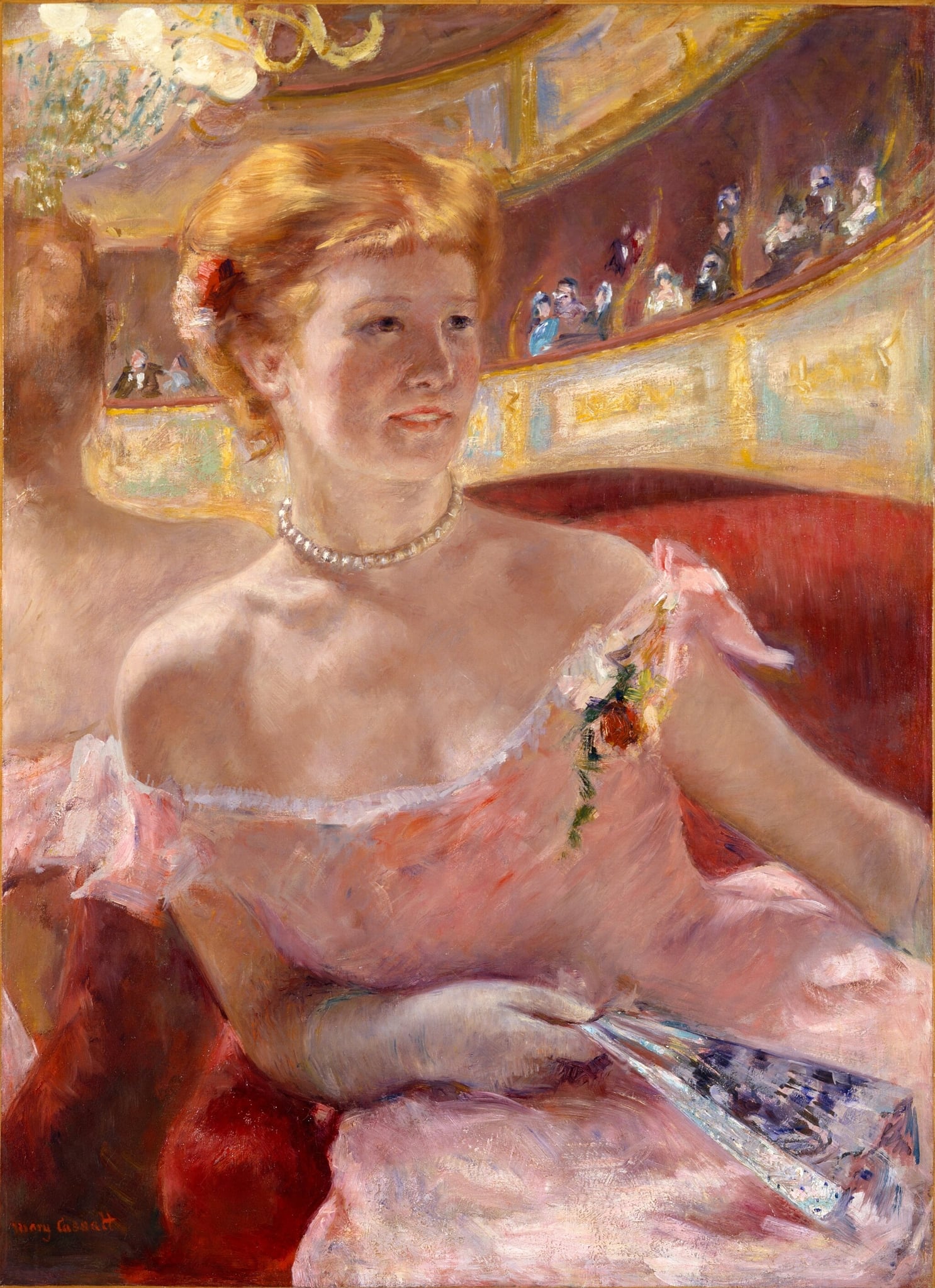
Mary Cassatt’s Woman in Black at the Opera stages a taut drama of vision and visibility. A woman in <strong>black attire</strong> raises <strong>opera glasses</strong> while a distant man aims his own at her, setting off a chain of looks that makes public leisure a site of <strong>power, agency, and surveillance</strong> <sup>[1]</sup><sup>[2]</sup>.

The Tea by Mary Cassatt

The Tea

Mary Cassatt (about 1880)

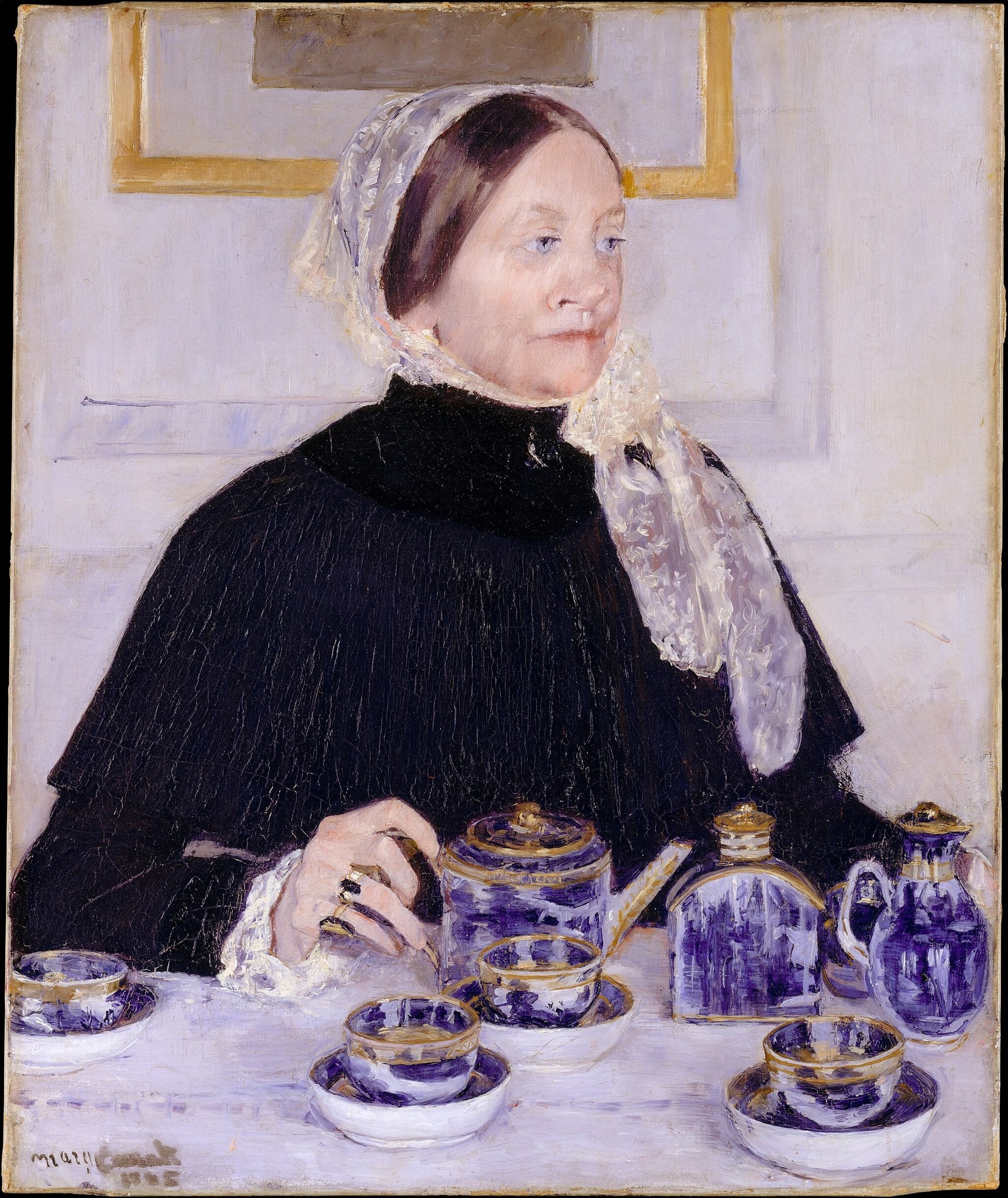
Mary Cassatt’s The Tea stages a poised, interior <strong>drama of manners</strong>: two women sit close yet feel apart, one thoughtful, the other raising a cup that <strong>veils her face</strong>. A gleaming, oversized <strong>silver tea service</strong> commands the foreground, its reflections turning ritual objects into actors in the scene <sup>[1]</sup>. The shallow, cropped room—striped wall, gilt mirror, marble mantel—compresses the atmosphere into <strong>intimacy edged by restraint</strong>.

Little Girl in a Big Straw Hat and a Pinafore by Mary Cassatt

Little Girl in a Big Straw Hat and a Pinafore

Mary Cassatt (c. 1886)

Mary Cassatt’s Little Girl in a Big Straw Hat and a Pinafore distills childhood into a quiet drama of <strong>interiority</strong> and <strong>constraint</strong>. The oversized straw hat and plain pinafore bracket a flushed face, downcast eyes, and <strong>clasped hands</strong>, turning a simple pose into a study of modern self‑consciousness <sup>[1]</sup>. Cassatt’s cool grays and swift, luminous strokes make mood—not costume—the subject.

Breakfast in Bed by Mary Cassatt

Breakfast in Bed

Mary Cassatt (1897)

Breakfast in Bed distills a <strong>tender modern intimacy</strong> into a tightly cropped sanctuary of rumpled white linens, protective embrace, and interrupted routine. Mary Cassatt uses <strong>cool light</strong> against <strong>warm flesh</strong> to anchor attention on the mother’s encircling arm and the child’s outward gaze, fusing care, curiosity, and the rhythms of <strong>everyday modern life</strong> <sup>[1]</sup><sup>[2]</sup>.

Young Mother Sewing by Mary Cassatt

Young Mother Sewing

Mary Cassatt (1900)

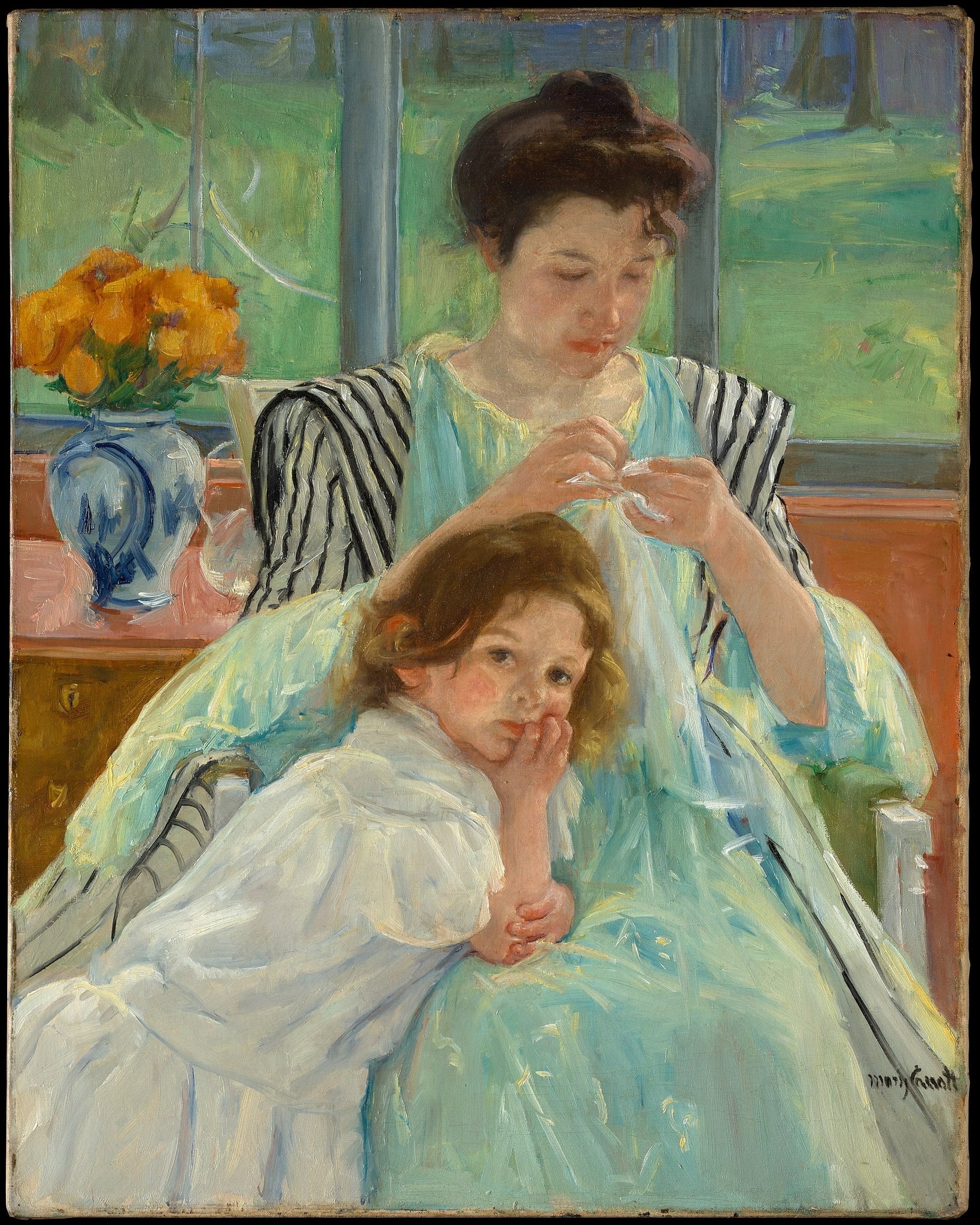
Mary Cassatt’s Young Mother Sewing centers the quiet <strong>labor of care</strong>: a mother steadies pale fabric while a child in white leans into her, eyes meeting ours. Cool <strong>greens and blues</strong> bathe the figures as striped sleeves and chair arms rhythmically return attention to the mother’s working hands, while a burst of <strong>orange blossoms</strong> by the window anchors interior life against the world outside <sup>[1]</sup>.
Children Playing on the Beach by Mary Cassatt

Children Playing on the Beach

Mary Cassatt (1884)

In Children Playing on the Beach, Mary Cassatt brings the viewer down to a child’s eye level, granting everyday play the weight of <strong>serious, self-contained work</strong>. The cool horizon and tiny boats open onto <strong>modern space and possibility</strong>, while the cropped, tilted foreground seals us inside the children’s focused world <sup>[1]</sup>.