How Much Is Mother About to Wash Her Sleepy Child Worth?
Last updated: February 22, 2026
Quick Facts
- Insurance Value
- $16.0M (Analyst estimate (replacement cost benchmark))
- Methodology
- comparable analysis
Indicative auction value for Mary Cassatt’s Mother About to Wash Her Sleepy Child (1880, oil on canvas; LACMA) is $8–14 million. This is a prime-period, museum-caliber mother-and-child oil—Cassatt’s rarest and most sought-after category—which could challenge the artist’s current auction record under ideal sale conditions.
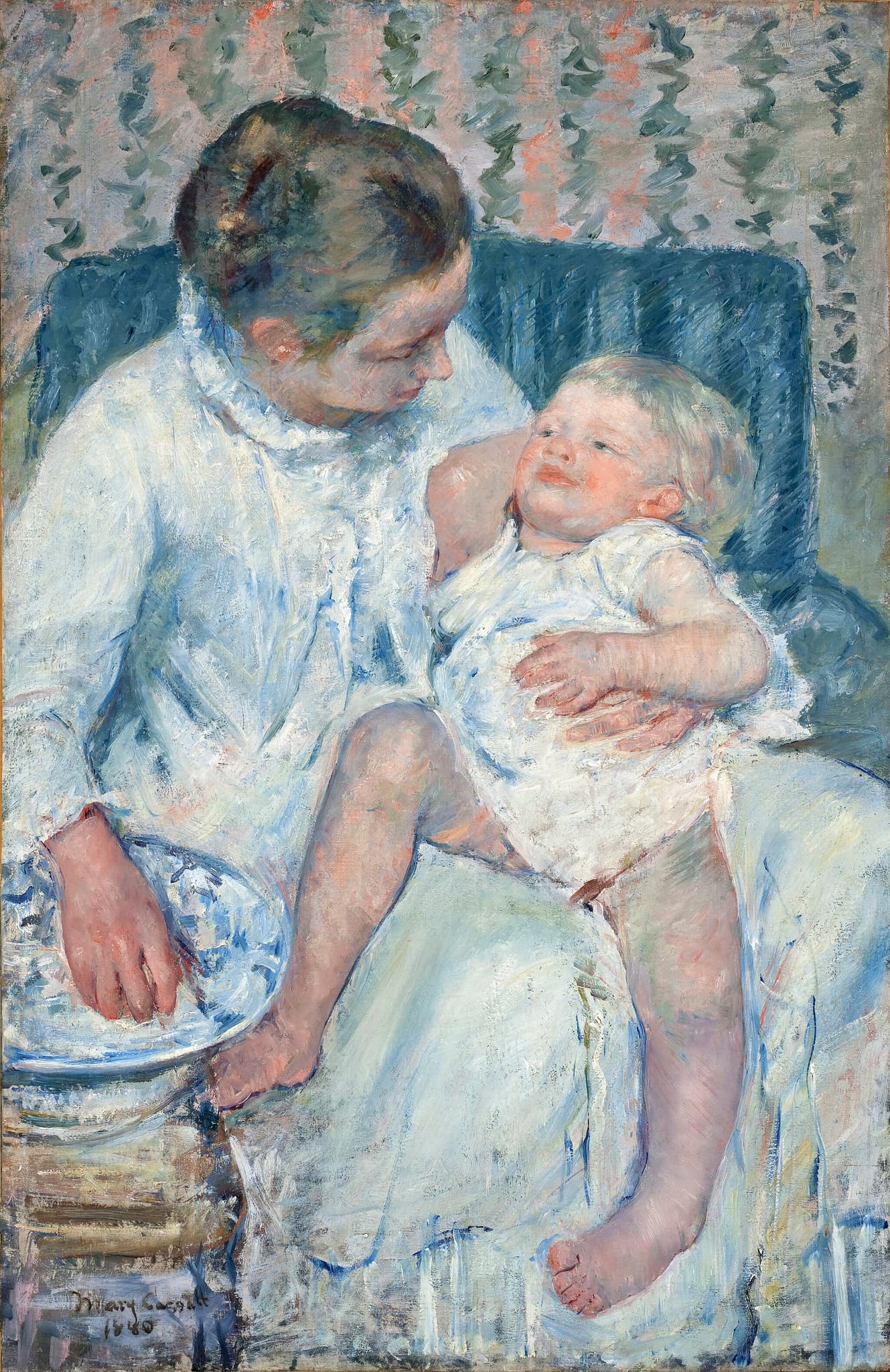
Mother About to Wash Her Sleepy Child
Mary Cassatt, 1880 • Oil on canvas
Read full analysis of Mother About to Wash Her Sleepy Child →Valuation Analysis
Conclusion: Based on recent benchmarks and the painting’s exceptional qualitative traits, a reasoned auction estimate for Mary Cassatt’s Mother About to Wash Her Sleepy Child is $8–14 million, with private-sale or insurance-replacement scenarios potentially skewing higher. The work is a prime (1880) oil in Cassatt’s signature mother-and-child theme and is held by LACMA with a documented museum pedigree—factors that position it at the top of Cassatt’s market were it ever to be offered for sale [1].
Comparables and price context: Cassatt’s top public auction price is $7.489 million (with premium) for a masterpiece pastel, Young Lady in a Loge, Gazing to Right (Christie’s, 2022)—a result that sets today’s public ceiling for the artist and confirms deep institutional demand for her finest prime-period works [2]. A closely related, prime-year mother-and-child pastel, A Goodnight Hug (1880), brought about $4.5 million at Sotheby’s (2018), demonstrating strong appetite for the subject even in works on paper [3]. For oils—rarer and generally more highly prized—strong child- and family-themed canvases have realized roughly $1.6–$6.2 million over the last two decades, with the 2007 peak at $6.2 million and subsequent results in the high single-digit millions plausible for truly exceptional examples.
Why this painting could test the upper band: The date (1880) aligns with Cassatt’s Impressionist prime; the mother-and-child motif is central to her legacy; and the scale is substantial. Scarcity is pivotal: early oils are far less common than her pastels and color prints, and top-quality, museum-pedigreed oils surface exceedingly rarely. These attributes—notably the canonical subject and period—are precisely what bidders prize when reaching beyond recent benchmarks.
Market backdrop: The Impressionist and Post‑Impressionist category has remained comparatively resilient, with selective strength at the top end despite broader market recalibration; masterworks continue to attract competition, while mid‑tier material can be price‑sensitive [4]. Within this climate, supply rather than demand is the main constraint for Cassatt. A prime, exhibition-worthy oil of this caliber would be positioned in a marquee evening sale with third‑party interest, creating conditions where a result at or above the current artist record becomes credible.
Caveats and sensitivities: The work is museum-held; any valuation is hypothetical. Precise outcomes would hinge on current condition (varnish, retouching, structural stability), completeness of provenance and literature, and sale orchestration (timing, narrative, and guarantees). A pristine report and rich exhibition/publication history would support the upper half of the range; material conservation issues or a thinner dossier would argue toward the lower half.
Key Valuation Factors
Art Historical Significance
High ImpactPainted in 1880, the work sits squarely in Cassatt’s Impressionist prime and within her most consequential theme: the intimate mother-and-child scene. This subject, explored with modern, observational nuance, underpins her canonization in the movement alongside Degas and Morisot. Works of this period informed her participation in the Impressionist exhibitions and shaped subsequent scholarship. Because art-historical weight is a leading determinant of market value for blue-chip Impressionism, the painting’s date, style, and subject confer a pronounced premium. In any major-sale context, this ‘core-oeuvre’ alignment would be highlighted to position the lot above more peripheral themes or later works.
Rarity of Medium and Period
High ImpactCassatt’s oils are materially scarcer than her pastels and color prints, and early oils from c. 1878–1882 appear only sporadically on the market. Scarcity is an amplifier: when a prime-period, canonical-subject oil surfaces, institutional and top private buyers often converge. Recent records indicate that even masterpieces on paper can set price ceilings; an equivalently important oil—especially one with museum-level credentials—can credibly stretch beyond those figures. This supply dynamic supports pricing at the top of her market range and underpins the view that $8–14 million is defendable, with upside in an optimal, guarantee-backed evening sale.
Subject-Matter Appeal
High ImpactMother-and-child imagery is the nucleus of Cassatt’s legacy and consistently outperforms secondary subjects. Collectors value the tenderness, modern domesticity, and technical poise she achieved in these scenes, and institutions seek strong exemplars to anchor their Impressionist narratives. The subject’s emotional and cultural resonance widens the bidder pool beyond strict Cassatt specialists to include generalist Impressionist collectors and museums aiming to correct historical imbalances in representation. This broader demand base tends to compress downside risk and enhance the potential for spirited competition, especially for large-scale, well-composed examples like this one.
Provenance and Institutional Pedigree
High ImpactThe painting’s long residence at LACMA and associated publication/exhibition history confer imprimatur that private works often lack. Museum-held status implies curatorial vetting, conservation oversight, and high scholarly acceptance—attributes that typically translate to buyer confidence and elevated pricing if a deaccession ever occurred. Earlier ties to notable collectors and reputable dealers can add narrative weight. While museum ownership means a sale is unlikely, in valuation terms this pedigree signals quality and helps justify placement at the upper end of Cassatt’s price spectrum, contingent on an excellent, up-to-date condition report.
Market Benchmarks and Liquidity
Medium ImpactCassatt’s auction record stands at $7.489 million for a prime-period pastel (Christie’s, 2022), and a prime-year mother-and-child pastel achieved ~$4.5 million in 2018. Top-tier oils with child/family subjects have ranged roughly $1.6–$6.2 million publicly over the last two decades, with rare, high-quality canvases attracting outsized interest. The category remains relatively stable, but it is bifurcated: masterpieces perform, while average material can be price-sensitive. Given the scarcity and caliber here, liquidity should be strong in a marquee sale. Still, realized price will be sensitive to condition, estimate strategy, and the presence of third‑party guarantees.
Sale History
Mother About to Wash Her Sleepy Child has never been sold at public auction.
Mary Cassatt's Market
Mary Cassatt is a blue‑chip American Impressionist with deep institutional support and an internationally recognized oeuvre. Her market is led by scarce oils from the late 1870s through the mid‑1880s and by iconic pastels of the theater and domestic interiors. While her overall auction volume is dominated by works on paper and color prints, the rare appearance of a museum‑caliber oil can reset expectations. Cassatt’s current auction record is $7.489 million (Christie’s, 2022) for a prime pastel purchased by a museum, underscoring institutional demand. Pricing for mid‑tier material has been disciplined in recent years, but best‑in‑class works—especially prime-period mother‑and‑child images—draw competition and can reach or exceed the high single‑digit millions.
Comparable Sales
Children Playing with a Dog
Mary Cassatt
Strong oil on canvas of children from Cassatt’s mature period; high-quality, widely recognized market benchmark for Cassatt oils depicting domestic/child subjects.
$4.8M
2018, Christie's New York
~$6.1M adjusted
Children Playing with a Dog
Mary Cassatt
Same painting as above at its 2007 peak price; useful as an upper-bound historical benchmark for Cassatt oils with child subjects in a frothy market.
$6.2M
2007, Christie's New York
~$9.6M adjusted
A Goodnight Hug
Mary Cassatt
Prime-year (1880) mother-and-child image; though a pastel, it closely matches the date/subject and shows depth of demand for this motif at the top tier.
$4.5M
2018, Sotheby's New York
~$5.7M adjusted
Baby Charles Looking Over His Mother’s Shoulder (No. 3)
Mary Cassatt
Oil on canvas with direct mother-and-child theme; strong institutional provenance (Brooklyn Museum deaccession) and recent result in a cooler market.
$1.6M
2021, Sotheby's New York
~$1.9M adjusted
Children Playing with a Cat
Mary Cassatt
Oil on canvas of children from Cassatt’s later period; relevant for medium/subject family. Note: price cited is hammer; realized with premium would be higher.
$1.8M
2020, Sotheby's New York
~$2.2M adjusted
Young Lady in a Loge, Gazing to Right
Mary Cassatt
Artist auction record; prime-period work on paper signaling current price ceiling for Cassatt masterpieces, informing the upper bound for a museum-caliber oil.
$7.5M
2022, Christie's New York
~$8.2M adjusted
Current Market Trends
Impressionism/Post‑Impressionism has shown relative resilience amid broader market recalibration, with strong sell‑through for carefully curated evening sales and trophy-level works. Category analytics point to stable demand and lower volatility versus more speculative sectors, though 2023–2024 saw softer volumes at the $10m+ tier before improving in late‑2025. For Cassatt specifically, supply constraints—rather than waning demand—have capped headline prices since her 2022 record. Against this backdrop, a prime 1880 oil with canonical subject matter and museum pedigree would likely catalyze competition and could test new highs for the artist, provided condition is excellent and sale strategy (estimate, placement, and guarantees) is optimized.
Study print
Study this painting as a print
Pair the full artwork with a museum-style study sheet focused on one meaningful detail.
Sources
- LACMA Collection: Mary Cassatt, A Child’s Bath (Mother About to Wash Her Sleepy Child), 1880
- Christie’s Press: The Ann & Gordon Getty Collection (artist record for Cassatt, Oct 20, 2022)
- Sotheby’s: Highest Auction Prices (includes Cassatt’s A Goodnight Hug, 2018)
- Artnet News: Impressionism at 150—market overview and volatility analysis (Dec 2024)