How Much Is Little Girl in a Big Straw Hat and a Pinafore Worth?
Last updated: February 23, 2026
Quick Facts
- Insurance Value
- $10.0M (Analyst estimate (replacement value))
- Methodology
- comparable analysis
Hypothetical fair‑market value for Mary Cassatt’s Little Girl in a Big Straw Hat and a Pinafore (c. 1886, oil on canvas; National Gallery of Art) is $5.5–9.0 million. This range reflects prime‑period oil status, a quintessential child subject, and exceptional Mellon → NGA provenance, benchmarked against recent seven‑figure Cassatt oils. For insurance/replacement, a prudent band is $8–12 million, acknowledging rarity and institutional caliber.
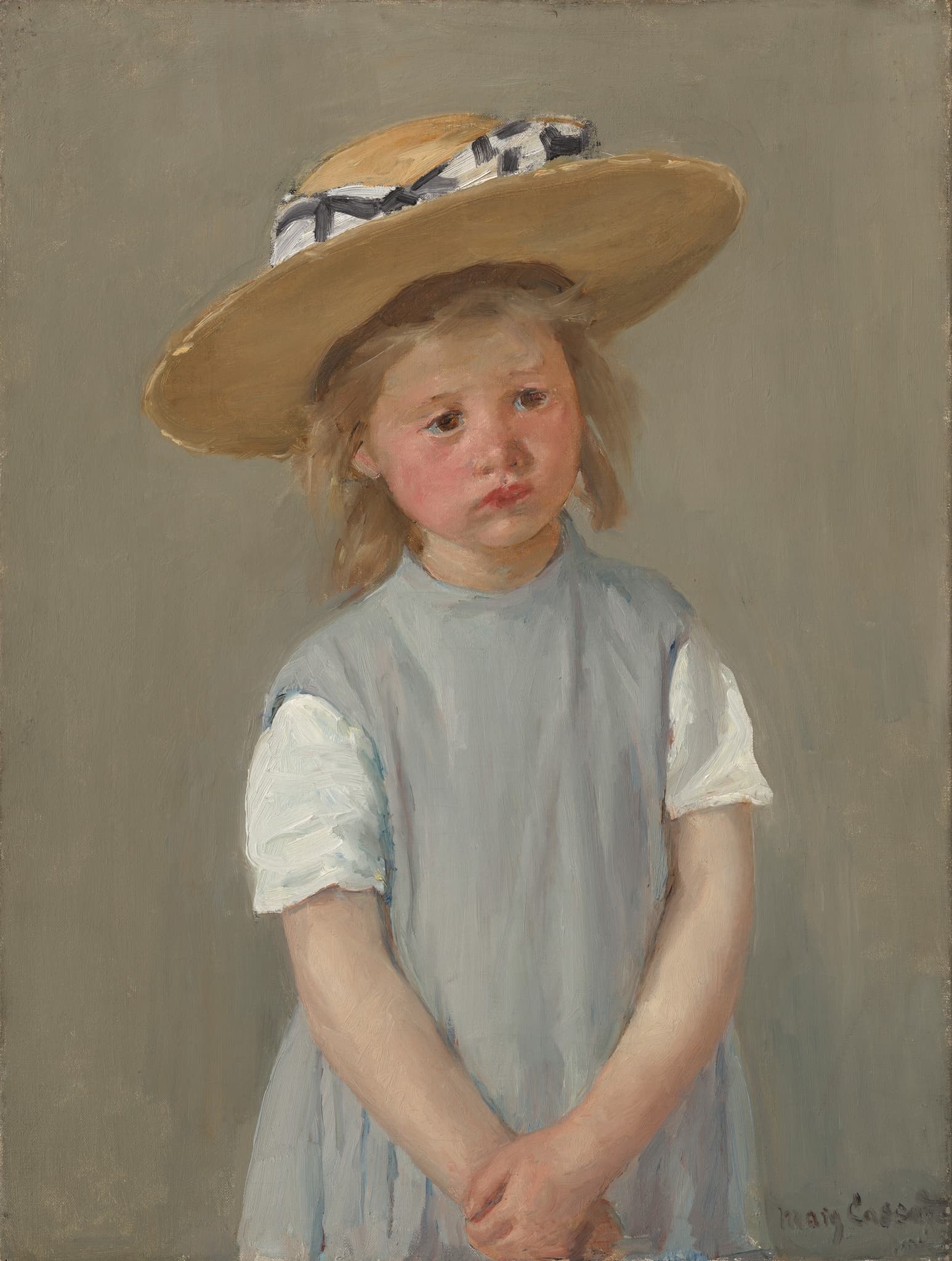
Little Girl in a Big Straw Hat and a Pinafore
Mary Cassatt, c. 1886 • Oil on canvas
Read full analysis of Little Girl in a Big Straw Hat and a Pinafore →Valuation Analysis
Overview. Little Girl in a Big Straw Hat and a Pinafore (also recorded as Child in a Straw Hat), c. 1886, is a prime‑period Mary Cassatt oil on canvas measuring 65.3 × 49.2 cm and held by the National Gallery of Art, Washington, via the Paul Mellon collection. The work encapsulates Cassatt’s signature exploration of childhood and domestic intimacy at the height of her Impressionist maturity—attributes that command sustained market interest and institutional regard [1].
Comparables and pricing benchmarks. While this specific painting has no modern public sale, recent market evidence for high‑quality Cassatt oils is instructive. In the marquee band, Children Playing with a Dog (1907) realized $4.81 million with premium at Christie’s (2018) [3], and The Sun Bath, with Three Figures (1898–99) achieved $4.4 million with premium at Sotheby’s (2020) [4]. At the European day‑sale level, Portrait de jeune femme au chapeau blanc (1879) brought €1.216 million (≈$1.3m) at ADER, Paris, in 2023, reflecting appetite for single‑figure oils outside evening contexts [5]. Cassatt’s standing auction record—$7.489 million—was set in 2022 for an iconic pastel, underscoring ceiling demand for top‑tier imagery across media [2].
Valuation logic. The subject work aligns with Cassatt’s most commercially desirable profile: a mid‑1880s oil depicting a child in a large hat, with deft handling and an intimate, immediately recognizable “Cassatt” look. Its scale sits in the upper mid‑size range for single‑figure oils. Layered, blue‑chip provenance (Vollard/Speelman → Mellon → NGA) meaningfully de‑risks quality and authenticity. Given that strong oils have clustered around $4–5 million in recent seasons, a museum‑caliber, prime‑period example of this subject plausibly sits above those benchmarks yet below Cassatt’s absolute apex, supporting a hypothetical FMV of $5.5–9.0 million [3][4][5].
Market setting and tailwinds. The Impressionist sector saw softer aggregate value in 2024 on limited trophy supply, but high‑end demand remained selective and rational; 2025 brought renewed confidence at the marquee level, rewarding rarity and quality [6][7]. Cassatt’s institutional momentum has been reinforced by the 2024–25 survey Mary Cassatt at Work (Philadelphia; San Francisco), further consolidating scholarly interest and collector focus on first‑rate examples [8].
Conclusion. On balance, a fair‑market range of $5.5–9.0 million is justified for this painting if hypothetically deaccessioned today, with replacement/insurance prudently set at $8–12 million to reflect scarcity and exceptional provenance. As always, condition, technical findings, and full exhibition/literature history could move the needle; absent red flags, this work would attract deep institutional and top‑private interest in a well‑staged sale [1][2].
Key Valuation Factors
Art Historical Significance
High ImpactCassatt is a canonical Impressionist and a foundational figure in American and women’s art histories. This painting’s mid‑1880s date coincides with her mature Paris years, when she crystallized the intimate, psychologically nuanced depictions of children and domestic life that define her legacy. The composition’s direct gaze, straw‑hat motif, and painterly economy are quintessential Cassatt, making it a strong representative of her core contribution to the movement. Works from this phase are fully integrated into scholarship and museum narratives, which amplifies cultural and market relevance. In valuation terms, art‑historical centrality supports pricing near the upper band for the artist, below only the handful of truly iconic, widely exhibited masterpieces.
Medium, Date, and Subject Fit
High ImpactPrime‑period oils (c. 1878–1895) are Cassatt’s most sought‑after category, outpacing later oils and most works on paper. The subject here—an engaging single child in a large straw hat—hits one of the artist’s most liquid motifs. The 65 × 49 cm scale is an attractive, display‑friendly size for connoisseur collections without entering the complexities of large multi‑figure canvases. Collectors pay systematic premiums for this exact medium/date/subject nexus because supply is thin and institutional absorption is high. In today’s selective but quality‑sensitive market, this alignment helps justify an estimate above recent mid‑tier comparables, while remaining disciplined relative to the artist’s absolute auction peak.
Provenance and Institutional Standing
High ImpactThe work’s chain—Ambroise Vollard to Edward Speelman to Paul Mellon, then gift to the National Gallery of Art—confers exceptional credibility. Museum ownership implies curatorial vetting, conservation oversight, and deep literature control. Such provenance typically compresses risk for buyers and can lift outcomes when comparable works appear at auction. While museum ownership also means a sale is improbable, the market often prices the hypothetical: if deaccessioned with clean governance, the NGA/Mellon imprimatur would meaningfully expand the bidder pool. In insurance terms, institutional caliber and replacement difficulty support a premium above fair‑market levels, reflecting the cost and time to source a like‑for‑like substitute.
Market Comparables and Liquidity
Medium-high ImpactRecent seven‑figure outcomes for quality Cassatt oils—$4.81m (2018) and $4.4m (2020) with premium—anchor the upper mid‑band for non‑iconic but strong works. A €1.216m ($1.3m) portrait oil in Paris (2023) and mid‑six‑figure results for lesser oils in 2025 further map a broad dispersion tied to subject, scale, and venue. The artist’s 2022 record at $7.489m (pastel) signals ceiling demand for best‑of‑type images across media. Against that backdrop, a prime‑period, quintessential single‑child oil with stellar provenance can reasonably clear the $4–5m benchmarks and test the high‑single‑digit zone in the right sale context. Liquidity is strongest at top international houses with institutional underbidders.
Condition, Scale, and Exhibition/Literature
Medium ImpactCondition and conservation history can shift value materially for Impressionist oils—surface bloom, overcleaning, or structural interventions can compress price bands. At ~65 × 49 cm, the present work’s scale is market‑efficient: large enough to carry wall presence, small enough for private settings. Exhibition and literature presence—especially inclusion in major surveys and the catalogue raisonné—typically adds confidence and can introduce upside in competitive bidding. While the NGA listing anchors core facts, a current condition report, high‑resolution imaging, and a consolidated exhibition/literature dossier would refine the estimate within the proposed range and help determine whether the upper band is achievable.
Sale History
Little Girl in a Big Straw Hat and a Pinafore has never been sold at public auction.
Mary Cassatt's Market
Mary Cassatt’s market is durable and globally distributed across American, Impressionist, and museum‑driven buyers. Supply of first‑rate oils from her 1878–1895 peak is thin, with many examples absorbed by institutions, sustaining price resilience for top material. Works on paper dominate volume, typically trading in the low‑ to mid‑six figures, with rare, iconic pastels reaching seven figures—her $7.489m record (2022) confirms demand at the top. Strong oils with signature subjects and blue‑chip provenance have clustered between roughly $2–5m at major houses in recent seasons, with the very best examples testing the high‑single‑digit band. Overall, the market rewards subject clarity, period correctness, and institutional validation.
Comparable Sales
Children Playing with a Dog
Mary Cassatt
Prime subject Cassatt oil (children), strong composition and scale; though later (1907) and multi‑figure, it calibrates the upper band for desirable Cassatt oils at marquee venues.
$4.8M
2018, Christie's New York
~$6.3M adjusted
The Sun Bath, with Three Figures
Mary Cassatt
Late‑1890s oil with multiple figures sold in an evening sale; demonstrates pricing for high‑quality figural Cassatt oils near the top of the market.
$4.4M
2020, Sotheby's New York
~$5.5M adjusted
Children Playing with a Cat
Mary Cassatt
Oil featuring children (1908); strong subject affinity to a child portrait and a good benchmark for seven‑figure Cassatt oils in recent seasons.
$2.2M
2020, Sotheby's New York
~$2.8M adjusted
Portrait de jeune femme au chapeau blanc
Mary Cassatt
Oil on canvas (1879), single‑figure portrait with hat motif; earlier date but closely comparable in type/medium and confirms current appetite for portrait oils in Europe.
$1.3M
2023, ADER Paris (Hôtel Drouot)
~$1.4M adjusted
Femme portant un bonnet noir et vert, cousant
Mary Cassatt
C. 1889–90 oil, single female figure, near‑identical size to the subject work (24 × 19.75 in vs. 25.7 × 19.4 in). Hammer price only; useful as a lower‑bound check for comparable scale oils.
$650K
2025, Christie's New York
Mother Resting Her Cheek on Her Daughter’s Blond Head
Mary Cassatt
Signed oil with mother‑and‑child subject; regional‑house result that helps define a price floor for smaller/less‑prominent venues.
$480K
2023, Guyette & Deeter, Portsmouth, NH
~$514K adjusted
Current Market Trends
Impressionist and Post‑Impressionist auctions in 2024 saw softer aggregate value due to scarce trophy supply, even as lot counts rose, reinforcing a flight‑to‑quality dynamic. By 2025, marquee sales rebounded, led by record‑setting blue‑chip works and renewed confidence for canonical names. Within this selective, buyer‑tilted climate, rare, well‑provenanced masterpieces continued to attract deep bidding, while mid‑tier material required disciplined estimates and strategic placement. For Cassatt specifically, recent museum surveys and institutional acquisitions act as tailwinds, but realized prices remain highly sensitive to medium, period, subject, and condition. Net‑net: best‑of‑type examples remain competitive; lesser works face wider dispersions and venue dependence.
Study print
Study this painting as a print
Pair the full artwork with a museum-style study sheet focused on one meaningful detail.
Sources
- National Gallery of Art — Child in a Straw Hat
- Christie’s — Ann & Gordon Getty Collection sale results (Cassatt record)
- Christie’s — Mary Cassatt artist page (selected results)
- Sotheby’s — Live-Streamed Sales of Contemporary and Impressionist & Modern Art (2020)
- The Art Newspaper (FR) — Portrait de jeune femme au chapeau blanc
- Art Basel — The Art Market 2025: Auctions
- Wall Street Journal — Big-Ticket Art Market Rebounds (2025)
- Philadelphia Museum of Art — Mary Cassatt at Work (2024–25)