How Much Is Woman in Black at the Opera Worth?
Last updated: February 22, 2026
Quick Facts
- Insurance Value
- $18.0M (Analyst estimate (replacement value))
- Methodology
- comparable analysis
Fair‑market (public‑auction) value for Mary Cassatt’s Woman in Black at the Opera (In the Loge, 1878, oil) is estimated at $10–15 million. This reflects its prime date, iconic opera/loge subject, oil‑on‑canvas scarcity, and proximity to Cassatt’s record-setting late‑1870s theater images on paper.
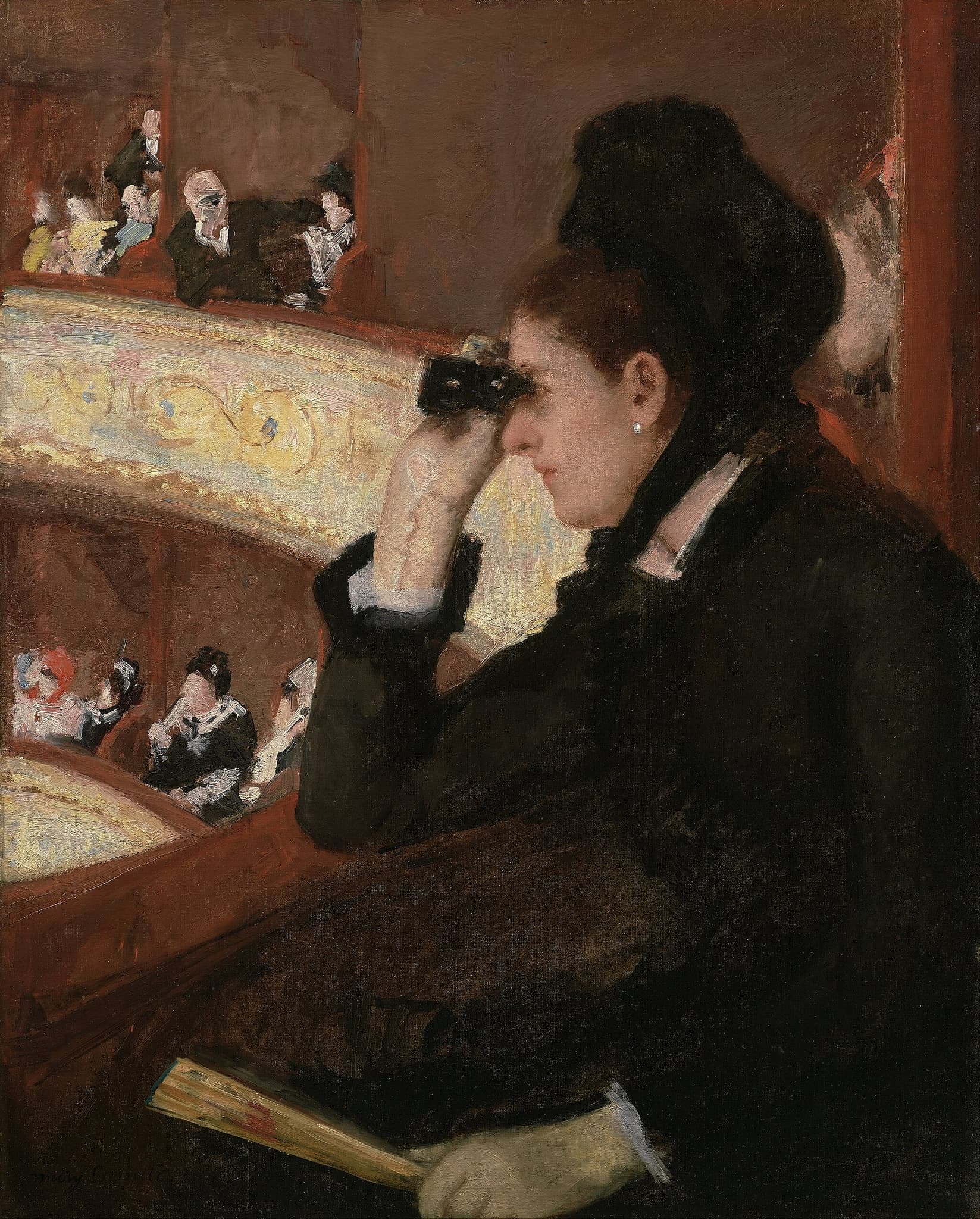
Woman in Black at the Opera
Mary Cassatt, 1878 • Oil on canvas
Read full analysis of Woman in Black at the Opera →Valuation Analysis
Conclusion: A prudent fair‑market (public‑auction) estimate for Mary Cassatt’s Woman in Black at the Opera—catalogued by the Museum of Fine Arts, Boston, as In the Loge (1878), oil on canvas, 32 x 26 in—is $10–15 million, with replacement/insurance value justifiably higher due to extreme scarcity and institutional-quality status [1].
Why the range: The picture is a canonical, prime‑period opera/loge scene—one of Cassatt’s defining contributions to Impressionism. Strong, well‑preserved oils by Cassatt are markedly rarer than her pastels and prints, and the opera/loge theme from 1878–79 is among her most sought-after subjects. The MFA Boston’s ownership underscores quality and art‑historical weight, which supports a premium over routine auction comparables while recognizing that institutional holdings are seldom available [1].
Key comparables: The most instructive benchmark is Cassatt’s Young Lady in a Loge, Gazing to Right (c. 1878–79), a celebrated theater image on paper that achieved $7,489,000 (with fees) from the Ann & Gordon Getty Collection at Christie’s in 2022—her current auction record [2]. Although that work is on paper, the shared subject, date, and iconic status demonstrate deep demand for this motif. Among oils, Cassatt’s Children Playing with a Dog realized $4,800,000 at Christie’s in 2018, confirming six‑to‑seven‑figure depth for strong paintings even when subject and date are less iconic than the 1878 theater scenes [4].
Category context: Market analysis underscores Cassatt’s robust standing among Impressionists, with sustained institutional attention and numerous seven‑figure results, particularly for prime works. The late‑1870s theater/loge images sit at the core of her oeuvre and have repeatedly anchored museum shows and scholarly narratives, strengthening price resilience and upside when best‑in‑class examples surface [3]. Given the artist’s record for a closely related loge subject on paper and the scarcity premium for high‑quality oils, a low‑to‑mid eight‑figure auction result is defensible for a comparable, museum‑caliber painting today.
Assumptions and sensitivities: The estimate assumes: original dimensions, attractive surface with no material condition impairments, and full, high‑quality provenance and literature. Size, condition, and conservation history can shift outcomes materially. Replacement/insurance values typically exceed public‑auction comparables due to rarity and the difficulty of sourcing a like‑for‑like substitute from this signature series [1][3].
Bottom line: On a fair‑market basis, $10–15 million is a well‑supported range for a prime 1878 opera/loge oil by Cassatt; for insurance/replacement, a mid‑to‑high‑teens figure is appropriate in today’s market.
Key Valuation Factors
Art Historical Significance
High ImpactDated 1878, the painting belongs to Cassatt’s seminal Paris years and to her signature opera/loge series, which helped define the modern, observational gaze within Impressionism. These works have anchored major exhibitions and scholarship for decades, making them touchstones for institutions and top private collectors. The image’s feminist art-historical resonance—depicting a modern woman navigating public space with agency—continues to amplify its cultural salience and market appeal. Within Cassatt’s output, the opera/loge motif is among the most cited and reproduced, reinforcing its recognition factor and the likelihood of competitive bidding when a comparable example appears. This centrality within the oeuvre warrants a strong premium relative to other themes.
Medium (Oil) and Condition
High ImpactCassatt’s strongest oils are far scarcer than her pastels and prints, and quality oils command significant premiums. Collectors and museums prize original, unreduced canvases with attractive impasto, legible brushwork, and minimal overpaint. Assuming a stable surface, no material paint loss, and conservation in line with best practice, the medium and presumed condition support the top end of Cassatt’s market. By contrast, Cassatt’s more commonly traded media (etchings, counterproofs) set a lower baseline. As a prime-period oil—particularly in a marquee subject—this work benefits from a medium-related scarcity premium that, all else equal, elevates it above even record-setting works on paper from the same theme.
Subject Desirability and Scarcity
High ImpactThe opera/loge subject from 1878–79 is among Cassatt’s most coveted themes, instantly recognizable and institutionally validated. Few high-quality oils of this motif remain in private hands; many reside in major museums, constraining supply and heightening competition for any comparable example. The subject’s crossover appeal—to Impressionist collectors, American art buyers, and those focused on women artists—broadens the potential bidder base. Scarcity within a marquee theme typically produces step‑function pricing when quality aligns with demand. This is especially true when a work has strong exhibition/literature history and can anchor a focused collection, connoisseurship narrative, or museum display.
Provenance and Institutional Validation
Medium ImpactLongstanding inclusion in the Museum of Fine Arts, Boston, signals museum-level quality and art-historical importance. While current institutional ownership reduces near‑term sale likelihood, it positively influences valuation benchmarks: insurers, appraisers, and private‑treaty parties typically ascribe a premium to works validated by major museums. A continuous, reputable provenance chain and extensive bibliography/exhibition history would further enhance value. Conversely, any gaps, deaccession constraints, or export restrictions can affect liquidity. Overall, blue‑chip institutional validation is a value amplifier in replacement scenarios and a confidence signal in hypothetical market pricing.
Market Comparables and Momentum
Medium ImpactCassatt’s auction record—$7.49 million for a closely related late‑1870s loge image on paper—demonstrates deep demand for this subject; important oils have sold in the multi‑million range even for non‑iconic themes. Within the broader Impressionist market, renewed focus on women artists and institutional acquisitions provide supportive tailwinds. Together, these comparables and trends justify low‑to‑mid eight‑figure guidance for a prime 1878 opera/loge oil, with upside if multiple tier‑one bidders emerge. Market selectivity remains real, however: condition, scale, and exhibition history are decisive in pushing results to the top of the range.
Sale History
Woman in Black at the Opera has never been sold at public auction.
Mary Cassatt's Market
Mary Cassatt occupies a blue‑chip position at the intersection of Impressionism and American art. Liquidity is strongest in prints and pastels, but pricing power concentrates in prime oils and canonical late‑1870s subjects. Her current auction record is $7.49 million for a late‑1870s loge image on paper, signaling robust appetite for the theater motif. Significant oils have achieved multi‑million results, though supply is exceedingly tight, with many A‑level works in museums. Institutional attention has intensified, bolstered by recent large‑scale exhibitions and a broader recalibration of the market for women artists. The net effect is a selective but constructive market that rewards rarity, pristine condition, and museum‑grade provenance.
Comparable Sales
Young Lady in a Loge, Gazing to Right
Mary Cassatt
Same artist; same late-1870s Paris theater/loge theme; widely regarded as a cornerstone subject in Cassatt’s oeuvre. Medium is work on paper (pastel/gouache) rather than oil, but it is the artist’s auction record and the closest subject match.
$7.5M
2022, Christie's New York
~$8.1M adjusted
Children Playing with a Dog
Mary Cassatt
Same artist; oil on canvas (medium parity) and strong market result for a Cassatt oil. Later date (1907) and different subject (children), but useful to calibrate the upper band for oils at auction.
$4.8M
2018, Christie's New York
~$6.0M adjusted
A Goodnight Hug
Mary Cassatt
Same artist; prime early date (1880, close to 1878); major pastel on paper showing market appetite for important works near the target period. Not the opera/loge theme and not an oil, but indicates high-end pricing for top-tier works on paper.
$4.5M
2018, Sotheby's New York
~$5.6M adjusted
Après le déjeuner
Berthe Morisot
Peer benchmark: a canonical oil by a fellow woman Impressionist from the early 1880s. Demonstrates established eight-figure demand for museum-caliber, signature works in this cohort—relevant headroom for a top Cassatt opera oil.
$10.9M
2013, Christie's London
~$14.7M adjusted
Mother Resting Her Cheek on Her Daughter’s Blond Head
Mary Cassatt
Same artist; oil on canvas confirming day-/regional-level pricing for secondary oils. Subject and likely date are less iconic than the 1878 opera theme, but provides a lower-bound reference for non-trophy oils.
$480K
2023, Guyette & Deeter
~$509K adjusted
Current Market Trends
Impressionist and Modern art remains a core, resilient category, with a flight‑to‑quality dynamic: A‑material outperforms while mid‑tier works see selective bidding. Within this framework, canonical works by historically underrecognized women artists have drawn heightened interest from both private collectors and institutions. Prices for blue‑chip names increasingly hinge on scarcity, subject iconography, and condition. Private‑treaty activity and institutional acquisitions provide additional depth at the high end. For Cassatt specifically, late‑1870s theater subjects represent the most compelling demand cluster; when coupled with the relative rarity of strong oils, these factors support low‑to‑mid eight‑figure pricing for museum‑caliber examples.
Study print
Study this painting as a print
Pair the full artwork with a museum-style study sheet focused on one meaningful detail.
Sources
- Museum of Fine Arts, Boston – In the Loge (1878) object page
- Christie’s – Ann & Gordon Getty Collection results (Young Lady in a Loge, Gazing to Right, record price)
- Artnet News – Impressionism at 150: The category that built the auction industry is not what it used to be
- Christie’s – Mary Cassatt artist results (incl. Children Playing with a Dog, 2018)