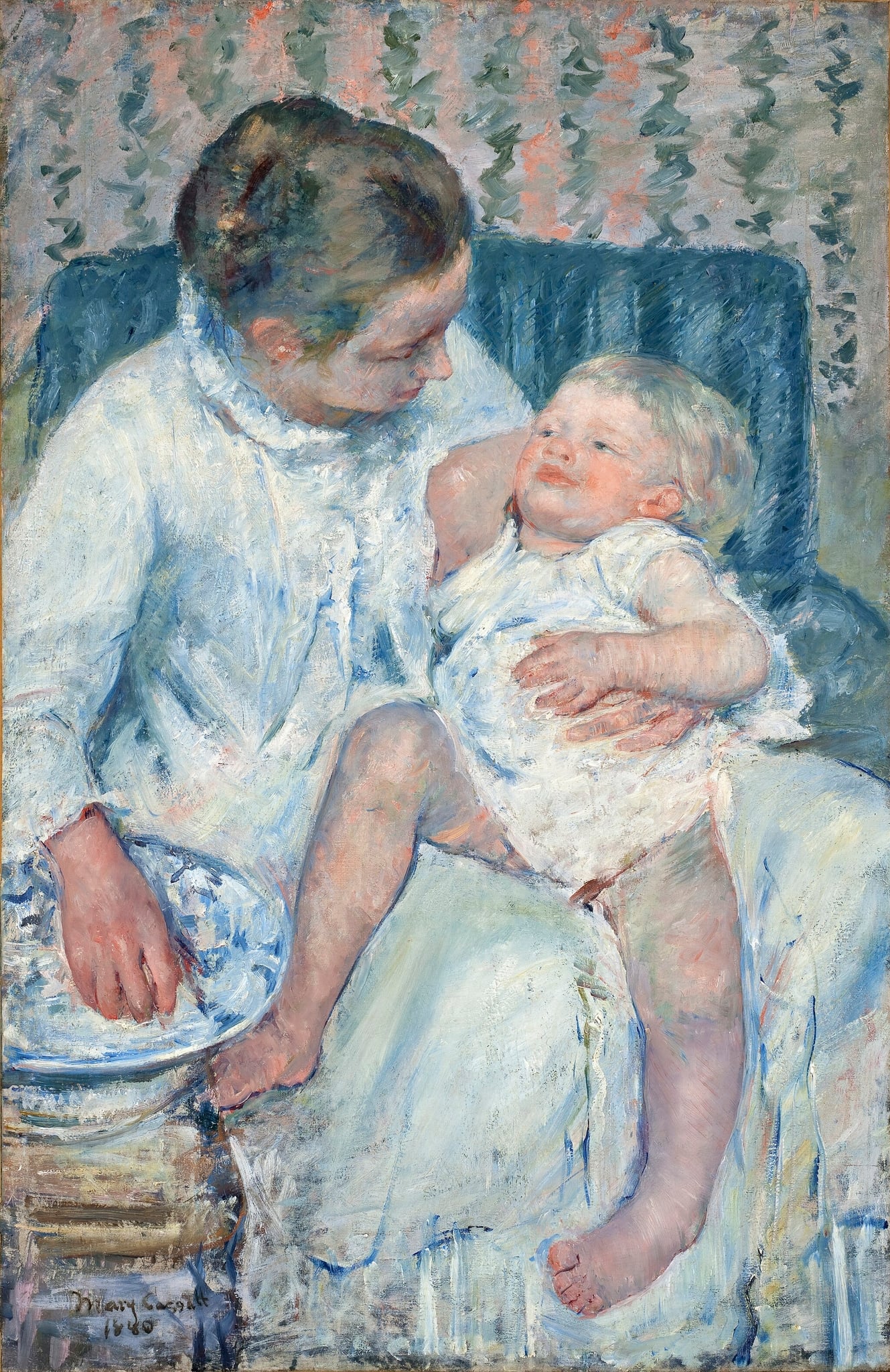
Children Playing on the Beach

by Mary Cassatt

In Children Playing on the Beach, Mary Cassatt brings the viewer down to a child’s eye level, granting everyday play the weight of serious, self-contained work. The cool horizon and tiny boats open onto modern space and possibility, while the cropped, tilted foreground seals us inside the children’s focused world [1].

Fast Facts

Year
1884
Medium
Oil on canvas
Dimensions
97.4 × 74.2 cm
Location
National Gallery of Art, Washington, DC
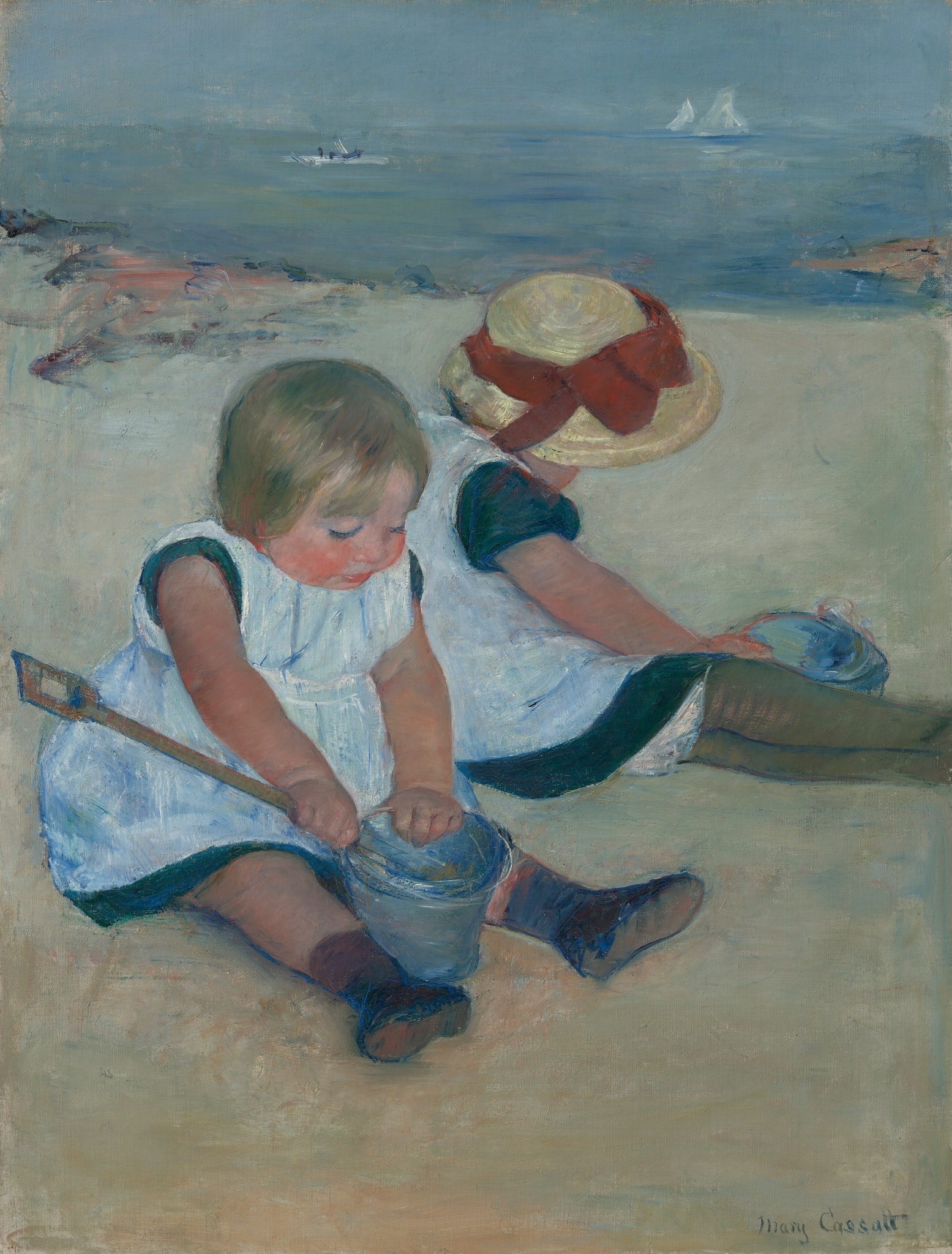
Children Playing on the Beach by Mary Cassatt (1884)

Click on any numbered symbol to learn more about its meaning

Meaning & Symbolism

Cassatt constructs a deliberate tension between nearness and expansiveness. In the foreground, the toddler at left presses a wooden scoop into a tin pail; her small fists bunch with effort, her boots splay, and the white pinafore bunches at the waist. To the right, a second child turns away beneath a straw hat banded by a red ribbon, her own pail catching light in cool blue flickers. The faces are partially obscured or downcast, so identity yields to gesture: the grip, the lean, the measured stir. These are work-like actions, not theatrical poses. By cropping their bodies at the frame’s edges and tipping the sandy plane upward, Cassatt binds us to the intensity of the task, a compositional strategy the National Gallery links to her interest in Japanese prints after 1883 12. The horizon, thinly scumbled and sparingly detailed, carries two small boats that punctuate the vast sea without stealing focus—tokens of distance, mobility, and modern life. Yet Cassatt withholds narrative closure: the boats remain schematic, the shore reduced to notations, so that meaning consolidates where the paint is densest—at the children’s hands, garments, and tools 1. Color functions as argument. The painting is orchestrated in a cool blue-green gamut, with whites of pinafores and buckets modulated rather than pristine, catching outdoor light that slides from sky into fabric and metal. The red ribbon on the straw hat is a calculated accent within that cool field, an economy of emphasis that fixes the eye on the turned-away child while refusing a sentimental facial close-up. The sturdy stockings and boots, along with the clean pinafores, mark these children as securely middle-class, supervised even in their solitude. That attire, together with the calm sea and toy pails, encodes the late-19th-century beach as a safe, healthful bourgeois space—an Impressionist site of modern leisure that Cassatt rarely explored, which underscores the picture’s singularity in her oeuvre 1. But rather than stage seaside spectacle, she locates modernity in absorption itself. Critics of the 1880s praised her for tenderness without sugar; here, tenderness resides in precision: the weight of a small leg against the sand, the damp shine on a bucket rim, the drag of a tool through grit 1. Formally, the painting marries an Impressionist register of shifting light to a studio-built structure. X-radiographs show Cassatt reworked nearly every area—proof that the apparent spontaneity is an achieved construct, a modern image composed for immediacy 1. This engineered nearness, indebted to Japanese asymmetry and cropping, affirms Cassatt’s place among artists who used Japonisme to renovate Western pictorial space 23. The result is a clear thesis: childhood is not an antechamber to meaning but a domain where meaning is made—through touch, repetition, and attention. The distant boats suggest horizons of travel and time, but the low viewpoint insists on the primacy of the present moment. In this way, the painting converts play into a model of seeing: to look well is to do the child’s work—to explore, to feel, to concentrate. That modern ethic of attention explains why Children Playing on the Beach remains pivotal: it redefines subject matter, technique, and value all at once, turning a quiet act of scooping sand into a durable image of human focus and care 14.

Explore Deeper with AI

Ask questions about Children Playing on the Beach

Popular questions:

Powered by AI • Get instant insights about this artwork

💬 Ask questions about this artwork!

Interpretations

Formal Analysis: Japonisme and Engineered Nearness

Cassatt’s tight cropping, tilted ground, and reduction of horizon detail mobilize a Japoniste toolkit to recalibrate Western pictorial space. The result is an asymmetrical, low‑vantage construction that keeps the viewer at child‑height while suppressing anecdote in favor of gesture. The hat’s red ribbon acts as a chromatic fulcrum within a cool gamut, an economy of emphasis reminiscent of ukiyo‑e color logic. Crucially, x‑radiographs show she reworked nearly every area, confirming that the picture’s “snapshot” immediacy is an achieved artifice—an image deliberately composed for immediacy that fuses Impressionist light with studio structure 12. Rather than illustrate the beach, Cassatt uses Japonisme to create a grammar of attention: cropped limbs, tipped planes, and notational boats that punctuate, not narrate, the scene.

Source: National Gallery of Art; The Met, Heilbrunn (Japonisme)

Social History: Bourgeois Seaside and the Politics of Safety

Costume encodes class. The clean pinafores, dark stockings, and stout boots register the children as securely middle‑class, supervised even when no adult is pictured. This dress, alongside toy pails and a placid horizon, situates the beach within late‑19th‑century regimes of healthful leisure—spa culture, sea air, and the codification of bourgeois recreation that Impressionists repeatedly mined. Cassatt’s rarity of seaside subjects heightens this work’s diagnostic value: she imports her domestic exactitude into a public leisure site while withholding the promenade’s spectacle. In doing so, she shows how modern freedom from labor is itself structured—buffered by clothing, tools, and etiquette—and how the era’s coastal modernity functioned as an idealized, classed stage for “innocent” play 15.

Source: National Gallery of Art; Royal Academy (Impressionists by the Sea)

Technical Art History: Constructed Spontaneity

Despite its outdoor subject, the canvas bears the marks of iterative studio composition: x‑rays indicate substantial reworking across figures, ground, and horizon. Foreground forms—hands, pails, boots—are materially built, while the sea and sky are thinly scumbled with exposed priming, producing a calibrated depth differential. This technical split lets Cassatt anchor meaning where paint is densest—at touch points—and keep the horizon schematic. The strategy exemplifies an Impressionist paradox: to look “immediate,” the picture must be engineered. Cassatt’s process thus parallels the children’s measured stir of sand: repetition, correction, and tactility yield structure. The painting becomes a manifesto on facture—how finish and abbreviation can be orchestrated to choreograph the viewer’s eye 1.

Source: National Gallery of Art

Gendered Labor: Play as Work, Artist as Professional

Cassatt’s scene converts play into purposeful labor: grips strain, tools drag, bodies brace. Current scholarship reframes her “women and children” imagery not as sentiment but as modern labor systems—care, practice, and concentration—often enacted by paid models in a rigorously professional studio. That lens resists automatic autobiography while allowing for nuanced resonances with family loss noted by curators. Here, the bourgeois beach becomes a training ground for attention, aligning the child’s task with the painter’s craft: both undertake repetitive, skilled work that produces form and meaning. Read this way, the canvas is less about cute pastime than the discipline of absorption, a feminist rejoinder to dismissals of domestic subject matter as trivial 134.

Source: National Gallery of Art; The Guardian (Mary Cassatt at Work); Financial Times (Mary Cassatt at Work)

Chromatic Economy: Color as Argument

Cassatt limits the palette to cool blue‑greens and modulated whites, letting light bleed from sky into fabric and tin. Against this field, a single red ribbon on straw becomes the pivot of attention—an accent that fixes the turned head while avoiding facial sentiment. The chromatic restraint supports thematic restraint: background forms are notational, and color saturation increases around hands, tools, and garments, where meaning is built. Such economy echoes Impressionist interest in outdoor light yet feels almost didactic: color is deployed to teach us what matters—touch, balance, intent—rather than to dazzle. The result is a palette that performs critique, undermining sugary genre expectations with precision and control 1.

Source: National Gallery of Art

Related Themes

About Mary Cassatt

Mary Cassatt (1844–1926) was an American painter who settled in Paris, exhibited with the Impressionists, and became a key conduit for introducing their art to U.S. collectors. After 1890 she adopted japoniste flatness, bold patterning, and strong design, focusing on modern women’s lives—especially mother‑and‑child subjects—until failing eyesight curtailed her work by 1914 [4].
View all works by Mary Cassatt

More by Mary Cassatt

Woman in Black at the Opera by Mary Cassatt

Woman in Black at the Opera

Mary Cassatt (1878)

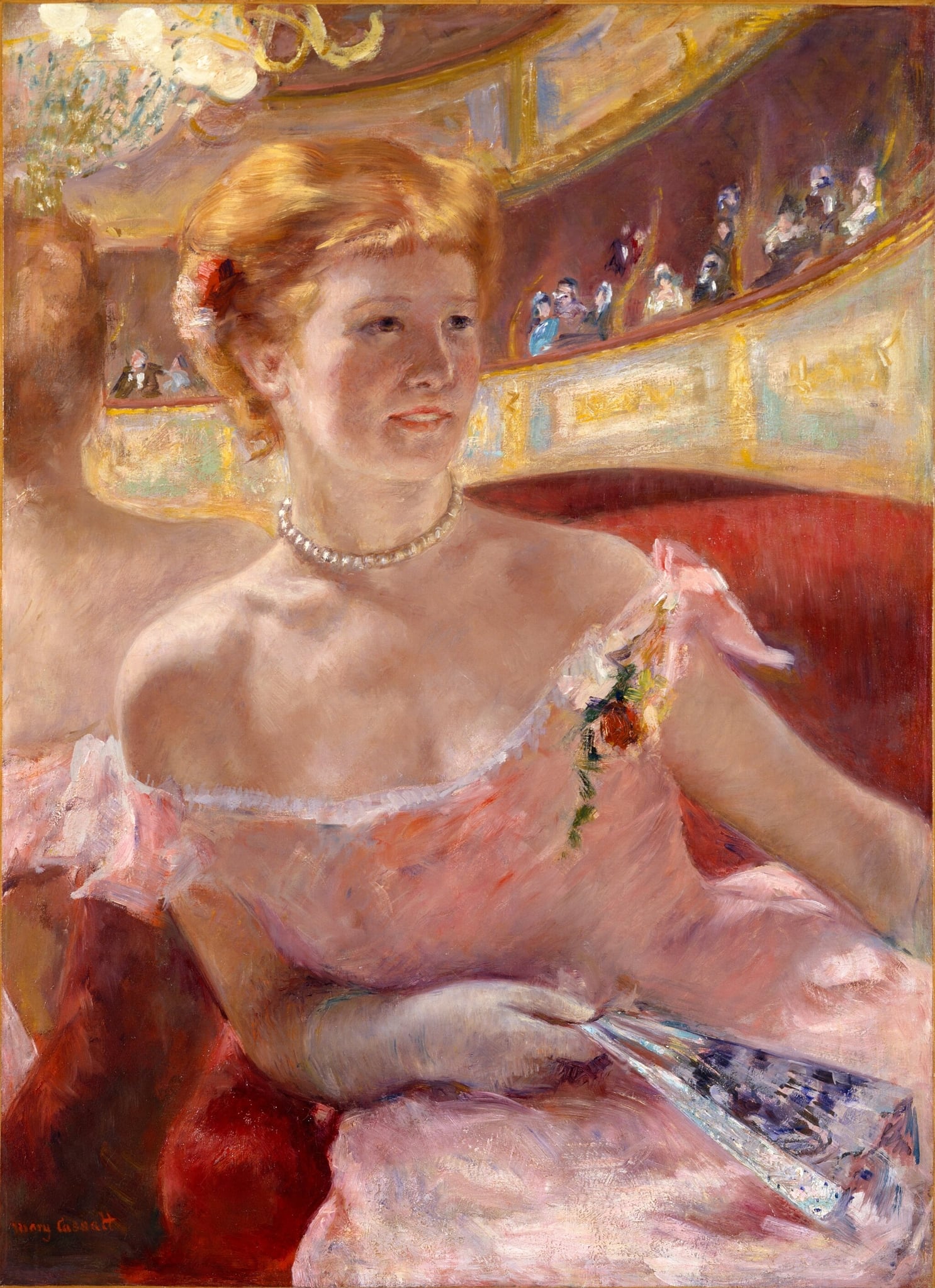
Mary Cassatt’s Woman in Black at the Opera stages a taut drama of vision and visibility. A woman in <strong>black attire</strong> raises <strong>opera glasses</strong> while a distant man aims his own at her, setting off a chain of looks that makes public leisure a site of <strong>power, agency, and surveillance</strong> <sup>[1]</sup><sup>[2]</sup>.

The Tea by Mary Cassatt

The Tea

Mary Cassatt (about 1880)

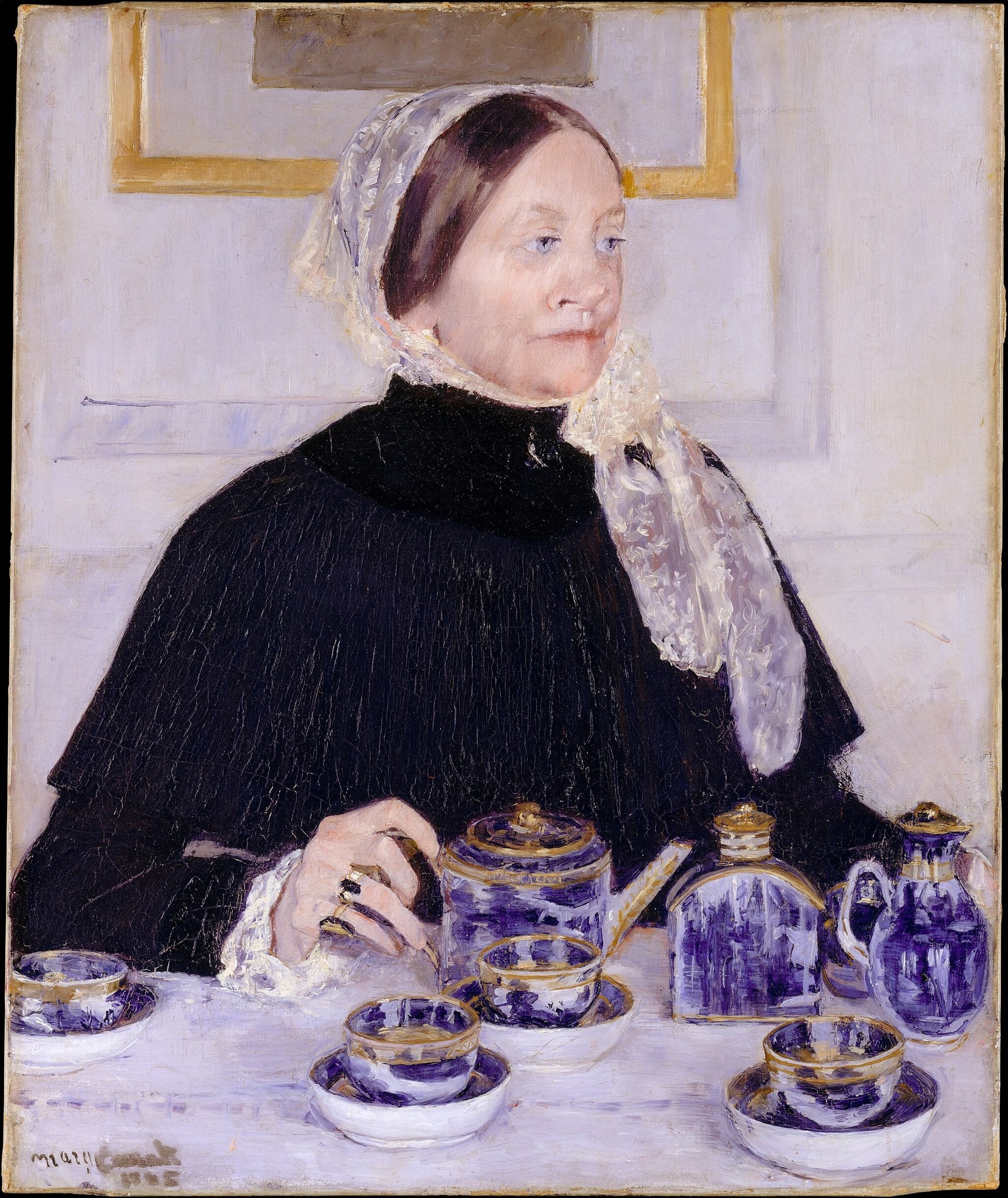
Mary Cassatt’s The Tea stages a poised, interior <strong>drama of manners</strong>: two women sit close yet feel apart, one thoughtful, the other raising a cup that <strong>veils her face</strong>. A gleaming, oversized <strong>silver tea service</strong> commands the foreground, its reflections turning ritual objects into actors in the scene <sup>[1]</sup>. The shallow, cropped room—striped wall, gilt mirror, marble mantel—compresses the atmosphere into <strong>intimacy edged by restraint</strong>.

Little Girl in a Big Straw Hat and a Pinafore by Mary Cassatt

Little Girl in a Big Straw Hat and a Pinafore

Mary Cassatt (c. 1886)

Mary Cassatt’s Little Girl in a Big Straw Hat and a Pinafore distills childhood into a quiet drama of <strong>interiority</strong> and <strong>constraint</strong>. The oversized straw hat and plain pinafore bracket a flushed face, downcast eyes, and <strong>clasped hands</strong>, turning a simple pose into a study of modern self‑consciousness <sup>[1]</sup>. Cassatt’s cool grays and swift, luminous strokes make mood—not costume—the subject.

Breakfast in Bed by Mary Cassatt

Breakfast in Bed

Mary Cassatt (1897)

Breakfast in Bed distills a <strong>tender modern intimacy</strong> into a tightly cropped sanctuary of rumpled white linens, protective embrace, and interrupted routine. Mary Cassatt uses <strong>cool light</strong> against <strong>warm flesh</strong> to anchor attention on the mother’s encircling arm and the child’s outward gaze, fusing care, curiosity, and the rhythms of <strong>everyday modern life</strong> <sup>[1]</sup><sup>[2]</sup>.

Young Mother Sewing by Mary Cassatt

Young Mother Sewing

Mary Cassatt (1900)

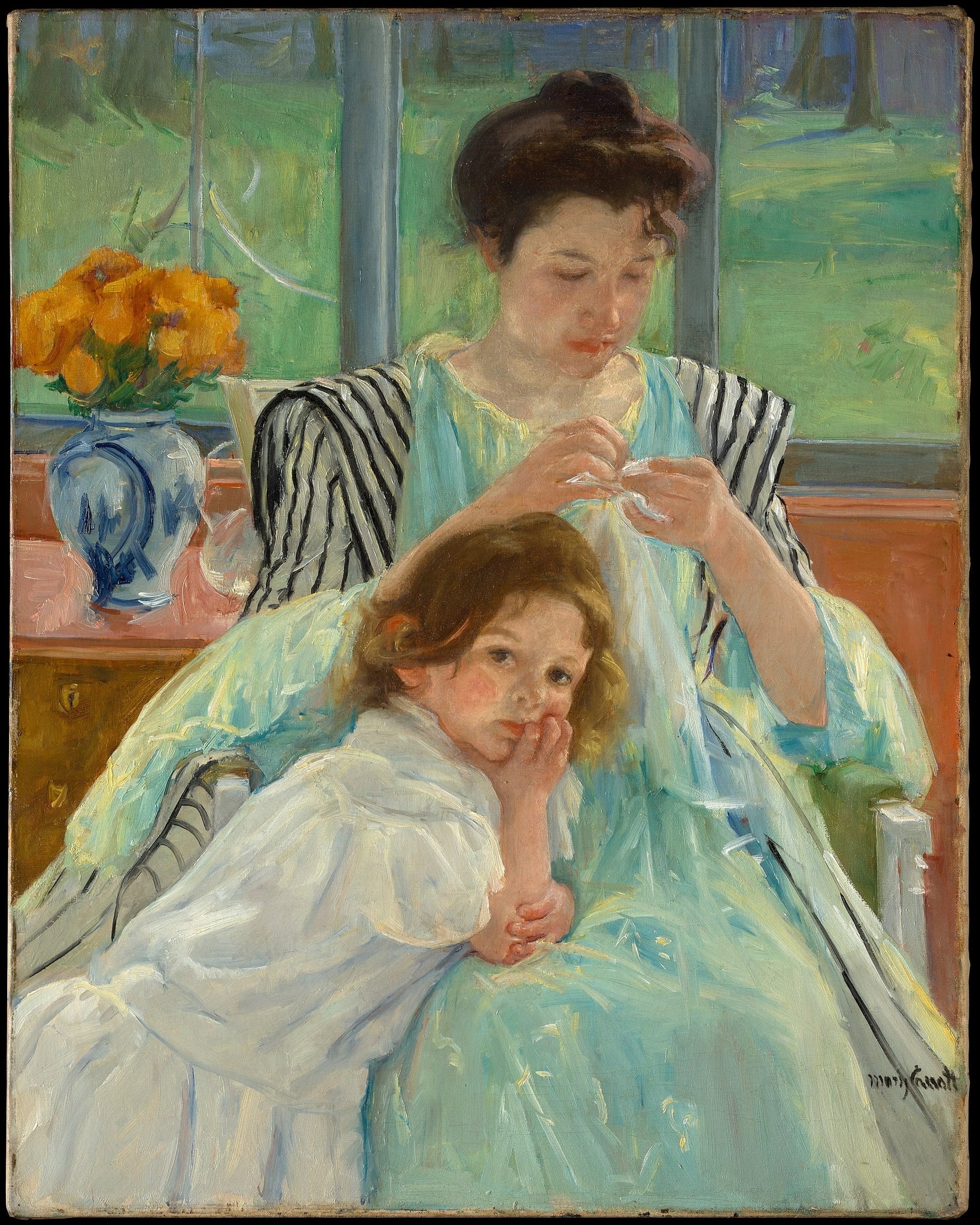
Mary Cassatt’s Young Mother Sewing centers the quiet <strong>labor of care</strong>: a mother steadies pale fabric while a child in white leans into her, eyes meeting ours. Cool <strong>greens and blues</strong> bathe the figures as striped sleeves and chair arms rhythmically return attention to the mother’s working hands, while a burst of <strong>orange blossoms</strong> by the window anchors interior life against the world outside <sup>[1]</sup>.
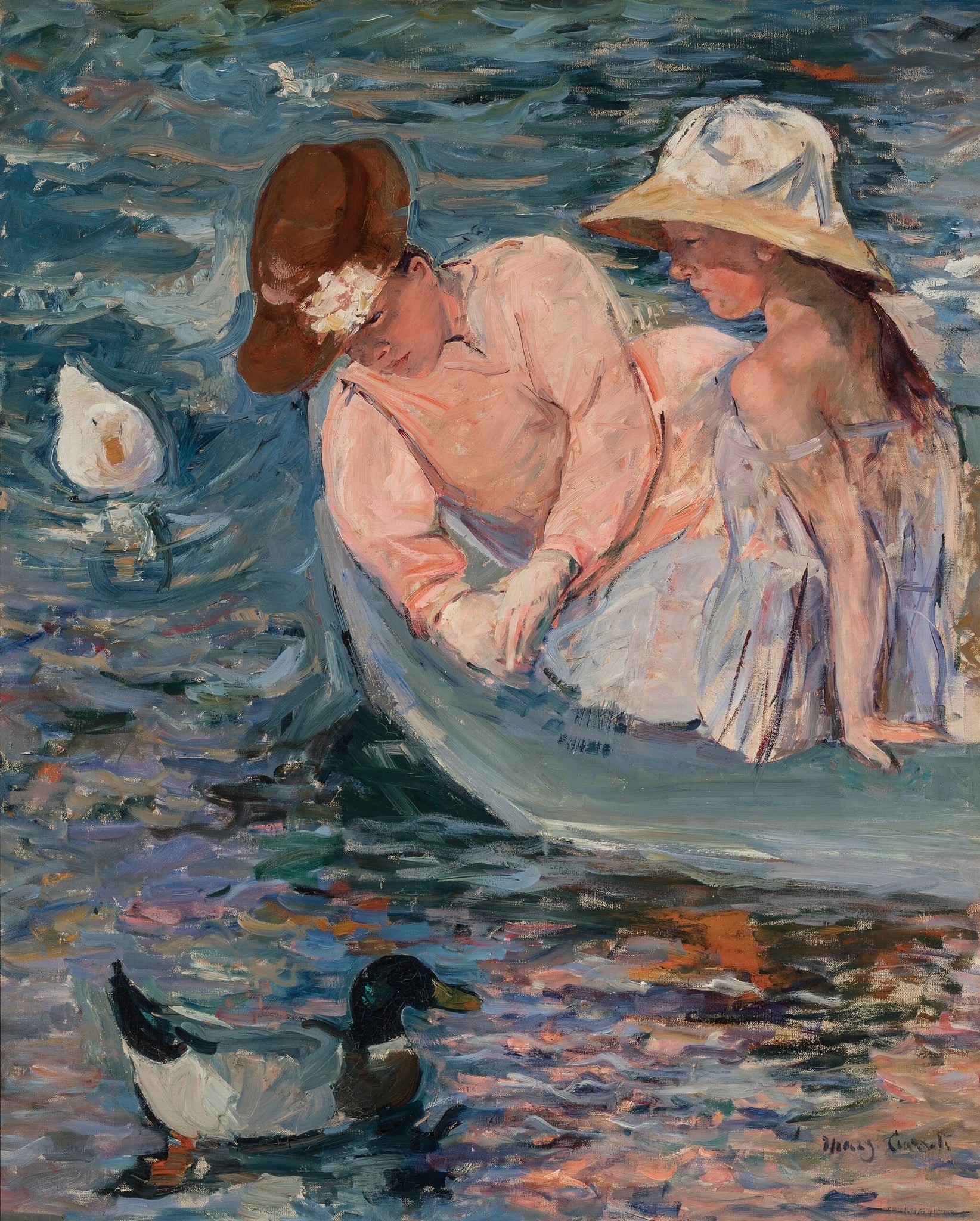
A Woman and a Girl Driving by Mary Cassatt

A Woman and a Girl Driving

Mary Cassatt (1881)

Cassatt stages a modern scene of <strong>female control</strong> in motion: a woman grips the reins and whip while a girl beside her mirrors the pose, and a groom seated behind looks away. The cropped horse and diagonal harness thrust the carriage forward, placing viewers inside a public outing in the Bois de Boulogne—an arena where visibility signaled status and autonomy <sup>[1]</sup><sup>[2]</sup>.