Portrait of Alexander J. Cassatt and His Son Robert Kelso Cassatt

by Mary Cassatt

A quiet, domestic tableau becomes a study in authority tempered by affection. In Portrait of Alexander J. Cassatt and His Son Robert Kelso Cassatt, Mary Cassatt fuses father and child into a single dark silhouette against a luminous, brushed interior, their shared gaze fixed beyond the frame. The newspaper, linked hands, and cropped closeness transform a routine moment into a symbol of generational continuity and modern attentiveness.

Fast Facts

Year
1884
Medium
Oil on canvas
Dimensions
100.3 × 81.3 cm
Location
Philadelphia Museum of Art, Philadelphia
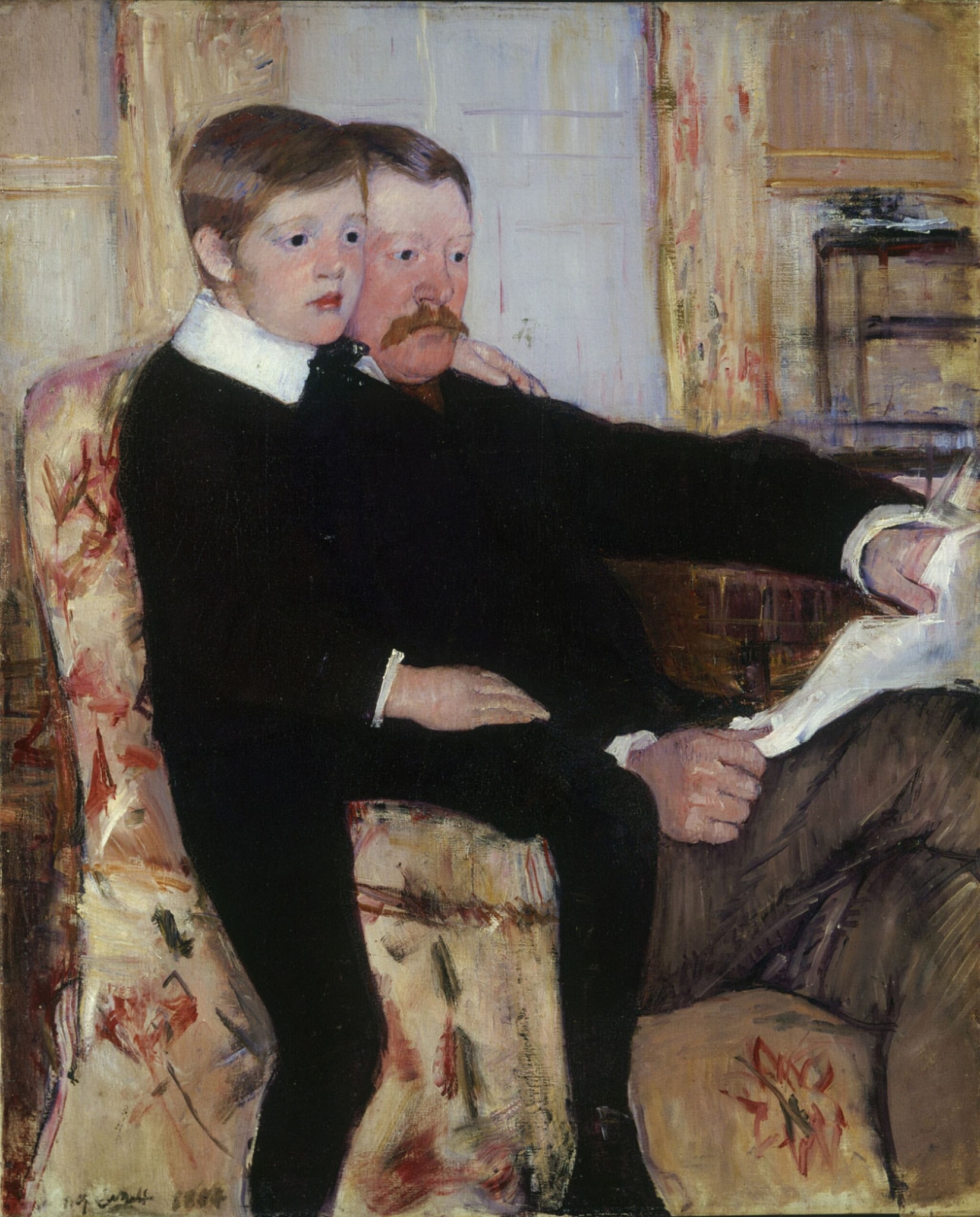
Portrait of Alexander J. Cassatt and His Son Robert Kelso Cassatt by Mary Cassatt (1884)

Click on any numbered symbol to learn more about its meaning

Meaning & Symbolism

Cassatt stages the encounter as a compact unit of attention. The boy’s arm hooks over his father’s shoulder; the father’s right hand anchors a newspaper, while the left steadies the child’s knee. Their black suits and white cuffs merge into a single dark, triangular form that reads almost as one body with two heads—an intentional fusion that asserts likeness, guidance, and the absorption of the younger by the steadiness of the elder 2. This fusion is heightened by the photographic crop: legs truncated, chair edges clipped, and the figures pressed forward into our space so that we, too, are pulled into their line of sight beyond the canvas 2. Around them, Cassatt’s background is broadly, even scribbly, brushed—beige walls, a suggestion of a window or door, and the floral armchair scumbled with rose and ocher—so that environment dissipates into atmosphere while faces and hands are modeled with greater precision. The result is a deliberate hierarchy: interior textures dissolve; human presence solidifies 2. Cassatt’s symbolic economy is spare but potent. The newspaper is the conduit between private nurturing and public information, a sign of literate habit and the hum of modernity entering the parlor. The boy’s smaller, pink hand—set atop his father’s lap—echoes and answers the larger hand gripping the paper, staging a tactile lesson in how knowledge is held and passed along 3. Their synchronized gaze outward denies theatricality; they are not posing for us but attending to something else together. That choice turns spectatorship into pedagogy: the father models how to look, how to weigh events, how to inhabit a world where domestic calm is threaded with news of industry, politics, and change 13. Even the floral, upholstered chair participates: its softness counters the suits’ formality, implying that authority can sit in comfort, that discipline need not cancel warmth. In formal terms, Cassatt uses value contrast to dramatize this balance—the dark mass of the figures against a light, luminous ground, punctuated by small reds and whites that keep the eye circulating around heads and hands rather than drifting into décor 2. Historically, the image also repositions a powerful man within a private register. Painted during a Paris visit in 1884—after the sitter had stepped back from corporate leadership—Cassatt strips away the boardroom to show domestic attentiveness as a counter-image to public power 13. That reframing aligns with Cassatt’s broader project—and the exhibition lens of her “work”: attending, caring, reading, and looking become forms of modern labor in the home, mirroring the disciplined craft evident in her differentiated brushwork 6. Critics have read the father’s expression variously—as inward, absorbed, or even bored—reminding us that the painting invites social as well as emotional interpretation; yet either way, the formal structure insists on bonded looking and the continuity of habit across generations 5. In this sense, the meaning of Portrait of Alexander J. Cassatt and His Son Robert Kelso Cassatt lies in its claim that intimacy is constructed—by routine, by shared focus, by the quiet geometry of heads and hands—and that such construction is as consequential to modern life as the news itself. That is why Portrait of Alexander J. Cassatt and His Son Robert Kelso Cassatt is important: it advances Impressionism’s language of light and touch to articulate a social ethic of care, modeling how images can bind private feeling to public time 1236.

Explore Deeper with AI

Ask questions about Portrait of Alexander J. Cassatt and His Son Robert Kelso Cassatt

Popular questions:

Powered by AI • Get instant insights about this artwork

💬 Ask questions about this artwork!

Interpretations

Formal Analysis

Cassatt orchestrates a modern close-up through a photographic crop that truncates legs and pushes the pair forward, a compositional strategy indebted to Degas and late‑19th‑century photographic vision 2. The black coats merge into a single value mass, punctuated by white cuffs and small reds, binding father and son as a unified silhouette against a high‑key ground 2. Faces and hands are carefully modeled, while the chair and walls dissolve into scribbly, atmospheric handling; this hierarchy pulls cognitive and affective attention to gesture and gaze rather than décor 2. The result is an intimate schema of triangles—heads, hands, and the paper—circulating the eye among nodes of agency and relation. Cassatt’s facture thus becomes semantic: finish equals psychological presence; looseness equals ambient domesticity.

Source: Philadelphia Museum of Art (Education Resource) [2]

Social History & Class

Painted during Alexander’s career interregnum, the portrait pointedly sidesteps the boardroom to stage a financier at rest, mediating classed leisure through the unshowy act of reading with a child 14. Critics have read the father’s mien as ennui or inwardness—an ambivalence that opens the image to debates about elite time, domestic respectability, and the optics of authority in private space 5. Cassatt’s strategy domesticates public power without glamor: the suits are sober, the chair floral but ordinary, the news a quotidian prop. In this register, the painting participates in bourgeois self-representation while quietly questioning its affective temperature—does comfort breed attentiveness or boredom? The ambiguity—felt in the neutral mouth and fixed gaze—keeps class performance from hardening into sentimentality.

Source: Philadelphia Museum of Art; The Washington Post review [1][5]

Gender & Paternal Modernity

As a rare paternal subject in Cassatt’s oeuvre, this image reframes late‑19th‑century fatherhood as hands‑on, literate, and emotionally proximate 14. The boy’s arm over the father’s shoulder and the synchronized outward gaze stage co-attention rather than patriarchal display; pedagogy appears as a shared practice of looking, not a didactic lecture 1. The fused dark forms make a visual argument for resemblance and tutelage—authority transmitted not by command but by modeling. Within a practice renowned for women-and-child dyads, the substitution of a father both diversifies gender scripts in the home and reiterates Cassatt’s conviction that care is work, performed by bodies in time and in routine 6.

Source: Philadelphia Museum of Art; Honolulu Museum of Art; PMA Exhibition “Mary Cassatt at Work” [1][4][6]

Media & Modernity

The newspaper functions as an index of modern temporality inside the parlor, threading public events into private life and turning spectatorship into a skill to be learned 14. By placing the child’s pink hand near the paper and echoing it with the father’s grip, Cassatt diagrams how knowledge is held, transmitted, and weighed—a tactile pedagogy of news consumption 4. The outward gaze suggests an unseen stimulus beyond the frame, converting the painting into a relay of attention that implicates the viewer as co-reader. In this sense, the work is a quiet treatise on media literacy avant la lettre: to inhabit modernity is to parse flows of information together, within the intimacies of home.

Source: Honolulu Museum of Art; Philadelphia Museum of Art [4][1]

Oeuvre & Artistic Labor

Within the lens of Mary Cassatt at Work, the painting models two kinds of labor: the domestic attentional work of co-reading and the artist’s own labor of selection, cropping, and differentiated touch 6. Cassatt’s calibrated finish—meticulous in faces/hands, cursive elsewhere—enacts an ethics of priority: human relation first, décor second 2. That choice aligns with her broader project of legitimizing the so-called feminine sphere as a modern site of work, not mere leisure. The portrait thereby doubles as a meta-statement about artmaking: to paint care is to practice it, to hone looking so the viewer learns to look likewise. Craft and caregiving converge in a picture that literalizes what the exhibition argues figuratively.

Source: Philadelphia Museum of Art, “Mary Cassatt at Work” (exhibition); PMA Education Resource [6][2]

Related Themes

About Mary Cassatt

Mary Cassatt (1844–1926) was an American painter who settled in Paris, exhibited with the Impressionists, and became a key conduit for introducing their art to U.S. collectors. After 1890 she adopted japoniste flatness, bold patterning, and strong design, focusing on modern women’s lives—especially mother‑and‑child subjects—until failing eyesight curtailed her work by 1914 [4].
View all works by Mary Cassatt

More by Mary Cassatt

Woman in Black at the Opera by Mary Cassatt

Woman in Black at the Opera

Mary Cassatt (1878)

Mary Cassatt’s Woman in Black at the Opera stages a taut drama of vision and visibility. A woman in <strong>black attire</strong> raises <strong>opera glasses</strong> while a distant man aims his own at her, setting off a chain of looks that makes public leisure a site of <strong>power, agency, and surveillance</strong> <sup>[1]</sup><sup>[2]</sup>.

The Tea by Mary Cassatt

The Tea

Mary Cassatt (about 1880)

Mary Cassatt’s The Tea stages a poised, interior <strong>drama of manners</strong>: two women sit close yet feel apart, one thoughtful, the other raising a cup that <strong>veils her face</strong>. A gleaming, oversized <strong>silver tea service</strong> commands the foreground, its reflections turning ritual objects into actors in the scene <sup>[1]</sup>. The shallow, cropped room—striped wall, gilt mirror, marble mantel—compresses the atmosphere into <strong>intimacy edged by restraint</strong>.

Little Girl in a Big Straw Hat and a Pinafore by Mary Cassatt

Little Girl in a Big Straw Hat and a Pinafore

Mary Cassatt (c. 1886)

Mary Cassatt’s Little Girl in a Big Straw Hat and a Pinafore distills childhood into a quiet drama of <strong>interiority</strong> and <strong>constraint</strong>. The oversized straw hat and plain pinafore bracket a flushed face, downcast eyes, and <strong>clasped hands</strong>, turning a simple pose into a study of modern self‑consciousness <sup>[1]</sup>. Cassatt’s cool grays and swift, luminous strokes make mood—not costume—the subject.

Breakfast in Bed by Mary Cassatt

Breakfast in Bed

Mary Cassatt (1897)

Breakfast in Bed distills a <strong>tender modern intimacy</strong> into a tightly cropped sanctuary of rumpled white linens, protective embrace, and interrupted routine. Mary Cassatt uses <strong>cool light</strong> against <strong>warm flesh</strong> to anchor attention on the mother’s encircling arm and the child’s outward gaze, fusing care, curiosity, and the rhythms of <strong>everyday modern life</strong> <sup>[1]</sup><sup>[2]</sup>.

Young Mother Sewing by Mary Cassatt

Young Mother Sewing

Mary Cassatt (1900)

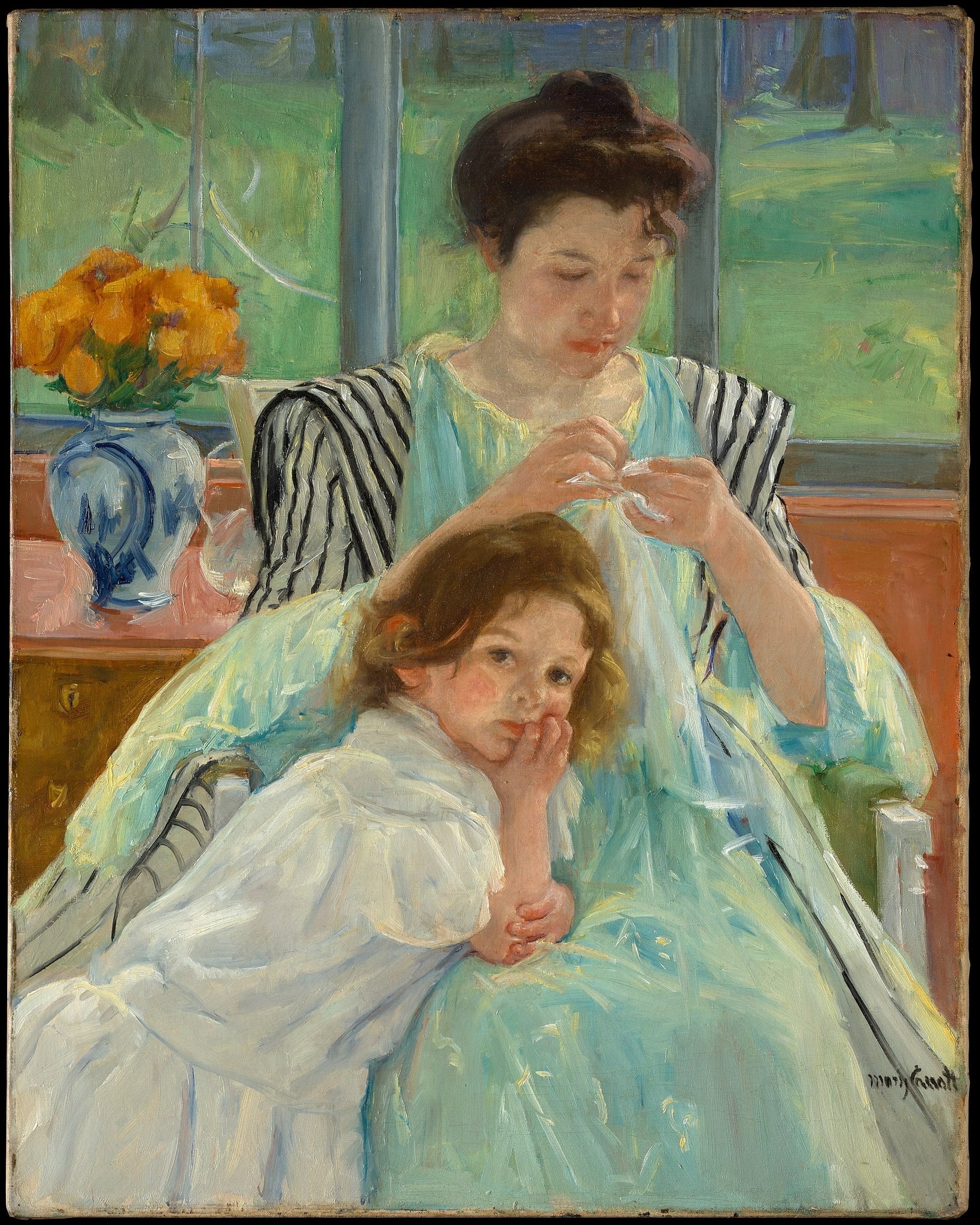
Mary Cassatt’s Young Mother Sewing centers the quiet <strong>labor of care</strong>: a mother steadies pale fabric while a child in white leans into her, eyes meeting ours. Cool <strong>greens and blues</strong> bathe the figures as striped sleeves and chair arms rhythmically return attention to the mother’s working hands, while a burst of <strong>orange blossoms</strong> by the window anchors interior life against the world outside <sup>[1]</sup>.
Children Playing on the Beach by Mary Cassatt

Children Playing on the Beach

Mary Cassatt (1884)

In Children Playing on the Beach, Mary Cassatt brings the viewer down to a child’s eye level, granting everyday play the weight of <strong>serious, self-contained work</strong>. The cool horizon and tiny boats open onto <strong>modern space and possibility</strong>, while the cropped, tilted foreground seals us inside the children’s focused world <sup>[1]</sup>.