Las Meninas

by Diego Velazquez

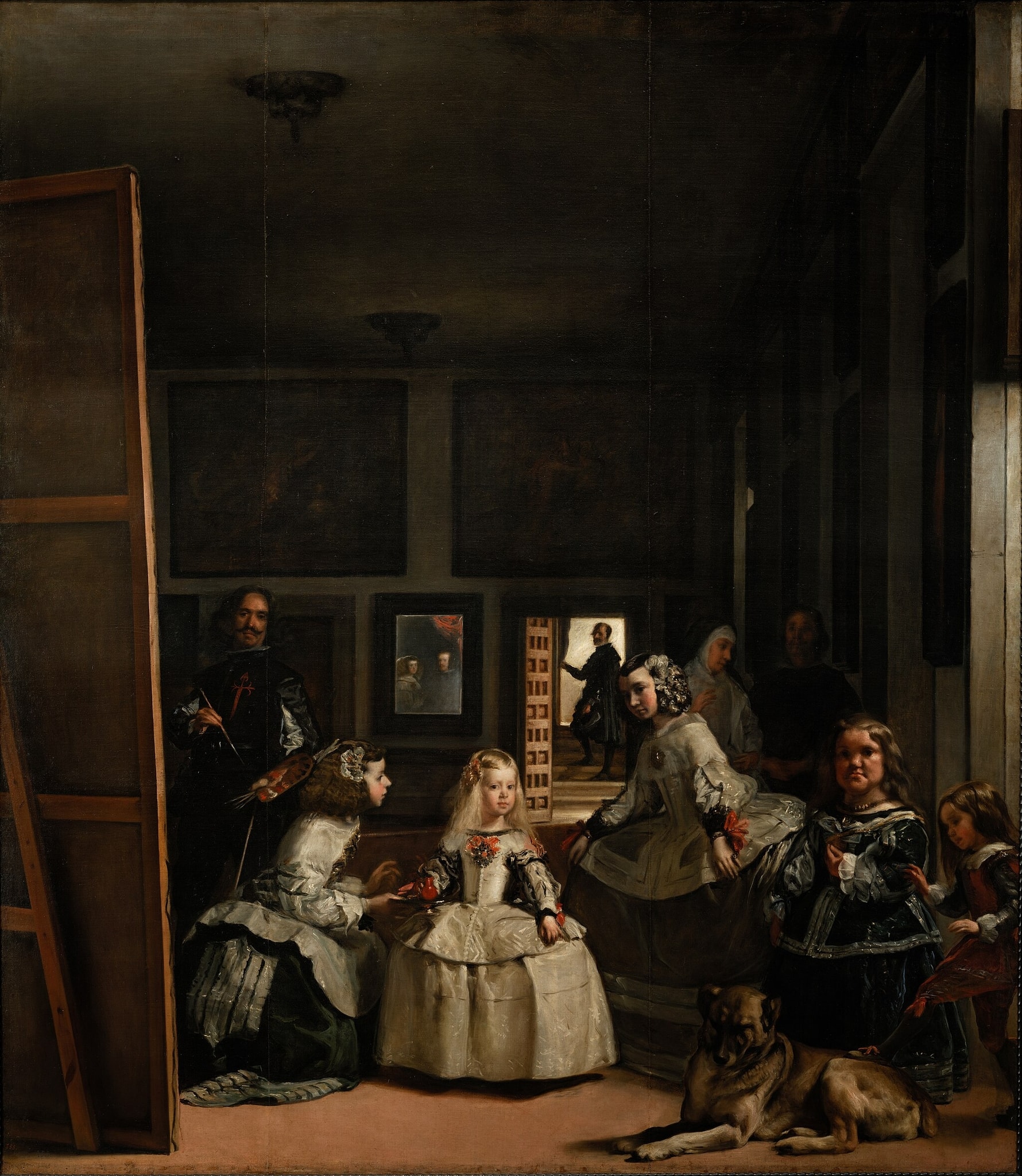
In Las Meninas, a luminous Infanta anchors a shadowed studio where the painter pauses at a vast easel and a small wall mirror reflects the monarchs. The scene folds artist, sitters, and viewer into one reflexive tableau, turning court protocol into a meditation on seeing and being seen [1][3]. A bright doorway at the rear deepens space and time, as if someone has just entered—or is leaving—the picture we occupy [1][5].

Fast Facts

Year
1656
Medium
Oil on canvas
Dimensions
320.3 × 279.1 cm
Location
Museo Nacional del Prado, Madrid
Las Meninas by Diego Velazquez (1656) featuring Reverse of the giant canvas/easel, Wall mirror with royal reflections, Open doorway and figure in light, Order of Santiago cross

Click on any numbered symbol to learn more about its meaning

Meaning & Symbolism

Velazquez constructs the studio as a machine for making meaning. At left, the colossal reverse of a canvas blocks our view, asserting that the act of painting itself is the real subject. The painter faces us, brush lifted mid‑stroke, while the Infanta stands irradiated at center, her ivory dress catching the only pooled light. Around her, two meninas bend in attendance; a mastiff lies still as a page nudges it with his foot; a dwarf meets our gaze with unembarrassed dignity. Most eyes angle outward toward our position, where the mirror on the back wall places the monarchs—and therefore the viewer—at the apex of the sightlines 1. This single device yokes representation to power: the picture we contemplate may be the picture being painted, and the sovereigns who authorize it stand where we do, transforming spectatorship into rule observed and reflected 3. The open doorway beyond, where José Nieto pauses halfway up a stair in a shaft of light, fixes the composition’s vanishing point and injects time into space: an arrival or departure that keeps the image perpetually in the present tense 15. Within this architecture of looks, Velazquez advances a claim for painting’s intellectual rank. The red cross of the Order of Santiago on his chest—generally considered a later addition marking his knighthood—projects noble status onto the artist’s body and, by extension, onto his craft 15. On the rear wall, large canvases after Rubens and Jordaens reprise myths of artistic trial and hubris (Arachne, Apollo’s contest), aligning Habsburg taste with classical authority and embedding a quiet manifesto: painting adjudicates knowledge, not mere decoration 5. Even small props carry cultural charge: the menina at left offers a red búcaro cup on a tray, a courtly object prized for its fragrance and porous coolness, folding everyday ritual into a scene about representation’s material means 6. Light, too, is political here: it crowns the Infanta while leaving most of the room in penumbra, staging innocence as a spectacle carefully produced. Yet Velazquez’s humanism resists caricature. The court dwarfs are rendered with the same tonal subtlety as grandees; the sleepy mastiff is a visual ballast, its warm brown echoing the painter’s palette, tying empathy to craft 1. The painting’s enduring power lies in its revolving center. Look long enough and focus slips: from the princess to the painter, from the mirror’s tiny busts to the glowing doorway, then back along the oblique. Scholars have shown how this shifting attention is built into the geometry, with the doorway’s axis and the mirror’s alignment creating a continuous loop between picture, viewer, and depicted world 35. In courtly terms, this loop naturalizes protocol—everyone appears to react to the sovereign presence at our position, as if the royal sitting has just concluded and we have been noticed 2. In philosophical terms, it stages the conditions of representation itself: the model exists because the painter looks; the painter acts because power and viewership authorize looking; the viewer sees because the painting constructs a place to stand. Even its later life underscores the argument: rescued and restored after the Alcázar fire and subjected to modern cleanings that recalibrated its tonal balance, Las Meninas has repeatedly proven that pictures are not just images but systems of attention that survive by reorganizing how they are seen 57. That is why Las Meninas is important: it is both a court portrait and a thinking machine, a work that makes the act of looking its subject and the dignity of art its thesis.

Explore Deeper with AI

Ask questions about Las Meninas

Popular questions:

Powered by AI • Get instant insights about this artwork

💬 Ask questions about this artwork!

Interpretations

Philosophical Interpretation

Foucault reads Las Meninas as a stage on which the relations between painter, model, and spectator perpetually displace one another. The mirror’s miniature effigies of Philip IV and Mariana anchor a circuit in which the viewing position is both inside and outside the painting—an operation that makes representation itself the subject. The work’s power lies in how it withholds a stable center: the eye oscillates between the Infanta’s irradiated presence, the painter’s raised brush, and the glowing exit where José Nieto hovers, producing a choreography of looking that dramatizes how images create the conditions for seeing. In this sense, Velázquez builds not only a portrait but a device of vision—a picture that thinks about how pictures think 13.

Source: Michel Foucault, The Order of Things (ch. 1) / Museo del Prado

Political Theology & Court Ritual

Building on court-historical readings, Snyder’s “mirror of the prince” thesis clarifies how the reflected monarchs function as a didactic emblem of exemplary rule. The figures in the room appear to react to the sovereign presence situated at the viewer’s locus, naturalizing etiquette as vision: to look is to acknowledge power, and to be seen is to be inscribed within protocol. Velázquez places himself within this circuit, elevating painting to an instrument that mediates authority rather than merely serving it. The result is ideological subtlety rather than propaganda: monarchy is not proclaimed with allegory but performed through sightlines, attention, and deference, making spectatorship itself a courtly act 17.

Source: Joel Snyder, Critical Inquiry (1985) / Museo del Prado

Iconography of Artistic Trial

The background canvases—copies after Rubens and Jordaens via Mazo—cite myths of Arachne and Apollo’s contest, where mortal ambition meets artistic judgment. Their placement above the mirror folds classical precedent into Habsburg taste, aligning court culture with narratives that adjudicate skill, hubris, and authority. Read against Velázquez’s own campaign for the Order of Santiago, these mythologies become a manifesto: painting is a liberal art capable of intellectual arbitration, not mere ornament. The meta-message doubles the onstage scene, where the studio becomes a tribunal of looking; myth confirms what practice demonstrates in the foreground 14.

Source: Museo del Prado object record; scholarly consensus via es.wikipedia synthesis

Material Culture & Sensory History

The small red búcaro cup offered to the Infanta is more than courtly refreshment: prized for its fragrance and evaporative coolness, such earthenware participated in early modern regimes of health, beauty, and refined taste. Its porousness—literally shaping what is seen, smelled, and sipped—echoes the painting’s own mediation of presence and absence. By staging a sensory ritual within the optics of representation, Velázquez binds everyday material practice to the high stakes of image-making. The búcaro thus functions as a quiet thesis on material supports: pictures, like cups, condition experience through their substances and surfaces 5.

Source: The Metropolitan Museum of Art, Perspectives: Immaterial Clay

Conservation, Catastrophe, and Afterlife

Las Meninas is also a history of survival. Damaged in the 1734 Alcázar fire and retouched by Juan García de Miranda, the canvas later underwent controversial cleaning in 1984 that lifted yellowed varnish and recalibrated its tonal balance. These episodes make visible the painting’s argument about time: meanings shift as surfaces change, and reception is co-produced by restoration. The image we see is not a fixed original but a palimpsest that keeps reorganizing how it is seen—an afterlife consistent with the work’s internal play of mirrors, thresholds, and suspended action. Conservation becomes yet another mirror in which the painting recognizes itself 26.

Source: El País (1984 cleaning retrospective); Royal/Prado histories summarized in Frick and Prado materials

Social Optics & Dignity

Velázquez’s treatment of Mari Bárbola and Nicolás Pertusato extends his humane portraiture of court companions: rendered with the same tonal subtlety as grandees, they anchor scale and space while claiming unflinching presence. Their reciprocal glances complicate the court’s hierarchy of looking, unsettling the tidy alignment of status and visibility. This is not sentimental inclusion but a recalibration of who may command attention in a sovereign image. By giving marginal figures the power to look back, the painter folds class difference into the work’s optical democracy, making perception itself a site where inequality is seen—and partially redressed—through style 1.

Source: Museo del Prado object record and figure identifications

Related Themes

About Diego Velazquez

Diego Velazquez (1599–1660) served as court painter to Philip IV, shaping Spanish Baroque art with a naturalism honed by two Italian sojourns. In the 1650s he held senior palace offices and pursued social elevation, culminating in admission to the Order of Santiago in 1659 [8]. Las Meninas crowns this career-long bid to assert painting as a noble, intellectual practice [2][8].
View all works by Diego Velazquez