The Dwarfs and Dog in Las Meninas
A closer look at this element in Diego Velazquez's 1656 masterpiece
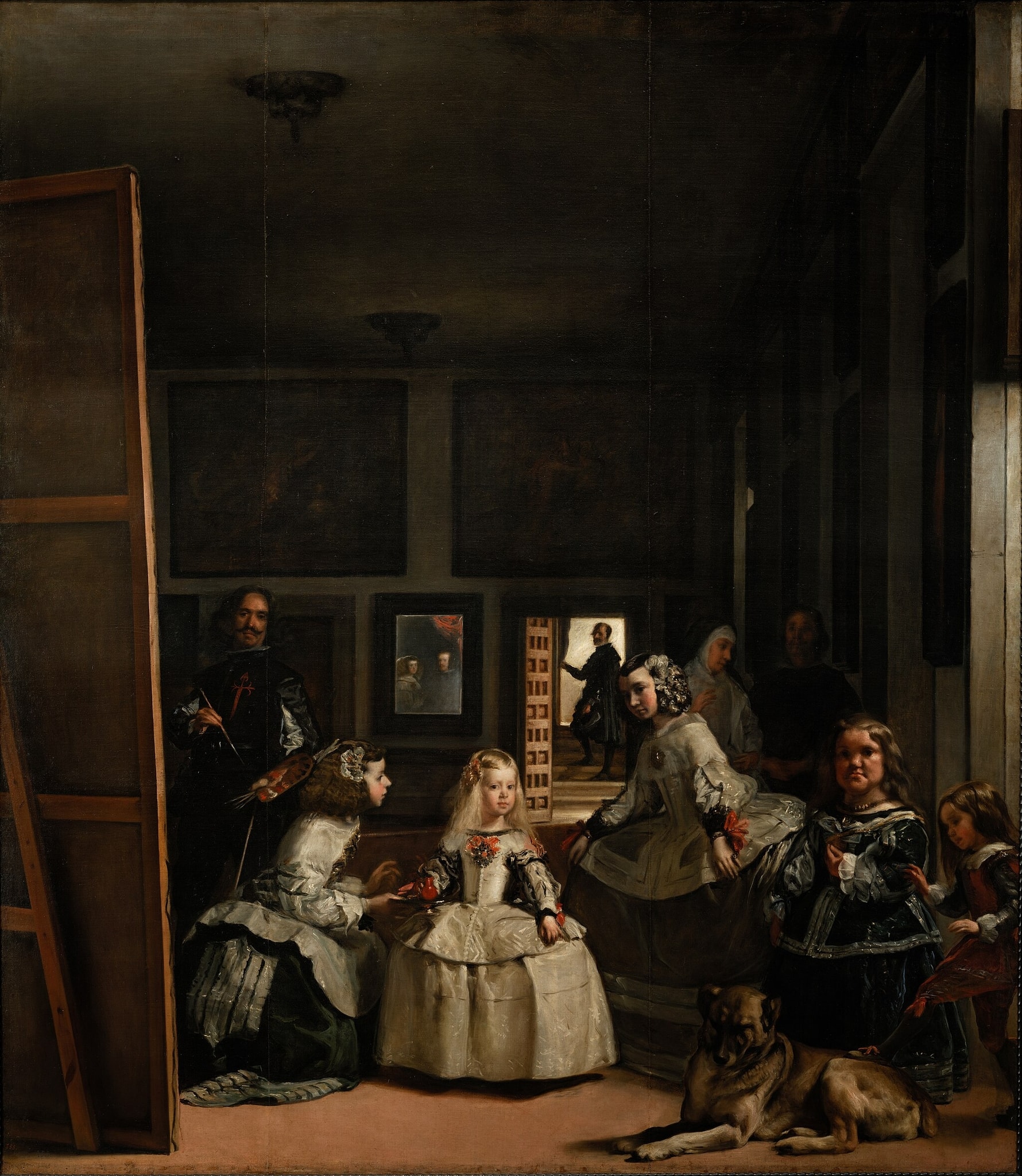
At the right front of Las Meninas, Mari Bárbola and Nicolásito Pertusato flank a huge, dozing Spanish mastiff. Pertusato’s casual nudge of the dog and Bárbola’s steady gaze bring the court’s closest attendants startlingly near, embodying Velázquez’s humane naturalism and anchoring the painting’s living threshold.
Historical Context
Velázquez painted Las Meninas in 1656 inside the Alcázar of Madrid, portraying the Infanta Margaret Theresa with members of her immediate household. At the far right stand the court dwarfs Mari Bárbola and Nicolásito Pertusato beside a somnolent mastiff; the Prado identifies them by name and notes Pertusato’s foot nudging the dog 1. Both were attached to the Infanta’s service at this date, which explains their prominent place beside her in the first plane of the scene 1.
Across the 1630s–50s Velázquez repeatedly portrayed court dwarfs with unusual sympathy and individuality, a hallmark of his late, truthful style. The Met underscores his commitment to naturalism and to recording the lived reality of the royal household—"two court dwarfs and a large dog" rendered without caricature but with presence and dignity 2. Their inclusion in Las Meninas reflects that reality: attendants who moved with the princess, captured here life-size and at immediate range, fusing ceremony with daily court life 12.
Symbolic Meaning
In early modern portraiture, the dog commonly signals fidelity, vigilance, and constancy. The mastiff’s placid pose aligns with this tradition, reinforcing the dependable order surrounding the Infanta 5. An eighteenth‑century commentator, Palomino, observed that Pertusato’s foot on the animal displays the dog’s good temper; the gesture reads not as cruelty but as proof of the courtly hound’s calm, controlled nature 6.
Some writers have proposed allegories in which the dwarf importunes Fidelity, but mainstream scholarship warns against over‑allegorizing such incidental motifs in Las Meninas, whose effect rests on observed reality more than fixed emblems 92. What resonates is human presence: Mari Bárbola’s direct, level gaze engages the very space of the sovereigns/viewer, a poise that several commentators read as compositional and psychological strength within the group 38. As official attendants, the dwarfs embody proximity and service to the princess, while their individualized likenesses assert their status as distinct persons within the court 13. Recent clinical analysis even notes Velázquez’s accurate observation of traits seen in achondroplasia, underscoring his empirical, unsentimental vision—one more reason their presence feels documentary rather than programmatic 7.
Artistic Technique
Velázquez renders the group with his late, economical manner: fluid, largely alla prima handling, thinly diluted pigments, and swift passages—what the Prado calls pintura a borrones—achieving immediacy at close range 1. A lateral light from the right strikes the dwarfs and the mastiff, modeling volumes crisply against the room’s half‑tones and locking them to the tiled floor through sharp foreshortening and cast shadows 1.
Color is restrained—deep blacks, silvery grays, warm flesh and tawny fur—so that texture carries expression: the satin’s glint, the dog’s coarse coat, the soft edges of hair and lace. The Met emphasizes how such strokes conjure the “look of life,” giving the massive dog and the attendants palpable weight and presence within the painting’s breathing space 2.
Connection to the Whole
Compositionally, the dwarfs and mastiff form a right‑hand counterweight to the painter and his large canvas on the left, completing the undulating frieze of the foreground and stabilizing the room’s deep perspective 1. Their proximity to the picture’s edge establishes a threshold that draws viewers into the scene as participants rather than onlookers 23.
Mari Bárbola’s frontal gaze plugs directly into the painting’s celebrated network of looks—the artist, the princess’s retinue, and the reflected sovereigns—tightening the circuit that entangles us with the monarchy’s presence 138. Meanwhile, the mastiff’s serenity, even under a nudge, mirrors the painting’s fusion of high ceremony with off‑guard immediacy: a living court captured in equilibrium, not allegory 12.
Explore More from This Painting
This detail is one part of Las Meninas. Use the links below to return to the full interpretation, browse the full set of details, or view the painting's valuation if available.
Sources
- Museo Nacional del Prado, Encyclopedia entry: “Meninas, Las [Velázquez]”
- The Metropolitan Museum of Art, Heilbrunn Timeline: “Velázquez (1599–1660)”
- Smarthistory: “Diego Velázquez, Las Meninas”
- Cambridge/Amsterdam UP: “Ordinary Marvels: The Case of Dwarf Attendants in Habsburg Spain”
- National Gallery, London: Glossary—Dogs (symbolism)
- Web Gallery of Art: Las Meninas (detail) and Palomino’s remark
- PubMed: Clinical observations on Velázquez’s portraits of dwarfs
- Financial Times, John Banville: “On the enduring mystery of Las Meninas”
- Wikipedia: Las Meninas (iconological debates, overview)