Velázquez's Self-Portrait in Las Meninas
A closer look at this element in Diego Velazquez's 1656 masterpiece
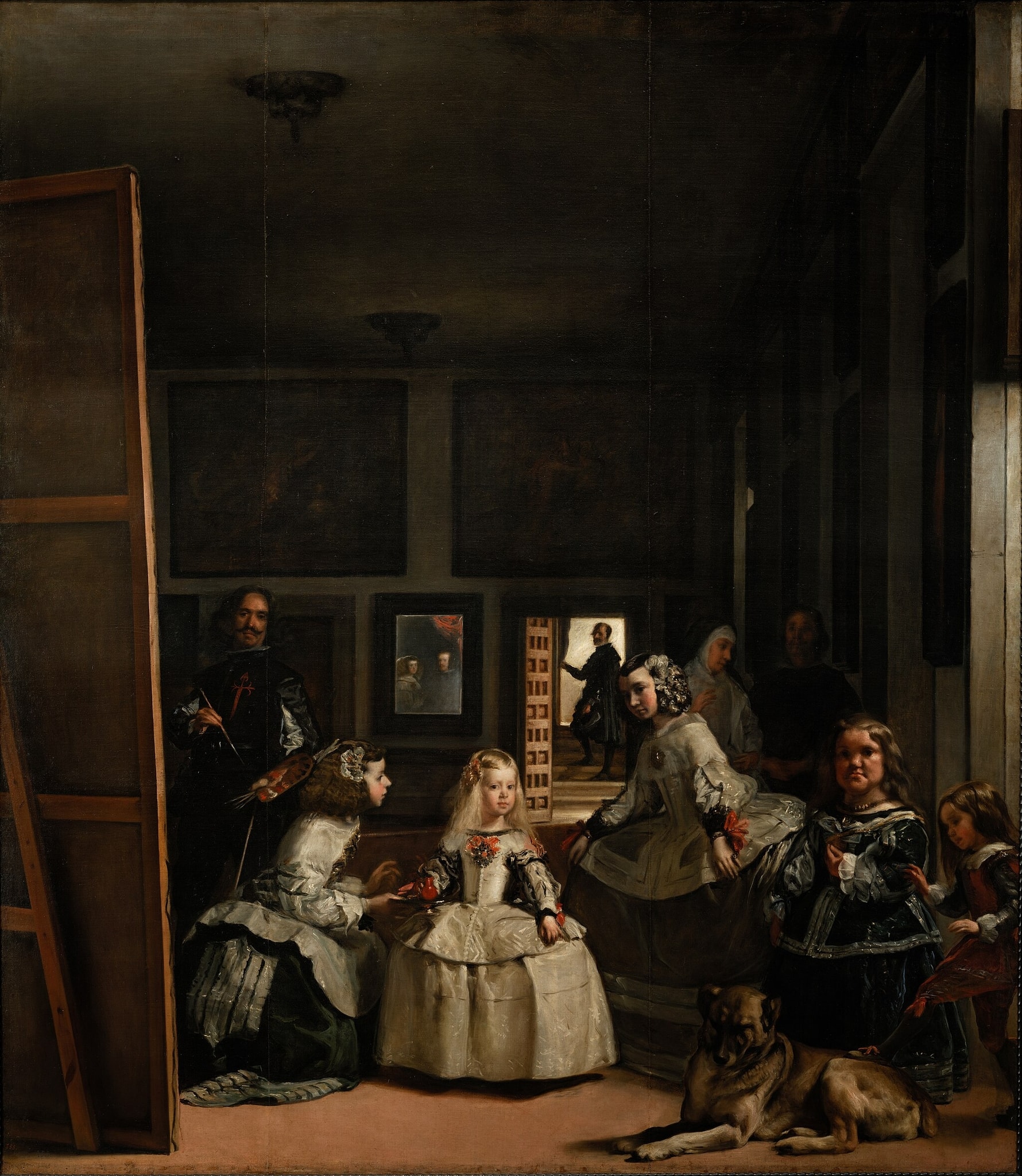
On the painting’s left, Velázquez paints at a monumental easel and meets our gaze as if we stand where the royal sitters do. Court dress, the key ring at his waist, and the later-added red cross of Santiago elevate this self-image into a declaration of rank and of painting’s dignity.
Historical Context
Painted in 1656 inside the Alcázar studio, the self‑portrait shows Velázquez at work—brush in his right hand, palette in his left—dressed as a court official and looking directly out toward the space occupied by the viewers and, crucially, by the absent sitters whose likeness appears in the rear mirror. His key ring signals his office in the royal household (aposentador), a marker of privileged access acquired after decades of service to Philip IV 12.
Velázquez was admitted to the Order of Santiago in 1658 after persistent petitions to recognize painting as a liberal art worthy of nobility; the red cross now visible on his chest was added after the canvas’s initial completion to register that knighthood. By inserting himself, life‑size and active, he affirms his status at court while redefining the painter as an intellectual counselor to princes, not merely a craftsman. The self‑portrait thus records a historical career milestone and simultaneously stages the courtly environment that authorized it 12.
Symbolic Meaning
The figure reads as an emblem of the Triumph of Painting. Velázquez adopts a poised, thinking stance at his easel, asserting that pictorial invention is an act of intellect. The far‑wall canvases—identified with myths of Minerva and Arachne and of Apollo and Pan—evoke contests that exalt artistic mastery, amplifying the self‑portrait’s claim for painting’s nobility and for the painter’s parity with learned elites 3. The visible Santiago badge literalizes that claim, inscribing knighthood onto the artist’s body and converting a likeness into a public statement of rank 5.
Equally potent is the image’s play with representation. By turning toward us while painting a canvas the size of Las Meninas itself, Velázquez places the viewer in the sovereigns’ position and makes himself the hinge between painted and real space. The mirror that reflects Philip IV and Mariana confirms this alignment, joining artist, monarchs, and spectator within a single optical system—an idea conversant with the mirror tradition stemming from Van Eyck and other precedents of reflective self‑reflexivity 14. The court‑studio setting also nods to celebrated anecdotes—from Apelles and Alexander to Renaissance studio visits—in which rulers honor artists, framing royal presence as the guarantor of artistic prestige 2.
Artistic Technique
Velázquez renders himself with late‑style looseness—thin, economical layers and swift touches that Prado scholars call borrones—reserving sharp definition for strategic accents: the brisk white zigzags at the shirt cuff, the charged dabs that map pigments on the palette, the crisp silhouette against the easel’s plane 3. Technical studies report minimal underdrawing and rapidly applied paint layers, characteristic of his mature method 3. Side‑light from the right models the head and hands, while atmospheric perspective and multiple light sources stitch the dark figure seamlessly into the room’s deep recession toward the open doorway 1. The easel‑backed canvas nearly matches the scale of Las Meninas, so the picture we see and the picture he paints conceptually coincide, intensifying the self‑portrait’s performative force 2.
Connection to the Whole
The self‑portrait is the painting’s structural and conceptual anchor. Its left‑hand mass balances the infanta’s group, while the artist’s gaze locks onto the viewer and, via the mirror, onto the monarchs. Together with the vanishing point at the open doorway, these elements form a triad—painter, sovereigns, spectator—that organizes sightlines and meaning across the room 1. By foregrounding the act of painting and the social standing of the painter, the figure converts Las Meninas from a court portrait into a meta‑picture about seeing, representation, and authority. Without the self‑portrait, the mirror’s logic and the work’s encompassing claim for painting’s intellectual dignity would lose their scaffold 62.
Explore More from This Painting
This detail is one part of Las Meninas. Use the links below to return to the full interpretation, browse the full set of details, or view the painting's valuation if available.
Sources
- Museo del Prado – Las Meninas (collection entry)
- Smarthistory – Diego Velázquez, Las Meninas
- Museo del Prado – Enciclopedia, “Meninas, Las [Velázquez]” (Calvo Serraller)
- The Met – Reflections: Van Eyck and mirrors; Las Meninas mention
- National Gallery (London) – Diego Velázquez (Santiago badge added)
- Encyclopaedia Britannica – Las Meninas