The Mirror Reflection in Las Meninas
A closer look at this element in Diego Velazquez's 1656 masterpiece
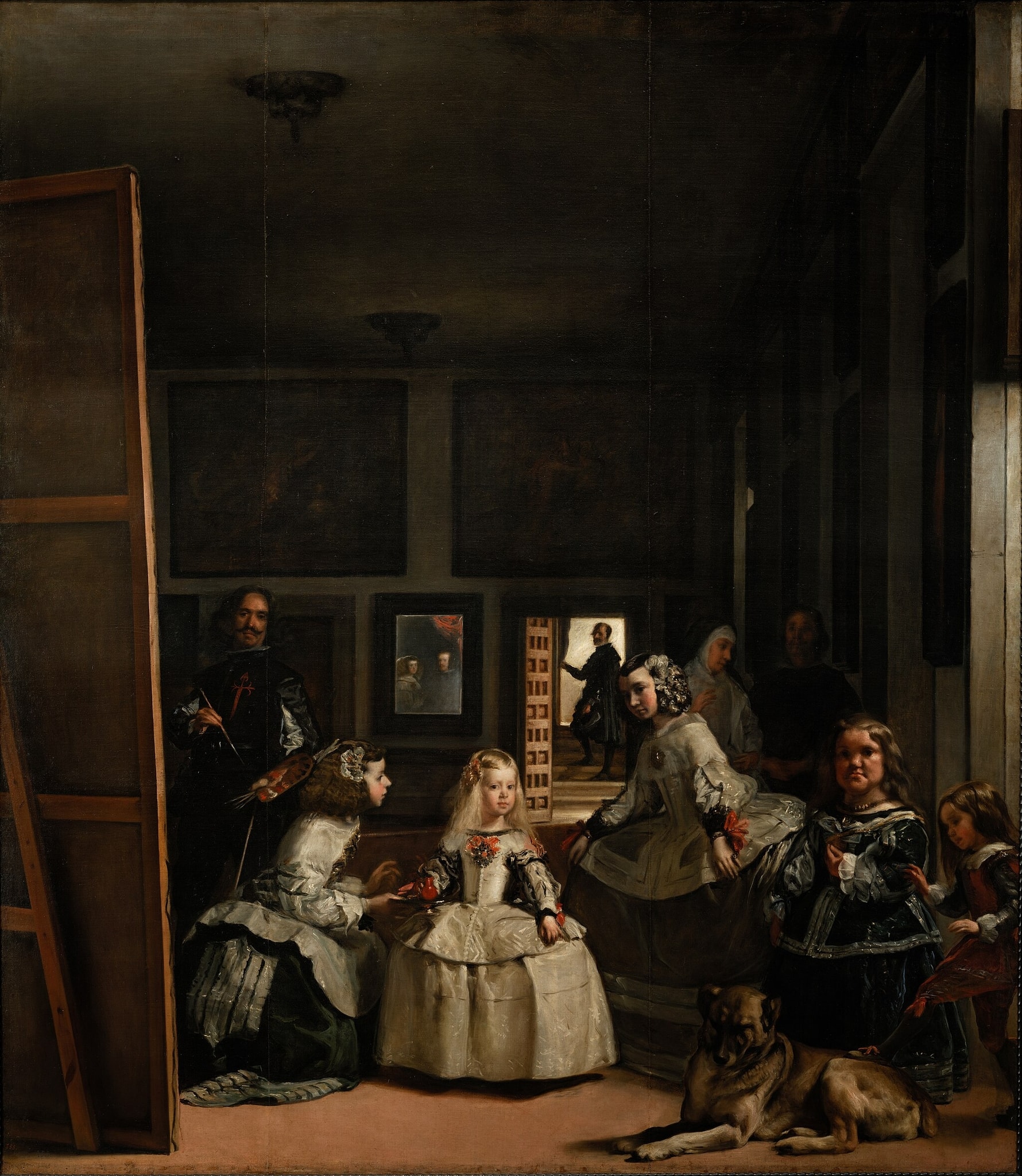
At the center of Las Meninas glows a small, black‑framed mirror that answers the painting’s greatest question: where are the king and queen? Its blurred reflections of Philip IV and Mariana make the sovereigns both present and absent, turning the viewer’s space into part of the court and anchoring Velázquez’s bravura meditation on power and seeing.
Historical Context
Painted in 1656 for the Alcázar in Madrid, Las Meninas belonged to Philip IV’s intimate world and was later hung in his private office. On the studio’s back wall, Velázquez places a modest, black‑framed mirror whose surface carries the bust‑length reflections of the monarchs—explicitly identified by the Prado as the Infanta’s parents and as the scene’s onlooking “witnesses.” 1
The mirror’s inclusion responds to a court culture fluent in sophisticated pictorial devices and intensely concerned with royal presence. The Prado’s encyclopedia describes how this specular image helps structure what the spectator sees and how the painting was conceived for the Alcázar’s rooms and for a courtly audience capable of reading such cues. By situating the sovereigns outside the represented room yet within the painting’s logic, the mirror transforms a studio gathering into a royal encounter, aligning the work with the functions and expectations of Habsburg ceremonial space. 2
Symbolic Meaning
The mirror embodies a theory of representation. Michel Foucault famously began The Order of Things here: the rulers’ displaced likeness appears only as reflection, making them simultaneously absent and commanding—an emblem of how images stand in for power and how vision is organized in the classical age. The painting thus stages the “place of the king” as both origin and effect of looking. 3
Joel Snyder reads the object as a “mirror of majesty,” tied to the early modern speculum principis tradition: it reflects sovereigns not merely optically but as moral-political ideals, the standard by which the scene is ordered. 4 The device also dialogues with celebrated mirror pictures known in Spain—above all Jan van Eyck’s Arnolfini Portrait—where a back‑wall mirror multiplies viewpoints and extends the fiction of space, a lineage the Met explicitly connects to Las Meninas. 5
For the Prado, the mirror extends the picture into the onlooker’s space and folds the beholder into the court’s gaze economy, while Smarthistory notes that this rare “visit” of the king and queen into an artist’s studio elevates both painting and painter to sovereign concern. The mirror is therefore a rhetorical engine: it secures authority, implicates the viewer, and proclaims Velázquez’s art as a noble instrument of vision. 67
Artistic Technique
Velázquez renders the mirror as a pale, opalescent rectangle set within a broad black frame, its beveled edges catching pinpoints of light. Two soft ovals—miniature busts—hover on the glass, legible yet deliberately blurred, a masterclass in economical late-style handling. 87
The object reads convincingly because it is calibrated to the room’s lighting and perspective. The Prado underscores the coordination of linear construction with multiple light sources—the side window, the luminous doorway, and the glow implicated by the reflection—so the small, luminous panel holds its place on the dim back wall without breaking the room’s optical plausibility. 1
Connection to the Whole
The mirror is the picture’s spatial and conceptual hinge. Prado curators stress that it expands the depicted room into the spectator’s space and back again, entangling us in the courtly exchange of looks; the painting’s signature illusionism depends on this swap between real and represented space. 6
It also anchors the work’s central ambiguity. Either the glass reflects the living monarchs standing where we stand, or it reflects their double portrait on Velázquez’s hidden canvas. Both readings place royal authority at the composition’s core while confirming the painter’s proximity to power—a theme Smarthistory highlights as key to the work’s self-fashioning. 87
Explore More from This Painting
This detail is one part of Las Meninas. Use the links below to return to the full interpretation, browse the full set of details, or view the painting's valuation if available.
Sources
- Museo Nacional del Prado – Las Meninas (collection entry)
- Prado Encyclopedia – Las Meninas (context and viewing)
- Michel Foucault, The Order of Things, Ch. 1 “Las Meninas”
- Joel Snyder, “Las Meninas and the Mirror of the Prince,” Critical Inquiry 11, no. 4 (1985)
- The Met Perspectives – Reflections: Mirrored Presence and the Arnolfini tradition
- Prado Encyclopedia – Family of Charles IV (on mirrors extending pictorial space, applied to Las Meninas)
- Smarthistory – Diego Velázquez, Las Meninas
- Wikipedia – Las Meninas (visual description and interpretive options)