The Man in the Doorway in Las Meninas
A closer look at this element in Diego Velazquez's 1656 masterpiece
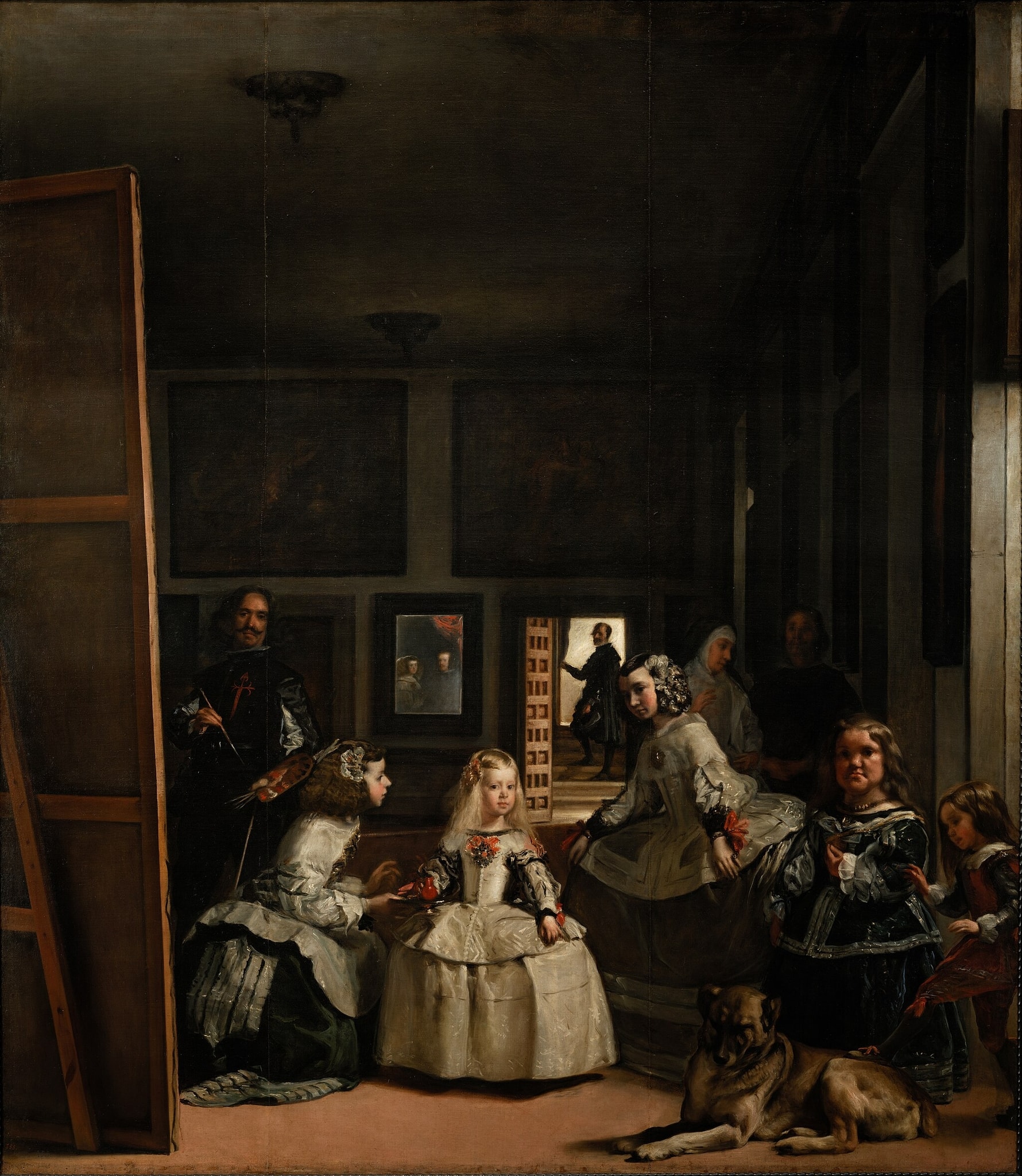
The brilliantly lit figure in the rear doorway of Las Meninas is José Nieto Velázquez, Queen Mariana’s chamberlain and head of the tapestry works. Cast as a backlit silhouette at the threshold, he anchors the painting’s deep space and dramatizes a poised moment of passage that turns Velázquez’s studio into a living stage of courtly movement and looking.
Historical Context
Painted in 1656 in Velázquez’s studio at the Alcázar of Madrid, the scene includes a senior court official: José Nieto Velázquez, attached to Queen Mariana’s household. The Prado identifies him unequivocally and describes his action with precision—he stands at the back, opening or closing the door to the bright corridor beyond. His presence records how spaces and access at the Habsburg court were managed by designated officers, embedding the protocols of palace life within the picture’s fiction 1.
The museum’s accessible guide adds his title as the queen’s chamberlain, clarifying why he would be stationed at this architectural hinge of the royal apartments. By including Nieto exactly where responsibility and circulation converged, Velázquez folds administrative reality into art: the man who oversees rooms and movement is literally the figure who controls entry and exit in the painting itself. This documentary clarity—naming a specific officer, at a recognizable doorway in the Alcázar—helps explain why the figure has been consistently identified since the earliest accounts and why he functions as more than a passerby: he is the court’s mechanism made visible 2.
Symbolic Meaning
The doorway forms a charged emblem of passage, and José Nieto becomes its human sign. Michel Foucault famously reads this figure as an "ambiguous visitor … coming in and going out at the same time," embodying a living threshold between the studio’s interior and the world beyond the picture plane. His poised step folds two temporalities together—the moment we see, and the imminent next moment—making the painting vibrate between presence and absence, arrival and departure 3.
Contemporary interpreters note that Las Meninas organizes attention around three centers: the Infanta, the reflected monarchs, and the radiant doorway. Nieto’s silhouette at that portal invites the eye deeper while acknowledging the scene’s interruption—an acknowledgment echoed by other figures who glance outward toward the space we occupy 4. The door’s flood of light reads as time slipping forward; its rectangular blaze, squared against shadow, signals order and control, yet also permeability. In Spanish painting after Velázquez, this “Velázquez door” becomes a cited motif of modern pictorial awareness—an aperture that stages transition, spectatorship, and narrative suspense—underscoring how Nieto’s stance crystallizes the painting’s meditation on looking and on the porous border between image and world 8.
Artistic Technique
Velázquez renders Nieto in intense backlight: a crisp profile cut against a luminous rectangle that punches through the dim studio. The Prado notes two luminous axes—the side-light bathing the Infanta and the radiant rear doorway—whose interplay sculpts depth and orchestrates attention 1. Orthogonals of ceiling beams and wall frames converge near the crook of Nieto’s arm, making him the painting’s practical vanishing point and a perspectival keystone 6.
Brushwork is late Velázquez: economical planes of value define sash, sleeve, and step with minimal description, while the door’s bright field and the gridded leaf of the hinge-door are laid in with brisk, decisive strokes. The restrained palette—amber floor, ashen walls, black costume—heightens the tonal drama of silhouette against glare, turning a few contrasts of light and dark into narrative emphasis 7.
Connection to the Whole
Nieto’s doorway completes the painting’s spatial and narrative architecture. Together with the Infanta at center and the mirror reflecting the monarchs, the door forms a triad that binds lateral illumination, reflective light, and axial depth into a single system. The curving gazes and converging lines pull us toward the back, while the backlight pushes time forward—an elegant tension that keeps the scene alive in the present tense 14.
If the king and queen stand where we stand, the chamberlain’s pause reads as courtly punctuation: the sitting concludes and movement is about to resume. His silhouetted control of the threshold mirrors his real office, suturing depiction to protocol and clarifying Las Meninas as a meditation on representation, hierarchy, and the traffic between painted space and our space 5.
Explore More from This Painting
This detail is one part of Las Meninas. Use the links below to return to the full interpretation, browse the full set of details, or view the painting's valuation if available.
Sources
- Museo del Prado Enciclopedia: Las Meninas (curatorial entry, lighting and identification of José Nieto)
- Museo del Prado, Easy-to-read guide: Las Meninas (names José Nieto as the queen’s chamberlain)
- Foucault on Las Meninas (discussion and excerpt of the threshold reading)
- Smarthistory: Velázquez, Las Meninas (centers of attention; awareness of interruption)
- Wikipedia: Las Meninas (synthesis on viewer/royal position and narrative timing)
- Joel Snyder, “Las Meninas and the Mirror of the Prince” (geometric analysis; vanishing point near doorway)
- Encyclopaedia Britannica: Las Meninas (late Velázquez handling and illusionistic construction)
- BSAA arte: The afterlife of the ‘Velázquez door’ motif in Spanish painting