The Infanta Margarita in Las Meninas
A closer look at this element in Diego Velazquez's 1656 masterpiece
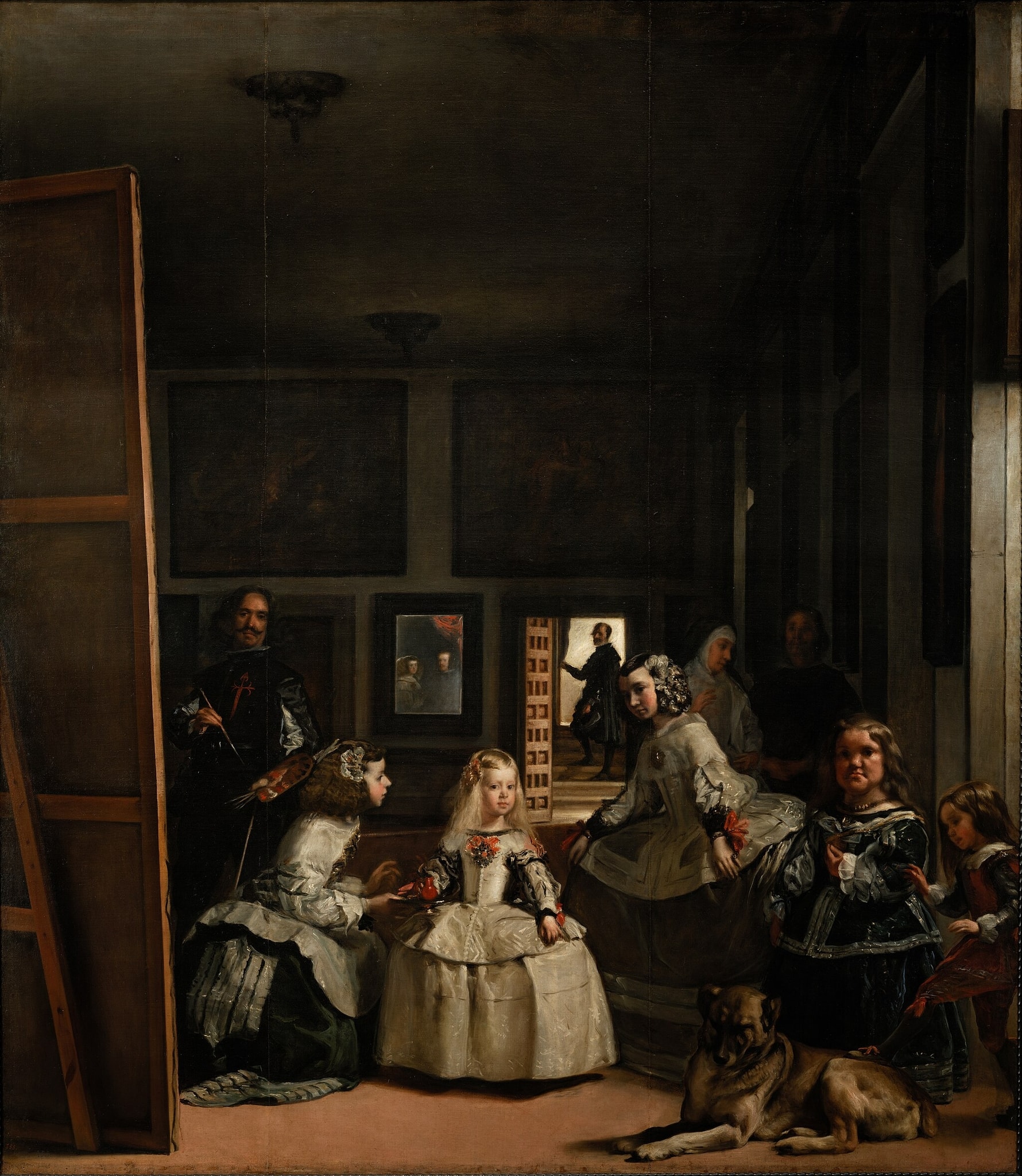
Brilliantly lit at the composition’s center, the Infanta Margarita Teresa anchors Velázquez’s Las Meninas as both child and cipher—dynastic hope and painterly thesis in one small figure. Around her, courtiers, dwarfs, and even the mastiff align, while the artist and the reflected monarchs extend her orbit into our space.
Historical Context
Painted in 1656 for King Philip IV’s private study, Las Meninas presents the five‑year‑old Infanta Margarita Teresa at a moment when she was the couple’s only legitimate child. Prado curators stress that Velázquez locates her precisely where the axes of space and light intersect, making her the focal point of a court preoccupied with succession in the mid‑1650s 1.
While the king and queen appear as a reflection in the rear mirror and Velázquez depicts himself painting at left, contemporary accounts and modern overviews agree that the painting’s immediate, visible subject is the Infanta and her small court reacting to the sovereigns’ presence. The intimate setting—part studio, part royal household—folds family, protocol, and artistic practice into a single scene, yet Margarita remains the brightest, nearest presence, commanding the attention of attendants and viewers alike 21.
Symbolic Meaning
Margarita functions as a living emblem of dynastic continuity. In 1656 she personified Habsburg hopes, and Velázquez’s staging turns her into the luminous center of a political image that is also an allegory of the triumph of Painting: a royal child illuminated, a painter ennobled, and a court whose future coheres around them 1. Museum and scholarly narratives consistently identify her as the "real subject" within the scene, the point to which every gaze and gesture converges 23.
Symbolic cues amplify this role. The silver‑white, mother‑of‑pearl tonality of her dress plays on her name—Margarita, "pearl"—linking court fashion, color, and identity 10. The menina María Agustina Sarmiento’s tray with a red búcaro evokes elite consumption and the fashion for pallor, a coded sign of aristocratic refinement embedded in the Infanta’s orbit 6. Philosophical readings after Foucault describe Margarita as the hinge in a network of gazes—painter, sovereigns, and spectator—where representation constitutes power; her illuminated presence mediates between the visible courtly "reality" and the unseen sitters in our space 83.
Artistic Technique
Velázquez sculpts Margarita with intersecting beams of light: a raking illumination from the right‑hand windows and a counter‑pull from the open doorway. These vectors meet at her rigid guardainfante, fixing her as the composition’s keystone 19.
His late, economical brushwork—quick, bright touches that fuse at viewing distance—conjures lace, bows, hair, and the satin‑silver sheen of her dress without pedantry, yielding lifelike presence without losing painterly freedom 5. Technical studies reveal that Velázquez worked directly on the canvas and revised passages during execution; radiography notes corrections, including adjustments near the Infanta’s right hand, confirming an evolving design refined in situ 711.
Connection to the Whole
Margarita is both visual anchor and narrative pivot. Her brilliance organizes the room: meninas bow and serve, dwarfs and dog form a lively counter‑group, and attendants and guard frame a courtly microcosm oriented toward the child at its center 12.
Placed between Velázquez at his easel and the monarchs in the mirror, she bridges studio space, royal presence, and our own viewpoint. As we occupy the sovereigns’ position, Margarita’s gaze meets ours, activating the painting’s play of reciprocity and making the spectator part of the courtly exchange. In this structure, the Infanta fuses the work’s twin claims—on dynasty and on the intellectual dignity of painting—into a single, commanding point of focus 381.
Explore More from This Painting
This detail is one part of Las Meninas. Use the links below to return to the full interpretation, browse the full set of details, or view the painting's valuation if available.
Sources
- Museo Nacional del Prado, “Meninas, Las [Velázquez]” (encyclopedia entry)
- Encyclopaedia Britannica, “Las Meninas | Diego Velázquez”
- Smarthistory, “Diego Velázquez, Las Meninas”
- Kunsthistorisches Museum, “Infanta Margarita in a White Dress”
- The Met, Heilbrunn Timeline, Everett Fahy, “Velázquez (1599–1660)”
- The Met Collection, “Covered jar (búcaro de Indias)”
- RTVE/Prado, radiography and technical study of Las Meninas
- Mimesis Journals, Filippo Silvestri, “Foucault as spectator/reader of Velázquez’s Las Meninas”
- Dress & World (Hypotheses), on the guardainfante and court fashion
- ebrary.net, on dress color, naming, and identity in the Habsburg court
- Wikipedia (ES), “Las meninas” (consolidated technical notes)