The Umbrellas

by Pierre-Auguste Renoir

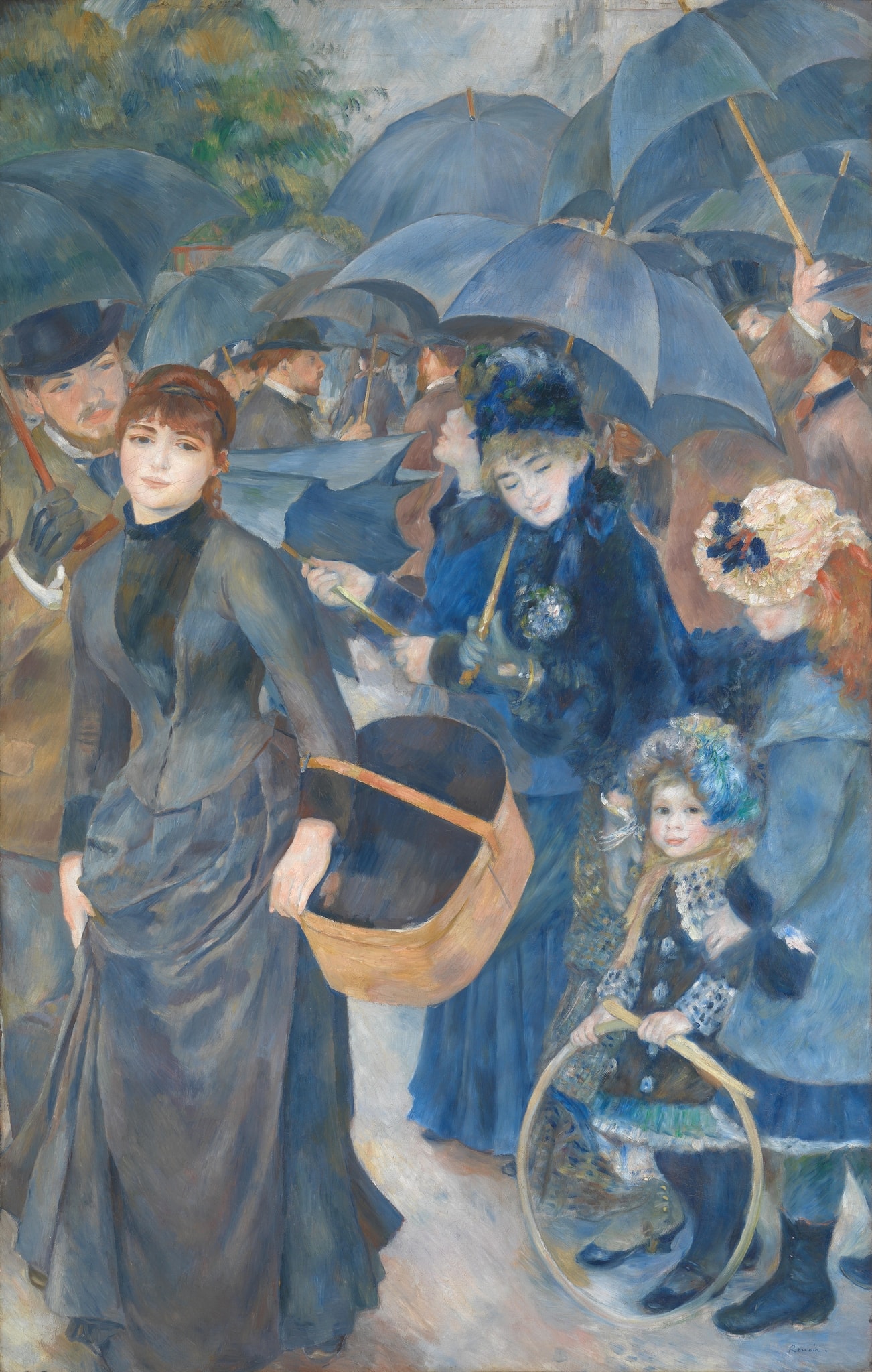
A sudden shower turns a Paris street into a lattice of slate‑blue umbrellas, knitting strangers into a single moving frieze. A bareheaded young woman with a bandbox strides forward while a bourgeois mother and children cluster at right, their hoop echoing the umbrellas’ arcs [1][5].

Fast Facts

Year
about 1881–86
Medium
Oil on canvas
Dimensions
180.3 × 114.9 cm
Location
National Gallery, London
The Umbrellas by Pierre-Auguste Renoir (about 1881–86) featuring Slate‑blue umbrellas canopy, Bandbox (hatbox), Bareheaded young woman’s direct gaze, Child’s hoop

Click on any numbered symbol to learn more about its meaning

Meaning & Symbolism

Renoir organizes the picture around a disciplined canopy of blue‑grey domes, an engineered order that presses downward and flattens distance. The alternating tilts of the umbrellas create a rhythmic grid across the upper half, transforming drifting passers‑by into a designed procession rather than a casual crowd 1. Under this canopy, figures behave like particles in a flow: bodies overlap, shoulders touch, yet faces are sealed off by fabric, handles, and angled shafts. Two gazes puncture the anonymity—the bareheaded young woman at left who meets us directly, bandbox slung from her arm, and the small girl at right who looks out while holding a hoop. Their frontal address turns the viewer into another passer‑by caught in the shower, tightening the painting’s social field and implicating us in its choreography 5. The young woman’s plain dress, upright carriage, and uncovered head contrast with the festooned hats and plush blues of the mother and girls at right; the bandbox marks her as a milliner’s assistant, moving through work rather than leisure 1. This adjacency of classes—laboring midinette and sheltered bourgeois family—enacts a democratic crowd where everyone is equalized by the same indifferent rain even as attire, posture, and proximity preserve social distance. The hoop repeats the umbrellas’ arcs, and even the oval bandbox rhymes with umbrella ribs and curved handles; these echoes convert the chance geometry of a shower into a classical motif of circles and counter‑curves spanning the entire surface 1. That armature is not just formal but historical. Technical analysis shows Renoir began the picture around 1881 in a feathery, high‑key Impressionist manner (most visible in the right‑hand group), then reworked it about 1885–86 with cooler blues, muted tonality, and firmer drawing—especially on the left‑hand woman and the expanded canopy of umbrellas 2. The sharper contour of her bodice and sleeves, the taut oval of the bandbox, and the precise, dry strokes defining her face exemplify his post‑Italy resolve to "construct" figures rather than dissolve them in light 12. X‑rays reveal he even altered fashion details—removing a hat, simplifying frills—thereby re‑coding her class identity and tightening the picture’s social argument 2. The surface thus carries two times at once: an Impressionist present of damp air and flicker on the right, and a later, Ingresque discipline on the left. The result is a painting that stages modernity as both flux and design. The umbrellas become machines of privacy and pattern; people share a street yet inhabit separate meteorologies under each dome. The rain binds them, but the apparatus of urban life—fashion, work routines, instruments of shelter—keeps them apart. Renoir’s compositional discipline answers this condition: the arcs impose order without erasing contingency. This balance explains why The Umbrellas is important: it reconciles Impressionism’s commitment to the momentary with a renewed desire for structure, marking a pivotal step in Renoir’s evolution and a clear statement about the texture of modern public space 13.

Explore Deeper with AI

Ask questions about The Umbrellas

Popular questions:

Powered by AI • Get instant insights about this artwork

💬 Ask questions about this artwork!

Interpretations

Gendered Street Looking (The Invisible Flâneuse)

The bareheaded young woman interrupts the boulevard’s typical gender script. Rather than being merely looked at, she returns the gaze, aligning with debates about the “invisible flâneuse” and women’s ambivalent visibility in public space. Her uncovered head and practical dress resist the ornamental codes on the right, while her frontal address folds the viewer into the social field, complicating who looks and who is looked at. The umbrella canopy both shields and obscures—an architecture of modesty and surveillance—so her uncovered head reads as a counter‑gesture of self‑presentation. Renoir thus stages a micro‑politics of looking in which female agency flickers within a managed crowd, rendering vision itself a contested modern practice 14.

Source: National Gallery, London (object record and audio guide)

Fashion as Internal Clock (Temporality of Modernity)

Renoir’s repainting converts fashion into a chronometer. Technical study shows that he eliminated a hat and frills and cooled the palette on the left during the 1885–86 campaign, updating silhouettes and hues in line with newer styles. These revisions are not cosmetic: they embed time passing inside the image, juxtaposing an earlier, feathery, high‑key right with a later, muted, linear left. The canvas becomes a palimpsest where obsolescence and novelty coexist, mirroring modern Paris’s accelerated cycles of style. In this light, The Umbrellas is as much about the ephemerality of the fashionable present as it is about shelter and rain—an urban memento of how swiftly appearances date 23.

Source: National Gallery Technical Bulletin; The Frick Collection

Medium as Meaning (Two Manners, One Argument)

The painting shows its making: cobalt/zinc mixtures and loose facture from the first campaign sit beside ultramarine/Naples and tightened contours from the second. This isn’t just evolution; it is argument by technique—a negotiated settlement between Impressionism’s optical flux and an Ingresque, constructed figure. The umbrella canopy added later operates like a classical frieze, binding volatile incident to an architectural order. Paint handling thus functions as content: it visualizes modernity as a field where sensation and design, contingency and control, must be reconciled. The viewer reads style diachronically across the surface, turning connoisseurship into a mode of interpretation 21.

Source: National Gallery Technical Bulletin; National Gallery, London

Commodity Circuits in the Rain (Labor and Leisure Interlock)

The bandbox signals a worker mid‑errand—the city’s fashion economy moving through the same space as bourgeois leisure. Renoir positions the milliner’s assistant beside a mother and children at promenade, making the street an interface where labor and consumption circulate together. Even the painting’s circular leitmotifs—the hoop, the domes, the handles—formalize this exchange into visible rhythms, as if the flow of goods and bodies shares a single geometry. The rain equalizes exposure yet umbrellas and attire re‑inscribe difference: work progresses under pressure while leisure lingers under plush blue canopies. The scene captures the modern boulevard as a market of appearances powered by hidden hands 14.

Source: National Gallery, London (object record and audio guide)

Private Weather Cells (Urban Phenomenology of Shelter)

The slate‑blue canopy behaves like a grid of micro‑interiors: each umbrella encloses a pocket of air, privacy, and etiquette. Stems, ribs, and tilts partition sightlines so that bodies brush while faces remain screened, making sociability proximate but withheld. This engineered shelter compresses depth and regulates flow—the “designed procession”—transforming meteorology into urban design. People inhabit separate climates under a single storm, a phenomenology of modern life where technology mitigates nature yet standardizes experience. Renoir’s ordered arcs convert contingency (a shower) into pattern, an aesthetic analogue to how infrastructure choreographs public behavior in the city 13.

Source: National Gallery, London; The Frick Collection

Related Themes

About Pierre-Auguste Renoir

Pierre-Auguste Renoir (1841–1919) emerged from craft training into the avant-garde circle around Monet, Sisley, and Bazille, helping to found Impressionism. In the mid‑1870s he focused on outdoor scenes of modern leisure in and around Montmartre, using dappled light and high-chroma color to capture transient sensations [1][2][5].
View all works by Pierre-Auguste Renoir

More by Pierre-Auguste Renoir
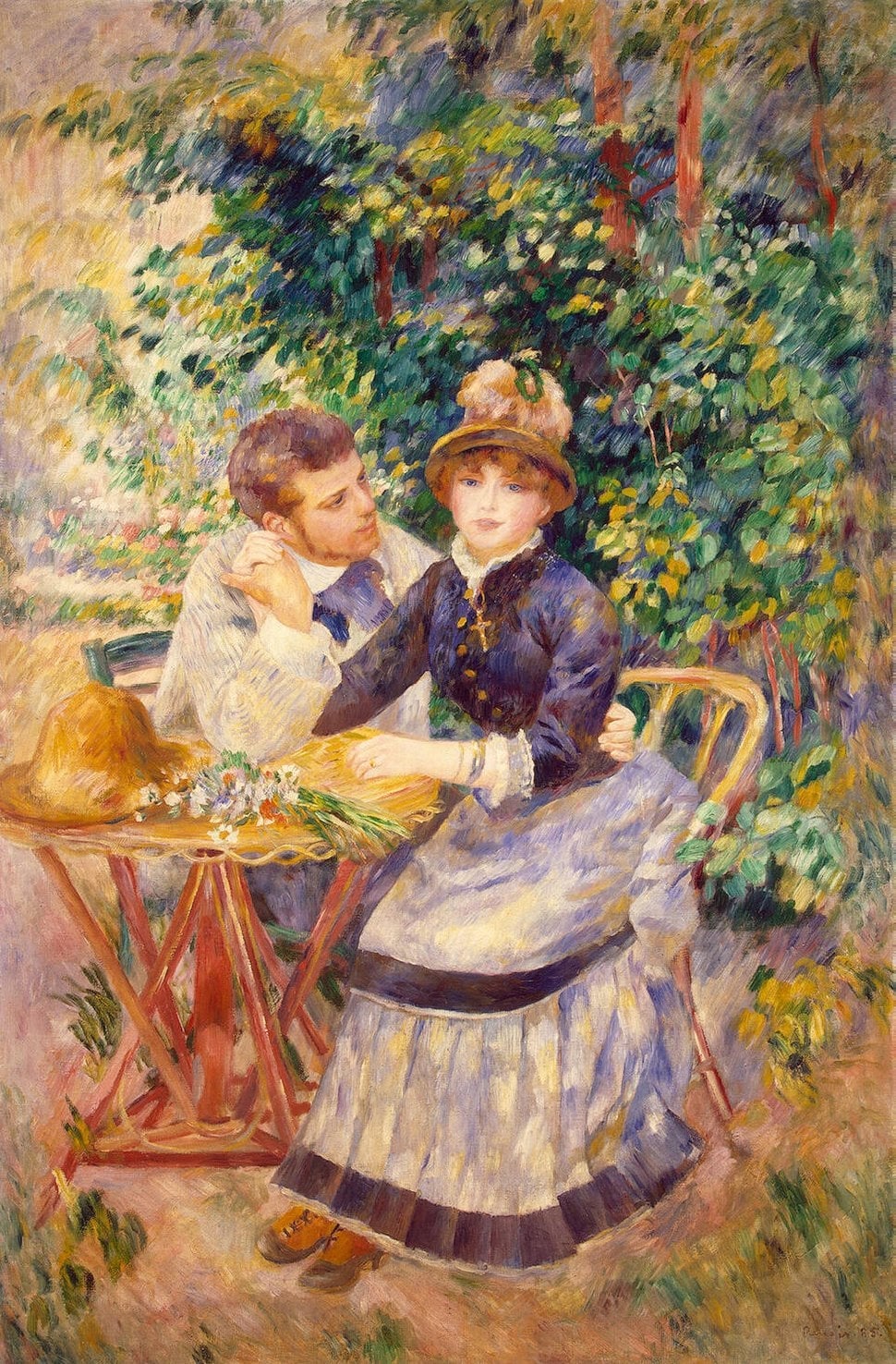
In the Garden by Pierre-Auguste Renoir

In the Garden

Pierre-Auguste Renoir (1885)

In the Garden presents a charged pause in modern leisure: a young couple at a café table under a living arbor of leaves. Their lightly clasped hands and the bouquet on the tabletop signal courtship, while her calm, front-facing gaze checks his lean. Renoir’s flickering brushwork fuses figures and foliage, rendering love as a <strong>transitory, luminous sensation</strong> <sup>[1]</sup><sup>[3]</sup>.
Young Girls at the Piano by Pierre-Auguste Renoir

Young Girls at the Piano

Pierre-Auguste Renoir (1892)

Renoir’s Young Girls at the Piano turns a quiet lesson into a scene of <strong>attunement</strong> and <strong>bourgeois grace</strong>. Two adolescents—one seated at the keys, the other leaning to guide the score—embody harmony between discipline and delight, rendered in Renoir’s late, <strong>luminous</strong> touch <sup>[1]</sup><sup>[2]</sup>.

Pont Neuf Paris by Pierre-Auguste Renoir

Pont Neuf Paris

Pierre-Auguste Renoir (1872)

In Pont Neuf Paris, Pierre-Auguste Renoir turns the oldest bridge in Paris into a stage where <strong>light</strong> and <strong>movement</strong> bind a city back together. From a high perch, he orchestrates crowds, carriages, gas lamps, the rippling Seine, and a fluttering <strong>tricolor</strong> so that everyday bustle reads as civic grace <sup>[1]</sup>.

The Large Bathers by Pierre-Auguste Renoir

The Large Bathers

Pierre-Auguste Renoir (1884–1887)

Pierre-Auguste Renoir’s The Large Bathers unites modern bodies with a pastoral grove to stage an <strong>Arcadian ideal</strong>. Three monumental nudes form interlocking curves and triangles while two background figures splash and groom, fusing <strong>sensual warmth</strong> with <strong>classical order</strong> <sup>[1]</sup><sup>[2]</sup>.

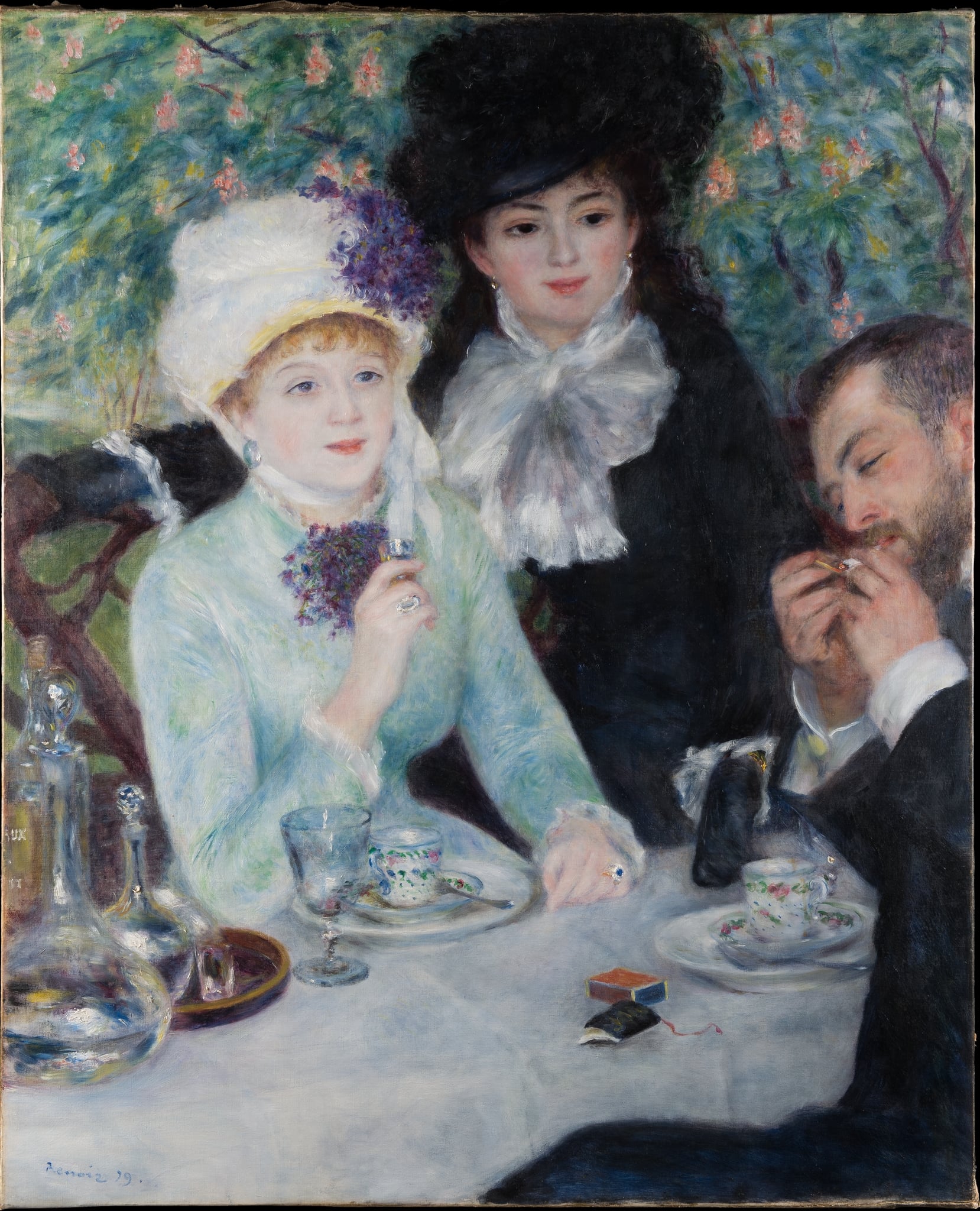
After the Luncheon by Pierre-Auguste Renoir

After the Luncheon

Pierre-Auguste Renoir (1879)

After the Luncheon crystallizes a <strong>suspended instant</strong> of Parisian leisure: coffee finished, glasses dappled with light, and a cigarette just being lit. Renoir’s <strong>shimmering brushwork</strong> and the trellised spring foliage turn the scene into a tapestry of conviviality where time briefly pauses.
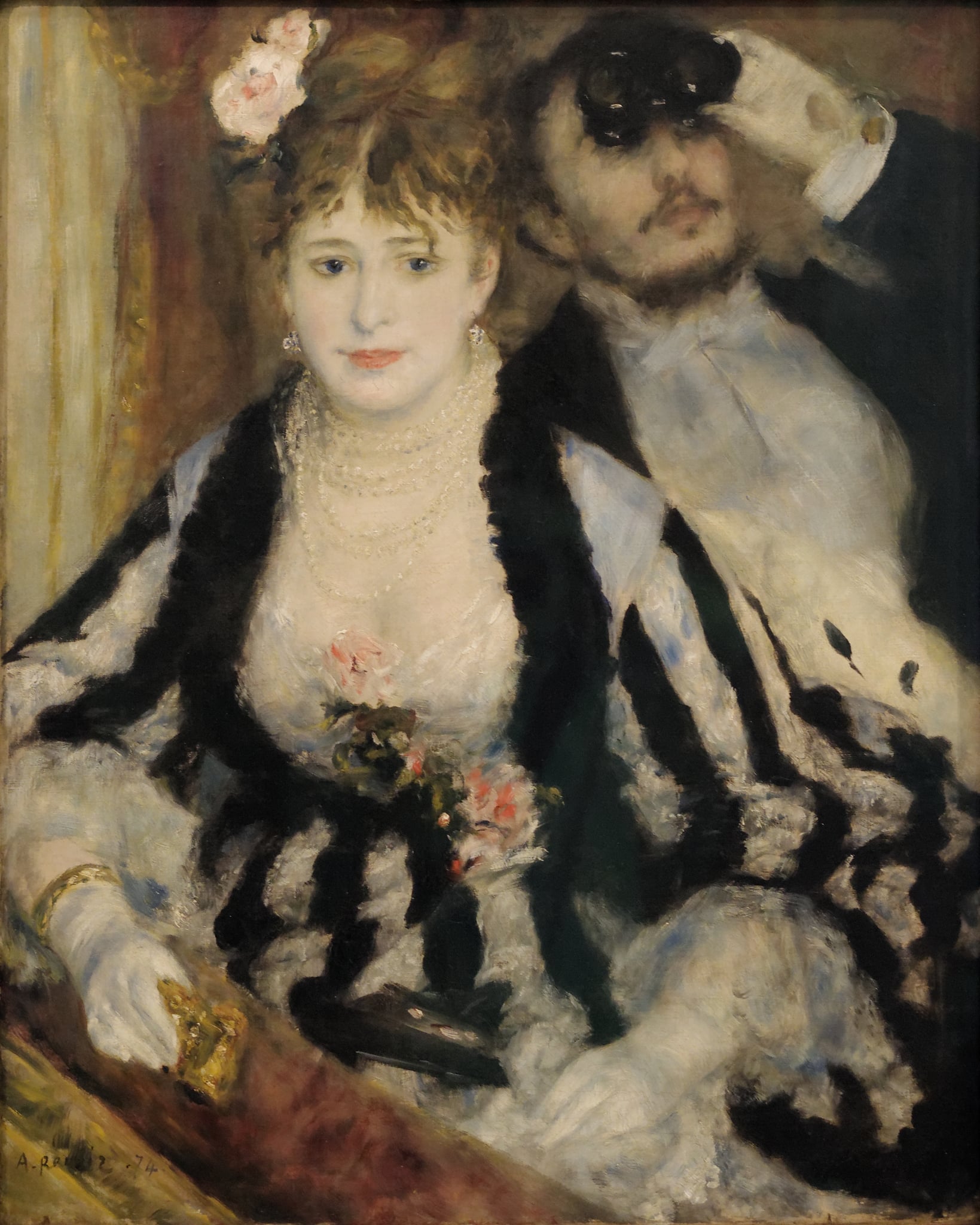
The Loge by Pierre-Auguste Renoir

The Loge

Pierre-Auguste Renoir (1874)

Renoir’s The Loge (1874) turns an opera box into a <strong>stage of looking</strong>, where a woman meets our gaze while her companion scans the crowd through binoculars. The painting’s <strong>frame-within-a-frame</strong> and glittering fashion make modern Parisian leisure both alluring and self-conscious, turning spectators into spectacles <sup>[1]</sup><sup>[2]</sup>.