After the Luncheon

by Pierre-Auguste Renoir

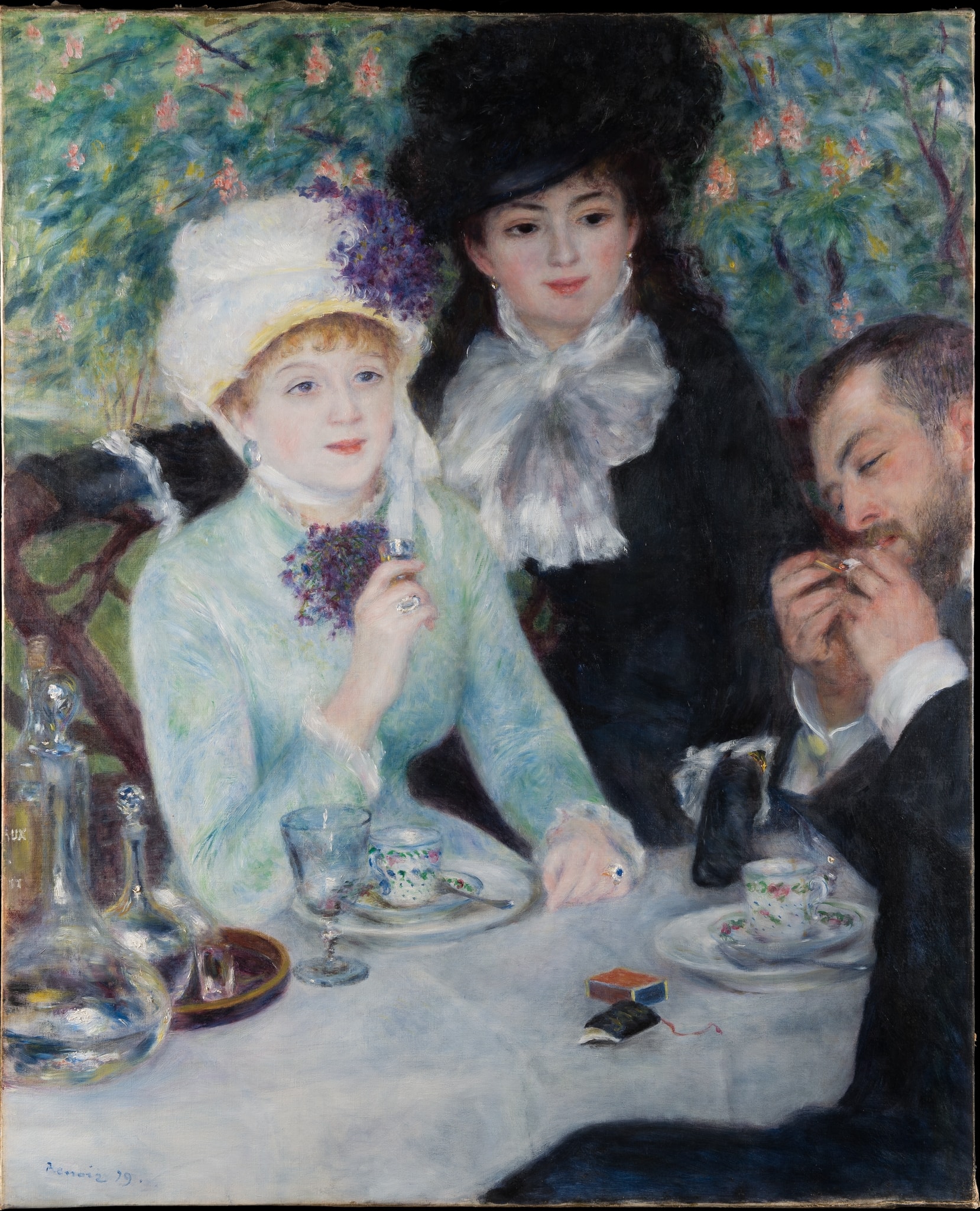
After the Luncheon crystallizes a suspended instant of Parisian leisure: coffee finished, glasses dappled with light, and a cigarette just being lit. Renoir’s shimmering brushwork and the trellised spring foliage turn the scene into a tapestry of conviviality where time briefly pauses.

Fast Facts

Year
1879
Medium
Oil on canvas
Dimensions
100.5 × 81.3 cm
Location
Städel Museum, Frankfurt am Main
After the Luncheon by Pierre-Auguste Renoir (1879) featuring Lit cigarette, Open matchbox, Empty decanters and wineglass, Coffee cups and saucers

Click on any numbered symbol to learn more about its meaning

Meaning & Symbolism

Renoir constructs the scene as a micro‑theatre of modern companionship governed by ritual, glance, and surface. The white‑draped table is not a neutral ground but a ledger of time: clear decanters sit emptied; a small liqueur glass glints beside porcelain cups ringed with coffee traces; an open matchbox lies between the saucers; and at the picture’s right edge a man raises flame to cigarette. These objects do more than describe a meal’s epilogue; they codify a sequence—wine, coffee, digestif, smoke—that culminates in the instant of ignition. Renoir’s brush dissolves edges so that glass, porcelain, and skin catch and pass on reflections, binding the trio into a single atmosphere. The women’s costumes set a rhythm of light and dark—one in a pale hat crowned with lilac blossoms, the other in a black hat with a white bow—so that fashion acts as visual counterpoint and social signal at once. Against them, the trellised chestnut in bloom wraps the group in a screen of spring, converting nature into décor and reinforcing the idea of ephemerality as pleasure’s natural condition 12. The figures enact complementary roles within this suspended beat. The woman at left, holding a small glass near her lips, becomes the scene’s luminous anchor; her gaze is outward but unforced, as if the last sip confirms the gratification already achieved. The standing companion, darker in tone, leans in without interrupting, embodying tactful presence, elegance, and the coded flirtation of Parisian café culture. The man, absorbed in the private rite of lighting up, introduces interiority into the sociable frame. Renoir thus stages a paradox: the group is together, yet each person remains briefly self‑contained, a dynamic that scholars of modern life read as the ambivalence of urban sociability—simultaneously convivial and solitary 67. The cigarette becomes the painting’s metronome. Its flame marks the present, its ember forecasts imminent dispersal, and its smoke—implied rather than described—echoes the painterly haze that softens contour across the canvas. Impressionist means and modern motif converge: the “instant” is both the subject and the method 12. Within Renoir’s broader project, After the Luncheon serves as a hinge. Earlier riverside meals such as Lunch at the Restaurant Fournaise had already tested how tables, glasses, and railings could structure intimate sociability; here the format tightens to three figures, sharpening psychological nuance and the table’s symbolic grammar 4. Soon after, Renoir will expand the cast and complexity in Luncheon of the Boating Party, but the essential vocabulary—contrasting hats and fabrics, sparkling glass, a trellised outdoor setting, actresses and friends intermingled—remains constant. The Städel Museum situates the scene in an arbour of a Paris restaurant, with identifications that connect the work to the Impressionist circle and Montmartre’s entertainment milieu; those ties underscore how the canvas translates a real social world into a harmonized vision of happiness without denying modernity’s performative edge 125. In sum, the painting argues that community is made perceptible through the choreography of ordinary after‑lunch gestures. Its importance rests in showing how Impressionism could bind perception, fashion, and ritual into an image of the present that is both tender and exacting—an art of the shared instant.

Explore Deeper with AI

Ask questions about After the Luncheon

Popular questions:

Powered by AI • Get instant insights about this artwork

💬 Ask questions about this artwork!

Interpretations

Social Art History: Leisure as a Bourgeois Script

Read through social art history, the table’s inventory—coffee stains, digestif, empty decanters—renders leisure as a codified sequence of bourgeois pleasure rather than a spontaneous idyll. Set in Montmartre’s Cabaret d’Olivier, the scene translates new urban leisure spaces into a harmonized etiquette of enjoyment. Ellen Andrée’s presence connects Renoir to the actress‑model network that frequented cafés and cabarets, where looking and being looked at were social currency. In Herbert’s framework, Renoir emerges as a painter of sanctioned happiness, smoothing over the frictions of class and labor that sustain such moments, even as the props quietly index consumption and time’s passage 24.

Source: Robert L. Herbert, Impressionism: Art, Leisure, and Parisian Society

Gender & Performance: Fashion as Agency

The women’s contrasting hats and fabrics are not decorative afterthoughts but performative devices that modulate attention and desire. Andrée’s pale ensemble and floral accents radiate visual dominance, while her companion’s darker hat and white bow produce a contrapuntal beat of light and shadow. In the actress milieu, attire served as both persona and profession, a portable stage that negotiated flirtation, respectability, and spectatorship. Renoir—attuned to textile sheen as the son of a tailor—renders costume as a social signal that structures interaction, anticipating the larger theatrics of Luncheon of the Boating Party where Andrée reappears as a calibrated focus of modern looking 17.

Source: The Phillips Collection (on Renoir’s women models and Ellen Andrée)

Medium Reflexivity: Making the Instant Visible

Renoir’s brush dissolves contour so glass, porcelain, and skin refract one another, creating a shared atmospheric envelope; the cigarette’s ignition punctuates this haze as an optical metronome. The painting thus collapses motif and method: an ephemeral act (lighting up) finds its analogue in an ephemeral technique (broken touch, flicker), a hallmark of Impressionist phenomenology. By fixing the micro‑interval between talk and dispersal, Renoir shows how paint can register time not as narrative sequence but as sensory residue—stains, gleams, reflections. The arbour’s tapestry‑like foliage further flattens depth, keeping the eye at the surface where perception and social ritual meet 12.

Source: Städel Museum (object record and interpretive essay)

Ambivalence of Urban Sociability

Applying T. J. Clark’s thesis on modern life, the trio embodies simultaneous sociability and solitude: Andrée’s poised satisfaction, the companion’s tactful lean, the man’s private rite of fire. Each is present yet withdrawn, their absorption diffusing the convivial script into parallel interiors. The match’s flare marks a now that is already passing, shadowed by dispersal; smoke (barely implied) becomes a metaphor for modern selfhood in flux. Renoir’s scene therefore reads not as mere hedonism but as a compact drama of urban ambivalence—pleasure tightly choreographed, identity performed, and connection hedged by the urge to remain oneself 52.

Source: T. J. Clark, The Painting of Modern Life

Topography of Pleasure: Cabaret d’Olivier as Site

The Städel’s identification of the Cabaret d’Olivier anchors the canvas in a specific Montmartre micro‑geography, linking it to café‑concert culture and the Impressionist circle’s habitual haunts. The trellised chestnut in bloom serves as both seasonal index and architectural screen, converting the urban garden into décor—nature staged for consumption. This site specificity nuances the painting’s claim to universality: it’s not any luncheon, but one embedded in the entertainment economy of northern Paris, where modern leisure was produced, curated, and sold. The picture becomes a place portrait, mapping how environment inflects ritual and how locale shapes the tempo of modern companionship 2.

Source: Städel Museum, Stories (Cabaret d’Olivier identification)

Career Pivot: From Intimate Trio to Ensemble Epic

After the Luncheon refines a format tested in Lunch at the Restaurant Fournaise—a three‑figure table drama—and anticipates the orchestration of Luncheon of the Boating Party. The intimate scale sharpens the table’s symbolic grammar (cups, decanters, matchbox) before Renoir scales up to a polymorphic cast and spatial complexity. Circa 1879, he was recalibrating ties to the Impressionist group while pursuing Salon visibility; the work exemplifies a middle path: Impressionist optics, Salon‑friendly modern subjects. Tracking Andrée across these canvases reveals Renoir’s iterative method: motifs of glass, fashion, and trellis evolve from close study to grand synthesis 367.

Source: National Gallery of Art (artist bio); Art Institute of Chicago; The Phillips Collection

Related Themes

About Pierre-Auguste Renoir

Pierre-Auguste Renoir (1841–1919) emerged from craft training into the avant-garde circle around Monet, Sisley, and Bazille, helping to found Impressionism. In the mid‑1870s he focused on outdoor scenes of modern leisure in and around Montmartre, using dappled light and high-chroma color to capture transient sensations [1][2][5].
View all works by Pierre-Auguste Renoir

More by Pierre-Auguste Renoir
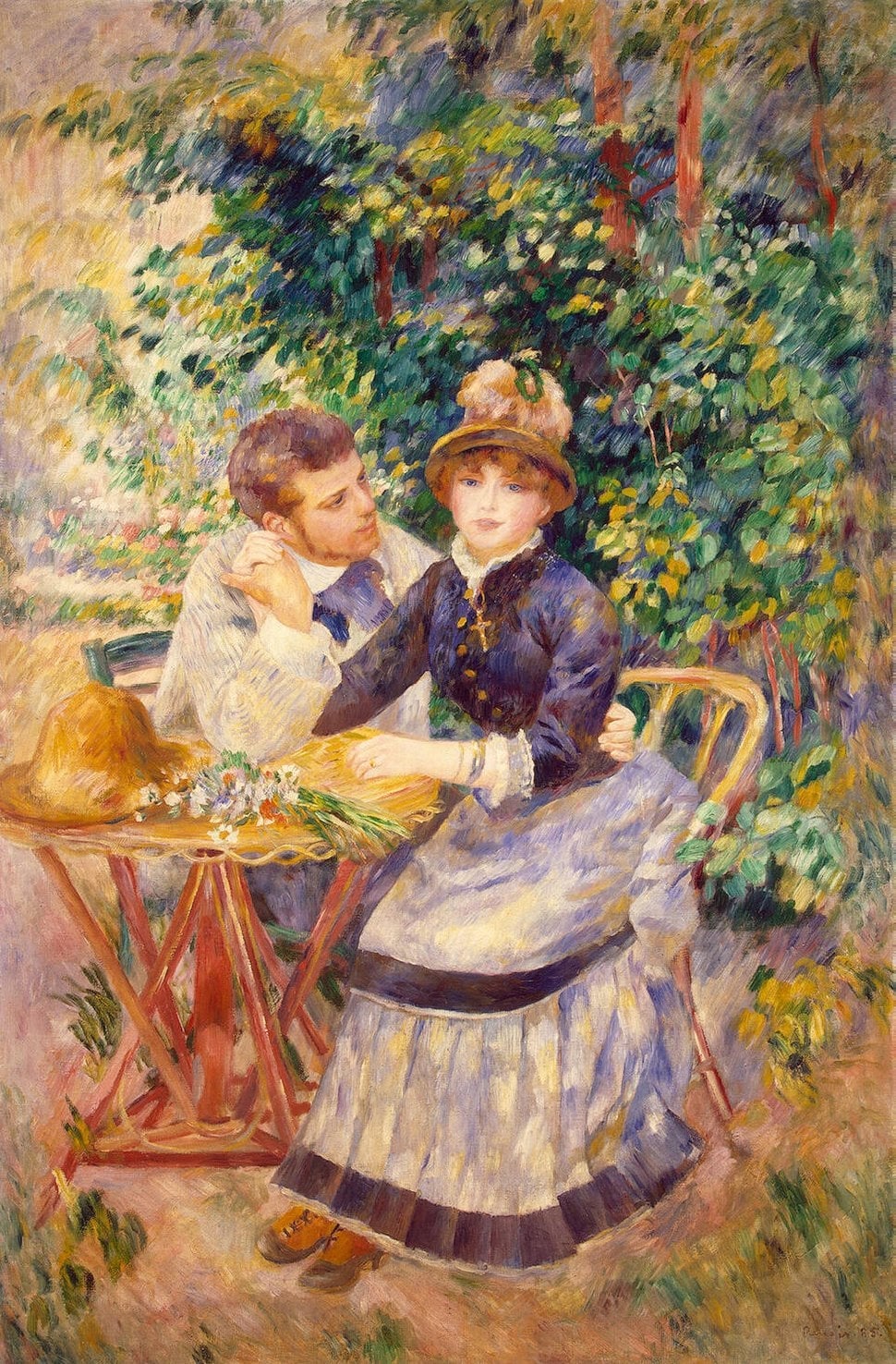
In the Garden by Pierre-Auguste Renoir

In the Garden

Pierre-Auguste Renoir (1885)

In the Garden presents a charged pause in modern leisure: a young couple at a café table under a living arbor of leaves. Their lightly clasped hands and the bouquet on the tabletop signal courtship, while her calm, front-facing gaze checks his lean. Renoir’s flickering brushwork fuses figures and foliage, rendering love as a <strong>transitory, luminous sensation</strong> <sup>[1]</sup><sup>[3]</sup>.
Young Girls at the Piano by Pierre-Auguste Renoir

Young Girls at the Piano

Pierre-Auguste Renoir (1892)

Renoir’s Young Girls at the Piano turns a quiet lesson into a scene of <strong>attunement</strong> and <strong>bourgeois grace</strong>. Two adolescents—one seated at the keys, the other leaning to guide the score—embody harmony between discipline and delight, rendered in Renoir’s late, <strong>luminous</strong> touch <sup>[1]</sup><sup>[2]</sup>.

Pont Neuf Paris by Pierre-Auguste Renoir

Pont Neuf Paris

Pierre-Auguste Renoir (1872)

In Pont Neuf Paris, Pierre-Auguste Renoir turns the oldest bridge in Paris into a stage where <strong>light</strong> and <strong>movement</strong> bind a city back together. From a high perch, he orchestrates crowds, carriages, gas lamps, the rippling Seine, and a fluttering <strong>tricolor</strong> so that everyday bustle reads as civic grace <sup>[1]</sup>.

The Large Bathers by Pierre-Auguste Renoir

The Large Bathers

Pierre-Auguste Renoir (1884–1887)

Pierre-Auguste Renoir’s The Large Bathers unites modern bodies with a pastoral grove to stage an <strong>Arcadian ideal</strong>. Three monumental nudes form interlocking curves and triangles while two background figures splash and groom, fusing <strong>sensual warmth</strong> with <strong>classical order</strong> <sup>[1]</sup><sup>[2]</sup>.

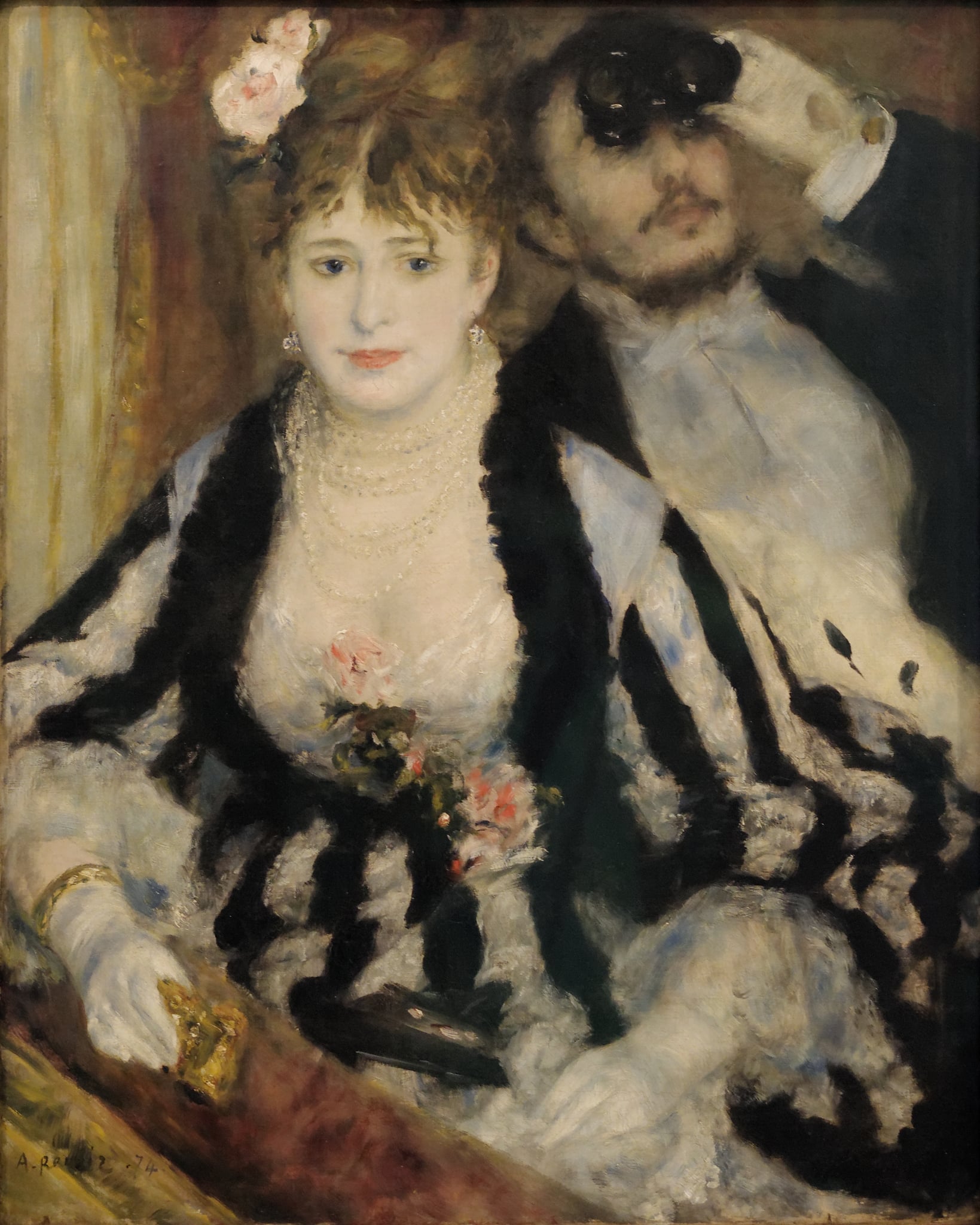
The Loge by Pierre-Auguste Renoir

The Loge

Pierre-Auguste Renoir (1874)

Renoir’s The Loge (1874) turns an opera box into a <strong>stage of looking</strong>, where a woman meets our gaze while her companion scans the crowd through binoculars. The painting’s <strong>frame-within-a-frame</strong> and glittering fashion make modern Parisian leisure both alluring and self-conscious, turning spectators into spectacles <sup>[1]</sup><sup>[2]</sup>.
The Swing by Pierre-Auguste Renoir

The Swing

Pierre-Auguste Renoir (1876)

Renoir’s The Swing fixes a fleeting, sun-dappled exchange in a Montmartre garden, where a woman in a white dress with blue bows steadies herself on a swing while a man in a blue jacket addresses her. The scene crystallizes <strong>modern leisure</strong>, <strong>flirtation</strong>, and <strong>optical shimmer</strong>, as broken strokes scatter light over faces, fabric, and ground <sup>[1]</sup><sup>[4]</sup>.