The Garden of Pontoise

by Camille Pissarro

In The Garden of Pontoise, Camille Pissarro turns a modest suburban plot into a stage for modern leisure and fugitive light. A woman shaded by a parasol and a child in a bright red skirt punctuate the deep greens, while a curving sand path and beds of red–pink blossoms draw the eye toward a pale house and cloud‑flecked sky. The painting asserts that everyday, cultivated nature can be a modern Eden where time, season, and social ritual quietly unfold [1][3].

Fast Facts

Year
1874
Medium
Oil on canvas
Dimensions
60 × 73 cm
Location
The Metropolitan Museum of Art, New York
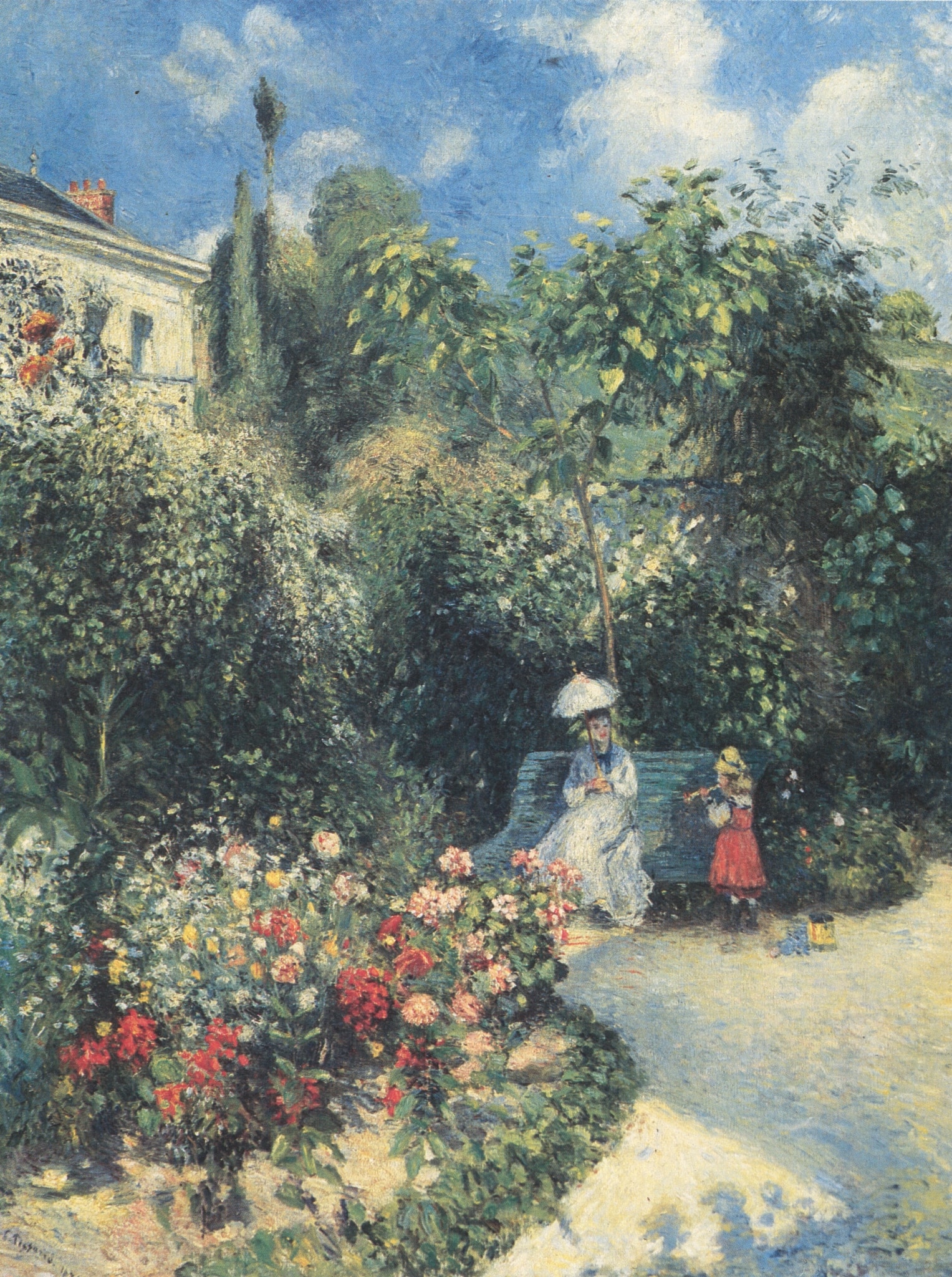
The Garden of Pontoise by Camille Pissarro (1874) featuring White parasol, Child in red skirt, Curving sand path, Ornamental flowerbed

Click on any numbered symbol to learn more about its meaning

Meaning & Symbolism

Pissarro composes The Garden of Pontoise as a choreography of cultivated nature and genteel behavior. The pale house with red chimneys at upper left signals bourgeois domesticity, while the bench beneath dense foliage offers a shaded niche for a woman under a white parasol; the nearby child, in a vivid red skirt and straw hat, enlivens the scene like a flare of chromatic energy. A sinuous sand path arcs through the lower right, shearing across a massed bed of pinks and scarlets; this serpentine line guides the viewer’s passage from ornamental foreground to leafy enclosure and up toward a cloud‑fretted blue. These are not incidental decorations but structural instruments: the path and flowerbeds stage the rituals of strolling and supervision, the parasol literalizes the filtering of light, and the child’s red dress locks a complementary charge against the enveloping greens, broadcasting Pissarro’s interest in optical vibration at the core of Impressionist practice 12. The painting’s horticultural abundance—trimmed shrubs, flowering borders, and a carefully kept promenade—marks the site as ornamental rather than productive, a pointed counterpoint to Pissarro’s many kitchen gardens. As Musée d’Orsay notes for related Pontoise views, this ornamental emphasis was a conscious engagement with bourgeois garden culture and a rebuttal to critics who dismissed his “vegetable” subjects; the artist toggles here toward display, taste, and seasonal spectacle, treating the garden as a modern sign system of status and propriety 3. Yet the work’s social coding yields to a deeper meditation on time. Pissarro uses broken, shimmering brushwork to let light erode edges: leaves scintillate; the parasol’s halo dissolves into the air; shadows cool the path in irregular pools. In this optic, the figures become emissaries of transience—a mother’s pause, a child’s fleeting game—held briefly by the arbor’s shade before dispersing into the day. Such staging parallels the “public garden” canvases Pissarro exhibited around the first Impressionist show, where promenaders, children’s toys, and distant civic markers (church spires, terraces) connect intimate leisure to a broader civic landscape 1. The red–green counterpoint intensifies the scene’s pulse, aligning with color‑theory experiments that Pissarro and peers explored in these years; Nelson‑Atkins’s related Pontoise garden even introduces a reflecting globe to literalize the culture of looking and display 2. In The Garden of Pontoise, that reflexivity is achieved without gadgets: the curving path doubles as a viewing protocol, instructing the eye to enter, wander, and re‑emerge, just as park design choreographs bodies. The result is an ethic of attention—a claim that modern vision, exercised in modest urban nature, can reconcile social order and sensory freedom. Read alongside Pissarro’s egalitarian outlook and his companionship with Cézanne in Pontoise, the canvas reframes domestic calm as part of a larger, humane atlas of contemporary life: labor elsewhere, leisure here, both surveyed with the same steady, democratic gaze 14.

Explore Deeper with AI

Ask questions about The Garden of Pontoise

Popular questions:

Powered by AI • Get instant insights about this artwork

💬 Ask questions about this artwork!

Interpretations

Urbanism and the Civic Park

Rather than a private idyll, Pissarro’s garden is a node in the urban fabric: terraces, hedges, and axial views synchronize bodies and sightlines like a modest, provincial echo of Haussmann’s Paris. The distant church spire and plain, noted by the Met, sutures promenade to civic horizon, staging leisure as a public good and social theater. In this sense, the painting participates in the 19th‑century ideology of the park as a technology of orderly sociability—a place to circulate, display, and be seen—while retaining Impressionism’s sensitivity to fleeting atmospheres. The park’s designed curvature is both amenity and optic, distributing figures across a lattice of choreographed movement and calibrated vistas that make modern urban life legible in miniature 156.

Source: The Metropolitan Museum of Art; John Dixon Hunt; Clare Willsdon

Optical Choreography and Color Theory

Pissarro’s red–green counterpoint and broken handling convert flowerbeds and garments into instruments of optical vibration. As the Nelson‑Atkins essay stresses, Pissarro in the mid‑1870s pursued cutting‑edge chromatic juxtapositions, anticipating later Divisionist experiments while preserving the spontaneity of plein‑air facture. Here, complementary accents (the child’s red, the garden’s greens) act as visual anchors that rhythmically punctuate the serpentine paths, producing a pulsatile field rather than a static view. The effect is not merely decorative: it externalizes perception as event, making color relations themselves the scene’s generator of tempo and attention, and aligning Pissarro’s practice with the most advanced color thinking of the Impressionist decade 12.

Source: Nelson‑Atkins Museum of Art (André Dombrowski); The Metropolitan Museum of Art

Ornamental vs. Useful: Classed Botanics

Musée d’Orsay’s reading of Pissarro’s Pontoise gardens clarifies the social code of flora: an ornamental garden signifies taste and status, while the kitchen plots that critics mocked as “vegetables” index labor and subsistence. By opting for clipped borders, promenades, and parasols here, Pissarro counters earlier disparagements and enters the discourse of bourgeois refinement without renouncing his broader, egalitarian survey of modern life. The result is a subtle class dialectic: utility displaced by display, yet rendered with the same democratic gaze he applies to workers and fields elsewhere. The picture thus becomes a comparative study of how plant culture registers social difference in late 19th‑century France 34.

Source: Musée d’Orsay; National Gallery (London)

Spectatorship Engine: Paths, Parasol, and Globe

Even without the reflecting globe that appears in the Nelson‑Atkins Les Mathurins canvas, this painting operationalizes the garden as a machine for looking. The curving path sets a protocol of entry and drift; foliage screens and openings modulate reveal and conceal; the parasol literalizes filtered light and mediated vision. Read against the sister work’s gazing ball—an emblem of spectacle culture—Pissarro’s park functions as an optical studio that models attention: how modern viewers move, glance, and compose scenes in motion. Impressionism’s vaunted immediacy is thereby institutionalized within landscape design, aligning painterly facture with the ornamental garden’s own devices of display and reflection 123.

Source: Nelson‑Atkins Museum of Art; Musée d’Orsay; The Metropolitan Museum of Art

Temporality and the Ethics of Attention

Pissarro’s brushwork lets light abrade edges so that figures appear provisional—“emissaries of transience.” Leisure, then, is not stasis but a temporal practice: a mother’s pause, a child’s darting motion, a cloud’s passage. The painting invites sustained looking as an ethical stance—what the summary calls an ethic of attention—treating everyday leisure as worthy of the same concentrated regard he gives to labor. This temporal sensitivity aligns the park picture with Impressionism’s larger ambition to register modern duration—kairos rather than chronology—where perception, not monumentality, confers meaning on the civic realm 1.

Source: The Metropolitan Museum of Art (curatorial context)

Dialogues in Pontoise: Cézanne, Monet, Renoir

During the Pontoise years, Pissarro worked in close exchange with Cézanne while tracking Monet and Renoir’s modern‑leisure subjects. The result here is a hybrid language: Impressionist scintillation organized by a disciplined scaffold of paths and terraces (a structure that would interest Cézanne), and a social cast—women, children, parasols—akin to Paris‑park scenes by Monet/Renoir. This cross‑pollination yields a controlled vibrato: light and color stay mobile, but the park’s architecture keeps the composition legible. The painting thus records a moment when Impressionism’s optical freedoms and emerging constructive approaches coexisted productively in Pissarro’s practice 13.

Source: The Metropolitan Museum of Art; Musée d’Orsay

Related Themes

About Camille Pissarro

Camille Pissarro (1830–1903) was a founding Impressionist, the only member to exhibit in all eight group shows, and a mentor to artists such as Cézanne and Gauguin. After experimenting with Neo‑Impressionism in the 1880s, he returned in the 1890s to a freer touch and developed serial city views from high windows to study time, weather, and modern life [5][1].
View all works by Camille Pissarro

More by Camille Pissarro
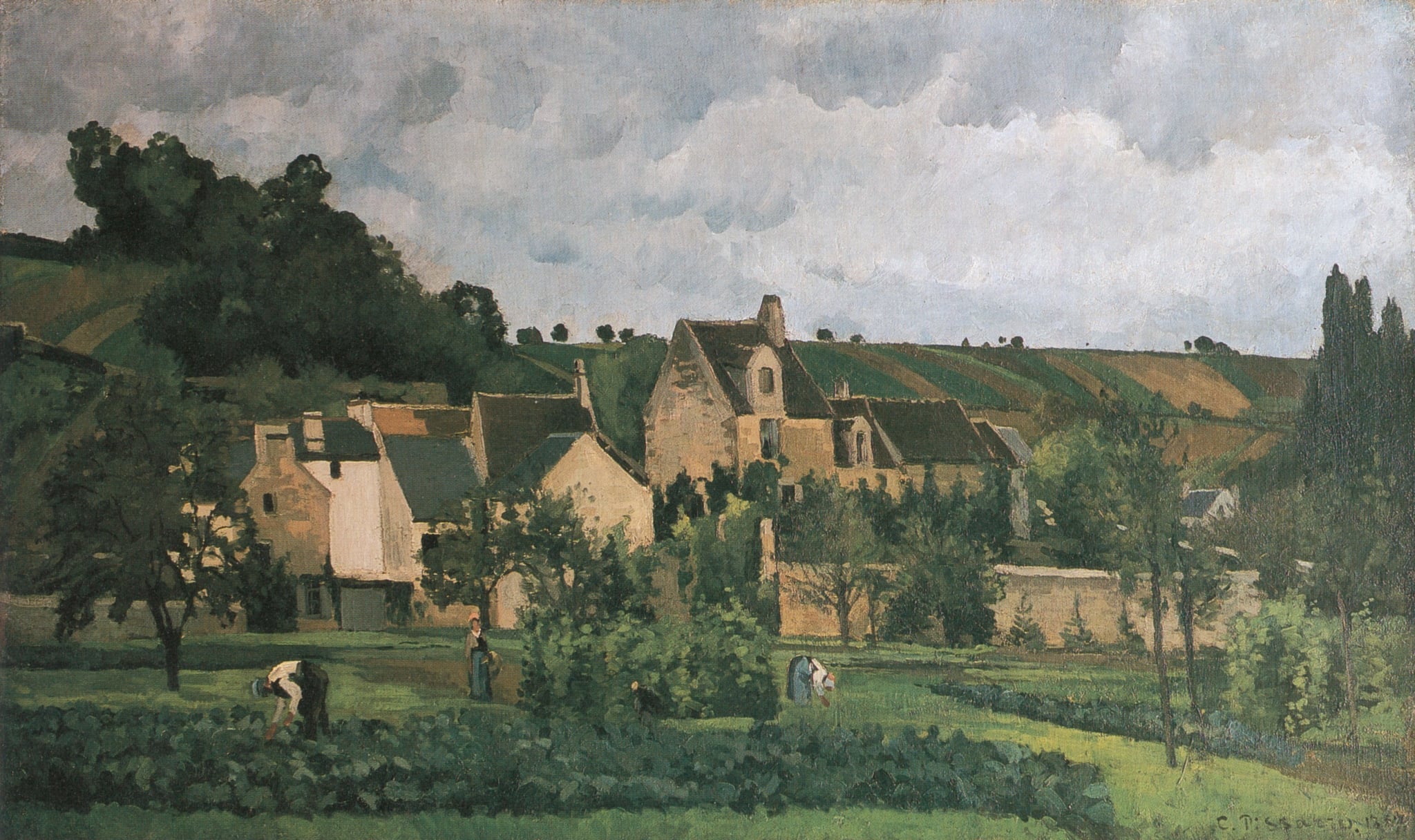
The Hermitage at Pontoise by Camille Pissarro

The Hermitage at Pontoise

Camille Pissarro (ca. 1867)

Camille Pissarro’s The Hermitage at Pontoise shows a hillside village interlaced with <strong>kitchen gardens</strong>, stone houses, and workers bent to their tasks under a <strong>low, cloud-laden sky</strong>. The painting binds human labor to place, staging a quiet counterpoint between <strong>architectural permanence</strong> and the <strong>seasonal flux</strong> of fields and weather <sup>[1]</sup><sup>[3]</sup>.

Laundresses Carrying Linen in Town by Camille Pissarro

Laundresses Carrying Linen in Town

Camille Pissarro (1879)

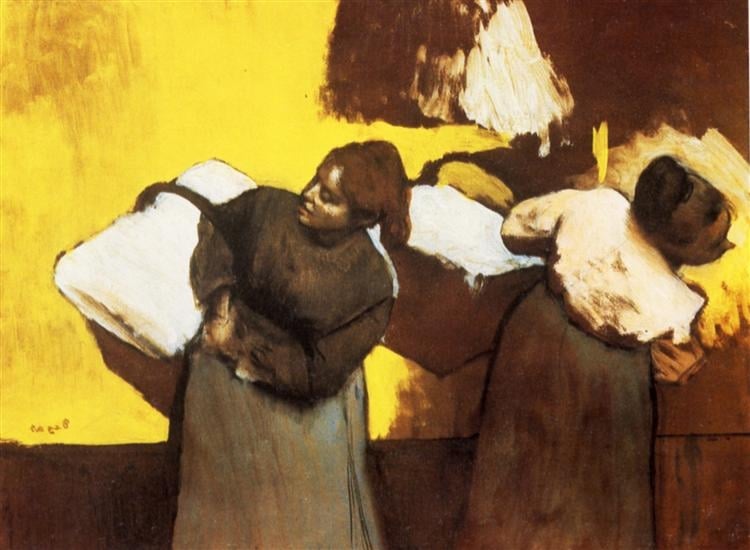
In Laundresses Carrying Linen in Town, two working women strain under <strong>white bundles</strong> that flare against a <strong>flat yellow ground</strong> and a <strong>dark brown band</strong>. The abrupt cropping and opposing diagonals turn anonymous labor into a <strong>monumental, modern frieze</strong> of effort and motion.

Boulevard Montmartre at Night by Camille Pissarro

Boulevard Montmartre at Night

Camille Pissarro (1897)

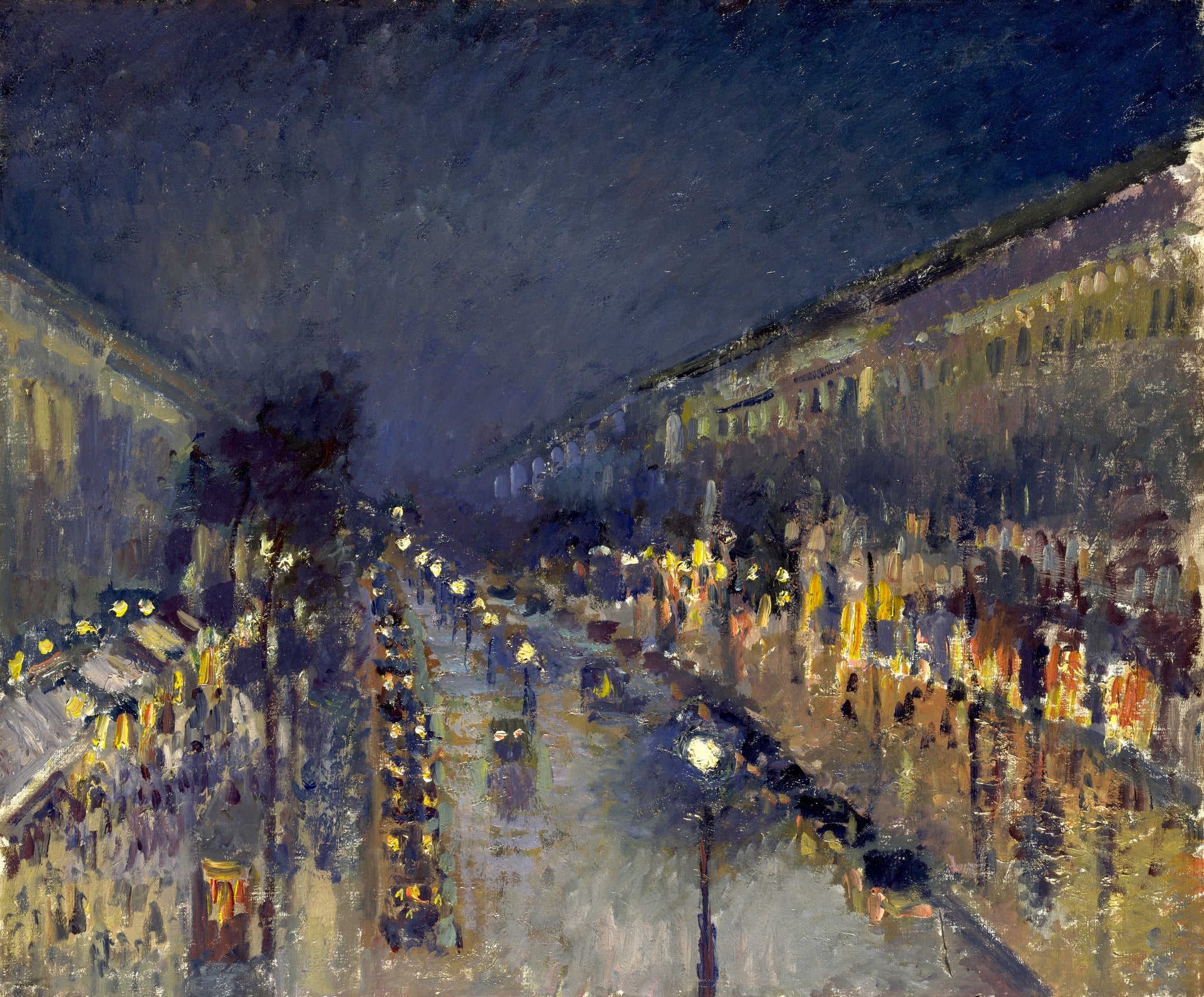
A high window turns Paris into a flowing current: in Boulevard Montmartre at Night, Camille Pissarro fuses <strong>modern light</strong> and <strong>urban movement</strong> into a single, restless rhythm. Cool electric halos and warm gaslit windows shimmer across rain‑slick stone, where carriages and crowds dissolve into <strong>pulse-like blurs</strong> <sup>[1]</sup><sup>[2]</sup>.

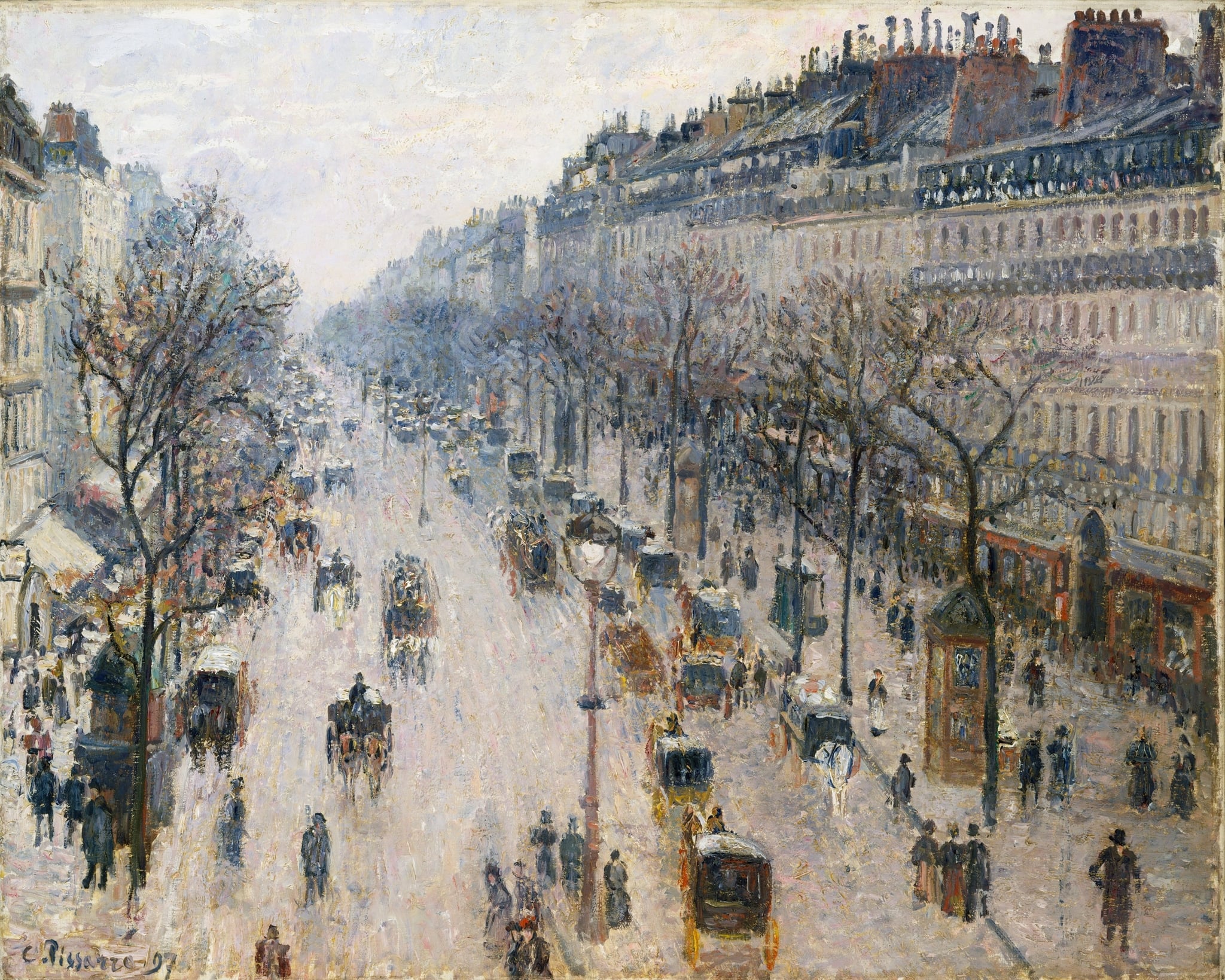
The Boulevard Montmartre on a Winter Morning by Camille Pissarro

The Boulevard Montmartre on a Winter Morning

Camille Pissarro (1897)

From a high hotel window, Camille Pissarro renders Paris as a living system—its Haussmann boulevard dissolving into winter light, its crowds and vehicles fused into a soft, <strong>rhythmic flow</strong>. Broken strokes in cool grays, lilacs, and ochres turn fog, steam, and motion into <strong>texture of time</strong>, dignifying the city’s ordinary morning pulse <sup>[1]</sup><sup>[3]</sup>.
Red Roofs by Camille Pissarro

Red Roofs

Camille Pissarro (1877)

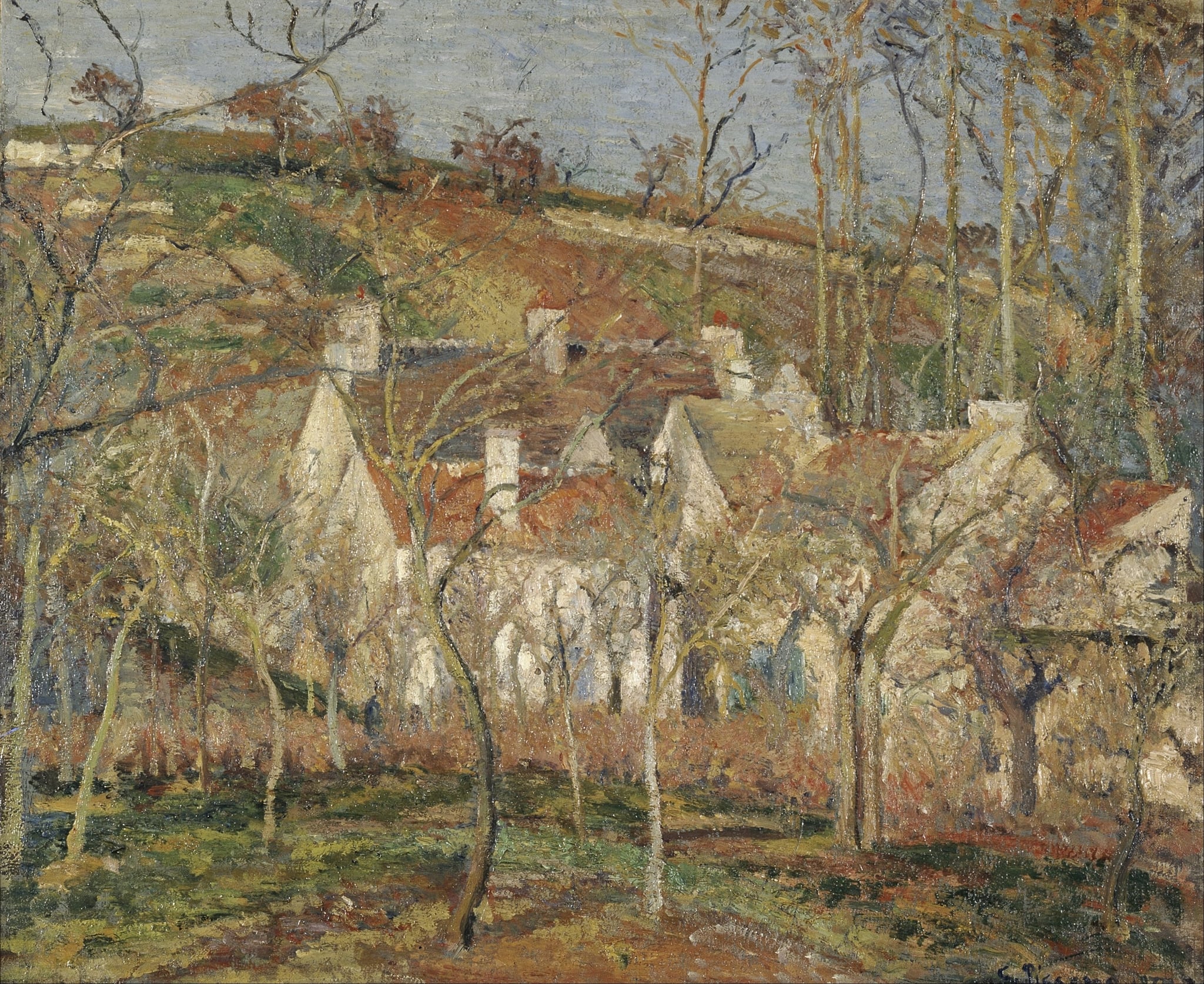
In Red Roofs, Camille Pissarro knits village and hillside into a single living fabric through a <strong>screen of winter trees</strong> and vibrating, tactile brushwork. The warm <strong>red-tiled roofs</strong> act as chromatic anchors within a cool, silvery atmosphere, asserting human shelter as part of nature’s rhythm rather than its negation <sup>[1]</sup><sup>[3]</sup>. The composition’s <strong>parallel planes</strong> and color echoes reveal a deliberate structural order that anticipates Post‑Impressionist concerns <sup>[1]</sup><sup>[2]</sup>.
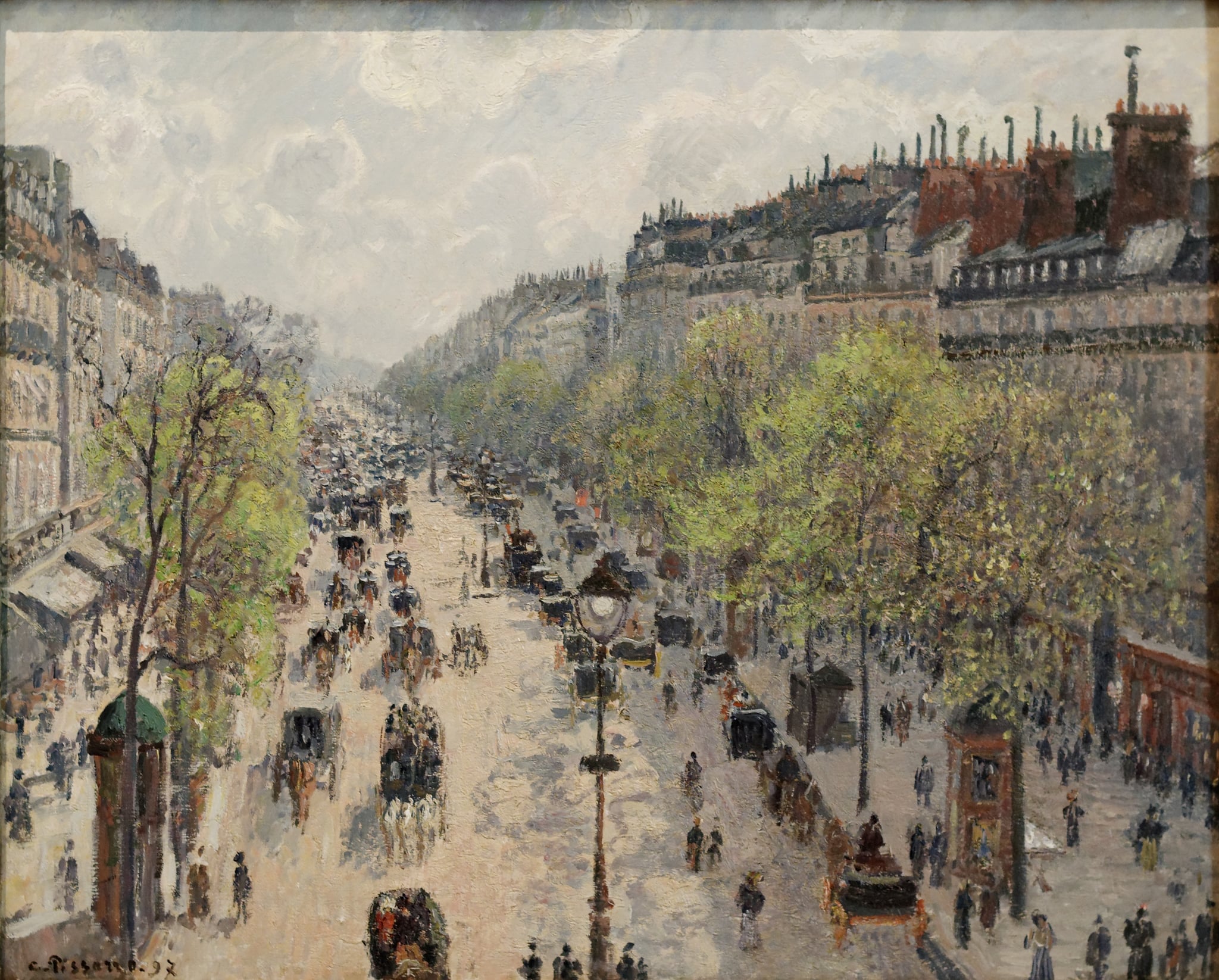
The Boulevard Montmartre on a Spring Morning by Camille Pissarro

The Boulevard Montmartre on a Spring Morning

Camille Pissarro (1897)

From a high hotel window, Camille Pissarro turns Paris’s grands boulevards into a river of light and motion. In The Boulevard Montmartre on a Spring Morning, pale roadway, <strong>tender greens</strong>, and <strong>flickering brushwork</strong> fuse crowds, carriages, and iron streetlamps into a single urban current <sup>[1]</sup><sup>[2]</sup>. The scene demonstrates Impressionism’s commitment to time, weather, and modern life, distilled through a fixed vantage across a serial project <sup>[1]</sup><sup>[3]</sup>.