The Boulevard Montmartre on a Spring Morning

by Camille Pissarro

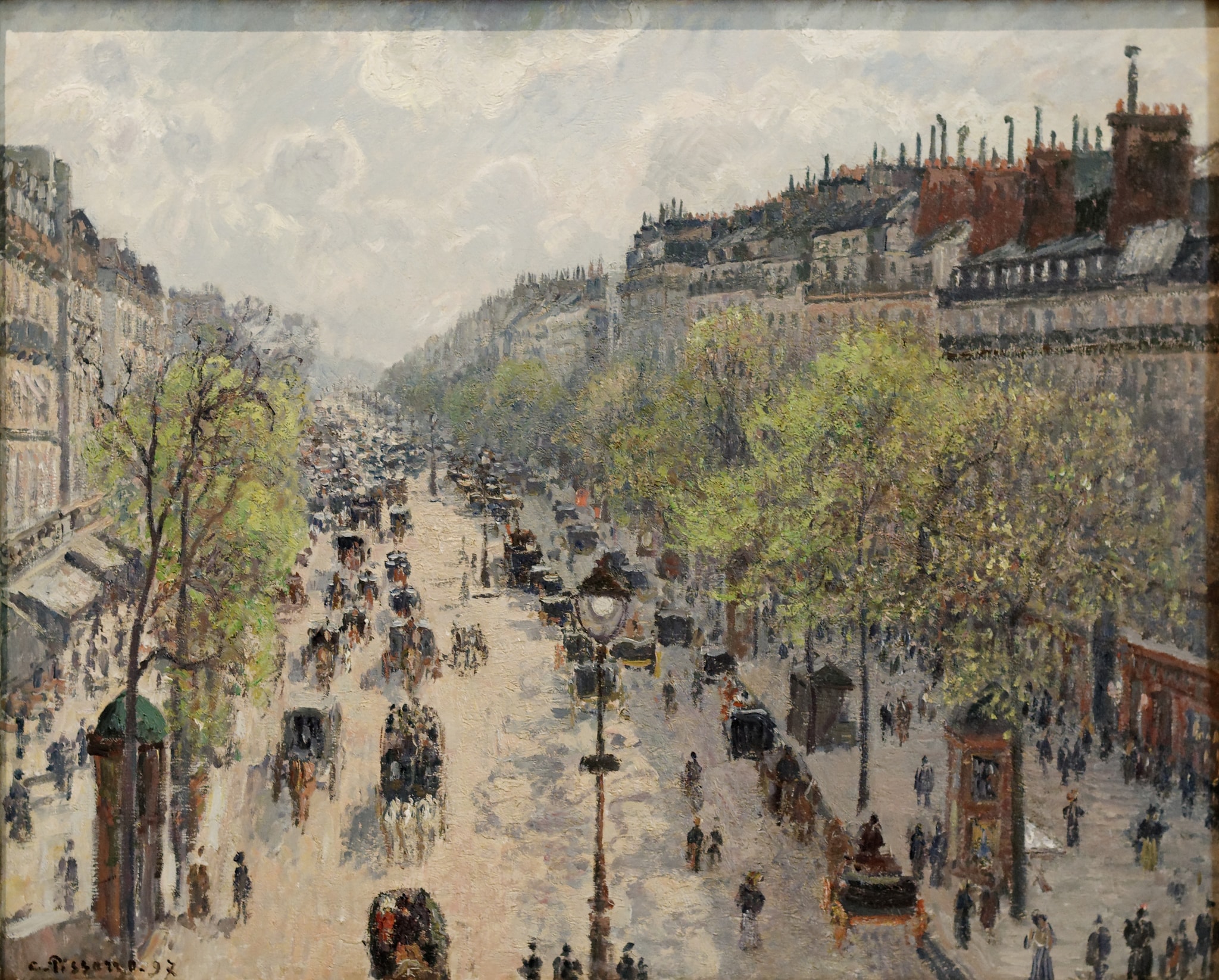
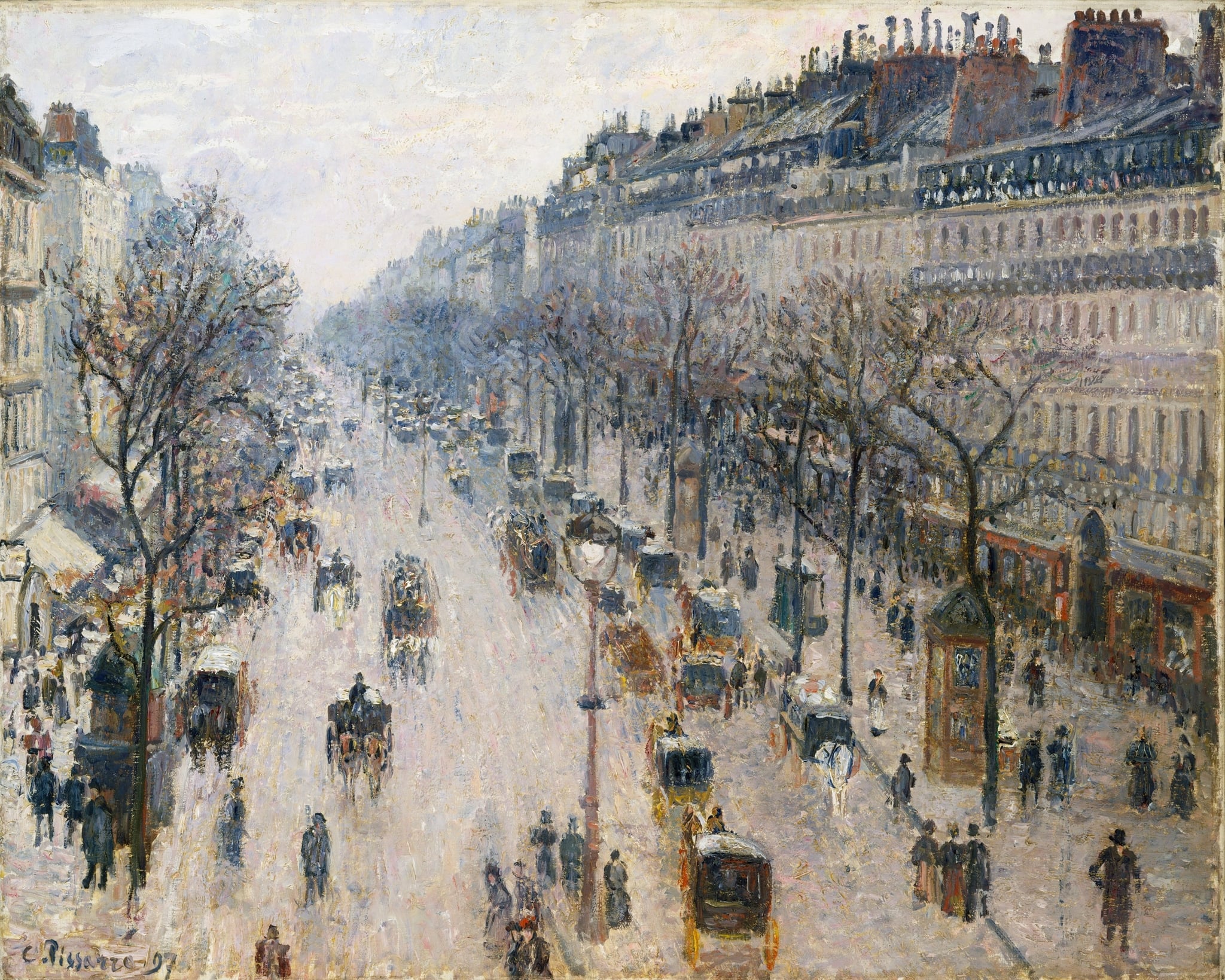
From a high hotel window, Camille Pissarro turns Paris’s grands boulevards into a river of light and motion. In The Boulevard Montmartre on a Spring Morning, pale roadway, tender greens, and flickering brushwork fuse crowds, carriages, and iron streetlamps into a single urban current [1][2]. The scene demonstrates Impressionism’s commitment to time, weather, and modern life, distilled through a fixed vantage across a serial project [1][3].

Fast Facts

Year
1897
Medium
Oil on canvas
Dimensions
65 × 81 cm
Location
Private collection
The Boulevard Montmartre on a Spring Morning by Camille Pissarro (1897) featuring Iron streetlamp, Pale boulevard roadway, Early spring trees, Crowds and horse-drawn traffic

Click on any numbered symbol to learn more about its meaning

Meaning & Symbolism

From the very first glance, the composition establishes a disciplined geometry that channels a restless city. The receding façades on both sides lock into a pronounced diagonal that funnels sightline and traffic toward a hazy vanishing point; the boulevard becomes an optical conduit rather than a mere street. Anchoring the axis, an iron streetlamp stands almost like a keystone, splitting the pale roadway and marking the cadence of municipal modernization even in daylight. Around it, horse-drawn omnibuses, cabs, and small knots of pedestrians dissolve into clusters of dabs and dashes, their specifics sacrificed to rhythm. Pissarro’s touch—no longer pointillist but a vibrating patchwork—lets forms fray at the edges so that speed, sound, and light seem to register simultaneously. The early-leaved trees along the right sidewalk and at the lower left lace the stone city with seasonal renewal, their thin green articulations mapping spring’s arrival onto Haussmann’s rectilinear program 123. The pale cream of the boulevard holds the whole together, a reflective plane that gathers sky glare, carriage shadows, and pedestrian silhouettes into a single shimmering field. That shimmering is not atmospheric decoration; it is the structural principle by which Pissarro translates a modern boulevard into a time-based experience. The fixed hotel-window vantage—secured at the Grand Hôtel de Russie for a deliberate series spanning times of day and weather—places perception at the center of the enterprise. One motif, multiplied by conditions, becomes a modern analogue to serial music: theme and variations conducted by light and season 134. In this spring morning variation, technologies of the city manifest not only in the lamp standards and regimented trees but also in the standardized façades whose cornice lines beat like measures across the canvas. The crowd’s anonymity is crucial: the people are not portraits but units of urban tempo, democratized into the same painterly currency as vehicles and architecture 23. This is how the painting argues for a civic commons—many private itineraries briefly synchronized by a boulevard—and why the work reads as both celebratory and analytical. It celebrates the accessibility and spectacle of the grands boulevards while analyzing how modern vision must aggregate fragments into a momentary whole. In this sense, Pissarro’s boulevard series refines the Impressionist wager that truth resides in transient appearances. Compared with Monet’s famously agonized serial rigor, critics have noted Pissarro’s freer delight in the city’s lived rhythms; here, that delight is legible in the easy counterpoint between the boulevard’s measured architecture and the playful leaves, in the way shopfront reds and slate-blue shadows pulse without tightening into hard outlines 13. The painting encodes a modern ethics of seeing: it refuses hierarchies between monument and passerby, between infrastructure and sky. Everything enters the same visual economy of small, vibrating marks, and the effect is a democratic unity-in-flux. By binding Haussmann’s planned city to the intimacies of weather and season, The Boulevard Montmartre on a Spring Morning not only documents Paris in 1897; it articulates a modern condition—life experienced as serial variation, meaning found in motion—making it a keystone of Pissarro’s late urban achievement and a touchstone for understanding Impressionism’s mature engagement with the metropolis 1234.

Explore Deeper with AI

Ask questions about The Boulevard Montmartre on a Spring Morning

Popular questions:

Powered by AI • Get instant insights about this artwork

💬 Ask questions about this artwork!

Interpretations

Serial Method as Modern Temporality

Rather than a single view, this canvas is one movement in a 14-part serial composition devised from a hotel window between February and April 1897. Joachim Pissarro argues the series crystallizes the artist’s most rigorous exploration of serial procedures—a fixed motif recomposed by weather, light, and season—so that perception becomes durational, not instantaneous 14. This approach reframes the boulevard as a time instrument, where shifts in luminosity and traffic recalibrate form and meaning. Compared to Monet’s serial austerity, critics note Pissarro’s freer responsiveness to lived rhythms, which here reads as buoyant spring clarity rather than optical ordeal 1. The result is vision as variation: a modern epistemology in which truth is approached through iteration, contingency, and the civic beat of Paris itself 134.

Source: Joachim Pissarro; Richard R. Brettell; Sotheby’s catalogue essay

Lighting Infrastructure and the Politics of Visibility

Even in daylight, the iron streetlamps punctuating the boulevard index Paris’s new regime of urban visibility. In the nocturne variant, the National Gallery notes Pissarro distinguishes distinct light technologies—cool electric arcs, warm gaslit windows, and oil lamps of cabs—through differentiated chromatic handling 2. That knowledge structures the spring canvas: unlit standards mark a technological grid that orders movement and perception, aligning with façades and tree rows to choreograph public life. The lamp at center acts as a civic keystone, signaling how municipal modernization disciplines space and spectatorship. Pissarro thus paints not just traffic but the infrastructural optics that make modern crowds legible, anticipating later theories of urban illumination and social control through light 23.

Source: National Gallery, London

Brushwork after Neo‑Impressionism: Surface as Sensorium

By the 1890s Pissarro tempers Neo‑Impressionist pointillism into a looser patchwork of dabs and dashes, retaining chromatic clarity while restoring spontaneity 1. Karen Levitov (via Sotheby’s) reads this as a reconciliation of system and sensation, apt for translating crowds and carriages into flickering incidents without hard contours. In Spring Morning, edges fray so sound, speed, and light seem to arrive together: omnibuses become strokes; shadows, supple skeins; façades, vibrating planes. The surface thus functions as a sensorium, where painterly “passages” mediate between empirical data and embodied experience. This material intelligence underwrites the painting’s unity-in-flux: a democratic texture that refuses hierarchies between architecture, person, and weather 13.

Source: Sotheby’s; NGV Melbourne

Democratic Crowd and Civic Optics

From a high vantage, the boulevard synchronizes private itineraries into a provisional civic commons: pedestrians and vehicles are rendered as anonymous units of urban tempo, equalized within the same painterly currency as stone and sky 3. Brettell contrasts Pissarro’s humane pleasure in the city with Monet’s stricter program, suggesting a social vision that finds dignity in ordinary flux rather than monumental spectacle 1. The standardized façades—icons of Haussmannization—provide the beat; the crowd supplies improvisation. The effect is a democratic optics: no single figure dominates, yet collective presence is palpable. In this lens, Spring Morning is not mere reportage but an ethic of seeing that redistributes attention across classes, labors, and leisures inhabiting the grands boulevards 13.

Source: Richard R. Brettell; NGV Melbourne

Restitution, Memory, and the Afterlife of Images

The painting’s modernity extends beyond 1897 into its provenance afterlife. Once in Max Silberberg’s renowned Breslau collection, it was forced into sale under the Nazi regime in 1935. Decades later, research by the Israel Museum and members of the Pissarro family enabled restitution to Silberberg’s heir in 2000; the canvas remained on loan to Jerusalem until 2013 and sold in 2014, setting a record for Pissarro 15. This trajectory reframes the boulevard’s civic ideals within a history of loss, displacement, and repair—a reminder that artworks accrue meanings through ownership, absence, and return. Reading Spring Morning today thus also entails an ethics of display and memory, where visibility in museums is inseparable from justice restored 5.

Source: Lost Art Database; Sotheby’s

Related Themes

About Camille Pissarro

Camille Pissarro (1830–1903) was a founding Impressionist, the only member to exhibit in all eight group shows, and a mentor to artists such as Cézanne and Gauguin. After experimenting with Neo‑Impressionism in the 1880s, he returned in the 1890s to a freer touch and developed serial city views from high windows to study time, weather, and modern life [5][1].
View all works by Camille Pissarro

More by Camille Pissarro
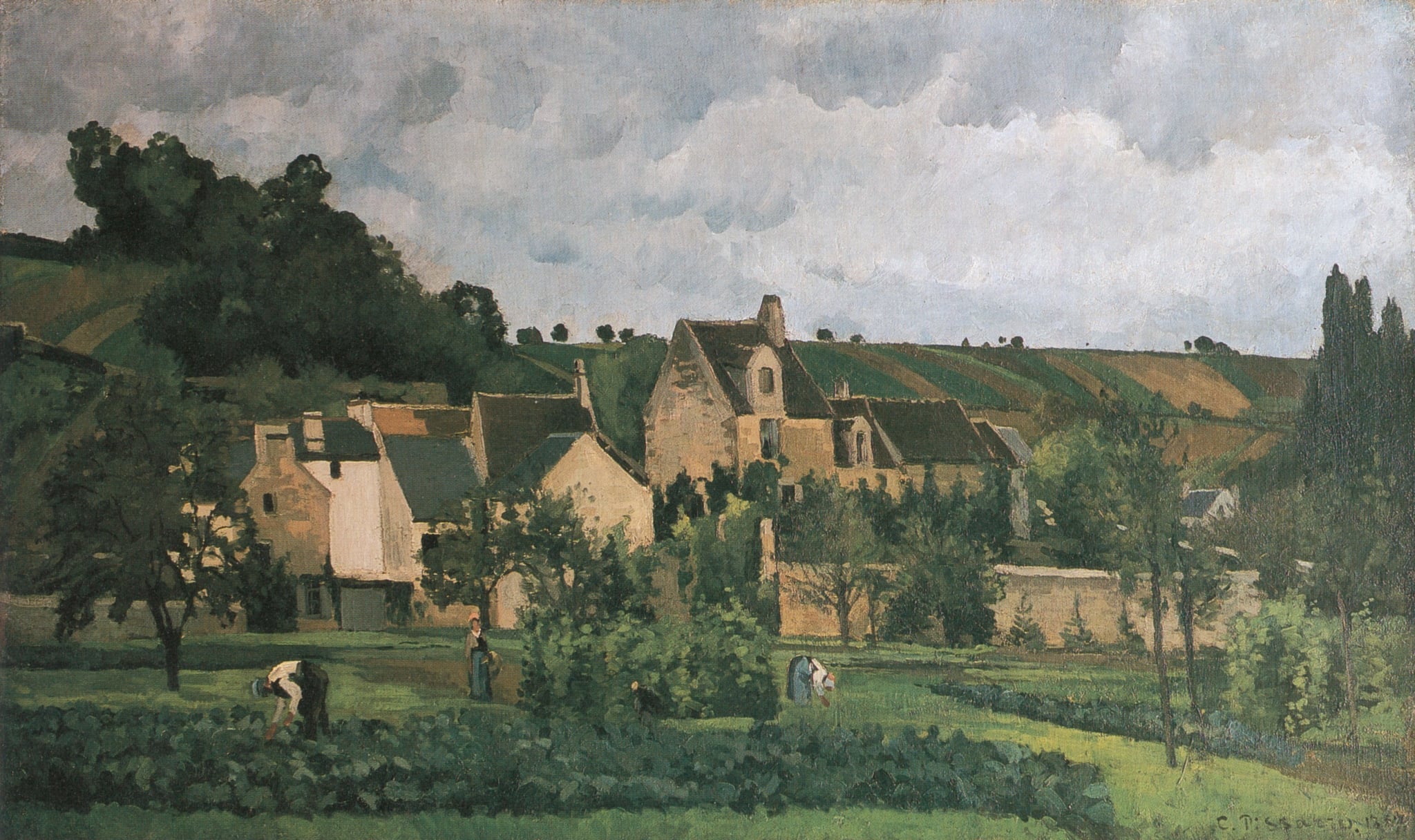
The Hermitage at Pontoise by Camille Pissarro

The Hermitage at Pontoise

Camille Pissarro (ca. 1867)

Camille Pissarro’s The Hermitage at Pontoise shows a hillside village interlaced with <strong>kitchen gardens</strong>, stone houses, and workers bent to their tasks under a <strong>low, cloud-laden sky</strong>. The painting binds human labor to place, staging a quiet counterpoint between <strong>architectural permanence</strong> and the <strong>seasonal flux</strong> of fields and weather <sup>[1]</sup><sup>[3]</sup>.

Laundresses Carrying Linen in Town by Camille Pissarro

Laundresses Carrying Linen in Town

Camille Pissarro (1879)

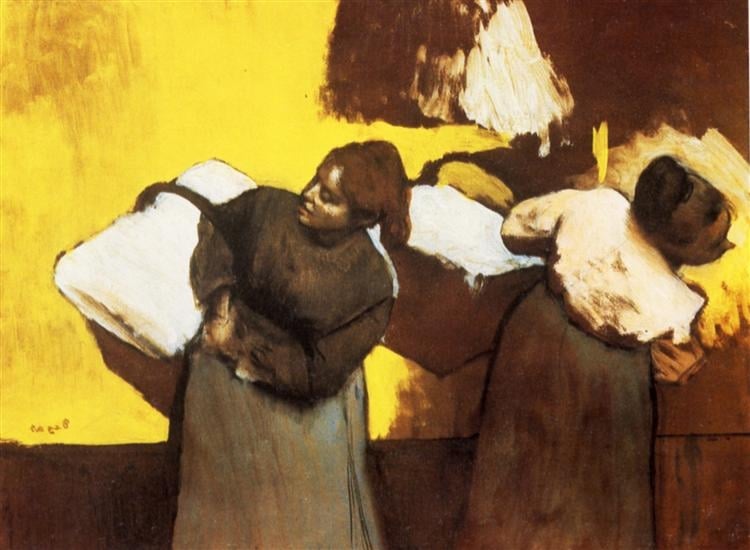
In Laundresses Carrying Linen in Town, two working women strain under <strong>white bundles</strong> that flare against a <strong>flat yellow ground</strong> and a <strong>dark brown band</strong>. The abrupt cropping and opposing diagonals turn anonymous labor into a <strong>monumental, modern frieze</strong> of effort and motion.

Boulevard Montmartre at Night by Camille Pissarro

Boulevard Montmartre at Night

Camille Pissarro (1897)

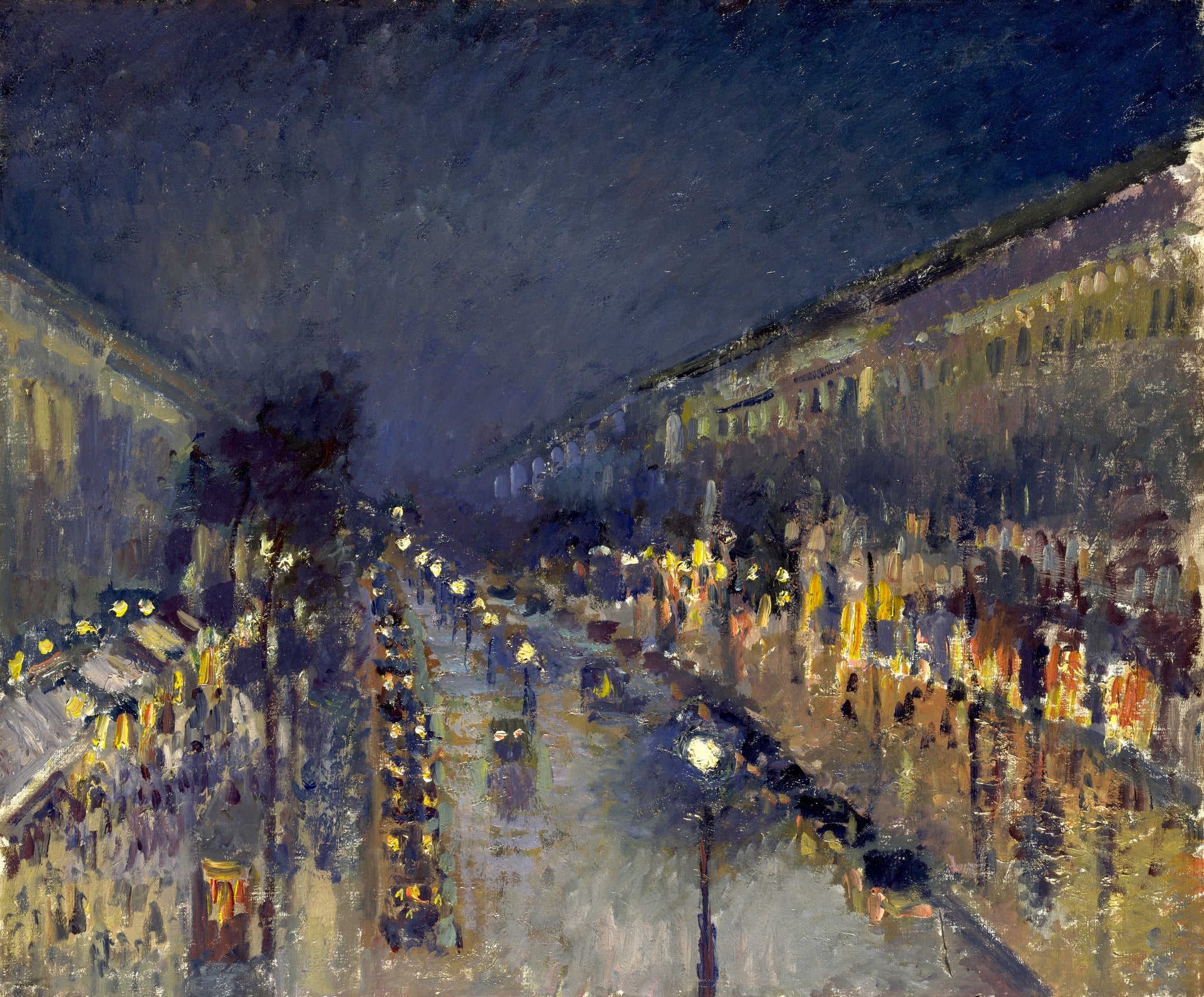
A high window turns Paris into a flowing current: in Boulevard Montmartre at Night, Camille Pissarro fuses <strong>modern light</strong> and <strong>urban movement</strong> into a single, restless rhythm. Cool electric halos and warm gaslit windows shimmer across rain‑slick stone, where carriages and crowds dissolve into <strong>pulse-like blurs</strong> <sup>[1]</sup><sup>[2]</sup>.

The Boulevard Montmartre on a Winter Morning by Camille Pissarro

The Boulevard Montmartre on a Winter Morning

Camille Pissarro (1897)

From a high hotel window, Camille Pissarro renders Paris as a living system—its Haussmann boulevard dissolving into winter light, its crowds and vehicles fused into a soft, <strong>rhythmic flow</strong>. Broken strokes in cool grays, lilacs, and ochres turn fog, steam, and motion into <strong>texture of time</strong>, dignifying the city’s ordinary morning pulse <sup>[1]</sup><sup>[3]</sup>.
Red Roofs by Camille Pissarro

Red Roofs

Camille Pissarro (1877)

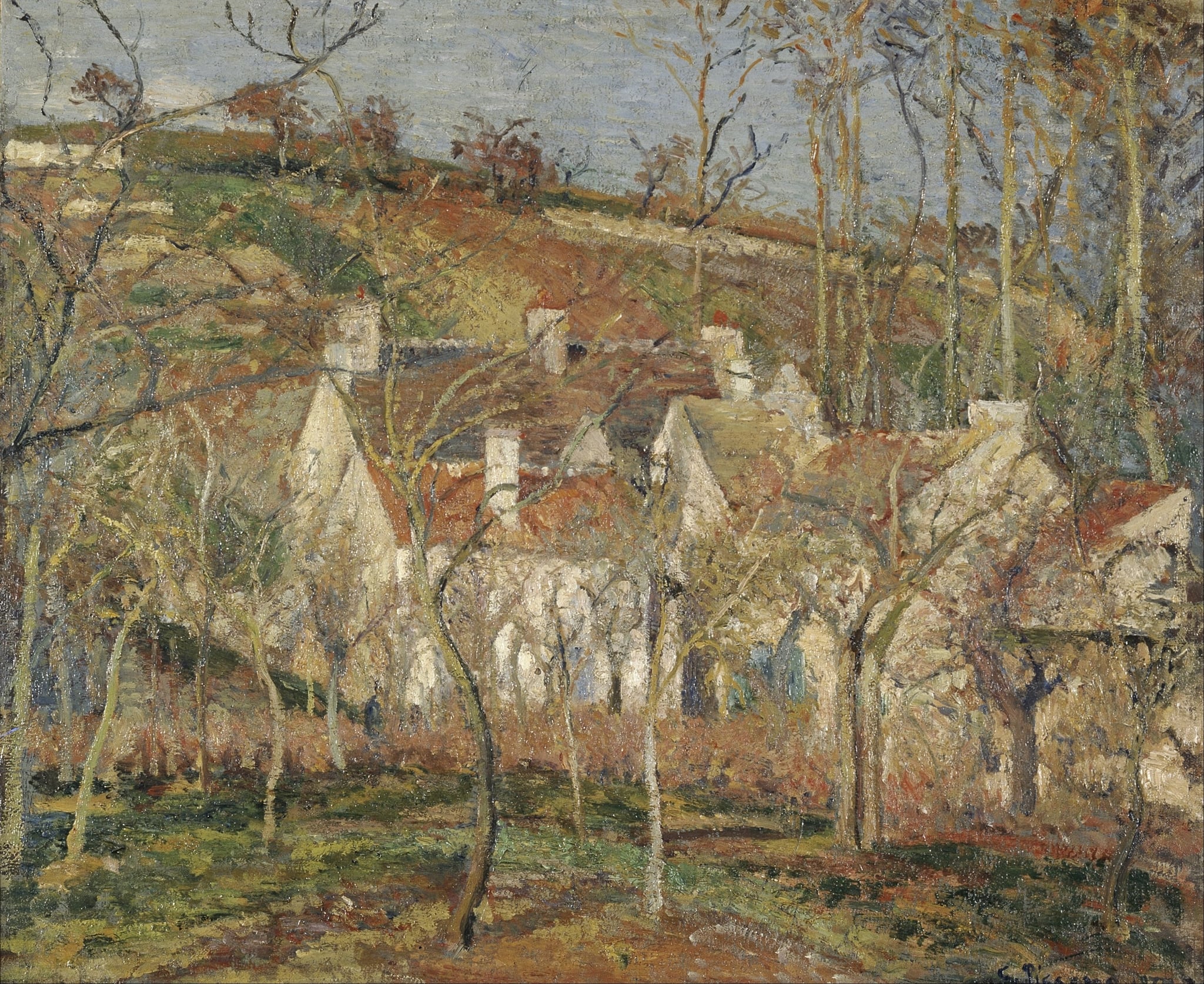
In Red Roofs, Camille Pissarro knits village and hillside into a single living fabric through a <strong>screen of winter trees</strong> and vibrating, tactile brushwork. The warm <strong>red-tiled roofs</strong> act as chromatic anchors within a cool, silvery atmosphere, asserting human shelter as part of nature’s rhythm rather than its negation <sup>[1]</sup><sup>[3]</sup>. The composition’s <strong>parallel planes</strong> and color echoes reveal a deliberate structural order that anticipates Post‑Impressionist concerns <sup>[1]</sup><sup>[2]</sup>.
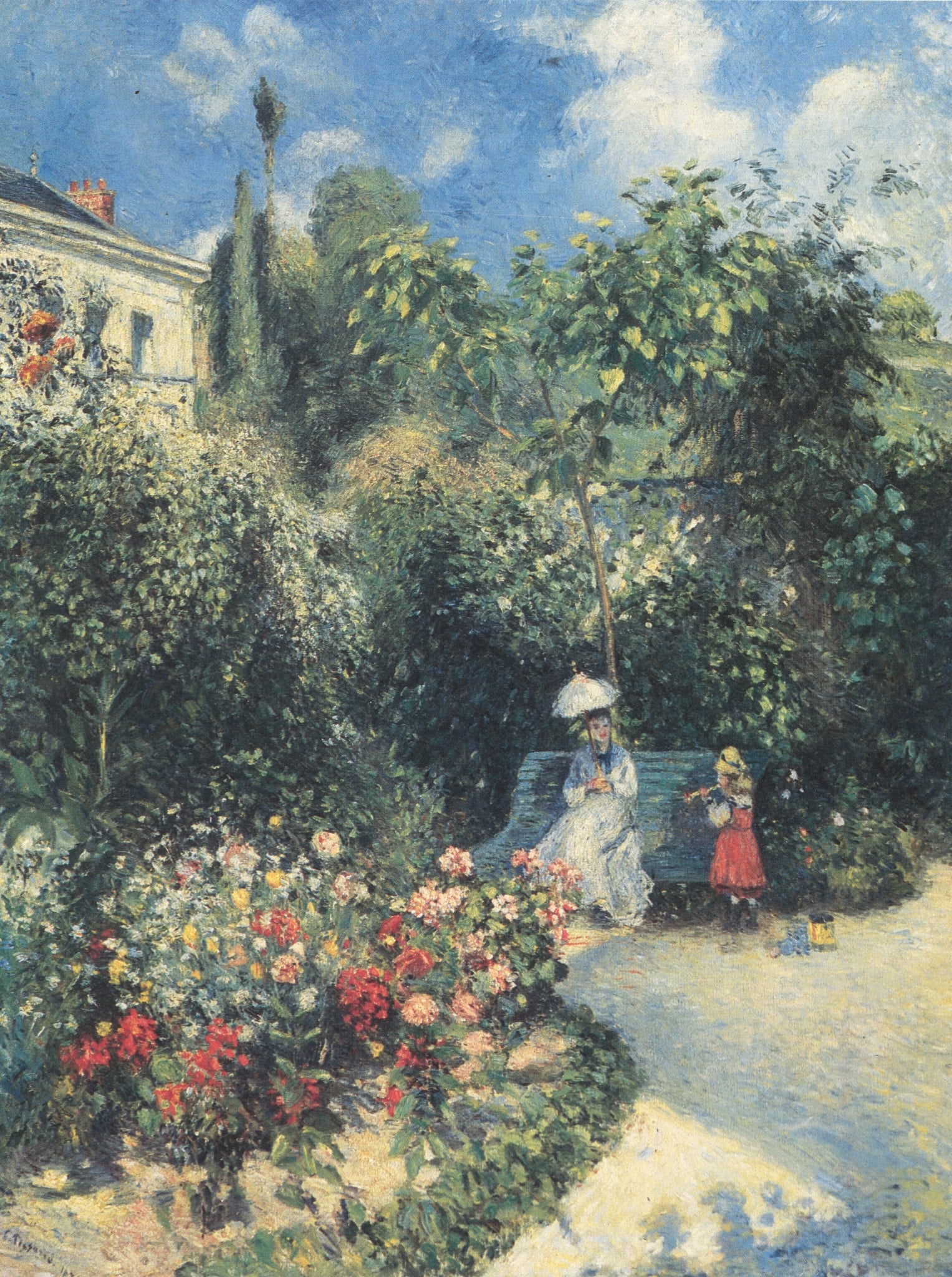
The Garden of Pontoise by Camille Pissarro

The Garden of Pontoise

Camille Pissarro (1874)

In The Garden of Pontoise, Camille Pissarro turns a modest suburban plot into a stage for <strong>modern leisure</strong> and <strong>fugitive light</strong>. A woman shaded by a parasol and a child in a bright red skirt punctuate the deep greens, while a curving sand path and beds of red–pink blossoms draw the eye toward a pale house and cloud‑flecked sky. The painting asserts that everyday, cultivated nature can be a <strong>modern Eden</strong> where time, season, and social ritual quietly unfold <sup>[1]</sup><sup>[3]</sup>.