How Much Is Breakfast in Bed Worth?
Last updated: February 22, 2026
Quick Facts
- Methodology
- comparable analysis
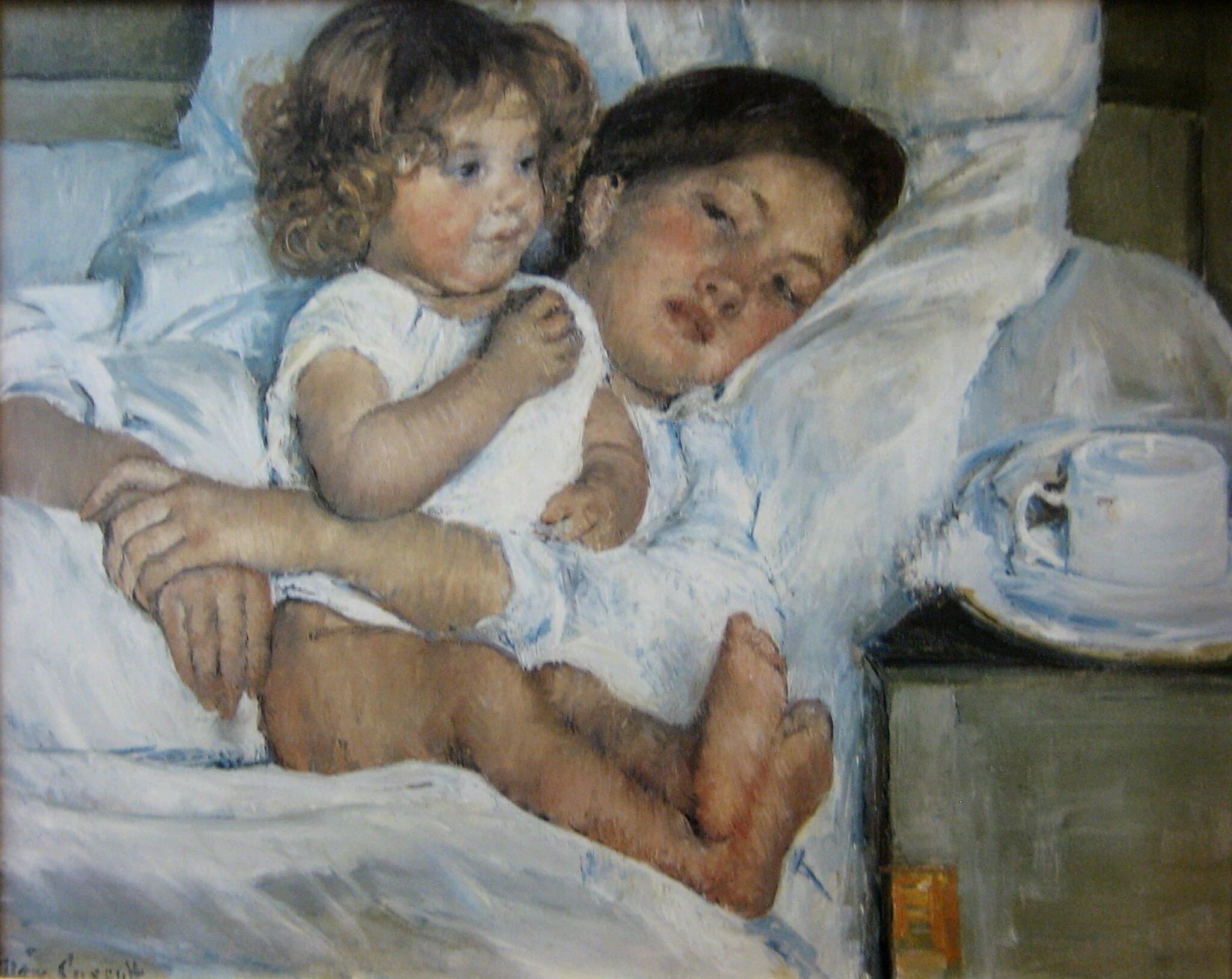
Estimated fair-market value (hypothetical): $20–40 million. Breakfast in Bed (1897) is a signature, prime-period oil by Mary Cassatt—an institutional icon at The Huntington—with rarity, subject, and quality that would likely reset the artist’s auction record if it ever came to market. The range assumes excellent condition, full provenance, and placement in a marquee evening sale.
Valuation Analysis
Estimated value (hypothetical, USD): $20–40 million. Mary Cassatt’s Breakfast in Bed (1897) is a peak-period, museum-caliber oil on canvas—among the artist’s most iconic mother-and-child images—held by The Huntington (Accession 83.8.6). It measures roughly 23 x 29 in and is widely reproduced, making it one of Cassatt’s most visible works in the United States [1]. There is no public auction history for this specific painting; any valuation is therefore theoretical and conditioned on presumed excellent state, full provenance, and optimal sale presentation.
Comparable and market context. Cassatt’s current auction record stands at $7,489,000 for Young Lady in a Loge, Gazing to Right (1878–79), achieved in 2022 from a blue-chip collection; notably, that record is for a work on paper, underscoring demand for masterpiece-status images regardless of medium [2]. Recent public sales of solid but non-trophy Cassatt oils have realized roughly $1.3–1.6 million (e.g., Portrait de Jeune Femme au Chapeau Blanc, €1.216m/$1.3m, 2023; Baby Charles Looking Over His Mother’s Shoulder (No. 3), $1.593m, 2021) [5]. These figures reflect the scarcity of A+ oils at auction rather than a ceiling on potential. Most canonical mother-and-child oils reside in museums, and a celebrated, prime 1890s canvas like Breakfast in Bed would command a substantial scarcity and recognition premium over routine comps [1], [2].
Segment dynamics. Impressionism/Post‑Impressionism remains a resilient, low-volatility category where truly great material elicits intense competition, even as overall art sales fell 12% in 2024 and buyers became more selective for mid‑tier lots [3], [4]. Meanwhile, reappraisal of historically underrepresented women artists has delivered step‑change records in adjacent segments, suggesting continued headroom for museum‑grade works by Cassatt when they appear. Against this backdrop, a signature mother‑and‑child oil—arguably the most sought‑after theme in her oeuvre—would attract deep global bidding from American and international institutions and private collectors [3].
Conclusion and range logic. The $20–40 million range reflects: (i) the painting’s upper‑tier status within Cassatt’s oeuvre; (ii) the scarcity of prime oils of this quality in private hands; (iii) the demonstrable demand for masterpiece‑level Cassatts (record set by a work on paper) [2]; and (iv) the premium typically paid for museum‑icon works under marquee exposure. Upside catalysts include pristine condition, exhaustive literature/exhibition history, and world‑class marketing; downside risks would be material conservation issues or suboptimal sale context. As a cornerstone of The Huntington’s collection, any sale is improbable; this figure represents a reasoned replacement‑cost/fair‑market proxy, not a disposition signal [1], [4], [5].
Key Valuation Factors
Art Historical Significance
High ImpactBreakfast in Bed is a signature example of Cassatt’s quintessential mother‑and‑child theme from the 1890s, the period most coveted by collectors and scholars alike. Its intimate domestic subject, masterful handling in oil, and frequent reproduction give it high visibility and pedagogical value. The work encapsulates Cassatt’s contributions to Impressionism—private, modern life rendered with psychological acuity and technical finesse—placing it alongside her most cited canvases. As a touchstone for American engagement with Impressionism and for the representation of women and motherhood in modern art, its art‑historical weight directly translates to market desirability and a museum‑icon premium. In short, it is “brand‑defining” Cassatt at scale, with enduring cross‑audience resonance.
Rarity and Demand for Prime Oils
High ImpactTrue A‑level Cassatt oils—especially 1890s mother‑and‑child compositions at exhibition scale—are exceptionally scarce in private hands; most reside in major museums. This structural scarcity tends to compress publicly visible comparables toward mid‑quality examples, understating what a masterpiece could achieve under ideal conditions. Cassatt’s auction record of $7.489m was set by a work on paper, underscoring that when the image is iconic and the provenance compelling, bidders will respond at the top end. A prime oil with the recognition and emotional immediacy of Breakfast in Bed would benefit from both scarcity and subject premiums, drawing competition from U.S. and international buyers anxious to secure a canonical example unlikely to reappear for decades.
Condition, Scale, and Medium
Medium ImpactAt approximately 23 x 29 inches, Breakfast in Bed offers an ideal, display‑friendly scale for both museums and top private collections. The medium—oil on canvas—commands a material premium over Cassatt’s more commonly traded pastels and prints. While specific conservation details are not public, valuation assumes a sound structural state, sympathetic historic restoration (if any), and strong surface quality with legible, original paint passages. Any evidence of overcleaning, significant overpaint, or structural compromise (lining issues, canvas weakness) could dampen the price, while excellent cosmetic presentation under modern lighting would expand the bidding pool. The medium/scale combination places this work in the top collecting bracket for Cassatt.
Provenance and Institutional Caliber
High ImpactThe painting’s long residence at The Huntington and association with the Virginia Steele Scott Foundation confer blue‑chip credibility and wide scholarly exposure. Works that are recognized museum icons often command a premium when they do trade, as buyers prize validated significance and public recognition. Although a sale is improbable, the institutional context signals exemplary provenance, exhibitions, and literature—attributes that de‑risk the acquisition for major collectors. If hypothetically offered with The Huntington’s full scholarly dossier and modern technicals, it would likely be positioned as a marquee lot with international marketing, maximizing competitive tension and price discovery. The institutional imprimatur is a core value driver here.
Market Context and Timing
Medium ImpactThe broader art market contracted in 2024, and buyers have been more selective at the mid‑tier. Yet trophy‑quality Impressionist works continue to draw strong bidding in a polarized, “two‑speed” market. Simultaneously, sustained curatorial and market attention to historically underrecognized women artists supports further price discovery at the high end. Against this backdrop, a masterpiece‑level Cassatt oil with widespread name recognition stands to attract deep international demand if timed to a major season and positioned in a high‑profile evening sale. Macroeconomic stability and effective pre‑sale institutional outreach could widen participation and push results toward the upper end of the range, while market softness would argue for the midpoint.
Sale History
Breakfast in Bed has never been sold at public auction.
Mary Cassatt's Market
Mary Cassatt occupies a blue‑chip position within American and Impressionist markets, though her supply of top‑tier oils is notably thin compared with her male peers. Prints and pastels are more frequently traded and form the backbone of day‑sale activity, while the strongest prices concentrate in prime‑period (late 1870s–1890s) works with iconic subjects and impeccable provenance. Her current auction record—$7.489 million—was set in 2022 for a celebrated, early pastel, underscoring that masterpiece‑level imagery can outstrip medium hierarchies. The relative paucity of A‑level oils at auction suppresses headline benchmarks but also suggests upside when a museum‑grade canvas appears. With renewed scholarly focus on women Impressionists, Cassatt’s market retains robust underpinnings and potential for record‑setting outcomes.
Comparable Sales
Baby Charles Looking Over His Mother's Shoulder (No. 3)
Mary Cassatt
Same artist and medium (oil), closely related mother-and-child theme from ca. 1900; good benchmark for late 1890s–1900 Cassatt oils.
$1.6M
2021, Sotheby's New York
~$1.9M adjusted
Portrait de Jeune Femme au Chapeau Blanc
Mary Cassatt
Same artist and medium (oil) with solid museum-level buyer (Fondation Bemberg); illustrates recent pricing for well-presented Cassatt oils.
$1.3M
2023, Ader, Paris (Hotel Drouot)
~$1.4M adjusted
Mother Resting Her Cheek on Her Daughter's Blond Head
Mary Cassatt
Same artist and medium (oil) with intimate mother-and-child subject; shows mid-market performance and the impact of regional venue/provenance.
$480K
2023, Guyette & Deeter
~$504K adjusted
Young Lady in a Loge, Gazing to Right
Mary Cassatt
Artist record; prime-period, iconic subject with top provenance (Ann & Gordon Getty Collection). Though on paper, it sets the modern ceiling for Cassatt's market and signals demand for masterpieces.
$7.5M
2022, Christie's New York
~$8.2M adjusted
Reine Lefebvre with Blond Baby and Sara Holding a Cat
Mary Cassatt
Related subject (maternal/child), demonstrates current day-sale appetite for Cassatt works on paper (pastel counterproof) featuring domestic intimacy.
$178K
2026, Christie's New York
~$174K adjusted
Sketch of 'Sara in a Green Bonnet'
Mary Cassatt
Work on paper from Cassatt's core domestic/child repertoire; illustrates selective demand for more modest pastels relative to oils.
$152K
2025, Christie's New York
Current Market Trends
Impressionism has remained comparatively resilient amid a softer global art market: overall sales fell in 2024, but top‑quality trophies continued to attract vigorous bidding, while mid‑tier material met disciplined demand. Buyers favor proven names, canonical subjects, and works with strong institutional narratives. Within this “two‑speed” dynamic, the best examples by historically underrecognized women have drawn increased attention, widening the competitive field. Currency movements and interest‑rate sensitivities persist, but well‑curated evenings, cross‑category storytelling, and institutional participation have supported prices for masterworks. In this context, a prime, museum‑icon oil by Cassatt would likely galvanize global interest and could set a new artist record under optimal sale conditions.
Study print
Study this painting as a print
Pair the full artwork with a museum-style study sheet focused on one meaningful detail.
Sources
- The Huntington — Breakfast in Bed (object record)
- Christie’s — Ann & Gordon Getty Collection totals; Cassatt record
- Artnet News — Impressionism is ‘humming’ despite supply concerns
- The Art Newspaper — Global art sales plummeted 12% in 2024 (Art Basel/UBS report)
- Artdaily — Sale of Baby Charles Looking Over His Mother’s Shoulder (No. 3), Sotheby’s 2021