How Much Is Woman with a Pearl Necklace in a Loge Worth?
Last updated: February 22, 2026
Quick Facts
- Insurance Value
- $35.0M (Appraisal synthesis (this report))
- Methodology
- comparable analysis
Fair-market value for Mary Cassatt’s Woman with a Pearl Necklace in a Loge (1879, oil on canvas; Philadelphia Museum of Art) is estimated at $15–30 million in a hypothetical, unrestricted sale. The work is a canonical, peak-period opera‑loge painting first shown at the 1879 Impressionist exhibition, with rarity, subject, and museum-grade stature that would likely reset the artist’s auction record.
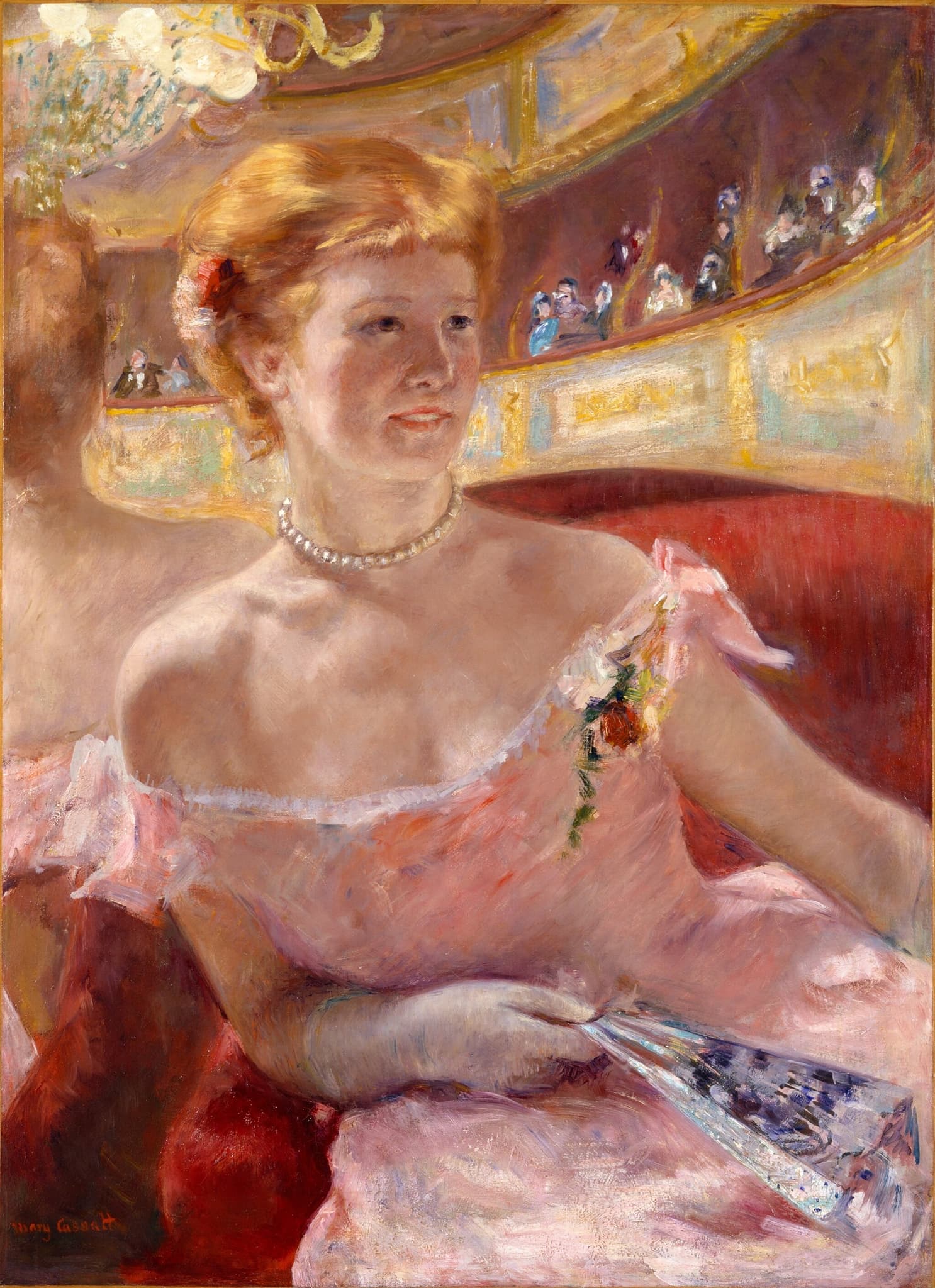
Woman with a Pearl Necklace in a Loge
Mary Cassatt, 1879 • Oil on canvas
Read full analysis of Woman with a Pearl Necklace in a Loge →Valuation Analysis
Conclusion: In a hypothetical open-market scenario, Mary Cassatt’s Woman with a Pearl Necklace in a Loge (1879) would warrant a fair‑market estimate of $15–30 million. The painting is a signature opera‑loge composition from Cassatt’s defining 1879 moment, recorded by the Philadelphia Museum of Art and exhibited at the fourth Impressionist exhibition that year—an unimpeachable art‑historical credential that anchors value at the top of the artist’s market [1].
Comparable evidence: The most probative comp is Cassatt’s Young Lady in a Loge Gazing to Right, a directly related loge subject on paper that achieved $7,489,000 at Christie’s in 2022, establishing the artist’s standing auction record. That result demonstrates the market’s willingness to pay a premium for this exact theme even in works on paper; a prime, 1879 oil of the same subject class justifies a substantial multiple over that benchmark [2]. A late‑1870s oil comparator—Portrait de jeune femme au chapeau blanc (1879)—brought €1,216,000 in 2023 at Ader, a fraction of the value expected for a canonical, exhibition‑proven loge oil and useful mainly to show the steep value gradient between solid period portraits and true masterpieces [3].
Rarity and demand: Fully resolved oils from 1878–79, especially of the opera‑loge theme, are exceptionally scarce in private hands; many reside in institutions. That scarcity, combined with the composition’s iconic status in Cassatt’s oeuvre, creates outsized competitive demand across multiple buyer pools: American art collectors, Impressionist specialists, and institutions seeking to redress historical underrepresentation of women artists. Ongoing scholarly and exhibition attention—such as the Philadelphia Museum of Art’s 2024 survey Mary Cassatt at Work—further supports long‑term cultural and market significance [4]. Broader market analysis has also highlighted renewed attention to Impressionism and to women within the canon, reinforcing the likelihood of aggressive bidding for best‑in‑class material [5].
Pricing rationale: Anchoring to the $7.49m paper record, a masterpiece‑premium for a museum‑grade 1879 oil, its exhibition pedigree, and cross‑category appeal supports a mid‑eight‑figure range. A tightly marketed, guaranteed evening‑sale placement in New York or Paris would plausibly reset Cassatt’s record by a wide margin.
Caveats: Any formal appraisal should confirm condition and technical state (lining, retouch, structural history), complete provenance and literature, and any legal/ethical constraints on deaccession. While the work is not for sale (PMA collection), an insurance scheduling level around $35 million is appropriate to reflect replacement difficulty and non‑financial significance.
Key Valuation Factors
Art Historical Significance
High ImpactPainted and exhibited in 1879, the year Cassatt first showed with the Impressionists, this canvas sits at the epicenter of her breakthrough. The opera‑loge theme is among her most emblematic subjects, encapsulating the modern, self‑possessed female spectator in the new social theater of Paris. The painting’s inclusion in the 1879 Impressionist exhibition and its canonical status within Cassatt scholarship place it in the artist’s top echelon. Works that embody an artist’s seminal contribution to modernity command sustained institutional interest and durable private demand, and this painting’s subject, date, and compositional ambition together support a value premium versus typical Cassatt oils.
Rarity and Supply
High ImpactMasterpiece‑level Cassatt oils from 1878–79 are exceptionally scarce in private hands; many are already in museums. Opera‑loge scenes of this caliber are rarer still, with most comparables either on paper or of lesser scale/ambition. Scarcity reduces substitution risk for motivated buyers, increasing the probability of competitive bidding when such a work is hypothetically offered. Given that Cassatt’s auction record was set by a loge composition on paper, a museum‑grade oil on the same theme—especially one linked to the 1879 exhibition—supports a step‑change in value that materially exceeds the artist’s typical public results.
Provenance, Exhibition, and Literature
High ImpactNow in the Philadelphia Museum of Art via the 1978 bequest of Charlotte Dorrance Wright, the painting benefits from the credibility of a major institutional collection. PMA documentation indicates it was shown in the 1879 Impressionist exhibition, a gold‑standard provenance event. Such provenance, paired with frequent scholarly reproduction, materially de‑risks authenticity and scholarly importance for buyers and insurers alike. In any hypothetical sale or loan context, this chain of custody and exhibition history would meaningfully enhance perceived value and likely attract both institutional and top‑tier private interest.
Market Evidence and Timing
High ImpactCassatt’s current auction record—$7.49m for a directly comparable loge subject on paper—demonstrates robust demand for this iconography. A lesser, 1879 oil portrait at €1.216m underscores how sharply prices escalate for canonical images versus period peers. Market visibility for Cassatt has been reinforced by recent museum programming and broader enthusiasm for blue‑chip Impressionism and women artists, conditions that typically concentrate demand at the masterpiece level. In a marquee evening sale with a guarantee, this painting’s subject/date/quality nexus is poised to reset the artist’s auction record by a wide margin, supporting the $15–30m fair‑market range.
Sale History
Woman with a Pearl Necklace in a Loge has never been sold at public auction.
Mary Cassatt's Market
Mary Cassatt is a blue‑chip American Impressionist whose market is anchored by scarce, highly desirable oils and exceptional pastels, with prints forming a broader, more accessible tier. Her standing auction record—$7.49 million for a loge subject on paper—signals strong appetite for her most iconic themes. However, fully resolved, peak‑period oils seldom appear, which suppresses observed price ceilings relative to male Impressionist peers and implies headroom when masterpieces surface. Demand draws from American art collectors, Impressionist specialists, and institutions prioritizing women artists. Overall liquidity concentrates in works on paper, but best‑of‑category oils and canonical subjects can attract aggressive, cross‑category bidding and step‑change pricing.
Comparable Sales
Young Lady in a Loge Gazing to Right
Mary Cassatt
Same artist; same opera‑box/loge theme; same 1878–79 moment as the PMA painting. Although on paper, it is Cassatt’s standing auction record and best subject match.
$7.5M
2022, Christie's New York
~$8.2M adjusted
Portrait de jeune femme au chapeau blanc
Mary Cassatt
Same artist; same year (1879) and oil on canvas. Not a theater/loge scene and smaller in ambition, but a close period/medium benchmark.
$1.3M
2023, Ader, Hôtel Drouot (Paris)
~$1.4M adjusted
Mother Resting Her Cheek on Her Daughter’s Blond Head
Mary Cassatt
Same artist; oil on canvas; classic Cassatt mother‑and‑child subject. Different period/subject than the loge works; calibrates pricing for smaller Cassatt oils at non‑marquee venues.
$480K
2023, Guyette & Deeter (Portsmouth, NH)
~$509K adjusted
A Kiss for Baby Ann (No. 3)
Mary Cassatt
Same artist; late‑19th‑century, iconic mother‑and‑child imagery with a seven‑figure day‑sale result. Not a loge scene and later in date, but shows demand for top Cassatt subjects beyond the 1870s.
$1.1M
2022, Christie's New York
~$1.2M adjusted
Sketch of “Sara in a Green Bonnet”
Mary Cassatt
Same artist; work on paper from the early 1900s. Not subject/period‑comparable, but helps frame current mid‑tier Cassatt works‑on‑paper pricing and market selectivity below trophy level.
$152K
2025, Christie's New York
Current Market Trends
Impressionism remains a resilient category, with buyers showing heightened selectivity and a premium for top‑quality, well‑provenanced works. The market has tilted toward connoisseurship over speculation, favoring demonstrably significant pieces that anchor an artist’s legacy. Within this context, women in the Impressionist canon have enjoyed growing institutional and private attention, and records have reset when rare, museum‑grade examples emerge. For Cassatt specifically, the combination of scarce supply in the 1878–79 window, ongoing curatorial focus, and cross‑collecting demand suggests that a canonical opera‑loge oil would achieve a meaningful step above historical pricing benchmarks despite cyclical caution elsewhere.
Study print
Study this painting as a print
Pair the full artwork with a museum-style study sheet focused on one meaningful detail.
Sources
- Philadelphia Museum of Art — Woman with a Pearl Necklace in a Loge (object page)
- Christie’s Press — The Ann & Gordon Getty Collection: Volume 1 (Cassatt record, 2022)
- Gazette Drouot — Résultats des ventes: Monet et Cassatt millionnaires à Drouot (Nov 24, 2023)
- Philadelphia Museum of Art — Mary Cassatt at Work (exhibition, 2024)
- Artnet News — How Impressionism factors into the auction industry today (2024)