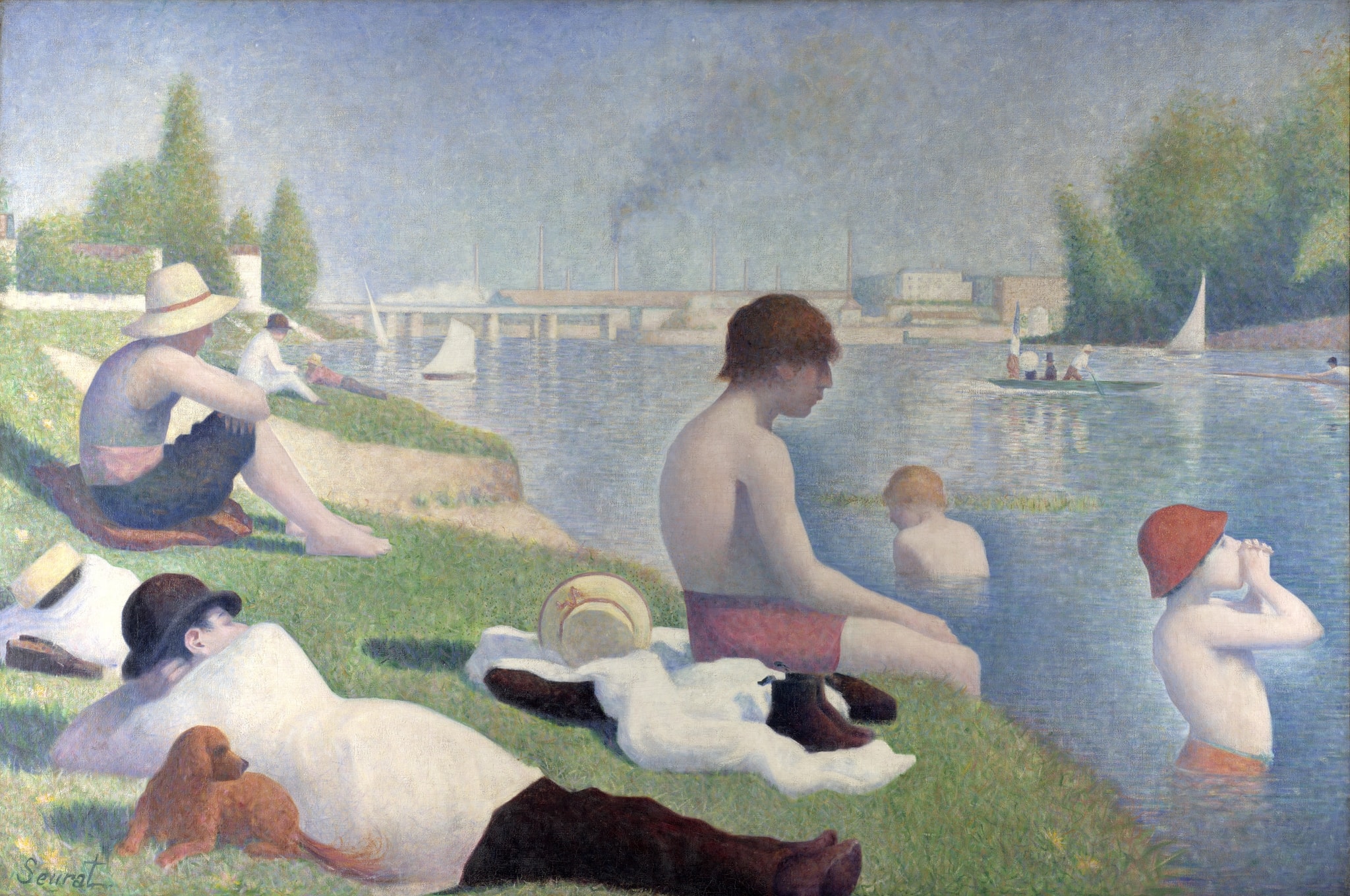
Bathers at Asnières
Bathers at Asnières stages a scene of modern leisure on the Seine, where workers recline and wade beneath a hazy, unified light. Seurat fuses classicizing stillness with an industrial backdrop of chimneys, bridges, and boats, turning ordinary rest into a monumental, ordered image of urban life [1][3]. The canvas balances soft greens and blues with geometric structures, producing a calm yet charged harmony.
Study Print Studio
Create a personal study print
Build a companion study sheet around the part of this painting that speaks to you most. Choose a detail, shape an interpretation, and walk away with something personal and display-worthy.
Fast Facts
- Year
- 1884
- Medium
- Oil on canvas
- Dimensions
- 201 × 300 cm
- Location
- The National Gallery, London
Click on any numbered symbol to learn more about its meaning
Meaning & Symbolism
Seurat organizes the bank into a measured procession of bodies that read like sculpture: the adolescent in rose trunks sits in profile, gravely self‑contained; the man in a straw hat triangulates the left edge; a reclining figure with a bowler hat anchors the foreground, his boots and shirt neatly arranged, a small dog at his side. The boy at far right, hands cupped to his mouth beneath a red cap, calls out across the water. These static, profile‑heavy poses recall antique reliefs and Puvis‑like friezes; they grant the sitters a classical poise while refusing anecdote or spontaneity 14. Seurat abstracts flesh into even planes and bathes it in a silvery envelope, suspending time so that leisure appears not as a fleeting Impressionist glimpse but as a composed, communal state. The river’s long horizontal and the receding bank repeat those calm rhythms, turning the bank into a stage where everyday bodies are accorded monumental dignity 13.
Across that stage, signs of modern life pass in measured counterpoint. A railway bridge partly masks a road bridge; chimneys and drifting smoke from the Clichy works line the horizon; sleek dinghies and a racing scull slice the surface; a punt ferries a bourgeois couple—top hat, parasol—under a tiny tricolour while the oarsman labors 1. The image builds an understated dialectic: leisure vs. labor, nature vs. industry, working class vs. bourgeois, all held within a single, lucid order. The calling boy—often read as a modern Triton—pipes toward that opposite shore, a playful classical echo that welds mythic form to suburban reality 15. Seurat refuses melodrama; contrast is structural rather than polemical, made legible by spacing, horizon line, and the boats’ vectors. Even small props—hats, boots, neatly folded shirts on the bright towel—signal social type while declaring that rest itself can be composed with care.
This equilibrium of classicism and modernity is reinforced by Seurat’s evolving technique. Bathers is not yet fully pointillist: water is laid with broader, directional strokes; flesh is smoothly modeled; but selected zones—most famously the orange‑red hat—are reworked with divisionist touches that intensify complementary contrasts and knit forms into the ambient light 23. The effect is not optical dazzle but ordered luminosity: hues are calibrated to meld at viewing distance into a unified haze, the whole surface breathing a single atmosphere. In giving a working‑class afternoon the scale (201 × 300 cm) and compositional discipline of academic painting, Seurat quietly revises the hierarchy of subjects. He proves that the modern city’s margins can sustain a timeless structure, and that optical science can serve a humane vision rather than mere experiment. That is why Bathers at Asnières is important: it inaugurates a Neo‑Impressionist ideal in which modern life, classic form, and scientific color cohere, and it sets the stage—across the very water—for La Grande Jatte’s bourgeois counter‑page, completing a social diptych of Parisian leisure 124.
Explore Deeper with AI
Ask questions about Bathers at Asnières
Popular questions:
Powered by AI • Get instant insights about this artwork
💬 Ask questions about this artwork!
Interpretations
Formal Analysis: Optical Order and Viewer Choreography
Rather than dazzle, Seurat builds an ordered luminosity that controls how the eye moves and when forms cohere. Broad, directional strokes in the water and smoothly modeled flesh create a calm optical field, while selective divisionist touches—famously in the orange‑red hat—heighten local contrast so that hues fuse at viewing distance into a single atmospheric envelope. This calibrates a spectator’s stance: step back for unity, close in for facture. The result is a temporal experience—leisure that seems suspended—not by anecdote but by optical design. In this transitional method, technique is meaning: emergent Neo‑Impressionist procedure becomes the very mechanism that converts a weekday swim into pictorial permanence 12.
Source: National Gallery Technical Bulletin (Kirby, Stonor, Roy et al., 2003)
Historical Context: Salon Politics and the Indépendants
Painted at age twenty‑four and rejected by the Salon (1884), Bathers reappeared at the Salon des Artistes Indépendants, an exhibition Seurat helped found to bypass academic gatekeeping. The canvas’s sheer scale (201 × 300 cm) is more than bravura—it asserts working‑class leisure as a subject worthy of the public, history‑painting wall. This curatorial politics echoes the composition’s quiet egalitarianism: a frieze of non‑heroic bodies stabilized by classical measure. The Indépendants’ open, non‑juried structure and Seurat’s systematic color are parallel projects of order without hierarchy—a new, democratic infrastructure for modern art matched to a new civic image of suburban Paris 13.
Source: National Gallery, London; Leighton & Thomson, Seurat and the Bathers (1997)
Symbolic Reading: Republican Pastoral
Under the bridges that knit the northwest suburbs to the capital, a punt slides beneath a tiny tricolour. The flag’s scale is telling: no bombast, only a discreet emblem suturing modern infrastructure, class intermixing, and civic leisure. The lone oarsman’s labor propels a bourgeois pair, while the bather‑bank remains still—an image of interdependence rather than conflict. Seurat recasts the ancien pastoral as a republican one: industry’s chimneys and a passing train frame a space where time off registers as a civic good, not a rustic fantasy. It is not propaganda; it is a naturalized civic order rendered in harmonized tones and measured intervals 1.
Source: National Gallery, London
Comparative/Social Analysis: Across the Water to La Grande Jatte
Bathers at Asnières is often read with La Grande Jatte as a social diptych: workers and clerks at ease on one bank, the more rigidly arrayed bourgeoisie on the other. Vectors point across: the calling boy (a modern Triton) sounds toward the opposite shore; racing shells and punts traverse the seam between scenes. Where Bathers tempers classicism with warmth, Grande Jatte will sharpen divisionism and social decorum. Together they map Parisian leisure as a system of classed spaces, joined by bridges yet separated by codes of posture, dress, and tempo. The diptych concept reframes Bathers as part of a larger urban anthropology rather than an isolated idyll 135.
Source: National Gallery, London; Seurat and the Bathers (1997); The Guardian (Jonathan Jones)
Classicism Recast: The Working-Class Body as Ideal
The profile‑heavy poses, silvery envelope, and gravity of the seated youth recall Piero and Puvis, but the “ideal” here is non‑mythic and modern. Seurat abstracts flesh into even planes, suppressing anecdote to confer a measured, sculptural poise on clerks and laborers. This is not academic pastiche; it is a reallocation of the classical ideal to the urban periphery. The strategy revises both genre and beauty: generalized forms yield a timeless rhythm while hats, boots, and folded shirts keep social type legible. Seurat proves classicism can be a technology of dignity for contemporary bodies, not merely a costume for antiquity 14.
Source: Encyclopaedia Britannica; National Gallery, London
Seen in Comparisons
Related Themes
About Georges Seurat
Georges Seurat (1859–1891) trained at the École des Beaux‑Arts, immersed himself in color theory, and pursued a synthesis of disciplined composition with optical effects. Bathers at Asnières is his first grand statement, rejected by the Salon in 1884 and then shown at the new Salon des Indépendants; within two years he developed full divisionism in La Grande Jatte [1][3].
View all works by Georges Seurat →