Circus Sideshow (Parade de cirque)

by Georges Seurat

Circus Sideshow (Parade de cirque) distills a bustling Paris fairground into a cool, ritualized threshold between street and spectacle. Under nine crownlike gaslights, a barker, musicians, and attendants align with geometric restraint while the crowd remains a band of silhouettes, held at the edge. Seurat’s Neo‑Impressionist dots make the night hum yet stay eerily still, turning publicity into a modern icon of order and mood [1][2].

Fast Facts

Year
1887–88
Medium
Oil on canvas
Dimensions
99.7 × 149.9 cm
Location
The Metropolitan Museum of Art, New York
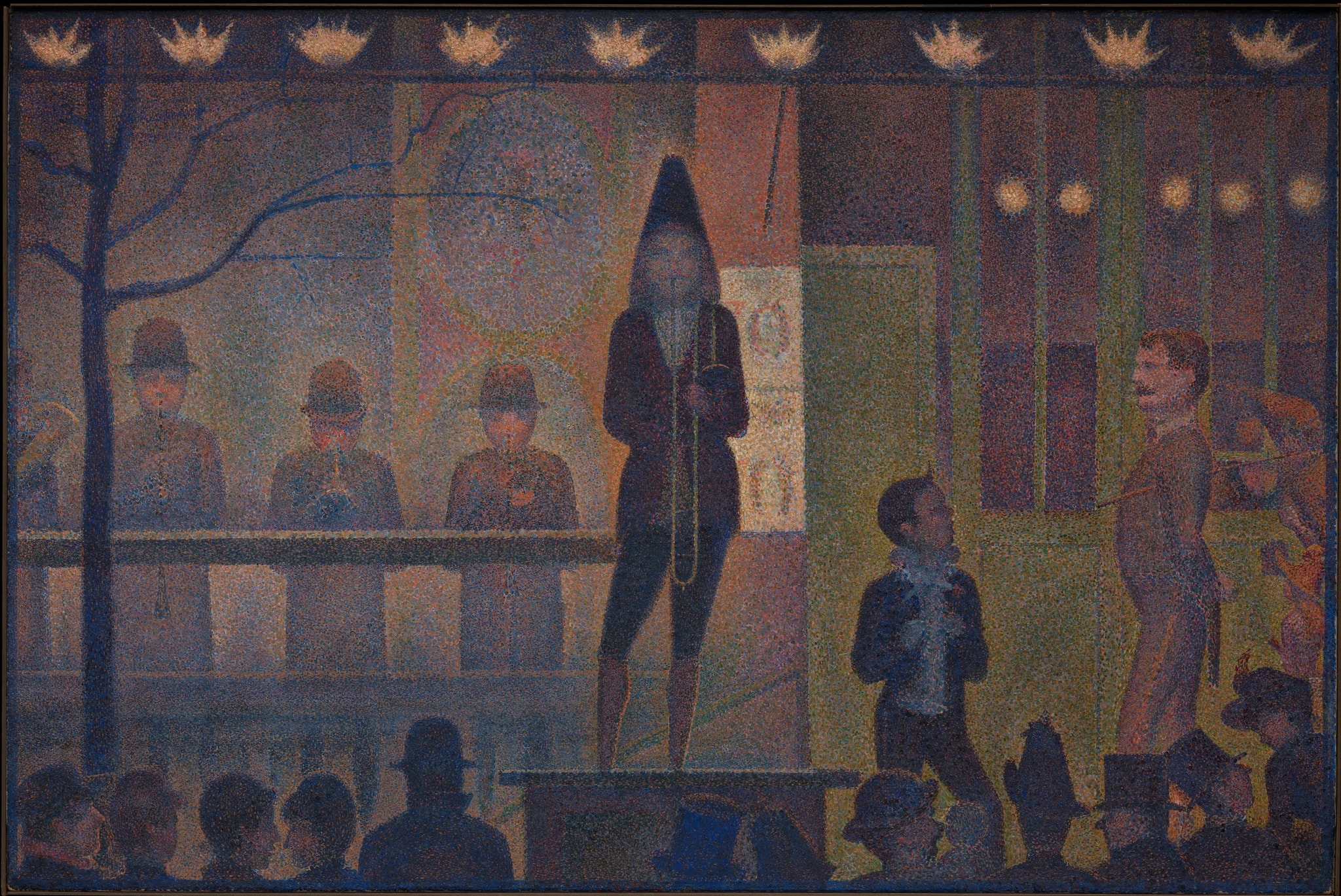
Circus Sideshow (Parade de cirque) by Georges Seurat (1887–88) featuring Row of gaslights, The barker with conical hat and rope, Silhouetted crowd of hats, Railing and stage platform

Click on any numbered symbol to learn more about its meaning

Meaning & Symbolism

Seurat stages the sideshow as a liminal platform where the street meets the promise of the circus. The audience is pushed to the painting’s base as dark silhouettes—hats repeating like an ostinato—never quite admitted to the stage, so we witness them witnessing. A row of nine gas jets crowns the scene, their milky flares acting as a visual metronome that both beckons and regulates. Below, the band forms a rigid frieze, toy‑soldier regular, while the central barker—tall, conical hat, and a rope that descends like a plumb line—anchors the composition’s vertical beat. A bare tree at left and the straight railing bars the foreground, reinforcing the sense that access is choreographed, not free. The color—blue‑violet shadows pricked with orange and green—vibrates like sound without releasing into anecdote; optical mixture produces pulse instead of movement, a hum instead of noise 124. This transformation of a commercial come‑on into a solemn rite is the core of Seurat’s claim. The parade was a free teaser to sell tickets to the main tent at the Gingerbread Fair; Seurat strips away animal tricks and clowning to expose the machinery—advertising, queuing, illumination—of modern amusement. The right side hints at the queue and the box‑office threshold; figures in profile are frozen as if indexed, not individualized. Expression is evacuated: faces register as masklike planes; the barker’s authority is diagrammed by his stance and by the strict scaffolding of verticals and stripes behind him. Gaslight, a hallmark of modern Paris, becomes the painting’s theology—its “halo” band sanctifies not saints but procedure, rendering spectacle as a measured public rite. In formal terms, Seurat fuses Ogden Rood’s color theory with Charles Blanc’s grammar of symmetry: discrete touches calibrate the night effect while the composition’s architecture enforces balance. The result is an image where entertainment is pattern, desire is queue, and sound is optical vibration—a cool anatomy of mass culture. That is why this canvas stands as a modern icon: it inaugurates Seurat’s nocturnal mode, recasts popular entertainment as a subject for high art, and models a rigor—chromatic, structural, and conceptual—that shaped the trajectory from Neo‑Impressionism toward later abstractions 1235.

Explore Deeper with AI

Ask questions about Circus Sideshow (Parade de cirque)

Popular questions:

Powered by AI • Get instant insights about this artwork

💬 Ask questions about this artwork!

Interpretations

Formal Analysis: Optical Acoustics

Seurat translates sound into sight. The band’s rigid frieze and the nine gas jets operate like a visual metronome, while divisionist touches generate an optical hum that stands in for music’s vibration. Rather than depicting motion, he calibrates a nocturne where “optical mixture produces pulse instead of movement,” leveraging Ogden Rood’s chromatic theory to orchestrate night effects without blur. Vertical scaffolds—the tree, posts, and barker—mark the beat; horizontals tamp down anecdote to preserve meter. The result is a synesthetic grammar: timbre becomes blue‑violet ground, accents flare in orange‑green counterpoint, and silence is rendered by dark, unlit silhouettes at the base. It is a score you read with your eyes, not your ears 25.

Source: Metropolitan Museum of Art (Thomson catalogue; Perspectives on Rood/Blanc)

Historical Context: Fairground Logistics as Image

This is a portrait of an infrastructure: lighting pipes, box‑office queue, poster tariffs, and regimented musicians form the real machinery of the Gingerbread Fair’s Circus Corvi parade. Period evidence—press notices, images, and price posters—anchors the specificity of the site near place de la Nation, while Met research plausibly identifies the ringmaster Ferdinand Corvi in profile at right. Seurat’s purge of ponies and monkey acts from his studies to the final canvas underscores a shift from show to system—from attraction to admission. The painting thus memorializes the free “pitch” whose purpose was to convert onlookers into paying spectators, a transformation that the right‑edge queue literalizes as threshold and tariff 14.

Source: The Met Perspectives (Laura D. Corey) and The Met object record

Symbolic Reading: Secular Liturgy under Gaslight

The sideshow is recast as a rite. The crown of nine gas jets forms a secular halo, elevating procedure over personality and sanctifying not saints but protocol—advertising, alignment, admission. Figures are hieratic and masklike; the barker’s authority is diagrammed by verticals and stripes, akin to a celebrant before an altar of standardized light. By stripping away comic business, Seurat engineers a solemn mood in which entertainment becomes a measured public ceremony of modernity. The painting’s theology is technological: gaslight confers aura, timing replaces pathos, and spectators are penitents in a queue. It is a liturgy of access, not salvation 23.

Source: The Met exhibition Seurat’s Circus Sideshow (2017)

Power & Politics: Social Choreography and the Managed Crowd

The picture anatomizes soft power. Railings, stage edge, and profile indexing sort bodies into roles—performer, barker, queued buyer, silhouette—what scholars call social choreography. The low, compressed foreground denies the audience pictorial agency; hats repeat like an ostinato, signifying fungibility. Illumination itself disciplines: those inside the gaslight’s band acquire legibility and rank, while others recede into darkness. The parade’s free pitch is thus a training ground for regulated attention, a preview that governs desire and movement before money changes hands. Seurat’s cool order makes this governance visible without satire, turning a commercial tease into a study of modern authority 123.

Source: The Met (object record; Thomson catalogue; exhibition texts)

Art & Representation: Between Poster, Stage, and Abstraction

Parade de cirque sits at a crossroads of mimesis and design. Its planar bands and crisp silhouettes borrow from poster culture even as divisionism secures a complex nocturne; the result helped reposition popular entertainment as a subject for high art. Barr and later historians saw in its geometric severity a pivot toward the abstract, while the Met’s scholarship locates this rigor in Seurat’s synthesis of Blanc’s compositional grammar with Rood’s optics. The piece thus models a modern pictorial economy: reduce anecdote, intensify structure, and let color carry sensation. From this hinge point, one can trace lines forward to Fauvism’s chroma and Cubism’s armature 267.

Source: The Met (Thomson 2017), Heilbrunn Timeline (Amory), Met 1991 Seurat retrospective
Related Themes

About Georges Seurat

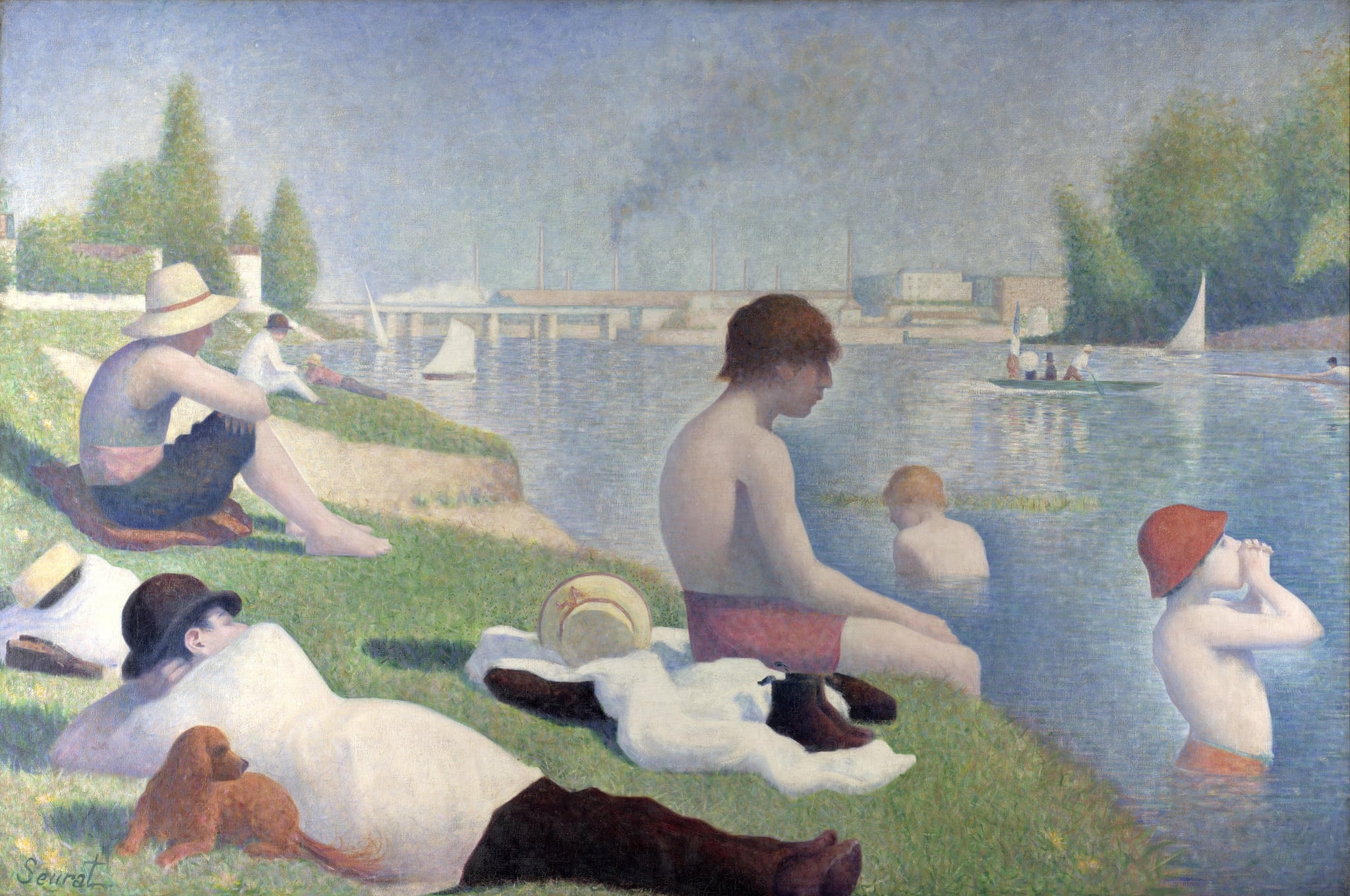
Georges Seurat (1859–1891) trained at the École des Beaux‑Arts, immersed himself in color theory, and pursued a synthesis of disciplined composition with optical effects. Bathers at Asnières is his first grand statement, rejected by the Salon in 1884 and then shown at the new Salon des Indépendants; within two years he developed full divisionism in La Grande Jatte [1][3].
View all works by Georges Seurat

More by Georges Seurat