Poplars on the Epte

by Claude Monet

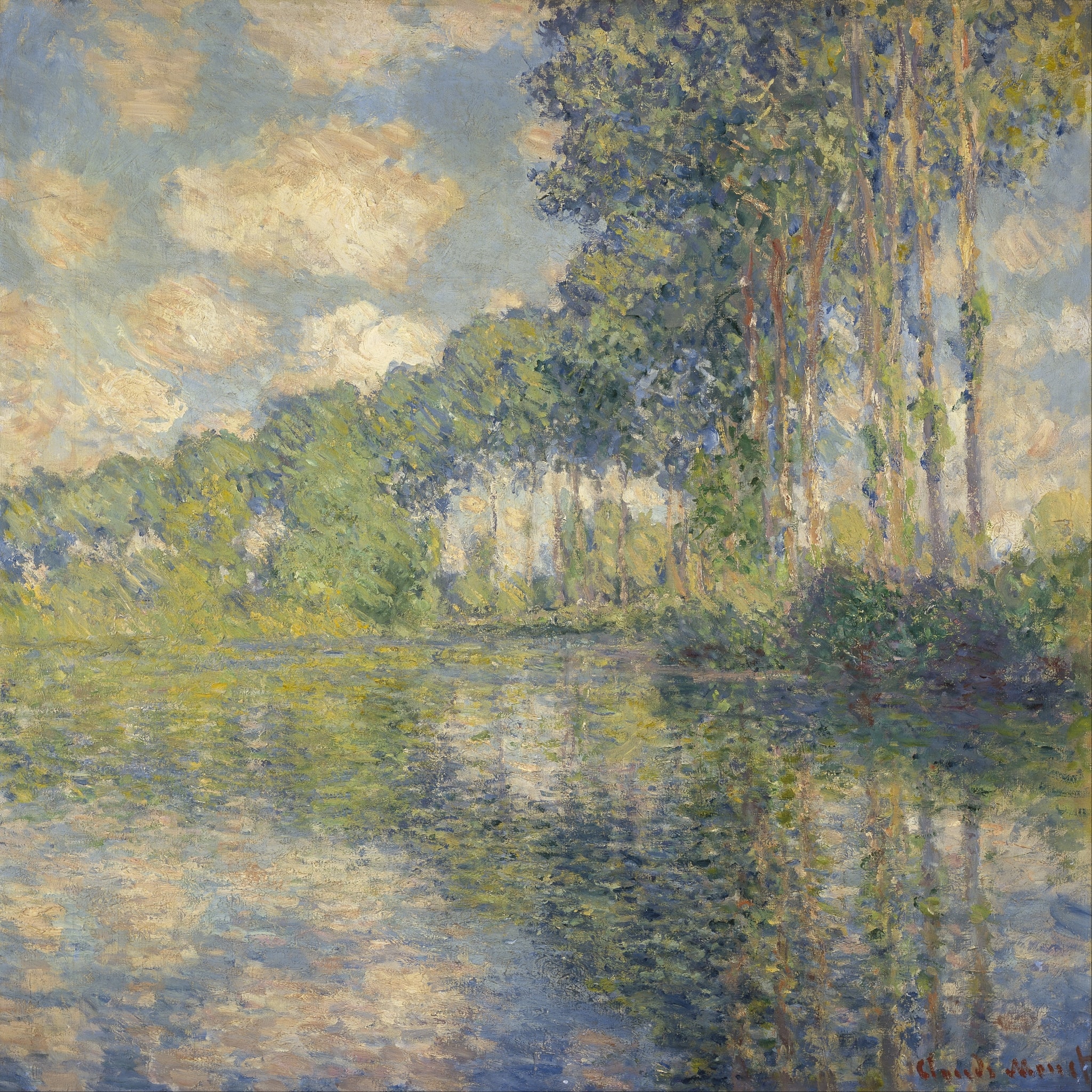
Claude Monet’s Poplars on the Epte turns a modest river bend into a meditation on time, light, and perception. Upright trunks register as steady vertical chords, while their broken, shimmering reflections loosen form into pure sensation. The image stages a tension between order and flux that anchors the series within Impressionism’s core aims [1][2].

Fast Facts

Year
1891
Medium
Oil on canvas
Dimensions
92.4 × 73.7 cm
Location
National Gallery, London (on loan from Tate)
Poplars on the Epte by Claude Monet (1891) featuring Poplar trunks (vertical columns), River reflections, Slanted shoreline / river bend, Sunlit sky and cloud gaps

Click on any numbered symbol to learn more about its meaning

Meaning & Symbolism

Monet organizes the scene around two competing structures. To the right, a column of tall poplars climbs past the picture’s upper edge, their trunks pruned into even intervals that read as human-shaped rhythm and rural order. To the left, a pale sky mottled with warm clouds breathes through the canopy, and below, the Epte’s surface multiplies everything into ripples and luminous shards. The trunk‑line stands like measured bars of a musical score; the water answers with syncopated strokes of blue, green, violet, and pale gold. From a low vantage—consistent with Monet’s use of a flat‑bottomed boat in this series—the trees cut the sky and assert their decorative linearity, while the river’s doubles slacken them into sensation 12. The slanted shoreline draws the eye along a quiet bend, but the painting refuses single-point closure; attention oscillates between upright regularity and liquid scatter, between permanence and change. This dialectic encodes larger meanings. As critics note, the poplar carried a long French association with the people (populus) and the Revolutionary Tree of Liberty; by the 1890s the motif could signify the resilience of rural France after upheaval 3. Here, the trees act as sentinels—rooted, communal, and rhythmically arrayed—yet their identities are continually revised by wind and light. Monet’s serial practice intensifies this: Poplars on the Epte belongs to a group painted along the river near Giverny during 1891, sometimes from the bank, sometimes from the boat, and even sustained through a moment when the trees were slated for auction and felling; Monet arranged to keep them standing until he finished 1. The work thus asserts continuity not as stasis but as an achieved condition—something maintained, negotiated, and seen anew in each passing effect. In this canvas, notice how the sun flashes between trunks in narrow, vertical glades and then dissolves into horizontal bands upon the water; the image effectively crosshatches time: vertical continuity meets horizontal ephemerality 2. The painting also marks a decisive step toward Monet’s later decorative ambition. The repeating poplars and their mirrored counterparts approximate a loose grid of columns and bands—a near‑abstract scaffolding that anticipates the allover surfaces of his Nymphéas. Cropping at the top edge and the insistence on serial variation align with Japoniste strategies Monet admired, giving the landscape a print‑like cadence and modern, photographic immediacy 23. At the same time, the surface is anything but schematic: the rough, scumbled impasto registers micro‑shifts of weather, confirming the Impressionist wager that meaning can be built from moments. The National Gallery’s canvas bears an 1890 inscription but was in fact painted in 1891—an archival quirk that underscores Monet’s concern with unfolding time rather than calendar exactitude 16. Exhibited with companion views in 1892, the Poplars declared that landscape could be both empirical and conceptual: an ordered motif opened up by phenomenology, a national emblem reimagined as a field of changing light 125. In that sense, the meaning of Poplars on the Epte is the modern condition itself—continuity held together by perception—and why Poplars on the Epte is important is that it fuses motif, method, and display into a single, influential grammar for twentieth‑century painting 25.

Explore Deeper with AI

Ask questions about Poplars on the Epte

Popular questions:

Powered by AI • Get instant insights about this artwork

💬 Ask questions about this artwork!

Interpretations

Historical-Political Symbolism

Read as a post-Revolutionary allegory, the poplars function as vernacular “Trees of Liberty,” a species long linked to the people (populus) and civic planting rituals in 19th‑century France. In this register, Monet’s orderly verticals act as collective sentinels, asserting continuity of the rural nation even as wind and light revise their identities. Rather than overt propaganda, the canvas practices a politics of form: regular spacing (order) meets flicker and reflection (change), modeling a Third Republic stability that absorbs contingency. By relocating patriotic symbolism from monument to riverside rhythm, Monet modernizes national iconography and aligns it with perception itself 31.

Source: Fitzwilliam Museum; National Gallery, London

Serial Display and Market Strategy

Poplars was conceived to be seen serially, not singly. Monet blocked motifs en plein air and then coordinated color relationships in the studio so canvases would harmonize when shown together—an approach that culminated in Durand‑Ruel’s 1892 exhibition of fifteen Poplars. This serial hanging turns motif into method: verticals/reflections become a variable set tested across hours and seasons, inviting comparative viewing as the core experience. The strategy is also economic and curatorial, crafting a branded suite whose unity amplifies value and meaning. In Poplars, the picture is thus a module in a designed environment, a component of a larger, time‑based work of art: the series itself 24.

Source: The Metropolitan Museum of Art; John House/Richard Thomson (via Christie's)

Japonisme and Cropped Modernity

Monet’s “print‑like cadence” draws on Hiroshige and Japoniste composition: repeating verticals, emphatic silhouettes, and edges that crop trunks as they “go off the top.” Such framing denies central hierarchy and distributes attention across an allover field, yielding a rhythm closer to woodblock pattern than to classical perspective. The effect reads as both decorative and modern—akin to photography’s cut and serial iteration—yet remains grounded in observed light. Here, Japonisme is not quotation but structural: it organizes the motif into columns and bands that stabilize rapid optical events, preparing the logic of the later Nymphéas while keeping the empirical tether of a specific riverside place 32.

Source: Fitzwilliam Museum; The Metropolitan Museum of Art

Artistic Engineering and the Work of Painting

Behind the shimmer lies logistics. Monet painted from a flat‑bottomed boat outfitted to hold multiple canvases, cycling among them as weather shifted; he also negotiated with a lumber merchant to delay the grove’s felling so he could finish. These acts—tool‑building, scheduling, contracting—are part of the artwork’s ontology, embedding labor and project management in the image’s serenity. The low vantage forces trunks to “cut” the sky, translating a technical setup into a formal signature. Poplars thus documents not just an effect of light but a choreography of means, where process and place are inseparable from the picture’s aesthetic outcome 1254.

Source: National Gallery, London; The Metropolitan Museum of Art; National Galleries of Scotland; John House (via Christie's)

Toward Decorative Abstraction

The painting organizes nature into a grid of columns and bands—upright trunks and their watery doubles—so that pattern rivals depiction. This is a decisive pivot toward Monet’s late decorative ambition: an “allover” surface where motif is armature for optical vibration. Thick, scumbled impasto operates as a time‑index, recording micro‑shifts in air and light while flattening depth into chromatic weave. Poplars thereby tests the boundary between landscape and abstract surface, a grammar Monet will enlarge in the Water‑Lilies. Crucially, this push arises from observational discipline rather than retreat from it, fusing empirical seeing with ornamental order 21.

Source: The Metropolitan Museum of Art; National Gallery, London

Environmental History: Managed Nature

This is not pristine nature but a managed plantation: trunks pruned in even intervals, a grove put to auction, a riverbank shaped by human use. Monet’s intervention—keeping the trees standing—briefly suspends the timber economy, converting a threatened resource into a field of changing light. The painting registers a late‑19th‑century ecology where extraction, leisure, and vision intersect; its harmonies are negotiated rather than given. By aestheticizing a working landscape, Monet exposes the paradox of Impressionism’s idyll: beauty premised on labor, property, and control, even as the image celebrates flux and renewal 15.

Source: National Gallery, London; National Galleries of Scotland

Related Themes

About Claude Monet

Claude Monet (1840–1926) led Impressionism’s pursuit of open-air painting and optical immediacy, especially during his Argenteuil years focused on modern leisure and light. He later developed serial studies of changing conditions, culminating in the Water Lilies cycle [2].
View all works by Claude Monet

More by Claude Monet

Haystacks Series by Claude Monet | Light, Time & Atmosphere by Claude Monet

Haystacks Series by Claude Monet | Light, Time & Atmosphere

Claude Monet

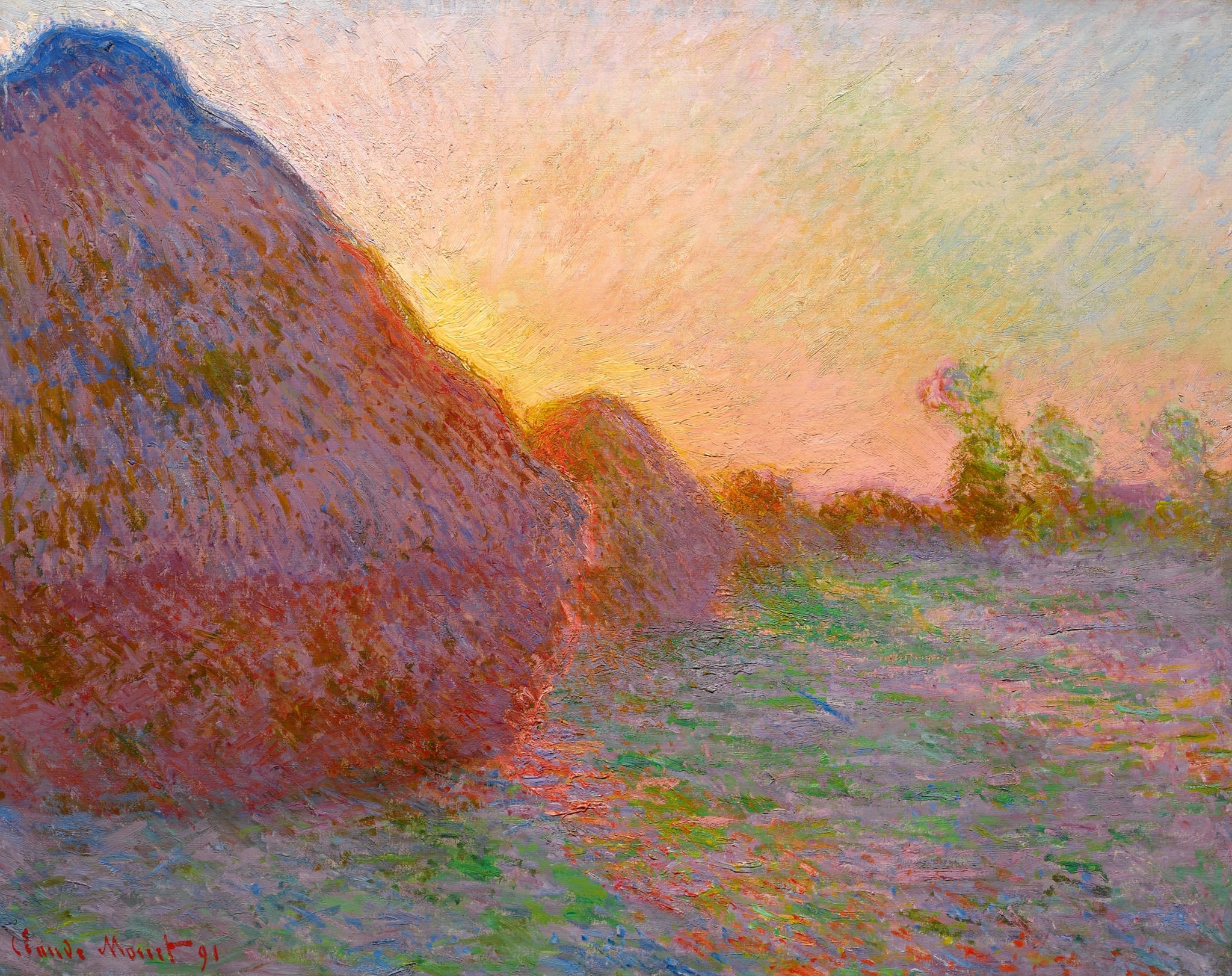
Claude Monet’s <strong>Haystacks Series</strong> transforms a routine rural subject into an inquiry into <strong>light, time, and perception</strong>. In this sunset view, the stacks swell at the left while the sun burns through the gap, making the field shimmer with <strong>apricot, lilac, and blue</strong> vibrations.
The Artist's Garden at Giverny by Claude Monet

The Artist's Garden at Giverny

Claude Monet (1900)

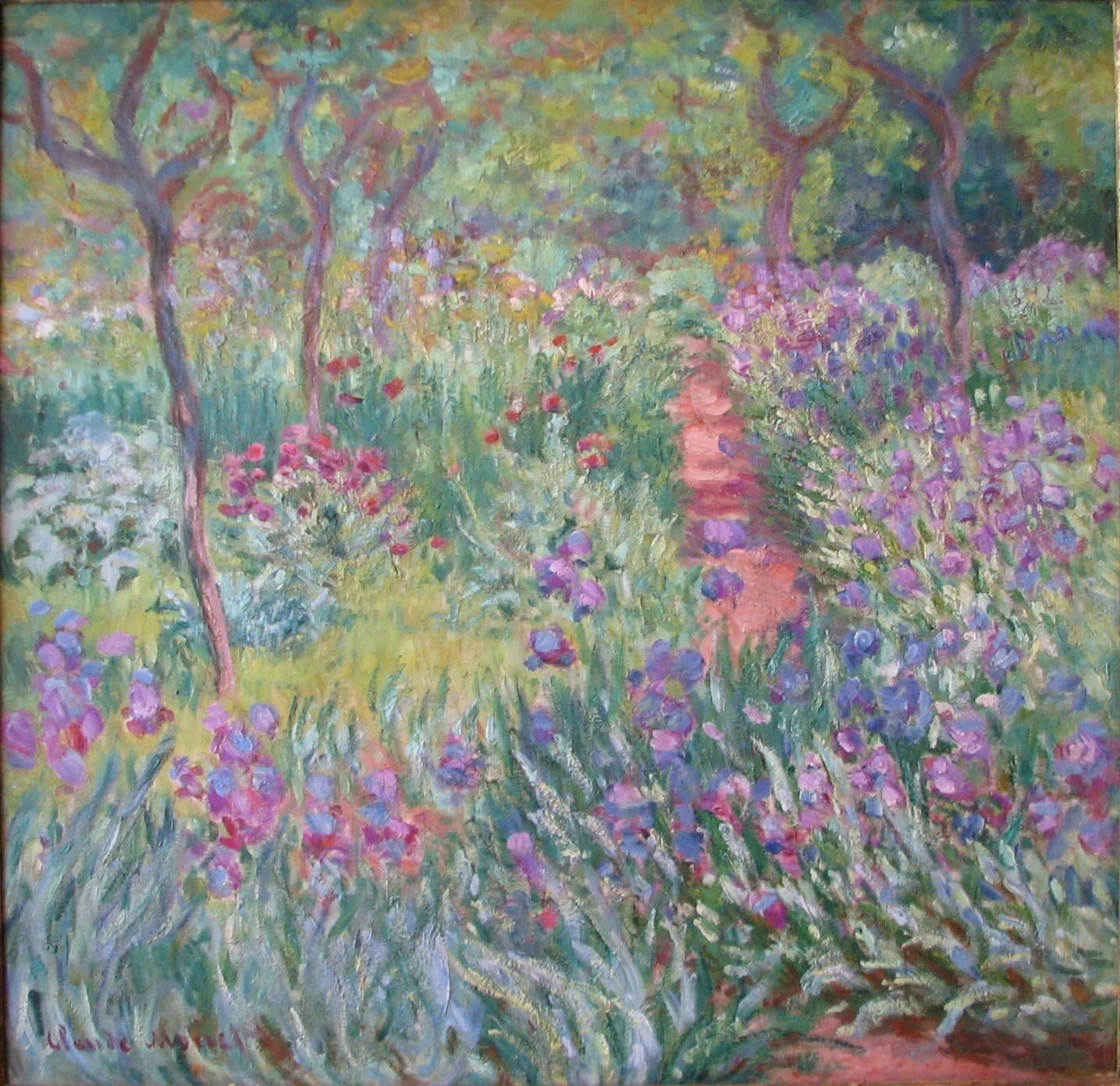
In The Artist's Garden at Giverny, Claude Monet turns his cultivated Clos Normand into a field of living color, where bands of violet <strong>irises</strong> surge toward a narrow, rose‑colored path. Broken, flickering strokes let greens, purples, and pinks mix optically so that light seems to tremble across the scene, while lilac‑toned tree trunks rhythmically guide the gaze inward <sup>[1]</sup><sup>[3]</sup>.
The Water Lily Pond by Claude Monet

The Water Lily Pond

Claude Monet (1899)

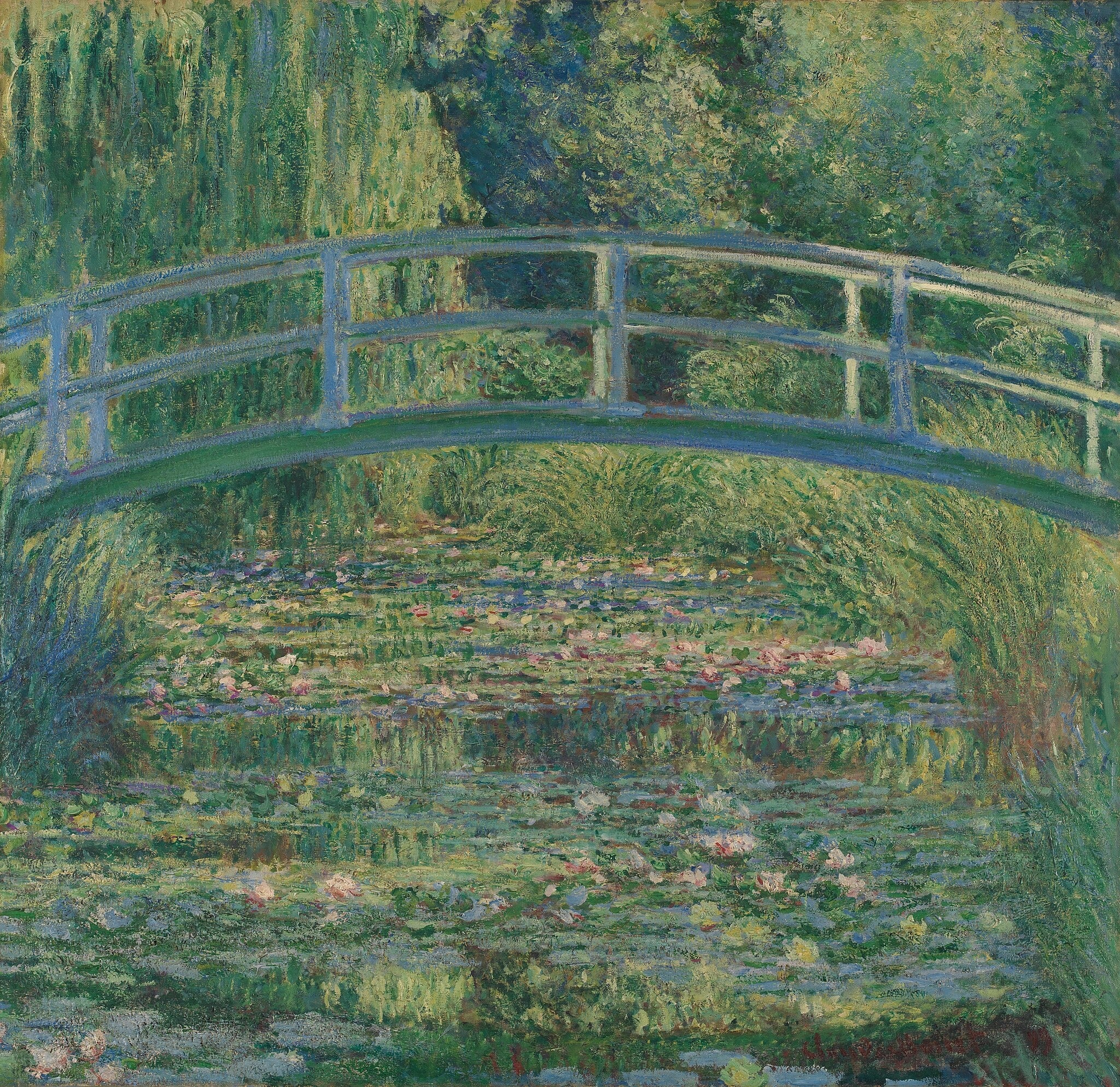
Claude Monet’s The Water Lily Pond transforms a designed garden into a theater of <strong>perception and reflection</strong>. The pale, arched <strong>Japanese bridge</strong> hovers over a surface where lilies, reeds, and mirrored willow fronds dissolve boundaries between water and sky, proposing <strong>seeing itself</strong> as the subject <sup>[1]</sup><sup>[3]</sup>.

Waterloo Bridge, Sunlight Effect by Claude Monet

Waterloo Bridge, Sunlight Effect

Claude Monet (1903 (begun 1900))

Claude Monet’s Waterloo Bridge, Sunlight Effect renders London as a <strong>lilac-blue atmosphere</strong> where form yields to light. The bridge’s stone arches persist as anchors, yet the span dissolves into mist while <strong>flecks of lemon and ember</strong> signal modern traffic crossing a city made weightless <sup>[1]</sup><sup>[2]</sup>. Vertical hints of chimneys haunt the distance, binding industry to beauty as the Thames shimmers with the same notes as the sky <sup>[1]</sup><sup>[3]</sup>.

Morning on the Seine (series) by Claude Monet

Morning on the Seine (series)

Claude Monet (1897)

Claude Monet’s Morning on the Seine (series) turns dawn into an inquiry about <strong>perception</strong> and <strong>time</strong>. In this canvas, the left bank’s shadowed foliage dissolves into lavender mist while a pale radiance opens at right, fusing sky and water into a single, reflective field <sup>[1]</sup><sup>[2]</sup>.

Woman with a Parasol by Claude Monet

Woman with a Parasol

Claude Monet (1875)

Claude Monet’s Woman with a Parasol fixes a breezy hillside instant in high, shifting light, setting a figure beneath a <strong>green parasol</strong> against a vast, vibrating sky. The low vantage and <strong>broken brushwork</strong> merge dress, clouds, and grasses into one atmosphere, while a child at the rise anchors depth and intimacy <sup>[1]</sup>. It is a manifesto of <strong>plein-air</strong> perception—painting the sensation of air in motion rather than the contours of things <sup>[2]</sup>.