The pastoral ideal
Featured Artworks
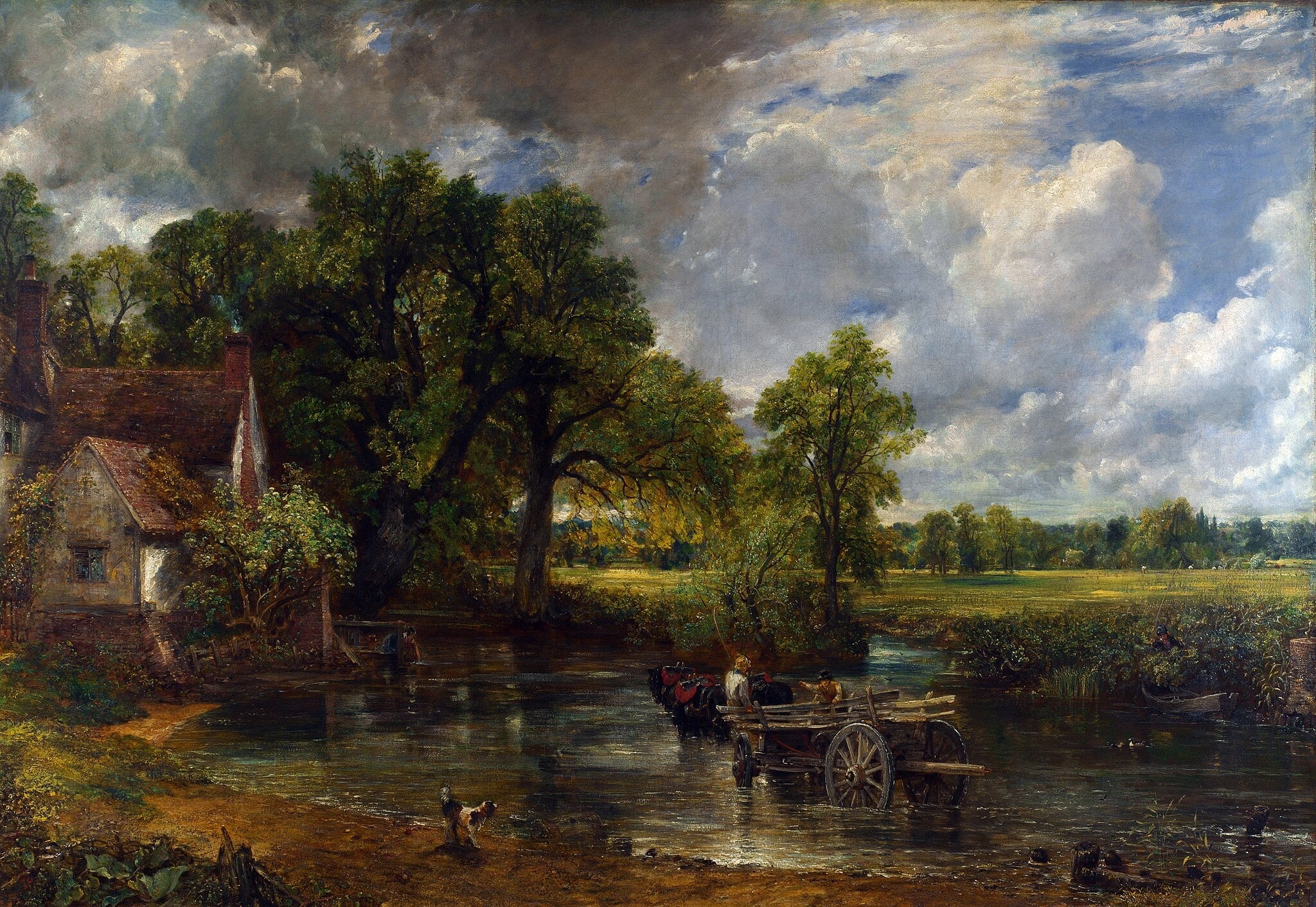
The Hay Wain
John Constable (1821)
Set beside Willy Lott’s cottage on the River Stour, The Hay Wain stages a moment of <strong>unhurried rural labor</strong>: an empty timber cart, drawn by three horses with red-collared tack, pauses mid‑ford as weather shifts above. Constable fuses <strong>empirical observation</strong>—rippling reflections, chimney smoke, flickers of white on leaves—with a composed vista of fields opening to sun. The result is a serene yet alert meditation on <strong>work, weather, and continuity</strong> in the English countryside <sup>[1]</sup><sup>[3]</sup>.
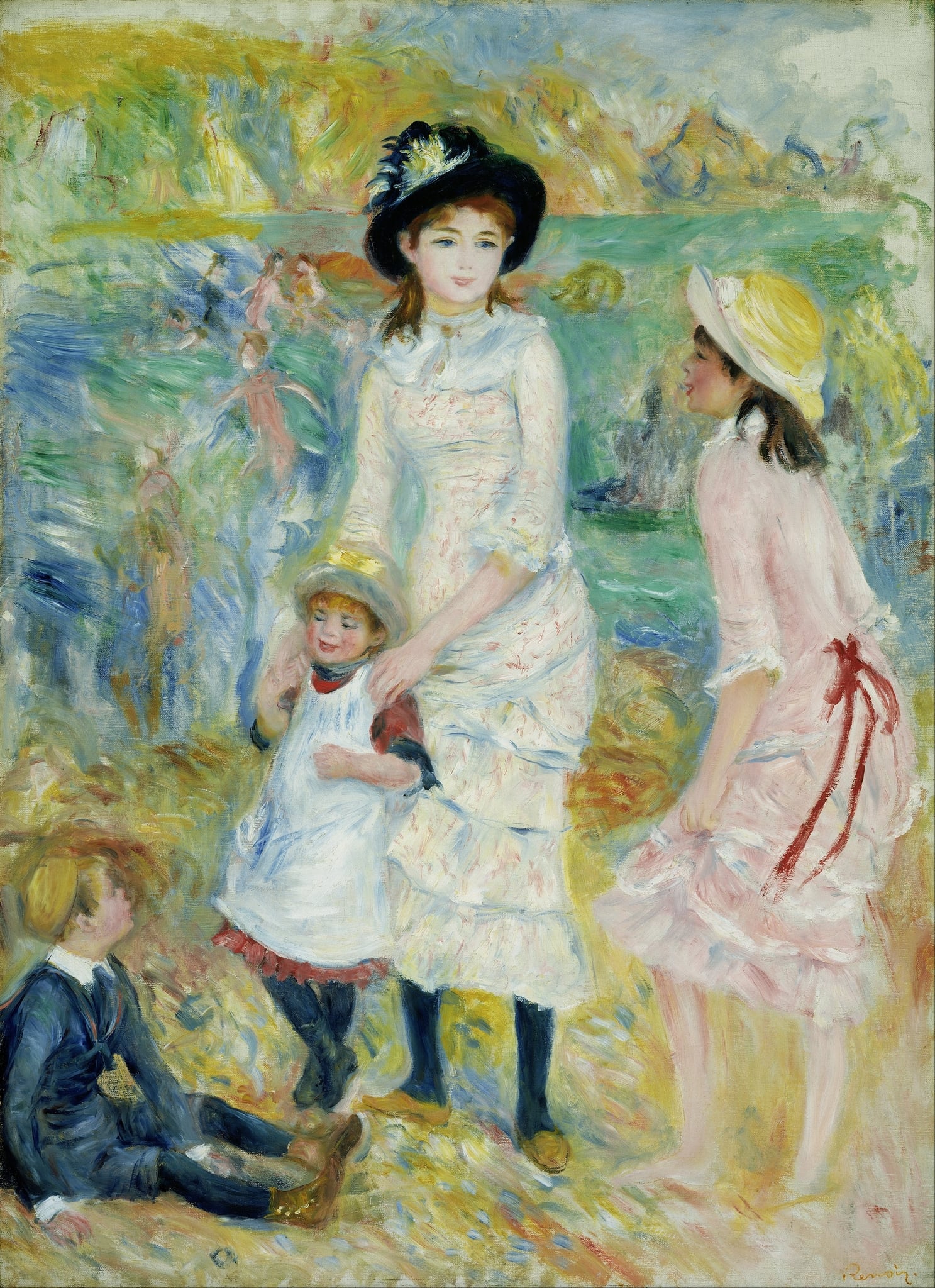
Children on the Seashore, Guernsey
Pierre-Auguste Renoir (about 1883)
Renoir’s Children on the Seashore, Guernsey crystallizes a wind‑bright moment of modern leisure with <strong>flickering brushwork</strong> and a gently choreographed group of children. The central girl in a white dress and black feathered hat steadies a toddler while a pink‑clad companion leans in and a sailor‑suited boy rests on the pebbles—an intimate triangle set against a <strong>shimmering, populated sea</strong>. The canvas makes light and movement the protagonists, dissolving edges into <strong>pearly surf and sun‑washed cliffs</strong>.
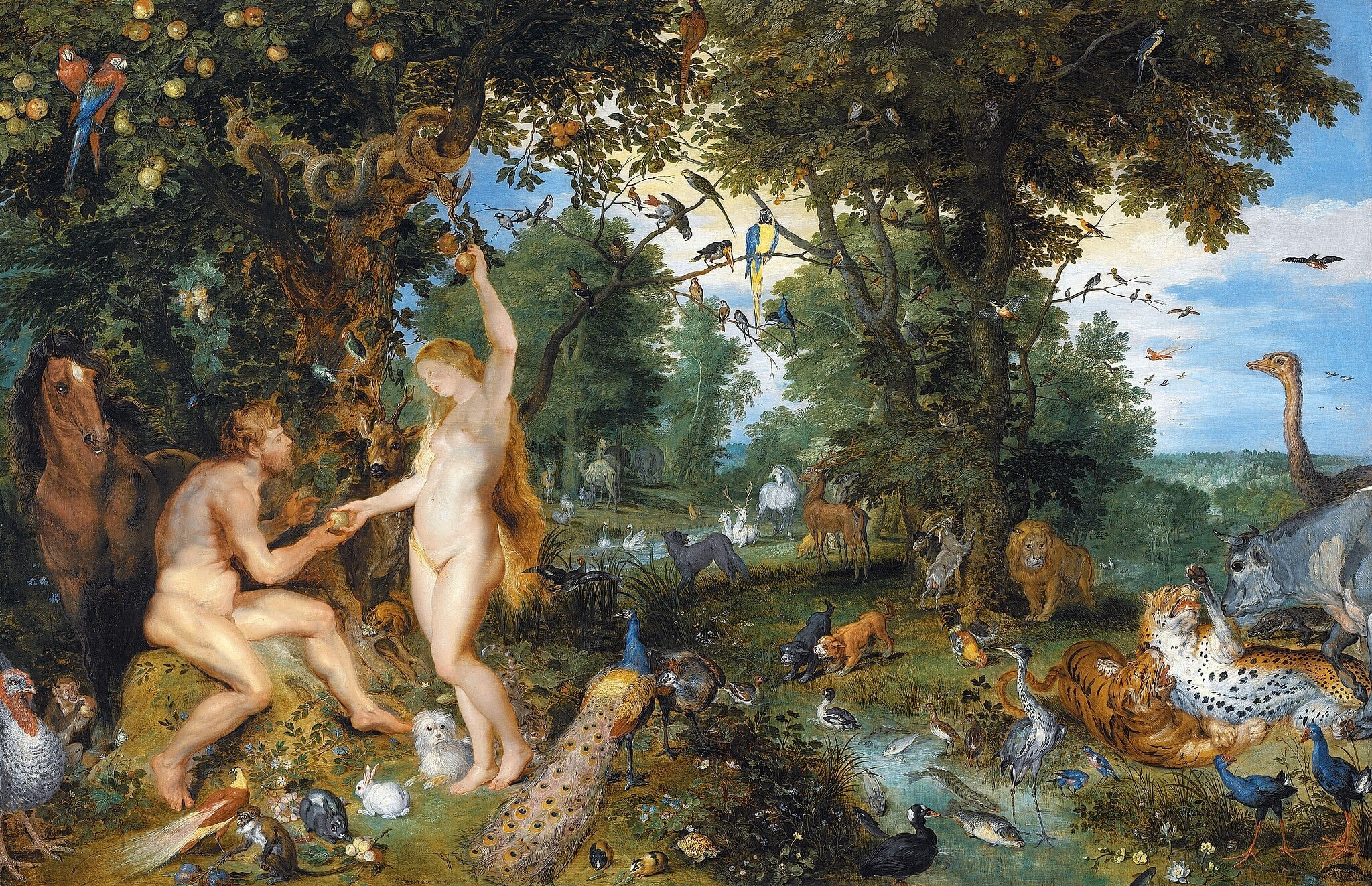
The Garden of Eden with the Fall of Man
Peter Paul Rubens (c. 1615)
<strong>The Garden of Eden with the Fall of Man</strong> stages the instant Eve passes the forbidden fruit to Adam as the serpent coils above and a teeming paradise encircles them. The panel fuses Peter Paul Rubens’s dramatic nudes with Jan Brueghel the Elder’s encyclopedic fauna and flora, turning Eden into a lush theatre of temptation and consequence <sup>[1]</sup>. Light isolates Eve’s raised arm and golden hair while predators stir at the margins, signaling paradise in the act of unraveling.
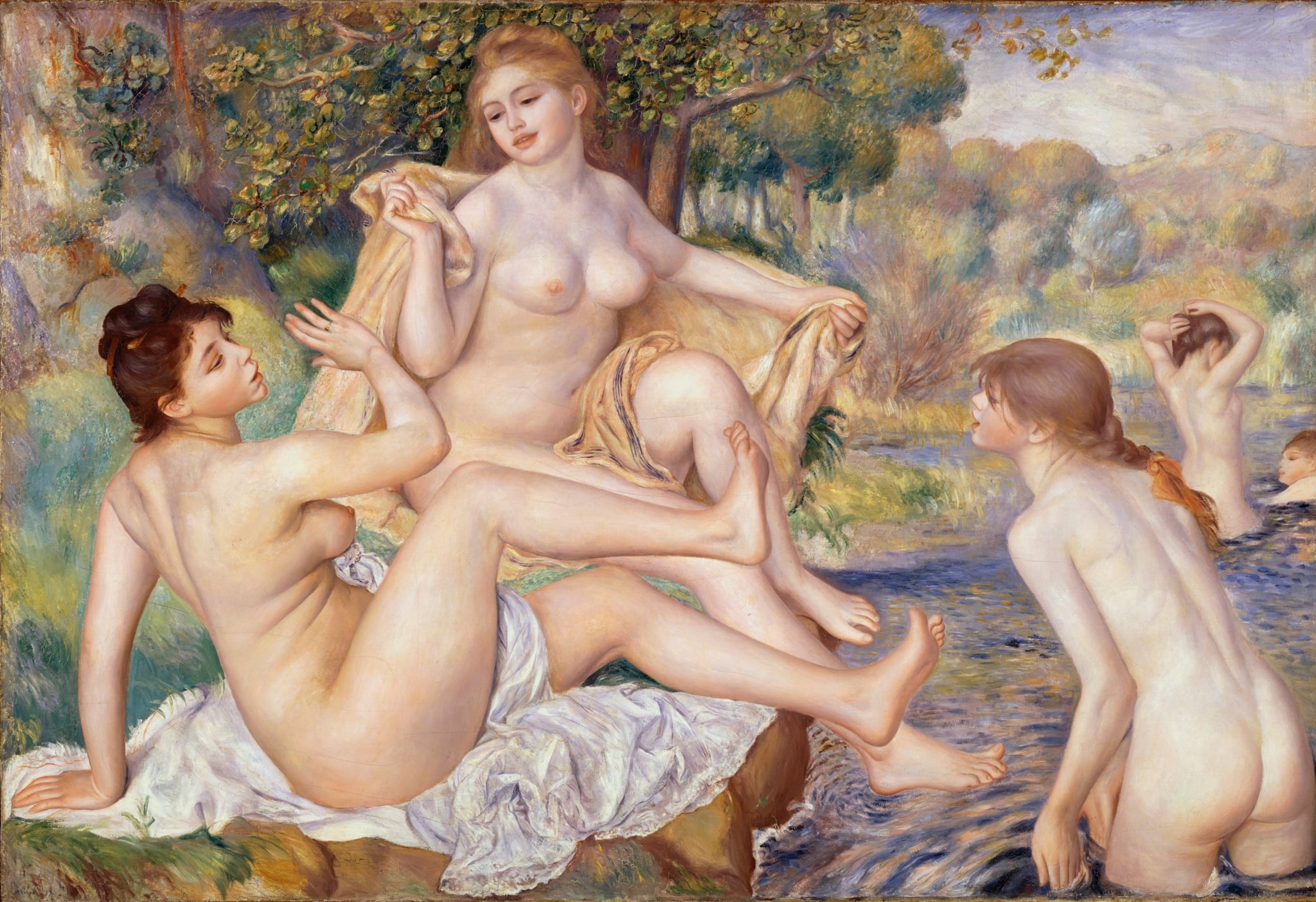
The Large Bathers
Pierre-Auguste Renoir (1884–1887)
Pierre-Auguste Renoir’s The Large Bathers unites modern bodies with a pastoral grove to stage an <strong>Arcadian ideal</strong>. Three monumental nudes form interlocking curves and triangles while two background figures splash and groom, fusing <strong>sensual warmth</strong> with <strong>classical order</strong> <sup>[1]</sup><sup>[2]</sup>.
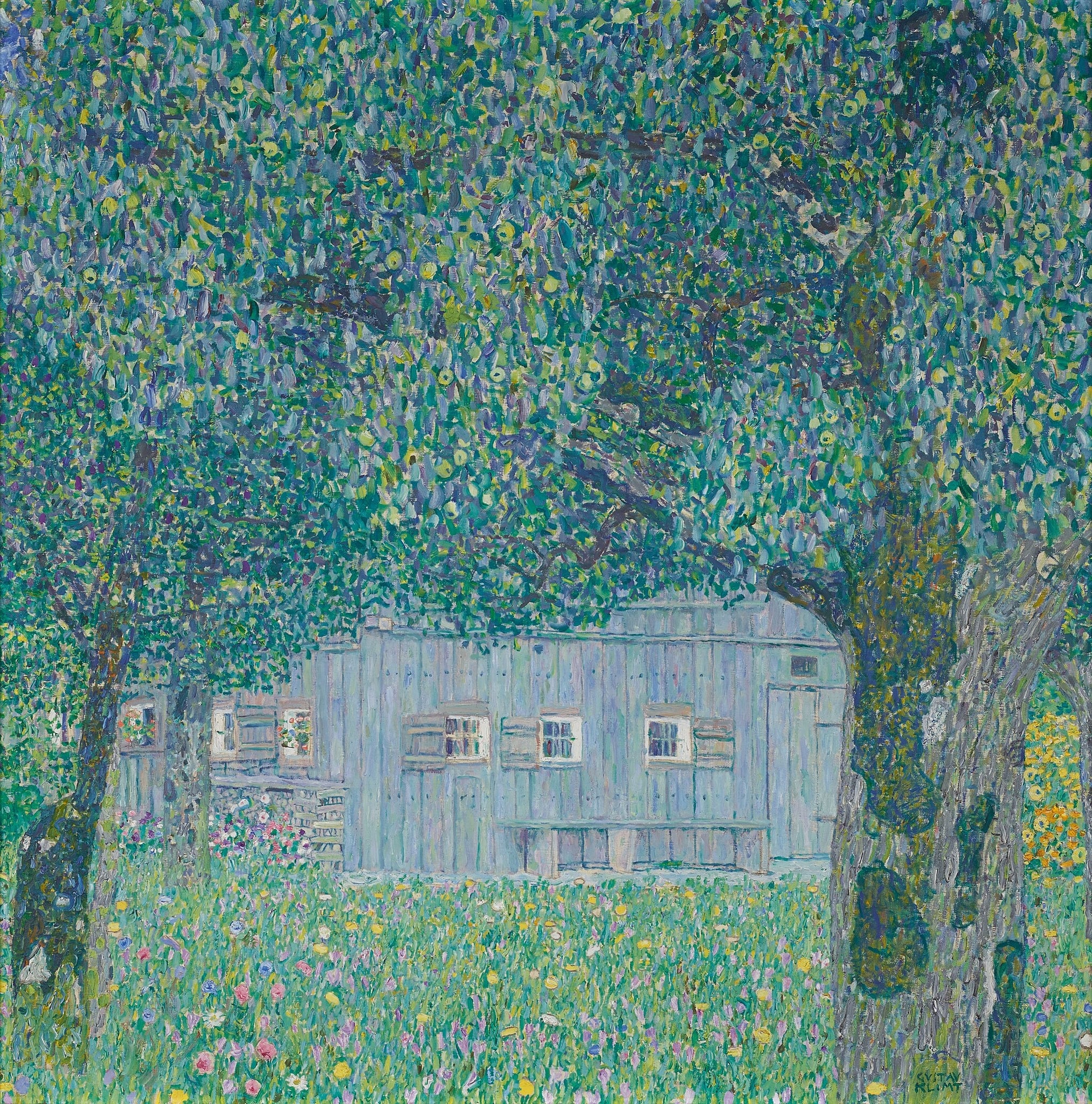
Farmhouse in Buchberg (Upper Austrian Farmhouse)
Gustav Klimt (1911)
Gustav Klimt’s Farmhouse in Buchberg (Upper Austrian Farmhouse) renders a rural dwelling almost absorbed by an orchard, its cool façade held in balance against a vibrating canopy of leaves and a jewel-like meadow. Through a square format and <strong>selective pointillism</strong>, Klimt fuses house, trees, and flowers into a contemplative, patterned field that privileges <strong>stillness</strong> over incident <sup>[1]</sup><sup>[6]</sup>. The work turns everyday architecture into an emblem of <strong>refuge within fecund nature</strong>.
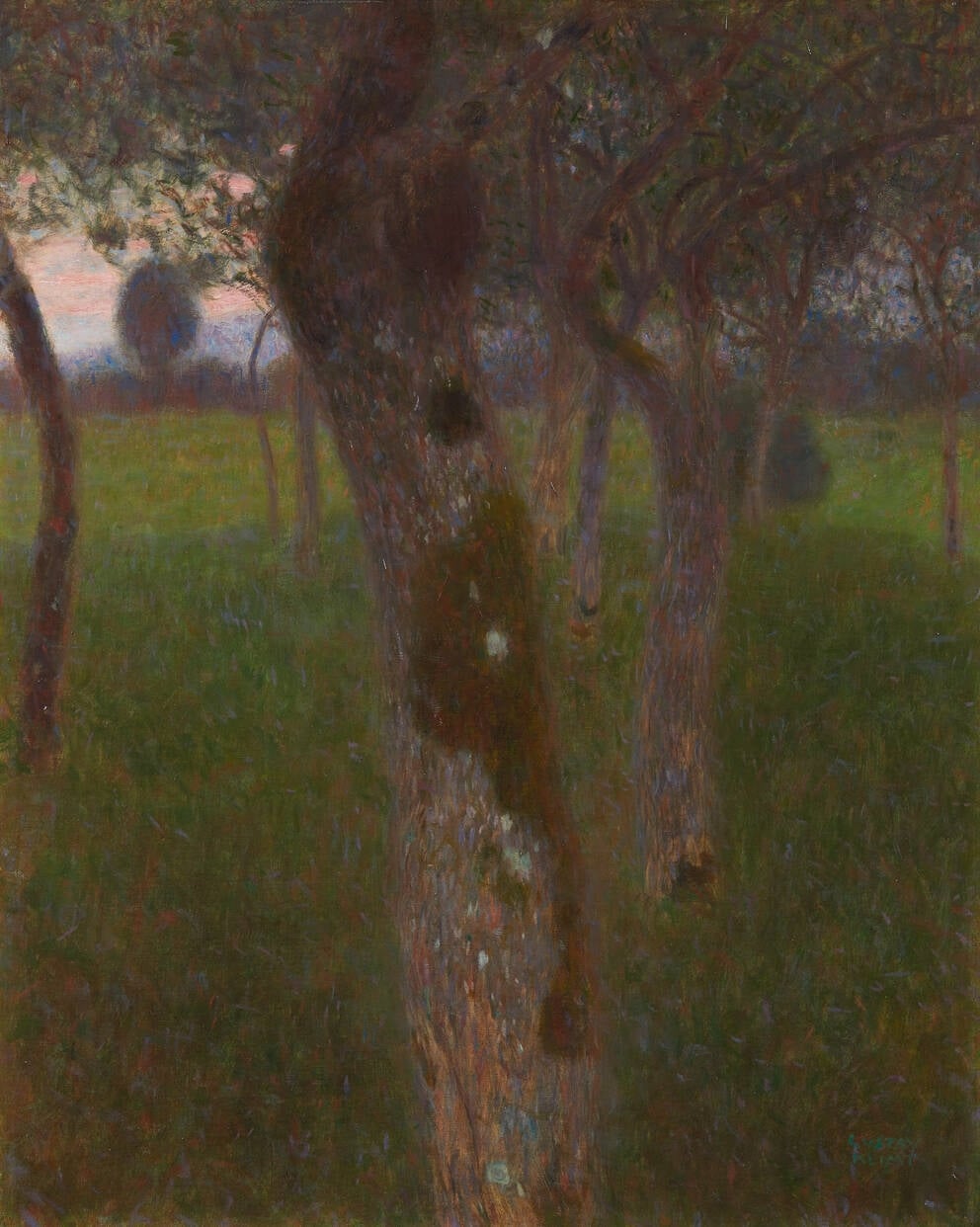
Orchard in the Evening
Gustav Klimt (1898)
Gustav Klimt’s Orchard in the Evening compresses a grove of fruit trees into a shallow, <strong>planar</strong> field where trunks press forward and dusk thins the color. A pale <strong>twilight</strong> band at the high horizon seals the space, turning observed nature into a contemplative, <strong>ornamental</strong> enclosure <sup>[1]</sup><sup>[2]</sup>.
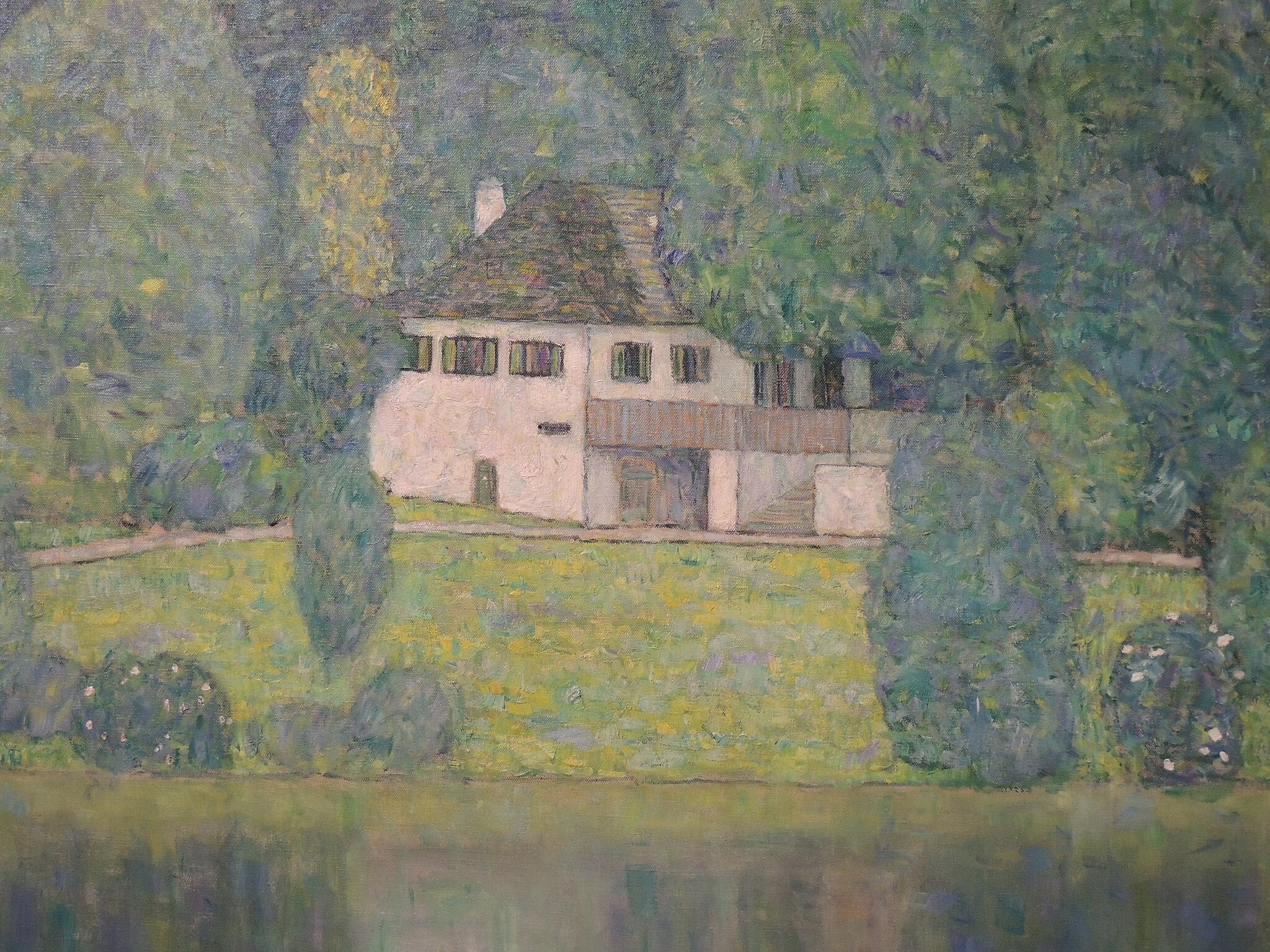
Litzlbergkeller
Gustav Klimt (1915–1916)
Litzlbergkeller distills a lakeside inn into a square, shimmering field where the house’s pale rectangle and window rhythm quietly answer the vertical screen of trees and the calm band of water below. Klimt fuses geometry and foliage into a <strong>decorative, contemplative refuge</strong>, converting observation into patterned memory <sup>[1]</sup><sup>[2]</sup>.
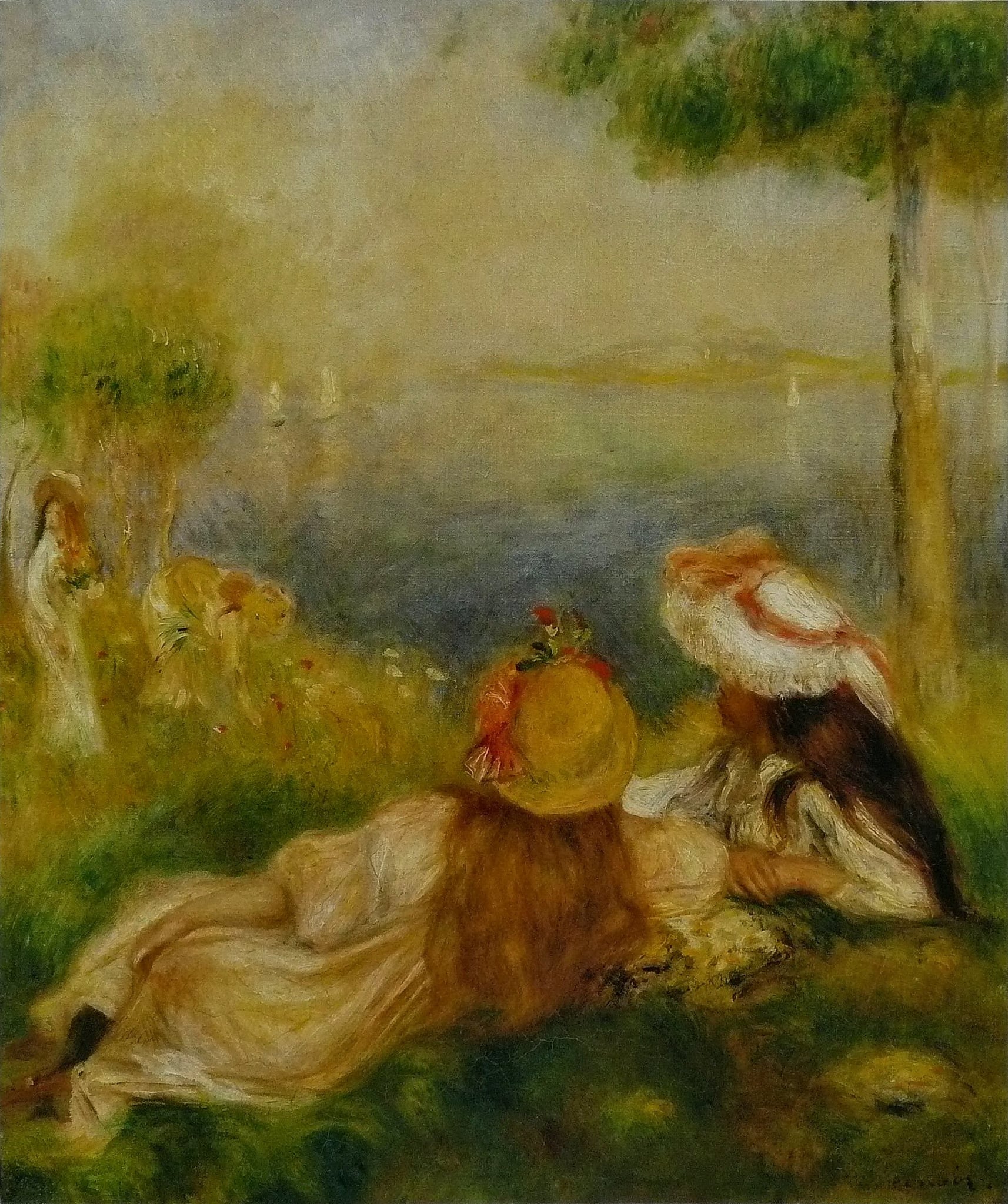
Girls at the Seashore
Pierre-Auguste Renoir (c.1890–1894)
Girls at the Seashore presents two young figures reclining on a grassy bank, their straw hats trimmed with flowers as they look toward a hazy waterway flecked with small sails. Renoir fuses figure and setting through soft, vaporous brushwork so that skin, fabric, foliage, and sea share the same light. The image is an ode to <strong>reverie</strong>, <strong>companionship</strong>, and the <strong>fleeting</strong> warmth of summer.
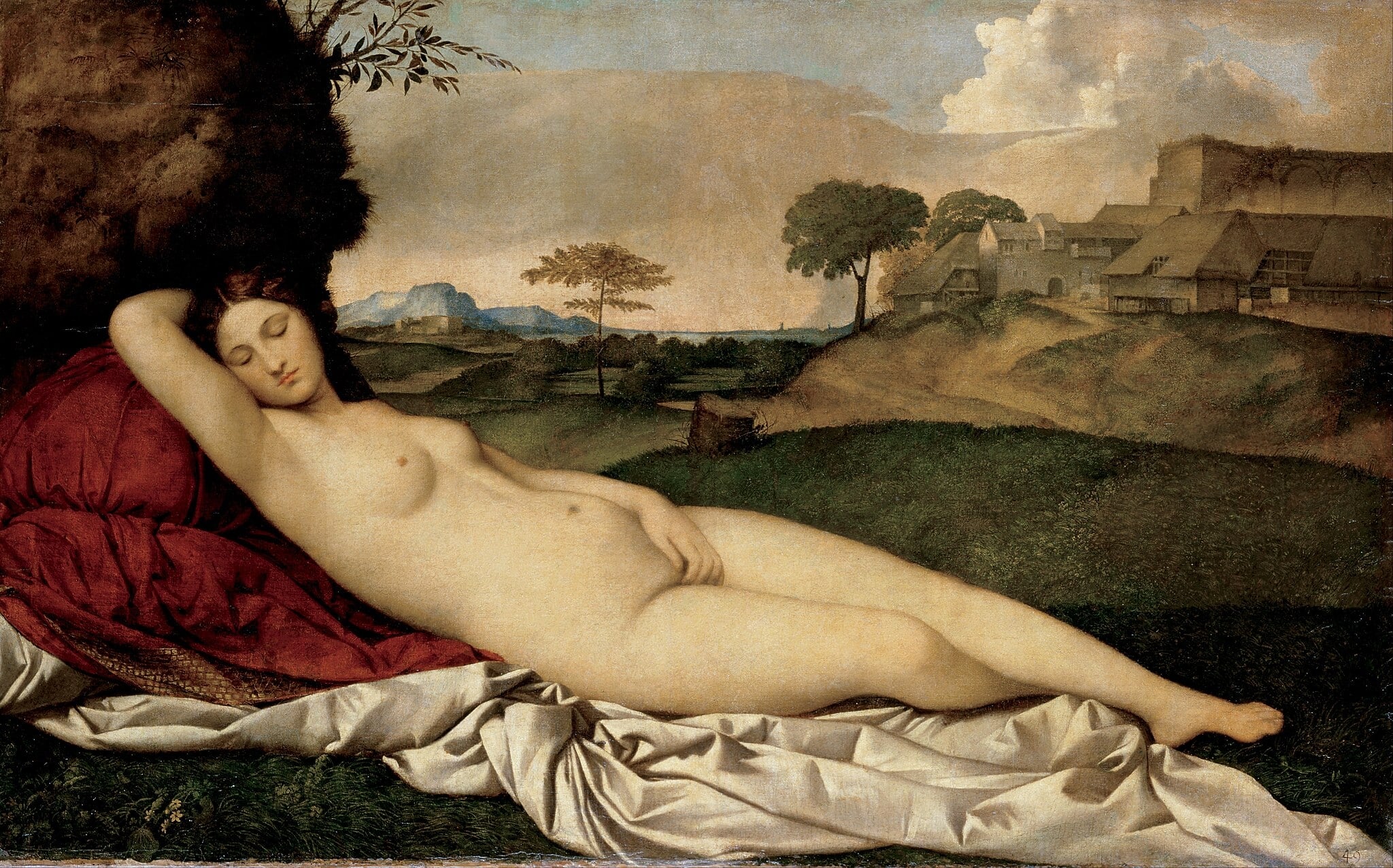
The Sleeping Venus
Giorgione (c. 1508–1510)
In The Sleeping Venus, the goddess reclines across a rolling landscape, her body a serene diagonal that fuses human beauty with nature’s forms. Cool, <strong>silvery drapery</strong> and <strong>deep red cushions</strong> intensify her luminous flesh, while the right-hand <strong>Venus pudica</strong> gesture suspends desire between revelation and restraint. The painting crystallizes the Venetian ideal of poetic harmony (<strong>poesia</strong>) and inaugurates the fully realized reclining nude in Western art <sup>[2]</sup><sup>[4]</sup><sup>[6]</sup>.
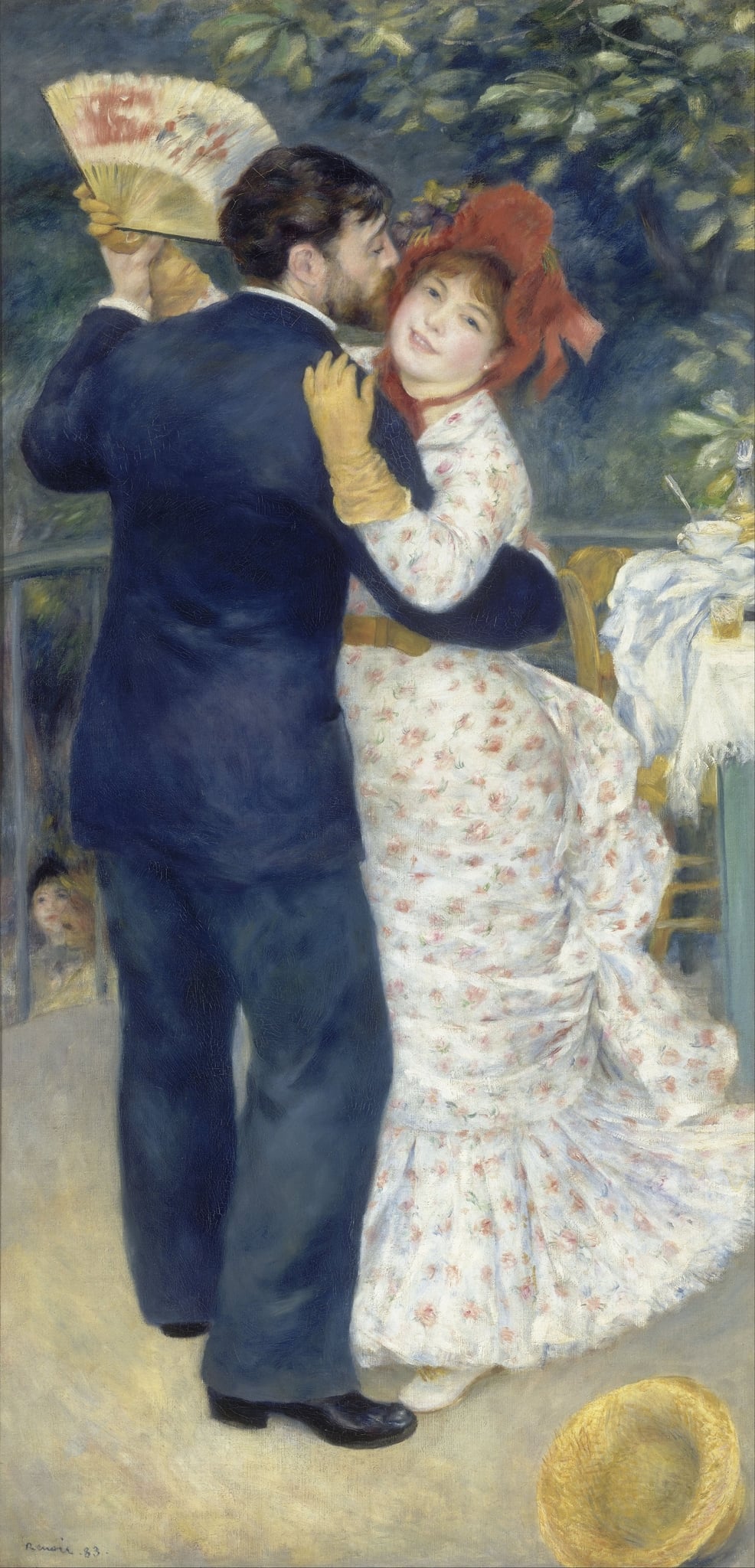
Dance in the Country
Pierre-Auguste Renoir (1883)
Dance in the Country shows a couple swept into a close embrace on a café terrace, their bodies turning in a soft spiral as foliage and sunlight dissolve into <strong>dappled color</strong>. Renoir orchestrates <strong>bourgeois leisure</strong>—the tossed straw boater, a small table with glass and napkin, the woman’s floral dress and red bonnet—to stage a moment where decorum and desire meet. The result is a modern emblem of shared pleasure, poised between Impressionist shimmer and a newly <strong>firm, linear touch</strong>.
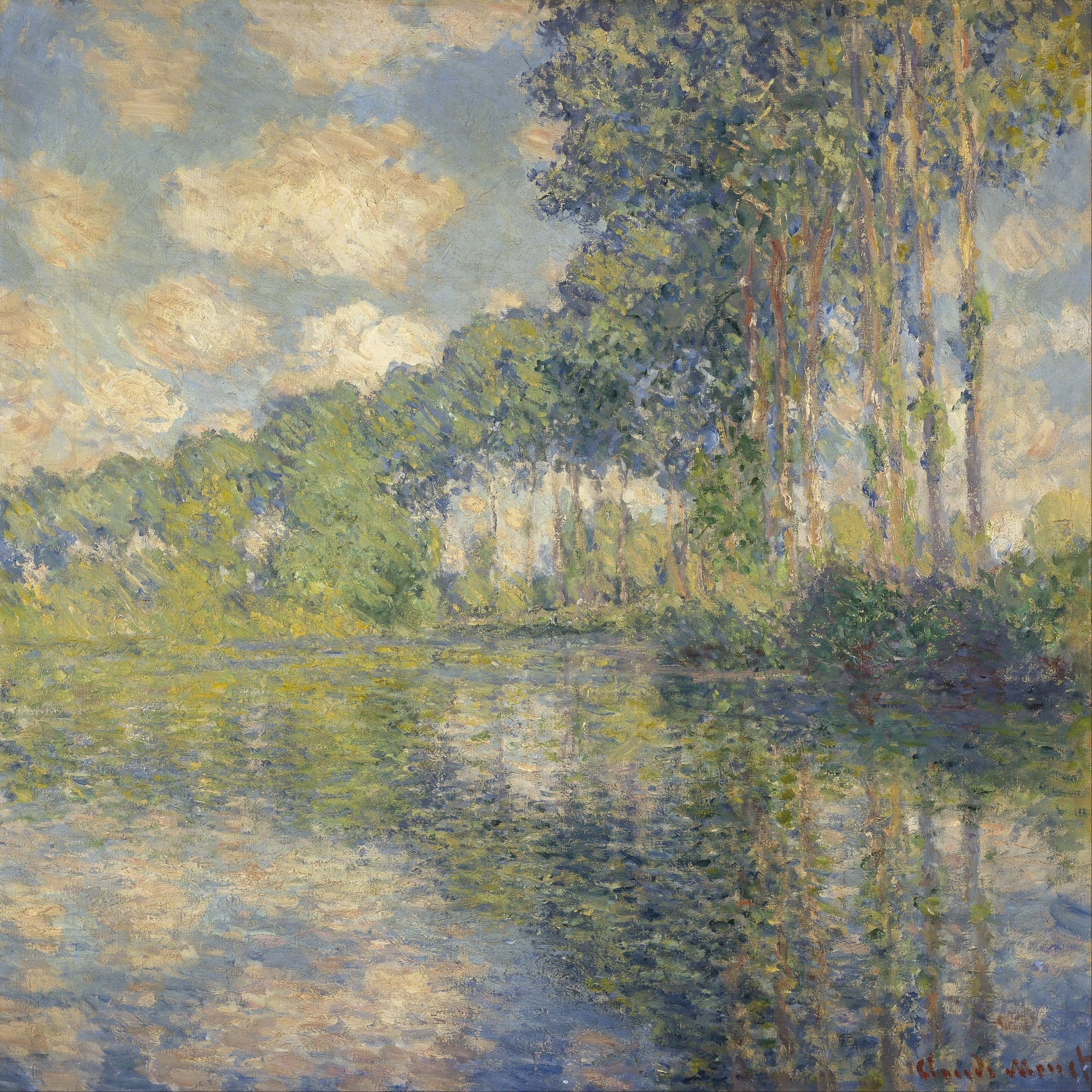
Poplars on the Epte
Claude Monet (1891)
Claude Monet’s Poplars on the Epte turns a modest river bend into a meditation on <strong>time, light, and perception</strong>. Upright trunks register as steady <strong>vertical chords</strong>, while their broken, shimmering reflections loosen form into <strong>pure sensation</strong>. The image stages a tension between <strong>order and flux</strong> that anchors the series within Impressionism’s core aims <sup>[1]</sup><sup>[2]</sup>.
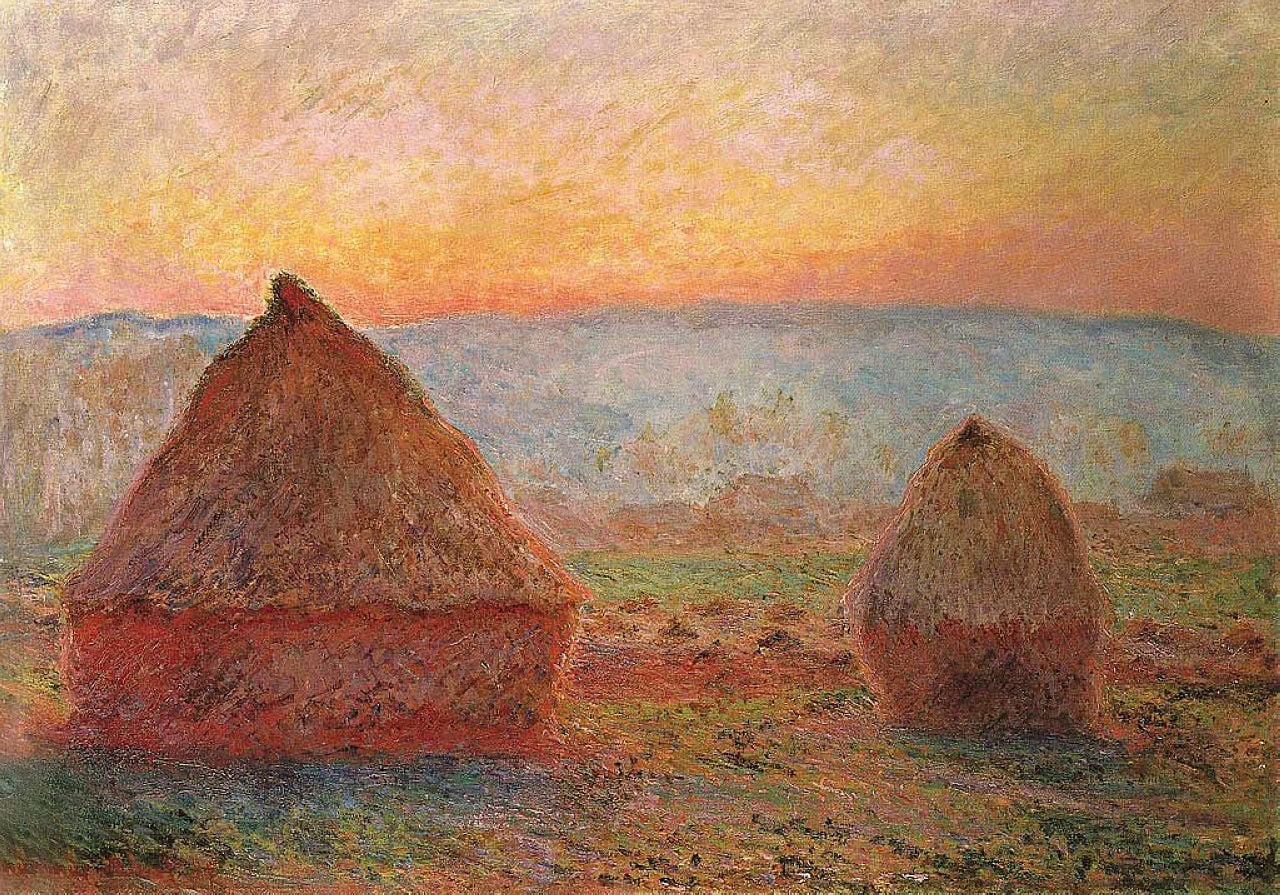
Haystack, Sunset
Claude Monet (1891)
Two conical stacks blaze against a cooling horizon, turning stored grain into a drama of <strong>light, time, and rural wealth</strong>. Monet’s broken strokes fuse warm oranges and cool violets so the stacks seem to glow from within, embodying the <strong>transience</strong> of a single sunset and the <strong>endurance</strong> of agrarian cycles <sup>[1]</sup><sup>[2]</sup><sup>[3]</sup>.
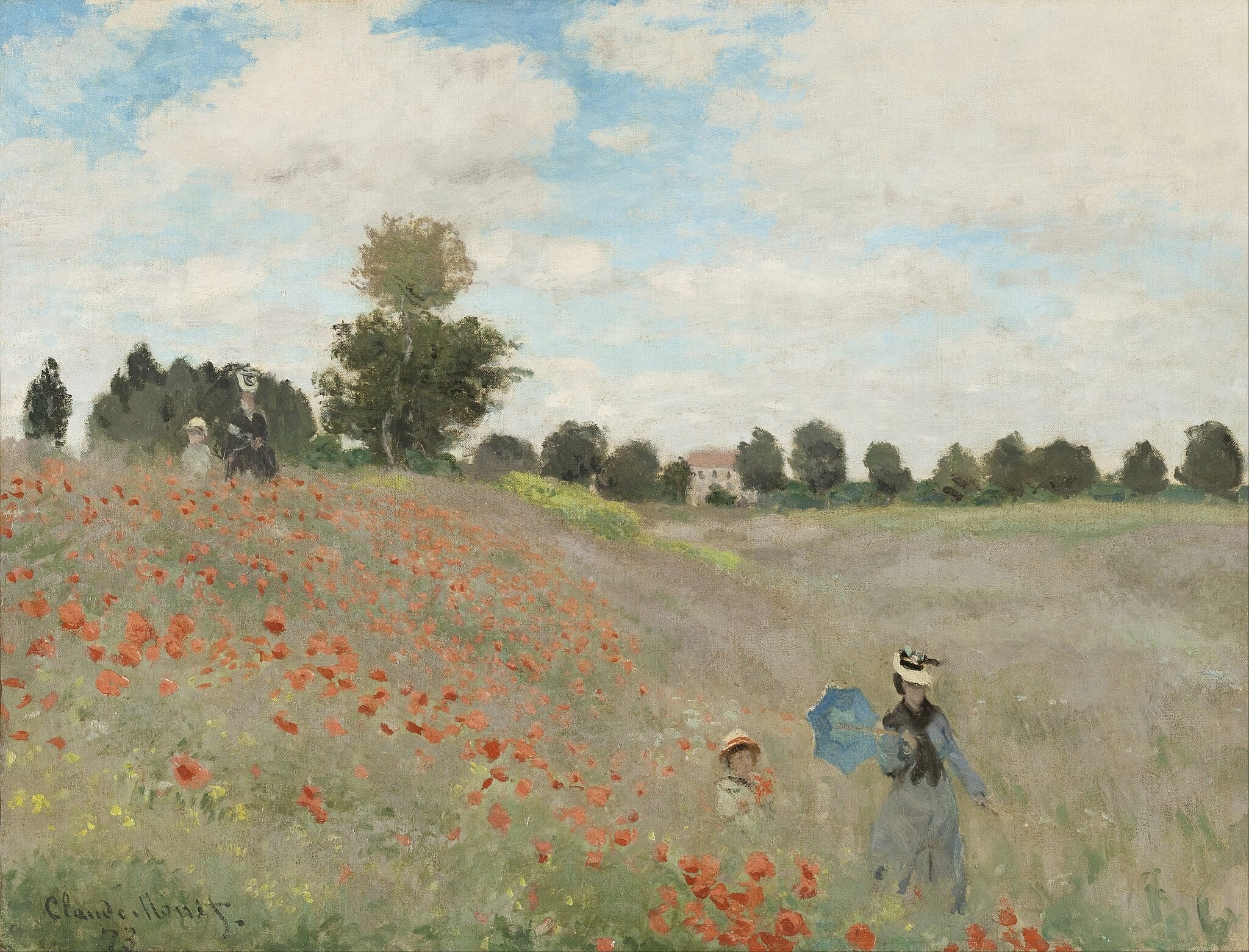
Poppy Fields near Argenteuil
Claude Monet (1873)
A modern pastoral where <strong>color and weather become the subject</strong>: in Poppy Fields near Argenteuil (1873), Monet arrays red poppies along a diagonal slope beneath an immense, changeable sky. Two promenading figures recur across the hill, turning a stroll into a <strong>rhythm of time and movement</strong> <sup>[1]</sup><sup>[2]</sup>.
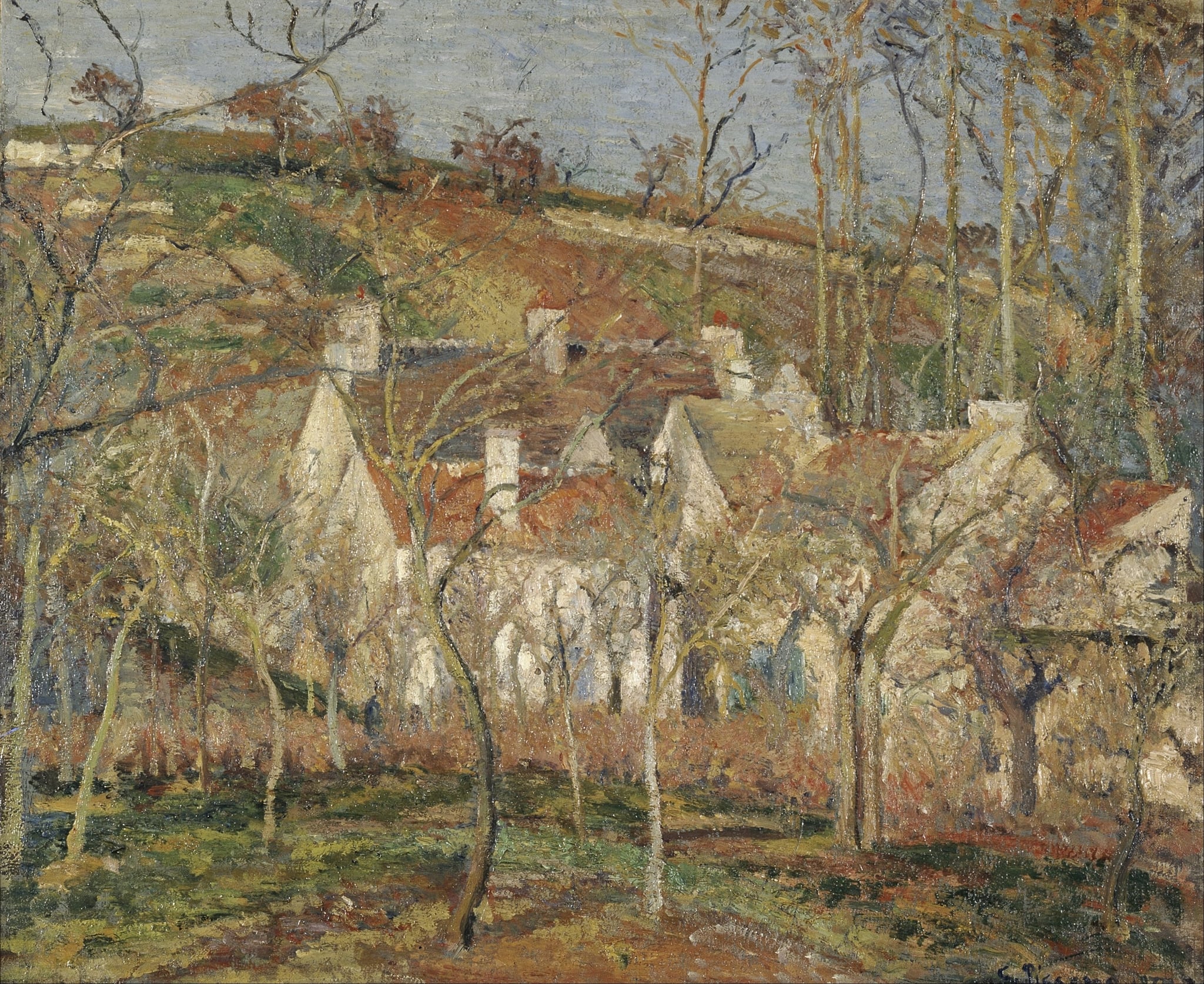
Red Roofs
Camille Pissarro (1877)
In Red Roofs, Camille Pissarro knits village and hillside into a single living fabric through a <strong>screen of winter trees</strong> and vibrating, tactile brushwork. The warm <strong>red-tiled roofs</strong> act as chromatic anchors within a cool, silvery atmosphere, asserting human shelter as part of nature’s rhythm rather than its negation <sup>[1]</sup><sup>[3]</sup>. The composition’s <strong>parallel planes</strong> and color echoes reveal a deliberate structural order that anticipates Post‑Impressionist concerns <sup>[1]</sup><sup>[2]</sup>.
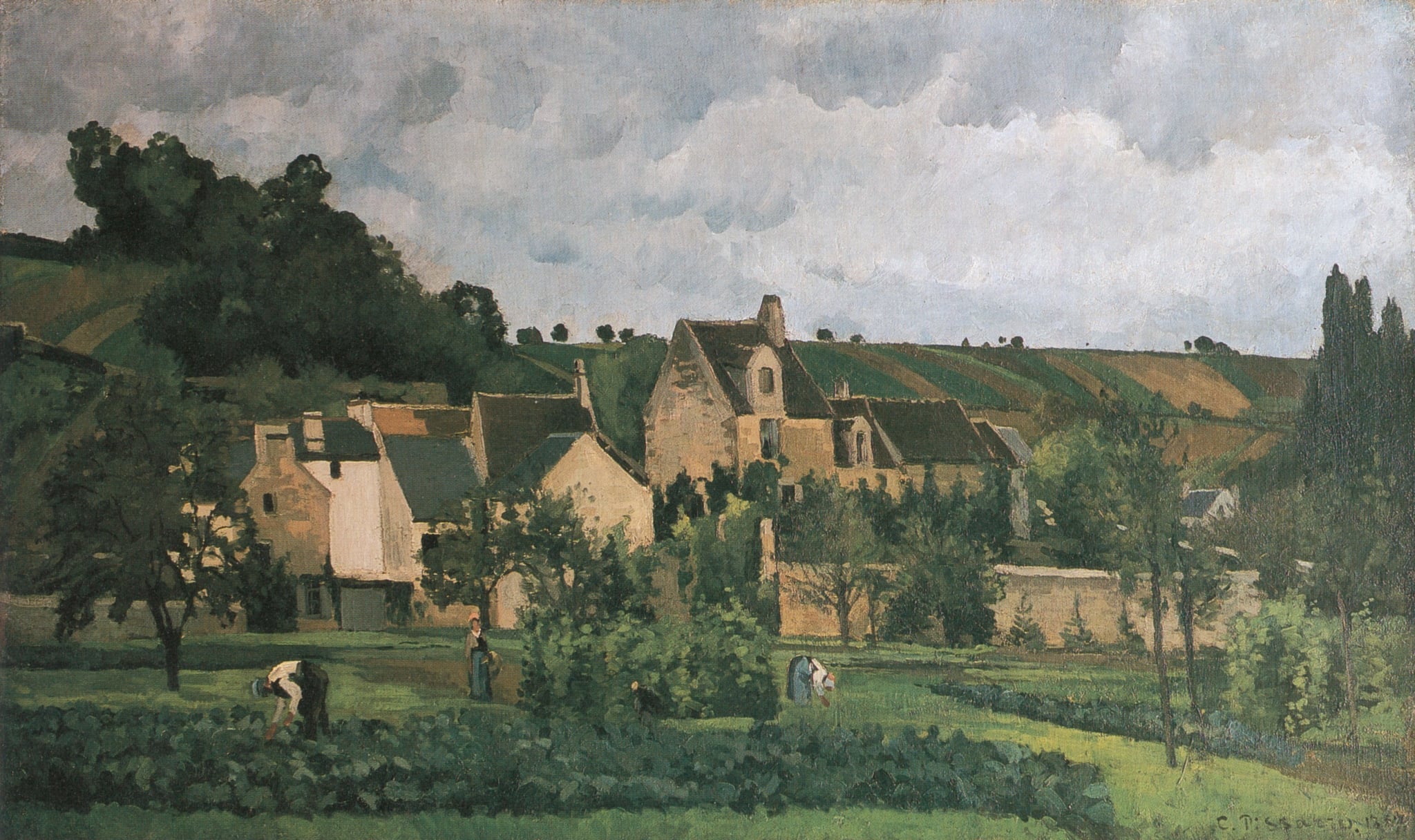
The Hermitage at Pontoise
Camille Pissarro (ca. 1867)
Camille Pissarro’s The Hermitage at Pontoise shows a hillside village interlaced with <strong>kitchen gardens</strong>, stone houses, and workers bent to their tasks under a <strong>low, cloud-laden sky</strong>. The painting binds human labor to place, staging a quiet counterpoint between <strong>architectural permanence</strong> and the <strong>seasonal flux</strong> of fields and weather <sup>[1]</sup><sup>[3]</sup>.
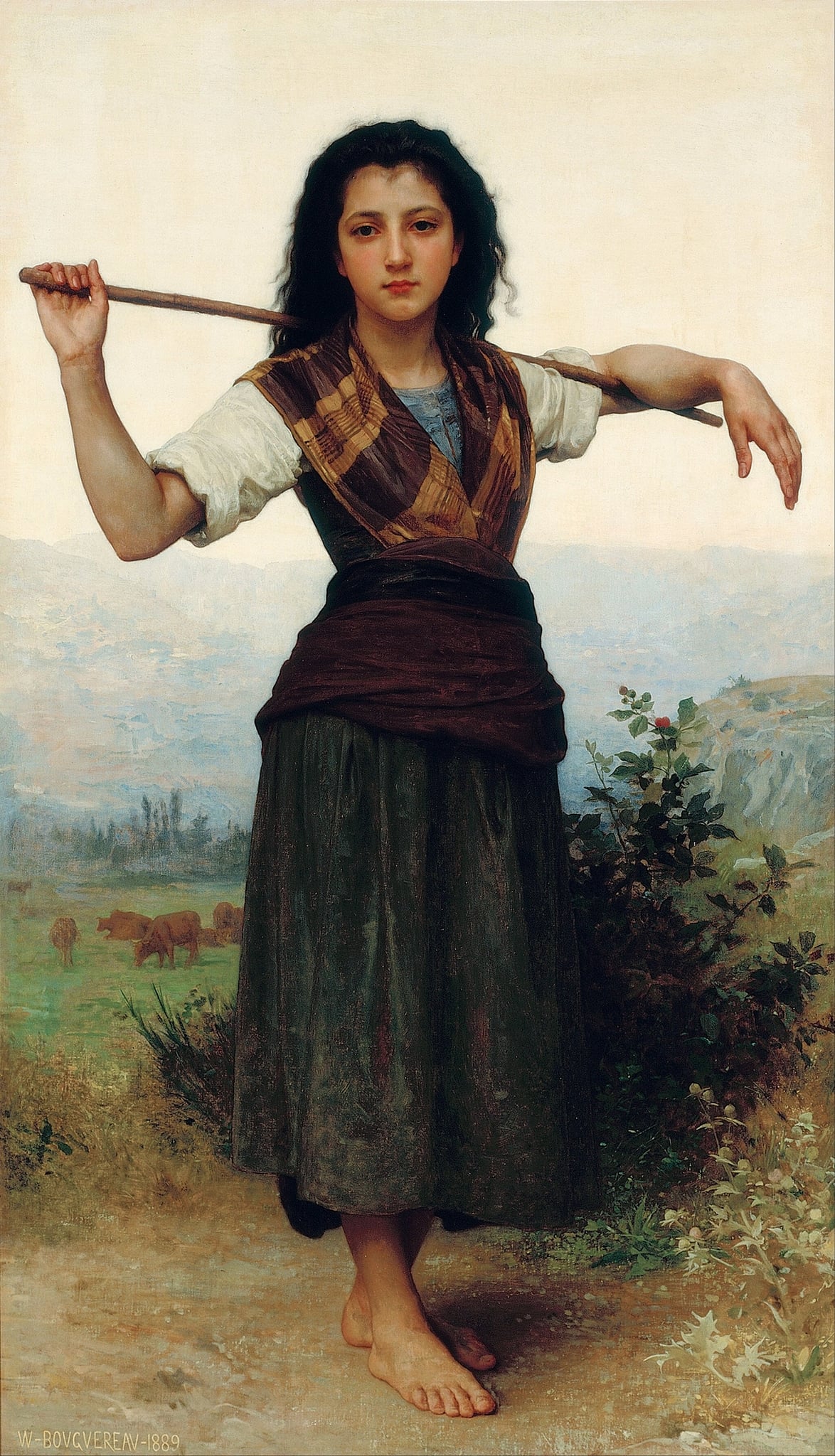
The Shepherdess
William-Adolphe Bouguereau (1889)
The Shepherdess presents a barefoot country girl frontally, her staff resting across her shoulders as she meets the viewer’s gaze with calm resolve. Bouguereau fuses <strong>rustic reality</strong> (earth‑stained feet, worn skirt, grazing cattle) with <strong>classical idealization</strong> (polished skin, poised contrapposto), elevating humble labor into quiet nobility <sup>[1]</sup><sup>[2]</sup>.
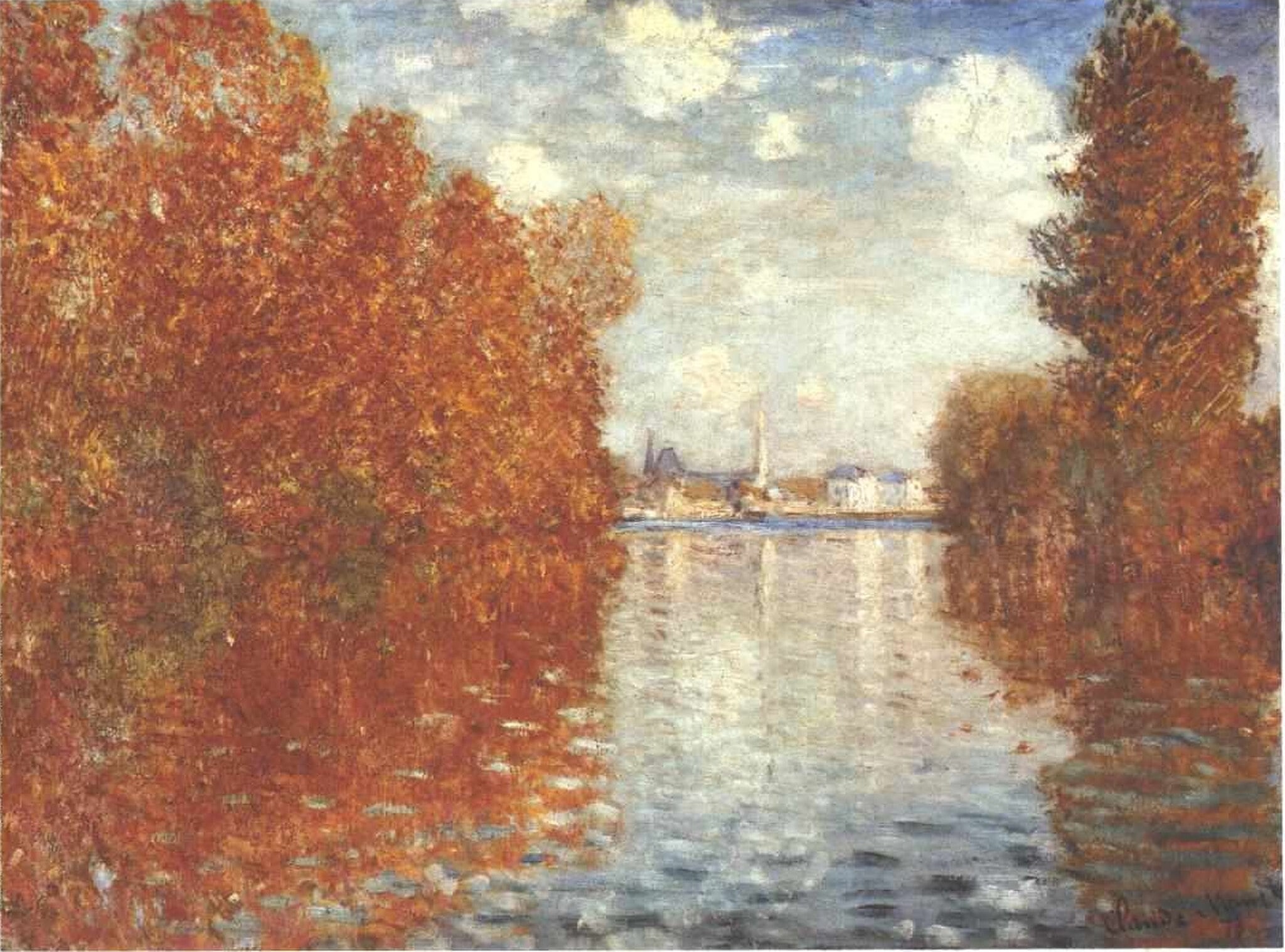
Autumn Effect at Argenteuil
Claude Monet (1873)
Autumn Effect at Argenteuil presents a luminous channel of the Seine flanked by blazing foliage, its surface vibrating with broken reflections. Monet turns the scene into an <strong>optical drama</strong> of complementary <strong>orange–blue</strong> contrasts, staging a passage from the narrowed banks to a light-struck town on the horizon. Painted from his <strong>studio boat</strong>, the work distills the Impressionist belief that truth resides in fleeting effects of light and air <sup>[1]</sup><sup>[2]</sup>.
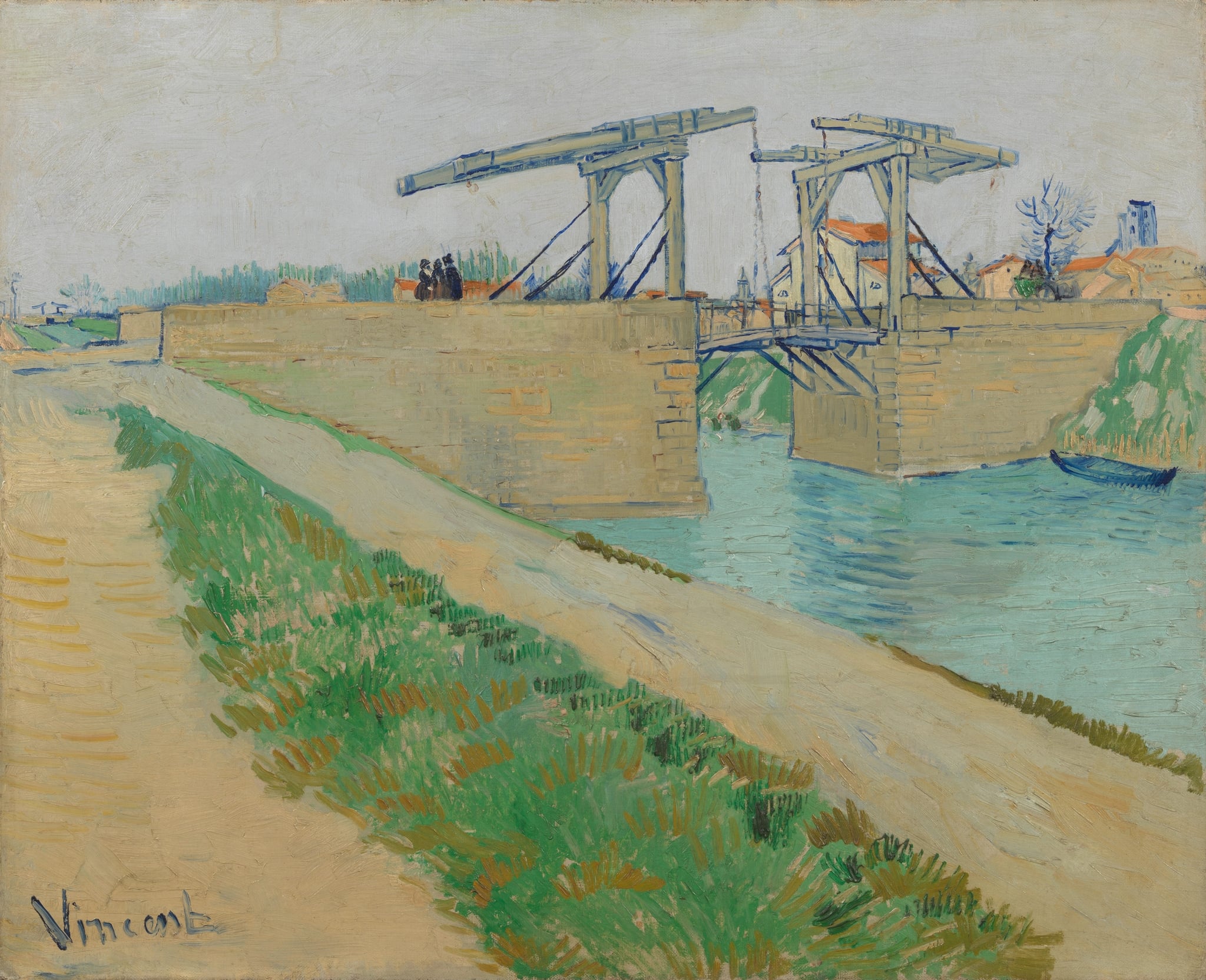
The Langlois Bridge
Vincent van Gogh (1888)
Van Gogh’s The Langlois Bridge turns a modest drawbridge into a <strong>symbol of connection</strong> and modern passage. With a sweeping towpath, <strong>firm blue contours</strong>, and turquoise water, the scene balances rural calm with engineered order <sup>[1]</sup><sup>[3]</sup>.
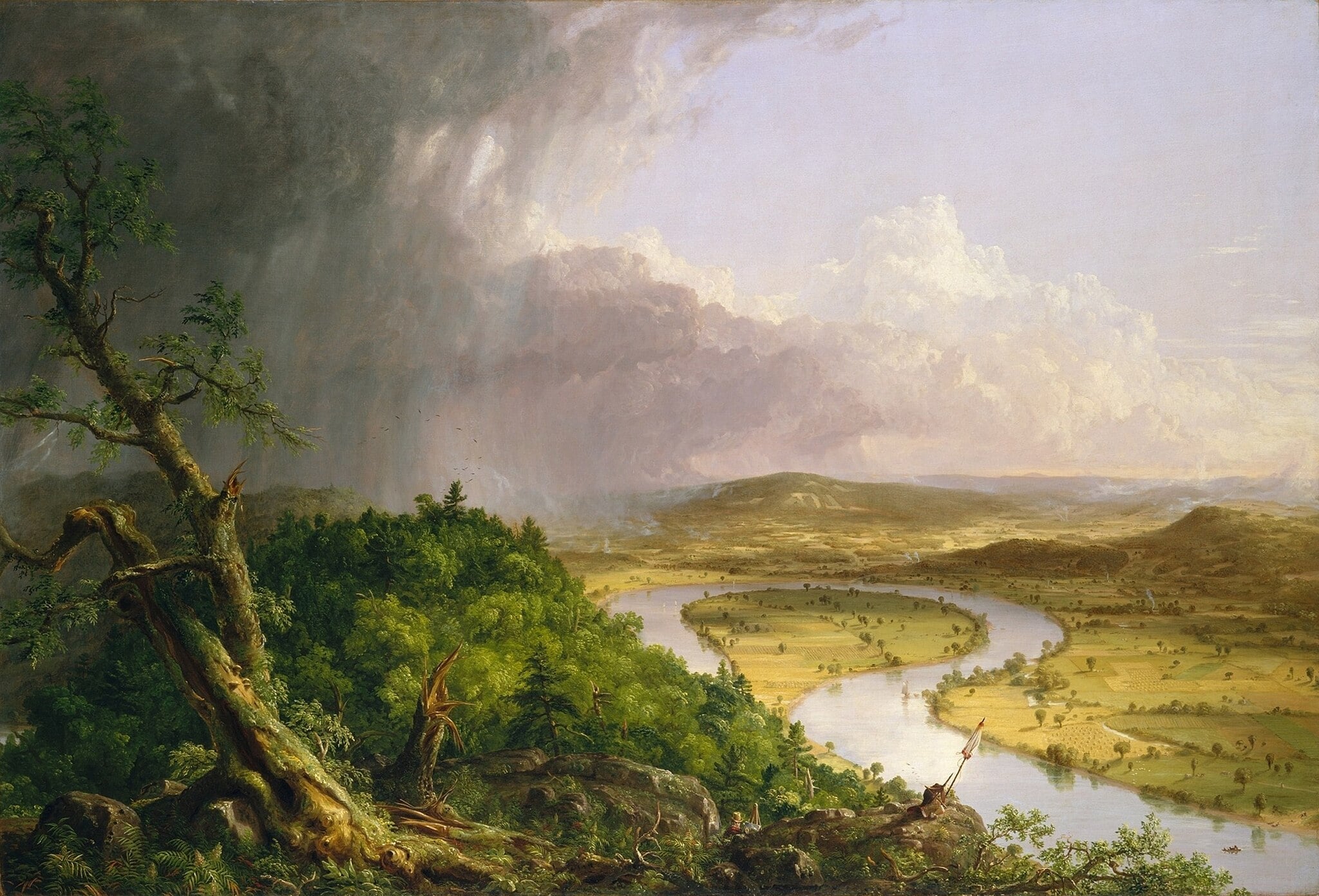
The Oxbow (View from Mount Holyoke)
Thomas Cole (1836)
Thomas Cole’s The Oxbow (View from Mount Holyoke) juxtaposes <strong>storm-lashed wilderness</strong> at left with <strong>sunlit, cultivated farmland</strong> at right, using a panoramic sweep of the Connecticut River’s curve. A tiny figure with an easel—Cole’s self-insertion—stands between realms, turning sight into judgment. The painting frames America’s landscape as both <strong>sublime</strong> and <strong>pastoral</strong>, a place of awe, promise, and warning.
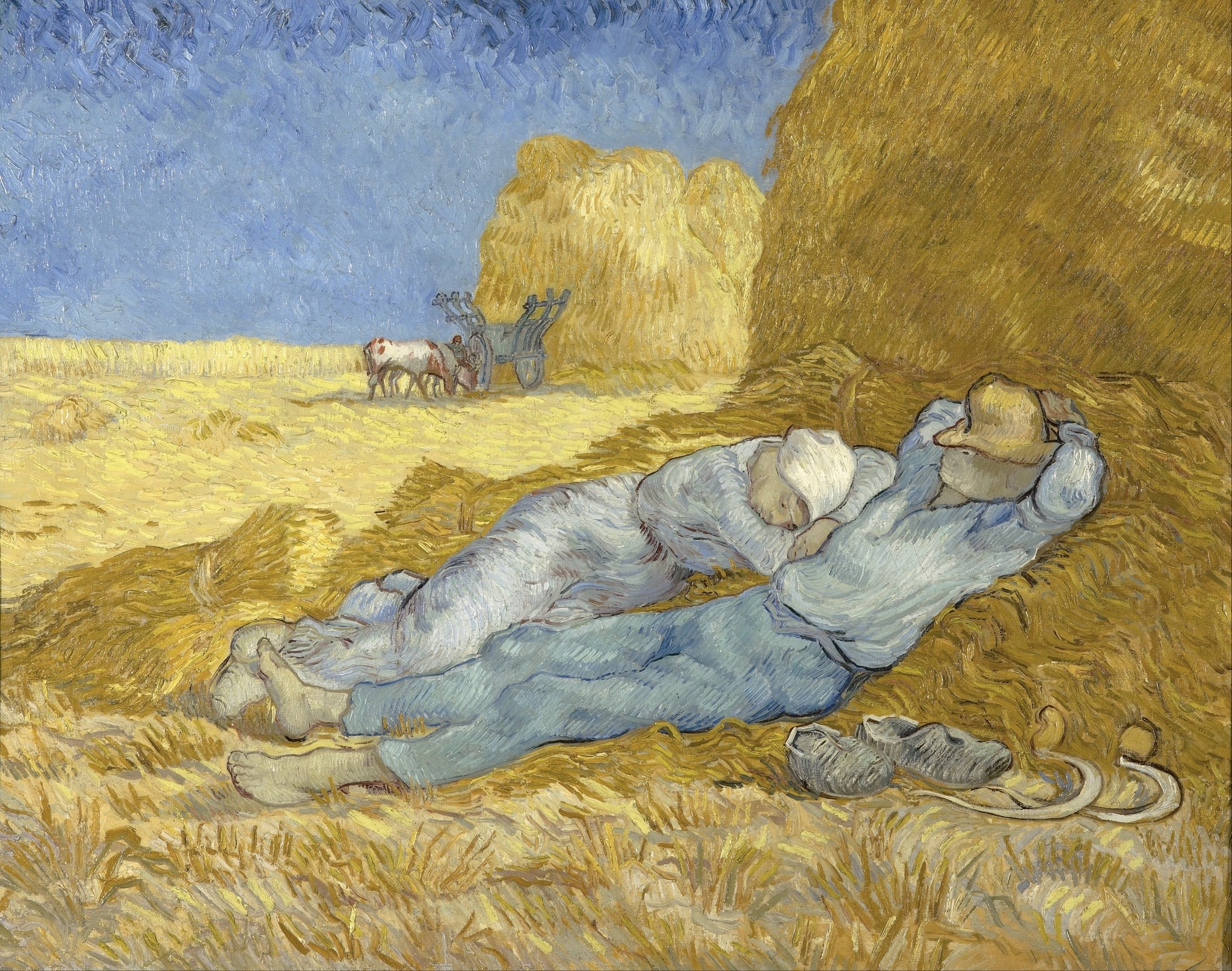
The Siesta
Vincent van Gogh (1889–1890)
The Siesta renders a midday pause as a scene of <strong>dignified repose</strong>: two harvesters sleep curved against a haystack while their scythes and shoes rest idle in the straw. Van Gogh’s complementary <strong>blue–yellow</strong> orchestration turns heat and light into rhythm, holding rest and labor in delicate equilibrium <sup>[1]</sup>. Painted at Saint‑Rémy as a color "translation" after Millet, it transforms a humble genre motif into an emblem of <strong>human need</strong> within work’s demands <sup>[1]</sup><sup>[3]</sup>.
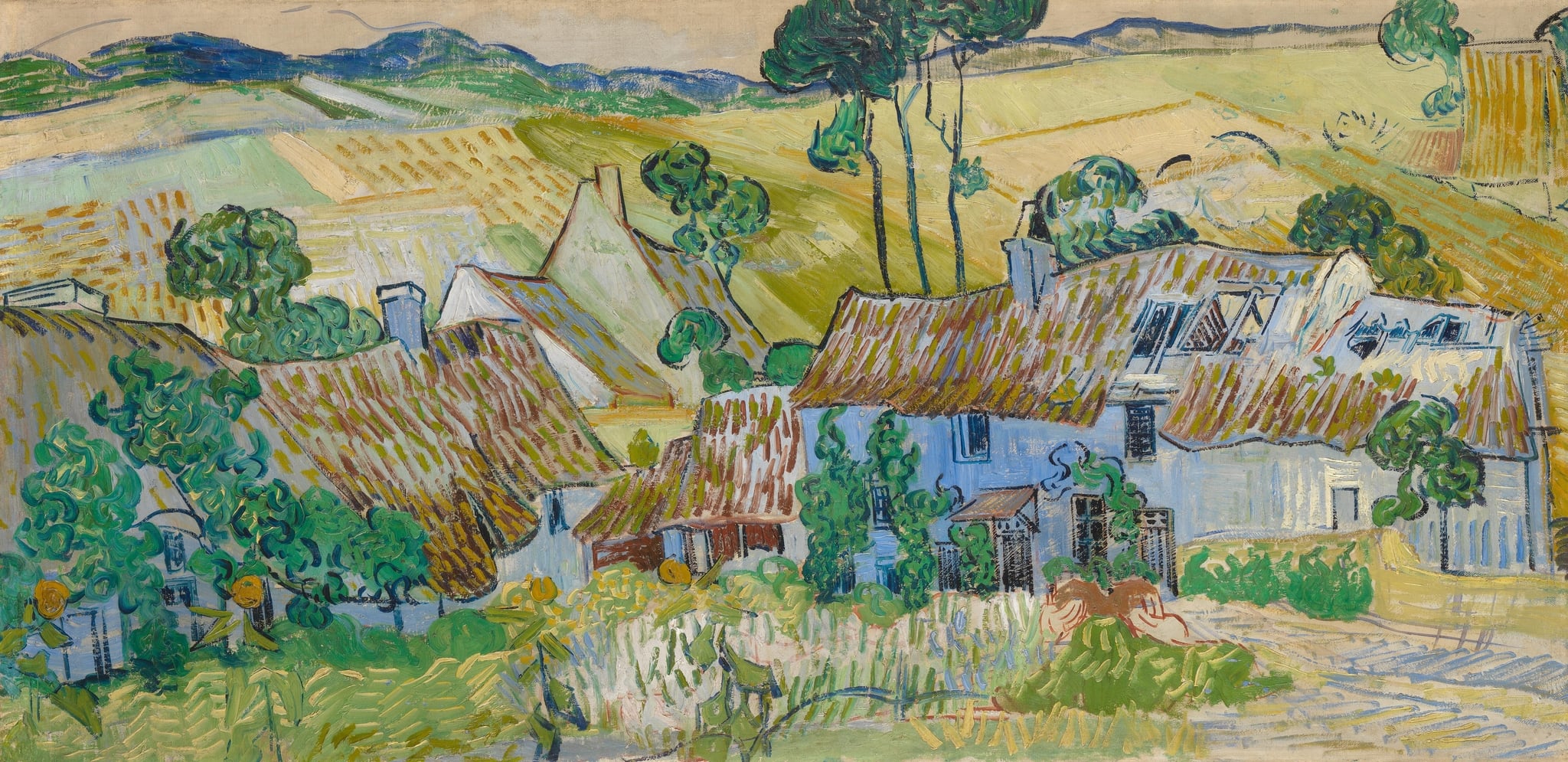
Farms near Auvers
Vincent van Gogh (1890)
Painted in July 1890, Vincent van Gogh’s Farms near Auvers is a late, "double‑square" panorama where thatched cottages, wheat plots, and wind‑bent trees pulse with <strong>rhythmic energy</strong>. The high horizon and criss‑crossing roofs compress the village into a living weave of color and line, turning ordinary farms into a scene of <strong>charged stillness</strong> <sup>[1]</sup><sup>[3]</sup>.
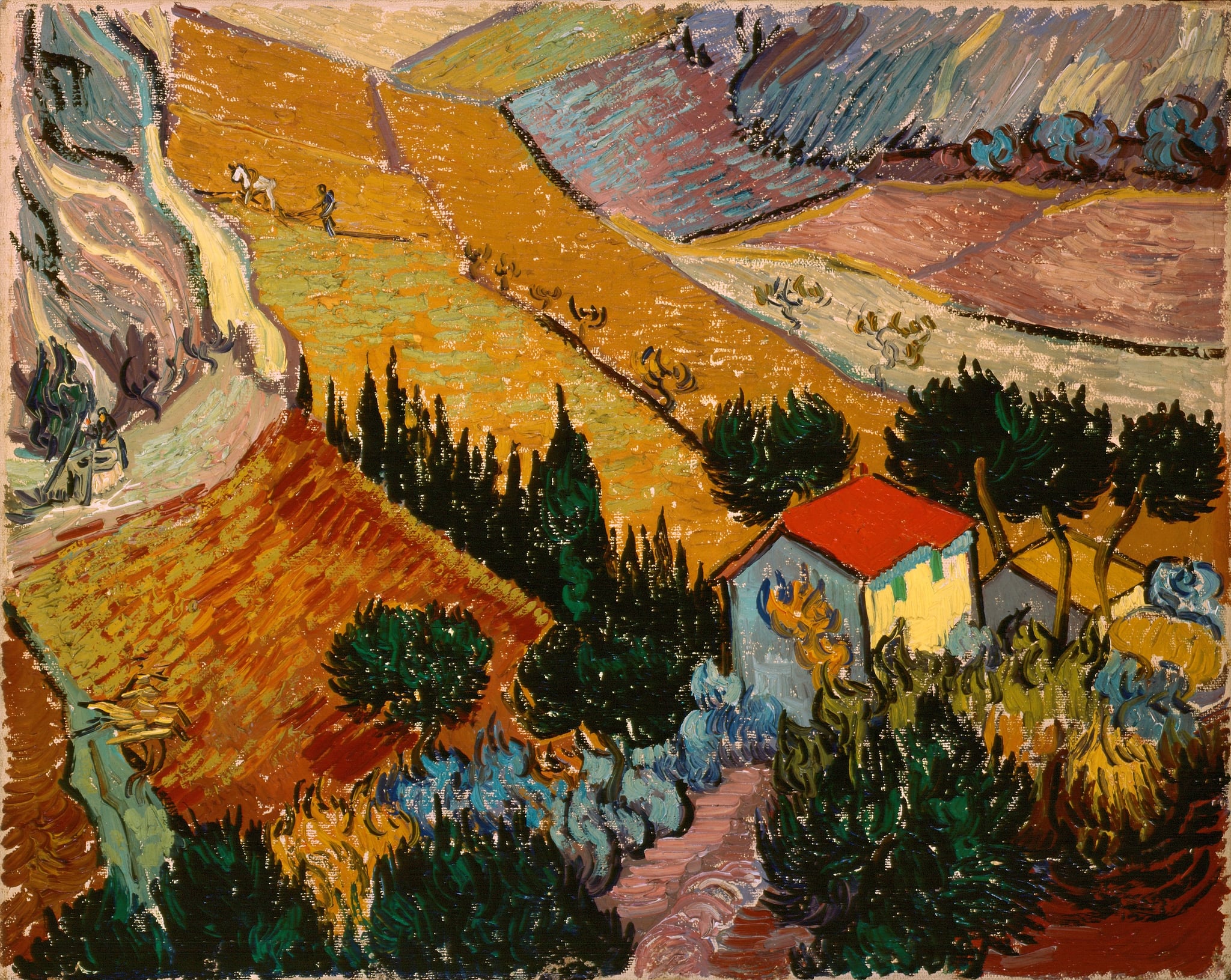
Landscape with Ploughman
Vincent van Gogh (1889)
Landscape with Ploughman compresses a steep Provençal valley into a vibrating mosaic of fields where a tiny figure with a white horse furrows the slope. Van Gogh turns cypress spires, a flame‑red roof, and banded plots into a pulse of <strong>human labor</strong> within <strong>restless nature</strong> <sup>[1]</sup><sup>[5]</sup>. The painting fuses elevated viewpoint and directional brushwork to stage endurance as pattern and rhythm.
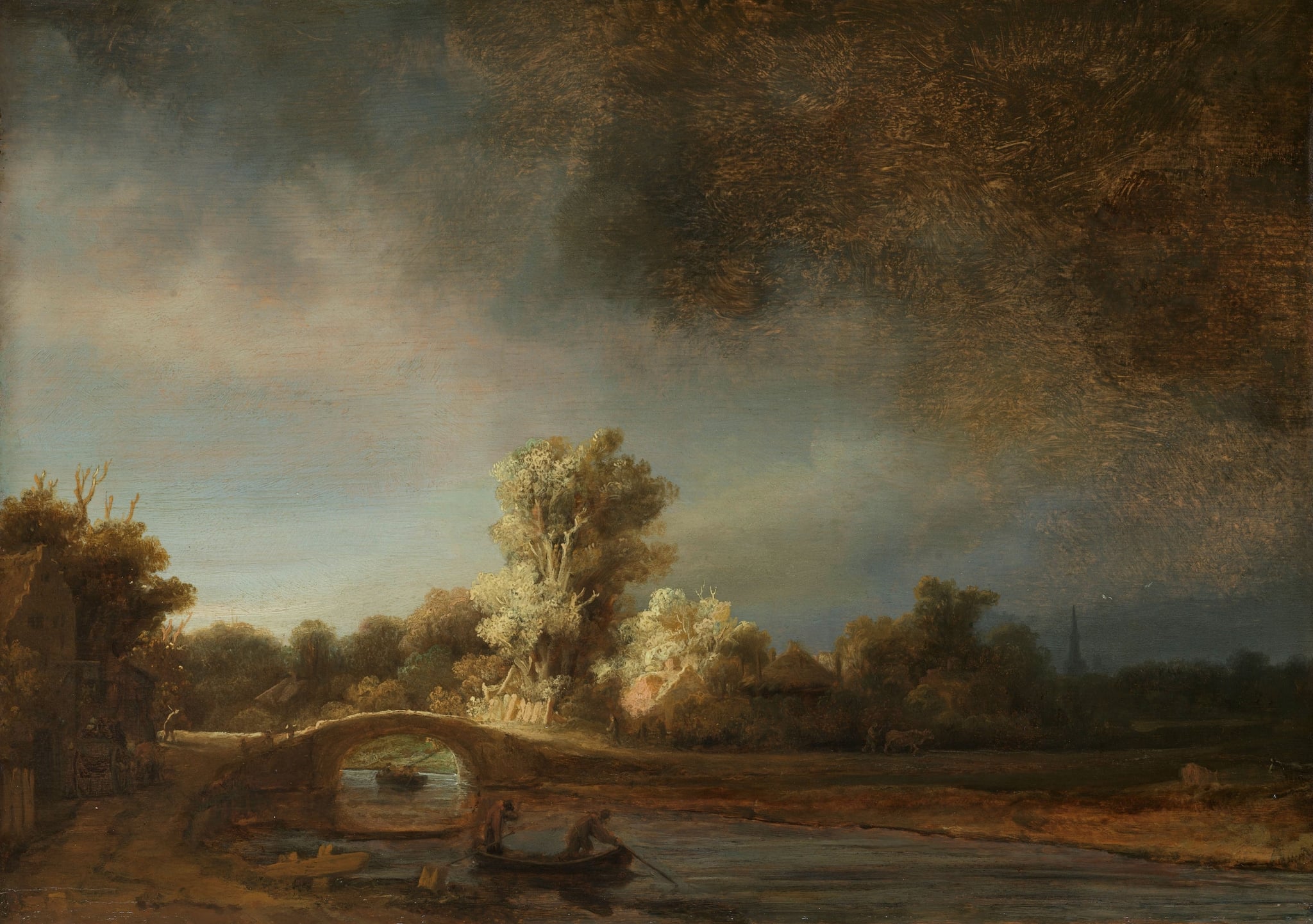
Landscape with a Stone Bridge
Rembrandt van Rijn (late 1630s (c. 1637–1638))
Under a storm-laden sky, a sudden shaft of light isolates the low <strong>stone bridge</strong> and a cluster of <strong>silvery trees</strong>, while tiny boats, a rutted track, a cottage, grazing animals, and a far <strong>church spire</strong> register human presence. Rembrandt van Rijn turns an everyday crossing into a scene of <strong>passage and providence</strong>, where transience moves beneath the endurance of stone and sky <sup>[1]</sup><sup>[2]</sup>.
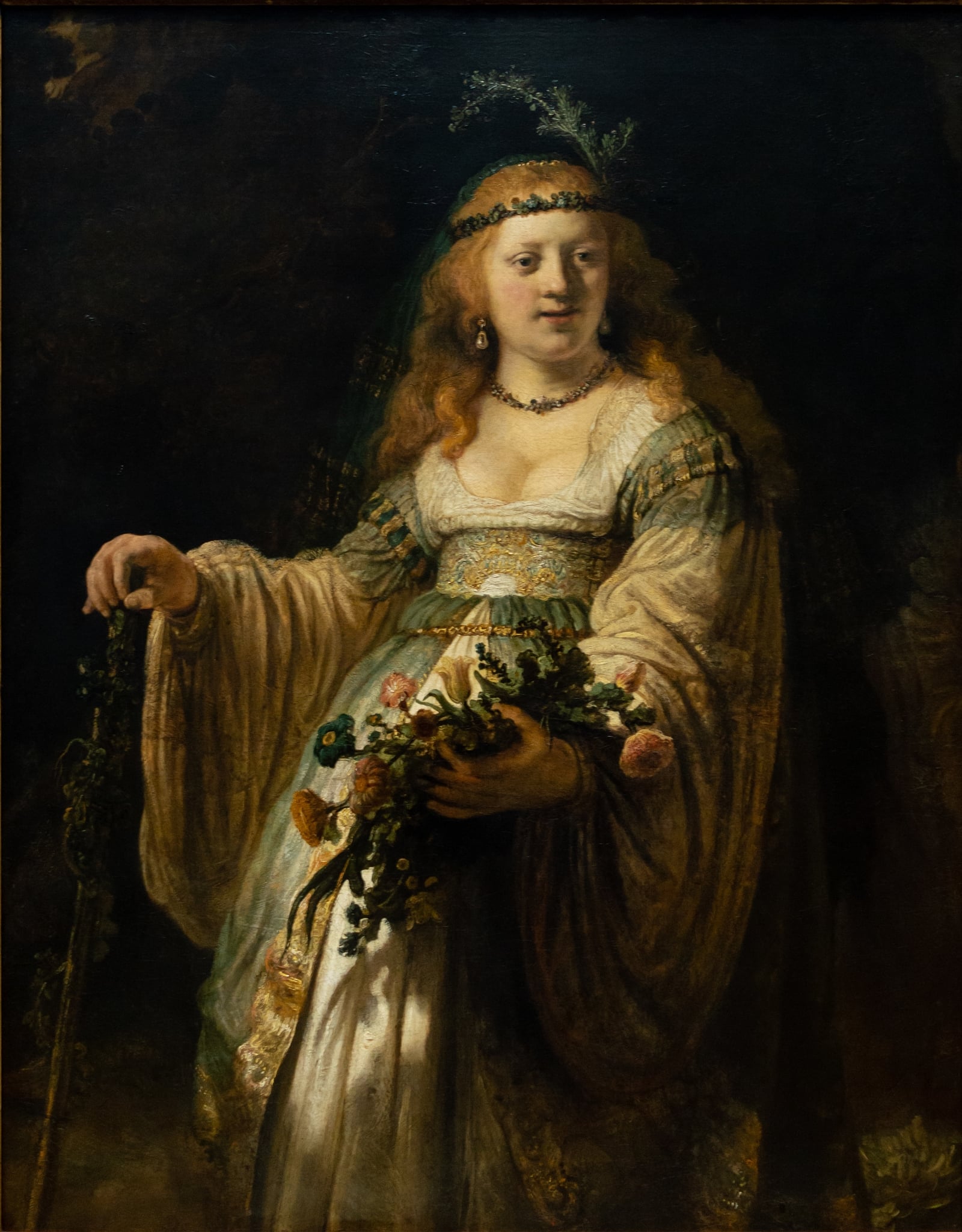
Saskia van Uylenburgh in Arcadian Costume
Rembrandt van Rijn (1635)
Rembrandt van Rijn’s 1635 portrait of his wife, Saskia, appears as a luminous shepherdess in <strong>Arcadian costume</strong>, her face and hands caught in a warm cone of light while the world around her recedes into shadow. The wreath, foliage‑twined staff, and armful of blossoms transform a private likeness into an emblem of <strong>fertility, prosperity, and renewal</strong> <sup>[1]</sup>.