Girls at the Seashore

by Pierre-Auguste Renoir

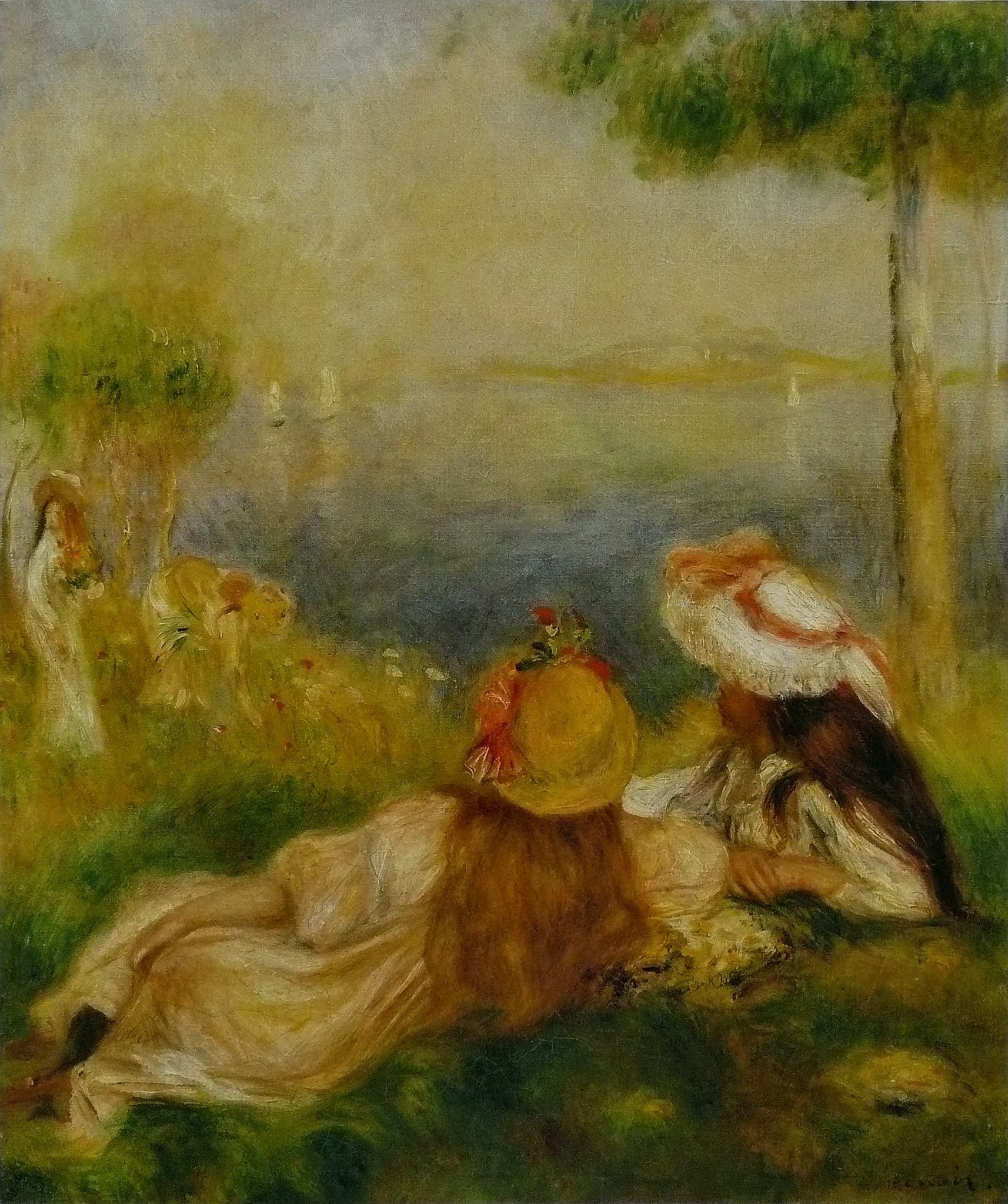
Girls at the Seashore presents two young figures reclining on a grassy bank, their straw hats trimmed with flowers as they look toward a hazy waterway flecked with small sails. Renoir fuses figure and setting through soft, vaporous brushwork so that skin, fabric, foliage, and sea share the same light. The image is an ode to reverie, companionship, and the fleeting warmth of summer.

Fast Facts

Year
c.1890–1894
Medium
Oil on canvas
Dimensions
55 × 46 cm
Location
Private collection
Girls at the Seashore by Pierre-Auguste Renoir (c.1890–1894) featuring Straw hats with floral trims, Tiny white sailboats, Silvery water and pale horizon

Click on any numbered symbol to learn more about its meaning

Meaning & Symbolism

Renoir anchors the composition with two girls seen from behind, reclining side‑by‑side on sun‑warmed grass. Their straw hats—one crowned with scarlet blossoms, the other banded in coral—declare season and youth while acting as chromatic pivots that bounce warm reds and oranges into the surrounding greens. The figures’ bodies form a low, sweeping diagonal that steadies our entry into space; from their shoulders our attention lifts past a scatter of wildflowers and up to the silvery water, where tiny white sails move like punctuation marks toward a pale horizon. This back‑turned posture is not coyness but a poetic device: it withholds faces to convert the figures into companions for our own looking, a 19th‑century strategy of reverie that invites the viewer to share, rather than interrupt, a private moment 5. What appears effortless is the result of a deliberate balance between structure and atmosphere. After Italy, Renoir often modeled figures with a clearer sense of volume while allowing settings to remain vaporous; here, the girls’ shoulders, sleeves, and the brim edges are gently drawn, then softened into a halo of strokes that dissolve into the meadow and the sea 1. The brushwork graduates from denser, warmer touches in the foreground to pearly, feathered strokes at the horizon, performing the very act of seeing across humid coastal air. This painterly fade does more than describe weather; it stages modern perception itself, a central Impressionist concern, so that “looking out” becomes the scene’s real action 6. The distant boats—minute, moving, and bright—signal mobility and the rhythms of modern travel familiar from Renoir’s Guernsey studies, where sails calibrate depth and seasonal time 2. In this picture they also become emblems of possibility and passage: markers of a life not yet embarked upon, the horizon of adulthood dilating before youthful leisure. Renoir’s iconography tightens this reading. Hats trimmed with ribbons and flowers place the girls within contemporary fashion culture, aligning them with the codes of display and identity that Impressionism often explored 6. Yet the millinery’s gardenlike ornaments echo the meadow’s blooms, fusing femininity with seasonal fertility. The grassy bank, stippled with small white and yellow blossoms, behaves like a gentle stage for modern pastoral: not Arcadia, but a reachable coastal verge where bourgeois time slows without fully stopping. To the left, a standing figure and another seated amid flowers extend the theme of sociability without breaking the central duo’s hush, suggesting that companionship here is both intimate and communal. The nearby tree trunks frame the view as if parting a curtain; their verticals counter the reclining diagonal and nudge the eye outward, a subtle architecture that supports the reverie without calling attention to itself. Why Girls at the Seashore is important, finally, is that it compresses the ambitions of late Impressionism into a modest scale: the fusion of felt light with formed bodies; the mapping of social modernity—seaside leisure, fashion, mobility—onto a timeless meditation on youth and time. The work belongs to Renoir’s mature practice in the 1890s, when he often returned to intimate figure‑in‑landscape scenes, refining a style that united classical solidity with shimmering color 17. In this canvas, sensation and symbol are inseparable: warmth becomes tenderness; distance becomes future; and the sea’s shimmer becomes the very texture of memory in the making. The result is less a story than a state—of waiting, wondering, and basking in the light—through which Renoir proposes that beauty resides in ordinary hours lived attentively.

Explore Deeper with AI

Ask questions about Girls at the Seashore

Popular questions:

Powered by AI • Get instant insights about this artwork

💬 Ask questions about this artwork!

Interpretations

Historical Context

This canvas condenses Renoir’s post‑Italy synthesis: firmer drawing in figures, freer atmospheric handling around them. After 1881–82 he pursued what he called a “dry” manner—clearer modeling that still bathes subjects in luminous air. The seaside motif taps his 1883 Guernsey campaign, where sails calibrate distance and seasonal time, a reservoir he revisited in later studio works. By the mid‑1890s, Impressionist iconography of bourgeois leisure—promenades, boating, beaches—had become a lingua franca for modernity’s social optics. Girls at the Seashore thus reads as a late‑Impressionist refinement: intimate scale, classical solidity, and a coastline that is less topography than a stage for modern seeing and sociability 123.

Source: The Metropolitan Museum of Art; National Gallery, London; Smarthistory

Formal Analysis: The Back‑Figure and Shared Gaze

Renoir’s choice to show the pair from behind aligns with a 19th‑century device of the back‑turned figure that orchestrates contemplative viewing. Puvis de Chavannes’s Jeunes filles au bord de la mer was praised for such “poetic neutrality,” a posture that invites spectators to share a vista rather than interrupt it. Renoir adapts the device to modern leisure: the girls become proxies for our looking, turning spectatorship itself into content. The composition routes the eye along a reclining diagonal to optical punctuation—white sails—before dissolving into a pearly horizon. The result is a choreography of attention, where posture, shoreline geometry, and graded brushwork collaborate to stage reverie as a collective, modern act 43.

Source: Musée d’Orsay; Smarthistory

Fashion & Gender: Millinery as Social Semiotics

The straw hats—ribbons, blossoms, coral bands—operate as millinery signifiers that tether youth to the rhythms of the season and to class‑coded display. Impressionist culture repeatedly foregrounded fashion as a medium of self‑presentation, a visual economy in which adornment signals status, taste, and gendered roles. In Renoir’s hands, trim and floral ornament do double duty: they mirror the meadow’s blooms (a soft pastoral echo) while situating the figures within an urban fashion system that extends into leisure spaces. Rather than mere decoration, the hats articulate how modern identity is performed at the shore, where looking—at water, at others, at oneself—converges with the pleasures of being seen 35.

Source: Smarthistory; Encyclopaedia Britannica

Symbolic Reading: Boats, Mobility, and Open Time

The tiny, bright sails function as temporal indices—mobile points that pace depth and duration across a humid veil of air. In Renoir’s Guernsey studies, boats calibrate distance while registering the rhythms of seaside life; here, their minuteness amplifies the girls’ stillness, turning the mid‑ground into a clock of moving marks. This dialectic of repose and motion ties private reverie to public circulation—tourism, travel, seasonal flux—central to Impressionist modernity. The sails hint at futures not yet embarked upon, translating the horizon into a prospect of possibility that belongs as much to life trajectories as to pictorial space 21.

Source: National Gallery, London; The Metropolitan Museum of Art

Pastoral Modernity: Softening the Social Optic

Renoir stages a modern pastoral—neither mythic Arcadia nor raw nature, but a manageable verge where bourgeois time slows. The stippled wildflowers, cushioned grass, and silvered water naturalize leisure, recoding social privilege as seasonal ease. Impressionist “painting of modern life” often folds classed behaviors into seductive atmospheres; here, the pastoral idiom masks the urban structures (rail, resort culture, fashion economies) that enable such hours. This lovely bank is thus ideological: a gentle buffer that converts modern social optics into sensory charm. The picture asks us to feel the world as soft weather, even as it describes a distinctly late‑19th‑century way of inhabiting time 356.

Source: Smarthistory; Encyclopaedia Britannica; Musée Marmottan Monet (exhibition context)

Medium Reflexivity: Atmosphere as Method and Meaning

The painting’s fade—from dense, warm strokes to pearly, feathered touches—performs the phenomenon it depicts: vision across humid air. This is more than weather; it is a demonstration of Impressionist epistemology, where knowledge arrives as gradations of light. Renoir’s post‑Italy practice keeps figure volumes legible while letting surroundings dissolve, so that the image toggles between formed bodies and optical flux. The horizon’s slight blur and the sailing flecks turn paint into time, making “looking out” the real action. In this sense the work is reflexive: it shows how the medium translates perception into surface, and how modern space is made by the very act of seeing 1.

Source: The Metropolitan Museum of Art

Related Themes

About Pierre-Auguste Renoir

Pierre-Auguste Renoir (1841–1919) emerged from craft training into the avant-garde circle around Monet, Sisley, and Bazille, helping to found Impressionism. In the mid‑1870s he focused on outdoor scenes of modern leisure in and around Montmartre, using dappled light and high-chroma color to capture transient sensations [1][2][5].
View all works by Pierre-Auguste Renoir

More by Pierre-Auguste Renoir
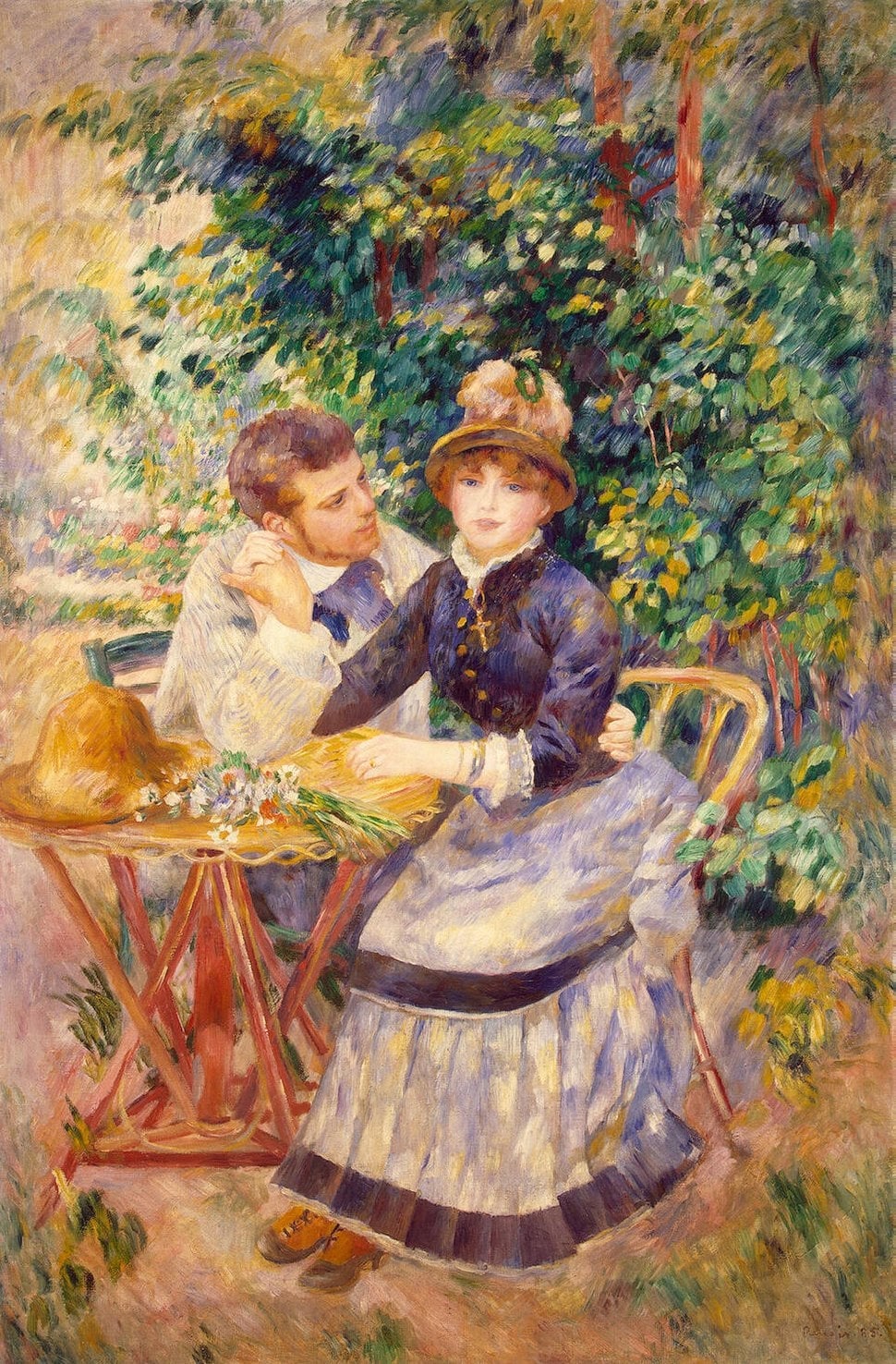
In the Garden by Pierre-Auguste Renoir

In the Garden

Pierre-Auguste Renoir (1885)

In the Garden presents a charged pause in modern leisure: a young couple at a café table under a living arbor of leaves. Their lightly clasped hands and the bouquet on the tabletop signal courtship, while her calm, front-facing gaze checks his lean. Renoir’s flickering brushwork fuses figures and foliage, rendering love as a <strong>transitory, luminous sensation</strong> <sup>[1]</sup><sup>[3]</sup>.
Young Girls at the Piano by Pierre-Auguste Renoir

Young Girls at the Piano

Pierre-Auguste Renoir (1892)

Renoir’s Young Girls at the Piano turns a quiet lesson into a scene of <strong>attunement</strong> and <strong>bourgeois grace</strong>. Two adolescents—one seated at the keys, the other leaning to guide the score—embody harmony between discipline and delight, rendered in Renoir’s late, <strong>luminous</strong> touch <sup>[1]</sup><sup>[2]</sup>.

Pont Neuf Paris by Pierre-Auguste Renoir

Pont Neuf Paris

Pierre-Auguste Renoir (1872)

In Pont Neuf Paris, Pierre-Auguste Renoir turns the oldest bridge in Paris into a stage where <strong>light</strong> and <strong>movement</strong> bind a city back together. From a high perch, he orchestrates crowds, carriages, gas lamps, the rippling Seine, and a fluttering <strong>tricolor</strong> so that everyday bustle reads as civic grace <sup>[1]</sup>.

The Large Bathers by Pierre-Auguste Renoir

The Large Bathers

Pierre-Auguste Renoir (1884–1887)

Pierre-Auguste Renoir’s The Large Bathers unites modern bodies with a pastoral grove to stage an <strong>Arcadian ideal</strong>. Three monumental nudes form interlocking curves and triangles while two background figures splash and groom, fusing <strong>sensual warmth</strong> with <strong>classical order</strong> <sup>[1]</sup><sup>[2]</sup>.

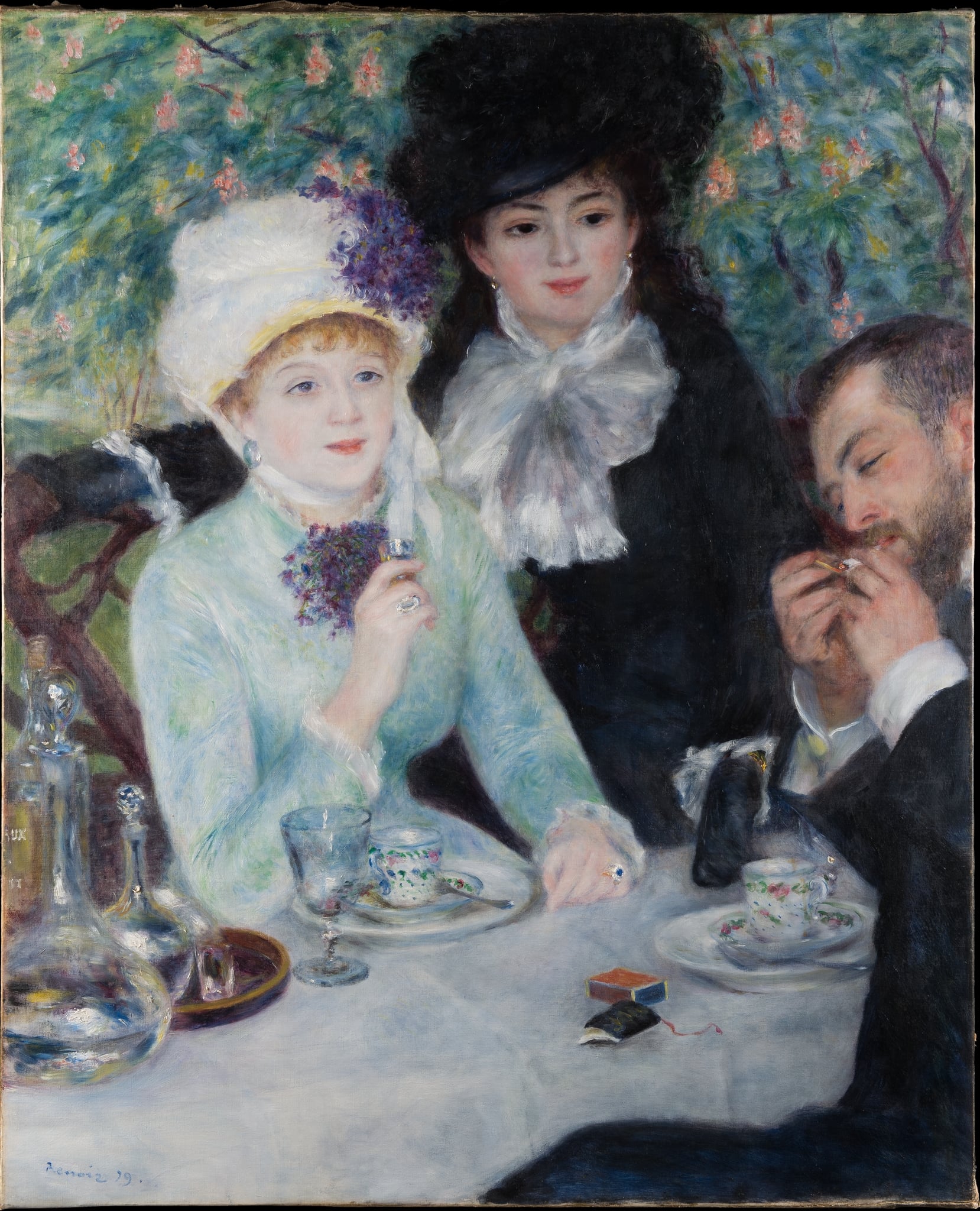
After the Luncheon by Pierre-Auguste Renoir

After the Luncheon

Pierre-Auguste Renoir (1879)

After the Luncheon crystallizes a <strong>suspended instant</strong> of Parisian leisure: coffee finished, glasses dappled with light, and a cigarette just being lit. Renoir’s <strong>shimmering brushwork</strong> and the trellised spring foliage turn the scene into a tapestry of conviviality where time briefly pauses.
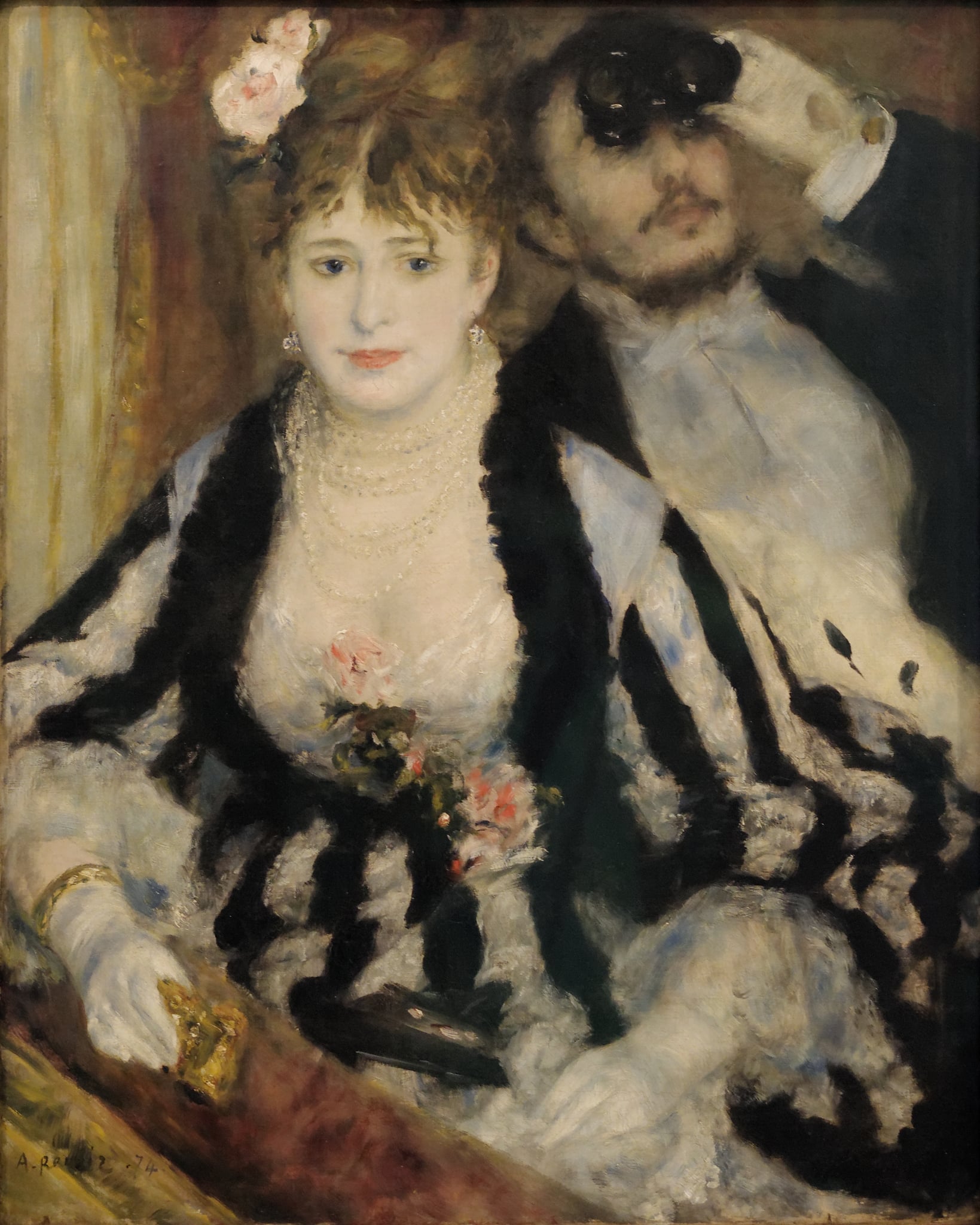
The Loge by Pierre-Auguste Renoir

The Loge

Pierre-Auguste Renoir (1874)

Renoir’s The Loge (1874) turns an opera box into a <strong>stage of looking</strong>, where a woman meets our gaze while her companion scans the crowd through binoculars. The painting’s <strong>frame-within-a-frame</strong> and glittering fashion make modern Parisian leisure both alluring and self-conscious, turning spectators into spectacles <sup>[1]</sup><sup>[2]</sup>.