The Sleeping Venus
by Giorgione
In The Sleeping Venus, the goddess reclines across a rolling landscape, her body a serene diagonal that fuses human beauty with nature’s forms. Cool, silvery drapery and deep red cushions intensify her luminous flesh, while the right-hand Venus pudica gesture suspends desire between revelation and restraint. The painting crystallizes the Venetian ideal of poetic harmony (poesia) and inaugurates the fully realized reclining nude in Western art [2][4][6].
Study Print Studio
Create a personal study print
Build a companion study sheet around the part of this painting that speaks to you most. Choose a detail, shape an interpretation, and walk away with something personal and display-worthy.
Fast Facts
- Year
- c. 1508–1510
- Medium
- Oil on canvas
- Dimensions
- 108.5 × 175 cm
- Location
- Gemäldegalerie Alte Meister (Staatliche Kunstsammlungen Dresden), Dresden
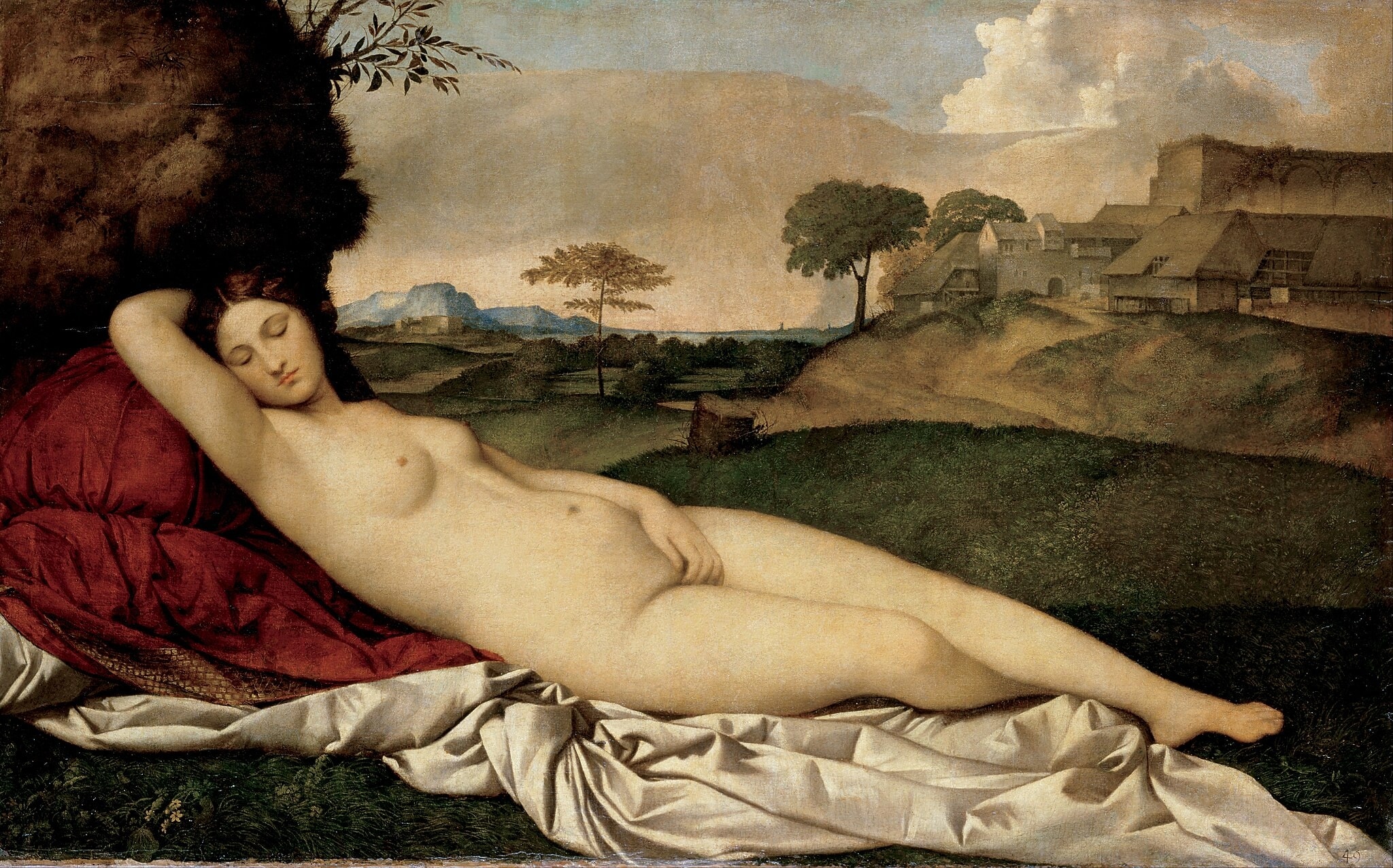
Click on any numbered symbol to learn more about its meaning
Meaning & Symbolism
The painting’s claim is that beauty and nature are not opposites but a single order. Venus’s body runs in a long, tranquil diagonal from the right foot to the shaded head; her contour is quietly rhymed by the low green ridge that rises and falls behind her, by the soft mounds near the farmstead, and by the distant blue massif on the horizon. The sky’s capacious cloud bank swells rather than storms, mirroring her closed eyes and even breath. These visual correspondences make the figure the landscape’s inner principle: the earth appears fertile yet pacified, an image of cosmic concord as love’s effect in the world 24. The color orchestration intensifies this claim without noise. The deep red cushions set off the cool silvery drapery, both tuned to make the flesh glow without harsh contrast; it is a Venetian colorito that courts sensuality while keeping the register hushed. Her right hand performs the pudica gesture—at once withholding and offering—so the painting frames eros as measured and civil, not turbulent. In Renaissance marriage culture, such a pose could channel desire toward fecund, lawful union; that message would have been explicit when a Cupid—documented in early testimony—stood at her feet, later overpainted and removed, shifting the scene from mythic declaration to introspective ideal 34.
The work also asserts a new pictorial type and a Venetian theory of painting. The scale and completeness of the recumbent nude, set not in a mythic architecture but in living countryside, creates the model later elaborated by Titian and, through him, by Velázquez and Manet. Its innovation lies less in display than in mood: Giorgione converts narrative into poesia, a sustained tonal atmosphere where meaning arises from analogies—curve to hill, breath to cloud, flesh to light—rather than from action 26. That the landscape and sky were likely brought to completion by Titian after Giorgione’s death, as recorded by Marcantonio Michiel, only underscores the work’s program: the goddess and her world cohere so completely that two hands can finish one thought 3. Even small specifics bind the claim. The distant town at the right, tucked beneath a bank of trees, suggests human dwelling folded into Venus’s domain; the narrow stream at mid-ground leads the eye to the horizon’s blue, a visual irrigation of the land that metaphorizes her generative power. The crisp crease at the drapery’s edge near her ankle catches highlights like surf on a shore, an image that turns the sheet into a luminous littoral where body meets world. In sum, The Sleeping Venus teaches that love’s calm rule orders nature, desire, and civic life into equilibrium. This is why The Sleeping Venus is important: it founds the Venetian reclining nude as a vehicle not just for beauty but for a humanist cosmology in which sensuality and order are the same art 124.
Explore Deeper with AI
Ask questions about The Sleeping Venus
Popular questions:
Powered by AI • Get instant insights about this artwork
💬 Ask questions about this artwork!
Interpretations
Authorship & Collaboration (Connoisseurship Lens)
The painting’s meaning is inseparable from its contested making. Marcantonio Michiel’s 1525 note credits Giorgione with the Venus and Titian with finishing the landscape and Cupid, a rare primary testimony to collaborative authorship in early 16th‑century Venice 3. Today the Gemäldegalerie often lists “Giorgione/Titian,” and some scholars extend Titian’s hand even to the figure, a debate complicated by the canvas’s transfer and lost underdrawing 148. Rather than undermining unity, the seamless integration supports a Venetian idea of painting as poesia—a shared atmospheric conception beyond a single signature. The prototype status of this nude thus emerges not from solitary invention but from a workshop ecology where concept, colorito, and finish cohere across hands, modeling authorship as a continuum rather than a proprietary seal 28.
Source: Britannica; SKD (Gemäldegalerie Alte Meister); Marcantonio Michiel
Marriage Picture Hypothesis (Social History of Art)
If linked to Girolamo Marcello’s 1507 marriage, the sleeping goddess operates as bridal allegory: the fertile valley, the (now-missing) Cupid, and the pudica gesture align erotic pleasure with lawful union and procreation 346. Rona Goffen’s work on Venetian marriage imagery—especially Titian’s later Venus of Urbino—clarifies how licit desire was visualized: controlled sensuality, domestic cues, and beliefs about female pleasure aiding conception 56. Transposed back to Giorgione’s prototype, the painting would function as an elite domestic object that channels eros into household virtue. Even absent explicit bridal emblems, the tonal hush, measured touch, and pastoral order render Venus not a courtesan’s emblem but a civic-moral ideal of fecund concord in the home, aligning private affect with public stability 56.
Source: Rona Goffen; Perspectives of History (on Venus of Urbino); Michiel
Iconographic Shift Without Cupid (Reception & Conservation Studies)
Michiel saw a Cupid at Venus’s feet; later overpaint and removal effaced him, transforming a mythologically explicit Venus-with-Cupid into a solitary, introspective nude 349. This conservation history reframes iconography: without Cupid’s sanctioning presence, viewers encounter a more idealized, universal beauty and a heightened fusion of body and land. The change also intensifies the painting’s poesia—less narrative cue, more atmospheric drift—prompting modern audiences to read the scene as inner state rather than mythic vignette 24. In effect, 19th‑century interventions recalibrated the work from a marriage-friendly Venus toward a philosophical landscape of embodied harmony, demonstrating how material history can redirect meaning and underscore the autonomy of mood in the Venetian mode 49.
Source: Britannica; Wikipedia (EN/IT); Marcantonio Michiel
Prototype and Legacy (Form & Influence)
Often hailed as the first fully realized large-scale recumbent nude, the work engineers a format later revoiced by Titian’s Venus of Urbino and, through him, Velázquez and Manet 27. Its formal novelty lies not in bravura display but in tonal unity: the diagonal body rhymes with hills; cool drapery and warm cushions ignite flesh while sustaining hush. By substituting narrative incident with poetic equivalence, Giorgione (with Titian) invents a genre where the nude convenes landscape, mood, and desire into one pictorial thesis 2. This genealogy matters: Manet’s Olympia fractures the concord that Dresden’s Venus models, proving the type’s durability as an arena for testing modernity’s tensions between erotic frankness, social codes, and painterly truth 7.
Source: Britannica; The Guardian (survey essay)
Geopolitical Allegory (Postcolonial/Geocritical Reading)
A minority view reads the Venus as an allegory of Cyprus, then under Venetian control: the body’s island-like contour and the topography conjure a cartographic Venus whose beauty encodes imperial possession 4. While speculative, this geocritical lens reframes the serene pastoral as a political landscape, where eroticized territory naturalizes dominion—an early modern precedent for mapping empire through aesthetic form. Even if unproven, the hypothesis exposes how the painting’s analogical logic (body to land) can be mobilized ideologically, complicating its “cosmic concord” with the quiet grammar of power. It reminds us that Venetian poesia—so often celebrated for mood—could also serve as a soft rhetoric of place-making and control in a maritime republic’s cultural imaginary 4.
Source: Wikipedia (summarizing Michael Paraskos’s hypothesis)
Related Themes
About Giorgione
Giorgione (c. 1477/78–1510) was a seminal Venetian painter whose small oeuvre profoundly shaped the city’s poetic, color-driven mode. Renowned for atmospheric ‘poesia’ and idealized forms, he influenced Titian directly; The Sleeping Venus is often treated as a keystone of this legacy [2][5].
View all works by Giorgione →