Haystack, Sunset

by Claude Monet

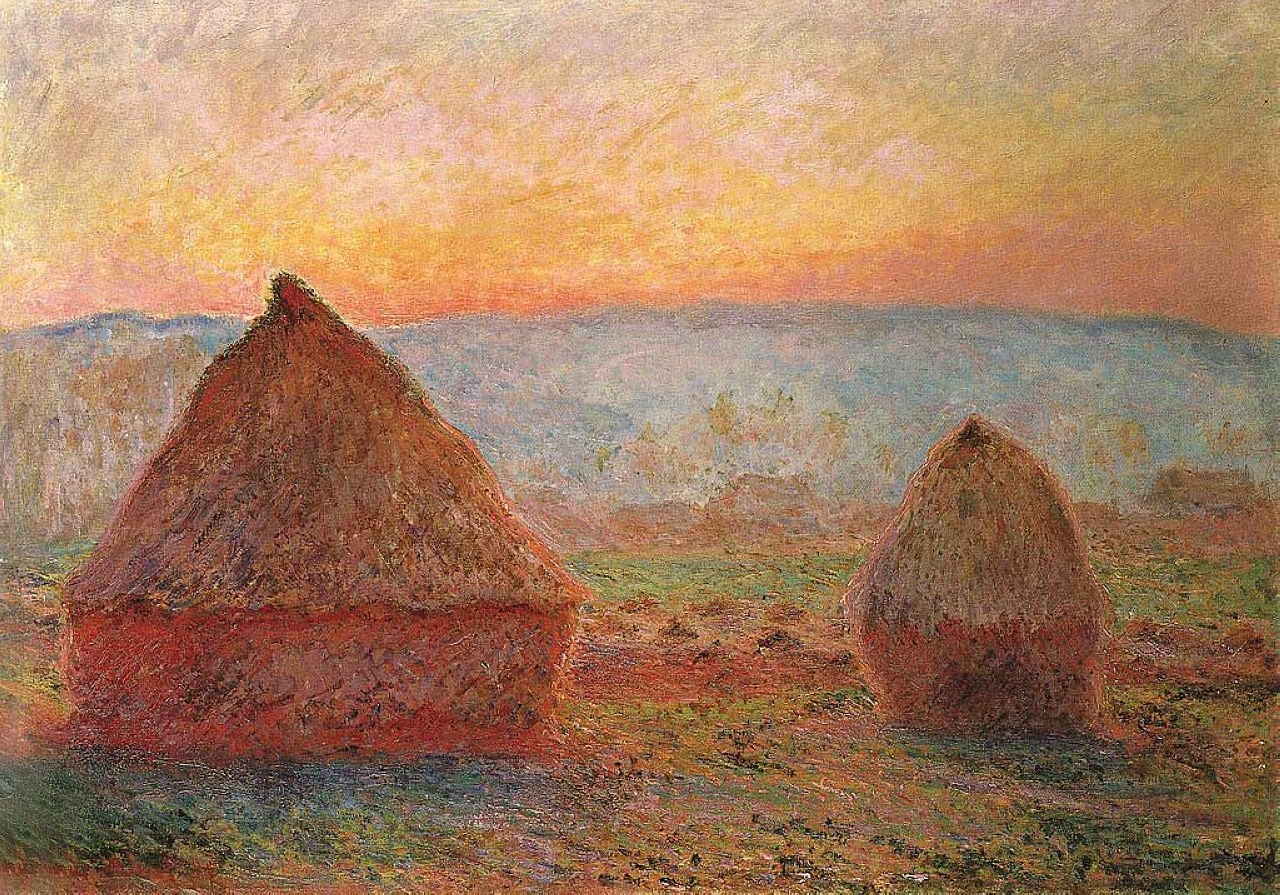
Two conical stacks blaze against a cooling horizon, turning stored grain into a drama of light, time, and rural wealth. Monet’s broken strokes fuse warm oranges and cool violets so the stacks seem to glow from within, embodying the transience of a single sunset and the endurance of agrarian cycles [1][2][3].

Fast Facts

Year
1891
Medium
Oil on canvas
Dimensions
73.3 × 92.7 cm
Location
Museum of Fine Arts, Boston
Haystack, Sunset by Claude Monet (1891) featuring Grainstacks (conical mounds), Sunset corona, Blue‑violet hills (atmospheric veil), Violet‑red shadow skirts

Click on any numbered symbol to learn more about its meaning

Meaning & Symbolism

At first glance the painting presents two conical forms set in an open field, the larger stack anchoring the left foreground while a smaller, tighter cone sits to the right. But the picture’s force comes from the volatile edge where the orange‑rose sky meets a cool blue‑violet belt of hills; that boundary dissolves hard contours and floods the stacks with complementary afterglow. Monet lays short, broken touches of vermilion, rose, and amber across their sun‑lit flanks, while the shadowed skirts pulse with reds and violets instead of neutral brown. This chromatic counterpoint is not decoration but an argument: nature’s forms are perceived through a shifting envelope of light, and color relationships—warm against cool, complement against complement—create solidity and luminosity without relying on line. The hayfield’s mottled greens and russets recede in shimmering bands, making the stacks appear to radiate from within, an optical effect Monet cultivated by working on multiple canvases as the sun moved and then harmonizing them in the studio 23. The subject is not mere hay; scholarship clarifies these as carefully thatched grainstacks—the “wealth” of their owners—constructed to protect harvested wheat through winter 2. That distinction shapes the painting’s symbolism. The conical architecture signals prudent husbandry and local prosperity, while the sunset’s fleeting blaze casts that stability in a register of impermanence. The left stack, monumental and almost architectural, functions like a rural obelisk; its peak catches a final ember of orange as if commemorating the day’s labor before night. The right stack, smaller and set back, extends the motif into depth, a quiet relay that links private wealth to communal landscape. In late‑19th‑century France such images resonated with pride in a fertile countryside and a desire for steady, apolitical anchors in the Third Republic; contemporary critics read the series as revealing the “drama of the earth” in humble forms 245. Thus the painting joins a social field as well as an optical one: it registers the seasonal cycle, the economy of grain, and a national ideal of rural continuity. Why Haystack, Sunset is important, then, is twofold. Formally, it epitomizes Monet’s serial practice—Stacks of Wheat, Poplars, Rouen Cathedral—in which he traded narrative for time-structured perception, attending to specific hours and weathers to build a new pictorial language of duration 36. Historically, its inclusion among the 1891 Durand‑Ruel exhibition’s fifteen stacks marked a breakthrough in the market and criticism, proving that modern art could be both experimentally optical and publicly compelling 4. The canvas’s specific visual cues—the orange corona along the horizon, the violet‑blue veil over the hills, the red‑violet halation at each stack’s base—compress this achievement into one dusk interval: endurance framed by flux, wealth illuminated yet momentarily unguarded, the earth’s labor resting under a sky that is already changing. In this balance of solidity and shimmer, Monet articulates a modern pastoral: not a story about farmers, but a vision of how light writes and rewrites the world before our eyes 1235.

Explore Deeper with AI

Ask questions about Haystack, Sunset

Popular questions:

Powered by AI • Get instant insights about this artwork

💬 Ask questions about this artwork!

Interpretations

Formal Analysis: Serial Method as Optical Engineering

Monet’s “serial” labor is a technical system: shifting between canvases as light changes, then harmonizing chroma and surface in the studio to compress hours into a single interval. In Grainstack (Sunset) the warm corona at the horizon and the blue‑violet veil over the distant ridge act like calibrated color fields that model form without contour. Short, broken touches of vermilion and rose meet complementary violets in the shadows, producing a palpable “afterglow.” This is not Impressionist spontaneity so much as optical engineering: controlled adjacency of complements to simulate luminosity and duration. The procedure—en plein air initiation, studio recomposition—was standard in Monet’s 1890s practice and is central to the grainstacks’ uncanny solidity‑through‑atmosphere 23.

Source: Art Institute of Chicago; National Gallery, London

Symbolic Reading: Agrarian Capital and Risk

These are not casual haycocks but grainstacks—thatched architectures built to safeguard wheat, literally “the wealth of their owners.” Monet’s cones therefore picture stored capital and risk management: protection against rot, weather, and market uncertainty. At sunset the stacks are bathed in volatile color, a reminder that wealth exists under shifting environmental and temporal conditions. The large stack’s obelisk‑like presence in the foreground—flanks ignited by orange‑rose, skirts vibrating with reds and violets—turns prudent husbandry into a public monument. This dual register—practical storage and symbolic prosperity—was legible to contemporary viewers and underpins the series’ cultural charge beyond mere optical study 2.

Source: Art Institute of Chicago (Robert Herbert via AIC scholarly catalogue)

Historical Context: Rural Continuity as Third Republic Ideal

In the early 1890s, France sought stable, apolitical emblems after decades of upheaval. Monet’s stacks, set in Giverny’s fields, supplied an image of rural continuity and fertility that critics embraced. Paul Hayes Tucker links the motif to patriotic pride in a fertile countryside; Octave Mirbeau praised the series as the “drama of the earth,” dignifying humble forms with grandeur. Exhibited en bloc at Durand‑Ruel in 1891, the series met an audience ready to equate agricultural plenitude with national health. Grainstack (Sunset) thus operates in a political imaginary: it naturalizes prosperity as French and enduring, while avoiding overt ideology through the alibi of light and weather 236.

Source: Art Institute of Chicago (Tucker, Mirbeau); National Gallery, London

Modernist Lens: Time‑Structured Perception vs. Narrative

Monet trades anecdote for time‑structured perception: the painting’s subject is not a harvest story but a calibrated moment when warm and cool systems equilibrate. The cones persist as invariants within a changing optical envelope; their identity is constituted by light, not line. This displaces traditional mimesis toward an epistemology of seeing—vision as temporal, contingent, and constructive. Such seriality anticipates modernist concerns with process and duration, where each canvas is a data point in a larger phenomenological set rather than an isolated tableau. Grainstack (Sunset) exemplifies this shift, compressing dusk’s drift into a legible scheme of complements and atmospheric depth 34.

Source: National Gallery, London; Encyclopaedia Britannica

Reception & Market: The Experiment That Sold

The 1891 Durand‑Ruel exhibition of fifteen stacks proved that advanced optical experimentation could command public attention and market success. Critics recognized the audacity of presenting near‑identical motifs differentiated by hour and season; the public responded to their chromatic drama and rural subject. This show consolidated Monet’s finances and reputation, enabling later serial cycles (Poplars, Rouen Cathedral) and validating a model where serial difference itself becomes content. Grainstack (Sunset), with its incandescent horizon and violet shadows, compresses the series’ appeal: visually sumptuous yet conceptually rigorous, it made a persuasive case that modern art could be both experimental and collectible 35.

Source: National Gallery, London; Art Institute of Chicago (gallery text)

Psychological Interpretation: Liminal Light as Memento

Sunset stages a threshold psychology: warmth drains as violets encroach, and the stacks seem to glow from within as if retaining daytime’s memory. The image operates like a memento mori of daylight—wealth and work secured for the night, yet momentarily unguarded under transient color. Mirbeau’s praise for the series’ “drama of the earth” cues this affective register: the drama here is not catastrophe but the poise before disappearance, when perception heightens and edges blur. The painting’s red‑violet halation at the base of each stack intensifies this hover between presence and fade, making dusk feel both consoling and fraught 64.

Source: Art Institute of Chicago (Mirbeau reference); Encyclopaedia Britannica

Related Themes

About Claude Monet

Claude Monet (1840–1926) led Impressionism’s pursuit of open-air painting and optical immediacy, especially during his Argenteuil years focused on modern leisure and light. He later developed serial studies of changing conditions, culminating in the Water Lilies cycle [2].
View all works by Claude Monet

More by Claude Monet

Haystacks Series by Claude Monet | Light, Time & Atmosphere by Claude Monet

Haystacks Series by Claude Monet | Light, Time & Atmosphere

Claude Monet

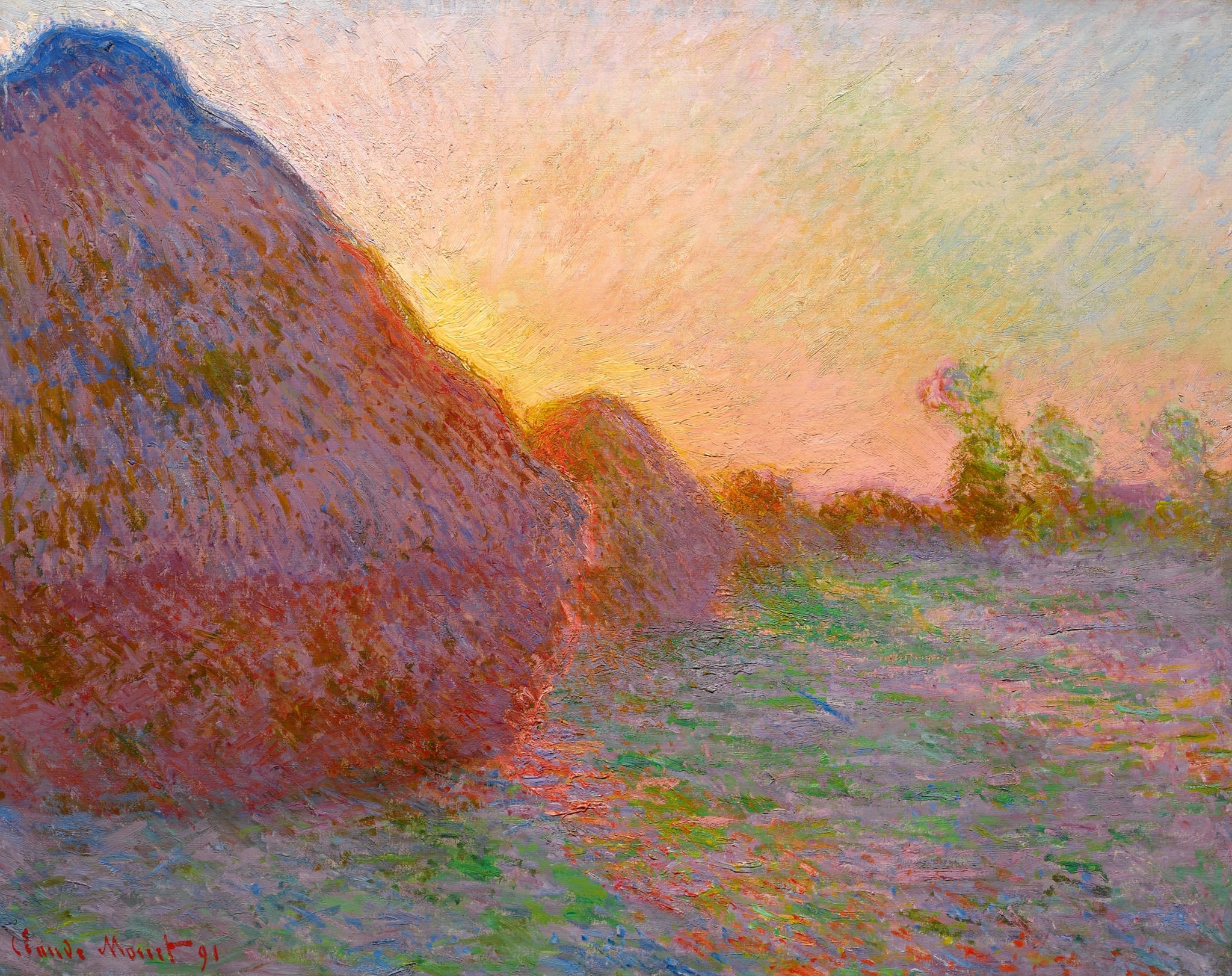
Claude Monet’s <strong>Haystacks Series</strong> transforms a routine rural subject into an inquiry into <strong>light, time, and perception</strong>. In this sunset view, the stacks swell at the left while the sun burns through the gap, making the field shimmer with <strong>apricot, lilac, and blue</strong> vibrations.
The Artist's Garden at Giverny by Claude Monet

The Artist's Garden at Giverny

Claude Monet (1900)

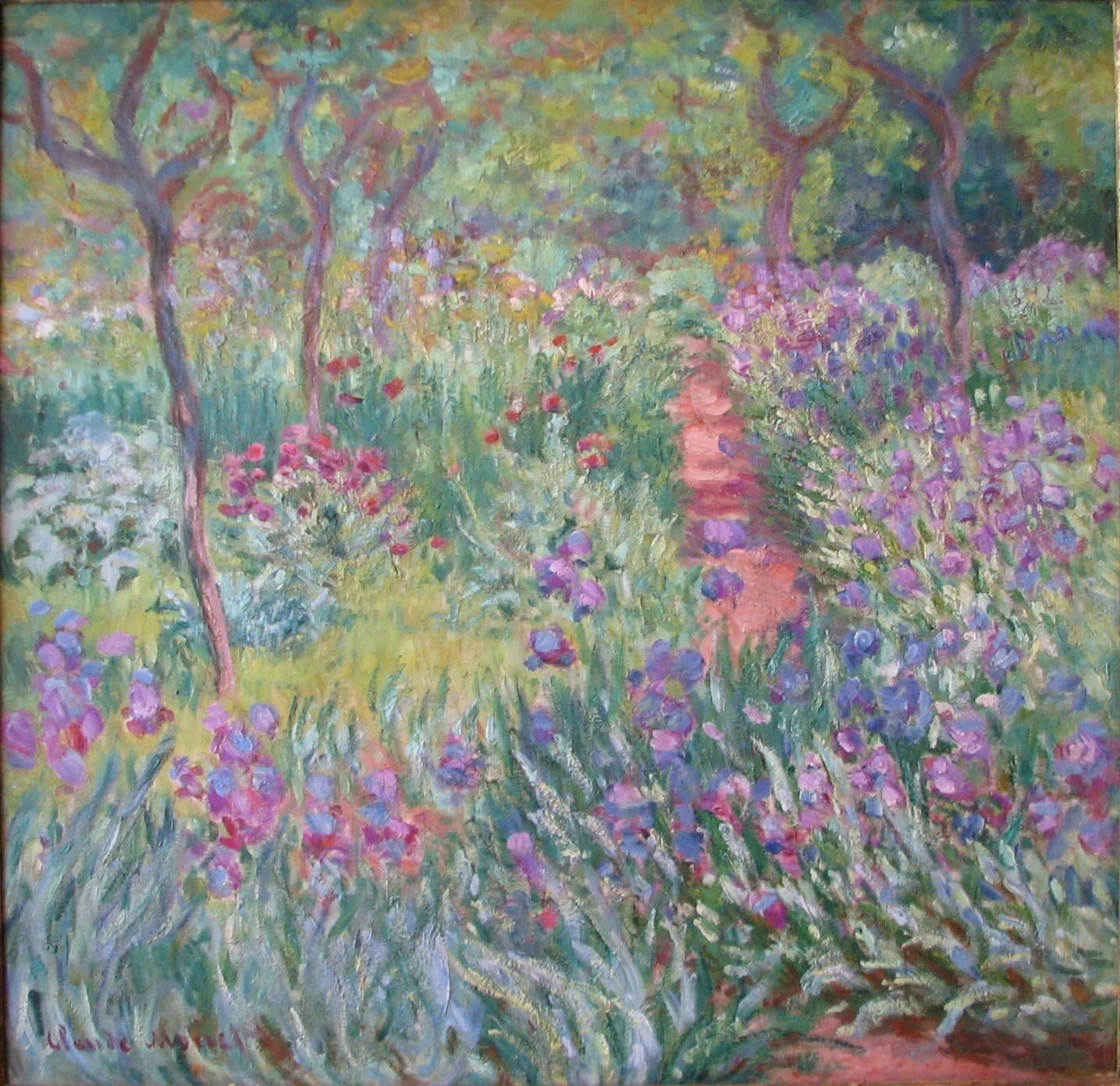
In The Artist's Garden at Giverny, Claude Monet turns his cultivated Clos Normand into a field of living color, where bands of violet <strong>irises</strong> surge toward a narrow, rose‑colored path. Broken, flickering strokes let greens, purples, and pinks mix optically so that light seems to tremble across the scene, while lilac‑toned tree trunks rhythmically guide the gaze inward <sup>[1]</sup><sup>[3]</sup>.
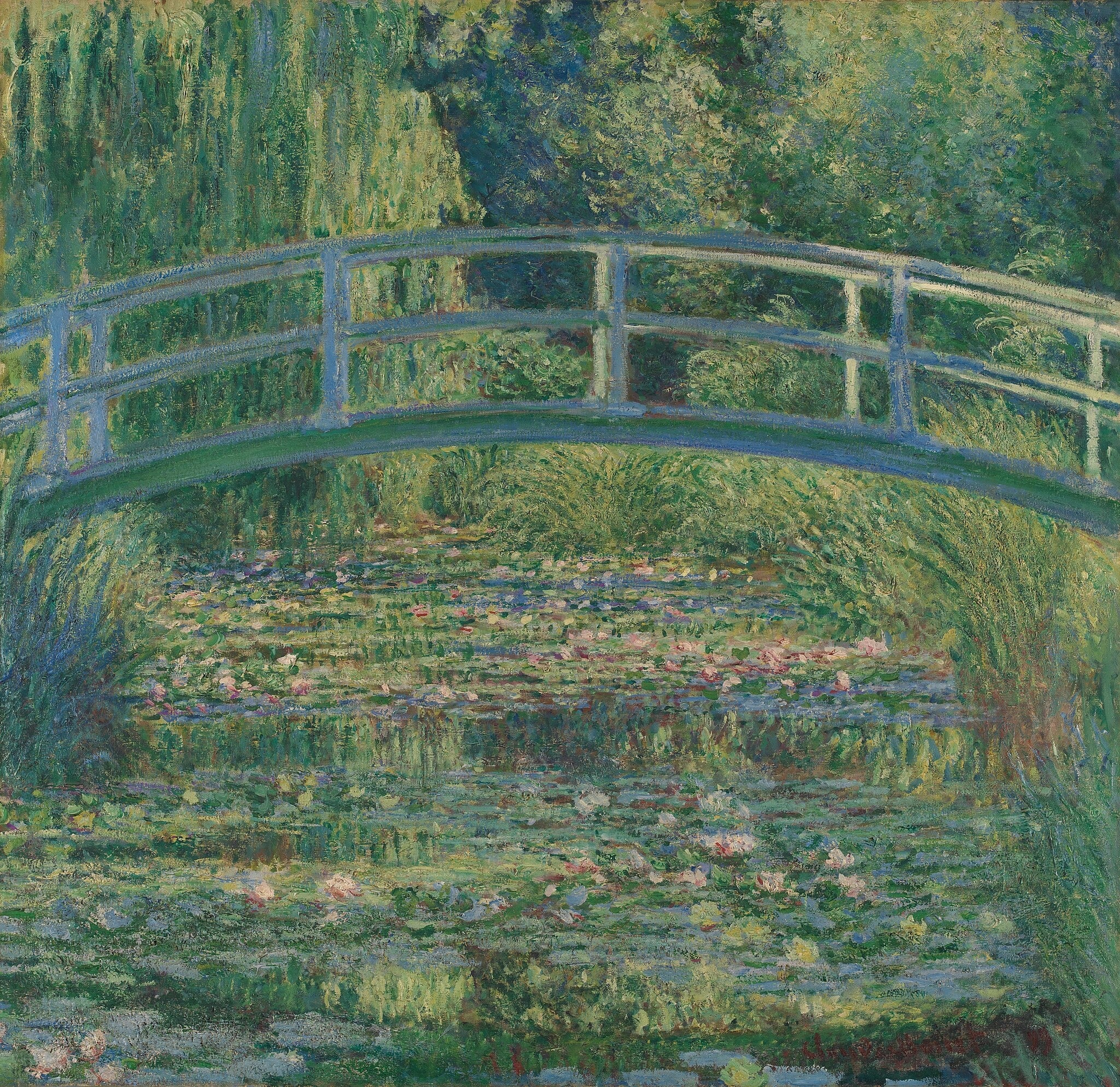
The Water Lily Pond by Claude Monet

The Water Lily Pond

Claude Monet (1899)

Claude Monet’s The Water Lily Pond transforms a designed garden into a theater of <strong>perception and reflection</strong>. The pale, arched <strong>Japanese bridge</strong> hovers over a surface where lilies, reeds, and mirrored willow fronds dissolve boundaries between water and sky, proposing <strong>seeing itself</strong> as the subject <sup>[1]</sup><sup>[3]</sup>.

Waterloo Bridge, Sunlight Effect by Claude Monet

Waterloo Bridge, Sunlight Effect

Claude Monet (1903 (begun 1900))

Claude Monet’s Waterloo Bridge, Sunlight Effect renders London as a <strong>lilac-blue atmosphere</strong> where form yields to light. The bridge’s stone arches persist as anchors, yet the span dissolves into mist while <strong>flecks of lemon and ember</strong> signal modern traffic crossing a city made weightless <sup>[1]</sup><sup>[2]</sup>. Vertical hints of chimneys haunt the distance, binding industry to beauty as the Thames shimmers with the same notes as the sky <sup>[1]</sup><sup>[3]</sup>.

Morning on the Seine (series) by Claude Monet

Morning on the Seine (series)

Claude Monet (1897)

Claude Monet’s Morning on the Seine (series) turns dawn into an inquiry about <strong>perception</strong> and <strong>time</strong>. In this canvas, the left bank’s shadowed foliage dissolves into lavender mist while a pale radiance opens at right, fusing sky and water into a single, reflective field <sup>[1]</sup><sup>[2]</sup>.

Woman with a Parasol by Claude Monet

Woman with a Parasol

Claude Monet (1875)

Claude Monet’s Woman with a Parasol fixes a breezy hillside instant in high, shifting light, setting a figure beneath a <strong>green parasol</strong> against a vast, vibrating sky. The low vantage and <strong>broken brushwork</strong> merge dress, clouds, and grasses into one atmosphere, while a child at the rise anchors depth and intimacy <sup>[1]</sup>. It is a manifesto of <strong>plein-air</strong> perception—painting the sensation of air in motion rather than the contours of things <sup>[2]</sup>.