The Garden of Eden with the Fall of Man

by Peter Paul Rubens

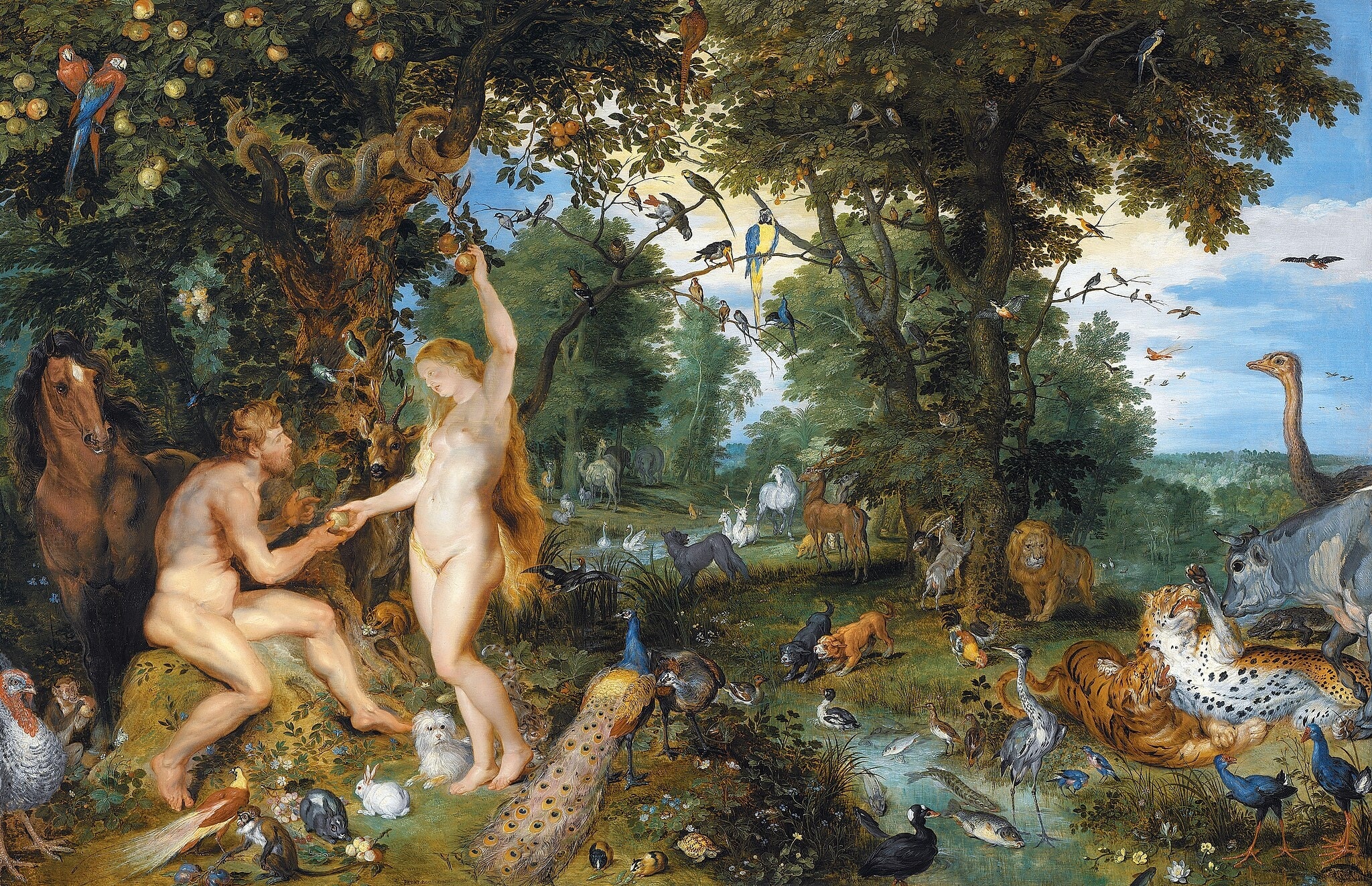
The Garden of Eden with the Fall of Man stages the instant Eve passes the forbidden fruit to Adam as the serpent coils above and a teeming paradise encircles them. The panel fuses Peter Paul Rubens’s dramatic nudes with Jan Brueghel the Elder’s encyclopedic fauna and flora, turning Eden into a lush theatre of temptation and consequence [1]. Light isolates Eve’s raised arm and golden hair while predators stir at the margins, signaling paradise in the act of unraveling.

Fast Facts

Year
c. 1615
Medium
Oil on panel
Dimensions
74.3 × 114.7 cm
Location
Mauritshuis, The Hague
The Garden of Eden with the Fall of Man by Peter Paul Rubens (c. 1615) featuring Serpent, Forbidden fruit, Peacock, Monkey

Click on any numbered symbol to learn more about its meaning

Meaning & Symbolism

At the center, Rubens sets a compact drama of reciprocity: Eve extends one fruit while lifting another; Adam’s hand meets hers with visible hesitation. Above them, the serpent knots itself around the fruit‑laden trunk, its looping body mirroring the circular logic of temptation—desire feeding on the very abundance Eden provides 1. A bright cluster of grapes hangs just over Adam’s head, an emblem that leaps from still-life detail to doctrinal claim: the fruit of the vine prefigures the blood of Christ and the Eucharist, the remedy that answers the original sin about to be committed 1. Behind Adam, a small monkey already gnaws an apple; in period iconography monkeys mark vice and unreason, so this creature functions as a visual prolepsis of Adam’s fall—sin enacted in miniature before the deed itself 1. Rubens intensifies the moral focus by bathing Eve’s torso and streaming hair in a warm, frontal light, while Adam recedes slightly into the cooler shade of the tree, a tonal shift that frames Eve as the conduit of desire and Adam as the will about to yield. Brueghel’s surrounding world is not a backdrop but a cosmos of consequences. At the left, a muscular horse, painted by Rubens, peers in with alert awareness, while parrots cluster like chattering witnesses on the branches above 1. Across the foreground, paired animals—rabbits, ducks, peafowl—parade the harmony of creation, yet at the right that order frays: a big cat pins its prey, lions emerge from the gloom, and birds scatter over a restless pond. This progression from calm proximity to predation stages the instant paradise tilts toward history’s violence. The proud peacock unfurls a jeweled tail near Eve’s feet; in Christian symbolism it can signal immortality and resurrection, but in moralizing contexts it also stands for pride, the vice that underwrites the Fall—an ambiguity Brueghel exploits at the very threshold of sin 56. Even the light maps theology: the near distance glows with clarity, while the far horizon cools to blue, implying a world beyond innocence that Adam and Eve will soon enter. Brueghel’s almost taxonomic rendering—made possible by direct study of exotic species in princely menageries—turns nature into a catalogue of signs that both celebrate creation and diagnose its coming rupture 1. As an object, the panel declares the power of collaboration. The Mauritshuis records that Rubens not only painted the figures but also initiated the panel and handled the horse, serpent, and tree, while Brueghel orchestrated the landscape and meticulously finished the flora and fauna; both then signed the work 1. The joining of Rubens’s kinetic anatomy to Brueghel’s minute observation elevates the Fall from moral anecdote to Baroque statecraft: a princely picture designed to overwhelm, to teach through splendor, and to advertise Antwerp’s studios as laboratories where human drama and natural knowledge meet 12. In this sense, the painting argues that beauty is never neutral. By dazzling the eye—the peacock’s iridescence, the ostrich’s odd gaze, the mirrored surfaces of water and hide—it makes visible the paradox at Eden’s heart: that the goodness of creation can become the very vehicle of transgression when desire mistakes gift for possession. The painting fixes the second before the bite, but everywhere around that poised exchange the world has already started to tell us what happens next.

Explore Deeper with AI

Ask questions about The Garden of Eden with the Fall of Man

Popular questions:

Powered by AI • Get instant insights about this artwork

💬 Ask questions about this artwork!

Interpretations

Workshop Practice & Authorship Politics

This panel is a case study in Antwerp’s collaborative “specialist” system, where authorship becomes a choreographed brand. Both artists sign, yet museum research shows Rubens initiated the panel and handled not only the figures but also the horse, serpent, and tree—while Brueghel completed the flora and fauna with microscopic finish. The result is a calculated fusion of virtuosi: Rubens’s energized anatomy anchors narrative gravitas; Brueghel’s empirical detail certifies worldly knowledge. As a “spectacle piece,” it sold collaboration itself as a courtly commodity, signaling a workshop ecology able to marshal multiple expertises into a single, princely image. The panel thus theorizes authorship less as solitary genius than as synergistic labor—an early modern answer to how grand narratives and natural knowledge could be co-produced on one stage 12.

Source: Mauritshuis; Getty/Mauritshuis, Rubens & Brueghel: A Working Friendship

Typology and Eucharistic Time

The bright grapes above Adam articulate a typological reading in which Eden folds into Calvary: the fruit of the vine becomes a cipher for the Eucharist, proposing the Mass as the remedy already inscribed in the moment of sin. Rubens and Brueghel stage a Baroque temporality where sacred history operates nonlinearly—the Fall prefigures Redemption, and the picture asks viewers to inhabit that liturgical loop. This is not mere iconographic garnish but a doctrinal claim about sacramental presence: abundance, once misused, is transmuted through Christ’s blood into saving grace. The painting’s suspended instant—hands meeting before the bite—therefore preserves a charged interval where agency, culpability, and mercy converge, making theological time palpable through still-life precision 1.

Source: Mauritshuis

Nature as a Theatre of Knowledge

Brueghel’s menagerie is more than pastoral décor; it is an epistemic display born from first-hand study of exotic species in the Archducal menagerie. The near-taxonomic spread—paired, varied, and meticulously lit—performs early modern natural history within a sacred narrative frame. Such mimesis functions devotionally: to know creation accurately is to read the Creator’s book. Yet accuracy is bent toward moral narrative; species become sign-bearing actors that forecast the world’s postlapsarian drift. The painting thus sutures empirical seeing to theology, rehearsing a Baroque conviction that science, spectacle, and salvation history can be coextensive on a single panel—a key reason patrons coveted these collaborative paradises as demonstrations of cultured knowledge and pious display 12.

Source: Mauritshuis; Getty/Mauritshuis, Rubens & Brueghel: A Working Friendship

Ambivalent Emblems and Moral Psychology

Animal emblems calibrate the painting’s ethics by mixing clarity with productive ambiguity. The monkey behind Adam—long a cipher for unreason and vice—offers an unequivocal prolepsis of the Fall. By contrast, the peacock near Eve’s feet is double-coded: in Christian art it can betoken immortality and resurrection, yet also pride and vanity. This oscillation forces viewers to adjudicate meaning at the threshold of sin: is Eden’s jeweled beauty a promise of glory or a lure to self-regard? Such polysemy aligns with Baroque pedagogy, engaging conscience through visual dialectic rather than fiat. Even the cat nuzzling at Eve—left uninterpreted by the museum—contributes to a field where domesticity, cunning, and sensuality blur, sharpening the psychological stakes of the central exchange 145.

Source: Mauritshuis; The Metropolitan Museum of Art; Kimbell Art Museum

Spectacle, Courtly Power, and Devotion

The painting’s afterlife underscores its function as princely propaganda. Fetching a price far above peers when acquired for Prince William V, the panel exemplified how Antwerp workshops supplied rulers with objects that conjoined splendor and instruction. Rubens’s status as a court painter and diplomat inflects the work’s rhetoric: overwhelming abundance, doctrinal clarity, and consummate craft model a politics of ornamented authority, where visual pleasure legitimizes power by appearing to harmonize beauty, order, and piety. In a gallery, the work operates as a devotional-luxury hybrid—catechesis by way of magnificence—advertising a regime in which divine and princely order mirror one another through art’s persuasive pageantry 13.

Source: Mauritshuis; National Gallery (London)

From Harmony to Predation: Spatial Ethics

The composition encodes an ethical gradient across space: paired animals in calm adjacency modulate, rightward, into stalking cats, roused lions, and scattering birds. This is more than narrative foreshadowing; it visualizes the theological notion of natura lapsa—creation’s state under sin—radiating outward from human will into ecology. The shift in atmospheric light and chromatic cooling toward the horizon doubles this moral cartography, suggesting an exit from innocence into the historical world. Rubens’s compact drama becomes a fulcrum that tips Brueghel’s living atlas from order to entropy, asking viewers to read environment as a register of ethical time—an Edenic ecology already answering the human act it frames 1.

Source: Mauritshuis

Related Themes

About Peter Paul Rubens

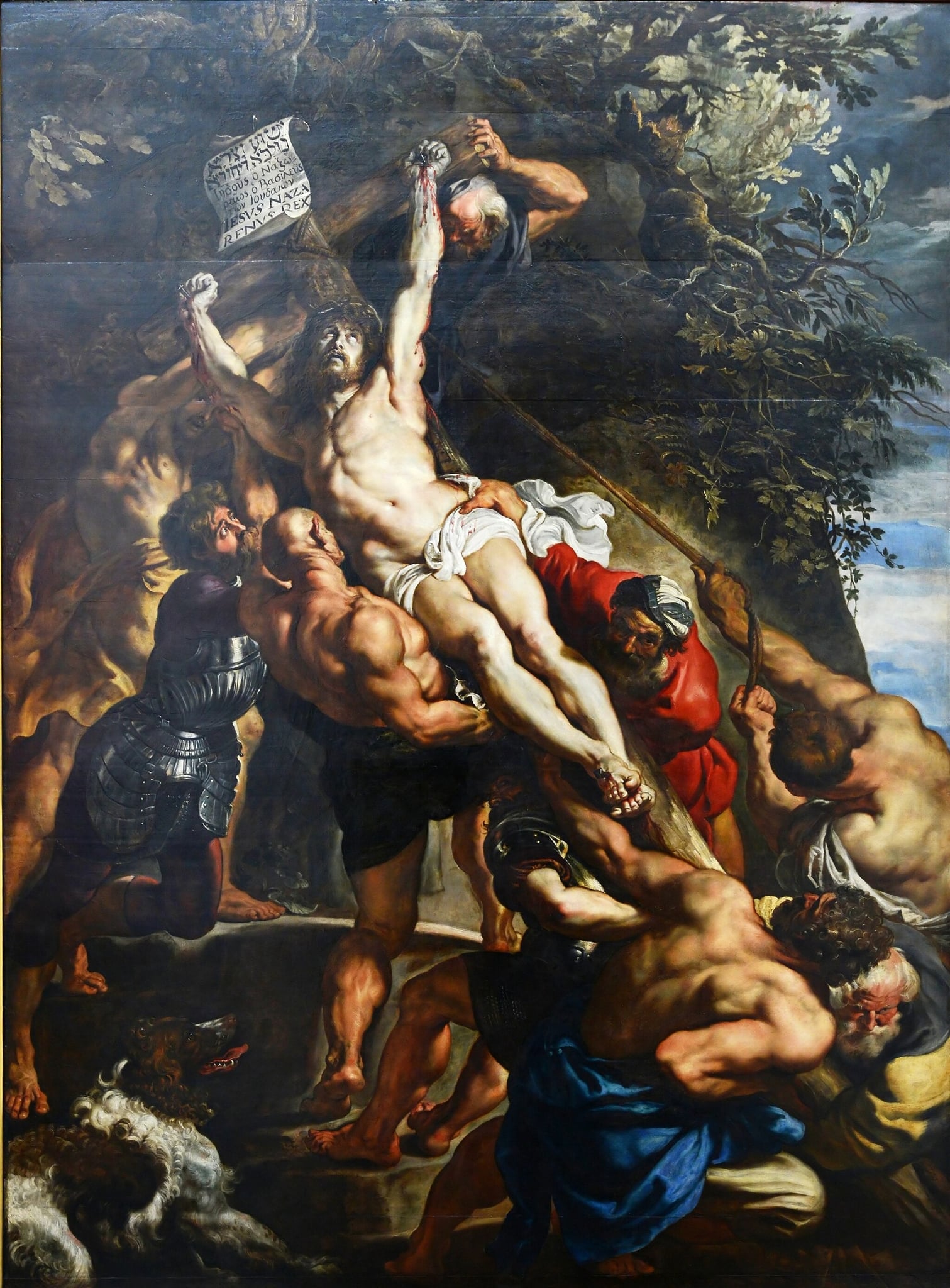
Peter Paul Rubens (1577–1640) returned to Antwerp in 1608 after eight formative years in Italy, where he absorbed classical sculpture, Venetian color, and new dramatic lighting. Appointed court painter in 1609, he rapidly organized a major workshop and shaped Flemish Baroque art. The Elevation of the Cross was among his first monumental public commissions, announcing his mature synthesis [3][6].
View all works by Peter Paul Rubens

More by Peter Paul Rubens