The Elevation of the Cross
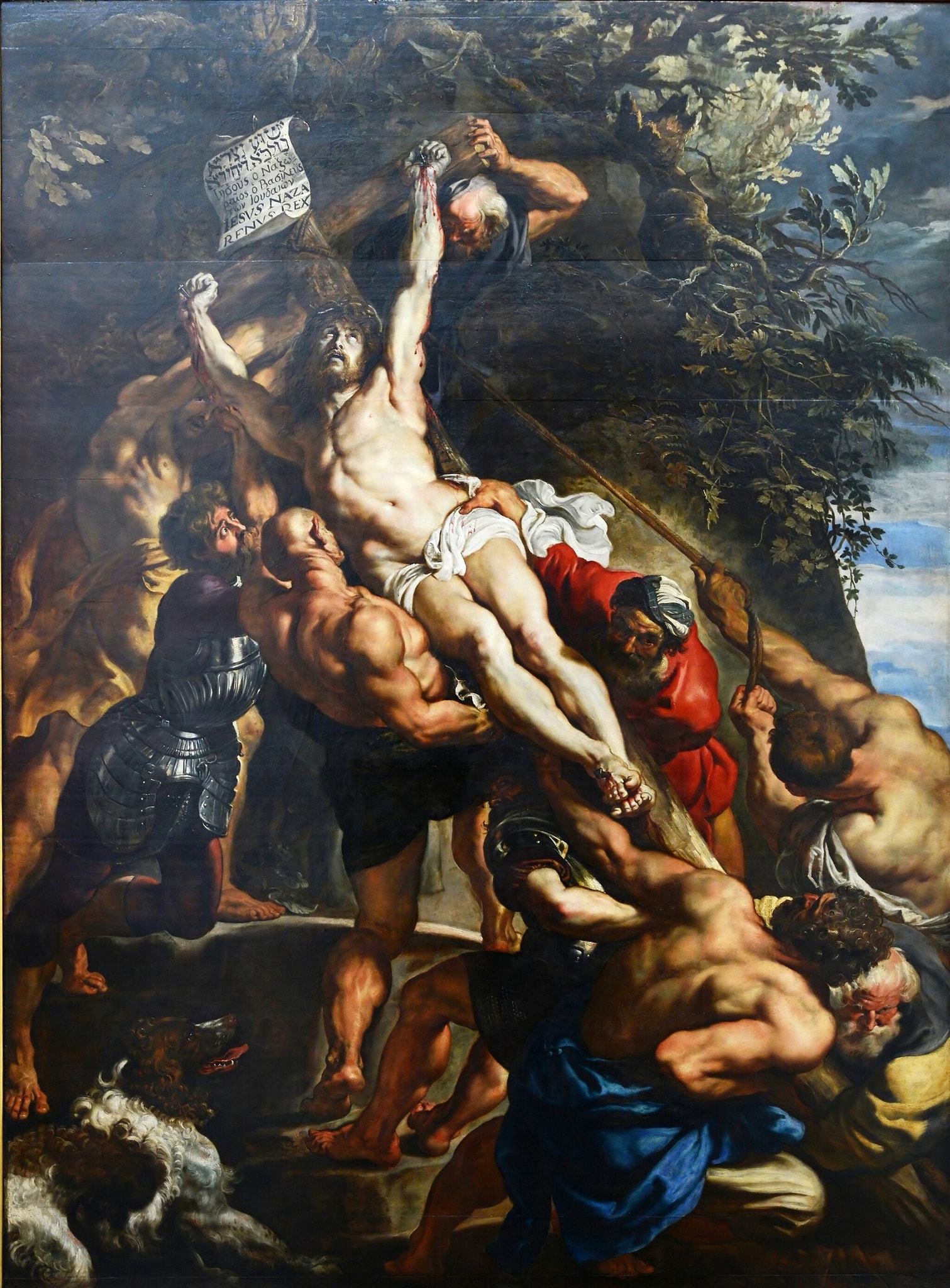
A single, surging diagonal drives The Elevation of the Cross as straining executioners heave the timber while Christ’s pale body becomes the calm, radiant fulcrum. Rubens fuses muscular anatomy, flashing armor, taut ropes, and storm-dark landscape into a Baroque crescendo where divine light confronts human violence [1][3].
Fast Facts
- Year
- 1609–1610
- Medium
- Oil on panel
- Dimensions
- Center panel approx. 460 × 340 cm
- Location
- Cathedral of Our Lady, Antwerp
Click on any numbered symbol to learn more about its meaning
Meaning & Symbolism
Rubens composes the scene on a razor-stretched diagonal from the boulder and dog at lower left to the INRI tablet at upper left, making Christ’s body the turning point where matter is forced upward and meaning descends. The men in blue, red, and steel lean and twist like cogs in a human machine; veins swell, backs torque, and ropes bite into hands, converting weight into motion. Yet Christ—head crowned with thorns, eyes lifted, torso arched—glows in a cool, even light, his serenity resisting the vortex of effort below. The oppositions are programmatic: fleshly might versus grace, darkness versus radiance, compulsion versus willed sacrifice. Rubens’s lighting and Herculean physiques—assimilating lessons from Italy—stage an immediate, bodily pathos while asserting a transcendent register through the unbroken contour and luminosity of Christ’s form 3. The barked command of the scene is kinetic, but its doctrinal claim is stillness: divinity is not dragged; it is exalted 13.
Every prop tightens the argument. The INRI placard atop the timber crowns an execution with kingship; armor plates gleam as emblems of worldly power that cannot dim the figure they surround; the ropes and levers externalize the otherwise invisible gravity of sin that the lifted Christ bears. Blood beads from nails and toes where hands yank the shaft, but the white loincloth and porcelain light seal him off from moral contamination even as he is handled. The gnarled tree and thickets on the right echo the cross’s wood, binding creation’s history to Golgotha; some viewers read in these forms a typology of the Tree of Life and Eucharistic vine—plausible within Catholic symbolism, though not documentary to the commission 8. At the lower left, a hound barks into the tumult, a mundane witness that grounds the miracle in ordinary time; Northern tradition often makes the dog a sign of fidelity, and some connect it to Psalm 22’s “dogs surround me,” an interpretive but resonant parallel for Passion scenes 8.
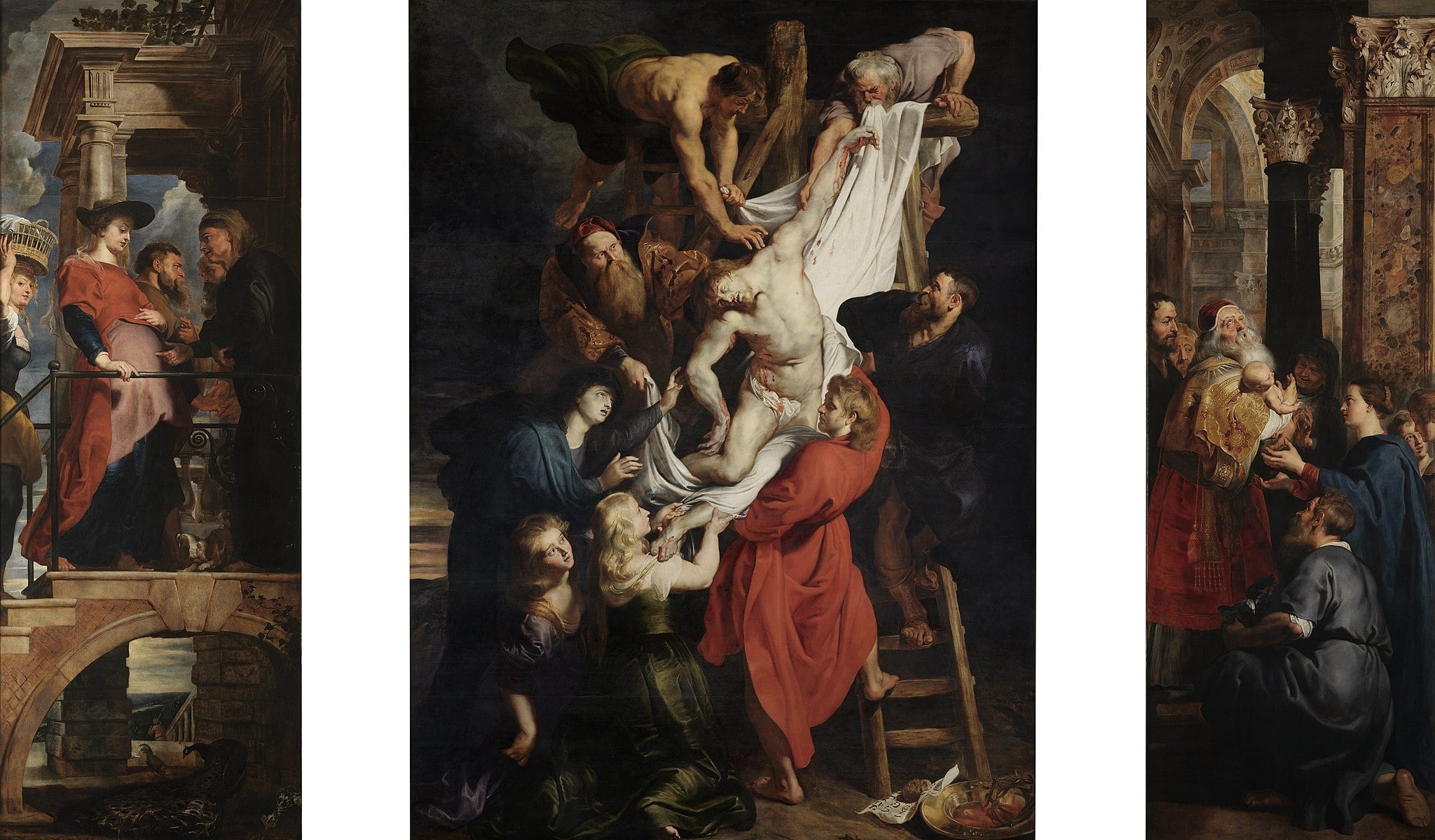
Liturgically, the painting functioned as an altar image whose single, continuous action extended across a triptych—an innovation aimed at legibility from distance and at synchronizing viewers’ bodies with the scene’s upward thrust during worship 1. That unity of motion and meaning exemplifies Counter‑Reformation visual rhetoric: clarity of subject, heightened affect, and the invitation to empathetic participation that converts looking into devotion 3. Historically, installed for Antwerp’s St. Walburga and later moved to the Cathedral of Our Lady, the work declared Rubens’s synthesis of Michelangelesque anatomy, Venetian color, and dramatic chiaroscuro into a distinctively Flemish Baroque language—a language that would dominate Northern altarpieces for a generation 23. In short, The Elevation of the Cross is not just a depiction of hoisting; it is a proclamation that salvation takes place in time and muscle, yet shines from beyond them.
Explore Deeper with AI
Ask questions about The Elevation of the Cross
Popular questions:
Powered by AI • Get instant insights about this artwork
💬 Ask questions about this artwork!
Interpretations
Formal Analysis: A Continuous Triptych Engineered for Distance
Rubens fuses three panels into one uninterrupted event, a rare Netherlandish choice that makes the surging diagonal legible from the nave. The device is Baroque to the core: a single vector from boulder to INRI concentrates action, while the unbroken contour of Christ acts as a visual hinge. This macro‑unity synchronizes viewers’ bodies with the painting’s upward torque, converting sightlines into participation. The composition’s tensile balance—mass stacked on a rising axis, counterweighted by torsion and rope—turns theology into physics. From afar, high-contrast chiaroscuro resolves into a clear subject; up close, layered glazes model Herculean volumes that quote Italian exemplars. Form becomes rhetoric: clarity, affect, and immediacy in the service of doctrine 12.
Source: Smarthistory; Cathedral of Our Lady, Antwerp
Liturgical Function: Choreographing Devotion in Post‑Tridentine Antwerp
As a high‑altar image, the work was designed to be seen during Mass, processions, and kneeling prayer. Its continuous motion models the faithful’s ascent—an image to be bodily mirrored as congregants rise, kneel, and look upward. This is Counter‑Reformation optics: intelligibility joined to affective persuasion, directing viewers from pathos to assent. Scholars situate Rubens’s altarpieces within spatial choreographies that redirect lay attention to sacramental action; the Elevation’s rising beam visually sutures nave to choir, time to eternity. Such staging aligns with Tridentine calls for clarity and devotion, not ambiguity; affect serves catechesis, and spectacle is pressed into service of belief 621.
Source: Cynthia Lawrence (Routledge; bibliographic record via IxTheo); Cathedral of Our Lady; Smarthistory
Classical Quotations: Pagan Heroics Baptized
Rubens absorbs the Laocoön, Farnese prototypes, and Michelangelesque torsions to cast the lifters as antique athletes drafted into sacred history. The muscular rhetoric is not bravura for its own sake: antique heroism is baptized to articulate Christian triumph through suffering. Venetian colorito deepens fleshly immediacy, while Caravaggesque lighting yokes drama to legibility. The result is a hybrid eloquence—Roman monumentality tempered by northern exactitude—that serves a Catholic thesis: the Cross is both scandal and victory. By placing Christ’s luminous body as the compositional fulcrum amid pagan vigor, Rubens folds humanist quotation into a theology of exaltation 138.
Source: Smarthistory; Web Gallery of Art; National Gallery (London)
Civic Theology: Local Saints and Antwerp’s Identity
On the closed wings, Saints Amand, Walburga, Catherine, and Eligius anchor universal salvation to local patronage. Commissioned for St. Walburga and bound to Antwerp’s civic‑religious fabric, the ensemble performs a politics of sanctity: the city’s guardians flank the Passion, implying that communal welfare flows from the altar’s sacrifice. Cornelis van der Geest’s role underscores elite mediation between commerce, parish governance, and art. After Napoleonic seizure and 1815 return, the triptych’s relocation to the Cathedral re‑inscribed Antwerp’s identity through Rubens’s Baroque idiom—devotion doubled as cultural patrimony, a Counter‑Reformation image that became a post‑Napoleonic emblem 43.
Source: Wikipedia (cross‑checked with WGA); Web Gallery of Art
Material and Making: In Situ Craft as Thematic Echo
Contemporary accounts describe Rubens executing the colossal panels in situ at St. Walburga, screened by a stretched ship’s sail. The logistical theater—cranes, scaffolds, massive timbers—mirrors the painting’s own apparatus of ropes and levers. Oil on panel enables pearly highlights and deep shadow pools that carry across the choir; thickened impasto on armor catches sanctuary light like liturgical metalwork. Making and meaning converge: the physical raising of panels into an altar setting parallels the pictured elevation. The craft history thus becomes iconographic residue—matter marshaled into ascent, just as human muscle in the scene converts weight into worship 52.
Source: TOPA heritage guide; Cathedral of Our Lady, Antwerp
Iconographic Micro‑Atlas: Dog, Trees, Tools
At lower left, the barking dog reads in Northern idiom as fidelity; some link it to Psalm 22’s “dogs surround me,” a Passion psalm—a plausible, if non‑documented, resonance. The gnarled tree and thickets echo the Cross’s wood; devotional readers further see Eden’s loss healed on Calvary’s timber and a Eucharistic vine typology. Ropes, levers, and nails make the invisible burden of sin visible as mechanics, while INRI and the crown of thorns assert paradoxical kingship. Armor flashes as worldly power that cannot eclipse Christ’s radiance. These micro‑signs thicken the painting’s doctrinal weave without disrupting its narrative thrust 721.
Source: ArtWay (interpretive, used cautiously); Cathedral of Our Lady; Smarthistory
Related Themes
About Peter Paul Rubens
Peter Paul Rubens (1577–1640) returned to Antwerp in 1608 after eight formative years in Italy, where he absorbed classical sculpture, Venetian color, and new dramatic lighting. Appointed court painter in 1609, he rapidly organized a major workshop and shaped Flemish Baroque art. The Elevation of the Cross was among his first monumental public commissions, announcing his mature synthesis [3][6].
View all works by Peter Paul Rubens →