The Descent from the Cross

by Peter Paul Rubens

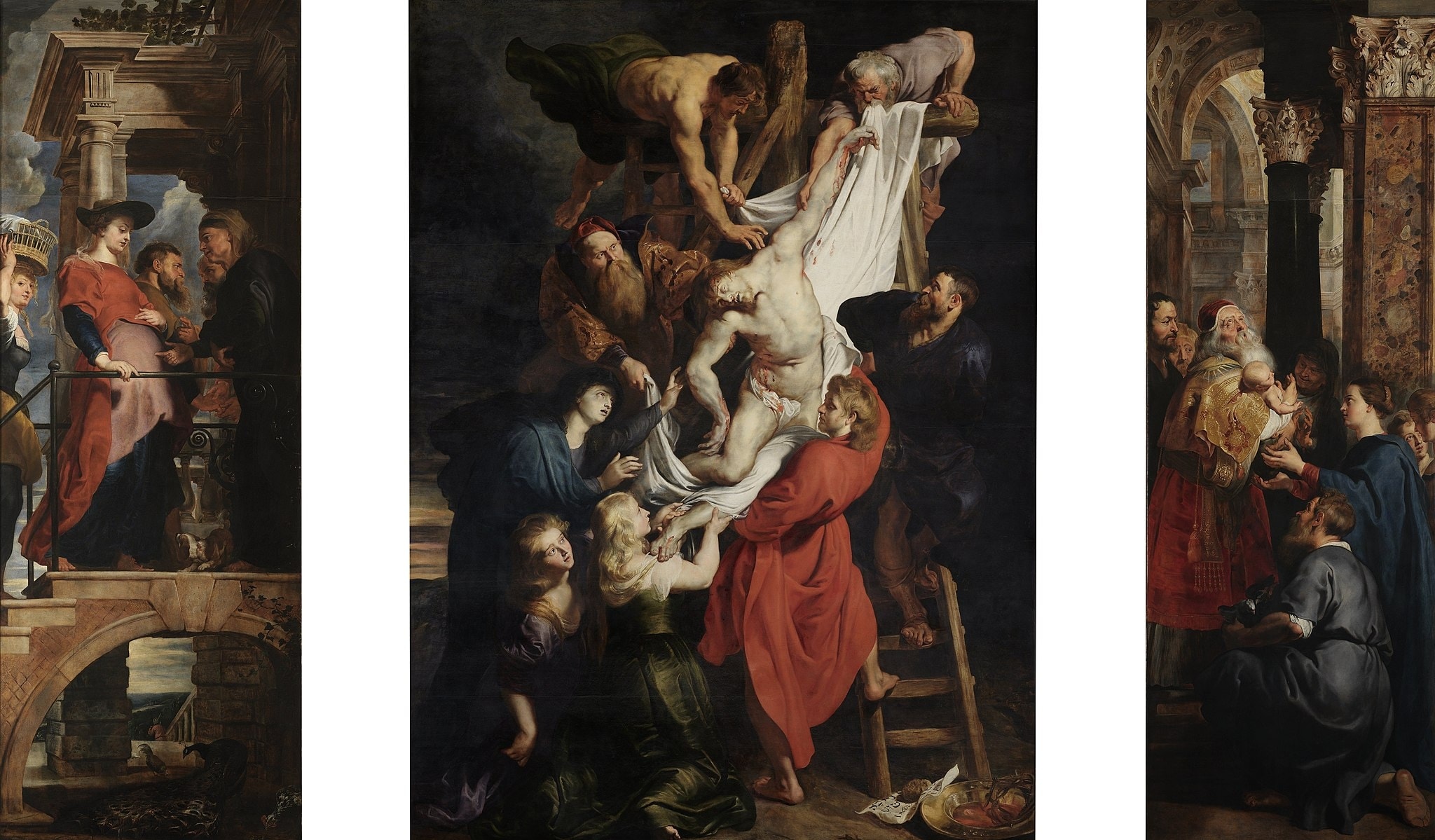
At night beneath a black sky, The Descent from the Cross stages a solemn transfer of Christ’s body along a luminous white shroud that cuts diagonally across the scene. The flanking wings—The Visitation and The Presentation in the Temple—frame the central tragedy with beginnings and revelation, turning the triptych into a single arc from Incarnation to Redemption. Rubens fuses Baroque chiaroscuro with tender, communal gestures to make grief a shared act of devotion.

Fast Facts

Year
1611–1614
Medium
Oil on panel (oak)
Dimensions
Central panel: 421 × 311 cm; each wing: 421 × 153 cm
Location
Cathedral of Our Lady, Antwerp
The Descent from the Cross by Peter Paul Rubens (1611–1614) featuring White shroud (linen), Cross and ladder, Crown of thorns and nails (Arma Christi), INRI tablet

Click on any numbered symbol to learn more about its meaning

Meaning & Symbolism

Rubens organizes the drama around a brilliant, diagonal white shroud that guides the eye from the crossbeam to the attendants below as they receive Christ’s slack, marble‑pale body. The shroud doubles as a theological device: in an altar setting it recalls the white corporal beneath the consecrated Host, so the removal from the wood becomes a meditation on sacrificial presence at the very moment the priest elevates the Eucharist 148. Around the base, the low still life of crown of thorns, nails, and the INRI tablet fixes contemplation on the Passion’s instruments while anchoring the composition’s downward motion 5. The figures act in a chain of care: Nicodemus and Joseph of Arimathea strain at the cross; St. John in red braces Christ’s torso; the Virgin in blue and the holy women reach upward with trembling hands; Magdalene clasps and kisses the wounded feet. These interlocking gestures form a visible theology of charity—redemption borne collectively by a grieving community 12. The wings extend that meaning through time. On the left, the Visitation presents Mary’s pregnant body as a first “bearing” of Christ, already set upon a stairway that prefigures ascent and descent; on the right, the Presentation in the Temple shows the aged Simeon lifting the infant toward the light within an architectonic sanctuary. Together with the center, the triptych spells a three‑part creed: Incarnation, revelation, and redemption—each enacted as the physical transfer of Christ from one faithful pair of hands to another 127. The choice answered the Kolveniers’ dedication to St. Christopher (on the exterior wings), so the confraternity’s altar proclaimed a consistent identity: to be Christian is to carry Christ 1. Rubens’s handling intensifies doctrine through sensation. The nocturnal field and chiaroscuro carve the bodies into relief without brutality; compared with his Elevation of the Cross, the light here is gentler, yielding pathos over heroics 26. The descending diagonal meets a subtle counter‑arc of upreaching arms, creating a stable ellipse that keeps the eye circling Christ’s body and the linen that bears it 8. This compositional mercy mirrors spiritual mercy: the weight is real, but it is shared. In post‑1585 Antwerp, such clarity of narrative and feeling served Counter‑Reformation aims—orthodoxy made palpable and public in the cathedral, where the painted body above and the consecrated Body below mutually interpret one another 124. The work thus stands as a paradigm of Baroque devotional theater: motion fused to emotion, doctrine translated into touch and light, and communal grief transfigured into liturgical hope.

Explore Deeper with AI

Ask questions about The Descent from the Cross

Popular questions:

Powered by AI • Get instant insights about this artwork

💬 Ask questions about this artwork!

Interpretations

Historical Context: Guild Patronage as Civic Catechesis

The Kolveniers (Arquebusiers) commissioned the triptych for their cathedral altar and placed St. Christopher on the exterior wings, binding confraternal identity to the act of “carrying Christ.” Rubens’s interior sequence—Visitation, Presentation, Descent—converts this into a public catechism: salvation is transmitted hand‑to‑hand across time. Installed in post‑1585 Antwerp, the ensemble operates as Counter‑Reformation civic pedagogy, aligning lay militias with orthodox spectacle in the city’s premier sacred site. The contract chronology (1611–14) shows a carefully paced delivery that synchronizes with Antwerp’s broader church refurbishments under the Archdukes. In this setting, “bearing” becomes both a devotional verb and a civic brand, making the altarpiece a model of how early modern guilds leveraged art to articulate belief, status, and communal duty within a rebuilt Catholic polity 1234.

Source: Our Lady’s Cathedral, Antwerp; Britannica; DBNL; Arts (MDPI)

Liturgical Reading: Eucharistic Optics and Synchronous Beholding

The painting is choreographed for the altar’s Eucharistic moment. The diagonal white shroud visually echoes the altar corporal, so the Deposition becomes a sacramental analogue to the priest’s elevation of the Host. Contemporary viewers would perceive a synchronicity: above, the painted Body descends; below, the consecrated Body is raised—two planes of presence meeting in the nave. Scholars note Rubens’s sensitivity to the celebrant’s line of sight and the congregation’s circulation, creating a devout “feedback loop” where image instructs rite and rite interprets image. This is Baroque embodied theology: optics, cloth, and flesh coordinate to render doctrine palpable and time‑specific to the liturgy unfolding before the work 145.

Source: Arts (MDPI); Jordaens–Antwerp Project; Our Lady’s Cathedral, Antwerp

Formal Analysis: From Heroic Diagonal to Stable Ellipse

While the descending diagonal steers the drama, Rubens builds a counter‑arc of upreaching arms that closes into a subtle elliptical circuit around Christ. This regulates affect: compared with the explosively muscular Elevation of the Cross, the Descent’s chiaroscuro is gentler, exchanging bravura for pathos. The ellipse slows the viewer’s eye, holding it on the linen’s brightness and the marble‑pale body. Italian lessons—Venetian colorito and Caravaggesque relief—are absorbed without literal quotation, producing a balanced dynamism: motion without rupture, weight without brutality. The result is a Baroque kinetics of mercy, where composition itself distributes burden across figures and space, mirroring the theology of shared charity 259.

Source: Britannica; Jordaens–Antwerp Project; National Gallery (London)

Gendered Touch: Affective Piety and the Ethics of the Hand

Rubens scripts a spectrum of tactile devotion: St. John’s supportive grasp, the Virgin’s tremulous reach, and Magdalene’s kiss at the feet. These gestures echo late medieval affective piety, where salvation is apprehended through compassionate touch and tearful contemplation. The wings amplify this pedagogy: Elizabeth and Simeon receive and present the child, legitimizing female and aged bodies as bearers of revelation. At the base, a quiet still life—crown, nails, titulus—awaits handling, extending touch to objects. In Antwerp’s public rite, such touch is vicarious yet ethically binding: to look is to learn how to hold, to mourn, and to care within a community that shares Christ’s weight 1210.

Source: Our Lady’s Cathedral, Antwerp; Britannica; TOPA (Tourism Pastoral Antwerp)

Dissemination: Workshop, Prints, and the Afterlife of an Image

The triptych’s program radiated beyond the chapel through prints of the closed St. Christopher and through studio variants of the Descent, embedding the “Christ‑bearer” theology in broader devotional markets. Scholarship tracks multiple versions and copies, indicating a workshop ecology that stabilized the composition’s authority while adapting it to new sites. Political displacements—Napoleonic removal to Paris and later restitutions—ironically amplified the work’s fame, converting it into a touchstone of national patrimony and Baroque memory. The image thus accrued meanings through reproduction and circulation, demonstrating how Rubens’s altarpiece functioned not only liturgically in situ but also as a mobile sign in European religious and cultural networks 381112.

Source: DBNL; British Museum; Corpus Rubenianum (Rubenshuis); Wikipedia (for provenance timeline synthesis)

Related Themes

About Peter Paul Rubens

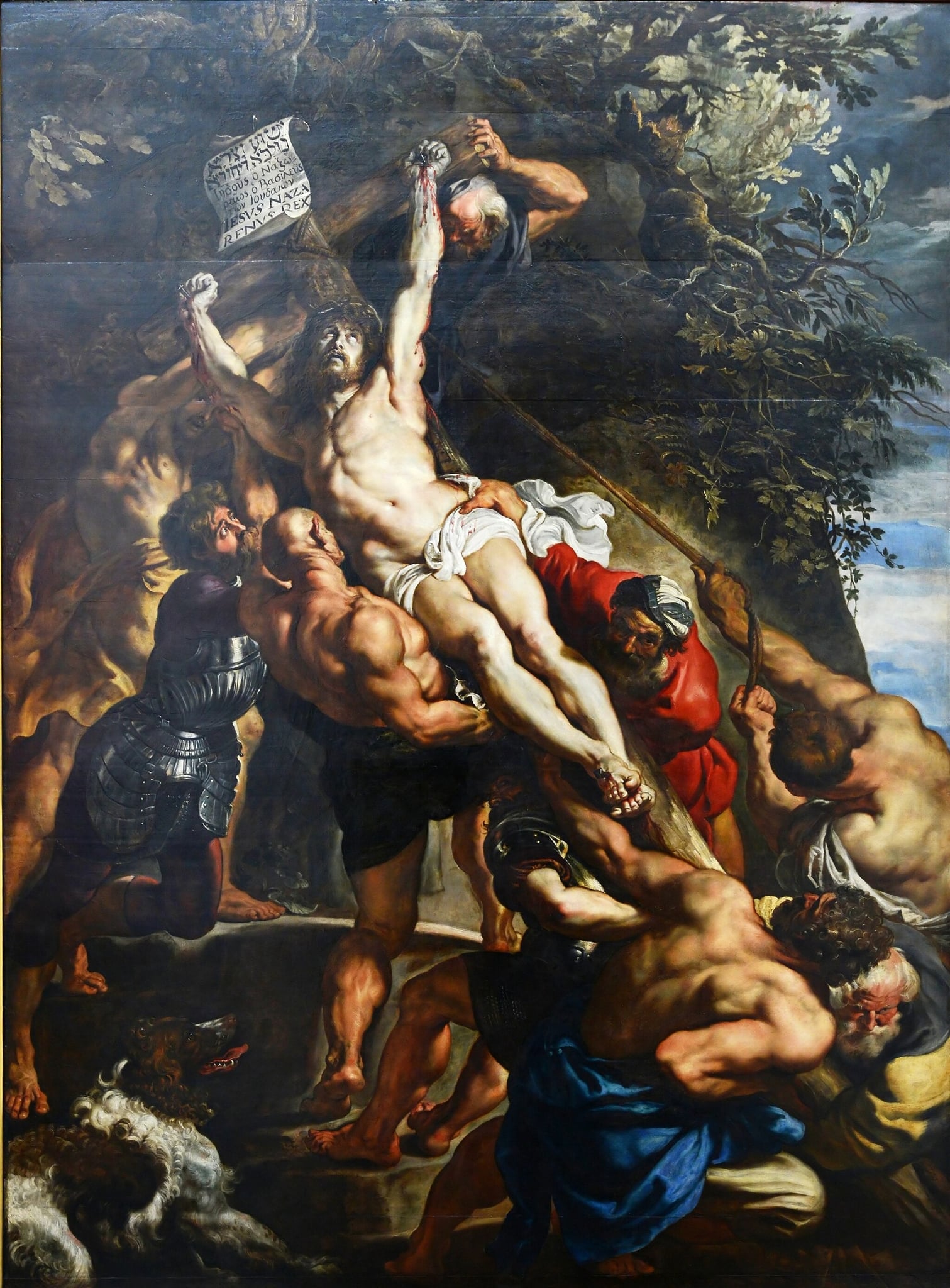
Peter Paul Rubens (1577–1640) returned to Antwerp in 1608 after eight formative years in Italy, where he absorbed classical sculpture, Venetian color, and new dramatic lighting. Appointed court painter in 1609, he rapidly organized a major workshop and shaped Flemish Baroque art. The Elevation of the Cross was among his first monumental public commissions, announcing his mature synthesis [3][6].
View all works by Peter Paul Rubens

More by Peter Paul Rubens