Marilyn Diptych
by Andy Warhol
Study Print Studio
Create a personal study print
Build a companion study sheet around the part of this painting that speaks to you most. Choose a detail, shape an interpretation, and walk away with something personal and display-worthy.
Fast Facts
- Year
- 1962
- Medium
- Silkscreen ink and acrylic paint on canvas
- Dimensions
- Overall approx. 205.4 × 289.6 cm; each panel approx. 205.4 × 144.8 cm
- Location
- Tate, London
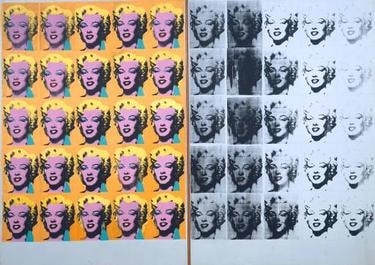
Click on any numbered symbol to learn more about its meaning
Meaning & Symbolism
Explore Deeper with AI
Ask questions about Marilyn Diptych
Popular questions:
Powered by AI • Get instant insights about this artwork
Interpretations
Theological Iconography
Source: Smarthistory; Tremaine Collection
Commodity and the Star System
Source: Whitney Museum (Michael Lobel); Art UK; Smarthistory
Technical Entropy as Content
Source: Smarthistory; Art UK
Cosmetics, Gender, and the Mask
Source: Smarthistory; MoMA
Serial Elegy: Repetition and Mourning
Source: Smarthistory; Art UK
Cold Monumentality: Pop vs. Abstract Expressionism
Source: Smarthistory; The Guardian
Explore Specific Elements
Dive deeper into individual scenes and details within Marilyn Diptych.
The Repeated Marilyn Face
Warhol’s repeated Marilyn face—fifty impressions of a single Niagara publicity still—turns a studio headshot into a modern icon. Vivid at left and fading to ghostly monochrome at right, the image collapses celebrity, mass reproduction, and mortality into one unforgettable motif.
The Color Marilyns
The Color Marilyns—the 25 hotly saturated faces on the left of Andy Warhol’s Marilyn Diptych—package a movie star’s image with the punch and clarity of consumer goods. Dazzling and repeatable, they crystalize how modern media manufactures allure while hinting at a cult of celebrity that borders on the devotional.
The Fading Black-and-White Marilyns
The fading black‑and‑white panel of Andy Warhol’s Marilyn Diptych stages a slow disappearance: 25 grayscale impressions of the same Niagara publicity still drift from crisp legibility to ghosted blur. By letting the image decay across the surface, Warhol turns mechanical failure into meaning—mourning a star while exposing how mass media makes and unmakes icons.
The Split Between Color and Black-and-White
Warhol’s vertical split—color at left, black‑and‑white at right—turns Marilyn Diptych into a two‑part drama of glamour and disappearance. It reads like a secular altarpiece to a modern icon, showing how media saturates an image until it fades to a ghost of itself.
Seen in Comparisons
Related Themes
About Andy Warhol
More by Andy Warhol
Race Riot
Andy Warhol (1964)
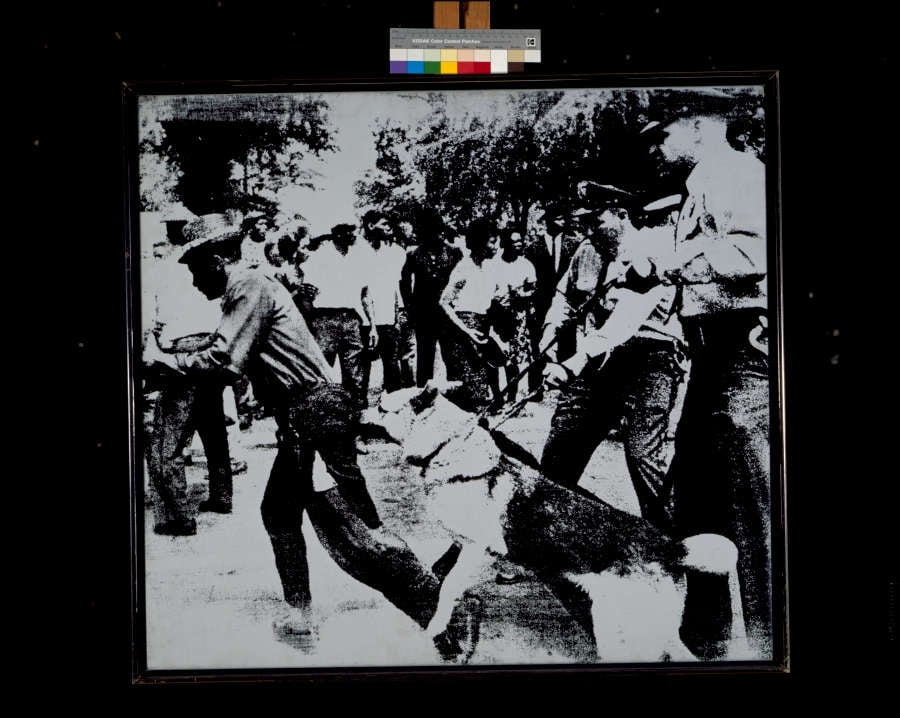
Race Riot crystallizes a split-second of state force: a police dog lunges while officers with batons surge and a ring of onlookers compresses the scene into a <strong>claustrophobic frieze</strong>. Warhol’s stark, high-contrast silkscreen translates a LIFE wire-photo into a <strong>mechanized emblem</strong> of American racial violence and its mass-media circulation <sup>[1]</sup><sup>[2]</sup>.
Campbell's Soup Cans
Andy Warhol (1962)
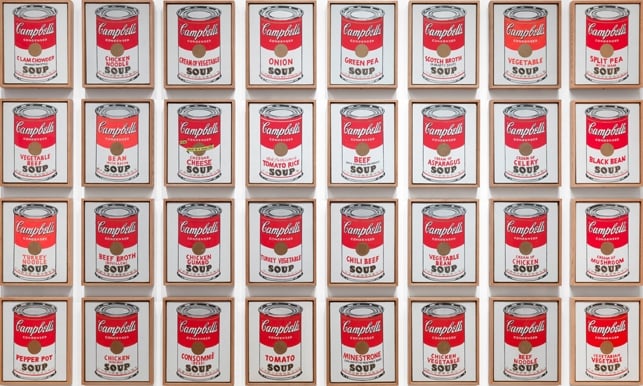
Warhol’s Campbell’s Soup Cans turns a shelf-staple into <strong>art</strong>, using a gridded array of near-identical red-and-white cans to fuse <strong>branding</strong> with <strong>painting</strong>. By repeating 32 flavors—Tomato, Clam Chowder, Chicken Noodle, and more—the work stages a clash between <strong>mass production</strong> and the artist’s hand <sup>[1]</sup><sup>[3]</sup>.
Silver Car Crash (Double Disaster)
Andy Warhol (1963)
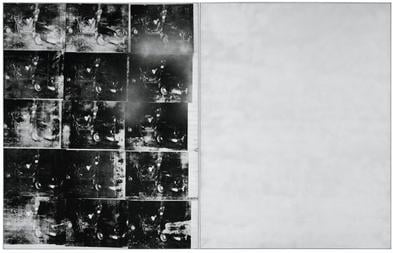
Silver Car Crash (Double Disaster) pairs a grid of uneven, black‑and‑white silkscreened crash images with a vast, nearly blank field of metallic silver, staging a battle between <strong>relentless spectacle</strong> and <strong>mute void</strong>. Warhol’s industrial repetition converts tragedy into a consumable pattern while the reflective panel withholds detail, forcing viewers to face the limits of representation and the cold afterglow of modern media <sup>[1]</sup><sup>[2]</sup>.
![Triple Elvis [Ferus Type] by Andy Warhol](/_next/image?url=https%3A%2F%2Fstorage.googleapis.com%2Fsite-images-programmatic%2Fpaintings%2F1771915343451-6gzg8m.jpg&w=3840&q=85&dpl=dpl_ASiQPiqukSad84i91Tcm2dUShHhL)
Triple Elvis [Ferus Type]
Andy Warhol (1963)
In Triple Elvis [Ferus Type] (1963), Andy Warhol multiplies a gunslinging movie idol across a cool, metallic field, turning a singular persona into a <strong>serial commodity</strong>. The sharply printed figure at center flanked by fading, <strong>ghosted</strong> doubles collapses still image, filmic motion, and mass reproduction into one charged surface <sup>[1]</sup><sup>[2]</sup>.
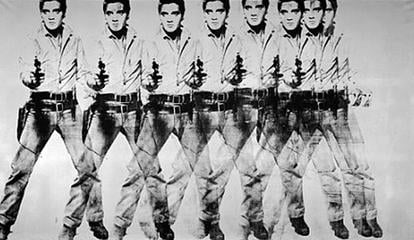
Eight Elvises
Andy Warhol (1963)
A sweeping frieze of eight overlapping, gun‑drawn cowboys marches across a silver field, their forms slipping and ghosting as if frames of a film. Warhol converts a singular star into a <strong>serial commodity</strong>, where <strong>mechanical misregistration</strong> and life‑size scale turn bravado into spectacle <sup>[1]</sup><sup>[2]</sup>.
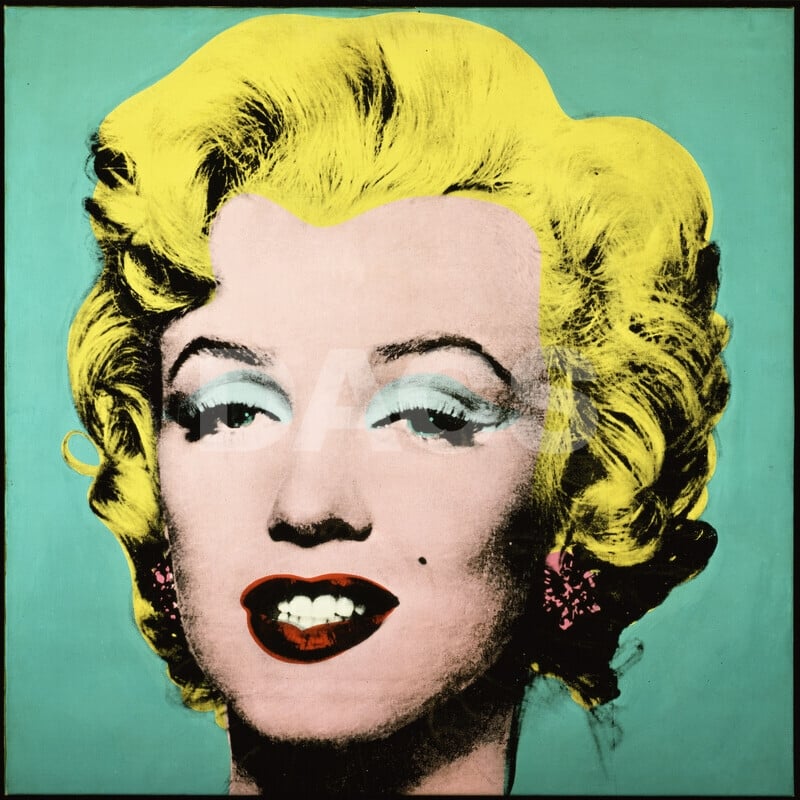
Turquoise Marilyn
Andy Warhol (1964)
In Turquoise Marilyn, Andy Warhol converts a movie star’s face into a <strong>modern icon</strong>: a tightly cropped head floating in a flat <strong>turquoise</strong> field, its <strong>acidic yellow hair</strong>, turquoise eye shadow, and <strong>lipstick-red</strong> mouth stamped by silkscreen’s mechanical bite. The slight <strong>misregistration</strong> around eyes and hair produces a halo-like tremor, fusing <strong>glamour and ghostliness</strong> to expose celebrity as a manufactured surface <sup>[1]</sup><sup>[2]</sup>.