American Gothic
by Grant Wood
Grant Wood’s American Gothic (1930) turns a plain Midwestern homestead into a moral emblem by binding two flinty figures to the strict geometry of a Carpenter Gothic gable and a three‑tined pitchfork. The painting’s cool precision and echoing verticals create a compressed ethic of work, order, and restraint that can read as both tribute and critique [1][2][3].
Fast Facts
- Year
- 1930
- Medium
- Oil on beaverboard
- Dimensions
- 78 × 65.3 cm (30 3/4 × 25 3/4 in.)
- Location
- Art Institute of Chicago
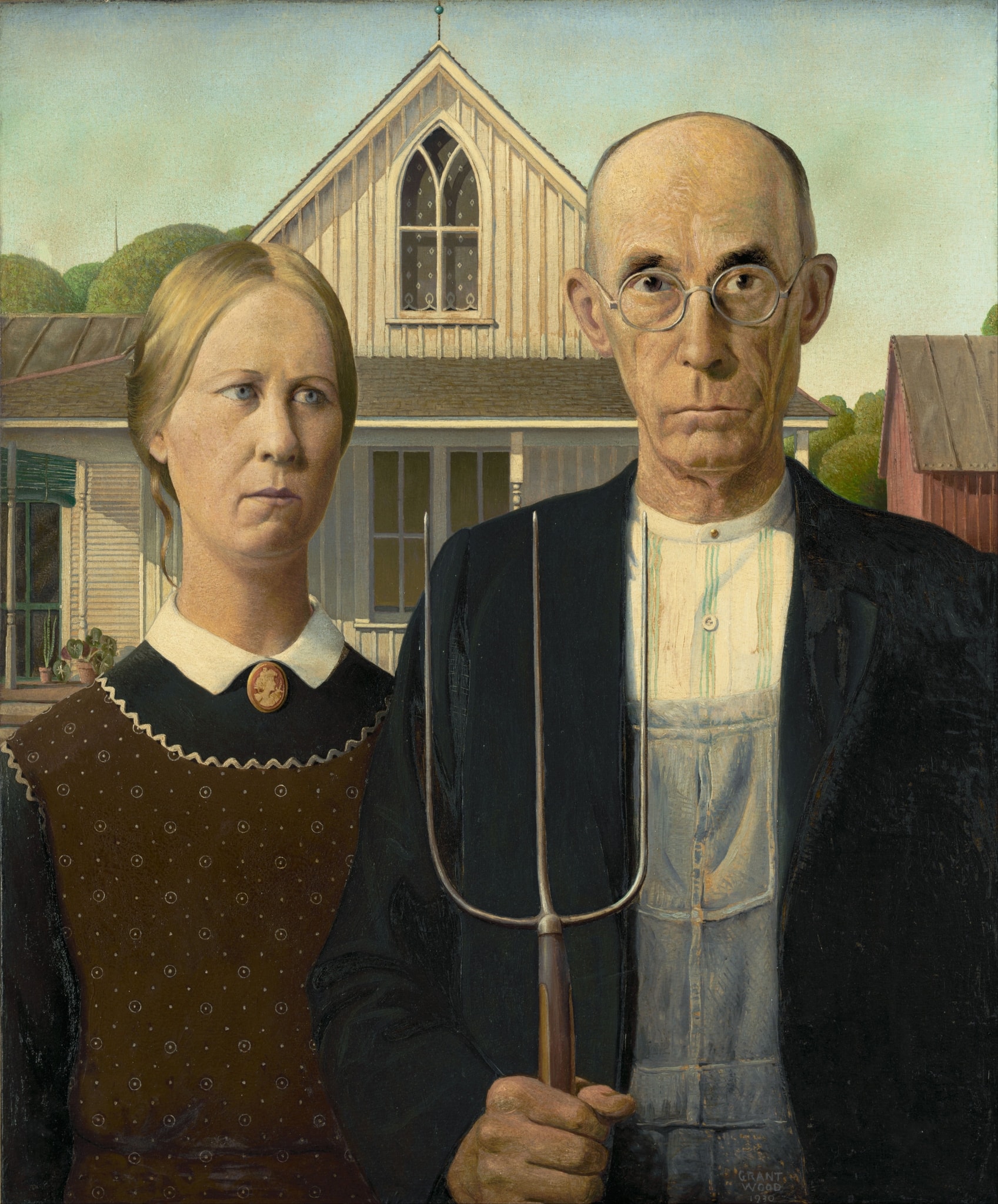
Click on any numbered symbol to learn more about its meaning
Meaning & Symbolism
American Gothic stages a compact drama of self‑belief under pressure. The farmer’s rigid grip and upright pitchfork announce discipline, and Wood rhymes that trident with the vertical seams of the man’s overalls and jacket, the window muntins, and even the scalloped edge of the woman’s apron to establish a metronome of restraint. These formal echoes do not merely decorate; they legislate. The architecture’s pointed arch—lifted from a real Carpenter Gothic cottage in Eldon, Iowa—places a churchlike emblem above the pair, as if their lives are vaulted by doctrine as much as by siding and roofline 17. In this schema, the tools of cultivation and the signs of belief become interchangeable: the pitchfork is a creed, the window a commandment 23.
Yet the painting’s power comes from how that creed strains against human particularity. The woman’s cameo and high collar signal modesty and inherited codes, while her sideways gaze dodges the frontal scrutiny that the man’s glasses and ramrod posture accept—an asymmetry that hints at gendered expectation and emotional withholding 23. The cool, even daylight wipes away anecdote, installing a hard factuality learned from Flemish precision and Germany’s Neue Sachlichkeit, which Wood studied in Europe; every board, button, and hair is accounted for, as if ambiguity must be built from clarity rather than vagueness 34. That clarity inflamed debate from the start: Iowans recognized themselves and bristled at the severity, while others saw an honorable distillation of Midwestern grit 23. Wood, who modeled the figures on his sister and his dentist but intended a farmer and daughter, held the line of ambiguity—familial yet not marital, intimate yet impersonal—so that viewers could project either satire or respect 126.
Placed in 1930, just after the market crash, the work reads as a compact survival manual. Its tight frontality and centered gable refuse the escapism of pastoral haze; this is a portrait of endurance as a compositional system. Details around the periphery—potted geranium and stiff snake plant on the porch, the neat curtains behind the Gothic window—extend the ethic from field to parlor, from muscle to domestic routine, suggesting that order is the family crop as much as corn or hay 26. At the same time, the painting withholds the consolations of warmth: the faces are unsoftened, the sky untroubled, the paint surface smooth and unforgiving. That refusal is why American Gothic is important in American art history: it grounded Regionalism not in folksy sentiment, but in a modern, exacting style that could rival European currents while insisting on local matter and myth 234.
The image’s endurance stems from this structural ambivalence. Its geometry elevates common life into civic iconography; its chill exactness keeps that iconography under scrutiny. In Biel’s terms, the work functions as a cultural barometer, registering shifts from Depression‑era stoicism to postwar parody and back again, without losing its charge 8. The result is an image that Americans continually reuse to argue about themselves—about virtue and suspicion, endurance and repression—because Wood engineered a composition where symbol and surface, faith and work, align so tightly that they cannot be pried apart without cracking the picture’s central truth: in this republic, ideals often arrive wearing overalls and a stern look 238.
Explore Deeper with AI
Ask questions about American Gothic
Popular questions:
Powered by AI • Get instant insights about this artwork
💬 Ask questions about this artwork!
Interpretations
Formal Genealogy: From Flemish Precision to New Objectivity
American Gothic’s chill exactitude isn’t just style; it’s a lineage. Wood’s exposure to Northern Renaissance painters (van Eyck/Memling) and the German Neue Sachlichkeit sharpened his surfaces into cool, inspected facts—buttons, wood grain, and hair rendered with forensic care. That precision suppresses painterly anecdote, making the image read like a vernacular icon rather than a portrait of individuals. The effect is double: the work claims truth through meticulous mimesis, while its emblemic frontality courts abstraction—turning Iowa into a concept as much as a place. This European‑honed clarity, repurposed for local subjects, helped define Regionalism’s modern bite and explains why the picture can be read as both document and design 34.
Source: Encyclopaedia Britannica; National Gallery of Art
Reception History: A Cultural Barometer
From its 1930 debut, viewers split: satire of grim puritanism or tribute to Midwestern grit. That forked reception became the painting’s engine. Steven Biel argues the image functions as a cultural barometer, absorbing shifts from Depression‑era stoicism to postwar parody and back, without losing charge. Its “readable ambiguity” lets publics project either suspicion or virtue; the image survives by being reusable—an icon whose clarity invites argument. Media circulation and endless pastiche cemented its status not as a settled statement but as a staging ground for national self‑description, where regional authenticity and ideological contestation meet 26.
Source: Steven Biel, American Gothic: A Life of America’s Most Famous Painting
Gendered Optics and Domestic Discipline
Modeled by Wood’s sister and dentist yet presented as a farmer and daughter, the pair enact gendered asymmetry: his frontal stare and pitchfork claim public authority; her averted gaze, cameo, and high collar encode modesty and restraint. The porch plants—geranium and snake plant—extend discipline into the parlor, echoing Wood’s Woman with Plants and suggesting that domestic order is a cultivated crop. This visual rhetoric frames a household where affect is managed and privacy guarded, aligning with contemporaneous ideals of feminine decorum and masculine labor, while leaving room for unease in the emotional distance between the two figures 127.
Source: Art Institute of Chicago; Smarthistory; Smithsonian Magazine
Medium Matters: Beaverboard, Economy, and Effect
Painted in oil on beaverboard—a fiber/composition panel—American Gothic’s support is a Depression‑era material linked to affordability and stability. The hard, smooth surface intensifies Wood’s exacting contour and enamel‑like finish, enhancing the work’s forensic clarity and minimizing expressive brushwork. Material choice thus participates in the painting’s ethic: thrift, durability, and order literally underpin the image. The panel’s resistance to absorbency keeps edges crisp, magnifying the pitchfork’s tines, window muntins, and seams into a rhythmic grid of restraint that reads as both moral code and optical system 1.
Source: Art Institute of Chicago
Regionalism’s Paradox: Local Matter, Modern Form
Wood’s Regionalism rejects Parisian subjects but not modern strategies. By wedding Iowa motifs to a constructed frontality and calibrated light, he advances an American Scene that competes with European modernisms on formal grounds. This is not folksy retreat but tactical national re‑centering: a program to make the Midwest carry the weight of high art without sacrificing legibility. The result is a picture that reads as populist yet is architected with high modern discipline—proof that American “ordinariness” can bear a monumental syntax suited to civic mythmaking 234.
Source: Smarthistory; Encyclopaedia Britannica; National Gallery of Art
Identity Under Constraint: Persona and Repression
Curators have read Wood’s oeuvre through the lens of crafted persona and managed identity, noting tensions between surface composure and inner strain. In American Gothic, the freeze‑frame stillness and coded propriety suggest an ethic of self‑containment that can shade into repression. The painting’s scrupulous order—aligned tools, upright architecture, controlled light—works like a self‑fashioning mask, staging virtue while hinting at what must be held back. This curatorial frame doesn’t claim a single biography‑to‑image key; rather, it shows how the work’s polished front becomes a theater for anxieties about authenticity, conformity, and the costs of rectitude 5.
Source: Whitney Museum of American Art (2018 retrospective, Barbara Haskell)
Related Themes
About Grant Wood
Grant Wood (1891–1942), born in Iowa, fused meticulous, Northern Renaissance–influenced finish with subjects drawn from Midwestern life, becoming a key figure of **American Regionalism** alongside Thomas Hart Benton and John Steuart Curry [4]. After European travels, Wood settled in Cedar Rapids, where he painted American Gothic in his studio at 5 Turner Alley; he later taught in Iowa and led New Deal arts efforts in the state [4].
View all works by Grant Wood →