The Ballet Rehearsal

by Edgar Degas

In The Ballet Rehearsal, Edgar Degas turns a practice room into a modern drama where discipline and desire collide. A dark spiral staircase slices the space, scuffed floorboards yawn open, and clusters of dancers oscillate between poised effort and weary waiting [1][4].

Fast Facts

Year
c. 1874
Medium
Oil on canvas
Dimensions
57.3 x 83.2 cm
Location
The Burrell Collection, Glasgow Museums, Glasgow
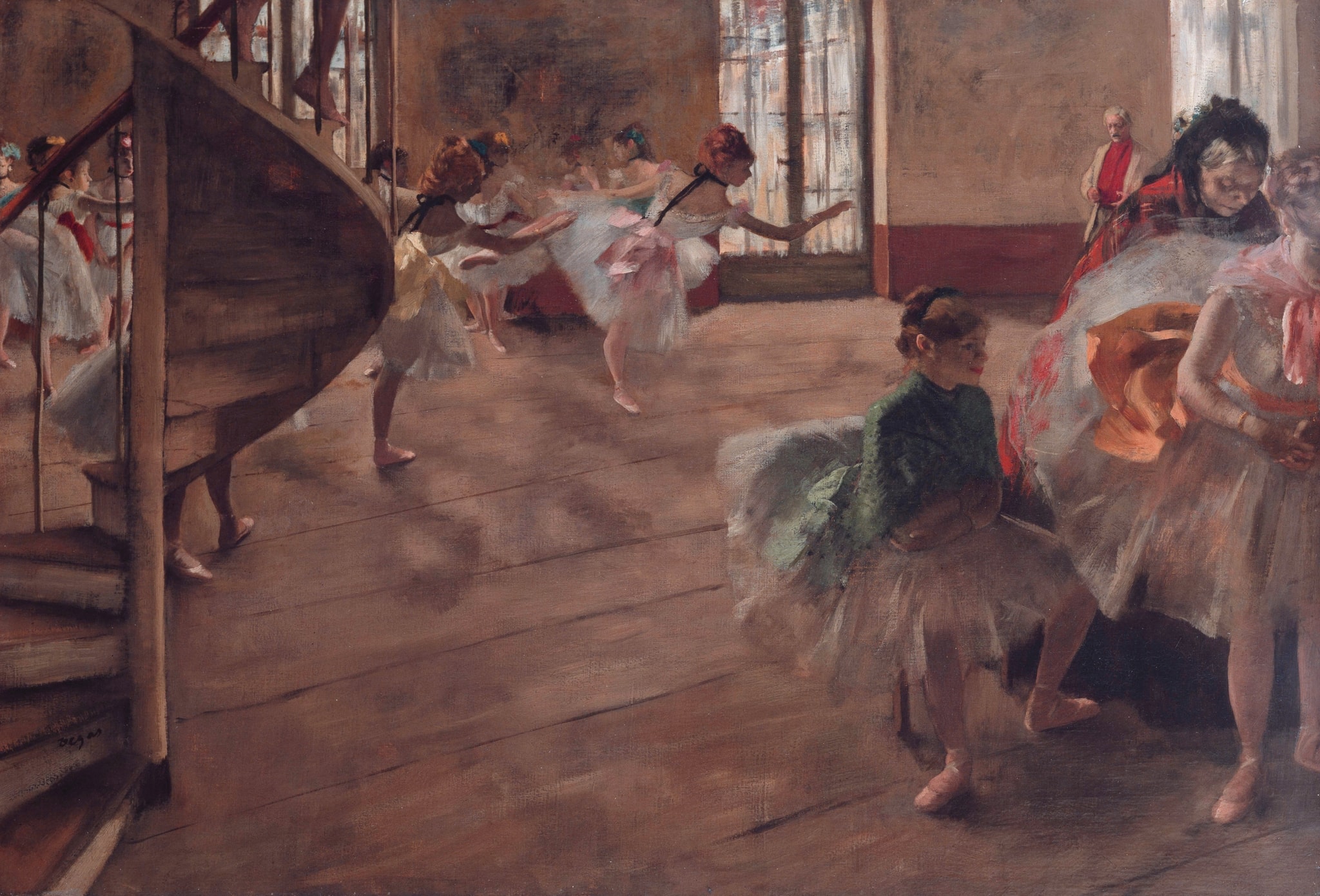
The Ballet Rehearsal by Edgar Degas (c. 1874) featuring Spiral staircase, Scuffed wooden floorboards, Empty center space, Authority figures

Click on any numbered symbol to learn more about its meaning

Meaning & Symbolism

Degas engineers the room as a working machine. The spiral stair on the left is not a backdrop but a structural blade that carves the scene, hides and reveals bodies, and introduces a turning rhythm that echoes torsioned limbs. From this diagonal fulcrum the composition fans out: a dancer reaches forward in arabesque near the bright doorway; another balances tentatively; several girls cluster at right, absorbed in ribbons and talk, while one slumps on pointe on a low bench. The floor—an expanse of abraded boards—dominates the foreground, insisting on rehearsal’s terrain of labor before any stage glamour. Daylight filters through tall windows and catches the powdery bloom of tutus, but the light is cool and untheatrical; it clarifies rather than flatters. In the back right, an older woman in black and a red‑sashed figure stand as quiet sentries, signs of supervision and discipline within the Opéra’s hierarchy. Degas crops dancers at the edges and sets the horizon low so that we seem to watch from the wings, a vantage that feels accidental yet is meticulously staged 1245. The painting’s rhetoric is declarative: rehearsal is a site where aspiration meets control. The empty center—that sweep of floor between the stair and the groups—reads as a gap between intention and achievement, a stage held in reserve for the next attempt. The staircase doubles as metaphor, a visible ascent that binds progress to repetition; its treads host partial legs and shoes, bodies forever arriving or departing, never centered, never at rest 5. Degas uses whitened tutus and pastel knots as small flares against umbers and warm browns, flashes of promise anchored by exhaustion. This is not reportage; museum scholarship underscores how Degas recomposed the Opéra from drawings and memory in the studio, crafting a candid illusion by design 2. That choice matters socially as well as formally. Across his Opéra works, Degas maps a culture of training, surveillance, and privilege; even here, with the stage far away, the authority figures at right remind us that hierarchy structures every gesture 3. The result is a modern picture of work—intimate, unsentimental, and exacting—where motion is held in suspension, and where the city’s new ways of looking—cropped, off‑axis, discontinuous—become the very form of truth 2347. Within Degas’s broader project, The Ballet Rehearsal consolidates innovations he was refining in multiple variants. He tests how a bold architectural form can orchestrate a crowd; he pushes asymmetry without losing balance; he shows labor as the hidden engine of spectacle. Related canvases confirm his iterative method—adding, removing, or shifting stair elements to hone the image’s grammar of partial sight and controlled chance 6. By 1874, this approach positioned Degas within Impressionism while sustaining his self‑declared realist conviction that art is made, not snatched from life 28. The picture endures because it tells a clear story—ambition, discipline, delay—through the exacting choreography of space itself.

Explore Deeper with AI

Ask questions about The Ballet Rehearsal

Popular questions:

Powered by AI • Get instant insights about this artwork

💬 Ask questions about this artwork!

Interpretations

Social History: Theater as Power System

Read the room as a social machine. The rehearsal studio encodes the Opéra’s stratified access—from the monitored students to supervisors who police comportment. Across Degas’s theater imagery, the presence (or implied presence) of abonnés and staff signals a regime of surveillance, class privilege, and gendered vulnerability. Even without a prominent dark‑suited subscriber here, the posture of watchers and the girls’ deferential spacing map a habitus learned under institutional eyes. This is a portrait of cultural labor embedded in a market of favors, reputation, and discipline—an ecosystem where proximity to the stage (and its patrons) is currency. The painting thus folds aesthetics into social control, making the arabesque as much a social gesture as a physical one 37.

Source: National Gallery of Art; Nelson-Atkins Museum

Form as Ethics: The Stair as Device of Occlusion

The spiral stair is not ornament but an instrument of ethical seeing. Its curved blade cuts bodies, interrupts friezes, and forces viewers to accept partial sight—a refusal of the complete, flattering tableau. Critics note how Degas balances this engineered asymmetry with rigorous counterweights: diagonals, low horizon, and calibrated intervals across the scuffed floor. The result feels “caught” yet is meticulously staged, a modern geometry that acknowledges what is hidden as much as what is shown. The stair’s ascent reads as discipline, but its occlusions also index the limits of spectatorship—how modern life is grasped in fragments, never as a seamless whole 245.

Source: Musée d’Orsay; Times Higher Education; The Guardian

Process & Iteration: Studio-Built Candidness

Degas crafted this apparent slice of life in the studio, fusing drawings, recall, and recomposition to produce a candid illusion. Orsay’s scholarship emphasizes his anti‑reportage stance; the Opéra becomes a laboratory for montage‑like splicing of time and view. Related variants confirm an iterative method: in a Harvard version, a stair element was added and later removed, proving that “chance” effects were editable choices. This painting is thus evidence of a modernist procedure—testing how architecture can conduct attention, how voids carry meaning, and how negative space can perform the drama of delay and discipline 26.

Source: Musée d’Orsay; Harvard Art Museums

Work Aesthetics: The Floor as Moral Stage

The floorboards dominate as an arena of exertion. Their scuffs and yawning sweep turn rehearsal into a workscape, a space where grace is manufactured through repetition. Rather than theatrical dazzle, Degas offers cool daylight that “clarifies rather than flatters,” making fatigue, balked balance, and fidgeting ribbons central evidence. Critics have read this “empty center” as a productive void—a reserve for the next try, where ambition meets regulation. In this ethic, beauty is an outcome of labor, not a veil over it; the painting’s truth lies in postponement, in the interval before perfection shows itself on stage 35.

Source: National Gallery of Art; The Guardian

Modern Optics: Cropping, Speed, and Discontinuity

Degas courts a vision keyed to the city: cropped, off‑axis, and discontinuous. The low horizon and cut figures simulate the shock of photography and Japoniste layouts, yet the image holds together through choreographed vectors and pauses. This is not speed for its own sake but a syntax of perception, admitting peripheral vision, distraction, and partial attention as valid aesthetic data. The painting trains us to see like moderns—accepting the fragment as truth and the pause as a compositional beat—while keeping the ethical insistence on clarity: light that describes, not seduces 25.

Source: Musée d’Orsay; The Guardian

Related Themes

About Edgar Degas

Edgar Degas (1834–1917) trained in rigorous drawing, revered the Old Masters, and pursued modern urban subjects—from races to café-concerts and ballet. Though he exhibited with the Impressionists, he insisted on a controlled, realist construction of scenes, often synthesizing observations into complex studio compositions [5][6].
View all works by Edgar Degas

More by Edgar Degas

The Opera Orchestra by Edgar Degas | Analysis by Edgar Degas

The Opera Orchestra by Edgar Degas | Analysis

Edgar Degas

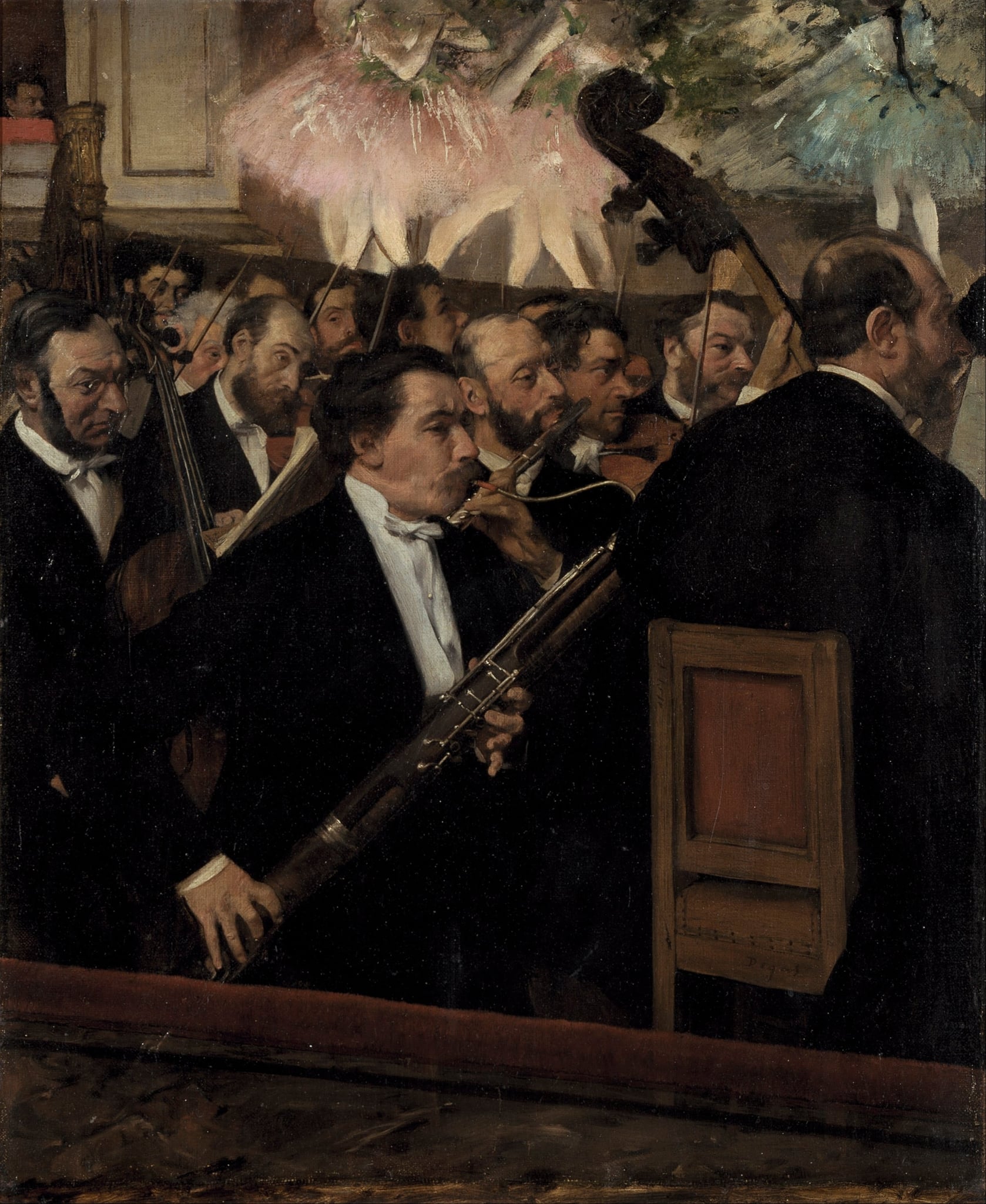
In The Opera Orchestra, Degas flips the theater’s hierarchy: the black-clad pit fills the frame while the ballerinas appear only as cropped tutus and legs, glittering above. The diagonal <strong>bassoon</strong> and looming <strong>double bass</strong> marshal a dense field of faces lit by footlights, turning backstage labor into the subject and spectacle into a fragment <sup>[1]</sup><sup>[2]</sup>.
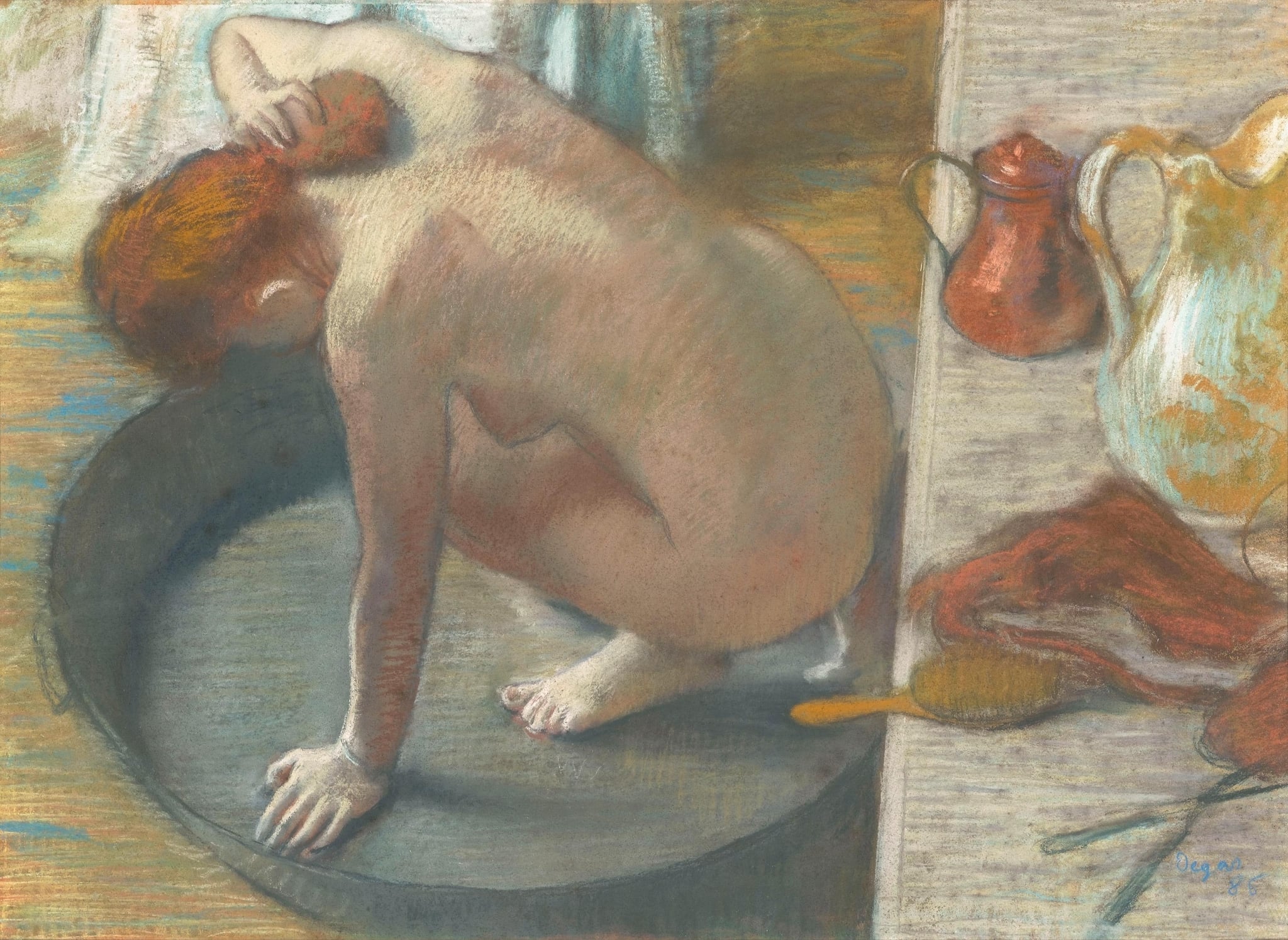
The Tub by Edgar Degas

The Tub

Edgar Degas (1886)

In The Tub (1886), Edgar Degas turns a routine bath into a study of <strong>modern solitude</strong> and <strong>embodied labor</strong>. From a steep, overhead angle, a woman kneels within a circular basin, one hand braced on the rim while the other gathers her hair; to the right, a tabletop packs a ewer, copper pot, comb/brush, and cloth. Degas’s layered pastel binds skin, water, and objects into a single, breathing field of <strong>warm flesh tones</strong> and blue‑greys, collapsing distance between body and still life <sup>[1]</sup>.
The Ballet Class by Edgar Degas

The Ballet Class

Edgar Degas (1873–1876)

<strong>The Ballet Class</strong> shows the work behind grace: a green-walled studio where young dancers in white tutus rest, fidget, and stretch while the gray-suited master stands with his cane. Degas’s diagonal floorboards, cropped viewpoints, and scattered props—a watering can, a music stand, even a tiny dog—stage a candid vision of routine rather than spectacle. The result is a modern image of discipline, hierarchy, and fleeting poise.

Woman Ironing by Edgar Degas

Woman Ironing

Edgar Degas (c. 1876–1887)

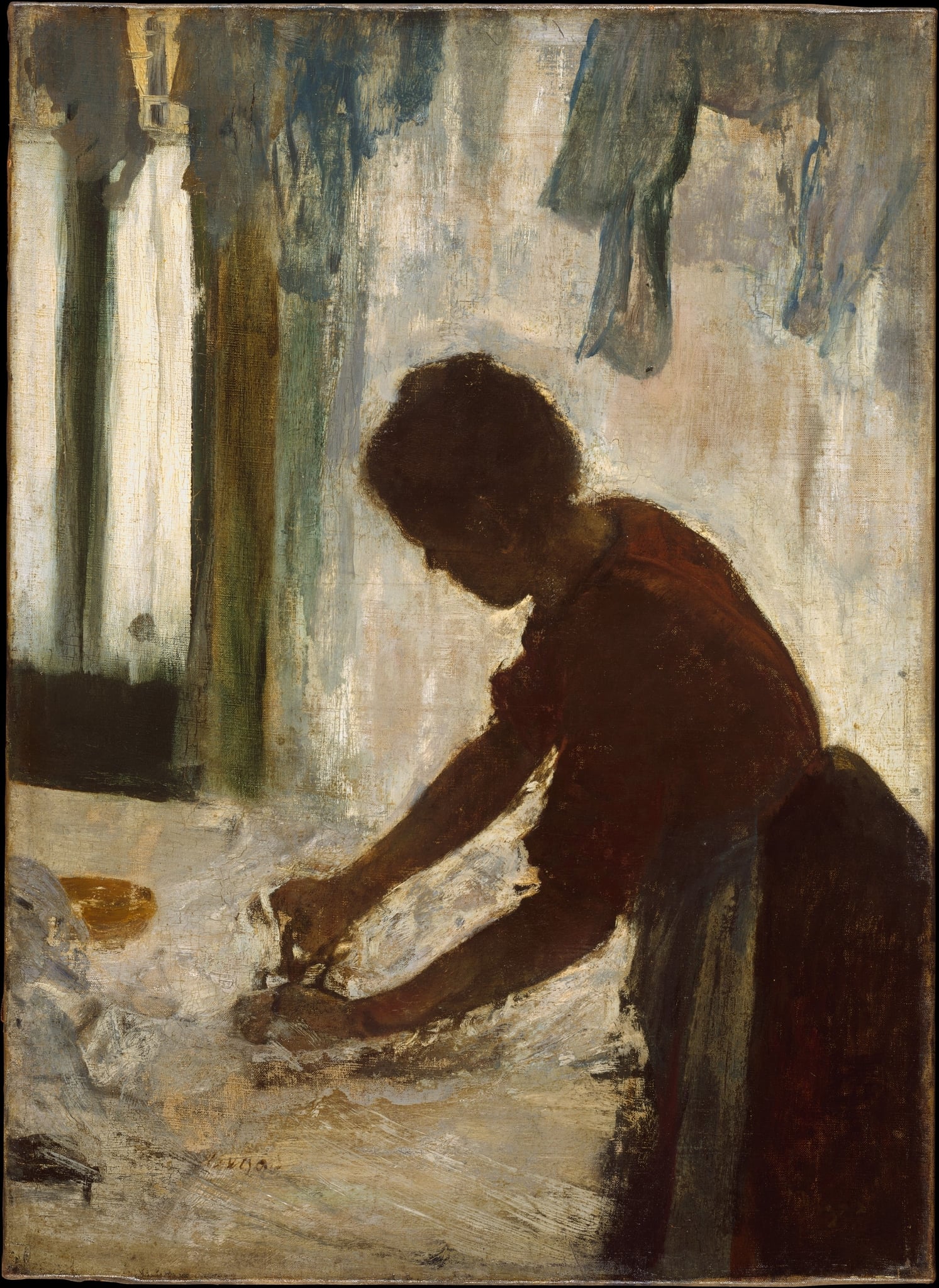
In Woman Ironing, Degas builds a modern icon of labor through <strong>contre‑jour</strong> light and a forceful diagonal from shoulder to iron. The worker’s silhouette, red-brown dress, and the cool, steamy whites around her turn repetition into <strong>ritualized transformation</strong>—wrinkled cloth to crisp order <sup>[1]</sup><sup>[2]</sup>.
The Rehearsal of the Ballet Onstage by Edgar Degas

The Rehearsal of the Ballet Onstage

Edgar Degas (ca. 1874)

Degas’s The Rehearsal of the Ballet Onstage turns a moment of practice into a modern drama of work and power. Under <strong>harsh footlights</strong>, clustered ballerinas stretch, yawn, and repeat steps as a <strong>ballet master/conductor</strong> drives the tempo, while <strong>abonnés</strong> lounge in the wings and a looming <strong>double bass</strong> anchors the labor of music <sup>[1]</sup><sup>[3]</sup><sup>[4]</sup>.

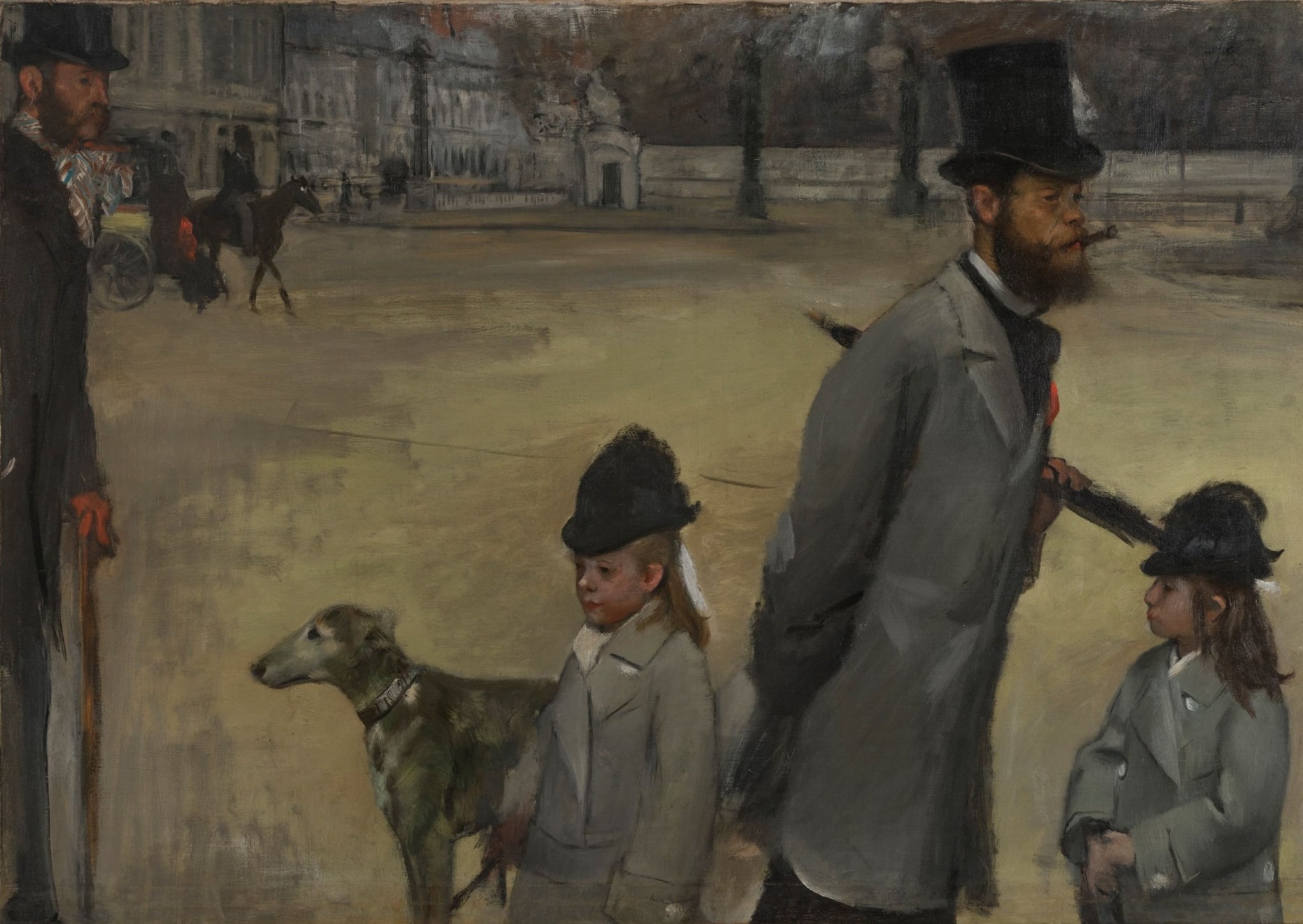
Place de la Concorde by Edgar Degas

Place de la Concorde

Edgar Degas (1875)

Degas’s Place de la Concorde turns a famous Paris square into a study of <strong>modern isolation</strong> and <strong>instantaneous vision</strong>. Figures stride past one another without contact, their bodies abruptly <strong>cropped</strong> and adrift in a wide, airless plaza—an urban stage where elegance masks estrangement <sup>[1]</sup><sup>[2]</sup>.