Boulevard des Capucines

by Claude Monet

From a high perch above Paris, Claude Monet turns the Haussmann boulevard into a living current of light, weather, and motion. Leafless trees web the view, crowds dissolve into flickering strokes, and a sudden pink cluster of balloons pierces the cool winter scale [1][2].

Fast Facts

Year
1873–1874
Medium
Oil on canvas
Dimensions
80.3 × 60.3 cm
Location
The Nelson-Atkins Museum of Art, Kansas City
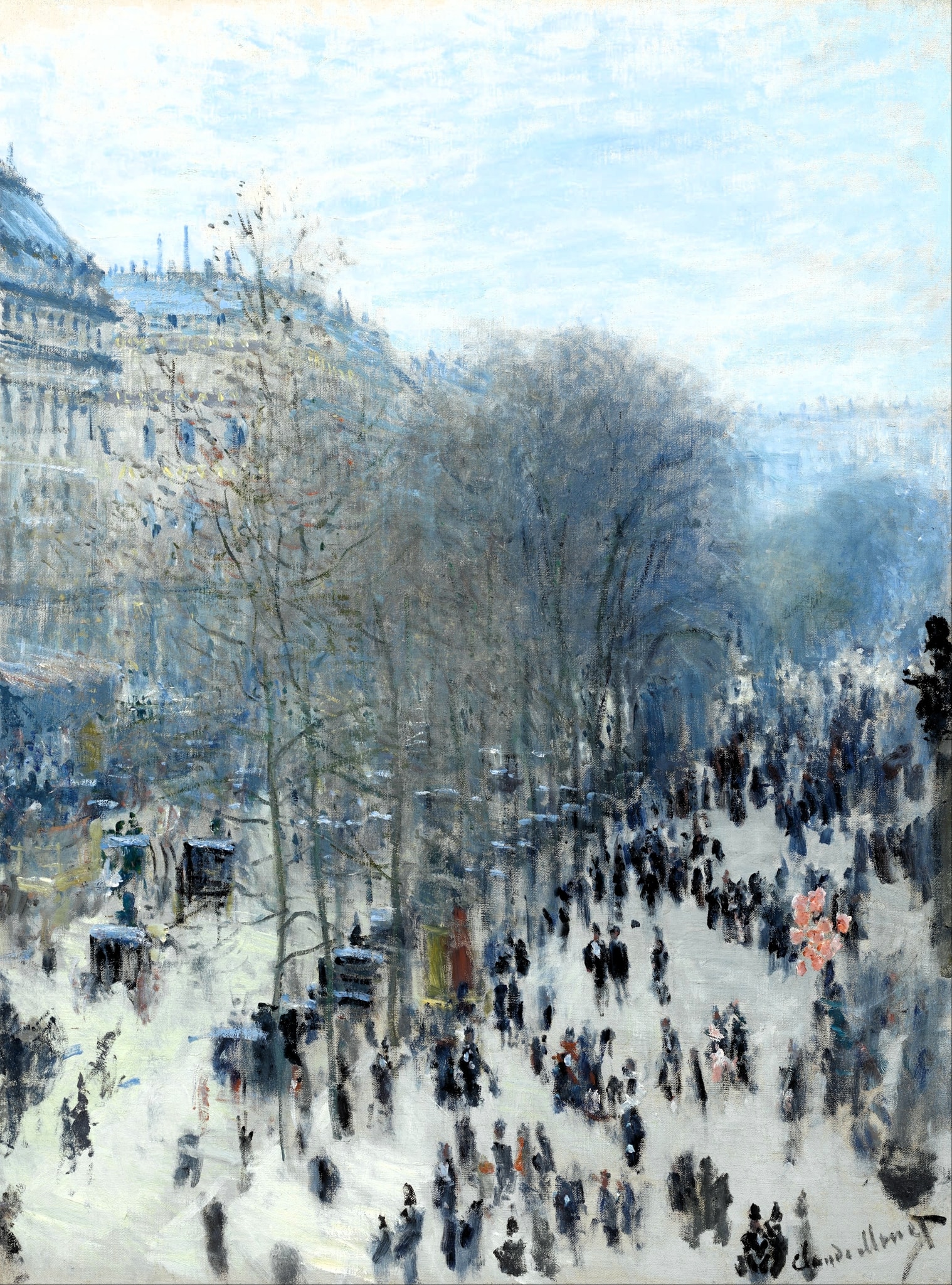
Boulevard des Capucines by Claude Monet (1873–1874) featuring Pink balloons, Morris column (advertising kiosk), Leafless winter trees, Crowd of black-clad pedestrians

Click on any numbered symbol to learn more about its meaning

Meaning & Symbolism

Seen from above, the boulevard opens like a proscenium where the city performs itself. Monet compresses the sky to a thin, chalky band, forcing attention onto the street’s patterned flow: pale pavement, a gridded stand of bare trees, and a tide of black-clad figures that never resolve into portraits. The brushwork—dry, rapid, and broken—declines contour in favor of vibration, so people and carriages read as beats in a rhythm rather than as subjects in a tableau. Two sharp motifs anchor the field: a warm, vertical accent in the foreground associated with a Morris column (the new advertising kiosk), and the pink bouquet of balloons at lower right, a chromatic flare that punctuates the cool blue-grays. Together they signal the modern economy of display and promotion, where attention is courted by color and signage amid incessant movement 16. Monet’s balcony perspective is not merely scenic; it is ideological. From Nadar’s upper-floor studio—also the site of the first Impressionist exhibition—Monet adopts a photographic, plunging view that compresses depth and privileges patterns of circulation over linear narrative 23. The boulevard becomes an optical field in which perception is contingent: a spectator on the adjacent balcony (right edge, top hats catching light) mirrors our own stance as flâneurs, coolly surveying the spectacle below while remaining outside it 15. This distance structures the picture’s politics of looking. Rather than dignifying bourgeois passersby with recognizable likeness, Monet renders them as collective motion, a “lonely crowd” without faces—his answer to a city rebuilt for throughput, vistas, and display under Haussmann 45. Technically, the painting makes a wager: that the speed of modern life demands a speed of facture. Thin, sketch-like applications leave the weave visible; branches are not drawn but breathed onto the surface; façades on the left hem dissolve into light, refusing solidity. Early critics seized on this as unfinished “palette scrapings,” but the distance effect—how forms cohere as you step back—enacts the very logic of boulevard vision: clarity is a function of vantage and duration 2. In this sense, Boulevard des Capucines does not simply depict flux; it reenacts it. The viewer’s eye is made to travel: from the compressed sky down the line of façades, through the filigree of winter trees, into the S-shaped stream of pedestrians that curls toward the balloon-seller and out of frame. Each passage insists that urban meaning is emergent, assembled from fleeting impressions rather than fixed outlines 14. By transforming traffic into a subject, Monet answers photography on its own ground—movement, instantaneity, and the accidental—and declares painting capable of something different: not the freeze-frame but the sensation of duration. That claim, launched from the very rooms where the 1874 show opened, is why this canvas became a cornerstone of Impressionism’s modern-life project 234.

Explore Deeper with AI

Ask questions about Boulevard des Capucines

Popular questions:

Powered by AI • Get instant insights about this artwork

💬 Ask questions about this artwork!

Interpretations

From Finish to Effect: Redefining Pictorial Truth

Contemporary critics called the foreground “palette scrapings,” indicting its refusal of finish; yet the work demonstrates a new standard of pictorial truth: effect over detail. Contour is sacrificed to vibration, and identities to collective motion. The criterion becomes whether sensation coheres at the proper vantage and interval—what Chesneau grasped as the distance where chaos becomes city. This is a reframing of mimesis for the age of throughput: truth as calibration of time, space, and perception. In that sense, the boulevard doesn’t just represent flux; it requires the beholder to re-enact it—walking the picture with the eyes until duration produces clarity 23.

Source: The Metropolitan Museum of Art; James H. Rubin

Urban Attention Economy (Political Economy of Looking)

The painting literalizes a newly engineered market for attention. The warm vertical accent of the Morris column and the pink balloons act as chromatic lures within a cool, wintry register—street furniture and spectacle designed to catch the eye. On Haussmann’s boulevards, circulation was the product, and advertising colonized public sightlines. Monet doesn’t just include these devices; he composes around them, showing how color and placement hijack peripheral vision. In doing so, the work visualizes an ideology of publicity—modern Paris as a system that monetizes glance, pause, and desire—anticipating theories of spectacle by half a century. The boulevard here is not a neutral conduit; it’s a marketplace of images and impulses where attention becomes currency 136.

Source: Nelson-Atkins Museum of Art; James H. Rubin

Photography as Adversary and Ally

Painted from Nadar’s rooms, the picture adopts a plunging, photographic vantage and instantaneous cropping that a camera popularized. Yet Monet proposes a different temporality: broken strokes that only resolve at distance, making legibility contingent on the viewer’s dwell-time. This is a calculated reply to the era’s technical image—what critics recognized as a “sketch” from near but a coherent “stream of life” from afar. Rather than mimic a snapshot, the canvas builds a layered present: look, step back, and the city gels; move closer, and it dissolves again. The work thus asserts painting’s claim over duration, afterimages, and the subjectivity of seeing—an alternative modernism to photography’s freeze 25.

Source: The Metropolitan Museum of Art; Financial Times (Paris 1874)

Classed Spectatorship and the Balcony Gaze

Monet stages a politics of vision. The top-hatted flâneurs on the adjacent balcony mirror our position: elevated, dry, and detached. This is the bourgeois viewing machine of Haussmann’s Paris—wide vistas for those with time to look, thoroughfares for those who must move. The crowd below is anonymized into rhythmic marks, while the onlooker retains silhouette and privilege. Such asymmetry exemplifies what social historians have read as modernity’s “lonely crowd”: collective yet unindividuated, visible yet not seen. The painting doesn’t sentimentalize the promenade; it coolly sorts positions in space as positions in society, rendering spectatorship itself as a classed form of leisure 14.

Source: Nelson-Atkins Museum of Art; Robert L. Herbert

Seasonal Optics: Winter as a Formal Engine

The scene’s winter conditions are not incidental; they are a formal armature. The bare tree grid clarifies the boulevard’s pacing, their branchwork becoming a visual metronome for pedestrian flow. Winter light drains chroma from façades, amplifying tonal contrasts so that tiny color events—the balloons’ pink, the kiosk’s warm note—read with heightened intensity. This meteorology enables Monet’s experiment in distance-effect: with leaves absent and air cool-dry, the eye can parse layers as a rhythmic weave rather than a leafy mass. Seasonal atmosphere thus structures both the image’s composition and its phenomenology, binding urban time to natural cycles in a city otherwise rebuilt for speed 13.

Source: Nelson-Atkins Museum of Art; James H. Rubin

Hidden Work in the Spectacle of Leisure

Beneath the sheen of promenade is labor: drivers, doormen, the balloon vendor whose pink cluster marks a node of street commerce. Monet’s facture mirrors this: rapid, repetitive strokes as a kind of painterly piecework aligned to urban tempo. Herbert’s social reading of Impressionism underscores how leisure scenes depend on invisible infrastructures of service and circulation. Here, the anonymity that dissolves faces also levels occupations into motion, ironically masking the workers who sustain bourgeois recreation. The painting keeps that contradiction visible through accents of function—the vendor’s wares, the cab’s silhouettes—small signals that the boulevard’s spectacle is produced by hands we barely see 14.

Source: Nelson-Atkins Museum of Art; Robert L. Herbert

Related Themes

About Claude Monet

Claude Monet (1840–1926) led Impressionism’s pursuit of open-air painting and optical immediacy, especially during his Argenteuil years focused on modern leisure and light. He later developed serial studies of changing conditions, culminating in the Water Lilies cycle [2].
View all works by Claude Monet

More by Claude Monet

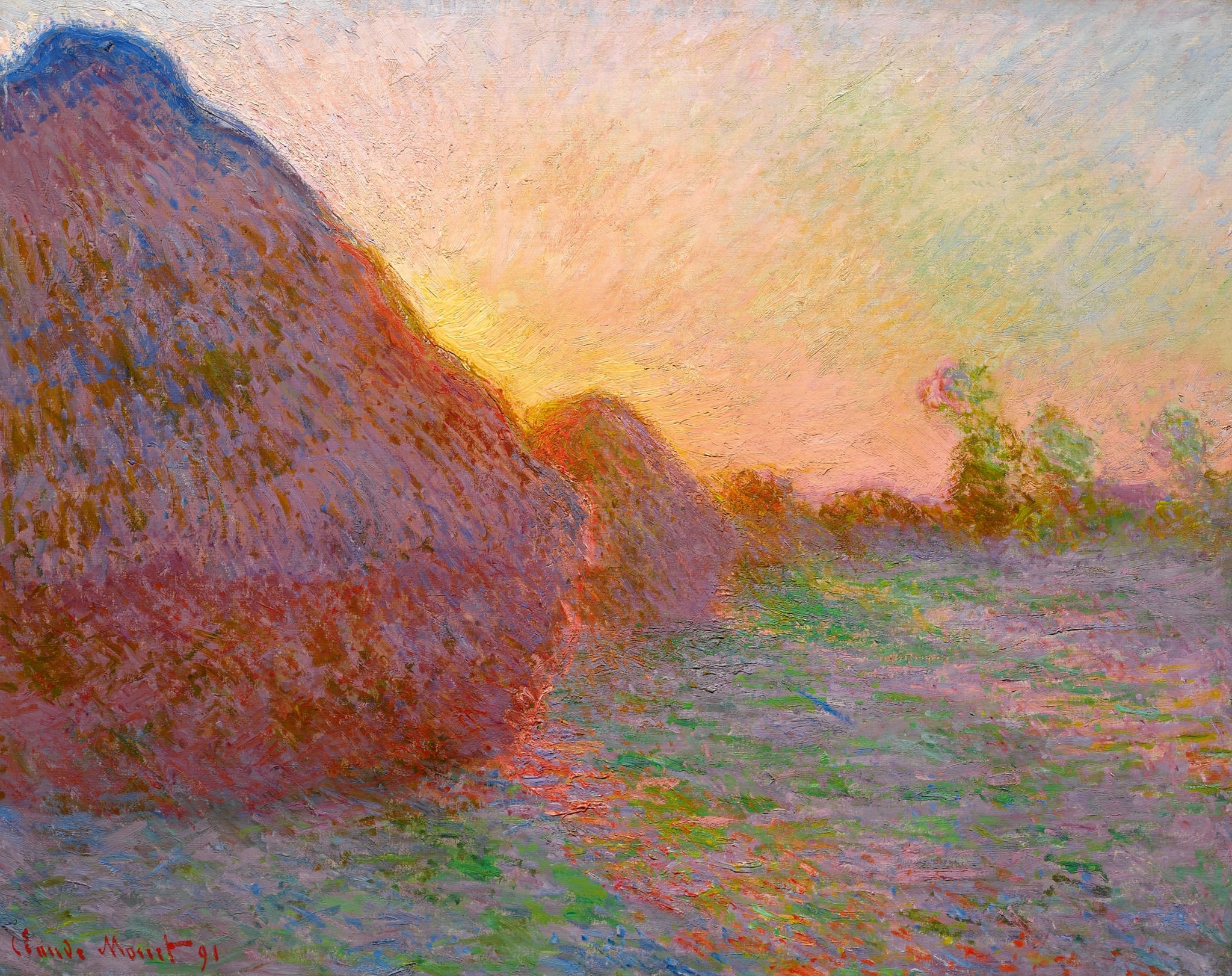
Haystacks Series by Claude Monet | Light, Time & Atmosphere by Claude Monet

Haystacks Series by Claude Monet | Light, Time & Atmosphere

Claude Monet

Claude Monet’s <strong>Haystacks Series</strong> transforms a routine rural subject into an inquiry into <strong>light, time, and perception</strong>. In this sunset view, the stacks swell at the left while the sun burns through the gap, making the field shimmer with <strong>apricot, lilac, and blue</strong> vibrations.
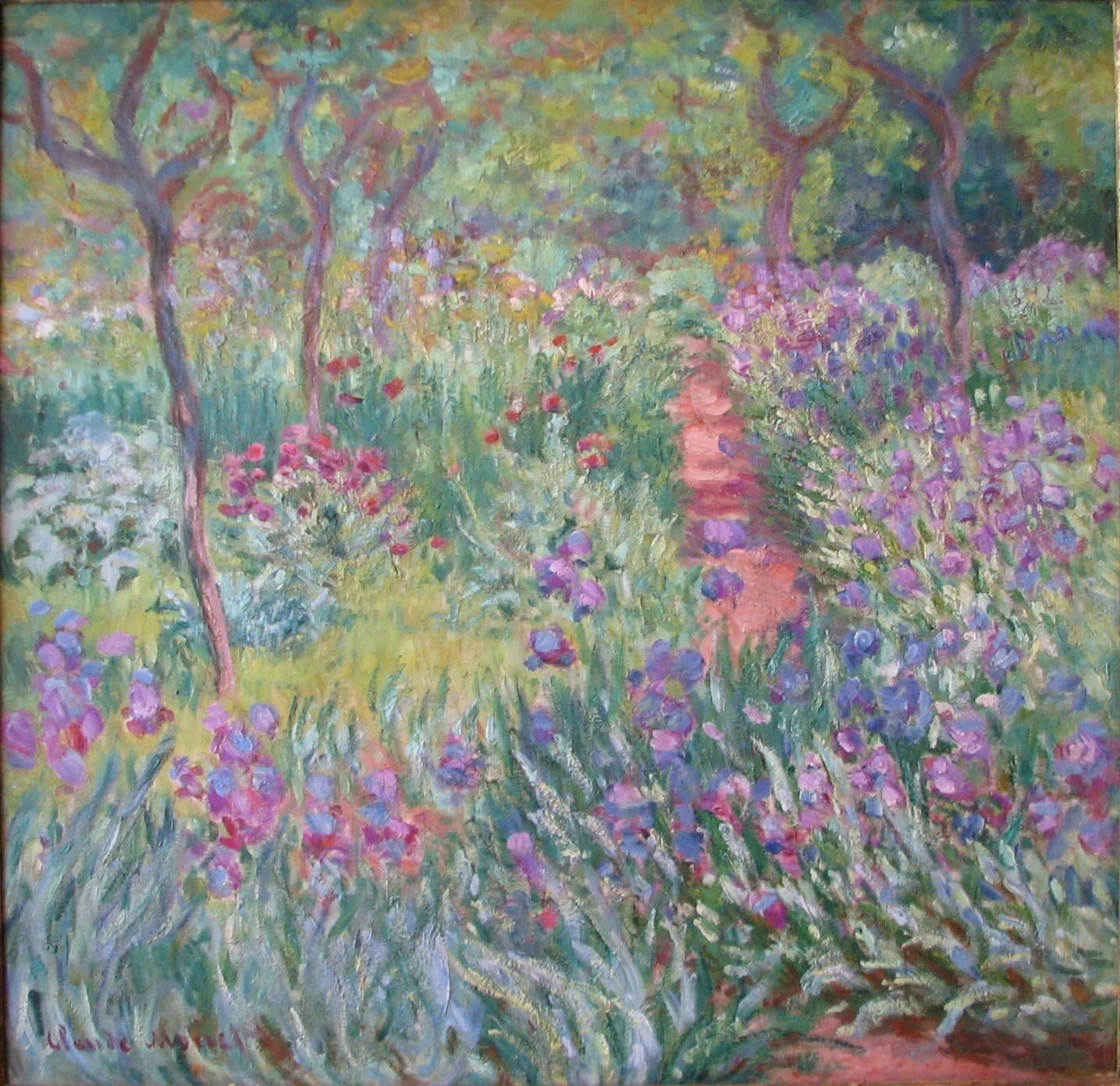
The Artist's Garden at Giverny by Claude Monet

The Artist's Garden at Giverny

Claude Monet (1900)

In The Artist's Garden at Giverny, Claude Monet turns his cultivated Clos Normand into a field of living color, where bands of violet <strong>irises</strong> surge toward a narrow, rose‑colored path. Broken, flickering strokes let greens, purples, and pinks mix optically so that light seems to tremble across the scene, while lilac‑toned tree trunks rhythmically guide the gaze inward <sup>[1]</sup><sup>[3]</sup>.
The Water Lily Pond by Claude Monet

The Water Lily Pond

Claude Monet (1899)

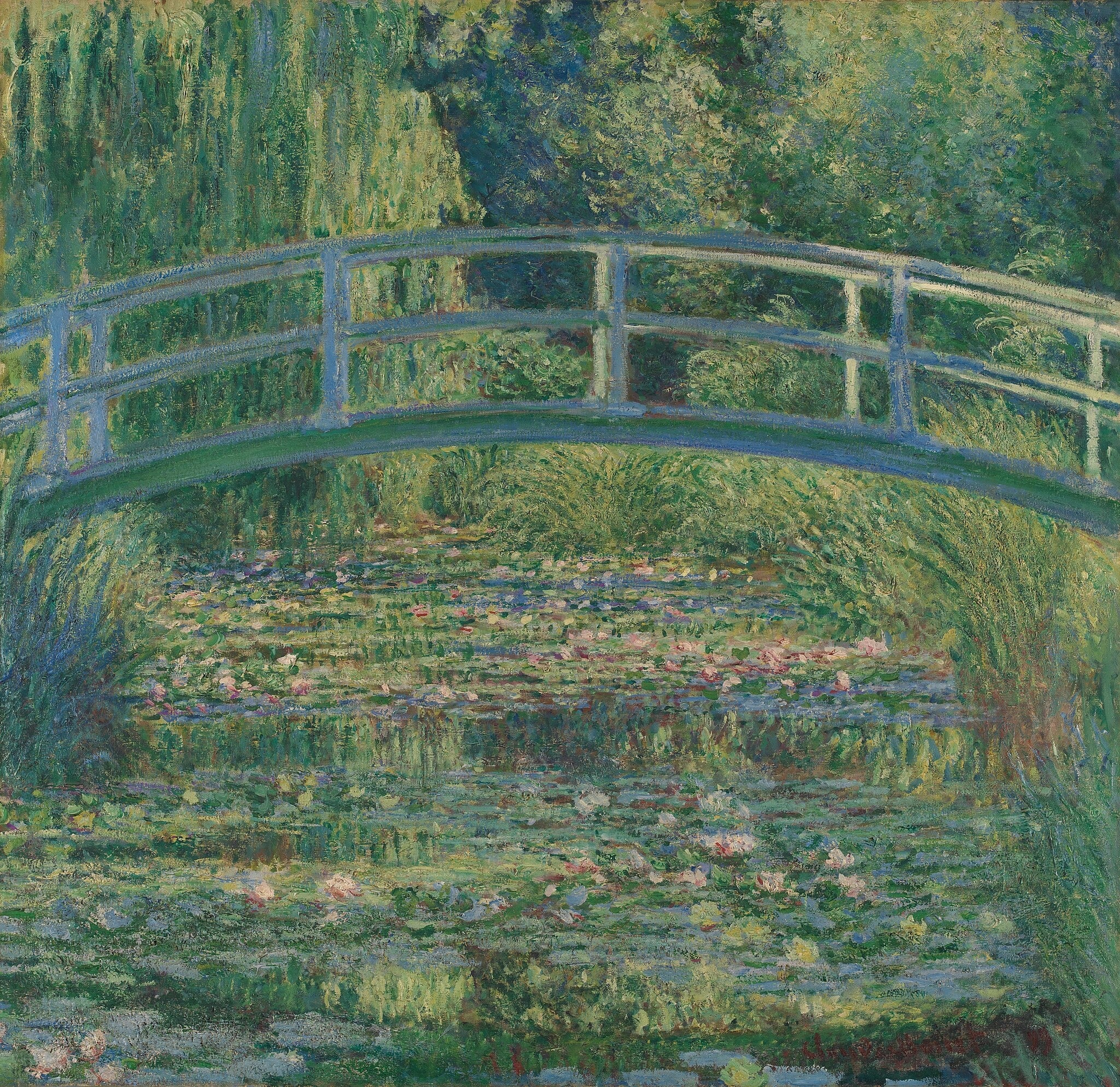
Claude Monet’s The Water Lily Pond transforms a designed garden into a theater of <strong>perception and reflection</strong>. The pale, arched <strong>Japanese bridge</strong> hovers over a surface where lilies, reeds, and mirrored willow fronds dissolve boundaries between water and sky, proposing <strong>seeing itself</strong> as the subject <sup>[1]</sup><sup>[3]</sup>.

Waterloo Bridge, Sunlight Effect by Claude Monet

Waterloo Bridge, Sunlight Effect

Claude Monet (1903 (begun 1900))

Claude Monet’s Waterloo Bridge, Sunlight Effect renders London as a <strong>lilac-blue atmosphere</strong> where form yields to light. The bridge’s stone arches persist as anchors, yet the span dissolves into mist while <strong>flecks of lemon and ember</strong> signal modern traffic crossing a city made weightless <sup>[1]</sup><sup>[2]</sup>. Vertical hints of chimneys haunt the distance, binding industry to beauty as the Thames shimmers with the same notes as the sky <sup>[1]</sup><sup>[3]</sup>.

Morning on the Seine (series) by Claude Monet

Morning on the Seine (series)

Claude Monet (1897)

Claude Monet’s Morning on the Seine (series) turns dawn into an inquiry about <strong>perception</strong> and <strong>time</strong>. In this canvas, the left bank’s shadowed foliage dissolves into lavender mist while a pale radiance opens at right, fusing sky and water into a single, reflective field <sup>[1]</sup><sup>[2]</sup>.

Woman with a Parasol by Claude Monet

Woman with a Parasol

Claude Monet (1875)

Claude Monet’s Woman with a Parasol fixes a breezy hillside instant in high, shifting light, setting a figure beneath a <strong>green parasol</strong> against a vast, vibrating sky. The low vantage and <strong>broken brushwork</strong> merge dress, clouds, and grasses into one atmosphere, while a child at the rise anchors depth and intimacy <sup>[1]</sup>. It is a manifesto of <strong>plein-air</strong> perception—painting the sensation of air in motion rather than the contours of things <sup>[2]</sup>.