The Beach at Sainte-Adresse

by Claude Monet

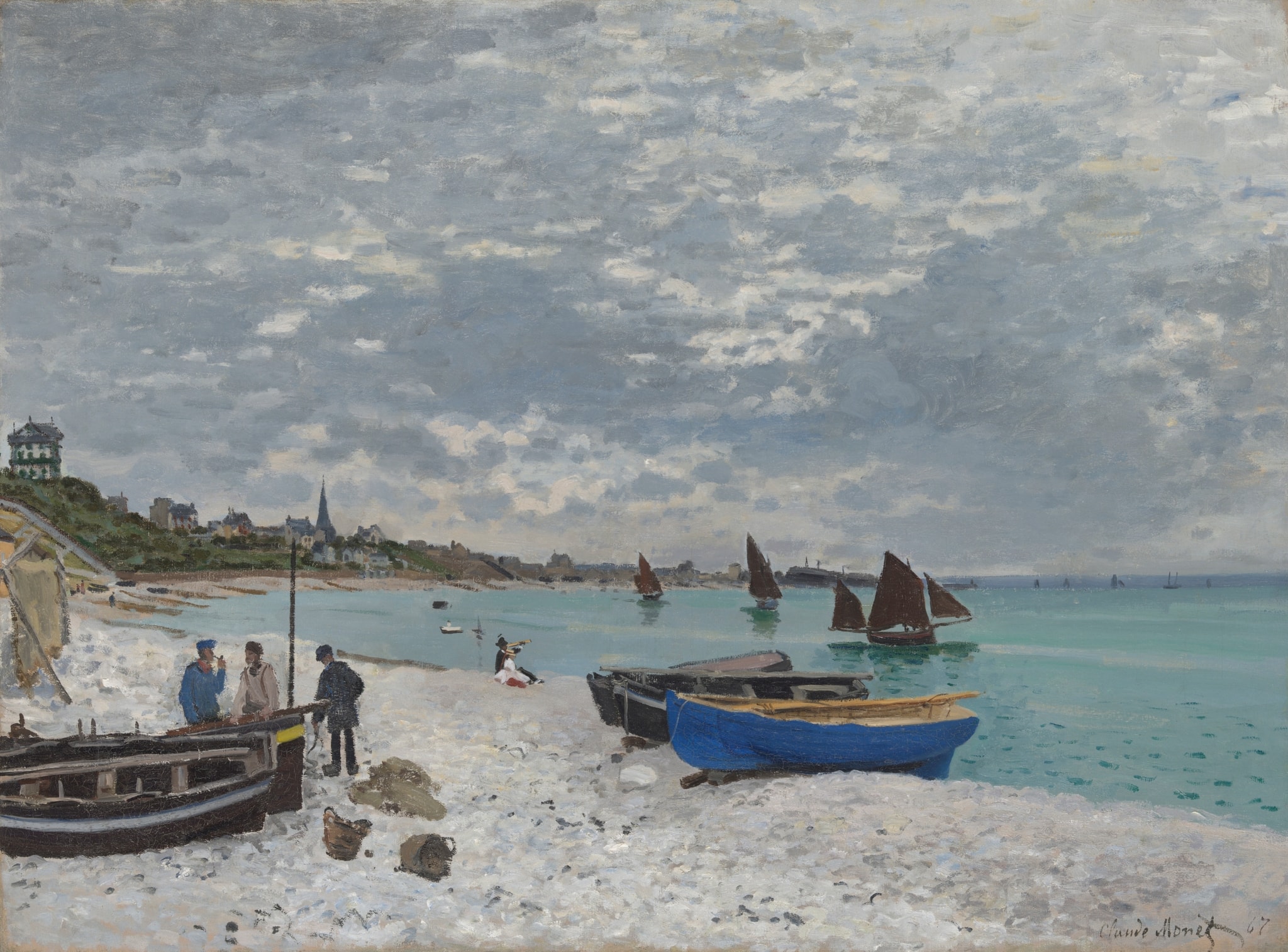
In The Beach at Sainte-Adresse, Claude Monet stages a modern shore where labor and leisure intersect under a broad, changeable sky. The bright blue beached boat and the flotilla of rust-brown working sails punctuate a turquoise channel, while a fashionably dressed pair sits mid-beach, spectators to the traffic of the port. Monet’s brisk, broken strokes make the scene feel caught between tides and weather, a momentary balance of work, tourism, and atmosphere [1][2].

Fast Facts

Year
1867
Medium
Oil on canvas
Dimensions
75.8 × 102.5 cm
Location
Art Institute of Chicago, Chicago
The Beach at Sainte-Adresse by Claude Monet (1867) featuring Blue beached boat, Rust-brown working sails, Seated woman in white (tourist gaze), Fishermen with gear (nets/baskets)

Click on any numbered symbol to learn more about its meaning

Meaning & Symbolism

Monet composes the shore as a social cross-section. At the left, three men cluster beside a stripped-down working boat and coiled nets; at mid-beach, a seated woman in a crisp white dress and a companion in dark attire face the water, the very picture of the new tourist gaze; across the channel, small craft fly brown and ochre sails, a conventional code for working boats rather than luxury yachts. These signals align the painting with a world where the beach is simultaneously a site of labor and a promenade of leisure. The bright blue hull in the foreground acts as a visual anchor, its saturated color insisting on present-tense vitality amid the pale shingle and mutable sea. Above, a vast, mottled sky—brushed in quick, broken notes—dwarfs figures and buildings, making human traffic feel provisional under the weather’s scale. Monet’s facture turns clouds and chop into flickering, momentary sensations, embodying an ethics of seeing that would define Impressionism 12. The narrative is modern not just in subject but in construction. Technical study shows Monet began the canvas outdoors and later painted out white-sailed yachts and additional tourist figures, replacing them with working craft and streamlining the group on the left 2. That revision shifts the emphasis from spectacle to livelihood, complicating the oft-cited pairing with the Met’s Regatta at Sainte-Adresse, where high tide, white sails, and sun privilege bourgeois leisure 3. Here, low tide exposes pebbled ground; boats are hauled up and propped; baskets sit in the foreground like commas in a sentence of work. Yet Monet refuses a polemic. He keeps the seated couple at center—she in white, he poised to look seaward—so that the painting holds a tensile equilibrium: looking and doing, leisure and necessity. In this balance, the sails become moving indicators of economic rhythms, and the sky’s unsettled light becomes a metaphor for temporal flux—weather shifts, market shifts, social shifts—defining the Normandy coast as a stage of modernity 24. Crucially, Monet’s pictorial strategy makes meaning without pedantry. The triangulated rhyme between the church spire on the distant ridge and the tacking sails folds tradition into the present, while the long, low horizon opens a democratic field where small actions register against a monumental atmosphere. The turquoise banding of the channel and the scatter of dark hulls guide the eye laterally, like reading traffic across a timetable; the painting depicts not an anecdote but a system—a port ecology in motion. That systemic vision explains why The Beach at Sainte-Adresse is important: it is an early, authoritative statement of how painting could register modern life as environment, binding social codes, technology, and fugitive light into a single, felt experience—an achievement affirmed by its later inclusion in the Second Impressionist Exhibition of 1876 12.

Explore Deeper with AI

Ask questions about The Beach at Sainte-Adresse

Popular questions:

Powered by AI • Get instant insights about this artwork

💬 Ask questions about this artwork!

Interpretations

Technical Process & Revision

Conservation imaging shows Monet began en plein air but later recomposed the social script in the studio: he painted out white-sailed yachts and additional tourists, substituting working craft and tightening the group at left. This is not mere cleanup but a change in sign-system: sail color, figure count, and boat types recalibrate the beach from spectacle toward livelihood. The finding complicates neat diptych readings with the Met’s leisure-focused Regatta. Instead of a fixed program, we see Monet negotiating meaning as he paints—testing how much bourgeois display the canvas will bear, then modulating it to stress the port’s economic life. Technique becomes argument: revision is interpretation by pigment, a proto-Impressionist embrace of painting as an evolving, contingent construct 23.

Source: Art Institute of Chicago (Online Scholarly Catalogue); The Metropolitan Museum of Art

Tourism, the Gaze, and Modern Seeing

The seated woman in a crisp dress and her companion with a telescope are not anecdotal staffage; they articulate the tourist gaze that the railway made possible along the Normandy coast. As Robert L. Herbert argues, such beaches became laboratories where artists tested how modern spectatorship reorders the shore’s meanings. In Monet’s staging, the couple faces the channel—consuming labor as view—while workers flank the canvas edge. The painting therefore performs a double optics: one for those who look (the visitors) and one for those looked at (the crews). This visual economy turns the beach into a market of attention, aligning with broader transformations in leisure, mobility, and pictorial address in the late 1860s 14.

Source: Robert L. Herbert; Art Institute of Chicago

Maritime Semiotics: Reading Sails and Hulls

Monet leverages a coastal codebook: brown and ochre sails index working boats; high, white sails connote yacht culture. By swapping in the former, he saturates the horizon with signals of labor time rather than festive regatta time. Hull angles, propped keels, and foreground baskets behave like punctuation, scanding the beach into units of task and pause. This semiotic approach makes the composition legible as a port system—boats launching, tacking, returning—rather than a single episode. The result is a picture you “read” laterally, akin to following a timetable, where each sail’s tint and trajectory registers position within a maritime economy more than within a narrative anecdote 245.

Source: Art Institute of Chicago (Online Scholarly Catalogue); Robert L. Herbert; Royal Academy, Impressionists by the Sea

Atmosphere as Timekeeper

Low tide exposes shingle, boats are hauled up and propped, and the sky breaks into quick, particulate marks—Monet’s facture turns weather into a timekeeping device. Rather than depicting a fixed moment, the brushwork models how conditions pass: tides cycle, light veers, wind shifts. This meteorological emphasis is not decorative; it aligns with Monet’s early commitment to serial perception that would define Impressionism. In Sainte-Adresse, the atmosphere mediates between economic and social clocks—the workday, the pleasure outing, the shipping schedule—binding them into a shared field of temporal contingency. Painting thus measures the day as much as it represents it 124.

Source: Art Institute of Chicago; Robert L. Herbert

Tradition Folded into Modernity

The distant church spire rhymes with the tacking sails, yoking a traditional vertical to modern, mobile triangles. This quiet triangulation does ideological work: it neither repudiates the past nor sacralizes the present. Instead, it folds heritage into circulation, letting inherited symbols coexist with commercial traffic and touristic viewing. The long, low horizon democratizes the field so minor actions—coiling rope, scanning with a telescope—register against a monumental atmosphere. Such compositional diplomacy helps explain the painting’s later inclusion in the Second Impressionist Exhibition: it models how a modern picture can absorb religion, labor, leisure, and weather without didacticism, achieving coherence through structure and light rather than program 12.

Source: Art Institute of Chicago

Related Themes

About Claude Monet

Claude Monet (1840–1926) led Impressionism’s pursuit of open-air painting and optical immediacy, especially during his Argenteuil years focused on modern leisure and light. He later developed serial studies of changing conditions, culminating in the Water Lilies cycle [2].
View all works by Claude Monet

More by Claude Monet

La Japonaise (Camille Monet in Japanese Costume) by Claude Monet

La Japonaise (Camille Monet in Japanese Costume)

Claude Monet (1876)

Claude Monet’s La Japonaise (Camille Monet in Japanese Costume) (1876) stages a witty confrontation between <strong>Parisian modernity</strong> and the fashion for <strong>Japonisme</strong>. A fair-skinned model in a blazing red uchikake preens before a wall tiled with uchiwa fans, lifting a <strong>tricolor</strong> hand fan that asserts Frenchness amid the imported decor. The painting turns costume, props, and gaze into a performance about <strong>desire, display, and identity</strong> <sup>[1]</sup><sup>[2]</sup>.

Boating by Claude Monet

Boating

Claude Monet (1887)

Monet’s Boating crystallizes modern leisure as a drama of perception, setting a slim skiff and two pale dresses against a field of dark, mobile water. Bold cropping, a thrusting oar, and the complementary flash of hull and foliage convert a quiet outing into an experiment in <strong>modern vision</strong> and the <strong>materiality of water</strong> <sup>[1]</sup><sup>[2]</sup>.

The Thames below Westminster by Claude Monet

The Thames below Westminster

Claude Monet (about 1871)

Claude Monet’s The Thames below Westminster turns London into <strong>light-made architecture</strong>, where Parliament’s mass dissolves into mist and the river shivers with <strong>industrial motion</strong>. Tugboats, a timber jetty with workers, and the rebuilt Westminster Bridge assert a modern city whose power is felt through atmosphere more than outline <sup>[1]</sup>.

Haystacks Series by Claude Monet | Light, Time & Atmosphere by Claude Monet

Haystacks Series by Claude Monet | Light, Time & Atmosphere

Claude Monet

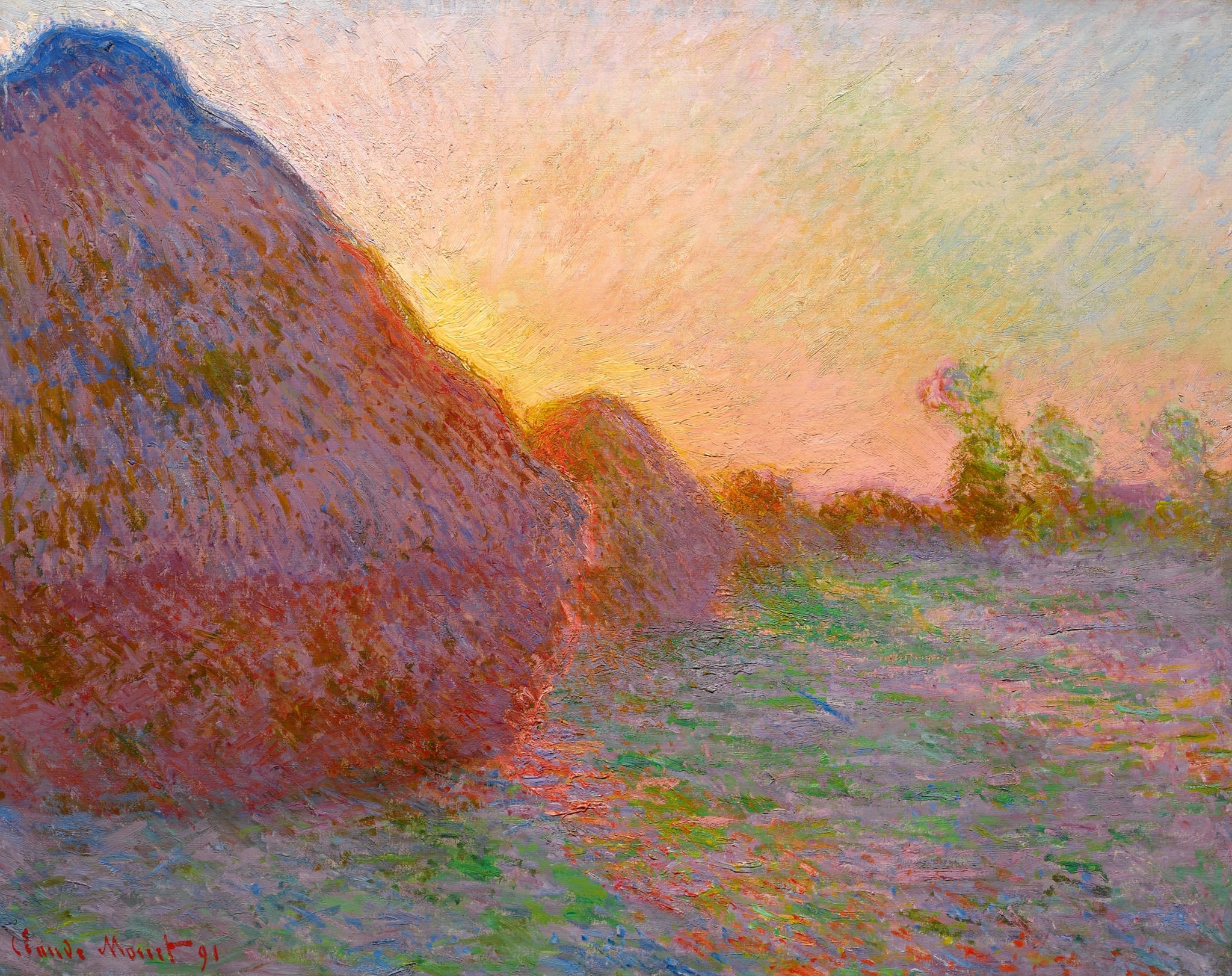
Claude Monet’s <strong>Haystacks Series</strong> transforms a routine rural subject into an inquiry into <strong>light, time, and perception</strong>. In this sunset view, the stacks swell at the left while the sun burns through the gap, making the field shimmer with <strong>apricot, lilac, and blue</strong> vibrations.
Women in the Garden by Claude Monet

Women in the Garden

Claude Monet (1866–1867)

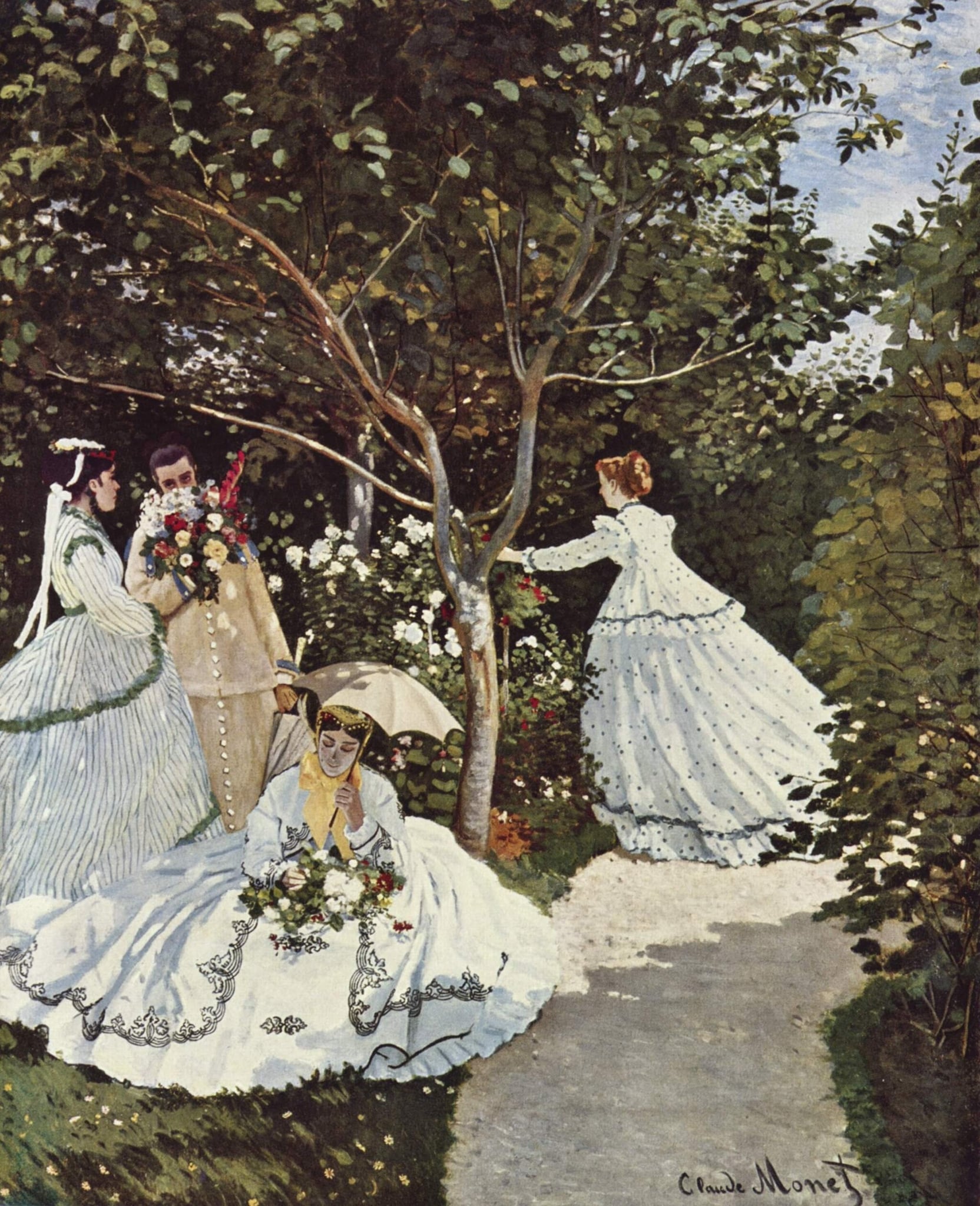
Claude Monet’s Women in the Garden choreographs four figures in a sunlit bower to test how <strong>white dresses</strong> register <strong>dappled light</strong> and shadow. The path, parasol, and clipped flowers frame a modern ritual of leisure while turning fashion into an instrument of <strong>perception</strong>. The scene reads less as portraiture than as a manifesto for painting the <strong>momentary</strong> outdoors <sup>[1]</sup><sup>[3]</sup>.
Impression, Sunrise by Claude Monet

Impression, Sunrise

Claude Monet (1872)

In Impression, Sunrise, Claude Monet turns Le Havre’s fog-bound harbor into an experiment in <strong>immediacy</strong> and <strong>modernity</strong>. Cool blue-greens dissolve cranes, masts, and smoke, while a small skiff cuts the water beneath a blazing, <strong>equiluminant</strong> orange sun whose vertical reflection stitches the scene together <sup>[1]</sup><sup>[3]</sup>. The effect is a poised dawn where industry meets nature, a quiet <strong>awakening</strong> rendered through light rather than line.